
11
Tannenberg vindicated the union in spectacular fashion. Lithuania had for years fought a rearguard action against the Order. Raids had become frequent and dangerous, while the Order’s exploitation of divisions among the Gediminids had prolonged the political disunity endemic since 1377. Only Polish aid could break the vicious circle; Tannenberg and the return of Samogitia, albeit only temporarily, demonstrated what might be achieved. For the Poles, accustomed to peace with the Order at the price of accepting the loss of Pomerelia, Tannenberg encouraged hopes that, in due course, it might be recovered.
The anticlimactic campaign that followed, and the deflating peace of Thorn demonstrated that the Order was far from broken, and that hopes for the recovery of Pomerelia and Samogitia’s permanent return were premature, given the Order’s standing within the Catholic world. Subject to both pope and emperor, it was unlikely that it would regard the peace as final.1 Plauen was determined on revenge. He urged the pope to declare a crusade against Vytautas, claiming that Lithuania was still pagan, that Jagiełło’s conversion was cosmetic, and attacking him for deploying pagans, schismatics, and infidels at Tannenberg.2
The diplomatic context worked, however, to Poland-Lithuania’s advantage. Sigismund of Luxembourg had favoured the Order since his humiliating rejection by the Poles in 1382. Now, however, he was promoting the idea of a general council of the church in Constance as a means of ending the papal schism. Sigismund needed the support of as many Catholic powers as possible; he therefore had an interest in tempering his hostility to Poland, whose support was also important for the realization of his vision of a Catholic Europe united against the Ottoman threat. This opportunity was too good to miss. The Order’s defeat had weakened it considerably as a political partner, while war against a resurgent Poland was not in Sigismund’s interests. He was distracted by the turbulent politics of the Empire following his failure to be elected king of the Romans in 1410, and concerned at Jagiełło’s construction of an anti-Luxembourg front with Moldavia, Venice, and Leopold IV of Further Austria, younger brother of Jadwiga’s ill-starred fiancé William von Habsburg. Sigismund was forced to backtrack, offering a tentative rapprochement to the Poles, which brought Jagiełło to Lubovňa in the spring of 1412 where a Polish-Hungarian alliance, known in Poland as the treaty of Lubowla, was signed on 15 March. The terms were not particularly favourable to Poland, not least because they raised the spectre of Hungarian claims to Red Ruthenia, which was to remain a Polish possession until five years after the death of one of the two monarchs, at which point a commission of representatives from both nations would decide its ultimate fate.3
Jagiełło also accepted Sigismund’s offer of mediation with the Order, as bitter wrangling demonstrated that the Thorn treaty had done little to advance the cause of permanent peace. Mediation began in Buda in the summer, and continued in Kaunas in January 1413. It soon became clear that a final settlement was unlikely. The Order presented a carefully prepared case to support its permanent possession of Samogitia, claiming that the continuing attachment of the Samogitians to paganism gave it the right to rule over them, and cited the Salin and Raciążek treaties, producing the ratifications signed by Jagiełło and Vytautas. The union negotiators took a radical approach. They argued that no prince had ruled over the Samogitians until they had voluntarily accepted the cousins’ joint overlordship. As a free people, they would recognize their rule as long as they chose, but Jagiełło and Vytautas did not have the right to alienate Samogitian land without consent. If the Samogitians did not wish to continue under their rule, they were free to choose another prince.4
This was radical indeed; that this line of argument was clearly sanctioned by Jagiełło and Vytautas indicates not only the importance they accorded Samogitia, but also that they were thinking deeply about the nature of the composite system over which they presided. They were already consulting over a major restatement of the nature of the union that reached fruition in a treaty formally promulgated on 2 October 1413 at Horodło on the river Bug in southeast Poland. That the deteriorating relations with the Order and the failure of mediation played a large part in the preparation of this new union treaty is clear. The talks merely sharpened mutual antagonisms and the propaganda war. Although mediation dragged on into 1414, both sides talked openly of war. Plauen’s replacement by the less bellicose Küchmeister in October 1413 made no difference.5 It was imperative that the new unity that had brought the great victory at Tannenberg was sustained and deepened as both sides prepared to present their case before the whole of Latin Christendom at Constance.
This motive was explicitly acknowledged in the first article of the Horodło Union of 2 October 1413, which expressed the desire that:
the . . . lands of Lithuania, ravaged by the hostile and insidious acts of the Order and its allies . . . who wish to destroy these lands of Lithuania and . . . Poland, . . . be brought into safety, security, and protection, and that their prosperity be established in perpetuity.6
There was, however, far more behind Horodło than the desire to present a united front. It comprised three documents.7 The most important was issued jointly by Jagiełło and Vytautas. Vytautas was officially accorded the title ‘grand duke of Lithuania’, and, on a par with Jagiełło, that of ‘lord and inheritor of the Ruthenian lands’.8 Vytautas had first used the title ‘grand duke’ in 1392 in Ruthenian documents; from 1395 he used it in German.9 Jagiełło did not recognize it at Vilnius-Radom, but allowed its use at Thorn in 1411. The formal raising of Vytautas’s status was not just a message to the outside world; it reflected the close cooperation of the cousins since 1408, and their role in the preparation of the Horodło documents, which were discussed at a long meeting at Hrubieszów in September 1412, at a Polish assembly at Niepołomice in November, and in a long consultation with Vytautas in Lithuania.10 This careful preparation was necessary for the new approach to the relationship between Poland and Lithuania that was outlined in what has been called the union’s ‘first full constitution’ (see Fig. 5).11
Its preamble stressed the union’s achievement in bringing Lithuania into the Catholic fold and freeing it from the ‘yoke of servitude’. The first article stressed the benefits of Lithuania’s conversion to Christianity, ‘through the breath of the Holy Spirit’, and explained the meaning of Krewo, amplifying the controversial term ‘applicare’ with a string of synonyms, firstly in the perfect tense, to stress that Jagiełło’s Lithuanian and Ruthenian lands had indeed been incorporated, and then in the present tense to indicate that they were being reincorporated:
Et primo, quamvis eo tempore quo almo Spiritu inspirante fidei catholicae recepta et cognita claritate, coronam regni Poloniae assumpsimus pro Christianae religionis incremento, et bono statu et commodo terrarum nostrarum Lyttwaniae praedictarum ipsas et cum terris ac dominiis ipsis subiectis et connexis praefato regno nostro Poloniae appropriavimus, incorporavimus, coniunximus, univimus, adiunximus, confoederavimus de consensu unanimi nostro et aliorum fratrum nostrorum et omnium baronum, nobilium, procerum et boyarorum eiusdem terrae Lyttwaniae voluntate accedente et assensu . . . easdem terras, quas semper cum pleno dominio ac iure mero et mixto hactenus habuimus et habemus usquemodo a progenitoribus nostris et ordine geniturae tamquam domini legitimi, baronum, nobilium, boyarorum voluntate, ratihabitione et consensu adhibitis, praedicto regno Poloniae iterum et de novo incorporamus, invisceramus, appropriamus, coniungimus, adiungimus, confoederamus et perpetue anectimus, decernentes ipsas cum omnibus earum dominiis, terris, ducatibus, principatibus, districtibus, proprietatibus omnique iure mero et mixto coronae regni Poloniae perpetuis temporibus irrevocabiliter et irrefregabiliter semper esse unitas.12
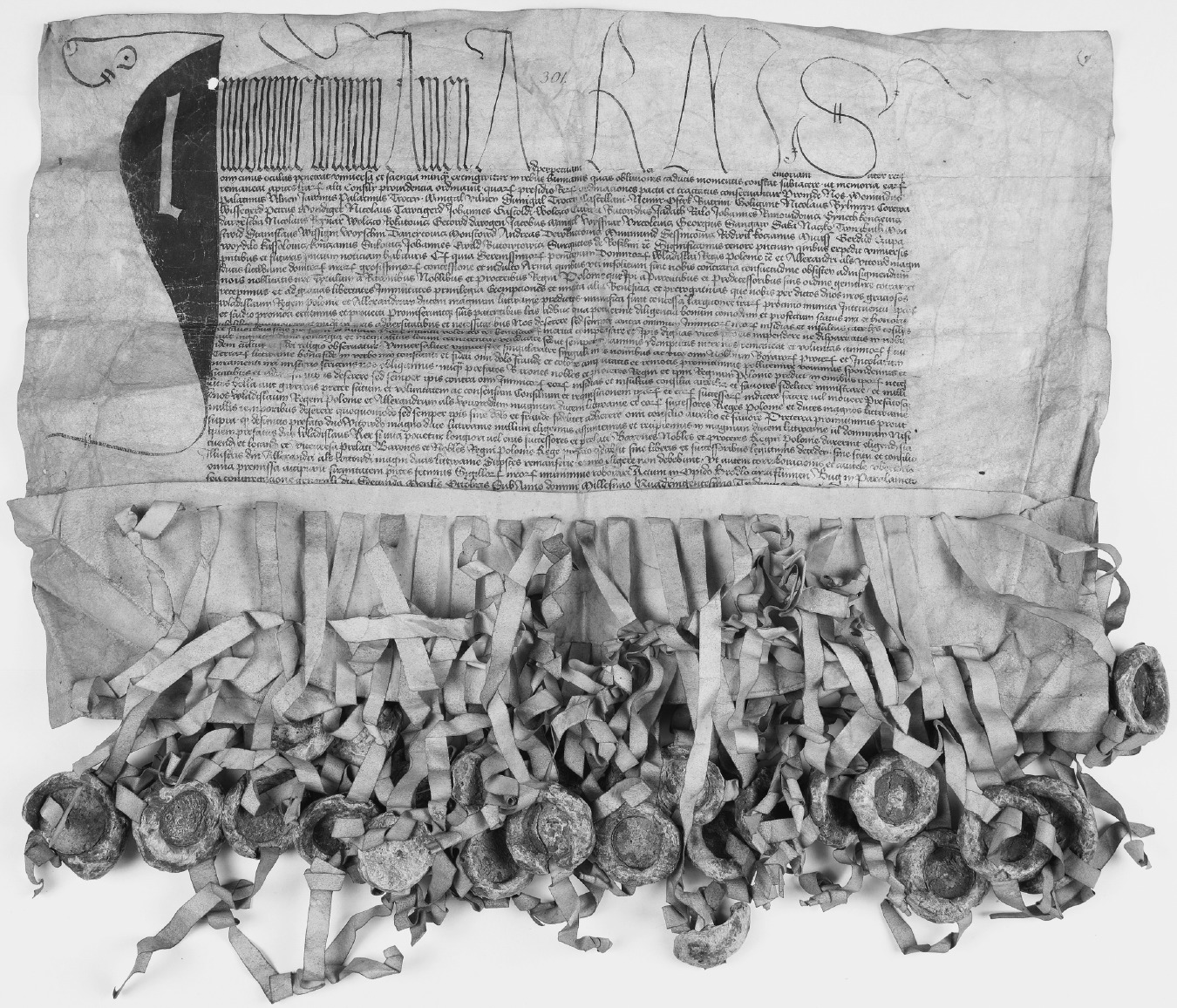
Fig. 5. The Union of Horodło (1413). Władysław Jagiełło, King of Poland and Supreme Duke of Lithuania, together with Vytautas, Grand Duke of Lithuania, establish the character of the union between the Kingdom of Poland and the Grand Duchy of Lithuania, Horodło, 2 October 1413. Latin, parchment, 650mm × 370mm. Biblioteka Książąt Czartoryskich, Cracow, perg. 301. By kind permission of the Fundacja Książąt Czartoryskich.
Despite this impressive concatenation of synonyms, historians have denied that Horodło sealed Lithuania’s incorporation, on account of subsequent clauses which, they claim, render this clause meaningless. Most importantly, in a startling departure from Vilnius-Radom, provision was made for the election of a new grand duke following Vytautas’s death, although it was stipulated that should such an election take place, the Lithuanian ‘barons and nobles’ would only choose a candidate ‘elected, designated, and agreed’ by Jagiełło or his successors, and the ‘prelates and barons’ of the kingdom of Poland. In return it was promised that, should Jagiełło die without a legitimate heir, Poland would not elect a successor without the knowledge and consent of Vytautas and the Lithuanian ‘barons and nobles’.13
It is striking that Jagiełło permitted Vytautas to be designated ‘grand prince and lord’ (magnus princeps et dominus). Yet the document’s real significance was that the government of Lithuania was no longer conceived simply in terms of the dynasty and the grand duke. Clause ten instituted new offices of palatine and castellan on the Polish model for Vilnius and Trakai, with provision made for their establishment elsewhere should the need arise.14 The creation of a new governing structure based on the devolved local offices that enjoyed considerable powers in Poland, together with the institutionalization of the office of grand duke, has seemed to many historians to have confirmed the existence of a separate Lithuanian state and to have rendered irrelevant the first clause’s incorporationist rhetoric.15
Historians have therefore tended to dismiss Horodło’s first clause, suggesting that, as Jagiełło prepared to defend the war against the Order at Constance, it was directed at an international audience and was intended merely as a public statement of unity in the face of the Order’s attempts to deny the reality of the union and to drive a wedge between Poland and Lithuania. Its purpose was to depict Poland and Lithuania ‘as one state’, even though this did not accord with reality.16 Łowmiański claimed that the clause hid Horodło’s true meaning; Kutrzeba, who believed that Lithuania had been incorporated in 1386, but that the incorporation had been reversed in 1392 and 1401, argued that Horodło did not effect incorporation, since throughout the rest of the document Lithuania was treated as a separate state, not as a province incorporated into Poland, adding that under Vytautas Lithuania was a great power that conducted an independent foreign policy. Only Kolankowski, the most determined adherent of the incorporation thesis, took clause one seriously, regarding it as the heart of the document.17 Lithuanian historians emphasize Lithuania’s independent statehood after 1413, as do Liubavskii—although he stresses Jagiełło’s ultimate suzerainty—Hrushevsky, and other historians of the Ruthenian lands.18 Rowell suggests that the incorporation was a ‘clever dynastic ploy’ aimed at undermining the Order’s claims, adding that Horodło was more like an agreement between states in its form, a view shared by Rabiej and Kiaupienė.19 Błaszczyk holds to the consensus that the apparent contradiction between the incorporation stressed so pedantically in article one and the rest of the document lies only on the surface, since clause one was intended exclusively for external consumption. Although he maintains that Horodło was the most significant union treaty between 1386 and 1569, he concludes that its importance should not be exaggerated.20
As the frequent citation of Horodło in subsequent disputes between Poles and Lithuanians demonstrates, contemporaries did not share the belief of these historians that article one had no significance for the union’s internal politics. Długosz, reflecting widespread Polish opinion, had no doubts, stating baldly that Lithuania and Samogitia had been incorporated, annexed, and inviscerated.21 His phraseology is significant. He talks of incorporation into the kingdom, but stresses that the union was one not of states, but of peoples: ‘populos Polonicos cum Lithuanicis et Samagiticis’.22 Yet historians continue overwhelmingly to follow Balzer, who in 1913 concluded: ‘to use modern terms, one can state that the Horodło union embodied the constitutional confirmation of Lithuania’s independent statehood’.23
Balzer’s phrasing suggests that he was aware that modern terms might not be appropriate, but most historians express no such reservations, concluding that Horodło’s most important feature was its affirmation of an independent Lithuanian state, and that therefore, to use terms even less carefully, ‘Lithuania’ could not have been incorporated into ‘Poland’.24 Such language reflects the concerns of the twentieth century, not the fifteenth. Horodło is significant because of the light it sheds on the thinking of those involved in forming and defining the nature of the union, and because it, for the first time, asserted a vision of what the union might become that was to influence the whole process of union down to 1569. Looked at on its own terms, not only can it be seen as internally consistent, but also as broadly consistent with Krewo and Vilnius-Radom. Horodło represented a stage in the evolution of a complex political relationship, and the first comprehensive attempt to define what union signified. It was neither a new beginning, nor a radical revision of the original union, nor the complete change of direction as which it is conventionally portrayed.
Długosz’s evaluation and the position maintained by Polish statesmen after 1413 call fundamentally into question the consensus that Horodło embodied a simple personal or dynastic union that was, moreover, looser than other personal unions in contemporary Europe because of its institutionalization of the office of a separate grand duke.25 It was far more than simply a dynastic arrangement agreed between Jagiełło and Vytautas, or a mere extension of Vilnius-Radom. In conception and in form it reflected the interests of the two political communities it sought to bring together, and with whom it was discussed, at Niepołomice in November 1412, in Lithuania in December, and at Horodło itself, where the Polish and Lithuanian nobles present debated its terms in separate assemblies, before agreeing to separate documents in which the two political communities formally endorsed the act presented by Jagiełło and Vytautas.26
The documents devoted considerable attention to those political communities and their future relationship. Clauses 2–7 of the principal document amplified and defined the general liberties of the Lithuanian church and the Catholic Lithuanian lords and boyars. Henceforth, the Lithuanian church and nobility were to enjoy the ancient rights and liberties of their Polish partners (iuxta consuetudinem regni Poloniae ab antiquo observatum). These clauses established the right to bequeath allodial estates, security of tenure for hereditary lands, and the rights of wives and daughters to a portion of the family’s estates. Finally, Catholic nobles were exempted from labour service for the construction and repair of fortresses.27
After clauses demanding that Polish and Lithuanian nobles swore oaths to Jagiełło and Vytautas, and stipulating that those who enjoyed these privileges were obliged to show them loyalty, provision was made in clause 15 for future assemblies (conventiones et parlamenta) of the Polish and Lithuanian nobilities in the border cities of Lublin or Parczew—or another appropriate location—to discuss matters of common interest.28 Then, in the most remarkable clause in the document, provision was made for forty-seven families of Catholic Lithuanian lords and boyars, selected by Vytautas, to be adopted by forty-seven Polish szlachta families. They were thereby admitted to the heraldic clans of these families, who were henceforth to regard them as brothers and relations:
We Alexander, alias Vytautas, with the consent of his most serene highness Władysław king of Poland . . . elect to the arms and honours of the nobility of the kingdom of Poland the nobles herein listed of our lands of Lithuania, whom, together with all those who derive their origin from the same lineage, the nobles of this kingdom of Poland welcome into the fellowship of brotherhood and consanguinity.29
This clause, sworn to and attested separately by the Poles and Lithuanians, marked a watershed in the formation of the Lithuanian nobility as an estate.30 All forty-seven Lithuanian nobles and forty-five of the Polish families involved are known through their seals.31 The adoption has occasioned much debate. Some Lithuanian scholars have presented it as a subtle change of strategy by the Poles: unable to effect incorporation, they deviously sought to achieve it by indirect means, through the gradual assimilation and polonization of the Lithuanian ruling classes.32 Others have dismissed it on the grounds that it was hastily put together, and had little practical effect: the adoption did not lead to any close contact between the Polish and Lithuanian families listed, beyond the adoption of Polish coats-of-arms, which some Lithuanian families later abandoned.33
While the practical impact of the clause was slight, at least in the short term, it is the thinking behind it that is significant. For if Horodło was undoubtedly drafted with one eye on the propaganda war with the Order, its main motivation was domestic. After twenty-seven years much had been learned about how in practice union might work, not least through the success of Vilnius-Radom, which, through providing a clear framework for Vytautas’s rule in Lithuania, laid the foundations for the closer cooperation that had led to Tannenberg. Confident that the exercise of power by a separate grand duke did not necessarily weaken the union, Jagiełło agreed to the possible continuation of the arrangement after Vytautas’s death. Yet the core of the Horodło union was not concerned with practical arrangements for governing Lithuania, but constituted a vision of what the union was, or at least what it might become: a relationship of two political communities, rather than the annexation of one ‘state’ by another.
Understood in this way, the first clause concerning Lithuania’s incorporation is entirely consistent with the rest of the document. It was not a piece of legerdemain directed at the Order, but a serious attempt to define the nature of the union. In this article we hear Jagiełło’s voice, for although the document was issued jointly with Vytautas, it is Jagiełło who speaks here, as the use of the term ‘our Polish kingdom’ makes clear. The clause opens with Jagiełło describing how, with the inspiration of the Holy Spirit, he accepted the Polish crown. He states that he had ‘appropriated, incorporated, conjoined, united, adjoined, and confederated’ his Lithuanian territories and dominions with ‘our Polish kingdom’.34 There is, in this sentence, a significant difference to Krewo, in which the term ‘applicare’ is used with reference not to the Polish kingdom but to the corona regni. Since the regnum and the corona regni were carefully distinguished in contemporary documents, the use of the term ‘regnum Poloniae’ at Horodło was clearly deliberate. Here the international context is indeed relevant: on the eve of Constance it was necessary for Jagiełło, and Vytautas to present Poland and Lithuania as one united regnum, capable of acting as one body under its king and supreme duke on the international stage; as such, Horodło was consistent with Vilnius-Radom and the agreements in which Vytautas had sworn not to act independently of Jagiełło and the Poles in the conduct of foreign affairs. This was certainly the position maintained at Constance.
In the words of Paweł Włodkowic (Paulus Vladimiri), rector of Cracow University and the most effective defender of the Polish-Lithuanian cause:
[The princes of Poland and Lithuania] after they arranged that Lithuania with all its lands, lordships, and everything that belonged to it, with the consent of the people and the said princes, should be united, joined, and incorporated into the kingdom of Poland in perpetuity, in such a way that the whole peoples of Lithuania and Poland should remain together with the said kingdom, as if they formed one body and one complete dominion, or kingdom.35
Włodkowic had a clear idea of the regnum as a sovereign political entity and legal persona, with defined borders and its own government. His position was entirely consistent with the text of Horodło and with the canon-law concept of Vytautas as governing in partem sollicitudinis as set out in Vilnius-Radom.
What, in practice, did incorporation mean? As Rowell observes, the Horodło document functions on many levels.36 In the first clause, the two great lists of synonyms are not, in fact, synonyms at all, or at least each list readily falls into two separate lists of synonyms with different connotations. For if ‘appropriavimus’ and ‘incorporavimus’ from the first list, and ‘incorporamus’, ‘invisceramus’, ‘appropriamus’, and ‘anectimus’ from the second, can certainly be seen as synonymous, the words in the second group express a different vision: ‘univimus’, ‘adiunximus’, and ‘confoederavimus’ from the first section, and ‘coniungamus’, ‘adiungamus’, and ‘confoederamus’ from the second, cannot be regarded as synonyms for the first list. Moreover, at the end of the clause, there is a brief explanation of what this ‘incorporation’ might mean in practice, in which the concept of the corona regni, not the regnum is invoked. Here, the emphasis is on union and unity, not incorporation; on the perpetual nature of that union; and on the enjoyment of all the laws operating in the corona regni.37
This article works on three levels. On the first, it is indeed intended to demonstrate the unity of Poland and Lithuania to the international Catholic community, hence the emphasis on the inspiration of the Holy Spirit as lying behind the original consummation of the union, and the stress that it was agreed with the unanimous consent of the Gediminid dynasty and the Lithuanian elites.38 On another level, it was directed at the Poles: Jagiełło formally and in public stated that he had fulfilled the promise he had made at Krėva in 1385, and that—in case there was any vestige of doubt—he was once more incorporating Lithuania into the regnum Poloniae, thus ensuring that Poland and Lithuania acted as one on the international stage. Finally, he was renewing that act, and, in so doing, he, together with Vytautas, was explaining more fully what, in practice, union meant for Lithuania. Hence the second list of synonyms provide a vision of union, not incorporation: the use of confoederamus was particularly significant given the resonance of the term in Polish political dialogue since the great confederations of Wielkopolska and Małopolska that had decided the succession in 1382.39 Confederation in Polish political discourse indicated the formal constitution of the political community in a foedus to enact decisions in common, at the local, provincial, or national level; its use at Hordło was another indication to the Lithuanians of the nature of the union of which they were now a part. The emphasis on the extension of law indicated that this was to be a political community bound together by law, and not solely by the person of the ruler, or on the basis of ad hoc arrangements between Jagiełło and Vytautas.
In this clause Jagiełło performed a subtle balancing act, which he brought off with considerable aplomb. To assess it in terms of the concepts of statehood that were of such burning significance in the nineteenth and twentieth centuries is to misunderstand it. For it is the medieval concepts of lordship (dominium) and of the community of the realm, not the modern idea of statehood—except in the context of the conduct of international relations—that primarily inform Horodło. In this clause, Jagiełło repeated what he had made clear in his various agreements with Vytautas since 1392: that he, as king of Poland and supreme duke of Lithuania, possessed regal authority across the union. While Horodło introduced the principle of election for the grand duke—to whom regal authority was delegated—Jagiełło’s hereditary rights as supreme duke were not affected, and he had an unchallenged right to dispose of his patrimony as he saw fit. As supreme duke he had therefore incorporated, and was incorporating anew, the grand duchy into the Polish regnum; the clause reminded Vytautas and the world that Vytautas had accepted this in 1385, 1392, 1401, and 1403. Jagiełło was stressing that he, as king and supreme duke, spoke for the regnum and the union on the international stage where, especially in 1413, it was vital that it spoke with one voice. Thus, for all that it was issued jointly, the document was, at least in part, the latest of a series of acts by which Jagiełło publicly reined in Vytautas and reminded him that he was not to conduct his own foreign policy.
Yet this was Vytautas’s treaty as much as it was Jagiełło’s. Vytautas could accept Horodło because in it the Poles conceded not only the establishment of a proper localized structure on the decentralized Polish pattern with the creation of the palatinates of Vilnius and Trakai, which extended over most of Lithuania proper, but also provision for the possible continuation of the grand ducal office after Vytautas’s death. This was perfectly consistent with the idea that, in domestic terms Lithuania had been incorporated into the corona regni; a political community, not a kingdom or state. Clarification was necessary, for the situation with regard to the succession had changed since 1401. Jagiełło now had a five-year-old daughter, Jadwiga, by Anna of Celje, who was formally recognized as heir to the Polish throne by an assembly at Jedlnia in early 1413.40 Jadwiga’s birth reduced Vytautas’s prospects of becoming king of Poland after Jagiełło’s death, although by no means eliminated them, and the clauses in Horodło concerning the election of a king of Poland if Jagiełło were to die without a male heir—still a very real prospect given his age—should be seen in this light: Lithuanian custom did not embrace female succession, thus Jagiełło’s death might threaten the union. The institutionalization of the office of grand duke gave Vytautas the prospect of securing the succession in Lithuania for his preferred candidate after his own death through the elective principle introduced at Horodło: in any election the forty-seven families who owed their dominant position to the Horodło adoption masterminded by Vytautas would play a significant role.
The rest of the document spells out the nature of the union as conceived for domestic purposes. Despite the separate provisions for the government of Lithuania, the union was not to be joined simply by the person of its supreme ruler, and the institutionalization of the office of grand duke did not mean it was to be a loose relationship. Neither, despite the talk of incorporation, was it to be based on the annexation of the grand duchy, but on a partnership of the dynasty with a joint community of the realm, in which Lithuania—or at least its Catholic noble elites—would occupy a privileged position, since they, unlike their counterparts in Wielkopolska or Małopolska, would have their own grand duke: thus if Lithuania was incorporated, this was not a full accessory union, but an incorporatio minus plena. Moreover, since Vytautas nominated the Lithuanian families to be included in the incorporation, Horodło enabled him to strengthen his political position in Lithuania by rewarding his supporters.41 It was a price worth paying for the limiting of his independence on the international stage. For the Lithuanian Catholic elites, on the other hand, Horodło established the legal basis for their political liberties, a fact they were never to forget.
Ivinskis, who believed that Krewo instituted a purely dynastic union, argued that it was Horodło that set Lithuania and Poland on the path to real union.42 It might be better to suggest that the path to real union began at Krewo, but the direction and nature of that process was established at Horodło. While the dynasty undoubtedly played a central role, as the elaborate demonstrations of public consent from the communities of the two realms on 2 October 1413 indicate, this was equally envisaged as a union of peoples, as Długosz suggests. Thus the union was to be driven as much from below as from above; moreover, Horodło’s carefully constructed phraseology ensured that two interpretations of its meaning were possible: the Polish view that the grand duchy had been fully incorporated into Poland, and the Lithuanian view, based on the canon law concept of aeque principaliter, in which the union was seen as a composite polity that encompassed two realms and a different political structure within the grand duchy.
The different interpretations of the nature of the union state, however, were obscured in the two documents of acceptance by the concept of a community of peoples, an idea that was to develop powerfully over the next 150 years. Thus the Polish version begins by stressing the importance of love and concord, ‘by which laws are made, kingdoms ruled, cities established, and the condition of the republic perfected’.43 The use of ‘republic’ indicates the direction in which Polish thinking on the nature of the community of the realm was tending. When it came to welcoming Lithuanian boyars into their heraldic clans, the language was that of union, not of annexation or incorporation: ‘coniunximus, univimus, et tenore praesentium coniungimus, conponimus, coadunamus et conformamus . . . in vim verae caritatis et fraternae unionis valeant utifrui, gaudere et potiri’.44 In their document, the Lithuanian boyars swore not to elect a successor to Vytautas without consulting the Poles, and that they would not desert them in time of need.45
Horodło set both the tone and direction of the process of union in a way that had not been achieved in any of the treaties agreed since 1385. It was undoubtedly a compromise between the parties involved—Jagiełło, Vytautas, and the Polish and Catholic Lithuanian elites—and if it is therefore full of the ambiguities that inevitably arise from such compromises, it gives a more coherent picture of how the union was conceived than most historians have allowed. It was a genuine union treaty, and not testimony to a simple annexation of a supposed Lithuanian state by its Polish counterpart; to that extent, the historians who have insisted that it saw no effective incorporation of the grand duchy are right. It nonetheless instituted far more than a simple dynastic union of otherwise separate ‘states’. To depict it, as some have, as a defeat for either Jagiełło or Vytautas—both points of view have been advanced—is to misunderstand the nature of the compromise. Apart from the practical measures for the government of Lithuania—the establishment of the palatinates of Vilnius and Trakai—Horodło was more a blueprint for a particular kind of union than an effective treaty of union. While there were occasional joint assemblies of the Poles and Lithuanians as provided for under the treaty, these had occurred before 1413—Horodło itself was one such meeting—the provision was rarely used; it was not, however, forgotten.
Horodło, however, had two serious shortcomings that were to have significant consequences. Firstly, despite the potential institutionalization of the office of a separate grand duke, the stipulations concerning the means by which the succession in each part of the union was to be decided were ambiguous and unclear.46 Secondly, the benefits of Horodło were only extended to Catholic boyars, who were overwhelmingly of ethnic Lithuanian descent. The success of Gediminid Lithuania was built on its open-handed treatment of the Orthodox Ruthenian population and of its elites, most of whom identified with the Gediminid condominium and defended it, although there were undoubtedly differing levels of integration and loyalty: there were many Ruthenians living within the Lithuanian heartlands, but attachment to the Gediminid realm weakened in direct proportion to the distance of Ruthenian communities from Vilnius. Jagiełło’s baptism, when he stressed the difference between the Ruthenians and ‘the whole Lithuanian nation’ (omnes nacione Lithvanos) had introduced a new sense of privilege for those who converted to Catholicism that was only reinforced at Horodło.47
Nevertheless, despite these problems, Horodło’s attempt to define incorporation marked a notable change of direction that has not received enough attention. The debate about incorporation has revolved around the issue of whether or not a Lithuanian ‘state’ was incorporated into the Polish state in 1413. Yet Horodło treated the grand duchy as a composite polity, not a unitary state. Whereas in the Krewo Act Jogaila promised to join both his Lithuanian and his Ruthenian territories to Poland, Horodło omitted any mention of the Ruthenian lands, except in the titles of Jagiełło and Vytautas. The incorporation clause referred only to ‘terrarum nostrarum Lyttwaniae’, with no mention of the Ruthenian lands, although incorporation included all Lithuania’s ‘dominions, territories, duchies, principalities, districts and lordships’.48 Thus the regnum was writ large, but the political community was to exclude the Orthodox and the benefits of Horodło were intended to affect only Lithuania proper: the territories included in the two new palatinates of Vilnius and Trakai. Although they contained many Ruthenians, both noble and non-noble, the majority of the grand duchy’s Ruthenian territories were excluded and office in the central government and the new palatinates was specifically restricted to Catholics. Despite Horodło’s location on the river Bug, in an area of the Polish kingdom with a considerable Ruthenian population, the great Ruthenian lords did not attend, and the Ruthenian princes were not required to swear to Horodło, as they had sworn to Krewo.49
Horodło’s silence concerning the status of the annexed Ruthenian lands was to have significant consequences. At the international level, however, the concentration on Lithuanian Catholics was sensible in the context of the bitter propaganda war against the Order, which, from 1414, was fought out at Constance on the greatest public stage possible, before the pope and the elites of the Latin church. The Order’s attacks on Jagiełło’s deployment of pagans, infidels, and schismatics could be countered or at least neutralized by Horodło’s emphasis on the union of two Catholic polities and the establishment of a common, Catholic ruling elite.
1 Nikodem, Witold, 296.
2 Halecki, Dzieje, i, 206.
3 Krzyżaniakowa and Ochmański, Jagiełło, 212–13; Žydrūnas Mačiukas, ‘Zigmanto Liuksemburgiečio veiksnys Lietuvos santykiuose su Vokiečių ordinu 1411–1418 m.’, in Alfredas Bumblauskas and Rimvydas Petrauskas (eds), Tarp istorijos ir būtovės (Vilnius, 1999), 159–76.
4 Jadwiga Krzyżaniakowa, ‘Rok 1413’, in Karol Olejnik (ed.), Pax et bellum (Poznań, 1993), 78–9.
5 Błaszczyk, Dzieje, ii/i, 372; Krzyżaniakowa and Ochmański, Jagiełło, 212–19.
6 AU, no. 51, 63–4; VL, i, 30; 1413 m. Horodlės aktai, eds Jūratė Kiaupiėne and Lidia Korczak (Vilnius and Cracow, 2013), 19–21; 29–31; 37–42 (henceforth Horodlės Aktai).
7 For a recent critical analysis see Piotr Rabiej, ‘Dokumenty unii horodelskiej’, in Horodlės Aktai, 83–110.
8 ‘Allexander alias Vytowdus magnus dux Lyttwaniae necnon terrarum Russiae dominus et haeres etc.’ AU, no. 51, 62.
9 Skurvydaitė, ‘Lietuvos’, 14–15.
10 Krzyżaniakowa, ‘Rok 1413’, 81.
11 Jerzy Wyrozumski, ‘Formowanie się politycznej i ustrojowej wspólnoty polsko-litewskiej w latach 1385–1501’, CPH, 45 (1993), 450.
12 AU, no. 51, 63–4; my emphasis. ‘Nonetheless, at that time whereby, having accepted and recognized the clarity of the Catholic faith thanks to the inspiration of the nourishing Holy Spirit, we assumed the crown of the Kingdom of Poland for the augmentation of the Christian religion, and for the sake of the good order and welfare of our aforesaid lands of Lithuania, we appropriated, incorporated, conjoined, united, adjoined, and confederated these lands, which up to the present we have always held and hold now as legitimate lord from our ancestors by the order of our birth with full dominium, and every right, pure and impure, together with the lands and lordships subjected and joined to them, to our aforesaid Kingdom of Poland, with our unanimous consent, and that of our other brothers, and of all the barons, nobles, dignitaries, and boyars of these same Lithuanian lands, who voluntarily approved and assented, desiring that these same lands [be secured against their enemies] . . . and by the wish, approval and consent of the barons, nobles, and boyars here summoned, we once again incorporate, inviscerate, appropriate, conjoin, adjoin, confederate, and perpetually annexe these same lands to the aforementioned Kingdom of Poland, decreeing that they, together with all their lordships, territories, duchies, principalities, districts, and domains, by every right, pure and impure, shall in perpetuity always be irrevocably and inviolably united with the Crown of the Polish Kingdom.’
13 AU, no. 51, 67–8.
14 AU, no. 51, 66–7.
15 For the debate, see Błaszczyk, Dzieje, ii/i, 368–426.
16 Krzyżaniakowa and Ochmański, Jagiełło, 229–30.
17 Łowmiański, Polityka, 75–6; Kutrzeba, ‘Unia’, 498–503; Kolankowski, Dzieje, i, 117; Kolankowski, Polska Jagiellonów (Lwów, 1936), 46.
18 Šapoka, ‘Valstybiniai’, 231–40; Jučas, Unija, 143–6; Gudavičius, Istorija, i, 220–4; Bronius Dundulis, Lietuvos kova dėl valstybinio savarankiškumo XV amžiuje, 2nd edn (Vilnius, 1993), 46; Любавский, Очерк, 80–1; Грушевський, Історія, iv, 151; Сагановіч, Нарыс, 90.
19 Stephen C. Rowell, ‘Dynastic bluff? The road to Mielnik, 1385–1501’, LHS, 6 (2001), 9–10; Rabiej, ‘Dokumenty’, 85; Kiaupienė, ‘1413 m. Horodlės dokumentų “gyvenimai”’, in Horodlės aktai, 255.
20 Błaszczyk, Dzieje, ii/i, 426.
21 ‘terrarum et principatuum suorum rectores optimi, Lithuanie Samogicieque terras dudum Polonie Regno incorporatas, annexas, invisceratas et unitas, geminato funiculo difficile solvendo eidem Polonie Regno arccius solidiusque conglutinare et populos Polonicos cum Lithuanicis et Samagiticis federe iungere sempiterno’. Annales, xi, 14; my emphasis.
22 The Polish translation renders ‘populos’ as narody (nations); it is better translated as ‘peoples’, in the classical sense of a body of citizens: Roczniki, xi, 10.
23 Balzer, ‘Unia’, 157.
24 Błaszczyk, Dzieje, ii/i, 426.
25 e.g. Šležas, ‘Vytauto’, 183; Kutrzeba, ‘Charakter’, 170–2.
26 AU, no. 49; no. 50, 50–9.
27 AU, no. 51, 64–6.
28 AU, no. 51, 66–8.
29 AU, no. 51, 69.
30 Władysław Semkowicz, ‘Braterstwo szlachty polskiej z boyarstwem litewskim w unii horodolskiej 1413 roku’, in Polska i Litwa w dziejowym stosunku (Cracow, 1914), 393–446;Władysław Semkowicz, ‘O litewskich rodach bojarskich zbratanych ze szlachtą polską w Horodle w 1413, r.’, LSP, 3, repr. (1989), 3–139; Suchocki, ‘Formowanie’, 50–5.
31 See the table in Błaszczyk, Dzieje, ii/i, 396–7.
32 Dundulis, Lietuvos kova, 46–7.
33 Egidijus Banionis, ‘Lietuvos bajorai 1413 m. Horodlėje’, in Čapaitė and Nikžentaitis (eds), Žalgirio, 189–206.
34 AU, no. 51, 63.
35 Paulus Vladimirus, quoted by Stanislaus Belch, Paulus Vladimiri and his Doctrine concerning International Law and Politics (The Hague, 1965), i, 281 n. 20; cf. 287 n. 63.
36 Rowell, ‘Forging’, 16.
37 ‘decernentes ipsas cum omnibus earum dominiis, terris, ducatibus, principatibus, districtibus, proprietatibus omnique iure mero et mixto coronae regni Poloniae perpetuis temporibus irrevocabiliter et irrefregabiliter semper esse unitas’: AU, no. 51, 64.
38 ‘de consensu unanimi nostro et aliorum fratrum nostrorum et omnium baronum, nobilium, procerum et boyarorum eiusdem terrae Lyttwaniae voluntate accedente et assensu’: AU, no. 51, 64.
39 Wiskont, while anachronistically emphasizing that Vytautas sought to defend the independence of the Lithuanian state, is one of the few historians to stress that Horodło was a union not with Poland, but with the corona regni Poloniae: Antoni Wiskont, ‘Wielki książę litewski Witold a unia horodelska’, AW , 7 (1930), 488.
40 Błaszczyk, Dzieje, ii/i, 389.
41 AU, no. 51, 69.
42 Zenonas Ivinskis, ‘Jogaila valstybininkas ir žmogus’, in Šapoka (ed.), Jogaila, 316.
43 AU, no. 49, 53.
44 AU, no. 49, 53.
45 AU, no. 50, 59.
46 AU, no. 51, 67–8; no. 50, 59; no. 49, 53–4. See Ch. 14, 152, 156.
47 Paszkiewicz, O genezie, 161, 168.
48 AU, no. 51, 62, 63.
49 Halecki, Dzieje, i, 214; Halecki, ‘Litwa, Ruś’, 229. Maksimeiko, polemicizing with Liubavskii, agreed that Horodło only applied to Lithuania proper: Николай Максимейко, Сеймы литовскорусскаго государства до люблинской уній 1569 г. (Kharkov, 1902), 62–4; cf. Kazimierz Chodynicki, Kościół prawosławny a Rzeczpospolita polska 1370–1632 (Warsaw, 1932), 84–7.