
20
For now Poland and the Bund had to concentrate on winning the war, declared on the day of incorporation but backdated to 22 February.1 This proved to be no easy matter. Despite the blows inflicted upon the Order in the initial phases of the rebellion, it proved more resilient than the Poles or the Bund expected. The war lasted thirteen years, and victory in 1466 was only partial.2 The political and military context had changed substantially since 1435. Although the end of the civil war in Lithuania and the establishment of Casimir on the Lithuanian throne without a serious rival meant that the days of Gediminid intrigues with the Order were over, the fact that Lithuania had secured what it wanted from the Order by 1422 meant that it had no interest in joining the fray. Although some Lithuanians fought in the war, the grand duchy made no substantial contribution to it. The Mazovians, who had played a generally supportive role—if sometimes reluctantly—between 1409 and 1422, now favoured the Order, afraid that its defeat would expose them to Polish domination. Poland stood alone, while the Order received more effective support from the Empire than had been the case under the mercurial Sigismund of Luxembourg.
European warfare was changing. Faced by the diminishing effectiveness of the armoured knight, warlords deployed infantry in greater numbers through the recruitment of professional soldiers who had mastered the increasingly complex disciplines of infantry warfare. Poland’s military superiority over the Order had owed much to its ability to dominate the battlefield through the deployment of armoured knights in greater numbers and of greater quality, than its opponents. Lighter cavalry units, many raised in the Lithuanian and Ruthenian lands, had, through a policy of deliberate destruction, helped bring the Order to the negotiating table. Poland’s forces were not suited, however, to the capture and defence of castles and fortified towns, as the failure to take Marienburg in 1410 demonstrated.
Thus the Order was not in such a desperate position as the dramatic losses in 1454 might suggest, even allowing for the fact that it would normally have expected to raise up to 20,000 men from the Prussian lands. Although the Regensburg Reichstag in April failed to agree aid, goodwill towards the Order within the Empire created favourable conditions for recruitment if it could raise the necessary funds, while—in contrast to the situation between 1409 and 1422—it enjoyed full papal support until 1463. Calixtus III excommunicated the Bund and all its allies in September 1455. Enea Sylvio Piccolomini, who succeeded him as Pius II in 1458, knew Poland well, but was friendly with Oleśnicki and had been provocatively nominated bishop of Ermland by Calixtus in 1457. He was disinclined to soften his predecessor’s line.3 With papal backing the Order strengthened its position. In 1454–5 it pawned the Neumark to Frederick II of Brandenburg—Jadwiga’s former fiancé—for the knock-down price of 40,000 Rhenish guilders. The move was initially resisted by the Neumark estates, where a strong party supported the Bund. Casimir promised them extensive privileges if they accepted Polish overlordship, but Frederick won majority support in March.4
This injection of capital turned the tide. A professional force of 9,000 horse and 6,000 foot was raised, led by Rudolf, duke of Sagan, a Silesian Piast, and Bernard von Zinnenberg, a talented Moravian soldier of fortune. Facing them were a mere 2,000 professional troops, raised by the Bund and led by Mikołaj Szarlejski, an inexperienced soldier who refused to listen to advice from his professional officers. Five hundred Pomerelian knights were unsuccessfully besieging Konitz, which the Order had recaptured at the end of March, and which they were to hold until the end of the war, protecting their communication lines with the Neumark.
Casimir summoned the Wielkopolskan levy in August. It was harvest time, the call to arms was unpopular, and Casimir failed to seek approval from the provincial sejmik. A generation had passed since Tannenberg. Economic and social change in the largely peaceful years since 1422 had changed the outlook of the petty and middling nobility. Up to 18,000 szlachta turned up grumblingly reluctant to meet their obligations and largely untouched by experience of war. They assembled at Cerekwica, eighteen kilometres from Konitz, and promptly went on strike, demanding new privileges, as their predecessors had in 1422. Casimir arrived on 12 September, and was forced to make substantial concessions before the army would move.5
Persuading amateur soldiers to take the field did not solve the military problem. Casimir advanced on Konitz, taking up a strong position on 18 September with 16,000 men, hoping to lure the Order’s army over a small stream running through boggy ground. The Order’s professionals—9,000 horse and 2,000 foot—arrived in mid afternoon, and promptly established a tabor—a fortified camp protected by waggons linked together with chains—refusing to fight on the advantageous ground the Poles had selected. The Poles decided to cross the stream and mount their own attack. Although initially successful in a cavalry action in which Sagan was killed and much of the Order’s horse chased from the battlefield, the Polish army contained a mere 1,000 infantry, and was incapable of storming the tabor, manned by professionals. When the Order’s cavalry rallied and returned to the field, and the Polish force besieging Konitz moved to aid the main army, the garrison under Heinrich Reuss von Plauen attacked the Poles unexpectedly in the flank. The szlachta broke and panic set in. Some 3,000 Poles were killed, including 60 knights and vice-chancellor Piotr Woda of Szczekocin; 330 were captured, including Szarlejski, Łukasz Górka, palatine of Poznań, and the new palatine of Pomerelia, Johann von Jane. The Polish baggage train fell into the Order’s hands; as did the royal standard, five other standards, the great and lesser seal, and chancery documents. Długosz moaned at the levy’s ill discipline, blamed Koniecpolski for urging Casimir to fight against Oleśnicki’s advice, and grumbled at the errors of the inexperienced commanders.6
Konitz has earned none of the retrospective renown of Tannenberg. It does not appear in lists of ‘decisive battles of the Western World’ and offers little to the student of military science, but in terms of its results, its influence on the future course of European history makes it at least as significant as Tannenberg. If the Order had lost, the war would effectively have been over. Although there was much sympathy for its cause in the Empire, and Frederick placed the Bund under an imperial ban in March 1455, the fall of Constantinople in 1453 ensured that both he and Calixtus were far more concerned with the Ottoman threat.7 The Order had nothing left to pawn, and lacked the resources to raise a new army—they could not even pay the one they had raised by pawning the Neumark. If Casimir had won at Konitz the union of all Prussia with Poland would have been completed, and European history might have looked rather different.
Yet the Order won the battle. The military structures that had served the Poles well enough for half a century were no longer adequate. The ill-disciplined amateurs of the noble levy could no longer overwhelm smaller professional forces through sheer numbers and were incapable of undertaking protracted sieges.8 The aftermath of the battle was equally decisive. The maintenance of small professional garrisons across the Prussian lands placed considerable strain upon Bund finances. Much of the burden fell upon Danzig, but its capacious coffers were emptying fast: the 3,200 professionals besieging Konitz and Marienburg were costing it 400 marks per day in pay alone.9 After Konitz the Order retook Stuhm, Christburg, Osterode, Dirschau, and Marienwerder. Casimir summoned the Małopolskan levy, which assembled at Nieszawa, across the Vistula from Thorn, and promptly demanded similar privileges to those granted to the Wielkopolska szlachta at Cerekwica. It was only in late November that the army advanced on Marienburg. It spent most of its time gathering fodder for the mass of horses accompanying it. When nobles began dying from the cold, the levy lost what little martial fervour it possessed, and dispersed without achieving anything.10 In February 1455, as the szlachta streamed home, the Order mounted a new offensive. An attempt to capture Thorn Neustadt was foiled by the Bund’s professional forces, but when it decreed new taxes in March to pay for them, opposition began to stir. The Altstadt and Löbenicht, two of Königsberg’s three cities, defected to the Order, which also took Allenstein and other strongpoints in Lower Prussia and Ermland. Kneiphof, Königsberg’s third city, held out for the Bund until its capitulation in July, despite reinforcements sent by Hans von Baysen.11
Both sides now consolidated. The Lithuanians remained aloof, although they did close the Samogitian border to embassies and reinforcements from Livonia. Without aid, the Poles struggled. In the summer of 1455 Casimir summoned the Wielkopolskan and Małopolskan levies, but the large force—claimed to be up to 40,000 though it was undoubtedly smaller—again proved inadequate: it could not even take the small town of Lessen, garrisoned by a mere 350 men.12 The Order now had a firm base in Königsberg and Lower Prussia, while its possession of Dirschau and Mewe on the Vistula, and of Konitz to the southwest, ensured that communications to the Empire remained open for the recruitment of fresh troops. Despite its financial problems, it kept the initiative on land until 1461, and while the Bund was too powerful in the west and south for it to contemplate winning back what it had lost, as the war dragged on, it became clear that the Poles and the Bund were unlikely to reverse its military gains of 1454–5.
Much of the burden of raising the money to hire professional troops fell upon the Prussian estates, and in particular on Danzig, Thorn, and Elbing. It was only Königsberg that resisted the taxes necessary to prosecute the war sufficiently for it to return to loyalty to the Order; for the majority of the Prussian elites the prize won in 1454 was too great to sacrifice. Loyalty to Casimir and the union with Poland remained largely firm, although Danzig negotiated an extensive set of new privileges, including the acquisition of territory, granted on 16 June 1454.13 It was only gradually that the Poles were able to rebuild their military capacity, and to provide the decisive military aid that the Bund had hoped for in 1454.
The problem was financial. Under Jagiełło, the monarchy, although not rich by contemporary standards, mobilized considerable resources from royal land. Władysław, however, had alienated, mortgaged, or donated royal estates on a massive scale during his brief reign to fund his Hungarian adventure, and Casimir could not hope to raise enough money from his own possessions to fund the professional army necessary to win the war. Gradually, a new system of recruitment was established, based on letters of commission issued by the king to officers who recruited units as specified in the commission, which were paid quarterly; the funds for these units, which could be kept together over the winter after the noble levy had dispersed, were cobbled together from loans, to be covered by taxes agreed by the szlachta and the clergy, and the minting of new money, which merely fuelled inflation.14
Gradually, the ability to raise taxation from Poland’s embryonic parliamentary institutions, even if that money was grudgingly given and came at a heavy price to the monarchy, gave the Poles the advantage in what became a war of attrition between two toothless adversaries. The decisive move came off the battlefield, as the Poles won the financial war. Even in the immediate aftermath of Konitz the Order could not pay its troops. In October 1454, in a desperate move to keep the mercenaries in service, Erlichshausen handed over several fortresses, including Marienburg, Dirschau, and Ehlau as security. The income derived from these castles was nowhere near enough to cover the arrears, which by April 1455 had reached the enormous sum of 500,000 Hungarian ducats.15 The problem was not that the mercenaries might strike or simply abandon their service, as frequently happened with unpaid hired troops, but that they might exploit their new assets.
This is precisely what several mercenary leaders, led by the Bohemian Oldřich Červonka did, as the Poles sought to purchase what they could not take by force. Thus began the phoniest of phony wars. From late 1455 until the summer of 1457 there was little fighting, as both sides conducted a bidding war. The mercenaries sat back, content to seek the best deal, although the seventeen-month contract they suggested to the Poles in December 1454 at a rate of 200 Hungarian ducats per horse was pitching it high: in February the Poles and the Bund offered 55, plus ten ducats compensation for a lost horse, although in secret talks with the Bohemians without the knowledge of the Prussians—who would in practice have footed much of the bill—the Poles offered 70. At least the Poles had some hope of raising these sums, whereas the Order in Germany had to report the complete failure of its fundraising efforts, which produced the miserly figure of 10,000 Rhenish guilders.16 The Poles won the bidding war. In July 1456 they agreed that twenty-one Prussian castles would be handed over for 436,000 Hungarian ducats, 100,000 of which were paid in cloth, beer, and other goods. Divisions among the mercenaries and the fact that the Order came in with counter-offers, blew the deal off course. The Poles reached an agreement on 15 August with around a third of the mercenaries, a group of seventy-four, led by Červonka’s Bohemians, but it was much less ambitious, involving the surrender of only six fortresses, though these included Marienburg, Dirschau, Konitz, and Ehlau. The cost was considerably lower, but the Poles struggled even to raise this sum. An assembly at Piotrków in early 1457 voted some of the funds, while the financial muscle of the Prussian cities was again called upon, though the renewed demands provoked revolts in Thorn and Danzig from a commonality weary of ever higher taxes, which were repressed with some severity. Another Piotrków assembly in the autumn criticized the deal for being too generous but finally agreed to relatively high taxes, although the clergy dragged its feet as usual; in the event, half the money, some 190,000 Hungarian ducats, was paid by the Poles; half by the Bund.17
The first instalment was ready by the summer of 1457. On 6 June the onceproud Order suffered the ignominy of seeing the city and fortress of Marienburg, its headquarters for two centuries, sold out from under its control. The humiliated Erlichshausen slunk out of the Marienburg with tears in his eyes, vowing revenge on the treacherous mercenaries just before the jubilant Poles marched in to give Casimir, who made the most of his ceremonial entry, a priceless propaganda victory.18 Zinnenberg, who had led a group of mercenaries resisting the deal, soon returned at the head of a force that managed to recover the city. Although the castle remained in Polish hands it was not until August 1460 that the city was recaptured. Dirschau and Ehlau were also handed over, though the Order held on to Konitz.19
It was a peculiar way to wage war. The deal delivered far less than had been hoped, but it marked an important turning point. Gradually, with the Bund’s support, the Poles consolidated their advantage. Danzig and Elbing established a powerful fleet of 33 privateers that harried the Order by sea, interfering with the Königsberg trade, and keeping at bay the Danes, who had entered the war on the Order’s side in 1454.20 On land, another disastrous showing by the levy summoned to Konitz in 1461 convinced Casimir that there was no point in summoning it at all: few Małopolskans bothered to turn up. In September 1461, gathered reluctantly once more, the szlachta formed what was known as a ‘horseback sejm’, and agreed to a one-off tax of five per cent on their annual income in return for release from their military obligations. This only allowed the recruitment initially of 2,000 soldiers, but it represented a political breakthrough. Gradually enough money flowed into the royal exchequer to support a professional force, commanded by the capable Piotr Dunin, sizable enough to make a difference. Further taxes were voted in December and the army grew steadily: by the end of 1466 it comprised 46 companies.21
The force may have been small, but the Order could no longer put large armies into the field, and it was far more effective than the large, unwieldy levy, which no longer knew what it was supposed to be doing, and did not wish to do it. Dunin, reinforced with troops raised by Danzig, led 1,000 horse and 1,000 foot into Pomerelia to winkle out the Order’s garrisons and to bring much-needed relief to towns loyal to the Bund, which the Order had been picking off at its leisure. This army, with its high percentage of infantry, was more suited to the kind of warfare necessary for victory. On 16–17 September 1462, Dunin, basing his tactics on the tabor, won a hard-fought victory over a larger force at Schwetzin; Długosz, whose nephew Janusz fought in the campaign, claimed improbably that 2,000 of the Order’s army were killed and 600 taken prisoner for the cost of only 100 Polish dead; the true figure for the Order’s casualties was perhaps half that number, with many of the infantry drowning as they sought to escape across a lake after the Poles, who had won the cavalry battle, stormed the tabor.22 In the summer of 1463, the Poles sought to retake Mewe and regain control of the lower Vistula. The Order sent a large relief force of 3,500, supported by a fleet that sailed into the Vistula delta. On 15 September the Danzig privateers won a crushing victory over it, in which they boarded every one of the Order’s vessels. The Order’s army withdrew, and Dirschau surrendered on 1 January.23 Gradually the Order’s forces were cleared out of Pomerelia. In September 1464, Danzig forces took Putzig after a five-month siege; Konitz fell in September 1466.24 The Order’s allies were melting away and its resources dwindling. After the failure of its siege of Frauenburg in the summer of 1462, broken off when Dunin led his forces into Pomerelia, the new bishop of Ermland, Paul Legendorf, abandoned the Order, signing a treaty in Elbing in March 1464 that placed Ermland under the protection of the Polish crown.25 Appeals for money to the Livonians and the German grand master were in vain; both urged Erlichshausen to settle.26 As their last footholds to the west and south of Ermland fell, the Order sued for peace, signing a treaty at Thorn on 19 October 1466 that preserved what they still held (see Map 4).
Despite the failure to secure control of all of the Ordensstaat, the second peace of Thorn was a victory for Poland and the Bund. Although they were not strong enough to defeat the Order completely, it had again been humbled. The treaty instituted a perpetual peace and an inviolable alliance between the two parties, defined as the king, the dukes Konrad, Casimir, Bolesław, and Janusz of Mazovia, Duke Erik II of Stolp, Bishop Paul Legendorf and the Ermland chapter, Stefan III, hospodar of Moldavia, and the Polish kingdom and all its territories on the one hand, and the grand master, the Order, and its lands in ‘part of Prussia’ on the other.27 The treaty restored to the king and the kingdom of Poland the lands of Culm, Pomerelia, and Michelow, lost in 1308–9, and the Order renounced all claims to them. The eastern Prussian lands, no longer subject to the incorporation of March 1454, were made a fief of the Polish crown. Future grandmasters were to pay homage in person, swearing an oath of loyalty to the king of Poland, his successors, and the kingdom of Poland.28 The bishopric of Culm was to return to Polish control and revert to the archdiocese of Gniezno with a secularized chapter; the Order also renounced its overlordship of the bishopric of Ermland, which was to be an ecclesiastical principality—thus not subject to Gniezno’s jurisdiction—under the protection of the Polish crown. Only the bishopric of Pomezania, whose chapter was also secularized, was to remain within the Order’s orbit, though for the moment it was placed under the administration of Wincenty Kiełbasa, the bishop of Culm; only on his death would it revert to the Order.29
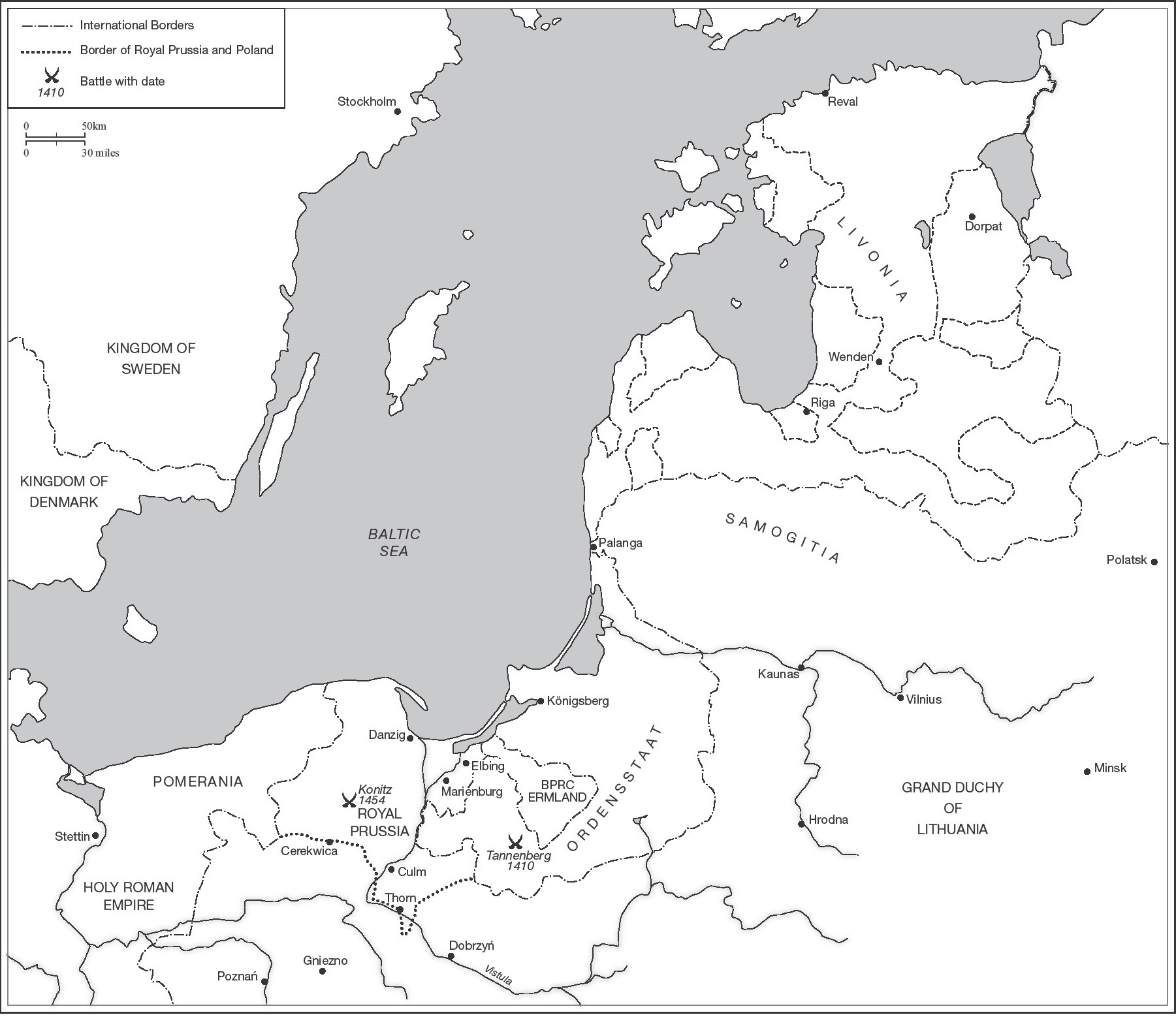
Map 4.The Prussian lands, 1454–1525.
Długosz, who participated in the Thorn negotiations, claimed that many in Lithuania and Poland were unhappy at the treaty, not because of the division of the Prussian lands, or any sense that it made too many concessions to the Order, but because the Lithuanians saw that it had strengthened Poland, and that therefore Podolia’s recovery would be more difficult in the future, while the Poles felt it would enrich the king and strengthen his position.30 Yet for all the carping, the second peace of Thorn was a success, establishing the political framework for the southern Baltic shore for over three centuries. It never received the papal confirmation both sides agreed to seek; on this basis the Order, after allying with Matthias Corvinus, king of Hungary, briefly and unsuccessfully challenged its legality in 1477; this led to a short war in which it was decisively defeated. The lands restored to the Polish crown, now known as Royal Prussia, were to remain loyal, though fiercely protective of the autonomy under the union secured in 1454. Those Prussians still under the Order’s direct rule did not forget the rights and liberties promised to them through the incorporation into Poland, and down to 1657 appealed regularly to their feudal overlord, the king of Poland, for protection of their rights, liberties, and privileges against challenges from the Order and its successors.
1 Górski, Związek, no. xii, 183–8.
2 Convention suggests that a war that began in 1454 and ended in 1466 should be called the Twelve, not the Thirteen Years War, but it is universally referred to under the latter name.
3 Karol Górski, ‘Rządy wewnętrzne Kazimierza Jagiellończyka w Koronie’, in Biskup and Górski (eds), Kazimierz, 107; Marian Biskup, ‘Dyplomacja polska w czasach Casimira Jagiellończyka, i: W kręgu wielkiego konfliktu zobrojnego z Zakonem Krzyżackim (1454–1466)’, in Biskup and Górski (eds), Kazimierz, 200–3; Jan Friedberg, ‘Zatarg Polski z Rzymem podczas wojny 13-letniej’, KH, 24 (1910), 422–67.
4 Biskup, Dzieje, 407–8; Biskup, Trzynastoletnia Wojna, 146–7; 224–8.
5 Biskup, Dzieje, 410; Biskup, Trzynastoletnia Wojna, 251–2; Nowak, ‘Walki’, 111–12. For the political concessions see Ch. 21.
6 Annales, xii/i, 209–16; Biskup, Trzynastoletnia Wojna, 261–9; Nowak, ‘Walki’ 112–13.
7 Biskup, Dzieje, 411; Biskup, Trzynastoletnia Wojna, 384–6.
8 Biskup, ‘Z zagadnień wojskowiści polskiej okresu wojny trzynastoletniej’, in Biskup and Górski (eds), Kazimierz, 141–72.
9 Biskup, Trzynastoletnia Wojna, 186.
10 Tadeusz Nowak and Jan Wimmer, Dzieje oręża polskiego, 963–1795 (Warsaw, 1981) 246–7.
11 Nowak, ‘Walki’, 117–20.
12 Nowak and Wimmer, Dzieje, 252. Biskup claims that the levy numbered 25,000–30,000 men, but Wimmer suggests caution: Biskup, Trzynastoletnia Wojna, 304; Wimmer, Historia piechoty polskiej do roku 1864 (Warsaw, 1978), 77.
13 Ernst Manfred Wermter, ‘Die Bildung des Danziger Stadtterritoriums in den politischen Zielvorstellungen des Rates der Stadt Danzig im späten Mittelalter und in der frühen Neuzeit’, in Conrad et al. (eds), Ordensherrschaft, 94–5.
14 Nowak, ‘Walki’, 115, 117.
15 Biskup, Trzynastoletnia Wojna, 283–5; Nowak, ‘Walki’, 123.
16 Biskup, Trzynastoletnia Wojna, 427–32.
17 Biskup, Trzynastoletnia Wojna, 440–73; Karol Górski, ‘Wojna trzynastoletnia (1454–1466)’, PZ, 10 (1954), 343.
18 Nowak, ‘Walki’, 123; Maria Bogucka, Kazimierz Jagiellończyk i jego czasy (Warsaw, 1981), 84.
19 Biskup, Trzynastoletnia Wojna, 487.
20 Nowak, ‘Walki’, 125–6; Nowak and Wimmer, Dzieje, 256–7.
21 Biskup, Trzynastoletnia Wojna, 589–94, 612, 735–9; Nowak, ‘Walki’, 126.
22 Annales, xii/ii, 42–6; Biskup, Trzynastoletnia Wojna, 622–9; Nowak and Wimmer, Dzieje, 260–1.
23 Józef Dyskant, Zatoka Świeża 1463 (Warsaw, 1987) 137–68; Nowak and Wimmer, Dzieje, 264; Biskup, Trzynastoletnia Wojna, 645–9.
24 Nowak and Wimmer, Dzieje, 265.
25 Górski, Związek, lxxxii; Biskup, Trzynastoletnia Wojna, 653–4.
26 Dyskant, Zatoka, 170.
27 Górski, Związek, no. xvii, 204, 205.
28 Górski, Związek, no. xvii, 215–16; Adam Vetulani, Lenno pruskie od traktatu krakowskiego do śmierci księcia Albrechta 1525–1568 (Cracow, 1930), 18–19.
29 Vetulani, Lenno pruskie, 217–18.
30 Annales, xii/ii, 167–8.