
2
The Krewo Act was the result of contingency rather than any long-term process. The immediate cause was Louis’s failure to produce a male heir. On his death in 1382, his Polish and Hungarian subjects had the opportunity to reconsider the personal union that had begun on Louis’s accession to the Polish throne in 1370. For the Poles, the relationship had been difficult. Hungary was the senior partner: the crown of St Stephen was long established, and its bearers ruled a populous, dynamic, and wealthy realm. The Polish monarchy rested on fragile foundations. Since the establishment of the Polish state, first mentioned in written sources in the 960s, only four of its rulers, Bolesław I (992–1025), his son Mieszko II (1025–34), Mieszko’s grandson Bolesław II (1058–79), and Przemysł II (1295–6) had been crowned. Only Mieszko enjoyed royal status for long: Bolesław I was crowned around Easter 1025, shortly before his death in June. Bolesław II only received papal permission for his coronation in 1076, eighteen years after succeeding his father, and was driven from his throne in 1079 after ordering the murder of Stanisław, bishop of Cracow; he died in exile in 1081. Przemysł II claimed the title of king of Poland, but only controlled Pomerania and his own duchy of Wielkopolska. He did not long enjoy his status: crowned in 1295, he was kidnapped and murdered in 1296 on the orders of the margraves of Brandenburg. Other Polish rulers bore the title książę, rendered in Latin as dux or princeps, whether they ruled over all, or only part, of the Polish lands.
The Piasts were bedevilled by dynastic rivalries. These were exacerbated by the attempt of Bolesław Krzywousty (the Wrymouth) (1107–1138), to provide for his five surviving sons and to systematize the opaque principles of succession among the burgeoning numbers of Piast dukes. Patrilineal inheritance and male primogeniture were not Slavic customs. Collateral succession was the norm. Brothers took precedence over sons, and rulers nominated their successor.1 Wrymouth’s testament divided the kingdom among his sons, establishing a complex system in which the senior member of the dynasty held Cracow and exerted supreme authority over other family members. He does not deserve his popular reputation as the man who wilfully smashed the unity of the Polish state: he tried to solve an increasingly intractable problem, prevent the worsening of the position through his own fecundity—altogether he fathered seventeen children—and to protect the position of his four sons born of his second wife Salomea. Nevertheless, while a common dynastic sense lingered after 1138, Wrymouth’s testament undermined the hereditary principle by establishing non-hereditary duchies for his sons. The failure of the principle of seniority, by which the duke of Cracow was to preside over the rest, brought nothing but confusion. The once-proud kingdom disintegrated over the generations into a mess of petty, squabbling duchies, whose rulers grew in assertiveness as their territories declined in size: if there were still only five duchies in 1202, there were nine by 1250, and seventeen by 1288.2 It was not until 1320 that Louis of Anjou’s maternal grandfather Władysław Łokietek (the Short) secured the permission of Pope John XXII for his coronation and revived Poland’s status as an independent monarchy.
His achievement was made possible by a reaction to the dark days following Przemysł II’s assassination, when the Bohemian Přemyslid dynasty briefly sustained its claim to the Polish throne. Łokietek’s own claims, as the third son of Casimir I of Cujavia, were weak. Yet he managed to unite the core provinces of Wielkopolska and Małopolska, though he lost control of Pomerelia and with it access to the Baltic Sea to the Teutonic Order in 1308–9, and was unable to recover Silesia or Mazovia. Rejecting Łokietek’s advances, the Silesian dukes swore homage in the 1320s to John of Luxembourg, king of Bohemia, who sustained the Přemyslid claim to the Polish throne. The Mazovian dukes were fiercely protective of their independence. One of them, Konrad I, invited the Teutonic Order into Prussia in 1226 to aid Mazovia against attacks by the pagan Prussian tribes to his north. Wary of Łokietek, the Mazovian Piasts swore homage to John of Luxembourg in 1329. For them, as for the Silesian Piasts, the resurrection of a Polish monarchy was unwelcome. As so often in dynastic politics, blood proved thinner than water.
Łokietek’s son Casimir III (1333–70) built impressively on the foundations laid by his father, but his major successes lay in the east, not the west, where he had to accept the status quo. He exploited the deaths without issue of Bolesław III of Płock in 1351 and Casimir I of Czersk in 1355 to secure oaths of homage to him personally, but not to the Polish kingdom: the vassal status of both duchies lapsed on his death, and the Mazovian dukes, like their Silesian cousins, were to be thorns in the side of Polish monarchs for generations to come.3 For all his achievements, Casimir faced daunting rivals. Apart from the Order, he had to deal with the fundamental shift in political gravity following the extinction of the Árpáds in Hungary (1301) and the Přemyslids in Bohemia (1306). The flourishing economies of these established kingdoms drew the attention of more powerful dynasties, with roots in western Europe and tendrils that snaked across the continent: the Neapolitan branch of the Angevins, which claimed the Hungarian crown, and the Luxembourgs, who succeeded the Přemyslids in Bohemia. The contrast between the dingy Piast capital of Cracow and the glittering courts of Buda and Prague was all too evident; the more so after the election of the glamorous cosmopolitan king of Bohemia, Charles IV of Luxembourg, as Emperor in 1347.
Casimir was a pragmatist. He abandoned thoughts of recovering eastern Pomerania, ceding it to the Order at Kalisz in 1343, thereby surrendering Poland’s direct access to the Baltic. His major problem, however, was his lack of a male heir. He therefore turned to the Angevin king of Hungary, Charles Robert, husband of his sister Elizabeth. In March 1338 Charles Robert agreed with the Luxembourgs that the Polish throne should be inherited by the Angevins in return for a promise that Charles Robert would do all he could to persuade Casimir to renounce his claims to Silesia, something that Casimir, aware he had little chance of recovering it, duly did in February 1339. He agreed that, should he die without a male heir, Elizabeth would succeed him and, through her, Charles Robert or one of his three sons; the agreement was probably sealed at Vysegrád following the death of Casimir’s beloved Lithuanian wife Aldona in May 1339, although its existence is only known indirectly.4
In 1339 Casimir was only 29 and had fathered two daughters with Aldona. His prospects of a male heir were ruined by his disastrous second marriage to Adelheid of Hesse who, after a brief period of spectacular conjugal disharmony, was despatched to a remote castle where she stubbornly refused an annulment, only leaving Poland in 1357. By 1355 Casimir was ready to sign away his daughters’ rights, putting flesh on the bones of the 1339 treaty by agreeing a succession pact with his nephew Louis, Charles Robert’s only surviving son, who was to succeed him should he die without male heirs. Casimir did not help Poland’s prospects of avoiding an Angevin succession by bigamously marrying his mistress, the widowed Krystyna Rokičana, daughter of a Prague burgher, in 1357 and then, in 1364 or 1365, after declaring himself divorced from her, Hedwig, daughter of the Piast duke Henry of Sagan, on the basis of a falsified papal dispensation purporting to deal with the issue of consanguinity, but not the more awkward one of bigamy. Hedwig bore him three daughters, all of them eventually legitimized by Urban V and—after Casimir’s death—Gregory XI. Polish law did not recognize succession in the female line, however, and Casimir confirmed his arrangement with Louis in a treaty signed in Buda in February 1369.
In 1370, just before his death, Casimir reconsidered. He negotiated with Charles IV for a marriage between Charles’s son and one of his daughters, and legitimized his favourite grandson, Casimir (Kaźko) of Stolp, son of Bogislaw V of Pomerania, whose sister Elizabeth had married Charles IV in 1363. Casimir probably did not intend to challenge Louis’s accession, for all the pro-Luxembourg sentiments of his chancellor, Janusz Suchywilk, and vice-chancellor, Janko of Czarnków. Louis’s lack of a male heir, however, meant that the succession was not secure, and it is likely that Casimir’s intention was to make Kaźko the heir presumptive should Louis die without a male heir. After Casimir’s unexpected death Louis duly succeeded him under the terms of the 1355 and 1369 agreements, although his rapid arrival in Poland in 1370 and hasty coronation in Cracow suggest he was nervous of his prospects (see Map 1).5
The brief personal union of Poland and Hungary was not a happy one. Louis may have earned the title ‘Great’ in Hungary, but he did not in Poland, which he barely visited during his reign, feebly claiming that the climate was disagreeable.6 He appointed as governor his formidable mother, Elizabeth Łokietkówna, who proved unpopular, partly because of the Hungarians who thronged her court. In 1376 resentment boiled over in a rising in which some of her Hungarian entourage were massacred. Elizabeth fled to Hungary; she was replaced by Wladislaus duke of Oppeln, a Silesian Piast, until her return in 1378.7
It was not so much Elizabeth’s unpopularity, however, as uncertainty about the succession that lay behind the political instability. Since Krzywousty’s testament dealt only with males, the fact that Polish customary law did not recognize succession through the female line gave the kingdom’s powerful elites considerable room for manoeuvre, not least because Louis’s tenure of the throne was based on their acceptance of Casimir’s disinheritance of the Piast cadet lines. In order to secure an agreement that on his death one of his three daughters would succeed him, in 1374 Louis granted a set of privileges at Kassa in the kingdom of Hungary—Košice in modern Slovakia; Koszyce in Polish—the foundation stone of the liberty of the Polish szlachta.8
The Koszyce agreement allowed Louis to choose which of his daughters should inherit the Polish throne. Several magnates swore oaths of loyalty to Catherine on behalf of the kingdom, but her death, aged eight, in 1378 threw Louis’s plans into disarray. Between 1373 and 1375 he negotiated the betrothal of Catherine’s younger sister, Mary, born in 1371, to Sigismund of Luxembourg, second son of Charles IV and great-grandson of Casimir III, who was three years her senior.9 Jadwiga, his youngest daughter, underwent a ceremony of sponsalia de futuro—a form of betrothal—with William, son of Leopold III von Habsburg, in 1378, when Jadwiga was four and William eight. After Catherine’s death Louis anointed Mary as his choice for the Polish throne, with Jadwiga intended for Hungary, as her nuptial agreement with William stipulated. At Kassa in August 1379 representatives of the leading Polish lords were invited to swear homage to Mary as their future queen. To overcome their evident reluctance, Louis shut the city gates, preventing them from leaving until the oath was sworn.10 In February 1380 he confirmed the arrangements for Jadwiga and William’s marriage, stipulating that it should take place as soon as Jadwiga reached the canonical age in 1386, and secured Hungarian recognition of these arrangements.11 In July 1382 he extracted another oath of loyalty to the fourteen-year-old Sigismund from representatives of the Polish nobility at Zólyom.
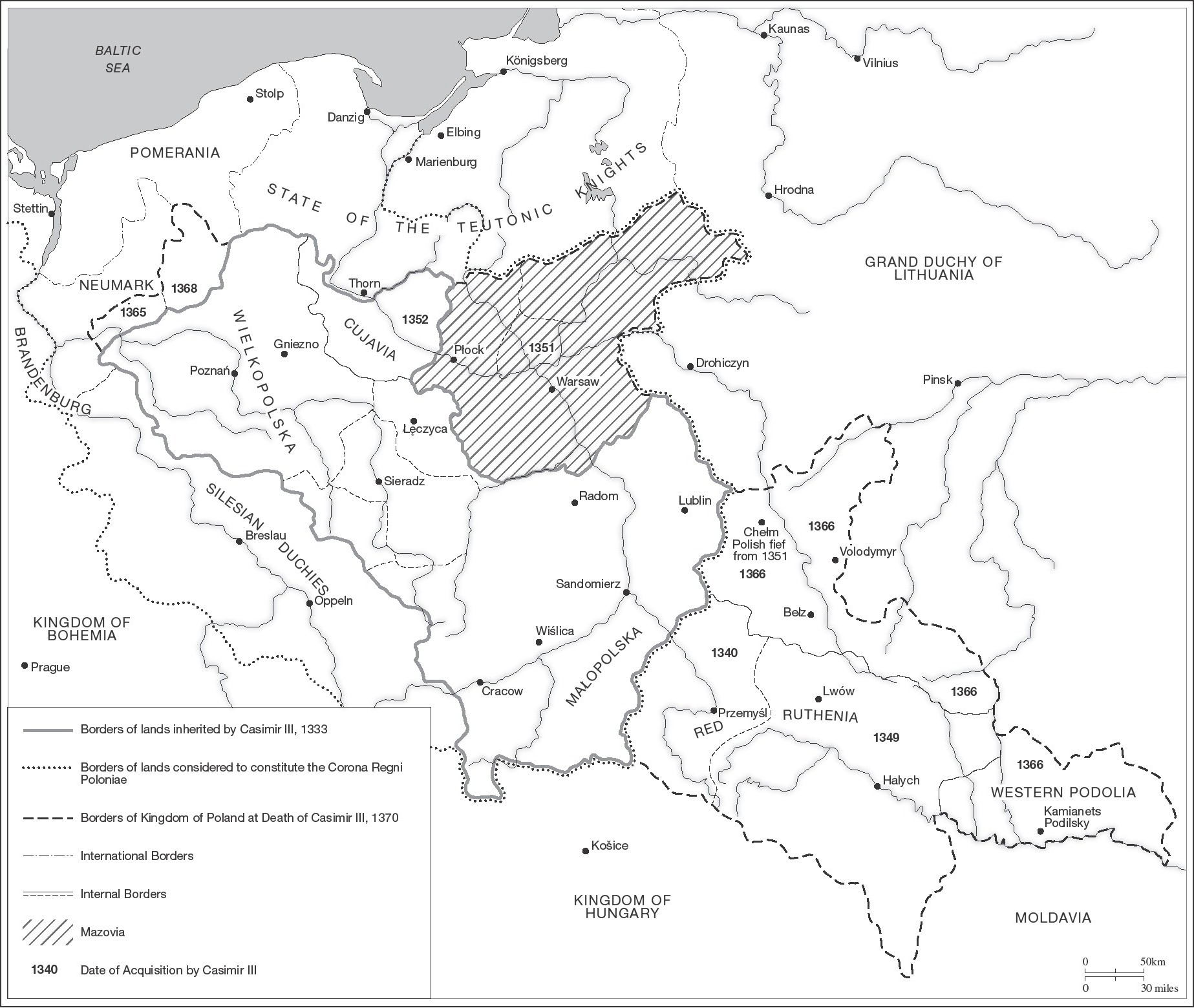
Map 1. The Kingdom of Poland in the fourteenth century.
Whatever Louis’s intentions, after his death on the night of 10/11 September 1382, the vultures circling the Angevin inheritance discovered that the elites of his kingdoms had their own ideas and were as ready to break their promises as their royal masters. Five days later the Hungarians declared Mary, not Jadwiga, to be their queen, leaving the regency council appointed in 1381 after Elizabeth Łokietkówna’s death with an interesting dilemma and an enticing opportunity.12 Sigismund entitled himself Herr des Kunygreiches zu Polen despite not being married yet, and secured oaths of loyalty from several Wielkopolskan towns and some members of the clergy. He met significant resistance, however, from the province’s nobility, who sought a commitment that after his coronation Sigismund would reside permanently in Poland.13
The Poles had had their fill of absentee monarchy, but this was an undertaking to which Sigismund, who knew of Mary’s election, was unwilling to agree. Whatever Louis’s intentions, Sigismund had always been more interested in Hungary than Poland. He refused to enter into any commitments in Poland that might compromise his position in Hungary. Encouraged by Konrad Zöllner von Rottenstein, the Order’s grand master, Sigismund returned to Hungary to secure his throne; no easy task as it transpired. His candidature was by no means dead, but his refusal to accept their terms left the Poles with a dilemma. They could remain loyal to Louis’s broad intentions—if not his last wishes—and the oaths they had sworn since 1374, and seek to avoid another absentee monarch by supporting Jadwiga’s accession. Yet Jadwiga was eight years old.14 She had never visited Poland, had been raised in expectation of the Hungarian throne, and was the ward of her mother, Elizabeth of Bosnia. She was betrothed to a German princeling largely unknown in Poland who was no match for the mighty Luxembourgs. There were other candidates, not least Siemowit IV of Mazovia, who attracted supporters, especially in Wielkopolska; Wladislaus of Oppeln; and the last surviving male in the royal Piast line, Władysław the White, who had already mounted a claim to the throne in 1370, when he had unexpectedly stirred himself from his Benedictine monastery in Dijon. He only reached Poland after Louis’s accession; although he had some support in Cujavia and Wielkopolska, having failed to persuade the pro-Angevin pope, Gregory XI, to release him from his vows, he could do little more than seize Gniewkowo, his hereditary duchy. In 1373 and 1375–6 he laid siege to several Wielkopolskan and Cujavian towns, before his final defeat after the siege of Złotoria in 1377, at which Kaźko of Stolp, who had joined his cause, was fatally wounded. Louis bought Władysław out of Gniewkowo and granted him an abbacy in Hungary. Clement VII, who was hostile to the Angevins, issued a bull in September 1382 releasing Władysław from his vows, but Władysław showed no inclination to leave his abbey. Wielkopolskan resentment at Angevin rule was channelled into support for Siemowit IV, an experienced politician who had many links to Wielkopolska, not least with the archbishopric of Gniezno, which had substantial estates around Łowicz in Siemowit’s lands.15
Whatever the merits of the various candidates, none was in a position to dictate to the Poles who should rule over them. By 1382 they had developed an ideology that justified their right to decide, and the institutional means to effect that decision. Both rested on the concept of the corona regni Poloniae—the crown of the Polish kingdom—formed during the fourteenth century, influenced by contemporary developments in Bohemia and Hungary.16 The concept of the corona regni in east central Europe embodied the idea that, as Susan Reynolds puts it in her study of western Europe:
A kingdom was never thought of merely as the territory which happened to be ruled by a king. It comprised and corresponded to a ‘people’ (gens, natio, populus), which was assumed to be a natural, inherited community of tradition, custom, law, and descent.17
Reynolds argues that this concept, which she terms ‘the community of the realm’, was deeply embedded in medieval political consciousness. The idea of a political community distinct from the person of the ruler was familiar across Europe, although its expressions varied according to local conditions. Whereas in Bohemia it was used by Charles IV to give institutional coherence to the eclectic collection of realms he had gathered under his rule, in Scotland it provided a theoretical basis for setting limits to the power of the crown: the 1320 declaration of Arbroath, which claimed the right to depose Robert I should he recognize English claims to suzerainty over Scotland, was drawn up in its name.18
The Polish concept of corona regni was influenced by contemporary Hungarian and Bohemian examples, but developed somewhat differently. As in Bohemia, it was originally nurtured from above by Łokietek and Casimir, for whom it served the purposes of strengthening royal authority and asserting the essential unity of the Polish lands. Although Casimir was forced to accept the de facto loss of eastern Pomerania and Silesia, the concept of the corona regni allowed him to claim that although control over these territories had been lost, they still formed an integral part of the regnum: the Silesian dukes were referred to in Poland throughout the fourteenth century as duces Poloniae despite paying homage to the Bohemian crown.19 Initially the monarch’s right to alienate parts of his realm was not questioned: as Janisław, archbishop of Gniezno put it in 1339: ‘the king of Poland is lord of all lands that constitute the kingdom of Poland, and can grant them to whomsoever he wishes’.20 Yet when Casimir bequeathed Łęczyca, Sieradz, and Dobrzyń to Kaźko of Stolp in his testament, the concept of corona regni was invoked to block the move. Louis was inclined to respect Casimir’s wishes, but strong opposition persuaded him to refer the matter to a tribunal, which decided that no monarch had the right to treat the territory of the corona regni as his patrimony, a verdict that Louis accepted.21
The triumph of the concept was apparent at Louis’s coronation, when he became the first Polish monarch to swear to maintain the kingdom’s territorial integrity: not only was he not to reduce it, but he swore to augment it through recovering lost provinces, a pledge he renewed at Koszyce in 1374.22 Under Casimir and Louis, the central government asserted its authority against the local and provincial institutions established before 1320. The chancellor and vice-chancellor were no longer referred to as ‘of Cracow’ or ‘of the court’: Jan Radlica, chancellor from 1381 to 1382, styled himself ‘regni Poloniae supremus cancellarius’. The separate chancellors for the various provinces disappeared, and central control was asserted by starostas appointed by the king, who acted on his orders; of particular importance were the starostas general, who had responsibility for a whole province.23 The influence of these officials, and of a small group of leading lords, particularly in Małopolska, grew during the unpopular governorships of Elizabeth Łokietkówna and Wladislaus of Oppeln. Louis’s decision to appoint a regency council after Elizabeth’s death placed substantial powers in the hands of this overwhelmingly Małopolskan group. Since Jadwiga was ten years old when she was crowned in October 1384, it was not until Jagiełło’s coronation in February 1386 that royal authority was restored.
For all the powers vested in the regents, they struggled to dictate the course of events. There was some unrest, notably in Wielkopolska, where, in 1377, the powerful position of the Grzymalita family was sealed by the appointment as starosta general of Domarat of Pierzchna, a dedicated Angevin loyalist and the province’s only member of the regency council. Wielkopolska, the main centre of power under the early Piasts, had long resented its loss of political influence to Małopolska. Przemysł II’s murder in 1296 deprived it of its duke, while Łokietek and Casimir based their power in Cracow and openly favoured the Małopolskan elite. Louis ignored Wielkopolskan demands and chose to be crowned in Cracow rather than—as was traditional—in Gniezno, a decision that provoked resentment, especially when he broke a promise to attend a ceremonial welcome in his coronation robes in Gniezno cathedral.24
There were good reasons for choosing Jadwiga. One of Casimir’s greatest achievements had been his acquisition of the Ruthenian principality of Halych-Volhynia after the murder of its young ruler Bolesław/Iurii, a Mazovian Piast, in 1340. Halych-Volhynia had emerged relatively intact from the destruction of Kievan Rus' by the Mongols, despite its subjection to Mongol power in 1246. Stretching from Lwów and Przemyśl in the north-west, it had originally included Volhynia, Black Ruthenia, and the cities of Halych, Volodymyr, Bełz, and Chełm. Orthodox in religion, its economy blossomed in the fourteenth century as the Mongol grip slackened, the Ottoman stranglehold on the Bosphorus tightened, and eastern trade sought alternative overland routes.
The murder of Bolesław/Iurii, who had claimed the throne after the death of its last Rurikid prince in 1323, saw Poland, Lithuania, and Hungary advance claims to this strategically vital territory. Hungary had included the claim to be rex Galiciae et Lodomeriae in the titles of the crown of St Stephen since the early thirteenth century, while Casimir’s claim rested on the fact that Bolesław/Iurii had designated him his successor.25 During the 1340s Casimir occupied much of Red Ruthenia; concerned at possible conflict with the Angevins, he signed an agreement with Louis in April 1350 in which both sides gambled: Louis signed away his rights to the territory for Casimir’s lifetime; if Casimir had a male heir, it would be sold to Hungary for the knockdown price of 100,000 florins. If, however, Louis or another Angevin should inherit the Polish throne, it would remain Polish. Louis thereafter supported Casimir’s military campaigns against the Lithaunians, and in 1366 they agreed to divide the principality between Poland and Hungary.26 On his accession Louis ignored these agreements, treating Halych-Volhynia as a Hungarian possession. By his death in 1382 he had recovered lands seized by the Lithuanians after 1370 and had put Hungarian garrisons into its major cities.
Louis’s Ruthenian policy drove a wedge between him and the Małopolskan lords, who had long supported Casimir’s Ruthenian ambitions, foreseeing rich pickings for themselves. They had, however, a powerful incentive to support the candidacy of one of Louis’s daughters: according to the 1350 treaty, under an Angevin ruler Ruthenia would legally belong to Poland. As the Hungarian garrisons streamed home in 1382 to fight in the bitter struggles over the Hungarian throne, Jadwiga’s claim as Louis’s heir was asserted. Following her coronation Polish control was gradually re-established.
Whatever the arguments in favour of Jadwiga, it was the way in which the succession was settled that was to have the greatest significance for the future. In the name of the corona regni, decisions over the vacant throne were taken at substantial assemblies of—to use Reynolds’s term—the ‘community of the realm’. The most important were at Radomsko (25 November 1382), Wiślica (6 December 1382), and Sieradz (27 February and 22 March 1383).27 These assemblies marked an important stage in the development of the Polish political system. The setting aside of Casimir’s testament marked the end of patrimonial dynasticism in Poland. Memory of the fragmentation of the realm between 1138 and 1320 was still fresh, while under Louis the principle that the monarch must consult with the community of the realm over the succession had been firmly established. What is remarkable, given the experience of other European states facing disputed successions, is the relative lack of bloodshed, despite the existence of several potential candidates in both 1370 and 1382–4. In part this was due to the fact that Polish succession law did not privilege male primogeniture. As in other Slavic societies, Polish custom allowed considerable latitude to the ruler to decide his successor, but Casimir’s promise of the succession to the Angevins had required the consent of leading figures in the realm. Louis was a Piast on the distaff side, but given the lack of support for succession in the female line in Polish customary law he was already in a weak position before his lack of a male heir ensured that he had to make further concessions to secure the throne for one of his daughters. In 1384 those agreements were honoured, at least in spirit. Despite strong support in Wielkopolska for a Piast, which led to a short-lived armed conflict that never quite degenerated into full-scale civil war, general opinion, particularly in Małopolska, was in favour of remaining true to the oaths sworn to Louis. The fact that it was the community of the realm, not the dynasty that would ultimately decide helped contain the violence and established an important precedent.
In his classic history of the institution of confederation in Poland, Rembowski singles out the assemblies of 1382 as being of particular significance for the development of what became a distinctively Polish form of political organization.28 While they were not the first Polish assemblies to use the concept of confederation, they were the first with such broad aims, and which so manifestly acted in the name of the whole political community: the regnicolae regni Poloniae. The concern for legality was underlined by a strong attachment to procedure throughout the interregnum, and a determination to reach decisions collectively. After the initial rejection by the Wielkopolskans of Sigismund’s candidature, a general assembly for Wielkopolska and Małopolska was summoned to Radomsk on 25 November 1382. It formally confederated itself to provide a legal basis for its actions, before deciding ‘unanimously’ to honour the promises concerning the accession of one of Louis’s daughters. There was initial opposition from Bodzęta and Domarat of Pierzchna, yet two of the most powerful political figures in the kingdom could not shake the consensus. The community of the realm had taken charge of the interregnum; if there were to be an Angevin succession, it would have to be on terms negotiated with that community.29
The phrases used in these accounts encapsulate the way in which the community of the realm was conceptualized. The Radomsk declaration of 27 November 1382 was made on behalf of the ‘lords and the whole community’ of Wielkopolska, represented by the barons and the ‘nobiles’ and ‘milites’, who were individually named, and representatives of the communities of Małopolska, Sieradz, and Łęczyca.30 The documents talk of ‘inhabitants of the kingdom’ (regnicolae), or ‘the whole community of lords and citizens’ (toti communiti dominorum et civitatum).31 In these assemblies, the participants stressed that the community of the whole realm of Poland was formally uniting its constituent parts to form an alliance (foedus) to provide a legal basis for its actions. This represented far more than simply the coming together of separate political units for a common aim: the documents express clearly the concept of a political community that transcended the local communities from which it was formed, using phrases such as ‘the community of this land’ (communitas ipsius terre) to denote the local communities which, taken together, formed the ‘the whole community’ (tota communitas) or ‘the whole kingdom of Poland’ (universitas regni Poloniae).32
Thus by 1382 there was a strong conception of the corona regni as a political community that transcended the various terrae of which it was composed. Although it was not until 1420 that the term was rendered in Polish as wszystkie korony pospólstwo (the whole commonality of the crown), the concept had taken root by the 1380s. While the monarch was seen as part of the community of the realm, and as necessary for the smooth functioning of the kingdom, the community of the realm was perfectly capable of running its affairs without a monarch, as it demonstrated between 1382 and 1386: even after Jadwiga’s 1384 coronation, her status as a minor meant that she was in office but not in power.
Jadwiga’s coronation represented an important victory for the community of the realm over her mother, who fought tenaciously to dictate the course of events. Although Elizabeth probably realized that Mary’s claim was unsustainable by the time her envoys attended the Sieradz assembly in February 1383, she did not give up, even if her envoys had to promise to send Jadwiga to Poland after Easter. Jadwiga had not arrived when the assembly reconvened. Bodzęta asked whether the community of the realm wished Siemowit IV to be king. Although this proposal—which may have been merely a demonstration to Elizabeth that she risked losing everything—was rejected on the grounds that there was significant dissent from Małopolska, Elizabeth missed several deadlines for Jadwiga’s arrival in Poland during 1383, and even mounted a clumsy attempt to send Sigismund into Poland at the head of a small army, ostensibly to help put down unrest.33
At Sieradz, legalism and Realpolitik triumphed over sentiment. Siemowit would have brought little benefit to the realm. While his accession would have reunited his lands to the Polish crown, he did not even rule over the whole of Mazovia, which he shared with his elder brother Janusz I.34 He had few resources to offer, and could not have challenged the Luxembourgs, who, if Sigismund were to secure the Hungarian throne, would rule Hungary, Brandenburg, and Bohemia; with the dynasty’s close links to the Order, Poland would be all but surrounded. Under Siemowit, the tender young Polish monarchy was likely to wither in their shadow.
Most Poles did not want Sigismund either. He was politely turned back at the border, and when Elizabeth missed a further deadline in November, the community of the realm took steps to ensure that it had a proper institutional basis for running its affairs should a rapid resolution of the succession prove impossible. On 2 March 1384 it was stated that until a king was crowned, authority in the realm would lie with the ‘community of lords and citizens’, and would be exercised by the starostas, the main royal officials in each locality, together with the local lords and representatives of the cities, who were ‘joined’ to him. The starosta was to take decisions with the unanimous agreement of two consuls selected from the local community. In naming them, attention was paid to the need for representation of different regions, and of the cities. Oaths of loyalty were to be taken to this collective leadership; in return, the authorities swore that they would act for the good of the ‘community and crown of this realm’.35
Those who depict authority in this period as ‘feudal’, based on lordship and a hierarchy of vertical allegiance to an ultimate suzerain, would do well to study the documents of the Polish interregnum of 1382–4. They do much to substantiate Reynolds’s assault on the idea that medieval politics can be understood in such terms, and to demonstrate that, while the early modern debate on the nature of sovereignty lay far in the future, political communities had sophisticated ideas about the nature of political authority and the relationship between the monarch, the dynasty, and the community of the realm.36 In the struggle between the Angevins and the Polish community of the realm, it was the dynasty that lost. The Poles stressed their wish to honour their commitments to Louis’s daughters, who alone possessed hereditary rights to the kingdom. Yet these natural rights were limited: the claims of Louis’s daughters ultimately depended upon the oaths taken by the community of the realm since 1374 to recognize those rights, and set aside Piast claims. These oaths were taken in good faith, but it was stressed after Louis’s death that while the Poles would honour them, they would do so only if the dynasty fulfilled its obligations: the community of the realm reserved the right to set aside natural rights to the throne, as it had with regard to the Silesian Piasts who, by swearing loyalty to the crown of Bohemia, were deemed to have broken with the corona regni and thereby released the community of the realm from its obligation to respect their natural rights.37 The community of the realm reserved the right to decide which of Louis’s daughters it wished to elevate to the throne. It was no longer to be the exclusive preserve of the dynasty to decide which of its members was most fitted to rule.
Thus although Jadwiga formally exercised royal power from the moment that she was crowned in regem Poloniae in October 1384, that power could only be exercised in concert with the community of the realm and after she reached her majority.38 The dynasty’s reduced authority was revealed by the annulment of Jadwiga’s 1378 betrothal. Despite its formal nature—which constituted the basis of a Habsburg challenge in the Papal curia—by 1384, Poland’s political leaders were considering other options. William, born in 1370, was young and inexperienced; he was from a junior branch of the Habsburgs; and he would bring little with him to the throne. If the Polish crown was to stand firm alongside the Luxembourg realms of Bohemia and Hungary, it would need a different kind of monarch.
By October 1384, there was an alternative. It is unclear just when Jogaila became a serious candidate. He was not an obvious choice. Poland’s relations with Lithuania had recently been tense on account of the struggle over Halych-Volhynia. The fourteenth century had seen a decline in the frequency of Lithuanian raids, but Jogaila himself participated in a devastating attack on Sandomierz in 1376 that resulted allegedly—if implausibly—in the capture of 23,000 prisoners.39 Yet circumstances were changing, and there was much to recommend a rapprochement with Lithuania and its pagan grand duke.
1 Marek Barański, Dynastia Piastów w Polsce (Warsaw, 2005), 218. For Polish succession law see Oswald Balzer, Królestwo Polskie 1295–1370, 2nd edn (Cracow, 2005), 515–86.
2 Benedykt Zientara, ‘Społeczeństwo polskie XIII–XV wieku’, in Ireniusz Ihnatowicz et al. (eds), Społeczeństwo polskie od X do XX wieku (Warsaw, 1988), 96.
3 Historia Śląska, ed. Marek Czapliński (Wrocław, 2002), 70–1; Dzieje Mazowsza, i, ed. Henryk Samsonowicz (Pułtusk, 2006), 251–4, 266–7. For the reigns of Łokietek and Casimir, see Jan Baszkiewicz, Odnowienie królestwa polskiego 1295–1320 (Poznań, 2008) and Paul Knoll, The Rise of the Polish Monarchy: Piast Poland in East Central Europe, 1320–1370 (Chicago, 1972).
4 Paul Knoll, ‘Louis the Great and Casimir of Poland’, in S.B. Vardy, Géza Goldschmidt, and Leslie S. Domonkos (eds), Louis the Great, King of Hungary and Poland (New York, 1986), 108–9; Stanisław Szczur, ‘W sprawie sukcesji andegaweńskiej w Polsce’, RH, 75 (2009), 64–71, 101–2.
5 Knoll, Rise, 229–30; Wanda Moszczeńska, ‘Rola polityczna rycerstwa wielkopolskiego w czasie bezkrólewia po Ludwiku Wielkim’, PH, 25 (1925), 88–91.
6 Jarosław Nikodem, Jadwiga, król Polski (Wrocław, 2009), 64–5. Polish historians generally reject Dąbrowski’s claim that Louis was also a great king of Poland: Jan Dąbrowski, Ostatnie lata Ludwika Wielkiego 1370–1382, 2nd edn (Cracow, 2009).
7 JerzyWyrozumski, Królowa Jadwiga, 2nd edn (Cracow, 2006), 44; Dąbrowski, Ostatnie, 318–20.
8 See Chapter 6.
9 Dąbrowski, Ostatnie 18–23. Hoensch mistakenly suggests she was eight, confusing her with another Mary, born in 1365, who died soon after her birth: Jörg Hoensch, Kaiser Sigismund: Herrscher an der Schwelle der Neuzeit 1368–1437 (Munich, 1996), 45.
10 Johannes de Czarnkow, Сhronicon Polonorum, ed. Jan Szlachtowski, MPH, ii (Lwów, 1872), 711.
11 Nikodem, Jadwiga, 72–6.
12 Jacek Gzella, Małopolska elita władzy w okresie rządów Ludwika Węgierskiego w latach 1370–1382 (Toruń, 1994), 146.
13 Hoensch, ‘König/Kaiser Sigismund, der Deutsche Orden und Polen-Litauen’, ZOF NF 46(1997), 3–4; Wyrozumski, Jadwiga, 76.
14 She was probably born on 18 February 1374: Nikodem, Jadwiga, 80.
15 Dąbrowski, Ostatnie, 210–15; Józef Śliwiński, Powiązania dynastyczne Kazimierza Wielkiego a sukcesja tronu w Polsce (Olsztyn, 2000), 122–42; Oswald Balzer, Genealogia Piastów, 2nd edn (Cracow, 2005), 640–7.
16 The classic account is Jan Dąbrowski, Korona Królestwa Polskiego (Wrocław, 1956; repr. 2010), abridged, tr. Ch. Woesler, as: ‘Die Krone des polnischen Königtums im 14. Jahrhundert’, in Manfred Hellmann (ed.), Corona Regni: Studien über die Krone als Symbol des Staates im späteren Mittelalter (Darmstadt, 1961), 399–548. Cf. Balzer, Królestwo, 586–649; Knoll, Rise, 40–1, 170.
17 Susan Reynolds, Kingdoms and Communities in Western Europe 900–1300, 2nd edn (Oxford 1997), 250.
18 Josef Karpat, ‘Zur Geschichte des Begriffes Corona Regni in Frankreich und England’, in Hellmann (ed.), Corona Regni, 70–155; Fritz Hartung, ‘Die Krone als Symbol der monarchischen Herrschaft im ausgehenden Mittelalter’, in Hellmann (ed.), Corona Regni, 1–69; Edward Cowan, For Freedom Alone: The Declaration of Arbroath, 1320, 2nd edn (Edinburgh, 2008). For a full discussion of her views, see Reynolds, Kingdoms, 250–331.
19 Dąbrowski, Korona, 72.
20 Quoted in Dąbrowski, Korona, 77.
21 Dąbrowski, Ostatnie, 145–6, 150–3 and Korona, 83.
22 Dąbrowski, Korona, 85.
23 Dąbrowski, Korona, 87.
24 Moszczeńska, ‘Rola’, 71–2, 98.
25 Wyrozumski, Jadwiga, 70.
26 Knoll, ‘Louis’, 110; Wyrozumski, Jadwiga, 70–1; Матвей Любавский, Областное деление u местное управление Литовско-Русского государства ко времени издания первого Литовского статута (Moscow, 1892), 38–9.
27 Wyrozumski, Jadwiga, 76–7.
28 Aleksander Rembowski, Konfederacja i rokosz, ed. Jola Choińska-Mika, 2nd edn (Cracow, 2010), 264.
29 ‘convenit universa multitudo procerum et primatum regni Poloniae in Radomsko . . . , ubi mature de statu suo et Poloniae regni salubriter pertractantes, unanimi voluntate conglobati et mutuo foedere uniti, fide praestita, promiserunt invicem sibi auxiliari fidemque factam et homagium praestitum duabus filiabus: Mariae et Hedvigi Lodvici regis praemortui firmiter tenere et observare . . .’ Johannes de Czarnkow, Сhronicon, 723.
30 The document lists the principal Wielkopolskan office-holders and dignitaries present, then adds ‘ceterique nobiles, milites totaque communitas Maioris Polonie’; similar formulae are used for Małopolska and the other territories. CDMP, iii, no. 1804.
31 ‘Conclusiones per dominos regni de unione regni et quomodo regi debetur usque ad regis novi electionem et coronationem’, CESXV, i, no. 2, 3; D ąbrowski, Korona, 93.
32 Dąbrowski, Korona, 93.
33 Wyrozumski, Jadwiga, 77–80; Nikodem, Jadwiga, 101–10.
34 Siemowit was duke of Płock, Rawa, Sochaczew, Gostyń, and Płońsk; Janusz was duke of Warsaw, Wyszogród, Ciechanów, Zakroczym, and Liw. Following agreements with their father, Siemowit III, the duchies of Czersk and Wizna were transferred from Siemowit to Janusz between 1379 and 1381: Balzer, Genealogia, 819–20, table x.
35 CESXV, i/i, no. 2, 2; Dąbrowski, Korona, 92.
36 Reynolds, Kingdoms, xi–lxvi.
37 Dąbrowski, Korona, 72.
38 Rowell questions the common assertion that Jadwiga was crowned king, not queen, of Poland in 1384, suggesting that, although some sources do use ‘rex’ or ‘ad regem’, they are outnumbered by those that state ‘ad regnum’, ‘regina’, or ‘in reginam’. His suggestion that the occasional use of ‘rex’ merely acknowledged that Jadwiga was queen regnant, not queen consort, is sensible: Rowell, ‘1386’, 139–40.
39 Simas Sužiedėlis, ‘Lietuva ir Gediminaičiai sėdant Jogailai į didžiojo kunigaikščio sostą’, in Adolfas Šapoka (ed.), Jogaila (Kaunas, 1935; repr. 1991), 36–7; Błaszczyk, Dzieje, i, 67.