
8
The soup in question here refers to the title of a book, Yinshan zhengyao, which celebrates the culinary delights available at the court of the Yuan emperor. The dishes were representative of the many regions that fell under the sway of the Khanbaliqi rulers and the variety of foods and tastes available at the Qa’an’s court. The court cuisine is indicative of the sophistication and the range of the foods that appealed to those who worked in the confines of the Yuan court, be it in the political capital of Khanbaliq or the cultural capital of Hangzhou. The Yuan Empire1 peaked during the long reign of Qubilai Khan, the dynasty’s founder and grandson of Chinggis Khan, and thereafter never achieved the power, confidence and lustre that it owned during the decades under Qubilai’s rule. However, many of the ideals and certainly the vision of the Toluid elite lived on after Qubilai’s death, just as they did in the other half of the Empire in the Iranian Ilkhanate. Whereas Qubilai lay dying, the young prince Ghazan Khan was ascending the Iranian throne as the Ilkhanate’s first recognised Muslim ruler. Just as the cuisine on offer at the court of the Yuan emperors had something for everybody and included the tastes of even the most obscure Yuan subjects, so was Ghazan’s appeal for all his subjects from the Turco-Mongol lords of the steppe to the wandering qalandars of the plains. Hu Sihui’s cookbook, Yinshan zhengyao, was presented to Tugh Temur in 1330 when political instability was growing in many regions and yet its existence paid testament to how deeply entrenched the global, multi-ethnic and multicultural ideals of the Toluids had become.
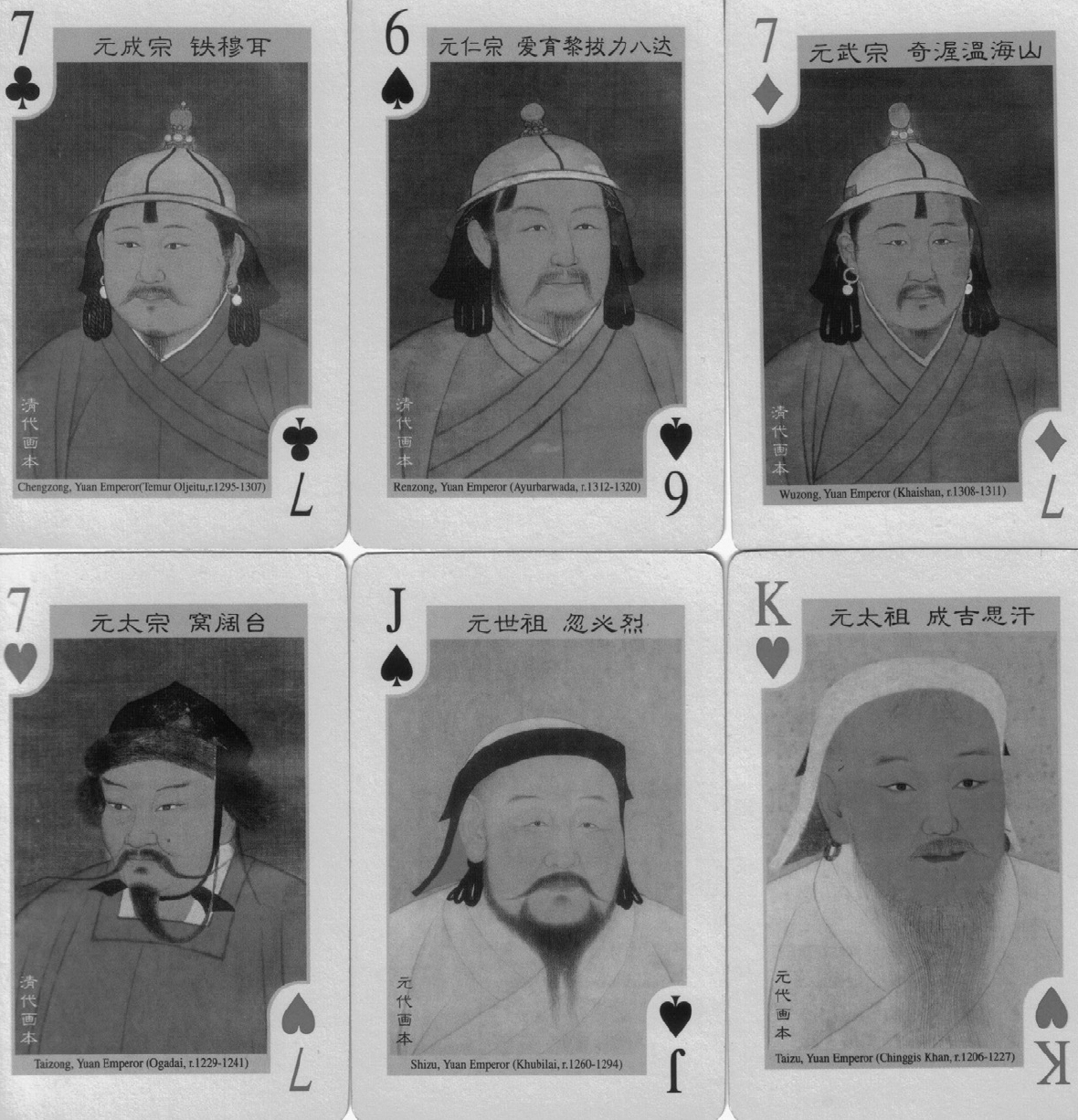
Fig. 12: The Great Khans of the Yuan as depicted in popular Chinese playing cards
STEPPE V. SOWN
The history of greater China post-Qubilai was a battle for the soul of the Empire, and it was a battle that had been played out from when Chinggis Khan had first stormed out from the steppe, accepted the alliance of his Khitan neighbours and absorbed the technicians and engineers who had offered their help in defeating their common foe, the Jurchen, the occupying forces of northern China. Chinggis Khan had begun the process of transformation from a steppe emperor to a world emperor. Many among his army wanted to achieve the domination of the steppe over the sown and continue the age-old war of survival. Chinggis had made it plain which he desired, but the degree of his metamorphosis was a matter of bitter dispute that was never to be wholly resolved. In Iran Amir Chopan confronted the disgruntled lords envious of the growing power and prestige of their fellow Iranians, the Persian courtiers, and the matter had been resolved until unfortunately the whole country dissolved into anarchy following the death of the young Ilkhan Abu Saʿid. In Yuan China the dispute wavered between the two parties as princes rose and fell and the government alternated between those who favoured Chinese traditions and others who still hankered after the clean air of the steppe. Qubilai Qa’an had been explicit when he came to the succession in that he stipulated that all future kings must be from the line of Chabi (1227–81) his chief wife, partner and friend. Qubilai was a hard act to follow. His achievements were recognised by all. In the Yuanshi, written by Ming scholars some 75 years after Qubulai’s death, the official verdict stated that:
Emperor Shizu was a man of broadest capacity for judgment. He knew men and was skilled in employing them. He had deep confidence in Confucian methods, and was able to utilise them so that Chinese ways transformed alien practices. He established the basic principles and set forth ruling norms in such a way that the institutions of the age were of vastly encompassing scope.2
However, the financial crisis which throbbed at the heart of the state’s continued existence plagued Qubilai’s successors as persistently as it had corroded away at his own regime. His administration had to balance the continued excessive military expenditure along with lavish imperial indulgence and generosity with Confucian ideals of frugality and an easing of the people’s tax burden. To solve this intractable problem and untie this fiscal knot, successive qa’ans had employed semu financial wizards and often Muslim monetary masters to solve the sums and balance the books, which was often translated as more cooking than balancing. The tax burden was rarely eased, and when it was, as happened under Temur Uljaytu, the result was simply an increase in the financial crisis. Most of the hapless economic experts could see the solution, a drastic curtailment of state expenditure, but this financial cure would result in political suicide and undermine the Mongol state in China.
In 1285 Qubilai’s eldest son and chosen successor, Zhenjin, died and not only left the father distraught but caused a succession disruption that persisted throughout the dynasty’s lifetime despite Qubilai’s stricture that the throne remain the preserve of Zhenjin’s successors. The steppe tradition of tanistry was never far beneath the surface, though a compromise between Mongolian patrimonial feudalism and the traditional Chinese autocratic–bureaucratic system was still possible. What does define the Yuan dynasty and indeed reflects the nature of Chinggis imperial rule is the ebb and flow of steppe versus sown culture. In Iran Ghazan made plain his identification with his settled subjects. Chinggis made clear his own attraction for the pleasures of urban life and luxuries, and during the Yuan the rulers alternated between those whose sympathies lay with their southern subjects and those who harkened to the call of the wild and the empty plains of the steppe.
THE YUAN EMPERORS
Temur Uljaytu Chengzong (r.1294–1307) embraced the policies of his grandfather Qubilai, whereas Qaishan Kulug Khan Wuzong (r.1307–11) rejected those pro-Chinese policies. Ayurparibhadra Buyantu Khan Renzong (r.1311–20) adopted Confucian culture, and his son and successor, Shidebala Gegeen Yingzong (r.1321–23), continued those same policies completing the codification of the law. However, after a coup d’état by Yesun Temur Taiding (r.1323–8) there was a return to the influence of the steppe. Tugh Temur Jayaatu Khan (r.1328–9; 1329–32) was known for his cultural sophistication and his Chinese was good, but when he was succeeded by Toghan Temur (r.1333–68/70) the rivalry between the two sides dissolved the state into growing anarchy. Though broad influences are discernible, often the reality was merely reflected in the ruling court and among the elite. Most of the emperors who succeeded Qubilai came to the throne as adults in their 20s or 30s, with only Rinchinbal Ningzong (r.1332) and Toghan Temur ascending as children. However, all were to varying degrees figureheads representing cliques of Mongol notables and political intriguers who saw their own interests best represented by either the steppe or the sown. This was the same broad split that still underlay tensions in the Ilkhanate and would sometimes surface even among the Chaghadaid–Ogodaid alliance. The Toluids under the Ilkhans and Qubilai had very much favoured a peaceful coexistence if not a merging and union between the cultures of the city and the steppe, and this fusion gave birth to the extraordinary cultural explosion in Iran and under the Yuan in China that the thirteenth and fourteenth century witnessed.
Mongke Khan, as the last imperial emperor of the Mongol Empire, had viewed China, at least initially, as an appanage of his steppe empire, whereas Qubilai saw China as his base and wanted to shape it into his image. Qubilai was strong and charismatic and he was able to force his vision on those who might oppose him, but his successors did not match his success. However, when the Mongol armies, defeated by the Ming rebellion, turned north and retreated to their ancestral homelands in Mongolia c.1369, the exodus did not include everyone who had ever thought themselves a loyal servant of the Yuan kings, nor every soldier or son or grandson of every soldier who had marched with the Chinggisids out of the northern steppe. Those who retreated back to the steppe represented those who had rejected China and the culture that had been fermenting and maturing over the past century. Those who stayed and embraced the life of the cities in which they now lived and of which they were an integral part remained and prospered and no doubt became loyal citizens of the new Ming dynasty.
Temur Uljaytu Khan (r.1294–1307)
Temur Uljaytu Khan,3 or Emperor Chengzong of Yuan, was the second leader of the Yuan dynasty and is considered the sixth Great Khan of the Mongols in Mongolia. He was an able ruler of the Yuan whose reign established the patterns of power for the next few decades, but neither he nor any of his successors would ever match the calibre of leadership exhibited by the founder of the dynasty, Qubilai Khan.
Zhenjin’s eldest son, Kammala (1263–1302), was rejected as successor because he failed to receive Zhenjin’s principal wife Kokojin’s all-important blessing, demonstrating the influence that this young woman, and indeed women in general, still exerted over the Great Khan. Kammala had served as a commander in Mongolia for many years and in 1292 he had been appointed as the Prince of Jin to take charge of the ‘four ordus of Chinggis khan and the troops and land of the Tatar’.4 However, his failure to secure the throne for himself was tempered later in 1323 when his son Yesun Temur became Qa’an.
Rashid al-Din recounts that the succession dispute between the two brothers was decided by a knowledge quiz. Kokojin Khatun proposed that whoever could display the deeper knowledge of Chinggis Khan’s biligs should occupy the throne. Temur was known for his eloquence and he was able to pronounce the biligs well with masterful intonation, which duly impressed the judges and contrasted sharply with Kammala’s slight stutter and less confident delivery. As a result, all unanimously shouted, ‘Temur Qa’an knows the biligs better and pronounces them better. He is worthy of the crown and throne.’ And so in 1295 in Shangdu, Temur was enthroned as the Yuan emperor. In recognition of his respect for his elder brother, Kammala, he awarded him a large share of their father’s wealth and sent him to Qaraqorum ‘where Chinggis Khan yurts and ordus remain still, and put the troops in that area under his command’.5
Temur Uljaytu, a moderate Chinese speaker, backed by the national hero Bayan Noyan, assumed the reins of power and adopted the policies of his grandfather, opting for continuity and peace as priorities. This became immediately manifest in his appeals to the other houses of the wider Chinggisid Empire and he achieved and oversaw a short-lived period of unity and peace, not only with his fellow Mongol khanates but with some neighbouring states such as Pagan, Dai Viet under the Tran dynasty (1225–1400) and Champa (south Vietnam) that in 1304 recognised his suzerainty and agreed to pay tribute.
Temur was born in 1265, the third son of Zhenjin of the Borjigid and Kokojin (Bairam-Egechi) of the Onggirat. Because Qubilai’s first son Dorji died early, his second son and Temur’s father, Zhenjin, became the crown prince. However, Zhenjin died in 1286 when Temur was 21 years old. Qubilai remained close to Zhenjin’s widow Kokojin, who was high in his favour. Like his grandfather Qubilai, Temur too was a follower of Buddhism. In 1293 his succession was assured when he was stationed in the north to oversee the steppe lands of Mongolia, though it was rumoured that his addiction to drink troubled his grandfather. Qubilai proved unable to curb that addiction despite the extraordinary measures and restrictions that he attempted to impose on the prince, so much so that Temur had his confidant Razi, a scholar from Bokhara, fill up his bath with wine in order to circumvent the ban on bottles being delivered to his rooms. However, on ascending the throne, Temur voluntarily gave up the consumption of alcohol.6
Temur came to power when change was afoot throughout the Toluid Empire. In the west Ghazan had assumed the Ilkhanid throne and had embraced the religion of his loyal subjects. He had thrown down the gauntlet to the Mongol amirs who still hankered after the privileges and power of a bygone era and reaffirmed his commitment to the multiculturalism of the Toluid state, a commitment shared by his grandfather Qubilai. Temur retained most of the ministers favoured by his grandfather and continued his domestic policies, but he initially cancelled further military adventures against Japan or Dai Viet and encouraged peaceful relations with the Chinggisid khanates in the west.
In 1304, Du’a Khan (d.1307), son of the Chaghadaid prince Baraq, Qaidu’s son Chapar, Toqta Khan of the Golden Horde and the Ilkhan Uljaytu negotiated peace with Temur Khan in order to further trade and diplomatic relations among the Chinggisids, and it was agreed that Temur would be declared their nominal overlord. According to the ancient custom inherited from the time of Hulegu, Temur thus deigned Uljaytu as the new khan of the Ilkhanate and sent him a seal in Chinese script, which read ‘Seal of Mandate of Heaven Emperor [i.e. Emperor of China] who made peace with all foreigners/barbarians’, which was later used by Uljaytu in his letter to the French king Philip IV of France in 1305. Soon after, fighting between Du’a and Chapar broke out over a question of territory. Ever the pragmatist, Temur backed Du’a, and in the fall of 1306 he sent a large army under Qaishan to assist the Chaghadaid prince until Chapar finally surrendered and the House of Ogodai fell once more to pre-Qaidu obscurity. Meanwhile, to further cement his position in the wider empire, Toqta Khan of the Golden Horde also sent his overlord Temur two tumans to buttress the Yuan frontier. With Temur Uljaytu the nominal overlord of the Chinggisid Empire, trade once again resumed on a transcontinental scale.
Outside the Chinggisid Empire reactions to Temur Uljaytu’s political muscle flexing were mixed. The Japanese ignored his demands for submission and instead the Kamakura Shogunate launched a raid on Ningbo, the sea port of the Empire’s cultural capital, Hangzhou. Three missions to Khanbaliq, in 1295, 1297 and 1300, reaffirmed the acceptance by the rulers of the Yuan’s neighbours, Dai Viet, Pagan and Sukhotai, of Temur Uljaytu as their overlord. In response Temur suspended his campaign in Pagan, he released his Dai Viet prisoners and accepted the tributes from the Tran court, and he began overtures to the rebellious tribal chieftains in the mountainous south-west. In 1301–3 a military expedition against Song Longji and the Dai (gold-toothed ones) proved very costly, but it was ultimately successful and peace was restored and trade resumed in Yunnan.
In Pagan, Temur suspended military operations against Pagan resistance but instead in 1297 Yuan armies repelled local Shan tribesmen on behalf of the Pagan prince Tribhuvanaditya, who was himself then murdered by his brother, Athinkaya. Eventually Athinkaya and the Shan lords offered their own submission to the Yuan court. Envoys from Sukhotai and Khmer were also received at court and in response the diplomat Zhou Daguan was dispatched to establish communications between the Yuan court and its southern neighbours.
It is generally agreed that the corruption that became endemic under the later Yuan khans began under the rule of Emperor Chengzong, while at the same time he succeeded in ruling peacefully at home and with his neighbours who recognised Yuan suzerainty and paid tribute in recognition. At home he also gained a reputation as a competent ruler and his administration was filled with a variety of nationals including Han Chinese, Tibetans, Mongols, Christians and Muslims, while Confucius was officially revered. The Mongol ministers Oljei and Harghasun oversaw policies that were designed to ensure political continuity, social stability and financial security. The Muslim statesman Bayan Noyan, great-grandson of the widely respected Sayyid ʿAjal Shams al-Din ʿOmar Bokhari, assumed the position of minister of finance. According to Rashid al-Din, Muslims were well represented in his administration.7 Temur’s cousin Ananda (d.1307) had been assigned command of the army in Tangut territory and the administration of the province formerly in the hands of his father and third son of Qubilai, Manggala.
The population of Tangut is predominantly Muslim, and the young Ananda had had a Muslim wet nurse and exposure to Islam from a young age. He grew up learning the Qur’an and became familiar with Arabic script. Rashid al-Din claims that his official conversion encouraged the conversion of his 150,000 troops, though the Yuanshi claims that it was the influence of his men and contemporaries that led to his conversion. A disgruntled amir complained to Temur Qa’an about the prince’s devotion to this foreign religion and claimed that his time was wholly consumed with fasting, praying, visiting the mosque and reciting the Qur’an and that he had converted and circumcised Mongol boys and most of the military. Alarmed by these reports Temur sent aides to prevent escalation of the situation and to encourage Ananda to return to the Buddhist fold. This situation could well have caused a deep rift in the family and more seriously it could have destabilised a strategic province and resulted in widespread disquiet in the ranks and the strong possibility of defections or rebellion. After, Ananda appeared at court and explained his case and the wise words of his mother Kokojin Khatun: ‘Ananda has many troops and all those soldiers and people of the province of Tangqut are Muslims and […] are close to enemy territory. Let them not be alienated. It is not wise to make him recant. He knows best about his religion and community.’8 When next Ananda attended a quriltai at the Qa’an’s capital, he was treated with the greatest respect and assured that he was free to worship as he felt best, Temur having been reassured by the example of his close ally, the Ilkhan, Ghazan.
Temur Uljaytu is credited with good intentions towards the common people and to this end he issued a number of imperial decrees ‘prohibiting the dukes, husbands of princesses, the rich and powerful from seizing people’s land’, but these proved empty words and widespread land annexation continued unabated.9 He wished to decrease the financial burden on the people in general and towards this goal he exempted various groups from taxation and opposed the addition of any new tax burdens wherever possible. Mongol commoners received tax exemption for two years. In 1302 he prohibited the collection of anything beyond the established tax quotas. Khanbaliq and Shangdu were exempted from taxes for two years. Worthy though such measures might have been, they were disastrous for the economy and they were a severe drain on court reserves, which resulted in an inevitable undermining of the country’s currency. This was particularly serious since the currency in use was still the paper currency introduced by Qubilai Khan that relied wholly on the confidence of traders in its continued value.
Though sometimes coupled with Qubilai’s reign as forming the peak of Yuan glory and strength, Temur’s reign lacked the intellectual vigour and confidence that underlined Qubilai’s years, and signs of the malaise that was to become pervasive were evident before the end. The size of the court reflects the general state of health of the regime: bloated and indulgent. The combined quota of court officials had been set at 2,600, but in 1294 a censorate established that there were 10,000 officials on the payroll in the capital alone with many more in the provinces. Corruption was endemic and inevitable when the nature of some of the organisations is considered. For example, two merchant mariners, Zhu Qing (d.1303) and Zhang Xuan (d.1303), had been apprehended in 1302 on a number of serious charges. However, it appears that before their defection from the Song to the Yuan navy they had been salt smugglers and pirates. They came over from the Song with a large number of vessels and men and were not only welcomed but assigned important positions in the emerging Yuan navy. The scandal that broke in 1303 revealed they had made immense fortunes from their management of the maritime transportation of grain and the control of overseas trade on behalf of the Yuan government, which considering their past lives and experience as smugglers is hardly surprising. The scandal centred not on the ex-smugglers but on the many worthy citizens that they had corrupted and had brought down to their level of greed. Ministers of the secretariat and managers of state affairs included respectable figures such as Arghun Sali, Liang Degui, and Duan Zhen and such luminaries as Sayyid ʿAjal Bayan, whose family name would have been indelibly tainted by such a scandal. They were cashiered for accepting bribes10 and so enraged the Great Khan that he promulgated 12 articles on corruption. After nationwide investigations in the capital and in the provinces, 18,473 officials and clerks were prosecuted and 45,865 ding (coins) uncovered. Tellingly, many of the officials disgraced in this hallmark crackdown were quietly reinstated over the next few years.11
Kulug Khan (r.1307–11)
Born Qaishan, Kulug Khan, or Emperor Wuzong of Yuan (1281–1311), was the third emperor of the Yuan dynasty and is regarded as the seventh Great Khan of the Mongols in Mongolia. His uncle Temur Uljaytu had died without a male successor. Based largely on his early military successes and a resulting popularity and solid reputation for competence and bravery, Kulug Khan was chosen to succeed his uncle as Great Khan. In addition, Mongol activists who wished to reverse the pro-Chinese policies of the previous regime indulged in fierce factional fighting to ensure their candidate Qaishan, thereafter named the ‘Martial Emperor’ or Wuzong, acceded the throne. The 26-year-old’s education included Chinese language but had concentrated on steppe military techniques, and much of his life had been spent in the steppe and therefore he had had minimal influence from sedentary Chinese life and culture.
He was the second son of Darmabala and Dagi of the influential Onggirat clan, and the full brother of Ayurparibhadra. He had been sent to Mongolia to command an army that defended the western front of the Yuan state against the rebel Ogodaid prince, Qaidu Khan and other royal khans in Turkestan serving under him. In 1289, Qaishan’s force was nearly routed and the Qipchaq commander Tutugh rescued him from capture by Qaidu’s army. In 1301 he clashed with Qaidu, who was fatally injured in the battle and eventually died from his wounds. In 1304 in recognition of his admirable success, Kulug Khan was honoured by the Great Khan, Temur Uljaytu, and given the title of Prince Huaining.
When the Ogodaid prince, Qaidu’s son Chapar Khan, attacked Baraq’s son and ruler of central Turkestan, Du’a Khan, Temur Uljaytu extended assistance to the latter by sending an army under his nephew, Qaishan. In 1306 Qaishan forced Melik Temur, a son of Ariq Buqa who had aligned himself with Qaidu, to accept a surrender in the Altai Mountains and then forced Qaidu’s successor Chapar westward. For these military achievements along the Yuan’s troubled western borders, Qaishan Kulug Khan earned a hard-won high reputation among Mongol princes in particular, and this was considered a major reason for his selection as a candidate for emperor.
He rejected the direction in which his uncle Temur Uljaytu Khan had been leading the country and instead initiated a series of unplanned economic reforms, the ‘New Deals’, which eventually led to a severe financial crisis with the Yuan government facing mounting debt and popular discontent. He had no schooling in statecraft and he behaved in government as he would directing his armies on the western front or back home on the steppe. Popular with the Mongol elite but a source of exasperation among the multicultural, multi-ethnic ruling elite of the Yuan state, he drove his government close to bankruptcy. He did enjoy some success in foreign affairs. It was during his reign in 1308 that the Ainu people of the island of Sakhalin were forced to accept Yuan supremacy, the same year that, following the death of the king Chungnyeol of Goryeo, Prince Qaishan sent a patent for the Korean successor, Chungseon. He enjoyed bestowing honours and titles in the manner of a nomadic chieftain and he filled his ministries with artisans, butchers, actors and Buddhist and Daoist clergy with little understanding of the repercussions of his actions.12 In order to raise funds he simply printed more money, trebling the amount of paper currency in circulation, and sold monopolies for key industries and licences for state enterprises. He became a self-indulgent and extravagant tyrant, neglectful of his administrative duties, debauched and dissolute. This madness ended in 1311 and his educated and competent brother and successor immediately began repairing the damage Qaishan’s three-year reign had inflicted on the country.
Ayurparibhadra Buyantu Khan (r.1311–20)
The fourth Yuan emperor, Emperor Renzong, earned a reputation for competence having received a good Chinese education and even mastered the classics, and his adoption of Chinese Confucian culture was very popular with his Chinese subjects even though it caused predictable unease and even some outright hostility among the Mongol elite. He had been mentored by Li Meng, a Confucian academic whose influence is seen as being behind some of the reform that was instigated during Ayurparibhadra’s reign. The liquidation of the Department of State Affairs resulted in the execution of five leading officials and a reversal in the policies instigated by Qaishan. Ayurparibhadra reinstated officials who had served under Qubilai, mostly learned Chinese but also Mongols competent in Chinese statecraft. China rather than the steppe was once again the basis of Yuan power, though it was Ayurparibhadra who had ‘ordered his minister to establish shrines for the Mongolian shamans’,13 possibly to placate the traditionalists, uneasy at his other reforms.
However, maybe it was his 1313 reintroduction of the state examinations,14 compulsory for all candidates seeking admission to the state administration, that was most controversial. The partial reintroduction of the examination system was seen as a landmark event by the Chinese. The annulment of the examination system had accompanied the fall of the Song administration and had immediately opened the state bureaucracy to a far wider pool of applicants including of course non-Han Chinese. The examinations demanded a thorough knowledge of Chinese history and culture and a grounding in Confucian philosophy. The first examinations for the jinshi degree were held in 1315, but other reforms and the tightening of standards were often opposed and his lack of forcefulness and character undermined much of what he might have achieved.
Ayurparibhadra also codified the Yuan’s laws and oversaw the translation and publication of a number of Chinese books and classics. Prior to the reintroduction of the examination requirement the administration had been dominated by Semuren and ethnic Mongols, though this domination has probably been exaggerated by foreign chroniclers. In many Chinese gazetteers the seemingly all-powerful western administrators are hardly mentioned and it would appear that many of their duties were replicated if not dominated by their Chinese colleagues. In addition the merchant classes, typically treated with a degree of disdain by traditionalist Chinese, had assumed a far higher social and political status under the Yuan khans, and the Semuren and Westerners far outnumbered Chinese in the mercantile world. Therefore though a greater balance was achieved with Ayurparibhadra’s decisive reintroduction of the examination system as a prerequisite for entry into public service,15 Buyantu (Ayurparibhadra) Khan relied on the foreigners and their connections for the continued success of overseas trade.
Shidebala Gegeen Khan (r.1320–3)
Ayurparibhadra’s son and successor, Gegeen Khan, or Emperor Yingzong of Yuan, continued his father’s policies of reform based on Confucian principles when he ascended the throne in 1320 with the help of his able chancellor and commander of the Imperial Guard, Baiju, a descendant of the near legendary Muqali (1170–1223) and a powerful replacement of Temudar, the Empress Dowager’s man at court. Baiju introduced the young Qa’an to the cult of the ancestors and he became the first Mongol ruler to perform the stately ceremony in full regalia through the streets to the temple of his ancestors.16 Gegeen Khan, who had also received a Chinese education, completed the codification of the Yuan’s laws started by his father. This vast collection of rules and regulations became known as the Da-Yuan Tongzhi (‘The Comprehensive Institutions of the Great Yuan’). Enemies of the emperor and of the policies favouring the Chinese factions were able to sabotage much of what Gegeen hoped to achieve firstly by taking charge of the imperial court, murdering his chief ministers and also by threatening the life of the young emperor himself. When his supporters fought back the court became a battleground for the two rival factions, but Gegeen was able to announce a programme of ambitious reforms, actions which directly threatened the Mongol nobility and turned the rivalry bloody. Following the murder of the minister Baiju, Gegeen was assassinated on his way from the summer capital at Shangdu to Khanbaliq at only 20 years old, leaving the bitter ideological and political division splitting the country unresolved.
The last decades of the Yuan dynasty were marked by struggle, famine and bitterness among the populace. Struggles for the leadership engendered instability and rebellion in the provinces. The Yuan khans had lost credibility with their homeland being viewed now as wholly Chinese, and yet in China itself they were still regarded with a certain amount of disdain, especially as corruption spread and they began to lose control first of the administration and then of the army itself. The country was ravaged by anarchy and popular rebellion became widespread. Gegeen Khan had survived only two years before five princes staged a coup and placed Yesun Temur on what was becoming an increasingly dangerous throne.
Yesun Temur Khan (r.1323–8)
Yesun Temur, or Emperor Taiding of Yuan, assumed the throne after the successful coup d’état against Gegeen Khan and his rule in some ways saw a return to the values of the steppe and the ideals of the early Chinggisids. However, it also saw the introduction of a period of great political instability, factional fighting, intrigue and assassination. As if to presage this political chaos, during the new Qa’an’s first year on the throne there occurred an earthquake, an eclipse, great floods, drought and a plague of locusts. The literati declared that the Heavens were expressing their anger with the nation and a study was commissioned detailing those acts and deeds that had caused the Heavens so much grief and wrath.17 The report was damning and not only named names but attacked the whole culture of indulgence and luxury and the neglect of the poor and the oppressed. In particular the report pointed an accusatory finger at the army of Buddhist lamas riding rough-shod around the country abusing the compulsory hospitality of the masses and the legions of ‘eunuchs, astrologers, doctors, and women’ and other such courtly hangers-on whose presence blinded the king to the true state of his country while admonishing the emperor himself. ‘The Empire is a family of which the Emperor is the father.’18
Yesun Temur did little to undermine the power of either his Mongol nobility or the lamas so great was their infiltration of his court. To distance himself from Gegeen’s assassination to which he had been party, Yesun Temur arranged for the arrest and murder of his fellow conspirators and then failed to implement or pursue the steppe-orientated policies with which the coup plotters had been associated. He even hired some of Gegeen’s courtiers to staff his court.
Seeking to overcome the hostility that his seizure of power had generated, Yesun Temur avoided limitations and exclusions from his administration and he sought to include as wide an ethnic base as was possible. He allowed influential posts to be awarded to Chinese, and Confucian values and traditions were everywhere respected and deferred to. However, despite such efforts it was impossible to hide the number of Turco-Mongols remaining in influential positions and that, deliberately or otherwise, Muslims in particular occupied key positions of power, influence and authority throughout the administration. Mahmud Shah, Hasan Khoja Ubaydullah, Bayanchar and Dawlatshah all conspicuously occupied positions of influence and power in the administration and central secretariat. Christians and Muslims were excluded from any corvée payments and guaranteed huge payments promised by the Mongolian nobility in return for luxury goods. Yesun Temur is thought to have presided over the high point of Muslim and western influence in the Yuan at the expense of the Chinese, or so the impression was created and believed. Exaggeration masked the reality of the situation and served the instigators of rebellion well.
Yesun Temur Khan was an idealist who deplored the extravagance of the court and the indulgences of imported luxuries. He denounced the court practice of buying costly precious stones, imported by foreign merchants, which were then sold for ten times their value, while outside the poor were starving. However, in 1326 when Ozbeg Khan of the Golden Horde sent cheetahs to Yesun Temur, the idealistic khan responded with grants of gold, silver, cash and silks.19
During his reign Yesun Temur initiated changes and administrative reforms. These included the expansion of the number of administrative departments from 12 to 18, which were overseen by a board, ‘the lords of the provinces’. These lords of the provinces received petitions from the people and this included complaints. In particular, complaints were received regarding the lamas, who it is reported subjected the people of the provinces to their arbitrary exercise of power and exploitation. Armed with their golden seals the lamas would descend on households unannounced exacting tribute and expenses and ‘treating the people in a shameful way’.20 They demanded board and lodging and would often take over the house and household, expelling the master and treating the house as if it were their own, and this included their treatment and use of the servants and women of the household. Yesun Temur initially felt constrained by fear of upsetting the lamas and the court elite, but eventually he issued a directive forbidding lamas from entering China. For this, Yesun Temur was accused of neglecting Buddhism and the ancient worship of the sky of the Mongols, and devolving too much authority to his Muslim aides, Dawlatshah in particular.21 Yesun Temur’s end came unexpectedly in Shangdu, where he spent the hot summer months, at the age of 36. He would have been more suited to commanding an army than administering a country and his successor inherited a divided and troubled land.
It was during Yesun Temur’s reign that Friar Oderic of Pordenone visited China and spent three years in the capital Khanbaliq and the magnificent palace with its ‘four and twenty columns of gold, and all the walls hung with skins of red leather, said to be the finest in the world’.22 His description of the court is similar to that of Marco Polo despite the decades that separated their visits. Interestingly the friar comments on the distinctive headdresses worn by the Mongol khwatin (ladies) which in his eyes resembled the giant foot presumably of their husbands, ornately decorated in silks, jewels and precious stones.23 William of Rubruck has a far more detailed and accurate description of these unique boccas24 made of bark and covered in fine silk and pearls worn the previous century when he was passing through.
Yesun Temur’s supporters installed the monarch’s young son Arigaba on the throne in Shangdu, but within two months the nine-year-old boy had disappeared presumed dead and a powerful former minister to the Emperor Wuzong seized control and demanded that a son of Wuzong should now be placed on the throne. The factional fighting that continued to rock both the country and the court was between powerful ministers attempting to put their own nominee emperor on the throne. Eventually Tugh Temur Wenzong was placed on the throne.
Tugh Temur Jayaatu Khan (r.1328–9, 1329–32)
Tugh Temur, or Emperor Wenzong of Yuan, is regarded as the 12th Great Khan of the Mongols in Mongolia and eighth Yuan emperor of China. Thanks to his father’s loyal partisans, Tugh Temur restored the line of Qaishan to the throne, but persecuted the family of his eldest brother, Kusala, and later expressed remorse for his actions. Tugh Temur was the first of the Yuan emperors to have been born from ethnically questionable parents. His mother had Tangut parentage.
Tugh Temur earned a reputation as an educated and sophisticated patron of the arts who also wrote poetry, painted and read classical texts himself, and examples of his competent calligraphy have survived, unlike his administrative policies. It was during his reign that the magnificent cookbook of Hu Sihui, Yinshan zhengyao, was compiled and its content reflects the multiculturalism and sophistication of his court. While he devoted his time and talents to the arts, his powerful ministers directed political and administrative affairs. However, Tugh Temur’s exclusion from administrative affairs and his restriction to artistic and cultural matters did not prevent him spreading disaster on his long-suffering population. The adage ‘the poor got poorer while the rich got richer’25 was coined to express the widespread resentment felt during his reign. Wishing to gain the esteem of the literati, Tugh Temur decreed new, great honours for the parents of Confucius. As a result, the inundations caused the devastation of 5,180,000 aspens of land in Jiangnan and Hu-Quang (Hunan) and reduced 400,000 families to poverty.26
Though Tugh Temur had grandiose plans for his reign, his administration was dominated by two autocratic figures, El Temur, a Qipchaq Turk, and Bayan, a Merkit Turco-Mongol. It was El Temur who was instrumental in arranging the coup d’état which saw him established on the throne and this dark figure continued to operate behind the scenes with Bayan. Some credit the two with allowing the rise of warlords and despotic figures which ushered in the decline of the Yuan dynasty. Tugh Temur had a good knowledge of the Chinese language and history and was also a creditable poet, calligrapher and painter and he paid great respect to and encouraged Chinese art and Confucianism. He founded the Academy of the Pavilion of the Star of Literature, first established in the spring of 1329 and designed to undertake ‘a number of tasks relating to the transmission of Confucian high culture to the Mongolian imperial establishment’.27 The academy was responsible for compiling and publishing a number of books, but its most important achievement was its compilation of a vast institutional compendium named Jingshi Dadian (‘Grand canon for governing the world’). His aim was to establish the achievements of the Yuan dynasty on a par if not above the cultural, legal and administrative achievements of the Tang and the Song.
It is said that Tugh Temur wished to view the files that were being kept on him and on his reign by the historians at the Hanlinyuan institute, breaking a tradition which restricts access to such files to selected official historians. Whereas the chief officials were cowed into surrendering to the emperor’s command, a subordinate official threw himself at Tugh Temur’s feet and pleaded the academy’s case, explaining that if this tradition were to be broken it would be impossible to maintain the academy’s integrity and history of objectivity and independence. Tugh Temur was so impressed by the words of this lowly official that he agreed to maintain the institute’s continued operational secrecy and inviolacy.
Tugh Temur’s potential administrative achievements were wholly undermined by his ruthless and controlling ministers El Temur and Bayan who also headed the keshig. The emperor was little more than a puppet of El Temur. When Tugh Temur was forced to abdicate in favour of his brother, Kusala, his minister poisoned the new emperor and reinstated the hapless Tugh Temur once more on the throne. El Temur felt that Kusala Qutuqtu Khan Mingzong, who was supported by the powerful Chaghadaid khans, would not be so easily controlled. He purged the administration of Kusala supporters and devolved power to regional warlords and so added to the anarchy raging in much of the Empire and especially in those areas where minorities held power and influence.
After Kusala had interrupted his reign briefly in 1329, Tugh Temur needed the support and recognition of the other Chinggisid khanates, and to this end he dispatched royal embassies bearing gifts, delivered by princes and seeking their acceptance of his sovereignty. Lavish gifts were received by the Golden Horde and the Ilkhanate, as well as by Eljigidei Khan, who had strongly supported Kusala Mingzong. Tugh Temur’s intention was to mollify Eljigidei’s anger at his friend Kusala’s suspicious death shortly after assuming the Yuan throne. Eljigidei was the ruler of the Chaghadaid khanate, successor to his brother Kebuk and father Du’a. His reign was short-lived however and another brother, Du’a Temur, overthrew him in 1329.
A total of 14 tributary missions from western khanates under Abu Saʿid, Ozbeg, Eljigidei and Tarmashirin to Tugh Temur’s Yuan court were recorded and this includes the dispatch of 170 Russian captives by the Chaghadaid khan, Changshi, who was rewarded with gifts of precious stones. It is recorded that a community of Russians existed in the capital, Khanbaliq, at this time and Tugh Temur is known to have formed a Russian regiment composed of these men known as the Ever-faithful Russian Life-guard. His liking for Russian was well-known, and both Ozbeg Khan of the Golden Horde and princes from Moghulistan sent captive Russians to his court. Tugh Temur was successful in gaining the support of the other Chinggisid khanates, even though that support was only paper-thin, but it was enough to impress the European powers. A papal memorandum concerning the Pax Mongolica declares:
the Qa’an is one of the greatest monarchs, and all lords of this state, e.g. the king of Almaligh (Chagatai Khanate), emperor Abu Said and Uzbek Khan, are his subjects, who salute his holiness to pay their respects. These three monarchs send their sovereign cheetahs, camels, falcons as well as precious jewelleries every year […] They acknowledge him as their absolute supreme lord.28
According to the annals, Tugh Temur’s death occurred along with earthquakes and natural disasters, presaging the building climax of Mongol domination of China.
Rinchinbal Khan
Rinchinbal Khan, or Emperor Ningzong of Yuan, was placed on the throne by his mother, who became acting regent, despite the wishes of the chief minister, Yen Timur, who favoured his own protégé. Ningzong became, at six years old, the youngest and the shortest ruling khan in the Yuan dynasty and he died not long after seizing the throne following his uncle Tugh Temur’s death. He left the throne open to his older brother, Toghan Temur, the last of the nine successors of Qubilai Khan.
Toghan Temur Khan (r.1333–1370)
Toghan Temur Khan, or Emperor Huizong of Yuan, was the last emperor of the Yuan dynasty before the remnants of the army and court fled north and re-established their ruling dynasty back in Ogodai Qa’an’s original capital, Qaraqorum. His rule was long but chaotic, and he oversaw a period of growing turbulence and unrest as minorities rose in revolt and opposition slowly began to coalesce around the Ming leaders from the north. The Ming founder Zhu Yuanzhang had Muslim generals such as Lan Yu, who rebelled against the Mongols and defeated them in combat, and one of the most famous of the early Ming’s military men, the sea admiral Zheng He, who was of Muslim ancestry being a grandchild of the legendary Sayyid ‘Ajal.
Toghan Temur’s assumption of power coincided with the death of El Temur and the beginning of his reign was dominated by the autocratic rule of the chief minister, Bayan. However, wary of the minister’s growing power and aware of the fate of his predecessors, Toghan Temur determined to undermine his vizier. With the help of Bayan’s disgruntled nephew, Toghtogha, Bayan was banished following a coup. A few years later, in 1344, Toghtogha was forced to resign as chief minister though after having completed writing the histories of the Liao, Jin and Song dynasties and with the award of a title, Ching Wang, ensuring his own name survived in the history books.
Toghan Temur was educated as a child by a Chinese monk who taught him to read and write Chinese and to memorise a number of classical texts. He was evidently a bright boy and he was even able to produce some acceptable calligraphy. However, that bright boy grew up to become a self-indulgent, debauched follower of religious cultic and tantric practices in which he was instructed by Tibetan monks. The Chinese view Tibetan tantric arts with great suspicion and consider them questionable and degenerate, and therefore the surviving colourful accounts must be read with a degree of scepticism.
Toghan Temur presided over a period of escalating natural disasters with droughts, famine, earthquakes and floods recorded. With no effective means of relieving the suffering of the population, unrest grew and rebellion became widespread. In 1351, he recalled the vizier Toghtogha, who had resigned six years previously, to deal with the Red Turban Rebellion which, by 1354, had become nationwide when his minister finally brought it under control. Fearing that Toghtogha could now grow too powerful, he dismissed his minister and then turned to local warlords to support his throne.
In 1357 a rebellion shook the port city of Quanzhou, which owing to the size and importance of its Muslim population was also known as Zaytun, an Arabic word meaning ‘olives’. Quanzhou was a major trading city that linked the vital Spice Route from the Indian Ocean and the Persian Gulf to China and provided an alternative trading artery to the overland Silk Road, which remained vulnerable to military and political disruption. Loyalist troops managed to scale the walls of the city and the Persian rebels were defeated with ten fighters being killed.
On 21 March 1257, according to the Yuanshi, the Myriarchs of the Righteous Soldiers Saif al-Din and ʿEmil al-Din rebelled and occupied Quanzhou. A further reference claims that on 24 May 1362 Saif al-Din from Quanzhou occupied the Fuzhou Road but he was repelled and defeated by the pinzhang zhengshi of the Fujian Branch Secretariat, Yanzhi Buhua. Retreating with the remnants of his army, Saif al-Din returned by sea to Quanzhou and occupied the port city. Meanwhile the Dingzhou Road was secured by Chen Youding (You al-Din), the canzhi zhengshi of the Fujian Branch Secretariat. The so-called Ispah Rebellion was finally put down by this Yuan loyalist, Chen Youding, arriving by sea from Hangzhou in 1366, and heavy civilian casualties were recorded. The rebellion seems to have been uncoordinated and probably opportunistic and there is no evidence of contacts between the two chief rebels and the Ming commander, Zhu Yuanzhang.
The Muslim community of Quanzhou is relatively well documented owing to the presence of a large mosque, which unusually for mosques of eastern China was built in the style of western Asian mosques, and also a large number of well-preserved tombstones, many of which contain biographical details and nisbas that specify the original place of residence of the occupants’ families. In addition, Ibn Battuta visited Quanzhou and recorded in some detail his experiences there and included accounts of those notables who entertained him during his sojourn. A document, the text of which is inscribed on a stele in the mosque, recounts the history of the compound stating that it was originally constructed in the eleventh century but underwent considerable renovation completed in 710AH (1310–11 CE) and overseen by Ahmad bin Mohammad Quds, a haji from Shiraz. ‘An elevated vault, broad paths, venerated gates, and brand new windows were built and installed.’29
As central government dissolved, chaos and unrest spread and eventually the enormity of Toghan Temur’s hopeless situation overcame him and he began to lose any interest in fighting back or attempting to restore control. As political struggles and local rebellion and civil wars spread, he was forced to flee his capital and seek safety in the north. In 1368 he abandoned Khanbaliq and escaped to Shangdu, and after a last failed attempt to regain Khanbaliq from the victorious Ming he retreated to Yingchang where he died in 1370 and left the country to the victorious armies of the Ming dynasty (1368–1644), led by Zhu Yuanzhang.
ENDGAME
Though the name Great Yuan was resurrected in the northern steppe lands of Mongolia, the Yuan dynasty had ended as far as the Chinese were concerned. The Chinese maintained an ambivalent attitude towards the Yuan dynasty. On the one hand they were almost universally pleased and even euphoric about the unification of China after nearly 400 years of political separation of the north from the south. The Song loyalists were loath to admit anything positive about the Yuan, but they could not fail to have been pleased and they were very much a dying breed. The quintessential Song loyalist Zhou Mi maintained an exterior hardness and resisted to the end, taking up employment with the state but in reality most of his friends were government officials and he made no attempt to banish the Yuan loyalists from his door. The Khitan Gao Kegong (1248–1310), a champion of local Muslims whose descendants helped establish the mosque and the Muslim community of Songjiang, was a friend and would have acted as a go-between for Zhou Mi and government officialdom.30 Though Zhou Mi did not work directly for the state, he worked for state officials advising them on their art purchases, renovating and restoring their investments, and generally stimulating and encouraging Hangzhou’s lively art market. Eremitism as a sign of loyalty and protest was believed to have deprived the state of many valuable, highly educated and trained individuals who retired to the provinces to devote themselves to painting, calligraphy or writing rather than serve an illegitimate or undeserving regime. Jennifer Jay in particular has been able to demonstrate that the influence and the impact of these loyalists has been greatly exaggerated and overstated.31 One reason for their high profile is that being high achievers with few openings for their energy and expression they wrote endlessly about their plight and their fellow dissidents while their colleagues who had accepted government appointments were simply too busy or otherwise occupied to devote their time to considering their situation.
Embittered Song loyalists were a dying breed and most were quietly co-opted and enjoyed the growing prosperity and sophistication of the developing state. All Chinese then and certainly since the Yuan years took pride in the expansion of the frontiers and the foreign exploits of the Yuan military as the Empire grew to include ever more land and peoples. Although critical of aspects of the governance and the preponderance of foreigners and their cultural inferiors, the Confucian elite accepted the Yuan state’s heavenly mandate to rule and were quite prepared to accept that the non-Chinese ruling elite were very often good people whose honesty, generosity, motivation and approach to work were sometimes superior to those of their Chinese colleagues. The legitimacy of the Yuan dynasty was not questioned, the sincerity of many of the imperial functionaries was accepted and it was widely believed that eventually the foreigners would be absorbed and transformed and that civilisation would eventually triumph. In Iran a similar process was taking place, but there there was no way that the ‘Mongols’ could withdraw and retreat back to the steppe when their domination ceased. In Iran the Ilkhanate like the Yuan was a cultural melting pot, a cultural soup into which many diverse ingredients were fed. The resulting broth was a source of nourishment and warmth for the population and for the generations yet to come who would consume and absorb that nutritious potage.
If the jury is out on the successes and failures of the Yuan government and bureaucracy, Yuan achievements in the field of artistic production are widely recognised just as in the west the cultural achievements of the Ilkhanate have long been recognised and acknowledged by art historians. The Yuan were able to learn from and develop the cultural achievements of the Song and in many fields their attainments were greater than those of the Ming. Though Ming porcelain is universally famous, it is widely acknowledged that it was under the Yuan that the potters reached the peak of their excellence. The playwrights of the Yuan are still revered today and the century is everywhere identified as the golden age of the dramatic arts. Qubilai Khan, like his brother Hulegu in the west, was a keen advocate of intellectual endeavour and both men and their descendants facilitated intellectual discussion and scientific enquiry and established appropriate institutions to advance philosophy, learning, science and academic development. Ilkhanid Iran in particular produced poets whose words have not been bettered since that golden age of 1250–1350. Their enthusiasm for history has resulted in the plethora of historical chronicles and records available to scholars today. The observatories of Maragha and of Khanbaliq produced intellectual giants like Tusi, Shirazi and Guo Shoujing, whose thoughts and theories are considered to this day. Painting and calligraphy continued the rich tradition that climaxed under the Song and reflected the richness brought about through unification. Zhao Mengfu has achieved international fame and even worldwide recognition for some of his images. No longer the political capital, Hangzhou blossomed as the cultural capital of Qubilai Qa’an’s global empire and assured the continuity and development of China’s artistic tradition.
The continuity of the excellence of Chinese ceramics and especially of its fine celadon attracted global attention and the potters began servicing an international market, especially in Iran where the Chinese potters fed an insatiable market for their fine porcelain. Blue cobalt was exported from Khemsar in Iran and the distinctive blue-and-white porcelain was returned from the kilns of Jingdezhen. The hard core of the Mongol army might have left for the steppe lands of Mongolia in 1369, but the population that had evolved over the past century contained elements of a cultural maturity that would be inerasable and would have entered the country’s DNA.
HOUSE OF CHINGGIS
The Great Khans and the Yuan dynasty of China
CHINGGIS-KHAN, 1206–27
OGODAI, 1229–41
GUYUK, 1246–8
MONGKE, 1251–8
QUBILAI, 1260–94
TEMUR, 1294–1307
QAISHAN, 1307–11
BUYANTU, 1311–20
GEGEEN, 1320–3
YESUN TEMUR, 1323–8
TUGH TEMUR, 1328–9
QUTUQTU, 1329–32
RINCHINBAL, 1332
TOGHAN TEMUR, 1332–70