
6
Iran had been in limbo for three decades. In fact, Iran had ceased to be a polity called Iran for nearly 600 years since the Arab invasion. Since the fall of the Sassanian Empire, a jumble of often warring states, Khorasan, Seistan, the two Iraqs, Azerbaijan, Arran, Kurdistan and the many city states, had replaced the strong state of Iranzamin. Originally Arab rulers had encouraged the patchwork to bury the concept of a Persian polity challenging their hegemony from across the Tigris–Euphrates valley. Turanian Turks had dislodged the Arabs and the first shoots of a renascent Persian nationalism, but the suicidal murders of the Chinggisid envoys by the delusional Khwarazmshah had initiated a catastrophe that had plunged the region into anarchy. An interregnum had stifled the country from the early 1220s until the appearance of a slow-moving, vast army on its north-eastern borders, across the Oxus. This huge army had been dispatched by the new Great Khan, Mongke, under the banners of his brother, Hulegu Khan. It had been heralded by countless delegates and envoys who had kept the Oxus ferries busy with their constant traffic between the mobile city of the new king, Hulegu, whose teeming ordu was relentlessly edging closer to Iran, and the host of local and regional potentates and rulers anxious to curry favour and eager to present their credentials and supplications to this royal arrival, brother to the most powerful man on Earth. A delegation from the northern Iranian city of Qazvin had already been to Mongke’s inauguration and had sought to exploit historical links with these royal brothers who were known to be favourably inclined towards their city. Their embassy had comprised leading Persian courtiers in key positions at court and local scholars to pander to this family’s love of erudition and learning.
THE QAZVINI DELEGATION
Hulegu Khan’s arrival on the south side of the Amu Darya, or the Oxus, in the 1250s was the second time that a large Mongol-led military force had landed south of the great river poised to advance on the Iranian plateau. Three decades earlier his grandfather Chinggis Khan had unleashed his forces in a destructive campaign of retribution and conquest. Hulegu Khan had come in response to an invitation from the Persian notables of Qazvin. He and his brothers harboured the aim of extending the mercantile, political and cultural power of the Chinggisid Empire and its emerging new dynamic re-incarnation under Mongke Khan, eldest of the brothers, by consolidating their grip on power over the southern half of the greater Chinggisid Empire encompassing Iran, Tibet and China. The delegation from Qazvin had approached Mongke Qa’an with the request that he extend his direct rule over the Iranian heartlands and appoint a prince to replace the ineffective and corrupt military regime under the governor, Baiju Noyan, which had been in place since the early 1220s. The Iranians had seen the rising fortunes of individual Persians and Muslims in the Chinggisid domains, and they sought to bring their land out from the cold and in from the peripheral political wastelands of the west. They sought to pre-empt any ambitions that the Turanian rulers might harbour towards their lands and welcome the new generation of sophisticated, worldly and educated young princes and, as they had done so many times before, assimilate the migrants from north of the Oxus. A merchant, another member of the delegation, eloquently explained the expectations of the people of Iran from their request to the Great Khan. After Mongke rejected his appeal to build a bridge across the Oxus, the silver-tongued Qazvini elaborated:
O illustrious and magnanimous Qa’an, we do not speak of a bridge made of stone (naguyim pol az sang), or brick, nor a bridge of chains. I want a bridge of justice (khwaham pol az dad) over that river, for where there is justice, the world is prosperous. He who comes over the river Amu Darya finds the Qa’an’s justice, and on this side of the river there is justice and a path. On that side of the river, the world is evil, and some people become prosperous through injustice. When one passes over the river into the land of Iran, the world is full of injustice, enmity and oppression.1
The young generation of Chinggisid rulers had indulged the steppe rulers’ tradition of surrounding themselves with scholars and scientists, and there was a rising generation of erudite Iranians determined to take full advantage of an empire whose doors were about to open fully to welcome them. Meanwhile, individual notables and their families, such as Baydawi, the Iftikhariyans, and the Juwaynis, were ready to exploit their contacts and positions. Hulegu came not so much as a conqueror but as a king arriving to ascend his throne and re-establish the kingdom of Iran.
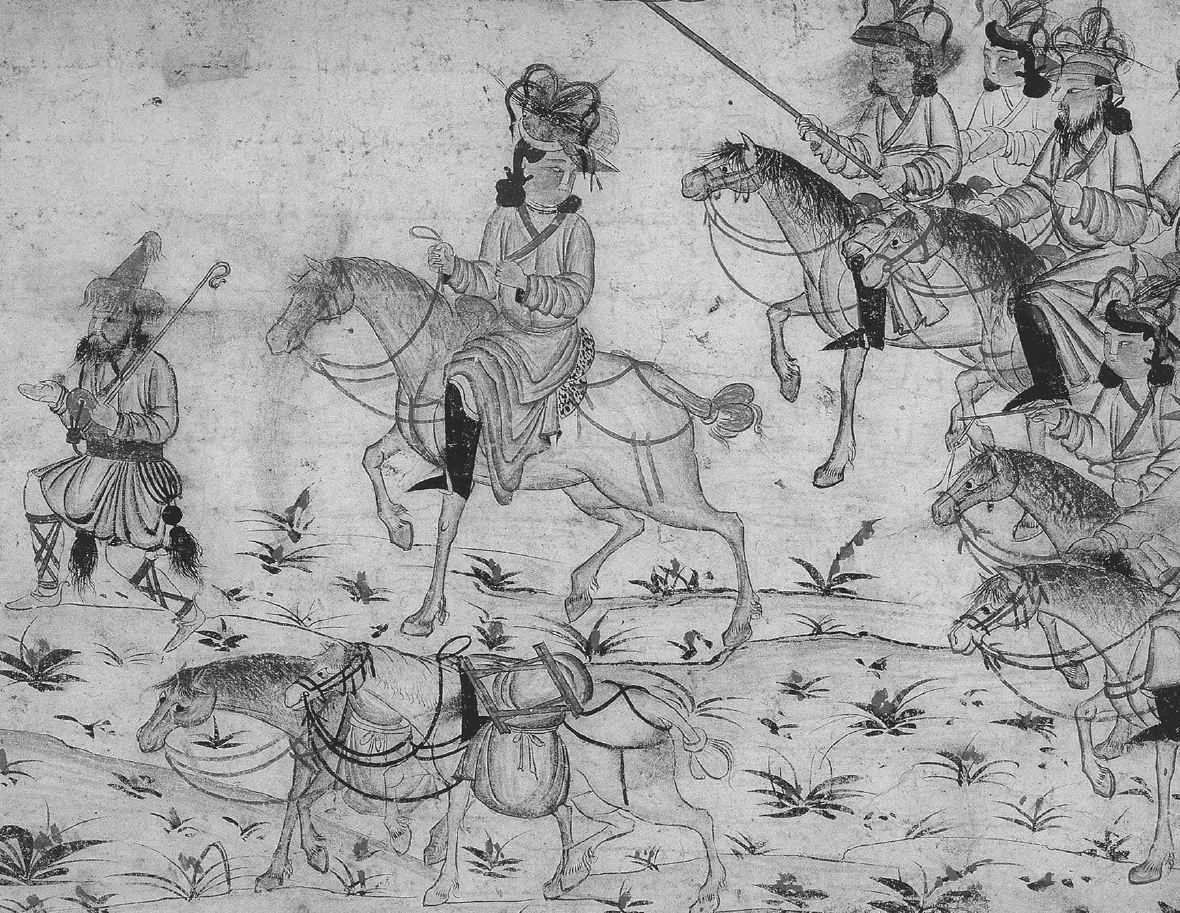
Fig. 8: The grandchildren of the Great Khan led very different lives from him and enjoyed the luxuries of court life
For the first time since the Arab conquests of the seventh century, Iran would exist as a state and a major regional, if not global, player. Contemporary chroniclers and those writing later in the Ilkhanid period recognised Hulegu as the reviver of the land of Iran, Iranzamin. Qadi Baydawi, a senior Sunni cleric whose theological expositions are still considered today, wrote a short summary of Iranian history more akin to agitprop than serious history in order to underline his support for Hulegu and the absorption of Iran into the Chinggisid Empire. His short history refers to Mongke ‘bestow[ing] Iran-zamin upon [Hulegu]’. Later, he describes Hulegu’s heir, Abaqa, as the ruler of ‘Iran-zamin’.2 Mustawfi portrays Hulegu and his kinsmen in Transoxiana and the Pontic steppe continuing the legendary battles between ‘lashkar-i Iran’3 and Turan. Shabankaraʿi, a Kurdish chronicler, describes the descendants of Hulegu as the ‘salaṭin-i Iran’, and the Tarikh-i Qarakhatayan written for their Perso-Khitan queen emphasises the concept of ‘Iran-zamin’4 which certainly chimed with Ilkhanid patronage of art and literature promoting the legacy of the Shahnama, as has been demonstrated in several previous studies.5
Hulegu Khan (1218–65)
During his youth, Hulegu and his brothers had been nurtured by their remarkable mother, Sorqoqtani Beki.6 She had instilled in her sons a love of learning and a respect for scholars. It was a trait found among steppe leaders and manifest in the popular practice of public debates. Where other cultures glorified the thrusts of sword play, animal taunting or jousting on horseback, the Chinggisids relished the clash of ideas and the drama of the debate. Rashid al-Din recognised the khan’s deep love of wisdom and his encouragement of debate and scholarship while admiring his court ‘adorned with the presence of scholars and wise men’. This was a view endorsed by Bar Hebraeus, another intellectual giant who had personal knowledge of the king, who believed Hulegu ‘was possessed of an understanding which endeared him to wise men and ulema, which was a characteristic he shared with his brother, Qubilai, who ‘loved wise men, the ulema and the godly of all sects and nations’.7 Many recognised in Hulegu the presence of farr or majesty which instilled in him the charisma needed for leadership. Nasir al-Din Tusi, almost as soon as he was ‘released’ from the Ismaʿili stronghold Alamut, found himself as Hulegu’s special adviser with enormous influence and power, a position he owed solely to his reputation for erudition and wisdom and his deep knowledge of science.
Qashani echoes Rashid al-Din when he writes that Hulegu ‘loved science, [and] was infatuated with astronomy and geometry; consequently scientists from East and West congregated at his court and his contemporaries were fascinated by different branches of learning, geometry and mathematics’. However, he continues, ‘In the time of Just Abaqa, … his intention was the promotion of farming, building and agriculture in such a way that his contemporaries followed and were guided by him’,8 and to complete the picture he claims that under Arghun industry and chemistry were the disciplines especially encouraged. The early Ilkhans are portrayed as surrounding themselves with the wise and the scholarly, there to be consulted and their opinions weighed and compared with their fellow experts. There was a belief at the time that Hulegu had embraced Islam, a tradition alluded to by the Safavid chronicler Ibn Bazzaz (d.1391) in the Ṡafwat al-ṡafa, ‘the padeshahs, Berke Khan and Hulegu Khan became Muslims’.9 One explanation for the emergence of such a tradition might have been to explain how an infidel could act so openly in the interests of Islam, which Hulegu very often did.10
The young Rukn al-Din had inherited the Ismaʿili throne following the death of his dissolute father, ʿAla al-Din Mohammad III (r.1221–55), for which many believed him responsible. As Hulegu approached his lair and his outlying castles in Qohestan and elsewhere fell and surrendered, the young Imam played desperately and hopelessly for time against the inevitable. Alamut’s ‘guests’, who often included the leading intellectual lights and thinkers of the country, advised him to negotiate with the advancing army and privately welcomed the advent of Hulegu. When finally their words were heeded and the king surrendered, Hulegu showed his appreciation by welcoming their spokesman, the world famous astronomer, scientist, theologian and thinker Nasir al-Din Tusi, into his inner circle and safe-guarding the future of a young Rashid al-Din and his celebrated Jewish family. Rashid al-Din confirms that ‘many poor people and Muslims had joined them [the intellectuals], and they were all in full agreement in making efforts to encourage the Khwarshah to surrender’. Despite Juwayni’s claim that he oversaw the destruction of many of the books in the famous library of Alamut, it is doubtful whether Tusi or Rashid al-Din’s family would have allowed such a despicable act of delinquency to occur.
Hulegu initially treated the young Rukn al-Din with kindness and respect and allowed him the hand of a young Mongol woman. It was on the arrogant insistence of the Khwarshah himself that he was eventually dispatched east to Qaraqorum and on the insistence of Mongke Khan that his blatant squandering of resources and manpower be punished by death, followed up by the death of the rest of his unfortunate community. Though many were subsequently killed, the Ismaʿili community retreated underground and behind the defence of taqiyya, as the aptly named poet, Nizari, recounts in his travelogue, the Safanama.11 When he was not visiting the dispersed communities of his co-religionists, the poet was employed as an official in the Ilkhanid administration.
Juwayni gleefully describes the final days of the ‘Heretics’, and as he stood high above the ruins on the fallen castle’s battlements he had a revelation and he suddenly understood ‘God’s secret intent’, God’s purpose in sending Chinggis Khan and especially the reason God had willed the coronation of the Great Khan, Mongke. Firstly, Mongke’s rule had resulted in the annihilation of this divine blasphemy and the destruction of their headquarters, Alamut; secondly, the Chinggisid Empire had allowed for the spread of Islam ‘even unto China’; and thirdly, perhaps most importantly, ‘the keys to the lands of the world’12 were now effectively in the hands of Muslims like him. Juwayni, whose father had entered Chinggisid service three decades earlier, had grown up in Mongol ordus. He had travelled the world and been educated along with the children of the Empire’s elite and had seen the ethos and working of the imperial machine from the inside. Juwayni, whose brother Shams al-Din was to become prime minister, had learnt his very Persian intellectual arrogance and acquired his very impressive literacy and education in the camps of the Mongol princes.13 Hulegu rewarded his faithful service by making him governor of Baghdad shortly after the city’s fall.
Hulegu famously went lion hunting as soon as he had crossed the Oxus. He continued to ensure that logistics were activated and preparations were in place to supply the huge army that he was leading into the west and that the people who had little choice but to host this mighty military machine were inconvenienced as little as possible. Though his call to arms contained a thinly veiled threat, it was met with an enthusiastic response and a popular muster of Iranian troops happy to follow Hulegu’s flag to Alamut and the gates of Baghdad.
I am setting out against the Heretics. If you send assistance in the form of troops and armaments and provisions and military supplies I will count it as a favour and your province will have peace and security, and if you neglect to do this when I become free from such concerns, I will deal with you and after that no excuses or apology will be acceptable.14
Just as the final siege of Alamut was joined by Iranian troops sent by the country’s loyal rulers from their various city states, so too was the fall of Baghdad facilitated by the combined massing of Iran’s united might. Hulegu requested that all Iran’s cities send troops to join his imperial forces and the call was met with little dissent.
[Hulegu] organised his armies in such a way that from the province of Pars until the province of Rum one body of men without limit and number descended upon Baghdad.
The army of Pars and Kirman came by way of Khuzestan and Shushtar. It was such that the army’s left wing came by the shores of the Sea of Oman and the right wing had merged with their troops from Iraq and the rest. The army of Rum proceeded from the border of Syria and Diyarbakr in such a way that their left wing joined with the armies of Arran and Azerbaijan while at the same time they poured from all sides into Iraq-i-Arab.15
THE FALL OF BAGHDAD
The fall of Baghdad in 1258 has been described in detail many times and eye-witness accounts are readily available. Hulegu had no plan nor desire to destroy the city, and it would have suited his vision for himself as the legitimate and just ruler of the region if the caliph Mustaʿsim had surrendered to him and accepted the hand of a suitably royal young Mongol princess, as his envoys had been attempting to arrange since embassies had been exchanged. Hulegu had already received the support and recognition from the Shiʿite community of Iraq al-Arab, whose spokesman, Ibn Tawus, had officially declared that an infidel but just ruler was preferable to an unjust Muslim leader. The Armenians had been long-term allies of the Chinggisids, and they along with the Georgian kings and the Kurdish warlords such as Badr al-Din Luʿlu, governor of Irbil and Mosul, now joined the ranks of the main army already swelled by the addition of the many Iranian troops from the provinces.
The caliph Mustaʿsim was a victim of his bickering courtiers and the internal politics of his palace machinations still locked in the vicious religious civil war which had been destroying the city-state for more than two years. While the Shiʿite minister Ibn al-Alqami advised talk and a negotiated surrender, a Sunni minister, Mujahid al-Din Aybak, the wily and ambitious nephew of the Caliph, fed paranoia and venom into the body politic and convinced the deputy of God that he could do no wrong and that these barbarians braying at his gates and the treacherous blasphemers undermining his government must be resisted and ignored. The envoys bearing gifts and honours which Ibn al-Alqami dispatched to Hulegu’s camp were intercepted and their treasures robbed while the letters that they contained bearing conciliatory words and urging compromise were produced before the Caliph as examples of Ibn al-Alqami’s secret correspondence and treachery. The Caliph, who was pathologically avaricious and even reluctant to pay his own soldiers, reacted with horror at this squandering of his riches. Instead of preparing for war, he sought solace in the arms of his dancing girls. Badr al-Din Luʿlu is recorded as despairing for the fate of his religion, Islam, when he received messages from both his allies; Hulegu demanded ‘artillery and siege material’ as contributions for the final showdown, and the Caliph demanded that he send him ‘a company of musicians’.16
Baghdad fell and the death toll, capped by the execution of the Caliph and his sons, was shocking. The victorious armies were permitted to indulge in a short period of plundering and looting, though strict limitations and restrictions were enforced. Most of the deaths were caused by unchecked pestilence, much of the widespread physical damage had been caused by the years of civil war and a devastating flood which had swept through the city some months before Hulegu’s arrival. Accounts survive of individual local notables coming to personal understandings with Chinggisid amirs, such as the musician ʿUrmavi, whose musical entertainment and lavish feast saved his district from destruction and ensured him an audience and future with Hulegu.17 Shaykh Tawus guaranteed the safety of the Shiʿite community and their mosques and homes in Baghdad, as did the arrangements of certain merchants and businessmen who had dealings with the Chinggisids elsewhere. Baghdad’s libraries, despite the later widespread reports of their destruction, were transferred to the safe-keeping of Nasir al-Din Tusi at his university and observatory in Maragha, along with a young novice librarian, Ibn Fuwati, who eventually succeeded Tusi as the director of the library and in fact oversaw the re-establishment of Baghdad’s libraries.
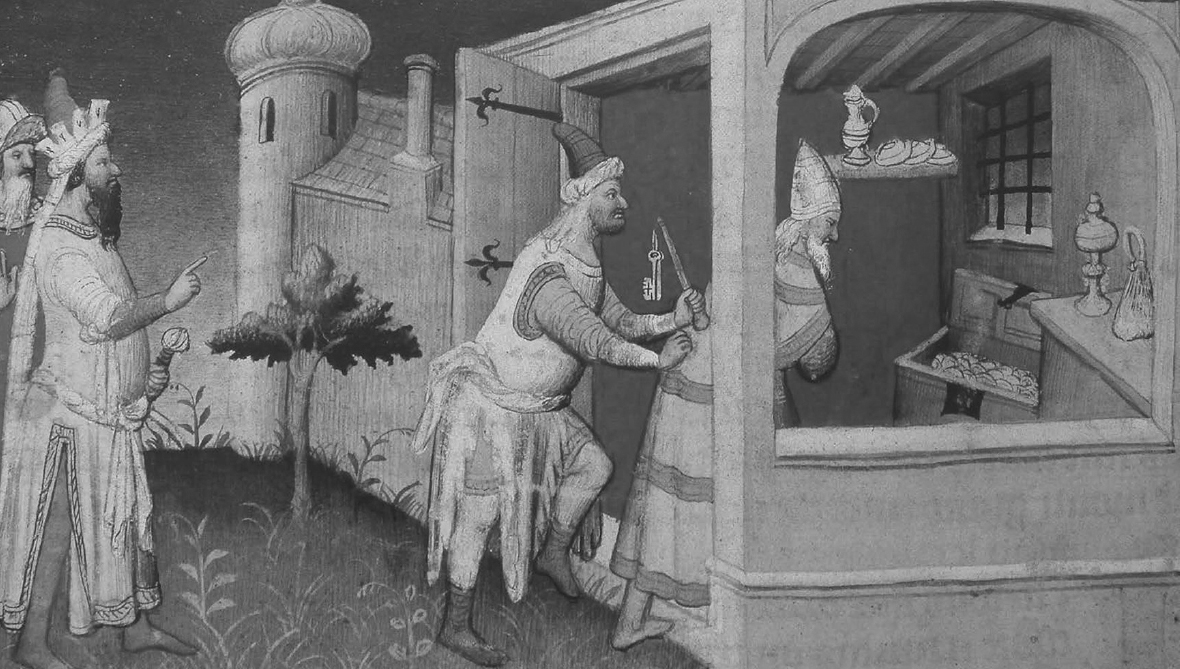
Fig. 9: Hulegu in Baghdad. According to some accounts the Caliph was invited to eat his fill of his precious treasures which he had hoarded rather than use to pay his armies
After the execution of the Caliph, swaddled in carpets and kicked to death as befitted a royal personage, Hulegu, who had himself contracted the pestilence, ordered the end to the violence and looting and the re-opening of the city and its bazaars. Ibn al-Alqami was appointed governor, which disproves those who accused him of treachery since any suspicion that he had acted against his legitimate master the Caliph would have disqualified him from office and would probably have earned him a death sentence. However, though Hulegu had judged him favourably, ‘[Ibn al-Alqami] is an intelligent man; he attends both to our interests and to those of his own master’, he died not long after taking office. In his stead ʿAta Malik Juwayni was appointed governor of Baghdad, and his brother, Shams al-Din, became prime minister, the two forming a very powerful alliance.18
Initially Hulegu established the bustling market town of Maragha as his capital. It lay not far to the east of the great inland lake of Urmiyya on the slopes of the Sahand mountain, the other side of whose peak nestled Tabriz, the economic heart of Azerbaijan. Initially Tusi’s famous observatory, the Rasadkhana, and his seat of learning with its 400,000-tome library, attracted visitors from all over the Empire, as Ibn Fuwati, the librarian and compiler of the biographical dictionary of all the library’s patrons attested. The Rasadkhana, eventually superseded by Rashid al-Din’s Rabʿ al-Rashidi, was twinned with the Yuan institution the Hanlinyuan (Hanlin Academy), providing an intellectual and cultural bridge between the Yuan and the Ilkhanate which found reflection in the vibrant and artistically rich life of their respective cosmopolitan cities.
The Ilkhanate developed through three periods. The first period saw Iran enjoy relative political stability, economic growth and cultural blossoming, underpinned by a sense of spiritual liberation as the restraints of an authoritarian ulema were replaced by an upsurge of Sufi schools and religious teaching flooded the whole region. In 1282 the reign of Ahmad Tegudar witnessed dissent and fatal weaknesses appearing in the ruling elite. The military objected to Ahmad’s unilateral, ill-conceived approaches to the Mamluks of Egypt and his relegation of authority to the crazed phantasies of a dangerous qalandar. Though his successor Arghun Khan imposed strong government, the fault lines between the traditionalists and the cosmopolitan Chinggisid Perso-Mongol elite persisted. When economic calamity threatened with the introduction of paper money, it was only the seizure of power by the young Ghazan Khan in 1295 that saved the Ilkhanate from disaster. The instability of the second period gave way to the so-called ‘Golden Age’, with Ghazan converting to Islam and proclaiming the Ilkhan king of all Iranians whether Turk or Tajik, Muslim or infidel. The Ilkhanate never actually went into decline; instead Abu Saʿid, the last Ilkhan, died without heir, and his death saw the collapse of the regime as Iran descended into chaos.
THE FIRST PERIOD
There were initially years of optimism and prosperity as stability returned after so many long tumultuous decades. Both Hulegu and his son, Abaqa Khan, received ‘good press’ as various communities reasserted themselves in this dynamic new climate. Merchants took advantage of the widely expanded markets, and the Silk Road entered the period of its greatest ever vitality. Artisans, many newly arrived from the other side of the Empire, exploited these same markets and created new domestic demand as people came to terms with this environment of stability and security, engendering a Persian renaissance to blossom. The odes of Saʿdi echoed not only in the diwans of Shiraz but on the far-off shores of Khinsa’i’s (Hangzhou’s) beautiful West Lake as merchants and traders, artisans and artists, adventurers and advisers, chancers and fortune-hunters, opportunists and romantics rode east creating the web and weave of empire building. This first period of Ilkhanid rule extended into Ahmad Tegudar’s reign (1282–4), coinciding with the successful founding of Qubilai Khan’s Yuan Empire and the establishment of his new capital, Dadu or Khanbaliq, constructed under the guidance of the Persian engineer, Jamal al-Din. The first period of Ilkhanid rule was spoilt by three military conflicts, namely the Battle of Ayn Jalut on 3 September 1260, the border skirmishes in the Caucasus initiated by Berke Khan, and finally the Battle of Herat, which threatened the stability of Khorasan and brought Abaqa Khan to the battle front in the east.
Ayn Jalut is often portrayed as a major Mongol defeat that destroyed the Chinggisid’s reputation for infallibility, a picture which is at the same time both completely false and accurate. As a military defeat its only repercussion was the tragic loss of one of Hulegu’s chief generals, Ket Buqa, who had been left in charge of the Ilkhanid forces in Syria while Hulegu was in the east contemplating travelling to Qaraqorum following his brother Mongke’s death. The Mamluks had launched a surprise attack on Ket Buqa’s small army and had won a victory which included the capture of the general and his family. As a military victory it was of no real consequence, and the balance of power was not upset; but as news of the battle spread, the propaganda value of this defeat ratcheted up dramatically. In fact, in the jungles of Vietnam, Qubilai’s forces under the command of Uriyangqadai Noyan, suffered a far greater military setback, and the Mongol armies fresh from their victories in Yunnan province over the Kingdom of Dali had been ignominiously expelled from the country by the Dai Viet. The minor clash assumed such importance because it signified the formal alliance of the Golden Horde under the Jochid Khan Berke with the Mamluks of Egypt, the first time a Chinggisid khanate had formed an alliance with a non-Chinggisid polity against another Chinggisid khanate. Relations between the Jochids and the Toluids had been deteriorating since the death of Batu in 1255 and the opposition of Hulegu and Qubilai to Berke’s assumption of power. The Jochids had made it clear that they had designs on Iran, and their presence had caused strife even before the execution of the three Jochid princes Balagha, Tutar and Quli.19
[The Jochids] exercised authority in the realm [dar mulkḥukm mikardand]. If ever Hulegu nominated their forces for some task, they would openly say, ‘Since our troops do most of the work, let him, namely Hulegu, not threaten us’ […] It was also the case that Berke’s shaḥnas and governors and his family held the choicest and best territories in Khurasan, Iraq, Azerbaijan, Arran and Georgia, and used to say, ‘They are our inju that is, our private property.’ And on every possible occasion factious persons would say things to aggravate the situation.20
Hulegu allowed the stalemate in Syria to continue, and the region became a ‘playground’ for Mamluk and Ilkhanid troops to skirmish and exercise with the status quo only occasionally upset by deeper incursions by either side. Hulegu had formed a Toluid alliance with his brother Qubilai whom he alone had supported as the new Qa’an. Qubilai’s coronation had split the Chinggisid Empire politically and culturally, with the traditionalist regimes of the Golden Horde, the Chaghadaids and the re-emerging Ogodaids under Qaidu viewing the Toluids as renegades, almost blasphemers, against the ideals of Chinggis Khan with their open courting of Persian and Chinese culture and the prominence of non-Mongol men of great influence and power in their ranks and administrations.
Trouble flared periodically in the Syrian desert and Baybars conducted a campaign into Anatolia in 1277 which resulted in the fall of the Ilkhanid representative there, the Parvana, who met a particularly grisly end under a cloud of suspected treachery. It was even suggested that he was eaten by the troops that had seized him.
A second military front was established in the Caucasus, always a much coveted region by whoever controlled the lands to the south and north of that forbidding mountainous barrier, after Berke launched a series of punitive but ultimately unsuccessful campaigns. Abaqa erected a barrier along the River Kur, manned by ‘Mongols and Muslims’, and established a base in Darband under the command of his brother prince Mongke-Temur with Samaghar Noyan and Oljai Khatun. After Berke’s death in 1266, his successor Mongke-Temur Khan (d.1280) did not pursue the conflict with such passion, and trade routes were once again opened while Abaqa became more concerned with trouble brewing on his eastern front.
In the east trouble arose after the ambitions of the Chaghadaid strongman, Baraq, were caressed and stimulated by the whispered words of the devious and very determined Qaidu Khan, who wished to restore the Ogodaid house to the place of honour in which it once stood. After the Talas quriltai of 1269 had determined that the lands of Turkestan and Transoxiana be divided between Mongke-Temur Khan of the Golden Horde, Qaidu Khan representing the Ogodaids and Baraq Khan, the Chaghadaid leader awarded control of two thirds of the land, all past enmity and conflicts were to be forgotten and the three Chinggisid rulers would form an alliance against the Toluids of China and Iran. The treaty had been devised to quiet the misgivings that the Jochid Khan and Qaidu felt towards Baraq and his propensity for violence and unwarranted savagery. Though it awarded Baraq generous land rights, it also severely restricted his access to the great cities of the region including Samarqand and Bokhara and forbade his unruly tribesmen from entering urban areas and from raising taxes from urban people while stipulating that his camps be based deep in the steppe.
Such restrictions did not cover the lands of Iranian Khorasan however, and it was to the Ilkhanate that Baraq turned his attention in search of an answer to his financial woes. He launched his attack on Herat in 1270 with the moral and spiritual support of Qaidu after first sending his chief minister, Masʿud Beg, to gather intelligence from Abaqa’s court. Ultimately Baraq was fed misinformation and after initial successes on the plains outside Herat, he was encouraged to proceed with his invasion of Iran, leaving the city of Herat intact behind its walls, in the hands of one he thought to be a solid ally, Shams al-Din Kart, whose subterfuge saved his city but not his skin. Abaqa executed this loyal ruler of Herat after he had dealt with the Chaghadaid threat. Baraq was routed and was forced to beg a horse to escape the field of battle. As has been described elsewhere, it was an ignominious ending for an ignoble despot. While the Jochid khan, Mongke-Temur, sent a congratulatory message to Abaqa, Qaidu consolidated his near total control over the region, a troublesome ally now permanently disposed off.
Abaqa Khan died suddenly of delirium tremors and left the throne to his brother, though support was strong for his reluctant son, Arghun. It is often assumed that it was because the new Khan, Ahmad Tegudar, professed Islam that the ruling Mongol amirs turned against him and ultimately deposed the third Ilkhan, son of Hulegu. In fact Iran’s clerics were no more supportive of the new Ilkhan than were the amirs, and generally speaking Ghazan Khan is still credited as being the first Muslim Ilkhan. Iran’s clerics found the Ilkhan’s practice of Islam deeply embarrassing, and there is no evidence that Ahmad had ever experienced a formal ceremony of conversion or had ever been instructed in the details and fineries of the religion. He was assisted in his religious duties by two extremely suspect figures, Shaykh Kamal-al-Din ʿAbd-al-Rahman and the hashish-crazed qalandar Ishan Hasan Mangoli, while he left the government in the hands of his mother, Qutui Khatun, and the amir, Asiq. He sent the Shaykh on an embassy to Cairo to see the sultan, Qalaun (r.1279–90) against the wishes and advice of his military; and the Mamluks neither replied nor returned his ambassador, the Shaykh, who died in Egypt. Ahmad’s execution of his brother, Qonghurtai, ‘a wise and powerful cypress’,21 on charges of conspiracy with his nephew, Arghun, provided the pretext for action, and in 1284 Ahmad was captured by forces loyal to his nephew, Arghun, and was executed by the breaking of his back, in the same manner as his own execution of his brother, and the throne was awarded to Arghun, an action eventually endorsed by Qubilai. It had also been Ahmad’s rehabilitation of the Juwayni brothers, powerful men with powerful enemies, and the execution of their principal antagonist, Majd al-Mulk Yazdi, that had angered influential insiders and Ahmad had not had the political instincts or nous to manoeuvre among and manipulate the many competing factions that had surrounded him.
THE SECOND PERIOD
The second period of the Ilkhanate covers the instability initiated by Ahmad’s ascendency. The economic and resulting social chaos that Iran was plunged into, during the reign of Gaykhatu in particular, provided Rashid al-Din with enough political ammunition to build himself an unassailable and fortified position. The portrait of himself as chief minister to the reforming sultan and champion of Islam had gone unchallenged until very recently. Trouble at the top and insecurity down below typified the years from 1282 to 1295, the year when the young Ghazan seized the throne. These troubled years spanned the reign of Arghun Khan, who never embraced the Toluid vision with the enthusiasm and conviction of other princes. Accusations that he harboured feelings of antagonism towards Muslims and his Persian subjects are generally unfounded and often without any basis. Unfortunately, his memory will forever be tainted by his treatment of the Juwayni brothers, whose demise he oversaw, believing the smears and lies of their detractors. Arghun was a strong leader however and stands in sharp contrast to his two successors, Gaykhatu (r.1291–5) and Baidu (r.1295). While Baidu’s main claim to fame is that he waged an ultimately unsuccessful military campaign against Ghazan Khan, Gaykhatu is remembered for his reputation for debauchery and the corruption of the young, as well as his disastrous introduction of the chao, which had proved very successful in Yuan China but led to economic collapse in Ilkhanid Iran.
Arghun’s strength lay in the support he enjoyed from the military and may account for some of the less than sympathetic press he received in the chronicles. His reputation for being anti-Muslim can be traced to his persecution of the Juwaynis, who unfortunately received a fate not uncommon among Ilkhanid courtiers; the support he gave to his able but manipulative and nepotistic chief minister Saʿd al-Dawla ibn Hibbat Allah ibn Muhasib Abhari (1240–91); and his baseless association with a fantastical plot to destroy Mecca. Examples of his sympathy for Islam is provided by the Sufi poet ʿAla al-Dawla Semnani (1261–1336), whose personal narrative contains his own recollections of the Khan, including one evening when Arghun came close to converting himself. Semnani was Arghun’s nadim who attended the Prince at all times, including in battle when the two rode together against Ahmad Tegudar. Though he was most reluctant to allow him to go, Arghun eventually granted Semnani leave to retire from royal service to enter a religious retreat. Semnani pledged that he would never consort or communicate with people connected with the court or government. He kept this promise to Arghun, such was his respect for the Khan, when 30 years later he was consulted by the Muslim army commander Amir Chopan. The plot to subvert Mecca by founding a new religion based on Chinggis Khan as a prophet and converting the Kaʿba to a pagoda was purportedly suggested to Arghun by Saʿd al-Dawla. There is no evidence that Arghun even knew of the idea, and the story appeared in Wassaf’s history, more than three decades after his death.22
It was Arghun’s enthusiasm for Saʿd al-Dawlah that fuelled the stories of his animosity against Islam. However, Arghun’s enthusiasm was justified; as a minister Saʿd al-Dawlah was most capable and proved effective in strengthening the economy. He had won the approval of King Arghun after his successful unearthing of the financial irregularities of two ministers, Buqa and his brother Aruq, who for many represented all that was intrinsically wrong with the rule of the khans. Buqa’s major role in Arghun’s struggle against his uncle, Ahmad, enabled the brothers to centralise power in the hands of the noyat, the Mongol military elite, but their machinations were halted and Arghun Khan appointed his Jewish mustawfi to clear up the mess.23 Saʿd al-Dawlah’s fatal error was his nepotism, practised in a Muslim country, thereby calling attention to himself and his infidel family. Most chronicles grudgingly concede his financial competence, but a whispering campaign of satirical tracts, libellous stories and unsupported claims undermined Saʿd al-Dawlah’s credibility. ‘Behold […] there is a Jew governor and general director on the throne of the House of ʿAbbas. Observe how Islam has been brought low.’24 After Arghun’s death the rabble found the prime minister and a pogrom ensued. The mob was congratulated by a local Arab preacher, Zain al-Din Ali, for ridding the world of the ‘foulest race who e’er on earth did thrive’ and praising the Amir Tughachar whose ‘flashing falchion on their flesh did feed’ and whose treachery had lured the unsuspecting minister to his house for dinner.25
If Arghun did not deserve the negative reaction his memory excites, Gaykhatu certainly does, and his short reign plunged the country into near economic disaster. While the Ilkhan Gaykhatu embarked on an orgy of indulgent debauchery, the country was forced into an economic experiment from which it is fortunate to have returned. Gaykhatu is known for two things only, neither of which impart honour or credit. His lust for young flesh either male or female was insatiable and it is said that ‘in his day, there was not a beauty who was not called upon to satisfy him […] His excesses were such that there was no sign of kingly virtue in him.’26 To finance his expensive appetites, he made demands on an economy weakened by the uncertainties of a chaotic political transition that could not be met. His demands led to the introduction of the chao, which while successful in Yuan China was a system unknown and certainly not trusted in western Asia. In 1294 Iran’s economic situation had been compounded by the spread of a devastating livestock disease, yut,27 and Gaykhatu’s prime minister Sadr al-Din Zanjani in consultation with Bolad, the ambassador from the Yuan court, convinced themselves of the viability of introducing paper currency. The chao flooded Tabriz and merchants were ordered to trade in it on pain of death for failure to comply. Within days, gold was allowed to be used for the purchase of food as bazaars closed and commerce came to a halt. The experiment lasted two months, but the detrimental impact on the economy lingered far longer. However, the implementation of the chao did enable the introduction of block printing to Iran from China.
Gaykhatu’s reign came to a close in character. The Ilkhan had reacted to a perceived insult from his cousin Baidu during a drinking session by having him severely beaten up by his henchmen. Baidu was left badly beaten and determined on bloody revenge; Gaykhatu was strangled in March 1295. Wassaf punned in plain language the universal disapproval of a dynasty, ‘with his reign behind him, Gaykhatu’s true love that is the behind, was shown’.28
[A] man who had no laws or faith and was also powerless in arms. Giving himself up entirely to debauchery and sin, he led the life of a dumb beast, a slave to the belly. He reigned for six loathsome years.29
Strangely enough, apart from depravity, Gaykhatu was also well known for his generosity and clemency. The generosity could more accurately be interpreted as financial recklessness and his clemency, which ultimately cost him his life, arose from his belief that Arghun’s early demise was directly linked to the number of nobles, princes and innocents whose blood he had shed.
Baidu’s brief reign does not even warrant a mention in Rashid al-Din’s mammoth history. Its main significance is that it allowed an easier transition to Ghazan’s ascension of the Ilkhanid throne in 1295 with Ghazan’s blood link to Hulegu through Arghun Khan rather than Baidu’s via Taraghai. There was a reshuffling of supporters, a re-alignment of amirs with the serial defector and pogromer, Taghachar, joining Ghazan’s camp, and for the first time religious affiliation became an issue. Baidu called upon Christians to flock to his cause, while Ghazan ensured the support of Arghun Aqa’s son, Nowruz Noyan, after he had unequivocally proclaimed himself a Sunni Muslim.
THE THIRD PERIOD
The third period of Ilkhanid rule opens with Ghazan Khan and closes with the untimely death of the young Abu Saʿid, who died without male issue and therefore without a successor. It is for this reason that the Ilkhanate is seen as ending without the usual decline but at the climax of its prosperity. The last three Ilkhans, Ghazan, his brother Uljaytu and Uljaytu’s son Abu Saʿid, were all Muslims and their reigns have often been referred to as the ‘Golden Age’. That, however, might well be relative and indicative of the chaos and brutality of the turmoil which followed the death of Abu Saʿid.
Ghazan Khan (r.1295–1304)
For many, Ghazan Khan’s embracing of Islam and the proclamation of Ilkhanid Iran as a Muslim state overshadows all else in the history of this period. Taking a selective lead from Rashid al-Din, the four decades before his conversion are dismissed as days of darkness and despair, a jahiliya from which Ghazan rescued the country. However, though Ghazan’s reign was extremely important and it did act as a watershed, it was not his conversion per se which was important. It was more his announcement and his determination to be a king of all Iranians, both Turk and Tajik, which was of such crucial significance. His conversion to Sunni Islam was just the external manifestation of his vision, and the earnest questions concerning the extent of his religious conviction and his sincerity are missing the point. Ghazan Mahmud Khan had decided that he had to unite his country and that he had to heal the growing rifts between antagonistic factions. Since the majority of the people of Iran were Sunni Muslim, it should be incumbent on the king to reflect that majority. Growing numbers of his multi-ethnic army were adopting Islam, including some powerful amirs, and most of his administration were Muslim. It mattered little if his heart was Muslim, as long as he was seen by his subjects as having accepted the tenets of the religion and that the religious leaders should accept him as a sincere convert. In fact, it would appear that Ghazan was genuine in his professed beliefs, despite some lapses and attachment to the religion of his forefathers, and the act of conversion was overseen by a reputable and widely revered cleric, Shaykh Sadr al-Din Ibrahim al-Hammuya.30
One reason that doubts have been cast on Ghazan’s conversion is his marriage to a wife of his father, forbidden under Sharia law. Rather than simply ignoring the convention or taking the woman in question as a concubine, Ghazan sought justification and legitimacy from the Islamic courts and a fatwa was duly passed in his favour. Ghazan was a pragmatist and a politician, and he would have been well aware that conversion at that particular time was extremely opportune and empowering. Though he made no claims to be a caliph, as a Muslim sultan he had the power to appoint qadis and to exert influence on the ulema. He was also in a position now to challenge the Mamluks and their claims to be guardians of Islam, a presumption he believed their questionable lineage disqualified them from and his own royal blood qualified him for. On his side, he not only had many respected clerics but his own chief minister, Rashid al-Din, whose theological tracts and expositions provided defence and learned responses to the bigoted venom, propaganda and doctrinal snares that emanated from Cairo. Rashid al-Din’s informed reasoning was a ready match for the malignant rantings of the jihadist Ibn Taymiya, and their respective analyses of the nature of jihad would not be out of place in the social media chatrooms of the twenty-first century.31
With Ghazan accepted by all his citizens, Turk and Tajik, as their legitimate king, Iran entered its traditional role in western Asia as the counter to the Arab and Byzantine world. Meanwhile, within the country, the rivalry had developed from that between perceived natives and newcomers to a struggle between the old guard, traditionalist amirs and the believers in the Ilkhanid ideals of a multicultural, multi-ethnic Iran. There were still Mongol amirs who hankered after the life of the steppe and the ascendancy of the nomadic life. They believed in the Great Yasa of Chinggis Khan and applauded the tales of yore, where men-of-the-sword were subservient to none and Tenggeri and his manifestations in rock, water and earth ruled supreme. They were outnumbered however by those from all backgrounds who had fully embraced the rich renascent culture of the Toluids and the emergence of artists, artisans, thinkers, wordsmiths, musicians, merchants and scientists, intellectual colossi all versed and bred in the synthesis of Persian, Chinese, Turkic, steppe, Abrahamic and Buddhist cultures, nurtured across the mountains, rivers, steppes and deserts, forests and cities of Asia. This dichotomy was played out to various degrees throughout the Chinggisid Empire. In the Toluid lands of Yuan China and Ilkhanid Iran, the steppe was held in check by the sophistication of the urbanites; whereas in the northern lands of the Golden Horde and the Eurasian steppe lands, the traditionalist followers of Chinggis Khan’s Great Yasa were dominant. The rivalry in both Iran and China rarely broke into open conflict, but the tension underlined the politics of the region. During Ghazan and his brother Uljaytu’s reign, the nature of the compromise is laid bare in the writings of the world’s first universal historian, Rashid al-Din.
The Ilkhanate provided a healthy climate for such noted erudition. Intellectual giants such as Rashid al-Din, Qutb al-Din Shirazi and Ibn Kammuna, the Jewish philosopher, were not alone or unique and did not exist in a vacuum. What Ghazan lacked in physical allure – ‘amongst all his host of 200,000 Tartars you should scarcely find one of smaller stature or of uglier and meaner aspect than this Prince’32 – he made up for in cerebral prowess. He was reputedly a linguist, speaking, besides Mongolian, some ‘Arabic, Persian, Turkish, Hindi, Kashmiri, Tibetan, Cathaian (Chinese), Frankish and other languages’,33 as well as being versed in learning in the tradition of his forefathers. Bolad Chingsang, Yuan China’s ambassador and Mongol noble, was Rashid al-Din’s intellectual partner and a link to the scholarship of China. Bolad ensured that links between the Rab al-Rashidi and the Hanlinyuan were maintained. Rashid al-Din had inherited the intellectual prestige of Nasir al-Din Tusi’s Rasadkhana for his own seat of learning, but by 1300 the Ilkhanate and its capital Tabriz were well established as cultural powerhouses with poets finding ready patronage, painters and miniaturists provided with ateliers, potters given inspiration and instruction from Yuan masters, and architects funded for ambitious projects. The dire consequences foreseen after the destruction of the House of ʿAbbas never materialised and instead the region entered a period of spiritual rejuvenation with Sufi lodges and spiritual hospices proliferating. Charismatic leaders such as Shaykh Safi al-Din of Ardabil (d.1334) became magnets for the faithful and lent legitimacy to their powerful patrons such as the Ilkhans whose courts they frequented. If the appearance of qalandars34 provided fuel for the invective of Iran’s Sunni neighbours, mention of the spread of Islam to China, the Indian Ocean and throughout Turkestan and the transformation of a once Arab dominated religion into a global faith would silence them. One reason that the Chinggisid Empire is so well documented is that the khans were always great patrons of chronicles and history. The Hanlinyuan in Qubilai’s capital, Khanbaliq, specialised in the production of history books, while throughout the Empire peoples from every clime were fully aware that they were living in exceptional times and they were anxious to record history in the making.
Rashid al-Din’s Compendium of History was embarked on at Ghazan’s request, but it was Uljaytu who commissioned its final form, a universal history, covering the people of Europe, India, Jewish Palestine, Turkestan, Mongolia and China, as well as selective individual dynasties, written in Persian and Arabic and intended to be available for all.35 Ghazan wished to protect the memory and history of the Mongol people, aware that the Chinggisids were metamorphosing in new and unpredictable directions, and Uljaytu wanted to ensure the central position of the Chinggisids in this new world. Rashid al-Din had a team of researchers and scholars at his disposal as well as Bolad, who allowed him access to ‘secret’ Mongol texts which have now become the only known copies of such singular sources. However, it was not only priceless historical data that Rashid al-Din recorded in his majestically illuminated volumes. In his capacity as Ghazan’s prime minister he also had unrestricted access to legal texts and detailed records of the laws, reforms and political speeches that Ghazan produced in the nine years that he was in power, all of which he was able to reproduce in his historical record.
Ghazan’s reign is possibly the most thoroughly scrutinised and critically analysed of any of the Ilkhans, and it will suffice here to summarise the significance of his rule in Iran and the wider regional context. Ghazan accepted fully that he was an autonomous king of a multi-ethnic state and that after the political and economic instability of the past 12 years, his primary task was to bring stability and prosperity to all his people. He announced his conversion and struck coins that dropped the title of ‘Ilkhan’ and adopted the titles of Islam and Iran. Though he and his successors were still addressed as ‘Ilkhan’, the title has been found used on only one Armenian coin. Even though his new bellicose title played well to his Persian subjects and emphasised his independence, relations with Yuan China were at their closest under Ghazan.
Padshah of the World, Shahanshah of Earth and Time, Sovereign Lord of the Kings of Iran and Turan, Manifestation of the Copious Grace of God, the Visible Sign of Islam and the Faith, a Jamshid, Dispenser of Justice, Animator of the Custom of World Domination, the Elevated Banner of Sovereignty, Bestower of the Carpet of Justice, an overflowing Sea of Compassion, King of the Domains of Monarchs, Heir to the Chinggisid Throne, Shadow of God, Defender of the Faith of Allah to the Ends of the Earth and Time.36
Foreign policy did not change and Chinggisid unity remained an elusive goal. War with Cairo intensified, though Ghazan could now argue that his royal blood and his support of a learned ulema made him the more qualified to champion the cause of Islam. Ghazan enjoyed a major if short-lived victory against the Mamluks, driving them out of Syria in 1299 at the Battle of Wadi’l-Kaznadar and capturing Damascus while envoys were dispatched to Europe to enlist papal support. The Golden Horde continued with their claims on the Caucasus, and in 1301 Ghazan repelled a military incursion which reached Darband, though this was followed by a delegation from Toqta to reiterate these claims.
Ghazan’s wide-ranging reforms were aimed at placating arrogant and powerful, often Mongol, amirs, satisfying the aspirations of an increasingly influential administrative and merchant class, and meeting the calls for justice and stability from an exploited underclass that now included impoverished Turks and Mongols as well as more native Iranians. Ghazan drew up laws to curb the excesses of greedy officials and instigate regular and realistic taxation schedules. Only authorised, identifiable officials would be permitted to collect specified amounts of taxes on specified dates; the army would be paid once again through the granting of iqtaʿs; the widely hated barat was outlawed; weights and measurements, and coinage would be regularised and monitored; all land claims over 30 years old would be investigated; the yam network would be reformed and those authorised to use this elaborate ‘postal system’ severely restricted; and the tyranny of ‘muleteers, camel drivers and messengers’ would be curtailed since it appeared that these street people were organising protection rackets against merchants, shopkeepers and the rich by demanding money with menaces.37 The reforms were wide reaching and very welcome, and they revealed a thoughtful rather than ideological intent, and though Ghazan made appropriate reference to God and his Prophet at the proper times his reforms were practical and based in reality. For example, while decrying the evils of alcohol, the law did not attempt to prohibit consumption, but rather public drunkenness was banned, a law to which few would object. He did not outlaw brothels, but he banned the coercion of girls to work in them.
One very welcome surprise was a generous tax incentive for those seeking to utilise unused land. Open land was considered almost sacrosanct by nomadic herders, who resented any impediment to their right to roam, so this offer sent a clear message to his subjects on both sides of the divide. His willingness to compromise and his awareness of the conflicts that he knew he had to confront is illustrated by the speeches he made to both his fellow Mongols and to his Muslim subjects. Addressing the Mongol amirs, he sympathised with their desire to exploit and rob the peasants: ‘If it is expedient, then let me pillage them all – there is no one with more power to do so than I. Let us rob them together.’ But, he cautions, what of the future when the people have been bled dry? Later on, he seems to let his guard slip and he reveals his true nature, ‘[T]hey are human being, just as we are.’38
Rashid al-Din was a politician who also had an eye on the history books, and his position as well as that of his master and therefore his reports on contemporary matters must be treated accordingly. He claimed that Ghazan encouraged the attacks on Christian churches and temples, no doubt to bolster the Shah Ghazan’s Islamic credentials with the ulema; whereas it is well known that Ghazan acted immediately and harshly against any such unauthorised infractions whenever he came upon them. Ghazan was a popular king with all his subjects and he was successful in his attempts to unite his country. Divisions remained and would continue to cause some discontent until the early years of Uljaytu’s son Abu Saʿid’s reign, but they never threatened the throne or caused the instability seen in Ahmad and Gaykhatu’s reigns. Ghazan succeeded in establishing Iran as a Muslim state and a political entity strong enough to endure the period of anarchy which followed the collapse of the Ilkhanate.
Uljaytu (r.1304–16)
Uljaytu, was born to Uruk Khatun, a Christian Kereit, and baptised Nicholas. His godfather was said to have been Isol the Pisan, also known as Ciolo Bofeti di Anastasio or Zolus Bofeti de Anestasio, an Italian merchant and diplomat who had resided at Ghazan’s court and is believed to have been one of Rashid al-Din’s sources on the European states. Uljaytu’s mother’s father was the brother of Dokuz Khatun. For Mustawfi, Uljaytu’s ascent signalled a time of peace and security and the implementation of the reforms that Ghazan had initiated. Certainly, his reign had an auspicious beginning when elchis arrived from the Great Khan to celebrate his coronation and herald a treaty of Chinggisid unity that Qa’an Temur had negotiated and the new Ilkhan soon publicised. Uljaytu sent his ambassador, Buscarello de Ghizolfi, with his royal sword-bearer Tomazo Ugi of Siena to the Frankish courts of the Doge of Venice, Edward I of England, and Phillipe the Fair to boast of the renewed unity of the Chinggisid khans.
We, Temür Qa’an, Toqta, Cahabar, Du’a and others the descendants of Chinggis Khan, after recriminating one another for forty-five years down to these recent times, have now […] reached a mutual agreement, and from the land of the Nankhiyas (Chinese) to the sea of Talu (Mediterranean), we have caused our post-stations (Jam) to be linked together.39
Though the Chinggisid unity was short-lived, post-Ilkhanate commentators viewed this whole period of Iranian history with nostalgia. ‘In that time of [those Ilkhan] Kings, Iran was tranquil and free from the aggression of intruders, especially in the days of the Sultanate of Ghazan Khan, Uljaytu Khodabanda and Abu Saʿid Bahadar Khan.’40 It was an age seen from 1362 as ‘admirable and luxuriantly cheerful like the Garden of Paradise, tranquil and secure like the sanctuary of the Ka’ba’,41 a view echoed by a Jalayrid historian (c.1360), Abu Bakr al-Qutbi al-Ahari,42 who saw Ghazan’s reign as a time of peace and justice. ‘During that time the whole of Iran was graced by the justice of the King of Islam, who held back the oppressor’s hand from (harming) the oppressed’,43 and under the rule of his brother, Uljaytu, ‘the country (was) flourishing and the army well organised’, reaching its apogee in the time of Abu Saʿid. ‘The time of his government was the best period of the domination of the Mongols.’44
The magnificent edifice of Sultaniya with its double-skinned dome is a permanent monument to not only the legacy of Uljaytu Kharbanda45 but also Ilkhanid Iran’s pride in its Islamic and intellectual past. Sultaniya, originally conceived by Uljaytu’s father, Arghun, was built to celebrate Islam and to encourage learning, debate and public access to scholars and education. Doctors of medicine and of philosophy, artists and artisans, agriculturists and botanists, veterinarians and physicians would all be on hand to exchange expertise and dispense knowledge and learning, and the public would be free to wander those hallowed halls to listen, observe and possibly even partake in the august and lively proceedings. So enamoured was Uljaytu with intellectual pursuits that it is said he constructed a special ‘madressa [madrasa] made of canvas with four porticos and chambers’ that would accompany him on trips away from his palaces.46
Uljaytu had been baptised a Christian, but converted to Sunnism with his brother Ghazan. However, he became disillusioned by the constant bickering of the ulema. Qutlugh-Shah Noyan, his chief-of-staff, had expressed his disgust at the distasteful insults which the Sunni sects traded during the staged theological debates which Uljaytu, like all the leading Mongols, relished greatly. Qutlugh-Shah was so disturbed by the venom expressed during these religious debates that he pleaded for the court to return to the religion of their forefathers and abandon this vindictive Arab religion whose multiple sects, he claimed, even endorsed incestuous marriage.47 Under the influence of Shiʿite theologians such as al-Hilli and Maitham al Bahrani and influential figures such as Shaykh ʿAla al-Dawla Semnani and Qutb al-Din Shirazi, Uljaytu compromised by allowing the practice of some ancient Shamanist rites and the presence of bakhshis at court and by announcing his adherence to Shiʿite Islam. A certain Taremtaz compared the Shiʿa with those who believed in the laws of monarchical succession and that the throne belonged to the legitimate heirs of Chinggis Khan. The Sunni, he explained, were like those who believed the throne belonged to the amirs and subjects.48 Henceforth the khutba honoured his name and those of ʿAli, Hasan and Husain.
While Uljaytu agonised over the fate of his soul, the soul of the state was split between his two ministers Taj ʿAli-Shah and Rashid al-Din, who fought over the expenses for the ballooning bureaucracy and the military. Rashid al-Din’s age and failing health prevented him from defending himself effectively from his many jealous and corrupt detractors. Although it was under the rule of Uljaytu’s successor Abu Saʿid that the great statesman was executed, the machinations were struck and initiated under Uljaytu. Since the wheels of government had been slowly implementing many of those reforms instigated under Ghazan, in 1307 Uljaytu allowed himself the luxury of attempting to subdue the inaccessible, outlaw province of Gilan which had repelled all attempts at taming it for 40 years. His pyrrhic victory resulted in his general Qutlugh-Shah’s death and the melting of the enemy forces into the forests of Mazanderan thirsty for revenge. Emboldened by the death of Qutlugh-Shah, Ozbeg Khan (1282–1341, r.1313–41), the ambitious Jochid ruler, encouraged the mercenary, periodically disruptive Qar’aunas from the eastern marches to mount raids into Khorasan, but Iran’s borders remained generally secure. Uljaytu was a great Ilkhan who is often overlooked because he brought peace, quiet and security to his country.
ABU SAʿID (R.1316–35)
Uljaytu’s son, Abu Saʿid, had a far more disruptive court when he ascended the throne at the young age of 11. His chief-of-staff was Chopan, who had replaced the very capable Qutlugh-Shah. The Muslim Chopan Noyan headed a large and ambitious family, and he immediately took on the responsibilities of kingship for himself. Though not of his engineering, he did not prevent the execution of Rashid al-Din on the spurious charge of having poisoned Uljaytu, and once in power he contrived to shape events in his favour, including a showdown with the Mongol amirs. This was a split that had existed for generations but Chopan enflamed it in order to cast himself as the hero of the Ilkhan against the forces of reaction. He cemented his position with his marriage to Sati Beg, Ghazan Khan’s sister.
Abu Saʿid’s reign was defined by his relations with the Chopan family. Entrusted by his father, Uljaytu Ilkhan, to the care of Chopan Noyan, he first had to fight for his voice and his independence. Dominated by the father, Chopan Noyan, the young king then found himself humiliated by one of his protector’s sons, Demasq Khwaja, and threatened by another, Temutash. Finally, he found his heart completely captivated by Chopan’s daughter, Baghdad Khatun, with whom he fell wildly in love but whose murderous jealousy he aroused by courting the new generation of family, the beautiful, Dilshad. However, though he used that situation cleverly and to his advantage, ultimately his relations with the Chopan family destroyed him and the Chopanids were instrumental in destroying Iran.
Chopan Noyan moved to bolster the young king’s position and defend him from the intrigues of the Mongol amirs, who for so long had harboured a grievance against the steady erosion of their traditional ascendancy. He had sacrificed Rashid al-Din through his refusal to become involved in the vizier’s contrived conflict with Taj ʿAli-Shah and instead confronted the leading amirs, including Qorumshi and Irenjin of the Kereit. Chopan’s gamble was successful, and when he celebrated his victory in 1319 with his royal marriage to Sati, his power appeared supreme with both the king and the prime minister, Ali Shah, indebted to him for the security of their offices and probably their lives. In addition, recognition of royal admiration and indebtedness to the powerful general and regent was delivered from the Great Khan Yesun Temur in Khanbaliq specifically for Chopan’s military successes against the Chaghadaid prince, Tarmashirin. The Qa’an invested Chopan with the title amir al-omara of Iran and Turan, and possibly China and the Qipchaq Khanate as well.
The disciplined and devoutly Muslim Chopan was able to maintain control with his very loyal army, usually based on the Caucasian frontline. He had sent envoys to the Mamluks with a view to establishing a permanent peace, though it was rumoured that correspondence existed from earlier, less secure times between Chopan and Sultan Malek al-Nasir discussing possible defection. These problems were challenges, but his children were not so easily managed and proved the great amir’s undoing.
In Anatolia, Chopan’s son Temurtašh had been acting far too autonomously, and in 1322–3 his father was forced to intervene and bring the wayward governor before Abu Saʿid to beg for a pardon duly granted. Meanwhile, Chopan’s other son, Dimashq Khwaja (1300–27),49 was taking advantage of his father’s absence from court and acting very imperiously and inappropriately and, in addition, he was rumoured to have been playing with the ladies of the royal harem. Abu Saʿid moved swiftly to remove him and dispossess him of ‘gold and silver, in measures and in sacks, […] an abundance of jewels of stone and iron […] horses, and garments beyond measure, and implements for banquets, war and entertainment […] in amassing which the man had committed crimes’.50 He was executed in 1327 by which time other events were unfurling. Despite desperate measures by her father, Chopan Noyan’s daughter, Baghdad Khatun, had enflamed the young king’s ardour and he had fallen completely in love with the highly regarded and newly married young woman. Ignoring the protests of Chopan, Abu Saʿid demanded her hand, even invoking the yasa which granted the Great Khan the right to possess any women he so desired. Shaykh Hasan-e Bozorg Jalayrid granted Baghdad Khatun51 a divorce, and she became a very powerful and influential figure in her new husband’s administration. Disgraced, humiliated and ultimately treacherously abandoned by all, Chopan was hunted down in Herat, where he was executed in 1327 by the Kart king, Ghiyath al-Din, who had been offered Chopin’s harem and ‘permission to confiscate the wealth of the atabeg of Fars’, and so the Malik ‘immediately forgot his obligations to Chopan and dispatched the executioner’.52
However, repercussions continued to echo in the affairs of the Ilkhans as Baghdad Khatun entrenched herself in the affairs of state, building up her own powerbase. Ibn Battuta heard the story and all its colourful detail on his journey through Persia, and in his eyes Baghdad Khatun ‘gained an ascendancy over’53 the king. When her husband’s roving royal eye began to wander from her and rested on the fair form of Delshad [Happy Heart], her niece and the daughter of her executed brother, Dimashq Khwaja, Baghdad Khatun contacted her former husband, Big Hasan, who the king in his confidence had appointed amir-e ulus, and together they conspired to poison the Ilkhan, who subsequently died without issue or heir in 1335 despite having numerous wives. Delshad Khatun gave birth to a daughter, seven months after Abu Saʿid’s death.
Abu Saʿid left behind a stable and prosperous state, where a peace accord had finally been agreed with the Mamluk Sultanate. Unlike his uncle, Ghazan, who was short, squat and ugly,54 the young king was ‘the most beautiful of God’s creatures in features’,55 cultured and educated, and he wrote and enjoyed poetry and music.56 The arts flourished, and the patronage that had blossomed during the golden years under the Muzafarids in Shiraz, with the Inju family, in Baghdad and in cosmopolitan Tabriz even survived into the chaotic decades that swamped the country following Abu Saʿid’s death. Genial relations had been established with the Delhi Sultanate during Uljaytu’s reign, with costly gifts being exchanged with Sultan Muhammad bin Toghloq, while agreement on joint operations against the Chaghadaid enemy remained elusive. Rapprochement with the Mamluks had started in 1320, culminating in the 1322 Treaty of Aleppo. The merchant Majd al-Din Sallami organised the negotiations, which ended six decades of hostilities and had the bonus of cooler relations between Egypt and the Golden Horde and the execution of Chopan’s rebellious son, Temutash. Economic benefits were immediate and provided the driving force behind peace.
Ozbeg Khan continued to destabilise the northern borders, though Abu Saʿid had maintained strongly defended positions in Qarabagh forcing the Jochid khan to concentrate on the more porous borders in Khorasan where he could utilise the armies of the mercenary Qar’aunas. Rumours were rife that Baghdad Khatun had been in contact with Ozbeg Khan and that her plans were coordinated with the Jochid ruler.
Had Abu Saʿid lived longer and been able to plan for his death, the history of Iran might well have been very different. A strong Ilkhan would have been able to contain the scourge of Timur Khan and entrench the institutions, which were only just striking deep and permanent roots. Abu Saʿid had not continued or encouraged the Shiʿism of his father, even though he was buried in Sultaniya. Chopan had ensured that Sunnism and the traditional ulema returned to their position of influence at court. The revolt by the disgruntled amirs hankering after the days of steppe ascendancy and the domination of the yasa had finally been put to rest, but that stability was only short-lived.
Arpa Ke’un (r.1335–6)
In the absence of a suitable Huleguid prince, the choice of Arpa Ke’un seems particularly far-sighted and appropriate. With a field of claims open and liberally splashed with blood and accusations of conspiracy, an outsider and ‘technocrat’ seems an inspired choice. Arpa Ke’un was a respected military officer with an aversion to the ostentation of the increasingly flamboyant Persianised court with its in-bred corruption and flaunted greed. As an able army commander he was respected for his honesty, his adherence to the law and his belief in traditional values. Arpa Ke’un was a descendant of Ariq Buqa but had no connection to the divisive politics of that distant era.57 He had been approached by Abu Saʿid’s capable chief minister, Ghiyath al-Din, son of Rashid al-Din, and was assured of the minister’s support on condition that he would agree to some fundamental principles which would govern and shape his rule. These conditions have been preserved in a recently discovered collection of documents copied and compiled by a notable man-of-letters of that time, Majd al-Din Tabrizi. The last document preserved in this Safineh is a letter from the minister to his brother detailing the agreement reached with Arpa Ke’un.
Arpa Ke’un was held at the minister’s house and released only after the four binding conditions had been decided upon. The four conditions that Ghiyath al-Din had worked out with his brother and presented to Arpa were: first, ‘he would not turn from truth, care, and justice for his people’ and would not indulge in depravity or licentious behaviour; second, he would treat all subjects whether Mongol or Persian, military or civilian equally; third, he would show full respect for Sharia law; and fourth, he would allow the minister, Ghiyath al-Din, to retire once he had ascended the throne.58
Thus four conditions must be accepted by you and you must promise to release me from my duties […] you would never fail truth and justice […] Any order that you give for any known creature or your capricious desire (be it directly by you or anybody else) must not abscond from righteousness […] Allah’s creatures be they Mongols, Taziks, the army, and your populace […] In their path be righteous in your commands. And for everybody have good thoughts and wish them goodness […] The khan should make statements of his support of Islam […] You must first perform the commands and – exclude the – inhibitions – of which Muhammad spoke […] You must make efficient efforts in announcing (statements) and strengthening the Islamic Shariat.
The great emphasis laid on Arpa Ke’un ruling according to Islamic law and being bound to ‘mak[ing] statement of his support of Islam’ is that he was not a practising Muslim and in fact might well have been an infidel. Mustawfi, no fan of the new king, lists among his failings ‘nor did he fear Allah.’.59 Ahari rather ambiguously emphasises that Arpa Ke’un followed ‘the Mongol code and administration’ while ignoring the yarliqs of the Muslim Ilkhans.60 Certainly, Arpa Ke’un would not have been Iran’s first infidel monarch. Questions exist as to the faith of the first Saljuq rulers when they crossed the Oxus. The Qara Khitai were celebrated Iranian rulers lauded in the country’s Mirror for Princes who made no pretence of their status as infidels. Hulegu and the Ilkhans before Ghazan were all accepted and fully recognised as the country’s legitimate rulers, so it should not be too surprising if Arpa Ke’un was accepted despite his personal beliefs, on condition that he agreed to uphold and respect Sharia law. Initially Arpa Ke’un received widespread support and popularity, but within a very short time that had all evaporated.
For his coronation, he donned a Russian felt hat in place of a golden crown, a simple waistband in place of a turquoise belt and declared to his commanders and admiring noyans, ‘I, unlike sultans past, am not addicted to luxury and finery […] From the army, I expect obedience and allegiance, and from me they may expect clemency and mercy.’61 He also ordered that his name, which he declared to be Muʿiz al-Din Arpa Ke’un, should be announced in the khutba on Fridays in the country’s mosques.62 He then set about fulfilling his promises and embarked on an anti-corruption campaign. It was the zeal with which he went about this that caused him problems. He seized Baghdad Khatun and had her executed without consideration for the popularity that she enjoyed in the country, and this heavy-handed manner made him more enemies that it destroyed. He married Sati Beg, Chopan’s widow, to strengthen his political position, but only succeeded in casting himself in the same mould as his rivals. Mustawfi, whose own affairs had undergone a drastic turn for the worse, despised this uncouth soldier and provided some harsh insights. For Mustawfi, Arpa Ke’un was ‘a cruel man who thought that he himself could not exist when there were other people in authority’63 and who was too liberal with his distribution of death warrants and assassination squads. Arpa could never succeed because ‘in his way of thinking, the triumph of his affairs was to be seen in the disruption of other’s affairs’64 and his targeted killing of the rich and successful Malik Sharaf al-Din Mahmud Shaykh Indju doomed him to early failure.
Unfortunately, his failure left the door open to a number of claimants all vying for power and all marshalling the resources of Iran’s multitudinous city states to finance their selfish and self-destructive wars. Big Hasan formed a military pact with Sati Beg, appealed to the remaining family of the murdered Ghiyath al-Din, executed his ex-wife’s killer, Lulu Khwaja, and declared ‘the dawn of happiness […] left the house of grief and made for the stadium of merry-making. Fate […] galloped like a gruesome steed across the heart’s field, trod like a sorrowful elephant over the soul’65 and ensconced himself in Tabriz.
Mustawfi, no apologist for Arpa Ke’un, expressed commonly held sentiments when he declared, ‘The sign of the times was now harm and negligence by [uninvited] guests […] the one who had all the power did not speak out once to smother the flames of unrest.’66 His chronicle from these turbulent years has never been published despite containing a long autobiographical section wherein he details the considerable hardship and depravation he was forced to endure. He also specifies the minutiae of political intrigue and names a plethora of figures who were fighting their futile noisy battles in a confusing pantomime signifying nothing, the style of his verbiage, ornate, and exaggerated, cloaked in flowering adjectives and metamorphosing nouns. The pages present a sorry end for a one-time major figure.
The final word is left to the Amir ʿAli-Padishah, uncle of Abu Saʿid and brother of Hajji Khatun, an ethnic Mongol of the Oirat tribe, and a descendant of Tangiz, arch-enemy of Arpa’s ancestor, Ariq Buqa; he solemnly declared, ‘Love and Hate are passed from generation to generation.’67 He concentrated all his energy on destroying the new Ilkhan and raising in his stead Musa Khan, grandson of Baidu Ilkhan son of Taraghai of Hulegu,68 for him to join the pantheon of puppets raised and destroyed in this dark period of Iran’s medieval history.
Ilkhanid rule effectively died with the death of Abu Saʿid in 1335, but Chinggisid rule continued indirectly until the demise of the Ilkhanid successor state, Aqqoyunlu, and the appearance in Tabriz of Shah Ismaʿil the Safavid God-king in 1501. The genius of Chinggis Khan is that he successfully instigated a new source of imperial legitimacy which his successors drew upon to justify their rule. In China, the Yuan dynasty was accepted as having a mandate from heaven, and in Iran, since the caliph had been removed as the main source of legitimacy for the various ruling regimes in the Islamic world, Chinggis Khan became that source for many in the eastern Islamicate, including Muslim states. The last state to rule Iran claiming their right to rule from their Chinggisid connections were the Aqqoyunlu, whose Sunni leader, Uzun Hasan (1423–78), defeated their fellow Turco-Mongol rivals, the Qara Qoyunlu under Jahanshah (d.1467), while nurturing the breakaway faction of the Sufi order of the Safavids led by the charismatic Shaykh Junayd (d.1460). It was Junayd who began the transformation of the Safavids from quietist Sunni Sufis into militant heterodox Shiʿites, who eventually turned on their one-time protectors and established a new ruling dynasty in Iran united under 12er Shiʿism and so ended Chinggisid rule in Iran.69