
• 9 •
THE FALL OF THE CRUSADER STATES
After the failure of his brother’s crusade, Charles of Anjou did not lead French forces to the Holy Land, but he did purchase the crown of Jerusalem for himself in 1277. The sale was unprecedented, but the pope approved it in the hope that Charles would pay more attention to the Holy Land than to his plans to conquer Constantinople. Charles never did sail to the East, and his regent, Roger of San Severino, received only partial recognition in the crusader kingdom. Hugh of Cyprus became a rival king, causing the kingdom of Jerusalem to divide its allegiance, with Acre supporting Charles and Tyre endorsing Hugh.
Fortunately for the Christians, the Mamluks could not at first take advantage of the division. The dreaded Baybars died in 1277, and it was not until 1280 that the emir, Kalavun, was able to close his grip around the sultanate. Kalavun matched Baybars in ruthlessness as well as in his desire to eradicate the Christians from Palestine. He quickly exploited the crusaders’ factionalism by making separate treaties with various cities. Invariably, this pitted the interests of different portions of the kingdom against one another.
Charles of Anjou’s empire building came to a crashing halt on March 30, 1282, when the revolt of the Sicilian Vespers ejected him from Sicily. Because he could no longer afford to be king of Jerusalem, he ordered his forces in Acre to return home. When Charles died in 1284 the barons and military orders overcame their mutual distrust and at last settled on a single king. They offered the crown to young Henry of Cyprus, who had only just succeeded his father, Hugh, on the island. Henry was crowned in Tyre on August 15, 1286. After the coronation, the king and his nobles rode to Acre, where they enjoyed two weeks of feasting, pageants, tournaments, and other courtly entertainment. It was a splendid event but the last of its kind ever to take place in Palestine.
Henry had little success quelling the infighting among the Italians and military orders that had already so damaged the kingdom. He had even less success with the sultan of Egypt. In 1287 Kalavun captured the important port of Latakia, the last remnant of the old Principality of Antioch. Then, despite a treaty of truce, he launched an attack on Tripoli in March 1289. The city fell, and the county was quickly assimilated into the Mamluk Empire. Although the sultan renewed his truce with Acre, his word obviously meant little now.
The barons and military orders at Acre sent urgent appeals to the West for aid. Much was promised, yet little arrived. Venice sent war galleys, and the pope raised money to fund an army of Tuscan and Lombard crusaders. The latter arrived in Acre in August 1290, but they were troops of very poor quality. After a few weeks, the new recruits killed some unarmed Muslim merchants who entered the city to sell their produce. The ringleaders were arrested and an apology for the deaths sent to Cairo. Kalavun seized on the altercation as a useful excuse to resume hostilities with the Christians. He demanded that the military orders turn the offenders over to him. The high council in Acre considered the sultan’s request, but the members could not bring themselves to surrender Christians to a Muslim leader for certain torture and death. Instead, they sent word to Kalavun that the Muslim merchants had really started the whole thing. Unamused, the sultan declared war.
Although Kalavun died, his son and successor, al-Ashraf Khalil, arrived at Acre with a vast army equipped with more than one hundred siege engines. It was probably the largest single force ever assembled during the crusade era, and it was arrayed before the mighty walls of Acre, the greatest of the Christian strongholds in Palestine. It was lost on no one that this was the crusaders’ last stand. All the factionalism and rancor that had so weakened the crusader kingdom in the past was now forgotten in the face of the common foe. The Templars, Hospitallers, and Teutonic Knights summoned all available men from Europe to assist in the defense. The brothers were led by the grand masters themselves, all three of whom were in Acre. King Henry was ill in Cyprus, but he sent troops and his brother, Amalric, who commanded the defense. Thanks to the constant support of the French crown, the fortifications of Acre were in excellent shape, but the Christians were faced with an army that outnumbered them seven to one.
The siege of Acre began on April 6, 1291. The engines relentlessly pounded the walls of the city night and day. Thousands of Muslim sappers were put to work digging tunnels under the walls to destroy their foundations. The fortifications held firm for a month but then began to collapse. On May 18, the Muslims breached the city’s inner wall and swarmed inside. Women and children fled to the harbor, where they boarded escape vessels. The military orders refused to surrender, continuing the battle in house-to-house fighting, but it was hopeless. The slaughter was immense. Those who could not escape were put to the sword.
By evening, the entire city was in Muslim hands, with the lone exception of the Templars’ house, which was partially protected by the harbor. As the last Christian possession, it became a refuge for those who could not escape. After a week, the sultan finally abandoned his attempts to take the building. He offered to allow the knights and refugees to leave Acre with their lives if they would surrender their position. They agreed, but when the Muslim soldiers entered the house, they at once began to seize the women and boys. Outraged, the Templar knights expelled the Muslims and secured the stronghold. The Muslims responded by undermining the building. When the outer wall collapsed, the Muslim troops rushed in to gather loot and refugees, but they had done their work too well. The building collapsed utterly, killing attackers and defenders alike (photospread illustration 11).
In the bloody battles to save Acre, the Christians lost their last effective army. Tyre, which had withstood even Saladin, surrendered without a fight. The last remaining crusader possessions quickly followed suit. Sidon capitulated at the end of June, and Beirut on July 31. The last Templar castles of Chateau Pèlerin and Tortosa surrendered in August. The crusader states founded by the First Crusade almost two centuries earlier were wiped away without a trace. All that was left was the island of Cyprus, captured by Richard I during the Third Crusade. To ensure that the Franks never returned, all of the fortifications along the Mediterranean coast were destroyed. Arab historian Abu al-Fida summed it up:
With these conquests the whole of Palestine was now in Muslim hands, a result that no one would have dared to hope for or to desire. Thus the whole of Syria and the coastal zones were purified of the Franks, who had once been on the point of conquering Egypt and subduing Damascus and other cities. Praise be to God!1
A panegyric to the conquering sultan al-Ashraf proclaimed:
Because of you no town is left in which unbelief can repair, no hope for the Christian religion! Through al-Ashraf the Lord Sultan, we are delivered from the Trinity, and Unity rejoices in the struggle! Praise be to God, the nation of the Cross has fallen, through the Turks [i.e., Mamluks] the religion of the chosen Arab has triumphed!2
The wealthy and splendid cities of Acre, Tyre, and Tripoli became ruined, sad remnants of a world that had forever passed away.
The loss of the crusader kingdom was taken hard in Europe. A flurry of plans to reconquer Palestine swirled between Rome and the thrones of Western Christendom, but none of them would be easy to implement. The absence of a fortified beachhead meant that any crusader army would have to constitute a major invasion force. Not surprisingly, most plans envisioned the conquest of Egypt as the necessary precursor to successful campaigning in Syria. In preparation, Pope Boniface VIII (1294–1303) imposed a trade embargo on Egypt, but the great retaliatory crusade never materialized. The pope soon found himself embroiled in a fierce dispute with King Philip IV of France (1285–1314) over the taxation of clergy. Matters turned ugly in 1303 when Philip declared Boniface a usurper and murderer and sent men to Italy to arrest him. The pope died of shock. Determined to make peace with the French crown, Pope Clement V (1305–14) spent the first years of his pontificate in Gascony, finally settling in Avignon, where the papacy would remain throughout most of the fourteenth century.
THE TRANSFORMATION OF THE MILITARY ORDERS
As one might expect, there was quite a lot of finger pointing after the fall of the crusader states. The lion’s share of criticism fell on the military orders. They were highly visible, for they had houses across Europe where they collected funds for the sake of the Holy Land. Over the course of the past century, they had also become quite wealthy and had even become involved in banking. Many Christians now derisively asked just how all that wealth had helped the land of Christ. Had the military orders enriched the Holy Land or just themselves? Was it not the incessant fighting between the Templars and Hospitallers that had so seriously weakened the crusader kingdom? Many wondered what need there was for military orders with the extinction of the Latin East. Even their supporters in the church began to argue that the various military orders should consider merging into a single entity.
Like all kings in the late Middle Ages, Philip IV had an insatiable appetite for money. After consuming his clerical tithes, he began to look for other sources of wealth to devour. In 1291 and in 1311, he ordered the arrest of Italian bankers and the confiscation of their wealth. In 1306, he claimed the wealth and property of all Jews in France, then expelled them from his kingdom. His gaze then turned toward the wealthiest bankers in Europe, the Knights Templar. Taking advantage of the unpopularity of the military orders, Philip, on October 13, 1307, ordered the mass arrest of all Templars in France. Under torture, Templar leaders admitted to a host of trumped-up charges, including sodomy, black magic, and heresy. In an attempt to appease Philip, Clement V launched a papal inquiry into the charges. But rational inquiry was not Philip’s desire. At last, under extreme pressure, Clement V suppressed the Knights Templar on April 3, 1312. The grand master of the order, who recanted his forced confession to imagined crimes, was burned at the stake in 1314.
The violent demolition of the Templars naturally led the Knights Hospitaller to fear that they would be next. In an attempt to prove their effectiveness, the Hospitallers launched an attack on the island of Rhodes in 1307. With the help of the Genoese, the knights subdued the island in less than three years. Rhodes was an excellent strategic port commanding the naval routes between the Levant and the West. Over time, the Hospitallers turned the island into a well-fortified Christian citadel, one that became a regular stopping point for pilgrims. Using Rhodes as a base, the knights extended their control over neighboring islands, including Cos, as well as coastal cities like Bodrum (once Halicarnassus). These well-publicized successes turned public opinion around. The Knights of Rhodes, as they came to be called, were applauded as the defenders of Christianity in the East.
As the rulers of their own strong feudal state in northern Europe, the Teutonic Knights were in no danger of suppression after the fall of the crusader kingdom. They continued to wage war against pagans in the eastern Baltic, particularly in Lithuania, where they did not meet with much success. They were successful, however, in expanding their holdings by purchase and conquest, becoming so powerful that Poland began to regret inviting them into the region.
CRUSADING IN THE FOURTEENTH CENTURY
The fourteenth century witnessed fundamental changes in Europe with profound effects on the crusading movement. A strong papacy had given birth to the crusades and nurtured them across the centuries. But without powerful popes able to rally the knights of Christendom, a great crusade—orpassagium generale—was impossible. The fourteenth century saw the political authority of the papacy declining noticeably, with the power of kings dramatically on the rise. As a result, popes found it increasingly difficult to enlist nobles directly, for the latter now had pressing responsibilities to their kings. The church alone could no longer launch a passagium generale: it needed the active support of kings.
To be sure, most Christian monarchs held dear the idea of liberating Palestine, and many genuinely longed to lead their armies against the Muslims. By definition, however, kings were easily distracted by matters of state. They were also plagued by the sure knowledge that any kingdom that took up the cross could expect to be preyed on by those that did not. Thus, although the French monarchy undertook plenty of initiatives to prepare for a great crusade in the first half of the fourteenth century, and despite the sincerest of motives, they never went anywhere.
The best that popes could do on their own was to organize smaller crusades aimed at limited goals, the so-called passagium particulare. During the fourteenth century, these were usually fought at home for political or religious reasons. When an expedition to the East was considered at all, it was usually to assist the remaining Latin states in Greece. These kinds of objectives, as well as the proposed targets of the greater crusades, finalized in the popular mind the divorce of the concepts of crusade and pilgrimage. The change had been a century in coming. When Richard I favored an attack on Egypt rather than Jerusalem during the Third Crusade, he was widely denounced by the soldiers. When the Fourth Crusade made a treaty for transportation to Egypt, the leaders carefully kept the destination secret, lest the rank and file discover that they were not bound for Jerusalem. The Fifth Crusade legitimized Egypt as a worthy crusading goal, and the first crusade of St. Louis sanctified it. The Albigensian Crusade and various political crusades of the thirteenth century only served to underline the point. Crusades were no longer armed pilgrimages but papally sanctioned wars against the enemies of the faith.
THE KINGDOM OF CYPRUS
The heir to the kingdom of Jerusalem was the kingdom of Cyprus; indeed, the monarchs there retained the titular kingship of the Holy City. A number of the older crusading families had retreated to Cyprus, so the island had the feel of a government in exile. Famagusta became a wealthy city, steeped in the chivalric culture of the old crusader kingdom. The island’s most famous king, Peter I (1359–69), was himself thoroughly imbued with the ways of the past. Young, brave, dashing, and charismatic, Peter devoted himself absolutely to the task of raising a mighty crusade to reconquer the East. Immediately after taking the throne in 1359, he began raiding Turkish possessions in Asia Minor. In 1361, he added the port of Adalia to his possessions. He then traveled to Europe, where he spent the next two years, as well as a great deal of money, in an attempt to raise troops for a crusade. He was received by the great and powerful with glittering pomp and ceremony. Monarchs were moved to tears by the stories that this valiant warrior brought of the plight of the Holy Land, but they did not join his crusade.
By sheer determination, Peter cobbled together a crusader army, although it was of very uneven quality. The crusader fleet gathered at Rhodes in 1365 to plan its attack. Expecting the Christians to land in Palestine, the Muslims beefed up their defensive forces there. Instead, on October 9, the crusade appeared in the harbor of Alexandria. A crusade army was so unexpected that the merchants of the city opened the gates to trade. They soon learned their mistake, but it was too late to make an effective defense. Mighty Alexandria fell in just one day. Inside, the crusaders found a sea of wealth. In revenge for Antioch and Acre, they massacred many of the citizens.
After the booty was divided, a council of war was called to decide on the next move. The majority of barons argued that they should abandon the city rather than defend it. Peter was thunderstruck. He reminded them that this was the first major victory against the Muslims in almost a century. Alexandria could serve as a defensible beachhead from which future crusades could continue the conquest of Egypt. The king’s arguments fell on deaf ears. The ragtag soldiery wanted nothing more than to return home with their loot; they had no interest in risking life or limb defending an Egyptian city. As the sultan approached Alexandria, he was delighted to learn that the Christians were departing. Peter remained until the last possible moment, boarding his vessel only when the Egyptian forces entered the city.
News of the surrender of Alexandria was greeted with roars of indignation in Europe. Peter’s reputation as a great crusader grew exponentially. Monarchs and barons bitterly lamented that there had been but one good and brave Christian at Alexandria. But aside from sympathy, they offered very little. Undeterred by the dispiriting failure, Peter launched a series of raids along the Syrian coast. In 1368, he returned to Europe in another attempt to raise a crusade. He was again received with every courtesy and honor but no help whatsoever. When Peter returned to Cyprus, he found the local barons seething over the vast sums he had spent on his crusading activities. Cyprus was also heir to the factionalism and intrigue of the crusader kingdom. Soon, a plot was hatched to remove the king, and Peter was assassinated in his own bedchamber. The people of Europe cursed the treachery of the Cypriotes and mourned the loss of the last crusader-king.
After the death of Peter I, Cyprus began its slow slide into ruin. A war with Genoa in the late fourteenth century was particularly destructive. In 1426, Mamluk Egypt attacked the island, captured the king, and forced the inhabitants to accept the sultan as their overlord. By that time, however, the island was in difficult economic straits. Aside from titles and a few ceremonies, almost nothing was left of the old crusader ways. In 1489, the island passed by inheritance to the Republic of Venice.
THE RISE OF THE OTTOMAN TURKS
Events in the East became more troubling with the rise of the Ottoman Turks. In the wake of the Mongol defeat of the Seljuk Turks in 1243, Seljuk rule declined and then shattered into an array of petty emirates. From the ashes of this chaos rose one emir, Osman, for whom the new dynasty was named. Osman established a solid government with well-disciplined troops. With them, he conquered the other emirates, including a good portion of Anatolia. After his death in 1326, his son, Orkhan, continued the expansion, conquering Nicaea and pressing on to the shores of the Bosporus. Across the water was Europe, and defending it, as always, was Constantinople.
Although restored to Byzantine rule, Constantinople had never recovered from the crusader sack of 1204. Since then, the city had lost more than 90 percent of its population. Its palaces and forums lay in ruin, and much of the city space was turned over to cultivation. The empire simply lacked the resources, organization, and will to support a grand and opulent capital city. Constantinople still had its mighty walls, however, and they had been kept in good repair. As long as the Byzantines opposed them, the Turks could go no farther west.
Byzantium did not oppose them. During a civil war, John Cantacuzenus, a claimant to the imperial throne, allied with the Ottoman Turks. In 1348, he allowed them to cross over the Dardanelles into Europe. Cantacuzenus was successful in his bid for the throne, but he sealed the eventual fate of his empire. The gates to Europe, so long closed, were now wide open. In 1354, the Turks occupied Gallipoli and secured control of the straits. Waves of Turks began to cross over. All of Europe lay before them.
After Orkhan’s death in 1360, the Ottomans began their European conquests in earnest. In 1361, they captured most of Thrace, including Adrianople, which became their capital in the West. By the end of the fourteenth century, they controlled all of Bulgaria and most of Greece. Constantinople itself was completely surrounded—a citizen could leave the empire simply by walking outside the city gates.
The rise of the Ottoman Turks and their successful campaigns to the West drastically changed the stakes in the crusading movement. It was no longer faraway Palestine that was in danger but western Europe itself. Crusaders had always seen themselves as fighting a defensive war, defending the Christians in the East, Jerusalem, or the faith. Now they were called on to defend themselves. Henceforth, crusades were no longer wars to expand Christendom but desperate attempts to slow the advance of Islam. Crusading had become a matter of simple survival.
The Ottoman conquests were not the only bad news for Europeans. After an extended stay in Avignon, the papacy at last returned to Rome, but only fitfully. By 1378, Christendom was split between two popes, one in Avignon and one in Rome. The Great Schism continued for more than thirty years, further degrading the image of the papacy. On top of that was the Black Death, which took the lives of at least one-third of the population. Few doubted that God was pouring down punishments on his sinful people and his fractured church. Calls for renewal and reform echoed across the countryside, as did calls for a crusade.
As in centuries past, France became the nexus of crusades in the late fourteenth century. Chivalric culture remained powerfully strong there, indeed, stronger than it had been in the High Middle Ages. The world was changing, however, and leaving the knight behind. Chivalry was already becoming just a literary device, spoon-fed to aristocrats with little serious experience in warfare. Nevertheless, it filled noble hearts with the desire to win glory on crusade, to slash down the infidel hordes with ease as did the heroes in courtly romances. Charles VI of France (1380–1422) was thoroughly committed to crusading, and he urged his vassals and members of his court to take up the cross. He wrote to Richard II of England (1377–99), suggesting that they both commit themselves to the defense of the faith. Because Richard did not so commit, neither did Charles, but many French did prepare to march in the footsteps of their ancestors.
In 1390, France joined with Genoa in a new crusade against Tunisia, the object of St. Louis’s second crusade. They garnered the approval of one of the popes and set sail for Mahdia, a notorious refuge for Muslim pirates. The siege lasted almost ten days before the crusaders returned home, having accomplished nothing.
THE CRUSADE OF NICOPOLIS
Much larger was the Crusade of Nicopolis. In 1395, King Sigismund of Hungary (1387–1437) sent a desperate plea for assistance to the French court. Charles responded enthusiastically with money and men, and he urged his subjects to contribute their time and money to the cause. Both popes endorsed the proposed crusade and issued indulgences for whichever troops recognized them. Many Burgundian and German barons also joined the expedition. The troops rendezvoused in 1396 at Buda, where they were joined by Sigismund and his armies. It was an impressive force, one of the largest crusades ever assembled.
In a council of war, the king of Hungary argued for a cautious advance into Turkish territory, but the knights, eager to cover themselves with glory, would not hear of it. They wanted to follow the example of the First Crusade, fighting the infidel directly and winning conquests all the way to Jerusalem. The crusaders crossed the Danube into Bulgaria, where they took a few small towns. Next they laid siege to Nicopolis, a well-fortified city overlooking the Danube. Sultan Bayazid I (1389–1402) was prosecuting his own siege at Constantinople when he heard of Nicopolis’s distress. At once, he marched his forces to meet the crusaders. The two sides had armies of equal size but unequal quality. Unlike the Christians, Bayazid’s men were well disciplined and under a unified command. The sultan took up a position on a hill and waited. Sigismund again counseled caution, but the French and Burgundian knights insisted on an immediate attack. They also demanded the honor of leading the assault.
The thunder of the Frankish charge echoed in the valley outside Nicopolis as the brightly adorned knights galloped toward the Turkish lines. Quickly and decisively, they defeated the Turkish light cavalry. Beyond was a forest of wooden stakes driven into the soil to break up a charge. When the knights dismounted and began removing the stakes, archers approached and showered arrows down on them. The Franks fell ferociously on the archers, who ran up the hill to safety. On foot, the knights pursued them. As they crested the hill, they found an unexpected sight. Waiting for them was the sultan himself with his elite Turkish cavalry and Serbian army. The flower of chivalry turned tail and ran back down the hill, but it was too late. The Turks advanced in good order, crushing the crusading army. The defeat was total. Most of the crusaders were captured or killed; a few escaped into the woods. Those barons who could arrange ransoms were allowed to go free. The rest, about three thousand in all, were stripped naked, tied together with ropes, and led before Bayazid, who had them beheaded.
The destruction of the Crusade of Nicopolis was a devastating defeat for western Europe. Hungary lay virtually defenseless before the sultan’s armies, and beyond that was the German empire. For the first time, Europeans began to consider seriously what life would be like under Turkish occupation, in a world in which there were no Christian states. Prophecies circulated that all of Europe would be conquered by the Turks before a great warrior would rise up to defeat them. Yet it was not a savior at home that spared Europe, but someone altogether different.
TIMUR
The rescuing monarch from the East did not look like the Prester John of legend, but his actions had a similar effect. Timur (Tamerlane) rose to power by violence and treachery in Transoxania. He was a Muslim, half Turkic and half Mongol. By 1360, he was ready to begin his own conquests, building a new empire from the scattered remains of the original Mongol conquests. With enormous brutality, he conquered Persia and invaded India. Behind him he left rivers of blood and towers of skulls. By 1399, he had returned to his capital at Samarkand and was examining the situation in the West. During Timur’s campaigns, Bayazid and the Mamluk sultan of Egypt had seized some of his lands. He was determined to punish them for that. In 1400, he marched into Syria and stormed Aleppo. The following year, he captured Damascus. In 1402, he seized Baghdad, massacring twenty thousand of its inhabitants. That was enough for the Mamluks. The sultan offered his submission to Timur, promising to pay an annual tribute.
Sultan Bayazid, however, had no intention of groveling before this Mongolian upstart. When Timur invaded Anatolia, Ottoman forces were waiting for him at Ankara. An epic battle took place on July 20, 1402. At the end of the day, the Turkish army was annihilated, and Bayazid himself had been captured and killed. The defeat was a stunning blow to the prestige and power of the Ottomans. The death of the sultan plunged the Turks into a destructive civil war. The Ottoman threat, for the moment, was neutralized. Satisfied, Timur began his planned invasion of China. On the march, in 1405, he died. Although it was by no means his intention, Timur’s defeat of the Turks may well have saved Christendom.
In the West, there was no move to take advantage of the Turkish disarray. France, the traditional homeland of the crusades, was itself torn by civil war and on the brink of conquest by England. The Great Schism, which did not end until 1417, took up much of Christendom’s attention, as did the problem of the Hussites, a heretical sect in Bohemia. A number of crusades were directed against the heretics, but none met with much success.
THE LAST YEARS OF THE BYZANTINE EMPIRE
Timur’s defeat of the Ottomans also gave a last-minute reprieve to the Byzantine Empire. Emperor Manuel II Palaeologus (1391–1425) seized every opportunity to bolster Byzantium’s position while the Turks were down. He reclaimed Thessalonica as well as other areas in Greece. With extraordinary diplomatic skill, he became a central figure in the Ottoman dynastic disputes, playing various sides off the others while retaining pretenders to the sultan’s throne in Constantinople as bargaining chips. He regularly requested aid from the West while dangling the promise of the reunion of the churches before both the Roman and Avignonese papal courts. Neither pope, however, was in a position to launch a major crusade.
By 1422, the embers of rebellion were dying down in the Ottoman Empire, and the aged Manuel II retired to a monastery. His son, John VIII (1421–48), quickly began making poor decisions. Upon assuming full power, John promptly released and supported a rival to Sultan Murad II (1421–51). When the sultan defeated the pretender and solidified his control over the empire, he was obviously not well disposed to the Byzantines; indeed, he was determined to crush the troublesome Roman Empire once and for all. Byzantine ambassadors who attempted to convince Murad that it was all a misunderstanding were sent back to Constantinople with the ominous message, “Go and tell the emperor that I will be coming soon.” On June 8, 1422, Murad began a massive attack along the Theodosian land walls of Constantinople. All the citizens of the capital, including women and children, manned the fortifications. Their heroic efforts saved their city. Despite his numbers, Murad had no effective means to deal with Constantinople’s ancient fortifications. Sappers were useless against their sheer size. It was widely rumored among the Turks that the walls of Constantinople were made of solid steel.
The siege of 1422 made it clear to John that the empire could not survive without Western aid. With the Great Schism at an end in Europe, a single pope could stir the forces of the West to come to the rescue of Byzantium. At least that is what the popes claimed. Military assistance, however, carried a price. Although the papacy was committed to preserving a Christian Constantinople, they rather doubted that the warriors of Europe could be stirred to fight for schismatics who did not recognize the primacy of Rome. John was eager for aid but wary about reunification with Rome, fearful that his citizens would be opposed to it. When Murad captured Thessalonica in 1430 and imposed a naval blockade on Constantinople, the emperor realized that he no longer had any choice.
The Byzantine emperor, patriarch, and upper clergy traveled to the West to attend the Council of Florence in 1437. There the various questions of theology, authority, and ritual that separated East from West were honestly and frankly debated. But no amount of debate could change the basic calculus that the Byzantine Empire would fall without Western help. At last, the emperor and patriarch accepted every position of the Western church, including papal primacy. Amid great celebration Pope Eugenius IV (1431–47) and Emperor John II formally signed the document of union on July 5, 1439. The long separation between the Greek and Latin sides of Christianity had finally come to an end—at least on paper. The emperor and his clergy were sincere enough, but they misjudged the power of certain factions in the Byzantine East, some of whom would accept no union with the West, no matter the conditions. Yet those problems lay in the future. For the moment, Christians rejoiced that East and West were reunited and looked forward to a new crusade to drive the Turks from Europe.
THE CRUSADE OF VARNA
Pope Eugenius worked energetically to send a crusade to rescue the Byzantine Empire. On January 1, 1443, he issued a crusade encyclical calling on the faithful to take up the cross and hurry to the defense of the Christian East. There was no response in central Europe. England and France were still locked in the Hundred Years War, and Germany had its own internal problems. The crusade was taken up by those states in eastern Europe for whom the Turkish threat was most dire: Poland, Wallachia, and Hungary. The Crusade of Varna, as it came to be called, was led by John Hunyadi, the ruler of Transylvania, and King Ladislas of Hungary. It enlisted a sizable force of approximately twenty thousand men. In 1444, the crusaders entered Serbia and captured Nish. In an attempt to neutralize the crusade, Murad opened negotiations with King Ladislas, offering Hungary a ten-year truce. Ladislas seized the opportunity and prepared to return home, but he was rebuked by the other crusaders and the papal legate. The latter absolved him from his oath of truce, and the crusade continued on its way, laying siege to Varna in Bulgaria. Angered by Ladislas’s bad faith, the sultan led his troops to Varna, where he crushed the crusade. The papal legate and king of Hungary were both killed in battle. Once again, a major crusade against the Ottomans had ended in humiliating defeat.
CRUSADING IN THE FIFTEENTH CENTURY
Two of the already weakened foundations of the crusading movement—a powerful and respected papacy and the culture of Christian chivalry—crumbled into dust in the fifteenth century. The papacy was discredited by its stay in Avignon and disgraced by the Great Schism. The wealth of the Renaissance popes and their support for distasteful abuses like indulgence sales further tarnished their image as the leaders of Christendom. Instead, the pope was increasingly viewed as just another ecclesiastical prince, exploiting the piety of the people for his own personal ends. Christian chivalry had begun a transformation in the fourteenth century. The fifteenth century saw further changes with the introduction of the longbow, the pike, and gunpowder, which made heavy mounted warriors militarily useless. As a result, the culture of chivalry became nothing more than a system of manners, a body of literature, and a collection of antiquarian pastimes. The warrior aristocracy of Europe was transforming itself into a landed gentry concerned with martial skill only in the most academic sense. Although they were still regaled with stories of glorious crusades, most of the nobility lacked the will or the means to take part in any such enterprise.
The Fall of Constantinople
The 2,206-year-old Roman state came to an end on May 29, 1453. The new Ottoman sultan, Mehmed II (1451–81), was determined to have Constantinople for his capital. After a two-month siege and round-the-clock artillery bombardment of the ancient walls, the city of the Caesars fell at last. The greatest Christian church in the world, Hagia Sophia, was turned into a mosque. News of the fall of Constantinople shook the West in a way that is hard to understand today. Dire predictions of the conquest of the city had circulated for more than a century, yet few took them seriously. Like the Byzantines, most Europeans believed that Christ and the Virgin would preserve the city from the Muslims. The Ottomans’ repeated failures to capture it seemed to confirm this view. Following the loss of the greatest Christian city in the world, many asked themselves what would be next. Mehmed II left no doubt. He vowed that he would reunite the younger sister (Constantinople) with the elder sister (Rome), boasting that his horse would eat oats from the high altar of St. Peter’s.
The loss of Constantinople meant that Latin Christendom now stood alone against the Ottoman Empire. The popes were determined to get the city back. Pope Nicholas V (1447–55) called a crusade to recapture Constantinople, and his successor, Calixtus III (1455–58) did the same. But the crowned heads of Europe were otherwise occupied, so no major crusade ever developed. John Hunyadi did save Belgrade in July 1456, when he led a crusade of Hungarians to break a Turkish siege of the city. The following year, a papal fleet occupied several Greek islands and captured some Turkish vessels. But that was all.
No pope felt more strongly about the reconquest of Constantinople than Pius II (1458–64). With extraordinary vigor, he succeeded in bringing representatives from most of Europe’s states to a congress at Mantua in 1460. There they unanimously agreed that they should put aside their quarrels and launch a great crusade against the Turks. Altogether, the delegates promised eighty thousand troops for a three-year campaign. Nothing of the sort occurred. The monarchs of France and Germany had their own agendas at home, and they suspected the pope’s motives were just as insincere. Pius, however, was sincere. He took the cross himself and, in 1464, prepared to depart for the East. When he arrived at Ancona to embark, he discovered that only the Venetians had answered the call. Heartbroken, the aged Pius fell ill and died, waiting in vain for a crusade army that never materialized.
The Turks Land in Italy
Mehmed II kept busy consolidating his power in the Balkans and transforming Constantinople into the capital of a mighty empire once more. By 1480, he was finally in a position to make good on his threats against the West. He waged a two-front war on the Christians, launching large-scale attacks on Rhodes and the coast of Italy. The Hospitallers on Rhodes held out, but in Europe, Otranto fell, providing the sultan with an excellent beachhead to begin his invasion of Italy. Panic broke out in Rome as people packed their bags and fled the city. Pope Sixtus IV (1471–84) at once issued a crusading bull, calling on all Christians to fight the Turks:
[I]f the faithful, and especially the Italians, want to keep their lands, homes, wives, children, liberty, and the very faith in which we are baptized and reborn, let them believe us that they must now take up arms and go to war!3
Despite the urgency of events, only the Italians took an interest in the pope’s call. The dire emergency evaporated, though, when Mehmed II died on May 3, 1481. Turkish attention shifted to the inevitable struggle for power among the sultan’s sons. A few months later, a papal fleet took advantage of the situation by recapturing Otranto.
European Inaction
By the end of the fifteenth century, crusade preaching had fallen into a recognizable pattern. Popes wrote encyclicals and gave orations about the necessity of a crusade against the Turks. Monarchs expressed the desire, often sincere, to join in the enterprise, but insisted on a peace in Europe favorable to themselves. Popes then acted as international referees, trying to mediate Europe’s internal disputes, but the task was thankless and nearly impossible. Everyone knew that the stakes were enormous, for Christendom itself seemed on the brink of extinction. There was widespread frustration that Europeans could not shake themselves from their petty quarrels long enough to defend against the wolf at the door. These sentiments were expressed in one of the most popular books of the time, Sebastian Brant’s The Ship of Fools, first published in 1494 and subsequently translated into most of Europe’s languages. In a chapter titled “Of the Decline of the Faith,” Brant echoed the thoughts of isolation, despair, and fear that plagued all Christians:
Our faith was strong in th’ Orient,
It ruled in all of Asia,
In Moorish lands and Africa.
But now for us these lands are gone,
’Twould even grieve the hardest stone.
. . .
We perish sleeping one and all,
The wolf has come into the stall
And steals the Holy Church’s sheep
The while the shepherd lies asleep.
Four sisters of our Church you find,
They’re of the patriarchic kind:
Constantinople, Alexandria,
Jerusalem, Antiochia,
But they’ve been forfeited and sacked
And soon the head will be attacked.4
CRUSADE PLANS OF LEO X
The final serious attempt to launch a major crusade to the East occurred on the very eve of the Protestant Reformation. Pope Leo X (1513–21) believed that he had no greater task than to organize the defense of Latin Christendom. Sultan Selim I (“the Grim”) (1512–20) was among the most ruthless and effective rulers of the Ottoman Empire. His name struck fear in the hearts of Christians, for they knew of his plans to conquer Europe. Leo invoked Selim’s name when he wrote to Europe’s leaders begging them to put aside their disputes and make ready to take up the cross of Christ. The new king of France, Francis I (1515–47), expressed youthful, bold, and probably sincere promises to put the resources of his kingdom at the disposal of the crusade. In the interim, he requested and received Leo’s permission to tax the French clergy for the crusade. Overjoyed, the pope wrote to King Henry VIII of England (1491–1547), Maximilian I of the German empire (1486–1519), Charles I of Spain and the Netherlands (1516–56), and Manuel I of Portugal (1495–1521), urging them to join with Francis in this holy enterprise. All the monarchs were enthusiastic about the crusade, but not about Francis. They doubted his sincerity, suggesting that he was interested only in collecting tithes. Maximilian even proposed that Germany, England, and Spain should organize their own crusade, which could then conquer France before heading off to the East.
The urgency for a crusade was ratcheted up in 1517 when, in the space of two years, Selim and his armies conquered Syria and Egypt. The Ottoman Empire was now truly massive, encompassing the entire eastern Mediterranean. Europeans were terrified. All the monarchs reiterated their firm intention to crusade, but all insisted that a truce must first be in place. As Henry VIII told a Venetian ambassador to his court:
No general expedition against the Turks will ever be effected so long as such treachery prevails among the Christian powers that their sole thought is to destroy one another; and I think how I could quit this kingdom when such ill will is borne me by certain persons.5
To get the ball rolling, Leo appointed a committee of cardinals to gather data concerning Ottoman movements and to make recommendations for a general crusade. The committee finished its work efficiently and in a timely fashion. It recommended that a universal truce be imposed on Europe that would last until six months after the crusade ended. Because it was clear that the kingdoms would not line up behind one ruler, the committee proposed two great armies, one led by the Holy Roman emperor and one by the king of France. As in the Second Crusade, the two forces would work separately but cooperatively. The army should consist of a minimum of sixty thousand infantry, drawn from Germany, Spain, and Bohemia. In addition, four thousand cavalry would come from Italy and France, and another twelve thousand light cavalry from Spain, Italy, Dalmatia, and Greece. The crusader fleet would be donated by Venice, Genoa, France, Brittany, Portugal, and England and would be under the joint command of the kings of England and Portugal. The land forces should march into Italy and assemble at Ancona and Brindisi, where the fleet would ferry them across to Durazzo. From there, they could follow the ancient Via Egnatia straight to Constantinople. They reckoned the total cost of the expedition at 8 million ducats. A general ecclesiastical tithe could pay part of the sum; the rest would come from the kings and barons, who, after all, had the most to lose if the Turks conquered Europe.
Francis committed himself and his armies fully to the plan and began collecting the new clerical tithes without delay. Maximilian offered a more ambitious counterproposal. He suggested that the crusade be organized along a three-year plan. In the first year, he, Charles of Spain, and Manuel of Portugal would land in North Africa and begin marching east. With naval support from England and France, Maximilian felt certain they could conquer Egypt within the year. Meanwhile, an army of Hungarians, Poles, and other east Europeans would attack the Turks in the Balkans. The second year, Francis and his armies would march to Ancona, as the papal commission suggested, and sail to Durazzo. They would then meet the Hungarian and Polish troops at Novi Pazar and conquer all of Greece. The third year, they would close the trap. The French, Hungarian, and Polish troops would besiege Constantinople by land, and the German, Spanish, and Portuguese would surround it on the sea. When the capital surrendered, they would join into one huge army and push the Turks out of Anatolia and Syria. Thus, in the space of three years Maximilian proposed undoing the Muslim conquests of the past millennium.
In March 1518, Leo proclaimed a five-year truce in Europe. England and Venice ratified it immediately. The pope sent legates to France, Germany, Spain, and England to oversee crusade preparations. A tangible excitement filled the courts of Europe, particularly that of England. Young Henry VIII and his lord chancellor Cardinal Wolsey were dead serious about getting the crusade on its feet. Wolsey realized that for a truce to be taken seriously, it must rest on more than just papal words; it would have to be hammered out among Europe’s most powerful states. He rightly saw that France was the greatest obstacle to such a truce. Without papal assistance, Wolsey negotiated a peace between France and England as a precursor to a universal peace. On October 3, 1518, the French and English were the first to sign Wolsey’s Treaty of London, which proclaimed an eternal peace throughout Christendom. Signatories agreed to attack in unison any other signatory that broke the general peace. The pope was overjoyed. In his ratification of the treaty, he proclaimed, “Be glad and rejoice, O Jerusalem, for now your deliverance can be hoped for!” Within a year, twenty-five princes had signed the peace treaty. In gratitude, Leo granted Cardinal Wolsey full authority over the forming crusade.
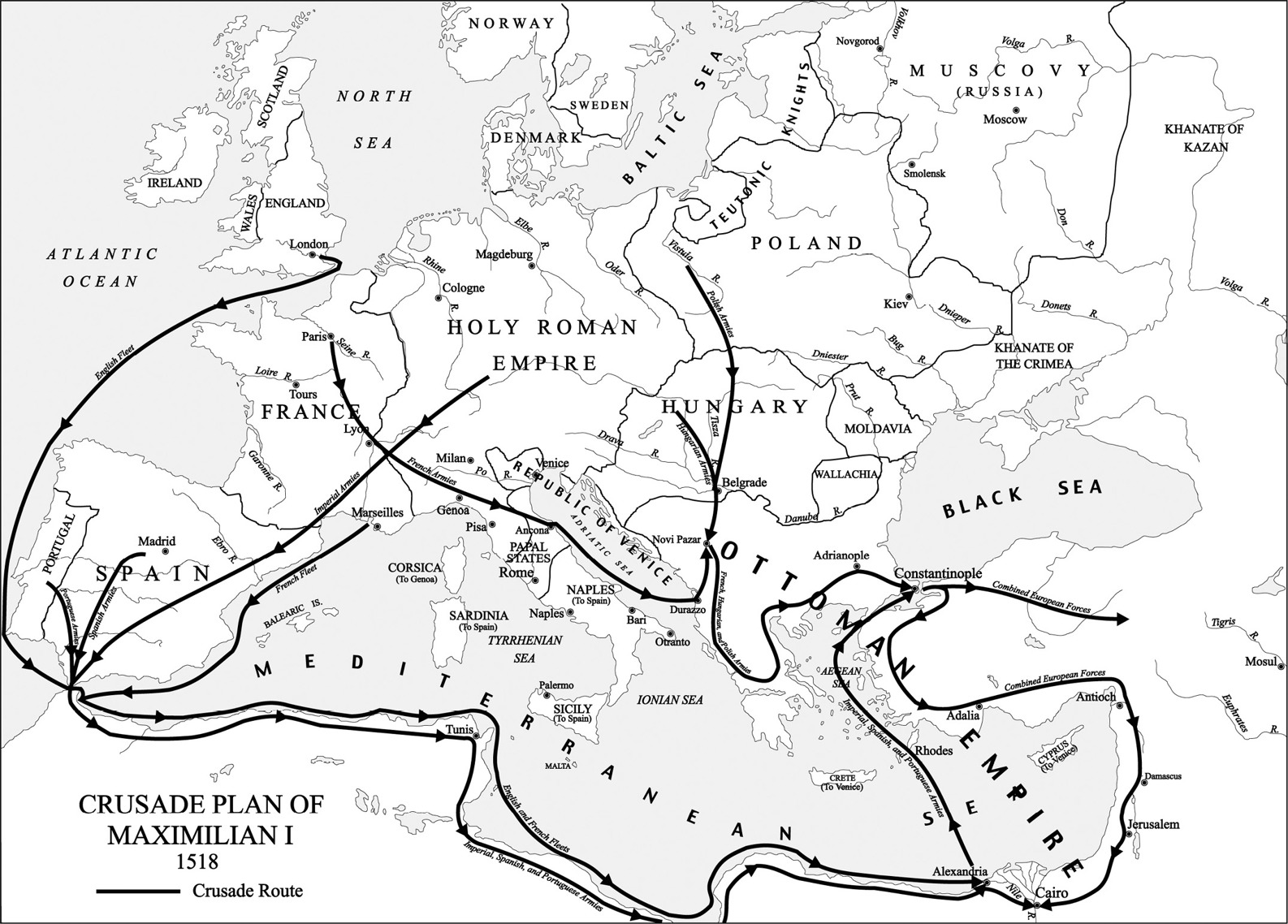
It seemed that at last the states of Europe would organize a powerful crusade against the Turks. A summit meeting between Francis I and Henry VIII was scheduled, and all countries were informed that they should send ambassadors to the meeting to coordinate preparations for the expedition. But on January 12, 1519, Emperor Maximilian I died, and the crusade died with him as Europe was plunged into a struggle of imperial succession. Charles I and Francis I wanted the imperial crown, and both promised to lead even greater crusades against the Turks if they got it. The reality was rather different. Whichever monarch won the German throne would hardly be on good terms with the loser, and Europe would again be divided. All of Wolsey’s work was for nothing. Pope Leo watched in horror as this bold new crusade became merely a tool of political rhetoric.
When King Charles I became Emperor Charles V (1519–58), Francis washed his hands of everyone and everything. Within a few years, he had allied France with the Ottoman Empire, an alliance that was to last for centuries. The homeland of the crusades was now in league with the Muslims. Leo continued to promote the crusade to Charles V, but even the pope abandoned it in 1520 when news of Selim’s death arrived in Rome. The new sultan, Suleiman, was known to be a quiet and scholarly man committed to peace. All of Europe breathed a sigh of relief.
Europe was wrong—the new sultan was quiet and scholarly, but not peaceful. Suleiman the Magnificent (1520–66) was the most dangerous foe the West had ever faced. He brought the Ottoman Empire to new heights of prosperity while pursuing an aggressive policy of conquest. In 1521, he captured Belgrade. The next year, he began a massive naval bombardment of the Hospitallers at Rhodes. With their fortresses in ruins, the knights were allowed to leave the island with honor, but it was a bitter defeat for the West. Suleiman decisively defeated Christian armies at the Battle of Mohács in 1526, opening the way for him to besiege Vienna in 1529. The battle was close, but Vienna held out. Had it fallen, all of Germany would have been at the mercy of the Turkish armies.
The Protestants, the Turks, and the Crusades
Pope Leo X was so involved in preserving Christendom from the dire threat to the east that he failed to recognize the danger from within. In 1517, Martin Luther, an Augustinian friar and professor of theology at the University of Wittenberg, published his famous Ninety-Five Theses. Within a few years, a “monkish quarrel” had developed into a widespread break with the church in Saxony and northern Germany. With the help of the printing press, Luther’s ideas spread quickly across Europe, inspiring other reformers to devise their own brands of Christianity. Western Europe was already fractured along national lines; the Protestant Reformation now shredded it along religious ones as well.
The Protestants and the Turks had a mutually beneficial, although unintentional, relationship. The Turkish threat distracted the pope and the Holy Roman emperor long enough for Luther to nurture his movement and secure his position. Because of his wars with the Turks and their allies, Charles V was unable to remove Protestantism from his northern domains. As Kenneth Setton has noted, “without them [the Turks], Protestantism might conceivably have gone the way of Albigensianism.”6 Simply put, the Turkish threat allowed the Protestants to flourish.
The Turks benefited from the arrangement as well. Within a few decades much of Europe was lost to the Catholic church. For Protestants, crusading was impossible for it presupposed obedience to the pope, the unity of Christendom, and the spiritual benefits of indulgences. The religious division of Europe was the best possible news for the Turks because it removed the ever-present threat of a major crusade. It was said that when Suleiman learned of Martin Luther, he expressed an interest in protecting him. When Luther heard this, he hastily crossed himself and asked God to save him from such a “gracious lord.” But whether Luther knew it or not, Suleiman was indeed his protector.
Luther set the tone for Protestant thought on the Turkish threat. When Leo X was still trying to resurrect his crusade in 1520, Luther wrote that “to fight against the Turks is to oppose the judgment God visits upon our iniquities through them.”7 In Luther’s view, crusades against the Ottomans were wars against God. Not only were they ineffectual, he contended, but they also helped the evil institution of the Catholic church. In 1521, he wrote:
How shamefully the pope has this long time baited us with the war against the Turks, gotten our money, destroyed so many Christians and made so much mischief! When will we learn that the pope is the devil’s most dangerous cat’s paw?8
After the siege of Vienna in 1529, the Turkish threat became much more dire to Germans, and so Luther changed his mind. In letters, he urged Christian princes to set aside their quarrels and take up their swords against the Muslims. He envisioned a great army of Catholic and Protestant troops marching to the East, called not by papal encyclical but by Luther’s own pamphlets and letters. Still, what Luther was preaching was a secular war, not a religious one, and it was by no means a crusade. As he wrote:
If in my turn I were a soldier and saw in the battlefield a priest’s banner or cross, even if it were the very crucifix, I should want to run away as though the devil were chasing me!9
As the greatest source of disunity in Europe, Luther’s calls for unity went nowhere.
HOLY LEAGUES
After the Protestant Reformation, crusades were naturally confined to Catholic Europe. In some cases, crusade status was given to religious wars between Catholics and Protestants, but the East was not forgotten. Popes routinely called for peace in Europe to prepare for crusades against the Turks. They had some success in negotiating new crusades with other Catholic states, which now took the form of Holy Leagues. Aside from the papacy, the greatest champions of crusades to the East were the Spanish and the Venetians. France, which remained Catholic, wanted nothing to do with wars against its ally, the sultan.
Several leagues bankrolled by the popes had limited successes against the Turks. The greatest victory, however, came in 1571, when a Holy League of the papacy, Spain, and Venice launched an armada of more than two hundred vessels carrying approximately thirty thousand men. On October 7, the fleet engaged a Turkish fleet of 275 vessels at Lepanto and destroyed it utterly. The Battle of Lepanto was the first major victory Christians had ever scored against the Ottoman Turks (photospread illustration 12). Although the sultan was able to build an even larger fleet within a year, the news of his defeat gave a psychological boost to all Europeans, Catholic and Protestant. The Turks were no longer invincible.
The rhetoric of crusade in Catholic Europe continued during the seventeenth century, but it was rarely more than that. Wars that acquired the moniker of a crusade, such as the attack by the Holy League of Poland, Germany, and Venice against the Turks in 1684, were actions that would have occurred without an indulgence. In any event, by the late seventeenth century the Turks were no longer a serious threat to Europe. Indeed, no power on earth was a serious threat to Europeans, who were expanding on a planetary scale.
THE FATE OF THE MILITARY ORDERS
The last tangible vestige of the crusades can be found in the military orders, most prominently the Knights Hospitaller of St. John and the Teutonic Knights. After Suleiman ejected the Hospitallers from Rhodes in 1522, Charles V donated the island of Malta to them. In this way, the Knights of Rhodes became the Knights of Malta. Suleiman later pursued them, laying siege to Malta in 1565. Against all odds, the knights not only held the island but also dealt a harsh blow to the Turkish navy. They followed up this victory by sending a fleet to take part in the Battle of Lepanto in 1571. The Knights of Malta never abandoned their mission to the poor and sick. On Malta, they built a great hospital in the capital city of Valletta that attracted patients from across Europe. They remained militarily active into the seventeenth century, but after that their numbers dropped as the need for their services evaporated. By the eighteenth century, the Hospitallers were little more than rulers of an island. On June 13, 1798, Napoleon captured Malta and expelled the knights. Their military function was forever finished. After the defeat of Napoleon, the order attempted to regain its island home, but it was given to Great Britain instead. Thus, in 1834 the order permanently established itself in Rome, becoming a government without a country. The order still exists. In Rome it issues passports, and the Vatican and 104 other states recognize it as a sovereign entity. More importantly, across the globe the Knights of Malta still devote themselves to the care of the poor and the sick.
The Teutonic Knights began to decline after the combined armies of Poland and Lithuania defeated them in 1410. Over the course of the fifteenth century, their Baltic holdings began to peel away one by one. When the Protestant Reformation swept through northern Europe, there was no longer room for a crusading order ruling a prosperous state. In 1525, the grand master, under Protestant influence, dissolved the order in Prussia and took the lands for himself as a vassal of the Polish crown. The knights’ other properties in Europe were taken from them by various secular leaders over the course of the following centuries. By the beginning of the nineteenth century, the Teutonic Knights were reduced to only a few tiny holdings in Austria. In 1809, the order was dissolved, yet it survived. In 1834, the emperor reestablished the order, headquartering it in Vienna, where it remains today. Henceforth, it was to be a religious institution. New rules were approved for the order by the Holy See in 1871 and 1929. Today, the Teutonic Knights are dedicated to charitable work and care for the sick.
In the fullness of time, the history of the last crusading orders, the Knights Hospitaller and the Teutonic Knights, came full circle. Both were founded by selfless people to care for the sick and the “holy poor.” Both later embraced holy war, carving out independent states and exercising significant worldly power. Today, both are shorn of those states, yet they continue to carry out their original mission—caring for the least of Christ’s brothers and sisters.
NOTES
1. Gabrieli, Arab Historians of the Crusades, 346.
2. Hillenbrand, Crusades, 240.
3. Kenneth M. Setton, Papacy and the Levant (1204–1571), vol. 2 (Philadelphia: American Philosophical Society, 1978), 364.
4. Sebastian Brant, The Ship of Fools, trans. Edwin H. Zedel (New York: Columbia University Press, 1944), 316–18.
5. Four Years at the Court of Henry VIII, trans. Rawdon Brown (London: 1854), 58.
6. Quoted in Kenneth M. Setton, “Lutheranism and the Turkish Peril,” Balkan Studies 3 (1962): 133.
7. Ibid., 142.
8. Ibid.
9. Ibid., 150.