
• 6 •
CRUSADES IN EUROPE
The enemies of Christianity were not confined to the Levant; they could be within Europe itself. The idea of crusading at home was an old one. Many of the foundational concepts of Christian wars of faith were forged in Spain, where popes had urged soldiers to turn back Muslim conquests for centuries. During the early ninth century, Charlemagne (768–814) waged wars of conversion repeatedly in Saxony. These early holy wars were not crusades, because they had associated with them no crusading vow, indulgence, or any notion of pilgrimage. The subsequent introduction of the crusade into Europe, though, changed the way people thought of religious wars. Popes generally equated the Reconquista with the Eastern crusades, urging Spanish Christians to fight Muslims at home rather than sailing to the Holy Land. Crusade indulgences were forthcoming for those who heeded this advice. By the time of the Second Crusade, the definition of a crusade had expanded to include a variety of wars in defense of the faith at home.
RECONQUISTA
Like the word “crusade,” the Spanish term Reconquista is more recent than the event it describes. It refers to more than six centuries of religious warfare waged in the Iberian Peninisula between Muslim and Christian forces. Just as in Palestine, the conflict began with a powerful Muslim invasion of Christian territories. In 711 an army consisting of Arabs and North African Berbers crossed the Strait of Gibraltar, defeated Iberia’s Visigothic rulers, and then quickly captured almost the entire peninsula. The new emirate of al-Andalus was thus established with its capital at Cordova. Only in the mountainous far northern regions of Iberia did a few Christian kingdoms hold out. These would form the foundation on which the Christian reconquest, or Reconquista, would take place.
In the first few centuries after the conquest, Spanish Christians fighting their Muslim neighbors to the south naturally saw their struggle from a religious perspective. Yet that was only one of the lines that divided the combatants. Christian rulers tracing their ancestries back to the Visigoths also understood their wars as part of a larger effort to restore their lost kingdom. These were not crusades, but the ideas developed during the Reconquista would become important components of the later crusading movement.
In 929 Emir ‘Abd al-Rahman III declared the independence of al-Andalus from the caliphate of Baghdad. But the new caliphate of Cordova was itself torn by divisions. After 1002 it broke apart into various small kingdoms (taifas) that were as likely to be at war with each other as with the Christians to the north. As in the Holy Land, Muslim disunity allowed Christian forces to make important gains. In 1085 King Alfonso VI of Castile-León captured Toledo, which had been the capital of the old Visigothic Kingdom. These were chaotic times, when an adventurer such as the famous El Cid could establish his own principality centered on the formerly Muslim Valencia.
But the chaos quickly subsided when new events brought forth frontiers defined increasingly by religion. The loss of Toledo led to a call for jihad among a group of North African Berbers known as the Almoravids, who swept into the peninsula and crushed Alfonso VI’s forces at Sagrajas. Over the next ten years (1085–95) the Almoravids conquered most of the petty kingdoms, forming a new and powerful Muslim state determined to push back the Christian advances. It is little wonder, then, that when Pope Urban II called the First Crusade in 1095 he made no effort to extend recruitment to Spain. Indeed, while the First Crusade was on the march Urban granted the crusade indulgence to those warriors who fought to wrest Tarragona from its Muslim conquerors.
There is no doubt that the enthusiasm for the crusade colored the ongoing struggle in Iberia. In 1114 the warriors who captured the Balearic Islands were in every way crusaders. They took the vow of the cross, received an indulgence, dressed as crusaders, and were even accompanied by a papal legate. The Reconquista had truly become the second front of the crusades. In 1123 the First Lateran Council referred to crusaders as warriors headed either to Jerusalem or to Spain. The earlier wars in Iberia were also co-opted into the crusading narrative, as can be seen most famously in theSong of Roland.
The Reconquista’s new identity as a crusade meant that it was no longer just a Spanish affair. Indeed, it was the business of all of Christendom. This was most apparent in the increasing number of French knights who crossed the Pyrenees to fight against the Muslims. It could also be seen during the Second Crusade, when foreign crusaders helped the Iberian kings in a variety of offensives against the Almoravids. Lisbon, Tortosa, and Lérida all came under Christian rule as a result of the international efforts of the Second Crusade.
With success came rivalries among the Christian kings, each of whom jockeyed for position against the others and who became increasingly less eager to see foreign crusaders disrupt the situation. Across the Strait of Gibraltar the Almoravids were overthrown by another Berber tribe, the Almohads, who poured into al-Andalus and completed its conquest in 1172. Like the Almoravids before them, the Almohads were fired with religious zeal to wage war against the Christian powers that continued to press in from the north. In 1195 the Almohads crushed the armies of King Alfonso VIII of Castile. The Christian kings of Castile, Aragon, and Navarre subsequently banded together to meet the common threat, and Pope Innocent III called on crusaders to assist them. By 1212, a large army was assembled, led by King Alfonso VIII of Castile (1158–1214) and King Peter II of Aragon (1196–1213). On July 17, 1212, the crusading army dealt a serious defeat to the Muslims at the Battle of Las Navas de Tolosa. The spectacular victory was hailed across Europe. After 1212 the momentum of the Reconquista was all on the Christian side. Iberia was the one place in the world where that could truthfully be said.
The remainder of the thirteenth century saw a rapid expansion of Christian power in Spain. King Ferdinand III of Castile captured Cordova in 1236 and Seville in 1248. King James I of Aragon won Mallorca in 1228, the Balearic Islands in 1235, and the kingdom of Valencia in 1246. By 1250 all that remained of Muslim power in Iberia was the southern kingdom of Granada—and that was a vassal state to Castile. With the exception of a few smaller conquests in the south, that is where matters remained for the next two centuries. In 1469 Aragon and Castile united under the joint rule of King Ferdinand II of Aragon and Queen Isabella I of Castile. As part of their program to purify the region, the Catholic monarchs waged war against Granada, capturing it on January 2, 1492. Thus fell the last Muslim outpost in Spain. The Reconquista was complete.
THE ALBIGENSIAN (CATHAR) HERESY
In the heart of Europe, a much more serious threat faced the church—heresy. In the medieval world, heresy did not represent benign religious diversity. Far from it. It was seen as an insidious and cancerous threat to the well-being of Christendom and the salvation of the faithful. Christ’s admonition to St. Peter still bound his successors: “Feed my sheep” (John 21:17). As the shepherds of Christ’s flock, the pope and bishops kept a sharp eye out for those who would lead the members astray. Heretics were not merely lost sheep, doomed to spend eternity in hell; they actively sought to lead others along their path to perdition. They struck at the heart of the church’s reason for existence: to save souls. Because it threatened the Body of Christ from within, heresy was held to be far more dangerous than faraway Muslims.
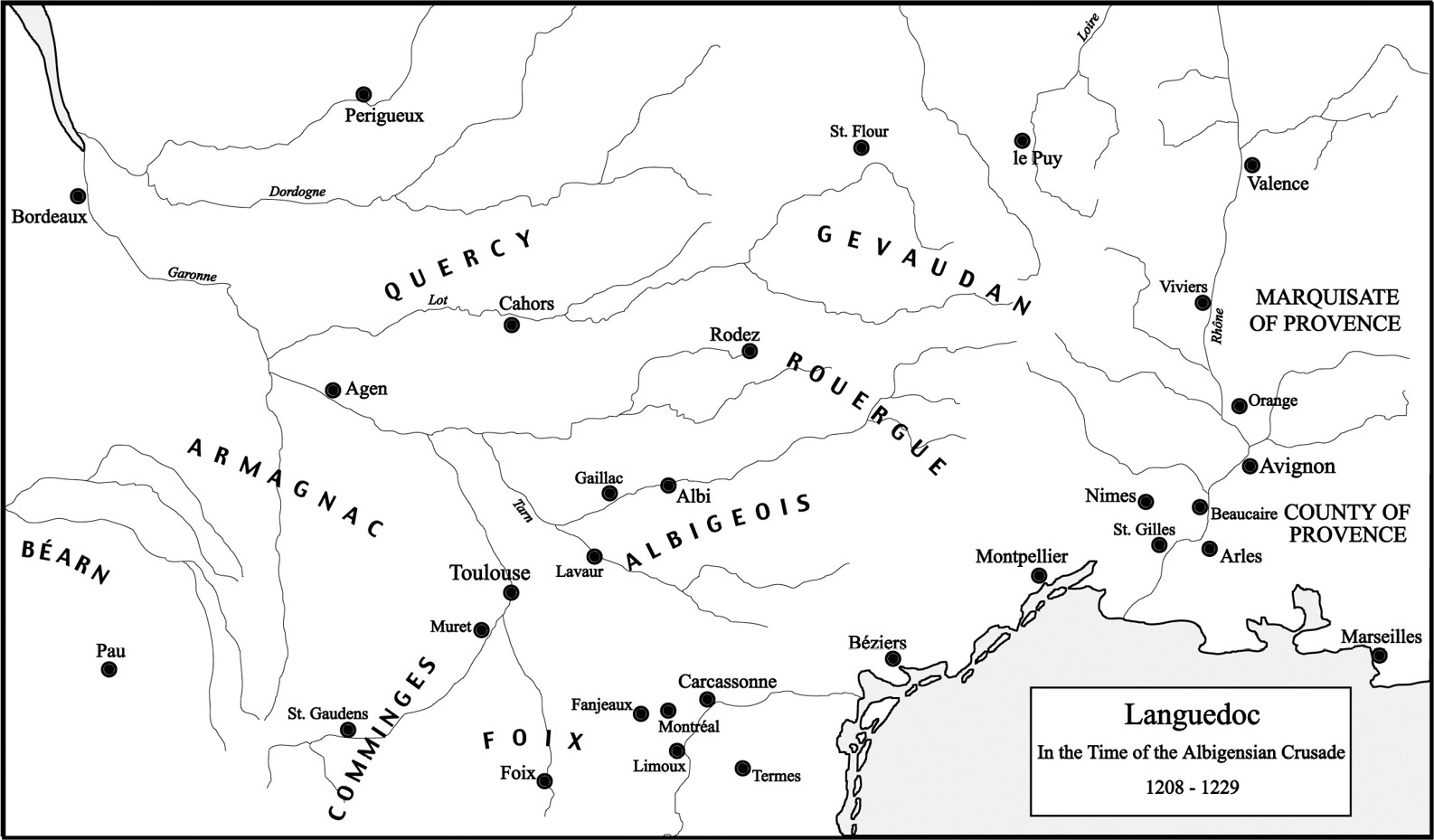
In Languedoc, near the city of Albi in the south of France, a very strong and ancient heresy had taken root and flourished. Catharism—also known as Albigensianism—was a heresy with a pedigree stretching back to the first centuries of Christianity. There were at least two varieties of the heresy, but both were neo-Manicheistic and neo-Gnostic. The Cathars believed that the universe is a battleground between a good god and an evil god. The spiritual world is the work of goodness, while the material world is inherently evil. The goal of all living creatures, therefore, is to free themselves from the bonds of matter, thus allowing them to rejoin God and thwart the designs of the evil one. The breaking of those material shackles, they believed, could be accomplished only through theconsolamentum, a ritual administered by the Cathar church.
The consolamentum was both baptism and ordination. Like baptism, it cleansed the recipient of all sin and prepared him or her for entrance into heaven. Like ordination, it allowed the recipient, now called a “Perfect,” to perform the rituals of the faith. Once cleansed, a Perfect had to remain sinless, free from the stain of the material world. Perfects practiced great austerity, attempting to reduce their body mass by rigorous fasting. Sex was perceived as a device of Satan, used to entrap more souls into the prison of material bodies; therefore, Perfects refrained from sex and refused to eat meat or eggs, both products of sexual union.
The vast majority of Cathars were not Perfects. They were “Believers,” those who accepted the Albigensian faith but had not yet received the consolamentum. Although they were enjoined to avoid sex and meat, there was no requirement to do so—and few did. This was not only more convenient but also provided a certain amount of deniability if that became necessary. As one Believer told the authorities, “I am not a heretic, for I have a wife and I sleep with her. I have sons, I eat meat, and I lie and swear, and I am a faithful Christian.”1 Most Believers did not undergo theconsolamentum until they were very old or nearing death. In this way, they could dramatically spurn the material world after a lifetime of enjoying its fruits. The Cathars believed that those who did not receive the consolamentum in this life could do so in their next incarnation.
Cathars accepted Christ as God, but not Christ as man. On earth, he was a phantom who appeared corporeal but remained a spirit. During his life, he had preached the message of spiritual release, but after his return to heaven the message was warped beyond recognition by Satan’s latest creation: the Catholic Church. The church, Cathars contended, perverted Christ’s words, blasphemously convincing the world that the Savior had become flesh. The idea that Christ was materially present in the Eucharist was thoroughly repugnant to Cathars. Likewise, they maintained that purgatory was a fiction and the resurrection of the body a cruel joke. They insisted that marriage was among the most destructive human institutions, for it bound earthly bodies together to enslave more souls in a material shell. Motherhood was not an honorable status but a mark of shame. Cathars believed that the pope and bishops were active agents of the evil one, damning the world in the name of the Lord.
Catharism found fertile ground for expansion in Languedoc. Throughout Christendom, the church relied on secular authorities to punish heretics who refused reconciliation to the faith. In Languedoc, the secular powers were highly independent and politically fractious. The most powerful lord in the region was the count of Toulouse, who was legally bound to the king of France but also held lands from the kings of England and Aragon as well as the German emperor. The result was a large fief that lacked political order. Counts of Toulouse tried for decades to assert their control over the region, but with little success. Their attempts at combating the heresy in their lands also failed, for the same reason. Indeed, rebellious vassals were often themselves Cathar leaders. The state of the church in Languedoc did not help matters. Bishops and abbots (who were themselves powerful lords) resented interference from the counts of Toulouse. The lavish lifestyle of these prelates contrasted sharply with the asceticism of the Perfects, leading many of the pious to believe in the holiness of the latter.
Although Cathars could be found in almost every social class, there were a large number of them among the nobility. Even bishops and abbots could point to Cathars in their own families. The religion had much to commend itself to the aristocracy. Although politically chaotic, the south of France was quite wealthy in the twelfth century. This wealth brought to the noble courts advanced education, cosmopolitan tastes, and cultural elitism. For this rising class of sophisticates, Catharism was something new, a means of distinguishing oneself from the unlettered and ignorant. The fact that the heresy condemned the kind of lavish lifestyle found in court culture only made it more intriguing. Often in human history intellectual and social elites embrace beliefs that contradict their own status and seemingly threaten their own comfortable way of life. Romanticism and anarchism in the nineteenth century and Marxism in twentieth-century Western countries are recent examples of this phenomenon. Like these modern beliefs, Catharism described a radically different universe that had no danger of becoming a reality soon. In other words, it allowed elites to embrace asceticism without the necessity of practicing it.
Attempts to Combat the Heresy
Because of the fragmented and particularistic nature of power in Languedoc, the counts of Toulouse made little progress in their efforts to contain and eliminate Catharism. These efforts ceased altogether after 1194, when Count Raymond VI of Toulouse succeeded his father. The new count was the product of a court culture that embraced the vibrancy of the heresy and scoffed at the Catholic rabble who could not accept it. Although he could not openly embrace Catharism, Raymond was by no means its enemy. His attitude did not sit well with Innocent III, who was determined to wipe out the heresy once and for all. Immediately upon his accession, the pope sent a string of legates to southern France with broad powers to reform the local church, preach the Gospel, and engage in public disputations with the heretics. Likewise, he urged Bishop Diego of Osma and his companion, the future St. Dominic, to preach in Languedoc. The new mendicant order later founded by Dominic was a dramatic counter to the Perfects. Like the Perfects, the Dominicans embraced poverty, but the message they proclaimed was orthodoxy. Unlike the wealthy prelates of Languedoc, the Dominicans visibly lived the Gospel that they preached.
Although it had some marginal effect, Catharism was too entrenched simply to be preached out of southern France. Anywhere else the heretics would have been examined by inquisitorial courts and, if they refused to recant, handed over to the secular authorities. But in Languedoc the Cathars had already converted a good part of the nobility and won the favor of many of the rest. Raymond of Toulouse was thoroughly opposed to taking any action against them. In desperation, Innocent III turned to Raymond’s lord, King Philip II Augustus of France. The pope urged Philip repeatedly to bring Raymond into line or to remove him with arms. By 1204, Innocent was even offering to bless a campaign against the heretics of the south with a crusade indulgence. Philip was unmoved, too busy with his wars against John of England to concern himself with the state of souls in Languedoc.
Papal attempts to reform the church in Languedoc and combat the heresy not only were ineffectual but also engendered bitter resentment. By 1206, Innocent’s legate, Peter of Castelnau, was so thoroughly hated by Catholics and Cathars alike that he left the region for six months in order to foil plans for his own assassination.
In 1207 Innocent’s patience with Raymond of Toulouse was at an end. He excommunicated the count and placed his lands under interdict. In January 1208, Raymond met Peter of Castelnau to secure an absolution. It was not a civil discussion. During the course of the meeting, Raymond became so enraged that he expelled the legate, warning him that he would be watching him wherever he went. It was a clear threat, the kind that Peter was becoming used to. The next morning, January 14, 1208, Peter was assassinated near Arles. The assassin was never caught, but Raymond was naturally suspected of being behind it.
Innocent was furious when he heard of the death of his legate. He had no doubt that Raymond was responsible; therefore, he renewed his excommunication of the count. For his part, Raymond officially denied any knowledge of or involvement in the murder, but he was obviously pleased that it had happened and made no real effort to apprehend the assailant. For Raymond, the matter was a source of minor amusement; for Innocent, it was the final straw.
THE ALBIGENSIAN CRUSADE
On March 10, 1208, Innocent III wrote a letter addressed to the king, prelates, nobles, and commoners of France. In it, he denounced Raymond of Toulouse as a murderer and a heretic. He urged the French, for the sake of the faith, to march against the heretics and supporters of heresy in Languedoc and take their lands from them. Two weeks later, on March 28, Innocent wrote to his legates in France, officially defining the campaign as a crusade with all indulgences and privileges normally associated with a crusade to the East. Of course, a march to Languedoc was by no means a pilgrimage; therefore, the pope declared that the completion of the crusader’s vow in this instance required only forty days of military service—the customary amount of military service a vassal owed each year to his feudal lord. Preachers fanned out across northern France. The response was tremendous. Not only was this a chance to fight for the cause of Christ, but a crusader could do his duty close to home and in the space of a single campaigning season. Philip Augustus did not share his nobility’s enthusiasm for the crusade. He did not join it himself, and he discouraged others so that they could remain with him in his fight against John of England.
As thousands of knights from across France mustered for the invasion of Languedoc, Raymond of Toulouse reconsidered his position. A large and angry feudal army was infinitely more persuasive to the count than a shrill and annoying papal legate. He contacted the pope, begging for absolution from his grave sins. He agreed to all charges against him, including supporting heretics, violating feast days, and trampling on the rights of the clergy. On June 18, 1209, he went to the abbey church of St. Gilles, where he promised to perform penitential services, was publicly flogged, and was then absolved. There was, of course, still the matter of the crusade army, which Raymond naturally feared. What he could not defeat, he joined. With papal permission, Raymond rode out to meet the crusaders wearing the cross of a pilgrim. By taking part in the crusade, he planned to make certain that it did not veer toward his own lands.
The crusaders chose as their first goal one of the areas most densely populated with Cathars, the lands of the Trencavel family. The lord, Raymond Roger, a vassal of Count Raymond of Toulouse, was viscount of Béziers and Carcassonne. He had refused to join the crusade, for he believed that his solid fortifications would outlast so large an army’s ability to remain in the field. The crusaders first laid siege to Béziers, while Raymond Roger traveled to Carcassonne to supervise its defense. The people of Béziers shared the confidence of their leader. Indeed, they were too confident. Rather than remain behind their walls, the citizens led a sortie against the attackers. During the retreat, some crusader foot soldiers were able to enter the city and capture it. The subsequent carnage and destruction were staggering. So shocked were the Albigeois by the brutality of the sack of Béziers that the towns from there to Carcassonne opened their gates to the crusaders rather than risk the same fate. It was left for Raymond Roger to make his stand at Carcassonne. The siege dragged on for two weeks in the summer heat. Finally, on August 15, 1209, Raymond Roger asked for terms of surrender. The people of the city were allowed to leave unmolested but with no possessions (photospread illustration 8). In return, Raymond Roger gave himself up. He died a few months later, apparently from dysentery, although foul play was suspected.
The crusade was off to a good start. Within a few short months, it had conquered the heart of heretic country, but much remained to be done. Who would do it? Having served their forty days, most of the crusaders prepared to return home. What was needed was someone to take ownership of the conquered lands, defend them, and prosecute the crusade again in the spring when new recruits arrived. The Trencavel lands were offered to various French barons, but all refused them. At last, the crusaders and papal legates settled on Simon, the lord of Montfort. Simon was a skilled tactician and pious soldier, but he was also self-centered, rash, and volatile. He was one of the French barons who had sailed with the Fourth Crusade when it left Venice in 1202, but he subsequently abandoned the enterprise when it attacked Christian Zara. Rather than continue to Constantinople, Simon and his retinue washed their hands of the whole affair and made their way to Palestine, where they fought Muslims but achieved nothing. When he returned to Europe with a coat of radiant self-righteousness he was disgusted to learn that the crusade he had abandoned was celebrated and honored for its dramatic conquest of Byzantium.
As leader of the Albigensian Crusade, Simon soon learned its greatest weakness: the short enlistment of the crusaders. With blessings and good wishes, the army vanished, leaving him and his men to defend the conquests. It was impossible. Most of the towns and castles that had opened their gates now closed them. King Peter of Aragon, who was overlord of Carcassonne, refused Simon’s homage for the city. In the spring, the situation reversed itself. Simon’s wife arrived with reinforcements ready to perform their forty days of service. This annual drastic fluctuation in crusader strength was a fact of life for the Albigensian Crusade, given the nature of the papal indulgence. It meant that each spring and summer, Simon could make important gains and consolidate victories, but during the fall and winter he would have to hold on to his conquests with only a skeleton force.
Count Raymond VI returned to Toulouse after the conquest of Carcassonne. He watched with pleasure as Simon’s conquests evaporated with the departure of the crusade army. Perhaps, he thought, the Albigensian Crusade was not so grave a threat after all. Raymond resumed his prior attitude toward the church and began putting off demands that he fulfill his penitential promises made in 1209. In 1211, he flatly refused to make good on his promises, and so his excommunication and the interdict on his lands were renewed. Raymond had again become the object of the crusade, but Simon did not directly attack heavily defended Toulouse. Instead, he slowly captured the areas around the city, including Comminges, Foix, and Béarn, hoping to encircle Toulouse before launching a major attack on it.
King Peter of Aragon had remained aloof from the Albigensian Crusade, despite the fact that some of the lands in question were held by his vassals. As Simon led his forces to surround Toulouse, Peter at last acceded to Raymond’s requests to get involved. In the spring of 1212, he visited Toulouse and, amid great cheers, took it under his protection. He then returned to Spain, where he defeated the Muslims at Las Navas de Tolosa, thus becoming the celebrated savior of Christendom. This victory brought him not only fame but also political currency to expend in the defense of Toulouse. At once, he sent envoys to Rome to complain about the course of the Albigensian Crusade. Simon of Montfort had gone too far, Peter argued. It was one thing to capture the lands in which heresy thrived, but Simon’s strategy of surrounding Toulouse meant that he was conquering Christian lands held by Catholic lords.
Innocent put great stock in the words of Peter, and he was in any case eager to phase out the crusade indulgence for those going to Languedoc so that he could proclaim a new crusade to win Jerusalem. On January 15, 1213, Innocent wrote to Simon, scolding him for his attacks against Christians. On the same day, he wrote to his legate, “Foxes were destroying the vineyard of the Lord in Provence; they have now been captured.” Because the primary objectives of the crusade had been met, the pope continued, he was removing most of the crusading indulgence for the campaign. He ordered Simon and the papal legates to hold a council of clergy and nobility to hear Peter’s proposals and report back to him with their recommendations.
The Council of Lavaur was already planned, so it simply adopted Innocent’s agenda. Peter did not attend the council, but he was allowed to make his observations in writing. He insisted that the lands of the counts of Comminges and Foix and the viscount of Béarn be returned to them, for they were Christian lords and therefore not legitimate targets of a crusade. As for Raymond, Peter affirmed that the count of Toulouse stood ready to make amends and receive absolution, after which Simon should return lands taken from him. If the council was unwilling to accept this, then Raymond would go on crusade to the East or Spain if his lands could be put into trust for his son, who was innocent of all heresy. Peter himself offered to serve as trustee. The council listened to Peter’s recommendations but rejected them all. The clergy of the council refused to absolve Raymond under any circumstances. They insisted that Comminges, Foix, and Béarn were infected with heresy and that their lords were abettors of that heresy. Not one square inch would be returned to them. In defiance of the council’s decision, Peter took Comminges, Foix, and Béarn under his protection.
The next battle was one of paper. While Peter appealed his case to Rome, the clergy in Languedoc showered the papal court with letters and testimonies to support their position. Raymond of Toulouse, they maintained, had to be crushed if Catharism was ever to be removed from the region. Innocent was convinced by the clergy. He wrote to Peter, rebuking him for falsely informing him of the conditions in Languedoc. In a general letter, he demanded that the lords of Comminges, Foix, and Béarn acquire absolution, and he urged Peter and Simon to make peace between themselves for the good of Christendom.
That was not to be. Both sides were prepared for war. Peter was threatened with excommunication, but it was a hollow threat—the hero of Las Navas de Tolosa could not be excommunicated. The two armies met on September 12, 1213, at the Battle of Muret. Although greatly outnumbered, Simon decisively defeated Peter’s forces. “On that day,” poet Guillaume le Breton later wrote, “the power and virtue of the French shone forth clearly; they sent 17,000 men to the swamps of hell.”2 Peter himself was among those killed. Simon’s victory was total. The Albigensian Crusade had succeeded not only in wiping out all opposition to its progress but also in killing one of the most successful defenders of Christendom.
THE FOURTH LATERAN COUNCIL
In the wake of Muret, Simon quickly went from victory to victory in Raymond’s lands, conquering almost everything. All that he lacked was papal confirmation of his conquests. Innocent referred the question to the Fourth Lateran Council, which met in November 1215. After a vigorous but probably pointless debate, the council ruled that Raymond VI of Toulouse was guilty of aiding and abetting heretics. He was deprived of his lands but allowed an annual stipend. All conquered lands were assigned to Simon of Montfort. All unconquered lands, which consisted only of Provence, were to be held by the church until Raymond’s son, Raymond VII, came of age. The next year, Simon received formal investment of the lands from Philip Augustus.
The Fourth Lateran Council confirmed Simon’s conquests but it also turned off the last trickle of recruits to the Albigensian Crusade. At the council, Innocent III declared a new crusade to the East, the Fifth Crusade. As a result, Simon was forced to rely on mercenaries to make good his claims. Determined to control his prize, he became ruthless in his drive to impose rigorous feudal order in a region that had never known it. He compelled all citizens of Toulouse to take loyalty oaths to him, then ordered the destruction of their city walls. Always unpopular, he now incurred, with his harsh rule, genuine hatred among many.
REBELLION IN THE SOUTH
Raymond and his son arrived in Provence to great applause. The younger Raymond was nineteen years old, courageous, bold, serious, and accomplished in battle. In other words, he was nothing like his father. In Provence, father and son heard often about Simon’s rule and the general longing for the return of the family of St. Gilles. They began to consider the possibility of recapturing their lands.
Raymond VI went to Aragon to hire mercenaries and drum up support. Meanwhile, Raymond VII came upon an intriguing opportunity. The citizens of Beaucaire, on the west bank of the Rhone, sent word that they would open their gates to him. The young Raymond had an attachment to the city, the place of his birth, and he saw that its capture would pose a difficult problem for Simon of Montfort. The archbishop of Arles had recently given Beaucaire to Simon; nevertheless, it could be argued that it was properly part of the Provençal lands that were to be held in trust for Raymond. It did not take long for the young man to take the citizens up on their offer. When the gates were opened, Simon’s garrison fled to a fortification north of the city. Raymond followed them and laid siege to the castle. Simon’s brother, Guy, and his son, Amalric, brought troops to break the siege, but with no success. Soon Simon himself arrived, but he was unable to save the castle. In August 1216, after a three-month siege, the garrison was starved into surrender.
The victory at Beaucaire, though small, had great symbolic impact. In the defeat of Simon, many in Languedoc saw the rise of the young Raymond of Toulouse, who, they hoped, would reclaim his patrimony and drive out the hated northerners. Inspired enthusiasm and hope in the hearts of the vanquished never bode well for a conqueror. Simon rightly feared that his defeat at Beaucaire would lead to rebellions across the region. The elder Raymond was already in the city of Toulouse, where most of the citizens swore allegiance to their old lord. Simon moved quickly to nip this insurrection in the bud. Toulouse lacked fortifications, but the citizens built makeshift defenses with amazing speed. In characteristic style, the elder Raymond fled the city before Simon arrived, leaving his supporters to defend themselves as best they could. They did so bravely, but in the end Simon took the city. Punishments meted out to the rebels were brutal. Aside from mass executions, Simon exacted other harsh penalties, including an enormous indemnity payment of 30,000 marks.
The victory at Beaucaire lifted the hopes of the southerners. The courageous rebellion and crushing defeat at Toulouse inflamed their anger. The treatment of the citizens of Toulouse had nothing to do with heresy; it was merely an exercise in raw power. Even his own supporters began to view Simon not as a pious crusader but as a ruthless tyrant. Those who had supported the crusade against the Cathars turned their heads in disgust at the Christian blood spilled in Toulouse.
The elder Raymond returned to Aragon, where he continued to raise a mercenary army. Despite their grave punishments, the people of Toulouse remained doggedly opposed to Simon. In the summer of 1217, they sent word that they were again ready to accept Raymond as their lord if he would journey there with an army. He wasted no time. With his Spanish troops, he crossed the Pyrenees. Along the way to Toulouse, the nobles of the region rallied to Raymond’s banner, thus enlarging his forces. Some of these men were heretics or supporters of heresy, but many more were good Christians who despised Simon and favored the restoration of the family of St. Gilles.
On September 13, 1217, Raymond’s forces entered unfortified Toulouse under cover of fog. Simon’s garrison fled to a nearby fortification, Château Narbonnais. Once again, the citizens of Toulouse set to work building earthwork and timber fortifications. “Everyone began to rebuild the walls,” wrote a chronicler. “Knights and burgesses, ladies and squires, boys and girls, great and small carried up the hewn stones singing ballads and songs.”3 When Simon heard of the rebellion, he swiftly called for troops from his new lands to assist him in the siege of the city. Most had already defected to the rebel side. The lines were now clearly drawn. Toulouse became the centerpiece of an effort to resist and remove Simon and the northerners once and for all. Here, it seemed, the fate of Languedoc would be decided.
It was clear to all that the advantage of momentum had shifted to the southerners. Despite a number of attacks on the city, Simon was unable to take it. Pope Honorius III (1216–27) sent various letters demanding an end to the rebellion and calling on other crusaders to assist Simon in his efforts. Nothing came of these exhortations. The siege dragged on through the winter of 1217–18 with plenty of action, none of it decisive. The crusaders made an attempt to improve their position in the summer, but without success. On June 25, 1218, during one such offensive, a rock propelled from a mangonel in the city struck Simon of Montfort squarely on the head, killing him instantly. The defenders joyously cheered this piece of extraordinary good luck.
With the death of Simon, the siege was over. Simon’s son, Amalric, withdrew from the city, making his way back to Carcassonne. The victory at Toulouse and the death of Simon gave heart to the last holdouts against rebellion. Defections were widespread. Even the appearance of Prince Louis, the heir to the French throne, could not reverse the disaster. By 1220, Amalric held only a small core of lands in the lower Languedoc around Carcassonne. In essence, he controlled the lands that his father had conquered in the first two years of the crusade.
In August 1222, Raymond VI died, but that was no help to Amalric. Raymond VII was a far more able leader than his father. He already had won the earnest respect of both the nobility and the common people for his liberation of the Languedoc region. For his part, Amalric’s resources were exhausted. He attempted to give his lands to Philip Augustus, but the king continued to refuse to become involved in the matter.
THE END OF THE ALBIGENSIAN CRUSADE
The indifference of the French crown changed dramatically when Philip died and Louis VIII was crowned in 1223. Having already crusaded twice in the south, Louis was now eager to put the resources of the kingdom behind the effort. The change in attitude of the French royalty could not have come at a better time for Amalric, who was at the end of his rope. On November 30, 1225, the Council of Bourges was held to hear the arguments of Raymond and Amalric concerning the ownership of lands. Louis had already made it clear that he would enforce the decisions of this council. Raymond pledged to pursue all heretics in his domains and obey all directives of the church if his father’s lands were restored to him. Amalric countered that the church had already distributed those lands to his father in 1215, and he had done homage for them to the king. After short deliberations, the council declared Raymond a heretic, excommunicated him, and pronounced his lands forfeit. Clergy were then dispatched across France to recruit men for a crusade led by the king himself.
With royal sponsorship, recruitment for the crusade went very well. Soon Louis had an imposing force ready to invade the south. There was little doubt that he could crush the rebellion in Languedoc, so most of the rebels hurried to make their own peace with the church. Raymond watched his supporters abandon him one by one. Louis first marched to Avignon, which he invested for three months. On September 9, 1226, the city capitulated. The king then made plans to invade the heartland of the region, but on November 8, 1226, he died. His son, Louis IX (1226–70), who would one day be the most famous of crusaders, was only twelve years old. Louis’s widow, Blanche of Castile, took charge of the regent government.
The death of the king gave Raymond some breathing room and even allowed him to reclaim some lost ground, but his situation remained untenable. How long could he sustain a war against the crown? In the end, he would surely lose. Reluctantly, he went to the peace table to make what deal he could. The Peace of Paris, a lengthy and very detailed document signed on April 12, 1229, ended the Albigensian Crusade. As a result of the agreement, Raymond was absolved and reconciled to the church. In return, he agreed to pay to the crown a large war indemnity and to give his daughter Joan in marriage to Alphonse of Poitiers, a brother of Louis IX. Raymond retained control of Toulouse, Foix, and other lands he currently held in Languedoc while he lived, but they were to pass to Alphonse of Poitiers or his heirs by Joan after his death. Under no circumstances could they be inherited by Raymond’s own heirs. In that way, the long history of the house of St. Gilles came to an end, signed away by Raymond to bring peace to the troubled region.
The winner of the Albigensian Crusade was the Capetian monarchy of France. Although a latecomer to the effort, the crown brought all the rich lands of Toulouse into the patrimony of the royal family. The loser, obviously, was the house of St. Gilles. Raymond made subsequent attempts to regain inheritance rights for his family, but none was remotely successful. As for the Cathar heresy, it remained firmly entrenched in Languedoc. Two decades of bloodshed deprived it of its support among the nobility, but not of its fundamental appeal. Shortly after the Peace of Paris, a council was held in Toulouse to organize an inquisition to root out and destroy the heresy. This proved a far more effective tool than large crusading armies. Thanks to the work of the Dominican inquisitors, Catharism was virtually extinct in Languedoc within a century.
THE CHILDREN’S CRUSADE
During the course of the wars against the Albigensians, crusade preaching became a constant fact of life in northern France and parts of Germany. The drumbeat of enthusiastic sermons added to an atmosphere already supercharged with popular piety, anticlericalism, and profound anxiety about the state of Jerusalem. In a world in which religious enthusiasm was common and respected, these tensions often manifested themselves in bizarre and startling ways. One such set of events is commonly called the Children’s Crusade.
This Children’s Crusade was not an army of children, and it was not a crusade. Indeed, it was not even one thing, but a blanket term used to describe a variety of popular uprisings and processions. At its core was the long-held medieval belief in holy poverty—that the poor of Christ could achieve things by their pious righteousness that church prelates and secular lords could not. These were the kinds of ideas that gave birth to and propelled the “People’s Crusade” in the wake of the preaching of the First Crusade. Since then, Christians had become disillusioned by the failure of powerful crusades to achieve their stated goals. Perhaps, they reasoned, it was the weak and humble that Christ was calling to victory in the Holy Land. Had he not preached, “Blessed are the meek, for they shall inherit the earth” (Matt. 5:5)?
Because it was a popular movement, the Children’s Crusade is difficult to trace. Unlike most crusades, there was no participant who wrote a memoir of the event. What we can glean comes from the reports of outsiders, primarily monastic chroniclers who watched it all go by. It is difficult, therefore, to say precisely how it began, or for that matter, how it ended. What is clear is that in early 1212, a young man named Nicholas from Cologne either initiated or quickly became the focus of a popular movement that swept through the Rhineland. Nicholas had in mind to go to Jerusalem and rescue the Holy City from the Muslims. Under divine instruction, he began walking south to the sea, which he believed would open up before him, allowing him to walk to Palestine. Tens, then hundreds, then thousands joined him in his march.
As Nicholas and his followers marched from town to town, they spread their enthusiasm. Children, adolescents, women, the elderly, the poor, parish clergy, and the occasional thief joined the movement in throngs. Wherever they went, they were hailed as heroes. They received gifts, food, money, and prayers from their abundant well-wishers. When clergy members expressed reservations or skepticism about the “crusade,” they were ridiculed and accused of jealousy. Had not the church-sponsored crusades failed repeatedly to reclaim the Holy Sepulcher? Were the prelates so blind that they could not see the hand of God in this extraordinary pilgrimage of the poor and the weak?
The throngs continued south, picking up many and shedding some as they went. In July 1212, they began crossing the Alps into Italy. The heat was stifling, causing many to give up and return home, but others pressed on.
Word of these wonders spread across Europe, sparking in some places smaller imitations of the event. The largest of these echoes occurred in Cloyes, a small town in France near Vendôme. Stephen, a twelve-year-old shepherd boy, had a vision in which Jesus, dressed as a pilgrim, asked him for bread. When Stephen gave it to him, Jesus handed over a letter for the king of France. Letters from heaven were a fairly common occurrence in the Middle Ages, but they rarely came from the hand of Christ himself. Stephen began his trek to Paris and was quickly joined by his fellow shepherds, then other bands of children, then lesser clergy, then the same kind of poor who were enlisting in Nicholas’s pilgrimage in Germany. As they marched through the towns, they sang, “Lord God, exalt Christianity! Lord God, restore to us the True Cross!” At last, they reached Paris, where Stephen delivered his missive to Philip Augustus. The contents are unknown, but the letter probably urged the king to lead another crusade to the East to rescue the True Cross and restore Jerusalem. Philip thanked Stephen for the letter, and that was the end of it. Unlike the Germans, the French participants saw themselves as messengers, not crusaders. With their message delivered, most of them returned home. A few of the able-bodied enlisted in the Albigensian Crusade.
By the beginning of August, the Rhenish multitudes were in Lombardy. From there, the movement broke apart as different groups made their separate ways to various ports. Nicholas and his band of followers arrived in Genoa on August 25. To their great disappointment, the sea did not open for them, nor did it allow them to walk across its waves. Some pushed on, hoping for better luck at other ports. According to one story, a large band of these “crusaders” arrived in Marseilles, where two unscrupulous men offered them free transportation to the Holy Land. When the vessels landed in Alexandria, the passengers were sold on the Egyptian slave markets. Others apparently went to Rome, where Innocent III praised their zeal but released them from their vows—which were not valid in any case. The fate of Nicholas is unclear. One story has it that he embarked on the Fifth Crusade, where he fulfilled his vow before returning home. Another states that he died in Italy.
Thus, the Children’s Crusade came to a humiliating end. Most of its participants turned back home, but they had a difficult journey ahead. They were now reviled and ridiculed by the same people who had previously acclaimed and assisted them. Food was a problem, because they could no longer count on gifts. Many simply could not make the journey and therefore settled wherever they found themselves. Centuries later, a few of Genoa’s leading families would claim descent from these wayward pilgrims.
THE TEUTONIC KNIGHTS AND THE BALTIC CRUSADES
The Teutonic Knights, a German military order founded during the Third Crusade, retained their presence in the Near East. By the thirteenth century, however, the knights had begun to shift their focus to holy war in Europe. The grand master, Hermann von Salza (1210–39), was instrumental in focusing the order’s energies on eastern Europe. In 1211, King Andrew II of Hungary invited the Teutonic Knights to protect his eastern border against the pagan Cumans by colonizing Transylvania and converting the people to Christianity. The knights were successful, but their power in the region grew too rapidly, startling the king and causing him to expel them in 1225. Just then, a similar situation arose in the Baltic region, where the Polish duke, Conrad of Mazovia, needed assistance against the pagan Prussians and was willing to grant lands to get it. Hermann von Salza was eager to assist Conrad, but he did not want to settle the knights in a region that would later be taken from them. To forestall that, in 1226 the knights received a charter from Emperor Frederick II granting them all lands promised by Conrad as well as those they could conquer from the Prussians. Subsequently, Pope Gregory IX decreed that all current and future conquests of the order in the Baltic region were the property of the Holy See, to be held in perpetuity by the Teutonic Knights.
In 1233, the Teutonic Knights and an army of German crusaders invaded Prussia. Over the next fifty years, the order conquered the entire region. Livonia was added to these conquests when the Order of the Brothers of the Sword, which crusaded in that area, was merged into the Teutonic Knights in 1237. The order oversaw the building up of Prussia and the importation of German peasants to work the land. Soon, the region became a prosperous state. The Teutonic Knights and their lands would play important parts in European history for centuries, long after their removal from the Holy Land.
WOMEN AND THE CRUSADES
As far as the military campaigns went, women played virtually no part in the crusades. From the beginning of the movement popes had urged women, the poor, and the elderly to stay home lest they burden the warriors on their difficult journey. Of course, this advice was sometimes ignored. A few extremely wealthy women took the cross in order to accompany their powerful husbands. These included Eleanor of Aquitaine on the Second Crusade and Marie of Flanders on the Fourth Crusade. Yet these were the remarkable exceptions. There is no doubt that women could be found traveling along with every crusade. These were the cooks, washerwomen, and other servants necessary to support the army. It is not clear, however, whether these were customarily brought from Europe or simply hired along the way. They do not appear to have taken a vow and therefore were not themselves crusaders. As might be expected, an army of thousands of men also naturally attracted “camp followers,” in other words, prostitutes who flocked to the crusaders to sell their services. These were so much part of the regular landscape that medieval chroniclers never bother to mention them except in relation to several prebattle purifications of a crusade army, when the prostitutes would be expelled from the camp.
Women began to take a more active role in the crusades in the thirteenth century. It was then that Pope Innocent III sought to harness the efforts of all Europeans for the success of the crusades. Women, who could not physically join a crusade, could take part in fasting, prayer, and monetary donations for the benefit of the holy cause. In so doing they could contribute to the war from the home front. To further support the crusades, however, Innocent also took away a traditional right of married women. Church law had previously held that a man’s vow to crusade was valid only with the consent of his wife, since the man’s absence would deprive her of her conjugal rights. By the time of the Third Crusade this had led to many instances of abuse. For example, a man after listening to a crusade preacher and being caught up in the moment might swear the cross. The next day, however, he would think better of his decision and look for some way to avoid the dangers of a crusade. The traditional woman’s right gave him that opportunity. He could simply report that his wife had refused to give her consent and thus nullify his vow. Innocent’s decree closed that loophole.
Innocent had begun the practice of allowing those unfit for military service to pay to outfit and supply a warrior for the crusade and thereby share in the crusade indulgence. This practice was expanded by his successors, particularly Gregory IX (1227–41). In order to raise funds for crusading, popes began encouraging all Christians, including women, to take the cross. The vow would then be “redeemed.” In other words, for a donation of money to support the crusade the vow was commuted, usually the day after it was originally taken. Men capable of bearing arms generally could not have their vows redeemed. Yet this was not true for women, who could always pay to be relieved of the cross. This practice allowed women to take a much more active role in the rituals of the crusade as well as its financial support. Indeed, crusade preachers soon began addressing their sermons to women, urging them to take the cross just as their husbands, brothers, or fathers had done in the past.
Crusading at home was a regular phenomenon that reached a fevered pitch during the pontificate of Innocent III but continued for centuries. The Children’s Crusade was not the pope’s fault, merely a by-product of constant crusade preaching and the repeated failures of the crusades. Like Innocent’s Fourth Crusade, the Albigensian Crusade had far-reaching consequences, but it failed utterly to achieve its projected goal. It is ironic that despite his successful pontificate, Innocent III failed where he most ardently wanted to succeed: in his crusades.
NOTES
1. Quoted in Carol Lansing’s epilogue to Joseph R. Strayer, The Albigensian Crusades (Ann Arbor: University of Michigan Press, 1992), 223–24.
2. Quoted in Strayer, The Albigensian Crusades, 95.
3. Ibid., 112.
