
CHAPTER XIV
1
THROUGH all these years of strife the king had one aide on whom he could always depend, his cousin, Henry of Lancaster. This nobleman was not only a fine soldier but a man of great courage, honesty, and tolerance; a scholar of sorts, moreover, and deeply religious. Having raised him to the rank of duke, Edward sent this cousin on a mission to Avignon in 1353 to discuss with Pope Innocent VI the possibility of a lasting peace between England and France.
The duke had two hundred men-at-arms in his party, and when he arrived on Christmas Eve he was met by such a host of churchmen and soldiers, not to mention curious townspeople, that it was difficult to cross the bridge into the papal city. Lancaster had seen the need to make friends and, with a prodigality worthy of Edward himself, had ordered that one hundred casks of wine be ready in the building he was to make his headquarters. After seven weeks of fruitless discussion, there was nothing left in any of them but a hollow sound.
The first impression gained of Avignon by this urbane ambassador was that the term “Babylonish captivity” was a complete misnomer. It should have been called the “French captivity,” for the papal court at Avignon was overrun with Frenchmen. There were French cardinals everywhere he turned, favoring him with sharp looks out of the corners of their eyes and questioning him to find what he proposed to say to the pontiff. French officials of all kinds were doing the same with the members of his train. Outside there were French architects, French builders, French sculptors, French merchants of Eastern goods, all trying to get their share of the enormous wealth which had been left by John XXII, so much of which had already been spent on the Palace of the Popes.
“Peace?” said Innocent VI. “That will depend on the terms you bring me.”
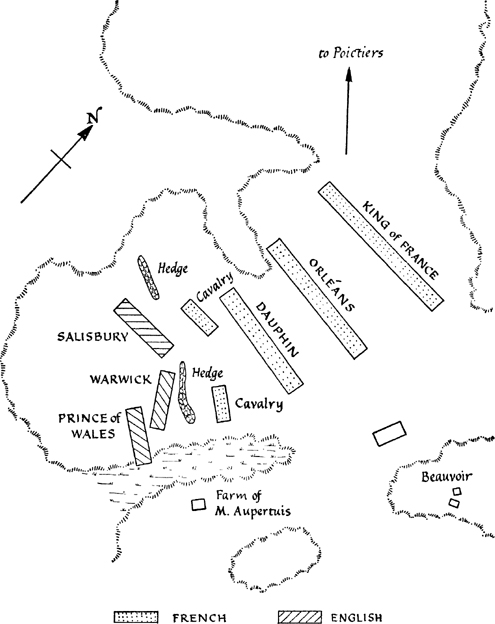
BATTLE OF POICTIERS 1356
Innocent was a man of impartial and judicial mind, although he had been born Étienne Aubert at Mons in Limousin. He wanted above everything to stop the war, but he knew the temper of French royalty too well to see any chance when he heard the terms that Edward was proposing: to give up his claim to the throne of France in return for having his possessions in that country confirmed to him in full sovereignty. The wise Pope knew this would not be acceptable, so it was clear from the start that the mission would not succeed.
The popes at Avignon had all been Frenchmen, and all of them, even the present incumbent with his real desire to be impartial, had found it necessary to favor the French cause. The miraculous victories won by the English had begun to suggest to quizzical and irreverent minds that the Lord on high was not in accord with His vicar on earth. The court at Avignon, where rumor and tattle were always rife, had fallen into the habit of discussing this in sly whispers. Even bits of doggerel were coined and passed from ear to ear. One of these was current when Lancaster paid his visit. A translation into English runs as follows:
The Pope is on the Frenchmen’s side,
With England Jesus doth abide;
’Twill soon be seen who’ll now prevail,
For Jesus, or the Pope, must fail.
The only result was that at Avignon Lancaster met Charles, the King of Navarre. The Navarrese king was young but he had already earned the name of Charles the Bad. It was well deserved, for Charles of Navarre was crafty, unscrupulous, cruel, and notoriously unfaithful in affairs of the heart. Although he was married to Joan, a daughter of the King of France, he was on the worst of terms with that monarch. His royal cousin, he informed Lancaster, meaning his father-in-law, had an eye on his possessions in Normandy which were strategically important. He proposed to the English ambassador an alliance between England and Navarre, with a promise on his part to join any army of invasion they sent into France. This alliance was confirmed later.
In the meantime King Philip had died, with no one to lament his passing. He had not been a success as a king; a glum, proud, and bitterly suspicious figure, whose defeat at Crécy had left France prostrate. He had been succeeded by his son John, who is known in history as John the Good for no visible reason except perhaps his personal bravery in battle. Otherwise he was credulous, vain, and cruel, and with all the incapacity to rule wisely which his father had displayed. One of his first acts was to behead the constable of France, a brave and loyal man named Raoul, Count of Eu. The new king showed Raoul a letter and demanded to know if he had ever seen it before. When the constable protested he knew nothing about it, the king cried, “Ha, wicked traitor, you have well deserved death!” So the constable went to the block without the formality of a trial and not knowing what the letter had contained.
John, it seems, liked only one man in his train, a naturalized Castilian called Charles of Spain. When he gave to this favorite some of the Norman properties of Charles of Navarre, the latter had the Castilian murdered in his bed. This led at once to hostilities.
Edward was not anxious for war at this stage. He had sent his chamberlain to ask Parliament if they would favor the making of a permanent peace, and the members had responded with loud cries of “Yes! Yes!” England, clearly, had no more stomach for war. Still, there was the obligation to support Charles the Bad.
An army was raised and sent across the Channel under the command of the Duke of Lancaster, and word was sent to the Black Prince at Bordeaux to support the move by advancing against the French flank. The prince had just completed a drive up the Garonne River for the purpose of paying his troops (being completely out of funds) with the spoils of that rich and quiet country. It was said that after the sacking of Carcassonne and Norbonne the horses of his army were so heavily laden they could hardly move. As Charles the Bad in the meantime had made his peace with France and left the English in the lurch, the Black Prince now found it necessary to march again to aid the hard-pressed army of Lancaster. He was slow in getting under way and did not reach the Loire country until much later than had been planned. In the meantime the duke had been forced back on Cherbourg and seemed about to suffer a major reverse. Word of the movements of the Black Prince came just in time, and the French king, who was eager to wipe the score of Crécy off the slate, moved his troops south to meet the heir to the English throne.
The Prince of Wales dallied along the Loire in an attack on Romorantin. A favorite squire was killed by a stone from the battlements, and Edward swore to avenge him by burning the place to the ground. This was accomplished by the use of Greek fire but not before the French army crossed the Loire south of him. When he became fully aware of their movements, the French had swung around him and were across his line of retreat to Bordeaux.
Prince Edward’s army was a small one. He had in all about ten thousand men, including two thousand cavalry and four thousand bowmen. It was certain that the French were out in force, and the situation looked desperate for the English. Falling back toward Poictiers, the prince sent out a party to reconnoiter. When they returned after a brush with a party of French horse, he dispatched the Captal de Buch with a strong force and with instructions to get as close as he could to the French lines. The Captal, who was a brave and resourceful soldier, gained a position on a high hill, from which he saw the royal banners of France waving over Poictiers. The whole countryside was covered with troops. Realizing that they had the full strength of France against them (some prisoners placed John’s army at sixty thousand), the Gascon rode back with his information.
“God help us!” said the Black Prince. But he spoke in reverent terms and not in fear.
2
The prince resembled his father in his tendency to loose planning, but he also had the king’s great tactical skill in ordering a battle and in fighting it through. He placed his meager forces as skillfully as Edward had done at Crécy. He took up his position on the field of Maupertuis on the crest of a slope so thickly covered with grapevines that the presence of the English was hard to detect. The ground here was unfit for cavalry and only a narrow lane gave access to the crest where the tiny English army waited. The bowmen were placed behind the hedges and in the thick vineyards, with the rest of the troops on foot behind them. The prince lacked one advantage that his father had enjoyed at Crécy: he had no protection on either flank, for the wood and abbey of Nouaille on his right offered no effective cover, and a ravine on the left might delay but not halt an attack. All that John of France had to do, in fact, was to divide his forces and push divisions of his men around both English flanks until the Black Prince would have only two courses: to retreat, which would be to invite complete disaster, or to surrender.
Fortunately for the English, the French king had no more sense of generalship than his father. He does not seem to have thought of the obvious and certain way of beating a small army with a large one, that of surrounding it. At the same time he did not like the look of the field at Maupertuis. It was not a fair and open field where knighthood could perform to advantage. He decided, on that account, to propose terms and sent the Cardinal Talleyrand de Périgord to discuss the matter with the English.
Edward had no illusions about the danger which faced him and he agreed to give up what he had won during the campaign. In addition he promised not to fight against the French for a period of seven years. John scoffed at these terms.
“First,” he cried, “he must surrender himself to me with one hundred of his best knights. Then we shall talk of other conditions.”
It was Edward’s turn to laugh. Had the French king forgotten Crécy that he allowed himself to entertain such a degree of confidence? He, Edward, would never give himself up.
Back and forth all day rode the Cardinal Talleyrand, striving to reconcile the two viewpoints and making no progress whatever. In the meantime the Black Prince had his men hard at work digging ditches and erecting ramparts of earth back of the encompassing vines. He even had time to do something about his vulnerable flanks in case a flash of military intelligence might come to the French king or his overconfident knightly advisers.
It was a Sunday, September 18, 1356, a bright and cheerful day. The French, sitting in their tents, were a happy and rather noisy lot. The late King Philip had created a brotherhood called Our Lady of the Noble House in opposition to the English Order of the Garter. The membership was limited to five hundred knights who had sworn never to retreat in battle but, if necessary, to die on the field. There was some rigmarole as well about never yielding more than four acres of land under any circumstances. They were all on hand, these five hundred bold knights, and it did not enter the head of anyone that on the morrow things would happen to make a mockery of their oaths. All they could see was that the English were trapped and must come to terms or be crushed.
The English remained stubborn and the bright sun sank in the west with no advance in the negotiations.
The battle began early next morning. The Black Prince stationed himself on the level ground above, where he could command a view of the narrow path winding crookedly up the hill. Sir John Chandos stood beside him as usual. This English knight, the finest the wars had produced, was tall, clean-shaven, with a nose like the beak of an eagle, and a disfiguration caused by the loss of an eye in battle. He was the ablest lieutenant of them all and his advice was always good.
As they stood together waiting for the French to advance, a scout brought word that the French king had donned black armor with a white plume in his helmet. A shout of laughter arose when it was reported soon after that nineteen French knights were also wearing black armor and with the same kind of plume in their head guards in order to protect the king from identification during the battle.
The talk between the prince and John Chandos was directed to one point. How much had the French learned from the battle of Crécy? Had they become convinced of the futility of sending knights against English archers before making an effort to rout the men of the longbow?
It soon became apparent that John of France had learned nothing. On a field covered with thick hedges and screened by vines, the stubborn king ordered an attack by his knights. He sent them up the narrow path, four abreast, and the English bowmen, shooting from cover, cut them down as fast as they appeared. The French army had been divided into three divisions. The king commanded one, his three oldest sons shared the leadership of the second, and his brother, the Duke of Orleans, led the third; five Bourbons who had forgotten nothing and learned nothing.
When the attack was broadened, the English archers shot down the horses of the charging knights, throwing the line into complete confusion. The English foot troops could now creep forward through the thick vines and with their long knives dispatch the knights before they could get themselves disentangled. It was Crécy all over again, but with the English in a still firmer command of the field. The division led by the three princes was thrown into such a turmoil that the marshals, who were actually in charge, saw nothing to be done but to get the royal sons off the field. The result was that the one division fell back on the next and the sanguinary chaos of Crécy was re-enacted.
It remained for the Captal de Buch to complete the wreckage of French morale. Charging from ambush with a small force of mounted men, he drove headlong into the flank of the second French division. Forgetting their oaths and perhaps confused as to how much land constituted four acres, the knights of the Noble House took to flight, prepared to yield not only four acres but the whole of France.
“Sir Prince!” said John Chandos quietly. “Push forward: the day is yours. God has given it into your hands.”
Mounting their horses, the English knights charged down the slope after the prince, crying, “St. George, for Guienne!” The retreat of the French became general, and one body of eight hundred lances galloped off the field without having struck a blow. Soon there was nothing left of that huge and confident army but the troops under the direct charge of the king. These were still capable of winning the battle, being double the size of the whole English army, but for some reason they had no thought but to escape or to sell their lives as dearly as possible. King John cried out to his men to alight and then dismounted himself. His youngest son, Philip (who would survive to cuff a cup-bearer at the English court), was beside him and behaving with great coolness for a lad of fourteen.
The king finally yielded himself a prisoner to a French knight who had been fighting on the English side, having been banished earlier. There had been excited rumors in the English lines during the battle about the nineteen French knights in black armor, and many of them had been captured or killed. The mystery as to the identity of the king was now solved. The king removed his helmet.
“Where is my cousin, the Prince Edward?” he asked. Then to the English men-at-arms, who were scuffling to get possession of his person, recognizing the value of the prize, he said: “I pray you take me peaceably to my cousin. I am great enough to enrich you all.”
The Black Prince had seen to it that his standard was brought down from the crest to serve as a new rallying point. His silk pavilion was raised and here a supper was served to the captive king, the prince waiting on him personally and doing everything possible to set him at ease. During the meal a survey was made of the field and it was learned that the French had left eleven thousand dead, over two thousand of them men of knightly rank. The English loss was low in the hundreds.
A curious anecdote of the battle has survived. A Welsh soldier named Howell y Twyell had performed so bravely that the Black Prince knighted him on the field and endowed him with a pension. As a further honor, the battle-ax of the Welshman was taken to the Tower of London and every day a full meal was placed beside it for the owner if he should appear. As soon as it was certain that Sir Howell would not come, the food would be distributed to the poor, with instructions to pray for the soul of the rightful partaker. This custom was followed for over two hundred years and was ended with the Reformation.
3
A truce for two years was arranged and the captive king was taken to Bordeaux. Here the winter was spent in tournaments and recreation of all kinds. John hoped he would not be removed from the country, but early in the spring orders were received from King Edward that he was to be brought to England. The prince set sail with his prisoner in April and they landed at Sandwich eleven days later. Desiring to meet the unfortunate John on an informal basis, the English king rode out from London with a hunting party.
“Sweet Cousin, you are welcome,” he said when the two parties met.
The citizens of London outdid themselves in their welcome a few days later. Tapestries were hung from all the windows and the twelve prettiest girls in the town were suspended above the streets in cages so they could shower flowers on the victorious Edward and the French king as they passed. John was on a splendid white charger, but Prince Edward contented himself with a black pony. King Edward received them at Westminster Palace and later presided at a great feast. A luxurious river-front palace, called the Savoy, was given to the royal prisoner for his residence. Here he was to remain in great comfort for a very long time.
There was no comfort for anyone in France. As the fighting was over temporarily, the soldiers who had been engaged in it formed themselves into bands called Free Companies and proceeded to prey on the people, robbing and burning and laying the country bare. Wherever one looked, the fields were black and desolate. The houses were piles of rubble and the fences had given up and were allowing the wild growths of nature to take back their own. Even the sun seemed to have caught the infection and shone with a wan light. Never did one hear, even at dawn when farmyards came alive, the cheerful lowing of cows or the confident cackle of chickens.
The French soldiers were as active in this freebooting as the English and the mercenaries from other countries. While the land was thus being bled white, the need to raise ransoms for the captured nobility led to new taxes and exactions laid on the overburdened backs of the people.
The hardships they suffered were so great that finally the peasantry rose in rebellion. Armed with scythes and clubs, the maddened peasants attacked and captured many castles and murdered all the occupants, irrespective of age or sex. This insurrection, which was called the Jacquerie from the name Jacques Bonhomme applied to the tiller of the soil, was suppressed in a thorough and bloody manner in time to prevent it from spreading and attaining the proportions of a civil war. The Jacquerie set off even more significant troubles. The eldest son of the king, Prince Charles, had been made regent in his father’s enforced absence and had taken the title of the dauphin, because the land of Dauphiné had recently been ceded to France. He resorted to many unpopular measures to raise money, including the debasing of the coinage. The people of Paris rose indignantly under the leadership of Stephen Marcel, their provost, and put such pressure behind the States-General (the equivalent of the English Parliament) that radical measures were taken to make the government of the country more democratic. Marcel, who was a combination of patriot and demagogue, went too far, however, and his following fell away from him and in the end he was killed in a riot on the streets of Paris.
In spite of the dire conditions in France, the people rallied back of the young regent to reject a treaty which had been negotiated in England between the English king and the captive French monarch. The terms included the cession to England of Maine, Touraine, and Poitou in the south and Normandy, Ponthieu, and Calais in the north, which thus established again the Plantagenet empire of the days of Henry II and went a vast step beyond, because the ceded territories would belong to the English king in full sovereignty.
This rejection in 1360 forced Edward to cross the Channel with another army in an effort to bring the French to terms. Knowing that he could not expect his army to live off a country which had been stripped so thoroughly, he took a long provision train with him, including equipment such as ovens, forges, and mills. The train following the army was six miles in length.
He met with no resistance in the open but was unable to capture Rheims, his first objective, and so pushed his forces down the Seine with the idea of attacking Paris. The mettlesome Parisiennes organized to defend themselves and succeeded so well that it soon became apparent to Edward that his supplies would be exhausted before he could expect to see his leopards floating above the Louvre. Accordingly he moved down into the fatter lands of the Loire and here he met envoys from the Duke of Normandy with proposals for peace. The dauphin had given in sufficiently to seek better terms, and in May a treaty was finally drawn up and concluded at Bretigny, a small town in the neighborhood of Chartres.
Although there was some disappointment in England because Edward agreed to abandon his claims to the throne of France, the Treaty of Bretigny was a triumph for the English king. He was confirmed in his possession in full sovereignty of Gascony, Guienne, Poitou, Saintonge, Limousin, Anjoumois, Périgord, Bigorre, Rouerque, Ponthieu, Guisnes, and Calais. The French king agreed to pay a ransom of three millions of gold crowns in six years, and a first payment of six hundred thousand florins was guaranteed by John Galeas Visconti, Duke of Milan, as the price of his marriage with Isabel of France, John’s daughter.
All this was humiliating to the French people, but they had suffered so much in the wars that they welcomed the peace with much ringing of bells and dancing in the streets.
Edward returned to England, believing the war to be at an end and the victory his.