
Jerusalem’s capture on 2 October 1187 was the crowning glory of Saladin’s career–the fulfilment of a passionately held personal ambition and the realisation of a publicly avowed and doggedly pursued campaign of jihad. The Latin kingdom was on the brink of extinction, its ruler in captivity, its armies decimated. It is easy to imagine that, in the wake of such a titanic victory, the Muslim world would rally to the sultan’s cause as never before, united in their admiration for his achievements, now almost abject in their acceptance of his right to lead Islam. Surely Saladin himself had earned a moment’s pause, to look back on all that he had achieved, to celebrate as the first chill of autumn brushed the Holy City? In fact, the conquest of Jerusalem brought him little or no respite, but, rather, begat new burdens and new challenges.
IN THE AFTERMATH OF VICTORY
Jerusalem’s repossession was a triumph, but it was not the end of the war against Latin Christendom. Saladin now had to balance the responsibilities of governing his expanded empire and completing the destruction of the Frankish settlements in the East, all while preparing to defend the Holy Land against the wrathful swarm of western crusaders who, he rightly guessed, would soon seek to avenge Hattin and retake Jerusalem. Even so, Saladin should have been in the ascendant in 1187. In reality, from this point on his strength gradually began to ebb. Amidst the bitter trials to come, he often seemed shockingly isolated–a once great general humbled, deserted by his armies, striving just to survive the storm of the Third Crusade.
Empires have always proved easier to build than to govern, but Saladin faced a profusion of difficulties after October 1187. Resources were of paramount importance. That autumn, Saladin’s subjects and allies were exhausted, and the sultan’s ill-managed financial resources were already drained by the costs of intense campaigning. In the following years, as the stream of wealth from new conquests turned from a torrent to a trickle, the Ayyubid treasury struggled to slake the greed of Saladin’s followers, and it proved increasingly difficult to maintain huge armies in the field.
The seizure of the Holy City had other, less obvious, consequences. Saladin had assembled an Islamic coalition under the banner of jihad. But with the central goal of that struggle achieved, the jealousies, suspicions and hostilities that had lain dormant within the Muslim world began to resurface. In time, the sense of purpose that had briefly united Islam before Hattin dissolved. The historic success at Jerusalem also prompted some to wonder where Saladin would next train his all-conquering gaze–to fear that he would prove himself a tyrannical despot, bent upon overthrowing the established order, sweeping away the Abbasid caliphate to forge a new dynasty and empire.
As a Kurdish outsider who usurped authority from the Zangids, Saladin had never enjoyed the unequivocal support of Turkish, Arab and Persian Muslims. Nor could he claim any divine right to rule. Instead, the sultan had carefully constructed his public image as a defender of Sunni orthodoxy and a dedicated mujahid. Following the advice of counsellors like al-Fadil and Imad al-Din, Saladin had also taken pains to cultivate the support of the Abbasid Caliph al-Nasir in Baghdad, because his backing brought with it the seal of legitimacy. After 1187 the sultan persevered with this policy of showing deference to al-Nasir, but with Ayyubid might now seemingly unassailable, relations became increasingly strained.17
Driving the Franks into the sea
Saladin’s overriding strategic concern in late 1187 was to sweep up the remaining Latin outposts in the Levant, sealing the Near East against any crusade launched from western Europe. But the work of eradicating the remaining vestiges of Frankish power promised to be neither swift nor easy. In the wake of the victory at Hattin, much of Palestine had been conquered, and the major ports of Acre, Jaffa and Ascalon were now in Muslim hands, but a number of Frankish strongholds in Galilee and Transjordan still held out. Elsewhere, the northern crusader states of Tripoli and Antioch were still intact, even though one of Saladin’s potential opponents, Count Raymond III of Tripoli, had died from illness that September, having escaped the battlefield at Hattin and taken refuge in northern Lebanon.
The most pressing issue was Tyre. Through summer 1187 the port city had become a focal point of Latin resistance in Palestine, and Saladin had allowed thousands of Christian refugees to congregate within its walls. Tyre might well have fallen to the sultan’s armies soon after Hattin had not command of its garrison and defences been seized by Conrad, the marquis of Montferrat. A northern Italian nobleman and brother of the late William of Montferrat (Sibylla of Jerusalem’s first husband and father to Baldwin V), Conrad had been serving the latest Byzantine Emperor Isaac II Angelus in Constantinople. But after murdering one of Isaac’s political enemies in early summer 1187, the marquis decided to cut his losses and make a pilgrimage to the Holy Land, arriving in Palestine in July 1187–coincidentally just days after Hattin.
Conrad found Tyre in a beleaguered state. The marquis’ arrival proved to be a major boon for the Franks and an unforeseen, troublesome intrusion for Saladin. Conrad was profoundly ambitious–guileful and unscrupulous as a political operator, competent and authoritative as a general–and he embraced the opportunity for advancement presented by Tyre’s predicament, quickly assuming control. Galvanising the Latin populace to action, he immediately set about bolstering the city’s already formidable fortifications. Saladin’s decision to channel his energy into the siege of Jerusalem in September 1187 afforded the marquis a valuable breathing space; one which he put to good effect, drawing in the support of the Military Orders and Pisan and Genoese fleets to prepare Tyre for attack.
By early November, when Saladin finally marched on Tyre, he found the city to be all but invulnerable. Built upon an island and approachable by land only via a narrow man-made causeway, this compact fortress settlement was protected by double battlements. A Muslim pilgrim who visited a few years earlier commended its ‘[marvellous] strength and impregnability’, noting that anyone ‘who seeks to conquer it will meet with no surrender or humility’. Tyre was also renowned for its excellent deep-water anchorage, its northern inner harbour being protected by walls and a chain.18
For more than six weeks, into the depths of winter, Saladin laid siege to Tyre by land and sea, hoping to pummel Conrad into submission. Fourteen catapults were erected by the Muslims, ‘and night and day [the sultan had them] constantly hurling stones into [the city]’. Saladin was also soon reinforced by leading members of his family: his brother and most valued ally, al-Adil; al-Afdal, the sultan’s eldest son, heir apparent to the Ayyubid Empire; and al-Zahir, one of Saladin’s younger sons, now designated as ruler of Aleppo, who received his first experience of battle at Tyre. The Ayyubid fleet, meanwhile, was summoned from Egypt to blockade the port. Yet, despite the sultan’s best efforts, little progress was made. Around 30 December the Franks scored a notable victory, initiating a surprise naval attack and capturing eleven Muslim galleys. This setback seems to have dampened Ayyubid morale. A Templar later wrote in a dispatch to Europe that Saladin himself was so distressed that ‘he cut the ears and tail off his horse and rode it through his whole army in the sight of all’. With the morale of his exhausted army faltering, the sultan decided to throw everything into one final offensive. On 1 January 1188, he unleashed a blistering frontal assault along the causeway, but even this was turned back. Beaten to a standstill, Saladin raised the siege, leaving Conrad in possession of Tyre.
Saladin has often been criticised for this failure. The Iraqi contemporary Ibn al-Athir offered a withering appraisal of the sultan’s generalship, observing that: ‘This was Saladin’s custom. When a town held out against him, he would grow weary of it and the siege and leave…no one can be blamed in this matter except Saladin, for it was he who sent armies of the Franks to Tyre.’ In part, the sultan’s decision can be justified by the inherent weaknesses of his military regime. By the end of 1187, after months of campaigning, with Ayyubid resources stretched to breaking point and the loyalty of some of his allies wavering, Saladin was obviously struggling to keep soldiers in the field. Judging that his base of support depended on his continued ability to pay and reward his troops, reluctant to stick with the task and risk insurrection, he chose to move on to pursue less intractable quarry. In truth, though, the smarting humiliation at Tyre was telling. The sultan’s earlier decision in September 1187 to prioritise the devotional and political objective of Jerusalem had possessed a certain logic. But by turning his back on an unconquered Tyre in January 1188, the sultan laid bare his limitations. For all the energy exerted in uniting Islam, all the preparations made for holy war, ultimately Saladin possessed neither the will nor the resources to complete the conquest of the Palestinian coastline. For the first time since Hattin it appeared that the all-conquering Ayyubids might fail to drive the Franks into the sea.19
Sweeping up pawns
Saladin spent the remainder of that winter resting in Acre. Anxious about the prospect of a Christian counter-offensive, he considered razing the city to the ground to prevent it falling into enemy hands, but eventually elected to leave this ‘lock for the lands of the Coast’ intact, summoning Qaragush from Egypt to oversee Acre’s defence. From spring 1188 onwards, Saladin began to march through Syria and Palestine, seeking out vulnerable Latin settlements, outposts and fortresses, sweeping up relatively easy conquests. Passing through Damascus and the Biqa valley, that summer he launched attacks on the principality of Antioch and the northern reaches of the county of Tripoli. The major Syrian port of Latakia was captured, while down the coast the Muslim qadi (religious judge) of Latin-held Jabala engineered that port’s surrender. The sultan also seized castles such as Baghras and Trapesac in the Amanus Mountains north of Antioch and Saone and Bourzey, in the southern Ansariyah range.
Saladin made significant gains in the northern crusader states, but showed a profound reluctance to commit to any prolonged investments. The imposing Hospitaller and Templar castles at Krak des Chevaliers, Marqab and Safita were all bypassed, and no real effort was made to threaten the Latin capitals of Tripoli and Antioch–with Saladin agreeing an eight-month truce with the latter (albeit on punitive terms) before returning to Damascus. The sultan then prosecuted a winter campaign in Galilee, securing the surrender of the region’s last remaining Frankish strongholds: Templar-held Safad and Hospitaller Belvoir. Around the same time, Ayyubid troops captured Kerak in Transjordan, and six months later nearby Montreal capitulated. The key factor in these successes was Latin isolation. Surrounded, deep in what was now Muslim territory, the garrisons of all four of these mighty ‘crusader’ castles found themselves in hopeless situations. With no possible prospect of holding out indefinitely, they laid down their arms, allowing Saladin to consolidate his dominion over Palestine. Sweeping through the Levant, the sultan had maintained martial momentum throughout 1188, but at the cost of leaving Antioch inviolate and the county of Tripoli all but untouched.
In the course of that year’s campaigning, Baha al-Din ibn Shaddad joined Saladin’s inner circle of advisers. A highly educated Mosuli religious scholar trained in Baghdad, Baha al-Din had acted as a negotiator for the Zangids in 1186 when, in the wake of the sultan’s severe illness, he agreed terms with Izz al-Din of Mosul. In 1188 Baha al-Din took advantage of the recent Muslim conquest of the Holy Land, making a pilgrimage to Mecca and then Jerusalem. It was at this point that Saladin invited Baha al-Din to join the Ayyubid court, evidently impressed by the Mosuli’s piety, intellect and wisdom. When the two met, Baha al-Din presented a copy of his newly authored treatise on The Virtues of Jihad to the sultan and was then appointed as qadi of the army. He rapidly became one of Saladin’s closest and most trusted counsellors, staying with him almost constantly throughout the years that followed. Baha al-Din later composed a detailed biography of his master, which now serves as a critically important historical source, particularly for the period after 1188.20
The loss of focus
Despite having laid plans to launch new, more determined offensives against Tripoli and Antioch with the onset of the new fighting season, Saladin failed to return to the north in 1189. Instead, seemingly worn down by the burden of rule and near-incessant campaigning, the sultan became uncharacteristically indecisive and ineffectual. With each passing month, the prospect of western retaliation loomed larger. Saladin certainly appears to have been aware that the Third Crusade was afoot–in a letter written later that year, his adviser Imad al-Din demonstrated an incredibly detailed and accurate understanding of the crusade’s scope, organisation and objectives. Yet the sultan made no last-ditch attempt to overcome the likes of Tyre before the inevitable storm struck. Instead, inexplicably, he wasted the spring and early summer of 1189 in protracted negotiations over the fate of Beaufort, a relatively insignificant and isolated Latin fortress, perched in the mountains of southern Lebanon, high above the Litani River.
Another questionable decision proved still more costly. As victor on the field of battle at Hattin in July 1187, Saladin had taken Guy of Lusignan, the Latin king of Jerusalem, prisoner. In summer 1188, however, the sultan decided to release Guy from captivity (apparently after repeated appeals from Guy’s wife Sibylla). The motive behind this seemingly injudicious act of magnanimity is difficult to divine. Perhaps Saladin judged Guy to be a spent force, incapable of rousing the Franks, or possibly hoped that he might cause dispute and dissension among the Christians, challenging Conrad of Montferrat’s growing power in Tyre. Whatever his reasons, the sultan probably did not expect Guy to honour the promises he made in exchange for his release–to relinquish all claim to the Latin kingdom and immediately leave the Levant–pledges which Guy renounced almost as soon as he was at liberty.21
If Saladin did take Guy for a broken man, he was sorely mistaken. At first the Latin king struggled to make his will felt among the Franks, and Conrad twice refused him entry to Tyre. But by summer 1189, Guy was preparing to make an unexpectedly bold and courageous move.
THE GREAT SIEGE OF ACRE
The blistering heat of midsummer 1189 found Saladin still bent upon the conquest of the intractable stronghold of Beaufort. But in late August news reached him in the foothills of the Lebanese highlands that stirred feelings of dread and suspicion–the Franks had gone on the offensive. In 1187–8 Conrad of Montferrat had played a crucial role defending Tyre against Islam, yet he still baulked at the notion of initiating an aggressive war of reconquest. Secure within the battlements of Tyre, Conrad seemed content to await the advent of the Third Crusade and the great monarchs of Latin Europe–willing, by and large, to wait out the coming war, looking for any opportunity for his own advancement.
Now, the unlikeliest of figures decided to seize the initiative. The disgraced king of Jerusalem, Guy of Lusignan, whose ignominious defeat at Hattin had condemned his realm to virtual annihilation, was attempting the unthinkable. In the company of his redoubtable brother, Geoffrey of Lusignan, a recent arrival in the Levant, as well as a group of Templars and Hospitallers and a few thousand men, Guy was marching south from Tyre towards Muslim-held Acre. He seemed to be making a suicidal attempt to retake his kingdom.
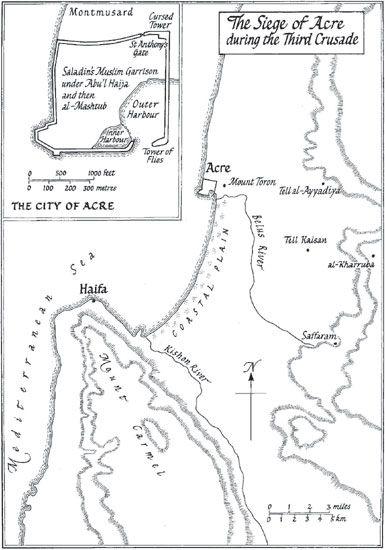
The Siege of Acre during the Third Crusade
At first Saladin greeted this move with scepticism. Believing that it was merely a feint designed to lure him away from Beaufort, he held his ground. This allowed King Guy to negotiate the narrow Scandelion Pass, where, one Frank wrote, ‘all the gold in Russia’ could not have saved them had the Muslims moved to block their advance. Realising his mistake, Saladin began a cautious advance south to Marj Ayun and the Sea of Galilee, waiting to assess the Christians’ next move before turning west towards the coast. Benefiting from his enemy’s circumspection, Guy followed the road south to arrive outside Acre on 28 August 1189.22
Acre was one of the great ports of the Near East. Under Frankish rule it had become an important royal residence–a vibrant, crowded and cosmopolitan commercial hub, and the main point of arrival for Latin Christian pilgrims visiting the Holy Land. In 1184 one Muslim traveller described it as ‘a port of call for all ships’, noting that ‘its roads and streets are choked by the press of men, so that it is hard to put foot to ground’ and admitting that ‘[the city] stinks and is filthy, being full of refuse and excrement’.
Built upon a triangular promontory of land jutting into the Mediterranean, Acre was stoutly defended by a square circuit of battlements. A crusader later observed that ‘more than a third of its perimeter, on the south and west, is enclosed by the flowing waves’. To the north-east, the landward walls met at a major fortification, known as the Cursed Tower (where, it was said, ‘the silver was made in exchange for which Judas the Traitor sold the Lord’). In the south-east corner the city walls stretched into the sea to create a small chained inner quay, and an outer harbour, protected by a massive wall running north–south that extended to a natural outcrop of rock–the site of a small fortification known as the Tower of Flies. The city stood at the northern end of a large bay arcing south to Haifa and Mount Carmel, surrounded by a relatively flat, open coastal plain, some twenty miles in length and between one and four miles in breadth. About one mile south of the port the shallow Belus River reached the coast.
The city stood at the gateway to Palestine–a bastion against any Christian invasion from the north, by either land or sea. Here Saladin’s resilience, martial genius and jihadi dedication would be tested to the limit, as Islam and Christendom became caught up in one of the most extraordinary sieges of the crusades.23
Early encounters
When King Guy reached Acre his prospects were incredibly bleak. One Frankish contemporary remarked that he had placed his meagre force ‘between the hammer and the anvil’, another that he would need a miracle to prevail. Even the Muslim garrison apparently felt no fear and began jeering from Acre’s battlements when they caught sight of the ‘handful of Christians’ accompanying the king. But Guy immediately demonstrated that he was developing a more acute sense of strategy; having surveyed the field that night, under the cover of darkness, he took up a position on top of a squat hill called Mount Toron. Some 120 feet high, lying three-quarters of a mile east of the city, this tell afforded the Franks a measure of natural protection and a commanding view over the plain of Acre. Within a few days a group of Pisan ships arrived. In spite of the punishing siege to come, many of the Italian crusaders on board had brought their families with them. These hardy men, women and children proceeded to land on the beach south of Acre and make camp.24
The measured pace of Saladin’s advance to the coast almost had disastrous consequences. Outnumbered and exposed as he was outside Acre, Guy decided to risk an immediate frontal assault on the city even though, as yet, he had no catapults or other siege materials. On 31 August the Latins attacked, mounting the walls with ladders, protected only by their shields, and might have overrun the battlements had not the appearance of the sultan’s advance scouts on the surrounding plain prompted a panicked retreat. Over the next few days Saladin arrived with the remainder of his troops, and any hopes the Latins entertained of forcing a speedy capitulation of Acre evaporated; instead, they faced the dreadful prospect of a war on two fronts–and the near-certainty of destruction at the hands of the victor of Hattin.
Yet, at the very moment that Saladin needed to act with decisive assurance, he wavered. Allowing Guy to reach Acre had proved to be a mistake, but the sultan now made an even graver error of judgement. True, Saladin lacked overwhelming numerical superiority, but he outnumbered the Franks and, through a carefully coordinated attack in conjunction with Acre’s garrison, he could have surrounded and overwhelmed their positions. As it happened, he adjudged a rapid, committed assault to be too risky and instead took up a cautious holding position on the hillside of al-Kharruba, about six miles to the south-east, overlooking the plain of Acre. Unbeknownst to the Latins, he managed to sneak a detachment of troops (presumably shielded by the darkness of night) into the city to bolster its defences and, while skirmishers were dispatched regularly to harass Guy’s camp on Mount Toron, Saladin chose to hold back the bulk of his forces and wait patiently for reinforcement by his allies. On this occasion, such caution, so often the hallmark of the sultan’s generalship, was inappropriate, the product of a significant misreading of the strategic landscape. One crucial factor meant that Saladin could ill afford to bide his time–the sea.
When Saladin reached Acre in early September 1189, the city was invested by Guy’s army and the Pisans. But in the aftermath of Hattin and the fall of Jerusalem, it was almost inevitable that the Frankish siege of this coastal port would become the central focus of Latin Europe’s retaliatory anger. During an inland siege, the king’s forces could have been readily isolated from supply and reinforcement, and Saladin’s circumspection would have made sense. At Acre, the Mediterranean acted like a pulsing, unstemmable artery, linking Palestine with the West, and while the sultan waited for his armies to assemble, ships began to arrive teeming with Christian troops to bolster the besieging host. Imad al-Din, then in Saladin’s camp, later described looking out over the coast to see a seemingly constant stream of Frankish ships arriving at Acre and a growing fleet moored by the shoreline ‘like tangled thickets’. This spectacle unnerved the Muslims inside and outside the port, and to boost morale Saladin apparently circulated a story that the Latins were actually sailing their ships away every night and ‘when it was light…[returning] as if they had just arrived’. In reality, the sultan’s prevarication gave Guy a desperately needed period of grace in which to amass manpower.25
A significant group of reinforcements arrived around 10 September–a fleet of fifty ships, carrying some 12,000 Frisian and Danish crusaders as well as horses. The western sources describe its advent as a moment of salvation, a tipping point beyond which the Latin besiegers had at least some chance of survival. Among the new troops was James of Avesnes, a renowned warrior from Hainaut (a region on the modern border between France and Belgium). Likened by one contemporary to ‘Alexander, Hector and Achilles’, a skilled veteran in the art of war and the politics of power, James had been one of the first western knights to take the cross in November 1187.
In the course of September, crusaders continued to arrive, swelling the ranks of the Frankish army. Among their number were potentates drawn from the upper ranks of Europe’s aristocracy. Philip of Dreux, the bishop of Beauvais, said to be ‘a man more devoted to battles than books’, and his brother Robert of Dreux came from northern France, as did Everard, count of Brienne, and his brother Andrew. They were joined by Ludwig III of Thuringia, one of Germany’s most powerful nobles. By the end of the month even Conrad of Montferrat had decided, apparently at Ludwig’s insistence, to come south from Tyre to join the siege, bringing with him some 1,000 knights and 20,000 infantry.26
Saladin too was receiving an influx of troops. By the second week of September the bulk of the forces summoned to Acre had arrived. Joined by al-Afdal, al-Zahir, Taqi al-Din and Keukburi, the sultan moved on to the plain of Acre, taking up position on an arcing line running from Tell al-Ayyadiya in the north, through Tell Kaisan (which later became known as the Toron of Saladin) to the Belus River in the south-west. Just as he settled into this new front, the Franks tried to throw a loose semi-circular cordon around Acre–running from the northern coast, through Mount Toron and across the Belus (which served as a water supply) to the sandy beach to the south. Saladin saw off this first Latin attempt at a blockade with relative ease. As yet, the crusaders lacked the resources to effectively seal off every approach to the city, and a combined assault by Acre’s garrison and a detachment of troops under Taqi al-Din broke the weakest part of their lines to the north, enabling a camel train of supplies to enter the city via St Anthony’s Gate on Saturday 16 September.
By mid-morning that day Saladin himself had entered Acre, climbing its walls to survey the enemy camp. Looking down from the battlements upon the thronged crusader host huddled on the plain below, now surrounded by a sea of Muslim warriors, he must have felt a sense of assurance. With the city saved, his patiently amassed army could turn to the task of annihilating the Franks who so arrogantly had thought to threaten Acre, and victory would be achieved. But the sultan had waited too long. For the next three days his troops repeatedly sought either to overrun the Latin positions or to draw the enemy into a decisive open battle, all to no avail. In the weeks since King Guy’s arrival the swelling crusader ranks had dug into their positions, and they now repulsed all attacks. One Muslim witness described them standing ‘like a wall behind their mantlets, shields and lances, with levelled crossbows’, refusing to break formation. As the Christians clung with stubborn tenacity to their foothold outside Acre, the strain of the situation began to tell on Saladin. One of his physicians revealed that the sultan was so racked with worry that he barely ate for days. Frankish indomitability soon prompted indecision and dissension within Saladin’s inner circle. With some advisers arguing that it would be better to await the arrival of the Egyptian fleet and others advocating that the approaching winter should be allowed to wreak its depredations upon the crusaders, the sultan wavered, and the attacks on the Christian lines ground to a halt. A letter to the caliph in Baghdad offered a positive summary of events–the Latins had arrived like a flood, but ‘a path had been cut to the city through their throats’ and they now were all but defeated–but in reality, Saladin must have begun to realise that the siege of Acre might prove difficult to lift.27
The first battle
The weeks that followed saw intermittent skirmishing, while Frankish ships continued to bring more and more crusaders to the siege. By Wednesday 4 October 1189 the Christians were numerous enough to contemplate going on the offensive, launching an attack on Saladin’s camp in what was to be the first full-scale pitched battle of the Third Crusade. Leaving his brother Geoffrey to defend Mount Toron, King Guy amassed the bulk of the Frankish forces at the foot of the tell, carefully drawing up an extended battle line with the help of the Military Orders and potentates such as Everard of Brienne and Ludwig of Thuringia. With infantry and archers in the front ranks, screening the mounted knights, the Christians set out to cross the open plain towards the Muslims, marching in close order and at slow pace. This was to be no lightning attack, but, rather, a disciplined advance in which the crusaders tried to close with the enemy en masse, protected by their tightly controlled formation. Surveying the field from his vantage point atop Tell al-Ayyadiya, Saladin had ample time to arrange his own forces on the plain below, interspersing squadrons under trusted commanders like al-Mashtub and Taqi al-Din with relatively untested troops, such as those from Diyar Bakr on the Upper Tigris. Holding the centre with Isa, but looking to play a mobile command role, boosting morale and discipline where necessary, the sultan prepared to face the Franks.
The scene outside Acre at dawn that day was spectacular and unsettling. For more than two hours, thousands of crusaders in packed ranks, resplendent banners raised, advanced at walking pace, inching towards battle with Saladin’s men. Soldiers on both sides must have struggled to hold their nerve. Then at last, around mid-morning, fighting began as the Christians’ left flank reached the Muslim lines to the north, where Taqi al-Din was stationed. Hoping to lure the Franks into a formation-shattering charge, Taqi al-Din sent in skirmishers and then feigned a limited retreat. Unfortunately his manoeuvre was so convincing that Saladin believed his nephew was under real threat and dispatched troops from his centre to reinforce the north. This unbalancing of the line gave the crusaders an opportunity. Advancing with rigid discipline, they attacked the right of Saladin’s central division ‘as one man, horse and foot’, quickly sending the inexperienced Diyar Bakris stationed there into full flight. Panic spread and the right half of the sultan’s central division crumbled.
For a moment, Saladin looked to be on the verge of defeat. With the way suddenly open to the Muslim camp on Tell al-Ayyadiya, Franks began racing up the hill. A detachment of crusaders actually reached the sultan’s personal tent, and one of Saladin’s wardrobe staff was among those killed. But the very lure of victory and, of course, of booty, brought a reversal of fortune. In the thrill of the moment, the crusaders’ formation, preserved until then with such care, broke apart: many turned to plundering, while the Templars doggedly pursued the retreating Muslims, only to discover that, unsupported, they had become separated from the main force. As they attempted a desperate withdrawal, Saladin rallied his troops. Accompanied by just five guards, he sped along the line, strengthening resolve and launching an attack on the retreating Templars. In the ensuing skirmish the brothers of that proud order were decimated. Their master, Gerard of Ridefort, the veteran of Hattin, was caught up in the midst of the fighting. With ‘his troops being slaughtered on all sides’, Gerard refused to flee to safety and was slain.
With the balance of the battle already shifting in Saladin’s favour, two events sealed the Christians’ fate. As combat raged on the plain between Mount Toron and Tell al-Ayyadiya, the Muslim garrison of Acre sallied out of the city, threatening both the crusaders’ camp and their field army’s rear. Sensing that they soon would be surrounded, struggling to maintain a semblance of formation, the Franks were close to panic. A small piece of misfortune pushed them over the edge. A group of Germans still engaged in pillaging Saladin’s camp lost control of one of their horses and, as the animal bolted back towards Acre, they gave chase. The sight of another crusader detachment seemingly in full flight threw the Christian host into disarray; as fear coursed down the ranks, a fully fledged rout began. With thousands now racing for the relative safety of the Latin entrenchments, hotly pursued by Saladin’s men, chaos reigned. ‘On and on went the killing’, wrote the eyewitness Baha al-Din, ‘until the fugitives that survived reached the enemy camp.’ Andrew of Brienne was cut to the ground while trying to halt the rout, and although he called out to his passing brother to save him, Count Everard was too terrified to stop. Elsewhere, James of Avesnes was unhorsed, but one of his knights gave up his own mount to enable James to escape and then turned to face his death. It even was said that King Guy rescued Conrad of Montferrat when the marquis became surrounded by Muslims.
Saladin proved unable to press home his advantage as the battle drew to a close. Latin troops stationed in the crusader camp fiercely resisted Muslim attempts to overrun their positions, and, perhaps more importantly, the sultan’s camp was still in a state of confusion. When the crusaders fought their way on to the slopes of Tell al-Ayyadiya, scores of servants in the Muslim army had decided to cut their losses, loot whatever they could and flee. Just when Saladin needed to direct the full weight of his military might against the retreating Franks, large swathes of his army were engaged in chasing their own thieving domestics.
Nonetheless, on the face of it, this was a victory for Islam. The Christians had come that morning seeking battle and had been defeated, leaving some 3,000 to 4,000 of their number dead or dying on the plains of Acre as darkness fell. The horror and humiliation of the day’s events were brought home to the crusader host when a mutilated, half-naked figure crawled into camp in the middle of the night. This poor wretch, a knight named Ferrand, maimed in the course of the fighting, had hidden among his fallen comrades only to be stripped and left for dead by Muslim pillagers. When he eventually reached the safety of the Frankish lines ‘he was so disfigured by his wounds that his people could not recognise him and he was barely able to persuade them to let him in’. The next morning Saladin chose to send his enemies a stark message: gathering the Christian dead, he pitched their remains into the Belus so that they floated downstream, into the Latin encampment. It was said that the stench from this mass of corpses lingered long after they were buried.28
Despite all this, the battle on 4 October did more lasting harm to Saladin’s prospects. In terms of Muslim dead and injured losses had been minimal, but those members of the sultan’s army that fled the field that day did not return–indeed, rumour had it that some of them did not stop running until they reached the Sea of Galilee–and they proved hard to replace. Worse still, the debacle in Saladin’s camp crushed morale and sowed distrust. Baha al-Din noted that in the looting ‘people lost vast sums’ and that ‘this was more disastrous than the rout itself’. Saladin made earnest attempts to recover as much lost property as possible, amassing a vast mound of plunder in his tent that could be reclaimed if people swore on oath that it was theirs, but the psychological damage had been done.
In the aftermath of the battle Saladin decided to review his strategy. After fifty days on the front line his troops were complaining of exhaustion, while he himself had begun to suffer from illness. Around 13 October his forces and baggage train began moving back from the contaminated battlefield to the more distant siege position of al-Kharruba to await the arrival of al-Adil. This was a tacit admission of failure; an acknowledgement that, in this first crucial phase of the siege, Saladin had been unable to dislodge the crusader force. By the logic of military science, the Franks had achieved the impossible–the successful establishment of an investment, deep in enemy territory, while facing an opposing field army. Historians have been consistently perplexed by this apparent anomaly. Yet the explanation is clear: the coastal nature of the siege certainly furnished the Franks with a vital lifeline, but, more significantly, the first exchanges of this conflict confirmed Saladin’s deepening crisis of manpower while exposing his own inability to command with resolute determination. Falling back on his habitual avoidance of full-scale confrontation when lacking overwhelming military superiority, the sultan believed that he was steering the safest course. But at this critical juncture action, not caution, was needed. Committing to a frontal assault on the crusaders’ positions at the start of Acre’s siege would have been a gamble, but one that Saladin stood a good chance of winning, albeit at considerable cost. With the decision to step back from the line in October, the chance to snuff out the Christian threat before it became fully embedded slipped away. It was not to return.29
Capitalising on the welcome breathing space they had been afforded, the crusaders set about securing their positions outside Acre. In mid-September they had begun throwing up rudimentary earthwork defences. Now, with the threat of an immediate offensive slackened, they ‘heaped up turf ramparts and dug deep trenches from sea to sea to defend the tents’, creating an elaborate system of semi-circular fortifications that enclosed Acre and offered far greater protection from Muslim assault, whether from the city’s garrison or from Saladin. To hinder mounted attackers, the no-man’s-land beyond the trenches was peppered with the medieval equivalent of minefields–deep, spike-laden, concealed pits, designed to cripple horse and rider. Reflecting on these measures, Saladin’s sometime critic Ibn al-Athir sardonically observed: ‘Now it became clear how well advised Saladin had been to retire.’ At the same time, throughout October Muslim scouts reported the near-daily influx of Latin reinforcements, prompting Saladin to write to the caliph in Baghdad proclaiming that the Christians were being supplied by ships more numerous than the waves and bemoaning the fact that for every crusader killed 1,000 took his place.30
Hiatus
The coming of winter in December 1189 brought a further lull in the siege. Faced with roughening seas and lacking access to the safety of Acre’s inner harbour, the Latin fleet was forced to sail north to Tyre and beyond in search of shelter. Conrad of Montferrat also returned to Tyre. Worsening weather forced a lull in hostilities as rain turned the ground between the crusaders’ trenches and Saladin’s camp at al-Kharruba to mud, across which it was impractical to launch attacks. The sultan sent the bulk of his troops home, remaining in person, while the Franks hunkered down to wait out the season, hoping to survive the predations of disease and hunger, devoting their energy to the construction of siege engines.
According to his confidant, Baha al-Din, Saladin now recognised ‘how much importance the Franks…attached to Acre and how it was the target at which all their determined plans were directed’. The decision to winter outside the city indicates that the sultan now regarded it as the war’s critical battleground. He may have lacked the nerve for an all-out assault on the crusader camp earlier that autumn, but at least he did show a new, steadfast determination to persevere with the campaign. Having spent the two years that followed Hattin scooping up easy conquests, avoiding drawn-out confrontations, he evidently decided that a line must be drawn at Acre and the Latin advance into Palestine halted in its tracks.
Knowing full well the devastation that would be rained upon Acre come spring, the sultan set about ‘[pouring in] sufficient provisions, supplies, equipment and men to make him feel confident that it was secure’. It was probably at this point that Saladin installed Abu’l Haija the Fat as the city’s military commander, alongside Qaragush. Even the crusaders were impressed by these measures, with one later commenting that ‘never was there a castle nor city that had so many arms, such defence, such provision of food, at such expense’. Amid the flurry of activity, the sultan suffered a grave personal loss when his close friend and shrewd counsellor Isa died of illness on 19 December 1189.31
The long months of stalemate were not solely the domain of grim-eyed exchanges and frenetic preparation. The winter afforded the first opportunities for fraternisation and the blossoming of a familiarity that would remain an undercurrent of the campaign. One of the last Latin ships to arrive in 1189 had carried a different breed of reinforcement: ‘300 lovely Frankish women, full of youth and beauty, assembled from beyond the sea [to offer] themselves for sin’. Saladin’s secretary, Imad al-Din, took a certain scandalised pleasure in describing how these prostitutes, having set up shop outside Acre, ‘brought their silver anklets up to touch their golden earrings [and] made themselves targets for men’s darts’, but noted with evident disgust that some Muslims also ‘slipped away’ to partake of their charms.
Another Muslim eyewitness noted that the Christian and Muslim enemies eventually ‘got to know one another, in that both sides would converse and leave off fighting. At times people would sing and others would dance, so familiar had they become.’ In the later periods the sheer proximity of the two entrenched sides must have contributed to this familiarity, as the Muslims were said to be ‘face to face with the enemy…with both sets of camp fires visible to each other. We could hear the sound of their bells and they could hear our call to prayer.’ The city’s garrison, at least, earned the crusaders’ begrudging respect, with one commenting that ‘never was there a people as good in defence as these devil’s minions’. This image of burgeoning friendship and acquaintance should not be stretched too far. Recent scholarship has unearthed an intriguing Latin survey of the forces amassed by Saladin at Acre, quite probably written during the siege. Characterised by a mixture of patchy knowledge and animosity, this document offers up precise details of Muslim troop characteristics and armament, peppered by persistent defamation and fantasy. Arabs were said to ‘circumcise’ their ears, while Turks were apparently renowned for indulging in homosexuality and bestiality, all in accordance with the supposed precepts of Muhammad.
The informal ‘rules’ of engagement that gradually built up between these entrenched foes also were sometimes transgressed. An understanding appears to have existed that troops leaving the safety of their camp to relieve themselves would not be attacked. The crusaders were therefore appalled when, on one occasion, ‘[a knight] doing what everyone has to do…was bent over’ when a mounted Turk raced from his front line hoping to skewer him with his lance. Wholly unaware of the danger, the knight was warned in the nick of time by the shouts of ‘Run, sir, run’ from the trenches. He ‘got up with difficulty…his business finished’, just managing to dodge the first charge, and then, facing his enemy unarmed, felled the horseman with a well-thrown rock.32
THE STORM OF WAR
With the advent of ‘the soft season of spring’, open warfare returned, and the first battle to be fought was for dominion of the sea. In late March 1190, shortly after Easter, news reached Acre that fifty Latin ships were approaching from Tyre. In the course of the winter, Conrad had agreed a partial reconciliation with Guy, becoming the ‘king’s faithful man’ in return for rights to Tyre, Beirut and Sidon. The fleet he now led south sought to re-establish Christian control over the Mediterranean seaboard to reconnect the crusaders’ lifeline to the outside world. This was a struggle that Saladin could ill afford to lose, as perhaps his best hope of overall victory at Acre lay in isolating the Frankish besiegers. He resolved to resist the oncoming ships at all costs, prompting one of the twelfth century’s most spectacular naval engagements.
The battle for the sea
When the Latin fleet appeared, driven down the coast by a north wind, around fifty of Saladin’s ships sailed out of Acre’s harbour in pairs to meet it, flying green and gold banners. The Franks possessed two main types of vessel: ‘long, slender and low’ galleys, fixed with battering rams and powered by two banks of oars (one below and one on deck); and ‘galliots’, shorter, more manoeuvrable warships with a single bank of oars. As the fleet approached, shield walls were erected on decks and the Christian ships formed into a V-shaped wedge, with the galleys at its point. With a cacophony of trumpets sounding on both sides, the two forces ploughed into one another and battle was joined.
Sea-borne combat was still a relatively rudimentary affair in 1190. Larger ships might try to ram and sink enemy craft, but on the whole fighting took place at close quarters and consisted of the exchange of short-range missiles and attempts to draw in opposing vessels with grappling hooks and board them. The greatest horror, as far as sailors were concerned, was Greek fire, because it could not be extinguished by water, and in this engagement both sides possessed supplies of this weapon. The Muslim fleet came close to gaining the upper hand on a number of occasions. One Frankish galley was bombarded with Greek fire and boarded, prompting its oarsmen to leap into the sea in terror. A small number of knights who were weighed down by their heavy armour, and who did not know how to swim anyway, chose to hold their ground ‘in sheer desperation’ and managed to win back control of the half-burnt vessel. In the end, neither side achieved an overwhelming victory, but the Muslim fleet came off the worst, being forced back behind Acre’s harbour chain. One of their galleys was driven ashore and ransacked, its crew dragged on to the beach and summarily butchered and beheaded by a merciless pack of knife-wielding Latin women. In a grim aside, a crusader later noted that ‘the women’s physical weakness prolonged the pain of death’ because it took them longer to decapitate their foes.
This battle cost Saladin control of the sea for the rest of 1190. The crusaders were able to police the waters around Acre, penning the sultan’s remaining ships within the harbour and disrupting any attempts to resupply the city’s garrison. For the next six months Acre’s inhabitants lived on the edge of starvation. By late spring their stores of supplies were exhausted and they were forced to eat ‘all their beasts, hooves and innards, necks and heads’ and expel any old or weak prisoners (the young were kept to load catapults). Saladin made repeated attempts to break the naval cordon, with varying degrees of success. In mid-June, part of a twenty-five-ship-strong fleet managed to fight its way through. Around late August, the sultan arranged for a round-bellied transport ship to be packed with 400 sacks of wheat, as well as cheese, corn, onions and sheep. To beat the blockade it sailed from Beirut under the cloak of disguise. Its crew ‘dressed up as Franks, even shaving their beards’, while pigs were placed on deck in plain view and crosses flown. The crusaders were fooled and the vessel successfully ran the gauntlet. But these were meagre victories for a city that needed near-constant supply. At the start of September, Qaragush managed to smuggle out a letter informing Saladin that in two weeks Acre would be entirely empty of food. The sultan was so alarmed that he kept the news secret for fear that it would break his army’s morale. Three more grain-laden supply ships were due from Egypt, but bad winds delayed their progress. Baha al-Din described how, on 17 September, Saladin stood on the shore ‘like a bereft mother…his heart troubled’, watching as they finally sailed up the coast towards Acre, knowing full well that the city would fall if they failed to get through. After fierce fighting ‘the ships came safely into harbour, to be met like rains after drought’.33
One saving grace throughout all these struggles was that the crusaders never succeeded in taking control of Acre’s inner harbour. Had they done so, the garrison’s position would have quickly become untenable. Late in the summer of 1190 the Franks made a concerted effort to seize the Tower of Flies, the fort built on a rocky outcrop in the bay of Acre that controlled the chain guarding the port’s harbour. They fortified two or three ships, creating what amounted to elaborate floating siege towers, but their assault failed when these were burned down by Greek fire.
With the exception of this attack, the Franks never attempted a naval assault on Acre and, in reality, from their perspective the battle for the sea functioned as a platform and an addendum to their land-based siege. Access to naval support was utterly indispensable in that it continued to furnish the crusaders with reinforcements, provisions and military supplies, and the blockade of Acre certainly added an important element of attrition to their investment, but for most of 1190 their overall strategy was grounded in warfare on land.
The struggle on land
Here the fighting season began again in earnest in late April and early May 1190. With spring, Saladin recalled his troops from Syria and Mesopotamia. On 25 April he moved his camp back to the front line at Tell Kaisan with the support of his son al-Afdal. Over the next two months they were reinforced by detachments from the likes of Aleppo, Harran and Mosul. At the same time, of course, with the sea open the crusader camp was again flooded by fresh recruits, many of whom were early arrivals from the armies of the French and English kings. Chief among them was Henry II of Champagne, count of Troyes, nephew of both Richard I and Philip Augustus. Henry reached Acre in August in the company of his uncles, Count Theobald V of Blois and Stephen, count of Sancerre, along with some 10,000 fighting men, and immediately took over military command of the siege. A large contingent of English crusaders arrived in late September, headed by Archbishop Baldwin of Canterbury, the formidable Hubert Walter, bishop of Salisbury, and Hubert’s uncle, Ranulf of Glanville, once one of King Henry II of England’s closest advisers.34
In spite of the renewed influx of western crusaders, Saladin should have possessed the manpower to balance, perhaps even overwhelm, the Christian besiegers during the long fighting season of 1190. But one factor stayed his hand–the coming of the Germans. As early as autumn 1189 Saladin had received reports that Emperor Frederick Barbarossa was marching to the Holy Land at the head of a quarter of a million crusaders–tidings that, not surprisingly, ‘greatly troubled the sultan and caused him anxiety’. The impending threat posed by the expected arrival of this horde meant that from April to September the sultan was never able to direct the full might of his military resources, nor focus his strategic thinking, upon the problem at Acre. Convinced that the emperor’s vast host would sweep south through Syria and Lebanon like an unstoppable tide, Saladin set about preparing for a bitterly fought war on two fronts. Almost as soon as the sultan’s troops arrived at Acre that spring he began sending them away to bolster the defences of the north. Inland cities were ordered to store their harvests in case of siege, while along the coast Saladin judged that the likes of Latakia and Beirut would have no chance of resisting Frederick, and thus ordered their walls to be razed to the ground to prevent them becoming Latin strongholds. These measures made complete strategic sense–indeed Saladin would have been mad to ignore Barbarossa’s approach–but they also served to cripple Muslim efforts at Acre by forcing a massive redirection of resources. In this way, even before they set foot in the Levant, the Germans made a significant contribution to the Third Crusade.35
Weakened and distracted, Saladin had to adopt a largely reactive approach to the defence of Acre. He could hope to frustrate the Franks’ attempt to seize the city, but any plans actually to make a concerted attempt to annihilate the besiegers were again sidelined. By the first days of May the sultan had re-established a front-line position, penning in the crusaders between his armies and Acre’s walls. This allowed Saladin to mount almost instantaneous counter-attacks to any Latin assault on the city, forcing the crusaders to fight their own draining struggle on two fronts. Meanwhile, the sultan sought to maintain contact with Qaragush and his garrison, but with the city subject to a close land and sea blockade this was no simple matter. Carrier pigeons were one of the mainstays of the communication and intelligence system that spanned the far-flung Ayyubid Empire, but at Acre they seem to have played a limited role, perhaps being too easy a target for enemy archers. Here, Saladin relied instead upon a group of guileful and courageous messengers who would seek to swim into Acre’s inner harbour under cover of darkness, carrying letters, money and even flasks of Greek fire sealed in otter-skin bags. This was perilous work. On one mission an experienced swimmer named Isa, who ‘used to dive and emerge on the far side of the enemy’s ships’, disappeared, only to be washed up drowned in the harbour a few days later, his consignment of messages and gold still tied round his waist.36
For the greater part of 1190, Saladin faced an enemy driven by one core objective–the breaching of Acre’s landward defences. Lacking a single universally acknowledged leader (with power passing between the likes of King Guy, James of Avesnes and Henry of Champagne), their attacks sometimes lacked resolve, but the threat they posed was severe nonetheless. The Franks adopted an assault-based siege strategy, looking to overcome the city’s walls through a combination of bombardment, scaling and sapping. Having constructed a number of catapults through the winter, they now initiated a near-daily barrage of stone missiles. These machines seem to have been of fairly limited strength, incapable of propelling truly massive boulders, so the attacks were probably designed to harass and injure the Muslim garrison as much as to weaken Acre’s walls. Of course, this was no one-sided affair. Within the city, Qaragush had his own array of heavy weapons with which he sought to destroy the crusaders’ siege engines, often with great success. One was said to be particularly massive, capable of loosing stones that on impact would bury themselves a foot into the ground.
Acre’s landward walls were encircled by a dry moat, designed to hamper any ground assault and prevent large-scale siege towers from being drawn up against its battlements. The crusaders made arduous attempts to fill sections of this ditch with rubble, often under the cover of aerial bombardment. The garrison did its best to hamper these efforts, showering the workers with arrows, but they were determined. One Frankish woman, mortally wounded as she carried forward stones, even requested that her body be thrown into the moat to act as infill. By early May 1190, to the Muslims’ horror, a path to the foot of the walls had been opened.
Panic now started to spread. For weeks Qaragush and Saladin had watched a frenzy of construction within the crusaders’ camp, as three massive siege engines gradually rose into the air. Built with wood specially brought from Europe to a height of some sixty-five feet, these wheeled three-storey behemoths were covered in vinegar-soaked hide, to dampen the effect of fire, and hung with rope netting to weaken the impact of catapult attack. One Muslim eyewitness wrote that, towering above the battlements of Acre, ‘[they] seemed like mountains’. Around 3 May, King Guy, James of Avesnes and Ludwig of Thuringia packed them with troops–crossbowmen and archers on the roof, spear and pikemen below–and began inching the machines towards the city. This dreadful spectacle appalled the Muslims. In Saladin’s camp ‘everyone totally despaired for the city and the spirits of the defend[ers] were broken’, while within Acre ‘Qaragush was out of his mind with fear’, preparing to negotiate a surrender. A swimmer was hurriedly dispatched to warn the sultan that collapse was imminent and Saladin quickly launched a counter-attack. Simultaneously, the garrison began pelting the towers with flasks of Greek fire once they came into range, but none of this halted their inexorable advance.
The day was saved by a young unnamed metalworker from Damascus. Fascinated by the properties of Greek fire, he had developed a variation on its formula which promised to burn with even greater intensity. Qaragush was sceptical, but eventually agreed to try this new invention, and the metalworker ‘concocted the ingredients he had gathered with some naphtha in copper vats, until the whole mixture was like a burning coal’. Earlier in the day, fruitless attempts to use standard Greek fire had prompted the Franks to dance about and make jokes atop their towers, but when a clay pot of this new formulation struck, their jeers were silenced. ‘Hardly had it hit the target before it burst into flames and the whole became like a mountain of fire’, observed one Muslim onlooker. The two remaining towers soon suffered a similar fate. Trapped crusaders on the upper levels died in the conflagration, while below those who could escaped to watch their great engines ‘burn to cinders’. For now, at least, Acre was safe.37
In the months that followed, the Muslims’ superior mastery of combustible weapon technology proved a decisive element. In August, when the Franks sought to intensify their bombardment, operating in shifts through day and night, building ever more powerful catapults, Qaragush and Abu’l Haija launched a lightning sortie, sending ‘Greek fire specialists’ to burn the enemy’s machines, killing seventy Christian knights in the process. In September a massive stone-thrower, built under the orders of Henry of Champagne at the cost of 1,500 gold dinars, was similarly dispatched in a matter of minutes. Not surprisingly, the crusaders developed an intense hatred of Greek fire. One unfortunate Turkish emir thus paid a heavy price when wounded in a skirmish beside a Frankish siege tower. He had been carrying a container of Greek fire, hoping to destroy the engine, but now a Latin knight ‘stretched him out on the ground, emptying the contents of the phial on his private parts, so that his genitals were burned’.38
Other, more insidious, battles raged that summer. The careful nurturing of morale within one’s own army and the struggle to break the will of the enemy had long been common features of medieval siege warfare. And, although events at Acre do not seem to have been marked by repeated acts of deliberately callous brutality or barbarism on either side, Qaragush’s garrison occasionally employed such tactics. Latin dead had already been hung from Acre’s battlements in November 1189 in an attempt to enrage the crusaders. Now, in 1190, Muslim troops occasionally dragged crosses and images of the Christian faith to the parapet to subject them to public defilement. This might involve beatings with sticks, spitting and even urination, although one soldier who attempted the latter was reportedly shot in the groin by a Frankish crossbowman.
The recurrent issues of any protracted investment–starvation and disease–also cast their shadows over Acre in 1190. Hunger and discontent seem to have prompted poorer sections of the crusader host to launch an ill-disciplined and ultimately fruitless attack on Saladin’s camp in search of food on 25 July, at the cost of at least 5,000 lives. With their corpses rotting in the summer heat and great swarms of flies descending, making life unbearable in both camps, disease inevitably spread across the plains of Acre.
Saladin once again sought to cleanse the battlefield by throwing the remains of the Christian dead into the river, sending a gruesome mixture of ‘blood, bodies and grease’ downstream towards the crusaders. The tactic worked. One Latin described how ‘no small number of [crusaders] died soon after [they arrived] from the foul air, polluted with the stink of corpses, worn out by anxious nights spent on guard, and shattered by other hardships and needs’. The lethal combination of malnutrition and atrocious sanitary conditions poisoned the camp for the rest of the season, and the mortality rate rocketed. Losses among the poor were severe, but even nobles were not immune: Theobald of Blois ‘did not survive more than three months’, while his compatriot Stephen of Sancerre ‘also came and died without protection’. Ranulf of Glanville lasted just three weeks. Acre was fast becoming the graveyard of Europe’s aristocracy.39
The fate of the German crusade
Elsewhere in the Near East another death was to change the course of the crusade. In late March 1190 Emperor Frederick Barbarossa secured terms with the Byzantines and led the German crusade across the Hellespont to Asia Minor. The Germans forged a route south-east through Greek territory, crossing into Turkish Anatolia in late April. Internal power struggles within the Seljuq sultanate of Konya meant that Frederick’s earlier attempts to negotiate safe passage through to Syria had a limited impact on the ground, and the crusaders soon encountered concerted Muslim resistance. Despite supply shortages, Barbarossa managed to maintain discipline among his men–Muslim sources claimed that he threatened to cut the throat of any crusader deemed to have contravened orders–and the German marching column continued to make headway. On 14 May a major Turkish assault was beaten back and Frederick moved on to attack Konya itself, occupying the lower town of the Seljuq capital and forcing the Turks into temporary submission.
With the crossing of Asia Minor almost completed, Barbarossa pushed south towards the coast and the Christian territory of Cilician Armenia. The German crusade had suffered substantial losses in terms of men and horses, but all in all Frederick had achieved a striking success, prevailing where the crusades of 1101 and 1147 had failed. Then, just as the worst trials seemed to be over, disaster struck. Approaching Sifilke on 10 June 1190, the emperor impatiently decided to ford the River Saleph ahead of his troops. His horse lost its footing mid-stream, throwing Frederick into the river–on a scorching-hot day the water proved shockingly cold, and unable to swim, the German emperor drowned. His body was dragged ashore, but nothing could be done. Western Europe’s most powerful monarch, the mightiest ruler ever to take the cross, lay dead.
This sudden unheralded cataclysm stunned Latins and Muslims alike. One Frankish chronicler remarked that ‘Christendom suffered much harm by [Frederick’s] death’, while in Iraq another contemporary joyfully proclaimed that ‘God saved us from his evil’. The German crusaders were gripped by a crisis of leadership and morale. Barbarossa’s younger son Frederick of Swabia tried to salvage the expedition. Assuming command, he had the late emperor’s body wrapped and embalmed, and then he led the way into northern Syria. But en route ‘disease and death fell upon them [leaving them] looking as though they had been exhumed from their graves’. Thousands died, while others deserted. At Antioch, some of Barbarossa’s remains were buried in the Basilica of St Peter, beside the site of the Holy Lance’s discovery; his bones were then boiled and collected in a bag in the hope that they might be laid to rest in Jerusalem (as it was, they were eventually interred in the Church of St Mary in Tyre). Frederick of Swabia limped down the Syrian coast with what remained of the German army, facing attacks from Ayyubid troops stationed in the north.40
It is not clear precisely when news of Barbarossa’s death reached Saladin–according to Baha al-Din, he was informed of the event by a letter from Basil of Ani, head of the Armenian Christian Church, but no date was provided. The tidings certainly caused celebration among the Muslims. A crusader wrote that ‘inside Acre…there was dancing and playing of drums’, and recalled that members of the Ayyubid garrison gleefully climbed the battlements to shout ‘many times, in a loud voice…: “Your emperor has drowned.”’ Nonetheless, the sultan was still dispatching troops to defend Syria as late as 14 July 1190 and the full strength of his armies did not reassemble at Acre until early autumn. Thus, even though Barbarossa’s demise crippled the German crusade, Saladin still lost vital military resources that summer. Frederick of Swabia eventually reached Acre in early October 1190 in the company of perhaps 5,000 troops. Saladin seems to have expected that, in spite of all their losses, the Germans’ arrival would reinvigorate the crusader siege, but in real terms it did little to advance the Frankish cause.41
STALEMATE
In one sense the fighting season of 1190 had been a success for Saladin. Acre had shrugged off every Latin assault, its garrison countering the artifice of the Franks’ experimental military technology. The sultan had managed, albeit with some difficulty, to maintain channels of communication and resupply with the city, while deploying his own troops to harass and distract the besieging crusaders. After twelve months’ investment, Acre still held.
Nevertheless, in the wider scheme of things, Saladin had failed. Forced to redeploy his martial resources to meet the perceived threat of the German crusade, he lacked the manpower with which to seize the initiative at Acre. With armies at full strength, that summer he might have risked a concerted frontal assault on the Frankish positions and driven the crusaders from Palestine. As it was, by the time his troops had regrouped at Acre in early October, Saladin seems to have decided that, for now at least, the opportunity for decisive intervention had passed. This, combined with the onset of a ‘bilious fever’, prompted him to move his army back to a distant winter encampment at Saffaram (about ten miles south-east of Acre) in mid-October, effectively bringing the fighting season to a close. With his confidence evidently shaken, Saladin ordered the demolition of Caesarea, Arsuf and Jaffa–the key ports south of Acre–and even mandated the dismantling of Tiberias’ walls. In the months that followed, Saladin faced a constant struggle to maintain his forces in the field. Some, like the lords of Jazirat and Sinjar, repeatedly petitioned to return to their lands; others, like Keukburi, were dispatched to oversee the governance of the sultan’s neglected Mesopotamian interests and were lost to the jihad.42
In pulling back from the front line, just as he had a year earlier, Saladin was relying upon the ravages of nature to weaken his enemy, waiting to see if the crusaders could survive a second cruel winter huddled outside Acre. Before long the change of season began to bite. As in 1189, autumn’s end heralded the closing of long-distance sea routes and the effective isolation of the Frankish host. By November, the crusaders’ supplies were already running short, forcing them to attempt a foraging expedition south towards Haifa which was beaten back after just two days.
Ordeals
In late November Saladin at last disbanded his army for winter, once again remaining in person with only a small force to watch over Acre as the ‘sea became rough [and the rains] heavy and incessant’. From the Muslim perspective, the months that followed proved far harsher and more trying than the winter of 1189. The city’s garrison was faltering, while Saladin and his men were exhausted and ill-tempered. With supply lines stretched, there were widespread shortages of food and weapons, and too few doctors available to deal with the frequent outbreaks of illness. ‘Islam asks aid from you’, the sultan wrote in an imploring letter to the caliph, ‘as a drowning man cries for help.’ And yet, these problems were but a pale reflection of the torments faced by the crusaders. One Muslim eyewitness acknowledged this, writing that because ‘the plain [of Acre] became very unhealthy’ and ‘the sea was closed to them’, there ‘was great mortality amongst the enemy’ with 100 to 200 men perishing daily.
The Latins’ suffering may have been obvious to onlookers, but the view from inside the Christian camp was even more anguished. Cut off from the outside world, the crusaders’ stores of food simply ran out. By late December people had turned to skinning ‘fine horses’, eating their flesh and guts with gusto. As the famine intensified, one crusader wrote that there were ‘those who had lost their sense of shame through their hunger [who] fed in sight of everyone on abominable food which they happened to find, no matter how filthy, things which should not be spoken of. Their dire mouths devoured what humans are not permitted to eat as if it were delicious.’ This may be an indication that there were outbreaks of cannibalism.
Weakened by hunger, the Franks fell prey to illnesses such as scurvy and trench mouth:
A disease ran through the army…the result of rains that poured down such as have never been before, so that the whole army was half-drowned. Everyone coughed and sounded hoarse; their legs and faces swelled up. On one day there were 1,000 [men on] biers; they had such swelling in the faces that the teeth fell from their mouths.
The resultant mortality was on a scale not seen since the First Crusaders’ siege of Antioch. Thousands died, among them such potentates as Archbishop Baldwin of Canterbury, Theobald of Blois and even Frederick of Swabia. These dark days of winter witnessed a collapse in Christian morale. One crusader commented ‘there is no rage like that born of starvation’, observing that, in the midst of this horror, anger and despair caused a loss of faith and desertion. ‘Many of our people went to the Turks and turned renegade’, he wrote; ‘they denied [Christ], the Cross and baptism–everything.’ Receiving these apostates, Saladin must have hoped that the siege of Acre would soon falter.
But still the crusaders clung on. Some resorted to grazing on grass and herbs ‘like beasts’, others turned to eating unfamiliar ‘carob-beans’ indigenous to the area, which they found ‘sweet to eat’. Hubert Walter, bishop of Salisbury, played a major role in restoring some semblance of order to the chaos-stricken camp, organising charitable collections from the rich so that food could be distributed to the poor. When scores of hungry crusaders sinned by eating what little meat they could find during Lent, Hubert enforced a penance upon them–three blows on their backs with a stick, administered by the bishop himself, ‘but not heavy blows’, as he ‘chastised like a father’. Finally, around late February or early March, the first small Christian supply ship bearing grain reached the camp to be greeted with great celebration, and with spring the crisis of supply ended. Having passed through a tempest of death and misery, the Franks were still thronged outside Acre.43
For Islam, the crusaders’ tenacity spelled disaster. As he had a year earlier, Saladin sought to use the winter season to strengthen Acre, but this time his efforts met with less success. Al-Adil was sent to organise a supply depot at Haifa from which resources could be ferried from Egypt up the coast to the garrison. On 31 December 1190 seven fully laden transport ships reached Acre’s harbour only to be dashed against the rocks and sunk by the treacherous seas. Food, weapons and money that could have sustained the city for months were lost. Then on 5 January 1191 an intense rainstorm caused a section of Acre’s outer wall to collapse, suddenly exposing the city to attack. Racked by starvation and illness, the crusaders were in no position to capitalise on this opportunity and Saladin’s men hurriedly filled the breach, but the omens for Islam were bleak. With a growing sense of apprehension, the sultan sought to reorganise Acre’s defences. Abu’l Haija the Fat was relieved of his military command of the port on 13 February, to be substituted by al-Mashtub, although Qaragush was left in his post as governor. The exhausted troops of the garrison were also replaced, but Saladin’s secretary Imad al-Din later criticised this measure, noting that a force of 20,000 men and sixty emirs was exchanged for just twenty emirs and far fewer troops because Saladin struggled to find volunteers willing to man the city.
The sultan’s frustration is apparent in a letter sent to the caliph that same month, in which he warned that the pope might be coming to lead the crusaders and bemoaned the fact that, when Muslim troops arrived at Acre from the far corners of the Near East, their commanders’ first question was when they could leave. At the same time, the manifold pressures of maintaining his enormous realm while locked in the struggle at Acre were beginning to tell. In March, Saladin begrudgingly assented to Taqi al-Din’s repeated demands to be made ruler of the north-eastern cities of Harran and Edessa. While the sultan could ill afford to lose his nephew from the jihad, he needed to safeguard his control over the Upper Euphrates or risk the unravelling of his empire.44
By April 1191 Saladin’s prospects, and those of Acre, seemed almost hopeless. For a year and a half the sultan had been immobilised by the crusaders’ siege of the city, unable to consolidate fully his victories of 1187, cowed into a strategy of reactive defence. He had sought to turn back the vengeful tide that had swept from western Europe onto the shores of Palestine, and he had failed. Frederick Barbarossa’s sudden death in June 1190 had been extraordinarily providential, but at Acre itself Saladin had been less fortunate, facing a seemingly indomitable Frankish enemy. Acre held, but so too did the Latin siege. Battered, but not broken, the crusaders had achieved a staggering feat of arms–the maintenance of a siege deep in enemy territory while beset by an opposing field army.
In one important regard, Saladin’s handling of the titanic struggle outside Acre was laudable. For the first time in the war for the Holy Land, he had refused to back away from a prolonged and entrenched military confrontation, showing dogged determination through one and a half years and two harsh winters. Yet, in spite of all the obstacles he faced, the sultan’s inability to crush the Christians between 1189 and 1191 must be harshly criticised. For he knew that all the Frankish might that had gathered before Acre, all the force of arms launched against its walls, were but tremors before the earthquake that would strike with the coming of the kings of England and France. And still Saladin lacked the will and vision to act. Now, with the gateway to the Holy Land ajar, Islam would have to face the full strength of Latin Christendom’s crusading wrath.