
In late summer 1191 King Richard I of England prosecuted a remarkably controlled, ruthlessly efficient march south from Acre to Jaffa, subjecting Saladin to a humiliating, if not crushing, defeat along the way. Since his arrival in the Holy Land, the Lionheart had galvanised the Third Crusade; no longer mired and inert in the northern reaches of Palestine, the expedition now seemed poised on the threshold of victory. Success depended on momentum–only immediate and resolute action would preserve the brittle Frankish coalition and maintain pressure on a faltering enemy. But just when focused commitment to a clear military goal was needed, Richard hesitated.
DECISIONS AND DECEPTIONS
Around 12 September 1191, just a few days after reaching Jaffa, worrying reports from the south began filtering into the crusader camp. Saladin, it was said, had moved on Ascalon and even now was razing the Muslim-held port to the ground. With these rumours stirring up a mixture of incredulity, horror and suspicion, the king dispatched Geoffrey of Lusignan (who had now been appointed titular count of the region) and the trusted knight William of L’Estang to investigate. Sailing south, they soon caught sight of the city, and, as they drew closer, a scene of appalling devastation revealed itself. Ascalon was awash with flame and smoke, its terrified populace streaming away in forced evacuation while the sultan’s men swarmed over the port’s mighty defences, ripping wall and tower asunder.
This grave spectacle was the product of Saladin’s newly resolute approach to the war. Still smarting from his humiliating defeat at Arsuf, the sultan had assembled his counsellors at Ramla on 10 September to re-evaluate Ayyubid strategy. Having tried and failed to confront the crusaders head-on during their march south from Acre, Saladin decided to adopt a more defensive approach. If Richard could not be crushed in open battle, then drastic steps would be taken to halt his advance–a scorched-earth policy to hamper Frankish movement, involving the destruction of key fortresses. The critical target was Ascalon, southern Palestine’s main port and the stepping stone to Egypt. If the Franks captured the city intact then the Lionheart would have the perfect bridgehead from which to threaten Jerusalem and the Nile region. Saladin realised that he lacked the resources to fight a war on two fronts and, prioritising the protection of the Holy City, ordered that Ascalon’s walls be razed to the ground. This cannot have been an easy decision–the sultan was said to have remarked, ‘by God I would prefer to lose all my sons rather than demolish a single stone’–but it was necessary. Time was pressing, for if Richard marched on he might yet seize the port. Saladin therefore sent al-Adil to watch over the crusaders at Jaffa, and then raced south with al-Afdal to oversee the dreadful labour, driving his soldiers to work at a furious pace, day and night, fearful of the Lionheart’s arrival.81
When Geoffrey and William brought news of what they had seen to Jaffa, King Richard still had a chance to act. Throughout the late summer he had been deliberately evasive about his objectives, but now a definite decision had to be made. To the Lionheart, the choice seemed clear: the seizure of Ascalon was the logical next step for the crusade. As a general he recognised that, to date, the expedition’s achievements had been dependent upon naval superiority. While the crusade continued to hug the coastline, Latin domination of the Mediterranean could stave off isolation and annihilation by offering a lifeline of supply and reinforcement. So far, the Christians had not truly fought the Third Crusade in enemy territory; once they marched inland, the real battle would begin. Ascalon’s seizure and refortification promised to destabilise further Saladin’s hold over Palestine, creating a secure coastal enclave, while keeping Richard’s options open for an eventual assault on Jerusalem or Egypt.
Richard arrived in Jaffa apparently expecting that, as king and commander, his will would be obeyed; that the march south could continue, almost without pause. But he had made a serious miscalculation. As a species of war, the crusade was governed not merely by the dictates of military science, nor by notions of politics, diplomacy or economy. This was a mode of conflict underpinned by religious ideology–one that relied upon the overwhelming and imperative devotional allure of a target like Jerusalem to create unity of purpose within a disparate army. And for the vast majority of those within Richard’s amalgamated crusading host, marching south from Jaffa was tantamount to walking past the doorway to the Holy City.
At a council held outside Jaffa in mid-September 1191, the Lionheart was confronted by this reality. Despite his best efforts to press for an attack on Ascalon, a large number of Latin nobles resisted–among them Hugh of Burgundy and the French–arguing instead for the refortification of Jaffa and a more direct strike inland towards Jerusalem. In the end, as one crusader put it, ‘the loud voice of the people prevailed’ and a decision was made to stay put. Richard seems not to have recognised it at the time, but he had failed a critical test. The events at Jaffa exposed an ominous deficiency in his skills as a leader. The Lionheart had been well schooled in the affairs of war since childhood; since 1189 his skills and authority as a king had blossomed. But, as yet, he had not grasped the reality of crusading.
With the decision to halt at Jaffa, the crusade lost impetus. Work began to rebuild the port and its defences, even as Saladin completed Ascalon’s destruction. Crusaders, shattered by the horrors of the march from Acre, now basked in the sudden break in hostilities. Among the constant flow of supply ships, vessels packed with prostitutes soon began to appear. With their arrival, bemoaned one Christian eyewitness, the army was again polluted by ‘sin and filth, ugly deeds and lust’. As days turned to weeks, even the will to press on to the Holy City faltered and the expedition started to fragment. Some Franks actually sailed to Acre to enjoy more luxurious comforts, and eventually Richard had to travel north in person to goad these absentees back into action.82
On the road to Jerusalem
In the end, the Third Crusade remained stalled around Jaffa and its environs for the best part of seven weeks. This delay gave Saladin time to extend his scorched-earth strategy, demolishing the network of fortifications running from the coast inland to Jerusalem. Richard spent much of October 1191 reassembling his army and, only in the last days of that month, with the normal fighting season drawing to a close, did the expedition begin to advance on Jerusalem. It now faced a challenge unlike any encountered by previous crusades. Back in 1099, the First Crusaders had marched on the Holy City largely unopposed, and in their subsequent siege, arduous though it was, the Franks had encountered a relatively small, isolated enemy force. Now, almost a century later, the Latins could expect to meet far sterner resistance.
Saladin’s power may have weakened in the years since 1187, but he still possessed formidable military resources with which to harass and oppose every step of a Christian approach on the Holy City. And should the crusaders reach Jerusalem, its actual conquest presented manifold difficulties. Protected by a full garrison and stout physical fortifications, the city’s defences would be all but insurmountable, while any besieging army would undoubtedly face fierce counter-attacks from additional Muslim forces in the field. More troubling still was the issue of supply and reinforcement: once the Third Crusade left the coast behind, it would have to rely upon a fragile line of communication back to Jaffa; if broken, Richard and his men would face isolation and probably defeat.
The Lionheart’s primary aim in the autumn of 1191 was the forging of a reliable chain of logistical support running inland. The main road to Jerusalem crossed the coastal plain east of Jaffa, through Ramla to Latrun, before arcing north-east to Beit Nuba in the Judean foothills and then winding east up to the Holy City (although there were alternatives, such as the more northerly route via Lydda). In the course of the twelfth century, the Franks had built a string of fortresses to defend the approaches to Jerusalem. Many of these had been controlled by the Military Orders, but all had fallen to Islam after Hattin.
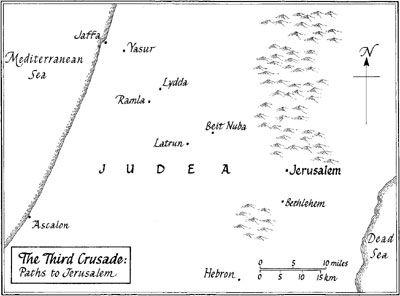
The Third Crusade: Paths to Jerusalem
Saladin’s recent shift in strategy had left the road ahead of the crusaders in a state of desolation. Every major fortified site–including Lydda, Ramla and Latrun–had been dismantled. On 29 October Richard marched on to the plains east of Jaffa and began the painstakingly slow work of rebuilding a string of sites running inland, starting with two forts near Yasur. In military terms, the war now devolved into a series of skirmishes. Marshalling his forces at Ramla, Saladin sought to hound the Franks, impeding their construction efforts while avoiding full-scale confrontation. Once the advance on Jerusalem began, the Lionheart frequently threw himself into the thick of these running battles. In early November 1192, a routine foraging expedition went awry when a group of Templars were attacked and outnumbered. When the news reached him, the king rode to their aid without hesitation, accompanied by Andrew of Chauvigny and Robert, earl of Leicester. The Lionheart arrived ‘roaring’ with bloodlust, striking like a ‘thunderbolt’, and soon forced the Muslims to retreat.
Latin eyewitnesses suggest that some of the king’s companions actually questioned the wisdom of his actions that day. Chiding him for risking his life so readily, they protested that ‘if harm comes to you Christianity will be killed’. Richard was said to have been enraged: ‘The king’s colour changed. Then he said “I sent [these soldiers] here and asked them to go [and] if they die there without me then would [that] I never again bear the title of king.”’ This episode reveals the Lionheart’s determination to operate as a warrior-king in the front line of conflict, but it also suggests that, by this stage, he was taking risks that worried even his closest supporters. It is certainly true that there were real dangers involved in these skirmishes. Just a few weeks later, Andrew of Chauvigny broke his arm while skewering a Muslim opponent during a scuffle near Lydda.83
Talking to the enemy
Bold as Richard’s involvement might have been in these inland incursions, his martial offensive was just one facet of a combined strategy. Throughout the autumn and early winter of 1191 the king sought to use diplomacy alongside military threat, perhaps hoping that, when jointly wielded, these two weapons might bring Saladin to the point of submission, forestalling the need for a direct assault on Jerusalem.
In fact, the Lionheart had reopened channels of communication with the enemy just days after the Battle of Arsuf. Around 12 September he sent Humphrey of Toron, the disenfranchised former husband of Isabella, to request a renewal of discussions with al-Adil. Saladin acceded, giving his brother ‘permission to hold talks and the power to negotiate on his own initiative’. One of the sultan’s confidants explained that ‘[Saladin] thought the meetings were in our interest because he saw in the hearts of men that they were tired and disillusioned with the fighting, the hardship and the burden of debts that was on their backs’. In all probability, Saladin was also playing for time and seeking to garner information about the enemy.84
In the months to come, reliable intelligence proved to be a precious commodity, and spies seem to have infiltrated both camps. In late September 1191 Saladin narrowly averted a potentially disastrous leak when a group of eastern Christians travelling through the Judean hills were seized and searched. They were found to be carrying extremely sensitive documents–letters from the Ayyubid governor of Jerusalem to the sultan, detailing worrying shortages of grain, equipment and men within the Holy City–which they had intended to present to King Richard. Meanwhile, to furnish a regular supply of Frankish captives for interrogation, Saladin engaged 300 rather disreputable Bedouin thieves to carry out night-time prisoner snatches. For Latin and Muslim alike, however, knowledge of the enemy’s movements and intentions was always fallible. Saladin, for example, was apparently informed that Philip Augustus had died in October 1191. Perhaps more significantly, the Lionheart persistently overestimated Saladin’s military strength for much of the remainder of the crusade.
Throughout autumn and early winter 1191, Richard eagerly maintained a regular dialogue with al-Adil, and, to begin with at least, this contact seems to have been hidden from the Frankish armies. In part, the king must have been driven to negotiation by the rumour that Conrad of Montferrat had opened his own, independent, channel of diplomacy with Saladin. As always, the Lionheart’s willingness to discuss avenues to peace with the enemy did not indicate some pacifistic preference for the avoidance of conflict. Negotiation was a weapon of war: one that might beget a settlement when combined with a military offensive; one that would certainly bring vital intelligence; and, crucially in this phase of the crusade, one that offered an opportunity to sow dissension among the ranks of Islam.
Even before leaving Jaffa, Richard entered into an intensive period of communication with al-Adil between 18 and 23 October. Initially, the king set out to gauge the enemy’s attitude towards Jerusalem. He wanted to explore the possibility that Saladin might relinquish possession of a city that Richard bluntly stated ‘is the centre of our worship which we shall never renounce, even if there were only one of us left’. But al-Adil conveyed an unequivocal response from the sultan, emphasising Islam’s own reverence for the Holy City and urging the Lionheart ‘not to imagine that we shall give it up, for we are unable to breathe a word of that amongst the Muslims’.
Richard then made an audacious change of tack–one that surprised his adversaries at the time and still confounds modern historians to this day. The king had already made a point of cultivating an amicable relationship with al-Adil, apparently describing him as ‘my brother and my friend’ in conversation. He now took the far grander step of proposing an extraordinary marriage alliance between Latin Christendom and Islam, in which al-Adil would be wed to Richard’s own sister, Joanne. This union would form the basis of a peace agreement in which ‘the sultan should give to al-Adil all the coastal lands that he held and make him king of [Palestine]’, with Jerusalem to serve ‘as the seat of [the royal couple’s] realm’. This new polity would remain part of Saladin’s empire, but Christians would be given free access to the Holy City. Al-Adil and Joanne would command the region’s castles, while the Christian Military Orders would take control of its villages. The pact would be sealed by an exchange of prisoners and the return of the True Cross. With a flourish of seeming magnanimity, the Lionheart proclaimed that the acceptance of this deal would bring the crusade to an immediate end and prompt his return to the West.
Because this offer was not recorded in any surviving contemporary Christian source (being mentioned only in Arabic texts) it is difficult accurately to assess how such an apparently outrageous arrangement might have been greeted by Richard’s Frankish compatriots. The Lionheart seems to have kept the entire affair a closely guarded secret, even initially from his sister, but whether he took the whole idea seriously, or whether it was merely intended as a ruse, remains uncertain. What is clear is that al-Adil viewed it as a genuine proposal. In diplomatic terms, Richard’s proposition possessed a masterful subtlety. Alive to the potential tensions between Saladin and al-Adil–the latter’s position as trusted brother being balanced by the threat he posed to the sultan’s son and heir–the English king made an offer that al-Adil could not ignore, but one that could also make him appear to be harbouring personal ambitions. Acutely aware of this implication, al-Adil refused to convey the news of Richard’s scheme to Saladin in person, instead deputising Baha al-Din, instructing him to speak with strict caution.
Saladin actually agreed to the terms, although he may have believed that Richard would never go through with the plan and was merely trying to ‘mock and deceive him’. Certainly, within a few days the Lionheart sent news that his sister would be unable to marry a Muslim and now suggested that al-Adil should convert to Christianity, leaving ‘the door open for negotiations’.85
A few weeks later, with the Third Crusade now grinding out its advance on Judea, Richard once again requested a parley. He and al-Adil met in an opulently appointed tent, pitched just beyond the Muslim front line at Ramla, on 8 November 1191. The atmosphere was almost convivial. The pair exchanged ‘foods, luxuries and presents’, tasting delicacies from their respective cultures; Richard asked to hear some Arabic music and a female musician was duly ushered in to entertain him with singing and the playing of a harp. Having talked through the day, ‘they parted’, in the words of one Muslim witness, ‘in amity and good spirits as firm friends’, even though the Lionheart’s repeated requests for a direct meeting with Saladin were declined.
Now, for the first time, the king’s negotiations with the enemy became public knowledge in the crusader camp, prompting considerable criticism. One Christian eyewitness noted that Richard and al-Adil ‘seemed to develop a sort of mutual friendship’, exchanging gifts including seven camels and an excellent tent. The general feeling among the Franks appears to have been that this diplomacy was ill advised. The Lionheart was said to have been fooled by the façade of generosity and goodwill into delaying the advance on Jerusalem–an error ‘for which he was much blamed and much criticised’–and outmanoeuvred by Saladin’s brother, who ‘trapped the overly credulous king with his shrewdness’. This notion of Richard as a befuddled pawn, manipulated by the devious political operator al-Adil, does not match up with the depiction of the Lionheart as a diplomat by Muslim sources. Indeed, the Mosuli chronicler Ibn al-Athir openly praised Richard, noting that ‘the king [met with al-Adil] as a skilful stratagem’.
In fact, the English king seems to have been a wily negotiator. A different man might have felt stymied by Saladin’s continued refusal of direct dialogue, but Richard sought to turn this factor to his advantage. On 9 November he sent the sultan an artful message, capitalising on the concessions made weeks earlier: ‘You have said that you granted these coastal lands to your brother. I want you to be an arbitrator between him and me and to divide these lands between [us].’ The Christians would need ‘some hold on Jerusalem’, but he wanted there to ‘be no blame on [al-Adil] from the Muslims and none on me from the Franks’. Richard’s rather devious underlying intention was to shift the whole basis of the negotiations, encouraging Saladin to think of himself as a magnanimous arbitrator and not an arch-opponent. At least some of the sultan’s advisers ‘were greatly impressed by this [approach]’.86
In the field of diplomatic machination, however, Saladin was, at the very least, Richard’s equal. Throughout the autumn, the sultan had been in contact with Conrad of Montferrat, a fact he made no effort to hide from the Lionheart–indeed, Conrad’s envoy even occasionally ‘went riding with al-Adil, observing the Franks as the Muslims engaged them in battle’, a spectacle which, it was believed, prompted the English king to redouble his own efforts at negotiation. Looking to exploit the rift between Richard and the marquis, Saladin pushed for a ‘show of open hostility to the Franks from overseas’, promising that if Conrad attacked crusader-held Acre he would be rewarded with an independent principality including Beirut and Sidon. The sultan juggled the negotiations with Richard and Conrad with panache, even lodging their respective envoys in different parts of his camp on the same day, all the while aiming, in the words of one of his advisers, ‘to cause dissension amongst them’.
By 11 November, however, with the crusaders now threatening Ramla, Saladin was willing to deal in earnest. He assembled his counsellors to debate the relative merits of forging a truce with Conrad or Richard. The marquis’ strength was certainly growing–he now had the backing of much of the nobility of the former Latin kingdom–but, ultimately, he was deemed less reliable than the Lionheart. Instead, the council backed an agreement with the English king based on an equitable division of Palestine that would see al-Adil and Joanne married and Christian ‘priests in the shrines and churches of Jerusalem’. In the end, perhaps believing that he had Saladin backed into a corner, Richard responded to this significant offer with prevarication. For the union to be permissible, he argued, the pope would have to give his blessing and this would take three months. Even as the message was being delivered the Lionheart was readying his troops to advance on Ramla and beyond.87
TO TAKE THE HOLY CITY
By early November 1191 the work to refortify the region around Yasur had been completed. Richard took the next step towards Jerusalem on 15 November, moving the crusader army forward to a position between Lydda and Ramla. Saladin retreated before him, leaving the two settlements–their defences shattered–to the Franks and, in the weeks that followed, he moved back first to Latrun and then, around 12 December, took refuge in Jerusalem itself. Although Muslim forces continued to harry the Latins throughout this period, in some sense at least the path to the gates of the Holy City was now open.
But even as his men hurriedly sought to rebuild Ramla, the Lionheart had to confront a new enemy: winter. On the open plain, its onset brought a ferocious change in the weather. Lashed by driving rain, freezing in plummeting temperatures, the crusaders spent six miserable weeks stockpiling food and weapons at Ramla, securing the supply line back to Jaffa, before inching their way forward first to Latrun, and then on to reach the small dismantled fortress near Beit Nuba, at the foot of the Judean hills, soon after Christmas. They were now just twelve miles from Jerusalem.
Conditions within the army that December were appalling. One eyewitness wrote:
It was cold and overcast…Rain and hail battered us, bringing down our tents. We lost so many horses at Christmas and both before and after, so many biscuits were wasted, soggy with water, so much salt pork went bad in the storms; hauberks rusted so that they could hardly be cleaned; clothes rotted; people suffered from malnourishment so that they were in great distress.
And yet, by all accounts, morale among the ordinary soldiers was high. After long months, and in some cases years, of struggle, they were now practically within sight of their goal. ‘They had an indescribable yearning to see the city of Jerusalem and complete their pilgrimage’, noted one Latin contemporary, while a crusader in the army recalled, ‘no one was angry or sad…everywhere was joy and happiness and [everyone] said together “God, now we are going on the right way, guided by Your grace.”’ Enduring commitment to the cause of the holy war seems to have inspired them, even amidst the anguish of a winter campaign. Like their crusading forefathers back in 1099, they were now ready, desperate even, to besiege the Holy City, regardless of the risk and privation involved.88
The question was whether King Richard shared their fervour. As the new year of 1192 began, he had a crucial decision to make. The crusade had taken almost two months to advance just thirty miles towards Jerusalem. The line of communication with the coast still held but was subject to near-daily Muslim raids. Mounting a siege of the city in these conditions, in the bitter heart of winter, would be a mammoth undertaking and a huge gamble. And yet, the bulk of the Latin army clearly expected that an assault would be made.
Around 10 January, the Lionheart convened a council to debate the best course of action. Its shocking conclusion was that the Third Crusade should retreat from Beit Nuba, turning its back on Jerusalem. Officially it was said that a powerful lobby of Templars, Hospitallers and Latin barons native to the Levant persuaded Richard. The dangers of undertaking a siege while Saladin still possessed a field army were too severe, they argued, and anyway, the Franks lacked the manpower adequately to garrison the Holy City even if it did, by some miracle, fall. ‘[These] wiser men were not of the opinion that they should acquiesce in the common people’s rash desires [to besiege Jerusalem]’, recalled one contemporary, and instead they advised that the expedition ‘should return and fortify Ascalon’, cutting Saladin’s supply line between Palestine and Egypt. In truth, the king probably packed the council with those sympathetic to his own views and knew only too well what its recommendations would be. For now, at least, Richard was not willing to stake the fate of the entire holy war on the outcome of so hazardous a campaign. On 13 January he broadcast the order to retire from Beit Nuba.
This was an earth-shattering pronouncement, but in recent scholarship Richard’s decision has been viewed in a positive light. Championed by the likes of John Gillingham as an astute general whose decision making was governed by martial reality and not pious fantasy, the Lionheart has been widely praised for his cautious strategy. Hans Mayer, for example, concluded that ‘in view of Saladin’s tactics, [Richard’s decision] was the right one’.89
In fact, the truth of the matter will never be known. One crusader eyewitness later concluded that the Franks missed an enormous opportunity to capture Jerusalem because they did not appreciate ‘the distress, the suffering and the weakness’ of the Muslim forces garrisoning the city, and to an extent he was right. Struggling to maintain his exhausted troops in the field, Saladin had been forced to disband the majority of his army after 12 December, leaving the Holy City dangerously undermanned. Ten days passed before Abu’l Haija the Fat arrived with Egyptian reinforcements. Throughout this period a decisive and determined move to assault Jerusalem might have broken Saladin’s will, fracturing his already fragile hold over the Muslim alliance and plunging Near Eastern Islam into disarray. On balance, however, Richard was probably right to forgo such a massive gamble.
Even so, the Lionheart should not escape reproach for his conduct in this phase of the crusade. To date, historians have ignored a fundamental feature of his decision making. If, in January 1192, it was so obvious to Richard’s military advisers and probably to the king himself that the Holy City was unconquerable and untenable, why had that same reality not been apparent months earlier, before the crusade ever left Jaffa? The king–the supposed master of military science–should surely have recognised in October 1191 that Jerusalem was a near-impossible military target and one that could never be retained. Writing in the early thirteenth century, Ibn al-Athir tried to reconstruct the Lionheart’s thinking at Beit Nuba. He conjured up a scene in which Richard asked to see a map of the Holy City; once aware of its topography, the king supposedly concluded that Jerusalem could not be taken while Saladin still commanded a field army. But this is little more than an imaginative reconstruction. Richard’s character and experience suggest that he would carefully have assembled the fullest possible picture of strategic intelligence before mounting the advance from Jaffa.
The Lionheart probably set foot on the road to Jerusalem in late October 1191 with little or no intention of actually prosecuting an attack on the city. This means that his advance was effectively a feint–the military component of a combined offensive in which a show of martial aggression augmented intensive diplomatic contact. Richard sought that autumn and winter to test Saladin’s resolve and resources, but was ever ready to step back from the brink if a clear opportunity for victory failed to materialise. In all this, the king acted according to the best precepts of medieval generalship, but he failed to account for the distinct nature of crusading warfare.
The impact of the retreat upon Christian morale and the overall prospects of the crusade were catastrophic. Even Ambroise, the Lionheart’s vocal supporter, acknowledged that:
[When] it was realised that the army was to turn back (let it not be called retreat), then was the army, which had been so eager in its advance, so discouraged, that not since God created time was there ever seen an army so dejected and so depressed…Nothing remained of the joy they had had before when they were to go to the [Holy] Sepulchre…Everyone cursed the day he was born.
Now a stunned and bedraggled rabble, the army limped back to Ramla. From there, depression and disillusionment ripped the expedition apart. Hugh of Burgundy and many of the French decamped. Some returned to Jaffa, others went off to Acre, where food and earthly comforts were plentiful. Richard was left to lead a severely weakened force south-west to Ascalon.90
REGROUPING
The Lionheart reached the ruined port on 20 January 1192 amid horrendous storms that further dampened morale. As the crusaders struggled to come to terms with their retreat from Jerusalem, Richard did his best to recover from the first real setback of his campaign. He put his remaining troops to work rebuilding Ascalon, determined to salvage something from that dismal winter by making practical and visible progress on the coast. Henry of Champagne had remained loyal to his uncle and lent his aid to the project, but the refortifying of so devastated a city was a mammoth undertaking–one that would ultimately take five months of hard labour and cost Richard a fortune.
In late February, a crisis erupted in northern Palestine–one that revealed enduring divisions among the Franks. Even though the war for the Holy Land was far from over, the Latins began openly fighting over Acre. Genoese sailors tried to take control of the city, probably with the connivance of Conrad of Montferrat and Hugh of Burgundy, and it was only the fierce resistance put up by Richard’s Pisan allies that prevented the port from being united with Tyre. Enraged by what he saw as a brazen act of betrayal, Richard travelled north to parley with Conrad, and the pair met halfway between Acre and Tyre. ‘Long discussions’ were apparently held, but no lasting agreement could be forged and the marquis returned to Tyre.91
Richard’s military fortunes had turned in the hills of Judea, and now on the northern coast his gift for sure-footed diplomacy seemed also to desert him. Frustrated by his failure to bully Conrad into submission, the Lionheart immediately instituted an assembly and had the marquis officially deprived of the share of the kingdom of Jerusalem’s revenue allotted to him in summer 1191. In truth, though, this was little more than an empty gesture. Conrad had two telling advantages: an unassailable centre of power at Tyre, and a growing body of support among Outremer’s remaining Frankish barons, including the likes of Balian of Ibelin. The marquis may have been a devious, self-serving opportunist who was willing to negotiate with Saladin against the interests of the crusade, but his marriage to Isabella of Jerusalem gave him a claim to the throne. He also had proven himself a stronger leader than Guy of Lusignan (his rival for the Jerusalemite crown) and, unlike Richard, showed every sign of being committed to a permanent career in the Levant. That February the Lionheart chose to ignore the obvious, but eventually he would have to acknowledge the uncomfortable reality. Conrad could be neither broken nor turned and, therefore, he would have to be accommodated in any lasting political and military settlement in the Near East.
Around this time, channels of negotiation between Richard and Saladin were reopened. The sultan, once again, was represented by his brother al-Adil, while Humphrey of Toron spoke on the Lionheart’s behalf. Meetings were held near Acre in late March and, at one point, it appeared that terms–including a partition of Jerusalem–might actually be agreed. In early April, however, Richard broke off the dialogue and sailed south to spend Easter in Ascalon. The reason for this sudden change of policy is uncertain, but it is likely that the king had heard rumours that Saladin’s exhausted armies were showing signs of insubordination and that the sultan was also facing Muslim insurrection in Mesopotamia. Seizing upon this possible vulnerability, Richard seems to have convinced himself that he now had no need to agree to anything other than the most advantageous terms. Once back in Ascalon, he began preparing to launch a new offensive.
CRISIS AND TRANSFORMATION
On 15 April 1192 Robert, prior of Hereford, arrived in Ascalon having sailed east from Europe. He bore news that overturned all of Richard’s plans. The king’s aide and representative William of Longchamp had been exiled from England by Prince John, and Richard’s ambitious brother was now making moves to increase his own power in the kingdom. After ten months of crusading in the Holy Land, this was a stark reminder of Richard’s duties and obligations as monarch of the Angevin realm. The Lionheart immediately recognised that, with a crisis looming in the West, he could ill afford to tarry in the Levant; but neither did he wish to abandon the crusade and return home a failure. Richard seems to have judged that he had time to dedicate one more fighting season to the cause of the cross. But to bring the Palestinian war to a swift and successful conclusion, he would need to unify the disparate Latin forces ranged across the Holy Land.
Reconciled to compromise, the Lionheart convened a council of crusader barons on 16 April. He announced that, in light of events in England, he might soon have to depart and instructed the assembly to resolve the issue of the Jerusalemite crown. A unanimous decision was reached, almost certainly with Richard’s tacit approval, to offer the kingdom to Conrad of Montferrat. Guy of Lusignan, meanwhile, was to be compensated handsomely for his loss of status–Richard arranged for the Templars to sell Guy the island of Cyprus for 40,000 bezants, a move that allowed the Lusignan dynasty to establish a powerful and enduring lordship in the eastern Mediterranean. Henry of Champagne was deputised to sail north to Tyre and inform the marquis of his sudden promotion, and, more importantly, to persuade him to unite his forces, and those of Hugh of Burgundy, with the crusader army gathered at Ascalon so that the holy war might be waged.
Within a few short days Conrad received the news and by all accounts he was ecstatic. After months of waiting in the wings, proceeding ever with caution and cunning, his dreams of threading a path to regal power had been realised. For all his earlier intransigence and hesitation, the marquis immediately initiated preparations for a military campaign. Unbeknownst to Richard or the Franks, he also sent an urgent message to Saladin, explaining that an unexpected agreement had been reached among the Latins, and threatening that unless Saladin finalised ‘a settlement [with Conrad] in the next few days’, a full-scale confrontation would follow. According to a Muslim eyewitness in the sultan’s court, Saladin took this approach extremely seriously. Threatened by impending civil unrest in Mesopotamia, ‘the sultan believed…that the best plan was to make peace with the marquis’ and on 24 April he dispatched an envoy to Tyre to finalise terms. In the last days of April 1192, then, King Richard and Saladin believed that they had found ways to conclude the war for the Holy Land: the one through renewed battle; the other through peace. The plans of both centred upon Conrad of Montferrat.92
On the evening of 28 April Conrad travelled to the French crusader Philip bishop of Beauvais’ residence in Tyre to have supper. The pair seem to have struck up a friendship in the course of the crusade and Conrad was in a relaxed, celebratory mood. Riding home through the city later that night, attended by two guards, the marquis passed the Exchange building and entered a narrow street.
[There] two men were sitting on either side of the road. As [Conrad] came between them they rose up to meet him. One of them came and showed him a letter, and the marquis held out his hand to take it. The man drew a knife and plunged it into his body. The other man who was on the other side jumped onto the horse’s rear and stabbed him in the side, and he fell dead.
Conrad’s two assailants were subsequently revealed to have been members of the order of Assassins sent by Sinan, the Old Man of the Mountain. One of the pair was decapitated immediately; the other captured, interrogated and then dragged through the streets until he died. But though their link to the Assassins was established, the original instigator of the attack remained less certain. Hugh of Burgundy and the French in Tyre spread the rumour that King Richard had contracted the killing, while in some parts of the Muslim world it was rumoured that Saladin was involved. Given recent developments, however, neither ruler actually stood to gain much from Conrad’s death. The truth of the matter is impossible to determine–Sinan may even have acted independently to eliminate the marquis, having deemed him to be a dangerous long-term threat to the balance of power in the Levant.93
The political situation among the Latins was in disarray. Hugh of Burgundy tried to seize control of Tyre, but he seems to have been thwarted by Conrad’s widow Isabella, the heiress to the kingdom of Jerusalem. With yet another outbreak of infighting threatening, a new settlement was pushed through quickly. Count Henry of Champagne was chosen as a compromise candidate–because as nephew to both King Richard and Philip Augustus he represented Angevin and Capetian interests–and within a week he was married to Isabella and elected as titular monarch of Frankish Palestine.
The exact extent of the Lionheart’s involvement in the engineering of this rapid solution is unclear. By and large, however, the new order suited his interests and those of the Third Crusade. Henry of Champagne’s appointment finally united all the Latin armies in Palestine–from the native Franks of Outremer, to Hugh of Burgundy’s French troops and Richard’s Angevin forces. Given Henry’s and Richard’s recent history of alliance, there was also a good chance that the pair would be able to cooperate effectively.
Through May 1192 the Lionheart set about bolstering his foothold in southern Palestine, conquering the Muslim-held fortress of Darum, while the work of refortifying Ascalon neared completion and Count Henry and Duke Hugh mustered armies to the north. With Christian morale reinvigorated, the stage seemed set for the launch of a decisive campaign–although, given Richard’s recent expansion down the coast towards Egypt, the target of any venture still might be subject to debate.
On 29 May, however, another Angevin messenger arrived from Europe with a dispatch confirming the Lionheart’s worst fears. Ever since his rival Philip Augustus of France had left the crusade in midsummer 1191, Richard had been deeply concerned that the Capetians might threaten Angevin territory in his absence. He now learned that King Philip had made contact with Prince John, and that together the pair were busy plotting. The envoy warned that unless something was done ‘[to restrain] this abominable treachery, there was a danger that very soon England would be taken from King Richard’s authority’. The Lionheart was said to have been ‘disturbed to hear this news, and afterwards…sat for a long time in silence, turning things over in his mind and weighing up what should be done’. In April he had resolved to remain in the Holy Land, but this latest grave report from the West reopened the issue. According to his supporter Ambroise, Richard was ‘melancholy, downcast and saddened…his thinking confused’.94Christendom’s great warrior had reached the critical moment of decision–would he fight on as a crusader, or heed the call of his Angevin realm and return home as a king?