
For more than half a century after Saladin’s death in 1193, members of his Ayyubid dynasty dominated Near Eastern Islam. Saladin had brought doom and defeat to the Christian Franks living in the Levant, reconquering Jerusalem and holding back Richard the Lionheart’s Third Crusade. But wrapped up in their own petty rivalries, later Ayyubids proved willing to live in relative peace alongside the remaining crusader states. And with Muslims and Christians both keen to maintain mutually profitable trade links, negotiation, accommodation and truce became the order of the day. The Islamic rulers of Damascus, Cairo and Aleppo still claimed to be champions of jihad, but their struggle turned inwards, to be expressed in works of spiritual purification and religious patronage. Rather than embrace the external militaristic form of jihad by waging holy war, the Ayyubids sought, in the main, to limit conflict–ever conscious that aggression might provoke a dangerous and disruptive western European crusade.
This delicately balanced modus vivendi was to be dramatically overturned when two new oriental superpowers–the Mamluks and the Mongols–rose to prominence in the Levant. Each was imbued with fearsome military strength, unlike anything yet witnessed in the age of the crusades, and their monumental clash reshaped the fate of the Holy Land and the history of the crusades. Overshadowed by these two behemoths, Latin Outremer became the third, sometimes almost incidental, challenger in the struggle for mastery of the East.
NEW POWERS IN THE NEAR EAST
A new Islamic dynasty–the Mamluk sultanate, governed by members of the mamluk (slave soldier) military elite–seized power in Egypt in the wake of King Louis IX of France’s failed crusade. A convoluted and brutal power struggle raged throughout the 1250s, as various mamluk leaders sought to overthrow the last vestiges of Ayyubid authority in the Nile region. The elite Bahriyya mamluk regiment was forced to flee Egypt in 1254, when their commander Aqtay was murdered by the ruthless warlord Qutuz, spearhead of a rival mamluk faction. Three years later, Shajar al-Durr–widow of the last great Ayyubid Sultan al-Salih–was executed, and Qutuz gradually assumed control of Egypt, while still governing in the name of a young puppet-sultan, al-Mansur Ali.
Meanwhile, the Bahriyya went into exile under the leadership of Baybars–one of the conspirators in the 1250 murder of the Ayyubid heir, Turanshah. Born around 1221, Baybars was a tall, dark-skinned Kipchak Turk, the hardy, bellicose people of the Russian steppes, known in the ancient world as the Cumans. He was said to possess a remarkably powerful voice, but Baybars’ most striking feature was his blue eyes, one of which held a small but distinct white fleck the size of the eye of a needle. Taken into slavery at the age of fourteen, Baybars began mamluk training, and then passed through the hands of a number of owners before eventually being recruited into al-Salih’s new Bahriyya corps in 1246. There his martial skill and leadership qualities were soon recognised, and he fought against King Louis’ crusaders in the Battle of Mansourah in 1250.
In the mid-to late 1250s, Baybars and the Bahriyya served a succession of ineffectual Ayyubid emirs who were trying desperately to cling to power in Syria, Palestine and Transjordan. Among them was al-Nasir Yusuf, the nominal ruler of Aleppo and Damascus–an emir born of a noble bloodline, being Saladin’s grandson, but singularly incapable of facing the violent challenges of this turbulent era of shifting allegiances and emerging world powers. During this period, Baybars honed his abilities as a military commander, scoring a number of impressive successes, but also enduring some chastening defeats. Throughout, he was closely supported by a fellow mamluk and Kipchak Turk, Qalawun, perhaps his closest friend and comrade in arms. With an ever watchful eye upon events in Egypt, Baybars twice attempted to invade the Nile region and depose Qutuz, but, being heavily outnumbered, he proved unable to achieve a significant victory.
By 1259, Baybars had shown himself to be an adept general with an obvious appetite for advancement, but as yet he had not been given the chance to realise his ambitions or evident potential. That opportunity would come, both for Baybars and indeed for the entire Mamluk regime, with the appearance of a new, devastating threat to the Muslim Near East.1
Around the year 1206 a warlord named Temüjin united the nomadic Mongol tribes of the vast east Asian steppe grasslands of Mongolia and assumed the title of Chinggis, or Genghis, Khan (literally ‘stern ruler’). Genghis and his followers were driven by a boundless hunger for war and came to believe, within the tenets of their pagan faith, that the Mongols were destined by a heavenly decree to conquer the entire world. Through sheer strength of will Genghis transformed the feuding Mongol tribes into an unstoppable army, harnessing the innate resilience of his people and their peerless skills as horsemen and archers.
For the next fifty years, first under Genghis Khan and then, after his death in 1227, under his sons, the Mongols exploded across the face of the Earth. They were a force unparalleled in the medieval world, perhaps in all human history. Unrelenting and utterly uncompromising in their approach to warfare, they expected enemies to show immediate wholesale submission or face total annihilation. And by 1250 their dominions stretched from China to Europe, from the Indian Ocean to the northern wastes of Siberia. This exponential expansion inevitably brought the Mongols into contact with the Christian and Muslim worlds.
Having subjugated northern China, the Mongols began their westward advance in 1229, crushing the Islamic rulers of northern Iran–a move which prompted the Khwarizmians to flee into northern Iraq and eventually culminated in the Khwarizmian invasion of the Holy Land in 1244. Between 1236 and 1239 the Mongol horde defeated the eastern Christians of Georgia and Greater Armenia and, in 1243, invaded Asia Minor, overwhelming the Seljuq Turkish dynasty that had ruled there since the eleventh century. Through the 1230s Mongol armies also conquered the southern steppelands of Russia, establishing a polity that came to be known as the Golden Horde. Ironically, this caused many of the Kipchak Turks native to this region to become refugees. Flooding southwards, they fell into the clutches of slave traders and thus massively increased the availability of mamluk recruits for the Muslims of Egypt.
Driving further west, the Mongols eventually encountered the Latin Christians of Europe, where their advent was greeted with a mixture of fear, confusion and uncertainty. News that the Muslims of Iran had been defeated by an unknown force from the distant lands of the East reached the Fifth Crusaders in Egypt in 1221, causing many Franks to imagine that the Mongols might actually be valuable allies. At first this view gained credence, because the shadowy Mongols were equated with the ancient legend of Prester John–a powerful Christian king, prophesied to emerge from the East in Christendom’s darkest hour. Over time, it also became clear that Nestorian Christians (a sect long settled in Central Asia) had managed to gain some influence among the Mongols, even converting the wives of some leading warlords.
But Latin Christendom slowly realised that the Mongols, or Tartars as they came to be known in Europe, were not merely a distant foreign power, but an immediate and potentially lethal threat. In 1241 the Mongol army pushed on from Russia and spent the next year ravaging and terrorising Poland, Hungary and eastern Germany, causing untold destruction. Even in the wake of this devastating incursion, the rulers of western Europe–locked in their own disputes–were slow to react, and many continued to nurse ideas of accommodation or alliance. From the late 1240s onwards, the Roman papacy sent two missionary embassies to the Mongols, led by groups of Friars. These Frankish envoys travelled thousands of miles to visit the lavish Mongol court at Qaraqorum (in Mongolia), hoping to convert the Great Khan to Christianity; they returned with blunt ultimatums instructing Rome to submit to Mongol authority. During his time on Cyprus, Louis IX also made contact with the Tartars. In 1249 he sent his own representatives to the Mongols in Iran, but when this embassy returned in 1251 to find Louis in Palestine, it likewise bore a stark demand that he begin paying an annual tribute, which, needless to say, he ignored.
In spite of this uncompromising approach to diplomacy, the Mongol Empire actually started to decay in the second half of the thirteenth century, corroded by dynastic struggle and the problems attendant on governing such an immense realm. Nonetheless, they remained an awe-inspiring force. In the 1250s, the new Great Khan Möngke (Genghis Khan’s grandson) initiated a renewed wave of expansion into the Muslim world of the Middle East and beyond, placing his brother Hülegü in command of a massive host of tens of thousands of warriors, alongside the leading Mongol general Kitbuqa. Marching through southern Iran in 1256, this mighty army turned towards Baghdad, where an enfeebled member of the Abbasid dynasty still claimed the title of Sunni caliph. In February 1258 Hülegü crushed Baghdad, putting in excess of 30,000 Muslims to the sword and destroying much of the once great capital. He went on to subjugate most of Mesopotamia, establishing what came to be known as the Mongol Ilkhanate of Persia (stretching from Iraq to the borders of India). Hülegü then crossed the Euphrates to arrive on the borders of Syria and Palestine in 1259.
Not surprisingly, the coming of the Mongols terrified the peoples of northern Syria. The Christians continued to harbour the hope that Hülegü might prove to be an ally against Islam, encouraged by the fact that his wife was a Nestorian. King Hethum of Cilician Armenia had submitted to Mongol rule as far back as 1246, and had been allowed to retain partial autonomy in return for the payment of an annual tribute. Hethum now convinced his son-in-law Bohemond VI (ruler of both the principality of Antioch and the county of Tripoli) to ally with Hülegü’s army. Al-Nasir, the Ayyubid ruler of Aleppo and Damascus, had also been paying the Mongols tribute since 1251 in the hope of forestalling a direct invasion, but in autumn 1259, with the horde now marching into Syria, the limitations of the policy of appeasement became apparent.2
The Battle of Ayn Jalut
While the advent of the Mongols brought panic and chaos to much of the Muslim Near East, their arrival infused the Mamluk world with a new sense of unity and purpose. In November 1259, Qutuz used the Mongol threat to justify his overthrow of the existing young sultan and had himself proclaimed as the new ruler of Egypt. At the same time, al-Nasir’s grip on power was faltering. Stationed near Damascus, the Ayyubid emir seems to have been wholly immobilised by fear as the Mongols advanced on Aleppo–certainly he did nothing to react, even as streams of refugees poured into southern Syria from as far afield as Persia.
In early 1260 Hülegü laid siege to Aleppo, with the aid of Hethum and Bohemond VI, and by the end of February the city had been captured and subjected to a six-day-long orgy of violence. Bohemond personally set fire to the city’s main mosque and although he was later excommunicated by the Latin Church for aiding the Mongols, the prince made significant territorial gains as a result of the 1260 pact, including the reassertion of Frankish control over the port of Latakia. Hülegü moved on from Aleppo to overcome the likes of Harim and Homs, and soon attained full dominion of northern Syria. News of these events caused al-Nasir to flee Damascus and the city’s populace elected to surrender to the Mongols rather than face Aleppo’s fate. Thus, in March 1260, the Mongol general Kitbuqa arrived to occupy Islam’s ancient Syrian capital. The cowering al-Nasir was soon captured and sent to Hülegü–where, for the time being, he was treated as a valuable hostage–but news arrived of Möngke’s death, and Hülegü decided to leave Syria with the vast bulk of his army, returning east to oversee the succession of his brother Kublai as Great Khan. This left Kitbuqa in command of Mongol Syria, albeit with a much-reduced host at his disposal, but even so he received the surrender of Ayyubid Transjordan that summer.
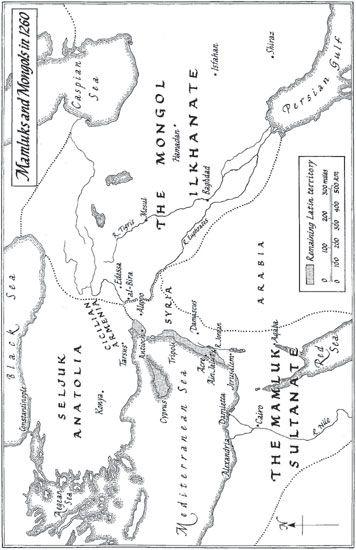
Mamluks and Mongols in 1260
With the Mongols having swept into the Holy Land largely unopposed, overturning the Ayyubid world, it was now questionable whether any Levantine power had the will and resources to stem their advance. The Franks of the kingdom of Jerusalem did not share Bohemond of Antioch’s ready willingness to side with the Mongols, conscious of the fact that to do so might simply be to exchange a Muslim enemy for another, even more dangerous, pagan foe. Hoping to avoid any direct confrontation, the Latins adopted a policy of neutrality.3
By the middle of 1260, therefore, only one force remained that might be capable of opposing the Mongol horde–Mamluk Egypt. By this time, Baybars had recognised that his Ayyubid paymasters would be unable to resist the Mongols, and thus he negotiated a rapprochement with Qutuz, travelling with the remaining members of the Bahriyya to Cairo in March. There a tense concord held, but a current of mutual animosity and suspicion swirled just beneath the surface. Both men were aware of the other’s ambition and Qutuz’s role in Aqtay’s murder was fresh in Baybars’ mind. One Muslim chronicler acknowledged that the profound hatred each held for the other was clear in their eyes.
The Mamluks now faced a defining question: whether to confront or placate the Mongols. On this issue, at least, Qutuz and Baybars were in resolute agreement. Early that summer, an embassy from Hülegü arrived in Cairo demanding Mamluk surrender. The envoys were summarily butchered, their bodies cut in half and their heads hung from one of Cairo’s gates. With this extraordinarily defiant statement of intent the Mamluks went to war. Rather than wait in Egypt, in the hope of repelling an invasion on home ground, they chose to confront Kitbuqa head-on, while his army was still in a weakened state. If successful, this bold strategy promised to bring the Mamluks near-total dominion of the Near East. But the risks were colossal, for they involved direct battle with the Mongols–an invincible enemy, before which all other armies had fallen.
In midsummer 1260 the Mamluks marched out of Egypt, rallying some additional Muslim troops who had formerly served the Ayyubids. Baybars was appointed as commander of the Mamluk vanguard and, together with Qutuz, formulated a plan of attack. Some attempt was made to draw the Franks into an active alliance. They refused, holding to their policy of neutrality, but did permit the Muslim host to march north unhindered through Latin territory to Acre. News of this advance brought Kitbuqa, then based in Baalbek (Lebanon), south, with additional troops levied from Georgia, Cilician Armenia and Muslim Homs.
The great battle to decide the Near East’s fate took place at Ayn Jalut, in Galilee–where Saladin had sought to confront the Franks in 1183. Leading the vanguard, Baybars found the Mongol army camped beside this small settlement, at the foot of Mount Gilboa. He and Qutuz then led their Mamluk army south-east down the Jezreel valley and launched their attack on 3 September 1260. The opposing armies appear to have been roughly equal in terms of numbers–with somewhere between 10,000 and 12,000 troops in each host–so, by the norms of medieval warfare, both sides were taking a perilous gamble. Qutuz and Baybars demonstrated skill and bravery in command, withstanding two massive charges, and, at a key moment, the Muslims from Homs positioned on the Mongol left wing fled the field. This turned the battle in the Mamluks’ favour, as they managed to surround the Mongols and slay Kitbuqa. In one of the epochal moments of history, the seemingly unstoppable tide of Mongol expansion was halted by the new champions of Islam.
Only one arm of the great Mongol Empire had been defeated, and the spectre of retaliation remained–as yet unable to return to the Near East, an incensed Hülegü responded to news of the setback by executing al-Nasir. But the victory at Ayn Jalut proved critical in sealing the future ascendancy of the Mamluk sultanate. In the immediate wake of the battle, Qutuz assumed control of Damascus and Aleppo, installing two of his allies as governors. Baybars’ ambitions and expectations were slighted by these arrangements, because Qutuz broke a promise to reward him with the rule of Aleppo (perhaps understandably judging that it would be folly to establish a rival in power so far from Egypt). Together, the sultan and his disgruntled general set out on the triumphant return journey to Egypt.4
Around 22 October 1260, Qutuz and his emirs were crossing the Egyptian desert en route to Cairo when the sultan called a pause to the march so that he might engage in one of his favourite pastimes–hare coursing. Baybars and a small group of mamluks agreed to accompany him on the hunt, but once away from the main camp, they murdered Qutuz. Numerous and varying accounts of the coup survive, but it appears that Baybars asked the sultan for a favour (probably the gift of a slave girl), and, when Qutuz acceded, reached out to kiss the sultan’s hand. At that moment, Baybars gripped Qutuz’s arms to prevent him from drawing a weapon, and another emir struck him in the neck with his sword. After that first attack, the other conspirators rushed in and the sultan died beneath a cascade of blows.
Baybars seems to have been the plot’s ringleader, but his position was not yet assured. Riding back to the camp, a council of all the leading Mamluk emirs was convened in the royal pavilion. Given their shared tribal Turkish roots, there was a strong sense of equality among these elitemamluks and an expectation that any new leader should be chosen from their ranks through election. Not to be denied, Baybars declared that, as Qutuz’s murderer, he had earned the right to power, while sweetening his demand with promises of reward and patronage for supporters. By these means–through blood and persuasion–Baybars emerged as the new Mamluk sultan, the man who would now be responsible for leading the Muslim Near East against the Mongols and the Latins.5
BAYBARS AND THE MAMLUK SULTANATE
In the autumn of 1260, Baybars was patently aware of the fragility of his hold on the sultanate. He moved swiftly to assume authority in Cairo, occupying the great citadel–the seat of power built by Saladin–and rewarding a wide circle of emirs with offices and wealth. In addition, the surviving Bahriyya mamluks were established as his personal bodyguards. Their old regimental barracks on the Nile were later rebuilt and placed under the command of the sultan’s most trusted emirs, including Qalawun.
Baybars’ most urgent concerns were the legitimisation of his own rule and the wider entrenchment of Mamluk power in Egypt. But the new sultan also possessed the political and strategic vision to recognise, and adapt to, the new Levantine world order. In decades past, Muslim leaders had sought to unite Islam and, in some cases, tried actively to combat the Franks in the Holy Land. Now, the imperative had changed and a different paradigm had been created. After 1260, the critical frontiers lay to the north and east of Syria, whence the primary enemy–the Mongol Empire–might once again seek to destroy Islam. To combat this threat, these borders must be protected and the Near East transformed into a united and impervious fortress state.
The Latin Christians were a secondary danger. Geographically their remaining settlements lay within the Syrian, Lebanese and Palestinian territory that Baybars now wished to unify and secure against the Mongols. He rightly judged that, in the wake of setbacks like the Battle of La Forbie, the Franks of Outremer were effectively emasculated. On their own, they posed little concern. But as allies to an external force–be it in the form of a Mongol horde or a western crusade–they might open a troublesome and distracting second front within the confines of the Near East. As such, the crusader states were embedded irritants that had to be neutralised.
Aware of these challenges, Baybars dedicated much of the early 1260s to radically reshaping the Muslim Near East, founding a potent, authoritarian regime. At the same time, he set out to ready the Mamluk state for the onset of war–be it against Mongol or Christian enemies. By these means, the new sultan spent his first years in power assiduously preparing for what he hoped would be ultimate victory in the struggle for control of the Holy Land.
The protector of Islam
At first, Baybars’ hold on power was relatively precarious: he inherited a Mamluk state that was only partially formed; and he had been involved in the assassination of two former sultans, Turanshah and Qutuz. Against this somewhat tainted background, civil insurrection or counter-coup threatened, and the loyalty of his fellow mamluk emirs was by no means assured. But in late 1260, the new sultan also stood to benefit from some significant advantages. In the aftermath of the Mongol invasion and the Battle of Ayn Jalut, the remaining vestiges of Ayyubid power in Syria and Palestine were all but shattered, and the Holy Land was ripe for Mamluk domination. Thus, in contrast to the likes of Nur al-Din and Saladin, who laboured for decades to unite the Near East, Baybars was able to assert control of Damascus and Aleppo within the first years of his reign, installing regional governors who answered to Cairo.
In addition, Baybars was able to draw upon the triumph achieved at Ayn Jalut to legitimate his claim to power. Presenting himself as the saviour of Islam, he had a monument erected on the battlefield, and demolished Qutuz’s grave to downplay any suggestion that the late sultan also might have played a ‘heroic’ role in the confrontation. In later years, Baybars’ chancellor and official biographer, Abd al-Zahir, reconfigured the history of the battle in his account of the sultan’s life, presenting it as a victory won almost single-handedly by Baybars. The sultan also sought to promote his own cult of personality, embodied in his lion emblem (depicting a lion walking to the left, with a raised forepaw). This distinctive heraldic device was placed on Baybars’ coinage and used to mark public buildings and bridges constructed in his name. And while it is true that the Mamluk state was threatened by potent enemy forces in the 1260s, these evident dangers enabled Baybars to enact an unprecedented programme of militarisation and to enjoy unparalleled autocratic authority.6
Baybars took a number of masterful steps to consolidate his hold on the sultanate. To ground the new Mamluk regime within the framework of Islam’s traditional legal and spiritual hierarchy, he reestablished the Sunni Abbasid caliphate. In June 1261, Baybars claimed to have found one of the few surviving members of the Abbasid dynasty. The man’s pedigree was carefully assessed by a hand-picked committee of Cairene jurists, theologians and emirs and then confirmed as the new Caliph al-Mustansir. Baybars then made a ritual oath of allegiance to the caliph, swearing to uphold and defend the faith; to rule justly, according to the law; to serve as a protector of Sunni orthodoxy; and to wage jihad against the enemies of Islam. In return, al-Mustansir invested Baybars as the sole, all-powerful sultan of the entire Muslim world, an act that not only confirmed his rights to Egypt, Palestine and Syria, but also provided tacit authorisation for a massive campaign of expansion. In a final public affirmation of his regime’s legitimacy, Baybars was invested with sultanly apparel: a black rounded turban of the sort customarily worn by the Abbasids; a violet robe; shoes adorned with golden buckles; and a ceremonial sword. Dressed in this finery, he and the caliph rode, in state procession, through the heart of Cairo. From this point onwards, Baybars took great care to endorse caliphal authority, so long as it did not impinge upon his own power. Both the caliph and sultan were named in the Friday prayer; likewise, Mamluk coinage bore both their names.
To reinforce the aura of tradition and continuity developing around the sultanate, Baybars consciously sought to connect himself with two Muslim rulers. The first, al-Salih Ayyub (Baybars’ own former master), was now presented as the last legitimate Ayyubid sultan, with Baybars as his direct and rightful heir–an agile manipulation of the past that conveniently ignored the bloody turmoil of the 1250s. The sultan also modelled himself upon Saladin, the conqueror of the Franks and idealised mujahid. Imitating his famed generosity as a patron of the faith, Baybars set about restoring Cairo’s now dilapidated al-Azhar mosque. In addition, he established a new mosque in Cairo and a madrasa beside al-Salih’s tomb. The sultan also visited Jerusalem and there restored the Dome of the Rock and the Aqsa mosque–both of which had become somewhat run down under later Ayyubid rule.
Similar echoes were present in a number of civil measures adopted in these early years. Styling himself as the archetypal ‘just ruler’, Baybars abolished the war taxes imposed by Qutuz, established palaces of justice in Cairo and Damascus and also ordered fair prices to be paid to merchants for goods sequestered by the state. By these diverse means, the sultan engendered widespread popular support among his subjects in the Near East and this helped to insulate his position against other mamluk challengers.7
Centralised power in the Mamluk state
While working to legitimise the Mamluk sultanate and his own claim to power, Baybars also took bold steps towards governmental and administrative centralisation. Mamluk Cairo was turned into the unquestioned capital of the Muslim Near East, and the office of sultan was imbued with a degree of despotic authority never before witnessed in the medieval era. In stark contrast to many of his predecessors, Baybars carefully monitored state finances and controlled the Mamluk treasury–measures that gave him the wealth to pay for critical reforms.
As sultan, Baybars expected his will to be obeyed without hesitation across the Mamluk world, and he made ready use of both direct force and propaganda to ensure submission and compliance on the part of regional governors. Emirs who failed to levy troops for war in short order, for example, were hung by their hands for three days. Anyone foolish enough to attempt insurrection could expect summary punishment, with torments ranging from blinding or dismemberment to crucifixion. Like other rulers before him–including Nur al-Din and Saladin–Baybars drew upon the fear of external threats to justify his autocratic behaviour, but new emphasis was placed upon the Mongols as the prime enemy of the state. Thus, when the sultan wished to remove the petty Ayyubid princeling al-Mughith from power in Transjordan in 1263, accusations of consorting with the Ilkhanate of Persia were levelled, and letters supposedly from Hülegü to al-Mughith were produced as evidence.
But even beyond guile and brutality, the true cornerstone of Baybars’ authority in the Near East was communication. He was the first Muslim in the Middle Ages to master the business of ruling a pan-Levantine empire from Egypt because he made huge investments in message-carrying networks. Many centuries earlier, the Byzantines and early Abbasids had made use of a courier-based postal structure, but this had long since fallen out of use. Baybars created his own barid, or postal system, using relays of horse-borne messengers, hand-picked and well rewarded for their reliability. Changing mounts at carefully maintained post stations positioned along key routes through the Mamluk realm, these men could routinely bring a message from Damascus to Cairo in four days, or three in an emergency. Use of the barid was strictly limited to the sultan, and letters were always brought directly to Baybars, no matter what he was doing–on one occasion he even had a messenger report to him in the bath. To ensure the smooth and swift transfer of information, major roads and bridges were carefully repaired, and the barid was also supplemented by pigeon post and a system of signal fires. This remarkable (and admittedly costly) feat of organisation allowed Baybars to maintain contact with the far reaches of the Mamluk state–in particular the northern and eastern borders with the Mongols–and meant that he could react to both military threats and civil disorder with unprecedented speed.8
Allied to Baybars’ own particularly forceful and energetic brand of rulership, this raft of practical and administrative reforms served to consolidate the Mamluk state and cement ‘royal’ power by the mid-1260s. However, Baybars’ regime was not without its faults. The success of this intensely centralised approach to government depended heavily upon the sultan’s personal qualities and skills, and this raised obvious questions about how readily the mantle might be passed on to a successor. Seeking to overturn the notion that a Mamluk sultan should be elected, Baybars tried to lay the foundations for his own familial dynasty in August 1264 by appointing his four-year-old son Baraka as joint ruler. Given the emphasis placed on merit rather than heritage among the mamlukelite, it remained to be seen whether this plan would be realised.
Baybars also developed a potentially disruptive association with the sufi (holy man) mystic Khadir al-Mihrani in these early years. Supposedly a prophet, but regarded by many in the Mamluk court as a philandering fraud, Khadir befriended Baybars in 1263 during one of the sultan’s visits to Palestine. Impressed by the sufi’s predictions of numerous future Mamluk conquests (many of which later came true), Baybars soon rewarded him with property in Cairo, Jerusalem and Damascus. Khadir was given unfettered access to the sultan’s inner circle and was said to have been privy to matters of state, all to the chagrin of Baybars’ leading mamluk lieutenants. This strange relationship suggests that even a cold-blooded despot like Baybars could be seduced by flattery–it also was a chink in his defences that, in time, would have to be sealed.
Mamluk diplomacy
Given the time and resources Baybars expended within the Muslim Levant while building his Mamluk state in the early 1260s–and the strident militarism evident in his later career–it would be easy to imagine that the sultan adopted an insular approach to the outside world, turning inwards to spurn diplomacy. In fact, he was an active and adept player on the international stage. Baybars used negotiation to pursue three interlocking goals: to forestall any possibility of an alliance between the Latin West and the Mongols; to sow dissension within the Mongol ranks by encouraging rivalry between the Golden Horde and the Persian Ilkhanate; and to maintain access to a ready supply of slave recruits from the Russian steppes.
Within his first year in office, Baybars established contact with the late Emperor Frederick II’s bastard son, King Manfred of Sicily (1258–66). Seeking to perpetuate the tradition of close relations between Egypt and the Hohenstaufen, and to support Manfred’s anti-papal policies, the sultan dispatched envoys to the Sicilian court with exotic gifts, including a group of Mongol prisoners, complete with their horses and weaponry–testament to their shattered reputation for invincibility. After Manfred’s death, Baybars renewed contact with his rival and successor, King Louis IX of France’s acquisitive brother, Charles of Anjou.
The sultan likewise opened channels of negotiation with the Golden Horde in 1261. The Mongol ruler of this region, Berke Khan (1257–66), had converted to Islam and was engaged in a heated power struggle with the Ilkhanate of Persia. Baybars flattered Berke’s religious affiliation by including his name in the Friday prayers at Mecca, Medina and Jerusalem, and by establishing equitable relations he retained access to the steppe-land slave markets within the Golden Horde and secured the Mamluk sultanate’s northern borders with Asia Minor. To ensure the safe and efficient passage of Kipchak slaves from the Black Sea to Egypt, the sultan also forged pacts with the Genoese–the main transporters of slave cargo in the Mediterranean basin. These Italian merchants had recently lost the so-called ‘War of St Sabas’–a two-year struggle with Venice over economic and political pre-eminence in Acre and Palestine. When this fractious civil war ended with Genoese defeat in 1258, they relocated to Tyre and, through the 1260s and beyond, proved only too happy to trade with the Mamluks. To ensure that Genoese ships continued to enjoy unhindered access to the Bosphorus Strait, Baybars forged additional contacts with the newly reinstated Byzantine Emperor Michael VIII Palaeologus, who had returned to Constantinople in 1261 with the final collapse of Latin Romania.9
For a mamluk inculcated in the arts of war rather than the intrigues of court politics, Sultan Baybars managed this tangled web of diplomatic interests with a surprisingly deft and assured hand–all the while manoeuvring to isolate the Mongol Ilkhanate and Latin Outremer.
Perfecting the Mamluk military machine
Between 1260 and 1265 Baybars was phenomenally active in the fields of diplomacy and statecraft. But ever mindful of the need to undertake urgent and extensive preparations for war, he simultaneously set the Mamluk state on the path to militarisation. The sultan’s underlying goal was to prosecute jihad against the Mongols and the Levantine Franks–scoring victories that would cement further his position and reputation, achieving conquests that would secure Muslim dominion over the Levant.
From the start, work proceeded apace to strengthen the Mamluk world’s physical defences. In Egypt, Alexandria’s fortifications were bolstered and the mouth of the Nile at Damietta was partially sealed to prevent another naval incursion up the delta akin to that mounted by Louis IX. Across Syria, battlements destroyed by the Mongols at the likes of Damascus, Baalbek and Shaizar were repaired. To the north-east, along the course of the Euphrates River–now the effective frontier with the Persian Ilkhanate–the castle of al-Bira became a strategic linchpin. The fortress was strengthened and heavily garrisoned, and its security closely monitored by Baybars via the barid. Al-Bira proved its worth in late 1264, when it successfully withstood the first serious offensive by Ilkhanid forces. This attack, brought on by a lull in the war between the Golden Horde and Mongol Persia, caused the sultan to rally his forces for war, but even as he prepared to march from Egypt reports arrived indicating that the Ilkhanids had already broken off their fruitless siege of al-Bira and retreated.
Above and beyond any reliance on castles, however, Sultan Baybars regarded the army as the bedrock of the Mamluk state. Adopting and extending the existing system of mamluk recruitment, he purchased thousands of young male slaves, drawn from Kipchak Turkish and, later, Caucasian stock. These boys were trained and indoctrinated as mamluk troops, and then at the age of eighteen freed to serve their masters within the Mamluk sultanate. This approach created a constantly self-rejuvenating military force–what one modern historian has called a ‘one-generation nobility’–because children born of mamluks were not regarded as being part of the martial elite, although they were permitted to enrol in the army’s second-tier halqa reserves.
Baybars ploughed massive financial reserves into building, training and refining the Mamluk army. In total, the number of mamluks was increased fourfold, to around 40,000 mounted troops. The core of this force was the 4,000-strong royal mamluk regiment–Baybars’ new elite, schooled and honed in a special practice facility within the citadel of Cairo. Here recruits were taught the arts of swordsmanship–learning to deliver precise strikes by repeating the same cut up to 1,000 times a day–and horse archery with powerful composite recurve bows. The sultan emphasised rigid discipline and rigorous military drilling across every section of the Mamluk host. In the course of his reign, two massive hippodromes were constructed in Cairo–training arenas where the essential skills of horsemanship and combat could be perfected. Whenever in the capital, Baybars himself came daily to practise the warrior craft, setting a standard of professionalism and dedication. His mamluks were encouraged to experiment with new weapons and techniques, some archers even attempting to use arrows doused in Greek fire from horseback.10
Once of adult age, mamluks were paid, but also were expected to maintain their own horses, armour and weaponry. To ensure his forces were outfitted properly, Baybars instituted troop reviews, in which the entire army, in full martial regalia, would parade past the sultan in a single day (in part to ensure that equipment was not being shared). Failure to attend these displays was punishable by death. Fear was also used to maintain order while on campaign. The drinking of wine was banned on many expeditions, and any soldier caught contravening this injunction was summarily hanged.
To reinforce the human component of the Mamluk armed forces, Baybars invested in some forms of heavier armament. Close attention was paid to the development of siege weaponry, including sophisticated counter-weight catapults, or trebuchets. These engines became the mainstay of Mamluk siegecraft. Capable of being dismantled, borne to a target and then readily reconstructed, the largest could propel stones weighing in excess of 500 pounds. In addition to raw military power, Baybars also placed great value upon accurate and up-to-date intelligence. He therefore maintained an extensive network of spies and scouts across the Near East and received reports from agents embedded in Mongol and Frankish societies. The sultan also showed generous patronage to the nomadic Bedouin Arabs of the Levant, and thereby won their valuable support, both in military conflicts and in the gathering of information.
Through these diverse methods, Baybars constructed the most formidable Muslim army of the crusading era; a force more numerous, disciplined and ferocious than any yet encountered in the war for the Holy Land–the perfect military machine of its day.11Having carefully legitimised and consolidated his hold on power, the sultan turned in 1265, with a united Islamic Near East behind him, to wield this deadly weapon in the name of jihad.
THE WAR AGAINST THE FRANKS
Unlike his Ayyubid predecessors, Sultan Baybars showed little or no interest in reaching an accommodation with Outremer. Rather than appease the Franks to preserve commercial links and stave off a western European crusade, he sought simply and completely to eradicate the Latin presence in the Levant. Baybars calculated that, by this means, the flow of trade might be forced back through Mamluk Egypt and that, with no bridgehead in the Holy Land, any attempts by the West to mount an invasion would surely fail. The sultan was always conscious of the need to maintain a watchful eye on the Mongol threat, but this did not prevent him from initiating a series of merciless strikes against the crusader states.
While the work of preparation proceeded apace in the Mamluk world through the early 1260s, Baybars carried out a number of incidental exploratory raids into Frankish Palestine, the only notable product of which was the destruction of the church in Nazareth. To preclude any premature outbreak of full-scale hostilities, the sultan agreed to some limited truces with various factions within the Latin kingdom–a realm that was now in an appallingly disunited and feeble state. The most useful pact was that forged with John of Ibelin, count of Jaffa, one of the last great barons of Outremer. In 1261, Baybars accepted John’s entreaties for peace, and in return used the port at Jaffa to transport grain supplies from Egypt to Mamluk territories in Palestine. By 1265, however, with the Mongol siege of al-Bira having faltered, Baybars’ offensive against the Franks began in earnest.
A path of destruction
For the next three years, Sultan Baybars prosecuted a brutal campaign of conquest and devastation, waging war on a scale not witnessed since the days of Hattin in 1187. To provide a formal justification for his attack, the sultan accused the Franks of encouraging the recent Mongol invasion of Mamluk territory to the north. Then, in early 1265, he initiated his own assault. In the past, Baybars’ first objective might have been to confront the Frankish field army, but now only a tattered remnant of this force remained. The sultan thus was free to begin the task of eliminating Latin settlements relatively unhindered.
In February the Mamluk host made camp in the woods near the fortified coastal town of Arsuf. Baybars had a massive tent erected next to the royal pavilion, within which five trebuchets were reassembled in secret. With the siege train prepared, the army marched on the Latin port of Caesarea on 27 February. Appearing suddenly and unheralded, the Muslims quickly secured control of the lower town, while the Christian populace retreated into the citadel–one of those recently refortified with the aid of King Louis IX. The sultan deployed his trebuchets, commencing heavy bombardment with stones and Greek fire, while a siege tower was raised, upon which he himself fought. By 5 March, the battered defenders had taken flight in a number of ships sent from Acre, abandoning Caesarea, and Baybars ordered the town and citadel to be razed to the ground.
Again, without announcing his target, the sultan moved south on 19 March and laid siege to Arsuf, which by this date was encircled by a major moat and possessed a sturdy keep. At first, Mamluk units under the direction of Qalawun tried to create a path to Arsuf’s walls by filling sections of its moat with vast quantities of wood (felled from local forests), but the defenders managed to burn these piles of timber during the night. After this initial setback, Baybars subjected the town to an incessant aerial barrage, and the garrison eventually capitulated on 30 April 1265 and was taken captive. In the face of this terrifying offensive, the hopelessly outnumbered Franks based in Acre were all but impotent. Even when the nominal ruler of the kingdom of Jerusalem, Hugh of Lusignan, arrived from Cyprus on 23 April with a small party of reinforcements, no move was made to counter the Mamluk invasion. In early May Baybars instructed his troops to demolish Arsuf, and, in triumph, led his Christian prisoners back to Egypt, forcing them to enter Cairo with broken crosses hung around their necks. That summer, the sultan wrote to inform Manfred of Sicily of these successes. In a stark demonstration of the casual disregard for Outremer’s future now prevalent in some western circles, Manfred responded by sending congratulatory gifts to Egypt. Others, including the papacy, began to consider action upon hearing of the Mamluk aggression.
In this first wave of attack, Baybars struck with speed and efficiency. His methods and achievements revealed the Mamluks’ grasp of siegecraft and their overwhelming numerical and technological supremacy. The sultan had also indicated an ability to employ stealth so as to prevent his Latin quarry from preparing for an attack. In future campaigns Baybars took extreme steps to maintain this element of surprise. Always suspicious of enemy spies and scouts, he used messengers to deliver sealed orders to his generals, containing details of the next target that were only to be read once on the march. Most crucially of all, the sultan had shown that, in the case of Caesarea and Arsuf, his intention was destruction, not occupation. All along the Mediterranean coast his policy would be to wipe the Latin ports from the face of the Holy Land, closing, one by one, the doorways that linked Outremer with the West.
Breaking the Franks
Baybars renewed his attacks in spring 1266. One army of around 15,000 troops was sent north under Qalawun to ravage the county of Tripoli, where it swept up a number of minor fortresses, all of which were razed. Later that summer, a second Mamluk force was dispatched, this time to punish the Armenian Christians of Cilicia for their alliance with the Mongols. The Muslim host invaded in August 1266 and proceeded to lay waste to a succession of Armenian settlements. This unrelenting campaign left Hethum’s Cilician kingdom in a severely weakened state.
Meanwhile, the sultan led the bulk of his forces on a series of scouring raids up the coast, enacting a devastating scorched-earth strategy around the likes of Acre, Tyre and Sidon. The Mamluk host then turned inland to attack the major Templar fortress of Safad in Galilee, the last Latin bulwark in the Palestinian interior. According to Baybars’ chancellor, this castle was targeted because ‘it was a lump in Syria’s throat, and an obstacle to breathing in Islam’s chest’. The siege began on 13 June 1266 with a mixture of bombardment and sapping, and though the Templars put up strong resistance, they were eventually forced to sue for terms on 23 July. Conditions of surrender were agreed that supposedly allowed the Franks safe conduct to the coast, but these were never realised. Whether through blunt deceit or, as most Muslim sources suggest, because the Templars were found still to be armed as they marched from Safad, Baybars ordered the garrison’s execution. Some 1,500 Christians were duly led to a nearby hill–the site upon which the Templars traditionally themselves had executed Muslim captives–and the entire party was beheaded. One sole surviving Frank was spared and sent to Acre to relate the news of these events, and thus inspire fear.12
In the aftermath of this massacre, Baybars refortified Safad with great care and at considerable expense, and garrisoned the fortress with Muslim troops. In addition to the strengthening of battlements, two mosques were also built within its confines. This established the second arm of the sultan’s strategy: the retention of major inland strongholds to act as centres of Mamluk administration and military domination. In the months that followed, he overran a series of other castles and settlements in Palestine, including Ramla. By the end of the summer, Galilee and the Palestinian interior were under Mamluk control.
Having suffered two years of unmitigated defeat, the Latins of Outremer were left in total disarray, unsure of how to react to this seemingly unstoppable enemy. In October 1266 Hugh of Lusignan bravely tried to lead a raiding party of about 1,200 men into Galilee, but around half of this force was butchered by the Muslim force now stationed at Safad. From this point onwards the Franks began clamouring to secure terms of peace with the Mamluks, no matter how punitive. In some cases, Baybars was happy to neutralise and isolate potential opponents while the work of conquest and destruction progressed elsewhere. In 1267, for example, the master of the Hospitallers agreed a humiliating ten-year treaty covering the castles of Krak des Chevaliers and Marqab, agreeing to forsake the tribute monies traditionally extracted from local Muslims and acknowledging Baybars’ right to annul the treaty whenever he wished. However, when the Franks of Acre desperately tried to negotiate a truce in March that same year, Baybars flatly refused and, in May, made another destructive incursion into the city’s environs, terrorising the population and burning the harvest. According to one Latin chronicler, the Mamluks ‘killed more than 500 of the common people’ taken prisoner in the fields, and then ‘sliced all the hair off their heads, to below their ears’. These scalps were then supposedly hung from a ‘cord around the great tower at Safad’. This story is not confirmed in any Muslim source, but it indicates clearly the level of horror either experienced or imagined by the Christians during Baybars’ dreadful assaults.13
The fate of Antioch
Baybars’ assiduous preparations in the early 1260s had borne considerable fruit. The outposts of the Latin kingdom of Jerusalem were being picked off virtually at will and the power of Cilician Armenia had been all but broken. Even so, the Mamluks had yet to conquer one of Outremer’s great cities–to crush a crusader state and drive home the message that the days of Latin dominion in the Levant were ending. In 1268, with the Ilkhanid Mongols still showing no sign of launching a new invasion, the sultan decided that the time for such a statement was ripe. As his target, he chose the territory of Bohemond VI, lord of Tripoli and Antioch–the Frankish prince who had collaborated with the Mongols in 1260.
With his sights firmly set on the north, Baybars marched out of Egypt that spring. He briefly paused at Jaffa. The truce agreed with John of Ibelin had elapsed (and John himself had died in 1266) and the sultan brusquely refused to renew terms of peace. The port promptly fell to his attack in half a day, and was demolished. After this short interruption, Baybars led his armies into the county of Tripoli, marching up the coast in early May, leaving a trail of desolation behind them. Contemporary Muslim testimony described how ‘the churches [were] razed from the face of the earth…the dead were piled up on the shore like islands of corpses’.
Bohemond VI was ensconced in Tripoli, readying himself to resist a siege, but the Mamluks bypassed the city. Baybars’ target was Antioch. Advancing north via Apamea, he arrived outside the ancient city on 15 May 1268. Antioch’s power as a crusader state had long since waned, but its great walls still stood, holding a population numbered in the tens of thousands. The sultan appears at first to have encouraged the Antiochenes to negotiate terms of capitulation, but they brazenly refused, choosing to rely upon the same walls that had held back the First Crusaders for eight months and had later repelled numerous Muslim warlords, from Il-ghazi to Saladin. This was to prove a foolish and fatal error. The Mamluk host surrounded the city on 18 May and, within a day, Baybars’ troops broke in near the citadel on Mount Silpius. A bloody and savage massacre followed, echoing that enacted by the Franks at the moment of their own conquest, almost exactly 170 years earlier. In retribution for their stubborn refusal to submit, the sultan locked the city gates so that none could escape.
Glorying in the triumphant horror of this moment, Baybars wrote to Bohemond VI to describe Antioch’s sack. In mocking terms he congratulated the Frankish ruler for not having been in the city, ‘for otherwise you would be dead or a prisoner’, and described how, if present, ‘you would have seen your knights prostrate beneath the horses’ hooves…flames running through your palaces, your dead burned in this world, before going down to the fires of the next’. The city’s fall brought the Mamluks a huge amount of plunder–it was said to have taken two days simply to divide the loot–but, once they had picked it clean, Baybars’ men left Antioch in a state of utter ruination; one from which it would not recover for centuries. The few remaining Templar outposts to the north were immediately abandoned, while the Antiochene patriarch was permitted to linger in his castle at Cursat (just to the south) for a few more years, but only as a Mamluk subject. The principality of Antioch–once Outremer’s great northern bastion–had been overwhelmed, reduced to a tiny, isolated enclave at the port of Latakia. Only the imperilled husks of two crusader states now remained: the county of Tripoli and the kingdom of Jerusalem.14
In three years of hardened campaigning, Sultan Baybars had demonstrated the unrivalled strength of the Mamluk military machine, laid bare his own hunger for conquest and for the prosecution of jihad, and exposed the wretched weakness of the Franks. In 1269 he allowed his victorious armies to pause for breath, and, that same summer, permitted himself the luxury of performing the Hajj, although even then he travelled in secret so as not to leave the sultanate unduly vulnerable to any threat, external or internal. With this affirmation of his Islamic faith completed, Baybars returned to Syria and began touring his dominions through the autumn. At this moment, he seems to have been absolutely confident of his ability finally to eliminate the last vestiges of Latin settlement and to resist any renewed threat of Mongol invasion.
But by then, tidings of Outremer’s devastation and the emergence of the terrible Mamluk scourge of the Levant had reached the West. Old champions and new were taking up the cross, eyes set to the East, for one last chance to reclaim the Holy Land.