
The First Crusade brought Latin Christendom control of Jerusalem and of two great Syrian cities, Antioch and Edessa. In the wake of these astounding achievements, a new outpost of the western European world was born in the Near East, as the Franks expanded and consolidated their hold over the Levant. In the Middle Ages, this region was sometimes referred to as ‘Outremer’, the land beyond the sea, while today the four major settlements that emerged in the first decades of the twelfth century–the kingdom of Jerusalem, the principality of Antioch and the counties of Edessa and Tripoli–are frequently described as the ‘crusader states’.49
At its core, the crusading movement, for centuries to come, would be dominated by the need to defend these isolated territories, this island of western Christendom in the East. With the benefit of hindsight, it is all too easy to forget that the basic survival of the crusader states hung in the balance in the years that followed the First Crusade. That expedition had achieved the impossible–the recapture of the Holy City–but amid the exultant drive towards that singular goal the crusaders had largely ignored the need for systematic conquest. The first generation of Frankish settlers in Outremer thus inherited a disjointed patchwork of poorly resourced towns and cities, and their fragile ‘new world’ teetered on the brink of extinction. In 1100 the future of the crusader states seemed desperately uncertain, and all the bloody triumphs of the crusade stood to be erased.50
PROTECTOR OF THE HOLY CITY
This problem was immediately apparent to Godfrey of Bouillon, the first Frankish ruler of Jerusalem. Possessing only meagre resources in terms of military manpower, with most of Palestine as yet unconquered and the forces of both Abbasid and Fatimid Islam cowed but far from broken, his initial prospects were bleak. Godfrey’s first priorities were to expand the Latin foothold in the Holy Land and to secure maritime communications with the West. To fulfil both needs he targeted Arsuf, the small Muslim-held fortified port town just north of Jaffa, but, despite a hard-fought siege in autumn 1099, he failed to secure its capture.
Godfrey returned to the Holy City in early December only to be confronted by a new danger–civil war. Given the contested nature of his elevation and his apparent decision to forgo a regal title, Godfrey’s authority over the Frankish territories in Palestine was open to challenge. Tancred’s continued presence already posed something of a problem, but the real possibility of internal overthrow solidified on 21 December 1099 with the advent of a powerful delegation of Latin ‘pilgrims’. Bohemond of Taranto and Baldwin of Boulogne had travelled south from Antioch and Edessa to fulfil their crusading vows by venerating the Holy Places. They were accompanied by the new papal legate to the Levant, Archbishop Daimbert of Pisa, a man driven by personal ambition and an unflinching belief in the power of the Church. Each of these potentates harboured hopes of ruling Jerusalem, as either a secular or an ecclesiastical realm, and their appearance presented an obvious, if unspoken, threat. And yet, through political pragmatism, Godfrey managed to turn their arrival to his advantage. After celebrating the Feast of the Nativity at Bethlehem, he elected to turn on Arnulf of Chocques and side with Daimbert. By backing the archbishop’s candidacy for the patriarchal seat, Godfrey stemmed the immediate threat from Bohemond and Baldwin and secured the much-needed naval support from the Pisan fleet of 120 ships that had accompanied Daimbert to the Near East. This new pact was not without its price–the donation of a section of the Holy City to the patriarch and the promise of a Pisan quarter in the port of Jaffa.
Baldwin and Bohemond returned to their northern lordships in January 1100, and over the next six months the latter bolstered Frankish authority over Syria at the expense of Byzantium by expelling the Greek patriarch of Antioch and installing a Latin in his place. However, in the course of a rather rash campaign beyond his principality’s northern frontier in July 1100, Bohemond was set upon by a force of Anatolian Turks and taken prisoner. The great crusader general would spend the next three years in captivity, dividing his time, rumour later had it, between courting a glamorous Muslim princess named Melaz and praying for the intervention of St Leonard, the Christian patron saint of prisoners.
In Palestine, Godfrey enjoyed a modicum of success deploying the Pisan fleet to intimidate Muslim-held Arsuf, Acre, Caesarea and Ascalon in early 1100, with each coastal settlement agreeing to make tribute payments to the Franks. Tancred, meanwhile, was busy carving out his own semi-independent lordship in Galilee, capturing Tiberias from the Muslims with relative ease. Upon the departure of the Pisan fleet in spring and the arrival of a new Venetian naval force in the Holy Land in mid-June, Godfrey’s reliance upon Patriarch Daimbert lessened. But before he could capitalise upon this new opportunity to exercise sovereign authority, the duke was taken ill, apparently after feasting upon oranges while being entertained by the Muslim emir of Caesarea. There was some suspicion of poisoning, but in all likelihood Godfrey contracted a disease akin to typhoid during what was, even by Levantine standards, a scorching hot summer. On 18 July he undertook the rituals of confession and communion for one last time and then, in the words of one Latin contemporary, ‘secured and protected by a spiritual shield’ the crusading conqueror of Jerusalem, still little more than forty years of age, ‘was taken from this light’. Five days later, in reverence of his status and achievements, Godfrey’s body was buried within the entrance to the Holy Sepulchre.51
GOD’S KINGDOM
Godfrey of Bouillon’s death in July 1100 left the newborn Frankish realm of Jerusalem in a state of turmoil. Godfrey’s wish seems to have been that lordship of the Holy City pass to his younger brother, Baldwin of Boulogne, the first Latin count of Edessa. But Patriarch Daimbert continued to harbour his own vision for Jerusalem; one in which the city would become the physical embodiment of God’s kingdom on Earth, capital of an ecclesiastical state with the patriarch at its head. Had he been present at the moment of Godfrey’s demise this dream might have found some purchase in reality. But Daimbert just then was engaged, alongside Tancred, besieging the port of Haifa. Supporters of Godfrey’s bloodline, including Arnulf of Chocques and Geldemar Carpinel, seized this chance to act, occupying the Tower of David (the strategic key to dominion over Jerusalem) and dispatching messengers north to summon Baldwin.
The news reached Edessa around mid-September. The count, now in his mid-thirties, was said to be ‘very tall [and] quite fair of complexion, with dark brown hair and beard, [and an] aquiline nose’, his regal bearing only faintly marred by a prominent upper lip and slightly receding chin. Given Baldwin’s quality and nature–his voracious appetite for power and advancement, his genius for hard-hearted enterprise–the invitation from Palestine represented a stunning opportunity. Even his chaplain, the First Crusade veteran Fulcher of Chartres, was forced to admit that Baldwin ‘grieved somewhat at the death of his brother, but rejoiced more over his inheritance’. In the weeks that followed, Baldwin quickly settled the county’s affairs. To ensure that this, his first Levantine lordship, would remain in Frankish hands and subject to his own authority, Baldwin installed his cousin and namesake, Baldwin of Bourcq (a little-known First Crusader), as the new count of Edessa. He seems to have recognised Baldwin of Boulogne as his overlord at this point.52
Setting out from the northern reaches of Syria with just 200 knights and 700 infantrymen in early October, Baldwin travelled via Antioch and then repelled a sizeable intercepting Muslim force led by Duqaq of Damascus near the Dog River in Lebanon. Once in Palestine, Baldwin moved quickly to outmanoeuvre Tancred and Daimbert, sending ahead one of his most trusted knights, Hugh of Falchenberg, to make contact with Godfrey’s supporters in the Tower of David and to orchestrate a fitting welcome to the Holy City. When Baldwin at last reached Jerusalem on 9 November, he was greeted by jubilant and, most likely, stage-managed celebrations, replete with cheering crowds of Latin, Greek and Syrian Christians. In the face of this apparent outpouring of popular support, Daimbert could do little to intercede. Skulking in the small Mount Zion monastery just outside the city walls, the patriarch absented himself on 11 November when Baldwin was formally declared Jerusalem’s new ruler.
As yet, however, Baldwin was unable to claim the title of king; first he would have to undergo a coronation. This centuries-old rite usually involved a crown wearing, but this was not, as might be imagined, the centrepiece of the ceremony. That honour fell to the ritual of anointment, the moment when holy chrism (oil) was poured upon a ruler’s head by one of God’s representatives on Earth, such as an archbishop, patriarch or pope. It was this act that set a king apart from other men; that imbued him with the numinous power of divine sanction. To achieve this elevation, Baldwin needed to reach some form of accommodation with the Church.
His rule began with a show of forceful intent: a month-long raiding campaign along the realm’s southern and eastern frontiers, securing pilgrim routes and harassing the Egyptian garrison at Ascalon. To his subjects and neighbours alike it was obvious that Baldwin brought a new sense of purpose and power to the Latin kingdom. Daimbert duly recognised that he was better off holding on to office under this new regime than risking deposition from the patriarchal throne. On 25 December 1100, in the Church of the Nativity at Bethlehem–a date and place steeped in symbolism–the patriarch crowned and anointed Baldwin of Boulogne as the first Frankish king of Jerusalem. By this act Daimbert effectively ended any notion that the crusader realm might live on as a theocracy. His submission also averted a potentially catastrophic civil war.
But the patriarch was not long saved by this concession. In the months and years that followed, Baldwin I moved with calculated efficiency to stamp out any residual challenge to his authority and to realign the Latin Church in his favour. Fortunately for the king, his most significant secular rival, Tancred, left Palestine in the spring of 1101 to take up the regency of Antioch during Bohemond’s imprisonment. Later that year, Daimbert was deposed when it was discovered that he had embezzled money sent from Apulia to fund the defence of the Holy Land. After a brief return to power in 1102, Daimbert’s fortunes waned and the patriarchal seat passed to a succession of papally sanctioned candidates, culminating in 1112 with the reinstatement of Baldwin’s long-term ally, Arnulf of Chocques. These patriarchs were never wholly subservient to the crown, but were willing to engage in active and mutual cooperation with the king as he sought to consolidate Frankish control over Palestine.
One key feature of this collaboration was the management and cultivation of the cult associated with the Jerusalemite relic of the True Cross discovered by the First Crusaders in 1099. In the first years of the twelfth century the Cross became a totem of Latin power in the Levant. Borne by either the patriarch or one of his leading clergymen into a succession of battles against Islam, it quickly acquired a reputation for miraculous intervention; soon it was said that, in the presence of the Lord’s Cross, the Franks were invincible. 53
Creating a kingdom
Having secured his accession, Baldwin I was confronted by one overwhelming difficulty. In reality, the kingdom over which he now ruled was little more than a loose network of dispersed outposts. The Franks held Jerusalem alongside the likes of Bethlehem, Ramla and Tiberias, but in 1100 these were still just isolated pockets of Latin settlement. Even here, the ruling Franks were vastly outnumbered by the indigenous Muslim population and by eastern Christian and Jewish communities. The bulk of Palestine remained unconquered and in the hands of semi-autonomous Islamic potentates. Worse still, the Latins had barely begun to assert control over the Levantine coastline, controlling only Jaffa and Haifa, neither of which offered an ideal natural harbour. Only by subjugating Palestine’s ports could Baldwin hope to secure lines of communication with western Europe, open his kingdom to Christian pilgrims and settlers, and tap into a potentially bounteous conduit of trade between East and West. Internal security and the need for territorial consolidation, therefore, were paramount.
A Latin eyewitness, Fulcher of Chartres, reflected upon this situation:
In the beginning of his reign Baldwin as yet possessed few cities and people…Up to that time the land route [to Palestine] was completely blocked to our pilgrims [and those Franks who could] came very timidly in single ships, or in squadrons of three or four, through the midst of hostile pirates and past the ports of the Saracens…Some remained in the Holy Land, and others went back to their native countries. For this reason the land of Jerusalem remained depopulated [and] we did not have more than 300 knights and as many footmen to defend [the kingdom].
The perils associated with these problems were reflected in the testimony of early Christian pilgrims who did reach the Near East. Saewulf, a pilgrim (most likely from Britain) who documented his journey to Jerusalem at the very start of the twelfth century, described the prevailing lawlessness of the Judean hills in disturbing detail. The road between Jaffa and the Holy City, he noted, ‘was very dangerous…because the Saracens are continually plotting an ambush…day and night always keeping a lookout for someone to attack’. En route he saw ‘countless corpses’ left to rot or to be ‘torn up by wild beasts’ because no one would risk stopping to organise proper burials. Things had improved somewhat by around 1107, when another pilgrim, a Russian known as Daniel the Abbot, visited the Holy Land, but he still complained bitterly that it was impossible to travel through Galilee without the protection of soldiers.
Perhaps the most striking demonstration that the Holy Land had yet to be truly conquered came in the summer of 1103 when, during a routine hunting trip near Caesarea, Baldwin I was attacked by a small Fatimid raiding party that had seemingly marched into Latin territory at will. Caught in the thick of the fighting, the king was struck by an enemy lance, and, although the precise nature of his injuries is unclear–one account had him stabbed ‘in the back near the heart’, another ‘pierced through the thigh and kidneys’–they were certainly grave. A Latin contemporary described how ‘at once streams of blood gushed ominously from this wound…his face began to grow pale [and] at length he fell from his horse to the ground as if dead’. Thanks to the careful ministrations of his physician, after a protracted convalescence Baldwin recovered, but he continued to be troubled by this injury for the remainder of his life.54
Ultimately, Baldwin I was forced to dedicate much of the first decade of the twelfth century to the consolidation of his hold over Palestine, employing a mixture of pragmatic flexibility and icy resolve in his dealings with the Muslim inhabitants of the Holy Land. He received an early boost when a Genoese fleet arrived in Jaffa, possibly alongside ships from Pisa, just before Easter 1101. These sailors had come east probably with a mind to aid in the consolidation and defence of the Levant and to explore new avenues for commerce. They brought a much-needed naval element to Baldwin’s campaign of conquest and, in return, he offered them generous terms: a third share of any booty taken and a semi-independent trading enclave, to be held ‘by perpetual and hereditary right’, within any settlement taken with Italian aid. With the deal struck, Baldwin was ready to go on the offensive.
His first target, Arsuf, had staunchly resisted a land-based assault from Godfrey of Bouillon in December 1099. Now Baldwin was able to enforce a siege from the sea and, after just three days, its Muslim populace sued for peace on 29 April 1101. The king was magnanimous, granting them safe conduct, bearing any goods they could carry, as far as Ascalon. Success had been achieved without loss of Christian life.
Baldwin then turned his attention to Caesarea, twenty-odd miles to the north. This once bustling Greco-Roman settlement had faded over centuries of Muslim rule; its aged walls still stood, but the city’s celebrated port had long since been destroyed and all that remained was a small, shallow harbour. Baldwin sent a legation to the emir of Caesarea, urging him to capitulate or face a merciless siege; but, holding out hope of Fatimid reinforcement, the town’s Muslim inhabitants stoutly rejected any notion of a negotiated surrender. At Arsuf, the Latin king had shown clemency to a submissive foe; here, in the face of such brazen obstinacy, he sought to make a brutal demonstration. Moving in around 2 May 1101, he began bombarding Caesarea with mangonels. Its garrison put up stern resistance for fifteen days, but Frankish troops eventually managed to storm the city’s buckling defences with the aid of scaling ladders. Baldwin now allowed the full wanton fury of his troops to be unleashed on Caesarea’s terrified populace. Christian troops scoured the city, street by street, house by house, giving no quarter, butchering most of the male population, enslaving the women and children and plundering every shred of loot they could find. One Latin observer wrote:
How much property of various kinds was found there it is impossible to say, but many of our men who had been poor became rich. I saw a great many of the Saracens who were killed there put in a pile and burned. The fetid odour of their bodies bothered us greatly. These wretches were burned for the sake of finding the gold coins which some had swallowed.
Not since the sack of the Holy City itself in 1099 had the Levant witnessed such avaricious barbarity. The wealth seized was substantial–the Genoese alone, upon receiving their allotted third, were able to distribute forty-eight solidi of Poitou and two pounds of valuable spices to each of 8,000 men–and the spoils must also have done much to restock the royal treasury. In addition, the Italians were given an emerald-green bowl, the Sacro Catino, once believed to be the Holy Grail, which remains in Genoa’s Cathedral of San Lorenzo to this day. Baldwin I, meanwhile, made a point of sparing the emir and qadi (judge) of Caesarea in order to secure a hefty ransom. A cleric also named Baldwin, notorious for having branded a cross on his forehead at the start of the First Crusade, was then appointed as the new Latin archbishop of Caesarea.55
This conquest sent a stark message to the remaining Muslim settlements in Palestine: resistance would bring annihilation. Before long this notion smoothed the way to the most significant conquest of Baldwin’s early reign. In April 1104 he laid siege to the port of Acre, some twelve miles north of Haifa, home to Palestine’s largest and most sheltered harbour. Fighting alongside a seventy-ship-strong Genoese fleet, the king began an assault siege, and the Muslim garrison, isolated from any possible Fatimid reinforcement, soon capitulated, requesting the same terms of surrender given at Arsuf. Baldwin readily acquiesced; indeed, he even allowed Muslim citizens to remain in Acre in return for payment of a form of poll tax. With limited loss of life, he had acquired a valuable prize–a port offering relatively secure anchorage, whatever the season, that could act as a vital channel for maritime communication and commerce with western Europe.56 Before long, Acre became the Latin kingdom’s trading capital.
In the years that followed, Baldwin continued gradually to extend and consolidate his control over the Mediterranean seaboard. Beirut was captured in May 1110, this time with the aid of Genoese and Pisan ships. Later that year Baldwin targeted Sidon, which for some time had been bribing the Frankish king with lavish tributes of gold to secure immunity. With the able support of a large contingent of recently arrived Norwegian crusader-pilgrims, under their young king Sigurd, Baldwin laid siege to Sidon in October and forced its surrender by early December, once again on terms of safe conduct and a provision to allow some members of the Muslim population to remain in peace, working the land under Latin rule.
In the course of this first decade, Baldwin I brought a real measure of territorial security to his nascent kingdom and forged a crucial lifeline back to the Christian west. Nonetheless, two cities remained beyond his grasp. To the north, the strongly fortified port of Tyre stood as a stubborn Muslim outpost, separating Acre from Sidon and Beirut; it survived a concerted Frankish siege in 1111 largely because its emir switched allegiance from Egypt to Damascus, securing valuable reinforcement. Unable to achieve its capture, Baldwin isolated Tyre by building fortresses inland at Toron and south along the coast at a narrow cliff pass known as Scandelion.
To the south, Ascalon likewise slipped through Baldwin’s fingers. In the spring of 1111 he threatened to besiege the city, frightening its latest emir, Shams al-Khilafa, into adopting a remarkable policy of political realignment. The emir first bought peace with the promise of a tribute of 7,000 dinars. With al-Afdal, the Fatimid vizier of Egypt, rumbling his objections back in Cairo, al-Khilafa decided that his best hope of political survival lay in a dramatic switch of allegiance. Breaking with the Fatimid caliphate, he travelled to Jerusalem to broker a new deal with Baldwin I and, having pledged his loyalty to the Latin kingdom, was left in power as a semi-independent client ruler. Soon afterwards a Christian garrison of 300 troops was installed in Ascalon, and for some months it seemed that Baldwin’s pragmatism had finally closed the doorway between Egypt and Palestine. The unfortunate Shams al-Khilafa did not live long beyond that summer. A group of Ascalonite Berbers, still loyal to the Fatimids, attacked him while he was out riding. Badly wounded, he fled to his house, but was hunted down and butchered. Before King Baldwin could come to its aid, the Christian garrison was similarly dispatched. Having been sent al-Khilafa’s head, al-Afdal swiftly reimposed Fatimid control over Ascalon.57
Servants to the crown
Baldwin I demonstrated a gift for forceful governance in his role as king of an expanding realm. Throughout the first phase of his reign he took great care to ensure that the balance of power in Latin Palestine lay with the crown and not with the nobility. In this he had a particular advantage over fellow monarchs back in the West in that he was, in relative terms at least, beginning with a clean slate. Not having to deal with an imbedded aristocracy, enmeshed within centuries-old systems of lordship and landholding, Baldwin could shape the new kingdom of Jerusalem to his advantage.
A central feature of his approach was the maintenance of a powerful royal domain–the territory owned and directly administered by the crown. Kings in Europe might inherit realms in which many of the richest and most powerful territories had long since been parcelled out to nobles, to be governed as fiefs in the name of the crown but ruled in semi-autonomous fashion. Baldwin I kept many of Palestine’s most important settlements within his domain, including Jerusalem, Jaffa and Acre, creating very few new lordships. Frequently whittled away by the high mortality rate of the warfare-strewn Levant, the aristocracy also had little opportunity to assert hereditary claims to the fiefs that were available. The king also made frequent use of money fiefs, rewarding service with cash rather than land.
The early history of two lordships–Haifa and Tiberias–is particularly illustrative of Baldwin’s management of, and attitude to, his leading vassals. Once Tancred left for Antioch in 1101, Baldwin divided the overpowerful principality of Galilee in two. Geldemar Carpinel, a southern French crusader who had been in Godfrey of Bouillon’s service, was given Haifa in March 1101, perhaps in return for his support of Baldwin’s claim to the throne. Geldemar was killed in battle just six months later and, over the next fifteen years, the lordship of Haifa passed through the hands of three further men, none of whom were related. In this way, authority over the port consistently reverted to the crown, and on each occasion Baldwin was able to redistribute the reward of this fief as he chose.
Tiberias, meanwhile, was given to one of the king’s closest followers, Hugh of Falchenberg, the knight from Flanders who had probably joined Baldwin during the First Crusade. Hugh served the kingdom well, but soon fell foul of the region’s military insecurity and was killed by an arrow during an ambush in 1106. Tiberias then passed to a northern Frenchman, Gervase of Bazoches, who became one of Baldwin’s favourites and was appointed as royal seneschal (in charge of financial administration and the judiciary). Within two years, however, Gervase was captured by Damascene troops during a Muslim raid on Galilee.
Of course, not all of Baldwin I’s vassals met with precipitous or gruesome deaths. Along the northern coast of Palestine, on the border with Lebanon and far from the immediate reach of Jerusalem, the king created some new lordships. One of these, Sidon, he gave to the great rising star of his reign, Eustace Garnier. A knight, probably of Norman origin, Eustace had likely served Baldwin while still in Edessa, and certainly fought for him against the Egyptians in 1105. From relative obscurity, Eustace quickly amassed a potent clutch of lordships, including Caesarea and, through marriage to Emma (the well-connected daughter of Patriarch Arnulf of Chocques), the town of Jericho. Eustace was, however, an exception. On the whole, Baldwin seems to have created a loyal and effective noble class that was, as yet, largely subservient to the crown.58
FACING ISLAM
Of course, in the early years of his reign Baldwin I could ill afford to focus simply upon the consolidation of his hold over Palestine; one watchful eye remained trained upon his Muslim neighbours, most notably the Shi‘ite Fatimids of Egypt. Their vizier al-Afdal had been humbled by the First Crusaders, but with the port of Ascalon–the stepping stone between Palestine and Egypt–still in Fatimid hands, the door stood open for a counter-attack on the kingdom of Jerusalem.
The Battles of Ramla
In May 1101, soon after Baldwin’s violent subjugation of Caesarea, news arrived of an Egyptian invasion. Al-Afdal had dispatched a large force that was now advancing on the Holy City under the command of one of his leading generals, the former governor of Beirut, Sa‘ad al-Daulah. Baldwin rushed south, but rather than seek open battle he elected to hold his ground amid the relative security of Ramla and wait for the Fatimids’ next move. For the next three months a tense stalemate held, with Sa‘ad waiting at Ascalon for the right moment to pounce and Baldwin nervously patrolling the region between Jaffa and Jerusalem. Finally, in the first week of September, with the fighting season drawing to a close, the Egyptians began a definitive advance.
Eschewing a reactive policy of defence, Baldwin decided to confront the enemy head-on, ordering an immediate mobilisation at Jaffa. This was a brave decision given the worrying paucity of warriors at his disposal. Even after summoning troops from across the kingdom and ordering that every eligible squire be knighted, he was left with just 260 knights and 900 footmen. Latin estimates of Muslim manpower at this point vary widely–from 31,000 to 200,000–and seem grossly inflated. No reliable Arabic testimony survives, but it is likely that the Franks were heavily outnumbered that autumn. Marching out of Jaffa on 6 September to intercept the Fatimids on the plains south of Ramla, the Christians seem to have been possessed by a sense of desperate determination. Among them was the king’s chaplain, Fulcher of Chartres, who later wrote that ‘we earnestly prepared to die for the love of [Christ]’, taking solace from the presence of the relic of the True Cross carried in their midst.
The atmosphere at dawn the following day was laden with echoes of the First Crusade. With Sa‘ad al-Daulah’s forces spotted ‘from a distance…shimmering in the plain’, the king apparently fell to his knees before the True Cross, confessed his sins and received mass. Fulcher recalled the rousing battle speech his monarch then delivered:
Come then, soldiers of Christ, be of good cheer and fear nothing, [but] fight, I beseech you, for the salvation of your souls…If you should be slain here, you will surely be among the blessed. Already the gate of the kingdom of Heaven is open to you. If you survive as victors you will shine in glory among the Christians. If, however, you wish to flee, remember that France is indeed a long distance away.
With that the Franks began advancing at speed, taking the fight to the Egyptians, arrayed in five or six divisions. Baldwin, astride his fleet-footed mount fittingly named Gazelle, led a reserve force, ready to attack once the shape of the fracas became clear. Riding close to his king throughout, Fulcher of Chartres later evoked the chaotic horror of the battle that followed, writing that ‘the number of the foe was so great and they swarmed over us so quickly that hardly anyone could see or recognise anyone else’. The Latin vanguard was soon decimated, with Geldemar Carpinel among the slain, and the whole army was quickly encircled.
With the Christians on the brink of defeat, Baldwin committed his reserve, riding alongside the True Cross. At the force of his attack rank upon rank of Fatimid troops buckled. Fulcher watched as the king himself skewered a leading Egyptian emir in the belly with his lance, and a large portion of the Muslim force turned in flight. It was probably in this shock assault that Sa‘ad al-Daulah was killed. One Latin contemporary believed that victory was assured by a miracle associated with the True Cross in which a Muslim commander was choked to death just as he was about to attack the bishop carrying the relic. This story seems to have circulated through the army, and certainly contributed to the burgeoning cult surrounding the Cross, but in reality the whole encounter was close run and inconclusive. Fulcher testified that the field was cloaked with weapons, armour and the bodies of both Muslim and Christian dead, estimating the enemy’s losses at 5,000, but conceding that eighty Frankish knights and a larger number of infantry were killed. And while Baldwin was able to retain control of the plain and of the run-down sections of the Fatimid force that had routed in the direction of Ascalon, terrified survivors of the Latin vanguard were, at the same time, streaming back towards Jaffa, hotly pursued by Muslim troops who believed they had carried the day.
So great was the confusion that two Frankish escapees from the battle actually declared a defeat upon reaching Jaffa, ‘saying that the king and all his men were dead’. With about 500 Fatimid troops riding on the port, Baldwin’s traumatised queen (then residing in Jaffa) quickly dispatched a messenger north to Antioch by ship, begging Tancred to bring aid. Luckily for the Franks, the people of Jaffa rejected any notion of an immediate surrender, and the very next day King Baldwin, having camped at the battlefield as a statement of victory, arrived on the coast. At first sight, the remaining Fatimid soldiers outside Jaffa thought the approaching army was their own and happily rode out in greeting; realising their mistake and the grave reversal of fortune that must have occurred, they fled. A second messenger was immediately sent north to declare the king alive and victorious.59
Through a mixture of strategic resolution and good fortune, Baldwin had prevailed against the odds, but any sense of triumph or security was to be short-lived. Egypt’s abundant wealth meant that al-Afdal had the resources to mount a second invasion of Palestine almost immediately. With the coming of spring in 1102 and the start of the new fighting season, another Fatimid army gathered at Ascalon, this time under the command of al-Afdal’s son, Sharaf al-Ma‘ali. In May the Egyptians marched once again on Ramla, skirmishing with the fifteen knights guarding its small fortified tower and raiding the nearby Church of St George at Lydda.
Baldwin I was, at this point, at Jaffa, seeing off the last members of the ill-fated 1101 crusade who had recently celebrated Easter in Jerusalem. William of Aquitaine managed to take ship to the West, but Stephen of Blois, Count Stephen of Burgundy and many others were less fortunate: having set sail, they encountered unfavourable winds and were forced to turn back. They were beside the king, therefore, when rumours of this latest Egyptian offensive arrived around 17 May. Baldwin now made the most calamitous decision of his life. Believing that the news from Ramla heralded the presence of a small Fatimid expeditionary force rather than a full-scale field army, he rashly elected to prosecute a speedy retaliatory attack. In the company of his own household and a clutch of crusaders–including the two Stephens, Hugh of Lusignan and Conrad, constable of Germany–he rode from Jaffa, seemingly brimful with confidence. His force contained a mere 200 knights and no infantry.
Once on the plains of Ramla the full might of the Egyptian army came into view and Baldwin realised the terrible reality of his miscalculation. Facing thousands of Muslim troops (one estimate put them at 20,000), the Franks now had no hope of victory and precious little chance of survival. Sharaf al-Ma‘ali rushed to engage the king’s tiny force the moment it was spotted. Baldwin attempted to mount a valiant charge, but the odds were hopeless; quickly surrounded, the carnage began. Within minutes the bulk of his force had been slain. Among the dead were the First Crusader Stabelo, once Godfrey of Bouillon’s chamberlain, and the 1101 crusader Gerbod of Windeke. Amid the confusion, another veteran of the First Crusade, Roger of Rozoy, managed to break through with a small group of men and race back towards Jaffa. Meanwhile, with the enemy closing in for the kill, Baldwin beat a fighting retreat to Ramla with a handful of survivors, taking meagre sanctuary in its fortified tower.
That evening, Baldwin found himself in a desperate predicament. Knowing full well that dawn would bring a crushing Fatimid assault and certain death or capture, he made what must have been a tortured decision: to abandon his army and seek escape under cover of night. In the company of five of his most faithful and fearsome retainers he stole out of the encircled fort, probably in some form of disguise and via a small postern gate, but he was soon challenged by Muslim troops. In the darkness a bloody, chaotic mêlée began. According to one contemporary, a Frankish knight named Robert ‘went to the front with drawn sword, mowing down the [enemy] to right and left’ but he momentarily lost hold of his weapon and was quickly overwhelmed. As another two of his companions fell, Baldwin fled, borne away astride his swift horse, Gazelle. He now had with him a single surviving follower, Hugh of Brulis (of whom there is no further record).
The Egyptians quickly launched a frantic hunt for the fugitive monarch. Sensing that he was only moments away from capture, the king sought sanctuary and concealment in an overgrown thicket of canes, but his pursuers set light to the undergrowth. Baldwin barely managed to escape, suffering minor burns in the process. He spent the next two days on the run, in fear of his life. Bewildered, short of food and water, he first tried to find a way through the wild Judean foothills to Jerusalem, but retreated at the sight of numerous Fatimid patrols combing the area. On 19 May 1102 he turned north-west to the coast and eventually found his way to Arsuf and a modicum of safety. Throughout this period Baldwin must have been plagued by feelings of humiliation and doubt; he had no way of knowing what fate had befallen his abandoned comrades at Ramla, nor whether Jaffa or even the Holy City might have capitulated in his absence. It is testament to the physical and psychological trauma of the preceding days that, once at Arsuf, his first concern was to eat, drink and sleep. As one Latin contemporary observed, ‘this was required by the human side of his nature’.
The next day brought better fortune. Hugh of Falchenberg, lord of Tiberias, arrived at Arsuf with eighty knights, having heard of the Egyptian assault. Commandeering an English pirate ship anchored nearby, the king sailed south towards Jaffa, while Hugh marched south along the coastline. Baldwin found Jaffa in a parlous state, besieged on land by Sharaf al-Ma‘ali’s forces and at sea by an Egyptian fleet of thirty vessels, come north from Ascalon. Boldly flying his royal banner from his own ship to bring heart to Jaffa’s garrison, the king narrowly evaded the Fatimid flotilla to reach the harbour. Once on land, the news he encountered was grim indeed.
Jaffa had come close to capitulation. Unsure of the king’s whereabouts and the fate of his army at Ramla, and surrounded on all sides, the port’s populace were already in desperate straits. But then Sharaf al-Ma‘ali employed a devious tactic. In life, Gerbod of Windeke had apparently borne a passing resemblance to the king. The Muslims now mutilated his corpse, cutting off his head and legs and, having dressed these grisly remains in the purple of royalty, paraded them before Jaffa’s walls, declaiming Baldwin’s death and demanding immediate surrender. Many, including the queen, who once again found herself ensconced in Jaffa, were taken in by this ruse, and began planning to flee the port by ship. It was at this very moment that Baldwin’s ship appeared from the north. The king’s timely arrival buoyed morale and seems to have shaken Sharaf’s resolve. The bulk of the Fatimid army now retreated some distance towards Ascalon, apparently to prepare siege machinery for a full-scale assault, but this gave the Franks an invaluable breathing space within which to regroup.
Baldwin had arrived in time to save Jaffa, but he was too late to intervene in the events at Ramla. On the morning after his escape, Muslim troops stormed Ramla’s town walls and moved in to surround the fortified tower which now held the remnants of Baldwin’s force. The Fatimids began an intense assault siege of this rudimentary structure, undermining its walls and setting fires to smoke out its occupants. By 19 May the trapped Franks were in a hopeless predicament; abandoned by the king, confronting defeat, they chose, in the words of one Latin contemporary, ‘to be destroyed while defending honourably [rather] than to choke and die a wretched death’. Charging from the tower, they mounted a suicidal last stand and were promptly butchered almost to a man. One of the few to survive was Conrad of Germany, who fought with such ferocity, cutting down any who came within sword length, that in the end he was left standing, ringed by the dead and dying. Awestruck, the Fatimid troops offered him the chance to surrender on the promise that he would be spared and taken as a captive to Egypt. Conrad left behind him many who were less fortunate, among them Stephen of Blois, whose death at Ramla finally put to rest the shame of his cowardice at Antioch four years earlier.
The disaster at Ramla proved to be the low point in Frankish fortunes that year. At the start of June 1102 Baldwin rallied troops from across the kingdom, including a contingent from Jerusalem bearing the True Cross. His forces were also boosted by the arrival of a sizeable pilgrim fleet. Now in command of a full field army, Baldwin launched an immediate counter-attack on the ill-prepared Egyptians. Sharaf’s indecisive generalship had already sewn the seeds of discontent among the Fatimids; in the face of this sudden Frankish assault, they were soon routed. The number of Muslim fatalities was limited and the pickings after the battle were rather paltry–some camels and asses–but the ‘crusader’ kingdom had, nonetheless, been saved.60
Between Egypt and Damascus
In these fragile, formative years the Latins of Jerusalem were extremely fortunate that no alliance existed between Shi‘ite Egypt and the great Sunni Syrian power of Damascus. Had Baldwin faced such a combined threat in 1101 or 1102, the meagre resources of his kingdom might have been overwhelmed. As it was, Duqaq of Damascus pursued a subdued policy of détente with Frankish Palestine for the remainder of his life. Stung by the memory of defeat at the Dog River, content to allow the Christians to block Fatimid ambitions in the Holy Land, Duqaq maintained a stance of neutrality. But with his premature death in 1104 at the age of just twenty-one, Damascus was to adopt a new policy.
After a brief but ugly contest, Duqaq’s leading lieutenant, the Atabeg* Tughtegin, took control of the city. As husband to Duqaq’s scheming widowed mother, Safwat, he had long waited in the wings; indeed, it was even rumoured that Duqaq’s untimely demise had been the result of poisoning organised by Tughtegin himself. Now, the atabeg’s gift for devious political intrigue and his casual, at times chillingly capricious, attitude to brutality propelled him into power. In 1105 the atabeg accepted a renewed overture for military cooperation from Egypt. Fortunately for the Franks, however, this unprecedented Sunni–Shi‘ite coalition had its limits. Perhaps still harbouring doubts about his new allies, Tughtegin stopped short of organising a full-scale Damascene invasion of Palestine. Instead, he contributed a force of 1,500 archers when al-Afdal sent a third army, under another of his sons, north to Ascalon in the summer of 1105.
With an Egyptian fleet also harrying Jaffa, Baldwin I recognised that the port would soon be besieged and his realm once again destabilised. Stealing the initiative, he summoned the patriarch of Jerusalem and the True Cross and moved to engage the Fatimid army head-on near Ramla. On this occasion he commanded around 500 knights and 2,000 infantry, but even so they must have been significantly outnumbered. For the third time in four years, however, Egyptian martial indiscipline allowed Baldwin to rout his enemy and secure a narrow victory. The casualties on both sides were roughly equal, but the encounter nonetheless had a ruinous effect on Fatimid morale. The Muslim ruler of Ascalon was slain in the battle; Baldwin ordered the emir’s decapitation and then had his severed head taken to Jaffa and brandished before the Egyptian fleet to encourage their hasty departure.
Egypt continued to threaten Frankish Palestine, but al-Afdal launched no further large-scale offensives and certainly never achieved significant success. For the moment Damascus had been partially neutralised. Tughtegin adopted a more nuanced, predominantly non-aggressive approach to his dealings with Jerusalem. He was certainly not averse to defending Damascene interests with force when he considered them to be under threat, and he also prosecuted frequent punitive raids into Christian territory. But at the same time he agreed a succession of limited-term pacts with Baldwin, primarily directed at easing the path of mutually beneficial trade between Syria and Palestine.
The most enduring consequence of these dealings was the formulation of a partial armistice (confirmed by written treaty) around 1109. This remarkable accord related to the region east of the Sea of Galilee–known by the Franks as the Terre de Sueth (or Black Lands) because of its dark basalt soil–centred on the fertile arable lands of the Hauran, and extending north into the Golan Heights and south of the Yarmuk River. Baldwin and Tughtegin agreed to establish what in essence was a partially demilitarised zone in this area, allowing Muslim and Christian farmers to cooperate in the exploitation of the land. The produce of the Terre de Sueth was then split into three parts, with one portion retained by the resident peasants and the remainder divided between Jerusalem and Damascus. This arrangement remained in place for much of the twelfth century.61
In the first five years of his reign, however, King Baldwin’s own survival, and arguably that of his entire realm, had been in doubt. Only through flashes of gifted leadership and the good fortune of Muslim disunity and Fatimid martial ineptitude had the Latins prevailed.
LATIN SYRIA IN CRISIS (1101–8)
In the first chill months of 1105, Tancred, the celebrated veteran of the First Crusade, had every reason to despair. He found himself in command of the Latin principality of Antioch at a time when that newborn realm seemed in its death throes. Six months earlier, the Franks’ reputation for invincibility had been shattered when Antioch’s army suffered a frightening and humiliating defeat at the hands of Islam. In response, Tancred’s famed uncle, and Antioch’s supposed prince, Bohemond, had fled the Levant, stripping the city of its resources even as he rushed to set sail for the West. With the principality crumbling before him, beset by rebellion and invasion on every front, Tancred faced the spectre of ruination. Seven years earlier, he had witnessed first hand the horror of Antioch’s siege and the terrible cost of its seizure by the crusade. Now, it seemed, the faltering Frankish enclave created by that conquest was doomed to collapse.
Little, if any, of the blame for this crisis could be laid at Tancred’s feet. In the spring of 1101 he had travelled north from Palestine to act as Antioch’s regent after Bohemond’s imprisonment. In the two years that followed Tancred quickly restored a sense of stability and security to the principality, demonstrating both vigour and competence. Shortly before his capture, Bohemond had allowed the fertile plains of Cilicia, north-west of Antioch, to slip out of his grasp. Hoping for greater autonomy, the region’s Armenian Christian population had switched allegiance to the Byzantine Empire, but Tancred beat them back into submission with a brief but vicious campaign. Not content simply to recoup his uncle’s losses, Tancred then sought to expand the principality. Like the kingdom of Jerusalem, Antioch needed to control the ports of the eastern Mediterranean seaboard, but Latakia, home to Syria’s best natural harbour, remained in Greek hands despite Bohemond’s intermittent efforts. After a protracted siege, however, the town fell to Tancred in 1103.
Tancred seems to have relished the new-found opportunities and authority his position offered; certainly he made no effort to orchestrate the speedy release of his uncle. This task was instead taken up by Bohemond’s recent ecclesiastical appointee, Patriarch Bernard, and by Baldwin of Bourcq, now count of Edessa. Together they set about amassing the vast ransom demanded by Bohemond’s captor, the Danishmendid emir–100,000 gold pieces. The Armenian Kogh Vasil, lord of two cities in the Upper Euphrates, gave one-tenth of this sum in return for promises of alliance, but in the words of one rather scandalised eastern Christian contemporary, ‘Tancred gave nothing.’ Eventually, in May 1103, Bohemond was freed. The consequences for Tancred were galling; not only did he have to hand over the reins of power in Antioch, he was also compelled to relinquish his own conquests in Cilicia and Latakia.62
The Battle of Harran (1104)
With his own liberty and authority restored, Bohemond sought to build upon his friendship with Count Baldwin II of Edessa. Over the next twelve months the two united in a series of campaigns designed to subdue the territory between Antioch and Edessa and to isolate and harass Aleppo. It was probably with the latter goal in mind that they launched an expedition east of the Euphrates in spring 1104. Dominion over this region would have secured the county of Edessa’s southern frontier while hampering Aleppan communication with Mesopotamia. As it was, they encountered fierce opposition from a sizeable Muslim army, led by the Seljuq Turkish rulers of Mosul and Mardin.
Battle was joined on the plains south of Harran around 7 May. Bohemond and Tancred held the right flank, while Baldwin II commanded Edessa’s forces on the left, alongside his cousin Joscelin of Courtenay (a well-connected northern French aristocrat who arrived in the Levant after 1101 and had received a lordship centred on the major fortress town of Tell Bashir). In the fighting that followed, the Edessene troops became detached from the rest of the army–overcommitting to a charge, they fell foul of a ferocious counter-attack and were routed. Baldwin and Joscelin were taken captive as thousands of their compatriots were killed or imprisoned. Bohemond and Tancred led a chastened retreat towards Edessa, where the latter was left in charge of defending the city.
Harran was a shocking reversal for the Franks. Battlefield losses through casualties and captivity were significant, but the greatest damage was psychological. This defeat shifted the balance of power and confidence in the northern reaches of the Levant; it now dawned on the indigenous peoples of Syria that the Latins were not, after all, indomitable. A near-contemporary Muslim writing in Damascus reflected that ‘[Harran] was a great and unparalleled victory…it discouraged the Franks, diminished their numbers and broke their power of offence, while the hearts of the Muslims were strengthened.’ In fact, Muslims, Greeks and Armenians all seized the opportunity to turn the tide in their favour, and it was Antioch, not Edessa, that suffered most. The Byzantines reoccupied Cilicia and Latakia, although the latter’s citadel may have remained in Frankish hands. To the south-east the towns of the Summaq region expelled their Latin garrisons, turning to Aleppo for leadership. In a final indignity, the strategically critical town of Artah followed suit soon after. Guardian of the main Roman road inland, lying barely one day’s march north-east of Antioch, Artah was regarded by contemporaries as the city’s ‘shield’. By the late summer of 1104, the principality had been decimated; all that remained of this once burgeoning realm was a small nucleus of territory around Antioch itself.63
Early that autumn, Bohemond made an unexpected decision. Recalling Tancred from Edessa, he convened a council in the basilica of St Peter and announced his intention to leave the Levant. The real motives behind this move are hard to unravel. Publicly Bohemond avowed that, in order to save Latin Syria, he would recruit a new Frankish army in western Europe. He may also have expressed his determination to fulfil his vows to St Leonard (to whom he had appealed while in prison) by making a pilgrimage to the shrine of his relics at Noblat, in France. Privately, however, he seems to have had little intention of making a swift return to Outremer, planning, instead, to raise a force with which to attack the Byzantine Empire head-on in the Balkans. This might have the effect of distracting Alexius Comnenus, perhaps forestalling a direct Greek assault on Antioch, but Bohemond’s strategy probably owed more to his desire to conquer new territory in the Adriatic and the Aegean, and to his dream of sitting upon the throne of mighty Constantinople itself.
Bohemond’s disenchantment with the fragility of Antioch’s position is further evidenced by his calculated appropriation of the city’s remaining wealth and manpower before departing. Even the contemporary Latin writer Ralph of Caen, normally a promoter of Bohemond’s cause, observed that ‘he carried off the gold, silver, gems and clothing [leaving the city] to Tancred without protection, wages and mercenaries’. Bohemond set sail from the shores of Syria around September 1104. During the First Crusade, he had trained the full force of his military genius and avaricious guile upon Antioch’s conquest. Now, as he turned his back upon the Levant, he must have known that he was abandoning his old prize to a desperately bleak and uncertain future.64
On the brink of collapse
So it was that Tancred began the year 1105 in a state of beleaguered penury, prince-regent of a realm bound for destruction. In the fire of this crisis, the defining challenge of his career, he proved his mettle. Blending charm and coercion, he won the support of Antioch’s indigenous population for an emergency tax, restocking the treasury and financing the fresh recruitment of mercenaries. He also sought to replenish further his resources by exploiting fully the one positive consequence of the debacle at Harran, Antioch’s nominal lordship over the county of Edessa. Calling ‘all the Christian men’ of northern Syria to arms, stripping Edessa, Marash and Tell Bashir of all but token garrisons, he had by early spring assembled an army of some 1,000 knights and 9,000 foot soldiers. Tancred’s unshakable resolution and incisive strategic acuity now came to the fore.
Facing such a plethora of enemies, he recognised that he could neither fight on every front nor fall back upon a policy of inert defence. Instead he employed targeted, proactive aggression, selecting his quarry with great care. In mid-April he marched on Artah, engineering a decisive confrontation with Ridwan of Aleppo. This was an audacious gamble. Overcoming this foe in pitched battle might allow Tancred to regain the initiative and rekindle the Franks’ martial authority, but he must have known that the Aleppans would outnumber his own forces, perhaps three to one, and that any defeat would mark the end of Latin dominion over Syria.
Before leaving Antioch the Christians undertook rites of spiritual purification, including a three-day fast, purging their souls of sin in a preparation for death that echoed crusading practice. Tancred then crossed the Orontes at the Iron Bridge and moved in to besiege Artah. Once Ridwan took the bait, advancing with a reported 30,000 troops, Tancred backed off. The centrepiece of his strategy was to capitalise upon his close knowledge of the local terrain and to exploit his growing appreciation of Muslim tactics. The route between Artah and the Iron Bridge passed through an area of flat but rocky ground, over which horses could not easily gallop, before reaching an open plain. It was to this second zone that Tancred retreated and, on 20 April 1105, Ridwan pursued. One Latin contemporary described the battle that followed:
The Christians held their positions as if torpid…then, when the Turks had passed the rough ground, Tancred charged into their midst as if having been roused from sleep. The Turks quickly retreated, hoping, as was their custom, to turn about while fleeing and shoot. However, their hopes and their tricks were foiled…the [Franks’] spears struck them in the back and the path arrested their flight. Their horses were useless.
In the ensuing battle, the Latins ploughed into the packed ranks of terrified Muslim troops, dispatching the enemy almost at will as Aleppan resistance crumbled. Horrified, Ridwan scurried away to safety as best he could, losing his banner in the process, and Tancred was left the victor on the field, enriched with spoils and glory.
The Battle of Artah marked a watershed in the history of the northern crusader states. Over the next few years Tancred readily recouped the losses suffered after Harran. Artah was immediately reoccupied and the Summaq plateau soon followed suit. Ridwan sued for peace, trying to position himself as a subservient ally, and, with the frontier zone between Antioch and Aleppo secured, Tancred was able to direct his attention elsewhere. By 1110 he had effected long-term Antiochene dominion over Cilicia and Latakia at the expense of the Greeks. At the same time, he shored up the principality’s southern defences against another potentially aggressive Muslim neighbour, the town of Shaizar, by seizing the neighbouring ancient Roman settlement of Apamea. In personal terms, the success of 1105 also served to legitimise Tancred’s position; before long he was ruling less as Bohemond’s regent and more as a prince in his own right. In this, however, he was also aided by a concurrent decline in the fortunes of his famed uncle.65
Bohemond’s crusade
Bohemond of Taranto sailed for Europe in autumn 1104. It was later rumoured among the Greeks that he employed a bizarre form of trickery to avoid capture by Byzantine agents during his voyage across the Mediterranean. Feigning his own death, Bohemond was said to have travelled west in a coffin punctured with concealed air holes. To complete the ruse, he was entombed alongside the rotting carcass of a strangled cockerel to ensure that his own ‘corpse’ emitted a suitably revolting putrefactive odour. Indeed, Emperor Alexius’ daughter, Anna Comnena, even allowed herself a note of admiration for Bohemond’s indomitable ‘barbarian’ spirit when she wrote, ‘I wonder how on earth he endured such a siege on his nose and still continued to live.’
Whatever his mode of transport, Bohemond’s arrival in Italy in early 1105 was greeted with a clamorous outpouring of adulation. The self-styled hero of the First Crusade had returned. He soon won the support of Pope Urban’s successor, Paschal II, for a new crusading expedition, one which Bohemond proceeded to promote in Italy and France for the next two years. Along the way he fulfilled his vow to visit the shrine of St Leonard at Noblat, depositing a gift of silver shackles as a sign of gratitude for his release from imprisonment in 1103. He also appears to have sponsored the copying and dispersal of a rousing narrative account of the First Crusade, akin to the Gesta Francorum, which promoted his own achievements and helped to blacken the name of the Greeks. With his fame in the ascendant and his recruiting rallies attracting large enthusiastic crowds, Bohemond secured a marriage alliance which propelled him into the highest echelons of the Frankish aristocracy. In the spring of 1106 he was wed to Princess Constance, daughter of the king of France; around the same time one of the king’s illegitimate daughters, Cecilia, was betrothed to Tancred. Bohemond used the occasion of his own nuptials at Chartres to promote his new crusade, launching a stinging attack on his proclaimed enemy, Alexius Comnenus–supposed betrayer of the crusaders in 1098 and 1101, and invader of Antioch.
By the end of 1106 Bohemond had returned to southern Italy to supervise the ongoing construction of a crusading fleet, having recruited many thousands of men to his cause. But despite the size of the force that gathered in Apulia one year later–some 30,000 men to be carried by a fleet of more than 200 ships–historians have long disputed the nature of this expedition. The current consensus maintains that this campaign, which targeted the Greek Christian empire of Byzantium, cannot be regarded as a fully fledged crusade, or at the very least should be branded as a distortion of the crusading ideal. The expedition obviously bore some striking similarities to the First Crusade, with participants taking a vow, bearing the symbol of a cross and expecting to receive a remission of sins. The nub of the debate, however, depends on papal involvement. Surely, so it is argued, the pope would never knowingly have awarded the privileged status of a crusade to an expedition against fellow Christians; rather, it was Bohemond, twisted by ambition and hatred, who deceived Paschal II, pretending that his armies would fight in the Levant.
This view of events is riddled with significant problems. The bulk of contemporary evidence suggests that the pope was aware of Bohemond’s intentions and nonetheless supported him, even dispatching a papal legate to accompany and endorse the preaching campaigns in France and Italy. Even in the unlikely case that the pope was misled, there can be no doubt that a huge number of lay recruits accepted the idea of joining a crusade against the Greeks. In fact, the tendency to sideline Bohemond’s expedition as a perversion of crusading is symptomatic of a more fundamental misconception: a belief that the ideas and practices of crusading had already coalesced to create a uniform ideal. For most people living in western Europe in the early twelfth century, this new type of devotional warfare had no finite identity and was still subject to continual, organic development. As far as they were concerned, crusades did not need to be directed against Muslims, and many readily accepted the idea of waging a holy war against Alexius Comnenus once he had been deemed the enemy of Latin Christendom.
However the background to the 1107–8 ‘crusade’ against Byzantium is viewed, the expedition itself proved to be a shambolic disaster. Crossing the Adriatic in October 1107, the Latins laid siege to the city of Durazzo (in modern Albania), regarded by contemporaries as ‘the western gate of the [Greek] empire’. But, in spite of his military pedigree, Bohemond was outwitted by Alexius, who deployed his forces to cut the invaders’ supply lines while carefully avoiding direct confrontation. Weakened by hunger, unable to break Durazzo’s defences, the Latins capitulated in September 1108. Bohemond was forced to accede to a humiliating peace accord, the Treaty of Devol. By the terms of this agreement, he was to hold Antioch for the remainder of his life as the emperor’s subject, but the Greek patriarch was to be restored to power in the city and the principality itself to be all but emasculated by the cession of Cilicia and Latakia to Byzantium.
As it was, this agreement was not implemented and thus had little bearing upon future events, because Bohemond never returned to the Levant. After sailing back to southern Italy in the autumn of 1108, he appears only fleetingly in historical records, his reputation broken, his grand dreams and ambitions shattered. Constance bore him a son, also named Bohemond, around 1109, but by 1111 the once great commander of the First Crusade was ailing, and on 7 March he died in Apulia. At Antioch, Tancred remained in power, perhaps still nominally as regent, but with his authority uncontested among the Franks. From the perspective of Outremer, one positive did emerge from Bohemond’s later career: his Balkan campaign diverted Greek resources from the Levant, allowing Tancred to assert lasting control over Latakia and Cilicia.66
TO RULE IN THE HOLY REALM
Tancred’s drive to expand the principality of Antioch and to augment its wealth and international influence accelerated after 1108, and he showed a ruthless willingness to use any and all means in pursuit of these ambitions, even if that meant fighting fellow Latins while engaging Muslim allies. For the next five years he worked tirelessly, drawing upon a seemingly inexhaustible pool of martial energy to engage in near-constant campaigning. Beleaguering his neighbours and opponents through a mixture of territorial conquest, political coercion and economic exploitation, Tancred came close to forging an Antiochene empire in the Levant.
The counties of Edessa and Tripoli
Between 1104 and 1108 Antioch was the effective overlord of the county of Edessa. Once Tancred assumed control of the principality in autumn 1104, he installed his brother-in-law and fellow southern Italian Norman First Crusader Richard of Salerno as regent of Edessa. Even though Richard proved unpopular, Antiochene influence went unchecked while Count Baldwin II remained in captivity.
Antioch certainly made no effort to orchestrate the count’s release. In the summer of 1104, when Baldwin’s captors first sought to organise the terms of his ransom, even Bohemond demurred. Rather than repay the energy Baldwin had expended to secure Bohemond’s own freedom in 1103, the prince preferred to retain control of Edessa’s considerable agrarian and commercial resources, estimated to value in excess of 40,000 gold bezants per annum. Once at the helm of Frankish Syria, Tancred continued to enjoy these revenues and to ignore Baldwin’s plight.
By 1107 the count’s companion, Joscelin of Courtenay, lord of Tell Bashir, had been ransomed by the populace of that town, and in the following year Joscelin successfully negotiated Baldwin’s release from Mosul. It was the Turkish warlord Chavli, the latest ruler of Mosul, who finally agreed terms; but with an eye to the fragility of his own position and the ongoing internecine struggles within Near Eastern Islam, Chavli demanded not only a cash ransom and hostages, but also a promise of military alliance.
When Baldwin sought to reclaim Edessa in the summer of 1108, a tense standoff ensued. Having enjoyed access to the wealth and resources of the county for four years, Tancred had no intention of simply handing over a territory which he had saved from conquest, and he now sought to pressure Baldwin into taking an oath of subservience; after all, he argued, historically Edessa had been the vassal of the Byzantine duchy of Antioch. The count refused, not least because he had already sworn allegiance to Baldwin of Boulogne in 1100. With neither side willing to give ground, conflict seemed inevitable.
In early September both men raised armies. Less than ten years after Jerusalem’s conquest, Baldwin and Tancred–fellow Latins and veteran crusaders–were now ready and willing to crush one another in open war. More shocking still was the fact that Baldwin marched forth to this struggle alongside his new ally, Chavli of Mosul, and some 7,000 Muslim troops. When battle was joined, probably near Tell Bashir, Tancred, although outnumbered, managed to hold the field. But with some 2,000 Christian dead on both sides, Patriarch Bernard, the ecclesiastical overlord of both Antioch and Edessa, stepped in to calm frayed tempers and adjudicate. When witnesses publicly attested that Tancred had actually promised Bohemond in 1104 that he would relinquish control of Edessa upon Baldwin’s release, the Antiochene ruler was forced grudgingly to back down. The city of Edessa itself may have been repatriated, but the embedded hatred and rivalry remained. Tancred stubbornly refused to hand over territory in the northern reaches of the county and was soon pressing Baldwin to make tribute payments in return for peace with Antioch.67
With this dispute still simmering, Tancred’s acquisitive gaze settled upon the nascent county of Tripoli. In the immediate aftermath of the First Crusade his old rival Raymond of Toulouse had sought to carve out his own Levantine lordship centred on the northern reaches of modern-day Lebanon. The challenge confronting Raymond was considerable, for unlike the founders of other Latin settlements he had no crusader conquests to build upon, and the region’s dominant city, Tripoli, remained in Muslim hands.
Nonetheless, Raymond made some progress, capturing the port of Tortosa in 1102, with the aid of a Genoese fleet and survivors from the 1101 crusade. Two years later he conquered a second port to the south, Jubail, resplendent with Roman ruins. Meanwhile, on a hill outside Tripoli, Raymond constructed a doughty fortress, christened Mount Pilgrim, thereby securing effective control of the surrounding region. Yet, despite his tenacious efforts, when the count died in his mid-sixties on 28 February 1105, Tripoli itself remained unconquered.
In the years that followed, two men sought to press claims to Raymond’s legacy. His nephew, William Jordan, the first to arrive in Outremer, continued to pressure Tripoli while also overcoming the neighbouring town of Arqa. In March 1109, however, Raymond’s son Bertrand of Toulouse reached the Holy Land, determined to assert his rights as heir. When he brought a sizeable fleet to reinforce the siege of Tripoli, the two claimants squabbled over rights to the city, even though it had yet to be captured, and William Jordan quit Mount Pilgrim for the north. The emergent county of Tripoli looked as if it might founder amid bitter dynastic squabbling.
In the end, however, the contest for control of Tripoli involved far more than the simple issue of inheritance; it became the centrepiece of a wider struggle for dominion over the crusader states. Realising that he would need an ally if he was to have any hope of claiming Tripoli, William Jordan turned to Tancred, offering to become his vassal. Not surprisingly, Tancred seized this sudden opportunity to expand Antiochene influence southwards; should Tripoli fall under his sway and his designs upon Edessa come to fruition, then the principality might rightly claim to be Outremer’s leading power. Modern historical analysis has persistently underestimated the significance of this episode, the assumption being that the kingdom of Jerusalem was automatically and immediately recognised as the overlord of the Frankish East at the start of the twelfth century. True, the Holy City had been the focus of the First Crusade, and Baldwin of Boulogne was the only Latin ruler in the Levant to assume the title of king, but his realm encompassed Palestine, not the entire Near East. Each of the four crusader states was founded as an independent polity and Jerusalem’s pre-eminent status among them had never been formally ratified. A current of rivalry had coloured relations between Baldwin and Tancred ever since they contested control of Cilicia in 1097; now, in 1109, Tancred’s brash assertiveness offered a challenge to Baldwin’s authority that would determine the balance of power in the Latin Levant.
Over the next twelve months, Jerusalem’s monarch resolved this political crisis with stunning finesse, roundly outplaying his old opponent. To his credit, Baldwin made no attempt to counter Antiochene ambition with direct force of arms, preferring instead to promote and harness the notion of Frankish solidarity in the face of Muslim adversaries. Employing diplomatic guile, he affirmed Jerusalemite supremacy even as he advanced Outremer’s defensive security.
In the summer of 1109 Baldwin called the rulers of the Latin East to assist Bertrand of Toulouse at the siege of Tripoli. On the face of it, this was to be a grand Frankish alliance, dedicated to the subjugation of an intransigent Muslim outpost. The king himself marched north with some 500 knights; Tancred, together with 700 knights, arrived in the company of his new ally, William Jordan; and Baldwin II of Edessa and Joscelin likewise brought a sizeable force. Alongside Bertrand’s Provençal navy and a Genoese fleet, this represented a formidable assembly. And yet, entrenched animosity and fractious suspicion rippled beneath the surface of this coalition.
Of course, the subtext to the whole affair–as all the key players must well have known–was the issue of power among the Franks. Would Baldwin I allow Antioch’s burgeoning influence to go unchecked, and if not, what manner of riposte would the king employ? With the gathering complete, the king enacted his canny scheme. Having already taken Bertrand of Toulouse under his wing, extracting an oath of fealty in exchange for Jerusalem’s support, he now convened a general council to resolve the dispute over Tripoli’s future. Baldwin I’s masterstroke was to comport himself not as a wrathful, overbearing overlord, nor as Tancred’s conniving rival, but rather as an impartial arbiter of justice. In the words of one Latin contemporary, the king listened to ‘all the injuries of both sides’ along with a jury of ‘his loyal men’ and then enacted reconciliation. Raymond of Toulouse’s heirs were ‘made friends’, with Bertrand given rights to the bulk of the county, including Tripoli, Mount Pilgrim and Jubail, and William placated with Tortosa and Arqa. What is more, Baldwin II and Tancred were said to have been ‘reconciled’ on the understanding that Antioch would relinquish control of all remaining Edessene territory. By way of compensation, Tancred was reinstated as the lord of Haifa and Galilee.
The king appeared to have achieved an equitable settlement, restoring harmony to Outremer. The coalition forces were certainly able to prosecute Tripoli’s investment with renewed vigour, bludgeoning the city’s Muslim garrison into submission by 12 July 1109. In reality, however, Tancred had been stymied and humbled. He made no effort to claim his lordship in the kingdom of Jerusalem, not least because this involved an oath of subservience to Baldwin I. The king, meanwhile, despite maintaining a façade of impartiality, had served his own interests, protecting his relationship with Edessa and positioning his own favourite as the new ruler of a Tripolitan county. He cannot have been overly dejected when, soon after Tripoli’s capitulation, William Jordan was ‘pierced through the heart in a secret attack and died’, leaving Bertrand in a position of uncontested authority.
In May 1110 Baldwin I seized an opportunity to consolidate further his status as overlord of the Latin Levant. That spring, Muhammad, the Seljuq sultan of Baghdad, finally reacted to the Frankish subjugation of the Near East. He dispatched a Mesopotamian army to begin the work of reclaiming Syria under the command of Maudud, a capable Turkish general who recently had come to power in Mosul. The first target was the county of Edessa. In the face of this threat, the Latins united, and the swift arrival of a large coalition army from Jerusalem, Tripoli and Antioch forced Maudud to break off his short-lived siege of Edessa. King Baldwin I used the opportunity presented by this gathering of the ruling Frankish elite to call a second council of arbitration, this time with the sole focus of addressing the ongoing dispute between Tancred and Baldwin of Bourcq. According to one Christian contemporary, resolution was to be achieved, ‘either by a fair trial or by agreement of a council of magnates’. Knowing that he was unlikely to receive anything approaching ‘fair’ treatment, Tancred had to be persuaded to attend by his closest advisers and, once the council began, his fears were soon confirmed. With King Baldwin presiding in judgement, Tancred was accused of inciting Maudud of Mosul to attack Edessa and of allying with Muslims. These charges were almost certainly manufactured and, notably, no mention was made of either Baldwin of Bourcq’s own alliance with Mosul in 1108 or Baldwin I’s dealings with Damascus. Facing the united opprobrium of the council and threatened with ostracism from the Frankish community, Tancred was once again forced to back down. From this point on, he seems to have stopped demanding tribute from Edessa.
Antioch’s submission had not been formalised and, in the years to come, the principality would make renewed attempts to assert its independence. Throughout the early decades of the twelfth century this secular power struggle was also mirrored by a protracted and embittered squabble over ecclesiastical jurisdiction between the Latin patriarchs of Antioch and Jerusalem. Nonetheless, in 1110 King Baldwin had, for the time being at least, affirmed his own personal authority and established Jerusalem’s position as the pre-eminent secular power in Outremer.68
Tancred’s legacy
In spite of the political setbacks of 1109 and 1110, the closing years of Tancred’s life proved to be a triumph. With unabated vigour he pushed the principality’s frontiers to the limit and subdued his Muslim neighbours, fighting for months on end almost without pause. In this period, Tancred confronted a significant strategic quandary that has been largely ignored by modern historians. For Tancred, as for all medieval military commanders, topography was a key consideration. By 1110 the principality had expanded its borders to two natural boundaries. To the east, on the frontier between Antioch and Aleppo, Frankish power now extended to the foot of the Belus Hills, a craggy spine of arid, low-altitude fells. To the south, towards Muslim Shaizar, the principality stretched to the edge of the Summaq plateau and to the Orontes River valley. As it stood, the physical barriers running along these two border zones offered both Latin Antioch and its Muslim neighbours a relatively equal balance of power and security.69
Tancred could have settled for this situation, allowing the status quo to be maintained, engendering the possibility of long-term coexistence. Instead, he chose the risks and potential rewards of continued expansion. In October 1110 he crossed the Belus Hills, prosecuting a taxing winter expedition that led to the capture of a string of settlements in the Jazr region (east of the Belus Hills), including al-Atharib and Zardana. This left barely twenty miles of open, undefended plains between the principality and Aleppo. Then, in the spring of 1111, he moved to apply a similar degree of pressure to the south, initiating construction of a new fortress on a hill close to Shaizar. To begin with, at least, Ridwan of Aleppo and the Muslim rulers of Shaizar, the Munqidh clan, responded to this aggression with conciliatory submission, offering tribute payments totalling 30,000 gold dinars in return for peace.
There was a well-established precedent for this form of financial exploitation. In eleventh-century Iberia, the Christian powers of the north had gradually come to dominate the fractured Muslim city-states of the south, establishing complex networks of annual tribute payments. This system famously culminated in the peaceful occupation of the peninsula’s long-lost capital, Toledo (central Spain), in 1085.
Tancred may well have harboured similar plans to reduce Aleppo and Shaizar to the point of collapse, but his policies had a dangerous edge. Apply too much pressure, demand overly exorbitant protection payments, and the quarry might be driven to risk retaliation. In the case of Aleppo, the mixture of intimidation and exploitation proved effective and culminated in a sustained period of submission. But in 1111, Tancred pressed Shaizar too far and the Munqidh clan readily allied with Maudud of Mosul when he led a second Abbasid army into Syria that September. Threatened with an invasion of the Summaq region, Tancred mustered every possible ounce of Antiochene manpower. He also called for aid from his fellow Latins and, despite the tensions which had recently divided their ranks, the armies of Jerusalem, Edessa and Tripoli assembled once more. This composite force took up a defensive position at Apamea, and by patiently holding its ground, blunted Maudud’s attempts to provoke a decisive battle and eventually forced his retreat.
Tancred once again had repulsed a threat to the principality’s survival, but any hopes of securing the conquest of either Aleppo or Shaizar came to nothing when, after years of tireless campaigning, his health failed him at the age of thirty-six. The early twelfth-century Armenian Christian historian Matthew of Edessa lavished elegiac praise upon Tancred when recording his death in December 1112, writing that ‘he was a saintly and pious man and had a kind and compassionate nature, manifesting concern for all the Christian faithful; moreover he exhibited a tremendous amount of humility in his dealings with people’. This panegyric conceals Tancred’s darker traits: his unquenchable hunger for advancement; his gift for political intrigue; and his willingness to betray or battle all around him in pursuit of power. It was these qualities, allied to his boundless dynamism, that lent Tancred his remarkable potency and enabled him to forge an enduring Frankish realm in northern Syria. If justice be done, history should regard Tancred, not his infamous uncle Bohemond, as the founder of the principality of Antioch.70
OVERLORD OF OUTREMER (1113–18)
Tancred’s death came at a time of more general change in the shape and balance of power in the Near East, brought on by a mixture of dynastic succession and political intrigue. At Antioch itself, power passed to Tancred’s nephew, Roger of Salerno, son of the First Crusader Richard of Salerno. Roger was soon woven into the fabric of Frankish society as a series of high-level marriage alliances bound together the ruling elite of Outremer. This complex web of familial connections ushered in a new phase of heightened interdependence among the crusader states. Roger himself married the sister of Baldwin of Bourcq, count of Edessa, while Joscelin of Courtenay, lord of Tell Bashir, was wed to Roger’s sister. Bertrand of Toulouse’s death early in 1112 led to the accession of his youthful son, Pons, as count of Tripoli. He soon distanced himself from the traditional Toulousean policy of subservience to Byzantium and antipathy to Antioch and, at some point between 1113 and 1115, married Tancred’s widow, Cecilia of France. Pons remained a dependant of Jerusalem, but Cecilia’s dowry brought him a significant Antiochene lordship in the Ruj valley, one of only two southern approach routes to Antioch itself. The wider significance of these shifts in personnel and allegiance was twofold: on the one hand, they promised to engender a new era of Frankish cooperation in the face of external threats; on the other, they reopened old questions about the balance of power in Outremer and, most notably, the relationship between Antioch and Edessa.
Strength in unity
The bonds of Latin unity were soon tested by the ongoing threat of Iraqi invasion. In May 1113 Maudud of Mosul, now Baghdad’s foremost military commander, led a third Abbasid army into the Near East, and on this occasion he turned away from Syria to invade Palestine. The frequency and ferocity of Frankish raiding upon Damascene lands to the north and east of Galilee appear to have convinced Tughtegin that he must now turn his back on any form of enduring rapprochement with Jerusalem. In the last week of May he led a sizeable army to join Maudud, and together they marched into Galilee.
When news of this threat reached Baldwin I at Acre, he dispatched an urgent call for reinforcement to his new neighbours, Roger and Pons. The king now had a difficult decision to make. Should he wait for the full strength of the Frankish alliance to assemble, leaving Maudud and Tughtegin free to ravage the north-eastern reaches of the realm, or risk an immediate move to counter their incursion with only limited military resources? In mid-to late June he settled upon the second course of action. Baldwin’s precipitous behaviour was widely criticised by contemporaries–indeed, even his chaplain noted that the king was denounced by his allies for ‘rush[ing] against the enemy in a rash and disorderly manner without waiting for their advice and aid’–and Baldwin has been similarly condemned in modern historiography. In the king’s defence, he does not seem to have acted with the same damaging impetuosity shown in 1102. Details of events in the summer of 1113 are sketchy, but it would appear that Baldwin advanced from Acre to establish an advanced base from which to patrol Galilee and not with the express intention of confronting the enemy in pitched battle.
Unfortunately for the king, on 28 June his army was battered by a surprise attack. Normally so assiduous in his use of scouts and the garnering of intelligence, Baldwin appears to have camped near the al-Sennabra bridge, a crossing over the River Jordan just south of the Sea of Galilee, without realising that his foes were stationed nearby, across the eastern shore. When Muslim foragers discovered his position, Maudud and Tughtegin launched a lightning assault. Pouring across the bridge, they quickly overran the shocked Franks, killing 1,000 to 2,000 men, including some thirty knights. Baldwin himself fled in disgrace, losing his royal banner and his tent, key symbols of his regal authority.
Chastened, Baldwin retreated to the slopes of Mount Tabor, above Tiberias, where he was soon joined by the armies of Antioch and Tripoli. He now adopted a far more cautious strategy, holding his forces in this defensible position, policing the region but avoiding direct confrontation. For nearly four weeks the two sides remained in the area, testing one another’s resolve, but in the face of such a large Latin force Maudud and Tughtegin could not afford to march south en masse to Jerusalem and were only able to launch a series of wide-ranging raids. In August, the Muslim allies crossed back over the Jordan, leaving, in the words of one Damascene chronicler, ‘the enemy humbled, broken, defeated and dispirited’. As evidence of their triumph they sent a gift of plunder, Frankish prisoners and the heads of the Christian dead to the sultan in Baghdad. Baldwin had survived, albeit with considerable damage to his reputation.71
Maudud fatefully elected to spend early autumn in Damascus. Having attended Friday prayers with Tughtegin at the Grand Mosque on 2 October 1113, the Mosuli commander was walking through a courtyard when he was ambushed and mortally wounded by a lone attacker. The assailant was summarily decapitated and his corpse later burned, but neither his identity nor his motive was ever precisely ascertained. The suspicion was that he had been an adherent of a secretive Nizari sect. This splinter faction of the Isma‘ili branch of Shi‘a Islam, originally from north-eastern Persia, had begun to play a notable role in Near Eastern politics at the start of the twelfth century. With limited resources, they gained power and influence by murdering their enemies and, because it was rumoured that their adherents were addicted to hashish, a new word emerged to describe them–Assassins. During Ridwan ibn Tutush’s life they gained a significant foothold in Aleppo, but after his death in 1113 they were driven out of the city. The Assassins then found a new ally in Tughtegin, and for this reason the atabeg was suspected of having been complicit in Maudud’s assassination. The true extent of Tughtegin’s involvement is unclear, but the rumour alone was enough to isolate him from Baghdad and to promote a new rapprochement between Damascus and Jerusalem.72
For the Franks, the crisis of 1113 proved beyond doubt the necessity for unified resistance to Muslim aggression; it also reaffirmed the wisdom of a cautious defensive strategy. Taken together, the events of 1111 and 1113 established a pattern of Latin military practice that was to persist for much of the twelfth century: in the face of a strong invading force, the Franks would unite; mustering at a defensible location, they would seek to police the threatened region and to disrupt the enemy’s freedom of movement, all while staunchly avoiding the unpredictability of open battle.
It was precisely this approach that Roger, prince of Antioch, adopted initially in 1115 when facing the first real threat of his reign. The only difference was that, on this occasion, he enjoyed the support not only of his Latin compatriots, but also of the Muslim potentates of Syria. With Aleppo now in a state of some disarray, the sultan of Baghdad saw an opportunity to take control of the city and thereby reassert his authority over the Near East. To this end, he sponsored a new expedition across the Euphrates, this time led by a Persian commander, Bursuq of Hamadan.
The prospect of such direct intervention prompted an unprecedented reaction from the feuding Muslim rulers of Syria. Tughtegin allied with his son-in-law, Il-ghazi of Mardin, the leading member of a Turcoman dynasty known as the Artuqids, who held sway over the Diyar Bakr region of the Upper Tigris River. Together, Tughtegin and Il-ghazi took temporary control of Aleppo and dispatched an embassy to Antioch to request peace talks. At first, Roger greeted this approach with some suspicion, but he was soon won over, perhaps by the entreaties of one of his leading vassals, Robert fitz-Fulk the Leper, who held a major lordship on the principality’s eastern frontier and had developed a close friendship with Tughtegin. A treaty of military cooperation was duly sealed early that summer and preparations for Bursuq’s invasion began.
Upon reaching Syria and discovering that Aleppo was now closed to him, Bursuq followed the example of Maudud of Mosul in 1111 and sought support from Shaizar for an attack on Antioch’s southern frontier. Roger, meanwhile, responded in kind by marching 2,000 troops to a holding position at Apamea, probably in the company of Baldwin II of Edessa. There the extraordinary pan-Levantine alliance assembled. Tughtegin, true to his word, joined Roger with some 10,000 men, while Baldwin I and Pons of Tripoli arrived later in August. These arrayed forces, so often themselves combatants, held their ground throughout the summer, successfully intermingling Latin and Muslim troops without apparent difficulty.
Facing such a sizeable and entrenched opposing force, Bursuq did his best to provoke open battle, sending skirmishers to harass the allied camp and leading raids into the Summaq plateau. It is testament to the difficulty of maintaining discipline in the face of such provocation that Roger threatened to blind anyone breaking ranks. The Latins, alongside their Damascene fellows, duly held to their position. Thwarted, Bursuq retreated from Shaizar and, with the danger to Syria now apparently passed, the grand coalition broke up.
Roger returned to Antioch, but in the first days of September Bursuq’s withdrawal was revealed as a ruse. Having fallen back towards Hama to await the dissolution of the defending army, he now circled around, cutting a swathe through the northern reaches of the Summaq. With the principality in real danger of being overrun, Roger found himself in an unsettling predicament, isolated from his allies. Only Baldwin of Edessa remained, having held troops in the principality throughout the summer as something akin to a client ruler of Antioch. Should Roger dutifully await the reassembly of the Latin–Muslim coalition, leaving Bursuq to roam the Syrian countryside with impunity, or risk swift, independent action? In essence, his dilemma replicated that faced by Baldwin I two years earlier and, in spite of the evident lessons of that encounter, on 12 September 1115 the prince of Antioch gathered his army at Rugia and marched to intercept the enemy. This was a rather foolhardy act of bravado. Leading some 500 to 700 knights and perhaps 2,000 to 3,000 infantry, he stood to be outnumbered by at least two to one. The Latins seem to have put their faith in an Antiochene relic of the True Cross carried in their midst by the bishop of Jabala and to have undertaken a series of purifying spiritual rites, but even so Roger must have recognised that he was gambling the future of Frankish Syria.
On this occasion it was the Christians who enjoyed the benefit of fortune and the sharper edge of military intelligence. Moving through the Ruj valley, Roger camped at Hab, all the while searching for signs of Bursuq’s army. On the morning of 14 September scouts brought news: the enemy was camped nearby in the valley of Sarmin, unaware of their approach. Roger launched a surprise attack, panicking the Muslims into a chaotic retreat on to the flanks of a nearby hill known as Tell Danith, where they were soon overrun. With Bursuq in full flight, Roger savoured a famous victory. So plentiful was the loot plundered from the captured Muslim camp that the triumphant prince needed three days to distribute it among his men. Roger had broken the rules of engagement and won; but in doing so he had set a worrying precedent for hot-headed impetuosity.73
Baldwin of Boulogne’s last years
King Baldwin I reaffirmed his own propensity for audacious, even visionary, exploits later that same autumn. East, beyond the banks of the River Jordan and between the Dead Sea and the Red Sea, lay an arid, inhospitable and largely unpopulated region. Today it roughly conforms to the modern borders of Jordan; in the twelfth century it became known as Transjordan. Desolate as it might have been, it acted as an essential channel for trade and communication between Syria and the cities of Egypt and Arabia. Baldwin had already ventured into the area in 1107 and again in 1113 on limited, exploratory campaigns. Now, towards the end of 1115, he made a bold attempt to initiate Frankish colonisation of the area as a first step towards controlling trans-Levantine traffic. Marching with just 200 knights and 400 infantry to a tell-like outcrop known locally as Shobak, he constructed a makeshift castle christened Montreal, or the Royal Mountain. He then returned to the region the following year to establish the small outpost on the Red Sea coast at Aqaba. By these steps Baldwin began a process of territorial expansion that would benefit the kingdom in years to come.
After a severe bout of infirmity in winter 1116–17, Baldwin spent months convalescing, but by the start of 1118 he was ready to contemplate new military endeavours. That March he mounted an ambitious raiding campaign into Egypt, reaching the eastern branches of the Nile. In the midst of success, he suddenly fell desperately ill; the old wound received in 1103, from which he had never fully recovered, had now reopened. Deep in enemy territory, the great king found himself in such terrible pain that he was unable to ride a horse, and so, borne upon an improvised litter, he began a tortured journey back towards Palestine. A few days later, on 2 April 1118, he reached the tiny frontier settlement of al-Arish, but could go no further and there, having confessed his sins, he died.
The king had been determined that his body not be left in Egypt and so, after his death, his careful, if rather gruesome, instructions to his cook Addo were precisely followed in order to prevent his corpse rotting in the heat.
Just as he had resolutely asked, his belly was cut [open], his internal organs were taken out and buried, his body was salted inside and out, in the eyes, mouth, nostrils and ears [and] also embalmed with spices and balsam, then it was sewn into a hide and wrapped in carpets, placed on horseback and firmly tied on.
The funeral party bearing his remains reached Jerusalem that Palm Sunday and, in accordance with his last wishes, King Baldwin I was buried in the Church of the Holy Sepulchre, beside his brother Godfrey of Bouillon.74
Although the First Crusaders prosecuted the initial invasion of the Levant, the real task of conquering the Near East and creating the crusader states was carried out by the first generation of settlers in Outremer. Of these, the greatest individual contributions were undoubtedly made by King Baldwin I and his rival Tancred of Antioch. Together these two rulers steered the Latin East through a period of extreme fragility, during which the myth of Frankish invincibility in battle cracked and the first intermittent signs of a Muslim counter-offensive surfaced. Between 1100 and 1118, perhaps even more than during the First Crusade, the real significance of Islamic disunity became clear, for in these years of foundation the western European settlement of Syria and Palestine quite probably could have been halted by committed and concerted Muslim attack.
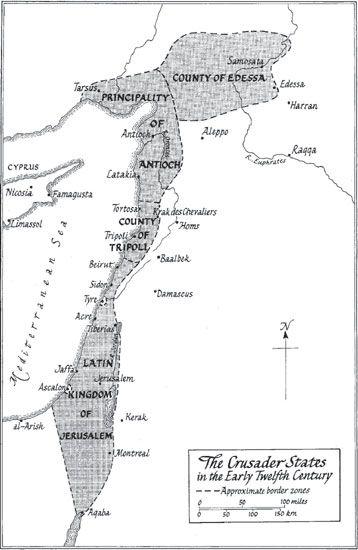
The Crusader States in the Early Twelfth Century
Baldwin’s and Tancred’s successes were built upon a flexibility of approach that mixed ruthlessness with pragmatism. Thus the work of consolidation and subjugation was carried out not simply through direct military conquest, but also via diplomacy, financial exploitation and the incorporation of the indigenous non-Latin population within the fabric of the Frankish states. Latin survival likewise was dependent upon the willingness of Baldwin, Tancred and their contemporaries to temper internecine competition and confrontation with cooperation in the face of external threats. There were some echoes of ‘crusading’ ideology in the struggle to defend the Holy Land, not least in the use of ritual purification before battle and the rise of the cult of the True Cross. But at the same time, early Latin settlers demonstrated a clear willingness to integrate into the world of the Near East, pursuing trading pacts, limited-term truces and even cooperative military alliances with their Muslim neighbours. Of course, this variety of approach simply mirrored and extended the reality of holy war witnessed during the First Crusade. The Franks continued to be capable of personifying Muslims, and even Greeks, as avowed enemies, while at a broader level still interacting with the indigenous peoples of the Levant according to the normalised customs of Frankish society.