
The background to the story of the Dublin King is the episode of English history popularly known as the Wars of the Roses. It is essential to understand the basic outline of this complex struggle for power within the royal family in order to be able to comprehend what took place in 1486–87.
The story of the Wars of the Roses started almost a century before the coronation of the Dublin King. It began in about 1390, with controversy over who was the true heir to the throne of the childless reigning monarch of the day, Richard II. The rival contestants were, first, the descendants of Richard II’s senior uncle, Lionel of Antwerp, Duke of Clarence and, second, the family of a younger uncle, John of Gaunt, Duke of Lancaster. As a result of the marriage of Anne Mortimer, great-granddaughter of Lionel, to her cousin, Richard, Earl of Cambridge, the Clarence descendants eventually evolved into what is known as the royal house of York, while John of Gaunt’s descendants were the house of Lancaster.
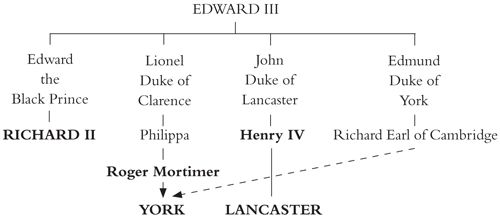
Who was the true heir of Richard II?
Historical attempts at analysing the rights and wrongs of the rival Mortimer/Yorkist and Lancastrian/Tudor claims to the throne are often based on the rather naïve assumption that the basic modern rules governing succession to the English throne also applied in the medieval period. The fact that the modern rules have only recently been altered should warn us against making any such assumption.
An examination of practice in relation to succession issues during the five centuries from 1000 to 1500 shows that the seizure of power by force, followed by subsequent parliamentary ratification, was not infrequently the basis of a sovereign’s authority during this period. It accounts for the accessions of William I (the Conqueror), King Stephen, King John, Henry IV, Edward IV and Henry VII. The accessions both of Stephen and of Henry II also prove beyond any shadow of doubt that a royal daughter could transmit rights to the throne if there was a lack of royal sons. At the same time, however, the civil war between King Stephen and Henry II’s mother, Stephen’s cousin Matilda, demonstrates that prior to 1500 the right of daughters to succeed to the throne in person remained unclear.
In 1399 John of Gaunt’s son forcibly resolved the succession issue of his day by deposing, imprisoning and probably ultimately murdering King Richard II, and by seizing the crown for himself, under the royal title of King Henry IV. Thus began the reign of the house of Lancaster, which lasted for sixty-two years.
Of course, such behaviour invites retaliation. Its effect in this instance was that, from the very beginning of the Lancanstrian era, there were attempts to change the situation in favour of Richard II’s alternative heirs, the descendants of Lionel, Duke of Clarence. The early attempts were unsuccessful, of course, and the house of Lancaster remained on the throne throughout the reigns of Henry IV and Henry V. However, the position of the dynasty was weakened by the death of Henry V, followed by the succession of the third Lancastrian king, his baby son, King Henry VI.
Henry VI was a weak king even when he grew up. His position was further undermined by a tendency to mental instability, which he inherited from his grandfather, King Charles VI of France. Doubts about the legitimacy of his supposed son and heir also helped to undermine the Lancastrian cause. Thus, after various vicissitudes, which later came to be called the Wars of the Roses, the Yorkist attempts to displace the house of Lancaster were finally successful. First, Parliament decided that the Yorkist line must succeed to the throne after Henry VI. Then in 1461, after this decision had been contested unsuccessfully by a Lancastrian army, Henry VI was deposed by one of his Yorkist cousins, who founded the Yorkist dynasty and became King Edward IV. Edward IV’s claim to the throne was a strong one, based on three very solid arguments: first, his superior blood right (via his female-line descent from Edward III’s second surviving son); second, his very effective seizure of power; third, the subsequent ratification of his succession by Parliament.
Ultimately, the death of Henry VI in the Tower of London left the Lancastrian dynasty with no clear heir, and the Yorkist takeover would almost certainly have proved to be a long-term success if Edward IV had had a sensible marriage policy. Unfortunately, by involving himself in two secret weddings, the king laid himself open to the accusation of bigamy. In 1461 he married Eleanor Talbot, daughter of the late first Earl of Shrewsbury,1 but in 1464, while Eleanor was still alive, he also secretly married Elizabeth Woodville. Unfortunately for Edward, since only the second of these two secret marriages produced offspring, those children then became liable to accusations of illegitimacy. Matters came to a head when he died unexpectedly in April 1483.
THE IMMEDIATE FAMILY OF EDWARD IV
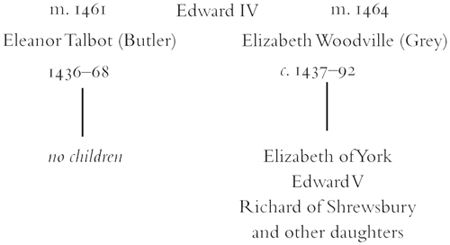
Notionally Edward IV’s heir was his eldest son, Edward, Prince of Wales, the elder of the so-called ‘Princes in the Tower’. Following his father’s death, in April 1483, this Prince of Wales was initially proclaimed king as Edward V. However, the subsequent revelation of Edward IV’s bigamy provoked a new controversy between those members of the nobility, such as Lord Hastings, who were prepared to hush up the young king’s technical illegitimacy, and those, like the Duke of Buckingham, who believed that it should not be suppressed, and who insisted that the order of succession should be altered, either to maintain the principle of absolute legitimacy upon which the Yorkist claim to the throne had always been based, or perhaps to ensure the exclusion from any position of power of the parvenu and upstart Woodville family.
The immediate outcome of Hastings’ opposition was his execution. Then, on the basis of the evidence of Edward IV’s bigamy (and the consequential illegitimacy of his children by Elizabeth Woodville), coupled with the fact that George, Duke of Clarence had been attainted and executed in 1478, thereby excluding his children from the succession, the throne was offered to Edward IV’s only surviving brother, the Duke of Gloucester, who thus became King Richard III. Since a Parliament had not, at that stage, formally been opened, the offer of the crown to Richard III was made initially by the Three Estates of the Realm – those noblemen, bishops and abbots, and representatives of the commons, who were in London waiting for the opening of Parliament. However, the following year, when a full Parliament was sitting, the offer was formally encapsulated in legislation, citing both the evidence of bigamy, and also the offer made to Richard III the previous summer.
As at every stage since the usurpation of Henry IV in 1399, the new change in the order of succession to the throne was not universally accepted. In France there was a remote descendant of John of Gaunt living in exile. The French, always happy to undermine the existing government in England, supported this obscure claimant, and to their – and probably his own – surprise, in August 1485 at the Battle of Bosworth, he suddenly found himself King of England, with the royal title of Henry VII.
Henry rapidly repealed the parliamentary decision which had declared Edward IV’s children bastards. This was done in order that he himself could marry Edward IV’s eldest daughter, Elizabeth of York, whom he wished to present to the nation as the Yorkist heiress. In this way he hoped that his marriage would be seen as having brought to an end the rivalry between the houses of Lancaster and York.
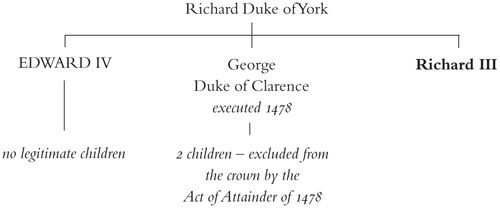
The heirs of Edward IV in 1483.
As a result of Henry VII’s action, the legal position regarding the Yorkist succession reverted to what it had been during the reign of Edward IV. By rescinding the decision which had declared Edward’s Woodville marriage bigamous and its children illegitimate, Henry restored his bride, Elizabeth of York, to the position of a legitimate princess, which she had enjoyed during the lifetime of her late father. It was also now possible for Henry to claim that Richard III had been a usurper.
Unfortunately, if Elizabeth’s legitimacy had been restored, so had that of her two brothers. Arguably, therefore, from the Tudor viewpoint, the rightful Yorkist claimant was now either Edward V or Richard, Duke of York – if either of them was still alive. Whether those Yorkists who had supported the late King Richard III would also have seen things in that way is perhaps more questionable. They may still have perceived the sons of Edward IV as bastards, in which case they would presumably have been seeking a new Yorkist leader from among the other surviving nephews of Richard III.
Fortuitously from Henry VII’s point of view, Edward IV’s two sons appeared, in the meantime, to have been lost from sight. Thus, they were not on hand as immediate contenders for the throne. Now that the legal situation in the autumn of 1485 has been explained, some readers may feel that the boys’ absence was so much to Henry VII’s advantage that it is very tempting to believe that either Henry himself or one of his leading supporters was behind their disappearance. However, Henry VII’s apparent uncertainty as to what had become of his young brothers-in-law constitutes quite a strong argument against this. The possible fate of the so-called princes will be considered in more detail later.
Meanwhile, from the Yorkist viewpoint, Henry’s repeal of the Act of Titulus Regius of 1484 had done absolutely nothing to restore the claim to the throne of the children of the Duke of Clarence, since their father’s attainder had not been reversed. Thus it might appear that the official legal position in Tudor eyes should logically have been that the 8-year-old Earl of Warwick and his elder sister represented no real threat.
However, there was also an alternative Lancastrian viewpoint. Ironically, according to this the Earl of Warwick was the rightful Lancastrian heir to the throne. This complex argument will also be explored in greater detail later. For the moment, suffice it to say that the new king was obviously taking no risks with potential rivals. He rounded up all the young Yorkist heirs that he could find, and made sure that they were placed under very careful supervision. Later, many of them were to be more permanently removed from the political arena by means of execution, either by Henry VII himself, or by his son Henry VIII.
In spite of his careful precautions, about a year after winning the crown Henry VII found himself confronting one possible Yorkist contender for the throne. The claimant was a boy who was recognised by those members of the house of York who were free to express their opinions, as a young but very high-ranking prince of that dynasty. Whoever he really was, all the surviving accounts speak quite well of him. They tell us that ‘the child … was handsome, intelligent and of courtly manners. … Lambertus erat vultu membrisque decorus [Lambert was handsome of face and limbs],’ says John Herd. ‘Puer aspectu decoro et docile [a boy of dignified appearance, and teachable],’ writes Ware. ‘Of a gentle nature and pregnant wit,’ says the Book of Howth.2
Precisely who this boy really was, and what was his true life history, comprises the central subject matter of this book. One fact, however, is beyond dispute: the boy was crowned as King of England at Christ Church Cathedral in Dublin. As for which royal name and number this Dublin King used, various answers have been offered by previous writers. In reality, though, the true position (like so many aspects of the Dublin King’s story) has not been clear. The relevant surviving evidence on this point will therefore be very carefully reviewed in due course. Before that, however, the fascinating quest for the true identity of the Dublin King has to begin by exploring all the possible – and conflicting – accounts of the boy’s childhood.
Notes
Abbreviations
|
CPR |
Calendar of Patent Rolls |
|
ODNB |
Oxford Dictionary of National Biography |
|
PROME |
Parliament Rolls of Medieval England |
1. For the evidence relating to this case, see J. Ashdown-Hill, Eleanor the Secret Queen, Stroud 2009, and Ashdown-Hill, Royal Marriage Secrets, Chapter 9.
2. M.T. Hayden, ‘Lambert Simnel in Ireland’, Studies: An Irish Quarterly Review, 4 (1915), p. 625.