
PART 2
6
The key active supporters of the Dublin King in England, in Ireland and on the Continent, included two leading members of the royal house of York, together with certain noblemen and gentry who had been among the prominent supporters of the Yorkist dynasty during the approximately twenty-four years of its rule. The leader of the Dublin King’s cause on the Continent was the Earl of Warwick’s youngest surviving aunt, Margaret of York, dowager Duchess of Burgundy. In Ireland his supporters were led by the Anglo-Irish Fitzgerald family, headed by Gerald Fitzgerald, Earl of Kildare, who, rightly or wrongly, may have considered himself to have been the Earl of Warwick’s guardian for about nine years. We shall consider in greater detail the character and background of these Continental and Irish supporters presently. First, however, let us review the situation in England, where the Dublin King’s key supporters included the Earl of Warwick’s cousin John de la Pole, Earl of Lincoln, together with one of Richard III’s greatest friends, Francis, Viscount Lovell.
Lincoln was born in about 1460, to Richard III’s sister, Elizabeth of York.1 He was the first child born to Elizabeth following her marriage to John de la Pole, Duke of Suffolk. As we have seen, his uncle, King Edward IV, created him Earl of Lincoln on 13 March 1466/67. Later, he was knighted. He had then fulfilled various ceremonial public roles, the most recent of which had been when he bore the orb at King Richard III’s coronation.2 The eldest grandson of Richard and Cecily, the Duke and Duchess of York, by 1485 Lincoln was already a young adult. He gave Richard loyal support during Buckingham’s Rebellion – for which his uncle rewarded him with grants of lands, together with the reversion of estates held by Margaret Beaufort for her lifetime.
Richard III’s son, Edward of Middleham, Prince of Wales, died, probably of tuberculosis, at the beginning of 1484,3 Before his death, Edward of Middleham had briefly held the important post of Lieutenant of Ireland.4 This post was normally exercised through a deputy, so that the boy’s youth was not a problem. After Edward of Middleham’s death, on 21 August 1484, Richard then appointed the Earl of Lincoln to the same post. Lincoln was also appointed to the presidency of the Council of the North.
The grant of the lieutenancy of Ireland may be one indication that, following the death of his son, Richard III initially regarded Lincoln as his interim heir. As we have seen, in connection with the life story of the Earl of Warwick, historians have sometimes claimed that, following his son’s death, Richard specifically named one of his nephews as his heir. Some writers have suggested that Edward of Clarence, Earl of Warwick was the chosen prince, while others argue that the nephew selected was Lincoln.5 Since there is no surviving written evidence that either nephew was ever formally designated as Richard III’s heir, these conflicting stories could simply be later inventions. However, there is also another possible way of interpreting the statements – that both Warwick and Lincoln were recognised as Richard’s heir in 1485.
We have already noted that, until the eve of the Battle of Bosworth, there was no real necessity for King Richard to make any public statement about who should succeed him, for two reasons. First, he was still a young man, with every prospect of a long life before him. The death of Queen Anne Neville, in 1484/85, focussed government attention on the succession problem. However, it also offered the perfect long-term solution: a second royal marriage and the begetting of new and healthy sons.
Negotiations ensued for marriage with either a Portuguese or a Spanish infanta. Since the English proposal was very favourably received in Portugal, under normal circumstances the Infanta Joana of Portugal would shortly have become the new queen consort of England.6 Assuming that many years of his own reign still lay before him, Richard III would then have had ample time to train a new son for future kingship. Therefore, it is difficult to see why he should have made any specific announcement about the identity of his heir presumptive prior to August 1485.
The second reason is that in April 1485, from a Yorkist point of view, the situation regarding the sucession was already quite clear. Apart from the death of Edward of Middleham, nothing had changed since Richard’s own accession two years earlier. Thus, until the king remarried, and produced a new son and heir apparent, the heir presumptive was John de la Pole, Earl of Lincoln. No explicit statement about the succession was therefore required unless Richard III wished to alter the situation in some way.
The point is that Richard III’s own accession had been based upon a decision made by the Three Estates of the Realm in 1483 (and subsequently confirmed by the formal Parliament of 1484). The prime factor behind this decision was that Edward IV had committed bigamy, in consequence of which his children by Elizabeth Woodville were illegitimate and therefore excluded from the succession. However, that first key point had been coupled with an almost equally important second one: the fact that in 1478 Edward had signed an Act of Attainder against his brother the Duke of Clarence, thus excluding Clarence and his children from the succession. The fact that Clarence’s heirs had been excluded by the Act of Attainder is stated quite specifically in the subsequent Act known as Titulus Regius, in the following terms:
Moreover, we consider how afterwards, by the three estates of this realm assembled in a parliament held at Westminster in the seventeenth year of the reign of the said King Edward IV [1478], he then being in possession of the crown and royal estate, by an act made in the same parliament, George, duke of Clarence, brother to the said King Edward, now dead, was convicted and attainted of high treason, as is contained at greater length in the same act. Because and by reason of which, all the issue of the said George was and is disabled and barred from all right and claim to the crown and royal dignity of this realm, which they might in any way have or claim by inheritance, by the ancient law and custom of this same realm.7
Without this explicit statement regarding the status of Clarence’s heir, Richard III himself would not have been the rightful heir to the throne in 1483. Instead, the ruling that the children of Edward IV and Elizabeth Woodville were illegitimate could have resulted in the crown passing to Clarence’s surviving son, the young Earl of Warwick, since Warwick’s line of royal descent was senior to that of Richard III.
Based upon the precise statement in the Act of Titulus Regius, however, it is obvious that in 1483, the young Earl of Warwick had been formally adjudged by Parliament to have no legal claim to the throne because of his father’s attainder. As long as this remained the case – even following the death of Richard III’s son, Edward of Middleham – there would have been no need for the king to make any formal statement about the identity of the heir presumptive to his throne. It should already have been perfectly clear to everybody that until the king either produced another son, or set aside the Clarence Act of Attainder of 1478, his legal heir was John de la Pole, Earl of Lincoln.
However, this logical analysis of the situation, together with the conclusion to which it inevitably leads, makes the subsequent support offered by Lincoln to the Dublin King appear utterly extraordinary. In fact, as we have already seen, it was considered extraordinary by some people – including Henry VII – at the time. And it is that which invited the suggestion that in August 1485 Richard III may suddenly have decided to re-instate the Earl of Warwick in the order of succession.
No documentary evidence of any such action on Richard’s part now survives. Nevertheless, it is only if his uncle – the then-reigning king, and a sovereign whom he had always served with loyalty – had made some specific move, prior to his death, to proclaim Warwick as his heir, that the subsequent conduct of the Earl of Lincoln becomes understandable. Only then does Lincoln’s subsequent loyal support for the Dublin King – whom he identified as the Earl of Warwick – make sense.
If my suggestion is correct – if in August 1485 Richard III chose to restore Warwick to his original place in the order of succession – Lincoln’s conduct in 1486–87 would then be of a piece with his earlier conduct in 1483. Those who accept the argument I have put forward would then find themselves forced to the conclusion that in John de la Pole, Earl of Lincoln we find ourselves dealing with a member of the house of York whose actions were determined by one fundamental aspect of his character – his absolute loyalty.
Of course, when Henry VII seized the throne, the position of the de la Pole family suddenly changed. Previously they had been closely related to the reigning monarchs (Edward IV and Richard III). Now, suddenly, a much more distant and possibly hostile relative wore the crown of England. After the Battle of Bosworth, ‘Henry VII was lenient with John of Lincoln mainly because the de la Poles were too powerful a family to drive into opposition until the King had a secure hold on the Crown, so the de la Poles retained their titles and estates’.8 Nevertheless, in the long term the aim of the new Tudor dynasty was to bring down the de la Poles – an objective which Henry VII and Henry VIII carried out slowly, but with complete success. There are now no living descendants of any of the seven sons of Richard III’s sister, the Duchess of Suffolk.
But in 1486 and 1487 the Earl of Lincoln’s public devotion to the Dublin King, ‘Edward VI’, was not widely reflected in his immediate family. His father, the Duke of Suffolk, was, of course, only related to the house of York by marriage. In fact the duke’s family background had originally been Lancastrian. Although he had served Edward IV and Richard III loyally during their respective reigns, the Duke’s main concern after 1485 seems to have been to ensure the safety of his own family and the maintenance of its position by the retention of its lands and property. He therefore acknowledged Henry VII. Indeed, the assessment of Michael Hicks is that the Duke of Suffolk ‘avoided supporting causes that were lost, quickly acquiescing in the successions of Richard III and Henry VII’.9
The position of Suffolk’s wife, Elizabeth of York, may have been more equivocal. In fact for her there was now a new and even bigger problem, in that her namesake and niece, the younger Elizabeth of York, had married the recently enthroned king, Henry VII. Elizabeth of York junior was now Queen of England. Moreover, she was also on the way to producing a new heir to the throne.10 The loyalties of the senior Elizabeth of York, Duchess of Suffolk, may therefore have felt somewhat split.
In the longer term it appears probable that, despite the political realism of her husband, privately Elizabeth of York, Duchess of Suffolk, took a rather different view. During her husband’s lifetime, of course, she was not really free to express her own feelings. Nevertheless, it is reported that ‘in the years after her husband’s death, Elizabeth Plantagenet went to visit her sister in Burgundy’.11 The Duke of Suffolk is thought to have died in 1492,12 so Elizabeth’s visit to her younger sister, Margaret, came much too late to be of any help to her son, the Earl of Lincoln, or to his chosen sovereign, the Dublin King. But while it is true that in 1486 and 1487 only Elizabeth’s eldest son, the Earl of Lincoln, came out openly in support of ‘Edward VI’, later some of Lincoln’s younger brothers were also to make it plain to the world that the Tudor usurpation was completely unacceptable in their eyes.
But in 1486 and 1487, in terms of the actions they took, the surviving members of the royal house of York were divided. Elizabeth, based at Wingfield in Suffolk, did nothing to support ‘Edward VI’. Her elderly mother, the dowager Duchess of York, now residing at Berkhamsted Castle in Hertfordshire, also did nothing. Of course, Cecily Neville was by that time very old, and her attention seems to have been entirely focussed on the future of her own immortal soul. Moreover, one of her grandchildren was married to the new king. On the other hand Cecily’s other surviving daughter, Margaret, who resided in the safe haven of the Low Countries, was firmly and openly opposed to Henry VII, and backed ‘Edward VI’ up to the hilt. And, as we have seen, her nephew the Earl of Lincoln also showed unequivocal loyalty to the Dublin King.
Of course, Lincoln was not unique in this respect; the same loyalty to the legitimate heir of his chosen royal house is also apparent in that second key English supporter of the Dublin King, Francis, Viscount Lovell.
Francis had lost his father, the eighth Baron Lovell, in 1463, when he was only 9 years old. As a result the boy had become a ward of the king. Edward IV had then consigned him to the guardianship of his cousin, Warwick the Kingmaker. In this way Francis eventually found himself growing up as a companion of the adolescent Richard, Duke of Gloucester (Richard III), and the two youths became close friends.
Francis Lovell was married in 1466 to one of Warwick’s nieces, a girl called Anne FitzHugh. Anne was the first cousin of Anne Neville, who eventually became the wife of Richard III. She was also the first cousin of Isabel Neville, Duchess of Clarence. This marriage consolidated Lovell’s position in Warwick’s entourage. As a result, in 1469–70, Francis (together with his father-in-law) seems to have supported the campaign of Warwick and the Duke of Clarence against Edward IV and the Woodville family. Later, when Edward IV had re-established himself as king and Warwick was dead, Francis Lovell received a royal pardon. Since he was still under age, he was then consigned to the guardianship of Elizabeth of York, and her husband, John de la Pole, Duke of Suffolk.13In this way the 17-year-old Francis was first brought into contact with Elizabeth’s 11-year-old son, John, Earl of Lincoln.
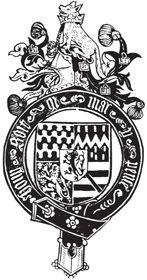
The coat of arms of Francis, Viscount Lovell, redrawn from his Garter stall plate at Windsor Castle.
Francis also had interesting connections through his father’s family. In 1463 his paternal grandmother, Alice Deincourt, had married Ralph Butler, Lord Sudeley (she was his second wife). This made Francis Lovell a kind of cousin-in-law of Eleanor Talbot, the first secret wife of Edward IV.14
The death of his grandmother, Lady Sudeley, in February 1473/74, brought Francis a large inheritance, making him one of the wealthiest barons in the land. In 1480 he served under his friend Richard, Duke of Gloucester in the Scottish campaign. He was knighted for his service by Richard in 1480, and one of the last acts of Edward IV was to elevate Francis from the rank of baron to the rank of viscount (4 January 1482/83).15
Following the death of Edward IV in April 1483, Francis became one of Richard’s strongest supporters. While he was still Lord Protector, Richard appointed Francis Chief Butler and Constable of Wallingford Castle. After Richard had been invited to take the throne, Francis carried one of the swords of state at his friend’s coronation. He succeeded the executed Lord Hastings as Lord Chamberlain, and was created a knight of the Garter. Towards the end of 1483, Francis helped Richard to defeat the rebellion of the Duke of Buckingham.
It was in July 1484 that William Collingbourne, an opponent of the Yorkist regime, attached to the door of St Paul’s Cathedral in London a now famous couplet:
The Catte the Ratte and lovell owyr dogge
Rulyn all Engeland undyr an hogge.16
The hogge was Richard III, the reference being to his white boar badge. Likewise the mention of Lovell as a dogge referred to the white wolf which formed part of the crest above his coat of arms. The Catte referred to William Catesby, another of Richard III’s servants, and yet another connection of Eleanor Talbot.17 The Ratte was Richard Ratcliffe, who was killed with Richard III and the Duke of Norfolk at the Battle of Bosworth.
In 1485, when news came of the planned invasion of England by Henry Tudor, Francis Lovell was sent by Richard III to guard the south coast. Since Henry actually landed at Milford Haven, Francis was not able to intercept him, and although some historians maintain that Francis fought with Richard at Bosworth – and two contemporary reports actually listed him among the dead18 – in fact it is by no means clear whether Francis had been able to reach Richard in time to take part in the battle. More will be said about this point – and about the subsequent history of Viscount Lovell – later, when we explore what actually occurred in 1486 and 1487.
Other Yorkists who actively supported the Dublin King included members of the gentry. Sir Henry Bodrugan from Cornwall was one of them.19 Although he was about 60 years of age in 1486, Bodrugan, who, like Lincoln and Lovell, had previously been a very firm supporter of Richard III, attended the Dublin coronation. John Beaumont was another member of the Yorkist gentry who attended the coronation.20 Like Bodrugan, Beaumont was based in Cornwall; indeed it is possible that Beaumont was related in some way to Bodrugan, who had married Jane, the widow of William Beaumont, in about 1461.21 Another member of the Yorkist gentry who is recorded as having supported the cause of the Dublin King is Sir Thomas Broughton.22 Edward Franke or Franks, who had been sheriff of Oxfordshire and Berkshire in 1484, under Richard III, also gave his support to ‘Edward VI’.23
Some members of the religious hierarchy in England also supported the Dublin King. One notable example is John Sant, the Abbot of Abingdon, who first helped the Stafford brothers in their unsuccessful rising of 1486, and whose name was well known to Margaret of York in Flanders. Later it was reported that Abbot Sant sent one of his servants abroad in January 1486/87, carrying funds for the Earl of Lincoln. Since this predated Lincoln’s own departure it would suggest that plans for the Dublin King were well under way even while Lincoln was still at Henry VII’s court.24
Curiously, however, the division of opinion over the contest between Henry VII and ‘Edward VI’ which we have already encountered within the royal house of York, also seems to have been present among the wider ranks of former Yorkist supporters. By no means did all the living Yorkists in England follow Francis Lovell, Bodrugan, Beaumont and Broughton in supporting the Dublin King. Even among those families which had earlier seemed very loyal to the house of York, the position adopted in 1486 was equivocal.
The Howard family are an excellent example of this, and possibly reveal the reason why some former Yorkists seemed reluctant. John Howard, Duke of Norfolk had, of course, been killed at the Battle of Bosworth, together with his king, Richard III. However, his son, Thomas, Earl of Surrey, though wounded in the fighting, survived – to be captured by Henry VII and subsequently imprisoned in the Tower of London.25 It is reported that in 1486 Thomas Howard was offered a chance to escape from the Tower and fight for the Dublin King.26 But apparently Thomas felt that it was safer for him to remain in his cell. Of course, this in itself may indicate that the Yorkist loyalty of the Howards had not died completely, for ‘while others prospered in serving the new king and in establishing the new authority, [Howard] led a passive existence’.27 But since he had been stripped of all his lands and titles by the Tudor regime, he was probably frightened about taking any further risks. In the long run, of course, Thomas Howard’s refusal to back the Dublin King does seem to have acted in his favour – as perhaps he had secretly hoped. Thus in May 1489, after the Dublin King had been defeated, Henry VII restored Thomas to the earldom of Surrey.
Notes
Abbreviations
|
CPR |
Calendar of Patent Rolls |
|
ODNB |
Oxford Dictionary of National Biography |
|
PROME |
Parliament Rolls of Medieval England |
1. There were two fifteenth-century Elizabeths of York. This is the senior of the two. The junior Elizabeth was her niece, the eldest daughter of Edward IV and wife of Henry VII.
2. ‘John de la Pole, Earl of Lincoln’, ODNB.
3. 9 April 1484.
4. Horrox, British Library Harleian Manuscript 433, p. 66.
5. See, for example, Myers, History of the Life and Reigne, p. 44.
6. See, for example, Ashdown-Hill, Last Days of Richard III, Chapter 2.
7. PROME, 1484 Parliament, Act of Titulus Regius, citing the petition of the Three Estates of the Realm of 1483; my emphasis.
8. J. Brown and E. Brown, ‘The de la Poles, Earls and Dukes of Suffolk’, Wingfield 2000, p. 6.
9. ‘John de la Pole, second Duke of Suffolk’, ODNB. (http://www.oxforddnb.com/view/article/22450, accessed December 2013.)
10. She must have conceived Prince Arthur in about December 1485.
11. Brown, ‘The de la Poles, Earls and Dukes of Suffolk’, p. 7.
12. He was certainly dead by 20 May 1492, ‘John de la Pole, second Duke of Suffolk’, ODNB.
13. CPR, 1467–1477, pp. 261, 312.
14. Eleanor’s first husband, Sir Thomas Butler, was Lord Sudeley’s son.
15. Horrox, British Library Harleian Manuscript 433, pp. 3–4.
16. A.H. Thomas and I.D. Thornley, eds, Great Chronicle of London, London 1938, p. 236. There are several slightly different published versions of this rhyme.
17. Ashdown-Hill, Eleanor, p. 37.
18. M. Bennett, The Battle of Bosworth, Stroud 1993, p. 155.
19. Hayden, ‘Lambert Simnel’, p. 628.
20. Hayden, ‘Lambert Simnel’, p. 628.
21. www.girders.net/Bo/Bodrugan,%20Sir%20Henry,%20(d.1489).doc, accessed December 2013, citing CPR 1461–67, pp. 539–40.
22. Hayden, ‘Lambert Simnel’, p. 631.
23. C. Weightman, Margaret of York, Duchess of Burgundy, 1446–1503, Gloucester 1989, pp. 168–9; http://en.wikipedia.org/wiki/High_Sheriff_of_Berkshire, accessed December 2013.
24. See Weightman, Margaret of York, pp. 156–7.
25. Thomas Howard was certainly imprisoned initially in the Tower of London. But though he remained in confinement for several years it is not certain that he spent all this time at the Tower. M.J. Tucker, The Life of Thomas Howard Earl of Surrey and Second Duke of Norfolk 1443–1524, London 1964, p. 49.
26. Tucker, Thomas Howard, p. 49, n. 58. However, Tucker is dubious about this report.
27. Tucker, Thomas Howard, p. 49.