
A race absolutely alien to God has invaded the land of Christians, has reduced the people with sword, rapine and flame. These men have destroyed the altars polluted by their foul practices. They have circumcised the Christians, either spreading the blood from the circumcisions on the altars or pouring it into the baptismal fonts. And they cut open the navels of those whom they choose to torment with loathsome death, tear out their most vital organs and tie them to a stake, drag them around and flog them, before killing them as they lie prone on the ground with all their entrails out. What shall I say of the appalling violation of women, of which it is more evil to speak than to keep silent?
On whom, therefore, does the task lie of avenging this, of redeeming this situation, if not on you, upon whom above all nations God has bestowed outstanding glory in arms, magnitude of heart, litheness of body and strength to humble anyone who resists you.1
This horrific imagery and forceful exhortation launched the First Crusade. On the last Tuesday of November, in the year 1095, Pope Urban II delivered an electrifying speech to a crowd outside the southern French city of Clermont. Christians living in the East, he alleged, were enduring dreadful oppression and abuse at the hands of their ‘savage’ Muslim masters, and the epicentre of Christian tradition, the Holy City of Jerusalem, likewise lay in the grasp of Islam. In the face of these intolerable ‘injuries’, Pope Urban called upon Catholic Europe to take up arms and prosecute a vengeful campaign of reconquest, a holy war that would cleanse its participants of sin. When he proclaimed that those fighting as ‘soldiers of Christ’ would be purified by the fire of battle, his words set Christendom alight.
In the weeks and months that followed, the pope’s impassioned appeal swept across Europe, prompting some 100,000 men and women, from knight to pauper, to take up the call – the largest mobilisation of manpower since the fall of the Roman Empire. One such was the great Norman warrior Bohemond of Taranto. Immersed in the bitter siege of the rebellious southern Italian city of Amalfi, Bohemond apparently underwent a dramatic conversion when news of the gathering crusade arrived. Calling for his most lavishly wrought cloak to be brought forth, he had this treasured garment cut to pieces in front of an astonished assembly. Fashioning the cloth into crosses, he then proudly displayed this badge upon his sleeve as a visible sign of his commitment to the cause and distributed the remainder among the enthralled audience. Together they abandoned the siege to fight a new war, leaving the air afire with their battle cry: ‘God’s will! God’s will!’2
This titanic expedition, known to history as the First Crusade, marked a watershed in relations between Islam and the West. This was not the first war between Christians and Muslims, but it was the conflict that set these two world religions on a course towards deep-seated animosity and enduring enmity. Between 1000 and 1300 CE Catholic Europe and Islam went from being occasional combatants to avowed and entrenched opponents, and the chilling reverberations of this seismic shift still echo in the world today.
The First Crusade stands at the heart of this transformation because it effected change on two intertwined levels: ‘reality’ and ‘myth-history’. In ‘reality’, the actual progress of the crusade brought Islam and the West into fierce physical conflict, but need not necessarily have prompted an irrevocable divide. Even before the expedition was over, however, its events began passing into ‘myth-history’, as contemporaries sought to record and explain its remarkable progress, asking why it had happened, who had participated and why, and how the expedition had affected the world. Indeed, from its genesis, the history of the crusade was blurred by distortion. The image of Muslims as brutal oppressors conjured by Pope Urban was pure propaganda – if anything, Islam had proved over the preceding centuries to be more tolerant of other religions than Catholic Christendom. Likewise, the fevered spontaneity of Bohemond’s decision to take the cross, dutifully recorded by one of his followers, was almost certainly a façade masking calculated ambition.3
The man who unleashed the First Crusade was born to the noble de Lagery family in the northern French town of Châtillon-sur-Marne around the year 1035. Baptised Odo, he is known in the annals of history by another name, for upon ascending the throne of St Peter in Rome in his fifties he followed papal tradition, breaking with his past to become Pope Urban II. But, in spite of this transformation, Urban remained a man of his time, his upbringing and earlier career leaving an unquestionable imprint upon his papacy and serving to shape the momentous call to arms that shook Europe at the end of the eleventh century.4
European society
Urban’s target audience in 1095 was the aristocracy of France, the very group into which he had been born, a violent warrior class, fighting for survival amid bloodthirsty lawlessness. One thousand years earlier, the region we would think of today as France had been overrun and absorbed by the relentless expansion of the Roman world. For centuries the province enjoyed relative peace and prosperity within the protective fold of this empire, but from the later fourth century CE onwards Rome’s dominion began to falter, as the force of its law, culture and society receded. The Roman Empire did not implode in one sudden, spectacular moment – rather, it decayed incrementally, and, with the gradual evaporation of its power, the way opened for ‘barbarian’ peoples to supplant, mimic and finally extinguish Rome’s authority. Between the fifth and seventh centuries, groups like the Visigoths, Avars and Lombards redrew the map of Europe, leaving a bewildering patchwork of diverse, warring realms where unity had once prevailed. In north-eastern Gaul one such group, the Franks, came to prominence around 500 CE, carving out a kingdom with which historians now associate their name – Francia, or France – Urban’s homeland.5
By 800 CE a descendant of the Franks, Charlemagne, had amassed such a collection of dependencies – encompassing regions that would today make up much of France, Italy, Germany and the Low Countries – that he could claim to have restored the glory of the Roman Empire in the West. France and Europe as a whole enjoyed a return to some semblance of centralised authority under Charlemagne and his successors, the Carolingians.6 But by the year 1000 this had dissolved under the weight of bitter succession disputes and harrowing Viking invasions. Without the controlling hand of centralised rule, disorder spread and effective power devolved into the hands of acquisitive warlords. At the time of Pope Urban II’s birth in the eleventh century, only the barest remnant of a Frankish realm survived, and any glimmer of unified French identity endured only in the imagination. The titular kings of France struggled even to control a small territory centred around Paris, while the Frankish realm fractured into numerous dukedoms and counties whose power eclipsed that of the royal house. ‘France’ was even divided linguistically, with two distinct languages – Languedor and Languedoc – prevailing in the north and south respectively. The people eventually attracted to Urban’s crusading ideal in 1095 were certainly not all from France, but contemporaries who wrote about this expedition, especially those looking in from outside western Europe, tended to categorise all its participants under the single term ‘Franks’. Although somewhat misleading, it has therefore become common practice to describe the First Crusaders as the Franks.7
Urban II grew up within the Champagne region of north-eastern France, in an intensely localised environment. Here, as in the rest of Europe, even nobles could expect to live their entire lives without travelling more than a hundred kilometres from home. The warrior aristocracy held sway, a class, dominated by the knightly profession, bound by a complex network of lordship, vassalage and obligation – what in the past has been called the ‘feudal system’ – at the heart of which lay an exchange of military service in return for tenure of a territory or ‘fief’. Champagne, and France in general, may not, as historians once thought, have been in a state of utter, chaotic savagery, but Urban was still born into an extraordinarily violent society, dominated by bloody feud and vendetta. Even the more peaceable nobles engaged in rapine and plunder as a matter of course, and vicious internecine struggles for power and land were a fact of daily life.8
Medieval Christianity
For all the violence and mayhem of Urban’s childhood world, he was, from his earliest days, surrounded by and immersed in the Christian religion. The medieval society in which he lived was obsessively dedicated to this faith, almost every feature of daily existence being conditioned by its doctrines. Europe’s devotion to Christianity can be traced back to the fourth century CE, when the Roman emperor Constantine the Great embraced Christian dogma, injecting this small-scale eastern Mediterranean sect into the lifeblood of Rome. Pumped through the arteries of the empire, Christianity eventually became the state religion, displacing paganism. In a strange quirk of history, the earthly power that had overseen the execution of Christ now catapulted his teachings on to the world stage. Even as Rome’s might crumbled, this creed continued to spread to almost every corner of Europe, and by the eleventh century the region could accurately be described as western Christendom. Following what would today be thought of as Roman Catholicism, its people can most precisely be termed the ‘Latins’ to distinguish them from adherents of the various other branches of Christianity.9
In Urban’s day, this faith dominated and dictated everyday life to an extent that can seem almost inconceivable to a modern observer attuned to the attitudes and preconceptions of an increasingly secularised contemporary society. Urban lived in an authentically spiritual age, one in which there was no need to question the existence of God because his absolute power was plain for all to see, made manifest on earth in the form of ‘miracles’ – the sudden curing of a ‘blind’ man after prayer, the ‘divine punishment’ of a murderer struck by lightning. Events that would today be interpreted as natural phenomena, or put down to the vagaries of chance, served to confirm the efficacy of the Christian message to a medieval audience. In eleventh-century Europe, the full pantheon of human experience – birth, love, anger and death – was governed by Christian dogma, and the cornerstone of this system of belief was fear. Medieval minds were plagued by one overwhelming anxiety: the danger of sin. In death, it was believed, every human soul would be judged. Purity would bring everlasting paradise, but an eternity of gruesome torment awaited those polluted by sin. This universal obsession, shared by king and peasant alike, shaped all custom, morality and law.10 Urban’s early life, like that of his contemporaries, was essentially a struggle to avoid sin and attain heavenly salvation.11
The problem was that sin and temptation were everywhere. Natural human impulses – hunger, lust, pride – all carried inherent dangers, and the Bible failed to offer medieval mankind a clear-cut definition of an ‘ideal’ Christian lifestyle. In Late Antiquity some Christians had gone to extremes to avoid worldly contamination: the celebrated fifth-century hermit St Simeon spent forty-seven years in lonely isolation atop a pillar in northern Syria, striving for purity. By Urban’s day, a more attainable path to perfection had become popular in western Europe. Monasticism, in which Christians dedicated their lives to prayer and the service of God within an enclosed environment, embracing the principles of poverty, chastity and obedience, was accepted as the pinnacle of spiritual existence. It was this path to ‘perfection’ that Urban eventually chose to follow. As a young man, he was sent to study at the cathedral school in Rheims and soon joined the Church, attaining the position of archdeacon, an indication that Urban had probably been a younger son and was therefore not bound to a knightly future.12
Remaining in Rheims until his mid-thirties, Urban then made a dramatic decision. We might imagine that, as a member of the Church, he was already cradled in the bosom of Christian purity, but in reality the eleventh-century clergy were a notoriously dissolute bunch. Priests and bishops often reaped rich profits from land, some might marry, hold two or three ecclesiastical offices at once and perhaps even fight in wars. Around 1068 Urban turned aside from this worldly ‘secular’ arm of the Church to become a monk, although his decision was probably inspired by a mixture of personal ambition and piety. He was professed into perhaps the most influential and respected monastery of the day, the Burgundian house of Cluny, an institution just reaching the apogee of its power. Cluny epitomised two interlocking concepts: liberty and purity. In an age when even monasteries commonly fell prey to worldly contamination, as lords, princes and bishops sought to meddle in their affairs, Cluny had one massive advantage. From the moment of its birth, in the early tenth century, it had been placed under the direct protection of the pope in Rome. Immune from local interference, Cluny was effectively its own master, free to appoint its own abbots, govern as it saw fit and pursue monastic perfection in true isolation. Under the guidance of its energetic and long-lived abbot, Hugh (1049–1109), the monastery itself grew to accommodate three times as many monks, and a vast new abbey church was built that would become the largest enclosed space in western Europe. At the same time, the tendrils of Cluniac power continued to spread across Latin Christendom, as existing monasteries in France, Germany, Spain, England and northern Italy reformed to adopt Cluniac principles. By the end of the eleventh century, more than 11,000 monks in some 2,000 religious communities had joined the Cluniac movement. Even within this vast, supranational edifice, Urban’s piety and administrative skill did not long go unnoticed. He rose to become grand prior of Cluny, second in command to the abbot, and helped to cement the monastery’s reputation as a bastion of uncompromising spiritual purity.13
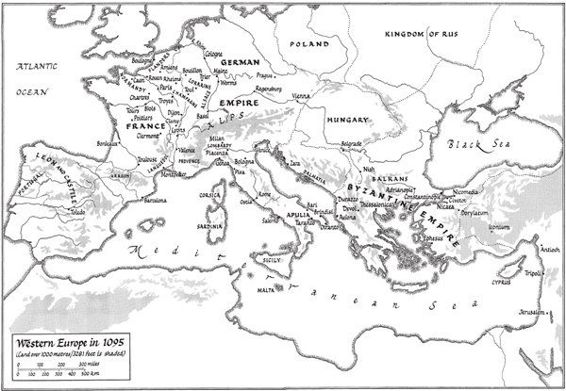
But Urban’s career was not to end within the confines of a monastery. As a papal protectorate, Cluny had long enjoyed an intimate, mutually beneficial alliance with Rome. It is no surprise then that Urban’s position within the monastery brought him to the notice of the pope. Around 1080, he was recruited to become cardinal-bishop of Ostia, one of the most powerful ecclesiastical offices in Italy. Urban had now entered the inner sanctum of spiritual authority, but he could not have arrived at a more tumultuous moment, for the papacy was in the midst of a ferocious dispute.
The medieval papacy
To understand the arena now confronting Urban, one must first appreciate the differences between the theoretical and actual status of the medieval papacy. In Christian tradition there were five great centres of ecclesiastical power on earth, five patriarchates, of which Rome was just one. But late-eleventh-century popes claimed pre-eminence among all these on the basis that Christ’s chief apostle St Peter had been the first bishop of Rome. Scripture indicated that St Peter had been empowered by Christ to manifest God’s will, becoming, in essence, the most potent spiritual figure on earth. The papacy maintained that an unbroken chain of descent ran from St Peter across the centuries, connecting all popes and thus making them successors to this authority. Indeed, it went one step further, arguing that this unique ‘apostolic power’ was not handed down from pope to pope and thus subject to dilution, but was instead directly conferred, fresh and unsullied, upon each new incumbent of the office. As far as Rome was concerned, this meant that papal authority was unassailable and infallible. Medieval popes thus regarded themselves as the world’s foremost spiritual power and believed they were entitled to exert absolute control over the Latin Church of Europe.14
When Urban joined the Roman camp, however, the reality of papal authority was but a pale, almost pathetic, reflection of these lofty aspirations. Far from being recognised as the leader of the Christian faith on earth, the pope struggled to manage the spiritual affairs of central Italy, let alone all western Christendom. The theoretical underpinnings of papal power had for centuries lain dormant and untapped, as the office of pope remained mired in localised interests and abuse, and any attempts to break free of these confines faltered in the face of massive obstacles.
The same centrifugal forces that had fragmented political power in the wake of the Roman Empire’s decline worked simultaneously to disorder and dislocate ecclesiastical authority. By the year 1000, bishops in England, France, Germany, Spain and even northern Italy had little or no expectation of, nor reliance upon, guidance from the pope, sitting in impotent isolation upon the throne of St Peter in Rome. Accustomed to the practice and rewards of independent government, these prelates were unresponsive, even resistant, to any shift towards centralisation and conformity.
At the same time, any hope of wielding absolute ecclesiastical power in Europe was unrealistic, because the dividing line between the spiritual realm of the Church and the temporal world of kings, lords and knights was at best blurred, at worst non-existent. In the medieval age, these two spheres were so intertwined as to be practically inseparable. Kings, believing themselves to be empowered by divine mandate, felt a responsibility to care for and, if necessary, govern the Church. Meanwhile, virtually all bishops wielded a measure of political authority, being major landholders in possession of their own wealth and military forces. To curb the political independence of these powerful figures, many kings sought to control the selection, appointment and investiture of churchmen based within their realm, even though in theory this was a papal prerogative. At the end of the first millennium of Christian history, the Latin Church was in disarray and the limited efforts to control it were being offered not by the papacy, but by secular rulers.
It was not until the mid-eleventh century that the first significant steps towards redressing this imbalance were taken. Amid a general atmosphere of heightened devotional awareness, inspired in part by the example of monasteries like Cluny, western Christians began to look at their Church and perceive sickness. A clergy rife with abuse and ‘governed’ by a powerless pope offered little prospect of guiding society towards salvation. Arguing that the Latin Church would have to clean up its act, starting in Rome itself and working outwards, a ‘Reform Movement’ emerged, advocating a twin agenda of papal empowerment and clerical purification. This campaign enjoyed some early success, establishing a rigorous new process for electing popes and launching public attacks on vices such as clerical marriage and the buying and selling of ecclesiastical office.15
The champion and chief architect of the cause was Pope Gregory VII (1073–85), the very man who recognised Urban’s talents and brought him to Italy. A profoundly ambitious, wilful and intransigent figure, Gregory fought harder than any pope before him to realise the potential of his office, struggling to unify and cleanse Latin Christendom under the banner of Rome. With audacious single-mindedness, he identified what he believed to be the root cause of the Church’s problems – the polluting influence of the laity – and then set about attacking it with near-rabid tenacity, in what has been termed the ‘Investiture Controversy’. Gregory was not interested in tempered diplomacy or negotiated reform – he went straight for the jugular of the mightiest secular force in Europe, hoping to cow the rest of Christendom into submission by example.
In 1075 Gregory banned the German king Henry IV, a man who could trace the lineage of his office to Charlemagne and beyond, from interfering in the affairs of the Church. When Henry resisted, Gregory mobilised the ultimate weapon in his arsenal. As yet possessing no military might with which to coerce, he chose instead to strike Henry with spiritual censure. In February 1076, he excommunicated the most powerful Latin Christian alive and instructed the king’s subjects to renounce him. So dramatic was this act that legend later declared it to have caused the ancient papal throne of St Peter to crack in two. Ejecting Henry from the Church, denying his status as a Christian, was an immense gamble; should Gregory’s edict be ignored, his bluff would be called and his authority shattered, but were this condemnation to be heeded, then the Roman pontiff, who just decades earlier had seemed a marginal nonentity on the European stage, would be confirmed as the arbiter of ultimate justice.
In the final analysis, Gregory’s strategy did not succeed, his papacy ending with the glorious ambition of papal empowerment unrealised. Henry’s excommunication did initially prompt the king to adopt a more penitent stance, but the pope soon overplayed his hand, enraging his enemies and alienating supporters with his radical and unbending vision of spiritual reform and his intensely personal, autocratic notion of papal authority. Along the way, Gregory experimented with the concept of a papal army, a move that prompted indignation in some quarters but broke crucial ground on the road towards the concept of crusading.
It was into a world of unrealised papal aspirations and seething diplomatic discord that Urban was propelled by his appointment as prelate of Ostia c. 1080. In spite of Gregory VII’s hard-line fanaticism and failing fortunes, Urban remained among his staunchest allies, backing up his publicly avowed support for the beleaguered pontiff with sterling service as papal legate to Germany between 1084 and 1085. He had, nonetheless, to witness Gregory’s ultimate decline, as Henry IV had his own candidate, Clement III, declared pope and finally moved in to occupy Rome itself. On 25 May 1085, Pope Gregory VII died in ignominious exile in southern Italy. In the chaos that followed his death no obvious candidate immediately emerged to champion the Gregorian cause or challenge the authority of the German anti-pope. The first, short-lived choice of a successor was not consecrated until May 1087, and, after his death in September of that same year, it took a further six months of infighting before Urban II could step forward to assume the office of pope.16
Given the extraordinary impact he was to have upon European history, the most striking feature of Urban’s early pontificate was the position of extreme weakness and vulnerability from which he began. In 1088, the Latin West seemed ready to turn its back upon the Gregorian party. Urban had to contend with Clement III, the rival German claimant to the papal throne, and recovered possession of the Lateran Palace in Rome in 1094 only through bribery, and even then his hold over the city was precarious. But he did gradually restore papal authority. A far more skilful diplomat than his predecessor, in his dealings with the secular and ecclesiastical powers of Europe Urban chose to encourage gradual change through cautious suggestion rather than affect brazen dominance. He also adopted a more flexible approach to reform and its implementation, stressing inclusion rather than retribution when dealing with transgressors. This temperance won back a good deal of support for the papal cause. Urban capitalised upon the network of contacts established during his days at Cluny and worked to rejuvenate the web of aristocratic clients, known as ‘the faithful of St Peter’, that had grown up under Gregory VII. Rejecting despotism in favour of consultative government, Urban was the first pope to institute a functioning curia Romana or papal court, in which he worked alongside ecclesiastical advisers instead of presenting himself as the sole, perfected mouthpiece of St Peter.
By 1095, Urban’s restrained touch had begun to pay off, bringing the doctrine of reform to regions that Gregory’s closed fist had failed to penetrate. The papacy was at last beginning to recover some of its international prestige. Rome’s power was still far from universal, however, when in March Pope Urban convened a major ecclesiastical council at the northern Italian city of Piacenza. It was during this meeting that a fateful embassy arrived bearing envoys from Constantinople (modern-day Istanbul), capital of the mighty Greek Christian Empire of Byzantium. Beset by aggressive Islamic neighbours, these Byzantines appealed for military aid from their Christian brethren in the West. The pope’s initial reaction was to urge ‘many to promise, by taking an oath, to aid the emperor most faithfully as far as they were able against the pagans’, but this seems to have provoked little or no reaction. The idea of promoting a more vigorous response was, however, beginning to take shape in Urban’s mind. Before the year was out, and with the backbone of papal authority barely rebuilt, he would issue a call to arms that would drive a multitude of Latins swarming to the gates of Constantinople and beyond.17