
The siege of Arqa ended in failure, but it at least prompted all the remaining armies of the First Crusade to mass in one place. On 16 May 1099, after long months of delays and prevarication, the expedition set out at an almost breakneck speed towards Jerusalem. From this point on the expedition was to maintain an almost unwavering focus upon its ultimate goal – the conquest of the Holy City. In part the crusaders’ haste was born out of a desire to avoid any further distractions or interruptions, but they must also have known that every day saved in the advance on Jerusalem meant less time for the Fatimids to organise their defences. Having consulted Maronite Christians living in Lebanon about possible routes into Palestine, and perhaps relying upon the skills of an elderly Muslim guide supplied by the emir of Tripoli, the crusaders took a bold step, opting for the coastal road. This direct approach had the distinct advantage of speed and the continued possibility of naval support, but in strategic terms it was a considerable gamble. At a number of points the coastal route passed through narrow gaps between the sea and mountains, passages that could be effectively closed by even a relatively small defending force. The crusaders took the chance on getting through before the Fatimids set up blockades.
On the first day out of Tripoli the Franks had to follow a rugged, narrow path around a precipitous promontory that juts dramatically into the sea and is today known locally as Raz ez-Chekka – the Face of God. Practically reduced to marching in single file, the crusaders were dangerously exposed, but they met no resistance. By the evening of 19 May they had successfully negotiated two further trouble spots – ‘a cliff where the path is very narrow and we expected to find our enemies lying in ambush’ and the crossing of the Dog river, the effective border with Palestine – bypassing settlements at Batrun and Jubail to reach Beirut. So far not a blow had been struck. The next day the expedition reached the town of Sidon, whose garrison attacked a group of Franks foraging for food, but these Muslims were quickly beaten back by a group of mounted knights.1
One crusade chronicler recalled that, while camped near Sidon, a number of crusaders were killed by the bite of an extremely venomous variety of ‘fiery’ snake. Locals apparently gave the Franks tips on how to counteract these attacks, suggesting that ‘a man who was bitten should lie at once with a woman, a woman with a man, and thus they would be released from all the swelling and heat of the poison’. Another more practical, if not particularly restful, recommendation involved banging stones together or pounding shields through the night so that ‘they could sleep in safety from the snakes, which [would be] terrified by this noise and clamour’. The Franks enjoyed two days of rather fitful rest at Sidon. They had adopted a sensible marching strategy – pushing hard for two to three days to cover ground at speed and then allowing the army to recover – thus limiting the amount of time spent in potentially exposed marching formation. Using this approach they followed the coastline south passing Tyre, Acre and on to Caesarea, where they spent four days celebrating Pentecost. The Latins met with no opposition, although a knight, Walter of La Verne, and his men disappeared during a foraging trip – it was assumed that they had been ambushed by a Muslim raiding party. For the most part, the towns they passed were happy to see them go in peace, and the crusaders were in no mood to dally.2
Finally, on 30 May, the Franks broke inland at Arsuf and made a beeline for Jerusalem. By 3 June they had reached the major town of Ramleh, the last potential barrier to their advance. Robert of Flanders went ahead in the company of the knight Gastus of Bederez to reconnoitre, but they found the town entirely deserted. Terrified by the crusaders’ approach, its Muslim garrison had fled the previous night. Positioned on the main route between Jerusalem and the coast, Ramleh was a site of considerable strategic importance, and with the famous Christian Basilica of St George – said to house the saint’s body – lying on its outskirts, it also had spiritual significance. To secure Frankish possession of the town and pay due reverence to St George who the crusaders hoped would be their ‘intercessor with God and faithful leader’, the princes created a Latin bishopric of Ramleh. Just like the bishopric instituted at Albara, this was no ecclesiastical restitution or conversion, but rather an innovation, a brand new episcopal see with combined military and clerical responsibilities. On this occasion, however, no Provençal from Raymond of Toulouse’s camp was chosen as bishop. Instead, it was Robert of Rouen, a northern French crusader, who was elevated and provided with a garrison, ‘paid tithes and endowed with gold, silver and horses’ – a move that confirms Raymond’s weakened status.3
On 6 June the crusaders loaded up the plentiful grain supplies discovered at Ramleh and set off for Jerusalem. By the end of the day they had reached Qubeiba, just sixteen kilometres west of the Holy City. That night a delegation of eastern Christians from Bethlehem arrived in the crusader camp, begging for the Latins to free them immediately from Islamic rule. Tancred and Baldwin of Le Bourcq, a member of Godfrey’s contingent, were immediately dispatched at the head of a hundred knights. Riding through the night, passing the distant shadow of Jerusalem in the half-light of dawn, they reached Christ’s birthplace and were received as deliverers with an emotional welcome, culminating in a Mass at the Church of the Nativity. Tancred soon returned to join the main army, but not before taking the liberty of raising his own banner above Bethlehem. Riding north, Tancred found his comrades ranged before the walls of Jerusalem. Many, unable to wait a moment longer, had set out from Qubeiba in the middle of the night. Now, at last, their extraordinary journey was at an end.4
For close on three years the crusaders had marched across the face of the known world, enduring terrible suffering, to reach the most sacred Christian city on earth. Jerusalem was, in their eyes, the centre of the cosmos, the city where Christ had lived, died and been resurrected. Many crusaders believed that if only the earthly city of Jerusalem could be recaptured, it would become one with the heavenly Jerusalem, a Christian paradise. Not surprisingly, many wept openly when the long-sought objective of their pilgrimage finally came into view on 7 June 1099.5
Fatimid incompetence had allowed the Franks to cover more than 300 kilometres from Tripoli to Jerusalem in less than a month. Had the Egyptians attempted even a limited defence of Palestine, the crusade could have been stopped in its tracks. As it was, the Fatimids either misjudged the Franks’ intentions or grossly underestimated their ability to march at speed, because the crusade was allowed to advance virtually unchallenged. The Latins did pay a price for the rapid, almost headlong, pace of their approach. Leaving cities such as Beirut and Acre unconquered in their wake, the crusaders had now placed themselves in a position of extreme isolation, with no network of communication or logistical support to fall back on. They had not even had time to occupy Jaffa, the port closest to Jerusalem. With their nearest allies hundreds of kilometres distant, well aware that before long the Fatimids would launch a massive counterattack, the crusaders had still raced to Jerusalem. It was a move of the utmost daring, at once expedient and visionary. Knowing that they lacked the manpower or resources to overcome all Palestine, the Franks chose to make a last-ditch strike at its heart, but they would probably never have taken such an immense gamble if not possessed by pious conviction, a steadfast belief in the force of divine protection. In the cold light of strategic reality, failure to secure the almost immediate capture of Jerusalem would leave the stranded expedition facing extermination.
In the context of this ‘all or nothing’ strategy, the crusader siege of Jerusalem was never going to resemble the earlier investment of Antioch. There was no time to establish an encirclement siege and await the piecemeal collapse of the city’s resistance. Instead, only one realistic approach presented itself – a full-scale frontal assault on Jerusalem’s mighty walls.
Of all the cities encountered by the First Crusaders, none could exceed the historic and spiritual resonance of Jerusalem. Across 3,000 years of human settlement, the passing of countless generations, this city became inseparably entwined with the genesis and essence of three religions. This was the epicentre of Christianity, the site of Jesus’ Passion. But it was also the seat of the Israelites – the first city of Judaism – and the third holiest city in the Islamic world, deeply revered as the site of Muhammad’s ascent to heaven. Jerusalem’s spiritual stature was matched by its imposing physical presence. Today, any visitor to the Old City of Jerusalem, at the heart of the sprawling modern metropolis, will gain a palpable sense of the breathtaking sight that confronted the crusaders, for its massive stone walls, reconstructed under the Ottomans, follow the line of Jerusalem’s eleventh-century fortifications almost exactly.
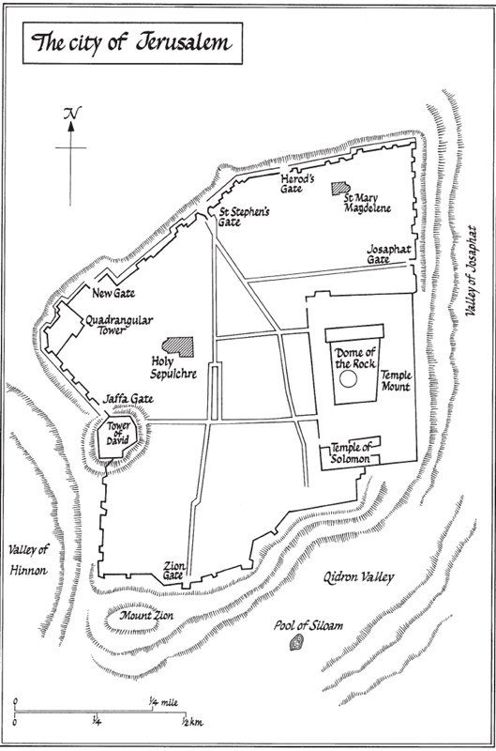
Some four kilometres long, up to fifteen metres high and three metres thick, enclosing an area of approximately eighty-six hectares, Jerusalem’s main walls presented a prodigious obstacle to any attacker. To the east and west these worked to reinforce natural defences, as the Judaean hills fell away steeply into the Qidron–Josaphat and Hinnon valleys. To the north and south-west, where flatter ground made it possible to approach the walls, they were reinforced by a secondary outer wall and a series of dry moats. Thiscircuit of fortifications – shaped like a lopsided rectangle – was pierced by five major gates, each guarded by a pair of towers and punctuated by two major fortresses. In the north-western corner stood a formidable stronghold, the Quadrangular Tower, while midway along the western wall rose Jerusalem’s ancient citadel, the Tower of David. One Latin chronicler described the latter’s awe-inspiring construction: ‘The Tower of David is built of solid masonry up to the middle, constructed of large square stones sealed with molten lead. If it were well supplied with rations for soldiers, fifteen or twenty men could defend it from every attack.’6
Within Jerusalem, the Fatimid governor, Iftikhar ad-Daulah, commanded a sizeable garrison, which had recently been reinforced by an elite troop of 400 Egyptian cavalrymen. On hearing of the crusaders’ approach, Iftikhar had taken further steps to hamper their assault, expelling many of the eastern Christians living in Jerusalem and poisoning or blocking all the wells outside the city. In contrast, within Jerusalem itself, the Muslim garrison could rely on numerous cisterns to supply uncontaminated water.7
Any assault upon Jerusalem would inevitably be a bloody affair, but for most crusaders the rewards far outweighed the risks. Within its walls lay a prize beyond measure: the Church of the Holy Sepulchre. It was to liberate this, the most sacred site on earth – where Christ had died on the cross and arisen reborn – that they had left their homes in Europe and faced the horrors of the journey east. A Latin chronicler imagined Tancred’s emotions early in the siege when, visiting the Mount of Olives, he was at last able to overlook Jerusalem: ‘He turned his gaze towards the city, from which he was now separated only by the Valley of Josaphat, [and saw] the Lord’s Sepulchre . . . Drawing a great sigh, he sat down on the ground, and would willingly have given his life there and then, just for the chance to press his lips to that [most holy church].’8
The Latins arrived with a small but battle-hardened force of around 1,300 knights and 12,000 ‘able-bodied men’. From the start of the siege, however, the rift within the army was obvious. The crusader host was effectively divided in two: the largest group, including Godfrey of Bouillon, Robert of Flanders and Tancred, moved to besiege the city from the north, taking up positions between the Quadrangular Tower and St Stephen’s Gate; meanwhile, Raymond of Toulouse and the southern French at first set up camp before the Tower of David, but quickly moved to a more threatening but exposed position before the Zion Gate. This formation had obvious strategic advantages, forcing the Muslim garrison to prepare for an attack on two fronts, but it was also symptomatic of a deep-seated fracture among the crusaders.
After Raymond of Toulouse lost control of the expedition at Arqa, his popularity plummeted. Raymond did receive some support from another visionary, Peter Desiderius, who sought to fill the void left by Peter Bartholomew’s death, but, by the start of Jerusalem’s siege, military and spiritual authority had gravitated towards another prince. Godfrey of Bouillon had long been respected for his Christian devotion and martial prowess. With Raymond’s decline, Godfrey stepped forward to become the crusade’s leading prince. His position was consolidated by the support of Arnulf of Chocques, the cleric who had helped to discredit Peter Bartholomew and the Holy Lance. Sensing the need for a new spiritual ‘totem’ to inspire and unify the Frankish host, Arnulf had a golden cross bearing the image of Christ made and encouraged a cult following to grow up around it. Godfrey duly became the patron and protector of this new ‘standard’ and, although it never achieved the same popularity as the Holy Lance, the cross did add to his aura of authority. Robert of Normandy, who had supported Raymond of Toulouse in the first half of 1099, changed sides, taking up a position to the north of Jerusalem, and Raymond soon became so isolated that even Provençal crusaders began defecting to Godfrey’s camp.9
Having taken up their positions around the city, the crusaders launched their first direct assault on 13 June. The Provençal crusader Raymond of Aguilers believed that the princes were spurred into action by the prophecies of a hermit encountered on the nearbyMount of Olives, promising victory if the offensive was continued throughout the day. In fact, the intense and ever-mounting pressure to overcome the city with speed was probably enough to prompt such a hasty frontal attack. The crusaders’ problem was that the region immediately around Jerusalem was devoid of woodland, and without timber it was impossible to prepare an adequate supply of siege tools. One story has it that Tancred found a small stack of wood hidden away in a cave, into which he had stumbled to relieve himself during a particularly painful bout of dysentery. This was enough to construct a single large scaling ladder, with which Tancred, now recovered, rushed forward to assault Jerusalem. An eyewitness later recalled the frustrations of this attack: ‘We did indeed destroy the curtain wall, and against the great wall we set up one ladder, up which our knights climbed and fought hand to hand with the Saracens with swords and spears. We lost many men but the enemy lost more.’
Luckily for Tancred, he had not been the first man up the scaling ladder. That unfortunate honour had been seized by a knight from Chartres, Raimbold Creton, who had fought atop Mount Silpius during the second siege of Antioch. Ascending the walls, ‘He had [just] seized the top of the battlements with his left hand, when suddenly an enemy sword, of the sort that can only be lifted with two hands, fell on him. Moving at lightning speed the blade sliced through his forearm, almost completely severing his hand.’10
Raimbold survived this dreadful wound, but the crusaders, unable to gain a foothold on the walls, were eventually forced to retreat. It was obvious to all that without careful preparation the Holy City would not fall. Thus, on 15 June, Raymond and the other princes put aside their disputes long enough to settle upon a course of action – no further assault would be attempted until the necessary weapons of siege warfare could be constructed. But the crusaders lacked the tools, timber and craftsmen needed to build siege towers, catapults and battering rams.11
As the princes considered their next move, a further crisis began to grip the army. Although they arrived with the harvest stored at Ramleh and suffered no severe food shortages, in the middle of a scorching Palestinian summer, adrift among the arid Judaean hills, the crusaders soon began to feel the effects of thirst. With all the surrounding wells poisoned or collapsed, the only local water source was the Pool of Siloam, a small lake fed by an intermittent spring at the foot of Mount Zion, but this lay within bowshot of the city. Even so, when the pool filled every three days, many would still brave Muslim arrows for a meagre drink:
When [the spring] gushed forth on the third day the frantic and violent push to drink the water caused men to throw themselves into the pool and many beasts of burden and cattle to perish there in the scramble. The strong in a deadly fashion pushed and shoved through the pool, choked with dead animals and filled with struggling humanity, to the rocky mouth of the flow, while the weaker had to be content with the dirtier water.
The Franks were soon forced to range further afield in search of water, but this brought its own attendant dangers:
We suffered so badly from thirst that we sewed up the skins of oxen and buffaloes, and we used to carry water in them for the distance of nearly six miles. We drank the water from these vessels although it stank, and what with foul water and barley bread we endured great distress and affliction every day, for the Saracens used to lie in wait for our men by every spring and pool, where they killed them and cut them to pieces.
The worst water, taken from ‘filthy marshes’, reportedly contained leeches, which were often accidentally swallowed by the poorest crusaders in their rush to gulp down what they could, causing an agonising death.12 These water shortages troubled the Franks throughout the siege of Jerusalem, but help in another quarter was at hand.
On 17 June news arrived in the crusader camp that six ships, most originating in Genoa, had docked at Jaffa, the nearest port to Jerusalem. Unbeknown to the Franks, Jaffa’s Muslim garrison had abandoned its ramshackle defences – ‘one intact tower of a badly ruined castle’ – leaving the port deserted. Thus the Genoese had been able to find mooring, but now requested an escort from their fellow Latins. Three squadrons were immediately dispatched: twenty knights and fifty footsoldiers under Geldemar Carpenel, a member of Godfrey of Bouillon’s contingent; a further fifty knights under the Provençal Raymond Pilet; and a last group under William of Sabran, who had marched to Jerusalem with the Provençal contingent. En route to Jaffa they ran into a Fatimid patrol, 600 men strong, near Ramleh. Geldemar’s troops, in the vanguard, caught the brunt of the fighting and, heavily outnumbered, they suffered numerous casualties. Only when Raymond Pilet raced forward with reinforcements were the Fatimids beaten back.
Lucky to be alive, the crusaders arrived at Jaffa, ‘where the sailors joyously received them with bread, wine and fish’. They seem to have celebrated in some style, because, ‘happy and heedless’, they neglected to post any seaward lookouts. As dawn broke the following day, the sailors awoke to find their ships surrounded by a large Fatimid fleet. Forced to abandon their vessels, they escaped with the crusaders just before the port was overrun. Fortunately for this now heavily laden party, the return journey to Jerusalem passed without incident. Even though the fleet itself had been lost, its cargo and crew were an enormous boost for the crusade’s fortunes. Among the Genoese sailors were many gifted craftsmen, including William Embriaco, and they brought with them ‘ropes, hammers, nails, axes, mattocks and hatchets, all indispensable’. All the evidence suggests that the crusaders had not anticipated the fleet’s arrival, but it would be incredible, almost miraculous, if such a timely boon had been wholly unplanned.13
In the days that followed, local Christians advised the Franks on the location of nearby forests, so wood could be procured. Robert of Normandy and Robert of Flanders soon returned with the first train of timber-laden camels. In five days, the crusaders’ condition had been utterly transformed – everything was now in place for the construction of siege weapons to begin. But, even here, the continued division among the Latins was in evidence. Raymond of Toulouse appointed William Embriaco to head the building programme on Mount Zion, but to the north of the city Godfrey employed the skills of the experienced campaigner Gaston of Béarn, who until now had been a dedicated devotee of the Provençal camp. By this stage, Raymond’s high-handed behaviour had evidently begun to alienate even his closest allies.14
The bad blood between the princes soon boiled over into open confrontation. In what seems like an act of extraordinary folly, given the urgent need for a concerted effort to overthrow Jerusalem quickly, the crusaders began to squabble over who should rule the Holy City if and when it was captured:
We now called a meeting because of the general quarrels among the leaders and specifically because Tancred had seized Bethlehem. There he had flown his banner over the church of the Lord’s Nativity as if over a temporal possession. The assembly also posed the question of the election of one of the princes as a guardian of Jerusalem in case God gave it to us.15
Not only were the princes unable to agree upon a candidate, but the Latin clergy now vociferously maintained that it would be wrong and sinful to raise a king over the Holy City, God’s patrimony. They believed that Jerusalem should be preserved as a spiritual realm, governed by the Church, and simply protected by a temporal military ruler bearing the lesser title of ‘advocate’ or protector. Just as at Antioch, the crusaders’ acquisitive minds had become fixated upon the spoils of war – power, territory and plunder – long before the battle itself was won. Now, however, far from bringing a voice of reason and conciliation, the clergy themselves were caught up in the midst of the wrangling. This dispute raged on unresolved until the assault was launched. The open rift between Raymond of Toulouse and Tancred was temporarily patched up in the final days before battle commenced, but, given the level of Frankish factionalism, it is remarkable that they were able to co-ordinate and launch any sort of attack at all.16
Two overriding emotions empowered their efforts – desperation and devotion. Having endured such an immense struggle simply to reach Jerusalem, and now facing the palpable threat of Fatimid counterattack, most crusaders were driven by an unshakeable determination to conquer the Holy City and complete their pilgrimage to the Holy Sepulchre. Without such an inspirational goal, or such impending danger, the expedition might well have been ripped apart by division. As it was, the crusaders’ spiritual fervour and survival instinct coalesced, providing just enough impetus to hold the few remaining threads of Frankish unity in place.
For three weeks in late June and early July, the crusaders applied themselves with furious energy to the task at hand. Both Godfrey’s and Raymond’s supporters threw themselves into an intense construction programme. In the former, Gaston of Béarn supervised the building work, while the princes ‘attended to the hauling of wooden materials’. Meanwhile, William Embriaco acted as foreman in the Provençal camp, with Peter of Narbonne, bishop of Albara, overseeing the procurement of materials. By this stage, Raymond of Toulouse was losing popular support at a damaging pace. With more and more crusaders transferring their allegiance to Godfrey’s faction, Raymond was forced to pay those who remained with funds from his treasury just to get them to work, and to make up the shortfall in manpower with Muslim captives. Elsewhere in the crusader host, only skilled artisans and craftsmen were paid from a communal fund, while everyone else ‘laboured, built and co-operated’ through day and night, ‘gladly turn[ing] their shoulders to the task’.17
The crusaders set out to construct the finest siege weapons available in the eleventh century, using cutting-edge military technology. At the heart of their assault strategy were two fearsome siege towers; three storeys tall and constructed upon wheeled platforms, these were designed to be pushed up against a wall, thus allowing a large number of attackers to access its ramparts in relative safety. To protect the tower and its passengers from arrows, rocks and fire, the entire structure was covered in wattles of interwoven branches and thick animal hide. Godfrey’s tower had a further technological refinement: it could be rapidly dismantled into portable sections and then reconstructed in a new position. The crusaders built an array of other siege weapons: a massive battering ram with an iron-clad head ‘of horrendous weight and craftsmanship’, shielded from above by a wattle roof; a number of large-scale mangonellae (catapults); numerous scaling ladders; and a series of portable wattle screens under which troops could approach the walls. To the south of the city, Raymond adopted a novel approach to the daunting task of filling the dry moat protecting the walls around the Zion Gate: ‘Our leaders discussed how they should fill the ditch, and they had it announced that if anyone would bring three stones to cast into that pit he should have a penny. It took three days and nights to fill it.’18
At the same time, within Jerusalem, the Fatimid garrison was not idle. They could see only too well where the Franks were preparing to strike. Their own mangonels were brought to the walls to be in firing range once an assault began. They also took elaborate steps to protect threatened sections of wall from bombardment or battering. One Latin eyewitness described how ‘they brought out sacks of straw and chaff, and ships’ ropes of great size and closely woven, and fixed them against the walls and ramparts, so that they would cushion the attack and blows of the mangonel’.19
As preparations for the attack continued at a furious pace, tension inevitably mounted and both sides were soon engaged in a secondary war of intimidation, designed to sap the enemy morale and their will to fight. This followed the pattern of terrorisation and abuse experienced in the earlier sieges of Nicaea and Antioch. During a foraging expedition in late June, Baldwin of Le Bourcq, Baldwin of Boulogne’s second cousin, captured ‘a very noble [Muslim] knight, a bald-headed man, of outstanding stature, elderly and corpulent’. The crusaders were evidently impressed by this ‘wise, noble’ figure for the princes ‘frequently enquired about his life and customs’ and sought to persuade him to convert to Christianity. When he declined, however, they made an example of him: ‘He was brought out in front of the Tower of David to frighten the guards of the citadel and was beheaded by Baldwin’s squire in full view of all.’
Later, a Fatimid spy was caught outside ferrying messages in and out of Jerusalem. After interrogation, the Latins sought to terrify the enemy by throwing him back into the city, as they had done with other victims in previous sieges. On this occasion, however, the captive was still alive: ‘He was put into the catapult, but it was too heavily weighed down by his body and did not throw the wretch far. He soon fell on to sharp stones near the walls, broke his neck, his nerves and bones, and is reported to have died instantly.’ For their part, the Muslim garrison resorted to insulting the Christian faith: ‘To arouse the Latins’ anger, they fixed crosses [on top of the walls] in mockery and abuse, upon which they either spat, or they did not shrink from urinating upon them in full view of everyone.’20
By early July, in this atmosphere of hatred and expectancy, the crusaders’ military preparations were nearing completion. Around this time, the visionary Peter Desiderius came forward claiming to have received a new message from Adhémar of Le Puy. Apparently, the dead legate had, in a vision, prescribed a series of purifying rituals designed to purge the crusaders of sins and restore them to a state of unity, thus bringing about a return of God’s favour. One Latin eyewitness recalled that after a council of princes and clergy had approved these measures,
an order went out that on [8 July] clergymen with crosses and relics of saints should lead a procession with knights and the able-bodied men following, blowing trumpets, brandishing arms, and marching barefooted. We gladly followed the orders of God and the princes, and when we marched to the Mount of Olives we preached to the people on the spot of Christ’s ascension after the Resurrection . . . A spirit of forgiveness came over the army and along with liberal donations we implored God’s mercy.21
The Fatimid garrison showed little respect for these rituals, and when the procession later passed close to the walls near the Mount Zion they peppered the crusader ranks with arrows, wounding clergy and laymen alike, and arousing Frankish bloodlust.22 Finally, at the end of the second week of July, with their preparations complete, the crusaders were ready to unleash their rage.