
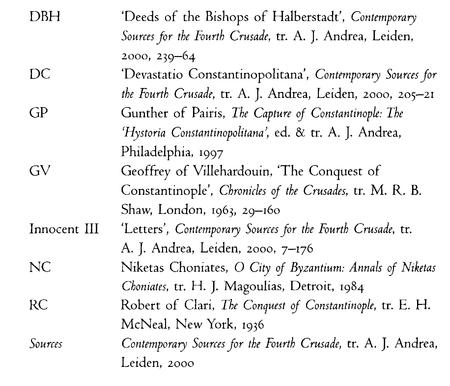
ABBREVIATIONS
INTRODUCTION
1 NC, 314-15.
2 The most detailed narrative of the expedition is by Queller and Madden, Fourth Crusade, whose perspective is as historians of Venice. Another good account of the campaign is Godfrey, 1204. The Unholy Crusade.
3 Vehemently anti-western accounts of the crusade written by Byzantine historians include: Runciman, History of the Crusades, III; Norwich, Byzantium: The Decline and Fall, 156-213. For more balanced and scholarly views, see: Harris, Byzantium and the Crusades; Angold, The Fourth Crusade.
4 Constable, ‘The Historiography of the Crusades’.
5 Siberry, ‘Images of the Crusades in the Nineteenth and Twentieth Centuries’, The Oxford Illustrated History of the Crusades, 314.
6 Runciman, History of the Crusades, III, 469, 480.
7 Cited in Bartlett, Medieval Panorama, 12-13.
8 Runciman, History of the Crusades, III, 474.
9 Riley-Smith, ‘Islam and the Crusades in History and Imagination’, 164-7.
10 Phillips, ‘Why a Crusade will lead to a jihad’.
11 Innocent III, Sources, 107.
12 Innocent III, Sources, 173—4.
13 See especially the comments by Harris, ‘Distortion, Divine Providence and Genre in Niketas Choniates’ Account of the Collapse of Byzantium’.
14 Jackson, ‘Christians, Barbarians and Masters: The European Discovery of the World Beyond Islam’.
15 Bull, ‘Origins’.
16 Guibert of Nogent, cited in and translated by Bull, Knightly Piety and the Lay Response to the First Crusade, 3.
17 William of Tyre, I, 372—3.
18 The best account of this is Hillenbrand, The Crusades: Islamic Perspectives.
19 See Phillips and Hoch, Second Crusade: Scope and Consequences, 1—14.
20 Harris, Byzantium and the Crusades, 116—20.
21 Eustathios of Thessaloniki, The Capture of Thessaloniki, 35.
22 William of Tyre, II, 465.
23 Hamilton, The Leper King and His Heirs: King Baldwin IV and the Crusader States.
CHAPTER ONE
THE ORIGINS AND PREACHING OF THE FOURTH CRUSADE, 1187—99
1 Gregory VIII, Audita tremendi, 64—5.
2 Beha ad-Din, The Rare and Excellent History of Saladin, 146, 150.
3 Chronicle of the Third Crusade, 382.
4 This period is expertly analysed by Gillingham, Richard I, 155-301.
5 A good, modern biography of Innocent is: Sayers, Innocent III. Also important are the essays collected in: Innocent III: Vicar of Christ or Lord of the World?, ed. Powell; Pope Innocent III and his World, ed. Moore.
6 Sayers, Innocent III, 10-27; Peters, ‘Lothario dei Conti di Segni becomes Pope Innocent III’, in: Innocent III and his World, 3—24.
7 Sayers, Innocent III, 2.
8 Innocent III, Sources, 7—9.
9 Innocent III, Sources, 9, n.4.
10 Ross, Relations between the Latin East and the West, 1187—1291, 58—60.
11 Innocent III, Sources, 10—11.
12 Innocent III, Sources, 12.
13 Innocent III, Sources, 14.
14 On this papal appeal, see also: Cole, Preaching the Crusades, 80—5.
15 Gillingham, Richard I, 316.
16 There is an excellent translation of the first 10,000 lines of the History. See: History of William Marshal, ed. Holden, tr. Gregory. The remainder of the text is forthcoming.
17 Translations from: Crosland, William the Marshal, 78—81. For William’s life see: Crouch, William Marshal; for this period of Richard’s reign, see: Gillingham, Richard I, 318-20.
18 Gillingham, Richard I, 323—5.
19 The most accessible modern account of Philip’s life is: Bradbury, Philip Augustus; for his marital difficulties, see 173-94.
20 Joinville, Life of Saint Louis, 196.
21 France, ‘Patronage and the First Crusade’.
22 Riley-Smith, ‘Casualties and Knights on the First Crusade’, 17—19; Phillips, Second Crusade.
23 Fulcher of Chartres, History of the Expedition to Jerusalem, 85.
24 Albert of Aachen, Historia, 329.
25 Raymond of Aguilers, in: Peters, First Crusade, 212—13.
26 Odo of Deuil, Journey of Louis VII, 123.
27 Guibert of Nogent, The Deeds of the Franks, 165. For the subject of crusader captives in general, see: Friedman, Encounters between Enemies.
28 Gesta Francorum, 3-4.
29 Gesta Francorum, 89.
30 Gesta Francorum, 62.
31 Chronicle of the Third Crusade, 232-3.
32 Orderic Vitalis, Ecclesiastical History, V, 17.
33 For Raymond and Eleanor, see: William of Tyre, History, II, 179-81. For women as guardians of property, see: Riley-Smith, First Crusaders, 135-43.
34 Chronicle of the Third Crusade, 48.
35 Gerald of Wales, Journey through Wales, 76.
36 Conquest of Lisbon, 73.
37 Peters, First Crusade, 287-9.
38 Cartulaire de I‘abbaye de saint-Père de Chartres, II, 646.
39 Fulcher of Chartres, History of the Expedition to Jerusalem, 139.
40 Conquest of Lisbon, 131.
41 Riley-Smith, First Crusaders, 120.
42 Robinson, The Papacy, 1073-1198: Continuity and Innovation, 336-9.
43 De Hemptinne, ’Les épouses des croisés et pèlerins flamands aux XIe et XIIe siècles’.
44 Hugh of Saint-Pol, Sources, 186—7.
45 William of Malmesbury, History of the Kings of England, 655.
46 Orderic Vitalis, Ecclesiastical History, V, 5.
47 Lambert of Ardres, History, 164—5.
48 Suger, Deeds of Louis the Fat, 41.
49 For Bishop Ortleib, see: Frolow, Relique de la vraie croix, 349; for Gouffier, see: Riley-Smith, First Crusaders, 235.
50 Odo of Deuil, The Journey of Louis VII, 115, 123.
51 Albert of Aachen, Historia, 626.
52 Herman of Tournai, The Restoration of the Monastery of Saint Martin of Tournai, 47.
53 Suger, Deeds of Louis the Fat, 40.
54 See also: Kenaan-Kedar and Kedar, ‘Significance of a Twelfth-Century Sculptural Group’.
CHAPTER TWO
ABBOT MARTIN’S CRUSADE SERMON, BASEL CATHEDRAL, MAY 1200
1 For Fulk’s career see: O’Brien, ‘Fulk of Neuilly’. Note also: McNeal, ‘Fulk of Neuilly and the Tournament of Ecry’.
2 Ralph of Coggeshall, Sources, 278-9.
3 GV, 29.
4 Ralph of Coggeshall, Sources, 280.
5 Cole, Preaching the Crusades, 89—90.
6 Maier suggests 3 May as the most likely date for the sermon in ‘Kirche, Kreuz und Ritual’, 101—4.
7 For sermons in general, see: Maier, Crusade Propaganda and Ideology: Model Sermons for the Preaching of the Cross; Cole, Preaching the Crusades.
8 There is an excellent translation with a full introduction and analysis of Gunther’s writings in: Gunther of Pairis, The Capture of Constantinople, ed. Andrea. For the Basel sermon, see also: Cole, Preaching the Crusades, 92—7; Maier, ‘Kirche, Kreuz und Ritual’.
9 Spicher, Geschichte des Basler Münsters.
10 For a discussion of this with regard to an earlier expedition, see: Phillips, ‘Holy War’, 133-4.
11 Cole, Preaching the Crusades, 45.
12 GP, 68.
13 GP, 69.
14 Maier, ‘Kirche, Kreuz und Ritual’.
15 GP, 70. On the True Cross, see also: Riley-Smith, First Crusade and the Idea of Crusading, 23-5, 31—2, 150—1; Murray, ‘Mighty Against the Enemies of Christ’.
16 For translations of excerpts from Urban’s sermon, see: Riley-Smith, Crusade: Idea and Reality, 40-3.
17 On the need to atone for sin, see: Bull, ‘Origins’; Bull, Knightly Piety, 155-249.
18 GP, 71.
CHAPTER THREE
THE TOURNAMENT AT ÉCRY, NOVEMBER 1199
1 On tournaments generally, see: Keen, Chivalry, 20-3; Barber and Barber, Tournaments, 13-27; Strickland, War and Chivalry, 149-53.
2 Roger of Howden, Chronica, II, 166-7. Translated in: The Annals of Roger of Hoveden, I, 490.
3 History of William Marshal, I, 309.
4 History of William Marshal, I, 173.
5 Lambert of Ardres, History, 126.
6 History of William Marshal, I, 177, 181.
7 Geoffrey of Monmouth, History of the Kings of Britain, 229.
8 Keen, Chivalry, 21.
9 On the difficult relationship between romantic literature and historical reality, see: Keen, Chivalry, 102-24; Bouchard, Strong of Body, 105-9.
10 Chrétien de Troyes, Érec et Énide, 63-4.
11 History of William Marshal, I. 175—9.
12 Lloyd, English Society and the Crusade, 199—200.
13 Decrees of the Ecumenical Councils, I, 199-200. This decree of the 1139 Lateran Council reiterated earlier statements from the 1130 Council of Clermont and the 1131 Council of Reims.
14 Keen, Chivalry, 22. For Flanders, Champagne and the crusades generally, see the references in Phillips, Defenders.
15 Humbert of Romans, De predicatione Sancte crucis.
16 Gillingham, Richard I, 19; Hillenbrand, The Crusades: Islamic Perspectives, 336.
17 Gillingham, Richard I, 19.
18 Keen, Chivalry, 56.
19 GV, 29.
20 Longnon, Les compagnons de Villehardouin, 11—13.
21 Longnon, Les compagnons de Villehardouin, 79-84.
22 GV, 29.
23 GV, 57.
24 Morris, ‘Geoffroy de Villehardouin and the Conquest of Constantinople’, 34. For a concise overview of the debate over Villehardouin’s writings, see: Andrea, ‘Essay on Primary Sources’, 299-302; note also Noble, ‘The Importance of Old French Chronicles’. For a remarkably hostile assessment of the text, see: Archambault, ‘Villehardouin: History in Black and White’. For Villehardouin’s treatment of the Champenois contingent, see: Dufournet, ‘Villehardouin et les Champenois dans la Quatrième croisade’.
25 Longnon, Les compagnons de Villehardouin, 18, 20, 113.
26 GV, 30; Wolff, ‘Baldwin of Flanders and Hainault’.
27 NC, 328.
28 GV, 30-1; RC, 32-3. On Robert as a source, see: RC, 3-27, and the comments in Andrea’s ‘Essay on Primary Sources’ in Queller and Madden, Fourth Crusade, 302-3; also Noble, ’The Importance of Old French Chronicles’.
29 GV, 31.
30 Conquest of Lisbon, 12—26.
31 Pryor, Geography, Technology and War, 3-4, 36, 51-3.
32 Marshall, ‘The Crusading Motivation of the Italian City Republics in the Latin East, 1096—1104’, 60—79.
33 For Genoa, see: La cattedrale di Genova nel medioevo secoli VI-XIV, ed. Di Fabrio, 188—91. For Venice, see: Cerbani Cerbani, ‘Translatio mirifici martyris Isidori a Chio insula in civitatem Venetem’, 323—4; Marshall, ‘The Crusading Motivation of the Italian City Republics in the Latin East’.
34 Caffaro, in: Williams, ‘The Making of a Crusade’, 38—9.
35 Ibn Jubayr, The Travels, 300—1.
36 Innocent III, Sources, 22.
37 Innocent III, Sources, 16.
38 GV, 31.
CHAPTER FOUR
THE TREATY OF VENICE, APRIL 1201
1 Lane, Venice, 1—21; Zorzi, Venice, A City, A Republic, An Empire, 10—20, 102—8; Howard, Architectural History of Venice, 2—41.
2 Tafel and Thomas, Urkunden, I, 51—4; Jacoby, ‘The Chrysobull of Alexius I to the Venetians’.
3 Madden, Enrico Dandolo and the Rise of Venice. Madden’s book was published as this present work was being completed. I have, therefore, been unable to include any of its detailed ideas.
4 Madden, ‘Venice and Constantinople in 1171 and 1172’, 169—70.
5 Madden, ‘Venice and Constantinople in 1171 and 1172’, 179—84.
6 For Innocent III see: Sources, 60—9, 95—8; 145—51. For later historians hostile to Venice, see: Queller and Madden, Fourth Crusade, 318—21; Runciman, History of the Crusades, III.
7 GP, 97.
8 Innocent III, Sources, 112.
9 RC, 40.
10 Stahl, ‘The Coinage of Venice in the Age of Enrico Dandolo’.
11 GV, 32—3.
12 Riley-Smith, First Crusaders, 19, 29.
13 GV, 33.
14 Tafel and Thomas, Urkunden, I, 362—73. See also: Queller and Madden, Fourth Crusade, 11, 217, n.23.
15 GV, 33-4.
16 For concise details on the construction of St Mark’s, see: Howard, Architectural History of Venice, 17-28. For the most complete survey of the church’s mosaics, see: Demus, Mosaic Decoration of San Marco, Venice.
17 Demus, Mosaic Decoration of San Marco, 20—3.
18 GV, 34-5.
19 GV, 35.
20 Queller and Madden, Fourth Crusade, 12; Mack, The Merchant of Genoa, 28—43.
21 Lane, Venice, 37.
22 For the First Crusade, see: France, Victory in the East, 142; for the Third Crusade, see: Johnson, ‘The Crusades of Frederick Barbarossa and Henry VI’, 89-94.
23 GV, 35.
24 Phillips, Crusades, 95-6.
25 William of Tyre, History, II, 313.
26 William of Tyre, History, II, 408.
27 Phillips, Crusades, 95-101, 146—50.
28 GV, 35.
29 GP, 77.
30 Hillenbrand, The Crusades: Islamic Perspectives, 557.
31 Queller and Madden, ‘Some further arguments in defence of the Venetians’, 438. See also: Lane, Venice, 70—3.
32 Madden, ‘Venice, the Papacy and the Crusades before 1204’.
33 Innocent III, Sources, 23-4.
34 William of Tyre, History, II, 335.
35 Ibn Jubayr, The Travels, 32.
36 Lane, Venice, 88; Howard, Architectural History of Venice, 17—19.
37 GV, 35.
38 Martin da Canal, Les Estoires de Venise, 46—7.
39 McNeill, Venice, 5—6; Zorzi, Venice: A City, A Republic, An Empire, 38—9.
40 The dimensions of all vessels discussed here are taken from: Pryor, ‘The Naval Architecture of Crusader Transport Ships’. See also: Martin, The Art and Archaeology of Venetian Ships and Boats.
41 Pryor, ‘Transportation of Horses by Sea during the Era of the Crusades’.
42 Pryor, ‘The Venetian Fleet for the Fourth Crusade’, 119—22.
43 GV, 35—6.
CHAPTER FIVE
FINAL PREPARATIONS AND LEAVING HOME, MAY 1201—JUNE 1202
1 For a full and stimulating discussion of the Jews in Europe at this time, see: Abulafia, Christians and Jews. For usury in particular, see 58—62.
2 Peter the Venerable, Letters, I, 327.
3 Bernard of Clairvaux, Letters, 466.
4 GV, 37.
5 Jubainville, Histoire des ducs et des comtes de Champagne, 4, 96. For the full description of the tomb, see the same work, 90—9.
6 Jackson, ‘Crusades of 1239—41 and their aftermath’, 32—60.
7 GV, 37.
8 Evergates, Aristocratic Women in the County of Champagne’, 79—85.
9 William of Tyre, History, II, 416.
10 William of Tyre, History, II, 450—1.
11 NC, 97.
12 Brand, Byzantium Confronts the West, 19.
13 NC, 210.
14 Continuation of William of Tyre, 53.
15 Continuation of William of Tyre, 54.
16 Chronicle of the Third Crusade, 40.
17 Jacoby, ‘Conrad of Montferrat and the Kingdom of Jerusalem, 1187—92’.
18 Continuation of William of Tyre, 114—15. The account in Chronicle of the Third Crusade gives another account of the murder, differing in minor details, such as that Conrad did eat with the bishop of Beauvais before meeting his fate en route home.Chronicle of the Third Crusade, 305—7.
19 Raimbaut de Vaqueiras, Poems, 312.
20 Queller and Madden, Fourth Crusade, 25—6.
21 RC, 35.
22 Brundage, ‘Cruce signari: The Rite for taking the Cross in England’.
23 Raimbaut of Vaqueiras, Poems, 218—20.
24 Morris, Papal Monarchy, 245.
25 Ralph of Coggeshall, Sources, 281.
26 Ralph of Coggeshall, Sources, 281.
27 Cole, Preaching the Crusades, 90.
28 Longnon, Les compagnons de Villehardouin, 209—10, 212—13.
29 For Alexius’s age, see: Brand, Byzantium Confronts the West, 96—7.
30 RC, 84.
31 NC, 305.
32 See the arguments put forward by Winkelmann and Riant, reproduced in: Queller, Latin Conquest of Constantinople, 26—9, 32—8.
33 The point is made by Queller and Madden, Fourth Crusade, 45—6.
34 NC, 242—3.
35 Johnson, ‘Crusades of Frederick Barbarossa and Henry VI’, 92—109.
36 Angold, Byzantine Empire, 303—11, 318—19.
37 NC, 248.
38 NC, 242—3.
39 ‘Novgorod Account of the Fourth Crusade’, 306.
40 Powell, ‘Innocent III and Alexius III: a Crusade Plan that Failed’, 96—100.
41 Tafel and Thomas, Urkunden, I, 241—6; Angold, Byzantine Empire, 319. See also: Brand, Byzantium Confronts the West, 225—9.
42 Innocent III, Sources, 32—4.
43 Innocent III, ‘Solitae’, from: Andrea, Medieval Record, 321.
44 Translation from Slack, Crusade Charters, 1138—1270, 145.
45 Translated from Cartulare de Notre-Dame de Josaphat, I, 358. For Geoffrey of Beaumont, see also: Longnon, Les compagnons de Villehardouin, 107.
46 Riley-Smith and Riley-Smith, Crusades: Idea and Reality, 147.
47 Continuation of William of Tyre, 68.
48 Fulcher of Chartres, History of the Expedition to Jerusalem, 74.
49 RC, 39.
50 Conon of Béthune, Les Chansons de Conon de Béthune, 6—7.
51 GV, 40.
52 Joinville, Chronicles of the Crusades, 195.
53 GV, 40. The Devastatio Constantinopolitana recorded that crusaders began to arrive in Venice from 1 June, Sources, 214.
54 Spufford, Power and Profit, 140—69.
CHAPTER SIX
THE CRUSADE AT VENICE AND THE SIEGE OF ZARA, SUMMER AND AUTUMN 1202
1 GV, 40.
2 GV, 40.
3 Villehardouin records that Pope Innocent III endorsed the agreement between the Venetians and the crusaders, but he does not mention any papal instructions for the crusaders to meet at Venice. Had the pope done so, it is odd that neither Innocent nor Villehardouin himself (who was always ready to apportion blame for the shortfall in men at Venice) chose to mention such an important point. This argument is contra to the view of Madden, ‘Venice, the Papacy and the Crusades before 1204’.
4 Spufford, Power and Profit, 152—5; 169—70.
5 GV, 41.
6 Gesta Innocenti, col. 138.
7 GV, 42.
8 RC, 42.
9 Hugh of Saint-Pol, Letter, 191; NC, 295—6.
10 For Conrad’s career in full, see: Andrea, ‘Conrad of Krosigk, Bishop of Halberstadt, Crusader and Monk of Sittichenbach’.
11 GV, 42.
12 RC, 40.
13 DC, Sources, 205—12.
14 DC, Sources, 214.
15 RC, 40.
16 DC, Sources, 214.
17 GV, 42.
18 GV, 42—3.
19 GV, 43; RC, 41.
20 GV, 43.
21 RC, 41.
22 GV, 43.
23 DBH, Sources, 251.
24 GV, 44.
25 GV, 44.
26 Phillips, Second Crusade.
27 RC, 42.
28 RC, 42.
29 The treaties are reproduced in: Tafel and Thomas, Urkunden, I, 386, 396.
30 DBH, Sources, 250—1.
31 Innocent III, Sources, 43; Gesta Innocenti, translated in: Sources, 44.
32 GV, 48.
33 RC, 44.
34 GV, 48.
35 Peter of Vaux-Cernay, History of the Albigensian Crusade, 58.
36 France, Western Warfare in the Age of the Crusades, 117—20; Bradbury, Medieval Siege, 254—70.
37 DC, Sources, 215.
38 Conquest of Lisbon, 143, 145. A cubit is a medieval measurement equivalent to a forearm.
39 DBH, Sources, 251.
40 GP, 80; Innocent III, Sources, 43.
41 Innocent III, Sources, 129.
42 GP, 78—9.
43 GP, 78.
44 GP, 79.
45 DC, Sources, 215.
46 GV, 49.
47 RC, 44.
48 Innocent III, Sources, 41.
49 Innocent III, Sources, 42—3.
50 Innocent III, Sources, 43.
CHAPTER SEVEN
THE OFFER FROM PRINCE ALEXIUS, DECEMBER 1202—MAY 1203
1 GV, 50.
2 GP, 90.
3 GV, 50.
4 GV, 51.
5 GV, 51.
6 GV, 51.
7 Innocent III, Sources, 35.
8 RC, 45.
9 RC, 59, 66.
10 GP, 91.
11 For this complex subject, see: Nicol, Byzantium and Venice, 50—123; Martin, ‘Venetians in the Byzantine Empire before 1204’; Madden, ‘Venice and Constantinople in 1171 and 1172: Enrico Dandolo’s attitudes towards Byzantium’; Angold, Byzantine Empire, 226—33.
12 Tafel and Thomas, Urkunden, I, 179—203, 206—11.
13 GP, 91.
14 GV, 51; RC, 66.
15 RC, 66.
16 GV, 51.
17 GV, 52.
18 Longnon, Les compagnons de Villehardouin, 114—15.
19 GV, 52.
20 GV, 52—3; Longnon, Les compagnons de Villehardouin, 149—50.
21 Innocent III, Sources, 48.
22 Innocent III, Sources, 52—4.
23 Innocent III, Sources, 54—7.
24 Innocent III, Sources, 57—9.
25 DBH, Sources, 253.
26 Hugh of Saint-Pol’s Letter, Sources, 188.
27 Hugh of Saint-Pol’s Letter, Sources, 189.
28 GV, 55.
29 GV, 55.
30 GV, 56.
31 DBH, Sources, 254.
CHAPTER EIGHT
THE CRUSADE ARRIVES AT CONSTANTINOPLE, JUNE 1203
1 GV, 57.
2 GV, 57.
3 GY 57
4 GV, 58.
5 Pryor, ‘Winds, Waves and Rocks: the Routes and the Perils Along Them’, 85.
6 GV, 58.
7 Jacoby, ‘La population de Constantinople à l’époque Byzantine: Un problème de démographie urbaine‘, 107.
8 GV, 58—9.
9 RC, 67.
10 Alexander, ‘The Strength of Empire and Capital as Seen Through Byzantine Eyes’, 345.
11 Baynes, ‘The Supernatural Defenders of Constantinople’.
12 Van Millingen, Byzantine Constantinople, 4.
13 Sarris, ‘The Eastern Empire from Constantine to Heraclius (306—641)’, 21.
14 For a full discussion of all these interpretations, see: Angold, ‘Road to 1204: the Byzantine background to the Fourth Crusade’.
15 Van Millingen, Byzantine Constantinople, 40—58.
16 Van Millingen, Byzantine Constantinople, 59—73.
17 RC, 108—9.
18 Mango, ‘Constantinople’, 66.
19 NC, 358.
20 Magdalino, ‘Manuel Komnenos and the Great Palace’, 101—14; Van Millingen, Byzantine Constantinople, 284.
21 William of Tyre, History, II, 381—2.
22 RC, 103.
23 Nicholas Mesarites, translation from: Mango, Art of the Byzantine Empire, 312—1453, 229.
24 Maguire, ‘Medieval Floors of the Great Palace’.
25 Benjamin of Tudela, Itinerary, 70—1; NC, 160; Magdalino, Manuel I Komnenos, 111.
26 RC, 107.
27 Many books have been written on the Hagia Sophia. See particularly: Mainstone, Hagia Sophia: Architecture, Structure and Liturgy of Justinian’s Great Church.
28 Mango, Art of the Byzantine Empire, 74—5.
29 RC, 106.
30 Alberic of Trois-Fontaines, ‘Chronicle’, Sources, 298.
31 Odo of Deuil, Journey of Louis VII, 65—7
32 RC, 108.
33 Ousterhout, Architecture, Art and Komnenian Ideology at the Pantokrator Monastery’, Byzantine Constantinople, 133—50; Megaw, ‘Notes on Recent Work of the Byzantine Institute in Istanbul’, 333—64.
34 For details of the running of the hospital, see: Byzantine Monastic Foundation Documents, II, 725—74.
35 Phillips, Crusades, 1095-1197, 58.
36 Mango, ‘Three Imperial Byzantine Sarcophagi’, 397—404.
37 Runciman, ‘Blachernae Palace and Its Decoration’, 277-83.
38 Odo of Deuil, Journey of Louis VII, 65.
39 William of Tyre, History, II, 450.
40 Benjamin of Tudela, Itinerary, 72.
41 Odo of Deuil, Journey of Louis VII, 65.
42 Cited by Magdalino, Manuel I Komnenos, 121.
43 NC, 132.
44 Ralph of Coggeshall, Sources, 285.
45 NC, 296.
46 NC, 296—7.
47 Innocent III, Sources, 35—8.
48 William of Tyre, History, II, 361.
49 Pryor notes that, given the Venetians’ knowledge of the weakness of the Byzantine navy, if Constantinople was always the planned target for the crusade, then the provision of 50 war galleys was superfluous. By contrast, the Egyptian navy was known to be more of a danger, hence the provision of war galleys to fight them. This is further proof that the crusade intended to go to Egypt from its inception. Pryor, ‘The Venetian Fleet for the Fourth Crusade’, 108—11, 119—22. See also Sesan, ‘La flotte Byzantine à l’époque des Comnenes et des Anges’.
50 Birkenmeier, The Development of the Komnenian Army, 1081-1180, 231—5.
51 Benjamin of Tudela, Travels, 71.
52 For the expedition of King Sigurd, see: Snorri Sturlusson, Heimskringla: History of the Kings of Norway, 689—99; for the Varangian guard, see: Birkenmeier, Development of the Komnenian Army, 62—6, 90—7.
53 Innocent III, Sources, 82.
54 Cheyet, ‘Les effectifs de l‘armée byzantine aux x-xii s.’, 333.
55 GV, 59.
56 GV, 59.
57 Stephenson, ‘Anna Comnena’s Alexiad as a source for the Second Crusade’, 41—54.
58 GV, 60.
CHAPTER NINE
THE FIRST SIEGE OF CONSTANTINOPLE, JULY 1203
1 Hugh of Saint-Pol, Sources, 190.
2 GV, 63.
3 GV, 63.
4 RC, 67.
5 Innocent III, Sources, 81.
6 Hugh of Saint-Pol, Sources, 190.
7 GV,64.
8 RC, 67.
9 GV, 64.
10 Innocent III, Sources, 82.
11 This had become very apparent during the First Crusade. See France, Victory in the East, 369—73.
12 GV, 65.
13 RC, 68.
14 RC, 68.
15 Hugh of Saint-Pol, Sources, 191.
16 Hugh of Saint-Pol, Sources, 191.
17 RC, 68.
18 RC, 68.
19 Hugh of Saint-Pol, Sources, 191.
20 Van Millingen, Byzantine Constantinople, 228—9.
21 Hugh of Saint-Pol, Sources, 191.
22 GV, 67.
23 RC, 70.
24 Alberic of Trois-Fontaines, Sources, 298.
25 Van Millingen, Byzantine Constantinople, 174—7.
26 Hugh of Saint-Pol, Sources, 194.
27 RC, 70.
28 GV, 68.
29 RC, 70; Hugh of Saint-Pol, Sources, 194.
30 GV, 69.
31 NC, 298.
32 NC, 298.
33 NC, 298.
34 Hugh of Saint-Pol, Sources, 196.
35 GV, 71.
36 Alberic of Trois-Fontaines, Sources, 299.
37 NC, 298.
38 NC, 298—9.
39 RC, 71.
40 GV, 72.
41 NC, 299.
42 Hugh of Saint-Pol. Sources, 197; RC, 71.
43 GV, 72.
44 RC, 72.
45 RC, 74.
46 RC, 75.
47 RC, 75.
48 RC, 75.
49 Hugh of Saint-Pol, Sources, 197.
50 NC, 299.
51 Innocent III, Sources, 83.
52 Hugh of Saint-Pol, Sources, 197.
53 Anna Comnena, Alexiad, 342.
54 NC, 299.
55 NC, 299—301.
56 NC, 299.
57 NC, 301.
58 NC, 299—301.
59 GV, 73.
60 GV, 73.
CHAPTER TEN
TRIUMPH AND TENSIONS AT CONSTANTINOPLE, JULY-AUGUST 1203
1 John Kinnamos, Deeds of John and Manuel Comnenus, 69.
2 GV, 75.
3 GV, 75.
4 Hugh of Saint-Pol, Sources, 198; NC, 302.
5 See Jackson, ‘Early Missions to the Mongols: Carpini and His Contemporaries’.
6 RC, 78-9.
7 Agnes was the sister of King Philip of France and was the widow of Emperor Alexius II (1180—3) and Andronicus I (1183—5). Theodore Branas was her third husband.
8 RC, 79.
9 RC, 79—80.
10 GV, 76.
11 RC, 80—1.
12 Innocent III, Sources, 63.
13 Innocent III, Sources, 68.
14 Innocent III, Sources, 72.
15 Hugh of Saint-Pol, Sources, 198—9.
16 Hugh of Saint-Pol, Sources, 201.
17 The link between tournament imagery and the crusades was not new and can be seen in an anonymous Old French trouvère song from the Second Crusade. See: Phillips, Crusades, 182—3.
18 Innocent III, Sources, 95—8.
19 Innocent III, Sources, 80—5.
20 Innocent III, Sources, 80—5.
21 RC, 81. See also RC, 41. Villehardouin gives a slightly lower figure: GV, 43.
22 NC, 302.
23 GV, 76—7.
24 GV, 77.
25 GV, 78.
26 DC, Sources, 218.
27 NC, 304.
28 GV, 78.
29 Angold, Byzantine Empire, 304—7.
30 NC, 304.
CHAPTER ELEVEN
THE GREAT FIRE OF AUGUST 1203
1 NC, 302.
2 NC, 303.
3 NC, 303.
4 NC, 303.
5 NC, 304.
6 DC, Sources, 218.
7 NC, 304.
8 NC, 305.
9 NC, 305.
10 NC, 305.
11 NC, 305.
12 For the Boar of Kalydon, see the novel by Lawrence Norfolk, In the Shape of a Boar.
13 NC, 305.
14 NC, 306.
15 Oration in: Brand, ‘Byzantine Plan for the Fourth Crusade’, 464—72.
16 RC, 83. For more on Murtzuphlus, see: Hendrickx and Matzukis, ‘Alexios V Doukas Mourtzouphlus: His Life, Reign and Death’.
17 GV, 81.
18 GV, 82.
19 Van Millingen, Byzantine Constantinople, 174—5.
20 GV, 82.
21 GV, 82.
22 GV, 82.
23 GV, 83.
24 GV, 83.
25 RC, 83—4.
26 RC, 84.
27 NC, 307.
28 GV, 83.
29 GV, 83.
30 GV, 84.
31 GV, 84.
CHAPTER TWELVE
THE MURDER OF ALEXIUS IV AND THE DESCENT INTO WAR, EARLY 1204
1 DC, Sources 219; NC, 307.
2 DC, Sources, 219—20.
3 NC, 307—8.
4 NC, 308.
5 Innocent III, Sources, 102.
6 NC, 308—9.
7 RC, 86.
8 NC, 311.
9 NC, 311.
10 France, Western Warfare in the Age of the Crusades, 119.
11 Alberic of Trois-Fontaines, Sources, 302.
12 RC, 84.
13 Alberic of Trois-Fontaines, Sources, 302.
14 Alberic of Trois-Fontaines, Sources, 302.
15 NC, 312.
16 Alberic was not, of course, an eye-witness to these events and his account of this battle may well have been embroidered. He also refers to Patriarch John by the name ‘Sampson’, another error. For Greek clergy not fighting, see: Anna Comnena, Alexiad, 256—7.
17 RC, 89.
18 RC, 90—1.
19 Innocent III, Sources, 105.
20 NC, 312.
21 NC, 312.
22 GV, 84; RC, 85.
23 Innocent III, Sources, 105.
CHAPTER THIRTEEN
THE CONQUEST OF CONSTANTINOPLE, APRIL 1204
1 Anonymous of Soissons, Sources, 234.
2 RC, 92.
3 RC, 92.
4 RC, 92; Innocent III, Sources, 103.
5 William of Tyre, II, 227.
6 For the March Pact, see: Innocent III, Sources, 140—4; Tafel and Thomas, Urkunden, I, 445. Also GV, 88.
7 RC, 92.
8 RC, 92.
9 NC, 312.
10 GV, 89.
11 RC, 93.
12 RC, 93.
13 Innocent III, Sources, 105.
14 GV, 89.
15 Conquest of Lisbon, 153.
16 Bradbury, Medieval Siege, 278.
17 RC, 95.
18 Innocent III, Sources, 106.
19 NC, 313.
20 Innocent III, Sources, 106.
21 GP, 104.
22 RC, 96.
23 Innocent III, Sources, 106.
24 Longnon, Les compagnons de Villehardouin, 204.
25 RC, 97.
26 RC, 98.
27 NC, 313.
28 NC, 313.
29 RC, 91.
30 NC, 313.
31 GV, 91.
32 Innocent III, Sources, 106.
33 DC, Sources, 221.
34 GP, 106.
35 GV, 91.
36 GP, 105
37 Madden, ‘Fires of Constantinople’, 84—5.
38 NC, 313.
39 NC, 314.
40 DC, Sources, 221.
41 NC, 314.
CHAPTER FOURTEEN
THE SACK OF CONSTANTINOPLE, APRIL 1204
1 GV, 92.
2 Innocent III, Sources, 107.
3 NC, 315.
4 NC, 315.
5 Nicholas Mesarites, translated in: Brand, Byzantium Confronts the West, 269.
6 Buckton, Treasury of San Marco, Venice.
7 GP, 109—12.
8 Anonymous of Soissons, Sources, 235—7.
9 DBH, Sources, 261—3.
10 Longnon, Les Compagnons de Villehardouin, 179—80; Michelin Green Guide—Northern France and Paris Region, 351.
11 RC, 112.
12 NC, 315
13 Nicholas Mesarites in: Brand, Byzantium Confronts the West, 269.
14 NC, 316.
15 GV, 92.
16 RC, 100—1.
17 NC, 327.
18 NC, 325.
19 Nicholas Mesarites in: Brand, Byzantium Confronts the West, 269.
20 RC, 101.
21 GV, 92.
22 Innocent III, Sources, 107.
23 For these figures, see the detailed analysis in Queller and Madden, Fourth Crusade, 294—5.
24 DC, Sources, 221; GV, 93—5.
25 RC, 102.
26 RC, 117—18.
27 GV, 94.
28 Innocent III, Sources, 107.
29 This is a conflation of the reports of Villehardouin and Robert of Clari. RC, 115; GV, 96.
30 NC, 328.
31 GV, 96—7.
32 RC, 117.
33 Innocent III, Sources, 100.
34 Innocent III, Sources, 105.
35 Innocent III, Sources, 107.
36 Innocent III, Sources, 112.
37 NC, 316.
38 NC, 316.
39 NC, 317.
40 Harris, ‘Distortion, Divine Providence and Genre in Niketas Choniates’s Account of the Collapse of Byzantium, 1180—1204’.
41 Nicholas Mesarites, in: Brand, Byzantium Confronts the West, 269.
42 NC, 357.
43 NC, 360.
44 NC, 360.
CHAPTER FIFTEEN
THE END OF THE FOURTH CRUSADE AND THE EARLY YEARS OF THE LATIN EMPIRE, 1204—5
1 GV, 92.
2 Brand, Byzantium Confronts the West, 19; Tafel and Thomas, Urkunden, I, 513.
3 GV, 97.
4 GV, 99.
5 GV, 101.
6 GV, 104.
7 GV, 107.
8 NC, 192—3.
9 RC, 124.
10 Galbert of Bruges, Murder of Count Charles the Good, tr. Ross, 251—2.
11 GV, 109; NC, 334; RC, 124.
12 In 1209 or 1210 Alexius III was ransomed by Michael, the Greek ruler of Epirus, who sent him to the Seljuk court at Konya. Theodore Lascaris, the Byzantine ruler of Nicaea, captured him in 1211 and had him placed in a monastery until his death a year or so later. Lock, The Franks in the Aegean, 70, n.4.
13 Longnon, Les compagnons de Villehardouin, 105.
14 Longnon, Les compagnons de Villehardouin, 114.
15 GV, 110—11; NC, 328.
16 GV, 115; NC, 336; Longnon, Les compagnons de Villehardouin, 195—7.
17 GV, 122.
18 Phillips, Defenders of the Holy Land, passim.
19 Innocent III, Sources, 147.
20 RC, 628.
21 DBH, Sources, 256—64.
22 NC, 337.
23 NC, 353.
24 Walter the Chancellor, The Antiochene Wars, 161.
25 In 811 Krum of Bulgaria had executed Nicephorus I of Byzantium and used his skull as a drinking vessel.
26 Wolff, ‘Baldwin of Flanders and Hainault’, 289—301.
27 Sayers, Innocent III, 91—3, 185—6.
28 Innocent III, Sources, 114, 116—17.
29 Daniel, ‘Joachim of Fiore: Patterns of History in the Apocalyse’; Andrea, ‘Innocent III, the Fourth Crusade and the Coming Apocalypse’. See also: McGinn, Visions of the End: Apocalyptic Traditions in the Middle Ages, 126—41.
30 Innocent III, Sources, 135.
31 NC, 357.
32 Innocent III, Sources, 139.
33 Innocent III, Sources, 166.
34 Innocent III, Sources, 166.
35 Innocent III, Sources, 173.
36 Gerald of Wales, Journey through Wales, 170.
37 Innocent III, Sources, 176.
CHAPTER SIXTEEN
THE FATE OF THE LATIN EMPIRE, 1206—61
1 The best accounts of the history of the Latin Empire are: Lock, The Franks in the Aegean, 1204-1500; Jacoby, ‘The Latin Empire of Constantinople and the Frankish States of Greece’, New Cambridge Medieval History, c.1198—c. 1300, V, ed. Abulafia, 525—42; Harris, Byzantium and the Crusades, 163—82; Setton, The Papacy and the Levant, I, 1—105. The most important primary sources are: GV, 98—160; Henry of Valenciennes, Histoire de l’empereur Henri de Constantinople, ed. Longnon.
2 Phillips, Crusades, 1095—1197, 40—51.
3 From Barber, ‘Western Attitudes to Frankish Greece’, 122.
4 Nicholas, Medieval Flanders, 150—61.
5 The archbishop’s letter is in: Röhricht, ‘Amalrich I, König von Jerusalem (1162-74)’, 489-91.
6 Innocent III, from: Barber, ‘Western Attitudes to Frankish Greece,’ 113.
7 Barber, ‘Western Attitudes to Frankish Greece’, 116.
8 Barber, ‘Western Attitudes to Frankish Greece, 123—4.
9 Weiss, Art and Crusade in the Age of Saint Louis, 11—74.
10 Harris, Byzantium and the Crusades, 170.
11 Jacoby, ‘Knightly Values and Class Consciousness in the Crusader States of the Eastern Mediterranean’, 158—86.
12 Harris, Byzantium and the Crusades, 173—4.
13 Housley, The Later Crusades, 80—117.
AFTERWORD
1 Odo of Deuil, Journey of Louis VII, 57. On closer examination, even Odo can display a more rounded view of the Greek character. See: Phillips, ‘Odo of Deuil’s De profectione Ludovici VII in Orientem as a Source for the Second Crusade’.
2 NC, 167, although this more flowing translation is from Hussey, Cambridge Medieval History, IV, Pt ii, 81.
3 Queller, Latin Conquest of Constantinople, 19—54.
4 GV, 36—9.
5 Evergates, Aristocratic Women in the County of Champagne’, 80—5.
6 For some of the early stages of this, see: Riley-Smith, ‘Family Traditions and Participation in the Second Crusade’.
7 Angold, ‘The Road to 1204: The Byzantine Background to the Fourth Crusade’.
8 Harris, Byzantium and the Crusades, 129, 147—8.
9 Roger of Howden, Chronica, II, 166. Translation from: Annals of Roger de Hoveden, I, 490.
10 Innocent III, Sources, 187.
11 Siberry, New Crusaders, 161—74.
12 Raimbaut of Vaqueiras, Poems, 228.