
1 Early cannon, from Walter de Milemete’s De nobilitatibus, sapientiis, et prudentiis regum, c. 1326. Musée de l’Armee, Paris.
2 Archers, from the Luttrell Psalter, c. 1330. © The British Library Board (Add. 42130, f.147v).
3 Battle of Sluys, from Froissart’s Chronicle, 24 June 1340, fifteenth century (Fr 2643 f.82). Bibliothèque nationale de France/The Bridgeman Art Library.
4 Edward III paying homage to Philip VI, illumination in Grandes Chroniques de France de Charles V, c. 1375–80. Bibliothèque nationale de France (Français 2813, fol. 357).
5 Battle of Crécy, from Froissart’s Chronicle, 24 August 1346, fifteenth century (Fr 2643 f.165v). Bibliothèque nationale de France/The Bridgeman Art Library.
6 Peasants reaping and binding sheaves, from the Luttrell Psalter, c. 1330. © The British Library Board (Add. 42130, f.172v).
7 Jean II, c. 1350. Musée du Louvre, Paris.
8 Edward III as a Knight of the Garter, from William Bruges’s Garter Book, c. 1440–50. © The British Library Board (Stowe 594, f. 7v).
9 Jean II founds the Company of the Star, from Chroniques de France, fourteenth century. Bibliothèque nationale de France/Index/The Bridgeman Art Library.
10 Edward III’s gilt bronze tomb effigy, c. 1370s. © Angelo Hornak/Alamy.
11 Bertrand du Guesclin’s tomb effigy, c. 1380s. © 2007 David Monniaux.
12 Portrait of Richard II (‘The Westminster Portrait’), 1390s. Westminster Abbey, London/The Bridgeman Art Library.
13 Master of the Wilton Diptych, Richard II presented to the Virgin and Child by his patron saint John the Baptist and saints Edward and Edmund, c. 1395–99. National Gallery, London/The Bridgeman Art Library.
14 Honore Bonnet, Tree of Battles, c. 1390 (Ms 346/1561 fol.10v). Musée Condé, Chantilly, France/Giraudon/The Bridgeman Art Library.
15 Coronation of Charles VI in Reims, 1380, illumination by Jean Fouquet in Grandes Chroniques de France, c. 1455–60. Bibliothèque nationale de France (Français 6465, fol. 457v).
16 Jean the Fearless, duke of Burgundy, sixteenth century. Kunsthistorisches Museum, Vienna, Austria/The Bridgeman Art Library.
17 Charles d’Orlèans in the Tower of London, from Poems of Charles, Duke of Orleans, c. 1500. © The British Library Board (Royal 16 F. II, f. 73).
18 Gold noble of Henry V. © Image courtesy of Heritage Auctions.
19 Jean Fouquet, portrait of Charles VII, c. 1450–55. Musée du Louvre, Paris.
20 Jean Fouquet, portrait of Agnès Sorel as the Virgin, Melun Diptych, c. 1472. Musée royal des beaux-arts, Anvers.
21 Christine de Pisan, from her Collected Works (The Book of the Queen).
22 Miniature of Joan of Arc, c. 1450–1500. Archives nationales (AE II 2490).
23 Reims Cathedral. Courtesy of Alain Tricot.
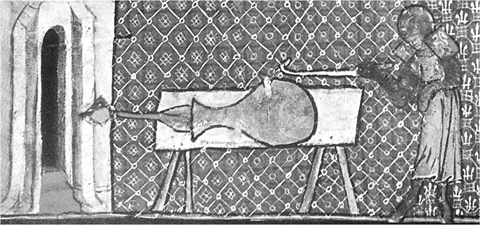
1 Walter de Milemete’s treatise on kingship, De nobilitatibus, sapientiis, et prudentiis regum (c. 1326), includes what is probably the first illustration of a gunpowder weapon. Crude cannons such as this would evolve into formidable siege weapons by the end of the Hundred Years War and they also began to influence the outcomes of battlefield engagements such as Castillon (1453).
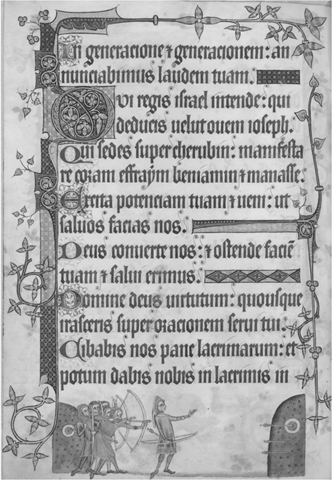
2 Commissioned by Sir Geoffrey Luttrell of Irnham, Lincolnshire, the magnificent Luttrell Psalter (c. 1330) is most famous for its extraordinary grotesques and babewyns but it also contains fascinating images of everyday life. Here, the increasing significance of archery can be seen. Tactically and numerically, archers became the most significant soldiers recruited for English armies in the Hundred Years War and they made a vital contribution to the victories at Crécy, Poitiers, and Agincourt. Such was its importance that in 1363 archery practice became compulsory.
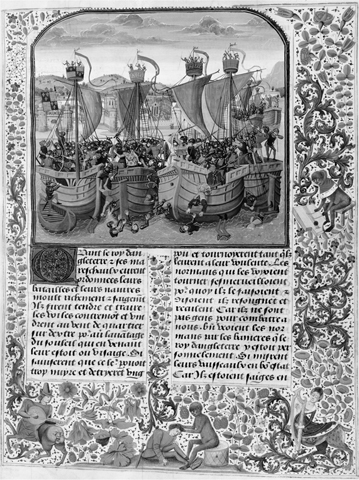
3 Victory at the battle of Sluys (1340) was all Edward III had to show for the enormous political and financial capital he expended in his first campaign to France. Fought using tactics developed for land battles, English archers were crucial in this engagement.

4 On 6 June 1329, Edward III gave homage to Philippe VI at Amiens for Gascony and Ponthieu. This image from the Grandes Chroniques suggests a deeply formal ceremony took place in which the young English king offered liege homage for his ancestral lands in France. Other accounts of the event, such as that recorded by Jean Froissart, differ and indicate that he paid only simple homage and, consequently, the relationship between Valois and Plantagenet was not so binding.

5 The victory at Crécy (1346) completely rehabilitated England’s military reputation, which had been so damaged by the defeat to the Scots at Bannockburn (1314). In this encounter, Edward III and his commanders employed tactics which had been tried and tested in earlier engagements in Scotland and France to defeat the French cavalry and Genoese crossbowmen.
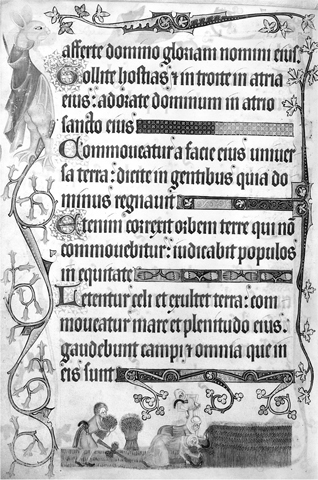
6 The Luttrell Psalter (c. 1330) includes a series of images that show the major events of the agricultural year. During the Hundred Years War, disruptions to farming took place in England along the south coast and the northern border because of French and Scottish raiding. However, this was nothing compared to the devastation visited upon the French peasantry in the course of successive English chevauchées. The somewhat idealised relationship between lords and vassals depicted in the psalter was also disturbed by repeated visitations of the Black Death.
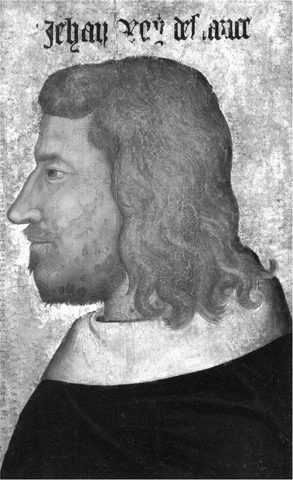
7 This profile of Jean le Bon (c. 1350) may well have been painted prior to the king’s accession in 1350, with the appellation ‘Jehan Roi de France’ added subsequently. It is the oldest extant portrait in France and may have been modelled on an imperial medal.
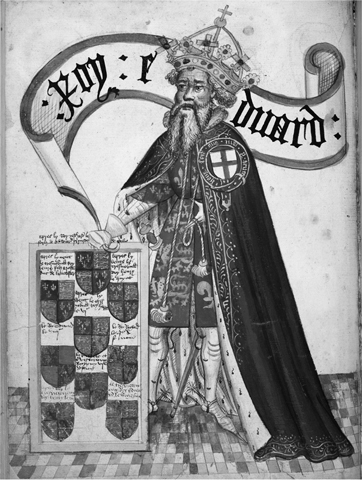
8 This fifteenth-century illustration shows Edward III as a knight of the Order of the Garter. Founded in 1348 to commemorate the Crécy-Calais campaign and to promote both the legitimacy of the king’s claim to France and unity among the military aristocracy, the Garter became the pre-eminent chivalric fraternity in England.

9 Despite the declining role of cavalry on the battlefield both Plantagenet and Valois kings recognised the continuing political importance of the chivalric ethic. As a result, monarchical military Orders and Companies were founded on both sides of the Channel during the Hundred Years War. Jean II established the Company of Our Lady of the Noble House, more commonly known as the Company of the Star, in 1350. This proved to be a short-lived enterprise, however, and many of the founder members of the Company died or were captured at the battle of Poitiers (1356).
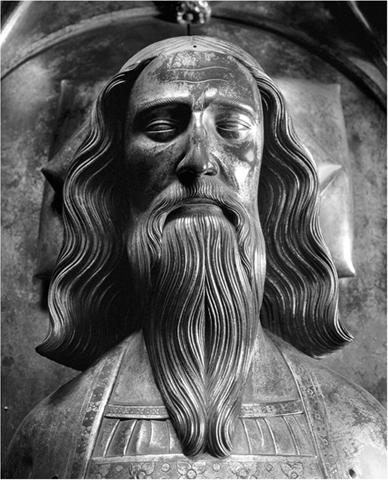
10 Edward III (1327–77), tomb effigy, Westminster Abbey. Although the English position in France had been in decline since the war reopened in 1369, that decline seemed terminal when Edward III died in 1377 after fifty years on the English throne. The Hundred Years War saw both coronations and royal funerals involve increasing religious intricacy and political symbolism.
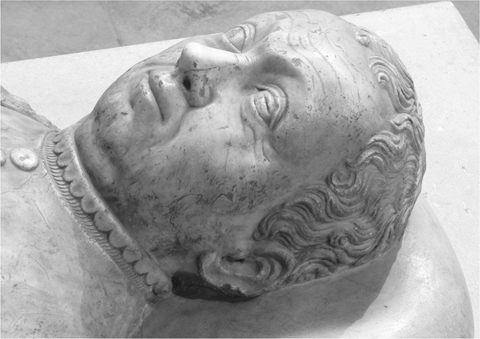
11 Bertrand du Guesclin (d. 1380), tomb effigy, Abbey of Saint-Denis, Paris. Du Guesclin’s reputation was based on military service in royal and mercenary ranks. After numerous campaigns he became constable of France in 1370 and was largely responsible for the recapture of those territories lost by the Valois in the treaty of Brétigny (1360). The low-born Breton knight was eventually buried alongside the kings of France in the abbey of Saint-Denis.
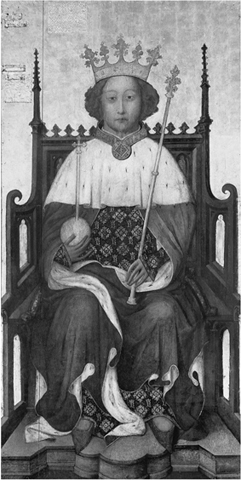
12 Richard II (1377–99), Westminster Portrait. Richard II’s reign saw the continuing deterioration of the English position in France, which had begun when the Hundred Years War reopened in 1369. After dealing with the vicissitudes of the Peasants’ Revolt (1381), Richard sought to expand his authority within the British Isles while also trying to achieve an accord with Charles VI. This brought him into conflict with his own nobles, which eventually led to his deposition in 1399.
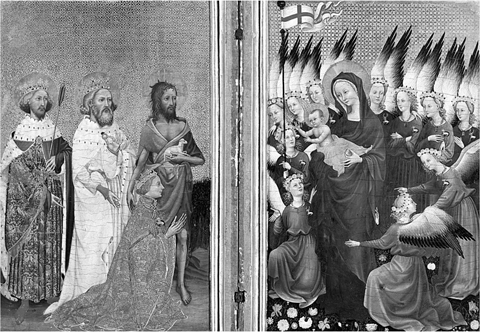
13 Richard II’s conception of his royal status evolved over the course of his reign. In the Wilton Diptych (c. 1396) he is shown in almost messianic fashion being presented to the Virgin, Christ Child, and the heavenly host by John the Baptist, Edward the Confessor, and St Edmund. The angels are shown as members of the king’s household, wearing his personal device, the white hart, and one carries the banner of St George (England).
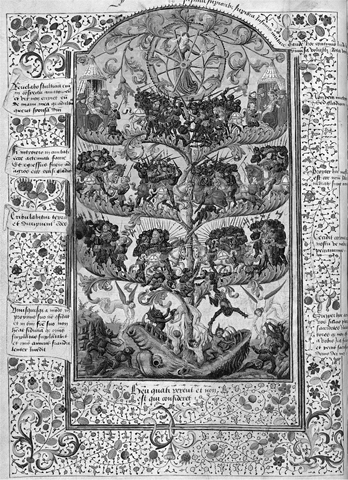
14 Honoré Bonet’s Tree of Battles (c. 1390) was an extremely influential guide to military conduct heavily based on John of Legnano’s Tractatus de Bello. Bonet lauded traditional military virtues but also decried the terrible consequences of war for the French peasantry. This image from a frontispiece to his work also indicates the importance of fortune (Blind Lady Fortuna and her wheel) and the terrible spiritual implications of the misuse of military strength (the hell mouth).
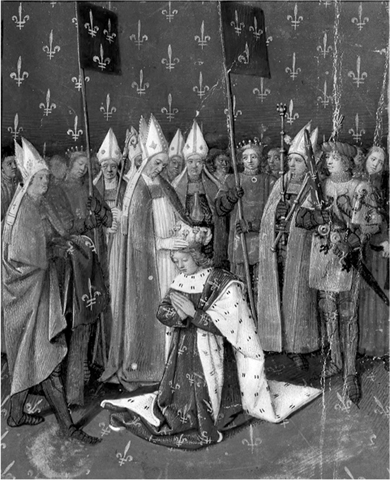
15 The coronation of Charles VI in 1380 marked the beginning of a long period of domestic strife in France. The young king’s uncles struggled for control during his minority and, later, his madness. Of enormous symbolic and political importance, the coronation of French monarchs was said to invest those who received the holy oil with sacral powers including the ability to heal the skin disease, scrofula – ‘the king’s evil’.
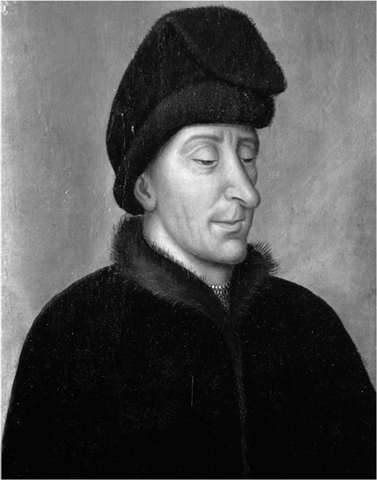
16 Jean the Fearless, duke of Burgundy (1404–19) stood at the centre of the Armagnac-Burgundian civil war which ravaged France in the latter stages of Charles VI’s reign. Jean orchestrated the assassination of Louis d’Orléans in 1407 and was himself murdered by soldiers loyal to the dauphin in 1419.
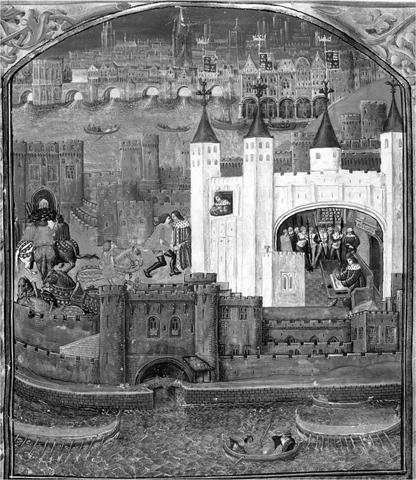
17 Fortunate to escape the slaughter at the battle of Agincourt (1415), Charles, duke of Orléans, spent the next twenty-five years in captivity as a political prisoner in the Tower of London. During this extended period he honed his very considerable literary talent and wrote acclaimed works of poetry in French and English.
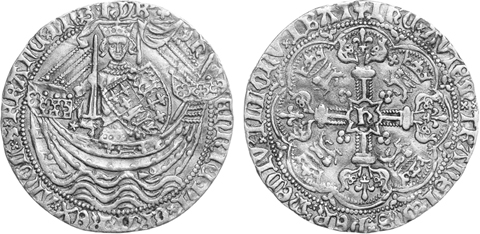
18 A gold noble from the reign of Henry V. On the obverse the king is shown crowned, wearing armour and holding a sword and a shield quartered with the arms of England and France. He is standing in a ship which may signify English naval power or may be a reference to his command of the ‘ship of state’.
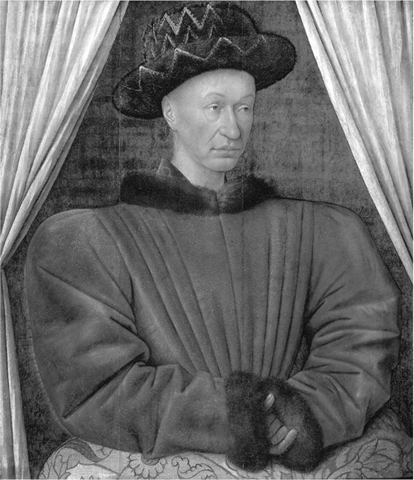
19 Disinherited by the terms of the treaty of Troyes (1420), Charles VII, ‘the Victorious’, eventually re-established Valois power in France. First, with the aid of Joan of Arc, he stemmed the English advance, and then through political skill and the establishment of a professional army he oversaw the recapture of Paris, the reconquest of Normandy, and the final defeat of the English at Castillon (1453).
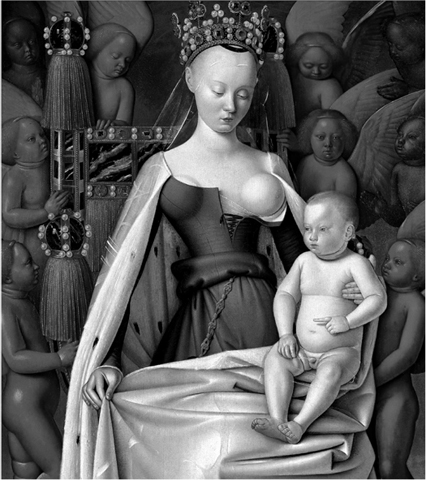
20 Shown here as the Virgin in Jean Fouquet’s extraordinary Melun Diptych (c. 1452), Agnès Sorel rose to cultural and political prominence as mistress to Charles VII. After bearing him three daughters she died in mysterious circumstances and may have been poisoned on the orders of Jacques Coeur, the king’s finance minister.
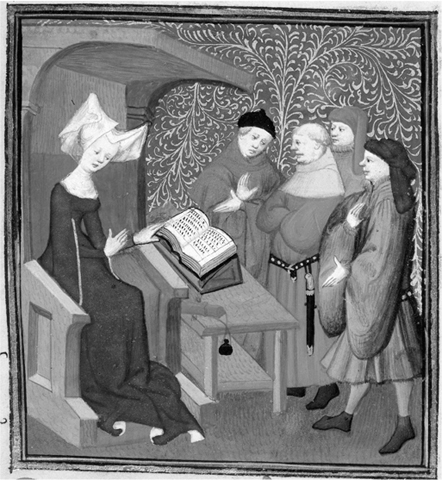
21 One of the most important authors in the later middle ages, Christine de Pizan wrote a wide range of works for various members of the French court. Her interests were extensive and included books on the roles of women in society, matters of high politics, and even a military guide.
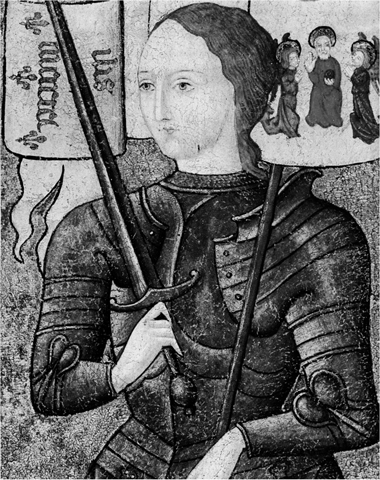
22 Joan of Arc’s remarkable career was short-lived. Convinced she had received divine inspiration, she revitalized the faltering Valois military effort by relieving the siege of Orléans in 1429 and led the campaign to Reims which concluded with the coronation of Charles VII. Burgundian forces captured her in 1430 and sold her to the English who handed her over to Church authorities for trial as a heretic. After an extensive trial and brief recantation she was found guilty and executed in Rouen in 1431. No contemporary portraits of Joan exist. This artist’s interpretation from c. 1485 was painted after her Rehabilitation trial (1455–56).
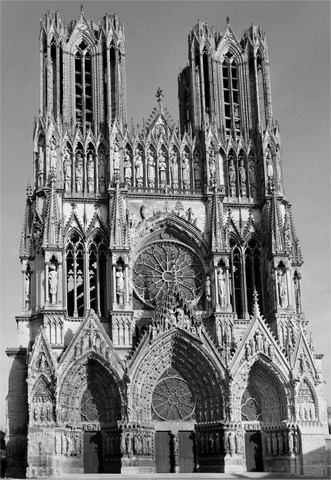
23 As the coronation site of French monarchs Reims Cathedral played a major role politically and symbolically in the Hundred Years War. It was the target of major military campaigns in 1359–60 (led by Edward III) and 1429 (led by Joan of Arc).