
7
If the years down to 1063 had been ones of glorious achievement for Harold Godwineson, the same was equally true for William of Normandy.
The duke’s victory at Varaville in 1057 had not ended his war with Henry I of France and Geoffrey Martel of Anjou: the following year he pressed home his advantage against the French king, recovering the castle of Tillières that had been lost during his minority and seizing Henry’s own castle of Thimert; his struggle against Anjou, meanwhile, ground on inexorably with no advertised losses or gains. But 1060 proved to be a providential year – for William, that is. On 4 August Henry downed some medicine, disregarded his doctor’s orders not to drink any water, and died before the day was out.1 Around the same time Geoffrey Martel also fell ill, ‘seized by an incurable sickness that grew worse daily’, according to an Angevin chronicler. He died on 14 November, in great pain, surrounded by his men.2
The near-simultaneous death of his two principal antagonists must have come as a great relief to William, for it meant that the longstanding threat of invasion was lifted. Henry I had been married three times, but only his last queen had given him any children, and in August 1060 his eldest son, Philip, was only eight years old. Power in France passed to a regency council, headed by the widowed queen and Henry’s brother-in-law, Baldwin of Flanders – who also happened, of course, to be William’s father-in-law.3Matters in Anjou fell out even more favourably for the Norman duke, since Geoffrey Martel, despite no fewer than four marriages, had managed to produce no children at all. The succession went to his sister’s son, Geoffrey the Bearded, whose rule was contested from the first by his younger brother, Fulk. Their struggle, which lasted for several years, effectively ended Anjou’s ability to compete with Normandy.
This was particularly evident in regard to the intermediate county of Maine. After his takeover of 1051, Geoffrey Martel had ruled Maine in the name of its rightful heir, Count Herbert II. According to William of Poitiers, at some point thereafter Herbert had escaped to Normandy in search of protection, in return for which he had provisionally made William his heir. Historians have been understandably sceptical of this story, which obviously contains strong echoes of the Norman claim to England. There is no reason why duplication by itself should automatically arouse suspicion: one could well argue that the similarity shows simply that this was the kind of arrangement that William favoured. Yet Poitiers’ very insistence that he is telling the absolute truth, coupled with his vagueness on points of detail, do on this occasion raise serious doubts. Certainly, the Norman claim did not go uncontested in Maine itself. When Herbert died on 9 March 1062, having failed to beget any children of his own, the pro-Angevin party in Le Mans offered the succession to his uncle, Walter, and made ready to resist.4
But resistance was useless. Shortly afterwards William launched a relentless campaign of harrying on the countryside around Le Mans, ‘To sow fear in its homes by frequent and lengthy visits,’ as William of Poitiers unashamedly explains, ‘to devastate its vineyards, fields and villages; to capture its outlying castles, to place garrisons wherever necessary, and thus everywhere and incessantly to inflict damage.’ Walter and his supporters appealed for aid to their existing overlord, but despite making threatening noises the new count of Anjou failed to appear. And so, at length, the defenders decided to submit to William, and the gates of Le Mans were thrown open to admit him. Both Walter and his wife died soon after the city’s fall, fuelling the rumour, first reported in the twelfth century, that they had been poisoned on the duke’s orders. It remained only to capture the castle of Mayenne, a virtually impregnable stronghold to the south of Domfront whose lord had long been opposed to William’s ambitions. The garrison there eventually surrendered after the Norman army succeeded in hurling fire at the castle and setting it alight.5
Thus, by 1063, William was in a triumphant position. Like Harold Godwineson, he had witnessed the fortuitous deaths of his enemies and mounted a successful conquest of a neighbouring province. Nothing reflects this triumph today so well as the town of Caen, which was developed on the duke’s orders during this same period. Caen had hitherto been a settlement of virtually no significance – indeed, it only enters the written record around the time of William’s birth. But from the late 1050s the town was transformed out of all recognition, becoming the second greatest urban centre in Normandy after the capital at Rouen. The duke probably settled on Caen because of its proximity to the site of his providential victory at Val-ès-Dunes, which made it an ideal place to emphasize the God-given nature of his authority. But the location also boasted certain natural advantages, not least the rocky outcrop on which the duke established a castle. Sadly, although the outline of this extensive fortress-palace can be traced today, none of its original stone fabric has survived. The same is not true, however, in the case of the two abbeys that were founded by William and Matilda, probably in return for the pope’s decision to lift the ban on their marriage. Her foundation was a house of nuns, begun around 1059 and dedicated to the Holy Trinity; his was a community of monks, started around 1063 and dedicated to St Stephen (St Etienne). Both, of course, were built in the Romanesque style, but William’s church, despite being only slightly later, was far more sophisticated, its innovative design becoming a model for much that was to follow. Happily it was only little altered in later centuries and escaped the worst destruction of the Second World War, so its splendour can still be appreciated. After a great deal of insistent arm-twisting (‘by a kind of pious violence’, as William of Poitiers puts it) the duke persuaded his chief spiritual adviser, Lanfranc, to become its first abbot.6
Not long after the founding of St Stephen’s, William received the exciting news that Harold Godwineson had landed on the north French coast.
Harold’s Continental adventure is one of the most celebrated episodes in the story of the Norman Conquest, largely because it is the subject of the opening section of the Bayeux Tapestry. It is also one of the most controversial, for in spite of its extensive treatment in the Tapestry and also in chronicles written in Normandy, it goes entirely undiscussed in contemporary English sources such as the Anglo-Saxon Chronicle and the Life of King Edward. As a result, the episode is difficult to date. Most historians are inclined to place it in the early summer of 1064, though it is just possible that it occurred at the same point in 1065. Fortunately, whichever of the two dates it was makes no difference to the story’s significance.7
There is no doubt that it is a true story, for all versions, both contemporary Norman and later English, agree in broad outline about what happened. The Bayeux Tapestry provides the most detailed prologue, beginning, as we’ve seen, with Edward the Confessor. The king, white-haired, bearded and elderly, is shown in animated conversation with two men, one of whom we take to be Harold. The earl – now explicitly identified in a caption – then rides to his manor of Bosham in Sussex, accompanied by his mounted retainers and a pack of hounds, and carrying a hawk on his wrist. Once at Bosham they say a prudent prayer in the church (which still stands), and have a meal in the manor house, before setting out to sea. The Tapestry shows them hitching up their tunics as they wade out into the waves to climb aboard their ships.
While crossing the Channel, however, Harold and his men sail into a storm and only narrowly avoid being shipwrecked – a fact implied by the Tapestry and stated explicitly in all the chronicle accounts. Providentially they escape a watery grave, but end up putting to shore in Ponthieu, one of several small counties sandwiched between Normandy and Flanders. This is clearly not their intended destination: the Tapestry shows Harold being seized as soon as he disembarks by Ponthieu’s ruler, Count Guy, and taken to be imprisoned at the castle of Beaurain. According to William of Poitiers, such brigandage was common practice in Ponthieu, and the count was planning to detain Harold and his companions until he obtained a large ransom.8
The scene then shifts to Normandy, where somehow news of Harold’s arrival has reached the ears of Duke William. Possibly Harold himself managed to send the duke a message: the Tapestry, in a section that seems somewhat confused, shows a messenger whose moustache suggests he is an Englishman; in a later chronicle version, the earl gets word out by bribing one of his guards. However it came to pass, once William was aware of Harold’s predicament he immediately sent messengers to Ponthieu to demand his release. William of Jumièges states that Count Guy was put under pressure, which seems entirely credible: the count had been captured at the Battle of Mortemer in 1054, and freed only after swearing fealty to the Norman duke. William of Poitiers, who evidently had a copy of Jumièges’ chronicle in front of him, insists that Guy co-operated willingly, in return for which he received gifts of land and money. Bullied or bribed, the count brought Harold to the Norman border at Eu and handed him over to William, who escorted the earl and his men to the comforts of his palace at Rouen.9
During Harold’s stay in Normandy, which by all accounts lasted some time, two significant things happened. Firstly, William fought a short and not particularly successful campaign in Brittany, described in detail by William of Poitiers and depicted at length on the Bayeux Tapestry. Harold accompanied his host on this mission, and the Tapestry shows him heroically rescuing some of William’s men from the quicksands near Mont St Michel. Secondly, and more importantly, Harold at some point swore an oath to uphold the duke’s claim to the English throne. According to William of Poitiers this happened at a specially convened council in the town of Bonneville-sur-Touques.10 The Tapestry shows the earl touching holy relics as the oath is sworn.11
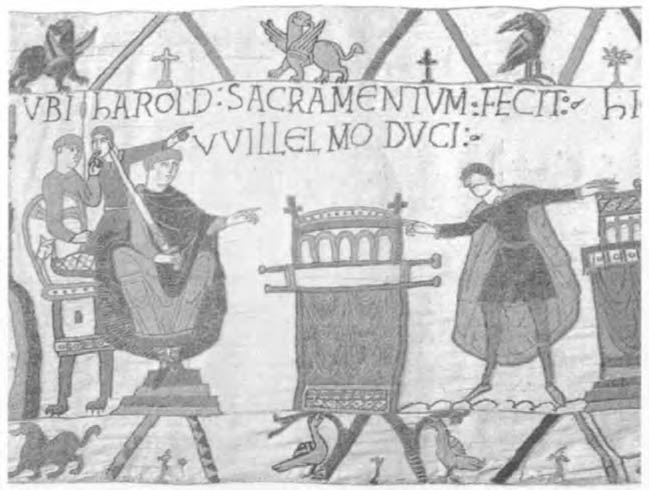
Such is the story of Harold’s visit as told by our various sources. Although they differ over certain small details – where Harold swore his oath, for instance, or whether he swore it before or after the Brittany campaign – both the chroniclers and the Tapestry agree that this was how it happened.12 Where they disagree totally, however, is why it happened.
According to Norman writers, the swearing of the oath had been the whole point of the exercise: Harold crossed the Channel because he had been sent by Edward the Confessor to confirm William’s claim to the English throne. William of Jumièges, for instance, says that:
Edward, king of the English, by the will of God having no heir, had in the past sent Robert, the archbishop of Canterbury, to appoint him heir to the kingdom given to him by God. But he also, at a later date, sent to him Harold, the greatest of all the earls in his realm in wealth, honour and power, that he should swear fealty to the duke concerning his crown and, according to Christian tradition, pledge it with oaths.13
William of Poitiers, who follows Jumièges’ account, naturally endorses this statement, to the extent that he even copies bits of it word for word: Harold had been sent to protect William’s position as Edward’s heir. And so too do all later Norman chroniclers. ‘The truth was’, said Orderic Vitalis in the 1120s, ‘that Edward had declared his intention of transmitting the whole kingdom to his kinsman, Duke William of Normandy, and had with the consent of the English made him heir to all his rights.’14
But the English themselves begged to differ. At the time, it is true, they seem to have preferred to stand on their silence. The Anglo-Saxon Chronicle carries no entries for the year 1064, and begins its discussion of 1065 with events that took place in August. TheLife of King Edward also fails to make any reference to Harold’s trip explicitly, although its author does make two comments which might be taken to allude to it. Later generations, however, were not so tight-lipped, and set out to deny the Norman claim directly. According to William of Malmesbury, for example, some Englishmen in the early twelfth century maintained that the earl had never intended to visit the Continent at all, but had been accidentally blown across the Channel having set out on a fishing trip.15
An altogether more credible alternative is offered by an early twelfth-century monk of Canterbury named Eadmer. According to Eadmer, Harold had set out for Normandy, but had done so on his own initiative, his purpose being to obtain the release of two relatives who were being held hostage at William’s court. Here we are on much firmer ground, because this was indeed the case – even William of Poitiers admits to the hostages’ existence. At some point during the crisis of 1051―2, the Godwines had handed over two of their number to Edward the Confessor: Eadmer names them as Wulfnoth, who was one of Harold’s younger brothers, and Hakon, a son of Harold’s older brother, the unlamented Earl Swein. Most likely they were surrendered in September 1051, when the family’s power was collapsing and Swein was still an active participant in the drama. At some point in the year that followed they were evidently transferred to Normandy, the likeliest scenario being that they were taken back by William himself after his visit to England.16
Which, then, is more credible: Harold being sent to Normandy to confirm Edward’s earlier promise, or the earl embarking on a mission of his own, trying to secure the liberation of his long-detained kinsmen? Do we prefer the testimony of William of Poitiers or that of Eadmer? Taken on their own merits there is little to help us decide between the two authors. William of Poitiers is more closely contemporary and provides a very detailed account of Harold’s visit. He is seemingly well informed about the oath-taking ceremony, supplying not only its likeliest location but also the terms of the promises that the earl allegedly made. According to Poitiers, Harold swore firstly that he would act as William’s advocate at Edward’s court and, secondly, that when the king died he would use his wealth and influence to ensure the duke’s succession. Thirdly, says Poitiers, the earl pledged to strengthen and garrison Dover Castle at his own expense for William’s use and, fourthly, that he would similarly fortify and provision various other places in England as the duke directed.17
But then Eadmer, despite the fact he wrote a generation later, is also an apparently well-informed witness. He alone supplies us with the names of the two Godwine hostages, and contributes other convincing details (he knows, for example, the name of the estuary in Ponthieu where Harold made his landing). Eadmer, too, offers a detailed description of the earl’s oath, mentioning both the pledge of personal support for William’s claim and the fortification of Dover, and contributing the additional suggestion that the agreement was to be sealed by a marriage alliance, by which Harold’s sister would marry a leading Norman magnate and the earl himself would wed one of the duke’s daughters.18
At the same time, both Poitiers and Eadmer are evidently giving us biased accounts. Poitiers very obviously wants to do all he can to strengthen the Norman claim. Harold, he insists, swore his oath ‘clearly and of his own free will’, ‘as the most truthful and distinguished men who were there as witnesses have told’. Such emphatic assurances from the pen of this particular chronicler immediately make us suspicious, and incline us to listen to Eadmer, who says that Harold realized that he was in a dangerous predicament, and effectively made his promises under duress: ‘He could not see any way of escape without agreeing to all that William wished.’19
Eadmer, however, is an equally partisan informant. Like most Englishmen who lived through the experience, he regarded the Conquest as a terrible tragedy, and was as anxious to deny the Norman claim as Poitiers was to defend it.20 In setting out his version of events he strains to avoid any mention of Edward’s promise of 1051. Thus the cause of the king’s quarrel with the Godwines that year goes unexplained, and the hostages are improbably handed over in 1052 once the Godwines are back in power. The effect of these suppressions and alterations is to absolve Harold of any blame. In Eadmer’s account, the first the earl hears of the Norman claim to the English throne is after his arrival in Normandy, when William reveals that Edward promised him the succession during his exile.
All things being equal, it would be impossible to decide between two such manipulative writers. But when we consider their accounts in light of the wider context, it becomes obvious that we ought to reject Poitiers’ explanation and accept that of Eadmer. Put simply, Eadmer’s version of events accords far more convincingly with what we know about the political reality in England. By 1064, Harold and his brothers reigned supreme, whereas the authority of Edward the Confessor had been eroded to virtually nothing. It stretches credibility beyond its elastic limit to believe that the king, aged and powerless as he was, could have commanded the earl to do anything detrimental to his own interests, let alone to help resuscitate a scheme for the succession to which he and his family had always been vehemently opposed.21
By contrast, it seems perfectly reasonable to suppose that Harold, at the very height of his powers, would have been acutely embarrassed by the continued detention of two of his close relatives, and at the same time optimistic that he could use his influence to secure their release. Since they were being held to guarantee Edward’s promise of 1051, the earl must have anticipated he would have to discuss the Norman claim, but must have felt confident that he could persuade William to drop it, either by tricking him or by paying him off. This is strongly implied in Eadmer’s account, when Harold informs Edward that he intends to get the hostages back. ‘I know that the duke is not so simple as to give them up to you,’ cautions the king, ‘unless he foresees some great advantage to himself.’ But the earl disregards this advice and goes to Normandy anyway, taking with him a large amount of gold, silver and costly goods.22
There is one final piece of evidence which might be taken to support Eadmer’s story, and that is the Bayeux Tapestry. The Tapestry is undoubtedly our most interesting source for the Norman Conquest, and also one of the most difficult to interpret. For the most part it appears to be a piece of Norman triumphalism, but the fact that it was created by English embroiderers seems to have affected its telling of the story. At critical moments where it could give us a decisive opinion on the Norman claim, the Tapestry is carefully ambiguous. To say this much is not to argue that it contains some hidden English code; simply that, as a piece of public art created very soon after the Conquest, the Tapestry seems to be trying deliberately to steer clear of controversy. In the opening scene, for example, we see Edward the Confessor talking to a figure whom we take to be Harold, but we are told nothing about the topic of their conversation. Norman observers would assume the king was ordering the earl to confirm William’s succession. English observers could imagine that the discussion concerned Harold’s plan to recover the hostages.
When it comes to depict the earl’s return, however, the Tapestry seems rather less ambiguous. Both Eadmer and William of Poitiers tell us that Harold recrossed the Channel accompanied by his nephew, Hakon; his brother Wulfnoth remained in Norman custody. Had his objective been to free both hostages, therefore, his trip had been only a partial success. If, on the other hand, he had been charged with confirming William’s position as Edward’s heir, then the mission had been accomplished. Indeed, he ought to have been given a jubilant reception.23
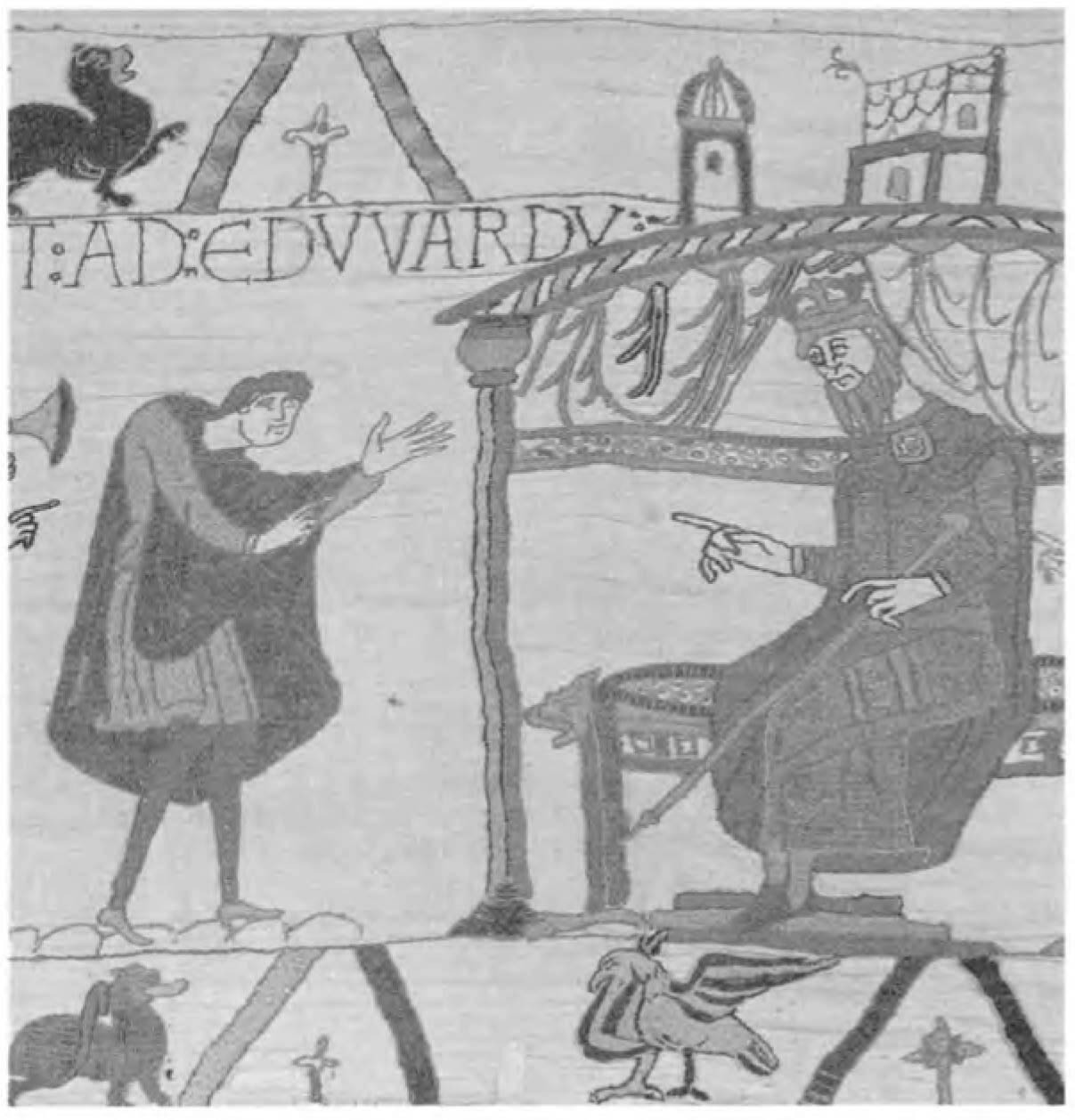
Yet the Tapestry appears to show a different scene. ‘Here Harold returns to England and comes to King Edward’, says the caption, blankly, but the picture below shows the earl advancing towards the king with his head visibly bowed and his arms outstretched – a posture that looks very much like an act of supplication or apology. Edward himself, moreover, is no longer the genial figure he seemed at the start, but larger, sterner, and raising his index finger as if to admonish.
‘Seems’;‘looks very much like’;‘appears’;‘as if. This is of course a speculative reading of a single scene, which some historians would argue is as ambiguous as any other.24 But Eadmer, who belonged to the same Canterbury tradition as the Tapestry’s designer, was in no doubt about the nature of Harold’s reception when he explained to the king what had happened. ‘Did I not tell you that I knew William,’ exclaims an exasperated Edward, ‘and that your going might bring untold calamity upon this kingdom?’25