
9
How and why did Harold Godwineson come to succeed Edward the Confessor? What of the candidacy of Edgar Ætheling, son of Edward the Exile, whose claim by birth was manifestly superior? Had Harold long intended to wear his brother-in-law’s crown, or did he accept it only at the last minute, in deference to the king’s dying wishes? Was his accession a legitimate act or a usurpation? Was he spurred by ambition or rather a sense of duty? As ever, this pivotal moment in the history of the Norman Conquest raises many questions for which there can be no definitive answers.
Part of the difficulty, of course, is that in eleventh-century England there was no hard-and-fast set of rules governing the succession. At the start of the century the trend may have been in the direction of a hereditary principle, but that particular apple cart had been upset by the return of the Vikings, who had characteristically re-emphasized the importance of violence and opportunism. Cnut’s grip on England, observed William of Poitiers, ‘owed only to conquest by his father and himself and nothing else’.1
So what else was there? In the succession debate that followed Cnut’s death we can discern three key factors. First, although there was no strict line of precedence, a close blood link with the previous king was still highly desirable – hence the unsubtle attempt to smear Harold Harefoot by suggesting that he was not really a son of Cnut at all but a low-born changeling. Second, it was also evidently considered beneficial for a prospective king to have been in some way designated as such by his predecessor. Thus theEncomium Emmae Reginae insists that Cnut had given Harthacnut everything under his control ‘while he was still living’, and maintains that Harthacnut had in turn invited Edward the Confessor to come to England in 1041 in order to hold the kingdom with him.2
The most important factor, however, in deciding who should be king was clearly election – not in the wide sense in which we use the term today, but in the sense of obtaining the approval of the majority of the kingdom’s leading men. Harold Harefoot had plainly succeeded in 1035 because he was backed by just such a majority; Harthacnut, as the Anglo-Saxon Chronicle makes clear, had accepted the crown in 1040 at the invitation of a body of magnates. And Edward the Confessor, although he could claim descent from the ancient royal line and perhaps designation by his predecessor as well, ultimately owed his throne to the collective will of the English aristocracy, and in particular Earl Godwine.3
How, then, did Godwine’s eldest surviving son manage to obtain the throne in January 1066? Clearly, in hereditary terms Harold’s case was extremely weak. The earl was related to Edward the Confessor, but only by virtue of his sister’s marriage. His claim therefore had to rest heavily on nomination by his predecessor and election by the magnates – which, according to some sources, is precisely what happened. ‘Earl Harold’, says the E version of the Anglo-Saxon Chronicle, ‘succeeded to the kingdom of England just as the king had granted it to him, and also men chose him for it.’ Similarly, John of Worcester, writing several decades later, says that Harold, ‘whom the king had chosen before his demise as successor to the kingdom, was elected by all the principal men of England to the dignity of the kingship’.4
But both John of Worcester and the E Chronicle are written with a strong pro-Godwine bias; other sources are not nearly so sure about the legitimacy of Harold’s elevation. Was he, for instance, really nominated by his predecessor? As it happens we have a very full account of the Confessor’s last hours in the Life of King Edward. The old king, we are told, had been in bed for days, slipping in and out of consciousness and rarely saying anything intelligible. Of the small number of people who were with him, the author of the Life names just four: ‘the queen, who was sitting on the floor warming his feet in her lap; her brother, Earl Harold; Robert, the steward of the palace, and Archbishop Stigand’.5
We can picture this scene more fully because it appears on the Bayeux Tapestry (which, moving seamlessly from Harold’s return from Normandy, resumes its story at this point). Having shown us the Confessor’s corpse being carried for burial in Westminster Abbey, it returns, as if in flashback, to the king’s deathbed. The scene is so similar to that described in the Life that one source (probably the Tapestry) must have been inspired by the other. We see Edward, lying in bed, surrounded by four figures. A servant (perhaps Robert the Steward) props him up, while a weeping woman (presumably Queen Edith) sits at his feet. On the far side of the bed stands a tonsured cleric, whom we take to be Archbishop Stigand, while on the near side a fourth figure, who must be Harold, kneels and touches the king’s outstretched hand with his own. ‘Here King Edward, in bed, speaks to his faithful servants’, says the caption.
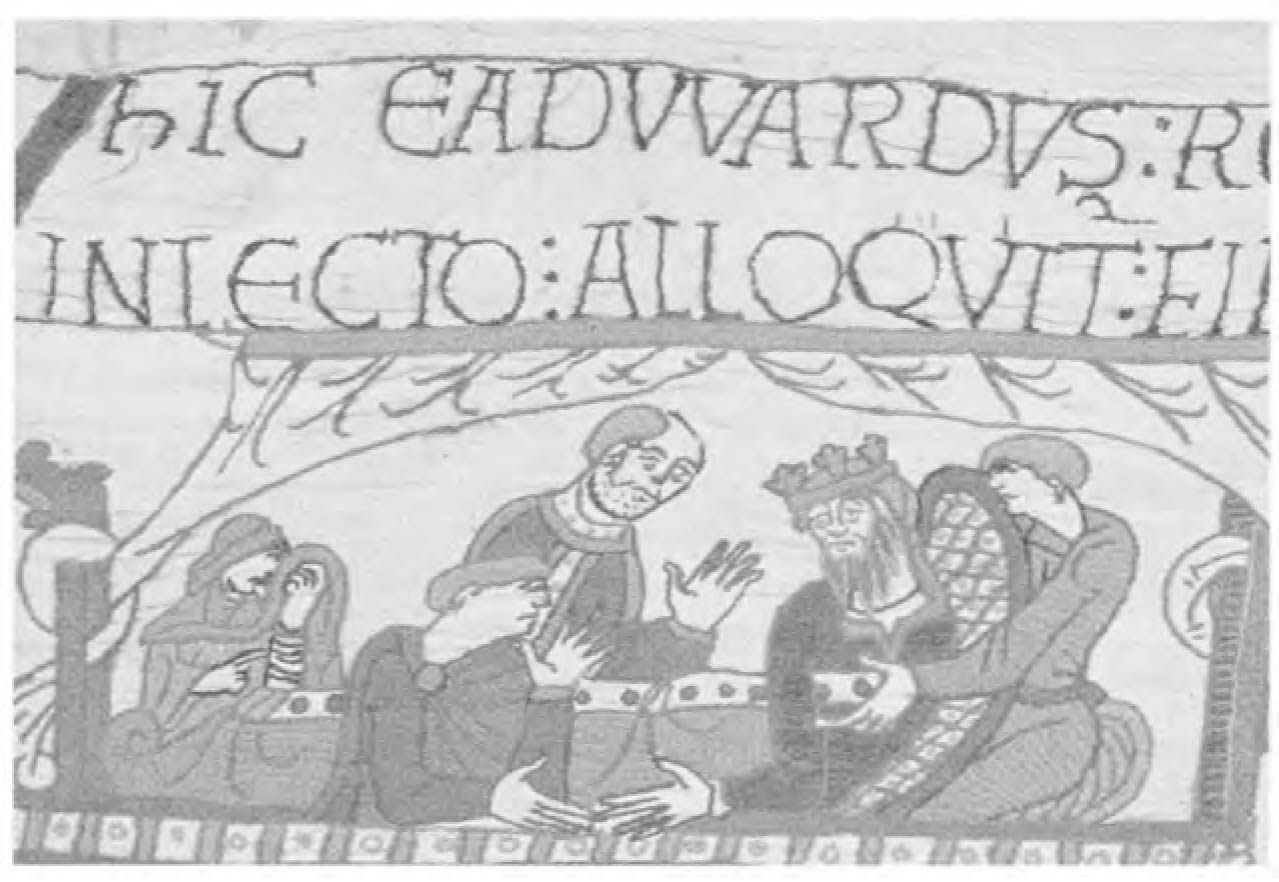
As usual the Tapestry gives us no idea what is actually being said, but the Life of King Edward purports to give us the Confessor’s last words. ‘May God be gracious to this my wife’, he says to Edith, ‘for the zealous solicitude of her service. For certainly she has served me devotedly, and has always stood by my side like a beloved daughter.’ Edward then turns to address Harold (‘stretching out his hand’, says the Life, just as depicted on the Tapestry): ‘I commend this woman and all the kingdom to your protection’, he continues. ‘Serve and honour her with faithful obedience as your lady and sister, which she is, and do not despoil her, as long as she lives, of any due honour got from me.’6
The heavy emphasis on Edith’s welfare is hardly surprising, given that the Life was written at her behest. What is surprising is how casually the subject of the kingdom is introduced. Edward seems to mention it in passing, almost as an afterthought. As a result, his words fall a long way short of providing a clear and unambiguous designation of his successor. Indeed, all the king says is that he commends the kingdom to Harold’s protection, which sounds rather more like the words one would use to nominate a regent. Of course, we don’t have to believe that these were actually Edward’s last words, any more than we have to accept the testimony of the pro-Godwine sources that insist Harold did receive his predecessor’s blessing. The Life of King Edward was completed after the Norman Conquest, and as such suffers from hindsight. Had there been an unambiguous bequest to Harold, the author and his patron, living in a post-Conquest world, may have diplomatically decided to downplay it. Nonetheless, when all allowances have been made, it remains striking that our best-informed source for the Confessor’s death is so reticent on the crucial subject of who he wanted to succeed him.7
Nor is the Life alone in using such guarded language. The E version of the Chronicle may insist that Edward ‘granted’ the kingdom to Harold, but the C and D versions say simply that the king ‘entrusted’ it to him – a significant verbal weakening which again suggests that Harold may have been empowered to take care of the kingdom only as a temporary measure. The Bayeux Tapestry might seem to offer something a little stronger, for immediately after Edward’s death it shows Harold being handed the crown by two figures, one of whom points back to the deathbed scene, as if to indicate that the one event had legitimized the other. But, once again, the Tapestry is carefully ambiguous. Harold’s supporters could interpret this scene as being the moment when the crown was bequeathed to him; his detractors, on the other hand, might see only the moment where Harold claimed the bequest had been made. Similarly, it is often argued in Harold’s favour that the Norman chronicler William of Poitiers – a very hostile source – refers to Edward’s deathbed bequest several times and, while he challenges its legitimacy, he makes no attempt to deny that it happened. This, however, proves nothing. Only a handful of people – those present by his bedside – could have actually refuted the suggestion that Edward, in his last hours, had nominated Harold. So far as we can tell, none of them did so. All we can say is, in the case of Queen Edith, she chose to describe it in a very non-committal way, and that such vagueness is also apparent in a number of other contemporary sources. Many people, it seems, harboured serious doubts about Harold’s version of events.8
What of Harold’s election? Was he, as the E Chronicle and John of Worcester maintain, chosen to be king by the English magnates, or did he, as William of Poitiers alleges, seize the throne ‘with the connivance of a few wicked men’? Certainly Harold was in a good position to put his case to a wide audience because, as we’ve seen, Edward the Confessor had died just a few days after Christmas and the dedication of Westminster Abbey, the combination of which events would have ensured there was a crowd of magnates at court. This is confirmed, more or less, by a pair of charters in favour of the abbey, given on the day of the dedication (28 December 1065), which show that during his last days Edward was indeed surrounded by the most important men in his kingdom. On the spiritual side we see no fewer than ten bishops, including both archbishops, as well as eight abbots. On the secular side, we see five earls: Harold, his brothers Gyrth and Leofwine, and also the brothers Eadwine and Morcar.9
The presence of Eadwine and Morcar – and the glaring absence of Earl Tostig – reminds us immediately of the recent rebellion. Just eight weeks earlier, the two brothers had assumed the leadership of the largest uprising in living memory, and successfully brought about Tostig’s downfall, despite the fact that he was supposedly the second most powerful man in England. Morcar was now the new earl of Northumbria, which meant that he and Eadwine (lately recognized as earl of Mercia) between them controlled almost half the kingdom. Clearly, for Harold’s bid for the throne to have been the success that it was, it must have been essential to have secured their support. Harold, of course, had led the negotiations with the rebels in October, and ultimately accepted that Morcar should replace Tostig. Were any other deals, one wonders, struck at the same moment?
Certainly a deal was struck at some point, because by early 1066 Harold was married to Eadwine’s and Morcar’s sister, Ealdgyth. This was very obviously a political match; apart from anything else, Harold already had a long-term partner, after the Danish fashion, named Edith Swan-Neck. Irritatingly, we do not know when his wedding to Ealdgyth took place, so we cannot date the alliance it embodies. She had previously been the wife of Gruffudd ap Llywelyn, the Welsh king killed in August 1063, so in theory her marriage to Harold could have occurred at any point after her first husband’s death. It is most unlikely, however, to have occurred before the rebellion of October 1065: whatever Tostig’s assertions to the contrary, it is impossible to believe that Harold had prior knowledge of the rebels’ plans, and far more plausible that the revolt itself obliged him to reach an accommodation with his brother’s opponents. The question therefore becomes whether the deal was done before or after the Confessor’s death. Given that the king’s declining health must have been evident to everyone in the final weeks of 1065, a deal during those weeks would seem the likeliest scenario. Presumably, though, it was agreed in secret. Harold could hardly have married Eadwine’s and Morcar’s sister without revealing his intentions regarding the throne – especially if, as later chroniclers contend, he had earlier agreed to marry a daughter of the duke of Normandy.10
For how long had Harold harboured such intentions? Certainly the idea of becoming king had occurred to him well before his alleged designation by the dying Confessor.11 That much is clear from the Life of King Edward, the original purpose of which was plainly to justify some sort of Godwine takeover once the Confessor was gone. What form this would have taken is uncertain: the author divides his praise fairly evenly between Harold, Tostig and his patron, Queen Edith. But since that plan, and the Life’s original purpose, was wrecked by the northern rebellion, we can safely date Harold’s ambition for power earlier than October 1065. Some historians have suggested that it was spurred by his trip to Normandy, which revealed the undiminished hopes of Duke William. Yet if anything this episode pushes the seeds of the earl’s ambition further back in time, for all our sources agree that at least part of his reason for going to Normandy was to effect the liberation of his brother and nephew – men whom William had long held hostage as a guarantee of his right to one day rule England. Harold’s desire to put his kinsmen beyond harm’s reach arguably indicates that his thoughts were already tending in the same direction.12
How Harold might have realized his ambition had the northern rebellion not happened, or been unsuccessful, is anybody’s guess. But it is far from certain that, had Tostig remained in power as earl of Northumbria at the time of Edward’s death, he would have stood in the way of his brother’s accession. The rivalry between Tostig and Harold was a consequence of the October rising, not a cause of it. Indeed, if we look back at their careers before that point, all we can see is co-operation – Tostig’s support of Harold’s conquest of Wales being the most obvious case in point. Part of the reason for the Godwine family’s success had always been their ability to stick together in both triumph and adversity. Based on past behaviour, it is more reasonable to suppose that Tostig, had he not been banished, would have supported rather than opposed his older brother’s bid for the throne.
The real obstacle to Harold’s ambition was neither Tostig nor William but Edgar Ætheling. The son of Edward the Exile, great-nephew of Edward the Confessor, Edgar was directly descended from the ancient dynasty that had ruled Wessex, and later England, since the beginning; the blood of Alfred and Athelstan, not to mention the celebrated tenth-century King Edgar, flowed in his veins. This fact, combined with the considerable efforts that had been required to secure his return from Hungary, must have led many to expect that the ætheling would in due course succeed his great-uncle. After all, his title, accorded to him in contemporary sources, indicates that he was considered worthy of ascending the throne. Moreover, according to one Continental chronicler with close connections to the English court, Harold himself had sworn to the Confessor that, when the time came, he would uphold Edgar’s cause.13 Whether this was true or not, the mere existence of this legitimate heir was singularly awkward for Harold. The saving grace was that in the autumn of 1065 Edgar was little more than a child, apparently no more than thirteen years old, and – owing to the Confessor’s political weakness – with no power base of his own.14 All Harold needed was enough of the other English magnates to agree that Edgar’s rights should be set aside, which is what he must have obtained from Eadwine and Morcar. The incentive for them, of course, was Harold’s marriage to their sister. As queen, Ealdgyth would produce children who would unite the fortunes of the two formerly rival houses, and a new royal dynasty would arise to take the place of the old.
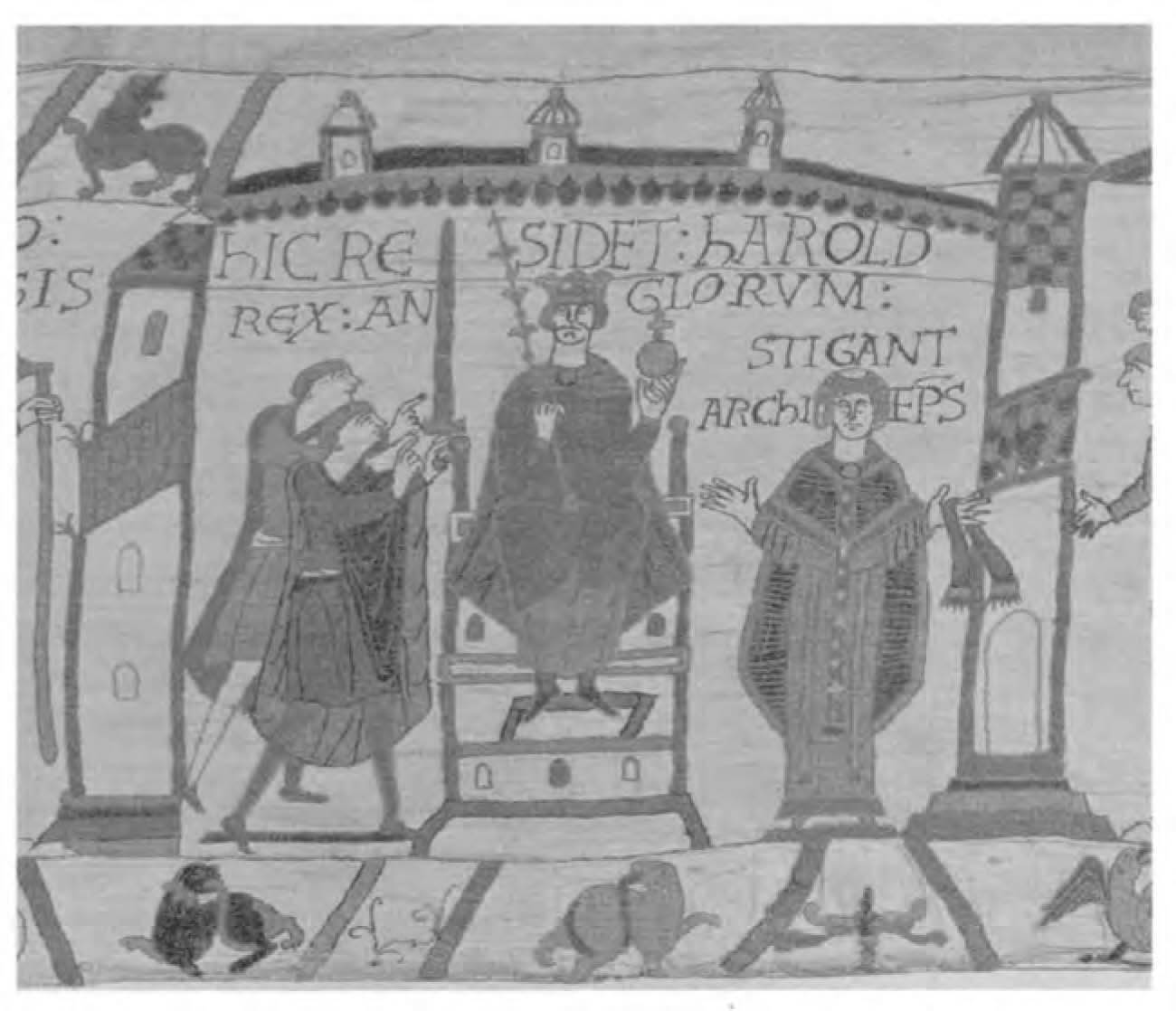
No single fact points to a conspiracy of this kind more obviously than the circumstances of Harold’s coronation, which took place on 6 January 1066, probably in Westminster Abbey. The Bayeux Tapestry shows the new king crowned and enthroned, holding his rod and sceptre, flanked on one side by two men who hand him a ceremonial sword, and on the other by the solitary figure of Archbishop Stigand. The inclusion of the excommunicate archbishop of Canterbury is almost certainly an underhand piece of Norman propaganda: it is far more likely that Harold’s consecration was performed by Ealdred, the archbishop of York, as John of Worcester later insisted was the case. What doesdamn Harold, however, is the unseemly haste with which the ceremony was arranged. The new king was crowned the day after the Confessor’s death, and on the same day as the old king’s funeral. No previous king of England had demonstrated such a desperate hurry to have himself consecrated, for the good reason that in England the coronation had never been regarded as a constitutive part of the king-making process. Normally many months would pass between the crucial process of election and a new ruler’s formal investiture. Edward the Confessor, as we have seen, had come to the throne by popular consent in the summer of 1042, but was not crowned until Easter the following year. Harold’s rush to have himself crowned within hours of his predecessor’s death was therefore quite unprecedented, and suggests that he was trying to buttress what was by any reckoning a highly dubious claim with an instant consecration. It is the most obviously suspect act in the drama.15
The last weeks of 1065, then, probably ran as follows. The king is clearly dying, and the greatest earl in the kingdom determines he will succeed him, having perhaps nurtured the hope of doing so for several years. He strikes a deal with his rivals in exchange for their support. The king dies, inevitably behind closed doors, and surrounded by only a handful of intimates, including the earl himself, his sister the queen and a partisan archbishop of Canterbury; afterwards it is given out that the old king, in his dying moments, nominated the earl as his successor. Before anyone can object – indeed, so fast that the dead king is barely in his grave – the new king is crowned, and is therefore deemed to be God’s anointed.
Not everyone was convinced. Clearly many people were surprised by Harold’s succession, not least because it required a far more legitimate candidate – Edgar Ætheling – be set aside. Half a century later, the historian William of Malmesbury wrote that Harold had seized the throne, having first exacted an oath of loyalty from the chief nobles. Malmesbury was hardly a hostile witness: in the same paragraph he praises Harold as a man of prudence and fortitude, and notes the English claim that the earl was granted the throne by Edward the Confessor. ‘But I think’, he adds, ‘that this claim rests more on goodwill than judgement, for it makes [the Confessor] pass on his inheritance to a man of whose influence he had always been suspicious.’16 More telling still is an account written in the 1090s for Baldwin, abbot of Bury St Edmunds, which described Harold’s hasty coronation as sacrilegious, and accused the earl of taking the throne ‘with cunning force’. Since Baldwin had formerly been Edward the Confessor’s physician, and was therefore very likely present at his death, this testimony ought to be accorded considerable weight. It is also possible that there was opposition in the north of England at the unexpected enthronement of the earl of Wessex. We know that soon after his coronation Harold travelled to York, a destination far beyond the usual ambit of English kings. Perhaps the occasion was his marriage to Ealdgyth, planned secretly in advance and now publicly celebrated. Alternatively, Harold may have had to go there in order to quell opposition to his rule. William of Malmesbury says as much, and has it that the people of Northumbria initially refused to accept Harold as their king. Unfortunately, elements of his story suggest that he may have confused these events with the northern rebellion of the previous year. Nevertheless, the likeliest reason for Harold’s trip to York was some sort of unrest. As the C version of the Anglo-Saxon Chronicle ruefully observed, there was little quiet in England while Harold wore the crown.17
Sadly we have few good contemporary sources for the immediate reaction in Normandy to the news of Harold’s accession. The chronicler Wace, writing a century later, says that William was near Rouen, preparing to go hunting with his knights and squires, when a messenger arrived from England. The duke heard the message privately, and then returned to his hall in the city in anger, speaking to no one.18
Whatever the merits of this scene, we can surmise certain things. Edward the Confessor’s final illness had been quite long-drawn-out, and so William must have known in the closing weeks of 1065 that the English throne was about to fall vacant. This has led some historians to wonder why he did not cross the Channel earlier, perhaps in time for Christmas, in order to push his candidacy when the moment arrived. In reality, though, this was not an option. If William had come in anticipation, however large an escort he might have been allowed to bring, he would still have been a stranger in a strange land, ill-placed to resist any parties that opposed his accession, and, moreover, vulnerable to the sort of deadly intrigues that went on at the English court. The only realistic option for William was to do precisely as he did: remain in Normandy and await an invitation to come and be crowned, as had previously happened in the case of Harthacnut and Edward the Confessor. More to the point, he already had someone who was supposed to be representing his interests in England, namely Harold Godwineson. During his trip to Normandy, says William of Poitiers, Harold had promised William ‘that he would strive to the utmost with his counsel and with his wealth to ensure that the English monarchy should be pledged to him after Edward’s death’. The news that Harold had made himself king was thus regarded by William as a betrayal, a violation of the fealty and the other sacred oaths he had previously sworn. According to William of Jumièges, the duke’s immediate response was to send messengers to England urging Harold to renounce the throne and keep his pledges. Harold, unsurprisingly, chose to ignore these admonitions.19
From an early stage, therefore, it must have been clear that if William was going to obtain the English throne, he would have to mount an invasion of England – ‘to claim his inheritance through force of arms’, as William of Poitiers put it. Needless to say, this was an incredibly risky proposition, quite unlike the cautious kind of warfare that he had practised to such advantage during the previous two decades. Its only real parallel – in terms of risk rather than scale – is the battle he chose to fight at the start of his career, at Val-ès-Dunes, when threatened with extinction by his domestic enemies. From this we can reasonably conclude that Norman writers who emphasize the justice of William’s cause – in particular his chaplain, William of Poitiers – accurately reflected the attitude of the duke himself. By choosing to embark upon a strategy of direct confrontation, William was effectively submitting that cause – along with his reputation, his life and the lives of thousands of fellow Normans – to the judgement of God.20
The duke’s conviction in the righteousness of his cause is also reflected in his appeal to the pope. Very soon after learning of Harold’s accession, he dispatched an embassy to Rome to put his case before Alexander II. Sadly, no text of this case survives, but there is no doubt that it was written down and circulated widely at the time, for it seems to inform several of the Norman accounts of 1066 (that of William of Poitiers in particular). Edward’s promise and Harold’s perjury were evidently the main planks of its argument,though it is likely that the Normans also alleged laxity against the English Church, epitomized by Archbishop Stigand. The pope clearly felt that the case was well founded (it may also have helped that he was a former pupil of Lanfranc), for he quickly decided that force would be legitimate. As a token of his decision, he sent William’s ambassadors back from Rome bearing a banner that the duke could carry into battle.21
The support of the pope was all well and good, but what of support in Normandy itself? Another of William’s initial moves in 1066 was evidently to summon a select meeting of the duchy’s leading men: his half-brothers Robert and Odo and his friends William fitz Osbern and Roger of Montgomery are among the familiar names mentioned by Wace and William of Poitiers. According to Wace, these men, the duke’s most intimate counsellors, gave him their full backing, but advised calling a second, wider assembly, in order to make his case to the rest of the Norman magnates. Again, although late, this is perfectly credible testimony: several other authors refer more vaguely to William taking consultation. William of Malmesbury, writing in the early twelfth century, says he summoned a council of magnates to the town of Lillebonne, ‘in order to ascertain the view of individuals on the project’. Malmesbury also says that this was done after the duke had received the papal banner, which, if correct, would suggest that this wider council took place in the early spring.22
Patchy as our sources are, they suggest that at this meeting there was rather less enthusiasm for the projected invasion. ‘Many of the greater men argued speciously that the enterprise was too arduous and far beyond the resources of Normandy’, says William of Poitiers; the doubters pointed out the strength of Harold’s position, observing that ‘both in wealth and numbers of soldiers his kingdom was greatly superior to their own land’. Much of the Normans’ anxiety seems to have hinged on the difficulties of crossing the Channel. ‘Sire, we fear the sea’, they say in Wace’s account, while, according to William of Poitiers, the main concern was English naval superiority: Harold ‘had numerous ships in his fleet, and skilled sailors, hardened in many dangers and sea-battles’.23
On this matter it is easy to sympathize with the naysayers. Although there is no way of making an accurate comparison between the naval resources of England and Normandy, the impression that England was the superior power is entirely borne out by the sources. As we’ve seen, the military history of the Confessor’s reign can be told largely in terms of ships. In the 1040s Edward had repeatedly commanded fleets for defence against Viking attack, and instituted a naval blockade of Flanders at the instance of the German emperor. The Godwines had forced their return in 1052 thanks to their ability to recruit a large fleet in exile, and Harold’s victory in Wales in 1063 had been won in part because he was able to draw on naval support. By contrast, the history of Normandy in this period is about war waged across land borders; the only fleets we hear about are the ones raised by Edward and Alfred in the 1030s and, as some Normans might well have pointed out in the spring of 1066, none of these had resulted in success.24
Moreover, mounting a naval attack on England was not simply a matter of feasibility; there was, in addition, the question of obligation. According to Wace, those Normans who said that they feared the sea had also added ‘we are not bound to serve beyond it’. Why should the Normans follow their duke on such a patently hazardous adventure? We know that in general terms William’s subjects accepted that they owed him military service. The clearest statement of this fact comes in a document drawn up shortly after the Conquest (the so-called Penitential Ordinance) which refers at one point to those who fought because such service was owed.25 Presumably these obligations in many instances had existed well before 1066, and explain in part how William was able to raise armies in the earlier part of his career. The frustrating thing is we don’t know on what basis military service was rendered. Historians used to argue that the Normans had a precociously developed feudal system, wherein many if not all major landowners recognized their obligation to serve the duke with a fixed number of knights. The problem is that there is virtually no evidence at all for the existence of such quotas prior to 1066.26
The first time, in fact, that we get a clear indication of formal obligations being discussed is in 1066 itself, during the build-up to the invasion of England. Wace speaks of individual negotiations between William and each of his vassals, during which he begged them to render double what they normally owed and reassured them that this extraordinary service would not be drawn into a precedent. ‘Each said what he would do and how many ships he would bring. And the duke had it all recorded at once, namely the ships and knights, and the barons agreed to it.’27
This would all seem pretty thin – Wace was writing a century later – were it not for the fact that William’s written record, or at least a redaction of it, has survived. It amounts to a short paragraph of Latin, copied in an early twelfth-century hand, and it fills only a single page of a much larger manuscript. Historians call it the Ship List, because it is simply a list of fourteen names and the number of ships that each agreed to provide for William in 1066. For a long time it was regarded as inauthentic on the grounds that such precise statements of military service are otherwise unknown at such an early date. Nowadays scholars are inclined to regard it as a genuine resume of the arrangements made that year, drawn up very soon after the Conquest. In other words, it bears witness to a key moment not only in the preparation for William’s expedition but also in the development of the duke’s relationship with his vassals. The extraordinary demands of 1066 itself seem to have set the Normans on the road to the more exacting form of feudalism for which they are famous.28
Precisely how William won over the more sceptical of his subjects is unknown. Wace has it that they were tricked into offering additional service by William fitz Osbern, who led the negotiations on the duke’s behalf. No doubt much was made of the injury to the duke’s right, the justice of his cause, and the permission he had obtained from the pope: if Malmesbury is correct about the timing of the assembly, William would have been able to display the papal banner and assure his audience that God was most definitely on their side. Certainly one of the inducements that was put forward to the Normans was the enormous material rewards that would come to them should the plan succeed. According to William of Poitiers, the duke pointed out that Harold could offer his men nothing in victory, whereas he, William, was promising those who followed him a share of the spoils. This may explain why, in the end, the Normans agreed to having the terms of their service written down, for the greater the service rendered, the greater the eventual reward.29
It was one thing to pledge large amounts of service, another to deliver it. The figures listed on the Ship List must have been minimum requirements, but even so their scale impresses. William fitz Osbern and Roger of Montgomery, the duke’s intimate advisers since the start of his career, both appear on the list, pledged to provide sixty ships apiece; William’s half-brothers, Odo and Robert, were respectively required to find 100 and 120. How these men, great as they were, proposed to procure these personal armadas is, like so much else, a mystery. The Bayeux Tapestry gives the impression that the entire Norman fleet was constructed from scratch. ‘Here Duke William ordered ships to be built’, it says, and immediately we see men with axes hacking down trees and shipwrights turning the timber into boats. Given the very large numbers required, and the very limited time available, we do not have to believe that every vessel was obtained in this way. The duke and his magnates must have had some ships of their own already to hand, and others could have been purchased or requisitioned, either in Normandy itself, or from places further afield, such as Flanders. Nevertheless, in the spring of 1066 there must have been much frenzied activity in the forests and shipyards of Normandy as men struggled to meet the demands of the duke’s great project that was now underway.30
News of these preparations must have travelled quickly across the Channel – William of Poitiers tells us that Harold had sent spies to Normandy, and in any case activity on such a scale could hardly have been kept secret. By Easter, at which point the new English king returned south from his mysterious trip to York, fears of foreign invasion must already have been mounting.
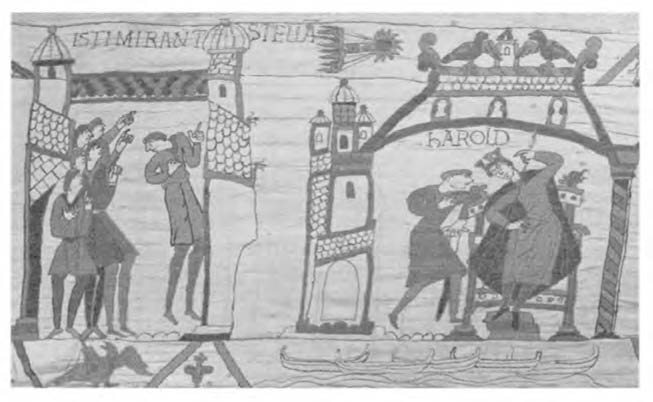
It was, therefore, unfortunate that his return to Westminster coincided with a rare celestial phenomenon. ‘Throughout all England’, says the Anglo-Saxon Chronicle, ‘a portent such as men had never seen before was seen in the heavens.’ Every night during the last week of April, an extraordinary star was seen blazing across the sky. Some people, says the Chronicle, called it ‘the long-haired star’, while others called it a comet. It was, in fact, the most famous comet of all; the one which, six and a half centuries later, the astronomer Edmond Halley calculated came round every seventy-six years. But to men and women living through the uncertain events of 1066, it seemed wholly unprecedented, and as such was regarded as a terrible omen. ‘Many people’, said William of Jumièges, ‘said that it portended a change in some kingdom.’ On the Bayeux Tapestry, an anxious crowd of Englishmen point to the comet in wonder, while in the next scene King Harold is told what is evidently disturbing news. Beneath his feet, in the Tapestry’s border, a ghostly fleet is already at sea.31
And indeed, no sooner had the comet disappeared than news came that southern England was being attacked by a hostile fleet – but not a Norman one. The attacker was Harold’s estranged brother, Tostig, last seen being driven into exile as a result of the previous year’s rebellion. Precisely what he had been up to in the meantime is an insoluble mystery. A thirteenth-century Icelandic writer called Snorri Sturluson (of whom more later) maintains that the exiled earl travelled to Denmark and tried to persuade its king, Swein Estrithson, to help him conquer England. Orderic Vitalis, writing considerably closer to events, has it that Tostig visited Normandy and had actually returned to England as an agent of Duke William. Both these authors, however, make major factual errors in telling their stories, which should caution us against giving them too much credence.32 All we can say for certain is what the Anglo-Saxon Chronicle and the Life of King Edward tell us: that when Tostig left England in 1065 he sailed to Flanders, where he was received by his brother-in-law, Count Baldwin. Most probably it was from Flanders that he launched his assault.33
According to the Chronicle, Tostig and his troops landed first on the Isle of Wight, which they plundered for money and provisions, and then sailed eastwards along the coast, raiding as they went, until they reached the port of Sandwich. Their wider objective is unclear. Possibly, in view of his rancorous split with Harold, Tostig was hoping to unseat his brother and replace him as king. More plausible, perhaps, is the notion that the younger Godwine was simply aiming to recover the estates and position he had lost the previous autumn, much as his father had done in similar circumstances fourteen years earlier, using almost identical tactics.
Whatever Tostig’s hopes might have been, they were ultimately dashed. Harold set out for Sandwich at once to confront his brother, and Tostig, hearing this news, put to sea again, taking with him the town’s shipmen. ‘Some went willingly, others unwillingly’, says the Chronicle, suggesting that enthusiasm for the exile’s cause, in the south at least, was at best mixed. Nor did his fortunes improve as he sailed north. Having reached the River Humber he raided southwards into Lincolnshire, ‘slaying many good men’ and perhaps intentionally trying to provoke his arch rivals, Eadwine and Morcar. If so he was not kept waiting long, for the two earls soon appeared leading land levies. Whether or not any actual fighting subsequently took place is unclear; the Chronicle says simply that the Mercian brothers drove Tostig out. Clearly one of the decisive factors that counted against him was the desertion of the press-ganged shipmen of Sandwich, and the extent of this haemorrhage is captured by the D Chronicler, who noted that the earl had sailed into the Humber with sixty ships, but left with only twelve. No doubt to his immense frustration, Tostig had found that support for his several rivals – Harold, Eadwine and Morcar – was far stronger than anticipated. From the Humber he sailed the remnant of his fleet further north and sought refuge with his sometime adversary, King Malcolm of Scotland.34
Having successfully seen off his troublesome younger brother, Harold turned his mind to the far greater threat looming across the Channel, and began preparations to resist the planned Norman invasion. Tostig’s attack may have caused him to begin mobilizing his forces rather sooner than he might otherwise have done, and Harold, having arrived in Sandwich too late to intercept his brother, remained there waiting for his troops to muster. The reason for the delay may well have been the scale of the operation. ‘He gathered together greater naval and land armies than any king in this country had ever gathered before’, says the C Chronicle, clearly impressed. Perhaps the host approached the notional maximum of 16,000 men that the recruitment customs recorded in the Domesday Book suggest. The gathering sense of national emergency, the fear of imminent foreign invasion, must have helped to swell the king’s ranks, and Harold, like English leaders in other eras faced with similar crises, no doubt played on such sentiments in his military summons. Several decades later John of Worcester penned a roseate picture of the king, for the most part formulaic in its praise, but probably authentic in recalling how Harold had ordered his earls and sheriffs ‘to exert themselves by land and sea for the defence of their country’.35
Having assembled his host at Sandwich, probably in the month of May, Harold took the unusual decision to break it up again. As the Chronicle explains, the king decided to station levies everywhere along the coast.36 Perhaps he feared that William, when he came, would repeat Tostig’s tactics, raiding along the shoreline in search of supplies and support. These troops would also have been able to provide an effective lookout for Norman sails, and no doubt there was some plan to enable the whole army to reassemble if a large enemy force made a landing. Harold himself sailed from Sandwich to the Isle of Wight (another decision possibly inspired by his brother’s attack) and established his headquarters there. Then he and the thousands of men spread out across England’s south coast did all they could do in such circumstances: they watched, and waited.
On 18 June 1066 William and his wife Matilda stood in the abbey of Holy Trinity in Caen, surrounded by a crowd of nobles, bishops, abbots and townspeople. It was the day of the abbey’s dedication, and we can picture the scene because it is described in a charter given on the day itself. Founded by Matilda some seven years earlier, Holy Trinity can hardly have been finished by the summer of 1066; as with Westminster Abbey a few months earlier, the rapid turn of political events had evidently prompted a dedication ceremony in advance of the church’s completion. Here was another public occasion for William and Matilda to demonstrate their piety, and to seek divine approval for the projected invasion. As the charter attests, as well as giving lands and rights to the new abbey, the couple also presented one of their daughters, Cecilia, to begin life there as a nun. Nor was it just the duke and his consort making such donations: the charter (properly speaking a pancart) also records the gifts made to the abbey by several Norman magnates, and elsewhere in Normandy we can see other individuals making gifts to religious houses around this time as part of their spiritual preparations for the coming conflict. A certain Roger fitz Turold, for instance, made a grant of land to Holy Trinity in Rouen, confirmed by a charter which stated that he was ‘about to put to sea with Count William’. At some point during the summer, William himself gave a charter to the ducal abbey of Fécamp, promising its monks the future possession of land at Steyning in Sussex ‘if God should grant him victory in England’.37
As such spiritual preparations suggest, by mid-June the Normans were nearing a point where the planned invasion would be possible. The fleet to transport them across the Channel, begun several months earlier, must have been nearing completion, with ships – bought, borrowed or newly built – being assembled at the mouth of the River Dives in the port of Dives-sur-Mer. As both Wace and the Bayeux Tapestry make clear, they were all different shapes and sizes: some were warships, akin to the familiar Viking longboats, which could have measured anywhere between fifteen and thirty-six metres (49 to 118 feet); others were cargo vessels with deeper draughts, suitable for transporting large quantities of food and wine, or for fitting with stalls for the transport of horses. The closest surviving examples are the ships sunk at Skuldelev in Denmark towards the end of the eleventh century, excavated in the 1960s and now on display in the Viking Ship Museum at Roskilde. Wace also writes of smaller boats and skiffs that were used to ferry arms, harnesses and other equipment.38
How large this highly miscellaneous armada was remains a matter of conjecture. The Ship List, arguably our surest guide, states that William’s magnates had furnished him with 1,000 ships, though the actual total of its individual quotas comes to only 776. It also states that the duke had many other ships from other men, though it is highly unlikely that these uncounted extras would be sufficiently numerous to create the kind of monster fleet imagined by some chroniclers: William of Jumièges, for instance, who offers the utterly incredible figure of 3,000 vessels. Interestingly, Wace, writing a century later, expressed his doubts about such inflated figures because they conflicted with the oral tradition that had come down to him. ‘I heard my father say, and I remember it well, although it was before I was armed as a knight, that there were seven hundred ships less four.’ A figure of 696 (which, Wace makes clear, included even the little boats and skiffs) fits far better with the evidence of the Ship List, and still constitutes a very big fleet.39
A big fleet was necessary because William, like Harold, was in the process of recruiting a very large army. The Ship List suggests that, as with the ships, individual Norman magnates had agreed to support the invasion with a certain number of knights, but sadly it records such quotas in only four cases. Clearly, many more Normans must have agreed to serve, either in fulfilment of existing obligations to the duke or in exchange for new inducements. Moreover, it was not just Normans that were turning out for William. ‘Foreign knights flocked to him in great numbers’, explains William of Poitiers, ‘attracted by the well-known liberality of the duke, but all fully confident of the justice of his cause.’ Liberality, of course, is a polite way of saying that William was recruiting mercenaries: ‘men with a lust for war’, as Orderic Vitalis put it, ‘panting for the spoils of England’. They came from all over Francia and possibly even further afield – between them these two chroniclers mention the men of France, Brittany, Maine, Aquitaine, Poitou, Burgundy, ‘and other peoples north of the Alps’.40
Alas, we cannot say with any certainty how many men William eventually recruited. Medieval chroniclers are notoriously bad guides when it comes to estimating troop numbers. William of Poitiers, for example, offers us the figure of 50,000 men, and then a few pages later increases it to 60,000; Orderic Vitalis, who may have taken his information from Poitiers, suggests that there were 50,000 knights ‘and a great company of foot soldiers’. Other chroniclers put the total even higher: at least two say that it was 150,000. No medieval armies were ever so large. The peak figures in Britain during the Middle Ages, derived from muster rolls rather than monastic observation, occurred during the reign of Edward I, whose largest armies numbered around 30,000 men. Needless to say, if this was the maximum for a king of England in the more populous and prosperous thirteenth century, it would have been difficult for an eleventh-century duke of Normandy to match, let alone exceed it. Modern historians have tried to arrive at better estimates forWilliam’s invasion force, but invariably end up basing their figures on conjecture (extrapolating, for example, from the number of ships, a pointless exercise if ever there was one, since their size and number are also unknowable).41
The best we can do in such circumstances is to look at comparable situations in subsequent centuries. When it came to crossing the Channel, no English king in the later Middle Ages ever managed more than 10,000 men. Given the disparities in power and population mentioned above, if William managed to assemble an army of even half that size he would have been doing extremely well. The consensus among Victorian scholars – who, whatever their other faults, knew a thing or two about landing cavalry forces on foreign shores – was that the Norman army may have measured around 7,000 men. Despite recent attempts to dismiss it, this is a conclusion that remains valid and compelling.42
To judge from comments made by William of Poitiers, the Norman invasion force, both army and fleet, was fully assembled by the first week of August, but the duke’s desire to set sail was frustrated for a whole month thereafter by unfavourable winds. In recent times, historians have been very sceptical of this statement. What William was actually doing, they aver, was waiting for Harold’s army to disband, either because its supplies had run out or else because the majority of men would have had to return home in time for the harvest. There are good reasons, however, for rejecting such scepticism. In the first place, comparative evidence suggests that delay in crossing the Channel due to contrary winds occurred all the time. In later, better-documented centuries, we see armies and ambassadors held up for weeks on end by bad weather, or dashed to pieces at sea when in desperation they attempt a crossing in such conditions. Experts with greater nautical experience tend to the opinion that, had the wind been blowing in the right direction that August, William would have been extremely foolish had he not seized the moment and got on with it. More to the point, the question of resources cuts both ways. Waiting for Harold’s army to run into difficulties and disband was all very well, but it would only have worked if William could keep his own equally large army well supplied and disciplined for the same duration.43
This was no mean feat. Some years ago, an American scholar named Bernard Bachrach wrote a paper looking at the logistics involved in keeping the Norman invasion force supplied during its month-long stay at Dives-sur-Mer. For unconvincing reasons (essentially, the testimony of an obscure contemporary chronicle) he assumed an army of 14,000 men, i.e. twice the generally accepted figure, but even if we halve his totals, they remain arresting. Supposing the men subsisted only on grain (highly unlikely, of course), it would have required fourteen tons a day to keep them fed, and a similar amount to feed an estimated 2,000 horses. Between them the men and their mounts would have also needed around 30,000 gallons of fresh water every day, and the horses, in addition, would have needed four to five tons of straw a day for their bedding. The resulting totals for a whole month are mammoth: thousands of tons of food and water, all of which had to be transported to the encampment, either ferried down the Dives or carted along rutted roads. Equal forethought, of course, had to be given to sanitation. That many men and horses would have produced a mountain of manure and a river of urine (2,000 tons and 700,000 gallons are Bachrach’s respective figures for the horses alone). Lastly, of course, they all required shelter: tents for the men, stalls for the horses. These, it bears repeating, are minimum requirements for keeping people alive for a month, more in keeping with a refugee camp than a volunteer army. To keep his men together, and to maintain their morale, William would have had to have found many more items – meat, fish, wine and ale – in similarly colossal quantities.44
Just to keep his army supplied, therefore, was a major undertaking – but one which William evidently managed to pull off. ‘Such was his moderation and wisdom that abundant provision was made for the soldiers and their hosts’, says William of Poitiers, who was also at pains to stress that the duke had forbidden his army from plundering the local people. ‘The crops waited unharmed for the scythe of the harvester, and were neither trampled by the proud stampede of horsemen nor cut down by foragers. A man who was weak or unarmed could ride singing on his horse wherever he wished, without trembling at the sight of squadrons of knights.’ Even if, as usual, Poitiers is laying it on here with a trowel, his overall claim must be broadly true. The Norman army could not live off the land while it remained in Normandy. Order and discipline had to be maintained.45
At last, on 8 September, the stalemate was broken, when Harold was forced to stand down his army. ‘The men’s provisions had run out’, explains the Chronicle, ‘and no one could keep them there any longer.’ The troops, we are told, were given permission to return home. The king, still on the Isle of Wight, sent his fleet back to London, and then set out for the city himself. As the Chronicle says, he had managed to keep his army together for the whole summer, and he must have hoped that whatever was delaying his opponent would continue to detain him a little while longer. Very soon it would be too late in the year for William to attempt a crossing.
On arrival in London, however, Harold was greeted with terrible news. Hostile sails had at last been sighted on the horizon; an invasion fleet had landed. But, once again, it was not the enemy he had been expecting.46
It was Tostig, come back for a second try. And this time he had brought some Vikings.