
11
If we believe William of Poitiers, the late summer of 1066 must have been a time of immeasurable frustration for the duke of Normandy and his army of would-be invaders. Although apparently ready since the start of August, the fleet that was supposed to carry them across the Channel to England had been unable to put to sea, its departure indefinitely delayed by bad weather and adverse winds. As late as the second week in September, the 700 ships were still beached and anchored in the port of Dives, leaving the thousands of knights, soldiers and horses idling in the nearby encampment.
If we believe most modern historians, on the other hand, this is simply nonsense. A delay of that length, they maintain, must have been deliberate; William of Poitiers, not for the first time, is twisting the facts to fit his own sensationalist agenda. What the duke was really doing during these weeks, say the sceptics, was waiting for Harold’s army to disband, so that the Normans could land in England unopposed.1
It is easy to see why this argument has commanded so much credence: apart from anything else, it seems well supported by the timing of subsequent events. Harold stood down his army, the Anglo-Saxon Chronicle tells us, around 8 September. Very soon afterwards – just four or five days later, as far as we can determine – William’s fleet finally put to sea. And yet, a closer examination of the evidence suggests that the sceptical line is unjustified. The duke, it seems, was delayed by contrary winds. For once, William of Poitiers appears to have given us the unvarnished truth.
The principal reason for believing Poitiers is that his testimony is corroborated by a new source – the so-called Carmen de Hastingae Proelio, or ‘Song of the Battle of Hastings’. The Carmen, as it is known for brevity’s sake, has a controversial history of its own. An epic poem, 835 lines long, it was discovered in 1826 in the Royal Library in Brussels. The text as it stands is anonymous, but it was quickly ascribed to Guy, bishop of Amiens, a contemporary of the Conqueror, chiefly because Orderic Vitalis, writing a couple of generations later, tells us that the same Bishop Guy had written just such a poem about the Battle of Hastings. Doubts about this attribution, and indeed the poem’s authenticity, have persisted almost since the moment of its discovery; such academic scorn was poured upon it in the late 1970s that many books and articles written soon thereafter simply ruled it out of court as evidence. Latterly, however, the Carmen’s fortunes have been greatly revived. Scholars are now inclined to accept that it was the poem described by Orderic, and, since he tells us that it was composed before the spring of 1068, it is reckoned as one of the earliest sources we have for the events of 1066. It remains, of course, a poem, with all the potential for artistic licence that that implies, but nevertheless theCarmen is now regarded as one of the key texts for the study of the Conquest.2
One thing that makes the Carmen especially interesting is that it was apparently written for the ears of William the Conqueror himself (the first 150 lines or so are written in the second person, i.e. ‘You did this, you did that’). This, of course, is true for some of our other sources, such as William of Jumièges and William of Poitiers; the difference in the case of the Carmen is that its author, Bishop Guy, was not himself a Norman. The city of Amiens lies in the neighbouring county of Ponthieu, and Guy himself was a scion of Ponthieu’s ruling house. As such, while he clearly sets out to praise William and the Normans, Guy does so with a greater sense of detachment, and far less sycophancy, than, say, William of Poitiers. Another thing that makes the Carmen an interesting source is that William of Poitiers had clearly read it. At various points in his own history we can see Poitiers responding to Bishop Guy’s poem, sometimes borrowing a word or phrase by way of endorsement, other times implicitly denying its account by substituting his own alternative version of events.3
What bearing does all this have on whether or not William’s delay in sailing was deliberate or not? The answer is that the Carmen – an early, independent source, addressed to the duke himself – begins by describing the adverse weather conditions that prevailed in the late summer of 1066: ‘For a long time tempest and continuous rain prevented your fleet from sailing across the Channel … You were in despair when all hope of sailing was denied you. But, in the end, whether you liked it or not, you left your shore and directed your ships towards the coast of a neighbour.’4
William of Poitiers, following the Carmen’s lead, elaborates: ‘Presently’, he says, ‘the whole fleet, equipped with such great foresight, was blown from the mouth of the Dives and the neighbouring ports, where they had long waited for a south wind to carry them across, and was driven by the breath of the west wind to moorings at Valéry.’5 Poitiers is probably being slightly economical with the truth here in blaming the mishap entirely on the weather – presumably the ships did not simply break their anchors and drift out to sea. What must have happened, and what the chronicler has judiciously excised from his account, is that the duke decided to set sail in less than favourable conditions. Having waited a month or more for a south wind that never came, he would have learned soon after 8 September that the English army had disbanded. It must have seemed an opportunity too good to miss, and in any case his carefully stockpiled provisions at Dives could hardly have lasted much longer. Probably around 12 or 13 September, William took a chance and launched his expedition, with near disastrous results.
‘The rough sea compelled you to turn back’, says the Carmen, candidly. The Norman fleet ended up, not in England as they intended, but (as William of Poitiers indicates) in the port of St Valéry, a hundred miles further east along the north French coast – ‘a dangerous rock-bound coast’, as the Carmen accurately describes it. William had, in truth, been very lucky to have escaped a more comprehensive disaster. Poitiers speaks of ‘terrible shipwrecks’, and tells us that men began to desert from the duke’s army. Although his comment that William tried to maintain morale by burying the bodies of the drowned in secret looks somewhat suspect (Xerxes once did something similar), Poitiers’ testimony is in general terms perfectly plausible. Indeed, it draws support from a fact we have already seen, namely that the disbanded English fleet, sailing back to London at the same time, suffered similar losses.6
In mid-September, therefore, William’s planned invasion hung precariously in the balance. His fleet was diminished by losses, his supplies were dwindling. He was no longer in his own duchy – St Valéry lies in the neighbouring county of Ponthieu (hence theCarmen’s credibility for these events). And the weather continued to be against him. Guy of Amiens describes the duke not only visiting the shrine of St Valéry, but anxiously watching the weathercock on top of the church’s steeple for signs of a change in the wind. ‘You were forsaken’, says the Carmen, ‘It was cold and wet, and the sky was hidden by clouds and rain.’ With the heavens set against them, there was nothing else the Normans could do except seek divine intervention. William himself prayed and made offerings at St Valéry’s shrine; he also (as subsequent records show) vowed to found a new church dedicated to the saint in England, should the invasion be successful. When these personal overtures had no discernible effect, he decided to get the whole army involved. According to William of Poitiers, the duke had Valéry’s body removed from its shrine and carried out of the church, in what was clearly a large-scale, open-air ceremony. ‘All the assembled men-at-arms’, says the chronicler, ‘shared in taking up the same arms of humility.’
They had to wait a further fortnight, but eventually their prayers were answered. ‘At length’, says Poitiers, ‘the expected wind blows. Voices and hands are raised to heaven in thanks and, at the same time, a tumult arises as each man encourages the other.’ The Bayeux Tapestry shows men carrying and carting weapons and wine to the ships in a somewhat sedate fashion. It is the Carmen that best captures the jubilant but frantic atmosphere that followed:
Immediately, all were of one mind and purpose – to entrust themselves to the sea, now calm at last. Although dispersed, all arrive rejoicing, and run instantly to take up position. Some step the masts, others then hoist the sails. Many force the knights’ horses to clamber on to the ships. The rest hasten to stow their arms. Like a flock of doves seeking their lofts, the throngs of infantry rush to take their places on the boats. O what a great noise suddenly erupts from that place as the sailors seek their oars, the knights their arms!7
Frustratingly, conflicting dates in our source material means we do not know on what day this dramatic scene took place. Most probably it was 27 September, though just possibly it was 28 September. We can, however, estimate the time of day by looking at the tides. The Normans would have needed to embark on a rising tide, and to have departed soon after high tide, in order for their heavily laden ships to have sufficient clearance. On 27 September 1066 low water at St Valéry occurred at around 9 a.m., high tide at around 3 p.m., and the sun set just before 5.30 p.m. This fits very well with the Carmen’s comment that ‘the day was already closing in, the setting sun departing’ when the ships finally cast off their moorings, and the duke’s own vessel raced ahead and took the lead.8
As luck would have it we have a description of William’s ship. A few lines added to the end of the Ship List tell us it was called the Mora, and that it been prepared for him by his wife, Matilda. Sadly, we can’t say for certain what the ship’s name signified (though all manner of suggestions have been put forward). The List also tells us about a finishing touch that Matilda had caused to be added: at the prow of the vessel stood the figure of a small, gilded boy, holding a horn to his lips with one hand and pointing towards England with the other. A similar figure appears on one of the ships depicted on the Bayeux Tapestry.9
Once the ships reached the open sea, says William of Poitiers, they immediately dropped anchor. Partly this must have been to enable the fleet to establish the ‘orderly formation’ described by the Carmen, but it was also, as Poitiers explains, ‘for fear that they might reach the shore to which they were bound before dawn, and run into danger in a hostile and unknown landing place’. There would, of course, have been no shortage of sailors who had made the same crossing hundreds of times before on hand to advise on timings. The English coast lies about sixty miles from St Valéry; if they maintained a speed of between three and four knots the voyage would take at least twelve hours – bringing them to England, as Poitiers indicates, before the sun had risen. For several hours, therefore, they idled outside the estuary while night fell. As the stars filled up the heavens, says the Carmen, so the ocean filled with glowing torches. At length – probably around 9 p.m. – a lantern was lit on William’s ship, a trumpet sounded, and the fleet sailed on.10
When the sun rose the next morning, at around 6 a.m., there was apparently intense anxiety on board the Mora. As William of Poitiers explains, during the night the duke’s flagship had raced ahead of the others (‘trying to equal his ardour by its speed’); at daybreak its occupants discovered they were quite alone, with no other sails in sight. The duke himself, naturally, was unperturbed, and quelled the nerves of his companions by calmly sitting down to an abundant meal, ‘as if he were in his hall at home’. It is a scene worthy of the classical authors that Poitiers sought to emulate, but not directly copied from any of them and so impossible to dismiss completely. Of course, by the time William had finished his hearty breakfast – washed down, we are told, with spiced wine – the crisis was over. ‘On being asked again’, says Poitiers, ‘the lookout saw four ships following; the third time he exclaimed that there were so many they resembled a dense forest whose trees bore sails.’11
Some three hours later, around 9 a.m., the Norman fleet landed on the English coast. Their port of arrival was Pevensey, and this was almost certainly intended. The town itself was insubstantial, but it boasted the attraction of a former Roman fort (Anderitum) which afforded the invaders some immediate protection. More importantly, aiming his ships at Pevensey meant that William could make use of Pevensey Bay, a suitably extensive landing ground for his several hundred ships. The Bayeux Tapestry shows the horses being unloaded from the ships, and Norman knights racing to occupy the town of Hastings, a dozen miles further east along the coast. Here too they seized an ancient fortification, in this case the Iron Age hill fort that stands on the cliffs high above the town. ‘You repair the remnants of earlier fortifications and set guards to protect them’, says the Carmen: the fort at Hastings, like the one at Pevensey, was immediately customized to meet the Normans’ requirements. As we can see from the surviving remains, the invaders dug ditches and raised ramparts to reduce the size of both sites, transforming each from an old-style communal fortress into that modern French phenomenon, the castle. At Hastings, the Tapestry shows teams of diggers labouring to create that most distinctive of early castle features, the motte.12
Thus William landed in England, probably on the morning of 28 September, possibly the morning after. When did Harold learn of his arrival? The answer depends, of course, on where the English king was, and here our sources leave us somewhat in the dark. We know that he fought and won the battle of Stamford Bridge on 25 September, but what he did in the days that followed is uncertain. One possibility is that, still anxious about the Norman threat, he immediately rounded up the remnant of his army and set out southwards, but this does not seem at all probable. Having won his great victory over the Vikings, it is far more likely that Harold would have remained in Yorkshire for a few days, resting his men and attending to the region’s pacification. We know that he negotiated with the Norwegian survivors and granted them safe passage home, and we can reasonably assume that he would have wanted to reimpose his authority on the citizens of York. As we’ve seen, William of Malmesbury claims that the body of Tostig Godwineson was taken to the city for burial, an occasion for which his brother is likely to have been present. Another twelfth-century writer, Henry of Huntingdon, says explicitly that Harold was holding a celebratory feast in York when news arrived of the Norman landing.13
The king’s location is important because it determines how much time he had to react. From Pevensey to York is approximately 270 miles: if the Normans landed in the morning of 28 September, news can hardly have reached him before 1 October. Looking ahead for a moment to our one indisputable date (and not, I hope, giving too much away), the Battle of Hastings took place on 14 October. Harold, in other words, moved from Yorkshire to the Sussex coast in barely a fortnight. Moreover, as all the chronicles attest, he spent some of that time paused in London – six days, if we believe Orderic Vitalis. All of which means the king must have travelled south from Yorkshire very quickly – much more quickly than he had travelled on his outward journey, which usually attracts greater admiration. If Orderic is right, Harold must have covered the 200 miles between York and London in just four or five days. Obviously he cannot have marched infantry at a rate of forty or fifty miles a day; most likely the foot soldiers who had fought at Stamford Bridge were dismissed in the wake of their victory. The conclusion must be that the king rode south, as fast as he could, accompanied only by mounted men. As they rode, fresh orders must have been sent to the shires, with orders to assemble a new army in London.14
Back in Sussex, the Normans themselves must have been anxious for news of their enemy – not least who their enemy was. As we have seen, it is highly likely that William’s original departure from Dives, around 12 September, had been inspired by news that Harold had stood down his army a few days earlier. It is also likely that, in the days that followed, the Normans learned about the arrival in Yorkshire of Tostig and Harold Hardrada. They cannot, however, have heard about the battle of Stamford Bridge on 25 September before their departure from St Valéry just two or three days later. It is a fact that has been noted by historians many times in the past, but is no less arresting for all that: William arrived in England not knowing which Harold he was going to have to fight.
News of Stamford Bridge must have reached William within a few days of his arrival – probably around the same time that Harold was made aware of the Norman landing. According to William of Poitiers, the messenger who brought the news was sent by Robert fitz Wimarc, a Norman who had come to England many years earlier in the company of Edward the Confessor and served in the former king’s household (he is the ‘Robert the Steward’ who was present at the Confessor’s death). If Poitiers can be believed – and here we must bear in mind his desire to dramatize events – the message sent by this sympathetic Norman was not encouraging. Harold had defeated and killed both Tostig and Hardrada, destroying their huge armies, and was now heading south to confront William. The duke was advised to stay behind his fortifications.15
Harold was thus aware of William’s arrival, and William of Harold’s return to London. As such, we have little difficulty in believing the various chroniclers who tell us that in the days that followed messages were exchanged between the two men. Both theCarmen and William of Poitiers purport to give the content of these messages as spoken by the monks who delivered them; what they are actually doing is rehearsing the arguments of both sides for possession of the English throne. In the case of William of Poitiers, in particular, his account becomes a rhetorical exercise to justify the Norman invasion; quite probably he was drawing on the legal case that had earlier been prepared for the pope. We hear, once again, of a grateful Edward the Confessor making William his heir; of oaths sworn and hostages given; of Harold’s visit to Normandy and his promise to uphold the duke’s claim. In fairness to Poitiers, we also hear Harold’s counterargument, namely the story of the Confessor’s deathbed bequest and its historic legitimacy. Naturally we don’t have to believe that all of these arguments were revisited in the course of these exchanges, though no doubt some of them were. Certainly we can believe the Carmen that offers were made by both sides in the hope of avoiding conflict. William, we are told, offered to let Harold hold the earldom of Wessex if he resigned the kingship; Harold, rather less generously, promised to let William return to Normandy unmolested if he made reparations for the damage he had caused.16
That the Normans had already caused extensive damage is beyond doubt. ‘Here the horses leave the boats’, says the Bayeux Tapestry, above the fleet’s arrival, ‘and here the knights hurry to Hastings in order to seize food.’ While they waited in France, William’s army had been forbidden to live off the land; once in England, they could start to plunder the surrounding countryside. On the Tapestry this requisitioning operation looks fairly innocuous; more space is devoted to the preparation of the tasty sit-down meal than the manner in which it was obtained. Of course, as with the creation of castles at Pevensey and Hastings, the damage involved in the search for food could be considered as collateral, but our sources leave no room for doubt that the Normans were also engaged in deliberate and indiscriminate destruction. In the Carmen, Harold is informed that William ‘has invaded the land, wastes it and sets it on fire’. The Tapestry famously shows two Norman soldiers torching a house from which a woman and a child are seen trying to flee.17
Indiscriminate it may have been, but this was devastation with a purpose. William, for the first time in his career, was engaged in a battle-seeking strategy. Had Harold decided to remain in London, the duke would have been in a difficult fix. His only option would have been to leave the security of his camp and lead a march into hostile territory, with all the dangers that implied. An army forced to live off the land would be vulnerable to attack as it spread out to forage, or death from disease or hunger if it failed to do so. Far better, then, from William’s point of view, to have the English king come to him and decide their dispute in a decisive battle. In William’s devastation, therefore, we discern a deliberate attempt to provoke a fight. It no doubt helped in this regard that the Normans had landed in Harold’s own territory, and were therefore terrorizing the king’s own tenants.
Harold, it seems, rose to the bait. In the opinion of several sources, the English king set out from London too soon: ‘before all his host came up’, says the E version of the Anglo-Saxon Chronicle, a comment later amplified by John of Worcester to ‘half his host’. Another later writer, Orderic Vitalis, relates a dramatic conversation in London between the king and the rest of his family. His mother Gytha, already lamenting the loss of Tostig, tried to dissuade Harold from riding to war for a second time. His brother Gyrth also urged caution, saying ‘You have just returned worn out after the war against the Norwegians; are you now hastening to move against the Normans?’ According to Orderic, Gyrth volunteered to lead the army on Harold’s behalf, on the rather unlikely grounds that he had sworn no oath to William. These representations, however, came to nothing: Harold flew into a violent rage, rebuked his relatives and hurried off to do battle.18
It has been fairly observed that all of these sources are English (or, in Orderic’s case, has clear English sympathies), and it might therefore seem reasonable to assume that all were making excuses for Harold ahead of his impending defeat. Yet it is William of Poitiers who tells us that ‘the furious king was hastening his march all the more because he had heard that the lands near to the Norman camp were being laid waste’. Naturally Poitiers, given his own sympathies, does not endorse the view that a speedy departure in any way diminished Harold’s fighting strength; like the other Norman writers, he maintains that the king’s army was enormous. But it is precisely the fact that Poitiers so often disagrees with our English sources at other times that makes his agreement on the point of Harold’s haste so significant, and suggests that the king did indeed set out too soon.19
Besides his desire to stop the Norman devastation, Harold set out at speed to confront William for another reason. He was, according to William of Jumièges, ‘hastening to take him by surprise’. As William of Poitiers explains more fully, the English king ‘thought that in a night or surprise attack he might defeat [the Normans] unawares’. We should have no difficulty in believing these statements. Harold had just won a great victory at Stamford Bridge by launching exactly such a surprise attack on his enemies. Of course, the situation differed somewhat in that the Norwegians appear to have been wholly unaware of the king’s approach. Yet the fact that William and Harold exchanged messages with each other in the days before the battle does not preclude the possibility of the English launching an attack sooner than expected, or falling on the Normans under cover of darkness. Harold could still hope to catch William off guard, especially if he moved quickly.20
William, however, got wind of his opponent’s intentions. According to the Carmen, it was the duke’s own envoy, returning from a final parley with the king, who revealed the plan, saying ‘Harold hopes to be able to catch you unawares. He is preparing for a great offensive on both land and sea. He is reported to have sent five hundred ships to obstruct our passage home.’ William of Poitiers, while he echoes the story about the ships, rather more credibly attributes the duke’s foreknowledge to good military practice. ‘Experienced knights, who had been sent out scouting, reported that the enemy would soon be there.’ (It is important to remember in what follows that Poitiers had himself once been a knight.)21
With each side trying to outfox the other, it is hardly surprising that our sources give no clear account of the timings involved. The likeliest scenario is that Harold set out from London around 11 October, and was drawing near to Hastings on 13 October when William learned of his approach. According to William of Jumièges, the duke, ‘taking precautions in case of a night-time attack, ordered his army to stand to arms from dusk to dawn’. But the night-time attack never came, and early the next morning William set out in search of his enemy.22
Harold’s army had reached a spot about seven miles north-west of Hastings which at that time had no very obvious name. The D version of the Anglo-Saxon Chronicle, uniquely, says that the English were at ‘the grey apple tree’ – presumably a significant landmark, long since lost. Orderic Vitalis, writing over fifty years later, insisted that the place had been known since ancient times as ‘Senlac’, though nobody else favoured the term until it was adopted by Freeman in the nineteenth century. After 1066, most people referred to the place by the name that it still bears today – Battle.23
For it was here that the Norman army surprised Harold’s men on the morning of 14 October. ‘William came upon him unexpectedly, before his army was set in order’, says the D Chronicle unequivocally. The duke, thanks to his good reconnaissance, had succeeded in turning the tables. Harold had intended to surprise William by attacking his camp at Hastings, but William had discovered this just in time and advanced to meet him. Although some historians contend he must have set out sooner, the obvious inference from our sources is that the duke left Hastings at sunrise on the morning of 14 October – a Saturday – and came upon Harold’s army a few hours later, around 9 a.m. The truly insoluble question is which side was more exhausted. Few modern commentators accept William of Jumièges’ statement that the English had ridden through the night to arrive at the battlefield at dawn, but whenever they arrived the speed of their advance must have taken its toll. At the same time, the Normans, having reportedly stood to arms all night and marched several miles in the morning, can scarcely have been better rested. William of Malmesbury, writing many years later, famously recorded the rumour that the English had spent the whole night singing and drinking, while the Normans had been confessing their sins. Scurrilous, no doubt, but it does fit well with the notion that the English were taken by surprise and the Normans knew what was coming.24
Although William had turned the tables by advancing on Harold, it is clear that this did not enable the Normans to ambush the English. Both sides had spotted each other in advance and there was a sudden rush to arms. Possibly it was only at this stage – i.e. after their early-morning march – that William’s men donned their heavy shirts of mail, or hauberks. According to a story reported by several chroniclers (William of Poitiers alludes to it in passing) the duke, in his haste, put his own hauberk on back to front, and had to laugh off what others took to be a bad omen. He also, says Poitiers, fortified himself spiritually by hanging around his neck the relics on which Harold had sworn his oath.25
There was just enough time for a pre-battle speech. ‘Here Duke William exhorts his knights to prepare themselves manfully and wisely against the English’, reads the caption on the Bayeux Tapestry. Poitiers, who admits with unusual candour that he is paraphrasing, purports to give us the gist: William reminded the Normans of their past victories and his own unbroken record, and exhorted them to prove their valour. He also stressed, with good reason, the do-or-die nature of the imminent conflict, reminding his men that retreat was not an option. Lastly, he played down the martial reputation of the English, saying they had been defeated many times in the past. ‘Never were they famed for the glory of their feats of arms.’ Not terribly fair, of course, but precisely the sort of denigration of an opponent we might expect from a commander about to lead his men into battle.
Poitiers uses the same speech to imply that the Normans were outnumbered by the English, saying ‘men who are inexpert in warfare could easily be crushed by the valour and strength of a few’. It is a line of dubious worth, largely because it is adapted from a maxim of Vegetius, a Roman authority on military matters (though Poitiers may have borrowed it from the Carmen, which says something similar). As we have seen, the English sources make comparable excuses for the size of the English army, with comments to the effect that Harold went into battle before all his host had been drawn up. Both sides would argue over this point for years to come. William of Malmesbury, incensed by the suggestion that Harold had lost despite having a large army, insisted that the English ‘were few in number but brave in the extreme’. Several decades later, the Norman writer Wace found it equally hard to accept that William had fielded the bigger army, and concluded that both armies had been much the same size. As ever with numbers, it is impossible to pronounce with any certainty. No doubt an opposing army often seems daunting to those about to confront it. The most reasonable conclusion, given the nature of the battle that followed, is that Wace was right, and the two sides were more or less evenly matched.26
Fortunately there is less disagreement over where the battle was fought. William had advanced from Hastings by the only viable route, namely the high ground known as The Ridge; the ground to either side would have been mostly impassable forest. The English, once aware of the Norman approach, had moved from the forest and seized a nearby hill – so says Poitiers and so says the Carmen. The hill is easily identified today because, some years later. William caused an abbey to be erected on the site, and its substantial ruins still remain.
Having seized the hilltop, the English arranged themselves in their favoured formation. ‘They dismounted and left their horses in the rear’, says the Carmen, with a hint of incredulity. ‘For that people, unskilled in the art of war, spurn the assistance of horses: trusting to their strength they stand fast on foot.’ This was, indeed, the way in which English armies had traditionally deployed for centuries – standing in a long line, several men deep, shields to the fore, forming the so-called ‘shield-wall’. Harold, we are told, took his place in the centre of the line, planting his standard on the summit of the hill. According to a local tradition dating back to the late twelfth century, this spot is marked by the abbey’s high altar.
William, at the foot of the hill, had adopted a more sophisticated arrangement – three lines, according to the knowledgeable William of Poitiers. The first line, at the front, consisted of foot soldiers ‘armed with arrows and crossbows’ (in other words, the archers). The second line also consisted of foot soldiers ‘but more powerful and wearing hauberks’ (i.e. mailed men-at-arms, probably carrying swords). Finally, says Poitiers, came the cavalry – ‘the squadrons of mounted knights’ – in the middle of which rode the duke himself, ‘so he could direct operations on all sides with hand and voice’. Poitiers, naturally, describes this deployment as ‘a well-planned order’, and perhaps that was the case. For the record, however, the Carmen implies that William had originally intended to place the cavalry behind the archers – i.e. in the second line – ‘but was prevented from doing so from the onset of battle’.27
That onset was signalled on both sides by ‘the harsh bray of trumpets’, says Poitiers, and followed by a thick cloud of arrows – ‘a shower of blows like a storm of hail’, in the words of the Carmen. To read the accounts of both writers, one might assume that the use of arrows was confined exclusively to the French side, for neither mentions English archers. Some later chroniclers went even further, and insisted that the English did not know about archery at all: Baudri of Bourgeuil, for example, spoke of the English at Hastings dying by ‘the arrow, which they had not known before’. Of course, this is patently ridiculous – cavemen hunted with bows and arrows – and hence historians have tried to square the circle by assuming that Baudri was talking about crossbows, which were indeed something of a novelty in 1066. But this is to put a rather strained reading on the evidence. Most likely Baudri had come to believe that at the time of Hastings the English knew nothing of conventional archery probably because earlier accounts of the battle, like the Carmen and William of Poitiers, not only fail to mention English archers, but also insist that the English were ignorant when it came to military matters. Thus Henry of Huntingdon, also writing in the twelfth century, has Duke William describe the English in his pre-battle harangue as ‘a people accustomed to defeat, a people devoid of military knowledge, a people that does not even possess arrows’. In fact, the silence about English archers at Hastings is not quite total: the Bayeux Tapestry shows a man armed with a bow and arrow lining up with the soldiers who formed the shield-wall. At the same time, this lone figure is the only evidence that Harold had brought any bowmen with him, compared with the abundant references to French archers in the chronicle accounts, and indeed the two dozen Normans depicted with bows on the Tapestry. The reasonable conclusion is that the English king, perhaps because of his haste, had not managed to assemble archers in any great numbers.28
The shower of arrows thus fell disproportionately on Harold’s men, striking and destroying shields (says the Carmen), killing and maiming many (Poitiers). Yet the English remained, in the Carmen’s words, ‘rooted to the ground’. They were not about to rush down the hill and forsake the advantage of the high ground – the point of the shield-wall was that it should remain intact and impenetrable. Hence it was the Normans who were obliged to advance in order to engage the English in hand-to-hand fighting. Once the volley of arrows had ceased, the Norman heavy infantry (‘helmeted soldiers’, as the Carmen calls them) rushed forward ‘to crash shields against shields’. According to Poitiers, these men immediately got into difficulty, for the English ‘resisted bravely, each one by any means he could devise. They threw javelins and missiles of various kinds, murderous axes and stones tied to sticks.’ The Norman cavalry therefore rode to the rescue, engaging the enemy with their swords. ‘The loud shouting, here Norman, there foreign, was drowned by the clash of weapons and the groans of the dying’, says Poitiers. ‘So for a time both sides fought with all their might.’29
At some point during this initial clash, according to the Carmen, there was a remarkable episode. A Norman knight named Taillefer rode in front of the duke’s army, encouraging them both with his words and with his dextrous swordplay, for as he spoke he juggled his sword, throwing it high into the air. These antics so irritated one Englishman that he broke ranks and ran forward to attack the juggler, but Taillefer was too quick: he turned, spurred his horse at his assailant and ran him through with his lance. Then, to the delight of his watching comrades, he hacked the fallen man’s head from his body and held it aloft in triumph.30
Even if this episode really occurred, the Normans had little else to celebrate. As William of Poitiers explains, ‘the English were greatly helped by the advantage of the higher ground’. The hilltop position that Harold had selected seemed unassailable. Not only was it practically impossible to mount an effective cavalry charge up such a steep slope, the terrain itself was also unfavourable – Poitiers refers at one point to ‘the roughness of the ground’, while the Carmen speaks of ‘land too rough to be tilled’. Unable to mount a mass charge, the Norman horsemen were forced to engage the English at close quarters, riding up to hurl their javelins, or closer still to hack with their swords. These methods (both of which can be seen on the Bayeux Tapestry) naturally exposed the attackers themselves to far greater risk. When Poitiers refers allusively to English weapons ‘which easily penetrated shields and other protections’, he is presumably talking about the great battleaxes which we also see on the Tapestry, being brandished by heavily armed English housecarls. ‘They strongly held or drove back those who dared to attack them with drawn swords’, says Poitiers. ‘They even wounded those who flung javelins at them from a distance.’31
This bloody business, with the Normans trying but failing to break through the English line, must have continued intermittently for hours: we know that the Battle of Hastings went on all day. At some stage, however, presumably several hours into the conflict, there came a crucial turning point, though the Carmen and William of Poitiers offer different versions of how it happened. According to Poitiers, it began with a near disaster. Because of the ferocity of the English resistance, he says, some troops on the left wing of the French army turned tail and started to flee. At the same time, a rumour ran through the entire army that William himself had been killed, which in turn led to ‘almost the whole of the duke’s battle line giving way’. The situation was only retrieved by an act of personal heroism by William, who rushed towards the fugitives, shouting ‘Look at me! I am alive, and with God’s help I will conquer! What madness is persuading you to flee? What way is open to escape?’ At these words, says Poitiers, the Normans recovered their courage. Following the duke’s lead, they turned to face the English who had been pursuing them, and killed them all in a moment.
The Carmen tells it somewhat differently. In this version, the episode begins with the French pretending to run away – it is a plan, intended to lure the English out from their impenetrable shield-wall. And at first it is successful: the English take the bait and run down the hill in pursuit of what they take to be a retreating enemy, only to have the French turn around and start attacking them. But soon thereafter, the plan goes awry, when the English fight back with unexpected vigour, compelling their attackers to run away for real. ‘Thus’, says the Carmen, ‘a flight which had started as a sham became one dictated by the enemy’s strength.’ It is at this point that William rides to the rescue, rallies the deserting troops and leads them in a successful counter-attack.32
Clearly, something like this must have happened. The two stories are quite similar in places, particularly in the crucial role they attribute to William. In the Carmen, just as in Poitiers’ version, the duke removes his helmet to dispel the rumour of his death, and this same scene is also depicted on the Bayeux Tapestry. (Although, as ever with the Tapestry, the true hero appears to be Bishop Odo, who rides in brandishing his baculum ‘to encourage the lads’.) The essential difference is that, in the Carmen, what begins as a ruse almost results in disaster, whereas in Poitiers’ account it begins as a disaster which in turn gives rise to a ruse. For, as Poitiers has it, the Normans soon realized their moment of crisis had given them a rare opportunity to kill Englishmen. ‘They remembered how, a little while before, their flight had brought about the result they desired.’ And so they fled again, only this time as a trick. The English, as before, rushed after them in pursuit, only to have the Normans wheel around their horses and cut them down.33
There is not much to help us choose between the two accounts. Our first instinct might be to believe Poitiers, the man with military experience. Yet there are strong hints in his text that the old soldier was here writing more in his capacity as ducal propagandist, trying to improve on the version of events related by the Carmen. In the latter account, for instance, it is unclear exactly who was responsible for the flight that nearly caused the disaster, but we are clearly told ‘the Normans turn tail; their shields protect their backs’. Poitiers, by contrast, blames the initial flight on ‘the Breton knights and other auxiliaries on the left wing’. If the Normans did run away, he says, it was only because they believed their leader was dead, so there was no shame in that; even the army of the Roman Empire, he continues, fled occasionally in such circumstances. This all smacks of protesting rather too much, and we might therefore prefer to believe the Carmen when it speaks of a deliberate stratagem that went badly wrong. Certainly it is hard to credit Poitiers when he claims that a subsequent fake flight was inspired by the original retreat, as if the Normans had discovered this trick during the course of the battle. Despite the doubts expressed by many armchair generals over the decades, feigned flight was a ruse that French cavalry forces had been employing for centuries. The Normans themselves are described as having used it to good effect against invading French forces in 1053, in the course of the struggle for Arques.34
One flight or two, real or ruse, the outcome was the same: substantial numbers of English soldiers were slaughtered, and the integrity of the English shield-wall was compromised. ‘Up to now’, says William of Poitiers, ‘the enemy line had been bristling with weapons and most difficult to encircle’, the obvious implication being that this was now no longer the case. The English grew weaker, he tells us, as the Normans ‘shot arrows, smote and pierced’. Arrows may well have become the crucial factor: at this point on the Bayeux Tapestry, the lower margin fills with archers. ‘The dead, by falling, seemed to move more than the living’, says Poitiers. ‘It was not possible for the lightly wounded to escape, for they were crushed to death by the serried ranks of their companions. So fortune turned for William, hastening his triumph.’35
What ultimately decided the battle, everyone agrees, was the death of King Harold. Day was already turning to night, says the Carmen, when the report ‘Harold is dead’ flew throughout the battlefield, causing the English to lose heart. Poitiers concurs: knowing that their king was dead, ‘the English army realized there was no hope of resisting the Normans any longer’. William of Jumièges, in his brief account of the battle, tells us that ‘when the English learned that their king had met his death, they greatly feared for their own lives, and turned at nightfall to seek refuge in flight’. The Bayeux Tapestry puts it in typically telegraphic terms: ‘Here Harold was killed, and the English turned in flight.’36
But how did Harold die? The established story, as everyone knows, is that the king was felled by an arrow that hit him in the eye. The Tapestry famously shows him gripping a shaft that has lodged in his face, and this depiction is seemingly backed up by several chroniclers. ‘A shaft pierces Harold with deadly doom’, wrote Baudri of Bourgeuil; ‘his brain was pierced by an arrow’, says William of Malmesbury. ‘The whole shower sent by the archers fell around King Harold’, says Henry of Huntingdon, ‘and he himself sank to the ground, struck in the eye.’37
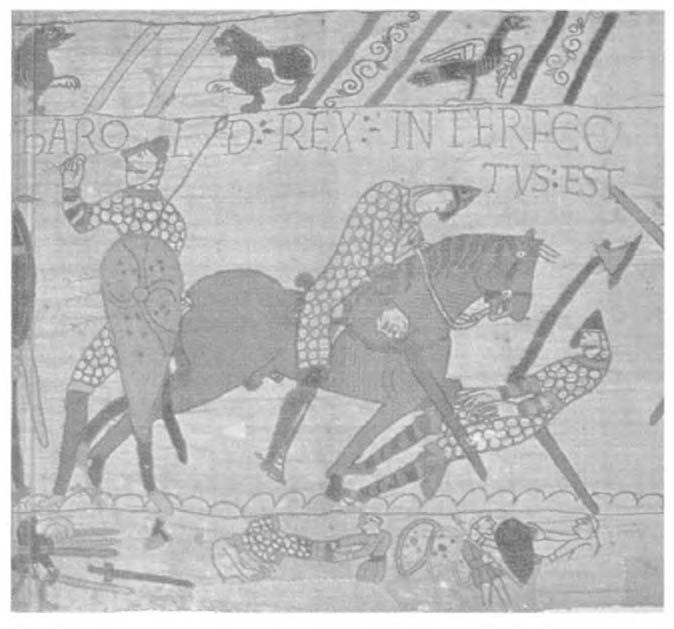
But there are problems. The Tapestry, as is well known, is debatable, principally for two reasons. First, there is debate over which figure is actually Harold. Is he the upright figure grasping the arrow (whose head, after all, interrupts the word ‘Harold’ in the caption); or is he the falling figure immediately to the right, being hacked down by a horseman, under the words ‘interfectus est’ (‘was killed’)? Some critics solve the riddle by saying that Harold is represented by both these figures, and that the Bayeux Tapestry artist does this kind of thing on numerous other occasions; others have demurred that, if this is really the case, Harold manages the neat trick of losing his shield and acquiring an axe in the act of dying.
Even if, however, we accept that the first figure represents Harold, there is controversy over the arrow itself. The Tapestry was heavily restored in the mid-nineteenth century, and the death of Harold is one of the areas where the restorers may have taken considerable liberties. Some experts contend, from an analysis of the embroidery and an examination of the earliest drawings of the Tapestry in its (apparently) unrestored state, that the first figure is actually holding not an arrow but a spear, ready to hurl at his attackers.38
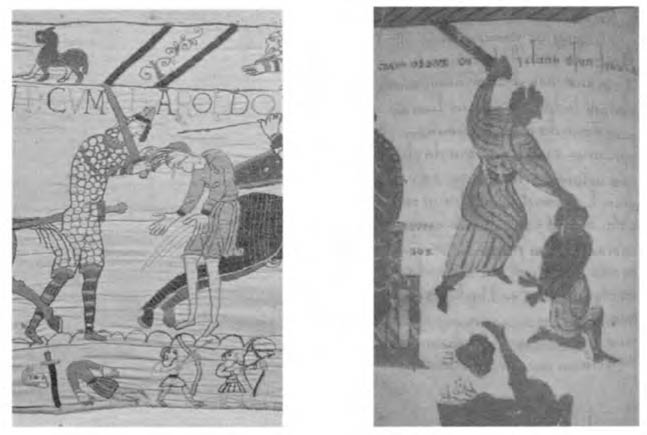
Even if the Tapestry artist did intend to depict an arrow, can we be sure that he was depicting what really happened? On many occasions we can see that the Tapestry includes images which are not truly original, but which have been copied and adapted from other illustrated manuscripts that the artist had to hand, and it looks very much like this process was at work in Harold’s death scene. Immediately before the king dies, we see a Norman soldier about to decapitate an unarmed Englishman. This otherwise inexplicable image seems to have been lifted more or less unaltered from an illustrated version of an Old Testament story, namely the fate of King Zedekiah and his sons, one of whom is shown being beheaded in exactly this manner. This artist may have lighted on this particular image because of the resonance of the story – Zedekiah and his family were punished because he had broken his oath of fealty to his overlord, and Zedekiah’s own punishment was blinding. It could well be, therefore, that the arrow in Harold’s eye is simply a piece of artistic licence based on nothing more than an allusion to this particular Bible story, and that blinding was felt to be a fitting end for a king who was similarly foresworn.39
Lastly, we have to consider the fact that the Tapestry is our only contemporary source to suggest that Harold was hit in the face by an arrow. True, a similar report is carried by an Italian chronicler, Amatus of Montecassino, writing about 1080, but his account is compromised by the fact that the Latin original is lost – it survives only in a fourteenth-century French translation, heavily interpolated in places, and hence of negligible worth.40 These two questionable sources apart, the story that Harold was felled by an arrow occurs in later works (Baudri of Bourgeuil, William of Malmesbury and Henry of Huntingdon are all twelfth-century). Contemporary accounts, by contrast – the Carmen, William of Poitiers, William of Jumièges and the various versions of the Anglo-Saxon Chronicle – make no mention of it. In the case of the last two, this omission is not very remarkable, given the brevity of their accounts; in the case of William of Poitiers and the Carmen it is altogether more striking. Poitiers offers us the longest and most detailed account of the battle, yet makes no mention of the manner in which Harold died. Possibly this was because he did not know. Alternatively, it may have been because he knew full well, having read the Carmen’s version, and did not care to endorse it.
For the Carmen – our earliest source for the battle – offers an entirely different account of how Harold met his end. According to the Carmen, the battle was almost won – the French were already seeking spoils of war – when William caught sight of Harold on top of the hill, hacking down his foes. The duke called together a cohort of men, including Count Eustace of Boulogne, Hugh of Ponthieu and a certain ‘Gilfard’ (‘known by his father’s surname’), and set out to kill the king. In this they were successful, and theCarmen gives a graphic description of the injuries each inflicted on Harold, who was pierced with a lance, beheaded with a sword and disembowelled with a spear. His thigh, we are told (possibly a euphemism for his genitalia) was hacked off and carried away some distance.41
Historians have always had huge problems with this story, and still tend to reject it outright. One of the foremost experts of the last century, Professor R. Allen Brown, found it impossible to believe that William had been personally involved in Harold’s death; not because the duke was uninvolved in the fighting, for everyone accepts that fact. Rather, his objection was that, had William really been involved so directly in Harold’s death, ‘the feat of arms would have been bruited abroad in every court and chanson in Latin Christendom and beyond’.42
This argument, however, assumes that everyone in Christendom would have regarded the premeditated butchery of a crowned king as acceptable behaviour, which was not necessarily the case. The Carmen insists that Harold’s killers acted ‘in accordance with the rules of war’, a statement which by itself suggests that others may have felt that these rules had been broken. One person who may have thought as much was William of Poitiers. In general he is not afraid to contest points of detail with the Carmen and offer his own version of what happened. When it comes to Harold’s gory end, however, he offers no denial and no alternative scenario: he simply lapses into silence. With most writers, their silence on a particular point would be a poor foundation on which to build an argument. But with a writer as erudite as William of Poitiers, we can reasonably read more into it. Poitiers wanted to present the duke as measured, merciful and just in all his dealings, and in particular in his pursuit of England’s throne. He did not want to show his hero, whose mission had been sanctioned by the pope, hacking his opponent into pieces. The suspicion that Poitiers tried to suppress the Carmen’s version of Harold’s death is reinforced by his similar failure to include the episode involving Taillefer the juggler. Perhaps he thought it unreliable; more likely he considered it shameful – a piece of bloodthirsty barbarism that cast the Normans in a bad light. More pertinent still is the fact we have caught Poitiers at this kind of suppressio veri once before, in his account of the taking of the town of Alençon. His source, William of Jumièges, tells us that the duke mutilated the town’s defenders by lopping off their hands and feet, but Poitiers omits all mention of this from his own account. In the case of Harold’s death, therefore, the silence of William of Poitiers, far from undermining our faith in the Carmen’s version, could instead be considered to strengthen its credibility. That credibility is also enhanced by the fact that the poem’s author, Guy of Amiens, had close connections with the men he tells us were William’s accomplices.43
Of course, we cannot say for certain how Harold died. Our sources, as ever, are contradictory, and each of them can be regarded as in some way compromised (because they are based on biblical or classical motifs; because they are inherently biased; because they are better regarded as imaginative works of art rather than sober reportage). We know that at various points in the battle the Normans showered the English with arrows and crossbow bolts, so it is not unlikely that Harold was hit, perhaps fatally, perhaps in the eye. At the same time, we cannot lightly disregard the Carmen (as historians have usually done) when it tells us that Harold died in a very different way, deliberately cut down by his enemies. Apart from anything else, a deliberate killing accords well with William’s assumed war-aim. He had risked everything to get an army to England and to bring Harold to battle. After a long day’s fighting, with the autumn light starting to fade, it would have been quite possible for the English king to withdraw, enabling him to fight another day. William could not take that risk; for him it was imperative that his opponent should die before the day was out. Given this fact, it would not be at all surprising if the duke, in the closing stages of the conflict, decided to risk all and lead just the kind of death squad that the Carmen describes. By the same token, with the deed accomplished, it would be equally unsurprising if the Normans in general, like William of Poitiers in particular, sought to keep these details quiet. An anonymous arrow in the eye accorded better with the idea that, in the final analysis, Harold’s death had been down to the judgement of God.