
9
A glance at the Frankish annals recording events over the years since 820, when the first small fleet of thirteen Viking ships raided around the mouth of the Seine, shows how persistently the raiders used the great river to penetrate the territories of the Frankish empire. In the 840s, fleets under the commands of Asgeir and Ragnar sailed as far as Paris, looting and burning as they went. Rouen was captured and burnt by Asgeir in 841, and when he returned to the Seine in 851 Rouen served as a base from which to raid on foot in the region of Beauvais. A permanent camp was established on the fluvial island of Jeufosse, from which successive generations of Viking leaders were able to exercise control over access to the Seine. The Norwegian Sigtrygg, who spent time in both Ireland and Francia, joined forces with a leader named Bjørn to raid along the Seine as far as Chartres until beaten back in a rare military triumph for Charles the Bald. In 857 the two armies attacked Paris and captured and sacked Chartres. Bjørn was joined by Hasting early in 858 and the attacks from the Seine valley continued. As we saw in an earlier chapter, the power struggle that followed the death of Louis the Pious made things much easier for the Vikings.
Carolingian efforts to preserve order within the divided empire were made more difficult by a development in the system of royal administration whereby those royal officials like the counts, who had formerly been peripatetic and derived their authority from their position within the Carolingian hierarchy, claimed an increasing autonomy that turned them into magnates with local, geographically determined power bases. Dynasties developed, several of which established themselves in the region around what would later become Normandy, known as the Breton or Neustrian march. In the days of Charlemagne it extended from Calais to the borders of Brittany and its military role within the empire was to prevent the incursions of the notoriously independent Bretons from the west. Fifty troubled years after Charlemagne’s death it was clear that the region could not be defended and in 867 the Cotentin and the Avranchin were ceded to the Bretons. Chronic instability in the region persisted as they continued to push eastward without ever establishing themselves as the dominant power in the region.
At the same time the Carolingian churches and monasteries were abusing their privileges of royal immunity to the point at which they more or less rejected any obligations at all to central government. Having neither money, lands nor reliable armies, the Carolingian monarchy was reduced to issuing ineffectual decrees and ordinances. Lawlessness and theft were combated by decrees advising that violators be ‘admonished with Christian love to repent’; punishment was to be meted out to the guilty ‘as far as the local officials could remember them’. One forlorn decree even required royal officials to swear on oath not to become highway robbers themselves.1
To this brew of royal intrigue and looming anarchy Viking raiders added their own particular form of terror. Hasting and Bjørn raided again and again in the Cotentin and Avranchin and turned them into deserted wastelands. In 865 the crews of some fifty ships built a new camp on the Seine at Pîtres, and in 876 another fleet of about 100 ships sailed up the Seine and were bought off in the following year for 5,000 livres by Charles the Bald. Just as it had done in England, Viking terror devastated and demoralized the Christian Church. Bishops were killed at Noyon, Beauvais and Bayeux, and the record of bishops at Avranches ceases after 862, at Bayeux after 876 and at Sées after 910.
The policy of a sometimes well-meaning appeasement had been practised by Frankish rulers for almost a century prior to the agreement made in 912 between Charles the Simple, king of the Western Franks, and a Viking leader named Rollo. Usually these deals involved Frisia, from Rüstringen in the north to Antwerp in the south, and the beneficiaries were Danes. Hemming was given the harbour of Dorestad on the Waal, a tributary of the Rhine, in 807; Louis the Pious gave it to Klak-Harald in 829, between 855 and 873 it was in the hands of Rorik, and in 882 Godfrid took it over.2 None of these episodes turned into a full-scale attempt to settle in Frisia and the archaeological record of the Viking presence there is sparse, but the story of Godfrid’s agreement of 882 with Charles the Fat, in which he was given ‘land to live on’ and a royal bride named Gisla, makes an interesting overture to Rollo’s establishment of the colony in Normandy.
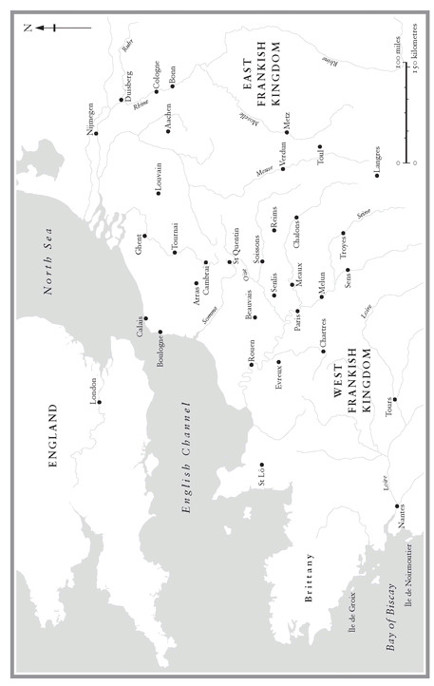
Vikingsd used the rivers of the north west Furopean mainland to penetrated deep into Frankish territory and capitalize on the rivalry that broke out between the sons of Louis the Pious after his death.
Also known to his biographers, chroniclers and poets as Rollo, Rollon, Robert, Rodulf, Ruinus, Rosso, Rotlo and Hrolf, Ganger Rolf or Rolf the Walker, founder in about 911 of what became the duchy of Normandy, is another of those, like Ragnar Hairy-Breeches and Ivar the Boneless, whose prominence among their contemporaries conspired over the years with an almost complete lack of biographical information to transform them from ordinary mortals into dense hybrids of men, myth and legend. As we noted earlier, Dudo of St-Quentin’s claim that Rollo was one of the Viking leaders at the long siege of Paris in 885 seems doubtful. A canon of St-Quentin in Picardy, Dudo was commissioned in 994 to write his history of the duchy of Normandy by Rollo’s grandson, Duke Richard I. Dudo’s account of the creation of the duchy and its subsequent development has suffered more than most from the rigours of source criticism. Much of his information about Rollo’s activities prior to the foundation of the duchy is probably the product of a desire to insert retrospectively into significant events someone whose rise to prominence went almost unnoticed in the contemporary record, and thereafter to portray him in as sympathetic a light as possible.3 Yet Dudo’s is the closest we have to a local and contemporary history of the duchy. His successors as historians of the duchy were William of Jumièges, writing some time after 1066, and Orderic Vitalis, who died in about 1142. Both used Dudo as their source, and though they did so with discretion and were able to provide a few extra items of information they did not substantially alter his account of the early days of the duchy. There are only three references to Rollo in independent contemporary sources, each of them brief, none that tell us anything about who he was or where he came from.
His origins, not unsurprisingly, are uncertain. The tradition Dudo records is that he was from Dacia or Denmark, of aristocratic family, and driven out of the country either as a result of what Dudo implies was a form of population control in Denmark that involved the expulsion of whole generations of young men by the drawing of lots, or because the Danish king considered the popular Rollo too great a threat to his power. Rollo made his way to Skåne and from there embarked on a career as a Viking that included making tributaries of the Frisians in Walcheren. In England he struck up an immediate and close rapport with a king whom Dudo calls ‘Alstem’, and agreed terms of perpetual friendship and support with him. This is regarded as one of Dudo’s wilder fictions and a grotesque misjudgement of Alfred of Wessex’s character. Yet its oddness is diminished if we take the reference to be not to Alfred, king of Wessex, or even a misdated Athelstan, grandson of Alfred, but to Guthrum, the Danish leader whom Alfred baptized and then recognized as king of the East Angles in 880. ‘Alstem’ is an acceptably close approximation to Guthrum’s baptismal name Athelstan, and we know that Athelstan used the name in minting his coins. Identifying Alstem as Guthrum/Athelstan, king of the East Angles, makes credible the warmth and respect that Dudo tells us sprang up between these two men, apparently spontaneously.4 When Rollo’s emissaries reveal to Alstem that they are Danes, the king’s reported reply - ‘No region brings forth extraordinary men, and ones actively instructed in arms, more than does Dacia’ - has the unique ring of one ex-pat fondly greeting another. Guthrum/Athelstan died in 890 and had been king in East Anglia since 880, dates that easily accommodate these associations. Dudo tells us that Rollo lived to an advanced age and died in about 929 or 930, so if we hazard a guess at a birthdate of about 860 this would make him active by 880 at the latest.
The identification also supplies a logic for this Danish Alstem’s recurring problems with a respectless and rebellious native population: ‘The English, puffed up and perverse with their audacious insolence, refuse to obey my commands’, he complained to Rollo.5Placing Rollo at the siege of Paris that took place in 885, Dudo writes as though this were indeed the state of affairs:
And when the English heard that Rollo had laid siege to the city of Paris, and was occupied with Frankish matters, they reckoned that he would not come to the assistance of his friend king Athelstan, and they renounced their fealty. They began to grow insolent and arrogant and fierce, and opposed the king by vexing him with battles.6
Dudo goes on to refer to the English as ‘perfidious’, illogically for a supporter of the house of Wessex, logically for the supporter of a Danish conqueror struggling to assert his authority over the natives. He even tells us that Alstem offered a half share of his kingdom to Rollo, an incredible gesture for Alfred, but for Guthrum/Athelstan only a sensible attempt to solve problems of order in his new kingdom.
The identification of Alstem with the Guthrum/Athelstan known to us from Anglo-Saxon Chronicle strengthens Dudo’s claim that Rollo was of Danish origins; but in general Dudo’s account of Rollo’s origins and career has all the vagueness and general applicability of a newspaper horoscope. It suffers by comparison with Snorri Sturluson’s more detailed account. In Snorri’s Saga of Harald Fairhair the future conqueror of Normandy is a Norwegian youth named Hrolf, a son of that Ragnvald, earl of Møre, who was Harald’s main ally during the campaign to unify Norway and his ceremonial hairdresser once it was successful. Snorri tells us that Rollo was so big that no horse could bear his weight and he had to walk everywhere, and was for this reason known as Ganger Rolf or Rolf the Walker. It makes him a sort of legendary inversion of Ivar the Boneless who, in one set of stories about him, could walk nowhere at all and had to be carried everywhere. For once it is Dudo who has the more sober explanation for this tale, conceding that in the last year of his life Rollo was ‘unable to ride a horse’ but adding that this was owing to ‘his great age and failing body’. There is no hint of his being an unusually large man.
Like Dudo’s Rollo, Ganger Rolf was a successful Viking. He made the mistake of harrying on the shores of the Vik at a time when King Harald himself was in the region. Harald promptly outlawed the young man. Rolf’s mother Hild, whose family name was Nevja, tried to persuade him to change his mind, but the king was adamant. Hild then composed this sorrowing verse:
The name of Nevja is torn;
Now driven in flight from the land
Is the warrior’s bold kinsman.
Why be so hard, my lord?
Evil it is by such a wolf
Noble prince to be bitten;
He will not spare the flock
If he is driven to the woods.7
The lines enjoy the special credibility generally extended to poems embedded in saga texts as more likely to be creations describing contemporary events; yet they have no direct bearing on the identification of Rolf with Rollo of Normandy. This comes unequivocally with Snorri’s summation of Rolf’s fate after his banishment: ‘Rolf the Ganger afterwards crossed the sea to the Hebrides and from there went south-west to France; he harried there and possessed himself of a great earldom; he settled many Norsemen there, and it was afterward called Normandy. ’8 Among Rollo’s three half-brothers was Rollaug, a name that transmutes more easily into Latin ‘Rollo’ than does Rolf. Snorri quotes, moreover, a verse by Einar, earl of Orkney, which shows that Rolf and Rollaug were at some point together in the Orkneys. But arguing against the faint possibility that Snorri somehow got the brothers confused and that it was Rollaug who was actually ‘Rollo’ of Normandy, is the story mentioned earlier of how Rollaug was told to settle in Iceland by his father, for he had ‘no disposition for war’.
Rollo’s Hebridean connections are further supported, despite some passing confusion, by the anonymous twelfth-century Welsh history The Life of Gruffyd ap Cynan, where the genealogy of Gruffyd’s grandfather includes Rollo, here a brother of King Harald Finehair, who subdued ‘a large part of France which is now called Normandy, because the men of Norway inhabit it; they are a people from Llychlyn’. 9 ‘Llychlyn’ looks like a variant spelling of that independent island kingdom, mentioned earlier, comprising the northern and western isles as well as parts of mainland Scotland.
At the close of the nineteenth century, with the Scandinavian nations jostling for position over the emerging reality of a ‘Viking Age’ and laying claims to its various heroes, the question of Rollo’s nationality became for a short time a matter of urgent debate. The Danish historian Johannes Steenstrup used the surviving fragments of a Planctus for William Longsword, a grief-poem written by an unknown author shortly after the murder of Rollo’s son and successor William Longsword, in 942, to advance arguments for accepting the reliability of Dudo’s history that would make Rollo a Dane. The Norwegian Gustav Storm employed the Planctus to opposite effect to reinforce Snorri’s case for his Norwegian origins, pointing out that the Planctus’s description of William as ‘Born overseas from a father who stuck to the pagan error/and from a mother who was devoted to the sweet religion’ directly contradicts Dudo’s claim that William was born in Rouen. Snorri’s tale of Rolf’s Hebridean interlude, along with the Planctus’s reference to his Christian wife, both appear to complement a tradition, recorded in the Icelandic Book of the Settlements, and repeated in the so-called Great Saga of Olaf Tryggvason,10 that Rolf had a daughter named Kathlín, or Kathleen, who married the Hebridean King Bjólan.11Dudo makes no reference to this daughter, whose name is both Celtic and Christian.12
Snorri is very sure of himself in the identification of Rolf with Rollo, and the enigma of Dudo’s ignorance of detail concerning his subject’s origins that was available to Snorri over 200 years later remains. It may well be that he was trying to rationalize the fact that Rollo was Norwegian but most of his followers Danes. In his Saga of St Olav, king of Norway between 1016 and 1028, Snorri revisits Rolf/Rollo’s great triumph at the conclusion of a typically brisk genealogical round-up: ‘From Rolf the Ganger are the jarls of Ruda (Rouen) descended, and long afterwards they claimed kinship with the chiefs of Norway and set great store by it for many years; they were always the Norsemen’s best friends, and all Norsemen, who would have it, had peace land with them.’13
Though there are other alternatives - William of Jumièges cautiously gives no pedigree for Rollo and says he was chosen by lot to lead his generation of Seine raiders; and the late tenth-century historian Richer of Reims trenchantly refers to Rollo as a ‘pirate’ and names his father as a certain Catillus (Ketill)14 - Snorri’s identification remains the most popular, though it is certainly not definitive. Nor is the anonymous thirteenth-century Saga of Ganger Rolf, a sublimely wild account of the doings of a man who shares nothing but his name with the hero of Snorri’s and Dudo’s histories, and the legend of his great size with Snorri’s. Contemplating some of his more obvious outrages against both history and common sense, the author admits with a disarming shrug that ‘maybe this saga doesn’t tally with what other sagas have to say about the same things, not in regard to the various events, or the names of the people, or the brave and bold deeds done by this one or that, or where the various chieftains ruled’. He assures his readers, however, that
those who have assembled these tidings must have based them on something, either ancient verses or else the testimonies of learned men. And in any case, few if any of the stories from the old days are such that people would swear that everything happened just as related therein, since in most cases a word here and there will have been added. And sometimes it’s not possible to know every word and every happening, for most things happen long before they’re told about.15
As we have noted earlier Dudo put the date of Rollo’s arrival on the Seine at 876 and placed him at a siege of Paris which, if there be any truth in the story, is more likely to be that of 886. Thereafter he treats him as the only significant Viking leader on the lower Seine. At some point Rollo captured the city of Rouen. Unlike his predecessors, he managed to keep control of it. The Historia Norwegie describes in admiring terms the tactics that won the day. The crew of his fleet of fifteen ships dug pits disguised with turfs between the city walls and the river and then lured their mounted opponents into the traps by pretending to run for their ships once the battle was under way. The trick was so successful that they were able to enter Rouen unopposed.16 Indeed, it seems that Rollo had established himself so firmly there that defeat in a battle against the Neustrian count Robert I in about 911 led not to flight but instead to an invitation from Charles the Simple to join him at the negotiating table, where the king formally recognized Rollo’s right to remain in possession of a large part of north-west Francia, pointedly described as already ‘too often laid waste by Hasting and by you’.17 In return Rollo agreed to be baptized and to assist the king in the defence of the realm. The seal of agreement was to be marriage between Rollo and Charles’s daughter, Gisla.18
The treaty agreed upon in 912, at a meeting between Rollo and Charles the Simple at Saint-Claire-sur-Epte, has not survived and is a historical presumption only; but there is a reference to it in a royal charter of March 918 which deals with the matter of an abbey whose patrimony had been bisected as a result of it:
we give and grant this abbey of which the main part lies in the area of Méresias on the River Eure to Saint-Germain and to his monks for their upkeep, except that part of the abbey [’s lands] which we have granted to the Normans of the Seine, namely to Rollo and his companions, for the defence of the kingdom . . .19
Rollo received a further grant of land in central Normandy in 924. The contemporary French analyst Flodoard of Reims tells us:
The Northmen entered upon peace with solemn promises in the presence of Count Hugo, Count Herbert and also Archbishop Seulf. King Ralph was not there, but with his consent, their [the Normans’] land increased with Maine and the Bessin, which in a pact of peace was conceded to them . . .20
Rollo died sometime between a final mention of him by Flodoard in 928, and 933, the year in which a third grant of land, usually identified as being the Cotentin and Avranchin areas of Brittany, was made to his son and successor William, known as Longsword. This completed the basic territory of what would become known as the duchy of Normandy. Its boundaries ran roughly from Eu, at the mouth of the river Bresle in the east, across to the river Vire in the west. It was bounded by the English Channel in the north and by the waters of the Avre in the south, an area corresponding to the modern French départements of Manche, Calvados, Seine Maritime and Eure. Orne was included, with the exception of Mortagne and Domfront. The validity of Dudo’s claim that Brittany was included in the initial grant of land remains uncertain. One small piece of possible evidence in favour is a coin found at Mont-St-Michel bearing the inscription + VVILEIM DUX BRI that is thought to refer to Rollo’s son William and to have been issued by him as a duke of Brittany.21
Along with the agreement of 878 between Alfred and Guthrum, sometimes known as the Treaty of Wedmore, and the trade agreements negotiated in 907 and 911 between the Kievan Rus and the Byzantine emperor, Saint-Claire appears to be the third example available to us of a negotiated settlement between pagan Vikings and Christian rulers. Each in its own way attempted to invite the raiders into the fold of the nominally civilized world of Christian culture, and each in its own way succeeded. Charles’s aims were to put an end to the century-old threat from Viking fleets that used the Seine to attack Paris and to bring stability to a volatile region by sponsoring the authority there of a ‘good’ Viking leader. From the time Rollo’s occupation of its lower regions was legalized he remained loyal to the agreement and Viking attacks on Paris effectively ceased.
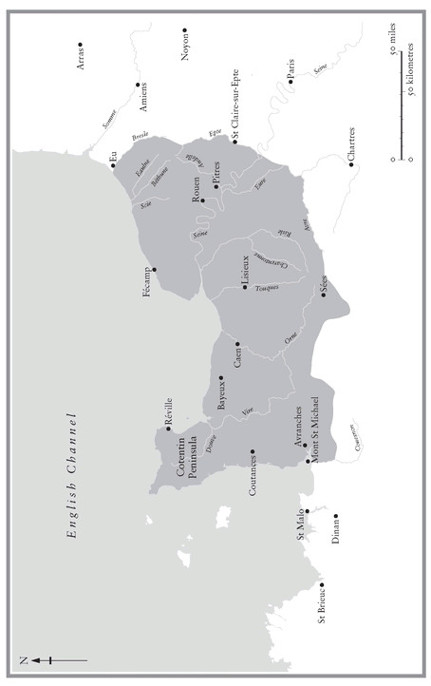
Following the original grant of land to Rollo in 911 the duchy of Normandy had grown to include the Cotentin peninsual by about 933.
The early years of the colony’s history are turbulent and hard to follow. In 923 Rollo’s forces fought alongside those of Charles around Beauvais, and the grant to him of Bayeux and Maine in the following year may have been an attempt by Charles’s enemy, King Ralph of Burgundy, to split the alliance. In 925 the Vikings devastated Amiens and Arras in the east, but were stopped at Eu by a coalition of Ralph’s allies in their attempts to expand further east into modern-day Picardy. A further complication was the activities of another band of Viking raiders on the Loire, under the leadership of the otherwise obscure Rognvald. After the death of Duke Alan the Great in 907, the Vikings showed an increasing interest in Brittany, whose Celtic population had maintained a fierce independence of Frankish attempts to incorporate it. By about 919 Rognvald’s army had control of all Brittany. In 921 he was formally given Nantes by Count Robert of Neustria, and it seems he may have been expecting the concessions to Rollo in 924 to lead to a Frankish version of the Danelaw which would also involve him, for Flodoard tells us that in anger at not being awarded any land within France at this settlement he led his forces on a series of devastating raids into Frankish crown land, between the Loire and the Seine, until defeated by Hugh the Great, the Robertian count of Paris and duke of the Franks, and compelled to fight his way back to Nantes. He seems to have died shortly after this and with him any prospect of a Viking axis of power connecting Rouen and Nantes and posing the same sort of threat to the whole of France as the York-Dublin axis might have done to the kings of Wessex. His Vikings survived for a few more years, but had been driven out of the area by 939 following a campaign by the Breton leader Alan Barbetorte, or Twisted Beard.
Dudo, in words similar to those in the Anglo-Saxon Chronicle that announced the Danish takeover in Northumbria and East Anglia, says that Rollo ‘divided that land among his followers by measure, and rebuilt everything that had long been deserted, and restored it by restocking it with his own warriors and with peoples from abroad’.22 What flimsy documentary evidence there is suggests that he took seriously his new role as the representative of the king’s authority in Normandy, and for his own sake and the sake of his sponsor attempted to restore order and respect for the law to the region. The government of the Norman rulers was illiterate for most of the first century of its existence and as Dudo tells us so little about the specific nature of Rollo’s administration we do not even know whether he continued to surround himself as a Frankish count with the hird of a typical Viking chieftain, nor whether he imported from Scandinavia the system of naval levy known as the leithanger. There is, however, nothing to suggest that he introduced government by thing meeting, and plenty of hints that it was autocratic in the Frankish tradition. Dudo claims that Rollo passed laws against robbery and violence that made them punishable by death, a novelty by comparison with Carolingian law, which exacted only a fine.23 Two of his anecdotes show that, from the very start, Rollo responded to slights or challenges to his authority with the same implacable faith in the efficacy of terror he had shown as a Viking.
Rollo had introduced a decree ordering that farm implements be left out in the field and not taken into the house at the end of the day. To make it appear as though they had done so and been robbed, it seems that a farmer’s wife hid her husband’s ploughing implements. Rollo reimbursed the man for his loss and ordered the trials by ordeal of the potential suspects. When all survived the ordeals he had the wife beaten until she confessed. And when the husband admitted that he had known it was her all along, Rollo handed down a finding of guilty on two counts: ‘The one, that you are the head of the woman and ought to have chastised her. The other, that you were an accessory to the theft and were unwilling to disclose it.’ He had them both hung ‘and finished off by a cruel death’, an action which Dudo credibly claims so terrified the local inhabitants that the territory became and remained free of petty criminality for a century afterwards.
The second tale also shows how central was the Viking idea of personal honour, and how fatal to it the taint of unmanliness. Shortly after Rollo’s marriage to Charles’s daughter Gisla, two of Charles’s warriors paid her a visit. Gisla entertained them in private. Presently rumours began circulating, to the effect that Rollo had failed to consummate the marriage. Any suggestion of sexual impotence, casting doubt on the legitimacy of his heirs, would have seemed particularly dangerous to Rollo. Suspecting that Gisla’s visitors were the probable authors of the rumours, he had them arrested and summarily executed in the public market place in Rouen. The story, with its possible hint at Rolf’s homosexuality, provides another glancing point of contact with the Saga of Ganger Rolf, whose ‘Rolf’ is said to have been uninterested in women. As an illustration of Rollo’s decisive ways, the tale has a certain symbolic value; but as history it is compromised. Gisla was one of the king’s six daughters by his first wife, Frédérune, and as the couple did not marry until 907 Gisla would have been, at most, five years old at the time of the Saint-Claire treaty.24 That the child-marriage took place as a diplomatic seal on the agreement that gave Rollo a foothold in the Frankish aristocracy need not be doubted.
Dudo is more interested in persuading his readers of the genuine nature of Rollo’s conversion than in providing details of the legislative and executive structures of the new regime. He solves the delicate problem of how to deal with Rollo’s Heathendom in the years before baptism and the respectability of legitimate rule by a literary trick involving Hasting, or Anstign, as he calls him, amplifying whatever natural qualities of cruelty Hasting may have possessed to turn him into a Heathen archetype of purest evil:
Death-dealing, uncouth, fertile in ruses, warmonger-general,
Traitor, fomenter of evil, and double-dyed dissumulator,
Conscienceless, proudly puffed up; seducer, deceiver, and hot-head.
Gallows-meat, lewd and unbridled one, quarrel maintainer,
Adder of evil to pestilent evil, increaser of bad faith,
Fit to be censured not in black ink, but in charcoal graffiti.25
He lists the holy places burnt by Hasting during his ravages in Western Francia, including his own monastery at St-Quentin, the churches of St-Médard and St-Éloiat Noyon, and St-Denis and Ste-Geneviève. Rollo, by easy contrast, becomes the ‘good’ Heathen, the Viking whose natural instincts always inclined him towards the Christianity he eventually espoused. Dudo credits him with the restoration of churches he and his men had been responsible for ravaging, the reopening of monasteries they had made uninhabitable, and the rebuilding of the walls and defences of cities and towns torn down by them. He even makes Rollo’s piety retrospective and tells an incredible tale of how he brought over with him from England the relics of a holy virgin, Hameltrude, carried them up the Seine on board his longship and deposited them in the church of St-Vaast. In further proof of Rollo’s piety, while still wearing the white baptismal robes and under his baptismal name ‘Robert’, he spent, we learn, the first seven days of his expiation at St-Claire in handing out gifts of land to various churches in the diocese of Rouen, having first ascertained which of them were considered most venerable and which were protected by the most powerful saints. Not until the eighth day did he finally turn his attention to the allocation of land to his own men.
Many of these, it seems, were not willing to join their leader in abandoning their Heathen beliefs. In a letter written before 928 Guy, the archbishop of Rouen, approached his colleague Hervé at Reims for advice on the best way to deal with apostate Heathen converts. In language that recalls the exasperation of Louis the Pious’ bishops at the behaviour of Klak-Harald’s following, who practised their own form of serial baptism in the 820s, Hervé passed the question to Pope John X, asking what was to be done with Heathens, ‘when they have been baptized and rebaptized, and after their baptism carry on living as Heathens, killing Christians as the Heathens do, slaughtering priests and eating animals that have been sacrificed to their idols’.26 In reply, the pope counselled patience and persistence, urging them to regard Rollo and his colonists as merely inexperienced in the ways of the new faith, and their conversion as not an event but a process which would inevitably take time to complete. He also reminded Hervé that ‘the calamities, the oppression, the dangers which have threatened our regions have come not only from the Heathens but from Christians too’.27 Flodoard tells us that in 943 there was an engagement between the Frankish Duke Hugo and a group of Normans ‘who had arrived as Heathens or who were returning to Heathendom: a large number of his own Christian soldiers were killed by them’. Later in the entry for the same year we hear of an otherwise unknown Viking Norman leader named Turmod, ‘who had reverted to idolatry and to the gentile religion’ and was apparently also trying to ‘turn’ the Norman ruler Richard (Rollo’s grandson) and involve him in a plot against the Frankish King Louis. In 1906 a tenth-century longship burial on a commanding headland on the Île de Groix, some 6 kilometres off the coast of southern Brittany, was excavated and found to contain two bodies as well as the remains of dogs and birds. Among the wealth of finds recovered were swords, arrowheads, lance-heads, rings, tools, gaming pieces and dice. Like the Oseberg ship, it had been dragged overland to a previously prepared site. Unlike the Oseberg ship it had then been burnt, the spectacle being framed by twenty-four shields.28 This is the only known archaeological evidence of a ship being burnt as part of a Viking burial ritual, and Ibn Fadlan’s literary description of the Rus funeral ceremony for their dead chieftain on the banks of the Volga gives us some idea of what the ritual may have involved.29 One of the two bodies was that of an adolescent and the archaeologist Julian D. Richards has suggested that here, too, may be the signs of a human sacrifice. The Île de Groix funeral probably took place after the official conversion to Christianity of most of the Vikings in the region, and the sumptuous nature of the ceremony may hint at a conscious act of apostasy.30
In his detailed study of the Norman conversion, the French scholar Olivier Guillot noted that Flodoard seems to have regarded the conversion of Rollo and his settlers as a process that was demonstrably under way as early as 923, and there is evidence that Rollo was sincere in his desire to embrace certain aspects of Christian culture. As we saw earlier, tradition tells us that his Scottish-born daughter bore the Christian name Kathleen, and both the children of his later association with a woman named Poppa were given Christian names. If his son Guillaume (William Longsword) also had a Scandinavian name then this has not come down to us. Rollo’s daughter had both a Norwegian name, Gerloc, and a baptismal name, Adèle. The reference in the Planctus for William Longswordto William as ‘born overseas from a father who stuck to the pagan error/and from a mother who was devoted to the sweet religion’ might be no more than a factual comment on Rollo’s early life. Adémar of Chabannes, however, writing about 100 years after Rollo’s death, described his last days as a time of religious madness, in which the Heathen ‘Rollo’ rose up against the Christian ‘Robert’ and in a desperate attempt to atone for the betrayal of Odin and Thor ordered the beheading of 100 Christians as sacrifices to them.31This was followed by a frenzied attempt to balance the books yet again when he distributed ‘one hundred pounds of gold round the churches in honour of the true god in whose name he had accepted baptism’.32 Adémar is the only ancient historian to doubt the truth of Rollo’s conversion. His story provides a rare and persuasive insight into the violent tensions that could arise when devout men change the object of their devotion as a matter of political convenience. In Rollo’s case they were seemingly mind-wrenching.
The large and consistent Viking military presence throughout the ninth and tenth centuries in the western Frankish kingdom has left little material archaeological trace. In 1927 the Norwegian archaeologist Haakon Shetelig visited museums along the Loire and the Seine and compiled a list of holdings that included an axe, seven spears and twenty-one swords, most of them dredged from the rivers or constituting stray finds. The Swedish archaeologists Arbmann and Nilsson complemented Shetelig’s list in 1968 with another two axe-heads from Rouen, and in 1987 a Viking Age sword was unearthed in the basement of the museum at Denain. A lance ferrule and a helmet fragment, possibly of Nordic origin, were excavated in Brittany, at the Camp de Péran (Côtes d’Armor).33 The discovery in the burnt ramparts of Camp de Péran, originally a Celtic fortified settlement, of a coin from York minted between 905 and 925 dates its restoration by Vikings to the early years of the tenth century. Alain Barbetorte is known to have landed at Dol in 936 and fought with the Vikings, an event that has been associated with the evidence of the destruction of the camp.34 Another earthwork, at Trans, Ille-et-Vilaine, may have been built or renovated by the Loire Vikings as they retreated from Nantes in 939.
In 1870 a navvy working on a road near Pîtres on the Seine came across two characteristically Viking Age brooches known as ‘fibulas’, which archaeologists have related to the presence of a Viking fleet at Pîtres in 865. Dated to the second half of the ninth century and of probable Norwegian origin, they come from the grave of a female and provide further evidence that Viking bands travelled with women who were either camp-followers or, as in the case of Hasting in the 890s in Wessex, wives. During a particularly low tide at Reville, in the Bay of Seine, a Frankish necropolis that included possible Viking Age graves was uncovered in 1964. Two ship-settings were seen, of a type familiar from Gotland and parts of Denmark and Sweden, and a third with an unusual arrangement of stones with four right-angled slabs ringed by three stone circles.35 A vase resembling vases found at Birka is the only artefact to have been found, and the cemetery is once again under water. A recent excavation of the area around Rouen Cathedral shows that the layout of streets appears to have been redesigned in the early tenth century and that the modifications gave the ancient town a layout reminiscent of Anglo-Saxon towns.36
The linguistic traces of the Scandinavian roots of the Norman colonists are slightly more extensive. Dudo’s silence on the subject of how the Viking colonists administered Normandy is only partially broken by the survival of a small number of words of Scandinavian origin into the duchy’s thirteenth-century law codes.37 The word ullac, meaning a sentence of outlawry, derived from Old Norse útlagr, and hamfara, or the crime of assault inside a house, from heimsókn. A number of words to do with fishing, whaling, boat-building and the laws covering the status of wrecks were also of Scandinavian origin.38 The settlement of the land by Rollo’s captains produced over the years a small crop of place-names of Scandinavian origin. Compounds first recorded between 1025 and 1200 include Bramatot, Coletot, Esculetot, Gonnetot, Herguetot and Ketetot. These were formed by combining the personal name of the Viking landowner with a genitive ‘s’ - respectively Bramis, Kolis, Skúlis, Gunnis, Helgis and Ketils - and -tot, deriving from the Old Norse word tomt or toft (cf. ‘Lowestoft’ in the English Danelaw), meaning ‘plot’ or ‘piece of land’. Other typical Scandinavian elements compounded in place-names include bec, dalle, hom, hogue, londe and torp (cf. English ‘Scunthorpe’). A number of personal and family names found in present-day Normandy can also be traced back to the Viking settlement via intermediary Latinized forms known from the eleventh century. These include Ásbjørn - Osbernus - Auber; Ásfridr - Ansfridus - Anfray; Ásketill - Anschetillus - Anquetil; Thorvaldr - Turoldus - Thouroude.39 Names like Murdac and Donecan may indicate that some of the colonists were Norwegians who arrived via Ireland and Scotland, just as certain personal names and examples of agrarian terminology that occur in the region between Bayeux and the river Orne indicate that others came via England.
For all that Dudo is now regarded with some scepticism as a reliable source for the settlement of Normandy, his history remains a vivid and interesting document. Two of his anecdotes have played a major role in creating the image of the Viking as an independent, heroic, proud and manly ideal. It seems that once the details of the meeting at Saint-Claire had been agreed upon, Rollo was advised that, as Charles’s vassal, it would now be fit and proper for him to kiss the king’s foot. Rollo declined: ‘I will never bow my knees at the knees of any man, and no man’s foot will I kiss.’ He ordered one of his men to do so instead. The man stepped forward, took hold of the king’s foot and lifted it to his lips without bending himself. The king fell over backwards, provoking ‘a great laugh, and a great outcry among the people’.40 The laughter was presumably from the Vikings and the outcry from the Franks; but the story is a good illustration of the reality behind the agreement, that Charles’s grant to Rollo was a concession to reality.
When William of Jumièges tells us that Rollo was chosen as a leader by the drawing of lots we add the tacit presumption that he was also known by his peers to be the best leader; and yet an insistent streak of egalitarianism attaches to the Viking war band. As part of his claim that Rollo was present at the 886 siege of Paris, Dudo describes an encounter at Damps between the Vikings and Charles’s go-between. The emissary asked by what title their leader was known, and was told ‘By none, because we [are] equal in power.’41 They were then asked if they would be willing to bow to Charles the Simple and devote themselves to his service and accept grants of land from him, to which the reply was: ‘We will never subjugate ourselves to anyone nor cling to anyone’s service nor take favours from anyone. The favour that would please us best is the one that we will claim for ourselves by force of arms and in the hardship of battle.’ The sentiments recall Ibn Rustah’s story of the Rus father throwing down a sword in front of his infant son and convey a specifically Viking ethic of self-reliance and self-assertion through violence. Despite the rapid cultural and linguistic assimilation to Frankish ways that took place, this code survived the transition from Viking to Norman. In his Deeds of Count Roger and his brother Duke Robert, written about 1090, Geoffrey Malaterra, a Norman writer living in southern Italy, formulated a set of general characteristics of the Normans which seem to reflect this continuity of values.42 He writes of an astute people, eager to avenge injuries and looking to enrich themselves from others rather than from work at home. Much interested in profit and power, they are hypercritical and deceitful in all matters, ‘but between generosity and avarice they take a middle course’. Mindful of their reputations, the leaders are notably generous. They are skilled in flattery and cultivate eloquence ‘to such an extent that one listens to their young boys as though they were trained speakers’. They work hard when necessary and can endure hunger and cold. When times are good they indulge their love of hunting and hawking, and they cultivate a sizeable streak of dandyism in their clothing. The aesthetic care that was formerly lavished on the longship was transferred to the horses’ livery as Viking pirates became Norman cavalry, and the practice of decorating and personalizing one’s weapons continued. It is another reminder that Viking culture was not so much primitive, as contemporary Christian scribes so determinedly described it, but essentially different.
Richer of Reims tells a story that epitomizes the determination of the first generations of Viking leaders in Normandy not to be deprived of their newly won land and their status as Frankish aristocrats. In 941, as a vassal of the Frankish King Louis IV, William Longsword made his way to Attigny, where the most powerful leaders in Francia were gathered to confer. Finding the doors barred against him on his arrival, he simply broke them down and voiced his rightful claim to a place at the table. The sight of the Emperor Otto and not his patron in the seat of honour affronted him, however, and before allowing the meeting to proceed he obliged Otto to yield his seat to Louis. A year later and, according to Richer, as a direct result of the insult to Otto, William was murdered.43 The succession passed to his ten-year-old son Richard and precipitated the most serious crisis the colony had faced so far in its short life. In 944 Louis IV and Hugh the Great mounted a joint attack on Normandy, with Hugh attacking Bayeux and Louis occupying Rouen. It seems that Louis could not countenance the thought of Hugh’s occupation of Bayeux and, as so often before, dissension among the Frankish allies worked to the advantage of the Vikings. Hugh took the king into captivity and ended his hostility to the Normans. His troops helped Richard’s men regain possession of Rouen, and in the wake of their victory Hugh gave his daughter Emma in marriage to the young count. The family ties thus established with the Capetians further increased the status of Normandy’s ruling family, and with surprising speed the threat to the survival of the duchy had vanished.44 Hugh continued to offer military support to Richard I and in 954 defeated a certain Harold in what may have been another attempt to retake the duchy. Richard’s marriage to Emma was childless, and after her death he married Gunnor, the mother of his two children and a member of a powerful family of Viking settlers from the west of Normandy. This second marriage strengthened his position in the Cotentin region.45
When a large group of people settles in a foreign country it tends initially to accentuate its roots in an attempt to stave off cultural entropy. Smaller groups, like the Vikings who settled in Normandy, let go more quickly. Dudo tells us that William Longsword had to send his son Richard to Bayeux to learn the Danish tongue, since the language was no longer spoken in the area around Rouen; although this is generally regarded as, at best, an exaggeration, the linguistic position of those in Normandy was unlike that of their fellow-Scandinavians in the colonies of the Danelaw across the Channel, where the native and immigrant languages resembled one another closely enough for a fusion of the two to evolve. Mutual incomprehen sibility must have hastened the demise of the spoken Scandinavian languages in Normandy, much as it did among the Kievan Rus, another warrior aristocracy who settled in a minority in a linguistically remote community. But even though they had traded in their longships for horses, the Normandy Vikings retained a number of their cultural traditions. While slavery was being replaced in other parts of the Carolingian empire by serfdom, the colonists in Normandy developed Rouen as an important centre for the trading of slaves. The trade brought such prosperity to the region that it was still thriving at the end of the eleventh century, occasioning a rebuke from the Lombard cleric Lanfranc to his master, William the Conqueror, and a request that he forbid slavery throughout his territories.
There are many possible suggestions for a date at which the assimilation process could be said to have advanced so far that it is no longer meaningful to refer to the Normans as Vikings and to look for Scandinavian elements in their cultural manifestations. Olav Haraldson, the future saint-king of Norway, was baptized at Rouen in 1013, the last Norwegian king to visit the duchy; and those soldiers from Normandy who fought beside the Dublin king Sihtric Silkbeard at the Battle of Clontarf in 1014 were the last to do so in a Scandinavian cause. As late as 1025, the court of Richard II at Rouen received a visit from Olav Haraldson’s court poet, Sigvat, who may have done what skalds do and composed praise poetry for his host in return for honour and gifts. Richard II, known as ‘the Good’, was the first of the Norman rulers to use the title ‘duke’, which he did from 1006. Perhaps the clearest sign of the irrevocable transition from Viking to Norman is the history his father asked Dudo of St Quentin to write in 994. It must have been among the last acts of Richard I, and there is profound significance in the fact that he chose to have his family remembered in prose, on parchment and in Latin and not, as his forefathers would have done, in verse, on stone and in Old Norse.