
14
Although Icelandic society had no executive force to implement the sentences arrived at by the courts, the strong were not always exempt from punishment. Ari the Learned assures readers of the Book of the Icelanders that ‘many chieftains were convicted or exiled for manslaughter or assault’ during the later years of the Saga Age.1 The fate of Erik the Red, leader of the Viking Age colonists who settled Greenland, is proof that there was substance to Ari’s claim.
Erik’s father Thorvald had emigrated to Iceland after being outlawed from Norway for some killings. In the early 980s, as a grown man, Erik himself became involved in a feud over the death of some slaves, in the course of which he killed a neighbour, Eyjolf Sauer, and a man known as Hrafn the Dueller.2 Relatives of Eyjolf took the case to court and Erik was found guilty and sentenced to outlawry. Grágás distinguished between three degrees of severity for such a sentence. For the most serious crimes a man might be declared a skógarmaðr, literally a ‘man of the forest’, compelled to live apart in forests and other deserted places. His property was confiscated, none was allowed to shelter him and it was a crime to help him leave the country. Should he manage to do so he was forbidden ever to return. In Iceland he might be killed by anyone without retribution, abroad he might be killed with impunity by any Icelander.3 For the least of crimes a sentence of heraðssekt was passed which entrained exile from a particular district for a period of time. On the presumption that the author of the saga was referring to these laws, it would seem that the court decided Erik’s punishment should fall between these two degrees of severity and sentenced him to the Lesser Outlawry, in contrast to the Full Outlawry of the skógarmaðr. The conditions of the Lesser Outlawry were that he pay a fine, leave Iceland within three summers and remain away for another three.4 Three places where he might live in sanctuary while waiting to leave were indicated to him by the court, each no more than a day’s journey from the other. The roads between these places were also his sanctuary, to a distance of a bow-shot from the main track, provided that he did not use them more often than once a month, and on his way to take ship out of the country. Erik left his home at Haukadale in the south of the country and presently settled on the island of Eyxney. Here he became involved in an obscure dispute over personal property which a neighbour had borrowed and failed to return. In the ensuing fight Erik and his party again came out on top. Again the relatives of the men who were killed took them to court and at the assembly at Thorsness Erik and his men were sentenced to the Full Outlawry. Erik at once set about planning to leave the country. As he was getting his ship ready to leave, the relatives of his victims scoured the countryside for him in a bid to kill him before he could get away.
Some seventy years prior to this train of events, a man named Gunnbjørn Ulfsson who had set sail for Iceland from Norway had been driven off course and sighted unknown land in the south-west, to which he gave the name Gunnbjørn’s Skerries. These are believed to have been islands off Tasiilaq, on the east coast of Greenland.5 Other Icelanders before Erik had been tempted to follow up these sightings; some are even said to have made landings on the north-east coast of Greenland, though their names are not recorded and they are not regarded as the European discoverers of the island. Erik sailed from Iceland with the intention of locating this land and possibly settling it, and Erik’s Saga describes his explorations of its south and south-west coasts over the next three years. Erik’s power, or perhaps the status that came with this voyage, seems to have earned him special treatment, for the saga tells us that he then returned to Iceland.6 He named the island Greenland, according to the saga because ‘people would be much more tempted to go there if it had an attractive name’.7 This was about midway through the Medieval Warm Period, and the relatively mild temperatures in the region and ice-free approaches from the sea will have made the name seem less fanciful than we might now be inclined to suppose.
The Book of the Settlements names ten chieftains whom Erik persuaded of the attractions of the new land, and when the fleet set sail it comprised twenty-five ships. These would in the main have been not longships but knarrs, like the Skuldelev 1 ship found in Roskilde fjord, more sturdily built than the warship, with decking fore and aft and around the sides, broad in the beam, high at the stem and stern and with a prow that bent inward. The knarr had a large, square sail, but when necessary it could be rowed by oarsmen seated on the fore and after decks. The families, their livestock and possessions would have travelled in the open, central cargo hold which in harsh weather would have been covered in hides for protection. The ships that were used in the colonization of Iceland are known to have lasted well into the tenth century. The timber native to Iceland was not tall enough for the construction of new, large ships, and at least some of the vessels used for the Greenland crossing were probably the patched-up remnants of the fleet that had transported the settlers to Iceland 100 years previously.8 In good weather the voyage might have taken four days; for a heavily laden armada like this it must have taken considerably longer. Fourteen of the original twenty-five ships completed the journey.
The colonists established themselves in two settlements. The Eastern Settlement, on the southern tip of the island, was the larger of the two, extending from the area around Cape Farewell to Tigssaluk fjorden, north of Ivigtut. Erik built himself a farm near the top of what became known as Eiriksfjord (now Tunugdliarfik), to which he gave the name Brattahlid. The name means ‘steep slope’, though the slope is not notably steep. The smaller Western Settlement was 400 miles further up the west coast, in the Nuuk area around Godthaab (Good Hope) and Lysufjord, where Erik’s youngest son Thorstein owned a half-share in a farm. There can have been no shortage of good-quality farming land for such a small group of settlers, so Erik must have had other reasons for encouraging some families to start a second settlement, among them possibly the fact that the more northerly settlement cut the distance to the rich fishing whale- and seal-hunting grounds around Diskos Island by half, providing an obvious benefit for the export trade in walrus ivory, a commodity that became much prized in Europe.9
Early written sources put the number of farms in the Eastern Settlement at 190 and in the Western at 90;10 but by the late twentieth century, the archaeological traces of about 220 farms had been discovered in the larger settlement and about 80 in the smaller.11Estimates of the total population during the colony’s best years put it at somewhere between 2,000 and 4,000. Government apparatus appears to have been minimal, with local power residing in the chieftains as family heads. The idea of an althing or General Assembly was imported from Iceland, and in all likelihood it met at Erik’s farm at Brattahlid. While he lived, Erik was the undisputed leader of the colony, and after his death Brattahlid continued to be a site of special authority.
It was at Brattahlid that the first church was built, although not on Erik’s initiative. The story told in Erik’s Saga of Christianity being brought to the island by his son Leif on the instructions of Olaf Tryggvason is probably only a part of the hagiography that grew up around Olaf after his death,12 but there is otherwise a good correspondence between the information in the saga about this church and the discovery of an ancient cemetery made in 1961 by workmen digging the foundations for a school dormitory on the site who came upon a large number of skulls. Archaeologists took over the site for the next few summers and excavated, in all, the remains of 144 men, women and children from the cemetery. The outlines of a tiny, U-shaped church were also discovered at the centre of the graveyard, 2 metres wide on the inside and 3.5 metres long, with turf-and timber walls that were over a metre thick. At most there would have been room for a congregation of between twenty and thirty people inside. The saga attributes the building of this church to Erik’s wife, Thjodhild, and says that her Christianity was a source of dissension between the couple. Erik was reluctant to abandon his Heathendom, and Thjodhild refused to live with him after she was converted. Her piety, says the saga, ‘annoyed him greatly’.13The statement that the church at K’agssiarssuk, as Brattahlid is now known, was built ‘not too close to the farmstead’, was a metaphorical illustration of the split between them which the archaeological evidence reinforces: the remains of Thjodhild’s church were found about 200 metres south of the main building on the site that is presumed to have been Erik’s farmhouse. Identifying the sex of the dead and estimating their ages at death posed formidable practical problems, but researchers concluded that a majority of the sixty-nine men were between the ages of thirty and fifty, and that ten of the thirty-nine women were between twenty and thirty and another ten between thirty and fifty. The average height of the men was 171 cm, with several individuals as tall as 185 cm, about the same height as the average Danish male at the time the excavations were undertaken. The average height of the women was 156 cm. Particular interest attached to three bodies found buried close to the church wall. By the tenets of medieval theology these would have been first in line for resurrection when Judgement Day came, and the obvious privilege of their situation has led archaeologists to speculate that they may be the remains of Thjodhild, Erik - a reluctant Christian perhaps, but the founder of the colony - and their son Leif. Only a few of the others had been buried in coffins, perhaps reflecting the scarcity of native timber. The remainder were probably buried in shrouds, in accordance with the basic church requirement that a corpse be not buried naked, though no traces of shrouds were found. By contrast, the clothes of those buried in the cemetery of a later church at Herjolfsnæs that marked the southern limit of the Eastern Settlement, excavated by Poul Nørlund in 1921, had been remarkably well preserved in the frozen earth and provided a unique insight into the daily wear of the Greenland colonists.14 The find included some thirty gowns, seventeen hoods, five hats and six stockings, woven and not knitted, for the art of knitting had not then been invented.15
To the degree to which it was practicable, daily life for the ordinary settler reflected the patterns familiar from Iceland and Norway. Families minded small fields in the vicinity of their homes. Cows, horses, pigs and goats were farmed, and sheep kept for their wool and milk rather than meat. Bear, reindeer, hares and birds were hunted and trapped and whale, walrus and seal hunted at sea. The fjords were fished for cod and salmon. A farm discovered by two hunters in 1990, at the head of a branch of the Ameralik fjord, east of Nuuk and at the heart of the Western Settlement, became the subject of an extensive archaeological excavation that has provided us with a vivid narrative of the everyday life of the tenants. The farm was occupied for some 300 years, from about the middle of the eleventh into the fourteenth century.16 At a distance of roughly 60 miles from the outer coastline, it was located on the eastern side of a plateau, about 60 metres above sea-level, on a rim of thinly vegetated land some 3 metres above the level of the plateau. A thousand years ago this was wetland and meadow, very amenable to the kind of animal husbandry with which these settlers were familiar. The site was not isolated, with neighbours less than a mile away at Nipaitsoq, a settlement at Sandnes, which could easily be reached by water.17 This latter was possibly the farm mentioned in the early thirteenth-century Saga of the Greenlanders as being part-owned by Erik’s youngest son, Thorstein.
Climate variations over the year could range from 25° centigrade in the summer to -50° in the winter, so that maintaining heat was a primary concern of the successive families who lived there. Stone and turf were the materials used for the first house built on the site, with walls that were in places 2 metres thick. Wood was used for interior partitioning, ceiling posts and panelling. Benches ran along the walls on both sides of the main room. The remains of what may have been a cooking pit were found at one gable-end, where the house faced out towards the meadows. It seems this first house was later turned into stabling for animals and that it burnt down not long afterwards.
The buildings that were raised on the site from this time onwards were unique to Greenland, with all the household functions gathered under the one roof. It seems to have sprouted rooms, with new ones being added on as required over the course of time, at right-angles to the main orientation of the house. A total of sixty-three separate rooms have been identified, the results of eight distinct phases of building activity, though only a fraction of them would have existed at any one time. One that contained a fireplace or oven, with three openings to regulate the draught, was identified by the archaeologists as a kitchen. In another, numerous textile fragments, spindle whorls and warp weights, and part of an upright loom suggested that weaving was done there, and a living room was identified from finds associated with eating and housework. Rooms that were abandoned were turned into stabling for the livestock. Roofing was a patchwork of branches, turfs and loose joists held up by wooden posts standing on flat stones, with each room having its own individual covering. Turf, or a combination of turf and stone, was used for the walls, sometimes with an insulating fill of rubble. Fireplaces were found in many of the rooms, box-shaped structures of flat stone usually built up against a wall next to a door-opening, their bases lined with smaller stones for ease of cleaning. The number of these, by contrast with the single, rectangular, centrally positioned long-fire familiar from excavated Icelandic houses, reflects the continuing battle against the cold. Wood and scrub from the surrounding countryside were important sources of fuel. As these ran low, dried dung was probably used, as well as turf and the blubber of whales, seals and walruses. Rooms were kept small and the ceilings just a fraction above head-height. The warmth from the animals stabled in the surrounding rooms would have been a valuable and much-appreciated source of heat. At some points boards were laid down to make it easier to get about the house, and as leftover food was simply thrown on to the floor archaeologists found plentiful evidence of a thriving world of mice and microfauna below the ripe macroworld of the humans. From personal experience, too, they learnt of the eye-watering smell of ammonia that must have greeted the inhabitants each morning as the sun thawed the upper layer of the permafrost. Some 80 per cent of the heat from an open fireplace literally goes up in smoke, and at times of extreme cold the families must have conditioned themselves to make do with minimal smoke-hole ventilation. Living with these smells and the other discomforts on a daily basis, they would soon have ceased to notice them. Although other farms excavated in the vicinity had bath-houses, no trace of one was found here. One of the earliest of the Eastern Settlement houses, excavated near the modern town of Narsaq, in southern Greenland, actually had its own indoor water-supply and stone-covered sewage system that worked by channelling water seeping down from fields above the house into specially constructed ditches.18
The walls of these dwellings have long since vanished, and for all we know there may have been many openings in them to admit light and let out smoke in the winter. But under any circumstances, in the dead of winter, with only about five hours of daylight, houses must have been dark inside. Fireplaces would have been an important light-source, and small carved soapstone lamps that consumed blubber appear to have been used. But the puzzle of how work was done indoors in such conditions, including intricate handiwork like weaving, remains. Poor and failing eyesight must have been at least as common in Viking times as it is today, and it is possible that in former times the dexterity and sensitivity of the hand were greater than the eye and compensated adequately for the disadvantages of darkness or impaired sight.
Despite living lives that seem hardly to distinguish them from animals, the generations who farmed at Ameralik were distinctly and even heroically human. Locks and keys were found, implying a structure of authority in which certain people controlled access to certain things. They also suggest chests that may have been used for seating. No purpose-built chairs were found, but the vertebrae of whale were, and these may well have been used as stools. The most common solution to tired legs, for most people, however, was not chairs but the squatting position. Trousers preserved in Danish and German bogs at Thorsbjerg, Damendorf, Marx-Etzel and Daetgen show a distinctive pattern of strengthened seat construction which supports the idea that squatting was the position of choice, not only for professional craftsmen but for most everyday household and farm work. Narrow-legged and wide across the buttocks, they were without the central seam of modern trousers which would have split under the strain of prolonged squatting, and are a fine example of the way in which Viking Age clothing was purpose-made rather than merely primitive.19
Soapstone, horn, reindeer antler, bone and wood were carved to make household items, like the shaped wooden case for sheep-shears found at neighbouring Sandnes,20 and the high-quality woollen clothing spun by the settlers for their own use also found an export market,21 as did the spiral tusks of the narwhal, which were traded in the south as the horns of unicorns. Finds of dice and gaming pieces show that in their spare time the home entertainments of these Greenlanders linked them culturally with fellow-Scandinavians as far away as the island of Gotland. There are rare signs of childhood as a separate state too, in the form of tiny, scaled-down copies of soapstone vessels, wooden knives, ships and shoe-lasts, and perhaps it was a child who cut the crude image of a four-legged creature found on a piece of wood. Pieces of wood with names incised in runes tell us that Thor was the name of one member of the community, Bardr of another. A girl called Björk is immortalized in rare knot-runes carved on the lid of a wooden box, along with a dragon’s head and a symmetrically curling plant. Björk may have lived on a neighbouring farm at Austmannadal, where other finds carry her mark. Joel Berglund, one of the archaeologists in charge of the excavation, tells us the box was never finished and wonders whether the lid may be all that remains of a failed love-affair.
Life ceased to be sustainable on ‘the farm beneath the sand’ sometime in the fourteenth century. The Medieval Warm Period was coming to an end, to be succeeded by a period of sharply falling temperatures that climatologists refer to as the ‘Little Ice Age’. As the temperatures fell, the ice sheet advanced and the meadows and wetland around the farm flooded, becoming a heavily sedimented lake that could be used by neither man nor beast. With grazing no longer possible and ready access to fresh water gone, a day came when the last occupants of the farm had to face the inevitable and pack up and leave. The skeleton of a goat found beneath a collapsed wall suggests that the animals were abandoned. Ice presently made access to the south and south-west coast of Greenland difficult for ships from Iceland and Norway, and as these vital lines of contact began to fracture the colonies suffered. The Western Settlement was the more exposed of the two in regard to the climate change; it was also the first natural target for the nomadic Thule-culture Eskimos of the north as the cold drove them southward down the coastline. Rumour reached the inhabitants of the Eastern Settlement that the sister colony had been attacked and that it was occupied by Eskimos, and in about 1350 a small force under a Norwegian named Ivar Bardarson sailed up the coast to investigate the situation. When he reached the Western Settlement he found no sign of either colonists or invaders, and the cattle, goats, sheep and horses living wild. Thirty years later, in 1379, the Icelandic Annals noted an attack on the Eastern Settlement by Eskimos, whom the Scandinavians called ‘Skrellings’: ‘The Skrellings attacked the Greenlanders, killed eighteen of them, and carried off two boys, whom they made slaves.’22 This notice may have been the inspiration for a papal letter of 1448, attributed to Nicholas V but of questionable authenticity, which refers to incidents ‘about thirty years ago when, God permitting it, a barbarous and pagan fleet from neighbouring shores invaded the island’. Having destroyed the settlement, they ‘led captive to their shores the unfortunate inhabitants of both sexes, and more particularly those who seemed best able to bear the hardships of servitude and tyranny’. According to the letter, many of these managed to escape and make their way back to the colony, which they tried to rebuild. The papal letter, addressed to two Icelandic bishops, requested that the bishops ascertain whether the stories were true and, if so, to provide pastoral care for them. A second papal letter, written by Alexander VI in about 1495, also expressed concern about the spiritual life of the Greenlanders and noted in passing that ‘no vessel has touched there during the past eighty years’. The pope referred to the rumours that, during that time, ‘many who were formerly Catholics have forgotten the faith of their baptism, and that no memory of the Christian religion is found, except a corporal, which is shown to the people once a year’.23 There is no record of either letter resulting in a journey to Greenland. In 1585 an Englishman, John Davis, reached the west coast of Greenland but found no Europeans there. The Gottskalk’s Annals, Icelandic annals kept by the priest Gottskalk Jónsson in the sixteenth century, are believed to have been based on a now lost set of annals up to the year 1394, after which its entries became Gottskalk’s own formulations based on diplomas and oral memories.24 To these later years of the annals belongs an entry recording that the colonists ‘ad Americae populos se converterunt’. Over the years this statement has excited dramatic speculations and theories involving a full-scale emigration of the remaining colonists to North America where, willingly or otherwise, they became absorbed by North American Indian tribes. But Americae is an obvious anachronism, and Gottskalk more likely intended to convey only that, under pressure, the settlers finally abandoned their religion and their pretensions to European civilization and reverted to Heathendom, becoming like the peoples of America, by which term he meant the Inuit. In the early years of the last century Vilhjalmur Stefansson, the Icelandic explorer and anthropologist, advanced a theory, on the basis of personal observation of the Cooper Inuit of Cambridge Bay in Nunavut, that interbreeding had taken place between the Inuit and the Norse. However, DNA testing on saliva samples from 350 Inuit from Greenland and the Cambridge Bay area, carried out in 2002 by Gisli Palsson and Agnar Helgason of the University of Iceland, failed to reveal anything which might have supported the theory.25
The archaeological evidence bearing on contacts of any kind between the Norse settlers and the Eskimos is sparse and hard to interpret. Norse materials have been found at Inuit sites throughout Greenland, but whether the material arrived there as a result of wars, plundering, trading or even looting from a Greenland ship crushed in the ice is impossible to say. In the far north-west of the island, sites that were occupied in the twelfth or thirteenth centuries have turned up a gaming piece, a fragment of chain mail, a piece of woollen cloth and the leg of a metal cooking pot, as well as the inevitable comb. Another site on the east side of Ellesmere Island yielded a similar clutch of material finds, while the recent discovery of a hinged bronze bar from a folding balance, at a site on the island’s western side, is similar to finds made in the footsteps of traders across the Viking Age world, and a hint that relations between the two cultures were not necessarily always fraught.26 In its way, the discovery of this sophisticated piece of technology is as evocative and thought-provoking as that of the wooden bearing-dial, found in 1948 at Uunartoq fjord, near the Eastern Settlement, during the excavation of a Benedictine convent which turned out to have been built on the site of a house from the settlement period.27 Another enigmatic find is that of a small figure, carved in walrus ivory in a style typical of Thule Inuit art of the time and found at a thirteenth-century site on southern Baffin Island, on the North American side of the Davis Strait. The figure wears a tunic of unmistakably European design, and the incision of what looks like a cross on the chest suggests an attempt to depict a priest or bishop. Another possibility is that it represents a woman in her work-clothes; European men and women of the period wore very similar clothing, making any more definite identification of the figure problematic.28
In 1858 the Danish geographer Hinrich Rink collected a number of Inuit folk-tales and beliefs concerning the Norse colonists from Danish missionaries who had been to Greenland and found Inuit living among the abandoned farmsteads. One of the most substantial describes the motiveless killing of two Greenlanders by an Eskimo at Kakortok, or Julianehåb, in the south-west of the island. The murders ignite the chain of revenge and counter-revenge familiar from saga literature, and the story ends with the killing of Ungortok, the chief of the kavdlunakker, as the Eskimos called the settlers.29 Ungortok may be an Inuit approximation of the Norse name ‘Ingvar’. Another of the tales collected by Rink reads like a version of the slaving raid, referred to in Pope Nicholas V’s letter. It describes how large ships of unknown provenance appeared suddenly in the Greenland fjords. The nomadic Inuit were able to hide from them, not so the Norse in their fjordside farmsteads. The raids may be associated with the explorations of the Greenland coast known to have been carried out by a Portuguese explorer and slaver named Joao Fernandes in about 1500. Fernandes had business connections with Bristol, and Bristol had respectable trading links with Iceland in the early and middle years of the fifteenth century. However, English pirates and slavers from Hull and Bristol are known to have raided in Iceland in the first half of the fifteenth century, and some unrecorded pirate fleet may well have been active in Greenland and made its contribution in this way to the disappearance of this Scandinavian foothold in the Arctic.
The King’s Mirror, that handbook of advice and knowledge which we consulted earlier for its descriptions of some of the natural phenomena of the populated Arctic north, puts in the mouth of the omniscient Father a neat summary of the immense difficulties faced by the Greenland settlers:
But in Greenland it is this way, as you probably know, that whatever comes from other lands is high in price, for this land lies so distant from other countries that men seldom visit it. And everything that is needed to improve the land must be purchased abroad, both iron and all the timber used in building houses.30
The reference in this thirteenth-century source to their having to buy even the timber with which to build their houses sounds an oblique epitaph for the demise of what was, along with the adventures among the tribes of the Volga and the Arabs of the Iberian peninsula, among the most surprising of Viking Age adventures: the apparent attempt to extend the Greenland colony across the Davis Strait and into North America. It may have been the activities of hunters working far to the north of the Western Settlement, north of Disko Island in the area they called Nordsetre, that first excited the notion of crossing the waters of the Davis Strait to see what lay on the other side. That hunters did penetrate this far north would seem to be indicated by the find of a rune-stone on the island of Kingigtorssuaq, at Upernavik, 200 miles north of Disko. The inscription is little more than the familiar announcement of a presence, and six enigmatic runes that have never satisfactorily been interpreted and may only be a recording of the date.31Hunters following the summer ice drifting from the north and the walrus that used it would presently reach a point at which the narrow Davis Strait was further narrowed by the accumulation of drift-ice. Following the walrus through open water along the curve of this ice would have driven the hunters west, to a point at which Baffin Island on the other side of the water was visible.
From excavations carried out recently under Patricia Sutherland of the Canadian Museum of Civilization at a site near the present-day trading post of Kimmikut in southern Baffin Island, evidence has emerged to suggest that Europeans - perhaps hunters like these - may have crossed these waters many years prior to the date of about 1000 traditionally given for the first such crossing to North America. The finds include a small carved wooden mask with a long and possibly bearded face, yarn spun from the fur of the arctic hare, and notched tally-sticks. As neither yarn nor wood was part of Inuit culture at the time, these have been identified as of Scandinavian origin. Though the rat was not native to the Arctic, microscopic amounts of rat droppings found at the Kimmikut site may also attest to the presence there of Scandinavians, with the first results of radio-carbon analysis of samples of rat-hairs indicating that this was some 75 to 100 years before 1000.32
The dating and interpretation of these finds remains provisional, however, and the established history of the North American adventure is based on literary sources in the form of two sagas, the Saga of the Greenlanders and the Saga of Erik the Red, known together as ‘the Vinland sagas’ and both written over 200 years after the events they describe. The story begins with an account of a voyage from Iceland made in about 985 by a man named Bjarni Herjolfsson to see his father in Greenland. Bjarni drifted off course in thick fog and found himself well to the south of his intended goal. Tacking back northward, he sailed past what had seemed to him three new and unknown lands, upon each of which he single-mindedly refused to land on the grounds that they were not Greenland.33 The Saga of the Greenlanders , believed to be the older of the two, describes five expeditions to the new lands in the west, one of which failed to arrive. In this account, the first person to see the new lands after Bjarni Herjolfsson was Erik the Red’s son, Leif, who carried out the first dedicated journey of discovery some fifteen years after Bjarni’s sighting, with further explorations being carried out by other members of Leif’s family.
The Saga of Erik the Red conflates all the journeys into a single, full-scale adventure, under the leadership of Thorfinn Karlsefni and his wife Gudrid, with Leif’s role reduced to that of the initial and accidental discoverer. The Icelander Ólafur Halldórsson is one of a number of modern scholars who find in the Saga of Erik the Red clear traces of the genealogical obsession of the era, which led the author to promote Thorfinn as the discoverer of Vinland in order to enhance the prestige of his descendants, and in particular to strengthen the campaign for the canonization in the thirteenth century of a direct descendant of the couple, Bishop Björn Gilsson.34 Other differences of detail and focus between the two sagas seem to have been made on literary grounds, or possibly as a result of new sources of information coming to light.35 Hauk Erlendsson, in his fourteenth-century redaction of the Saga of Erik the Red, is known to have altered a number of details in his version, including the sailing directions given in Chapter 8 of the saga, and it is hardly possible to know whether his reasons were political, literary or even practical.
Three distinct regions of the journey southwards after the crossing of the Davis Strait were named by the explorers, each reflecting the topography and to some extent also the economic value to them of the region. The first was Helluland, which translates as something like ‘land of rocky slabs’, and was clearly the large and barren Baffin Island. Sailing past the southern tip of the island, the first site of practical interest to the explorers in their search for timber and iron would be Ungava Bay, in the north-east corner of Labrador, a densely forested region of black spruce and larch that marked the beginning of the vast Markland. Following the coastline brought the explorers to the Strait of Belle Isle, with land visible on both sides for the first time as they slipped through the 18-km-wide channel between Labrador and Newfoundland that brought them into the Gulf of St Lawrence. Where the idea of Markland ended and Vinland began is unclear, but the Gulf forms an almost self-enclosed sea and following its coastline would have brought the explorers back to their starting point, in the Strait of Belle Isle.36 It was here, on the north-eastern tip of Newfoundland, that they established the settlement at L’Anse aux Meadows, which remains the only authenticated Viking Age settlement site discovered in North America.37
The suggestion that the Vinland of the sagas was L’Anse aux Meadows was made as early as 1914 by a Newfoundlander, W. A. Munn; but it was not until 1960 that the Norwegians Helge and Stine Ingstad located a likely site and began the excavations that presently unearthed what were indisputably the remains of a Norse settlement. Scholars were long of the opinion that the site could not be the Vinland of the sagas; but with the gradual revelation of its full extent and of the resources that would have been required to construct it, this has changed and the identification is now widely, though not universally, accepted.38 Among the more persuasive factors are modern estimates that the three residential halls unearthed could have provided living accommodation for between seventy and ninety people. With a population at this early stage of no more than about 500, this represented a sizeable proportion of the colony’s human resources. Estimates based on the modern reconstruction of the site indicate that a work-force of about sixty men would have needed about two months to build the three houses, and it seems unlikely that a fledgling settlement like Greenland could have afforded the manpower and the time necessary to build and maintain more than one such site.
About a third of the 150 radio-carbon dates for the L’Anse aux Meadows site are connected to the period of Norse settlement there, dating it between 980 and 1020. Three houses, two of which were on the scale of the largest halls of Icelandic goði, were built on a terrace about 100 metres up from the shoreline and looking eastward across Epaves Bay. A stream now named Black Duck Brook meandered across in front of them on its way to the sea. On the far side of the brook the remains of a charcoal pit kiln identifies the location of the community’s smithy, which seems largely to have been employed in the manufacture of iron nails: eighty-one fragments were found in the vicinity of a small building on the eastern side of the northernmost house of the settlement, where repairs to the boats were carried out.
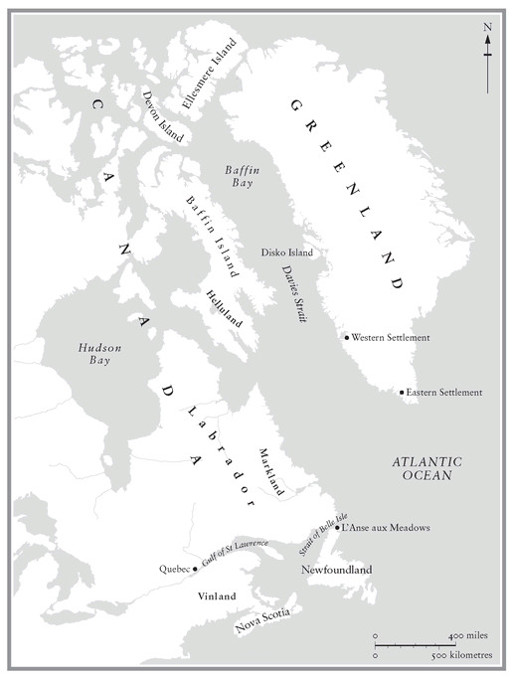
The Greenland colonists in North America, with the site of the excavated settlement at L’Anse Aux Meadows.
The houses were built of turf, with timber roofs which could not have been expected to last more than twenty or at the most thirty years in the wet coastal climate, and they show no signs of having been repaired.39 The explorers brought cattle with them, but neither barns nor stabling were found, perhaps another indication that this was not intended as a permanent settlement but rather as a base for the preparation and forwarding of timber for the homeland.
The Saga of the Greenlanders refers to just one Vinland camp, Leifsbudir, or Leif’s camp. The Saga of Erik the Red names two, Straumfjord, or Fjord of currents, and Hóp, or small and land-locked bay. Birgitta Wallace, an archaeologist who worked on the site for many years, identifies Straumfjord as the L’Anse aux Meadows site, with Hóp as the summer camp well to the south, too small and too infrequently occupied to leave any significant archaeological trace. On the strength of the find of white walnuts within Norse woodworking waste at the main site, she locates Hóp somewhere below the northern limit for this tree, specifically in north-east New Brunswick, which also defines the northern limit of the grape-vines for which the explorers named the region. Wallace is able to explain the name by pointing to the high status of wine in the north in the Viking Age. For Leif and his family to have access to their own supply of grapes was a development that must have been as surprising as it was welcome.
But they were not left in peace to enjoy these luxuries. The sagas describe the souring of relationships between the Norsemen and the local inhabitants, a tribe of native Americans encountered at Hóp, whom they also referred to as ‘Skrellings’. Modern research identifies them as the ancestors of the Beothuk and the Mi’kmaq, tribes whose fascination with the colour red the Greenlanders were able to exploit in trading furs for red woollen cloth. Mutual suspicion and cultural misunderstandings were rife, however, and fighting broke out. Men were killed on both sides. For the colonists, life itself was the most dangerously scarce of all their resources and, rather than risk significant and irreplaceable losses, they withdrew and made their way back to the base at Straumfjord. It was probably the realization of how thickly ringed around with hostile neighbours these as well as any future settlements were going to be that put an end to the Greenlanders’ attempts to establish themselves on the new continent. The possibility of making their own wine may have been attractive, but only timber was a necessity of life.
Markland had it in plentiful supply. It was closer and without the disadvantage of a population of hostile natives, and there can be little doubt that the trip across the Davis Strait to Ungava Bay to cut timber and gather bog-iron for use in the Greenland smithies was made with such regularity that it was no longer considered worthy of further note by those keepers of the Icelandic record who made occasional notes of events concerning their neighbours. Recent finds at the late culture layer of the ‘farm beneath the sand’ of the hair of bison and brown or black bears, neither of which is indigenous to Greenland, suggest the colonists may also have hunted across the water.40 The Icelanders, it seems, were interested in Greenlandic affairs primarily where these directly involved themselves. The only further references in their annals to crossings of the Davis Strait are the report that an Icelandic-born bishop of Greenland set off to look for Vinland in 1121, with what result we are not told; and the entry for 1347 regarding a small ship with a crew of seventeen or eighteen Greenlanders carrying timber from Markland back to Greenland which had been driven off course and landed in Iceland. The narrowed focus seems to show that a sense of something akin to national identity had arisen among the Icelanders. We have no way of knowing whether their neighbours in the west ever had time to cultivate such a luxury, before the extinction of the colony. Probably not. Probably life was simply too hard, too desperate to allow of it. A wooden crucifix, found beneath a bench during excavations on a farm at the head of Austmannadalen in the Western Settlement, depicts not the strutting and muscular Christ Triumphant characteristic of much early Viking Age Christianity, but a mournful, emaciated, suffering Christ, slumped on the cross. In conception and execution it is as far removed from the Jelling stone as could be imagined, and it makes apt symbolic comment on the harsh fate endured by these Norse Greenlanders.