
CHAPTER XI
John III, Duke of Brittany, a gentle vacillating man who had peacefully governed his duchy for almost thirty years, fell ill at Caen on his way back from the siege of Tournai and died there on 30 April 1341. The ‘Good Duke John’ had been a better friend of Philip VI than most of his predecessors. He had fought with his vassals, at his own expense, in the French armies which invaded Flanders in 1314 and 1328, and in spite of his close connections with England he had fought in those which faced the Anglo-German coalition of 1339 and 1340. He had conserved the independence of his principality, without the abrasiveness which characterized the affairs of Flanders and Aquitaine. But he was guilty of the ultimate offence against his own dynasty: he died childless and with no obvious heir. ‘And so we come to the epic of Brittany,’ Froissart wrote, ‘to the great adventures and fine feats of arms which happened there and will light up the pages of my book.’1
The origins of this savage civil war which lasted for nearly a quarter of a century and ruined Brittany for a generation longer lay in the obscurity of Breton successorial law and the rancours of a family quarrel. John III was survived by a niece, Jeanne de Penthièvre, and by a half-brother, John de Montfort, the issue of the previous Duke’s second marriage. Which of them had the better right was a nice question. Jeanne’s partisans asserted that since her father Guy was a full brother of the dead Duke he would have had an indisputable right to succeed him had he still been living. They also asserted, although perhaps with less conviction, that by the customary law of Brittany Jeanne, as her father’s sole heiress, had the same right as he would have done. Unfortunately, the customary law of Brittany had never previously had to answer such a question and its effect was a great deal less clear than the submissions of Jeanne’s lawyers. Brittany, moreover, was one of the peerages of France and the better view was that its devolution was not governed by Breton customary law at all but by the same law which governed the succession to the crown of France. By the law of the crown women were excluded. John de Montfort’s case was very simple: he was the closest blood relation of the last Duke and the only male candidate. He was probably right.2
Although a great deal of legal analysis was applied to the dispute the outcome was determined by political manoeuvre. The late Duke had had no affection for his father’s other family. He believed that the financial provision made for them had been altogether too generous, and he had once passed many years in an undignified and unsuccessful attempt to have his father’s second marriage retrospectively annulled and its issue bastardized. For most of his reign he was determined that John de Montfort should not succeed him. He even proposed, in 1334, to disinherit both candidates and sell the succession to Philip VI. This remarkable plan, which would have extinguished permanently the independence of the duchy, had almost been agreed when it foundered on the opposition of the Breton nobility, adroitly stirred up by John de Montfort himself. The result of its failure was that Jeanne de Penthièvre became the only available means of preventing a Montfortist succession. The Duke knew that a woman was vulnerable in the harsh political climate of Brittany and so, in 1337, he married her to Charles of Blois, a younger son of the house of Châtillon, a notable military family which had great possessions in northeastern France, and was closely connected with the house of Valois. His mother, Marguerite de Valois, was the King’s sister. Charles was an unusual man, then eighteen years old. He was austere, intensely pious, but at the same time a fine horseman and a brave and intelligent soldier who was always able to command strong personal loyalty from those around him. A better guarantee of Jeanne’s succession could hardly have been found. There is little doubt that that was John III’s object. Although the marriage contract said nothing about the succession to the duchy, it seems that shortly after the nuptials Charles of Blois was received as the heir of Brittany at a solemn session of John’s court. He was made to swear that on the Duke’s death he would bear the arms of Brittany and honour its customs.3
Early in 1340 Duke John seems for some obscure reason to have been reconciled to his half-brother and to have undergone a change of heart about the succession. He made a new will after prolonged deliberation with his closest advisers in which, to the great surprise of everyone who knew about it, he declared John de Montfort to be his heir after all. On his deathbed his last words on the subject were true to his havering spirit: ‘For God’s sake leave me alone and do not trouble my spirit with such things.’4
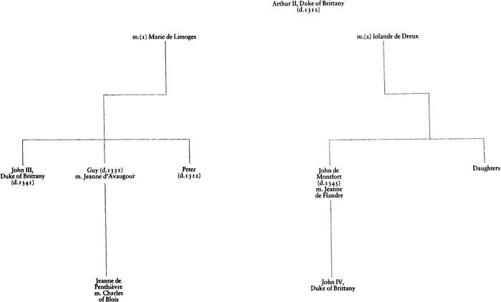
16 The Breton succession, 1341
It hardly mattered. Charles of Blois’ position was too strongly entrenched by John’s past acts. John de Montfort claimed the support of the common people and the towns, but there was no doubt that those who counted in Brittany took it for granted that Charles of Blois would succeed. Shortly after the death of John III an assembly of Breton notables met. The bishops accepted Charles’s claim by a majority of seven to two; the nobility were overwhelmingly in his favour. This was not in the least surprising. It simply illustrated how a French principality could be practically autonomous but nevertheless part of the larger community. The clergy of Brittany belonged to the archdiocese of Tours; they were wedded like the rest of the French Church to law and to a notion which made the French Crown the ultimate source of political legitimacy; the more educated of them had studied at Angers (there was no university in Brittany); and the more ambitious looked to the French civil service for their prospect of advancement. As for the higher nobility, their marriages, their more distant possessions, their language, their chivalry and their ambitions all marked them out as members of the French aristocracy. However loyal these men may have been to the duchy and its rulers, it was natural for them to look to the French political community to fill a void. Charles of Blois was the official candidate.5
By comparison with his rival John de Montfort was an outsider in Brittany. He possessed the lordship of Guérande at the mouth of the Loire, which included some of the richest salt beds in Europe.6 But otherwise his lands were concentrated in the Ile de France, in the Loire valley and in Artois. Since he had been elbowed away from power throughout the reign of his half-brother there had been little opportunity to build alliances in the duchy. We cannot know how well he would have used his opportunities if he had had better ones. His actions suggest an enterprising and quick-witted man. But he was a political incompetent who misjudged both the fickleness of his friends and the ruthlessness of his enemies. The dominant personality in his camp was not his own but his wife’s. She had ‘the spirit of a man and the heart of a lion’, according to Froissart. Jeanne de Flandre, Countess of Montfort, was a tough, rich and ambitious woman, a sister of the Count of Flanders and the owner of great properties in the counties of Artois and Nevers. She was a complete stranger to Brittany, but in her brief career as a war leader she inspired the same extravagant loyalty from her followers as Charles of Blois could do on his side. There is no reason to doubt the assertion of a well-informed chronicler that she was the principal author of her husband’s plans in the summer of 1341.7
The old Duke was buried in the Carmelite monastery of Ploermel early in May 1341.8 As the Breton nobility dispersed to their homes John de Montfort arrived outside Nantes with 200 men and bloodlessly took possession of it. Nantes was the principal city of Brittany, an important administrative and economic centre living well on the trade in salt and wine and on the tolls of the Loire. Its citizens did not know what to do. John de Montfort was the only claimant to the duchy who appeared to be asserting his rights; Charles of Blois had not yet stirred. So they did homage to him but with reservations. They would fight for him, they said, unless Charles of Blois should be pronounced Duke of Brittany by the King. They too saw the Crown of France as the source of all legitimate power. The couple installed themselves in the ducal castle of Nantes, which was the main seat of the Breton government, and summoned the whole baronage of Brittany and representatives of the town to come before them to do homage. Three days of festivities were arranged. While they waited for the response of the Bretons, John and his wife laid hands on as much as they could find of the treasury of John III. Part of it was seized from the cathedral sacristy of Nantes, where it had been placed for safekeeping. Most of the rest was kept at Limoges, an outlying possession of the dukes of Brittany some 200 miles into the heart of France. At some time in the middle of May John launched a bold raid on Limoges with a handful of armed men. The citizens of Limoges were as confused and compliant as those of Nantes. They took their new seigneur at his face value, accepted his largesse and delivered up the treasury.
The first signs of resistance did not appear until after John had returned, loaded with cash, from Limoges to Nantes. This was probably towards the end of May 1341. When the appointed day came for the baronage and towns of the duchy to do homage almost everyone of any consequence stayed away. The only important Breton feudatory who was willing to throw in his lot with John de Montfort was Hervé de Léon, the head of the principal noble house of Finistère, a self-serving schemer who had concluded that John was the man of the future. This view was wrong and Hervé did not hold it for very long, but his alliance, however brief, was valuable. Hervé had the local connections which John de Montfort lacked and he was a shrewd political adviser. As the men of Nantes and the gentry of south-eastern Brittany ate the banquet laid out for the great, John suppressed his disappointment and devised a bold show of force. The object was to take possession of as much territory as possible before any serious opposition materialized.
*
Brittany is a broad peninsula extending about 160 miles into the Atlantic from the march of France to the western extremity of Finistère. In spite of the unifying hand of the ducal government it was a fragmented society, revealing marked local contrasts. Eastern Brittany, roughly corresponding to the modern départements of Ille-et-Vilaine and Loire-Atlantique was a fertile and densely populated plain given over mainly to vineyards and to cattle farming and possessing in Nantes and Rennes the only truly importantcommercial towns of Brittany. This was Gallo-Brittany, speaking French and belonging to France as recognizably as the neighbouring provinces of Maine, Anjou and Poitou, which it physically resembled. West of this region lay the massif of lower Brittany, ‘Bretagne Bretonnante’, demonstrably different and overwhelmingly Breton-speaking. The main geographical feature of lower Brittany is a chain of granite and sandstone hills running east–west from the Menez to the Arrée mountains, not particularly high but covered by a thick impenetrable mantle of forest. The insatiable naval dockyards of the seventeenth and eighteenth centuries had not yet stripped it bare and created the bleak void that exists today. Western Brittany in the fourteenth century consisted of an inhospitable central region of high, cold and almost uncultivable ground surrounded by a narrow fringe of coastal land, marginally cultivable, where most of the population eked out a living by keeping pigs and goats, by growing vegetables (even then), by fishing and salt production, and by piracy.
There were obvious reasons why eastern Brittany should fall naturally to any candidate supported by France. It was a francophone region, wide open to invasion from Normandy or the Loire provinces. But the converse was not true of ‘Breton’ Brittany, whose allegiances were determined by complicated patterns of geography and feudal dependence. In the extreme west and the coastal plain of the south Vannes was the only large town, and the house of Léon the only significant aristocratic power. Lorient did not yet exist. Brest was a small village. It was a region of little harbours and minor seigneuries without cohesion or obvious natural loyalties. The rest of western Brittany was dominated by powerful local dynasties firmly opposed to John de Montfort’s ambitions. On the south face of the central massif there were the viscounts of Rohan. The main centres of their power were the fortified towns of Rohan, Pontivy and La Chèze. They were by far the most powerful noble house of all Brittany as well as the most consistently francophile. On the north face of the massif as far as the sea lay the great lordships of Tréguier and Penthièvre, which covered most of the territory comprised within the modern départment of the Côtes-du-Nord. This was the personal domain of Charles of Blois’ wife, the appanage which had made her father the most considerable man in Brittany after the Duke. These were not regions which John de Montfort could hope to capture except by deploying the kind of overwhelming strength which he did not have.
What he could hope to do was to take possession of the eastern plain and the approaches from France, the three principal cities of Nantes, Rennes and Vannes and the bulk of the ducal domain in the south and west from which the day-to-day government of the duchy was financed. At about the beginning of June 1341, John de Montfort marched out of Nantes with the banner of Brittany borne before him. His first objective was Champtoceaux, which was a large castle belonging to the dukes situated on a spur of land on the left bank of the Loire guarding the approach to Nantes by the river valley. Once he had garrisoned this place and secured the main approach to his capital, John marched on Rennes, the second city of Brittany.
The inhabitants of Rennes fell to violent discord on his approach. The town was protected by a strong garrison and a large circuit of walls, but the mass of the population was minded to open the gates. The more prominent citizens urged resistance. The garrison commander havered until he was captured during a sortie. The town put up a half-hearted resistance and then surrendered. The effect on John’s cause was magical. Saint-Aubin du Cormier, the great circular keep built by the dukes at the end of the thirteenth century to guard the road from Paris to Rennes, fell apparently without a blow. Dinan opened its gates. John now held every major stronghold of eastern Brittany except for Vitré and Fougères, strong modern fortresses held by hostile noblemen which were wisely left alone. In early July he was back in Nantes.
The south and west coasts appear to have been taken in the course of July and August. With the exception of Vannes and Hennebont, both of which had powerful defences, the towns and harbours were protected only by ditches and palisades or at best by antique seigneurial towers dating from the twelfth century. These places were guarded by men without orders, confused by events and uncertain of their loyalty. None of them resisted except for La Roche-Périou (which was passed by) and Brest (which was stormed). By the middle of August John de Montfort was in possession of the greater part of his duchy and in spite of his lack of support in the Breton establishment was beginning to look like the stronger claimant.
*
Philip VI reacted passively to these events. The development of his thoughts is not easy to follow. He had certainly assumed like everyone else that Brittany would fall to Charles of Blois, but it was not a foregone conclusion that he would support his nephew once John de Montfort had taken possession. John had hitherto been a loyal subject of the Crown. He had a strong claim in point of law. The prospect of dislodging him by force cannot have been attractive. For more than three months after the death of John III Philip did nothing. Charles’s first appeals for help were received, according to report, with cold embarrassment.9 At some stage which cannot be determined but was probably early in the summer of 1341, the contested succession was referred to the Parlement of Paris, whose deliberate procedures could be expected to last a long time. Philip’s motives are a matter for conjecture but the delicate state of relations with England must have been the main one. At the time when John de Montfort was occupying most of Brittany, the truces were already breaking down on the march of Gascony and there was every prospect of a fresh English invasion of the Low Countries.
Two events occurred in the south-west which advertised the fragility of the peace there and the insecurity of the government’s position. The first arose from an apparently petty row between Philip VI and James II, King of Majorca. This impetuous Aragonese prince ruled a number of territories on the Mediterranean coast of France. In some he was an autonomous monarch but in others, including the great Mediterranean lordship of Montpellier, he was a vassal of the French Crown. He was therefore in much the same position in Montpellier as Edward III was in Gascony, and he had it in mind that the English King might help him shake off the sovereignty of France. How much encouragement he received is unclear. He certainly received some. His agents visited Edward III in Ghent in the autumn of 1340 and arrangements were made for English officials in Bordeaux to engage in some discreet negotiations early in the following year. In March 1341 James conducted a tournament before a great crowd of onlookers in defiance of a royal ordinance and the express commands of the royal lieutentants of Languedoc. One of James’s squires dressed his horse in the arms of England and shouted ‘Guyenne!’, the war-cry of the English duchy, as he rode into the lists. Very soon afterwards James repudiated the sovereignty of France. At this point Philip’s lieutenants in the south were the Bishop of Beauvais, Jean de Marigny, and Louis of Poitiers, Count of Valentinois. They began drawing troops to Toulouse during April 1341, and in June they occupied Montpellier by force.10
While their backs were turned the English recaptured Bourg, thus making good the most serious of their losses in the years between 1337 and 1340. This coup appears to have been a private enterprise of three members of the La Motte family, a large divided clan whose members were to be found on both sides of the war. In the first week of June 1341 the La Mottes recruited a band of about sixty men, less than half the size of the garrison. They arrived under the river wall in barges a little before sunrise. Two accomplices let them into the town through a window of the abbey buildings of St Vincent, which were built into the defences in the weakest part of the town. Once inside they raised the townsmen and rushed the citadel. The garrison, which was completely surprised, was founddistributed between the town walls and the citadel. The men in the town were overcome. Those in the citadel had time to close the gates and arm themselves. They fought off their assailants and held out for another three weeks before they too were obliged to surrender. The garrison commander was accused by the King of treason, but he could hardly have done more. It was a serious breach of the truce, which must have happened with the connivance of the ducal government. Oliver Ingham certainly condoned it. The castellany of the town was eventually conferred on Amanieu de la Motte, and the leading actors received handsome rewards.11
What the incident illustrated was the virtual impossibility of enforcing the truce when public war was only lightly superimposed on so many private wars. Local noblemen, particularly on the English side, had lost too much to resist the temptation of a swiftcoupde main: a handful of men gathered at dawn, a cart jammed under the portcullis, an unwarned, undermanned garrison half asleep quickly overcome, and the possessions of one’s ancestors recovered from the ancient rival or useful parvenu to whom the Bishop of Beauvais had recently granted them. And not only the possessions of one’s ancestors. The English practice of making grants from territory yet to be conquered was an invitation to violate the truce which was very often accepted. The fall of Bourg was the signal for an explosion of unofficial warfare across the marches of Gascony. Bands of dispossessed Anglo-Gascons poured across the Gironde to loot and burn in Saintonge. There was serious fighting in the Agenais, in the Dordogne valley around Bergerac and further north, right up to the walls of Périgueux. By the end of June 1341 the guerrillas had been joined by government forces on both sides. Ingham hastily retained men and took the field on the 29th. The French royal lieutenants proclaimed the arrière-banin all the southern provinces. ‘The truce counts for nothing down here,’ one of them wrote to Philip VI.12
In England Edward III’s government was slowly emerging from the paralysis of a savage administrative purge and a constitutional crisis. Parliament began to assemble on 23 April 1341 and sat until the last week of May. The King adeptly retreated before the storm of protest against his conduct during the past four months. He abandoned the judicial commissions. He renounced the attempt to collect the ninth of 1340 from the clergy. He submitted to statutes providing for the enforcement of Magna Carta against his ministers and the appointment of officers of state and of members of his household who should be answerable to Parliament. He agreed to an audit of his government’s use of tax receipts going back to the beginning of the war. In return he obtained a fresh Parliamentary grant in kind, 30,000 sacks of wool, which relieved some of the more severe pressures on his budget. Edward read the signs more skilfully than his father or grandfather would have done at such moments. He broadened the circle of his advisers and mended his quarrel with Stratford, allowing the charges against him to be quietly forgotten and restoring him to most of his old influence. Stratford for his part forgot the radicalism of his pamphlets and became as royalist as he had ever been. Within a few months of the dispersal of Parliament, the King had sufficiently recovered his authority to annul its more unwelcome statutes by royal warrant. They were ‘contrary to law and reason’ and had been imposed upon him by duress. Never again, until the years of his senility and decline, did he misjudge the political mood of England so completely as he had in 1340. Edward’s retreat from the abrasive manner of the previous year enabled him to contemplate however distantly the resumption of the war when eventually the truce of Esplechin expired.13
It was due to expire on 24 June 1341. The terms envisaged that there would be negotiations for a permanent peace, but Edward III showed no interest in serious negotiations with the French government. His defeat and bankruptcy in 1340 had served only to sharpen his determination. ‘My power has not been laid so low and the hand of God is not yet so weak’, he had written to Simon Boccanegra in April, ‘that I cannot by His grace prevail over my enemy.’ In the same month he had told Parliament that the war could now be expected to last for many years and had obtained the consent of the Lords for another seaborne expedition to the continent. Preparations for this expedition, which had been in hand since February, were expected to be complete by the end of May. They were conceived on an ambitious scale. An army of about 13,500 was planned. Nearly two-thirds of them were to be archers.14 It was only when the King’s preparations suffered the inevitable obstruction and delay that the English showed any interest in resuming diplomatic contact with the French, and then only for the purpose of securing short extensions of the truce for what were manifestly strategic rather than diplomatic reasons. On 9 June 1341, a fortnight before the truce was due to expire, three princes of the French royal Council met the leaders of the Anglo-German coalition in Flanders and agreed to extend it until 29 August, ostensibly in order to enable serious negotiations to begin. A peace conference was called into being at Antoing, a castle overlooking the Scheldt on the borders of Flanders and Hainault. But the small time allowed for it hardly augured well for the outcome. It was due to convene on 1 August 1341. In England, Edward ordered the ships of the invasion fleet to be ready at the embarkation ports by 15 August and the troops a week later.15
In retrospect it is possible to see that the King of England’s plans were doomed to failure by the reluctance of his allies and the weakness of his financial position. But Philip VI and his advisers took them as seriously as their author did, and they had their hands full with warlike preparations. From April to November 1341 a strong fleet, including twenty-one galleys, mostly French but with some Spanish and Portuguese auxiliaries, cruised between La Rochelle and the Biscay ports of Castile in case the English should attempt to land their army in Gascony. All merchant ships between Calais and the Gironde were surveyed for war service. Relations with the Genoese were patched up well enough to enable rowers and crossbowmen to be hired for the surviving vessels of Doria and Grimaldi. There were plans for reinforcing the garrisons of the northern frontier, which were at low strength. A general summons was issued in May for the assembly of the army at Arras a week before the expiry of the truce.
In the south-west men were already being deployed in increasing numbers in response to English violations of the truce. At the end of June 1341 the French royal lieutenants in Languedoc had 4,500 men under arms; a month later there were just under 6,000; 7,000 at the end of August; 12,500 at the end of September.16 Most of these men were employed in the most cautious possible way, on garrison duties. But there were significant field operations towards the end of the summer. During August 1341 the Count of Valentinois moved west along the north bank of the Dordogne into Saintonge. On the 25th he even succeeded in reoccupying Bourg, although probably only the town not the citadel. His success at any rate was short-lived. The Anglo-Gascon forces, commanded by Hugh of Geneva, crossed the Dordogne at Libourne. On 26 August 1341 he surprised the French under the walls of the old Benedictine abbey of Guitres and pursued them for several miles to the north. The two armies were probably both very small. Hugh had no more than 1,200 men, the enemy rather fewer. The encounter was indecisive but the French withdrew up the Dordogne valley and their men in Bourg, whose position had now become untenable, decamped a week later. Although the French greatly increased their field army in the course of September they dissipated it in a succession of minor sieges in southern Périgord, police work on a large scale directed against anglophiles and bandits who had entrenched themselves in isolated towns and castles. In the border regions men regarded these events as a significant setback for French arms. A number of towns threw out their French garrisons and received English ones.17
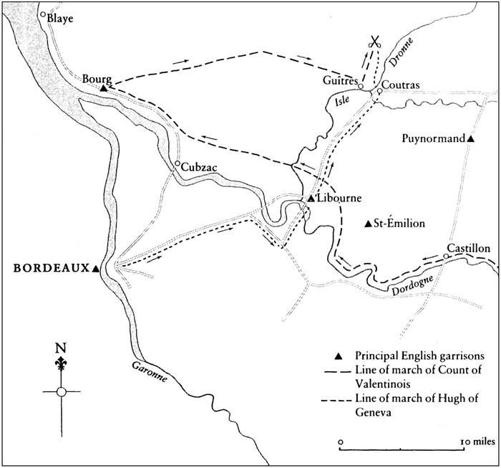
17 Gascony: the battle of Guîtres, 26 August 1341
The effort that lay behind all this activity not only mesmerized the French King and his advisers but consumed the whole of their financial resources. French tax-payers were notoriously reluctant to pay up in time of truce, when the apparent danger had passed, and they were not impressed by the cost of repaying past borrowings or preparing to fight future battles. In most of France the government’s receipts from taxation dried up in 1341. Philip pressed the ingenuity of his officials for raising money. The profit margin exacted from the issue of coins rose to unprecedented levels. The gabelle du sel or salt tax made its first, short-lived, appearance in parts of the realm, provoking furious opposition wherever attempts were made to enforce it. Officers of the Chambre des Comptes were sent on tours of the provinces, cajoling wealthy noblemen and ecclesiastics into submitting to a tax on the revenues of their domains. The results of so much effort were very poor. Treasury receipts fell by almost half.18
In the face of this concatenation of problems the last thing that Philip VI desired was a civil war in Brittany and if events had taken a different turn John de Montfort might have been left in undisturbed possession. Early in August 1341, however, there were persistent rumours that John was about to make common cause with the English. Philip believed that John was preparing to do homage to Edward III and he may even have heard wilder reports that it had already happened. The prospect of a descent on Brittany by the fleets now gathering at Winchelsea and Orwell was horrifying. The precise moment when this possibility dawned on Philip VI cannot be determined, but it was probably in the middle of August 1341, when the first military measures were taken to prevent it. On the 13th, orders were given to proclaim the arrière-ban throughout France. The sixteen remaining galleys of Doria and Grimaldi were taken out of lay-up and sent to lie off the Breton coast. At about the same time plans were laid to invade Brittany from the east and dislodge John de Montfort by force. The French government’s attitude to the Breton succession was transformed.19
At Antoing the peace conference proceeded with a painful slowness which appeared to confirm the worst suspicions of the French. The English delegation, led by the Earl of Huntingdon, did not arrive until 6 August 1341, almost a week after it had opened. On the 10th they agreed to extend the truce by just two weeks from 29 August to 14 September 1341. Discussions about a further extension continued, but on 19 August the Earl of Huntingdon abruptly left to seek further instructions in England and in his absence the conference was suspended. The news that the truce had been extended until mid-September reached England on about 18 August 1341 and resulted in orders that the army should be ready to embark on the day after its expiry. There were now between 200 and 250 vessels in the south-and west-coast ports of England waiting for orders to proceed to the assembly point at Winchelsea; a rather smaller number were gathered at Orwell; thirty huge ships, including ten galleys, were due to arrive in England from Bayonne. In Paris Philip VI had already set in train the procedure for dispossessing John de Montfort. The proceedings in the Parlement were accelerated. In Nantes John was served with a citation by a royal officer. On 20 August 1341 he left hurriedly for Paris.20
In the Parlement the decision fell to be made not by the ordinary tribunal but by the peers of France assisted by the opinions of professional lawyers and by the report of a commission which was instructed to examine the evidence. The proceedings advanced at speed once the urgency of the King’s political needs became clear. Long written memoranda were submitted by both sides. On 27 August the commission, consisting of two bishops, began to hear witnesses. John de Montfort arrived in Paris to find the city tense with preparations for war. John was received by Philip VI at a chilly audience in the royal palace which left no one in any doubt about the King’s sympathies. Philip directly confronted him with the rumours of his treasonable dealings with the English, which he denied. At the end of the interview he was peremptorily ordered not to leave Paris until after the Parlement had pronounced judgement. The implication was plain. When the duchy had been awarded to his rival, John would be held as a hostage for its peaceful delivery. At the beginning of September 1341, John secretly left Paris and fled to Nantes. All his garrisons in Brittany were put on a war footing.
When his flight was discovered the proceedings were initially suspended in confusion, then rapidly brought to an end and adjourned for judgement. On 7 September 1341 the Parlement gathered at Conflans, a royal castle outside Paris, and pronounced judgement in favour of Charles of Blois. There were no proceedings against John for treason, and it may be that the King had decided to suspend disbelief on this point. He did, however, order the immediate sequestration of John’s county of Montfort l’Amuary in the Ile de France until the facts should become clearer. The courtiers dispersed to gather their retinues. The army had been summoned to assemble at Angers on 26 September 1341.21
*
The disputed succession of Brittany was naturally of great interest to the English government. It seems surprising that Philip VI’s advisers should have taken so long to realize it. A hostile power controlling Brittany could sever communications between England and Gascony, ruin the wine trade of the Gironde and make the Channel Islands untenable. A friendly power in Brittany would not only secure England’s maritime communications but give her a bridgehead into northern and central France. Even before the death of John III, in 1336, Edward III had tried to obtain the hand of Jeanne de Penthièvre (whom he called the ‘heiress’ of Brittany) for his younger brother. After the war with France had begun Brittany continued to be treated with the utmost circumspection by the English. Bretons were not treated as Frenchmen when it came to applying the laws against enemy aliens. Moreover John III almost alone among French noblemen was allowed to retain possession of his valuable estates in England. When the news of his death reached England in May 1341 immediate steps were taken to discover what could be expected of his successor.22
The rumours which Philip VI heard in August 1341 were true. John de Montfort had not finally committed himself to Edward III but he had certainly had exchanges with him of a kind which were inconsistent with his status as a vassal of the French Crown. The initiative was Edward’s. At the beginning of June 1341 he sent one of his household knights, Gavin Corder, to Brittany to make contact with the pretender. Corder was unfortunately delayed in England for a long time by contrary winds. He finally sailed from Dartmouth on 1 July 1341 accompanied by a Chancery clerk and an armed escort and landed at the little harbour of Guérande in south-eastern Brittany on the 7th. On 10 July he found John de Montfort in Nantes. John saw the English agents in private. The tenor of their discussions has to be inferred from oblique references and later events. It seems that John was very forthcoming. He said that he thought that Philip VI was bound to try sooner or later to expel him from Brittany and expressed interest in an alliance of some kind with Edward III. The impression which he gave was that if Edward was prepared to help him he would consider recognizing him as King of France. What he would not do was commit himself formally while there was still some prospect of obtaining Brittany without such dangerous assistance. He therefore kept the English agents waiting for six weeks upon his formal answer. They had still not received it when John was abruptly called away to Paris. So, on 21 August 1341, the day after John’s departure, the Englishmen left. They reported to Edward III in London on 12 September.23 Almost immediately afterwards the news arrived of John’s flight from Paris, the edict of Conflans and the sequestration of the county of Montfort 1’Amaury.
When John de Montfort arrived back in Nantes one of his first acts was to send two of his confidants to England with his formal proposals. These broadly reflected the conversations with Gavin Corder. He wanted military support against Philip VI urgently; when he got it, but not before, he was willing to do homage to Edward III for Brittany.24 John’s messengers, however, arrived too late. In the last week of August 1341 the Earl of Huntingdon had returned from Antoing to report that Edward’s allies and in particular the Duke of Brabant would not support another campaign in France launched from their territories. They insisted on an extension of the truce. With no news from Brittany and unfavourable news from the Low Countries there had been nothing that Edward could do except authorize his agents at Antoing to extend the truce of Esplechin into the following year. The decision had been taken at an enlarged meeting of the English royal Council on about 2 September 1341. The ships under requisition along the south coast had been released; the Bayonne galleys had been stood down; the troops had been sent home. On 12 September 1341, even as Corder was delivering his report to Edward III, the plenipotentiaries at Antoing extended the truce to 24 June 1342. To assist the Bretons now it would be necessary to rewind the spring and to repudiate their deed.25
Edward III did make some attempt to do this. The homage of Brittany was a great prize and something had to be done to impress John de Montfort’s representatives. Probably at the beginning of October 1341 the English King sealed a treaty of military alliance with the two Breton agents. £10,000 was earmarked from the proceeds of the wool subsidy to pay wages of war. On 3 October orders went out to requisition all merchant shipping in ports between London and Bristol and assemble them at Portsmouth. The first ships were to be ready to carry the advance guard to Brittany by the end of October or the beginning of November 1341; the main body of the fleet was to be assembled by 18 November. The command of the ships was given to Robert Morley, Admiral of the north, and of the troops to those ready adventurers Walter Mauny and Robert of Artois. Once the orders had been given the two Bretons returned home.26
Edward’s enterprise was conceived on a modest scale. The numbers were small and most of them were drawn from the personal retinues of the participants. There was no attempt to conscript troops in the counties. Even so, it was a hopeless endeavour. No one had ever previously succeeded in assembling a fleet of any size from requisitioned ships in less than four months. Most of the ships of southern England had only just been released from requisition for the abortive Brabant expedition. It was the season of the great Gascon wine fleets. Many of them had left their harbours to trade. Others fiercely resisted the admirals’ officers. By the middle of November 1341, eighty-seven ships had been requisitioned along the south coast of England to carry the advance guard to Brittany and some of them had arrived at Portsmouth. Shortly after this, the expedition was cancelled. It had been overtaken by events in Brittany.27
*
The French army gathered in the last days of September 1341 at Angers on the Loire about 50 miles upstream of the Breton border.28 It consisted, according to the least unreliable contemporary estimate, of about 5,000 Frenchmen and some Genoese, probably about 2,000 strong, drawn from the crews of the galleys. There was a powerful train of siege artillery. The command of the army was given to John, Duke of Normandy, but he was straitly supervised by the King’s closest confidants, the minister Mile de Noyers and Philip’s brother-in-law the Duke of Burgundy. Philip’s instructions to his son were profoundly revealing of this cautious, troubled man. He did not like the hazards of war, and John was told that he was on no account to take risks. In particular he was not to attack any town unless reconnaissance had shown that it could be swiftly captured. If the opportunity arose of avoiding war by compromise it was to be taken. Philip was prepared to see John de Montfort generously compensated with land in other parts of France and even to guarantee him the succession to the duchy if Jeanne de Penthièvre should die without heirs. The main point was to keep the English out of Brittany. Philip was to be informed as soon as they had landed at whatever time of night or day it happened. There was an interesting additional instruction. When the Prince wrote to his wife at court he should on no account omit to say how large was his own army and how feeble the enemy’s: ‘she has heard things about the King of England … which terrify her.’
The original plan was to march immediately on Vannes, which was the closest port of any importance to Nantes and an obvious landing place for an English army. This idea was quickly abandoned. It would have involved penetrating deep into Brittany, leaving John de Montfort’s garrisons in Nantes and Rennes to harass the French army’s lines of communication. The Duke of Normandy had learned the unwisdom of that strategy in the Hainault campaign of the previous year. In the event most of the fighting took place around Champtoceaux, which was the first obstacle to be met by any army entering Brittany through the Loire valley and had been garrisoned by John de Montfort with mercenaries under the command of some Germans from Lorraine. Charles of Blois left Angers with the advance guard of the French army at the beginning of October 1341 and laid siege to this place on about the 10th. The Duke of Normandy followed him on the 14th with the main body of the army and most of the dignitaries: his minder Mile de Noyers, the dukes of Burgundy and Bourbon, Philip VI’s brother the Count of Alençon, the Constable, the Marshals of the army and the Admiral of the French fleet, Louis of Spain. It was an imposing demonstration. John de Montfort made a bold attempt to relieve Champtoceaux with wholly inadequate forces. He led them out of Nantes and following the south bank of the river arrived at a fortified farmhouse called L’Humeau about 3 miles from the siege. He expected to find this place held by his own men. In fact, he found Charles of Blois there and came very close to capturing him. But after two days of fighting around the tower of the farmhouse the Montfortists were driven off by the Duke of Normandy with much bloodshed. Champtoceaux fell on about 26 October 1341.29
It proved to be the turning point of the campaign. John de Montfort returned in headlong flight to Nantes. The army of the Duke of Normandy arrived outside the city a few days after him at the end of October. Nantes should have resisted for a long time. It was well supplied by river and its walls on the landward side were too long to be completely invested by the French. But the citizens had no enthusiasm for its defence. They knew about the defeat of the Montfortists at L’Humeau. The French overwhelmed the outlying castles of the Nantais with the utmost ferocity and beheaded their prisoners in front of the city walls. The townsmen reminded John de Montfort of the reservations which they had made when they had done homage to him and refused to fight. They were eventually persuaded to support him, but only on terms that if relief had not arrived after a month the pretender should leave the city and chance his fate outside. Short of time and without news from England, John organized a succession of desperate and costly sorties, some of which he led in person with great courage. The last of these sorties, which was designed to seize a victuals train, ended in the precipitate flight of John’s mercenaries and the massacre of a large number of townsmen. It also provoked a bitter quarrel between John and Hervé de Léon, who had led the flight. The men of Nantes had had enough. They called a great assembly and in spite of their recent agreement with John they decided that unless he opened negotiations at once with the besiegers they would do so themselves. John had no option but to agree. He went into the Duke of Normandy’s camp and agreed to surrender Nantes to his rival. This probably happened on 2 November 1341.30 The siege had lasted for less than a week. Immediately afterwards Charles of Blois entered his capital, which received him with the same festivities as they had put on for John de Montfort six months before.
There remained the difficult question of John’s personal position. He had not been prepared to surrender Nantes without some assurances for himself, for all the weakness of his hand. So the Duke of Normandy offered him the prospect of negotiations with the King and presumably some hope of a compromise. In return he was required to surrender all his garrisons in Brittany into Philip’s hands to abide by the further consideration of his claim. For this purpose John was given a safe conduct to Paris and back again. For a few weeks he remained in Nantes with his enemies. Then, at the end of December 1341, he accompanied the Duke of Normandy to Paris. When he arrived at the Royal court some negotiations did indeed occur. John was invited to sign a treaty with his rival renouncing in return for a pension and a grant of land in France his entire claim to the duchy and everything that he possessed there. He refused. Philip then repudiated his safe conduct and ordered him to be imprisoned in the Louvre.31 In Brittany John’s erstwhile supporters had already begun to desert him. Hervé de Léon led the way. He became one of Charles of Blois’ principal counsellors very soon after the fall of Nantes and began to write to his friends and connections urging them to submit. The enormous fortress of Saint-Aubin du Cormier on the north-eastern march surrendered at once. Many of John’s most important captains submitted during January 1342. and received pardons from the King. By February 1342 Charles of Blois controlled all of the French-speaking regions of eastern Brittany except for Rennes.32
*
When Nantes fell the Countess of Montfort was at Rennes some 70 miles away to the north. She had with her the greater part of the ducal treasury, still the main asset of the Montfortist cause, and a force of garrison troops. Her husband’s military strength seemed unlikely to survive his capture for very long. But it still existed, for the moment, intact. The main body of the army had not been with John at Nantes but was encamped at Saint-Renan in Finistère waiting for the arrival of the English. There were garrisons installed for the same reason along the western coast, in particular at Le Conquet and Brest. These forces were commanded by a group of minor Breton lords, the principal of whom were Tanneguy du Châtel, the captain of Brest castle, and Geoffrey de Malestroit, who appears to have been in command of the field army. These men were under strong conflicting pressures. Several of them had land in territory now controlled by Charles of Blois and their families had made their peace with him. The Crown was offering them free pardons for their loyalty, and they were wavering.33
The Countess made a number of acute decisions. The first was to dispatch her treasury to safety at Brest. The second was to leave Rennes, a strong city but a place of divided loyalties, inland and far away from help. At the end of the year she joined forces with Geoffrey de Malestroit. Leaving enough men at Rennes to hold it she fought her way south, captured the town of Redon by storm and occupied the Guérande peninsula at the mouth of the Loire. From there she marched west and established her headquarters at Hennebont. Hennebont was a small walled town at the head of the estuary of the River Blavet on the Morbihan coast of Brittany. It had stout walls built at the end of the previous century. It was probably more easily defended than any other place in westernBrittany. From here, Jeanne asserted her authority over all the surviving field and garrison forces of her husband. Their two-year-old son was proclaimed as the nominal head of their party and the heir apparent should John be put to death in Paris.34 As his guardian the Countess appointed the ablest and most prominent of her advisers, Amaury de Clisson, a member of the great Breton family whose elder brother Olivier was even then fighting for Charles of Blois.
In February 1342 Amaury de Clisson arrived in England with the widest powers to commit the Countess’s party, and chests loaded with cash from the ducal treasury. The English King had passed the winter in a barren show of force in the lowlands of Scotland which achieved nothing and ended early. On 11 and 12 February 1342 he was engaged in a most spectacular and expensive tournament at Dunstable, fighting in the lists as a simple knight with almost all the noble youth of England. Serious consideration of the renewed civil war in France did not begin until some days later. During the third week of February the nobility gathered in London to lay plans for the prosecution of the war. Edward responded to the Countess’s invitation with enthusiasm. The treaty which he had made with the Breton agents in the previous October was renewed. Plans were prepared for intervention in Brittany which amounted to nothing less than the immediate assumption of control by the English government over the Montfortists’ territory there in the name of the Countess and her young son. All the towns, harbours and castles of the coast of Montfortist Brittany would be taken over by the English. The command of them was committed to Walter Mauny, who was to take a sufficient company of men to the duchy early in March. A much larger force, of 1,000 men-at-arms and 1,000 archers, was to sail in April 1342 under the command of the Earl of Northampton and Robert of Artois. In order to maintain the pretence that the truces were being observed these men were probably intended to fight under John de Montfort’s colours. But when the truces expired in June Edward intended to come over to the duchy in person to ‘support the Duke and recover his own right in the crown of France’. To finance this venture, Amaury de Clisson promised to make over the whole ducal treasury to the English King by way of loan. Edward was paid at once the equivalent of £1,000 in gold, silver and jewellery from the chests which Amaury had with him. This was intended to meet the initial expensesof Mauny’s force. A further 68,000 l.t. (£13,600) was to be advanced after Northampton and Robert of Artois had arrived. The remaining contents of the ducal treasury would be advanced when Edward himself landed in the summer. Edward appointed an English civil servant to return to Brittany with Amaury to take custody of the coffers lodged at Brest and a team of craftsmen to coin their contents into money. These arrangements were more or less complete on 21 February 1342 when the Bretons put their seal to the treaty.35
The following eight months were a story of persistent struggle in the face of administrative and diplomatic obstacles to bring help to Jeanne de Montfort before she succumbed to the overwhelming military strength of France. She manoeuvred skilfully for time. At some point in February 1342 Jeanne moved from Hennebont to Brest. On the 24th she was found there by an emissary from Philip VI, Henry de Malestroit. Henry, a senior judicial officer of the royal household, was a Breton, the brother of the Countess’s military commander. He was to undergo agonies of divided loyalty. His instructions were to require submission from the Countess’s partisans, including his brother and Tanneguy du Châtel, and to demand the surrender of Brest into the King’s hands in accordance with the arrangements made between John de Montfort and the Duke of Normandy on the fall of Nantes. The first instinct of the Countess’s friends was to resist. Tanneguy answered that he had taken up the cause of the true line of Brittany and would defend himself to the death. But wiser counsels prevailed. The French were asking for nothing more than a formal surrender which would leave the Countess and her friends in actual possession. Was it not better in a time of weakness to avoid provoking them? The Countess conceded the point. Five days later on 1 March 1342 she negotiated a truce with Henry which froze the military position until 15 April and left her in effective control of the west. This was approximately the date on which the Earl of Northampton was expected to arrive from England.36
Help came from England with appalling slowness. The first, unofficial and rather ineffective assistance came in the form of shipmasters from the Cinque Ports, the West Country and Bayonne who received letters of marque to prey on French shipping in return for a third of the spoil. They were recruited by an Englishman, Oliver Stretford, who was installed in the Countess’s administration in Hennebont Castle and was styled the ‘Duke’s lieutenant’. These privateers were very active in the early spring of 1342 but indiscriminate in their choice of victims and not overscrupulous about accounting for their takings.37
The advance guard of the expeditionary force, which was due to sail under the command of Walter Mauny to secure the landing places, gathered punctually in Portsmouth in March 1342 but was delayed by the usual difficulty in requisitioning ships. Of the sixty medium-sized vessels which had been called for, only forty-four had been found by the requisitioning officers by the end of the month. Some of these arrived laden with cargo and had to be laboriously discharged; most arrived late; one group of shipmasters anchored in the roads and refused to enter the harbour until they had been paid; seventeen failed to appear at all. Mauny fumed impatiently. He was not a man to understand bureaucratic limitations.38
The delays to the main army of Northampton and Robert of Artois do not seem to have been due to the officials, who on this occasion surpassed themselves. One hundred large vessels were available at Yarmouth by the end of the first week of April; in the harbours between Portsmouth and Bristol, where requisitioning did not begin until 1 April 1342, 117 ships had been found within the month. It was an impressive achievement by the standards of the past five years.39 But the assembly of the army which was to fill them was deliberately delayed. The main reasons seem to have been political. Edward III had made ambitious promises to the Bretons very hastily, too hastily to consult his allies. The main point in the treaty which he had sealed with Amaury de Clisson was the dispatch of an army to a province of France two months before the expiry of the current truce. The reactions of his allies in the Low Countries when they were told are not recorded but they can be guessed. These men were parties to the truce which Edward proposed to violate, and they were potential victims of a French counter-attack. They had no interest at all in Brittany. England’s alliances with the princes of the Low Countries were strained by now and had become more than anything a memory of past stalemate and uncollected debts. But Edward could not ignore these men. He still had cause to value their capacity to hold down large French forces on the great open frontier of the north. The deliberations of the English government are obscure. All that is known is that at the end of March Edward was persuaded at short notice to appoint representatives to attend yet another peace conference between the French ministers and the princes of the Low Countries which was due to open at Condé in Brabant on 14 April 1342. In Paris, too, attention was fixed upon the Low Countries. Philip was slow to recognize that for the first time in half a century it had ceased to be the decisive theatre. On 11 April 1342 he summoned his army to meet at Arras on 24 June, the day on which the truce was due to expire.40
In southern and western England troops had been told to be ready by early May to proceed to their ports of embarkation for Brittany.41 The French did not wait. As soon as the local ceasefire between the Countess of Montfort and the French Crown expired on 15 April they attacked the easternmost outpost of the Montfortist party at Rennes. On this occasion the command was taken by Charles of Blois himself. His chief lieutenants were his older brother Louis, Count of Blois, and Louis of Spain. The latter was the kind of princely adventurer who had always thrived at the courts of Capetian France, a man who might have been king of Castile but for the coup d’état which had elbowed his father from the throne many years before, just as John of Bohemia might have reigned in Germany and Walter of Brienne in Greece or Florence. Because Philip VI was still anxious to preserve the truce, Charles of Blois and his companions had had to raise their own troops, and for that reason the number of men-at-arms available to them was probably small, consisting of their own retainers and Breton lords from the regions which were loyal to him. The mass of the army was made up of Italian and Spanish seamen. Ayton Doria was certainly in Charles’s service by this time, and probably Carlo Grimaldi as well. They left their ships laid up in Normandy and used the two or three thousand crewmen as archers and infantrymen. The Spaniards were drawn from the crews of a squadron of galleys hired by Louis of Spain in Castile. These men had established a base to beach their ships in a small harbour of Beauvoir-sur-Mer at the southern end of the Bay of Bourgneuf in the Vendée. They were present in force in Charles’s army from May onward.42
Charles had no difficulty in taking Rennes, which was too far from the heartlands of the Montfortists to be relieved and too large to be effectively defended by its garrison. The citizens decided at the beginning of May that resistance was hopeless. They called on the garrison commander to surrender. When he refused they arrested him and opened their gates. This event was followed by the submission of almost all the remaining partisans of John de Montfort in the francophone regions of eastern Brittany.43
Shortly after Charles of Blois entered Rennes, Walter Mauny at last arrived with the English advance guard at Brest at the opposite extremity of Brittany. His force was pitifully small, 34 men-at-arms and 200 mounted archers, and its function was limited. It was required for securing the coastal towns, principally Brest itself. Mauny may have been told not to attack troops of the French Crown while the truce remained in force. At any rate, for whatever reason, he did not do so. Instead he turned the occasion to his own advantage by a brief plundering raid against the turncoat Hervé de Léon, Charles of Blois’ only significant supporter in the far west. Not long after their arrival the Englishmen fell on the fortified manor house at Tregarantec in northern Finistère where Hervé was staying. They attacked at dawn, burned down the doorway and captured the surprised occupants almost without bloodshed. The prisoners included not only Hervé himself but six other ransomable noblemen and a large number of lesser men who were no doubt worth something to Mauny’s followers. The chronicles are full of stories of Mauny’s fabulous deeds and audacious attacks on the French army in the summer of 1342, but they were fishermen’s tales drawn from the faulty recollections of his old age. The truth was that neither he nor the Montfortists had the strength to attack Charles of Blois in the field and for most of May and June 1342 they did nothing. Charles of Blois ignored Mauny’s presence in his duchy. He sent his brother to invest Vannes. He himself together with the greater part of his army marched on Hennebont, where the Countess was.44
Edward III was still struggling with his allies and reconciling himself to the existence of the truce with France. There was therefore a pause in England at the high point of the French campaign in Brittany. Edward splendidly entertained the Count of Hainault at Eltham and saw him wounded in a tournament. He sent the Bishop of London and the Earl of Warwick to explain matters to the other German princes at another grand conference of the coalition at Mechelen. The troops did not receive their orders until 20 May, the shipmasters five days later.45
The army of Charles of Blois arrived before the walls of Hennebont in late May 1342 and encountered the most ferocious resistance. The castle and the town were stuffed with victuals and defended by a garrison entirely devoted to the Countess’s cause. Almost as soon as they arrived the French suffered a humiliating reverse. A number of their Genoese and Spanish troops rushed forward without orders and milled about the gates and walls engaging in undisciplined tourneys with groups of the defenders. In order to extricate them it was necessary to mount a full-scale assault on the town before the army was ready. The result was a massacre followed by a disorganized retreat. Charles of Blois’ camp was overwhelmed by the Montfortists and most of the tents were burned. According to Jean de Bel (whose account of this campaign is unfortunately very erratic) the Countess was to be seen riding through the streets and suburbs of Hennebont haranguing her men from a charger. The French made a number of other attempts to take the town by storm but all of them were costly failures. They therefore settled down, probably in early June, to starve the place out. In the second half of the month the momentum of their reconquest had been largely dissipated and their army split up in penny packets along the Morbihan coast. Louis of Spain and the Viscount of Rohan remained at Hennebont with a small force consisting mainly of Spaniards. They steadily battered the walls with siege artillery until, probably in late June, they gave up and raised the siege. Charles of Blois himself moved to Auray and sat outside the town with the main body of his army. Further east, Vannes still held out. Small detachments spread out along the roads of the inland hills, killing and looting. It was the beginning of the most wretched period in the history of medieval Brittany.46
Charles of Blois was lavish in his promises to those who might abandon the Countess’s cause for his own. But the imprisonment of John de Montfort had made a profound impression here. Philip VI and his friends and protégés were distrusted, and were resisted by men whose interests might have brought them to submission long ago. How long their resistance would last was another question. Walter Mauny, not a man to shy away from a difficult undertaking, was so pessimistic about the Montfortists’ prospects of survival that when the main English expeditionary force failed to arrive at the end of June he proposed a truce to Charles of Blois until 1 November 1342, in effect for the whole of the campaigning season of that year. On about 8 July Mauny arrived back in England to lodge his prisoners in safety and to press this idea on Edward III. But Edward was not interested and promptly repudiated him.47
*
On the continent the political balance was shifting fast in the French government’s favour. Pope Benedict XII, that austere and independent man, had died on 25 April 1342. He had had little sympathy for either protagonist in the war and his relations with Philip VI had become particularly cool as a result of the French King’s rapprochement with the outcast Louis of Bavaria. On 7 May, to Philip’s unconcealed delight, the conclave of cardinals elected as his successor Pierre Roger, formerly Archbishop of Rouen and one of Philip’s principal ministers and advisers during the 1330s.
Pierre Roger was the ablest but perhaps the least edifying of the Avignon popes before the Great Schism. He was a native of the Corrèze, by birth therefore a subject of Edward I. But his real origins were in the Benedictine abbey of La Chaise-Dieu in eastern Auvergne, where he had been professed as a monk at the age of ten. Its magnificent buildings are, together with the grandest parts of the papal palace at Avignon, his principal surviving monument. They are also revealing of his personality. He was a man of princely tastes and worldly outlook, an ecclesiastical politician of the great style. He was also wedded to the interests of France. This is not to say that he was a creature of Philip VI. However, he had spent the prime of his life in the secular employment of the French government and although he was not among the anglophobes of Philip’s circle he had the views of an urbane and intelligent French courtier. He truly believed that France’s interests were the interests of Christendom and of peace, and that Edward III was a rebel and an aggressor. It was a tenable view. Pierre Roger took the title Clement VI. He was crowned on 19 May 1342 in the vast church of the Franciscans of Avignon in the presence of a crowd of French notables including the dukes of Normandy, Burgundy and Bourbon, whose vassals were at that moment marching with Charles of Blois against Hennebont. To the Duke of Normandy fell the honour of holding the reins of the Pope’s horse and sitting at his right hand at dinner. Observers were not slow to notice it.48
Clement began to interest himself in the war at once. Within a fortnight of his coronation he had appointed two cardinals to mediate between Philip VI and his rival. Edward III received news of this appointment in the middle of June 1342. He regarded it as a transparent attempt to delay his expedition to Brittany until the Countess of Montfort had been defeated and he declined to co-operate. The cardinals were in France throughout June and July 1342 and were well received at Philip VI’s court. But when they asked for leave to cross the Channel for discussions with the King of England they received a caustic reply. Edward said that since he was about to visit ‘our Kingdom of France’ they might save themselves some trouble by attending upon him there.49
Clement meanwhile assiduously set about widening the gap between the King of England and his allies in the Low Countries. On 12 June 1342 he conceded to Philip VI what Benedict XII had persistently denied him. He agreed to lift the interdict on the county of Flanders which had been the source of so much ill-feeling between the Flemings and the French government. Another emissary was sent north from Avignon to discuss terms with the Flemings. The terms on offer have not survived but they certainly included a requirement that the Flemings should abstain from any active part in the war. The Flemings must have been tempted. They wanted to be absolved from the excommunication and to see the interdict lifted, but they wanted even more to maintain their supplies of English wool and to recover the large sums which the English government still owed them. Their response was ambivalent. In the event they made no formal agreement with France. But they listened to the Pope’s proposals and in the meantime they took no steps to stir up the war on their southern frontier. The Duke of Brabant and the Count of Hainault went further. They met the cardinals at Antoing in the third week of August 1342 and concluded what amounted to an independent truce. They undertook that unless Philip VI invaded Flanders they would not make war on him without giving him at least one month’s notice. It was for practical purposes the end of the Anglo-German coalition.50
The effect on the military fortunes of the French was striking. They were able to maintain and even expand their forces in the south-west, which they would otherwise have withdrawn by mid-summer, and to concentrate troops in Brittany which might have been idly guarding their vulnerable northern frontier.
On the marches of Gascony a large French army, recruited locally, reoccupied enclaves of English strength north of the Gironde, in Saintonge and in the Agenais which had been lodged there in the previous year.51 In the Garonne valley the Bishop of Beauvais and his brother Robert de Marigny set about retaking the towns which had thrown out their French garrisons. They mopped up almost all the isolated outposts of the Anglo-Gascons in the western Agenais and the Bazadais one after the other. Most of them surrendered after a nominal siege. Damazan, an important bastide on the left bank of the Garonne opposite Aiguillon, achieved more than most places by holding out for three weeks. On 21 August 1342 the arrière-ban was proclaimed in Languedoc and the strength of the Bishop’s army gradually rose to some 10,000 men. It was fortunate for the Anglo-Gascons that he was so cautious in the use of them. They passed the rest of the campaigning season encamped outside Sainte-Bazeille, which had expelled its garrison earlier in the year. Sainte-Bazeille resisted with ferocity but was finally captured at the beginning of October 1342, the fourth occasion in the past two years when this important garrison town on the Garonne had changed hands. It was not until the end of that month that the Bishop began to wind down the scale of his operations and prepare for his own return to the north.52
The army which had been summoned to meet at Arras on 24 June 1342 duly assembled there, and although the surviving records do not enable us to assess its strength a list of the principal participants suggests a host of at least 10,000 men and probably more. A covering force was left in the north, the command of which was eventually assumed by the Count of Eu and the Duke of Bourbon. By far the greater part of the French army was redirected to Brittany to reinforce Charles of Blois. There was a surge of fresh activity at sea. In the last few days of June, as the northern army was being transferred to Brittany, the Genoese were withdrawn and sent to relaunch their ships. The two Genoese captains now had fourteen seaworthy galleys between them. They were taken round the tip of Ushant during July to support the land army. In addition to these the French had twenty-one of their own less efficient galleys and oared barges. They were relaunched at Leure in the Seine and ordered to cruise off the south coast of England with a view to blockading the English expeditionary force in its ports of embarkation.53
Charles of Blois’ reinforcements arrived in Brittany in the first half of July 1342 and found no serious opposition. Of Edward III’s promised armies the Countess of Montfort had so far seen only 230 or so men left in Brittany by Walter Mauny. In the course of July 1342 the Montfortists were driven relentlessly back to their fastnesses in the west of the peninsula. The garrison of Auray, which had been reduced to eating its horses, abandoned the place, slipping through the French lines at night to take refuge in the inland forests. Vannes surrendered on terms after some of the principal gates had been stormed. At Guémenée-sur-Scorff, an important fortified village on the main road west, the commander was forced to surrender by the inhabitants. The Countess of Montfort fled fromHennebont and took refuge in Brest. Here in mid-August 1342 she found herself besieged by an enormous French army on the landward side and blockaded by the Genoese galleys from the sea.54
*
The logistical difficulties of the English government in mounting a seaborne invasion of Brittany were much more formidable than those of 1338 and 1340. Although the Breton campaign was conceived on a smaller scale England had less to expect on this occasion from its allies. The demands made on the country’s manpower and shipping were the most exacting of the war so far. About 5,500 English troops fought in Brittany in 1342 in addition to about 1,400 reinforcements who were assembled in England but never reached the continent. This was probably fewer than Edward III had originally envisaged. Even so, at least 440 ships were employed, most of which performed more than one passage.
The English had learned something from their past experience of confused, congested ports and interminable delays while fleets of transports were drawn together from their far-flung home harbours and bored, hungry and thieving soldiers rampaged through the countryside. On this occasion it was proposed to embark a number of independent forces each under its own commander from half-a-dozen ports between Kent and Devon. In their final form the plans called for three main armies followed by smaller contingents for reinforcement. The first army was to sail from the Solent ports, Southampton and Portsmouth. William Bohun, Earl of Northampton, the companion of Edward III’s coup d’état of 1330 and of many campaigns in Scotland and the Low Countries, a bold spirit now about thirty years of age, was given the command of this army and was appointed as the King’s lieutenant in Brittany and France with extensive power to carry on the war in his name. The ships which carried his men to Brittany were then to return to Sandwich and Winchelsea to join forces with freshly requisitioned vessels and embark another army commanded by the King and the Earl of Warwick. In the autumn a third army recruited in Wales and the West Country and led by the earls of Gloucester and Pembroke would leave on newly requisitioned ships from Dartmouth and Plymouth. The later reinforcement drafts would leave in packets from the harbours of the West Country.55
While these elaborate movements were being carried out, it was proposed to launch a spoiling operation in Gascony to draw as many French troops as possible away from Brittany. Oliver Ingham was in England during the summer of 1342. A small force of English archers and men-at-arms, some six dozen men in all, was placed at his disposal under the command of Hugh Despenser, the son of Edward II’s fallen favourite. A subsidy was promised. The more pressing arrears of war wages owed to the Gascon nobility were paid. Ingham and Despenser sailed from Dartmouth in the second half of July 1342. However, when their ships put in at Saint-Mathieu at the south-west tip of Brittany, the traditional port of call on the route to Bordeaux, they were so alarmed by the weakness of the Countess’s position in Brest that Despenser agreed to stay behind to reinforce her garrison. Ingham had to proceed to Gascony on his own.56
Northampton’s army was seriously delayed. By 8 July 1342, the date which had eventually been fixed for his departure, there were no ships in Portsmouth, and only forty-five ships had arrived there a week later. Then, when the fleet was ready it was held up by adverse winds. Northampton’s force was not only late but small: only 1,350 men, roughly equally divided between archers and men-at-arms, embarked on 140 transports. With the converted merchant ships of Yarmouth and the northern Admiralty and some galleys of Bayonne, the fleet numbered 260 vessels.57
Nevertheless the Earl was immediately and spectacularly successful. The French galleys and barges which had been sent to intercept him arrived too late to stop him leaving the Solent. They had the satisfaction of burning Portsmouth for the second time in five years and of lying off Southampton for several days while terror gripped the inhabitants of Hampshire. But that was all. The English fleet sailed on 14 and 15 August 1342. On the 18th, after three days at sea, they entered the roads of Brest. The magnificentroadstead of Brest is like an inland lake connected to the Atlantic at its western end by a narrow channel little more than a mile wide and divided in two by the mass of the Plougastel peninsula jutting in from the east. Brest itself lies on the northern shore just inside the entrance channel. In the 1340s it was a fishing harbour overshadowed by an old stone castle. The River Penfeld, which passed under the castle walls, was no more than a narrow shallow stream tapering into marsh just north of the village. The fourteen galleys of the Genoese were anchored within sight of the town off the mouth of the Penfeld. They were taken by surprise and were almost immediately enveloped by the slow and unmanoeuvrable but much more numerous ships of the English. The only means of escape into the open sea was blocked. At at Sluys, the French were deploying galleys in a way which deprived them of their mobility, their principal natural advantage. Only three of them were able to make off up the estuary of the River Elorn. The other eleven retreated into the mouth of the Penfeld, where they grounded in the mud between the forces of the invader and the garrison of the castle. Their crews scrambled ashore and abandoned their ships to be burned by the English. Thus perished the last remnant of the great Genoese galley fleet which had fought under French colours since 1338. The reaction of the French army encamped around Brest was extraordinary. They cannot have realized what a small army a fleet of 260 sailing ships carried. They abruptly lifted the siege and withdrew. Charles of Blois retreated with the main body of his army and Grimaldi’s Genoese seamen towards his wife’s territory in northern Brittany ‧ Louis of Spain and Ayton Doria led their Spanish and Genoese auxiliaries in rapid retreat across southern Brittany towards the Spanish ships beached in the Bay of Bourgneuf. For the time being western Brittany was left to the English and their friends.58
Within a few days of the battle Northampton’s army was reinforced by the arrival of Robert of Artois with about 800 men. They had been delayed in Southampton by a shortage of weapons and of ramps and hurdles for embarking horses, and had not sailed until later.59 With these men and the handful of Englishmen who had been in Brittany since the spring Northampton had at his disposal about 2,400 Englishmen and an unknown number of Bretons. Once he had secured Brest his main object was to capture a harbour on the north coast of Brittany. This was to be an abiding preoccupation of English commanders in Brittany for years. The Montfortists did not securely hold any territory on the north coast, and until they did it would be necessary for ships carrying supplies and reinforcements from England to make the perilous passage through the reefs off Finistère and Ushant. Northampton was advised to march on Morlaix, a small walled town with a good natural harbour about 30 miles north-east of Brest. Unfortunately he does not appear to have begun this enterprise until the beginning of September and by then the defenders of Morlaix were ready for him. On 3 September 1342 the Anglo-Breton army delivered an assault on the place which was repulsed with heavy casualties. The English sat down to a tedious and time-consuming siege.60
The fleet which had carried Northampton to Brest left Brittany immediately after disembarking the army, and if all had gone well it would have brought Edward III and Warwick to Brittany in the first half of September 1342. All did not go well. The shipmasters, some of whose vessels had been under requisition for three months, were in a rebellious mood. They had already lost some of the best trading weather of the year and were about to miss the autumn wine fleet from Gascony. So when the main body of Northampton’s fleet reached England on 22 August it was found that many of them had deserted. They included no less than forty-five ships of Dartmouth and the whole fleet of Hull. The second army of Brittany was due to sail on 1 September 1342. By the middle of September there were about 840 men-at-arms and just under 2,200 archers waiting for their passage by the Kent and Sussex coasts. Less than half the number of ships required was available and some of those were deserting day by day. Requisitioning officers were racing from port to port to scrape the barrel for more. Even smacks of twenty tons were considered. Important contingents from Wales had to be diverted to Plymouth to join the army of the Earl of Gloucester because there was no hope of finding shipping space for them in the south-east.61
Ironically the immobilization of Edward III’s army in south-eastern England was almost as beneficial to the Earl of Northampton as its arrival in Brittany would have been. The reason was that the French government’s intelligence-gathering had improved immeasurably since 1337 and the scale of the preparations at Sandwich and Winchelsea was reported to them, probably with some dramatic exaggeration, in the course of September. The south-eastern ports seemed unlikely places from which to sail to Brittany. The distance and the prevailing winds would be against them. Philip VI and his advisers therefore concluded that Edward’s real intention must be to land in the Pas-de-Calais while the best of the French army was engaged in Brittany. Ominous movements of the Flemings north of the Aa pointed in the same direction. Consequently large numbers of troops were withdrawn from Brittany at the very time when they were most needed there. They were concentrated instead around Boulogne and Calais and along the northern frontier. Charles of Blois was left with a much reduced field army, the main elements of which were some 3,000 cavalry, 1,500 Genoese survivors of the galleys of Brest and a motley force of Breton infantry. These figures are derived from English scouts and erred, if at all, on the high side.62 By the time the French government realized their mistake Charles had suffered a minor but humiliating and morale-denting defeat.
He moved out of his headquarters at Guingamp in the last week of September 1342 with the evident intention of relieving Morlaix. On the afternoon of 29 September he had reached the vicinity of Lanmeur, about 7 miles north-east of the town, when his presence was detected and reported to the Earl of Northampton. In order to avoid being caught between the sorties of the garrison of Morlaix and the main body of the French army he withdrew most of his men from the siege at nightfall and marched them through the darkness towards the enemy. The break of day on 30 September found the English dismounted and dug in across the French line of advance about 2 or 3 miles from Lanmeur. Their positions were covered by a thick wood on one side and by trenches and pit-traps concealed with greenery. The French attacked them. They approached across the open land west of Lanmeur in three successive lines. The front line was composed mainly of Franco-Breton cavalry commanded by Geoffrey de Charny, a famous Burgundian paladin. Geoffrey’s line charged the English positions and was thrown back. The second French line after a moment’s hesitation followed by a route which took them straight into the pit-traps. There were appalling casualties. The French losses of knights alone were some 50 killed and 150 captured, including Geoffrey de Charny himself. They made the classic French tactical error to be repeated in almost every pitched battle of the decade including Crécy: dashing their cavalry against dismounted men in prepared positions and makingvirtually no use of their infantry. How much the English had to fear from skilfully deployed infantry was apparent from the confused sequel of the battle. Rather than face the great horde of unmounted French troops who were still in their starting positions, Northampton’s men withdrew into the forest with their prisoners, where they were besieged for several days and suffered great privations. The battle of Morlaix therefore ended with a whimper. It was, moreover, strategically insignificant. The town, it is true, was not relieved, but neither was it taken.63
*
Oliver Ingham’s spoiling operation began in October. Unfortunately, it was poorly provided, and the Seneschal was unable to take any of the major garrison towns from the French. Instead he crossed the Gironde and invaded Saintonge. His initial purpose seems to have been the capture of Blaye, whose inhabitants had laid plans to expel their French garrison as soon as he should appear. It would have been a great prize. But the plot failed. There were too many in the secret. It was betrayed to the garrison commander and the ringleaders were arrested. The Anglo-Gascon force passed on towards Angoulême doing much damage but capturing little of value. Their only known prize was Blanzac, a castle on the edge of Saintonge and Angoumois which was taken by storm and garrisoned.64
The most significant gains of the autumn campaign were in the Agenais and they were achieved (as most things there were) by political machination rather than military force. The bastide of Damazan expelled its new French garrison soon after the Bishop of Beauvais had departed, and received an English one instead. Casseneuil, a fortress dominating one of the crossings of the Lot, invited in the English at the end of November. Curiously, the French ignored the loss of Damazan although they had passed three weeks of the summer in besieging it and in spite of its situation by the confluence of the Lot and the Garonne, the two major rivers of the south-west. Casseneuil, on the other hand, was bitterly fought over. Ingham’s deputies succeeded in putting 60 cavalry and 500 infantry into the place before the French could gather their forces, a considerable achievement since it was more than 80 miles from Bordeaux. During the next month the ducal government was able at some risk to its position to supply fresh reinforcements by stripping troops from the garrison of Bordeaux and the march of Béarn. A French army some 5,000 strong was engaged in the siege of Casseneuil by the beginning of the New Year. All of these troops, however, were recruited in the south and would probably not have fought in Brittany anyway. Ingham’s diversion did not even succeed in retaining the Bishop of Beauvais on the march of Gascony.65
*
Edward III boarded his flagship, the George, off Sandwich on 4 October 1342 and after three weeks of gales and extreme discomfort reached Brittany on the 26th.66 After the landing, the English King went straight to Brest, where he met the leaders of the Montfortists and the commanders of the English forces already in the duchy. It was resolved at this stage that the main object of the campaign should be the recapture of Vannes. Vannes, Edward wrote to his son, was ‘the finest city of Brittany after Nantes and the best place from which to reduce the land to our obedience; for the advice which we have received is that if we had tried to penetrate beyond Vannes without taking it we would have lost all our conquests’. It was sound advice. Vannes was a walled town lying across the main routes between the Loire estuary and the coastal plain of southern Brittany, where the Montforists’ strength was concentrated. There was also a good sheltered harbour by which it could be supplied and reinforced if necessary from England. So, while Edward III enjoyed himself hunting in the forests of Cornouaille for deer, boar, foxes, bears, monkeys and other beasts ‘plentiful beyond measure’, Walter Mauny and two other knights were given the task of exploring the walls of Vannes. They reported towards the end of the first week of November that there were weaknesses which should enable it to be taken by assault. The army began to move out of its encampments around Brest on 7 November 1342. The fleet was ordered to follow along the coast.
The fleet had the more eventful journey. It began with a mutiny. The reasons might have been foreseen: want of pay, despair at the prospect of an indefinite period of service to the state, in many cases a real fear that after several months of service under requisition the ships were in poor shape and liable to founder in the winter gales. When the time came to leave Brest it was found that half the fleet, 186 ships, had defied the admirals and sailed away. The rest were placed under the command of Robert of Artois. He probably took with him the troops which he had led from England, about 800 men. It was an unfortunate choice. Robert had lost none of the recklessness which he had shown at Saint-Omer in 1340 and had learned no generalship. He made good speed along the coast and at some stage in the second week of November he arrived in the Bay of Bourgneuf. He resolved to attack the Castilian galley squadron at Beauvoir. It was probably his own decision. But he was soundly beaten. The Spanish and Genoese were present in force. They not only prevented Robert from landing near the town but succeeded in boarding their own vessels in time to attack him first. The English lost some large ships and suffered heavy casualties.
Undeterred, Robert led the survivors back along the coast into the Gulf of Morbihan. Without waiting for the main army he tried to take Vannes by a coup de main with the troops he had with him. He very nearly succeeded. The garrison unwisely came out to attack him on the open ground outside the town walls. As they did so the English adroitly turned their flank and seized the gate by which the French had left. Unfortunately, Robert’s men lacked the strength with which to follow up their gains. On the following day they were dislodged by a mixed force of garrison troops and citizens, including a mob of furious women. In the course of the fighting Robert himself was wounded. The wound was not fatal, but the cure was. Robert was laid up in his camp, where he contracted dysentery and died. His body was carried back to England and buried in the Blackfriars church of London. Thus ended the life of the great plotter, characteristically leading a foreign army. ‘Don’t pray for him,’ wrote the chronicler of Saint-Denis.67
The Anglo-Breton army under the English King’s personal command swept through southern Brittany meeting no significant resistance. The only important garrison of Charles of Blois in western Brittany, which was at Roche-Periou, surrendered apparently without a blow. All the main towns of the south opened up their gates. But at Vannes their fortunes changed. The bungled attack of Robert of Artois had removed any possibility of surprise. The French had reinforced the garrison, bringing its strength up to about 300 men, and had placed it under the command of Louis of Poitiers, Count of Valentinois, a plodding man but loyal and experienced. In the Gulf of Morbihan the English fleet lay leaderless and mutinous at anchor. Another twenty-nine vessels sailed away. There was no siege train. The English had been compelled by shortage of shipping space to leave it behind. As a result on 22 November 1342 Edward III had to call a halt at Grand-Champ, 12 miles north of Vannes, while new engines were specially made.68 This took a whole week, an unfortunate and costly delay. On 29 November 1342, the English and their Breton allies finally arrived outside the walls of Vannes and delivered their assault. It failed. Edward was obliged to sit down outside the city, a significant strategic setback.
The English King made as much use of idle time as he could, and did so to some effect. Large raiding parties were formed from the besieging army and sent to reduce as much as possible of eastern Brittany to Edward’s obedience before the resistance of the French hardened. At the end of November the English captured three strong towns on the inland road, Rédon, Malestroit and Ploermel. The last two places resisted, but in vain. They had to pay protection money to spare themselves the horrors of a sack.69Further west the Earl of Northampton invaded the territory of the Viscount of Rohan, who had fought for Charles of Blois from the outset. Pontivy was taken and Rohan itself burned to the ground. At the beginning of December 1342 Northampton set out with the Earl of Warwick, Hugh Despenser and 400 men-at-arms to attack Nantes. They broke the Loire bridge, invested the city on the northern side and spread terror through the Nantais. In mid-December, yet another flying column commanded by the Earl of Salisbury appeared in the far north-east corner of Brittany, where neither the English nor even the Montfortists had yet penetrated. Here they burned the suburbs of Dinan and the villages around Dol and briefly threatened Pontorson and Mont-Saint-Michel. Not all of these raids achieved anything of strategic significance, but the effect on the morale of the French was shattering. There was a steady stream of desertions of Breton notables to the Montfortist cause.
The main weakness of the English was the small size of their army. Edward had at this stage less than 5,000 English troops. Some of the Welsh forces under his command had agreed to serve for fixed periods. Four hundred of them withdrew on 17 December 1342. There was a contingent of Breton lords, said by French spies to be large, but of uncertain quality. The shortage of infantry and archers, which could only come from England, was acute, and once the French entered the field, which they had so far conspicuously failed to do, the deficiency would be sorely felt. A fresh army, commanded by the earls of Gloucester and Pembroke, had been due to leave England for some weeks from Plymouth and Dartmouth but had failed to arrive. The reasons were the usual ones. By 3 November, the date finally fixed for their departure, only fifty-six ships had been found for them, enough to take only 600 men to Brittany. Even they got no further than the Scilly Isles. They were driven ashore there by Atlantic gales and in December had to be brought back to Falmouth and Lostwithiel to wait for another passage. The rest, some 800 strong, waited at Plymouth until February, when they were sent home. Only the two earls and their personal retinues reached Brittany. On 14 December 1342 those magnates who remained in England gathered in a sombre mood in London and resolved that it was impractical to send any further reinforcements overseas in mid-winter. Instead the earls of Arundel and Huntingdon undertook to sail with a new army of 6,000 men,four-fifths of them Welshmen, on the earliest realistic date, which they fixed, perhaps too optimistically, for 1 March 1343. That was likely to be too late.70
The French were operating on internal lines and overland, but their logistical difficulties should not be under-estimated. Winter mud is a formidable enemy to the movement of armies and feeding them required organization on an enormous scale. Uncertainty about Edward III’s destination and perhaps a lingering hope that he would give up altogether made advance preparations difficult. A fresh army had to be mustered from scratch when the news of Edward’s landing reached the French court at the beginning of November 1342. Its supplies had to be collected at a forward base at Angers. In spite of the catastrophes which were occurring in Brittany it proved impossible for the French army to march before 14 December 1342. The command as on previous occasions was given to the Duke of Normandy. The size of the force at his disposal cannot even be guessed but it was undoubtedly much stronger than the Anglo-Breton army.71
The campaign was short and unglamorous and it ended in a sudden compromise. John of Normandy entered Nantes around Christmas just in time to prevent a faction of the citizens from surrendering it to the Earl of Warwick. Eighteen men of Nantes were arrested and summarily put to death to teach constancy to a city which wanted above all to be left alone. Warwick’s men were forced to make off rapidly towards the main army around Vannes. In January 1343 the French marched up the inland road recapturing successively Rédon, Malestroit and Ploermel. At Ploermel they stopped. About 18 miles of woodland and marsh now separated the two armies. But for the third time in just over three years they avoided battle.
The two cardinals whom Edward III had rebuffed in the summer had been watching events from Avranches, the cathedral city on the march of Brittany and Normandy. The English King sensed the weakness of his position well enough to find time for them now. They were allowed to enter the duchy and to approach as close to Edward’s army as Malestroit. They were probably there when the French retook the place from the English some time after 10 January 1343. During the second and third weeks of January their staff carried proposals and counter-proposals between the French and English armies and the court of Philip VI which was installed at Rédon. Edward was careful to hide his weaknesses. The papal officials, whom he suspected of being on the side of the French, were never allowed to come within sight of his army. On the 19th a truce was concluded in the priory church of St Mary Magdalene at Malestroit. The terms were astonishingly favourable to the King of England. They did not give him Vannes. That was placed in the hands of the papacy as stakeholder for the duration of the truce. Moreover, it was agreed that the cardinals would deliver the place to Philip’s officers when the truce expired. But the rest of Brittany was to remain in the hands of its present possessors. In most of the south and west, this meant Edward III and his friends. Not only the English King’s territorial gains but the allegiances which he had found among Philip VI’s subjects were to be left untouched. John de Montfort himself was to be released from the Louvre, where he was still languishing. In Flanders, Gascony and Scotland the two kings were to hold their present positions.72 At Casseneuil on the Lot, the great French host which had gathered to recapture the place turned awav and dispersed.
The truce was intended to last until 29 September 1346. Its avowed object was to enable both governments to send their plenipotentiaries to Avignon to negotiate a permanent peace under the auspices of the Pope. There was a measure of unreality about this. Edward III did not intend to make any permanent peace except perhaps on terms which the French government did not intend to offer him. The truce was an expedient judged by both sides on its immediate advantages. In public both of them expressed entire satisfaction. Writing to the King of Aragon two days after it was signed, Philip VI announced that the English had retreated wherever a French army had approached. Edward had ‘gone away, to our infinite credit, without conquering anything of ours’. For his part, Edward described it as ‘an honourable truce creditable to himself and his allies’. It is, on the face of it, easier to understand Edward’s attitude than Philip’s.73
Edward III’s main losses were in Scotland. Ever since David Bruce had returned to his kingdom in June 1341, he had been anxious to prove himself as a king, and to prove the value of his alliance to the French. He had mounted a savage raid on Northumberland in February 1342 while Edward was negotiating with Amaury de Clisson. Roxburgh, one of the principal border fortresses of the English, was captured at the end of March 1342 by a band of soldiers who set their ladders against the wall at dawn and fell on the garrison without warning. Stirling, the last English stronghold north of the march, surrendered a few days later after a long siege, as the English government struggled to collect the men and ships to invade Brittany. In the interests of the main object Edward had to allow these losses to pass, and the truce consolidated them. Edward was bored with Scotland, ‘half in a melancholy’, as Sir Thomas Gray had described him when he had wintered in the north the year before.74
The losses of Philip VI were much more serious. In the first place the truce confirmed that Flanders was to remain, as it had effectively been for three years, a province outside the French political community, recognizing a sovereign who was France’s principal enemy. At the end of November 1342, at the height of the Breton campaign, the Flemings had assembled at Damme to make a solemn reaffirmation of their alliance with the English King.75 The loyalty of van Artevelde and his friends was rewarded by the terms of the truce, which acknowledged their practical control of the province. The Count of Flanders was not to return there without the leave of his subjects. His supporters among the exiled Flemish noblemen in France were not to return at all.
Brittany was now added to the regions of France where Edward III could claim to be king, but with the important difference that whereas he had never exercised direct administrative control in Flanders he did so in those parts of Brittany which the Montfortists occupied: the far west, the south coast to the outskirts of Vannes, and the Guérande peninsula west of Nantes. John de Montfort, in spite of the French King’s promise at Malestroit, remained in prison in the Louvre. The Countess of Montfort, whose courage had kept her husband’s cause alive, returned to England with Edward III. Shortly afterwards she went mad. In October 1343 she was taken with all her personal possessions to the grim Norman castle of Tickhill in southern Yorkshire. She survived for more than thirty years, but took no further part in events. Her infant children were lodged in the Tower of London, where a small household was created for them under the charge of a royal clerk.76 In Brittany a hybrid administration gradually took shape in the course of 1343, which was controlled partly by English officials and partly by a changing group of Breton noblemen. The Earl of Northampton, Edward’s lieutenant in the duchy, left for England in the spring of 1343 not long after his master. He was replaced by the first of a series of resident lieutenants, John Hardeshull, an elderly English knight who, like others after him, held office jointly with one or sometimes two Breton noblemen. Hardeshull disposed of a small force of English garrison troops which was regularly supplied and occasionally reinforced with fresh drafts of contract soldiers from England. There was also, at least during the first two years, a small naval squadron of four ships furnished by the city of Bayonne and stationed more or less continuously off the south coast of the duchy. In the extreme west of the duchy, strategically much the most important region for their purposes, the English created a separate military governorship for the Captain of Brest. This officer was virtually independent of the King’s lieutenant in the duchy andadministered his territory as an appendage of England with no pretence of doing so for the Duke’s account. The first Captain, John Gatesden, was appointed in December 1343 and exercised direct authority over Brest and Saint-Mathieu and the whole viscounty of Léon together with the offshore islands. Brest grew under the impact of England’s Atlantic strategy from a minor fishing port into a great fortress town with a substantial population, the last redoubt of the English in Brittany which remained in their possession for more than thirty years after the Breton civil war had ended.77
The cost of all this was met as far as it could be from the resources of Brittany. The English brought over a royal clerk by the name of Coupegorge, who may have been a Breton by origin. Duke John III had previously employed him to run his estates in England. This man was appointed receiver-general of Brittany. He conducted the financial operations of the Breton administration in the Duke’s name but on instructions which came to him from England. The lucrative sale of brefs de la mer, which exempted the holder from the Duke’s right to seize wrecks washed up on his shores, was taken over by the English King’s officials. Purveyance was taken in Breton towns and forced loans collected there. Taxation was imposed fairly summarily on movable property. The money raised was minted into coins which revealed their origins by designs borrowed from England and Gascony.78
Men like Hardeshull and Gatesden held difficult and responsible offices which were nevertheless too minor for the great noblemen who traditionally commanded armies. They represented a new kind of soldier: a career professional, generally of modest origin, serving for long terms for pay and the profits of war, and sometimes for fame. They behaved for reasons of cupidity as well as policy very much as the twentieth century would expect the soldiers of an army of occupation to behave, and their government was frequently characterized by ‘outrageous theft and extortion, maladministration and greed’: the words belonged to one of Edward III’s later lieutenants.79 As the war became more complicated, more permanent, and more widely dispersed across the provinces of France its conduct fell increasingly to their like.
NOTES
1 Chron., ii, 86.
2 Jones, ‘Documents’, 15–70.
3 Nangis, Chron., ii, 144; Chron. anon. Par., 161. Marriage: *Duchesne, 118–20; Jones, ‘Documents’, 49–50.
4 Jones, ‘Documents’, 18, 52–3; Morice, Preuves, i, 1398.
5 B. d’Argentre, Hist. de Bretagne, 3rd edn (1618), 355; Jones, ‘Documents’, 27, 50.
6 Morice, Preuves, i, 1457.
7 Froissart, Chron., ii, 318; Chronographia, ii, 167.
8 John’s conquest of Brittany, May-Aug. 1341: Bel, Chron., i, 248–59 (much exaggerated); Chronographia, ii, 166–75, 193; Chron. Norm., 48–9. Nantes treasury: RF, ii, 1164. Champtoceaux: Istore de Flandre, ii, 2. St-Aubin: Chron. Norm., 50. PRO E372/187, m. 48 (Swaffham) reveals John’s presence in Nantes on 10 July.
9 *Duchesne, 120; Chronographia, ii, 176–80.
10 HGL, ix, 528–30, 536–7; Bock, Quellen, nos 561, 563; *Lecoy, ii, 296, 306–8. Occupation: BN Fr.n.a. 9236, pp. 193–6, 211–17.
11 Confessions, 167–9; CPR 1345–8, 546; PRO E101/166/12, m. 16, C61/54, mm. 18, 7, C61/59, m. 10; RF, ii, 1167. Date: BN Fr. 9237, pp. 628–97 (French garrison pay records). Treason: AN X2a/4, fols 82, 82vo. La Motte family: PRO C61/52, mm. 20, 17; AN JJ 72/457, JJ76/395.
12 BN Coll. Doat, 187, fols 202–204vo; BN Fr.n.a. 9237, p. 766; Trés. Chartes Albert, i, 529.
13 REP, ii, 126–34; Bridlington Chron., 38–41; French Chron. London, 89–90; RF, ii, 1177.
14 CFR 1337–47, 258; RP, ii, 126–7. Expedition: RF, ii, 1150, 1151; PRO C76/16, mm. 28, 28d, 27, 26d, 19, 16; PRO C47/2/33; Prestwich (2); CCR 1341–3, 302 (Antwerp destination).
15 RF, ii, 1160, 1165; Déprez (1), 378n; Cart. Hainault, i, 139–41. Ships, troops: PRO C76/14, mm. 19, 18, 17, 16.
16 H. Lot, ‘L’avocat du Breuil’, RH, 5th series, iv (1863), 137. Garrisons: Jassemin, ‘Papiers’, 193–7. Ships: DCG, no. XXVII (59–109, 571, 594–5, 652–3). Summons: Rec. doc. Poitiers, 351., South: Contamine (2), 68.
17 Petit Chron. Guyenne, 398–9; Gray, Scalacronica, 181–2; BN Fr.n.a. 9237, 696, 697, 752, 759; Très Chartes Albret, i, 529. French garrisons expelled; Bazas: RF, ii, 1188; PRO C61/54, m. 32; Ste-Bazeille: PRO C61/54, m. 22d; Damazan, Vianne, Durance: *HGL, x, 904–6; AN JJ68/234.
18 Henneman, 155–62, 340, 350; AN P2291, pp. 565—7.
19 Chronographia, ii, 180; *Anselme, vii, 912–3 (misdated 1342); DCG, no. XXVII (573–4, 652–3). Muster fixed for 26 Sept. (BN Fr.n.a. 7413, fol, 452); six weeks’ notice normally required.
20 Conference: PRO E101/311/40; Muisit, Chron., 136–7; Cart. Hainault, i, 147–51; RF, ii, 1175. English preparations: PRO C76/16, m. 14d; *Déprez (1), 382n. Ship numbers: 213 requisitioned between London and Bristol, 3 April–26 May (PRO E101/22/39), adjusted down for desertions and up for contribution of Cinque Ports. Bayonne:RF, ii, 1173. Proceedings: Chron. Norm., 49; Chronographia, ii, 180; Bel, Chron., i, 260–1; Jones, ‘Documents’, 15–16, 70–1; PRO E372/187, m. 48 (Swaffham).
21 Jones, ‘Documents’, 15–70, 75–8; BN Fr. 22338, fols 117–55; Morice, Preuves, i, 1421–4; Grandes Chron., ix, 219–20; Chronographia, ii, 181–2; Bel, Chron., i, 261–4; RF, ii, 1176. Army: BN Fr.n.a. 7413, fol. 452.
22 RF, ii, 929, 1159; CFR 1337–47, 37–8; CCR 1337–9, 89–90, 94, 169 171, 185; CCR 1339–41, 429; CCR 1341–3, 356; CPR 1334–8, 479; CPR 1338—40, 93; Borderie, iii, 404–7.
23 PRO E372/187, m. 48 (Swaffham), E101/23/5; RF, ii, 1176.
24 Murimuth, Chron., 121; PRO C76/16, m. 7d.
25 PRO C76/16, m. 10d; RF, ii, 1175, 1177; Cart. Hainault, i, 152–3.
26 Jones, ‘Documents’, 72 (recital); PRO C76/16, mm. 8d, 7, 7d, 4, 3, E403/323, m. 17; RF, ii, 1177, 1181.
27 PRO E101/22/39, C76/16, mm. 5d, 4, 3.
28 Brittany campaign, Sept.–Nov. 1341: Chronographia, ii, 183–95; Chron. Norm., 51–3; Bel, Chron., i, 264–71; Grandes Chron., ix, 220–1. Army: DCG, nos 396, XXI, XXII. Instructions: LC, no. 143. Other references below.
29 Dates: BN Fr.n.a. 7413, fols 417, 419; JT, no. 4723.
30 Date: cf. DCG, no. XXII.
31 Morice, Preuves, i, 1426–8; AN J241/43bis.; Murimuth, Chron., 131 (recital in truce of Malestroit). Imprisonment: Grandes Chron., ix, 220–1; Chron. Norm., 53.
32 Grandes Chron., ix, 21; Bel Chron., i, 270; Chron. Norm., 53; Morice, Preuves, i, 1429–30; AN J241/42 (pardons).
33 Morice, Preuves, i, 1428, 1429–30, 1431; AN J241/42.
34 Bel, Chron., i, 271–2; Chronographia, ii, 195.
35 Jones, ‘Documents’, 72–4; PRO C76/17, mm. 47, 47d, 44, E101/22/39, C62/119, m. 10; RF, ii, 1187, 1189; CFR 1337–47, 270. Tournament, council: Murimuth, Chron., 123–4.
36 AN J241/41, 43, 43bis.; Morice, Preuves, i, 1430, 1431.
37 CCR 1341–3, 536, 545–6; CPR 1340–3, 451, 454.
38 PRO E101/22/39, C76/17, mm. 43, 44; CCR 1341–3, 504, 505.
39 PRO C76/17, m. 43, E101/22/39.
40 RF, ii, 1190,1191; PRO E36/204, P.161. French summons: *Cordey, 298.
41 PRO C76/17, m. 44d.
42 Genoese: ANJJ74/685; Chronographia, ii, 196–7; Bel, Chron., i, 307, 311, 323. Spaniards: Cart. Rays, i, pp. xxv–xxvi; Chronographia, ii 196–7; Bel, Chron., i, 307, 311, 321, 323, 327.
43 Bel, Chron., i, 306–7; Chron. Norm., 50–1.
44 Murimuth, Chron., 125; Knighton, Chron., ii, 23–4; Morice, Preuves, i, 7; Grandes Chron., ix, 221–2. Dates, numbers: PRO E36/204, p. 210; Hervé’s capture known in Paris by 2 June: *KOF, iii, 524–6. Vannes: *Denifle, 21n.
45 Tournament: Murimuth, Chron., 124. Conference: PRO E36/204, p. 161; RF, ii, 1196; Muisit, Chron., 137. Orders: RF, ii, 1195; PRO C76/17, m. 40.
46 Grandes Chron., ix, 222–3; Bel, Chron., i, 307–15, 319–20 (partly fictional); Charles was still at Hennebont on 13 June, Maitre, ‘Repertoire’, 247.
47 Murimuth, Chron., 125; Knighton, Chron., ii, 24; PRO E36/204, p. 210.
48 Vitae Paparum, i, 263; Lescot, Chron., 57.
49 Clément VI, L. Cl. (France), nos 94–6; PRO E403/326, m. 15; Murimuth, Chron., 125–6; Lescot, Chron., 58; Grandes Chron., ix, 226–7.
50 Clément VI, L. Cl. (France), no. 157, Lettres, no. 567; Cart. Hainault, i, 180–2; Muisit, Chron., 138; Lescot, Chron., 58; Grandes Chron., ix, 226–7.
51 BN Fr. 25996, no. 189.
52 Agenais: AN JJ68/234, JJ77/5; BN Fr. 7877, fols 219–219vo, 232; BN Clairambault 70/5479, 5744; *HGL, x, 916–7. Ste-Bazeille: PRO C61/54, m. 22d; BN PO 2215 (Paule, 3); BN Clairambault: 26/1877, 35/2615, 54/4085, 56/4251, 69/5401, 70/5479, 103/177, 113/25, 114/119. Numbers: Contamine (2), 69.
53 Army: BN Fr.n.a. 7413, fols 453vo–456vo; BN PO 750 (du Chillot, 2). Covering force: BN Fr.n.a. 20025, fols 140–3; Chronographia, ii, 200. Ships: DCG, no. XXVII (571, 599, 653). Blockade: RF, ii, 1210; CPR 1340–3, 562, 575, 579.
54 Bel, Chron., i, 322–5; Murimuth, Chron., 126; DCG, no. XXVII (653).
55 Numbers: E36/204, pp. 211–40, where the figures for troops exclude R. of Artois’ contingent and those for ships exclude some which sailed in August and deserted before next passage. Reinforcements: PRO E372/190, m. 41 (Watenhull). Bohun: RF, ii, 1206.
56 PRO E403/326, mm. 15, 16, 17, 29, C61/54, m. 5, E36/204, p. 211; CCR 1341–3, 561–3, 571, 653; CCR 1343–6, 209–10; CPR 1340–3, 567–8, 591.
57 PRO E372/187, m. 48 (Baddeby), C76/17, mm. 35d, 32, 31, E204/36, p. 211; Murimuth, Chron., 125.
58 Portsmouth: RF, ii, 1210; CPR 1340–3, 562, 575, 579. Brest: Murimuth, Chron., 126–7. Charles went to Guingamp: DCG, no. XXVI. Louis’ retreat: see below.
59 PRO C76/17, m. 33; Déprez (2), 63–4. Numbers: CCR 1341–3, 564; PRO E36/204, pp. 211–20.
60 Murimuth, Chron., 127; CPR 1343–5, 33 (wrong date, see PRO C81/287/15131). Morlaix topography: AHVF Morlaix; Leguay, 174–5, 252.
61 PROC76/17, mm. 30, 28, 22, 19, 17, 16, 16d, 15, 14, E36/204, pp. 211–20, E403/327, m. 17; CCR 1341–3, 597–8, 621–5, 628–31, 651–2, 646, 686–90; CCR 1343–6, 70; Murimuth, Chron., 227.
62 Chronographia, ii, 199–200; Murimuth, Chron., 127–8; RSG, ii, 152–3, 204, 207, 254; Kervyn, iii, 275. Troop movements: BN Fr.n.a. 7413, fols 456vo–458vo; BN Clairambault 7/369, 10/617, 41/3109, 44/3249, 76/5937.
63 Knighton, Chron., ii, 25–6; Murimith, Chron., 127, 128–9; Baker, Chron., 76; Doc. Monaco, 315–6; CPR 1343–5, 130.
64 AN JJ74/53,118; Confessions, 169; *Bertrandy, 28on; AHP, iv, 424.
65 PRO E101/167/3, mm. 8, 9, 15, 16, 18; BN Clairambault 6/275, 326, 7/323, 27/2017. French numbers: Contamine (2), 69.
66 Brittany campaign, Oct. 1342–Jan. 1343: (a) itineraries, Edward’s reconstructed from PRO E36/204, pp. 65–84 and *Lescot, Chron., 207–8, and ‘Itin Philippe VI’; (b) Edward’s letter to his son in Avesbury, G. Edwardi, 340–4; (c) English chroniclers, Murimuth, Chron., 127–35, Knighton, Chron., 26–7, French Chron. London, 91–2; (d) accounts of French spy Jobelin in *Lescot, Chron., 228–30; (e) French chroniclers (unreliable in detail), Chronographia, ii, 196–204, Chron. Norm., 54–9, Venette, Chron., ii, 192, Lescot, Chron., 58–9, Grandes Chron., ix, 227–30, Bel, Chron., ii, 10–21; (f) other references below. Mutinies of English fleet: CCR 1343–6, 128–33; PRO E3 72/192, m. 29 (Montgomery).
67 Death of R. of Artois: cf. RF, ii, 1215; Déprez (2), 65–6.
68 Artillery: cf PRO E36/204, PP. 164, 220; RF, ii, 1213, 1215.
69 Protection money: PRO E36/204, P. 34.
70 PRO E36/204, p. 211, C76/17, mm. 20, 19, 18d, 17, 16, 15, 14d; RF, ii, 1213. Gloucester, Pembroke: E101/23/22, E372/190, m. 41 (Watenhull); CPR 1343–5, 494; CIM, ii, 489. Dec. plans: RF, ii, 1216,1218; PRO C76/17, mm. 15d, 13, 13d, 12, 11, 11d.
71 AN K43/23; BN PO 1757 (Toubert, 8); BN Fr.n.a. 7413, fol. 466.
72 Murimuth, Chron., 129–35; Avesbury, G. Edwardi, 343; Lescot, Chron., 59, *230; Grandes Chron., ix, 230; AN J636/18, 18bis (custody of Vannes).
73 Miret y Sans, ‘Lettres closes’, no. 11; RP, ii, 136(8).
74 Gray, Scalacronica, 299; Fordun, Chron., i, 365; Cal. doc. Scot., iii, no. 1383.
75 PRO E3 6/204, pp. 82–4; RF, ii, 1220.
76 Murimuth, Chron., 135; PRO E372/203, m. 41 (Fraunkes, Haukesden); Borderie, iii, 488–91.
77 Hardeshull: *Bel, Chron., ii, 334; CCR 1343–5, 131. Victuals: RF, iii, 3. Drafts: PRO C76/18, m. 4, C76/19, m. 23, E101/24/10. Galleys: PRO C76/19, m. 20. Brest: RF, ii, 1240; PRO C76/27, m. 13; Jones (1), 144–5.
78 Coupegorge: CCR 1337–9, 393; CCR 1339–41, 334; CPR 1338–40, 30; CPR 1340–3, 147, 162; CPR 1343–5, 351; PRO C76/19, m. 23. Brefs: RF, ii, 1241; PRO C61/56, mm. 7, 5d. Impositions: RF, ii, 1242; *KOF, xviii, 342. Coinage: Planiol, iii, 388–9.
79 *KOF, xviii, 339.