
CHAPTER XIII
‘Now let us speak first of the Earl of Derby,’ Froissart wrote, ‘for he bore the heaviest burden and enjoyed the best adventures.’1 Henry of Lancaster, Earl of Derby, was the ideal choice for Edward III’s purpose. He was the King’s cousin, and for all practical purposes (since his father was old and blind) the head of the house of Lancaster, a man who for rank and reputation exactly fulfilled the freebooter Arnaud Foucaud’s requirements for a successful military commander in Gascony. But Derby was not a mere dignitary like Edmund of Kent, who had presided over the disaster of Saint-Sardos twenty years before. He was a diplomat and military strategist of conspicuous intelligence. Moreover, his personality was calculated to make him many friends among the Gascony nobility:flamboyant and showy, generous, fond of women and good living. The terms of Derby’s contract with the King stipulated that he would spend eighteen months in the duchy. He was to enjoy viceregal powers there and the title of King’s lieutenant. But his military objectives were left entirely to his discretion. He was to do ‘whatever could be done’ with the strength he had: 500 men-at-arms, 500 Welsh infantry and 1,000 archers who would accompany him from England, together with whatever forces could be raised in Gascony itself. His companions included a distinguished band of captains, among them the Earl of Pembroke and those reckless heroes Sir Walter Mauny and Sir James Audley.
Edward III and Derby made their plans in February 1345. The Seneschal, Nicholas Beche, was recalled. He had not been a success and his health was failing, the fate of many Englishmen sent out to the marshy environment of medieval Bordeaux. He was replaced by Ralph, Lord Stafford, a much more august figure who was sent out to Bordeaux with a small advance guard to prepare the ground as soon as shipping could be found for him. Derby himself expected to follow in May.2
All the military disasters of the French in 1345 sprang from the decision which they made in the opening months of the year to avoid offensive warfare in the south-west and to conduct a mere holding operation there while the main effort was made elsewhere. It was not that the French ministers were ignorant of Edward III’s plans for the south-western theatre. They knew the general thrust of them with surprising exactness by mid-March 1345 at the latest.3 But they were desperately short of money. Apart from the ecclesiastical tenths and the uncertain contribution of the gabelle du sel, the only significant tax revenues which were being collected came from the sales taxes of four pence in the pound which was still being paid by certain towns of the northern and central provinces. Nothing was being collected in the south. The government’s efforts to improve the position did not begin until March 1345, when the breakdown of the Avignon conference made the war seem serious again to some, if not all, tax-payers. But they did so then by the time-honoured method of conducting piecemeal negotiations through commissioners with one community after another. The Parisians granted a generous subsidy at the beginning of April, equal to the cost of maintaining 500 troops for six months. The rest of France was urged to follow their example, but the results were extremely patchy and especially disappointing in the south. Moreover, most of those who agreed to pay a subsidy did so on terms that its collection would begin in September, an extraordinary delay in the political conditions of 1345.4
Philip’s ministers formed the view that the main threat would come in the north. In a sense they were right about this. It is where the main threat would have come if Edward had not been thwarted by events. For this reason, and because the defence of the north was always a more sensitive matter politically, the whole military resources of northern and central France were concentrated there. The arrière-ban was proclaimed on 29 April 1345. The assembly of the army was fixed, not long afterwards, for 22 July at Arras. Not only were no reinforcements sent to the southern theatre from other parts of France, but troops recruited in Languedoc were directed to the north. For reinforcing their men on the Gascon march the French appear, astonishingly, to have counted on the governments of Castile, Aragon and Portugal, with whom very slow-moving negotiations were then in progress. As a result, Philip VI’s forces were seriously overstretched throughout the summer, and particularly in the early part of it. A small coastguard watched the shores of Saintonge and Poitou. The entire council of La Rochelle was engaged in preparing the defences of their town, which was the major Atlantic port south of the Loire. But there was no war fleet there to intercept Derby’s ships. The few ships which had been mobilized, some galleys from the Rouen arsenal and sailing ships requisitioned in the Channel ports, were all in the north. Inland, garrisons absorbed most of the available manpower. There was a small number of troops in Saintonge, along the northern shore of the Gironde, commanded by Louis of Poitiers, Count of Valentinois, who had been sent specially from Paris. Another force was collected in his own area by the Seneschal of Agen, Robert Houdetot. He was appointed royal lieutenant in Languedoc. Containment was the only policy open to these men. The population of the south was exhorted to increase its efforts and subjected to a torrent of royal propaganda dwelling upon the horrors which the English were about to visit upon their homes. But the truce of Malestroit was still in force. The appeals were received with deadening apathy. Most communities found some reason for evading the royal commissioner’s pleas for funds and men; some, such as Carcassonne, refused point-blank.5
*
Henry of Lancaster’s army was ready at Southampton by 22 May 1345, within a week of its appointed time, a masterpiece of careful preparation nullified by the vagaries of the weather. Strong south-west winds held his fleet of more than 150 ships for several weeks in the Solent.6 In Gascony men excited by the prospect of recovering their lost lands could not wait. Small bands of armed men had already begun to infiltrate themselves into French-occupied Saintonge during May. At some time between 4 and 6 June 1345, the Gascons attacked Montravel, an enormous moated castle near Castillon on the north bank of the Dordogne. They came without warning and captured it. Montravel was the kind of place which must have been under-manned by the French in the conditions of 1345. Monbreton, a short distance upstream, was taken a few days later. These were the first acts of open war, the repudiation of the truce which all France had been told to expect daily. At Agen the Seneschal called for reinforcements to be sent urgently from Toulouse. Across the neighbouring provinces the nobility were called to arms in one district after another as the news percolated through to officials during the next few days.7
The formal campaign was opened by the English Seneschal, Ralph Stafford, in the second half of June 1345. He laid siege to Blaye and then, leaving a strong covering force there, to Langon. They were the closest significant French garrison towns to Bordeaux, obvious targets for an English offensive, therefore well prepared and garrisoned. Neither showed any sign of surrendering quickly. While the main forces of the duchy sat patiently outside Blaye and Langon, a war of movement was fought by irregular bands of freebooters and adventurers, small groups who made their way into French territory and fell without warning on vulnerable places. This bewildering succession of widely dispersed attacks was extraordinarily difficult for the thinly spread forces of the Frenchcommanders to deal with, and caused disruption out of all proportion to the importance of the gains. Moreover, not all the gains were unimportant. In Périgord, which was the worst-affected region, Gascon raiders joined forces with rebellious local noblemen throughout the length of the province and not only in the southern parts which had risen with the Albrets in 1340. In the extreme north of Périgord, on the march of Limousin, a disaffected bastard of the Count’s family roamed about with a mixed band of Gascons and local men. Nontron, a hill town which was one of the main markets of the region and was defended by a royal garrison, fell to him in July. Ans, just east of Périgueux, followed in August. Périgueux itself might have fallen to a well-organized conspiracy between a group of citizens and a local nobleman in English service. If their plan had not been betrayed, they would have seized a gate of the Puy Saint-Front and occupied the Bourg with the aid of sixty men-at-arms and a contingent from the Anglo-Gascon garrison at Mussidan.8
The French defence was as uncoordinated as the assaults of the Anglo-Gascons. By the beginning of August 1345, French forces in Saintonge were tied down in beating off raids and defending Blaye. The small army which Robert Houdetot had collected in the Agenais, perceiving that the threat was still far away, was engaged in the siege of Casseneuil, the only English garrison in their immediate neighbourhood. Some 40 miles away an independent force which the Count of Armagnac had assembled was besieging an insignificant Anglo-Gascon garrison at Monchamp just outside Condom. The largest concentration of French troops in the southwest had been assembled in the course of July by Bertrand de l’Isle and the Count of Périgord. They laid siege at about this time to Montcuq, a castle occupied by the lord of Albret’s men which stood over the road south from Bergerac, a short distance away from the town. This decision appears to have had no better strategic justification than the fact that the Count claimed Montcuq for his own. In northern Périgord and in the march of the Bazadais around Langon, there were no significant French forces at all. The Bishop of Beauvais was with Louis of Poitiers in Saintonge. But he was not a military man and whatever efforts he made wholly failed to impose strategic order on this chaos.9
Philip VI and his ministers were mesmerized by the dangers which had yet to materialize in the north. The first English troops to reach France landed in Brittany (probably at Brest) with John de Montfort and the Earl of Northampton during the second week of June 1345. Within a week a flying column commanded by one of Northampton’s lieutenants, Sir Thomas Dagworth, had penetrated into central Brittany. Dagworth, a rising star among the lesser English captains, found Charles of Blois in the marsh of Cadoret near Josselin and inflicted a humiliating defeat on him. The Governor of the Channel Islands, Sir Thomas Ferrers, landed on Guernsey at about the same time with a mixed band of Englishmen and seamen of Bayonne. They laid siege to the French garrison of Castle Cornet on 2 July 1345. The numbers involved in these adventures were still small, about 500 in Brittany, not much more than 100 on Guernsey.10
In England, the ships of the army of Gascony were still tacking along the west coast into stiff south-westerly winds while Henry of Lancaster and his men followed on land. The army of Edward III himself, which included the Prince of Wales and most of the higher nobility of England, was embarking at Sandwich in the last days of June. The probability is that Edward intended to land in southern Normandy. But his plans were so completely shrouded in secrecy that not a trace of them can be discovered in the sources or had reached the ears of the French. Large garrisons and coastguard forces therefore had to be stationed along the march of Flanders and the whole length of the coast from Picardy to the Cotentin to account for every possibility. Philip VI had left Paris at the end of May 1345. He passed the whole of June and July in the lower valley of the Loire, close to the Breton front and equidistant from Gascony and Flanders.11
*
Edward III’s plans for his own army, whatever they had been, were briskly put aside as a result of a sudden crisis of events in the Low Countries at the end of June 1345. The Low Countries were no longer central to the English King’s thinking as they had been five years earlier. He had finally lost the alliance of the Count of Hainault, who had been reconciled to Philip VI in April 1343. That veteran soldier John of Hainault, once among Edward III’s closest mentors, had lost interest in his cause and was soon to make his peace with the King of France and fight in a French army. The Duke of Guelders, Edward’s closest friend and counsellor among the German princes, was dead. The Duke of Brabant had remained friendly for just long enough to see his dues more or less paid and then relapsed into an increasingly unfriendly neutrality. Many of the lesser princes had still not been paid. They were openly hostile.12 Flanders was the only important ally surviving from the grand coalition of 1340. The events of 1340 had taught Edward III not to look on Flanders as a source of great contract armies or even as a landing ground for English ones, but the county remained an invaluable strategic asset, the only province of France apart from Gascony and the occupied parts of Brittany which recognized Edward III as king, a thorn in France’s northern flank which tied down large French forces in the border garrisons of the Lys and Aa valleys, forcing Philip VI to divert energy and money far away from the main point.
Flanders mattered enough for ‘sudden news’ about its fate to make Edward put back his expedition. The ‘sudden news’ has not been recorded but it can be guessed. Edward’s position in Flanders depended entirely on the governments of the three great towns, and in particular on Ghent, the richest and most populous of them. Their rule was not entirely secure. In the rural areas and the smaller towns it was a government of force. Moreover, it was ruthlessly exercised in the economic interest of the great towns, which suppressed the municipal autonomy of their rivals and crabbed their competing textile industries with onerous regulations and controls. Periodic outbreaks of rebellion in towns like Dendermonde, Poperinghe and Aalst had always in the past been efficiently put down. But the system was inherently unstable and it depended on unity of purpose among the three towns, which could not be taken for granted.
Ghent in particular had grave internal problems. Jacob van Artevelde was a declining power there, insensitive and isolated behind the walls of liveried bodyguards who surrounded him, his reputation dented by the military fiasco of 1340, even his value as an orator and demagogue undermined by growing remoteness and by the widening divisions within his own town. In January 1343 van Artevelde’s enemies had taken to the streets and very nearly succeeded in deposing him. He was saved not so much by his own supporters in Ghent as by the militiamen of Bruges and Ypres. An even more serious incident had occurred much more recently in May 1345 as a result of a long and bitter industrial dispute between the weavers of Ghent and the fullers. The quarrel was about wages, not politics, but it divided the oligarchy of the town, most of whose members were publicly identified by trade or sympathy with one side or the other. On 2 May 1345 in the Friday Market, the scene of Edward III’s first proclamation as King of France five years earlier, the members of the two guilds fought a pitched battle in which several hundred men were killed.13
Louis of Nevers and the exiled nobility of Flanders who were with him in France grasped their opportunity. In May 1345 the town of Dendermonde in north-eastern Flanders declared itself for the Count and threw off the government of Bruges. It is almost certain that Louis’ intrigues lay behind this incident as well as the outbreaks of violence which occurred at Aalst, Grammont and Oudenarde at about the same time. For a while, he was prevented from re-entering his county and completing the chaos only by the terms of the truce of Malestroit. The repudiation of the truce in the south released him.14 In the last week of June 1345 Edward III was told that he was likely to lose Flanders very quickly. The embarkation of his army had already begun. On 29 June, he abruptly changed his orders. The fleet, some 300 ships carrying more than 2,000 troops with all their stores, equipment and horses on board, was ordered to sail first to the Hondt. The ships sailed from England on the evening of 3 July 1345. On the morning of the 5th they lay off Sluys.
Edward’s intention was to sort out his affairs in Flanders as quickly as he could before proceeding with his original plans. Unfortunately, his negotiations took longer than he had expected. The ships remained at their anchorage with the men and horses cooped up on board for two and a half weeks, from 5 to 22 July 1345.
On 7 July van Artevelde arrived from Ghent, a frightened man, more like a refugee seeking asylum than the representative of his town, and obviously dependent upon the protection of the troops provided for him by Bruges and Ypres. Other delegations came and went. Edward received them on board his ship. No record of their discussions has survived. It seems clear, however, that the King wanted to force Louis of Nevers to make a choice. The fiction that the Count’s government continued in his absence while Louis did his best to upset it from beyond the borders of the county had a gravely unsettling effect on Flemish politics. Louis should return to Flanders and govern his county as Edward’s vassal, or be permanently deprived of it. There may have been some truth in the rumour that Edward wanted to appoint his son, the Prince of Wales, in Louis’ place if he should choose the second alternative. But if this proposal was ever made it was certainly not acceptable to the Flemings. They preferred a legal fiction to an illegal one. Bruges and Ypres seem to have favoured the status quo, uncomfortable as it was. The problem was Ghent, whose desires emerged only in the course of a covert power struggle within the municipality while the conferences at Sluys were in progress. Only the outcome of this struggle is known. The sizeable minority within the town which questioned the whole notion of an alliance with England was defeated. It was decided to continue the policy of van Artevelde. But the man himself was dispensed with. He was thought to be too ambitious and too ready to use his intimacy with Edward III to buttress his personal position. The magistrates of Ghent peremptorily commanded him to return. On 17 July 1345, after a great deal of hesitation, he went. In the evening a mob was whipped up by a rival demagogue, a weaver called Gérard Denis, the rising star among van Artevelde’s enemies. They collected around his house. ‘Come out and tell us the news about the King of England,’ Denis cried, according to the most reliable account of what happened. Van Artevelde replied that it was late. He would give a full report tomorrow. ‘Break it down, men!’ the mob cried. ‘Kill him!’ Van Artevelde tried to get out through a stable wing and make for sanctuary in the Franciscan church a short distance away. But he was caught and battered to death. The municipality which he had governed for many years confiscated his property and banished his family.
Edward III had always regarded van Artevelde as the principal pillar of the Anglo-Flemish alliance. He was profoundly affected by his death. For some years afterwards van Artevelde’s family lived under his protection in England on pensions paid from his treasury. But the truth was that van Artevelde had become a marginal factor in the politics of Flanders by July 1345, as Edward must have realized in the course of his visit. How marginal was apparent from the fact that his death made almost no difference to the course of Edward’s relations with the Flemings. It may even have made them smoother. During the third week of July, Louis of Nevers was presented with the joint decision of the three great towns that they would not permit him to return unless he recognized Edward III as his sovereign. Louis refused. No attempt was made to depose him, but on 19 July, two days after the murder of van Artevelde, the English King sealed an agreement with each of the great towns by which they undertook not to allow the Count to resume the government of Flanders while he remained loyal to Philip VI of France. In the meantime public business would continue to be conducted on his behalf by the oligarchies of Ghent, Bruges and Ypres. Edward promised to give them what help they needed in putting down any internal opposition. He declared himself satisfied, and probably he was. Louis of Nevers made no progress thereafter in reoccupying the county and his supporters, who had immured themselves in Dendermonde, were in due course expelled.
The English King’s visit to Flanders was a considerable diplomatic success. But it put his military plans for the year into disarray. When his ships sailed from Sluys on 22 July 1345 for their secret destination they were hit by a violent summer storm which drove them north for two days and then back on to the English coast. At dawn on 26 July 1345 the leading vessels arrived in the Downs. The rest were scattered across the North Sea and found their way home over the next few days. The men could not be confined to the ships any longer. They had to be disembarked, itself a time-consuming business, and once it was completed even more time would be required to rest and re-embark them. Meanwhile not only the soldiers but several thousand seamen would have to be kept by the Kent coast under the orders of the Marshals and Admirals. Edward travelled to Westminster to deliberate with his Council on what should be done next. The argument lasted eight days. The outcome was the cancellation of the expedition. So the army was dispersed. The ships were allowed to return to their ports. Fresh arrangements were made for two new and much smaller armies to be collected between August and October to reinforce the troops already sent to Brittany and Gascony. It was probably not the decision that Edward himself would have made. Although the Council meeting had been held in the utmost secrecy the result could hardly be concealed. Within a very few days after it had broken up, Philip VI felt safe enough in the north to begin switching money and troops to Brittany and the south-west. On 8 August 1345 he appointed the Duke of Bourbon as his lieutenant on the south-west march.15
*
Henry of Lancaster completed the disembarkation of his army in Bordeaux on 9 August 1345, the day after the Duke of Bourbon’s appointment.16 He made his presence felt immediately. Ralph Stafford’s cautious policy of pushing the boundaries of the duchy outward from the centre by a succession of methodical sieges was briskly repudiated. Derby had arrived late and intended to achieve the maximum political impact in the shortest possible time. He had no desire to lose the initiative by becoming involved in a succession of interminable sieges, and no desire to give the French time to concentrate their dispersed forces. A local truce was therefore made with the French castellan of Blaye. The Anglo-Gascon troops besieging the place were recalled. The Earl then marched up the Garonne valley from Bordeaux to join forces with the rest of the army of the duchy encamped with Stafford himself outside Langon. The two men did not get on well. Derby rebuked Stafford for wasting effort on the siege of so insignificant a place. There was a meeting of the commanders of the army. It was decided to abandon the siege, and instead attack Bergerac.
The main author of this scheme appears to have been the lord of Albret. He had his own reasons for wishing to see English arms triumph in the Dordogne valley. Of the many pockets of French troops carrying out miscellaneous operations in the south-west, the largest was engaged in the siege of his own castle at Montcuq. Foremost among the besiegers was Albret’s most persistent enemy, the Count of Périgord. There were, however, sounder reasons for the decision. Bergerac was the major French garrison town of southern Périgord. The great stone bridge was the principal crossing of the Dordogne in Périgord. It was a superb forward base from which to raid deep into French-held territory to the north and east. There were good communications by river with Bordeaux and Libourne. At the same time the town was weak, situated on low-lying ground and defended by old and inadequate fortifications: a castle dating from the eleventh century, a ditch and a wall which was still made up of the joined façades of houses at the edge of the town.

19 The Bergerac campaign, August 1345
The Earl of Derby’s army marched day and night from Langon and arrived at Montcuq before the news of its coming. In the French camp, there was consternation, then panic. Abandoning their equipment, the besiegers fled towards Bergerac, pursued by the mounted contingents of the Anglo-Gascon army. The pursuit extended across 3 miles of flat marshland, ending in the small village on the south bank of the Dordogne opposite Bergerac known as La Madeleine. The bridge of Bergerac crossed the river between village and town, a narrow causeway some 200 yards long which was guarded at its southern end by a powerful moated barbican, but at the northern end by nothing more than a portcullis. In the middle of the bridge the causeway was partially obstructed by a small chapel. The Anglo-Gascons reached the south end of the bridge in the early evening while the rearguard of the French army was still struggling through the barbican and along the causeway into the town encumbered with horses and equipment. The troops within the town attempted to sortie from the portcullis at the northern end of the bridge. The Anglo-Gascons simultaneously launched an assault on the barbican and forced their way on to the bridge at the southern end. In the confusion the refugees from Montcuq were crammed between the two. They were killed in great numbers by archers shooting from the sound banks in the river. As the massacre ended, dismounted men-at-arms of the English army rushed the entrance of the town. A frightened horse jammed the portcullis and prevented the defenders from bringing it down. The attackers were able to carry their pursuit into the streets and by the end of the day they were masters of Bergerac. Like any place taken by storm, Bergerac was given over to the plunderers. The booty of the town was immense: that of the defeated army possibly greater: tents, horses and equipment for several hundred men-at-arms. The haul of prisoners was the largest yet taken by either side in the course of the war. It included the Seneschal of Périgord, ten prominent French noblemen and a host of lesser persons.
The military organization of the French in the south-west was now in complete disarray. The survivors of the army of Montcuq and Bergerac had been split in two by the fighting. Those who had escaped southward were reconstituted as an army of sorts by Bertrand de l’Isle and withdrawn to La Réole, the strongest of the Garonne fortresses. Another force, of which the Count of Armagnac took command, was collected from the remnants who had found their way out of Bergerac by the north. They withdrew towards Périgueux and shut themselves up there.17
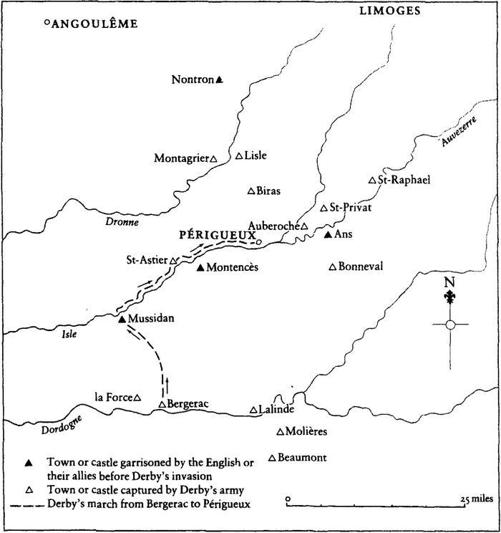
20 The Earl of Derby’s invasion of Périgord, September–October 1345
The shock felt at the French court when the news reached them can be imagined. Gascony was now given priority over every other front. Within ten days of the battle a fresh army was being formed. The Duke of Bourbon arrived to take up his lieutenancy in Languedoc in September. He threw himself into a campaign of recruitment extending over the whole of that month and the next. All the soldiers who could be found in the seneschalsies of Beaucaire, Carcassonne and Toulouse were assembled at mustering points in the north of the province. A headquarters was set up at Angoulême. Most of the men recruited in Languedoc were directed there from their mustering points. They joined forces in the fields outside the walls with the army which had been operating in Saintonge under Louis of Poitiers, with the survivors of Bergerac commanded by Bertrand de l’Isle and with fresh men raised in more distant provinces of France, mainly Burgundy and Auvergne. The overall direction of affairs was placed in the hesitant hands of the young Duke of Normandy.18
Derby remained at Bergerac for just over two weeks after the battle, resting, distributing the spoils and mopping up the fortified places within easy reach. These included most of the castles and bastides of southern Périgord. The inhabitants, according to a French official, were paralysed with fear. No one resisted. On 10 September 1345 the Earl divided his forces, leaving 1,500 men to hold Bergerac under the command of the Albret brothers, Bernard-Aiz and Bérard. The rest, consisting of 2,100 men-at-arms, with perhaps 4,000 to 6,000 footsoldiers and mounted archers, marched north under Derby’s own command to the town of Mussidan, where the Anglo-Gascons had maintained an isolated garrison for more than three years. From Mussidan, the Earl turned east along the valley of the Isle towards the provincial capital, Périgueux.19
The defences at Périgueux were in an even worse state than those of Bergerac. Like a number of towns of central and southern France, Périgueux was a double city with two entirely independent systems of fortification. The Cité to the west had its origin in the old Roman town. It was a geometrical grid of streets around the church of St Étienne (then the cathedral), the castle of the counts of Périgord and the remains of an old amphitheatre, defended by low crumbling Roman walls of the third century with only a few modern improvements; the much larger, more densely populated Puy Saint-Front to the east was an organic growth around the great monastic church which now serves as the cathedral, protected by walls dating from the twelfth and thirteenth centuries. Between them lay the open suburbs of Entre-Deux-Villes. Only the accident that the Count of Armagnac had fled there with some of the survivors of Bergerac enabled this great expanse of walls to be defended, and indeed turned to the town’s advantage. Derby cannot have had enough men to invest such a large conglomeration entirely. He maintained a loose siege, prowling with large raiding parties around the roads into the city, plundering the land about, and attacking those nearby castles and towns which had kept their gates closed. By the middle of October 1345 the English had taken control of a tight ring of fortified places around the northern and eastern sides of Périgueux and had more or less cut off the city from its sources of supply.20
The fall of Périgueux would have been a misfortune for the French as great as that of Bergerac, but it was a long time before they made any serious attempt to prevent it. The Duke of Normandy arrived in Angoulême in the first half of September 1345 and marched his men in a wide arc around the north of Derby’s theatre of operations, eventually establishing his headquarters at the safe distance of Limoges. By October he had about him (according to a reliable contemporary estimate) some 8,000 men-at-arms and ‘innumerable’ footsoldiers.21 At the beginning of October he decided to detach 3,000 men-at-arms and a large number of footsoldiers to go to the aid of Périgueux. The command of this force was given to Louis of Poitiers, but it also included Bertrand de l’Isle and many of those who had fought with him at Bergerac. John of Normandy himself followed by an uncertain route with the rest of his army.
The precise sequence of events is obscure. What appears to have happened is that Louis of Poitiers successfully relieved Périgueux, forced the main body of the Anglo-Gascon army to withdraw, and then, in accordance with the established French military practice, began the slow, methodical reconquest of the surrounding strongholds. Derby had left garrisons in all the more important of them in order to maintain pressure on Périgueux and delay the progress of the French army. In about the middle of October 1345 the French laid siege to one of these places, the castle of Auberoche. Today Auberoche is a small hamlet on the north bank of the river Auvezère 10 miles east of Périgueux. In the fourteenth century it was the site of a large seigneurial fortress belonging to one of the many petty lords of Périgord who had (in the French Chancery’s phrase) ‘turned English’. He had surrendered it as soon as the English army had arrived. Derby placed its defence in the hands of Alexander de Caumont, a fearless old man, one of the principal Gascon lords of the English army.
The besiegers sat outside the castle of Auberoche for a time. Then, on the morning of 21 October 1345, they were attacked suddenly and in force by the Earl of Derby. He had approached them by night with the main body of his army. The French suffered heavy casualties from arrow wounds before they had even come within fighting distance of their enemy. Although they had the advantage of numbers and at one point seemed to be prevailing, by mid-day they had begun to waiver and fall back. As their lines broke, the garrison sortied from the castle. The men-at-arms of Derby’s army remounted their horses. The combined force pursued the separated groups of fleeing French soldiers, inflicting upon them the appalling carnage always reserved for the defeated in battle. Louis of Poitiers was taken after a savage fight but died of his wounds, the end of an uninspired general but a courageous and loyal servant of the French Crown who had fought in every significant campaign since 1338. Bertrand de l’Isle, an abler but more self-serving man, was also captured. He could not bring himself to utter the words of surrender when he was overpowered, but being too valuable to kill was dragged away to captivity. The other prisoners included one count, seven viscounts, three barons, the seneschals of Toulouse and Clermont, twelve other bannerets, a nephew of Pope Clement VI and more knights than anyone counted. The ransoms exceeded even those taken at Bergerac.
By a convention which persisted well beyond the end of the middle ages prisoners were not the state’s affair but the private property of their captors. They might sell or mortgage them, detain them at pleasure or make what terms with them they could extract within the very broad limits fixed by the customs of war and the law of contract. So much so that prisoners released on parole to find their ransoms could expect to find their bargains enforced against them in their own country by the code of honour of their class and even by the courts of the sovereign in whose service they had been captured. Prisoners were by far the most valuable prizes of war, pursued in many cases with greater energy and courage than more important military objectives and occasionally at the expense of them. The egregious Walter Mauny, who was the most successful collector of prisoners of his age, had already captured the engineer John Crabbe in the Scotch wars and sold him to the King of England for 1,000 marks; between 1337 and 1340 he took a further£11,000 worth of prisoners in Flanders and northern France, including Guy Bastard of Flanders; in 1342 there were seven Breton noblemen, allies of Charles of Blois captured in the course of an otherwise useless enterprise in Finistère. Mauny had made a substantial personal fortune out of prisoners. But in spite of his example the English had so far taken relatively few of them. There had been too few victories. It was the battles of Bergerac and Auberoche which opened the eyes of both sides to the financial rewards of victory in the field and the catastrophic consequences for the defeated.22
There was an uncertain principle that ransoms should be reasonable. But the only limit recognized in practice was the amount which the prisoner could afford, with the aid of his friends, relations and tenants if need be. The inhabitants of Montricoux, a village in the valley of the Aveyron whose lord was captured at Auberoche, had to find the large sum of 200 l.t. to contribute to his ransom, ‘not wishing to see him destitute’. Some, who had exhausted their own resources and connections, turned to the Crown. Half a century later, Froissart recorded the recollections of some of the prisoners of Auberoche about the way they had been treated in Paris: squatting on the ground outside the offices of household officials day after day, hoping for an audience of the King as their purses were drained by greedy Parisian innkeepers. ‘Come back tomorrow or, better still, the day after.’ It has the authentic ring of officialdom, but it is hardly fair to Philip VI, who was at his wits’ end to find money to defend his realm and made generous grants in hard cases: 2,000 l.t. (£400) in one case, 2,000 gold écus (£375) in another, many smaller sums to knights and squires who, having paid their ransoms, could no longer afford to arm or mount themselves. The ransoms of Bergerac and Auberoche were thought to be particularly steep. The Pope’s nephew, according to his indulgent uncle, was made to pay Alexander de Caumont a sum so large that he would have to sell a large part of his estates. Indeed, some ransoms were never paid. The prisoners languished in jail for years or, like Jean de Galard, lord of Limeuil, took service with the English in lieu of payment and found themselves accused of treason by their erstwhile companions in arms. For Derby’s army the profits were immense. The Earl himself was reliably reported to have made enough money from the prizes of Bergerac to cover the entire cost, 52,000 marks (£17,333), of rebuilding the Savoy Palace in the Strand, and to have made another £50,000 from the ransoms of Auberoche.23
The battle of Auberoche marked the end of the French campaign of 1345 in the south-west. Although the Duke of Normandy was only about 25 miles away when the battle was fought, and commanded a fresh army larger than the one which had been defeated, he abandoned the effort as soon as he heard the news. His troops returned to Angoulême and were disbanded there on 4 November 1345. The Duke himself led his entourage north to lay plans for the following year in the austere castle of Châtillon-sur-Indre. It may be that shortage of money left him no alternative. Some of his troops were certainly in a very bad way. The Seneschal of Beaucaire had been complaining in September that not only were his men unpaid but they did not have the wherewithal to feed themselves and their horses. Some had already sold their equipment and deserted. The position is unlikely to have been better at the end of October, and was probably worse. Even so, the Duke’s decision to withdraw from the field was remarkable, and it had serious consequences for the French war effort in the south-west. There was no one to oppose the Earl of Derby in the field between November 1345 and March 1346.24
*
In spite of its promising beginnings the English expedition to Brittany ended in disappointment. On Guernsey, Castle Cornet had been stormed by the seamen of Bayonne on 24 August 1345 and the entire French garrison killed. This event completed the English reoccupation of the Channel Islands and removed the most serious threat to England’s communications with Brittany and Gascony.25 But then progress faltered. There were several reasons. Northampton’s army was of high quality but it was only a few hundred strong. Moreover, control of its operations was shared with John de Montfort, who had to be allowed to cut a good figure in his own duchy but proved to be a thoroughly inadequate commander. After Dagworth’s flying raid into central Brittany in June there was a long delay before the real campaign began at the end of July. It is not clear why this delay occurred, but its results were unfortunate. In June and July 1345, Charles of Blois was weak. In August, the French government, realizing that Edward III’s threatened invasion had been abandoned, began to transfer to Brittany troops previously reserved for the defence of the north. Many of these troops had been deployed in Normandy. Their transfer was therefore achieved much more speedily than the other great movement of men to Périgord and Languedoc which was planned at the same time. Charles of Blois had already received substantial reinforcement by 9 August.26
It was John de Montfort who conducted the main military operation of the summer. In the last few days of July he laid siege to Quimper, now the only significant town which his rival held on the south coast of the peninsula. The siege was a terrible failure. When John tried to storm the flimsy defences on 11 August he was driven back with heavy losses. Charles of Blois arrived a few days later with his newly enlarged army and brought the siege to an abrupt end. John, who appears to have received no warning of his coming, withdrew in disorder. He himself was surrounded in a fortified house nearby and escaped only by corrupting a sentry in the middle of the night. Not long afterwards he withdrew to his castle at Hennebont where he fell gravely ill. On 26 September he died. He had been a hesitant politician and an uninspired soldier, always the tool of other men’s ambitions. But however unsatisfactory John had been while he was alive, his death created worse problems than it solved. The English once again had to remake the Montfortist party around a new symbol. The Earl of Northampton received the homage of the surviving Montfortists in October 1345 in the joint names of Edward III and the dead man’s son, also called John. But the new Duke was only a child. He was about five years old and was being brought up in England. The outlook seemed more than ever uncertain.27
On 16 October 1345 the English King’s Council assembled at Westminster for what must have been a rather sombre review of events. The news of Derby’s capture of Bergerac, which arrived in the middle of the proceedings, was the only bright note. At this stage it was still proposed to send fresh armies to Gascony and Brittany to reinforce the men already fighting there. They were due, in theory, to leave the Solent ports in a matter of days. This proposal had never had much to recommend it. It was the compromise which had emerged from the lengthy debates in the Council in July after Edward had been obliged to cancel his project of invading northern France. Reality had crept in by now. Even if the timetable could be kept (which it could not) it would have been folly to spend scarce money on dispatching penny packets of troops to the continent at the very end of the campaigning season. The government announced the cancellation of both expeditions on 22 October 1345. A new expedition to the continent was to be undertaken as early as possible in the new year. The shipmasters, whose vessels had in most cases been under requisition since the spring, were not released. They were simply licensed to trade on putting up bonds to secure their reappearance at Portsmouth by 17 February 1346. The embarkation of the new army was fixed for 1 March 1346.28
It is unlikely that any firm decision had yet been made about its destination. The most likely place at this stage was Brittany. In October 1345 the Earl of Northampton embarked on a long winter campaign in the north of the Breton peninsula, the object of which appears fairly clearly to have been the capture of harbours more accessible from southern England than Brest or Vannes. Northampton’s difficulties were particularly acute in this part of Brittany, where the family of Jeanne de Penthièvre (Charles of Blois’ wife) had been the dominant power for decades and natural loyalties were as strong as anywhere in the duchy. It was all very well to inflict a sharp defeat on Charles of Blois on open ground, as Northampton succeeded in doing at the outset of the winter campaign. Charles always withdrew in good order. Northampton was unable to capture his strongholds. He failed to take Carhaix, an important road junction on his way north. He failed to take Guingamp, Charles of Blois’ headquarters, which had been heavily fortified since 1343. Northampton’s siege engines made no impression at all on its walls. At Lannion there was another embarrassing failure at the end of November. The Earl succeeded only in capturing a large consignment of Spanish wine which was being stored outside the walls. By the end of the year he had established a tenuous hold over the long inlet of the River Jaudy on the Tréguier peninsula. But it was almost useless to him. Tréguier, the principal harbour, was unfortified save for the tower of the cathedral, which had to be demolished in order to prevent it from being used by the French. The only place where the English could establish a permanent garrison was the small town of La Roche-Derrien, 3 miles upstream, which was captured in the face of ferocious resistance by its citizens after a series of assaults extending over several days. La Roche-Derrien was to be the focal point of the Breton war for the next two years and its retention, so far away from the main centres of English strength, proved to be a costly business. A large garrison was left there and one of Northampton’s principal captains, Richard Totesham, was put in command of it. But the harbour could take no vessels larger than 60 tons’ burden and these only at the top of the tide. It never could be, certainly never was, used as a landing place for large bodies of troops.29
At Westminster the English King received a papal ambassador at a disagreeable audience. The ambassador, Niccolo Canali, Archbishop of Ravenna, was the harbinger of another pair of peacemaking cardinals. He had come to obtain a safe conduct for them and to draw the King’s attention to the fact that the truce of Malestroit still had nine months to run. Edward’s answer, which was delivered by one of his household officers, was a litany of abuse against the King of France. Edward would appoint ‘neither place nor date’ to discuss a permanent peace. On the contrary he intended, he said, to claim his rights by armed force and then, if the Pope was pleased to send him cardinals with reasonable proposals, they might be graciously received. The Archbishop inquired where those cardinals would go. When the King of England comes, was the answer, all Christendom will know of it, and the Pope will have no doubt where to send his messages. The interview ended on this grandiloquent note. Edward could be confident now that English opinion would support him in any quarrel with the Pope even in the face of excommunication and interdict. Clement probably thought so too. He did not dare to resort to these extremes. The ambassador stayed at court for a while ‘because it was Christmas’, wrote the acerbic Adam Murimuth, ‘and because his expense allowance was fifteen florins a day.’ When the cardinals renewed their application for a safe conduct, in February 1346, their messenger was thrown in prison.30
*
The Earl of Derby changed the direction of his campaign after the battle of Auberoche. Instead of pressing the siege of Périgueux, he left a group of garrisons close by to watch their opportunities and then marched south towards the Garonne valley to begin the recovery of territory on the eastern march of the duchy in more favourable conditions than any which an English army had yet enjoyed there. The bastide of Pellegrue surrendered on terms; Monségur, another bastide, resisted and was stormed and sacked. Early in November 1345 the Earl arrived outside La Réole.31
The defences of La Réole were very powerful and were manned by a large French garrison, but, as Henry of Lancaster once observed, no fortress was strong enough to resist the enemy within. The citizens of La Réole had no stomach for a siege and no natural loyalty to the King of France. Before its capture in the war of Saint-Sardos the town had enjoyed a more prominent place in the English duchy than it could ever hope to have in a French province. It had also had privileged access to the sea for its wines and a greater degree of municipal autonomy than any French seneschal was likely to tolerate. The leading citizens discussed among themselves what they should do, and agreed to deliver up the town to the Earl. On 8 November 1345 a feint was arranged at one side of the town. The men on watch summoned help from the garrison while others opened a gate at the opposite side and allowed the English in. The garrison were lucky to avoid being trapped on the town wall. They saw what was happening in time to reach the citadel, grabbing a troop of pigs in the street as they went, to sustain them for a siege.
The citadel stood at the western edge of the town on a promontory overlooking the river. It was a great square fort with broad corner towers built by the engineers of Edward I. The English bombarded it with stone-throwers without effect and launched assaults over the walls which were driven back. But the citadel was vulnerable to undermining from within the town. After three weeks of burrowing (the Earl worked in the tunnels himself) the garrison commander struck a deal with the besiegers. He had resisted long enough to save his honour before the court of France. So he agreed to observe a truce of five weeks and to surrender if a relieving army had not appeared by the end of that time. Conditional surrenders of this kind were quite common and, provided that the garrison was recognizing reality, not colluding with the enemy, the custom of war sanctioned them. The garrison commander sent notice of the treaty which he had made to the Duke of Normandy and called on him to relieve the town. But the Duke was far away at his winter quarters on the Indre. He did nothing. Bourbon, who was closer at hand, had proclaimed the arrière-ban in Languedoc and the march provinces as soon as the English had arrived at La Réole. But the response to his summons was poor. He had squeezed the lemon dry to swell the army which John of Normandy had just disbanded. These men were still trudging back across southern France to their homes. In December the Count of Armagnac was trying to recruit men for Bourbon in his domains in the Rouergue, but if anything came of this it was too little or too late. Early in January 1346 the garrison of La Réole marched away and the English took possession of the citadel. The townsmen were generously treated for their pains.32
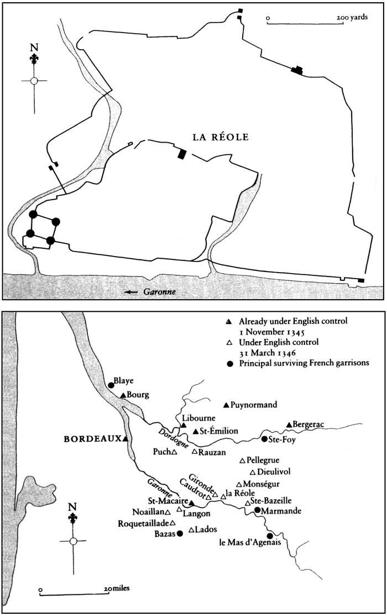
21 English occupation of the Bordelais, winter 1345–6
The Earl of Lancaster (as he had now become, on his father’s death in September) remained in winter quarters at La Réole until March 1346 and most of his army was dispersed. The Gascon lords and their retainers returned to their homes until the spring. Some of the principal retinues which had come with the Earl from England went back there, including those of the Earl of Pembroke and Sir James Audley.33 Those who remained occupied themselves in raiding ill-defended towns and castles of the enemy. Small detachments overran the Garonne valley between La Réole and Saint-Macaire and carried out attacks deep into French territory north of the river. The most spectacular case was the seizure of Angoulême by a small force commanded by the Englishman John of Norwich, which occurred at the end of 1345. Angoulême, which was quite unprepared for an attack, appears to have surrendered after the most perfunctory resistance. John did not hold it for very long. He was compelled to withdraw in February 1346 and it might be supposed that he had gained nothing except spoil. In fact, adventures of this sort hamstrung the French government’s conduct of the war. They made men divert effort and money into local defence. No doubt it made sense for Toulouse to begin a great campaign of fortification in December 1345 and for Limoges not only to start rebuilding its defences but to man them day and night during the winter. In most such cases there was a direct cost to the state. The towns sought and almost always obtained the privilege of diverting the state’s local tax revenues at source to pay for their work. It became difficult or impossible to recruit men to serve away from home. The tendency of provincial societies to turn in upon themselves in the face of danger was never more clearly expressed than by Gilbert of Cantobre, Bishop of Rodez, writing some eighteen months after these events, in April 1347. The fighting had by then taken a more serious turn, but it had still hardly touched his own diocese. Yet this nervous cleric proposed a scheme of local defence which treated the Rouergue as if it were an independent republic, not a province of the French kingdom. There was to be conscription and taxation organized by local captains, district by district. There was to be a captain-general for the whole province. Elaborate arrangements were proposed for mutual assistance between neighbouring towns and districts. But the captains were on no account to take their men beyond the boundaries of the seneschalsy, and they were not to be obeyed if they tried to. No levies were to be paid to support any military operations outside Rouergue ‘but only to pay for the defence of our homeland here in this province’. As for the taxes collected by the Crown, they were to be entirely abolished, and Philip VI invited graciously to content himself with his ordinary revenues.34
These places were far from the seat of the fire. Fear, which inspired their inhabitants to urgent effort, paralysed those who lived at the edge of the Bordelais, where the English conquest proceeded swiftly. Froissart relates a conversation between a garrison commander and a deputation of townsmen which was invented but must in fact have occurred in many towns of the south-west. ‘Think of us,’ the townsmen said; ‘if the English capture the town we shall all be killed and our homes overrun.’ ‘And what do you expect us to do about that?’ the captain’s attendants asked. ‘We want you to stop the assaults of the English by parleying with them, so that we can be left alone in peace, for otherwise we shall not be safe whatever happens. But if you are not prepared to do that, then why not at least withdraw into the citadel to carry on your war, for we have had enough of ours.’ This man did as he was asked. A less percipient commander might have rejected their petition out of hand.
Sir Hugh was very harsh [Froissart wrote about one such man]; he told them that the place was strong and well supplied and could hold out for a good six months. They were making a fuss about nothing. When they heard this, they did not argue the point but left him most respectfully. Then, at vespers time, they seized him and threw him into a cell, shouting that he would not be allowed out until he had agreed to do their bidding. ‘And what may I ask is that?’ ‘It is that you shall use your authority to go out and treat with the Earl of Derby and the English, so that we can live in peace.’
In a few places an energetic local commander with a large garrison was able to uphold the cause of Philip VI with élan. The captain of Sainte-Foy-la-Grande, which was now the main obstacle to free communication by river between Bordeaux and Bergerac, beat off a strong attack on his town, one of the few reverses which the English suffered. At Bazas, the French captain returned a defiant answer to Henry of Lancaster’s summons to surrender, and managed to hold the townsmen’s loyalty for another year. These men were not typical. Langon, which had successfully resisted in the summer, surrendered in the winter. Sainte-Bazeille was recovered for the third time. Marmande was now the only significant French garrison on the Garonne between Bordeaux and Aiguillon.35
In the Agenais every hill-baron was assessing the impact of the English victories. In November 1345 the Durforts of Duras, the major noble house of the northern Agenais and the richest branch of the great dispersed clan of Durforts, switched their allegiance to the King of England. Their sudden change of loyalties illustrated the snowball effect of victory in the field. Aimeric de Durfort had been one of the many lords of the south-west forced to make hard choices on the outbreak of war eight years before. He had consistently supported the French Crown, and forfeited valuable estates of his family in the Bordelais in consequence; but he had retained much more extensive possessions in the Agenais and southern Périgord which Philip VI would otherwise have confiscated, and had received periodic grants of territory conquered from supporters of the Bordeaux government. When Aimeric died in 1345, probably at the battle of Auberoche, the situation was very different. The English were now in possession of most of southern Périgord and poised to reconquer the Agenais. Aimeric’s calculation did not seem as sound to his brother Gaillard, who succeeded him. Gaillard, who was to become one of the pivotal politicians of the south-west in the next decade, was a shrewd and cynical ex-priest who had once been a professor of canon law at Toulouse University and among the most successful accumulators of ecclesiastical benefices in France. Only the political difficulties of his family induced him to abandon a clerical income of 3,000 l.t. per year in middle age in order to marry, take knighthood and throw himself into a dynastic war and the many vendettas of his tribe. He accounted for the allegiance of his three brothers, a large military retinue, major fortresses at Puyguilhem and Duras and, with his allies, ‘towns, places, castles, lords, all restored to the obedience of our lord the King’. Lancaster made sure that they were well rewarded.36
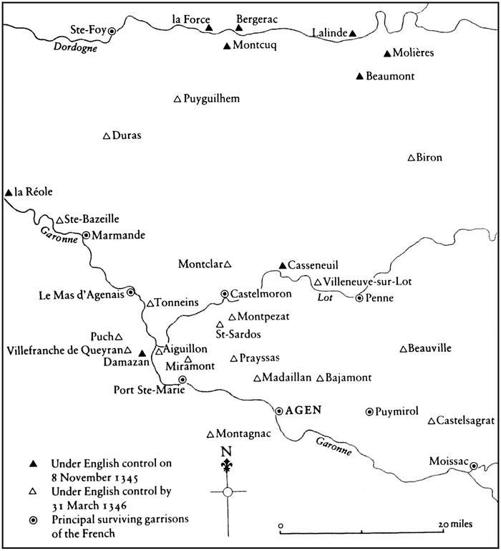
22 Agenais and southern Périgord, November 1345–March 1346
It was the first sign of the way the wind was blowing in the Agenais. Except in places which were directly garrisoned by the French Crown (as opposed to local lords for the Crown’s account) Philip VI’s officials rapidly lost all control there during the winter. According to a complaint which the main garrison towns addressed to the King, the region was reduced to anarchy by the end of November and defections were occurring ‘daily’. The English opened their campaign at the beginning of the following month. They seized Aiguillon, the town which commanded the confluence of the Lot and the Garonne. As soon as Ralph Stafford appeared before the town the inhabitants fell upon the garrison, killing some and imprisoning others. Then they opened their gates. At which, said Jean le Bel, the Earl of Lancaster was ‘as pleased as if the King of England had suddenly become £100,000 richer’. Judging by the flow of gifts to the coseigneurs of Aiguillon, the coup had been arranged with them in advance. Before they captured Aiguillon the English had no garrisons in the Agenais except at Casseneuil on the Lot. During the next three months they took possession of substantially the whole region, mainly by defection rather than conquest. In some places the local inhabitants joined in the plundering of their neighbours. The only sustained resistance which is recorded occurred at Montpezat, which had a royal garrison. They defended the place with courage until the inhabitants rose up and killed them. By March 1346, the French were reduced to their major strongholds: Port-Sainte-Marie, Agen and Moissac on the Garonne, and Castelmoron on the Lot.37
The Duke of Bourbon kept his quarters throughout the winter at Agen, the provincial capital. There was already a siege atmosphere there. All the roads out were cut off one after the other in the first three months of 1346. River traffic downstream beyond Port-Sainte-Marie was closed off by the English capture of Aiguillon. In the fourteenth century, before the fruit trees took over, the men of Agen made some of the most famous wines of the south-west on the hillsides behind the town, which were now speckled with enemy garrisons. Bajamont, the closest, had been recovered by the Durforts, those persistent enemies of the town, a base from which to resume the harassment of the citizens suspended on their family’s expulsion years before. The inhabitants of the suburbs were pressing into the town, carrying all their possessions with them. The cathedral canons moved their wine from the sheds in the vineyards where it was made, to stores within the walls. Weapons were distributed to the citizens from the common stocks. Tremendous works were in progress on the walls, which had never completely enclosed the town. A new wall appeared on the northern side, where previously a ditch and a canal had been thought enough. Two towers which had been allowed to collapse were rebuilt. The cluster of buildings between the east gate and the river was being demolished, and a new tower was rising at the head of the Garonne bridge. Great gaps had appeared in the market place where once had stood the mansions of prominent citizens, now disgraced for defecting to the English King. The tension generated a sense of common purpose, but also venomous antagonisms: between the citizens and the refugees; between both groups and the soldiers of the Duke of Bourbon. The refugees, if they were not penniless and thrown on to the grudging charity of their hosts, were suspected of staying alive by selling their possessions in competition with local traders. The troops, bored, unruly and possibly unpaid, helped themselves to what they needed. The situation deteriorated sharply in February and March 1346 when fresh contingents began to gather for the forthcoming campaign, including several hundred Genoese and Tuscan mercenaries. There were some ugly incidents. Several Italians were lynched after one of these. Agen refused point-blank to supply any contingent of its own to the army in spite of its wealth and size: their men, the citizens said were needed to guard their hearths.38
*
The extent of the French government’s financial problem in the south is graphically revealed by the tone in which the Seneschal of Périgord and Quercy was addressing his subordinates in December 1345.
We have heard that the proceeds of the ecclesiastical tenths are on deposit with certain persons at Sarlat [this man told his officers there]. The King’s needs are plain. He must have everything that he can get if he is to prevail over the enemy. There is plenty of money in Sarlat. Go and find it and bring it to me wherever I may be on pain of a fine of twenty silver marks. If anyone makes a fuss, seize all his goods.39
This approach, which had already generated unrest in other part of Périgord, was unproductive. Sensible men recognized that overbearing methods of collection were also politically unwise at a time when the Earl of Lancaster appeared to be invincible and was offering attractive terms to defectors.
At the end of the year the French government, chastened by the continuing flow of bad news from the south, resolved upon a radical reform of the tax system, a difficult enough enterprise at any time let alone at a time of grave political disaffection and impending military crisis. The Estates-General was summoned to meet in two great assemblies, the representatives of the north and centre in Paris, and those of Languedoc in Toulouse. The tone of the summonses betrayed the King’s misgivings. They were very defensive. The King had heard, he said, that his subjects considered themselves grievously oppressed by the burden of taxation which they had been asked to bear, as well as by the harsh methods of the numberless provosts, sergeants, commissioners and tax farmers which he had loosed upon them, ‘for which evils we are truly sorry and sore of heart’.
The Paris assembly opened first, in the great hall of the Augustinian friars on the left bank of the Seine. The proceedings lasted for about a week, and although no account of them has survived it is reasonably clear what happened. The government was aware that there was a widespread fear that the sales tax and the gabelle du sel, both of which had begun as temporary expedients, were becoming permanent taxes. They offered to abolish both of them and replace them with a uniform tax directly related to the Crown’s military needs. Each community would be assessed to furnish the cost of a fixed number of men-at-arms for up to six months in the year for the duration of the war. The formula which the government had in mind was: one man-at-arms for each 200 hearths, or 300 hearths in the poorest communities. In addition Philip’s ministers promised a number of administrative reforms. They proposed to abolish the farming of taxes, to restrain the more notorious excesses of their financial officials and to limit the requisitioning of carts and foodstuffs, a prerogative which was no more popular in France than it was in England. These were intelligent and attractive proposals which appear to have been welcomed by the three estates. The problem was that there had been no preliminary discussion of them before the assembly opened. They seem to have been devised either in the course of the assembly’s deliberations or immediately beforehand. It was therefore necessary for the representatives to return home to consult their constituents. No final answer could be given until a further round of assemblies had met, province by province, during the spring and early summer of 1346. Thereafter, there was bound to be more delay while the assessments were prepared and collection was organized. There was simply not time to do all this across the whole of northern and central France. In the meantime it was understood that the gabelle and the sales taxes would continue, however inadequate their yield or difficult their collection.40
Languedoc, with its long tradition of obstruction and rebellion against taxes, was more cautious. The Estates opened at Toulouse on 17 February 1346 under the presidency of the Bishop of Beauvais and agreed to grant a hearth tax of ten sous per hearth. Since by the Crown’s reckoning it needed to raise the equivalent of twenty-seven sous per hearth throughout the kingdom in order to finance an army of between 20,000 and 30,000 men the representatives of Languedoc were conceding little more than a third of what was required of them. Moreover, it was payable in instalments in April, May and June, well after the date fixed for the opening of the campaign. The long-term proposals which the government had presented to the Paris assembly did not arrive in the south until some time after the representatives had departed. Another assembly had to be summoned to consider them in May. But there was little enthusiasm for them even then. Another ten sous per hearth was granted, payable in July. Further discussion of the tax was put off until yet another assembly, which, in the event, never met.41
These taxes narrowed, even if they did not close, the gap between income and expenditure in the Crown’s accounts. The main difficulty which they did not solve was the heavy concentration of military expenditure in the weeks before the campaign and at its opening, when equipment and stores had to be bought and advances paid to the troops. The burden was particularly heavy in 1346. This French government’s plans were ambitious and they had to be laid well in advance.
Ships and archers were perceived to be the main deficiencies in the French defences. The French evidently distrusted the quality of their own galleys and oared barges, and they were probably not as seaworthy as the vessels of the Genoese. The problem of the great English superiority in archers must have been apparent to the French ministers for many years. Morlaix, the first significant pitched battle of the war, was a sombre warning. Auberoche was another. Less than a month after it was fought Philip VI was trying to recruit crossbowmen in Aragon. An intense campaign of recruitment was begun in Italy, the main source both of skilled crossbowmen and of fighting galleys. Pietro Barbavera, the scapegoat of Sluys, left Paris for Genoa at the beginning of December 1345. Marquis Scatisse, the King’s Lucchese financier, followed him three weeks later accompanied by the Admiral of France, Floton de Revel, and Jean de Boucicaut, the future Marshal. They were busy in Nice, Monaco and Genoa in the new year.
Philip’s emissaries hired no less than thirty-two galleys, all but two of which were full-sized vessels of sixty oars. Their crews (most of them carried more than 200 men) would provide a valuable reserve of infantry and crossbowmen to fight on land as well as at sea. The chief entrepreneur responsible for assembling this great fleet was that veteran of past naval campaigns, Carlo Grimaldi of Monaco. A large number of the galley commanders were members of his own family. Most of the others were his friends and dependants. The crossbowmen who fought on board these vessels had to be recruited separately. During March, the French officers passed under review a disorderly mass of Provençal and Genoese marine soldiers in the gardens of the Carmelites of Nice.42
In the early part of 1346 the financing of these projects fell chiefly on the war treasurers of the south and the tax-payers of Languedoc. The Bishop of Beauvais, who was in charge of the collection of the hearth tax, struggled to anticipate as much of it as he could. He allowed some communities to pay lump sums at a discount. Italian moneylenders were mulcted (again) for forced loans. The King borrowed heavily from his relatives. The Queen borrowed on her husband’s account from divers Paris moneylenders. John of Bohemia somehow found 1,000 l.t. for Philip’s coffers. But the government’s largest creditor by far was the Pope. Clement had always gone as far as he could to relieve the financial distress of the King. He had allowed Philip to go on levying a tenth of ecclesiastical incomes year upon year. In June 1344 he had dispensed Philip from the duty to repay the money previously collected for the cost of the abortive crusade, something which his predecessor had always refused to do. But, apart from one recorded loan of 50,000 florins (£7,500) in 1343, Clement had stopped short of lending money to the French King. It might be thought inconsistent with his role as a peacemaker. In the aftermath of the battles of Bergerac and Auberoche, and the capture of his nephew by one of Lancaster’s commanders, Clement’s scruples disappeared. In the utmost secrecy Philip’s conspiratorial private secretary, Robert de Lorris, made three visits to Avignon between November 1345 and March 1346, in the course of which he arranged loans amounting to 330,000 florins (£49,500) from Clement himself and 42,000 florins (£6,300) from principals and bankers at the papal court. These were enormous sums. Almost half of them went to swell the Duke of Normandy’s war-chest either directly as payments to him or as advances paid to his Genoese mercenaries in the ports of Provence. Clement also lent money to some of Philip VI’s friends and commanders, including Charles of Blois and the Duke of Bourbon.43
Even so, there were acute shortages of cash at awkward moments. In April 1346, the Duke of Normandy was obliged to issue commissions to three of his financial officials to seize rebel property, sell letters of pardon and letters of nobility and legitimacy, assume jurisdiction in every species of civil or criminal dispute in which fines could be levied and do almost all the things about which the King had written so apologetically in summoning the Estates-General. ‘Amass all the money that you can extract for the support of our wars. Take it from each and every person you can, and see to it that every penny is transmitted directly to our Treasurer.’ Few documents are more evocative of the hand-to-mouth existence of a fourteenth-century government.44
*
Serious as the financial problems of the French Government were, it was not by want of money that they were defeated in 1346. The army which John of Normandy commanded in the south-west was the largest which they had ever deployed there. Not since the campaigns of 1339 had so many northern noblemen fought in Gascony. They included the Duke of Burgundy and his son, as well as the Count of Boulogne, Walter of Brienne Duke of Athens, a host of knights from the north and centre and all the military officers of the royal household: the Constable, Raoul II, Count of Eu, both Marshals and the Master of the Royal Archers. These men marched south from the Loire valley in February. The Duke of Bourbon and the Bishop of Beauvais formed a second army in Toulouse drawn from all the southern seneschalsies. They collected a train of siege equipment which included five cannon. The two armies joined forces in Quercy in March 1346 and began to move slowly down the valley of the Garonne. Fresh groups of men joined them throughout the spring and summer. By comparing the known strength of earlier armies with what is known about the recruitment of this one, it is possible to guess that John of Normandy had between 15,000 and 20,000 men under his command at the height of his campaign, including 1,400 Genoese mercenaries. The first English-held town on the army’s line of march was Aiguillon. The van of the French army arrived before its walls on about 1 April 1346. On 2 April the arrière-ban was proclaimed in the south. In the middle of April the Duke himself arrived with the rearguard and the great noblemen and principal officers of the army.45
Aiguillon, which had fallen in a matter of hours to Ralph Stafford, was besieged by the Duke of Normandy throughout the summer of 1346.46 Indeed, at one disheartening moment of his fortunes there, he swore an oath that he would never withdraw from it until it had fallen. The Duke was much criticized for his obstinacy. The real object of his campaign, as he had publicly announced, was the recapture of La Réole, the loss of which in the previous year had been a grave setback for the French position in the Garonne valley.47 But John of Normandy, although a poor soldier for his own part, was not short of expert advice. The truth was that Aiguillon was vital. It commanded the confluence of the Lot and the Garonne upstream of La Réole, and its possession by the English denied the French the use of both rivers. These rivers were the routes by which any French army encamped around La Réole would have to be supplied. There was no practical alternative. The condition of the roads in the south-west was appalling, and they ran through country which was in a state of anarchy and in places occupied by the English and their allies. John of Normandy had some personal experience of these matters. His first campaign on the Scheldt in 1340 had failed chiefly because he had attempted to capture towns without securing the river communications in his rear. There were, however, considerations of a more intangible kind also. The Duke of Normandy was the first man of the realm after the King. Once he had delivered his formal demand for the surrender of the town his dignity was committed to a successful outcome. One of those present at the siege was that famous paladin and authority on matters of chivalry, Geoffrey de Charny. Was it, he asked some years afterwards, even more dishonourable for a man who had laid claim to a town to march away without winning it than to refuse a relieving army’s challenge to battle?48
One of the first things which the French army did was to dig trenches and earthworks behind their positions, to guard against surprise from behind, and to preserve themselves from the fate which had befallen the army of Auberoche. But the Earl of Lancaster had no intention of being drawn into battle against forces so enormously superior to his own. He withdrew to Bordeaux a few days before the siege began to reconstitute his forces and muster those of the Gascon nobility. Reinforcements, mainly archers, had also been promised him from England. Some of them arrived during May and June.49
Aiguillon was left to be defended by Ralph Stafford and the captain of the town, a Leicestershire knight called Hugh Menil. They commanded a strong garrison, plausibly estimated by Jean le Bel at 600 archers and 300 men-at-arms, including two of the more famous captains on the English side, the Hainaulter Walter Mauny and the Gascon Alexander de Caumont. They had to make up by courage and numbers for the inadequacy of the fixed defences. Aiguillon was a small town consisting of two bourgs which had gradually coalesced. Lunac d’Aiguillon was an ancient Gallo-Roman town on a square plan with crumbling brick walls, the remains of a low keep at its western end, and the castle of its seigneurs rising out of the river at the north-east corner. Le Fossat d’Aiguillon was the castle of another local family lying just south of Lunac around which a small village had grown. A modern rectangular perimeter wall about 270 by 170 yards around both bourgs had been begun but never finished. The gaps in it had to be filled with wine barrels packed with stones. On the north side there was a delapidated fortified bridge over the Lot ending in a barbican gate on the far bank.50
It took a very long time for the French to invest Aiguillon entirely. At first they encamped in the plain east of the confluence of the two rivers, leaving free access between the town and La Réole by river and across the Lot bridge to the open country north of it. Lancaster had left strong garrisons in Damazan and Tonneins to hold the ground west and north of Aiguillon. To occupy this territory without splitting the besieging army into three parts and exposing them to defeat in detail, it was necessary for the French to take possession of the nearest bridge over the Lot at Clairac, 5 miles upstream, which was accomplished without difficulty; and to build a wooden bridge across the Garonne a short distance downstream of the town, a more formidable undertaking which occupied some 300 carpenters and journeymen working for several weeks under the protection of an enormous escort of Genoese crossbowmen. In the early weeks of the siege the garrison made two or three sorties a day in the attempt to destroy these works. Eventually they took to attacking them from barges. The Garonne bridge was broken up twice before it was finally completed towards the end of May 1346. Having occupied the ground beyond the rivers, the French stretched chain across the Garonne to stop supplies or reinforcements reaching the garrison from the west.51
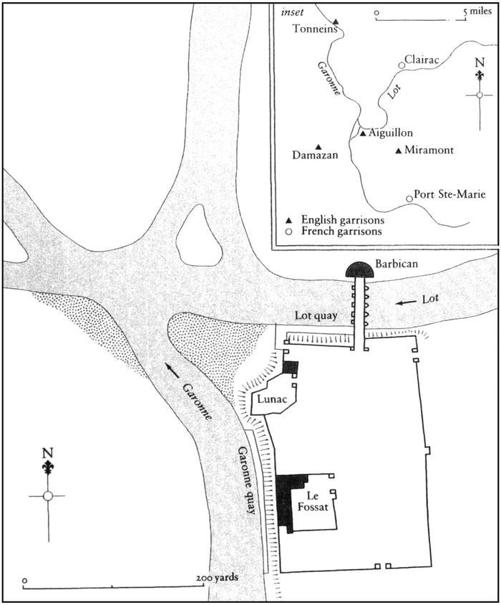
23 Defences of Aiguillon
On 16 June 1346 the French tried to bring two huge barges laden with supplies from Toulouse past the town into the lower reach of the Garonne. The defenders launched two hazardous sorties against these barges. One sortie party attacked in small boats from beneath the west walls of Lunac; the other, about 100 men-at-arms commanded by Alexander de Caumont, sallied over the Lot bridge, through the French encampment on the far side and along the north bank of the river. The barges were captured and brought into the town under the noses of the besiegers. It was a remarkable feat of arms, but it was achieved at great cost. For the French soldiers north of the bridge launched a furious assault, supported by stone-throwing artillery, against the barbican gate on their side, just asAlexander de Caumont’s force was trying to retreat back through it. After several hours of fighting, during which both sides were heavily reinforced from behind, the French succeeded in capturing the barbican gate and fought their way on to the bridge. In order to prevent them from getting into the town itself, it was necessary to bring down the portcullis at the southern gate. As a result the sortie party was cut off. Many of them were killed and others, including Alexander de Caumont himself, were taken prisoner. He had to redeem himself for an enormous ransom, most of which was advanced by the Earl of Lancaster. This transaction was completed almost at once and Alexander was back in the thick of the fighting within a few days of his capture. Perhaps a more intelligent calculation of French interests would have kept him in prison for longer, but prisoners were above all a marketable commodity.52 The battle of the bridge of Aiguillon boosted the moral of the besiegers as well as making money for a few of them. Thereafter nothing went their way.
NOTES
1 Chron., iii, 44.
2 Fowler, 222–4, *230–2; RF, iii, 32, 34–5, 37–8.
3 HGL, ix, 572.
4 Henneman, 181–4, 187–8.
5 Arras army: AN P2291, pp. 833, 841–3 (postponed in June to 8 Aug., Grandes Chron., ix, 254); BN Fr. 25998/437. Spain, Portugal: *HGL, x, 971; Arch, admin. Reims, ii, 949–51; Daumet (1), 10–17, *132–47. La Rochelle: LE, no. 240. Ships: DCG, nos 421, XXXII (21, 22); Roncière, i, 472, 474. Saintonge: BN Clairambault 5/229, 21/1501, 1675, 46/3419, 65/5023, 76/5937, 5981, 87/6889, 6895. Agenais, Languedoc: HGL, ix, 572, 580; Dupont-Ferrier, iii, no. 13671. Funds: *Bertrandy, 23n; HGL, ix, 572–3, 573n, *x, 969–72.
6 PRO E372/191, m. 54 (Lancaster); RF, iii, 58.
7 *Bertrandy, 24n; Jurades d’Agen, 21; AN JJ78/60 (Monbreton); HGL, ix, 580; BN Clairambault 212/9435.
8 Blaye: Chronographia, ii, 214. Langon: Chron. Bazas, 43. Périgord: AN JJ68/187, 199, 428, JJ78/148; AD Pyr.-Atl. E608; *Bertrandy, 50n.
9 Chron. Norm., 66; *HGL, x, 973; *Bertrandy, 32n; Chron. Bazas, 43. Bishop: BN Clairambault 5/229; JT, nos 910, 2751.
10 RF, iii, 44; Morice, Preuves, i, 8; PRO E101/25/6 (Ferrers).
11 PRO E372/191, m. 54 (Lancaster). Defence: JT, no. 185; LE, nos 244, 247; BN Clairambault 29/2121, 41/3099, 71/5507. ‘Itin. Philippe VI’.
12 Lucas, 493–505, 509–11.
13 Lucas, 481–93; Werveke, 87–95.
14 Lucas, 511–7. Edward’s visit to Sluys, death of van Artevelde: RF, iii, 50, 53, 55–6; Murimuth, Chron., 169–70; Récits d’un bourgeois, 198–201; Chron. Com. Flandrensium, 216–17; RSG, ii, 391–3, CPR 1374–7, 508 (Appendix); Chronographia, ii, 211–12; Chron. Norm., 63–5; Istore de Flandre, ii, 32–3; Villani, Hist. XII: 46, col. 926; Lucas, 519–27. Artevelde’s family: PRO E403/336, mm. 10, 12, 15, 16, 20–1, 27, 33.
15 RF, iii, 55–6; Murimuth, Chron., 170. Bourbon: Ordonnances, iii, 160.
16 Bergerac campaign: Chron. Bazas, 43–4: Petit Chron. Guyenne, 400; Chronographia, ii, 214–5; Chron. Norm., 66–7; Murimuth, Chron., 189; Knighton Chron., ii, 118. Topography: AHVF Bergerac.
17 Chron. Bazas, 43; Knighton, Chron., ii, 32.
18 HGL, ix, 579–81; E. Petit (1), viii, 4–5; Titres Bourbon, no. 2418; LE, nos 248–50, 258–60, 262, 264, and lists of French combatants at Auberoche in Petit Chron. Guyenne, 401, and Murimuth, Chron., 190, 249–50.
19 S. Périgord: *Bertrandy, 33n, 36n, 44n; *HGL, x, 973. March to Périgueux: Villani, Hist. XII: 46, col. 927; Knighton, Chron., ii, 32; *Bertrandy, 97n (Maurens), 72n, 75 (St.-Astier); Murimuth, Chron., 251 (St-Front de Pradoux, Sourzac); Avesbury, G. Edwardi, 356 (St-Louis, Lisle, Montagrier).
20 Avesbury, G. Edwardi, 356; Rec. titres Périgueux, 251, 253. Murimuth, Chron., 251 (Biras, Bonneval); AN JJ68/428 (Ans); *Bertrandy, 77n, 105n (St-Privat, St-Raphaël). Topography: Higounet-Nadal, 25–7, 31–9; AHVF Périgueux.
21 HGL, ix, 581. Auberoche campaign: Bertrandy, 16; Villani, Hist, XII: 46, col. 927; Chron. Bazas, 44; Petit Chron. Guyenne, 401; Murimuth, Chron., 190, 249–50; Avesbury, G. Edwardi, 356–7; Clément VI, L. Cl. (France), nos 2608–10. On occupation of Auberoche by English: *Bertrandy, 105n; AN JJ68/157, JJ80/699.
22 Keen (1), 156–74; Timbal, Registres, 305–74; CPR 1345–8, 468 (courts). Mauny: PRO E403/270 (Crabbe); RF, ii, 1123 (Guy, etc.); Knighton, Chron., ii, 24, and *KOF, iii, 525 (Bretons).
23 Montricoux: *Bertrandy, 51n, 117n; HGL, ix, 575–6; Anselme, ii, 195. Nephew. Clément VI, L. Cl. (France), no. 2608. Galard: AN JJ68/79. Derby: Knighton, Chron., ii, 118; Villani, Hist. XII:46, col. 927.
24 Villani, Hist. XII:46, col. 927; Bertrandy, 265–71; JT, nos 2265, 2270, 3387, 3368, 3649, 4311, 4535; E. Petit (1), viii, 5n. Seneschal: *HGL, x, 973.
25 PRO E101/25/6.
26 BN Fr. 25998/437; JT, no. 278.
27 BL Add. Chart, 3323–4; Morice, Preuves, i, 8, 113; Grandes Chron., ix, 255–6; Murimuth, Chron., 189.
28 RDP, iv, 556–7; Murimuth, Chron., 176–7; PRO C76/21, m.4.
29 Grandes Chron., ix, 260–4. Guningamp: Leguay, 43. Roche-Derrien: Touchard, 324.
30 Murimuth, Chron., 190–2; *Bertrandy, 64n; Chron. Bazas, 45.
31 Avesbury, G. Edwardi, 356: *Bertrandy, 64n; Chron. Bazas, 45.
32 Chron. Bazas, 44; Chron. Norm., 69–70; Grandes Chron., ix, 259; AHG, i, 302–3. Bourbon: Doc. Millau, 82; BN Col. Doat 189, fol. 183. Topography; AHV La Réole. Rewards: *Bertrandy, 168n; RF, iii, 125; PRO C61/57, m. 2, C61/59, mm. 12, 10, 9, 8, 7, 6, SC8/243/12141, 12154–55.
33 PRO E372/191, m. 54 (Pembroke), E372/202, m. 37 (Audley), E101/24/20.
34 Angoulème (not an error for Agen or Aiguillon): Chron. Norm., 70–1; Bel, Chron., ii, 43– 4, 50–4. Toulouse: AD Hérault A1/12, 16, 17, 19, 20; Bertrandy, 298–9. Limoges: *Bertrandy, 223n; LE, no. 296. Rouergue: Débat, ‘Trois lettres’, 73–6.
35 Froissart, Chron., iii, 77, 303. Ste-Foy; Chron. Norm., 67. Bazas: JT, no. 1366; Chron. Bazas, 43. Langon: Knighton, Chron., ii, 32. Ste-Bazeille: Bel, Chron., ii, 40. Other conquests: Murimuth, Chron., 251.
36 Doc. Durfort, pp. xxvii-xxx, nos 918–19, 931, 947, 949–54.
37 Anarchy: Jurades d’Agen, 31. Tonneins, Damazan, Villefranche de Queyran: Chron. Norm., 69 Bel, Chron., ii, 43. Castelsagrat, Beauville, Balamont, Montclar, Montagnac: Jurades d’Agen, 60. Miramont, St-Sardos, Pressas: Murimuth, Chron., 251. Villeneuve: Muisit, Chron., 151. Montpezat: *Bertrandy, 227n; Chronographia, ii, 217;Chron.Norm., 68; Bel. chron., ii, 42. Castelmoron: Jurades d’Agen, 98. Moissac: Doc. Durfort, no. 929. Port Ste-Marie: *Betrandy, 317n.
38 Jurades d’Agen, 32–8, 40–7, 53–4, 60, 68–9, 72, 79–80; ‘Chartes d’Agen’, 150–1, 153–5; Thohn, 25–8; AHVF Agen.
39 *Bertrandy, 295n.
40 Guesnon, ‘Documents’, 233–6; Arch, admin. Reims, ii, 977, 1019; Grandes Chron., ix, 265; Ordonnances, ii, 238–41; *H. Hervieu, Recherches sut les premiers États-Généreaux (1879), 244–5; AN P2291, pp. 55–8; Henneman, 191–202.
41 *HGL, x, 976–80, 984–7.
42 Aragon: LC, no. 175. Ships, bowmen: DCG, XXII (34, 81, 84–791, 1016–17, 1022, 1041–2); Doc. Monaco, i, 330–1; AN P2291, pp 553–7; Roncière, i, 474–6; JT, nos 2198, 4874.
43 Compositions, forced loans: Henneman, 189, 206–7. Queen: AN J357/14bis; JT, no. 268. John: BN Chairambault 67/5245. Pope: Clément VL, L. Cl. (France), nos 1852, 2180; *Bertrandy, 292n, 293n, 29411; *HGL, x, 1019–20; ‘Inventarium instrumentorum’, 71–2, 76; *Faucon, 572–4.
44 *HGL, x, 980–2.
45 BN Fr. 32510, fol. 185–7; LE, nos 272–428; E. Petit (1), viii, 6–7; Jurades d’Agen, 60; HGL, ix, 583, 585n, 586–8; Anselme, vi, 701–2; JT, no. 380; Bertrandy, 309–10; DCG, no. XXXII (1016). Siege train: HGL, ix, 583; Lacabane, 43. Arrière-ban: AD Hérault A4/178.
46 Siege of Aiguillon, to June: Chron. Norm., 71–3; Chronographia, ii, 220–1; Istore de Flandre, ii, 35–7; Villani, Hist., XII: 46, col. 928; Bel, Chron., ii, 49–50, 56–64; Knighton, Chron., ii, 40; Murimuth, Chron., 249; Baker, Chron., 78. Other references below.
47 AD Hérault A4/178.
48 Keen (1), 131–3.
49 Lancaster: Fowler, 264. Reinforcements: PRO E101/25/9; RF, iii, 77.
50 Topography: Gardelles, 83–4; Rôles Gascons 1307–17, no. 1709; *Bertrandy, 365n; Knighton, Chron., ii, 41; Bel, Chron., ii, 62.
51 Chain: Jurades d’Agen, 70.
52 Ransom: Bertrandy, 326–7.