
CHAPTER XV
Calais was a minor town of the county of Artois with an awkward, sand-clogged harbour and a population of about 7,000 or 8,000 people living mainly by fishing and piracy. It was not a great commercial port like Dieppe, or an important regional market like Boulogne or Saint-Omer. It was not even a significant staging post for travellers crossing the Channel, who almost invariably embarked and disembarked 10 miles down the coast at Wissant. But because it was only a few miles from the border of Flanders it had become one of the principal fortresses of the north-west. The town was a rectangle with a regular grid of streets and well-designed fortifications dating from the thirteenth century. It was completely surrounded by water. On the north side, towards the sea, lay the harbour, which was separated from the town by a line of walls, a single moat and a long, low, fortified dyke. On the other sides the town was protected by high walls and a broad double moat. In the north-west corner there was a great castle comprising a circular keep and a large square bailey and surrounded by its own independent system of moats and curtain walls. Behind the town, extending for several miles beyond the man-made defences, lay a great expanse of bleak flat marshland crossed by innumerable small rivers and causeways whose course constantly shifted with the accumulation of mud and sand. The ground was so soft that it was impossible to undermine the walls or even to set up siege engines.1
Calais had for a long time been viewed as a potential target. It had had a strong garrison since the beginning of the year, and ample stores including stone-throwing and gunpowder artillery. During July and August fears for the security of the town had intensified. Reports from spies in Flanders suggested that the Flemings, who had had designs on the town for many years, were trying to persuade Edward III to attack it and were making their own preparations for a siege. Philip VI did not take these reports seriously. But the local commanders did. In spite of carping from Paris they heavily reinforced and resupplied the garrison in the course of August. The command was given to two men of conspicuous loyalty and ability, both closely associated with the ruler of Artois, Odo, Duke of Burgundy. One of them was the Burgundian knight Jean de Vienne, the other a local knight called Enguerrand de Beaulo. On 14 August 1346 Jean du Fosseux, one of the two lieutenant-governors of Artois, arrived in Calais to take command of the citadel in person. When the first English soldiers appeared across the marsh on 4 September the defenders were well prepared.2

29 Calais
Even the most cursory inspection showed that an immediate assault on the town walls was out of the question. The English did not attempt it. Instead, they began to make methodical preparations for what was clearly expected to be a long siege. They set up their main encampment on an island of firm ground around the church of St Peter, which stood by the causeway carrying the road from Boulogne to Gravelines about half a mile south of the town. On the day after their arrival the first English ships appeared off the harbour. These vessels, which had been gathering off Winchelsea and Sandwich while Edward III marched up through Picardy, brought with them most of the reinforcements which the Council had been able to collect in England. Their arrival across the beaches by the town must have brought the strength of the English army to something between 10,000 and 12,000 men. They spread about the three landward sides of the walls and began to dig themselves in, making trenches across the causeways and paths, and constructing improvised fortifications around the bridges to guard themselves against attack from the rear.3 Within their lines they began, during the following weeks, to build a temporary town along the line of the causeway, which they called Villeneuve-la-Hardie, including mansions of timber for the King and the principal officials and noblemen, market halls, public buildings and stables, and thousands of hovels of brushwood and thatch.
The English troops, who had lived on the uncertain spoils of the French countryside since the end of July, were already hungry and short of clothing and footwear when they arrived. To feed and supply them for a long siege called for a miracle of administrative effort and commercial organization. Villeneuve-la-Hardie served a population larger than any English provincial town and most French ones. Most supplies were brought overland from Flanders via Gravelines, a route which was kept open throughout the siege in spite of the periodic attempts of the French to cut it. But surprisingly large quantities came by sea from England. Proclamations were read in every town of eastern and south-eastern England calling for wholesalers to bring their wares to Calais. All grain exported from the country was reserved for the army on the other side of the Channel. Immense purchases were made by purveyors and by the Prince of Wales’s officers in north Wales and the west country. Orwell, Sandwich and Plymouth became major entrepôts where food was warehoused and shipped on to some hundreds of requisitioned vessels. The operation was a remarkable success. By mid-winter men returning from the siege lines were reporting that the meat and cloth markets of Villeneuve looked just like those of Arras or Amiens.4
The siege of Calais, which lasted for eleven months and drew more from the English people than any campaign of the fourteenth century, would not have been possible without the surge of public support in England which followed the victories at Caen and Crécy. Parliament opened at Westminster on 13 September 1346. The commissioners who presided in place of the King gave a highly coloured account of the campaign. ‘The whole host of France has been laid low,’ they said; ‘kings, prelates, dukes, counts, barons, knights and the mighty of their realm have been killed, captured or despoiled.’ The document found at Caen, revealing the French King’s plans to conquer England, was once again read out. The piratical deeds of the Calais seamen were recounted. There were letters from the leading men of the army calling for special effort and generosity from those at home. The Commons grumbled about past abuses and the strain of continual recruitment, but they voted a subsidy for the coming year and another for the year after that. The Lords agreed to an aid of 40s. per knight’s fee to mark the knighting of the Prince of Wales. They did not want Calais to be another Tournai. The less percipient of them hoped that they would have done with the war if they spent enough money on finishing it. Edward’s representatives told them that he had committed his honour to the capture of Calais and intended to remain there until it fell. The English King delivered the same message to would-be peacemakers. The two cardinals, who had continued to hover about the armies since July, came into the English camp at Calais soon after Edward had arrived there, but the King refused to receive them. They travelled south to Amiens, where Philip VI had been since the morning after the battle. He would not see them either.5
*
September 1346 was among the most dismal months of Philip VI’s reign. It was rainy and unseasonably cold. There was a succession of state funerals as the bodies of the French princes were recovered from the abbey of Valloires and reburied in more fitting surroundings. The King of Bohemia’s cortège passed across nothern France to his tomb in Luxembourg, surrounded by the painted arms of fifty knights who had fallen with him. The Count of Alençon’s bier was carried through the streets of Paris to be laid to rest in the Dominican church.6 Philip VI remained for two weeks after the battle of Crécy at Amiens amid the stench of dead horses. Here, inconstant and vacillating as ever, he made a succession of ill-considered decisions. In spite of the firm views of his commanders in Artois and the accurate intelligence which they were receiving, Philip did not at first believe that Edward would embark on a long siege of Calais. He seems to have thought that the English King would bolt into Flanders. On 5 September, the day after the siege began, he dispersed the greater part of the army. Then, on the 7th, he left Amiens for Pont-Sainte-Maxence, his favourite residence by the Oise. On the road he was met by his son, John of Normandy. John had learned of the disaster of Crécy while he was marching across the Limousin. He brought with him the particulars of the complete failure of his own campaign on the Garonne and the disbanding of his army, which had occurred a few days before. From Calais came further news about the elaborate arrangements which the English appeared to be making there. It must have been a gloomy conference. The outcome was a complete change of plan. It was decided to summon a new army to muster at Compiègne, north of Paris, on 1 October. From there it was intended to march to the relief of Calais before the winter. The orders were issued on 9 September 1346, only three weeks before the appointed day. Nothing more clearly illustrated the directionless panic of the French leaders.7
The only blow struck for the defenders of Calais in the autumn of 1346 was the work of the despised Genoese. At the beginning of September Philip VI recommissioned the galley fleet, which had been laid up in the Seine since its arrival. On the 17th, the galleys caught the first convoy of victualling ships to cross the Channel since the beginning of the siege and fell upon them just as they were approaching Calais. All twenty-five English vessels were destroyed and their crews killed. This stroke, in addition to damaging the morale of the hungry English, added significantly to the cost of ferrying future cargoes. It became necessary to provide large escorts for convoys and to post strong guards of archers and men-at-arms on every ship.8
On land, however, the result of the orders and counter-orders of early September was catastrophic. For the whole of September (and, as it turned out, October) the English had the field to themselves. Against the Earl of Lancaster in the south there was no organized defence at all. The French government distributed every man they had among the garrisons around the marsh of Calais and along the frontier of Flanders, but there were still great gaps in the defences of the north.
The Flemings raised large numbers of men in the three great towns and, joining forces with the rabble which had just returned from Béthune, they poured into the county of Artois, burning their trail towards the great garrison town of Saint-Omer. There they joined forces with the Earl of Warwick, who came up with several hundred English troops from Calais. Leaving enough men behind them to contain the garrison of Saint-Omer, their combined force moved south towards Thérouanne, an ancient ecclesiastical city about 8 miles away which was the site of a famous commercial fair, then in progress. It was virtually defenceless. The Bishop, Raymond Saquet, was in the town with a large military retinue. But Saquet had passed his life in official and diplomatic business about the court and was certainly no soldier. Having no faith in his crumbling Roman walls, he gathered his men and many of the citizens of the town, and marched them out to meet the enemy in open country outside. As a result his scratch army was massacred and he himself was severely wounded. The spoil of the fair filled a large wagon-train and the buildings of the town were so thoroughly sacked that it was several months before the survivors took courage to return and rebuild their homes. The capture of Thérouanne occurred on 19 September 1346. Encouraged by the spoil and the almost complete absence of resistance, the Anglo-Flemish forces spread across north-western Artois from Boulogne to the River Aa. Within a month they had destroyed everything there that would readily burn outside the walled towns and principal castles. At the end of September the Flemings decided that they had had enough. They stopped their raids, abandoned the siege of Saint-Omer and returned home.9
Philip VI and his ministers looked on helplessly. Defeat dried up tax revenues and fear made men spend what they had on patching up their walls. The growing desperation of the French government was reflected in the brutal measures which had become necessary to extract even small sums of money. The purveyors of the army, sent about their work without funds, began to take victuals, carts and horses without payment, provoking anger and riots in the northern towns. The richer churches were made to surrender their jewellery and their gold and silver plate. The abbey of Saint-Denis alone gave up 130 pieces worth more than 1,200 l.p. The commissioners would have taken the abbey’s famous jewelled crucifix presented by Pope Eugenius III 200 years before if there had not been an inscription round the base excommunicating all despoilers. In the provinces some of the baillis and seneschals embarked on a heavy-handed campaign of seizures, extracting fines in lieu of military service, and appropriating goods and money for the repair of fortifications and the payment of army wages. The King’s need of troops was paramount, said the bailli of Chaumont. The public interest would brook no resistance, said the Seneschal of Saintonge; the men would desert if they were not paid.10
*
It is not clear how much Philip VI and his ministers knew about what was happening in the south-west. The immediate result of John of Normandy’s withdrawal from Aiguillon had been the collapse of the French position in southern Périgord and most of the Agenais. They held on to their strongholds in the Garonne valley: Port-Sainte-Marie and Agen, where there were strong garrisons; and Marmande, the solitary French garrison downstream of Aiguillon. But the English took firm control of the whole of the Lot valley below Villeneuve in the last few days of August, as well as most of the remaining outposts of French strength between there and the Dordogne. The Earl of Lancaster conducted an effortless military promenade through the region. The towns surrendered without striking a blow.11
The task of preserving something of the French Crown’s position in the south-west was left to John, Count of Armagnac. He was made royal lieutenant. But he was left with virtually no troops; his treasury was empty; and his attempts to raise money and men were persistently obstructed by orders from the King inconsistent with his own. Within three months of his appointment he was threatening to resign. ‘I cannot and will not act as lieutenant and commander,’ he wrote, ‘for a king who countermands without consulting me the orders that I give for the prosecution of his war.’12
On 4 September 1346 the leaders of the Anglo-Gascon army gathered in the castle of La Réole to plan their next move. In view of the absence of organized resistance they decided to divide their forces into three. The ‘Archdeacon’, Gaillard de Durfort, and the lords of the Agenais were left to hold their own province and conduct raids in the territory east of it. Most of the rest of the Gascon retinues were placed under the command of Bérard and Bernard-Aiz of Albret and sent to complete the reconquest of the Bazadais, south of the Garonne. Lancaster himself, who was more interested in political impact than creeping reconquest, proposed to launch a long-distance raid to the north. On 12 September 1346 he marched out of La Réole with 1,000 men-at-arms and an uncertain number of mounted infantry. About half the men-at-arms and most of the infantry were probably Gascons. Their morale was high. The Gascons had agreed to serve without pay for a month, a sign of the profit they expected to make from ransoms and booty under a much admired commander.
Lancaster’s object was to recover the province of Saintonge and the northern approaches to Bordeaux. His method of doing it was characteristically bold. He proposed to strike hard, well north of the disputed region, cutting it off from reinforcement, demoralizing its defenders until they were ready to surrender without serious resistance. Loot may have been the reason why he chose Poitiers, one of the most opulent cities of central France, as his main target.
The Anglo-Gascons marched for eight days without pause from the Garonne to the Charente. On 20 September they arrived at Châteauneuf, within 10 miles of Angoulême. Here the Earl paused to repair the bridge, which the inhabitants had broken on his approach, and was diverted from his purpose by an escapade of Walter Mauny’s, not the first nor the last time that this reckless soldier’s adventures complicated the course of the war. Mauny had obtained from the Duke of Normandy a safe conduct for himself and twenty companions to cross France and join Edward III’s army in the north. He had in effect bought it by remitting the ransom of one of the Duke’s friends whom he had captured in a skirmish outside Aiguillon. It was one of those unorthodox transactions at the margin of public and private affairs which were so characteristic of the fourteenth century. Not everyone was willing to take the document at its face value. As Mauny’s party travelled up the Bordeaux-Paris road, they were captured by a party of French soldiers and taken into the town of Saint-Jean-d’Angély, where they were thrown into prison. Mauny himself succeeded in escaping with two friends, but the rest of the party were still languishing there when the news of their plight was brought to the Earl of Lancaster. Saint-Jean-d’Angély was about 40 miles north-west of Châteauneuf across the flat plains of Aunis, then one of the richest wine-producing regions of France. It was a small walled town, an important local market and river port lying under the shadow of a Benedictine abbey whose relics, including a head of St John the Baptist, made it one of the great staging posts on the pilgrimage roads to Santiago de Compostela. The walls and barbicans, which were reported a decade later to be broken and crumbling in many places, were probably in even worse condition in 1346. When the English arrived without warning on 22 September 1346 the town fell at the first assault. It was violently sacked. The abbey and most of the warehouses and mansions of the merchants were stripped bare. Those who were spared were subjected to heavy ransoms and indemnities by Lancaster’s orders, and made to take oaths of loyalty to their new sovereign. Those who objected were imprisoned and those who fled found their property confiscated after they had gone. But there were not many who fled. The men of Saint-Jean-d’Angély were stunned by the blow which had fallen on them. Most of them kept their objections to themselves and salved something of their world. In Lancaster’s phrase they ‘turned English’.13

30 The Earl of Lancaster in Poitou and Saintonge, September–October 1346
On 30 September Lancaster’s army, its strength somewhat reduced by garrison troops needed to hold Saint-Jean-d’Angély, resumed its march at high speed, covering about 20 miles a day. On 2 or 3 October 1346 they stormed the little town of Lusignan a short distance south-west of Poitiers. The resistance of the townsmen was half-hearted. The castle, although it was powerfully constructed and filled with the gentry of the region, who had taken refuge there with their families, offered no resistance at all. The defenders sent out the emissaries to meet the English with the keys. The men of Lusignan, like those of Saint-Jean-d’Angély, reconciled themselves soon enough to the government of King Edward’s agents, returning over the following weeks to find the ruins of their homes and buy back their possesions from the soldiers who had pillaged them.14
Lusignan fared better than Poitiers. The churches of this great ecclesiastical city were filled with treasures, not only their own but those of many monasteries of the surrounding region whose communities had loaded up their carts and joined the mass of refugees washing into the city as the news of Derby’s movements spread. But in spite of its impressive situation at the top of a semicircle of cliffs over the confluence of two rivers, Poitiers was weak. Parts of it were unwalled, the approaches defended only by earthworks and trenches. Where there were walls, they were old and in places ruinous.15 A garrison had had to be improvised at short notice from the tenants and retainers of some local noblemen.
Lancaster’s men arrived outside the city on the evening of 3 October. They launched an immediate assault, which failed. But on the following morning they found a weak point in the defences by the church of St Radegonde in the eastern part of the city, where the rampart had been pierced long ago to allow access to a water mill. The English seized the breach and poured into the town, lighting fires and striking down anyone in their way. There was a terrible massacre. Everyone who could ran to the opposite end of the city with all that they could carry, cramming themselves into the congested streets and fleeing through the gates into the fields outside. Those who fled included the Bishop and four of the five noblemen responsible for the defence of the town. When the initial lust fordestruction had died down the English and Gascon soldiers spread through the streets breaking open churches and other buildings and collecting enough booty to fill every cart they could lay hands on: ‘sacred vessels, copes, chalices, crucifixes, everything of gold or silver’, the cathedral chapter declared when they came to count their losses. The monks of Charroux lost the whole contents of their treasury and much of their muniments, which they had brought into the city for safety. About 600 people died, most of them labourers and petty tradesmen. Men of consequence were spared when they were recognized, but they were ruined by the extortionate ransoms which their captors demanded. And when they returned home, in some cases many months later, it was often to find their houses and furniture burned and their farms occupied by destitute and savage squatters.16
It is not difficult to understand why a city like Poitiers should have been so unprepared for this calamity. Although rich and populous it had been a political backwater since the beginning of the thirteenth century. It was more than 100 miles from Bordeaux. The war was now in its tenth year but the lines of battle had ebbed and flowed far away. The municipality was weak and without any real tax-raising powers of its own. Jurisdiction over its defences was uncertainly divided between the city magistrates and three ecclesiastical proprietors. There was nothing unusual about any of this. The breach by which the English entered Saint-Jean-d’Angély was there because of a long-standing quarrel among the citizens about who was to pay to fill it. The same problems were common to most walled towns of France. The surrounding region was as ill prepared as the provincial capital. At the outset of the war, a decade earlier, there had been a survey of royal castles in Poitou, but there is no evidence that it was followed by any significant repairs. During September 1346 Philip VI had sent hurried instructions to the Seneschal of Poitou to repair the walls of three towns of western Poitou, Niort, Saint-Maixent and Fontenay-le-Comte, to serve as refuges for the local population. But it was very late in the day. His letters must have arrived at about the same time as the Earl of Lancaster did.17
Some years afterwards the craven terror and helplessness of small provincial towns in the path of the English armies was graphically described in the evidence given for the prosecution at a treason trial in Paris. The accused was the Bishop of Maillezais, which was a minor market town at the edge of the marais Poitevin north-east of La Rochelle. Maillezais had no garrison and poor walls, but it was some way from Lancaster’s line of march and was reasonably well protected by rivers and marshes. When the first reports of the English campaigns reached the town, the citizens and the monks of the Benedictine abbey began weapon training. They organized themselves in watches, working shifts day and night. But in October the mood changed. The Bishop called the monks before him in the cloister. He described the fate of Saint-Jean-d’Angély and Poitiers. He told them that their town was much weaker than either of those places and that it was folly to defend it against impossible odds. Besides, he said, was not God evidently performing miracles for the English? Was He not showing them plainly that Edward III was their lawful king? Had their own church not been founded by Edward’s ancestors? Did they not owe the English King their loyalty? Rather than fight a useless battle at the walls and expose themselves to the revenge of the conquerors, they should meet Lancaster’s troops in procession on the road, wearing their finest vestments and carrying the keys of the town. The Bishop then called the citizens before him and made a similar speech to them. He suggested that they should raise funds to buy a suitable gift for the Earl of Lancaster and promised that he would personally make the largest contribution. There were people in Maillezais who had been saying for some time that Edward III would be a better master than Philip VI. Two of these were sent to find the Earl of Lancaster. They presented him with a goshawk and two greyhounds and invited him to come to Maillezais, where he would be received, they said, with honour and joy. Lancaster promised to come and gave them badges bearing his insignia to attach to their clothes. The town began to prepare their welcome. They made banners with the arms of Plantagenet and Lancaster to display at the gates. They laid gold cloth over the tomb of an eleventh-century Duke of Aquitaine in the abbey and surrounded it with lighted candles. In their own evidence the monks and townsmen claimed that they had rejected the Bishop’s advice with indignation and had refused to have anything to do with his plan. But there is some doubt about this. The truth seems to be that they supported him, tacitly at least, until the crisis had passed, when they fell to venomous and self-serving recrimination. The Bishop was acquitted. What is interesting is that his defence (which was presumably accepted) stopped a long way short of complete denial. The facts, he said, had been exaggerated by his enemies. But he did not dispute that he had been in favour of treating with the English. His point was that nobody should be blamed for that in the conditions of autumn 1346. He pointed out that there had been virtually no organized bodies of French troops in Poitou when Henry of Lancaster invaded it. There had been no warning of his coming. There were not enough weapons with which to arm the population. The walls of the towns, including Maillezais, were incapable of resisting any determined assault. Other towns and castles of the region had made their peace with the English on whatever terms they could get. What else could they do?18
When the English withdrew from Poitiers, on about 12 October 1346, they marched towards Saintonge and Bordeaux, looting, smashing and burning as they went. Resistance was patchy and uncoordinated. Some places, like Maillezais, Melle and Vivonne, officiously thrust their surrenders on the retreating commander. A few resisted ferociously, like the workers of the royal mint at Montreuil-Bonnin just west of Poitiers, many of whom lost their lives on the walls when the place was assaulted. Niort and Saint-Maixent, two of the refuges appointed in September, beat off all the Earl’s attacks and survived.19
Lancaster made no attempt to occupy Poitou. He left no garrison in the province except at Lusignan, where the castle was well sited and the town small and relatively easy to hold. A hundred men-at-arms and some infantry and archers were left here under the command of the murderous Bertrand de Montferrand and his two brothers. They turned it into a centre of organized banditry from which they terrorized much of western and central Poitou for years. Garrisons like these were not so much intended to control territory as to create chaos and insecurity, tying down many times their own numbers of the enemy. A more serious attempt at permanent occupation was made further south in Saintonge and Aunis. An enormous garrison, 200 men-at-arms and 600 infantry, was installed at Saint-Jean-d’Angély. Regular taxes were imposed on the town, much heavier than those which had previously been paid to the King of France. Gascon officials and judges were brought in to administer the surrounding region.20 During the second half of October 1346, the English expanded this distant enclave of the duchy by occupying the whole of the valley of the Boutonne from Saint-Jean-d’Angély to the sea, including the great castle and harbour of Rochefort and the island of Oléron. Lancaster himself, however, was in a hurry to return to Bordeaux and he did not have the time or the resources to conquer the whole territory between the Boutonne and the Gironde.21 Most of the country was brought more or less under the control of the Bordeaux government by seizing the more vulnerable castles and fortifying the larger farms and rural monasteries. These places received small garrisons generally under the command of sympathetic local noblemen. But the French Crown was certainly not driven out of Saintonge. The French hung on to their principal strongholds along the Bordeaux–Paris road, including Saintes, the provincial capital, and Taillebourg, dominating the crossing of the Charente north of it, one of the strongest fortresses of the region. Moreover, they kept most of their garrisons along the north shore of the Gironde, including Blaye, Talmont and Royan.22 Lancaster’s chevauchée was therefore only a qualified success.
The result of this stalemate was to condemn the whole province to a permanent and debilitating guerrilla war between neighbouring strongholds of either side, conditions which had already ruined Brittany and much of eastern and southern Gascony. Depopulation, the first symptom, began very soon. On the marches of Poitou and Saintonge towns like La Rochelle and Niort found themselves losing inhabitants at an alarming rate as the burdens of keeping watch twenty-four hours a day and supporting great schemes of fortification made themselves felt, and as fighting on the roads dried up their trade. A constant war of ambushes, murder, arson and vandalism was waged between the English garrison of Saint-Jean-d’Angély and the French garrison of Aulnay across the 10-mile stretch of land which separated them. At Saintes, the citizens declared when they petitioned for money to build a bell tower, that alarms, exercises and calls to arms had now become part of the routine of their daily lives. With the continual danger and insecurity came xenophobia and occasional hysteria, unreasoning suspicion of any stranger who might be spying for the other side, fear of treachery, exaggerated by confessions extracted by torture. Men were hanged as confessed spies or branded on the forehead with the fleur-de-lys as suspected ones. The open country beyond the town walls was overrun by the freebooters of both sides, men like the pair of anonymous Gascons described in evocative detail in a contemporary letter of pardon: lightly armed mounted men laden with booty, their satchels stuffed with the recognizances of prisoners of war binding themselves to pay ransom. These two were set upon and one of them killed as they travelled down the road from Saint-Jean-d’Angély to Bordeaux. Such men learned to travel in large bands. Gradually, extensive tracts of this fertile province around the principal towns and roads became uncultivable. Along the coast, land reclaimed from the sea by years of effort was abandoned to the encroaching marsh, a better defence against attack, men said, then firm ground and manned walls.23
The French government aggravated the wretched fate of the population by the particular method which they used to recover their lost territory. Having no field army to serve in the south-west and no immediate prospect of raising one, they began to make general grants to freebooters of any English-occupied territory which they could reconquer by their own efforts. These grants were often limited to a specified period, say a year after the recapture, but some of them were indefinite. Important successes were achieved by this method. Oléron, for example, was recaptured by the private enterprise of the lord of Royan within a few months of its fall. But the practice was unfortunate from every other point of view. It set the captors of occupied territory against each other and against the families who had owned them before the occupation, generating vicious local wars between men who might otherwise have been on the same side. It was also one of the seeds of those self-governing private armies owing only tenuous allegiance to either government which were to give the war a momentum of its own in the 1350s and to inflict greater and more continuous misery on the rural population of France than Edward III’s periodic expeditions could ever do.24
The Earl of Lancaster’s troops returned to Bordeaux in early November 1346 and he himself began to prepare for his return to England. But sparks from the fires that he had lit had already started new conflagrations far away. Gaillard de Durfort, whom Lancaster had left in mid-September in command of the lords of the Agenais, embarked soon afterwards on long-distance campaigning of his own. Some of Gaillard’s forces occupied themselves in raids into Quercy, penetrating up the valley of the Lot almost as far as Cahors.25 A force of 400 horsemen under Gaillard’s own command turned north. In the last ten days of September they suddenly appeared in the remote and mountainous Corrèze and captured Tulle, the principal market town of the region. This event had an electrifying effect on the neighbouring province of Auvergne, for which tax collectors and recruiting officers had hitherto been distant reflections of a war fought elsewhere. The news reached Montferrand on 30 September 1346, followed within a few days by the first tidings of the sack of Saint-Jean-d’Angély by the Earl of Lancaster. Although Montferrand was 80 miles from Tulle and 180 miles from Saint-Jean-Angély the citizens sent panic-stricken messages in all directions: to Riom to compare reports; to Paris to withdraw an offer of assistance in the relief of Calais; to Poitiers to find out where the Earl of Lancaster had gone after leaving Saint-Jean-Angély; to the neighbouring royal baillages to summon help at once. There were anxious inspections of the walls and ditches. The town’s ageing stock of crossbows was brought out of store. A barn was taken over to be used for building stone-throwing artillery. The provincial Estates of Auvergne gathered at Riom to raise money and troops for their defence and remained intermittently in session for six weeks. The crisis passed. The Count of Armagnac gathered the troops which he had assembled in Languedoc to reinforce the King’s army. He joined forces with the levies of Auvergne and Limousin and laid siege to Tulle in the middle of November. At about Christmas time the intruders surrendered on terms. Their lives were spared. But they were all taken prisoner and ransomed.26
It was a Pyrrhic victory. At an absurdly small cost the Gascons had diverted some thousands of French soldiers to the insignificant town of Tulle, depriving Philip VI of part of his army and dislocating the royal administration in central and southern France for three months. While the Count of Armagnac was encumbered with the problems of the Corrèze, the English and their allies tightened their grip on the Agenais and southern Périgord and swept through the Bazadais south-east of Bordeaux, picking up for little or nothing prizes that had eluded them for years. Bazas itself, which had courageously defied Henry of Lancaster after the battle of Auberoche, negotiated attractive commercial terms and opened its gates to the English on 3 January 1347. A wave of treasons, even in regions securely held by the French Cown’s officers, signalled the last stages of disillusionment and exasperation with the government’s conduct of the southern war: a garrison commander at Aigues-Mortes on the Mediterranean, a bishop of Saint-Papoul in the Toulousain, men with nothing to gain by negotiating with the English unless they really believed that the Valois dynasty was about to be extinguished.27
*
The strongest and best-organized expedition launched from Scotland for many years28 began on 7 October 1346, three days after the fall of Poitiers. It was a direct response to Edward III’s campaign in France: an opportunity for plunder and revenge presented by the King’s absence, and the long-delayed answer of the Scottish King to Philip VI’s desperate pleas for help. The Scotch army seems to have included a handful of French knights who had arrived in Scotland in the course of the summer.29 According to reasonably reliable official estimates in England there were about 12,000 men altogether. Some of them had been supplied with modern French weapons and armour, a great improvement on the equipment which Scotch armies usually carried, as English observers noted with dismay.
David II entered England by the western march, north of Carlisle. Although he did not lack courage, David quickly revealed himself to be an inexperienced and mediocre commander with little control over his men. Instead of making progress before the English could organize their defence, the Scots wasted several days in besieging the Peel of Liddell, a powerful natural fortress just over the border on the River Esk. This place was battered down for three days and then taken by assault. The governor, Sir Walter Selby, was butchered unshriven in the presence of the Scotch King. Carlisle, 10 miles south, would probably not even have lasted three days. Its walls and gates were in bad repair and its stores were low.30 So they paid a heavy indemnity and secured a local truce. Passing the town by, the Scots turned east towards the rich churches and manors of Durham and Yorkshire which had been the magnet of Scotch armies of invasion since the twelfth century. They spread out across a wide front, as Edward had done in northern France, burning whatever lay in front of them. Three days were spent sacking the great priory of Hexham. Then on 16 October, the tenth day of the campaign, they arrived outside Durham and encamped at Beaurepaire, the sumptuous country residence of the priors of the cathedral monastery a short distance west of the city. The monks offered £1,000 protection money, payable on 18 October. The Scots waited.

31 The Scotch invasion, October 1346
Philip VI had been wrong to describe the north of England as a ‘defenceless void’, although it was certainly weak. Persistent Scotch raids over the years had depopulated much of Cumberland, Westmorland and Northumberland, reducing them once more to a patchily cultivated wasteland like the marches of Gascony, Brittany or Flanders. In Cumberland alone (it was probably the worst-affected county) a survey revealed more than a hundred communities reduced to penury during 1345 and 1346. The situation in Northumberland, a larger and better-defended county, may have been marginally more satisfactory. The defence of the border was in the hands of three men: Henry Percy and Ralph Neville, the permanent English commanders of the border; and the warden of the eastern march William de La Zouche, Archbishop of York, a worldly ecclesiastical politician. English spies had been busy in Scotland since August and the general tenor of what the Scots were planning had been known to them for at least six week. Men had already been arrayed and told to wait for their orders. When the Scots crossed the border, therefore, the troops were collected very quickly. The assembly, which was held at Richmond in north Yorkshire, was supervised by the Archbishop of York. But his army, although quickly recruited, was not large. At its greatest strength it probably comprised no more than 3,000 or 4,000 men of Cumberland, Northumberland and Lancashire. Another 3,000 Yorkshiremen had mustered further south and were on their way. No troops were available from south of the Trent, which was still being scoured for fresh reinforcements for the army of Calais.31
On 14 October, at about the time that the Scots were passing through Hexham, the Archbishop decided not to wait for the Yorkshiremen and set out with the rest of the northern army across the moorland north of Richmond towards Barnard Castle. Here he drew up his forces in three battalions for the march to Durham. The leaders of the Scots had not anticipated the efficiency of their enemies. They did not learn of the existence of the English army until dawn on 17 October, and then it was by accident. A troop of Scots commanded by William Douglas was engaged in a plundering raid south of Durham when, in the thick morning mist, they suddenly stumbled upon the two rearward divisions of the Archbishop’s army. There was a sharp encounter. The Scots were worsted and driven off with heavy losses.
When David II discovered from the survivors how close the English were, he roused his army and led them towards the enemy. He drew them up on high ground at a place called Neville’s Cross where there was an old Anglo-Saxon stone cross. He arranged them, like the English, in three battalions, but extremely unskilfully on terrain which was crisscrossed by ditches and walls, where their freedom of movement was very restricted. The Scots remembered Dupplin Moor and Halidon Hill well enough to avoid taking the offensive if they could. So when the English army reached Neville’s Cross, about mid-morning, they remained immobile in their positions. Neither side did anything for several hours. Then, in the middle of the afternoon, the English advanced to within bow range and began to pour arrows into the Scotch line. The Scots, unable to withstand the onslaught, were forced to attack. Their first battalion charged the English lines on foot, keeping their heads down to ward off the arrows with their helmets and shoulder pieces. As they did so, the walls and ditches about the fields broke up their formations. Many of the Scots never reached the English lines. Those who did were forced back by the men-at-arms who had been placed in the front. Seeing this, the second and largest of the Scotch battalions, which was commanded by Robert Stewart and the Earl of March, turned and fled. David II was left with his own battalion to face the whole English army. He and his men fought with ferocious courage. The King himself was badly wounded by an arrow in the face. Towards the end of the afternoon they failed, then turned and fled. David was overtaken and surrounded. He refused to surrender and, in spite of his wounds, knocked out two of his captor’s teeth before he was overpowered. The rest of the Scotch army was pursued in the failing light for more than 20 miles across County Durham.
The Sheriff of London did well to hire a barge to carry the first rumours of the battle to Calais. It was an even worse defeat for Scotland than Crécy had been for France. This small country lost in a single day almost all of its leaders and many of its most experienced soldiers. John Randolph, Earl of Moray, who had led the first brave charge into the English lines, had been killed with most of his battalion. The Constable, the Marshal and the Chamberlain of Scotland all perished. Apart from David II, the prisoners included William Douglas, Scotland’s most skilful and persistent practitioner of guerrilla war, as well as four earls. The English government had learned in France the political value of these great hauls of prisoners. Two of the Scotch earls, Fife and Menteith, who had previously done homage to Edward, were convicted of treason and one of them, Menteith, was drawn, hanged and quartered. As for the other prisoners, Edward III was not prepared to see them released at any price. Orders were given for them to be collected together and placed in the King’s custody in the Tower of London. None was to be ransomed without the leave of the Council. These high-handed instructions caused much ill-feeling among the captors, who regarded their prisoners, correctly in point of law, as their property to do with as they pleased. Some captors concealed their prisoners from the King’s commissioners. Some made secret bargains with them and then colluded in their ‘escape’. Most, however, duly delivered up their captives to the Constable of the Tower in the months which followed the battle, and Edward eventually promised to compensate them for their ransoms. The man who captured David II received a very large annuity, £500 a year, and was promoted to the rank of banneret. David was the most valuable prisoner taken in the war so far. He was kept at Bamburgh Castle for a few weeks while he recovered from his wounds in the care of barber–surgeons brought from York. Then, at the beginning of January 1347, he was brought south under heavy guard to London. They put him on a tall black charger for all to see and paraded him about the streets of the capital. Then they locked him in the Tower. He was to remain in custody for eleven years.32
*
Ten days after the disaster at Neville’s Cross, the French government’s plans to relieve Calais before the winter collapsed in humiliating confusion. The response of the French military class was late and poor. Hardly any of the troops summoned to Compiègne had arrived by the official muster date, 1 October. Then, as the days passed, news began to arrive of the deeds of the Earl of Lancaster in Saintonge and Poitou and, early in October, of the fall of Poitiers itself. The French ministers probably over-estimated Lancaster’s strength, and their first impression was that he was heading for the north. It seemed to them that the English had a grand stretegy for attacking the French army from two directions at once. A succession of panic-stricken decisions was made at Compiègne. On 13 October 1346 the Duke of Normandy announced that he would lead a fresh army against the Earl of Lancaster at the end of the month. Part of this army was to be raised by withdrawing men from the muster of Compiègne; the rest by issuing new military summonses with the utmost urgency. The new summonses called for all available men who were not already on their way to Compiègne to proceed to Orléans, where the Duke would meet them on his march south. The plan was to hold the Anglo-Gascons south of the Loire in Touraine, where the main routes from the south-west converged. These arrangements caused renewed dislocation of the government’s recruiting, especially when the Earl of Lancaster turned south again and the Orléans muster was cancelled. In the last ten days of October men were arriving at Orléans only to be redirected to the north.33
The Marshals at Compiègne still had only a little over 3,000 men-at-arms by the end of the month of October.34 To these must be added the troops redirected from Orléans, the forces already deployed in the ring of garrison towns around the marsh of Calais, and an uncertain number of infantry, making perhaps 6,000 to 10,000 men in all. In spite of the desperate expedients to which Philip’s officials had resorted, the war treasurers did not even have enough money to pay advances to this modest army. Philip VI, seeing that his campaign was about to fall apart, turned to face-saving diplomacy. He authorized an approach to Edward III through Charles of Bohemia, son of the gallant John. The English King rejected it out of hand, Philip turned to the cardinals. He told them that he was, after all, willing to appoint ambassadors to negotiate with the enemy. It was too late. Edward was persuaded to appoint ambassadors. But his clerks had hardly got beyond the stage of drawing up the formal documents when, on 27 October 1346, Philip suddenly wound up all French naval and military operations in northern France except for the defence of the principal garrison towns. The troops at Compiègne were dispersed without ever leaving the town. New arrivals were turned away. The Genoese galleys were laid up on the banks of the Somme at Abbeville on 31 October and the French ones a week later.35
It was the signal for a severe political crisis within the French government, reminiscent in some ways of the English one which had followed the withdrawal of Edward III from Tournai in 1340. Philip, like Edward, blamed his servants. Godemar du Fay was disgraced for failing to stop the English at Blanchetaque; Charles de Montmorency, one of the Marshals present at the battle, was dismissed. Philip dealt harshly with his financial officials, who were blamed for the débâcle of Compiègne. He could not understand, any more than Edward could, that failure to produce money when it was needed could be due to anything other than incompetence or corruption. Pierre des Essarts, one of the principal officials of the Chambre des Comptes, a man who had been at the centre of the French government for more than twenty years, was summarily dismissed and arrested at the end of October 1346. He was charged on the most imprecise counts of embezzling 100,000 l.t. On 11 November the entire financial affairs of the Crown were placed in the hands of three commissioners, the abbots of Saint-Denis, Marmoutiers and Corbie. They not only inaugurated a rigid regime for controlling expenditure, but conducted a purge of the financial departments of the administration, dismissing a large number of civil servants great and small and causing some of them to be prosecuted.36
Within the King’s privy council the same individuals remained in power, but they were divided by rancorous mutual recrimination. There is a good deal of circumstantial evidence that one of the people whom Philip fell out with was his son John of Normandy. Philip had prevented him from taking Aiguillon in August, to no avail for John had failed to arrive in time for the battle of Crécy. But it may well be right, as Jean le Bel suggests, that the occasion for their quarrel was relatively trivial. Walter Mauny, after escaping from prison in Saint-Jean-d’Angély, had been arrested again in early October when passing through Orléans and had been taken to Paris, where he was imprisoned in the Louvre on the instructions of the King. The dishonour of Mauny’s safe conduct outraged Edward III and led to retaliatory measures against French prisoners of war in England, some of whom were placed in close confinement unfitting for their rank. John, who had issued the safe conduct in question, was as angry as Edward was and, although he was eventually able to procure Mauny’s release, he appears to have withdrawn from court for several months and to have entertained a real (though surely exaggerated) fear that he might be disinherited. Relations between the King and the Duke of Burgundy, John’s father-in-law and mentor, were glacial. Artois, the appanage which the Duke governed on behalf of his wife, had now become the principal theatre of the war and and the constitutional niceties which prevented Philip from exercising direct power there were irksome and frustrating. The government tended increasingly to disregard them, appointing its own officials and commanders not only in the march of Calais but in the main towns of the hinterland. In December 1346 Philip suspended the Duke’s government in Artois and began to dismiss a large number of his officials.37
These were troubling and unaccustomed chinks in the traditional solidarity of the French royal family. Some distanced themselves even more emphatically from the failures of Philip VI as a war leader. Joan of Navarre, Countess of Angoulême and daughter of Louis X, admittedly an embittered and discontented woman, went as far as to conclude a private truce with the Earl of Lancaster. This remarkable document, which was executed in about November 1346, has not survived. But it appears that she obtained protection for her county of Angoulême, granting in return a right of free passage through it for Anglo-Gascon troops, and an undertaking not to build new fortifications in the region or allow old ones to be garrisoned by the French Crown. Philip VI cannot have liked thisarrangement, but he was obliged to acquiesce in it. He was in no position to take over Angoulême as he had Artois.38
The professional element in the King’s Council threw themselves with abrasive vigour into the work of putting his finances on a sound footing for the following year. The winter of 1346–7 was remembered for many years to come for famine, disorder and the heavy exactions of the collectors and farmers of royal taxes. Fresh attempts were made to enforce the gabelle du sel and the sales taxes. The government’s plan to assess communities for the cost of men-at-arms in proportion to their population, which had been put before the Estates-General as an alternative to these taxes, was now imposed in addition. The French Church was subjected to another tenth, which the Pope authorized, as well as to a variety of more or less illegal impositions which he did not. But these measures were slow in producing money, and as the campaigning season approached the government turned, as it always had done on such occasions, to patchwork expedients. A fresh programme of coinage manipulation began in January 1347, provoking intense discontent. Foreigners and other unpopular minorities were mulcted for all that they were worth. In February, the government confiscated all the asssets of Italian moneylenders in France, including their portfolios of loans, which became repayable (without interest) to the Treasury. Clergymen resident outside France were deprived of their incomes for the profit of the Crown, a measure which might have been decreed in direct imitation of Edward III’s proceedings in England a year before. Protests were brushed aside. Every man, Philip told the Pope, had a duty to defend the realm and the place his property and his person at the disposal of the Crown for the common good. If the Queen had had her way, Philip would have gone further and revived the compulsory free military service of the nobility which had not been required in France for many decades. Philip rejected this suggestion. He knew some at least of the limits of his power.39
*
The stagnation of the war around Calais depressed the spirits of both sides during the winter months. The English were unable to blockade the town from the sea, as a result of which supplies and fresh drafts of troops continued to reach it. In the second week of November, just before the foul weather set in, the French got a convoy of requisitioned merchant ships into the harbour with enough food to preserve the garrison until supplies could resume in the spring.40 For their part, the English received a steady flow of supplies overland from Flanders which the low level of French military strength in the winter months and the poor morale of the Artois garrisons allowed to continue unhindered. The newsletters which the towns of Artois exchanged, sometimes several times a day, reveal their frustration, and shifting moods of fear, anger and despair as they tried to make sense of what was happening only a few miles away. Reports were muffled by ignorance and confusion. It is reported that Edward III has abandoned the siege and withdrawn from Calais. In which direction? Better reports suggest that he is still there. Another assault on the town was attempted this very morning. The earls of Derby and Stafford are on the point of launching a powerful raid into Artois. How many men do they have? Fifty thousand. What route will they take? ‘In spite of all the warnings which we and others have given to the King our sovereign,’ the councillors of Saint-Omer wrote at the end of February 1347, ‘he has done nothing to help us, nothing to bring the battle to the enemy.’41
Edward III made a serious attempt to break the deadlock while his enemies’ strength was still at its nadir. In the middle of November 1346 an extremely elaborate plan was devised for storming Calais by introducing a fleet of small boats into the moat and scaling the walls from ladders placed on their decks. This enterprise occupied a great deal of energy and ingenuity. Fifty fishing vessels were ordered from England with specially large crews; 25- and 40-foot ladders were obtained. Carpenters were pressed into service in the southern counties. Wooden stone-throwers and at least ten cannon with powder and ammunition were shipped across the Channel. The reinforcements which had been held back in Kent when the French army had dispersed from Compiègne were ordered across the Channel and more were called to arms from their homes. Most of these men reached Calais during the second half of December. But repeated assaults on the walls all failed. The last-known attempt was made on 27 February 1347.42
In the intervals between these moments of excitement and the occasional violent foraging raid into the interior, the English army sat about the marsh in the damp and rain, periodically shifting their tents and cabins as neap tides encroached upon their islands of firm ground. Disease diminished their strength and thinned out their numbers. Desertion became a serious problem, particularly among the archers, as men found ways of getting back on victualling ships or through Flanders. Some stole money or plate to get themselves home, or smuggled out valuable prisoners. In England, the sheriffs and councillors were occupied in checking on the homes of long lists of absconders. Some they discovered and punished. Many they found to be wounded or too ill to fight any more.43
*
The French government knew that with the return of fair weather and English ships in the spring Calais would become increasingly difficult to supply. Unfortunately, they no longer had the means of controlling the sea, even locally. The galleys of the Genoese would have been ideal for conducting operations over a limited range around Calais. But either the French did not realize this or else the Genoese, who had only contracted to serve during 1346, declined to stay another year in Philip’s service. In view of the treatment which their compatriots had received at the time of the battle of Crécy, neither explanation would be surprising. For whatever reason Grimaldi’s shipmasters and crews were paid off in November 1346. The French government bought those of the Genoese galleys which were still seaworthy and laid them up. They then turned from oars to sail, and from Italy to Spain. In the winter of 1346–7 Alfonso XI of Castile and his admiral Giles Boccanegra (he was the brother of the Doge of Genoa) made a business proposal. Castile was becoming an Atlantic power of great importance, with a strong permanent war fleet and a merchant fleet famous for the size and height of its largest vessels. They offered, it seems in their private capacities, to provide the French government with a contract fleet of up to 200 large sailing ships each with a full complement of seamen plus a hundred armed men and twenty-five crossbowmen. Boccanegra visited Vincennes in January 1347 to press this idea on the French King. A contract was signed on the 25th. But the Spanish were no more punctual than the Genoese had been. There may also have been difficulties in paying their mobilization fees and advances, which were high. The result was that the French employed neither the Italians nor the Castilians, and were thrown back on their own maritime resources.44
The number of suitable French ships available had been much diminished by the destructions of the English in southern Normandy the year before. But effective use was made of those that there were. The revictualling of Calais was organized by Pierre Flote (‘Floton’) de Revel, who had been Admiral of France since March 1345. He was no seaman, but he was an intelligent and energetic administrator, scion of one of the great bureaucratic dynasties of the fourteenth century. During February 1347 purveyors scoured north-western France for supplies and dispatched them for carriage downriver to two main collection points on the coast. Supplies found in Normandy and southern Picardy were taken to Dieppe; those from the basin of the Somme and the northern Ile de France were carried by relays of river barges to Abbeville and thence to Saint-Valéry at the mouth of the Somme. At Dieppe and Saint-Valéry they were reloaded on to large ocean-going vessels and sent north. At Boulogne the ships were filled with soldiers, formed into convoys and provided with an escort of galleys and fortified sailing ships. A large number of vessels was engaged in these operations: well over sixty small coasters and river barges, more than two dozen sailing ships, twelve French galleys and oared barges, and a solitary Italian galley from the previous year’s campaigns. It represented enormous effort and expenditure by the Crown as well as the maritime towns of Normandy and Picardy. At Dieppe almost all the seafaring community of the town took part including the women, more than 300 of whom volunteered to haul ships with hawsers out of the harbour. The first results were highly satisfactory. Two large convoys successfully got through. The Dieppe convoy of five laden ships and about fifteen escorts reached Calais in the middle of March 1347. The Saint-Valéry convoy, about thirty ships including six laden, entered the harbour at the beginning of April. There was no significant opposition from the English, and no losses except for one ship which foundered in a storm on the way. At least 1,000 tons of stores must have been delivered to the beleaguered town.45
*
Philip VI took the Oriflamme at Saint-Denis on 18 March 1347. he had intended to have his army ready by the end of April and announced his intention of marching against the English early in May. But he was grossly misinformed about the progress of his government’s preparations. Recruitment was even slower and patchier than it had been in the previous October. When Philip reached Amiens, there were very few men there. Undaunted, in the second week of May 1347 he left Amiens, marching north ‘in short stages to give the troops time to gather’. It was not until he arrived at Arras that his eyes were opened. There were insistent calls for reinforcement, a slow trickle of men in May and a slightly fuller one in June. No serious military operations could be undertaken until July, more than two months late. Even then they had to be conducted on a smaller scale than Philip’s first plans had envisaged.46
This state of affairs, so entirely uncharacteristic of French military organization before Crécy, was the consequence of the defeat. The battle had been a blow to the authority of the Valois dynasty out of all proportion to its real strategic significance. It was much worse than the aftermath of Courtrai, forty years before. The aggressive efforts of Philip’s officials to collect taxes during the winter had largely failed, the result of popular indifference and obstruction. Another more emollient approach was tried in March 1347. A series of assemblies was summoned to agree ways and means with the King’s ministers. The towns of Languedoc sent their representatives to Paris in April. There was an ill-attended meeting of the towns of Picardy and the baillage of Vermandois, which had to beadjourned when the delegates discovered that they had no authority to agree anything of importance. In provinces across northern and central France local assemblies continued to meet and deliberate during April, May and June. The result was a medley of local taxes, usually involving laborious further negotiations with one community after another. Many districts promised the cost of a specified quota of soldiers. In three districts, Paris, Orléans and Sens, the nobility agreed to fight at their own expense. In the Ile de France there was a property tax. Most of the northern towns were bullied somehow or other into continuing the sales tax. Normandy agreed to a hearth tax. Collection was inordinately slow. Communities far from Calais hardly cared; those closer to the fighting wanted the money spent on their own walls and some of them would raise taxes on no other terms. Reims, for example, that rich city of cloth-makers and ecclesiastical princes, spent some 5,000 l.t. on its fortifications between October 1346 and July 1347. In May and June 1347 expenditure was running at more than 1,000 l.t. per month and was consuming all the men and stores which the townsmen could lay hands on. They would not pay any taxes to the King’s treasury nor send a contingent to his army. Their case was not untypical and their priorities were difficult to fault. An impressive field army had done nothing for Caen or Poissy in 1346.47
Graver even than the penury of the Crown was the penury of the nobility on whom it depended for its troops. The French nobility had incurred enormous expenditure over the past decade in equipping themselves for war and had sustained a continuous succession of defeats for two years. Defeat was not only demoralizing. It was costly. Philip’s ministers believed that the crushing burden of debt carried by the nobility, and the high rates of interest charged by usurers were prime causes of their difficulty in recruiting troops. They were probably right. The parlous finances of many noble families are revealed in the mass of records generated by the nationalization of the loans of the Italian moneylenders. Jean de Landas and his wife and father had owed between them 5,275 l.t. to the Scarampi, bankers of Asti: a sum roughly equal to the entire expenditure of the city of Reims on its fortifications in the year after Crécy. Two-thirds of this was accumulated interest. Jean’s brother-in-law, who was the military governor of Artois during the siege of Calais, was so heavily indebted to the Italians that he had had to petition the King for relief in 1346. He was allowed to serve at his own expense with thirty men-at-arms for three months in 1347 just to repay the principal. Jean de Châtillon, lord of Dampierre, who had fought in the battle of Saint-Omer in 1340 and helped to defend Béthune against Hugh Hastings in August 1346, owed 1,400 l.t., most of it interest. This was partly due to the cost of buying horses, a common enough case. Mile de Noyers, the King’s minister, whose ostentatious way of life had led him deep into debt even before the war completed his discomfiture, owed 2,000 l.t. to the Bardi, representing interest and principal on money borrowed to pay the ransom of his son. The case of Pierre de Messelan is perhaps more striking than any of these, for whereas they were prominent figures with an expensive reputation to maintain, he was a relatively obscure squire from the Gâtinais. This man ruined himself by borrowing from the Italians before he was killed fighting at Crécy. His debts amounted to no less than 14,565 l.t. His heirs made the best deal they could with the Treasury before selling up his estates to an acquisitive lawyer and sinking into genteel poverty. Pierre de Messelan bore his burden and died fighting for the King. In the aftermath of defeat men like him became indifferent to the King’s military enterprise. Some could no longer afford to fight. Some could not see the point.48
Some turned to treason. Edward III had never received as many offers of support from well-placed French noblemen as he did during the eleven months when his army stood immobile outside Calais. Moreover, for the first time their assistance was of real military value. In November 1346 there was a serious rebellion in the county of Burgundy against the authority of the King’s brother-in-law, Odo, Duke of Burgundy. The county, legally part of the Empire but belonging to France by language, sentiment and feudal dependence, was a region of fickle political allegiances with an old tradition of aristocratic rebellion. The coalition of Burgundian noblemen who led the rebellion of 1346 had sent their agents into the camp at Calais within two days of the beginning of the siege to concert their plans with Edward III. The subsidy which they received from the English treasury, 45,000 florins (£6,750), was well spent. The rebels devastated much of the county, drained the Duke’s funds, and kept the greatest feudatory of the Crown together with most of his retainers and followers in eastern France for virtually all of the year 1347.49 In March 1347 there was another serious incident when Philip VI’s officials uncovered a plot to deliver up the city of Laon on the borders of Champagne and the Ile de France to the English. One of the organizers, an advocate in the Parlement of Paris, was betrayed by an accomplice and arrested before his preparations were complete. The others fled to the castle of Bosmont a few miles outside the city, where they held out under the command of a strange misfit called Jean de Vervins. Like the Burgundians, Jean de Vervins had surreptitiously found his way into the English camp during the winter. Correspondence was intercepted between the ringleaders and Edward’s ministers. And when the enterprise misfired, sixty English archers were found among the garrison of Bosmont. This adventure tied up a small army that might otherwise have gone to the aid of Philip VI. It was almost certainly one of the reasons why the towns of Champagne were so reluctant to send their men to Calais. The castle of Bosmont was besieged in May by the baillis of Laon and Vermandois and the Count of Roucy. Its garrison eventually surrendered on terms. When they had held out as long as they could, they delivered up Jean de Vervins to the vengeance of the French King, received a safe conduct for themselves and marched away.50
These were the most spectacular cases. There were others, too obscure to interest the English or strike a blow for Edward III. The goldsmith of Paris who was quartered and hanged in May for plotting to let in the enemy was probably no more than a discontented loudmouth.51 Judicial torture could add a great deal of circumstantial detail to what was really only grumbling and careless talk. But incidents like these aggravated the tensions of the crowded populations of the northern towns and the fear of worse ones produced an obsessive preoccupation with the threat of enemies within.
*
By far the most serious of the many diversions which drew Philip’s resources from the main object was the work of the inhabitants of Flanders. The new Count of Flanders had done homage for his territory to the King of France a week after his father’s death at Crécy, the lowest point of French fortunes. Louis de Mâle was an intelligent and cunning man with many of the political skills that his father had lacked. He was to become the ablest ruler of Flanders for more than a century. But he was only sixteen years old in the autumn of 1346, entirely without political experience, and destined for the first year of his reign to be manipulated by more powerful politicians: the leaders of the Flemings, for whom he represented the prospect of stability and the legitimacy; the French government, who saw in him the means of reasserting their authority in Flanders; and the English, who perceived very clearly that as long as the Count remained the titular ruler of Flanders and a vassal of Philip VI, Edward’s claim to be king there was a mere formula. Soon after Crécy, Philip made lavish offers to the government of the three great towns of Flanders: subsidized supplies of grain, the first call on France’s production of raw wool, a protected position in the French cloth market and a variety of fiscal and economic privileges as well as the restoration of the three castleries of Walloon Flanders which had been taken by Philip the Fair. These proposals served mainly to demonstrate Philip’s grasp of the factors which bound the Flemings to England. They were firmly rejected. When the English King travelled into Flanders during October 1346 to repair his alliances, the Flemings solemnly renewed them.52
But if Philip failed to capture the Flemish oligarchies for his cause, Edward failed just as completely to capture the Count. All three parties for their own purposes urged the new Count to return to Flanders, and when at last he did so at the beginning of October 1346 he was received with much public celebration. But Louis was never allowed to exercise any real power. Within a short time he was as much a prisoner of his subjects as his father had been. He was allowed only two companions of his own choice. Twenty men watched him night and day, ‘so closely that he could hardly piss in private’ wrote Jean le Bel. His council was packed with nominees of the three great towns, and treaties, letters and public documents were all signed at their dictation. Intolerable pressure was brought to bear on Louis to declare himself publicly for Edward III. They wanted him to seal the alliance permanently by marrying Edward’s eldest daughter Isabella.
Louis resisted these demands for as long as he could. He would never, he said, take to his wife the son of the man who had killed his father. But in the middle of March 1347, it seemed that he would be forced to. Edward III returned to Flanders and confronted the young Count at Berghes, a small cloth town in the south-west of the county. There, surrounded by the representatives of Ghent, Bruges and Ypres, Louis solemnly betrothed himself to Isabella. He also undertook to lead an army of Flemings into France in support of the English cause, and accepted a subsidy from the English treasury. About a fortnight after the encounter at Berghes, as the gorgeous preparations for the marriage were nearing completion and the Count was running out of excuses for postponing it, he went out falconing and, slipping his guard to retrieve a bird, bolted southward and escaped into France.53 His half-brother, a bastard of Louis of Nevers, stayed behind and tried to raise a revolt in Ghent with French money and some Flemish sympathizers. But he was arrested before the arrangements were complete, and beheaded. Fear gave way to hatred as intense in Ghent as it was in Paris. The oligarchy would have had him tortured to death in a public square but for the intervention of the Margrave of Juliers. Some respect, the Margrave said, was surely due to his birth.54
The western frontier of Flanders had become vital to both sides. The fall of an important town like Saint-Omer would have been a humiliating blow to Philip VI. Moreover, at a time when he was trying to persuade the northern provinces of his realm to help him with money and men it was unthinkable to allow long-distance raiders to roam freely across the borders. The French King’s motives, however, were not entirely defensive. It became clear to him, as it already was to Edward III, that the southwestern corner of Flanders was one of the keys to the relief of Calais. The French army would either have to penetrate the marshland fastness of the English around the beleaguered town, a difficult and dangerous undertaking; or starve them out of it, which would involve occupying the roads north of Calais by which the English were receiving most of their supplies. The dependence of Edward III on these roads was bound to increase as his army was reinforced from England in the course of the summer and the strain of feeding it mounted. Keeping them open was a considerable strategic success, almost entirely due to the Flemings. It was achieved at great cost to themselves, for they were generally outfought by troops who were more experienced, better equipped and better led than they were, and they suffered heavy casualties in consequence. They prevailed by sheer numbers and persistence.
In the absence of Louis de Mâle, the command of the Flemish troops was taken by a disreputable French renegade called Oudart de Renti, the bastard of a distinguished French family from western Artois who had been banished from France for some crime and had temporarily thrown in his lot with the Flemings. Reliable estimates of the strength of his forces are difficult to come by, but it was certainly considerable. By the end of March 1347 there were about 5,000 men from Bruges alone. There must have been at least three times that number from the whole of Flanders, and further contingents continued to arrive during April, May and June.55
The French forces in the region consisted of major garrisons at Aire, Saint-Omer, Béthune, Lille and Tournai, and minor ones at less important places. At the beginning of April 1347 they were heavily reinforced, and a mobile border force of several hundred mounted men was created around Aire and Saint-Omer. This was achieved partly by stripping troops from the immense garrison of Boulogne and from other French garrisons further south; and partly by drawing off men from the field army which Philip VI was painfully assembling at Amiens and Arras. Men no sooner arrived there and received their advances than they were sent up to the border. The whole of the western march of Flanders was placed under the control of Charles of Spain, the future Constable of France and one of the ablest of his martial family. At the age of twenty-one, he was exercising his first significant command.56
The campaign opened in the middle of April 1347 with a concerted attack on Saint-Omer by detachments from the English and Flemish armies. It was an inauspicious beginning. The two forces mistimed their arrival and were defeated separately. The Flemings came across the Neuve Fosse from the east and were scattered by cavalry outside the town with the loss of several hundred men. The English, who came up from the west about a week later with some 500 mounted men, found themselves heavily outnumbered. They were pursued for several miles back along the Calais road until, caught with their backs to a river near the village of Tournehem, they made a stand and were defeated with some losses.

32 The march of Flanders, 1347
A few days after this incident, at the end of April 1347, Charles of Spain took the offensive. His first target was Cassel, an important crossroad town some 15 miles north of the Aa. But his force was not strong enough to take the place. After an unsuccessful attempt to storm it, he withdrew to Saint-Omer. This adventure was followed almost immediately by another, bolder but equally unproductive. The object was to break the dam across the Aa at Watten, north of Saint-Omer, thereby flooding the flats of Bourbourg between Watten and Gravelines and cutting the vital supply road. It almost succeeded. The French approached without warning, the mounted troops coming through the forest of Ham, the infantry arriving in boats from Saint-Omer. The dam was captured and the labourers who had come with them began to cut it. But unfortunately their commander, Moreau de Fiennes, was nervous about a counter-attack and sounded the retreat before the work had been completed. So apart from the loot of the nearby Benedictine abbey, the operation was a waste of effort.
The Flemings regrouped their men in May and shifted their operations further east, attempting a series of hit-and-run raids into eastern Artois and the French provinces of Walloon Flanders. None of them succeeded. Most were sanguinary failures. The first was nipped in the bud when the men who were to take part in it were attacked at their assembly point by the small town of Hazebruck. They formed themselves into battalions when the French arrived and fought it out in front of the town. But although they acquitted themselves better than the French had expected they were routed and most of them were killed. Béthune was probably the destination of this abortive expeditionary force.
Another, a fortnight later, tried to surprise Lille. They did no better. They crossed the River Lys one evening, some 8 miles north of the town. But at dawn on the following morning the Lille garrison attacked them as they passed through the village of Le Quesnoy-sur-Deulle and wiped them out. This was the last service which Oudart de Renti performed for the Flemings. He changed sides a few days afterwards, negotiated his pardon and began a long career as a captain in French service. The French had no particular reason to value his skills. But he could hardly have done more damage to them if he had won victories. His mere presence with a large body of men at unpredictable points on a long border had tied down valuable French troops and forced on them a costly dispersal of effort. The fact that the Lille garrison which finally defeated him was about 800 strong and commanded by Charles de Montmorency, a former Marshal, speaks for itself.57
*
Just as defeat had dried up Philip VI’s sources of money and men, victory enabled Edward III to mine fresh seams of his subjects’ wealth. Edward’s representatives called the principal lay and ecclesiastical peers who were still in England to Westminster on 3 March 1347. They told them very plainly that the King needed a great deal of money at once. Unless he received it, they said, everything that had been spent since the beginning of the previous year would be wasted. Faced once more with the spectre of Tournai, the peers agreed to authorize a forced loan of 20,000 sacks of wool to be assessed against every man in the kingdom except the poorest laymen. These were the preliminaries to further monopolistic schemes after the model of 1337. A syndicate of merchants formed by thegovernment’s principal bankers undertook the disposal of the wool, paying ready cash and receiving in return a monopoly of the right to export. The Council then sat with the representatives of the seamen to consider the immense resources of shipping which would be required in order to ferry men and horses, equipment and stores across the Channel. In addition to transports, which would be requisitioned in the ordinary way, it was proposed to raise a fighting fleet of 120 ships of 150 tons or more, each carrying sixty seamen and twenty archers. The cost was to be met by a heavy supplementary duty, of doubtful legality, levied on exports. The proceeds of these taxes were anticipated almost at once by a great programme of borrowing. The whole of the wool loan was sold to Walter Chiriton’s syndicate for £66,666, which represented a fairly substantial discount on its full value and was payable in instalments over a period of months. A variety of other lenders was found. The Great Crown was mortgaged (again) for £20,000 to a syndicate organized by the London vintner Henry Picard. This great influx of money satisfied the King’s needs for a short time.58
During the latter half of April 1347 Edward III finally succeeded in surrounding Calais from all sides. The second French victual fleet had entered the harbour at the beginning of the month. Shortly after this event the English seized the Rysbank, which was the narrow tongue of sand extending from the south to enclose the harbour on the seaward side. At the end of it, opposite the town, they built a timber fortification on which they sited cannon and other artillery, and a garrison of 40 men-at-arms and 200 archers. Of the 120 large fighting ships promised by the English seaports, about two-thirds appeared in the second half of April. They were placed under the command of the Earl of Warwick. The English now had more or less complete control of the Channel between Calais and the Kent and Sussex coast.59
When it came to reinforcing the army, progress was rather slower. The Council had fixed 2 April 1347 for the assembly of the transport fleets. Embarkation was expected to take place a week later on the 9th at three ports: Sandwich, Dover and Winchelsea. However, none of the men had arrived in France a month later, apart from the personal retinues of a few noblemen. Progress was delayed by a variety of factors, all aggravated by the ambitious scale of the government’s plans. The requisitioning of troops did not begin until February and proceeded raggedly throughout the spring months. It was still far from complete at the end of May. The collection of victuals at the ports, which had started at about the same time, was slower still. The King’s financial problems, apparently resolved in March, began to reappear towards the end of May, when the shipmasters and the levies of Wales and the English counties demanded their due faster than the King’s bankers and collectors could find it.60
There were moments of anxiety as news of Philip’s progress trickled into the English camp, exaggerated by fear and by respect for the efficiency which had been characteristic of French military organization in the past. A panic at the end of March, when Philip VI took the Oriflamme, subsided when he returned to his mansion on the Oise. May was a month of acute alarm on both sides of the Channel. On the 14th, when Philip’s departure from Amiens was reported, the French were expected to attack on the 20th. A week later, when he reached Arras, the attack was expected on the 27th.61 In England, the Council desperately tried to accelerate the receipt of funds. The emergency export duties, which were being paid directly to the paymasters of the army, were now sold to bankers in London and Bruges at a discount in return for ready money. There was another round of forced loans. Well-known merchants from all over England were summoned before the Council to make their proposals for easing the King’s difficulties. Commissioners passed from county to county extracting money from monasteries. At Westminster the cash was being laden on to pack animals as soon as it was received and taken down to the ports to pay the men. Henry of Lancaster was abruptly commanded to cross the Channel with every available man, ready or no. He left London and embarked with part of the army of reinforcement, several thousand men, in the last days of May. The others were left behind to follow in relays in the course of June and July. Edward III had no conception of his enemy’s difficulties. He only appreciated his own, and those imperfectly.62
Philip’s major difficulty was that the Flemings had not been humbled by their defeats in April and May nor by the defection of their commander. On the contrary, they had steadfastly reinforced their troops along the Aa and the Lys rivers with levies from the industrial towns. Hardly had one Flemish raiding force been repulsed from Lille by Charles of Montmorency than another larger one appeared in eastern Artois and made for Béthune. They were probably stronger now than they had ever been.
Philip wanted to recall most of his garrison troops to swell his army and then march on Calais. But as matters stood he could do neither. The Flemings would have a free hand to overrun the provinces behind him and then to attack him in the rear as he confronted the English by the coast. The King’s dilemma was vigorously debated among his advisers at Arras. The preferred solution, which prevailed until a late stage, was to invade south-western Flanders and come upon the English from the north. This idea had several things to commend it. It would have placed the French army across Edward III’s principal lines of supply. It would also, in all probability, have drawn the Flemings away from the French border. The difficulty was that the French army’s own line of supply would have had to run through southern Flanders. It would be highly vulnerable there unless the main strongholds along the line of march were captured and securely held. It would also be necessary to clear the main concentrations of Flemish troops in the French rear.
Two large task forces were therefore formed out of the French army at Arras at the beginning of June. The first was placed under the command of Edward de Beaujeu, a rising star in high favour at Philip’s court who had distinguished himself at Crécy and was shortly to become a Marshal. Beaujeu joined forces with Charles of Spain at Saint-Omer. His men crossed the Aa into Flanders and made another attempt against Cassel, the second in two months. Cassel was built in a remarkable position, at the summit of a great hill dotted with windmills rising suddenly some 500 feet above the plain of western Flanders. Although its walls had been twice demolished by French armies in the past thirty years and only patchily repaired, it remained a powerful natural fortress. A considerable part of the Flemish border force was concentrated there. They had with them a small troop of English archers. When Charles’s army arrived at the base of the hill, early on the morning of 8 June 1347, they found the Flemings waiting for them in prepared positions behind palisades around the summit. The French advanced up the slope. Their crossbowmen went ahead, shooting bolts into the cramped lines of the defenders. Then the French men-at-arms charged the Flemings on foot, trampling down the palisades and pushing them back in hand-to-hand fighting which continued for several hours. At about mid-day, as the Flemings on the hill were beginning to fail, the captain of the town threw in a large body of fresh troops, Flemish and German mercenaries, which he had kept in reserve. Their arrival was decisive. The French were driven back. They regrouped at the bottom of the hill. Then, finding that their casualties had been heavy and that their crossbowmen had run out of bolts, they retreated and returned to Saint-Omer.
The second French task force fared better, but it did not achieve the shattering victory over the Flemings which Philip needed. The commanders on this occasion were Robert de Waurin, lord of Saint-Venant (one of the Marshals) and the Count of La Marche, Jacques de Bourbon. These two marched to Béthune, the capital of the north-eastern region of Artois. Although Béthune itself was still in French hands the whole of the region around had been overrun by the Flemings. They were still present in force near the town, watching their chances. As soon as they reached Béthune, Bourbon and Saint-Venant collected about them most of the French border forces. There was the garrison of Béthune itself. Charles de Montmorency was recalled from the eastern sector of the border around Lille. Charles of Spain arrived with most of the men from the region of Aire and Saint-Omer. They attacked the Flemings with their combined strength on 13 June 1347. The Flemings’ reconnaissance had been careless. They had no advance warning of the attack and, when the French fell on their encampment at night, they were asleep. But most of them escaped in the darkness and confusion into the surrounding fields and, knowing the country better than the French did, were able to regroup their men. They counter-attacked with vigour, causing havoc in the French ranks and killing many of them. Then they melted away, retreating across the Lys and leaving the French to wreak terrible vengeance on their own people, the villagers of north-eastern Artois who had submitted to the invader rather than fight.
In Arras there were still some men about the King who favoured the approach to Calais through Flanders. But the mixed results of Beaujeu’s campaign and the fact that the Flemings still held Cassel was enough for most people. The French commanders decided that the English should be attacked from the southern side. The risk of a Flemish invasion behind their backs would have to be accepted. Philip havered for a long time, ‘en grant destreche de cuer’, before he finally came to agree with them. The border troops and garrisons rejoined the King at Arras. So, on about 20 June 1347, Philip and his army marched towards the coast. On the 23rd, he set up his headquarters at Hesdin, 50 miles south of Calais.63
*
While Philip was on the road to Hesdin, disaster struck his cause in Brittany, a place where few troops were now engaged and which, in the face of greater events elsewhere, had receded from the attention of almost everyone. The French government had no troops of its own in Brittany, although Charles of Blois himself retained several hundred men from other provinces of France as well as some Genoese. Edward III for his part had for some time viewed Brittany as a sideshow whose retention (apart from the important autonomous fortress of Brest) was justified only if it could be achieved without spending money. The system employed was to leave the conduct of operations there to independent captains. These men contracted to carry on the war with their own retainers at their own expense and in their own way. They held their offices at the English King’s pleasure but they were only nominally subject to direction from his government. They received almost unlimited civil and military power and all the ordinary revenues of the duchy, which were made over to them together with the profits of war and a lump-sum fee. ‘A most convenient and profitable arrangement’ Edward III called it, ‘considering the great and outrageous sum which the defence of the region has been costing us’.
In Brittany, the first of these military entrepreneurs were Sir Thomas Dagworth and Raoul le Caours, both of whom were appointed in January 1347. Neither was a great nobleman of the kind traditionally appointed to exercise such extensive powers, although Dagworth came nearer to the model than Le Caours did. He was a Suffolk knight who had risen to prominence by marrying a great lady, Eleanor Bohun, sister of the earls of Hereford and Northampton. Northampton had taken Dagworth to Brittany in his retinue in 1345 and left him there as his deputy when he was recalled to England early in the following year. At the time of his appointment, therefore, he had already been in the duchy in one capacity or another for about eighteen months, during which time he had shown himself to be an efficient administrator and a courageous and talented commander who had twice defeated Charles of Blois in the field. Dagworth’s army was never very large. He could call on the Breton lords in the occupied parts of the duchy and on their tenants and retainers, sometimes in fair numbers. But the kernel of his strength was a permanent contract army of 300 men-at-arms and 200 archers, a miscellaneous band drawn from his friends, relatives and retainers in England, from pardoned criminals and from soldiers of fortune hired on the continent, mainly in Flanders. In armies like these, few of whose members were gentlemen, the ranks and hierarchies of life at home played a much smaller role than they did in the army of the King. They were professional soldiers, ‘making war for their private profit’ as one of Dagworth’s successors described them, ‘neither knights nor squires but men of little worth who will not do a thing without their twelve pence a day and forty marks a year’.64
Dagworth’s territory covered the whole of Brittany, including Brest and its region but excluding those districts which, although they formed part of the dominions of the dukes, lay south of the Loire estuary and belonged geographically to Poitou. These districts and the territory south of them as far as the Sèvre at Niort were assigned to Raoul le Caours, a shady adventurer of rather similar origin but without the redeeming features of a fine marriage and a chivalrous reputation and without Dagworth’s fundamental loyalty to the English Crown. Raoul came from the Guérande peninsula of southern Brittany and owned modest estates in the Vendée. He had already turned his coat at least twice, fighting for John de Montfort in 1342 and 1343, submitting to Charles Blois in 1344, then returning to the Montfortist cause after the English victories of 1345 and 1346. The terms of his appointment were probably similar to Dagworth’s. Rather later he was given a fee of £1,000 a year from land to be conquered by him in the territory covered by his captaincy. It was what a man like Raoul really wanted: not to carry home a fortune, like Mauny or Dagworth, but to make a figure in the region where his family had always lived, and to build a great territorial interest transcending any loyalty to this king or that one.65
Raoul le Caours was a ruthless but not particularly skilful soldier and his resources were even smaller than Dagworth’s. His sole recorded contribution to the English war effort in 1347, apart from the ‘excesses, rebellions, murders, rapes and arsons’ recorded in the routine formulae of the French Chancery, was to mount a raid on a house where Philip VI’s lieutenant in northern Poitou was staying, and to capture him in his bed in the middle of the night. The lieutenant, Louis, Viscount of Thouars, was worth a large ransom but it was otherwise a very minor affair causing more embarrassment than damage to the French.66
A few days after this event, towards the end of May 1347, Charles of Blois laid siege to La Roche-Derrien. Richard Totesham, the captain of this long-standing English enclave by the north coast, was an old Brittany hand. He had settled in there with his wife and newborn baby, surrounded by a large permanent garrison. But his hold was precarious. He was a long way from help and, although he seems to have won the support of the townsmen, the English presence was detested by the inhabitants of the surrounding country. For them it meant constant harassment and banditry, and heavy corvées by which local men were forced to work on the buildings and fortifications necessary to consolidate the foreigners’ position.
Charles of Blois’ real purpose was probably to draw Dagworth into battle. The destruction of any significant proportion of Dagworth’s small army would have brought the whole of western Brittany (except Brest) into his hands. He had an army which was larger than anything required for the siege of a small town. There were 1,200 men-at-arms, 2,000 crossbowmen and some 600 other infantry in addition to an enormous number of volunteers from the surrounding region armed with sticks and stones who came to join him after his arrival. Trenches and earthworks were constructed around Charles’s positions extending more than a mile from the town. Nine siege engines methodically battered at the walls and the buildings. One of them destroyed half of Totesham’s house.
Dagworth took almost three weeks to rise to the bait. Most of that time was probably needed for gathering troops from the dispersed garrisons of his command; 700 men were found, 300 cavalry and 400 archers. On 19 June 1347 they arrived within 10 miles of La Roche-Derrien at a deserted Cistercian monastery and made their plans. Careful reconnaissance of the French siege lines had shown that although Charles’s army was much larger than their own it had been divided into four separate bodies. They were posted at different sectors of the walls separated from each other by woodland, marsh and waterways. Charles had taken the largest body of troops for himself and encamped with them on the east side of the town. Dagworth decided to send some camp followers with carts and animals round by the west to make a noisy diversion, while he himself and the rest of his men attacked in Charles’s sector. To give themselves the advantage of surprise, the English began their march at midnight.
Although they reached La Roche-Derrien well before dawn on the 20th, Dagworth’s men found when they got there that their presence had already been detected by Charles’s scouts. The French had been drawn up in their battle lines all night, each troop at its own sector of the walls, their armour lit up by torches and candles and the glow of the half-dawn. The camp followers’ diversion on the west was a failure. Charles had warned his men about feints and told them to remain in their positions until they were actually attacked. On the east, the English fought their way through the siege works on foot and threw themselves on Charles’s men.
There was a confused and bloody battle fought hand to hand in semidarkness. At first, things went badly for the English. They were pushed back. Several of them were captured, including Dagworth himself. But when the light was strong enough for the two lines to be distinguished, Totesham’s garrison rushed out of the gates of the town accompanied by three or four hundred citizens armed with hatchets and home-made weapons. They fell on Charles’s men from the rear and overwhelmed them. Dagworth was rescued. Charles of Blois was recognized and cornered near a windmill by a group of Flemish mercenaries. He fought savagely, and was wounded seven times before he finally gave himself up to a Breton knight who made his way through the mêlée to take his surrender. No nobleman of the fourteenth century would willingly surrender to a man too far beneath him. While this was happening, the other three groups of French soldiers remained fixed in their separate positions at the other sectors of the walls as Charles had ordered them to do. None of them was as strong as Charles’s group. The English attacked and defeated each of them in turn. It was all over by sunrise.
French casualties in the battle were high. The darkness had made it difficult and dangerous to take prisoners. Large numbers of men had died of hatchet wounds during the indiscriminate slaughter which followed the sortie from the town. The dead included the greatest noblemen of Brittany among Charles’s party, the Viscount de Rohan, the lords of Laval, Châteaubriand, Malestroit and Rougé, as well as six or seven hundred knights and squires, more than half the men-at-arms in Charles’s army. Of those who survived almost all those of any consequence were taken prisoner. Charles of Blois was a prize of almost incalculable value. The most elaborate precautions were taken to prevent him from being rescued. He was first taken into La Roche-Derrien, then carried secretly from castle to castle before finally ending up in the citadel of Vannes on the south coast.67 He remained there for several months recovering from his wounds. In the autumn of 1348, when he was well enough to travel, Dagworth shipped him to England and sold him to Edward III for 25,000 écus (£3,500), a very moderate price in the circumstances. In London he joined David II of Scotland and the principal captives of Caen, Crécy and Neville’s Cross in the Tower, bargaining counters to be retained against impossible demands for ransom or traded for political concessions in France.68
The news of Charles’s defeat and capture caused consternation among the French army at Hesdin. At a delicate state of Philip’s campaign to relieve Calais the King was forced to devote time, money and scarce troops to shore up his position in Brittany. Philip assumed direct political powers in the duchy. He appointed a royal lieutenant there, Amaury de Craon, a young man of twenty-one years whose family were a great power in Maine on the marches of Brittany and had been closely associated with Charles’s cause. Early in July 1347 Amaury was hurriedly dispatched to Brittany with a small army: 600 crossbowmen and less than 100 men-at-arms. Six of the Italian galleys laid up since the winter were recommissioned. They were crewed with more than 1,000 oarsmen forcibly impressed in Normandy and Picardy and then filled up with soldiers and sent at once to Brittany. Ayton Doria, who was still living in France, was persuaded to take command of them.
The battle of La Roche-Derrien did not transform the military balance in Brittany because the English had too few men to contemplate sweeping over northern and eastern Brittany. Indeed La Roche-Derrien itself, which Charles of Blois had failed to capture in three weeks, fell to Amaury de Craon with smaller forces in three days.69 But there was no longer, now, any prospect of dislodging the English and their allies from the territory which they firmly held in Brittany, without major expenditure by the French Crown. The cause of the house of Blois had lost its leader, on whose powers of inspiration it had always heavily depended. It had lost a generation of its principal supporters, who were dead, imprisoned or financially crippled by the burden of paying their ransoms. With all the principal participants removed from the scene the Breton civil war became more than ever a formless contest of small bands and local enmities and ambitions, of coups and surprises, banditry, intensifying desolation and poverty, and strategic realities essentially unchanged for years.
*
Inside Calais the defenders were suffering terrible privations. Their stores, which had not been replenished since early April, were approaching exhaustion. There was hardly any grain, wine or meat left. Men were eating cats, dogs and horses. Some of them were reduced to gnawing the leather of their saddles. As the summer lengthened the wells began to dry up; fresh water became scarce and disease took hold among them.70
Since the English capture of the Rysbank there had been one attempt, in May, to force the entrance of the harbour with a food convoy. The ships had got as far as Boulogne but when their commander saw the strength of the English fleet lying off the coast, he called off the attempt and sailed south. Towards the end of June, as the royal army was pitching its tents in the forests around Hesdin and the government was grappling with the crisis in Brittany, the seamen made another, more determined attempt which ended in disaster. A large convoy was formed in the mouth of the Seine: ten sailing vessels and a cargo barge all laden with victuals, escorted by ten galleys and twenty-one armed merchantmen, a total of more than fifty ships. On 25 June 1347, as the fleet passed the mouth of the Somme, they were attacked by a much larger fleet of English ships filled with archers and men-at-arms including both English admirals and the earls of Pembroke and Northampton. The French ships scattered on the enemy’s approach. The galleys fled. The crews of the victuallers began to throw their precious cargo overboard to make speed, then leaped into the sea after it, leaving their vessels to drift aimlessly aground.
That evening Jean de Vienne sat down to compose a sombre report to Philip VI. ‘We can now find no more food in the town unless we eat men’s flesh,’ he wrote. None of the officers of the garrison, he said, had forgotten Philip’s orders to hold out until they could fight no more. They had agreed that rather than surrender they would burst out of the gates and fight their way through the English siege lines until every one of them was killed. ‘Unless some other solution can be found, this is the last letter that you will receive from me, for the town will be lost and all of us that are within it.’ This message was entrusted to a Genoese officer. He tried to slip out of the harbour mouth with a few companions in two small boats at first light on the following morning. The English saw them and gave chase. His own boat grounded south of the town, within the siege lines. Before he was captured he attached the letter to an axe and flung it as far as he could into the sea. But the English retrieved it at low tide and took it to Edward III. Edward read it, attached to it his personal seal and forwarded it to Philip VI.
The French King did his best to answer Jean de Vienne’s plea. With remarkable courage and persistence the seamen began again. Yet another convoy was formed at Dieppe. Eight barges were loaded up and set out, full of armed men but apparently without escorts, in the middle of July. They hoped to creep into Calais unnoticed. But they were seen, and the whole convoy was captured.71
When the commanders in Calais realized that supplies could not be got to them, they rounded up everyone in the town whom they judged to be useless to the defence, women, children, the aged, wounded and infirm, some 500 people in all, and turned them out of the gates. It was the common fate of ‘useless mouths’ in the last extremity of a long siege. The laws of war imposed no obligation on the besiegers towards these wretches. They had for months defied the King’s summons to surrender. Why should the defenders be spared their moral dilemma when they tried to get rid of them to eke out their rations? The English would not let them pass through the lines. They drove them back towards the walls where they remained in the town ditch starving to death within sight of both sides.72
Fresh troops from England had now been pouring over the beaches since the end of May, bringing enormous accessions of strength to the English army and making the prospect of relief ever more remote. At its maximum strength, which was probably attained at the end of July, Edward III had more than 5,300 men-at-arms, some 6,600 infantry and 20,000 archers with him, a total of about 32,000 men. It was the largest army that England sent overseas before the end of the sixteenth century. A vast fleet of ships was engaged in ferrying men, horses and stores from the south of England: 699 requisitioned vessels drawn from eighty-three English ports from Bamburgh to Bristol, 37 hired vessels from Bayonne, Castile and the Low Countries. There were more than 15,000 seamen, many of whom could be (and were) deployed on land. In addition to Edward’s own men there were the Flemings, who had now placed themselves under the command of William, Margrave or Juliers. An estimated 20,000 of them were gathered by the coast beyond the Aa.73
The French army moved north out of Hesdin on 17 July 1347. The English learned about it almost at once from spies sent to hang about the fringes of the enemy’s camp. Further information about the enemy’s movements came from some English knights, paroled prisoners of war who had been in Hesdin to negotiate about their ransoms. Within the English camp Edward’s commanders began to deploy their men. The Earl of Lancaster, who had left with a large body of troops on a foraging raid into Picardy, was recalled. The Margrave of Juliers and his Flemish army crossed the Aa and moved into the English lines. Philip advanced slowly, covering only about 6 to 8 miles a day. In the small town of Lumbres, near Saint-Omer, the army paused while the troops still guarding the Flemish frontier and serving in the garrisons of northern Artois were withdrawn to swell its numbers. At Guines, some 7 miles from Calais, they were joined by the garrison troops who had been stationed for much of the year along the southern flank of the English army, and by infantry levies from the towns of Picardy. There is no reliable evidence of the strength of the French army. The Florentine chronicler Villani, who had good sources and was careful with statistics, reported that there were 11,000 cavalry. He does not offer an estimate of the infantry, but since all of them were concentrated in one of the six battalions into which the French army was divided, they cannot have been very numerous. Philip probably had between 15,000 and 20,000 men under his command. On 27 July 1346 they appeared on the heights of Sangatte, the line of escarpments which abruptly marked the southern edge of the marsh of Calais 6 miles south of the town. Their banners could be clearly seen from the walls by the defenders of the town.74
Philip and his entourage were overcome with despondency at what they saw below them. Spread out across the vast extent of the marsh was an army much larger than their own. The only negotiable approaches to the English lines from the south or east were by the beaches and dunes along the shore or by two narrow paths across the marsh. Between the two armies the river Ham meandered towards the sea not far from the escarpment on which the French were standing. There was only one usable bridge, at the hamlet of Nieulay. The English had taken full advantage of these natural obstacles. The beaches were obstructed with palisades and lined from Sangatte to Calais with their ships, filled with archers and artillery. Behind the bridge of Nieulay stood several thousand men in prepared positions under the command of Henry of Lancaster. South of the bridge, by the main approach, there was a tower which the English had surrounded with trenches and filled with soldiers. North of it, behind Lancaster’s lines, the English and Flemish encampments could be seen, defended by earth works and trenches across every tongue of passable land.75
Skirmishing between the outlying forces of the two armies began as soon as they came within sight of each other. The tower guarding the road to the Nieulay bridge was quickly taken and all the men in it killed. From here, the French sent scouts forward to reconnoitre the English positions. They returned in the early evening of 27 July. Their report was very gloomy. There was not a single approach to the English lines, they said, which could be forced without a massacre worse than Crécy. The terrain was as bad for cavalry as any that could be imagined. Within hours of his arrival Philip had decided that it would not be possible to relieve Calais. He kept his men on the heights of Sangatte for almost a week, time entirely consumed by the search for some diplomatic expedient to mitigate the humiliation. Philip turned, as both he and Edward had done on similar occasions in the past, to the two cardinals, who were never far from the lines of battle. That evening the cardinals passed through the French positions and came to the bridge of Nieulay, where they delivered letters asking for someone of suitable rank to speak to. The earls of Lancaster and Northampton conferred with the King and went out to meet them with a small group of officials. Philip, the cardinals told them, was most anxious to discuss peace. He had some proposals to make which Edward ‘ought in all reason to find acceptable’.
The English were very guarded. Opinion in their camp distrusted the cardinals and feared some shabby compromise. But they were willing to agree to a short truce of three days. On the following morning two large pavilions were erected at the edge of the marsh just within the English lines. Lancaster, Northampton, the Margrave of Juliers, Walter Mauny, Reginald Cobham and Edward’s Chamberlain Bartholomew Burghersh represented the English side. The French delegation included the Duke of Bourbon, the Duke of Athens, the Chancellor Guillaume Flote and Geoffrey de Charny, the famous paladin who had once been Northampton’s prisoner in England. As soon as the negotiations began, it became clear that the French regarded Calais as lost. Their main concern was to try to get reasonable terms for the garrison and townsmen, guarantees that their lives would be spared and that those who wanted to leave the town could do so with all their goods and chattels. After a great deal of hesitation, they added that they were also authorized to offer a permanent peace. But the terms which they proposed were not attractive. Philip was willing to restore all of Aquitaine but only on the basis on which Edward I had held it, that is as a fief of the French Crown. The French King had already offered these terms three weeks before the battle of Crécy. Edward’s representatives would not even discuss them. They said that Calais was as good as theirs in any case. As for the offer of Aquitaine, that seemed ‘too small a reward for all their pains’.
On 31 July 1347, after four days of repetitious and unproductive discussion, another delegation arrived with a challenge. They proposed that the English should come out of the march and fight a battle in a ‘fitting place’ to be chosen by a joint commission of eight knights, four from each side. The proposal was designed to save Philip’s face. No sensible person in Edward’s strong position could have accepted it, but no one with his reputation could be seen publicly to turn it down. Wealth, brute force and cunning may have decided wars but it was not until the sixteenth century that these were generally recognized as military virtues. Indeed the English King later asserted that he had taken up Philip’s challenge ‘trusting in God and in our right’, and had even issued safe conducts for the four French knights. The French denied it. The truth is obscure and perhaps unimportant, for events passed Philip by. The defenders of the town could not hold out any longer. They had celebrated the arrival of Philip’s army with flags, bonfires and trumpets. They could not know what was happening by the bridge of Nieulay, and the delay was more than they could bear. On the evening of 1 August 1347, they took torches to the summit of a tower and signalled to the army on the heights of Sangatte that they intended to surrender. That night the French army burned their tents and equipment and spoiled their stores. Before dawn broke, they marched away.76
The commander of the garrison sent a messenger into the besiegers’ lines. He asked to speak to Walter Mauny by name, perhaps because he was a Hainaulter with a chivalrous reputation who might be expected to sympathize with their plight. Mauny crossed no-man’s land with three other councillors of the King to parley in front of the gates. But his message was bleak. Edward would offer them no terms. He would take everything in the town for his own and ransom or kill whom he pleased. ‘You have defied him too long,’ the Englishmen said; ‘too much money has been spent, too many lives lost.’ According to Jean le Bel, Jean de Vienne replied that his men were ‘but knights and squires who have served their sovereign as loyally as they could and as you yourself would have done in their place’. Edward’s harshness embarrassed his captains. They returned into their lines and remonstrated with him. Their arguments, as Jean le Bel reported them, are interesting. One day, Mauny pointed out, they might be in the same position themselves. ‘By Our Lady I say that we shall not go so willingly on your service if you put these men to death, for then they will put us to death though we shall be doing no more than our duty.’ Mauny could not have stated more clearly the principle, common to both sides, on which gentlemen were admitted to ransom, not killed. Like many chivalrous conventions it was founded in caste solidarity and mutual self-interest. A very similar argument had persuaded Philip VI to spare the earls of Salisbury and Suffolk when they fell into his hands in April 1340. Edward was habitually more interested in the political than the financial value of prisoners, and chivalrous convention rarely shifted him from his purpose. But he was also sensitive to the political cost of insisting on his own way. ‘My friends, I do not want to stand alone against all of you,’ he replied. The defenders of Calais were allowed their lives but not their liberty or their possessions. Moreover, there were to be six exceptions, chosen from the most prominent citizens of the town. ‘They shall come before me in their shirtsleeves, with nooses round their necks, carrying the keys of the town and they shall be at my mercy to deal with as I please.’
On 3 August, exactly eleven months after Edward III had first laid siege to it, Calais surrendered. It was the occasion of one of the most famous scenes of the middle ages. Jean le Bel’s account, written about ten years later, is encrusted with picturesque detail but it is probably substantially accurate. The six ‘Burghers of Calais’ emerged from one of the gates bearing the keys of the town and dressed exactly as Edward had commanded. The whole of the English army was drawn up in front of the walls, Edward himself seated on a dais in the middle with the Queen, his councillors, allies and commanders. The six threw themselves on the ground before the King, begging for mercy. Edward, however, wanted to teach other towns the consequences of defying him. He called for the executioner and ordered them to be beheaded at once in front of the troops. There was an altercation on the dais. His advisers were shocked. They protested noisily. They pointed out the damage that he would do to his reputation if he killed them in cold blood. But it was only when the Queen began to plead with him that Edward agreed with ill grace to revoke his instructions and allow the six to go free.
When the ceremony was over the marshals of the army entered the town. They raised Edward’s standard, the arms of England quartered with those of France, from the battlements and rounded up the citizens, herding them out of the gates. A little later Edward processed through the empty streets towards the citadel with choruses of horns and trumpets. All the movable property in the town was assigned as spoil to the troops as it would have been if the place had been sacked. Every building was meticulously cleared out, money, goods and valuables sorted out from the rest and carried to a central store to be distributed under the supervision of the marshals. Its value exceeded all expectations. Calais, although not a major trading town, was the principal centre of piracy on the Channel coast. Its houses were found to be stuffed with the spoil of years. ‘There was not a woman in England of any account who did not enjoy the pickings of Caen, Calais and other places.’ Thomas Walsingham wrote; ‘coats, furs, quilts and household goods of every kind, table cloths, necklaces, wooden bowls and silver goblets, linen and cloth could be seen in every home.’ The knights of the garrison became the King’s prisoners. But only a handful of the richest and most prominent, including Jean de Vienne, were held for ransom. They were sent to join the growing crowd of prisoners in the Tower of London and in other castles about England. The rest were allowed to go. The citizens were given doles of bread and wine from the English army’s stores. Then, apart from a few favoured exceptions, they were sent away to find whatever home they could.
Philip VI was much shaken by the fate of these refugees, wandering advertisements of his military humiliation. A royal ordinance gave them the rights of residence and citizenship in any town of the kingdom. They were promised cash, grants from the confiscated property of the Italian moneylenders, first call on the proceeds of future forfeitures. Those of them who were qualified were offered appointments to all offices at the disposal of the Crown as they fell vacant. These promises could be honoured only intermittently as circumstances allowed. Nevertheless, for many years after 1347 a committee of ex-citizens kept lists of their fellows in need and distributed the King’s largesse as and when it became available. The process was still continuing in the 1360s.77
Edward did not propose to rule Calais as King of France but to repopulate it with Englishmen, transforming it into a colony such as Aquitaine had never been. Pulteney, Pole and other well-known English merchants were invited to set up business in the town in the hope that others would follow them. During August and the following months proclamations were published throughout England calling for settlers to cross the Channel and receive free grants of land and houses in Calais. They began to arrive in September. Within ten weeks of the capture of the town nearly 200 people had taken up the offer.78
*
Philip VI assumed that having taken his prize the King of England would now go home with his army, leaving a garrison to hold Calais and allowing the population of north-western France to live in relative peace. He was probably right. A large number of English soldiers was released as soon as Calais had fallen, including some of the King’s own household troops and those of the Prince of Wales. The Flemings were paid off. The French government no doubt learned about all this as it was happening. They replaced their garrisons along the Flemish border and in the towns of Artois and northern Picardy. The rest of the army were withdrawn south by the route on which they had come. When they reached Hesdin on 7 August 1347 Philip dispersed them.79
It was an act of folly. As soon as Edward III saw his adversary disarmed he seized his opportunity. All further withdrawals from his army were stopped. Messengers were sent after those who had left, recalling them as soon as they could come. Powerful and damaging raids were launched into the French interior. The Prince of Wales took one large mounted raiding party into Artois. Another, led by Henry of Lancaster, captured the town of Fauquembergues, 30 miles south of Calais, five days after the French army had left it. They burned it to the ground. In high alarm the military governor of Artois left Arras for the north on 15 August, taking with him all the troops that he could find.80
It was the same mistake as Philip had made a year earlier, after the battle of Crécy, and it had the same results. Some time before the 18th, Philip VI arrived at Pont-Sainte-Maxence. But instead of resting there from his exertions he was obliged to preside over a fresh general summons. The new army was told to be at Amiens on 1 September, less than a fortnight away. Edward, promptly informed as always of the French King’s plans, decided to lead a great chevauchée into France as soon as he could. He declared that he would leave Calais with his army at the beginning of September.81 These ambitious schemes proved to be beyond the capabilities of either side.
Philip VI arrived in Amiens from Pont-Sainte-Maxence early in September to find the turnout poor and the war treasury empty. Morale was exceptionally low. Even in provinces close to Calais, which were directly threatened by the invaders, recruitment had to be backed up with threats of imprisonment and forfeiture among noblemen and commoners alike. In Normandy the collection of the hearth tax destined to pay for the new army encountered serious resistance which in some places had to be suppressed by armed force. Philip put off the date of the muster by a month to 1 October 1347.82
The morale of the English was higher, but the date which Edward III had set for his chevauchée came and went without movement. His own forces and the resources which sustained them were as exhausted as those of the French. His men had been campaigning now for fifteen months. Their difficulties were beginning to accumulate. The weather was very hot and fresh water hard to come by. Food was still plentiful but future supplies uncertain. In England, where the harvest was late, purveyors were having difficulty in buying grain, and the scale of their past purchases was causing severe local shortages. To these troubles and discomforts were added a variety of administrative burdens which Edward had as usual under-estimated when he made his plans. Getting men quickly back to Calais after they had returned home proved to be slow and difficult. Paying them was an even greater problem. The collection of the second year of the Parliamentary subsidy of 1346 was only just beginning. An attempt was made to anticipate it with a fresh round of forced loans, the third in six months. It was extremely badly received.83
At the beginning of September 1347 two incidents occurred which dented the self-confidence of Edward’s army and reduced their appetite for long-range raiding. The first was a misfortune which overcame the Earl of Warwick. He was conducting a raid around Saint-Omer with a large troop of English and Flemish soldiers when the garrison of the town, reinforced by its citizens, sortied from the gates and fell on them. They were caught off their guard. In the battle which followed Warwick lost 180 men. The rest of his troops were driven in headlong flight back to Calais. At about the same time a fleet of ten ships from England was sailing unescorted towards Calais with victuals, horses and women coming to join their husbands in the encampments. A short distance from the town they were attacked by a French privateer called Marant, a well-known figure, by profession a pirate from Boulogne, in wartime one of Philip VI’s more enterprising sea captains. He captured the entire fleet, scuttling half of it and taking the rest as prize into Abbeville. These were unwelcome signs of the continuing capacity of the French to resist. Both of them owed a good deal to private initiative and virtually nothing to their government’s direction of affairs.84
When, early in September 1347, the cardinals resumed their labours, they found both sides willing to talk in spite of their public professions of bellicosity. A truce was proposed, to last until 7 July 1348. The terms, like those of the truce of Malestroit, were drawn up by the cardinals themselves. Their clerks laboriously journeyed between Calais and Amiens to humour the grievances and reservations of the two kings. The representatives of both sides met on 28 September to convey their formal assent. The terms naturally favoured the victor in possession. Edward III and his allies maintained their present positions everywhere on the march of Calais, in Flanders, Brittany, Aquitaine and Poitou, in Scotland and even in the county of Burgundy, where the coalition of aristocratic malcontents were dignified as allies of England. The Flemings not only preserved their independence but were granted complete liberty to travel and trade in France, while the Flemish royalists in exile in France were prevented from going back to their homes. Both sides swore not to intrigue with the confederates of the other or to tempt or threaten them, a promise profoundly distasteful to the King of France since it prevented him from punishing or even reconciling the traitors of 1346 and 1347. More than any earlier document of its kind the truce of September 1347 recognized Edward III’s position as a power in the domestic politics of France.85
The news of the truce was received with mixed feelings in the English camp. Some men thought that they had been poised to win the overwhelming victory which would settle the war on whatever terms they should name. Some thought it was a betrayal of Edward’s cause which God had favoured with victories. Some regretted the loot which they would have gained on the proposed chevauchée into France. But the malcontents saw only a small part of the effort required to maintain an army in the field. Edward and his councillors were more realistic. The truce was short, only nine months. The possession of Calais would make the revival of the war and the choice of moment easier. Public opinion in England was well enough pleased with the victories already won. It was, said the chronicler, ‘like the rising of a new sun.’86
Few monuments are more evocative of the self-confidence of these victories than the tomb of Sir Hugh Hastings in Elsing Parish Church, Norfolk. The war had raised Hastings from well-born obscurity to great renown, just as it had done for those other East Anglians, Oliver Ingham and Thomas Dagworth. He had fought under Edward III at Sluys and Tournai and under Henry of Lancaster at Bergerac and Auberoche. He had commanded the Flemish army on the northern border during the Crécy campaign. He had died, probably of disease contracted in the camp at Calais, four days before the town fell.87 His brass shows him in full plate armour with helmet and visor, the kind of armour which Jean le Bel had been so impressed to see Englishmen wearing in 1337. His soul is borne up by angels to a mounted and armoured figure of St George, patron of soldiers, of chivalry and, shortly, of the Order of the Garter, the saint whose name had become the English King’s war-cry. Around the sides of the brass Sir Hugh’s companions in arms mourn his passing: Edward III; the Earl of Lancaster; the earls of Warwick and Pembroke; Ralph, Lord Stafford; Amaury, Lord of Saint-Amand. Here was the idealized English soldier of the 1340s and 1350s: the exhibition of wealth, the pride of caste, the relish for war and the utter confidence in the righteousness of those who fought it. Defeat and disappointment were still far away.
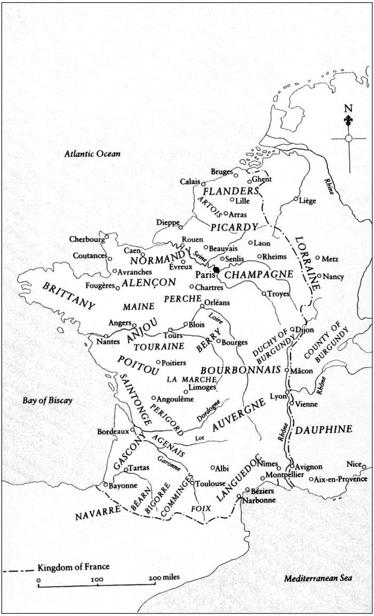
I Provinces of France, 1328
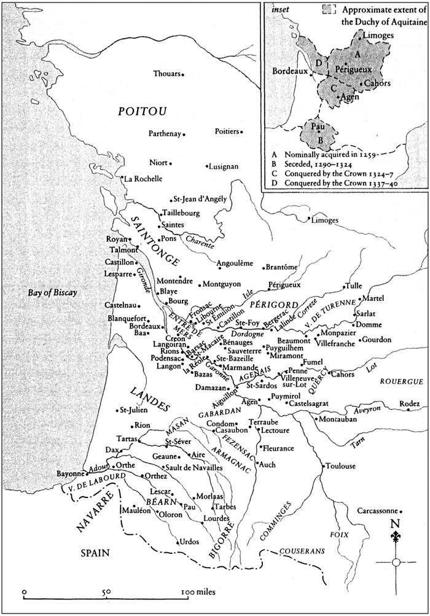
II South-western France

III England and Wales and the Channel Islands

IV Scotland

V The Low Countries, 1337–47

VI Brittany
NOTES
1 P. Bougard and C. Wyffels, Les finances de Calais (1966), 11, 198–221; Brown et al., 423–50; Patourel (2); Baker, Chron., 89.
2 JT, nos 661–3, 854, 893, 1922, 1935, 2239–42, 4614, 5025; ‘Compte de P. de Ham’, 246–8; lnventaire AD P.-de-Calais, i, 115. J. de Vienne: Anselme, vii, 806.
3 Venette, Chron., ii, 203; Muisit, Chron., 166.
4 RF, iii, 89-90; RBP, i, 57–8, 85; PRO C76/23, mm. 17d, 15d, 12d, 8, 7, 5, 4, 3, E403/339, mm. 24, 27, 33; Avesbury, G. Edwardi, 369; Bel, Chron., ii, 112; Grandes Chron., ix, 285–6; Lescot, Chron., 75; Istore de Flandre, ii, 61; Baker, Chron., 89.
5 Park.: RP, ii, 157–63(5–14, 18–19, 45). Cardinals: Muisit, Chron., 166.
6 Grandes Chron., ix, 286–7.
7 DCG, no. XXXII (792-921); JT, nos 420, 750, 796, 806, 936, 1771, 2269, 2276, 3206, 3340, 3370, 4433, 4527, 4540, 4635, 5030; ‘Itin. Philippe VI’; Recits d’un bourgeois, 237; Arch. St.-Quentin, ii, 198; AN P2291, p. 779; Arch, admin. Reims, ii, 1124.
8 Muisit, Chron., 167; Murimuth, Chron., 217; RF, iii, 91; PRO C76/23, mm. 18, 17, 14d; DCG, no. XXXII(37).
9 Chron. Norm., 83–4; RSG, iii, 121–30; Muisit, Chron., 164–7; Chron. Com. Flandriae, 219–20; Istore de Flandre, ii, 58–9; Knighton, Chron., ii, 39; Récits d’un bourgeois, 240; JT, no. 672; AN JJ68/329.
10 Arch. St.-Quentin, ii, 199; JT, no. 290; Grandes Chron., ix, 288; Viard (2); Timbal, Registres, 63–4, 67, 97–8.
11 Avesbury, G. Edwardi, 373; Murimuth, Chron., 217.
12 HGL, ix, 595–8.
13 Avesbury, G. Edwardi, 373–4; Bel, Chron., ii, 118–19; Muisit, Chron., 167–8; Grandes Chron., ix, 287; Bertrandy, 377; CPR 1345–8, 562; Reg. St.-Jean d’A, i, 134–6, 138; Ordonnances, xviii, 690–1; Clément VI, L. Cl. (France), no. 2901.
14 Avesbury, G. Edwardi, 374; Chron. Norm., 69; Istore de Flandre, ii, 60–1; Rec. doc. Poitou, iii, 1–3.
15 Rec. doc. Poitiers, ii, 90–1, 94–5, 97–8; Favreau, 150–1.
16 Avesbury, G. Edwardi, 374; Bel, Chron., ii, 123–4; Rec. doc. Poitou, ii, 332–5, 356–8, 370–5, 429–34, iii, 58–60; Chartes … de l’abbaye de Charroux, ed. D.P. de Montsabert, AHP, xxxix, 308–9; Favreau, 153.
17 S.-Jean d’A.: Chron. Quatre Valois, 12–13. Survey: BN Clairambault 163/4765. Refuges: Cartulaire de N.D. des Chatelliers, ed. L. Duval, Mems. Soc. Stat. Sci. et Arts Deux-Sèvres, 2e serie, vii (1867), 134–5, 137.
18 Rec. doc. Poitou, ii, pp. xxx–xxxvi.
19 Avesbury, G. Edwardi, 374; Chron. Maillezais, 166–7; Bel, Chron., ii, 122–3; Rec. doc. Poitou, ii, p. xxxv.
20 Avesbury, G. Edwardi, 373–4; Chron. Maillezais, 167; PRO C61/60, mm. 36, 39 (S.-Jean d’A.); AN X2a/5, fols 180, 189 (Lusignan).
21 Tonnay-Charente: AN JJ76/321, JJ86/37; PRO C61/60, mm. 1, 3, 19, 20, 41. Soubise: PRO C61/60, mm. 12, 16, 41; Rec. doc. Poitou, ii, 331. Tonnay-Boutonne: PRO C61/60, m. 17. Rochefort: CPR 1345–8, 560. Oléron: AHSA, vi, 229–30; AN JJ77/192.
22 Coiron: AHSA, xli, 244–6. Conac: PRO C61/60, m. 7; CPR 1345–8, 546. Cheray: Denifle, 33. Saintes, Talmont: Bertrandy, 380. Taillebourg: Rec. doc. Poitou, ii, 331.
23 La Rochelle: AN JJ77/80, 194. Niort: Rec. doc. Poitou, ii, 343. Aulnay: LE, nos 527, 629. Saintes: AN JJ77/233. Spies: AN JJ76/321; Inventaire AC Périgueux, 80. Freebooters: AN JJ76/380. Marsh: Reg. S.-Jean d’A., i, 116–30; JT, no. 241.
24 Rec. doc. Poitou, ii, 329–30; AHSA, vi, 230.
25 AN JJ76/303; Doc. Durfort, nos 943–6.
26 Inventaire AC Clermont-F., i, 368-9; Doc. Durfort, no. 946; HGL, ix, 598; JT, no. 3649; Baluze, 199, *717–18; Jurades d’Agen, 94.
27 Bazadais: Jurades d’Agen, 98; Bertrandy, 181–3, 185. Treasons: HGL, ix, 598–601.
28 Neville’s Cross campaign: CIM, ii, no. 2051; CCR 1346–9, 448–9; Chron. Lanercost, 344–51; Baker, Chron, 86–9; Anonimalle Chron., 23–8; Murimuth, Chron., 218–19, 252–3; Knighton, Chron., ii, 41–4; Letters of Thomas Samson (*KOF, v, 489–92) and Prior of Durham (Raine, N. Reg., 387–9, 392–5); Fordun, Chron., i, 367; Bower,Chron., ii, 339–40, 341–3; Wyntoun, Oryg. Chron., ii, 470–7. Other references below.
29 Cf. RS, i, 685.
30 Cal. doc. Scot, v, nos 802–3.
31 Spies: RS, i, 673–4. Numbers: Morris (5), 98–9.
32 Barge: PRO E403/339, mm. 17–18. Prisoners: RS i, 675–6, 677–9, 680, 684, 685, 688; RF, iii, 99, 102–3; CCR 1346–9, 332–3; CPR 1345–8, 225; Morris (5), 102.
33 AD Hérault A1/15; *Baluze, 717–18; BN Fr.n.a. 9421, fols 95, 102–54; JT, no. 373.
34 BN Fr.n.a. 9241, fols 102–54; Arch. admin. Reims, ii, 1124n.
35 Ludewig, Reliquiae, v, 465–7; RF, iii, 92; DCG, no. XXXII (34, 84, 947).
36 Godemar: Froissart, Chron., iii, 437 (derived from J. of Hainault). Montmorency: Cazelles (1), 178. Financial officials: Grandes Chron., ix, 288–9; Cazelles (1), 181–9, *460–3.
37 John, Mauny: Bel, Chron., ii, 128–9; Muisit, Chron., 168; Récits d’un bourgeois, 243–4; RBP, i, 33; Ludewig, Reliquiae, v, 450–1; Cazelles (1), 201–5. D. of Burgundy: Cazelles (1), 196–201; LE, no. 502.
38 BN Coll. Périgord 13, fol. 298; AN JJ76/380; RF, iii, 157. Cf. LC, no. 203.
39 Venette, Chron., ii, 204–5; Lescot, Chron., 75; Grandes Chron., ix, 291; Ordonnances, ii, 252–7, 262–3; HGL, ix, 602; Rec. doc. Poitou, ii, 361–3; Viard (9), 169n; LC, no. 185.
40 DCG, nos 441, XXXII(1032, 1156, 1199, 1239, 1243–4); JT, nos 2302, 2913, 3134.
41 Guesnon, ‘Documents’, 237–40.
42 *Bel, Chron., ii, 338–40; RF, iii, 93–5, 98; Knighton, Chron., ii, 39; Tout (2), 241–2, 259–60, 261; PRO E372/191, mm. 11, 7 (Surrey, Sussex, Essex) (ladders), E403/339, m. 33 (troops), C76/23, m. 8 (carpenters); Guesnon, ‘Documents’, 239–40.
43 RF, iii, 94, 96; CPR 1345–8, 308–9; PRO C76/23, mm. 4d, 3d, 3.
44 DCG, nos XXXII (1126bis–1152); AN J602/46–7; JT, nos 1981–3.
45 JT, nos 1157, 1163, 1207, 1752, 1898; DCG, no. XXXII (922–46, 950–9, 1008–9, 1020–1, 1025–9, 1034, 1038–9, 1048, 1153–1301); Récits d’un bourgeois, 245; Knighton, Chron., ii, 46–7.
46 Grandes Chron., ix, 291; Arch. admin. Reims, ii, 1124n, 1152–4; LC, nos 182, 185; Viard (9), 168n, 169n; ‘Itin. Philippe VI’; JT, nos 1035, 1097, 1372, 1749, 1799, 2236, 2250, 3098, 4526, 4529, 4534, 4541, 4681, 4728, 4753.
47 Taxes: Henneman, 216–27; Ordonnances, ii, 262; Arch, admin. Reims, ii, 1145, 1151; LC, nos 181–2; Actes Normands, 322–5, Reims: Arch. admin. Reims, ii, 1153; Desportes, 541–4.
48 AN X2a/5, fol. 97. Landas: AN JJ68/262; Anselme, vi, 166. Châtillon: AN JJ68/324; Duchesne, 380. Noyers: E. Petit (2), 279. Messelan: AP 1328–50, no. 8479; AN JJ76/225.
49 Burgundy: CPR 1345–8, 517; Bock, ‘English Register’, 366; E. Petit (1), viii, 17–24.
50 Muisit, Chron., 172–3, 174–5; Grandes Chron., ix, 293–6; Chronographia, ii, 241; Noyal, ‘Fragments’, 253–4; Moranvillé (2); AN JJ77/183, JJ80/396; Arch. admin. Reims, ii, 1153–4.
51 Grandes Chron., ix, 296.
52 Avesbury, G. Edwardi, 383; Muisit, Chron., 168.
53 AN JJ77/42; Bel, Chron., ii, 136–9; Muisit, Chron., 169–70; Venette, Chron., ii, 208–9; Chronographia, ii, 237–9; Chron. Com. Flandriae, 222; Chaplais, Dipl. Practice, 503–7.
54 Récits d’un bourgeois, 247–8; Muisit, Chron., 176.
55 Muisit, Chron., 171; Chron. Norm., 86.
56 LE, nos 456–7, 462–3, 472–3, 475; JT, nos 332, 761, 2093, 2219, 2725, 3291; Philip VI, ‘Nouvelles LC’, 177–8; Récits d’un bourgeois, 249; Chron. Norm., 86.
57 Istore de Flandre, ii, 51–2, 53–4, 61, 63–5; Muisit, Chron., 173–4, 176; Chron Norm., 86, 87–8; Chronographia, ii, 240–1, 242–3; RSC, iii, 133–6; JT, no 562 (Renti).
58 Councils: RDP, iv, 562–3; CFR 1347–56, 1–10; RF, iii, 112–13, 115; RP, ii, 166(11); CPR 1345–8, 264. Loans: CCR 1346–9, 290–1; E. Fryde (3), 11–12; RF, iii, 102; Harriss, 450–1.
59 Bel, Chron., ii, 152, *344–5; Knighton, Chron., ii, 47.
60 PRO C76/24, mm. 23, 18, 16, 15, 14, 11, 8d; RF, iii, 114, 121; *Bel, Chron., ii, 344–8.
61 RF, iii, 114, 120; RBP, i, 81; *KOF, xviii, 301–2.
62 RDP, iv, 563–5; RF, iii, 122, 124–5; *Bel, Chron., ii, 346–7; Knighton, Chron., ii, 47. Lancaster: RBP, i, 81; PRO C81/319/18383B.
63 RSG, iii, 136–41, 244–9; Kervyn, iii, 325; Muisit, Chron., 178–9; Istore de Flandre, 66–8; Recits d’un bourgeois, 251–2; Avesbury, G. Edwardi, 384; ‘Itin. Philippe VI’.
64 GEC, iv, 27–8; *Prince (1), 370–1; RF, iii, 100, 169; *Bel, Chron., ii, 340–1; PRO E101/25/19; *KOF, xviii, 340–1; Avesbury, G. Edwardi, 389, and Lescot, Chron., 80n (Flemings); Jones (1), 144–5.
65 RF, iii, 100–1, 168; AN JJ75/154; Rec. doc. Poitou, iii, 26–30.
66 AN JJ80/8; Grandes Chron., ix, 296; LE, nos 479, 5295; JT, no. 381.
67 Avesbury, G. Edwardi, 388–9 (Dagworth’s report); Grandes Chron., ix, 298–306; Lescot, Chron., 77–81.
68 *Bel, Chron., ii, 353–4; CCR 1346–9, 570.
69 JT, no. 2226, 2228; DCG, no. XXXII(1011); Grandes Chron., ix, 306–9.
70 Avesbury, G. Edwardi, 386; Chronographia, ii, 244–5, 245n.
71 Istore de Flandre, ii, 65; Avesbury, G. Edwardi, 384–6; Knighton, Chron., ii, 47–8; DCG, nos. 453–5, 457; Muisit, Chron., 180.
72 Knighton, Chron., ii, 48; cf. Bel, Chron., ii, 113.
73 Champollion-Figeac, Lettres, ii, 82–92; Morris (5), 97–8; RSG, iii, 72; Muisit, Chron., 179–80; Istore de Flandre, ii, 69; Villani, Hist. XII: 95, col. 973.
74 lstore de Flandre, ii, 68–9; Knighton, Chron., ii, 49–50; Coll. gén. doc. français, 73–4; Doc. historiques inédits, ed. L.-A. Champollion-Figeac, ii (1843), 181–3; JT, nos 371, 419. Numbers: Villani, Hist. XII:95, cols 973–4.
75 Bel, Chron., ii, 156; Villani, Hist. XII:95, cols 973–4.
76 Bel, Chron., ii, 157–9; Chron. Norm., 89–90; Avesbury, G. Edwardi, 392–3; Knighton, Chron., ii, 50–1; Baker, Chron., 90–1; Récits d’un bourgeois, 257; Muisit, Chron., 182; Anonimalle Chron., 29.
77 Bel, Chron., ii, 161–9; Récits d’un bourgeois, 258–60; Chron. Norm., 90; John of Reading, Chron., 105. Spoil, prisoners: Bel. Chron., ii, 168; Avesbury, G. Edwardi, 396; Muisit, Chron., 274; Knighton, Chron., ii, 53; Istore de Flandre, ii, 70; Villani, Hist. XII.-95, col. 974; Walsingham, Hist., i, 272. Citizens: Ordonnances, iv, 606–9;AP1328–50, nos 8921, 9016; Molinier, ‘Documents’.
78 RF, iii, 130; *Bel, Chron., ii, 349; CPR 1345–8, 549, 563–8; Venette, Chron., ii, 207.
79 RF, iii, 130; Knighton, Chron., ii, 52; Villani, Hist. XII:95, Cols 974–5; Bel, Chron., ii, 169–70; JT, no. 375, cf. nos 1009, 1021, 1282, 1372, 1389, 1446, 2896, 3174, 4176, 4507, 4529–30, 4534; DCG, no. XXXII(40); ‘Itin. Philippe VI’.
80 RF, ii, 130; Knighton, Chron., ii, 52; Muisit, Chron., 186; Guesnon, ‘Documents’, 241.
81 ‘Itin. Philippe VI’; Récits d’un bourgeois, 261–2; Guesnon, ‘Documents’, 242; Arch. admin. Reims, ii, 1159–61; RF, iii, 130.
82 Arch. admin. Reims, ii, 1159–61; *Delisle, 114–15; Actes Normands, 351–2; JT, no. 375.
83 RF, iii, 130–5; CFR 1347–56, 44–5; Knighton, Chron., ii, 53. Shortages: PRO C76/25, mm. 26d, 24, 23.
84 Knighton, Chron., ii, 53; Muisit, Chron., 187–8.
85 Clément VI, L. Cl. (France), no. 3486; RF, iii, 136–8.
86 Wright, Political Songs, i, 53–8; Walsingham, Hist., i, 272.
87 GEC, vi, 352–4.