
CHAPTER VIII
Edward Ill’s long-prepared armada sailed in the early hours of 16 July 1338, seven weeks late. The King himself and about half the army embarked at Ipswich into ships assembled in the pool of Orwell. The rest embarked at Great Yarmouth. A third fleet bringing late-comers and horses left Great Yarmouth at the end of the month. This great gathering of ships, 350 in all, with nearly 12,000 crew, carried to the continent in the space of about a fortnight a relatively small army. There were about 1,400 men-at-arms, and nearly 3,000 archers together with their horses, equipment and victuals. It was for the most part an army of volunteers. All the men-at-arms served voluntarily and all of them, earls, bannerets, knights and squires, received double the usual wages of war. The archers, whose support for the war mattered less, received the ordinary rates. Rather more than half of them were conscripted men. Most of the others were hired privately to serve in noble retinues. But no less than 445 men from different parts of the country arrived at the ports of embarkation of their own accord and formed themselves into free companies. Edward and his men landed at Antwerp on 22 July 1338, watched from the foreshore by a crowd of onlookers, many of whom had travelled from far away to see such a spectacle.1
At about the same time the Archbishop of Canterbury and the Bishop of Durham arrived together with the two cardinals in Amiens to negotiate a truce. It was pure pretence. The English King had not forgotten the shock of the previous winter when the cardinals had threatened to excommunicate him and to annul his treaties with the German princes. Some of these would have been only too pleased to have another excuse for non-performance. Edward could not afford to give the impression that he had lost interest in a peaceful solution. So Stratford and Bury proceeded from Amiens to Paris and were received there by Philip VI at the beginning of August. They had little to say and made it clear to Philip that they did not intend to do anything quickly. They wished to wait until further instructions had been received from Antwerp. Perhaps Philip would appoint a committee of his Council to negotiate with them in some convenient place. How seriously Philip himself took these proposals is not clear, but he did appoint a committee of his Council and directed that the discussions should take place close to the Flemish border at Arras.2
The French King had other preoccupations. He had spent the whole summer in his capital receiving regular and on the whole accurate reports of the difficulties of his enemies. He knew that there had been serious problems about supplying the English army: victuals were proving hard to collect both in England and in the Low Countries and forage for horses would not be available in quantity until July or August. Armour was thought to be in short supply in the English army. Friends in Germany had told Philip that all was not well between Edward and his allies. There had apparently been certain difficulties about the payment of subsidies and Louis of Bavaria was threatening to withdraw from the alliance. On 26 July 1338, when Philip learned that the English had finally landed, the muster of the French army was fixed for 8 August. The response was not wholly satisfactory, for except in the frontier provinces of the north the threat was not even now treated seriously by the mass of the French population. There were persistent rumours that Philip was negotiating with his rival and many Frenchmen assumed that a truce would be patched up before the crisis broke. The arrival of Stratford and Bury made these rumours very credible.
Philip could only deny it and dictate letters from the Bois de Vincennes in terms which betrayed his mounting frustration and finally produced some effect. By the last week of August the French were more or less ready on their northern frontier. The Constable, Raoul, Count of Eu, was at Tournai on the march of Flanders and Hainault, about 60 miles from Antwerp. He had with him a strong French garrison, the armed contingents of the town, the Count of Flanders and refugees from van Artevelde’s revolution, most of whom were gentlemen trained in arms. Men were working on the walls and gates. Forty miles away at Cambrai the Bishop had been instructed by the Pope (at the prompting of the French government) to defend his city. The main body of the French army assembled on the Somme at Amiens and Saint-Quentin. Philip himself had arrived at Amiens by 24 August 1338 with the Oriflamme, the crimson banner of Saint-Denis which the great Benedictine Abbey invested with mystic significance and ceremonially presented to each French King on the eve of war: ‘May the Lord by his Grace and by the intercession of your glorious patron St Denis grant you victory over all your enemies.’3
At Arras, Stratford and Bury installed themselves in comfort with a household and diplomatic staff of more than 200. Desultory negotiations had begun by the end of the month, but the two English bishops were distracted by greater events elsewhere. Stratford’s household became a busy centre for intelligence-gathering. Runners were sent to Amiens to report on the progress of the French muster and to Paris to listen out for gossip about the intentions of the enemy. Dispatches regularly left for Antwerp with reports of conditions in the French frontier towns, on shipping in the Norman ports and on the state of public opinion in Flanders and Brabant.4
The King’s sojourn in Antwerp began disastrously. On his first night in the town he narrowly escaped death when the lodgings which had been hired for him were accidentally burned down by his servants.5 Once he had recovered his composure, Edward set about measuring his resources against his commitments. As a result of the efforts of the Bishop of Lincoln, he could in theory call on his allies to furnish him with a further 7,000 armoured men, in addition to the troops which he had brought with him from England and a steady trickle of soldiers of fortune who arrived during the next three months. But before the allies appeared they were entitled to be paid. Their fees were already greatly in arrears. In addition there were the wages of their men, which had to be paid for two months in advance at the onset of the campaign. The prospects of Edward’s continental expedition depended entirely on the forced loan of 20,000 sacks of wool which Parliament had authorized in February. The collection of this wool had been in progress since the end of February and arrangements had been made to store it in the east-coast ports and ship it for the King’s account to Antwerp. In order to enable the King to sell it to his best advantage all other exports were forbidden unless licensed, and licenses were granted only to Edward’s most favoured creditors and to the subjects of his most important allies. What the King expected to find, therefore, when he reached Antwerp in July were warehouses filled with wool which might, if skilfully sold, be expected to raise between £150,000 and £200,000. In fact the warehouses were almost empty. No wool at all had been shipped until 5 July 1338, less than a fortnight before the embarkation of the English army. Only 1,846 sacks had been shipped by the end of July. Initially it seemed that the explanation was want of shipping, the result of the government’s requisitioning of so many ships for use as troop carriers. The ships in which Edward and his army had crossed the North Sea were at once sent back to fetch wool. But the real problem, as it transpired, was that less than 3,000 sacks had been collected. The forced loan had been evaded and resisted with almost complete success. There had been a sudden and unexplained shortage of sacks in which to pack it. The collectors had been dilatory, incompetent and corrupt. There is nothing surprising about these endemic vices of medieval bureaucracy. What is perhaps surprising is that Edward had no inkling of what had happened until he arrived with his army in Brabant. He characteristically blamed his servants. ‘I have been badly advised,’ he complained bitterly to the Bishop of Lincoln. It was the beginning of the Bishop’s fall from favour.6
Edward’s principal allies, the Duke of Brabant, the Count of Hainault, the Duke of Guelders, the Margrave of Juliers and a host of lesser princes had all come to Antwerp to greet the King and to present their accounts. Edward confronted them empty-handed at a long and painful conference. The Duke of Brabant, as the most powerful prince among them, took the lead. He was not only unpaid but very equivocal about the whole enterprise. So was the young Count of Hainault, a weaker personality than his formidable father and less enthusiastic when it came to the point about the recovery of the castles of the Cambrésis. Edward III pleaded with them to march at once against the French. He had brought his army with him from England and their wages were a crushing burden, mounting daily. The princes were evasive. They said that they had brought only a ceremonial entourage with them, that their men-at-arms had not yet been summoned in due form; that they would have to consult their advisers at home; and that it would be very desirable to put them in funds. Then they withdrew. The next meeting was fixed for 15 August 1338.7
While the princes consulted their advisers Edward III scraped the barrel for money. He borrowed more than £70,000 from the Bardi and the Peruzzi on the security of wool not yet shipped. He pressed William Pole for all that Pole could lend. He mortgaged his Great Crown as well as gold and jewellery belonging to rich monasteries in England. His agents scoured the Low Countries and the Rhineland for lenders, Italian, Flemish, Dutch and Jewish without discrimination. Rates of interest of up to 50 per cent per annum were recorded.8
Between 26 July and 2 August 1338 Edward’s young heir, the Duke of Cornwall, presided over a Great Council at Northampton, which was attended by the prelates and magnates still in England and by representatives of the Commons. An assembly of merchants followed immediately afterwards. Failure in the field had not yet tarnished Edward III’s reputation at home, and these men were still prepared to dig deeper into their packets. A new levy of wool was ordered, accompanied this time by ruthless arrangements for its collection. Every community was required to supply wool in proportion to their assessment for Parliamentary taxes. No one might excuse himself on the ground that he did not have any. Those who truly had no wool were to buy some. As a result the new levy was much more successful than the old, but in spite of a relentless flow of hectoring letters from the King in Brabant, it was quite impossible to collect it in time to save the King’s plans. In the event hardly any of the wool was to reach Antwerp until the following year.9When Edward III next met his allies, near Mechelen on 15 August 1338, he had succeeded in making small interim payments to a few of them but otherwise his position was scarcely better than it had been in July. The princes were unsympathetic. They needed more time, they said. The Emperor, they pointed out, was not present. In so grave a matter as an attack on France they would have to obtain his approval before the campaign could begin. Why, Edward asked them caustically, had they not told him that before?10
Although it was some time before the English King recognized the fact, the hesitations of the princes and the King’s want of money to pay them put an end to his plans for invading the Cambrésis in 1338. The summer had almost passed. There were perhaps six weeks, at the most ten weeks, of open weather left to him. The Emperor’s support, on which the enterprise had now come to depend, was not likely to be obtained quickly or cheaply. Of the 400,000 florins (£60,000) which was owed to Louis of Bavaria, less than a tenth had been paid. Moreover the Emperor, who rarely let an opportunity pass, had begun to invite competing offers from Philip VI. A meeting of ambassadors of France and the Empire was due to take place on 1 September 1338.11 In these difficult circumstances Edward III acted rapidly. He sent the Margrave of Juliers to Germany to arrange an interview between himself and the Emperor. Then, without waiting for the answer, he set out for Coblenz where Louis was due to hold a Reichstag at the beginning of September. Travelling light across Brabant and Juliers with a handful of advisers and a bodyguard of archers, Edward reached the island of Niederwerth on the Rhine north of Coblenz on 30 August 1338. His household servants and equipment followed laboriously by river barge. A week later John Montgomery arrived, bringing every penny which it had been possible to find in Antwerp: carts and saddle packs laden with 50,000 florins (£7,500) in specie, and bags of jewellery to be pawned to the merchants of the Rhine cities. Edward needed to impress. At Niederwerth he entertained magnificently as if the money had fallen like ripe fruit into his hands instead of being borrowed on ruinous terms from usurers. Louis of Bavaria’s relatives and advisers were plied with cash. One important Imperial councillor received 4,000 florins (£600); the Empress received 2,400 florins (£360) and her secretary 60 florins (£9). For Louis himself there was nearly £6,000, which brought the total of payments to him to a fifth of what was due. The rest was promised in two instalments in January and March 1339. The Emperor was mollified. On 5 September 1338 he sent the Imperial barge to bring the English King into Coblenz. Here, at a splendid public session, the electors of the Empire gave their approval to Edward’s appointment as Imperial Vicar and invested him with all the powers of the Emperor himself. The English King received absolute property of this office until such time as he should have conquered France ‘or a substantial part of it.’ Edward’s wars were pronounced to be wars in defence of the integrity of the Empire against the usurpations of France, and disobedience to him tantamount to treason. The Emperor sat enthroned with orb and sceptre, a naked sword held aloft behind him. Beneath the throne Edward III watched the proceedings seated, robed in scarlet between the Margraves of Meissen and Juliers and surrounded by a great crowd of knights and princes of Germany.12
Edward set about putting these grandiose declarations into effect as soon as he returned to Antwerp. On 18 September 1338 he summoned his allies to attend him on pain of forfeiture of their fiefs to hear the decrees of Coblenz recited and to receive his commands. The meeting took place on 12 October 1338 in the covered market of the little town of Herk in Loon because it was near at hand yet not in the dominions of the Duke of Brabant. The Duke was still trying to avoid proclaiming too openly his hostility to France. Indeed he declined to attend in person at all, sending representatives instead. Edward set up his throne on a butcher’s counter to receive the plaudits and loyal oaths of the assembled princes and knights and to announce his plans for the coming year. At Coblenz the opening of the campaign in the Cambrésis had been provisionally fixed for May 1339; now it was thought prudent to put it back a little further until July. In order to force the legal point the Bishop of Cambrai was summoned to attend upon Edward sitting as Imperial Vicar at Mechelen on 26 October 1338 on pain of deprivation. So were those other firm allies of France, the Bishop of Liege and the Count of Flanders. There was some grumbling. The Duke of Brabant’s bluff had been called; his representatives declared that further consultation would be required. The Count of Hainault added that although he would be glad to fight in the Cambrésis, where he would benefit by any conquests, he doubted whether he could properly cross into France. But when the princes reassembled at Mechelen at the end of the month and the Bishop of Cambrai with other francophiles predictably failed to appear, the doubts and equivocations were temporarily silenced. Edward’s allies were still unpaid and some of them still uncertain, but they kept their counsels to themselves.13
Edward III withdrew his household to Antwerp at the beginning of November and remained there for most of the winter. The Queen joined him from England. There were friends to gamble and hunt with him. There were pennies to be counted and pounds to be spent on the steady drain of wages, subsidies and household bills. The troops, which had now been in the Low Countries for more than three months without seeing any action, were dispersed in small groups among the towns of Brabant, Hainault and Flanders. Many of them deserted and tried to make their way home to England, ‘for want of food to eat’ as Edward admitted to his Council. The rest drank heavily, strained their welcome by pilfering and violence and waited for the spring.14 At Arras the plenipotentiaries of the two sides went through the motions of diplomacy under the chairmanship of the two cardinals. Four prelates of the French royal Council attended, including the two principal experts on relations with England, Pierre-Roger, Archbishop of Rouen, and Jean de Marigny, Bishop of Beauvais. On the English side Archbishop Stratford and Richard Bury, Bishop of Durham, represented Edward III. Others, including Henry Burghersh and William Montagu, Earl of Salisbury, came and went. For a short while in December 1338 and January 1339, the discussions were removed to Paris. The circumstances were not propitious. The cardinals put forward a series of proposals. The French or the English or both rejected them. Their minds were on other things.15
The French stood warily on their frontiers. Although most of their troops were released on 15 September 1338 they were told to hold themselves equipped and ready to return at short notice. One thousand mounted troops and 5,000 infantry were retained at reduced wages for garrison service during the winter. These men were eventually, in November 1338, disposed in four military commands along the border. Godemar du Fay, an able full-time soldier, was appointed Governor of Tournai and placed in command of the left bank of the Scheldt and the western sector of the march of Hainault. He was given a strong garrison of Picards and Normans at Tournai itself and subsidiary forces at Mortagne, Douai and Arleux. The Cambrésis was the responsibility of the Count of Auxerre. Further west, the march of Flanders and the coast from Calais to Boulogne were guarded by more than a dozen garrisons extending well to the rear. Smaller garrisons were distributed through those parts of Normandy and Brittany which were regarded as vulnerable to English coastal raids. It was a scheme of defence in depth which stands out principally for the contrast with the arrangements which the English had made in rather similar circumstances in the south-west in 1337. None of the garrisons except perhaps those of Tournai and Cambrai could have held out for long against a determined assault, but they were strong enough to delay an invading army until the main French army could be reassembled and brought forward to relieve them.16 Philip VI was much criticized at the time for keeping his troops on a defensive footing throughout the summer of 1338 and during the following winter without attempting so much as a show of force against the territories of Edward’s allies. But these criticisms did not allow for the delicacy of his diplomatic situation in the face of a coalition which seemed likely to disintegrate under its own internal strains, and with whose principal members he was covertly in contact. These were not matters which could easily be explained to those who led contingents in his army, men whose limited outlook historians have sometimes been content to adopt.
*
Philip did not get much credit from his countrymen for the great French success of the autumn of 1338, the aggressive campaign at sea which began at the moment when the danger was passing on the landward front. During the summer the French had been greatly hampered by the failure of their contract fleet of Italian galleys to arrive from the Mediterranean. The ships had not reached the Channel until August, some three months overdue and too late to prevent the English army from leaving England. They were not too late, however, to cut the shipping lanes between England and Gascony and to threaten Edward Ill’s long and poorly defended lines of communication across the North Sea. Edward was receiving by sea not only money and wool desperately needed to pay his allies, but a large proportion of the army’s victuals and stores. The English were concerned about the threat to their supplies and went to great lengths to obtain advance warning of the movements of enemy ships. A spy was sent from Bordeaux to Genoa to watch the galleys of the contract fleet being fitted out. The Bardi bank maintained agents in the Channel ports to report on warlike activities there. From Arras John Stratford sent runners at regular intervals to Dieppe, Rouen and Le Havre to observe the galley fleet once it had assembled.17
Nevertheless the English were caught unawares at the beginning of September when the galleys of Monaco descended on the Channel Islands with a raiding force under the command of one of the Marshals of France, Robert Bertrand. The islands were an obvious target. They were close to the coast of the Cotentin, an important staging post for the trade of southern England, Gascony and the Norman and Breton ports, as well as a springboard for raids on France. Sark, which was wholly undefended, had already been raided in April 1337 by a combined Norman and Scotch squadron. A year later, in March 1338, Nicholas Béhuchet had made his destructive descent on Jersey when he had tried and failed to take Gorey Castle. As a result of these incidents the islands had been reinforced, but unfortunately for the English their troops there were heavily concentrated in Jersey. On Guernsey there were only sixty-five men at Castle Cornet when the place was surprised and taken by assault on 8 September 1338. All of them were killed. Jerburgh, the only other castle on Guernsey, was defended by just twelve archers and fell on the same day. The local seamen put up some resistance. There was a fight in the course of which the Italians lost two of their galleys. But in spite of their efforts the French were able to occupy the whole island and they were to remain in possession of it for several years.18
The messengers who had tried to reach England from Guernsey to find help were caught in mid-Channel and their ship burned. It took almost a week for the news of the loss of the island to reach the Council.19 By this time the galley fleet had turned north in search of other prey. They collected Genoese and French reinforcements at Harfleur and Dieppe and made for the estuary of the Scheldt. There were now about forty galleys and some Norman barges in the fleet, under the overall command of the two French admirals, Nicholas Béhuchet and Hugh Quiéret. A spy noted the arrival of the galleys off Cadzand. But his warning came too late. Off the island of Walcheren there were five English ships laden with wool and victuals waiting to discharge. They included two of Edward III’s largest and finest ships, the Cog Edward and the Christopher. They were caught unprepared on 21 September 1338 with their sails packed, their masters away in Antwerp conferring with the King and part of their crews ashore. The men still on board were heavily outnumbered. After a ferocious fight, which lasted all day, they were overpowered and surrendered. A force of English household archers which tried to reach the ships by barge from Antwerp arrived after the fight had ended. The French dealt ruthlessly with their prisoners. They were all put to death on Quiéret’s personal instructions. As for the ships, they were taken to Normandy and commissioned into French service.20
The news of this reverse caused great distress to Edward III. On 27 September 1338 the Council in England ordered the ships of both Admiralties to put to sea to search out and destroy the enemy. The order was lackadaisically carried out by shipmasters weary of the constant requisitioning of their ships.21 On 5 October 1338 the French fleet entered the Solent and landed an armed force several thousand strong near Southampton. Once again the English received some warning, probably from gossip in the French Channel ports. Hugh Quiéret, who was in command, had been offering a prize of 100 livres to the first man to breach the defences of Southampton. Nevertheless, resistance was patchy and disorganized. The ships of the western Admiralty which had been detailed to guard the entrances of the Solent never appeared. The Hampshire levies had not yet been arrayed. The men of Berkshire and Wiltshire who should have come to their assistance never left their counties. Church bells which rang out the alarm were thought to be calling for divine service. Southampton itself was only partly walled. On the seaward side the only defences consisted in a large but vulnerable wooden barbican and the stone gates closing off the ends of streets which led to the waterfront. It was not therefore surprising that few of the townsmen made any attempt to defend their homes. Instead, when they heard about the French landings, they fled in panic into the surrounding countryside together with the officials who had been charged with their defence. A few men of stouter heart and the small permanent garrison of the castle remained behind to fight the invaders. They succeeded in containing the first assault, which was led by Normans of the Admiral’s retinue. But the next wave, 200 crewmen of Ayton Doha’s galley, forced them back. The French and Italians poured into the town. Once inside they had the place to themselves for the whole night and were able to remove to the galleys a great deal of wool, wine and other stores as well as the scales which were used to weigh out merchandise at the Custom House. It was not until early the next day that the first signs of armed resistance appeared outside. Disorganized bands of angry villagers congregated along the roads leading to the gates. The invaders decided to withdraw, starting fires in five separate places as they did so and leaving much of the town in flames behind them. Returning townsmen and Hampshire rustics completed the disorder by running riot through the streets looting what the invaders had left behind. The damage done was appalling. The whole southern part of the town comprising the parishes of St John, St Michael and Holy Rood was destroyed. Southampton’s commerce ceased almost entirely for a year. The great trading houses, including the Bardi and the Peruzzi who traditionally shipped their wool at Southampton, all withdrew. Many of those who fled never returned, or returned briefly only to migrate elsewhere.22
The French admirals had originally intended to resume their raids on the south coast as soon as they had revictualled their ships and discharged their booty. In the event the weather deteriorated and they were unable to do so. The ships were laid up for the winter early in November 1338. In a short period, however, they had succeeded in creating panic in southern England and demoralization on both sides of the North Sea. Reports came in rapid succession of French plans to attack the Isle of Sheppey, the Kent coast, London and the Medway ports, and wool stores as far north as Hull. In London, it was believed that the French raids presaged an invasion in force in which ‘the whole realm of England would be seized and slaughtered’. The city government took emergency measures to prevent landings on the strands of the Thames, driving wooden piles into the river bed. Stores of weapons including artillery were collected at the Guildhall and elsewhere, and watches organized at the gates.23
It was not at all clear what could be done to prevent such catastrophes. The government’s explanation, when these matters were discussed in Parliament in 1340, was that England had been worsted ‘pur defaute d’une navie sur mer’. Edward III had made some attempts, after the first naval encounters, to acquire a galley fleet of his own. In 1336 he had built at great expense a galley called the Philippa which was based at King’s Lynn. Another was built for him at Winchelsea a year later. The Poles, those diligent war contractors, had two galleys built for the royal service. One, belonging to William Pole, accompanied the King on the crossing of the North Sea in the summer of 1338. His brother Richard, who held the office of King’s Butler, operated a galley called Le Botiller,which saw service in Scotland in 1337. None of these vessels, however, played a very notable part in the warlike operations of the following years. They were rather small and the probability is that like earlier galleys built in England they were unseaworthy.24 The only galleys regularly in English service were those of Bayonne, and they rarely served north of the Bay of Biscay. The solution, no doubt, was to take a leaf out of Philip VI’s book and to hire galleys complete with their crews in the Mediterranean. Nicolino Fieschi had succeeded in hiring for him in Marseille just two Italian galleys, which served in the North Sea for most of the year 1338. During the summer a less reliable and possibly dishonest Italian agent called Sarzana was soliciting galley masters on Edward III’s behalf in the ports of Provence. He had no success at all. He was provided with funds which were quite inadequate and even these were impounded by the Count of Provence.25 Three days after the loss of the Christopher and theCog Edward Fieschi was sent on a fresh mission, ostensibly to the papal court at Avignon, in fact to retrieve what he could of the money given to Sarzana and to try to achieve better results himself. The clumsiness of these early intrigues explains their failure quite as much as Edward III’s lack of ready cash does. On the one occasion (it was in 1339) when Edward’s agents did succeed in hiring a significant number of galleys in Aigues-Mortes and Nice, the agents of the French Crown arrived from Paris with bulging purses and bought them off.26
Whether it would have made any difference to the security of the coast if the English fleet had been stronger is another question. Even if the ships had existed, it would have been impossible without a superbly accurate intelligence service to intercept them at sea or to ensure that they were in the right place when the French chose to attack. Even with a superbly accurate intelligence service it was difficult enough, as the sack of Portsmouth had demonstrated earlier in the year. Once the invaders landed it is unlikely that any system of coastal defence could have been wholly successful in repelling them. Forty galleys as large as those operated by the Genoese contained more than 8,000 men. To concentrate a force capable of engaging them in pitched battle would have taken a long time. The only effective protection was the possession of a sufficient number of fortified refuges into which men could be brought in time of danger with their families, animals and goods. The problem in England, as in France, was that many years were required to plan, finance and build any significant defensive works. Hardly any attention had been paid to the fortifications of the coastal areas of England until 1335, when the French had devised their first seaborne raids. In that year surveys had been made of the fabric of several royal castles, including the Tower of London, Canterbury, Porchester and Carisbrooke on the Isle of Wight. These surveys had sometimes led to proper repairs, but more often they had not. The defences of the Tower of London were extended along the riverside between 1336 and 1338, an important improvement. Large sums were expended at Carisbrooke. Some work, but rather less than was required, was undertaken at Dover, Pevensey and Porchester. Elsewhere almost nothing was done. At Canterbury for example, where the bridge had collapsed into the moat and the towers and walls were crumbling, just two pounds was spent during the following half-century. At least in the case of the royal castles, the responsibility for maintenance was clear. In the boroughs, where responsibility was uncertainly divided between the Crown and the townsmen, the condition of the defences was almost always worse. At Winchester the ancient walls had collapsed in several places. Long sections of the town walls of Dover were ruinous. The walls of Chichester were said to be indefensible on account of the gaps in them. The citizens complained that they could not afford the cost of repairs. In the immediate aftermath of the Southampton raid there was a brief flurry of enthusiasm for wall building. The men of Winchester, who must have felt that they had had a narrow escape, began work at once. But the impetus was quickly lost. Portsmouth, the first large town to be sacked by the French, remained unfortified until the end of the fourteenth century. Southampton, which had suffered terribly for its unreadiness in October 1338, was an even more remarkable case. The royal Council gave explicit instructions that a stone wall was to be built along the western and southern strands and even provided money for the purpose. But the citizens were fond of their gardens and liked to have direct access to their ships. They were not at all enthusiastic about doing garrison duty. When the Earl of Warwick inspected the defences of the town in July 1339 he found the garrison grossly deficient in both quantity and quality and the fixed defences in lamentable state. He considered that 200 men-at-arms could have forced the town at any point. No systematic scheme of fortification was attempted at Southampton until after 1376.27
*
Morale in England sank very low in the winter of 1338–9, a mood to which the immobility of the war on the continent and the successes of the French fleet contributed much unease and misgiving. The second winter of the war was exceptionally severe. It rained incessantly until December and then froze so hard that over much of England the grain and fruit crops were lost. The remarkable three-year subsidy granted by Parliament in September 1337 was still being collected year upon year. The wool prize authorized by the Council of Northampton in July 1338 had proved so troublesome to enforce that collection was still in progress a year later. These burdens were heavier than any which the English people were called upon to bear during the fourteenth century. Moreover, their incidence was often arbitrary and uneven. Since Parliamentary taxes were levied on movables, rents (the nobility’s main source of revenue) were not touched. The taxes were paid mainly by tenant farmers and peasants, and by urban householders. The richest and strongest often refused, even if they were not exempt, to contribute to the assessments of their communities, and defied the rest to make them. The Hertfordshire knight Sir Stephen Bassingbourne thrashed the collectors with the flat of his sword until they fled.28
To these misfortunes were now added the effects of purveyance on an unprecedented scale to satisfy the army and the fleet, voracious acquisitions of beef, mutton and pork, grain, malt and fish, and prizes of barges, carts and horses. Not only had the scale of compulsory purchase increased, but the manner of its enforcement had become more brutal. Instead of being carried out by the sheriffs and local officials, the practice since the beginning of 1336 had been to appoint merchants or royal clerks with roving commissions extending over several counties and draconian powers to enforce their will. As the King’s demands became more pressing, some of these purveyors got completely out of hand, entering houses by force, ordering the arrest and imprisonment of whole villages who obstructed them and appointing large numbers of deputies with powers as extensive as their own and even less restraint in using them. They frequently failed to pay, or paid with debentures or tallies. In the worst cases they took the year’s seed-corn or broke up plough teams, inflicting distress which was felt for years. The effects were particularly severe in certain regions, chiefly East Anglia and the East Midlands, which included the main grain-growing counties and were closest to the North Sea ports by which Edward’s army was being embarked and supplied.29
There was a squeeze on agricultural incomes and a severe deflation, exacerbated by the general European shortage of coin and the export of huge quantities of it to pay the wages of troops and the subsidies of princes. The evidence is anecdotal, but it is almost entirely consistent. There was ‘great plenty of goods and great scarcity of money’, empty markets, low prices and destitution in the face of insistent tax collectors. During the early years of the war cultivated land went out of cultivation at an accelerating rate, and while there were many reasons for this phenomenon, surveys carried out for the Exchequer in 1341 suggested that war taxation, purveyance and military service were prominent among them. As depression set in and the government’s grip was seen to loosen after Edward III’s departure, there was a noticeable breakdown of public order, with outbreaks of rioting and gang warfare reminiscent of the last years of Edward II.30
These difficulties were not likely to be surmounted by the men whom Edward had left to govern in his absence. The nominal Guardian of the realm was Edward, Duke of Cornwall, the future Black Prince, who was then eight years old. The King had with him in Brabant all his most experienced lay and ecclesiastical advisers and almost all his administrators of any proven ability. Instructions were issued in the young Prince’s name by a group of royal councillors who were no more than moderately competent and had the minimum of discretion. Because this was well known they had very little personal authority. Officials on whom they tried to impose their will found it all too easy to appeal to the protection of powerful individuals in Brabant and to justify themselves by maliciousgossip about those in charge in England. Edward III, who never understood how heavy his ministers’ burdens were, was very ready to believe it. In December 1338 he summarily dismissed the Treasurer Robert Woodhouse. ‘May God be pleased that I shall never again serve a master who has so little interest in my efforts and so little concern with the burdens that I carry for him,’ Woodhouse confided to a friend. It was only one incident in what became in the following year an open war between the King and his home officials, marked by ignorance and venom on Edward’s side, fatalism and passivity on the other. In September 1338 Edward even announced that as a measure of economy he proposed to stop the salaries of the civil service except in cases of proven hardship. This extraordinary order was ignored. In the following May, when Edward repeated it, he was told that were he to insist his servants would resign in a body. They kept their salaries, but they had few enough reasons to serve the King well.31
The weakness of the home administration was one reason why there appeared in England earlier than in France a large class of profiteers and embezzlers who found their opportunity in the urgency of the King’s needs and the growing bureaucracy which was necessary to satisfy them. William Dunstable, Edward’s chief purveyor, was charged with trafficking in goods purveyed for the army, together with his brother and several of his staff. Chief Justice Willoughby was accused a little later of having ‘sold the laws like cows or oxen’. Public opinion held these men guilty and believed that their crimes were only a trickle in an ocean of dishonesty. There is not much doubt that they were right.32
Overt opposition to the war was still rare. But the rumblings of future discontent were heard in the Parliament of February 1339, which met to consider measures for the defence of the realm but was largely taken up with an ‘immense clamour’ about purveyance. These were complaints about means, but there were others willing to challenge the ends. At about the time that Parliament was sitting, a remarkable anonymous poet railed bitterly against the government and the great of the land who voted taxes to sustain their improvident schemes. ‘He who takes money from the needy without just cause is a sinner,’ this man declared. Edward III’s continental ambitions were not a just cause but a dereliction of duty to which the nation had never truly consented. The Parliamentary subsidy of 1337 was an iniquity. The peasantry, the poet wrote, were now selling their cows, their tools and even their clothes to pay for Edward’s war, but the time would come when there would be nothing for them to do but rise in rebellion. It is difficult to say how widespread these opinions were. But they must have been more than the isolated eccentricity of their author, for the government found it necessary to answer them in its propaganda. In the spring of 1339, when the Council was trying to enforce an onerous scheme of compulsory military service for the defence of the realm, commissioners were sent out to harangue provincial communities about the menace of the French and to soothe their discontents. A broadsheet was drawn up in Parliament suggesting what line they might adopt. ‘It is not the intention of the King and his Council to make the communities serve at their own expense,’ this document said, ‘but at the expense of the rich and powerful who can afford it.’ It is probable that once Edward III had abandoned the campaign of 1338 the poet’s views were held in a more respectful form by very many people. The return from so much expense seemed too meagre. The Northumberland knight Thomas Gray cannot have been the only one who thought that the King in Brabant was ‘only jousting and having a jolly time’.33
*
Between November 1338 and July 1339, while Edward tried to scrape together the resources to press his invasion of France, the French very nearly succeeded in doing away with the English presence in the southwest. The decisions were made at Vincennes early in November 1338 and revealed some limited readiness to learn from past mistakes. In the first place it was proposed to devote adequate resources to the task. This meant sending large forces from other parts of France instead of relying exclusively on unenthusiastic local levies and the princes of the south-west like the Count of Foix whose strategic notions were dictated by their own territorial ambitions. Secondly, although it was intended to finance this campaign, like previous ones, from local sources, the French did not repeat the mistake of asking their generals to act as administrators and tax-collectors. Political direction of the campaign and absolute civil power in the south-west was entrusted to John of Luxembourg, King of Bohemia, quixotic knight-errant and adoptive Frenchman who had become one of Philip VI’s closest confidants in his time of trouble. Moreover, the French were not on this occasion going to dissipate their forces in razzias about the long Gascon march, but were going to concentrate them against the principal strongholds of the English, the first of which was to be Penne d’Agenais. The Count of Foix was loaded with favours, paid in land all his vast arrears for past services and sent to invest the place at once. With him went Le Galois de la Baume (one of the captains-general of the summer) and another Savoyard, Pierre de la Palu.34
It was probably these decisions of the French government which were discovered by a group of four spies whom John Stratford had sent to mingle among the crowd of gossiping suitors and courtiers at Vincennes. What is certain is that on 20 November 1338, a few days after they had been made, Edward III attempted a diversion in the north. Although he had agreed that the campaign in the Cambrésis would be postponed until the following summer, he suddenly issued orders in the name of the Emperor commanding all his allies to assemble in Hainault between Mons and Binche on 18 December 1338 whence, he declared, they would march at once and in force against the enemy. A few days later Edward commanded the Bishop of Cambrai to appear before him to answer serious charges of treason against the Empire on pain of forfeiture, the prescribed prelude to an armed attack on his principality. There was a brief alarm in France. The main French garrison in the north, at Tournai, was reinforced by troops commanded by Philip’s cousin the King of Navarre. The Duke of Normandy, Philip’s heir, mustered another force at Péronne on the Somme. In about the middle of December 1338 William, Count of Hainault, crossed his frontier into the principality of Cambrai and wasted a tract of territory north of the episcopal city. Several of the Bishop’s granges and windmills were destroyed and two castles in the Scheldt valley within a mile of the city of Cambrai were taken by surprise. The Count left garrisons there to await the main campaign expected in the summer. Then he withdrew. Nothing else happened. Edward’s other allies refused to move and his orders eventually had to be cancelled. On 19 December 1338 the French army was once again reduced to garrison strength. The incident failed to achieve even a short respite for Gascony. Philip VI continued to give instructions for the southern campaign even while he was on his way north to meet the new threat. The King of Bohemia left Philip’s presence for the Garonne valley at the beginning of December 1338 as if nothing was amiss.35
Gaston de Foix and the two Savoyard captains arrived in the south-west in mid-November 1338 and set up their headquarters at Marmande. John of Bohemia arrived in the province about a month later. Their combined forces laid siege to Penne and the subsidiary tower of Castelgaillard, which stood over the approach to it. The besieging army was not large. There were the modest personal retinues of the commanders, some 1,200 men recruited in Rouergue by the Count of Armagnac and a siege train directed by a small group of German specialists, part of the great diaspora of German sappers and miners of the middle ages. Penne, normally had a garrison of 250 and was certainly well manned in 1339. Yet in less than a fortnight the town surrendered, leaving the castle above them to hold out alone. The reason was plain. There was no prospect of relief from Bordeaux. Without relief the likelihood was that sooner or later the town, whose defences were weaker than those of the castle, would be assaulted, and its inhabitants would lose their property and many of them their lives. The citizens sent several despairing messages to Oliver Ingham pointing out the weakness of their position and asking what they should do. Eventually their leader, a lawyer, went out to bargain with the Count of Foix.
There were more than 100 soldiers of the garrison in the lower town. Their commander, a mercenary from Béarn called Fortanier d’Esguarrepaque, was persuaded to deliver both town and castle to the French. He received an enormous bribe, more than 14,000livres, for distribution among the garrison. In the event the plan went awry. The town opened its gates at about Christmas time. But it seems that most of Fortanier’s men refused to join him. Instead they went to reinforce the garrison of the castle, whose gates remained firmly shut. By the time the French discovered the deception Fortanier had made off with the money. He did not enjoy it for long. On 26 December Oliver Ingham’s officers found him near Bordeaux and shut him up in the gatehouse of the Château de l’Ombrière.36
In January 1339 the French built up their strength in the south. At the beginning of the month they had 5,700 men under arms, a figure which steadily increased until it exceeded 12,000 at the end of April. Not all of them were used in field operations. In the meticulous way which characterized their military method the French applied themselves diligently to basic facilities. A heavily fortified wooden bridge had been built in 1337 at Sainte-Foy, the point at which most supplies and reinforcements crossed the Dordogne. At the end of 1338 two bridges were constructed on floating pontoons over the Garonne at La Réole and Marmande and a third, slightly later, at Le Mas d’Agenais, enabling troops and supplies to be moved rapidly across as well as along the great river valleys. A fleet of forty-two barges was assembled on the river, some of which were equipped with siege engines and high machicolated superstructures. At the same time the main routes were denied to the English. Fords were guarded or made impassable to horses by driving sharp stakes into the river beds. The region was sprinkled with garrisons ranging from the four or five troopers stationed in a hill village to stiffen the locals, to the 700 men who defended the army’s northern flank on the Dordogne at Sainte-Foy. In the first four months of the year, forty-five new French garrisons were established, of which more than half were concentrated in the Garonne and Dordogne valleys and the territory in between. These garrisons not only held territory and lines of communication, but formed a reserve from which reinforcements could be drawn, a protection against unexpected counter-attack, and a shield behind which towns and castles could be invested by relatively modest forces without fear of relieving armies. The administrative burden of these arrangements and their enormous cost (about 45,000 livres per month at the height of the campaign) was the responsibility of a growing military bureaucracy lodged in the castle of Marmande and at a branch of the Chambre des Comptes established at Agen.37
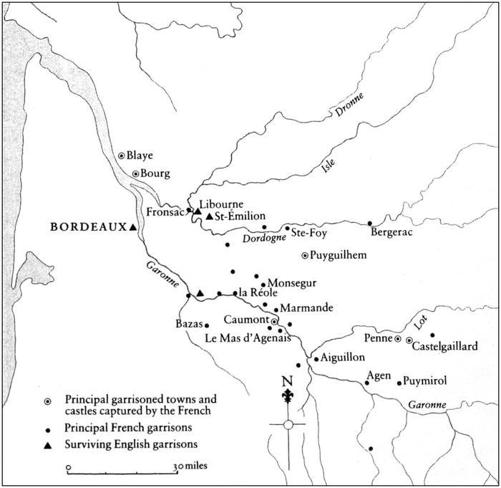
5 The French offensive in the Garonne, November 1338–July 1339
After the fall of the town of Penne a small force consisting for the most part of Le Galois de la Baume’s Savoyards was left to blockade the castle for however long it should take to surrender. The main body of the French army worked their way towards Bordeaux. They descended with a siege train and armed barges on Caumont, an isolated English garrison on the Garonne, the only one left above Saint-Macaire. The defenders of this place resisted fiercely but without success. It was in French hands by the end of February 1339. Next it was the turn of Puyguilhem, the great rectangular keep on the confines of the Agenais and Périgord. Here, the resistance lasted longer. In the course of March 1339 it was necessary to bring up powerful reinforcements as well as additional siege engines and a corps of sappers to undermine the walls. The siege is the earliest recorded instance of the use of cannon in the Hundred Years War. On 6 April 1339 the captain of Puyguilhem gave up hope of relief and surrendered his damaged fortress to the French.38
The middle of April 1339 was a time of triumph for French arms in the south-west. Their army was now approaching its maximum strength. At Penne and the outlying tower of Castelgaillard the beleaguered garrisons had exhausted their supplies and their strength. On 10 April the commander of Castelgaillard sold himself to the enemy and delivered the place up. The citadel of Penne accepted terms a week later. The French were now able to plant on its ramparts the royal banner which they had prematurely ordered in December. Their greatest successes, however, occurred further west in the Gironde. On 20 April 1339 a force of galleys from La Rochelle under the command of the Admiral of France and the Seneschal of Saintonge attacked Blaye. On the river side the town was only lightly fortified and the attack came without warning. Both the town and its citadel were taken swiftly and with only the lightest casualties. It was clear that the defenders had not even had time to arm and assemble. Blaye was delivered over to be pillaged and burned by the soldiers. Almost immediately afterwards Bourg was captured in the same way. For the English these events, following one upon the other within a single week, were a disaster of the first order. Penne perhaps had become little more than a symbol now that the territory west of it was so securely occupied and garrisoned by the French. But the loss of Bourg and Blaye meant that the whole north shore of the Gironde was in French hands and Bordeaux liable to be cut off from its markets and source of reinforcements in England. In addition Edward III had lost one of his ablest and most loyal commanders in Bérard d’Albret, who was captured with some twenty-five other important prisoners and carried off to the Temple in Paris. There was a brief and strange epilogue of which unfortunately almost nothing is known. Shortly after its capture and before the French had properly garrisoned it, Blaye was recaptured by the English Seneschal’s troops, probably from the river. But they were unable to hold it and were soon expelled. Philip VIcommemorated his victory by delivering Blaye to the family of Melun, who had unsuccessfully fought for it through many years of litigation in the Parlement of Paris and had personally taken part in its capture. As for Bourg it was placed in the King’s hands and guarded by an enormous garrison.39
It was the beginning of the most difficult period which the ducal government experienced in the first part of the Hundred Years War. The defeat of the English in 1339 began a vicious circle from which there was no escape except by the dispatch of money and troops on a large scale from England. Men who held lands after the fashion of the Gascon nobility scattered through the province now had fine calculations to make if they were to decide whether they would rather lose their estates in French-held territory by remaining loyal to the English or their lands in English districts by deserting to the French. Every loss of territory caused a failure of loyalties which led directly to the next one. Those who did, in spite of everything, remain loyal to the English dynasty brought their own problems, for they had to be rewarded and compensated for their losses. Yet with each contraction of its territory the resources of the Bordeaux government dwindled and with them the means of preserving friendships for a better day. They turned to ingenious expedients, unusual taxes and devaluations of the Bordeaux pound, putting up with the mounting inflation which followed. The pressure on the Seneschal remained, and in the course of 1339 and 1340 increased. Refugees who had served Edward III in towns and castles now lost to the enemy eked out an indigent existence in Bordeaux hoping to be succoured by a grateful government, men like William Gordon, who had lost everything in the fall of Bourg and petitioned Edward III for a pension to save himself and his wife and son from starvation. For them and a few others in their position there was outdoor relief on a modest scale. For those whose state had been greater it was necessary to begin the practice of making grants of lands and revenues at places in the possession of the French to take effect when, if ever, they were reconquered. A very high proportion of royal grants were of this kind from the middle of 1339 onwards. A year after the fall of Bourg Oliver Ingham addressed to Edward III an anguished plea for some of the petitioners. One had served the King with more than 600 men without being paid for their wages, and with no better reward than the loss of much of his land to the French. Another, who had served Edward’s father before him, had brought his wife and children and his entire household to Bordeaux when the French had occupied every acre he owned. He was now living in humiliating penury in Libourne. Theirs was a loyalty of sentiment, not calculation, rare in Gascony. ‘He has a good heart utterly and unstintingly devoted to your service.’ Yet Ingham could not reward it. He had made assignments, he explained, from the customs of Bordeaux which French conquests had now made almost worthless. The whole of the lands and revenues of the duchy had been granted to others, and there was not a penny left at his disposal.40
*
The Normans and Genoese returned to their ships, in spite of the bitterly cold weather, in February 1339, and were ready to put to sea in early March. The English government (according to the report which its representatives gave to Parliament) had ‘reliable information from several sources’ which suggested that the French were planning a descent on the coast of East Anglia. This may at one stage have been true. But by March the French government’s designs had become more ambitious.41
The ships under their command were divided into two independent fleets. One of them was to raid the harbours of East Anglia in the manner of 1338. The other was sent to attack the Channel Islands again, and then proceed to Gascony to assist the flourishing campaign in the Garonne valley. The Channel Islands expedition, which was the larger of the two, left the mouth of the Seine between 9 and 11 March 1339. It consisted initially of seventeen Italian galleys of Carlo Grimaldi, about thirty-five Norman barges and a cog, none other than Edward III’s great ship Christopher captured off Walcheran in the previous year and now serving under French colours. Another five galleys joined them later. About 8,000 soldiers and seamen were embarked on this armada under the command of the Marshal, Robert Bertrand. Bertrand had been granted the lordship of the Channel Islands after his last descent, and was bent on expanding his demesne. On 12 March 1339, he landed on Jersey near Gorey Castle on the east side of the island. An ultimatum was delivered to the garrison. The garrison was at full strength, some 260 Englishmen and about 40 local men. They replied, by their own account, that the castle would ‘not be given up as long as there were ten men alive in it’. Bertrand’s summons had been largely bluff. He did not have the use of the fleet for more than a short time: it was urgently required in Gascony. So, after reconnoitring the defences of the castle he attempted an assault which failed. On 16 March, the fleet sailed on to Guernsey, where the French were already in occupation. Bertrand and some of his men remained there to reinforce the island. The rest sailed for La Rochelle in company with a large commercial convoy. It was this fleet which captured Blaye and Bourg in April.42
The other fleet, consisting of eighteen Genoese galleys commanded by Ayton Doria, was ordered north to Sluys, which in spite of its proximity to Bruges had remained effectively under French control and was being used as a base from which to attack English shipping carrying wool, supplies and reinforcements into the Scheldt. On their way there, a detachment broke off to attack the East Anglian ports where these much needed commodities were being loaded. On 24 March 1339 the French ships arrived off Harwich, an unwalled fishing town at the entrance to the harbour of Orwell. It was the anniversary of the first French landing in strength at Portsmouth in 1338. On this occasion local resistance was stronger. Although the French could not be prevented from landing they were fiercely resisted at the edge of the town. They lit fires at three points, but the wind blew them away from the buildings until they went out. Shortly, the invaders re-embarked and sailed away.43
Since the beginning of the year Philip VI’s ministers had been negotiating with the communities of Normandy upon a vaster scheme of naval war. This envisaged not simply raiding England’s coasts but landing an army of conquest. The Normans were proposing to furnish the Crown with an army of 24,000 men including 4,000 cavalry and 5,000 archers, together with ships to carry them across the Channel. This force, which was to be placed under the command of the King’s heir, the Duke of Normandy, was thought to be large enough to achieve the conquest of the whole of England in ten to twelve weeks. The Normans were promised valuable juridical privileges in return for their services, but the main inducement was a share of the spoils. They were to receive for distribution among themselves the entire landed wealth of England except for the royal domain, which was reserved for the Duke of Normandy; the property of the papacy, which would remain undisturbed; and lands to the value of £20,000 per annum, which would be permitted the English Church for its upkeep. This extraordinary scheme was approved by most of the leading Normans at a meeting in the castle of Vincennes on 23 March 1339, about the time when the galley fleet was approaching Harwich. The Estates of Normandy ratified it a month later. How seriously it was taken by either party is difficult to say. The agreement envisaged that the invasion would take place that very year. However, it also envisaged that it might have to be postponed if Edward III invaded France, which was expected to happen in June. This did not leave very much time for even a short campaign of conquest.44
Nevertheless the French made practical preparations with every sign of earnestness. They drew up detailed articles for the conduct of the expedition, which dealt with such matters as the custody and distribution of booty, signalling between ships of the fleet, the order of battle at sea and on land, the manner of landing, and the fighting of a rearguard action in case it should be necessary to retreat to the ships. Steps were also taken to join up the dispersed squadrons of the French and Italian fleets from the Bay of Biscay and the North Sea.45
The English Council took the plan extremely seriously when they heard about it, as they inevitably did given the public manner in which it had been resolved upon. The custody of the coast was placed in the hands of the principal noblemen still in England. The Earl of Huntingdon, who was Constable of Dover Castle, took command in Kent; the old Earl of Surrey in Sussex; and the Earl of Arundel in Hampshire. The Earl of Oxford was made responsible for the defence of London and the Essex coast. Inland, the council found as powerful a reserve army as it could, and placed it under the nominal command of the young Prince Edward. Almost from the outset the government decided that the French were likely to attempt their landing in Hampshire, and it was there that they concentrated their strongest forces. Southampton received an enormous garrison. The garrisons of Portsmouth and Porchester were almost as large. Troops and supplies were rushed to the Isle of Wight. Stocks of food were taken into Winchester, which was probably the safest walled city of the county for all its defects. Specially valuable items such as the King’s horses were moved out of the county altogether.46
What the French admirals really intended is far from clear, and no doubt changed from time to time. The Norman army of conquest, if it was still part of their plans in May, was evidently not ready. The transports and barges remained in the ports of Normandy and Picardy. The southern squadron revictualled in the Seine ports and sailed north in mid-May to harry the south coast of England, hit-and-run raids of the traditional kind.47 As the English Council had predicted, and perhaps known, the galleys first made for the Solent. On about 15 May 1339 they arrived off Southampton and tried to find a suitable place to land. But the strands of the town were defended by temporary works, and the county levies could be seen drawn up in strength all along Southampton Water. The Isle of Wight seemed equally unassailable. The French commanders became concerned about the danger of being bottled up in the waterway if the English fleet should appear. They left quickly and headed west, where the defence would perhaps be less well prepared. Their instinct was sound. There was no army drawn up on the long indented coast of Devon and Cornwall. No English fleet opposed them. They cruised with impunity around Land’s End and into the Bristol Channel, picking off and plundering merchant vessels as they found them and killing their crews.
On 20 May 1339 they arrived off Plymouth. Plymouth in the early fourteenth century was a mediocre place, comprising four scattered villages on the eastern side of the Sound and the Benedictine priory of Plympton. But there chanced to be several ships in the Sound taking refuge from the raiders, including seven merchantmen of Bristol. These were seized and burned. The French and Italians then landed their men on the shore. The commander of the Devon levies was the Earl of Devon, Hugh Courtenay, a vain and rebarbative old man in his sixty-fourth year but lacking nothing for vigour. He marched on Plymouth when the news of the raid reached him and arrived just as the French were beginning to set fire to the houses. There was a sharp, indecisive skirmish in which both sides suffered heavy casualties. The French then withdrew to their ships pursued by angry West Countrymen who drowned many of them at the water’s edge.
As they passed back along the south coast towards their bases, the galleys left behind them a trail of burning fishing boats. On 24 May 1339 they landed briefly on the Isle of Wight but were chased off. During the following week they made several attempts to land on the Kent and Sussex coasts, but at Dover, Folkestone and the Isle of Thanet they found powerful forces arrayed behind the beaches and were obliged to withdraw. Only at Hastings did they succeed in getting ashore any significant number of men. Hastings, once the chief of the Cinque Ports, was a small fishing town whose days of prosperity had passed just as those of Plymouth were about to begin. The town was unwalled. The castle, which belonged to the collegiate church of St Mary, was ungarrisoned, unrepaired and at its southern end falling into the sea. On 27 May 1339 the French and Genoese administered the coup de grâce to Hastings, from which there was no recovery until the holidaymakers arrived at the end of the eighteenth century. Their galleys came right into the harbour and landed, apparently unopposed, on the quays and strands. They burned much of the town, including the three parish churches. They invaded the castle and plundered the canons of their ornaments and plate. The townsmen had fled. At the beginning of June 1339 the Monégasques of Carlo Grimaldi, who had played the leading role in this raid, were back in Calais parading through the streets and exhibiting the naked and mutilated bodies of English fishermen as their trophies.
England’s coastal defences had succeeded tolerably well. Her naval forces had not. On 16 February 1339, while the Westminster Parliament was still sitting, the Council had called for service at sea from a large number of ports of southern and eastern England. This should, by their reckoning, have produced by 15 March 1339 an eastern fleet of 31 ships at Orwell and a southern fleet of 111 ships in two squadrons at Portsmouth and Winchelsea, all fully manned and victualled for three months’ service. In fact nothing of the kind occurred. Neither fleet was ready in time to resist the French raiders. The southern fleet seems never to have materialized except for the service of the Cinque Ports.48
In the North Sea the fleet of the other Admiralty had gathered by early April, but its performance was very mixed. Robert Morley, a Norfolk knight who had recently been appointed Admiral of the north, proved to be one of Edward III’s more energetic and able commanders. Lack of seagoing experience was never considered a defect in a fourteenth-century admiral, and Morley’s was made good by his assistants. John Crabbe, a colourful and disreputable figure, was by origin a Flemish pirate who had been noticed by Robert Bruce in the 1320s and hired as a naval commander and military engineer. Walter Mauny had captured him in a skirmish in the lowlands and sold him to Edward III for 1,000 marks. He did not care for whom he worked. These two men put to sea in early April 1339 with a convoy of sixty-three ships carrying money, wool and reinforcements for the continent. Off the Flemish coast they fell upon a merchant convoy of the enemy, escorted by some Genoese galleys. They pursued them north up the coast and right into the harbour of Sluys where a bloody battle took place. In the confined space of the harbour the galleys were unable to make use of their superior manoeuvrability and speed and stood by helplessly. The English took many of the convoyed ships as prizes. They also boarded other vessels which they found at anchor in the harbour. Unfortunately they plundered not only French ships but also those of Flanders and Spain, neutrals whom they had been strictly enjoined to leave alone. These included a huge Spanish carrack, which was in the course of loading a cargo from lighters. One of the English King’s household knights, who was carrying money for Edward’s treasury, had to flee for his life and take refuge with the money in a monastery in Bruges. These acts of indiscipline caused grave diplomatic embarrassment to Edward III and cost him some £23,000 in compensation, a misfortune far outweighing the damage done to the Genoese galleys. The sequel was almost as discouraging. When the English had returned to Orwell with their booty they quarrelled over its division, as a result of which part of the fleet mutinied and sailed away.49
In July 1339 the French admirals collected all their strength for a great raid on the Cinque Ports, which they may have supposed, in common with romantic historians of the nineteenth century, were the principal pillar of England’s maritime strength. The entire galley fleet in the North Sea, consisting of Ayton Doria’s Genoese squadron at Sluys and a small number of French galleys, was withdrawn to Boulogne. Twenty Norman barges were fitted out in the Channel and Seine ports. Carlo Grimaldi’s squadron, now rested from its exertions, joined them. The combined fleet of sixty-seven vessels included thirty-two galleys. They sailed shortly after 20 July 1339 under Béhuchet’s command. The venture was a disaster. The first objective was Sandwich but when they arrived in the Downs they found the Kent levies waiting for them in force along the coast. They therefore turned south to Rye, where they were able to land some of their men and do a great deal of damage. But before they had finished their work their ships were surprised in Rye Bay by Robert Morley with the combined fleets of the northern Admiralty and the Cinque Ports. Panic spread among the French and Italian seamen. They seemed to have thought themselves in the presence of 400 English ships, at least three times the real number. They re-embarked and raced for the French coast. Morley’s ships pursued them. The two fleets confronted each other off Wissant, but there was no battle. The French forces escaped safely into their harbours.50
At this point the French campaign at sea was brought to a sudden end by a crisis in the affairs of the Genoese. They had now been in northern Europe since August 1338, much longer than they had originally intended. They were private contractors in business for profit and set-piece battles such as the one which might have occurred in Rye Bay or off Wissant were much less to their taste than plundering the ports of southern England. Many of them were unwilling to go on. Moreover, they had begun to quarrel among themselves. It seems that while the French government had punctiliously paid Doria, he had not been paying his crews, or had done so only after making large and unwarranted deductions. When Ayton Doria’s squadron returned to Boulogne the oarsmen mutinied for their pay. They elected a spokesman, who went with fifteen companions to enlist the sympathy of Philip VI. But Philip was not sympathetic. He had them arrested and thrown into prison. This was a mistake. When the news reached the other oarsmen in Boulogne they took over their galleys by force and sailed for Genoa. Two of Grimaldi’s galleys deserted at the same time. At a stroke Philip VI had lost nearly two-thirds of his battle fleet. There remained only his own galleys, most of which were now laid up; the remnant of Doria’s squadron, probably four galleys, which had remained loyal to him; and the Monaco squadron of Carlo Grimaldi, now reduced by losses and desertions from seventeen galleys to twelve. Grimaldi remained in French service for another two months, but they were idle months for which the French government got little value.
By the end of the year all the Italian oarsmen who had not mutinied appear to have been sent home, for although their vessels remained in France they were beached in the mouth of the Orne below Caen, and only two of them took any part in the great events of the following year. Relations with Grimaldi remained amicable enough, but Doria became increasingly embittered. Two years after the mutiny he was still owed 30,000 florins by his own reckoning and was intriguing with Edward III’s ministers in Gascony, offering to change sides, burn his galleys and surrender all the strongholds under his control.51
Faced with no real opposition at sea, Robert Morley’s fleet passed July and August in raiding the French coast. The Englishmen cruised down the coast of Picardy and Normandy, burning ships and villages much as the French and Italians had done in southern England earlier in the year. They sacked the town of Ault and destroyed the harbour. At Le Tréport they put a large landing party ashore under the noses of the inhabitants, who thought that they had to do with a convoy of Spanish merchantmen and put up no resistance. The English burned the harbour and much of the town, and devastated the country about. Then they marched up the coast and sacked the harbour village of Mers before re-embarking. The Countess of Eu, wife of the Constable of France, who was staying only 2 miles away, was very nearly captured. The militia of Eu did not arrive on the scene until after the invaders had left. It was a mirror image, on a smaller scale, of the English fiasco at Southampton in 1338. The fleet continued down the French coast, rounding the Breton peninsula and attacking harbours in northern Poitou. Where the English had begun, the Flemings enthusiastically followed. Shortly after Morley had returned to England a Flemish fleet raided Dieppe, the principal commercial port of Normandy, which appears to have been undefended. They burned much of the built-up area before they were driven off.52
How much had either side achieved? In terms of physical damage the honours were about equal. But in spite of the miserable end of their campaign the French had used their fleet to their decisive strategic advantage. Within England they had caused the usual panic and disruption. In Hampshire, although the French were repulsed, the alarm provoked by their second appearance within a year caused a widespread flight of men away from the coast. Many of them took all their goods with them and refused to come back in spite of adamant royal commands. Edward III’s attempt to supply and reinforce his army in the Low Countries was persistently hampered by the strain which was inflicted on the resources of England. Some of his reinforcements had to be diverted to do garrison duty on the south coast. Others were bottled up in the pool of Orwell by shortage of shipping and the dangers of the crossing. English ships carrying wool and stores had to proceed in heavily defended convoys across the North Sea from Orwell or London. The ships of the northern Admiralty were responsible for the safety of the Orwell convoys; the London ones were escorted from Gravesend by ships of the Cinque Ports. These measures were reasonably effective in protecting cargoes from attack, but they involved a considerable diversion of ships and men which England could not easily spare. They also caused delay and meant that vessels which might have carried troops and cargoes had to be filled instead with fighting crews. Some shipmasters, impatient to return to profitable trading, defied the admirals’ orders and attempted to make the passage unaccompanied. They were usually captured.53
The most serious consequence of the raids for the English war effort was financial. In Antwerp Edward III had to spend money which he did not have on buying supplies which never reached him. In England his Council was obliged to spend very large sums on coastal defence, fortification and shipping which Edward was counting on for his own purposes and in some cases had already assigned to his creditors. At one point Edward became so incensed at the amount which his officials were spending in England that he forbade them to spend any money whatever except on maintaining his castles in Scotland and satisfying the Bardi and the Peruzzi. It was useless. Are we, the Council inquired by way of reply, to ignore:
the defence of the Isle of Wight and Jersey, the garrison of Southampton, the royal castles in England, the wages of the crews of the King’s ships, the victualling and supply of fleets of the Northern and Southern Admiralties, the wages and fees of the Admirals and their officials, the subvention of Gascony, the defence of the towns and strongholds of Scotland, the subsidies of the Scottish King [sc. Edward Balliol], the huge cost of bagging, carrying and storing the King’s wool and all the other expenses which become more numerous and urgent every day and which can only come from the domain revenues and taxes of England?
Edward did not, doubtless could not, answer.54
By comparison the threat and occasional reality of English seaborne raids on France caused much less disruption there. The attack on Le Tréport in August 1339 was the first significant raid on the French coast since the start of the war. Other more destructive raids on more important places were to follow. But the French government retained its composure. It never allowed itself to be forced into the kind of costly diversion of resources to coastal defence which persistently addled the English war effort. Why not? It was partly because maritime trade was relatively less important to France. It was partly because they were defending a shorter coastline, about 430 miles between Calais and Mont-Saint-Michel. They had a different order of priorities.
The French system of coastal defence had its origins (like the English one) in the wars of the 1290s. When relations with England were formally severed in 1337 one of the French government’s first acts was to dust off the records and undertake a careful review of it. It was not particularly effective either before or after the review. There was a number of fixed garrisons and a mobile reinforcement in each area commanded by a local ‘Captain of the Sea Frontier’. There were usually three captains in the north of France. One of them was responsible for the coast from the Flemish border to the Somme, and was generally an officer of the Count of Artois; a second commanded the coast immediately north of the Seine estuary and a third the Cotentin peninsula south of it. Captains were also periodically appointed for the sea frontiers of Poitou and Saintonge between the Loire and the Gironde. Except in moments of extreme panic the forces at the disposal of the captains were small, probably no more than a few hundred, including the fixed garrisons. There was a somewhat ill-defined right to call for assistance on major local lords and on towns immediately inland. The lords of Estouteville in Normandy, for example, whose lands were close to the sea, regularly supplied soldiers for the defence of the coast. The citizens of Arras were expected to reinforce the garrison of Calais whenever an English landing should occur. Those of Eu should have gone to the aid of Le Tréport in August 1339. In general the assistance given by inland towns was limited and late. It was a much less ambitious scheme than the English one and it never succeeded in preventing a landing or even in defending the major ports against a determined attack. It is difficult to say which was the sounder policy. In due course the French would pay a heavy price for their lack of an effective scheme of coastal defence.55
*
That Edward should have ordered his ministers to stop spending money in England and apparently expected them to obey him is some indication of how desperate his financial position had become.56 He had now been in the Low Countries since July 1338. He had already borrowed in the first three months after his arrival everything that he could induce his creditors to lend in the forlorn and unsuccessful endeavour to mount his invasion of France within the year. By the beginning of 1339 some of these debts were falling due and fresh instalments of his allies’ subsidies were accruing all the time. The Duke of Brabant should have received £33,333 by Christmas 1338 and, since he was the most important and least enthusiastic of Edward’s allies, had been paid as much as three-quarters by 1 January 1339. Another £30,000 fell due to the Emperor Louis of Bavaria on 6 January 1339, none of which was paid. Enormous sums promised in the previous year to the Archbishop of Trier remained unpaid. He was promised punctual payment of £16,650 between March and June 1339. On 27 February the Great Crown of England was redeemed from pawn in Bruges and pledged to him as security. These were only the largest and most pressing of the English King’s creditors, men who were better able to enforce their demands than the mass of minor princes, retained knights and miscellaneous contractors who pressed with growing insistence for their money. Edward’s financial officials presumably told them the story which they recorded in their accounts. ‘Nothing has reached us from England for a long time,’ they said; ‘… and we can find no one to lend us any more money.’ This was in January 1339. ‘The King has nothing left with which to make these payments, nothing to pay his own men and support his court … for nothing has come from England for so long and we have all exhausted our credit,’ another, later, entry ran. In his winter quarters in Antwerp the English King surrounded himself with a small band of intimate advisers: Bishop Burghersh, the former Chief Justice Geoffrey Scrope, William Montagu, Earl of Salisbury, the Margrave of Juliers, and his powerful private secretary William Kilsby. All these men, except perhaps the Earl of Salisbury, were wholly devoted to the continental strategy conceived in 1337. As the financial and administrative difficulties continued to frustrate it their opinions and advice increasingly shielded the King from reality.
Edward plainly believed that there were infinite resources in his kingdom which were kept from him only by the incompetence or sabotage of his subordinates there. ‘Although time after time we have sent them letters and messengers impressing on them our penniless condition and begging them to send us at once some wool, money and whatever supplies they could raise,’ he wrote in May 1339, ‘we have received none of the subsidies which were voted to us, none of our ordinary revenues, nothing at all.’57 The truth was that Edward had spent it. The taxes and revenues had been assigned long before to repay loans which he had spent. The same was true of the new wool levy which was to have been the salvation of Edward’s enterprise. The orders for its collection, issued in early August 1338, envisaged that all 20,000 sacks would be collected within a month, an absurd and impossible forecast. In fact rather less than three-quarters of the quantity voted was collected, the result, as the Council nervously explained, of the adamant refusal of clergy to contribute and of various miscalculations of what was available.58 Most of the wool which was collected never reached the Low Countries because Edward directly assigned it to his bankers to pay for loans contracted in the previous autumn. More than 9,000 sacks were assigned in this way, mostly to the Bardi and the Peruzzi. The rest were shipped to the Low Countries in small consignments between November 1338 and July 1339 and much of that went straight to the continental creditors. The King himself received a mere 2,300 sacks with which to pay his allies. Moreover, Edward was beginning to suffer the natural economic consequence of this unusual mode of public finance. A glut developed in the markets of Bruges and Antwerp, and English wool, which had fetched £9 a sack in the autumn was selling at £7 in the summer. At one point Edward was trying to tempt potential lenders with promises of repayment in non-existent wool at £5 per sack.
Edward’s principal creditors, the Bardi and Peruzzi of Florence, would probably have thrown good money after bad if they had been able. But the great loans of the previous year had exhausted their resources and provoked disquieting rumours about their own solvency. They had also led to the arrest of their agents and the confiscation of their assets in France.59 The Peruzzi were so gravely affected by the troubles of Edward III that the senior partner of the firm travelled to the Low Countries from Italy in July 1338 and remained there for fifteen months. News of Edward III’s fortunes was sent by special messenger to Peruzzi branches as far away as Rhodes in order to forestall a run on deposits. As for the Bardi, they began in the last weeks of 1338 to default on some of their obligations, early signs of the crash which came five years later. The two firms continued to provide a money-transfer service and to make some generally modest loans. But they could do no more than that.
They were succeeded as the principal creditors of the Crown by the tenacious William Pole. Pole was greedy, but social ambition was his strongest motive. He wanted to acquire the great royal manor of Holderness in the hinterland of his native Hull and to raise his family to the level of the foremost barons of the land. He thought that the King could be pressed to part with it for much less than it was worth. The Italians had found themselves imperceptibly enmeshed in Edward’s web, but Pole flew straight into it. He found very large sums from his own resources and borrowed even larger sums on his credit, which was better than Edward’s. By October 1339 he had lent the King at least £111,000. The great merchant was already well on his way to achieving his vulnerable eminence.
For the rest Edward was obliged to turn to less vulnerable lenders who could drive harder bargains. He borrowed money at exorbitant rates of interest from merchant syndicates in Brussels, Louvain and Mechelen. He bought wool on credit at interest and sold it at a loss for cash. He mortgaged his warhorses. He allowed his principal advisers, the Bishop of Lincoln and the earls of Salisbury and Derby, to be held as hostages by his creditors. The King’s financial officials were told that they were to borrow regardless of the cost, provided that money was obtained at once. Edward was a man profoundly conscious of his dignity. He found the means by which he fought off bankruptcy ‘dangerous and humiliating’ (his own words),60 tolerable only in order to avoid the worse humilation ofreturning to his own country without having taken the field. He paid his allies just enough to put off until the muster the moment when his coalition should collapse.
*
Uncertainty about what Edward III would or could do posed its own difficulties to the French government. Their admittedly larger budget was much strained by the scale of their operations in 1339 and nice judgement was required to allocate resources between four fronts: Gascony, the north, Scotland and the sea. There had been a general review of these resources early in March 1339. At that time it was expected that the King of England would be ready to invade from the north in June. Until then the main effort on land was to be concentrated in the Garonne valley where 2,000 men-at-arms and 10,000 infantry would be deployed. From mid-May the plan was to run down the southern army and build up the northern one until, by 1 June 1339, there would be 10,000 men-at-arms and 40,000 infantry along the Somme in addition to the household troops of the King and the Duke of Normandy. The northern army alone was expected to have four times the combined strength of Edward III and all his allies. In addition the fleet was to operate at full strength throughout the summer. The cost of these plans was prodigious. The Chambre des Comptes calculated that between June and September 1339 military expenditure would be running at 252,000 l.t. (about £50,000) per month, which was nearly four times the anticipated receipts of the treasury even when extraordinary taxes were included. This balance sheet was prepared on 4 March 1339. Between that date and the beginning of June, there was a determined attempt to make good the deficit by summoning provincial assemblies to vote fresh extraordinary taxes and sending commissioners to visit bishops, monasteries and rich men with promises of future favours in return for immediate loans and contributions. Four provincial assemblies were planned, at least one of which (covering the frontier baillages of Vermandois, Amiens and Senlis) certainly took place and produced moderately satisfactory promises of help. There were also substantial contributions in cash or kind from the representatives of Normandy and Paris. The arrière-ban was proclaimed and large sums exacted in lieu of service. Past mistrust was appeased in some parts of France by offers to place the money in the hands of stakeholders appointed by the local communities, to be released only when it was confirmed that the King himself, or his eldest son, was marching against the enemy. These measures were relatively successful. The French Crown’s receipts from extraordinary taxation in 1339 were as large as and possibly slightly larger than they were in any other year of the reign.61
The gathering of an army was a simpler process in France than it was in England and usually took about two months. About a month was required to transfer a contingent of any size between the Garonne and the Somme. Nevertheless, no date was fixed for the assembly of the northern army until 21 May 1339, when the nobility of the realm was summoned to be at Compiègne by 22 July. Even this date was regarded as provisional. Edward III was known to be in extreme financial and diplomatic embarrassment. Indeed he was reputed to be contemplating returning empty-handed to England. Philip VI felt that he had time to press his advantages in the other theatres of the war which the English King had stripped of resources to supply his ill-starred venture in the Low Countries. In both Gascony and Scotland the English came under intolerable pressure.62
In Gascony Philip ordered a halt to the run-down of the southern army. This decision was taken in the spring although it took some time to put into effect. A senior royal councillor, Jean de Marigny, Bishop of Beauvais, was appointed as the King’s lieutenant at the end of March. Marigny, who was the half-brother of Philip the Fair’s famous Chamberlain, was a less chivalrous but more effective lieutenant than his predecessor John of Bohemia. He was not only a highly competent administrator, but an intelligent diplomat and politician and a fair strategist who was to spend many years representing the King’s interests in Languedoc and the march of Gascony. He arrived on 23 April 1339 just after the capture of Bourg and Blaye, when the French effort was beginning to flag for want of any significant prizes which could be captured before the dispersal of the army northward. The Bishop at once injected renewed vigour into it. He took command of all the royal forces in the region at the end of May 1339. At about the same time he announced his intention of attacking Bordeaux. Large reinforcements were necessary for this purpose. It was decided, notwithstanding the threats to the northern frontier, to provide them. They included some prominent noblemen whose presence so far from the Somme valley suggested supreme self-confidence on the government’s part: Pierre de Bourbon, Philip’s kinsman Louis of Spain, Count of La Cerda, and the Constable’s brother Walter of Brienne, titular Duke of Athens, were among them.63
The French government’s plans for Scotland involved a smaller expenditure of resources but they revealed the same boldness of conception. William Douglas was in France in the first half of 1339. With his arrival the quality of French intelligence on the state of the country markedly improved. Douglas’s guerrillas had achieved a large measure of control over the lowlands. North of the Firth of Forth, territory nominally ruled by Edward Balliol, the English and their friends were now confined to the garrisons of Perth, Stirling and Cupar in Fife, which were becoming increasingly difficult to supply across tracts of desolate and hostile country. By now they were receiving almost all their victuals and reinforcements by sea from Hull and King’s Lynn. In April the Scots renounced the truces and began to attack this long vulnerable line of supply with a small fleet of oared barges hired in France. The cost of these vessels must have been met by the French government. In May 1339 the Scots laid siege to Perth, the northernmost of the surviving English garrisons. In June William Douglas sailed from France with five oared barges commanded by a French privateer by the name of Hugh Hautpoul. With him went not only a force of exiled Scots recruited at the court of Chàteau-Gaillard but several French knights and their retinues. They were the first French troops to fight the English in Scotland.64
In Antwerp Edward III was impotent to protect either of the extremities of his far-flung dominions. All that he could do was give a more serious impression of hostile intent than he had done hitherto in the hope of drawing French troops to northern France. On 20 June 1339 Edward left Antwerp with the English army and marched on to Vilvoorde, a small cloth-making town a few miles south of Brussels. There they camped by the River Senne and waited for their allies. Money continued to pass in packets into the coffers of the Duke of Brabant: a little at the end of March, a little more on 9 April, a few hundred florins on 2 May and again on 23 and 27 May. Another £3,300 was found by the Peruzzi branch in Bruges and carried overland to the Count of Hainault. The small size and great frequency of these payments was eloquent evidence of the difficulty with which they were made. But effort alone did not impress the allies. They made a concerted demand for a minimum sum which was much more than they had yet received. ‘Otherwise’, they said, ‘there is nothing that we can do for your war.’ Edward’s embarrassment could not be concealed. ‘No money, no men,’ the courtiers of Philip VI sang gleefully among themselves.65
The Emperor’s case was particularly delicate. Louis of Bavaria could not decide whether his political interests would be best served by invading France with the King of England or by seeking a reconciliation with the papacy. Benedict XII made it very clear that he could not do both. In Germany the possibility was canvassed of accepting all of Edward’s money and doing nothing. It was perhaps because these rumours had reached Edward’s ears that careful arrangements were made for matching payment to performance. Louis of Bavaria was due to receive 200,000 florins (£30,000) by 9 May, whereupon he would march towards Cologne with his army. When he had set out but before he had reached Frankfurt, another 100,000 florins (£15,000) were to be deposited with the Templars of Cologne as stakeholders. When this sum had been paid to him he would leave Cologne for the assembly point in Hainault. Louis, however, was never called upon to perform this elaborate ritual, for apart from 5,000 florins (£750) collected with the utmost difficulty at Antwerp and sent to him in April 1339 none of these sums was paid. The most that Louis could be persuaded to do was to send five ambassadors of modest rank to the camp at Vilvoorde, there to announce publicly that the Emperor and his Vicar were still linked by indissoluble bonds of treaty and affection and that gossip which suggested otherwise was false.66
Edward III’s allies would have been even more reluctant if they had known that he had plans after the Cambrésis had been overrun to invade Artois for the benefit of Robert of Artois. Robert had lain low in England for two years and his movements had been restricted for at least part of that period. In February 1339, however, he was smuggled by royal officials into the Low Countries and passed the early summer in Brabant concealed in the house of a citizen of Brussels. Edward seems to have believed that Robert had a sizeable following in the county of Artois, although he had never governed it (except for a few months in 1316) and his claim to it was a creature of legal analysis. The English plotted on his behalf with conspirators in Arras who were said to be well disposed towards him. This was probably how the secret escaped. In June 1339 rumours of it had even reached the papal court at Avignon. The allies were outraged. They had pointed out to Edward’s ambassadors in 1337 that they could have nothing to do with Robert of Artois and had received Bishop Burghersh’s promise that the King would distance himself from the man. In July 1339 Edward was forced to repeat these promises in person and to send Robert away to the court of his sister, the Countess of Namur. He remained there until November 1339 when he was surreptitiously returned to England. His moment would come. Philip VI followed these events from Conflans on the Seine where he had now established his headquarters. On 11 July 1339 he deferred the assembly of the northern army until 15 August. He was ‘reliably informed’, he said, that Edward would not be ready before that date.67
The Bishop of Beauvais launched his attack on Bordeaux at the beginning of July 1339. It came very close to success. Between 12,000 and 15,000 men, the largest field army which the French had yet assembled in the south-west, converged on the city from two directions. The main army under the command of the Bishop and the Count of Foix gathered at La Réole and approached up the Garonne valley, arriving outside the city walls on 6 July. A subsidiary force raised in Périgord and Saintonge crossed the river at Bourg and invested the city from the north on the same day. Bordeaux was filled with refugees from captured strongholds of the hinterland. Morale was low. The French troops assaulted the walls at once. With the aid of some traitors they had already planted some of their men inside the city before the siege began. A gate was opened as they approached. The French royal banner appeared briefly on a tower. Panic and confusion followed. The citizens on guard concluded that all was lost, laid down their arms and fled to their houses. Oliver Ingham, who was in the citadel, collected the garrison and as many armed citizens as he could find and set upon the French, fighting them through the streets of the city until they were forced to withdraw. In spite of their successful infiltration of the city’s defences the French attack had not been well planned and reinforcements had not been available quickly enough to consolidate the gains made at the gate. The planning of the siege which followed was worse. The French commanders had not anticipated a prolonged investment of Bordeaux. They had little if any heavy siege equipment. They had not accumulated stocks to feed their great host, and were short of barges, carts and pack animals to bring in supplies from elsewhere. Within a week the besieging army was starving and some of it had to be sent away. On 19 July 1339 the siege was abandoned.68
The other diversionary attack, on the English garrisons in central Scotland, fared rather better. At the beginning of July 1339 William Douglas and Hugh Hautpoul were able with their small fleet of barges to close the Firth of Tay. This sealed the fate of Perth and Cupar, both of which were low on victuals and had no other line of communication with England. Cupar Castle was surrendered by its commander William Bullock, who took a bribe and did homage to David II. The change of allegiance of this sharp, ambitious and experienced clergyman who had been Balliol’s chamberlain for six years, showed which way the tide of Scotch affairs was moving. In the northern counties of England a determined attempt was made to prevent the same fate from befalling Perth. A force of some 1,300 troops was raised quite quickly and entered Scotland in June. But it hovered ineffectually about the siege, attempting little and achieving nothing. The Scots succeeded in draining the moat of Perth and began to undermine the walls. Inside, the garrison was starving. Their commander, Sir Thomas Oughtred, surrendered on terms on 17 August 1339. He and his men received a safe conduct and left. The Scots destroyed the walls. Oughtred was arraigned before the next Parliament to answer for his conduct, but he defended himself with vigour. He had, he said, resisted as long as his impossible situation permitted. The lords of Parliament agreed with him. Edward Balliol’s client kingdom had all but disappeared at the moment that Edward III launched his scheme of continental conquest.69
In Arras the two cardinals made their final heroic effort to make peace between the belligerents after almost a year of fruitless discussion in the city. The Pope had long before given up the job as hopeless. Archbishop Stratford had no proposals to make and there is no evidence that Philip VI’s ministers were any more accommodating. In June 1339 Stratford finally left Arras to rejoin Edward III in Brabant and deliver his report. A list was prepared of five preliminary conditions on which Edward III would consent to enter into further negotiations. They were carried back to Arras in July by two Chancery clerks and were found on examination to be bleakly uncompromising. They included the immediate cessation of French assistance to the Scots and a withdrawal from all territory which Philip’s generals had conquered in Gascony in the past year. As the Pope observed, these looked more like the outcome of negotiations than their preliminaries. Philip VI rejected them. The long conference of Arras then came formally to an end.70
The King of England spent the whole of the second half of August in Brussels pleading with his allies. The Duke of Brabant, the Count of Hainault and his uncle John of Hainault, the princes of Guelders and Juliers were all there, but their men were not. Edward’s bold front in dealing with the cardinals belied the real weakness of his position. The last shipments of wool from England had been sold at wretched prices in July and the proceeds hurried to Edward. The Bardi and the Peruzzi lent 15,000 florins (£2,400) to redeem some jewellery from pawn in Bruges which was sent off at once under armed guard to be pawned again in Germany. Loans were raised for short terms at high rates of interest from moneylenders in Mechelen and Antwerp. Pole found an extra£7,500 to advance to the princes of Guelders and Juliers. For the rest of what was due Edward persuaded his allies to accept his bonds for payment by September 1339, failing which he acknowledged that they should be discharged of all their obligations to him. These bonds were issued on 14 August 1339. Within a week, however, Edward was forced to admit that there was no prospect that they would be honoured. ‘Our resources are so stretched by the cost of our own men that we cannot take the field against the enemy,’ he told the Margrave of Juliers on the 19th. In this extremity Edward played his final card. He told the princes that he would lead his own army into France without them and confront the French alone, and if he should be killed then he would at least have died honourably. The princes grudgingly replied that they would follow him. They accepted for their wages and fees new and yet more stringent bonds by which Edward not only promised to remain in the Low Countries with all the greatest men of his court until his creditors should be fully satisfied but offered six distinguished knights of his retinue as hostages, and four earls, six barons and three bishops as guarantors to the full extent of their fortunes. To protect his allies against further unpleasant surprises, such as the scheme of restoring Robert of Artois to his county, one of the princes, the Margrave of Juliers, was at once to be sworn to Edward’s Council. On these terms the allies were willing to receive their payments in deferred instalments at the end of the year and through the next. The terms are apt to seem humiliating, but they represented in reality a considerable diplomatic triumph. The King had put off for a little longer what had seemed only a few days earlier to be the certain collapse of all his schemes. The Margrave was duly admitted to the royal Council, and later became Earl of Cambridge.71
The princes, with one exception, sent messages to Philip VI renouncing their fiefs in France, or promised that they would do so as soon as the expedition was under way. The exception was the Duke of Brabant, but even he could not avoid the issue for much longer. He began with painful deliberateness to assemble his contingent. It was agreed that the allied armies would gather outside Mons in Hainault on 15 September 1339 and march at once on Cambrai.72 The question whether they would follow Edward III from the Cambrésis into France was perhaps not posed and certainly not answered. Philip VI put back the assembly of his own army to 8 September, a week before his enemy was due to move. On the 11th, he received the Oriflamme from the Abbot of Saint-Denis.73
*
Edward III left Brussels in the second week of September 1339 and arrived with his army at Mons on the 13th, his creditors snapping at his heels.74 There he installed himself in a Cistercian nunnery a short distance from the town and waited for his allies. Some of them came. Others did not. The Duke of Brabant was still corresponding with Philip VI. His intentions were so uncertain that many French knights assumed that he would not appear, and dispensed themselves from the muster at Compiègne. To Edward III the Duke protested that he was not yet ready. He had an enormous statement of account drawn up showing what further sums had fallen due to him since Edward had last composed with his creditors in Brussels a month before. The lesser allies and foreign retainers pressed for their two months’ wages in advance. Edward’s own army was clamouring for its pay, which had to be found if there were not to be an embarrassing mutiny on the territory of a friendly prince. The war treasury was completely empty. More bonds were issued; more hostages offered and more onerous promises made. But there were many who would accept nothing less than cash and their demands threatened to bring the whole expedition even now to a halt. In this new crisis Edward was saved by William Pole, whose supreme efforts to scrape together enough to pay the more insistent troops were said by Edward himself to have saved him from the abyss of sudden collapse. It is not known how much Pole found or where, but for his services he was promoted to the rank of banneret, the first occasion on which this had happened to a mere merchant. Edward’s army struggled on slowly to Valenciennes. He arrived there on 18 September 1339.75
The first attack on French territory was made while Edward was gathering his strength at Valenciennes. Fifty men impatient for action moved north under the command of Walter Mauny to attack towns in eastern Hainault and the county of Ostrevant, where the French government had infiltrated its garrisons. They arrived at dawn one morning outside the walls of Mortagne and finding the gates open burst in and started to pillage and set fire to the houses before they were driven off. Much damage was done and several citizens were killed in this act of pointless and ostentatious daring. The real campaign began on 20 September when Edward III marched out of Valenciennes accompanied by all his allies (except the Emperor and the Duke of Brabant), by the leading members of the English nobility and by Henry Burghersh, for whom this moment was the consummation of two years of diplomatic labour. They marched southward along the Scheldt into the Cambrésis.
The Bishop of Cambrai had been formally summoned in the name of the Emperor to allow the passage of the army through his territory. But he had refused to do so and intended to resist, which he was well placed to do. The French government had repaired the walls and ditches of his city and had thrown a large garrison into the place commanded by some of its most experienced military officers. Cambrai was invested on the northern side on the first day of the invasion. The ground on this side consisted in the fourteenth century of a dismal expanse of marshland guarded by three castles. Two of these, at Escaudœuvres and Relenghes, within a mile of the walls, had been in the possession of the Count of Hainault since the short raids into the Cambrésis in December of the previous year. The third, guarding the road and river approaches a little further away, was the old twelfth-century fortress of Thun-l’Évêque. Thun-l’Évêque was captured almost at once. The garrison commander was a Fleming with no love for his French masters. Just as Walter Mauny’s men were about to assault the walls he accepted a bribe and abandoned the place. The main body of Edward III’s army passed round the east side of the city and encamped between the walls and the city’s source of relief and supplies in France. The English and their King pitched their tents in the fields by the Scheldt near the village of Marcoing ‘within the march of France’ as Edward grandly wrote to his subjects at home.
The first news that Philip VI received of the attack on Cambrai came after a French troop escorting a consignment of money for the garrison rode straight into the English army and was captured together with the money. This was followed within a day by the arrival of a messenger from within the city demanding to know why the French army was not already on its way. The French army was in fact at its assembly point at Compiègne, 65 miles further south. Its strength cannot be exactly known but the most plausible contemporary estimates suggest that Philip VI had about 25,000 men, more than twice the number available to Edward III. Nevertheless he decided not to relieve Cambrai but to remain on his frontiers, the first of a succession of decisions which was to earn him a reputation for timidity. There were, nevertheless, good reasons for his caution. One was that the relief of the city would have involved entering Imperial territory and antagonizing Edward III’s German allies while there was still some prospect of their deserting him. The Pope, now a staunch advocate of French interests, urged him not to do so and he probably received the same advice from others closer to his counsels.76 Philip knew that Edward III could not sustain a war for more than a short period. Before long, winter and penury and the fickleness of his mercenary allies would defeat him as surely as any reverse in battle. It was Edward III who needed a battle and had to fear a stalemate which would leave nothing decided before his army fell apart. The French army advanced to Noyon and then to Péronne, where the Paris road crossed the Somme 22 miles from Cambrai.
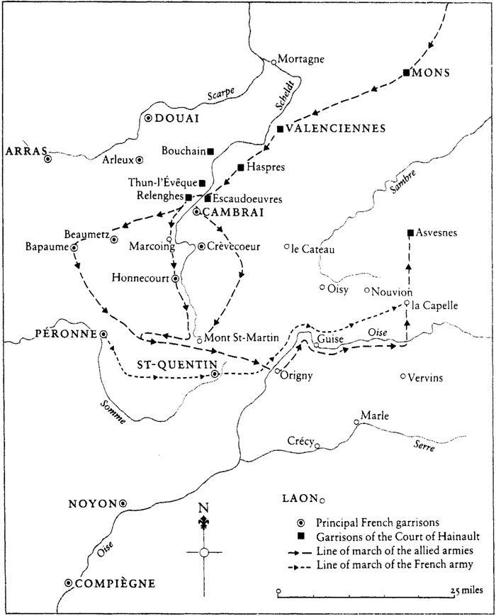
6 The Cambrésis and the Thiérache: Edward III’s campaign, September–October 1339
Edward III was dismayed by his enemy’s inactivity. In the last days of September 1339 the siege was pressed forward with vigour in the hope of drawing a relief army which he could confront in battle. Raiding parties were detached from the main army and sent to lay waste the property of the Bishop and castles held by Philip’s subjects and friends. ‘On the Monday, the Eve of the Feast of Saint Matthew,’ Edward wrote to his son, ‘the troops began to burn in the Cambrésis and they burned there for the whole of the following week so that the whole territory was laid waste and quite stripped of corn, cattle and everything else.’ The devastation was so great that four years later the rich ecclesiastical estates of the region were lying uncultivated and abandoned.77 Against defended places the results were less consistent. The Earl of Suffolk captured Beaumetz with great bloodshed and burned it. But the Hainaulters failed before Oisy.78 At about the end of September there was a determined and almost successful attempt to take Cambrai by storm. By the Scheldt at the northernmost point of the city there was a fortified gate known as the Château de Celles (which, rebuilt by Vauban, still exists). Its captain, another Fleming, was bribed to lower the drawbridge and admit the enemy. But before enough of them had penetrated into the streets the cathedral bells rang out the alarm and the gate was recaptured. As the French had discovered at Bordeaux in July it was remarkably difficult for an army to fight its way through the narrow streets of a defended town.
By the beginning of October 1339 it was clear that Edward was achieving nothing. He was not bringing the French King to battle. He was not subduing Cambrai, a city for which he had little use in any case. It is probable that there was also a shortage of victuals, in spite of the enormous stores of provender which had been looted in the Cambrésis. Medieval armies usually needed to keep moving in order to eat and Edward’s army, small as it was by comparison with Philip’s, was nevertheless as large as the population of a substantial city. Edward estimated that he had about 15,000 men before Cambrai, although there is reliable evidence that the true figure at this stage was about 10,000, of whom rather less than half were Englishmen.79 On 30 September 1339 the Duke of Brabant at last arrived with another 1,200 men-at-arms. The Emperor’s son, the Margrave of Brandenburg, arrived three days later with a prestigious name and further reinforcements.
It was a time for reassessment. Edward pressed his allies to carry the war into France and provoked a new crisis among them. The Rhineland princes, whose territory was far away from the French government’s vengeance, were glad enough of the prospect of pillage and ransoms. But the Duke of Brabant still had his permanent agent in Philip VI’s entourage offering reassurances which became daily more incredible. The Duke asked to be allowed to send an ultimatum to Philip VI first.80 On that condition he was persuaded to take the momentous step of renouncing his homage for his French lands. The French lands of the Count of Hainault, however, were more extensive than those of anyone present except Edward III. The Count had a real territorial interest in capturing the castles of the Cambrésis but none at all in invading France, as ‘aucuns sages’ pointed out to him. William II of Hainault was an impressionable young man without the firmness of purpose of his father. He was torn between the ‘sages’, cautious lawyers, bureaucrats and ecclesiastics of his council, and the greater part of the nobility of Hainault, whose spokesman was John of Hainault, the Count’s belligerent uncle. In Count William’s tents the wise men prevailed. William said that he would not only withdraw his forces from Edward’s service but would bring them over to the French side. It was, he said, his duty as a vassal of France to defend it against invasion. It was a courageous gesture, but an almost empty one. William left to join the French army, but John continued to serve as Marshal of Edward’s army, and most of the nobility of Hainault stayed with him.
The allied army marched south on 9 October 1339, crossing into France that evening. Their marching order was devised so as to enable them to live as far as possible off the land and to spread destruction over the widest possible area. The men were disposed across the whole of the western Cambrésis and advanced along a front about 20 miles wide, destroying everything in their path which they did not pillage for their own use. The eastern wing of the army followed the road leading south-east from Cambrai (corresponding to the modern D 960). Only two places put up any significant resistance and compelled them to pass by. In the centre Edward III and Henry of Lancaster, Earl of Derby, followed the main road along the valley of the upper Scheldt. The only resistance which they encountered came from a troop of French soldiers under the command of the Constable who were making for Cambrai to reinforce the garrison there. They took refuge in the nearby castle of Honnecourt, which the French had repaired and fitted out as an advance post only a month before.81 A ferocious attack was made on the walls which lasted for the whole of 10 October and was beaten off with so many casualties that the English King became concerned about the dissipation of his strength before the decisive battle to come. The pattern was the same elsewhere: an effortless ride through undefended villages spreading fire and death, followed by repulse at castles which they had neither time nor equipment to capture. On the western wing of the army the Earl of Warwick narrowly failed to take Bapaume, the great border fortress guarding the cloth road from Flanders to Paris. Its commander had been bought over but by the time the English arrived to take delivery he had been discovered. They found his mulitated body displayed from the battlements and the gates closed and guarded. They then swept south into eastern Picardy, systematically wasting the land to within 2 miles of the town of Péronne, where most of the French army was. Villagers and local ruffians completed the tale of chaos and destruction by joining in the pillaging on their own account. A year later two papal officials followed in the footsteps of the allied army distributing alms, recording the fate of the inhabitants in their accounts with a sobriety far more powerful than the excited descriptions of the chroniclers. Fifty-five villages of the diocese of Noyon had been largely or entirely destroyed: here a village ‘burned’, ‘devastated’, ‘abandoned’; here a market town populated only by beggars; here a priest knocked senseless while saying mass. Many of those who had fled to safety in the main walled towns like Saint-Quentin found that they had nothing to go back to. They were still begging in the streets there in the autumn of 1340.
On his first evening in France, the King of England established his headquarters in the nunnery of Mont-Saint-Martin, which was about 10 miles north of Saint-Quentin and only a little more from Péronne. Here he was found out on 10 October 1339 by the cardinals. They had made their way under safe conduct from Arras in a final attempt to turn Edward back. It was a brave but naive and useless gesture. When it failed they tried to delay the King with advice on strategy. At least Edward should wait until his army received further reinforcements from Germany, they said. ‘The Kingdom of France’, they told him, ‘is surrounded by a thread of silk which not even the whole strength of England will break.’ One of them, Bertrand de Montfavence, was taken by the old Chief Justice Scrope to the top of the convent tower. The sky glowed in the night and the countryside could be seen burning for 15 miles around. ‘Do you not think’, Scrope asked, ‘that this thread of silk about France is already broken?’ The Cardinal fainted.
Philip VI left Noyon on 10 October 1339 to join the main body of his army at Péronne. He was accompanied by the King of Bohemia and six dukes together with their household troops. By the time the King reached Nesle they could see the smoke of burning villages ahead. Péronne itself was crowded with soldiers and refugees and unwelcome messengers from princes serving in the allied army. The Duke of Brabant’s defiance was read out in the presence of his diplomatic agent at the French court. This man was so mortified by the deception of which he had been the unconscious agent that he abandoned his master and accepted a pension from Philip VI. William of Hainault was there in person to offer explanations of the past and promises for the future. Philip asked him whether he had come to betray him. Had he not allowed the English passage through his territory and assisted them to ravage the Cambrésis? One of Philip’s friends, the Count of Évreux, took the King aside to remonstrate with him. Philip was unmoved. He told the wretched Count that he would reconsider his position in due course. William took his place in the French army with 400 or 500 men and followed it for the rest of the campaign. But the King treated him as a pariah and addressed not another word to him.82
The invaders drew their scattered forces together in the plain east of Péronne. Edward himself left Mont-Saint-Martin on 14 October to join them. His movements in the next few days lacked his usual decisive manner. On the evening of the 14th the two armies came within a mile of each other close to Péronne. In the French camp the leaders of the army decided that they would attack the enemy on the following morning. Edward might have had his battle. But he was not ready. He was probably concerned about his line of retreat in the event of disaster and did not want to be caught so far west between the main French army and the strong French garrisons of Cambrai, Tournai and Lille. When the French decision was reported to him by spies, as it was almost immediately, he decamped by night and withdrew rapidly eastward past the walls of Saint-Quentin towards the River Oise. The English were first across the river. They burst into the town of Origny and burned the whole place including the nunnery and the Benedictine abbey.83Edward installed himself among the ruins. This was on 16 October. Philip VI, hearing that his prey had gone, delivered an angry tirade against the indiscretion of his servants and courtiers, the raw material of every hostile spy. ‘Can I not speak quietly in my private room without the King of England listening? Must he always sit invariably by my side?’ Then he moved his troops out of Péronne to Saint-Quentin and waited.
In Edward III’s army conditions were becoming difficult. There had been fresh dissensions among the allies on the march from Péronne. There was a growing crisis about victuals. The English had organized their supplies very thoroughly. They had many beasts of burden and a large wagon train loaded with plundered victuals. But the allies had nothing of the kind. Edward had had to buy carts and teams for the Margrave of Brandenburg, who had arrived in the Cambrésis with no transport at all.84 The others appear to have had some transport but not enough. They had expected to fight the decisive battle as soon as they entered France and, the battle having been deferred, they had nothing to eat. From Origny the English and the Hainaulters launched raids deep into French territory in search of loot and supplies. The earls of Derby, Salisbury and Northampton and John of Hainault took a troop of 500 mounted men on a long ride up the valley of the Serre. They burned Crécy-en-Laonnais, the suburbs of Marle and at least fifteen other villages and towns. The convent of La Paix-Notre-Dame near Marle was so completely wrecked that the sisters were still begging in the streets of Laon a year later. At Sains the inhabitants took refuge with all their possessions in the castle, where they perished in a huge conflagration after the place had been taken by assault. The rest of the army sat by the Oise consuming its stores and complaining. On 17 October the allies came before the King and told him that they intended to withdraw before they starved. Edward offered to supply them from his own stores. He suggested that they should mount their infantry on his cart-horses and move rapidly on to new territory which had not yet been stripped of all foodstuffs. They grumbled among themselves and said that they could see no point in going on.
These discordant voices were silenced by a sudden reminder of the closeness of the French. The leaders of the French army sent Edward a formal challenge to battle on the following Thursday or Friday, 21 and 22 October, at a ‘convenient place uncramped by rivers, walls or earthworks’, a fight on even ground and a fair appeal to God’s judgement. The message reached the allied camp in the form of a letter from Le Galois de la Baume to a kinsman of his, another Savoyard soldier of fortune who was serving in the English army. After a long period of deliberation he replied on behalf of Edward III and all the allies accepting the challenge.
Origny was not the place to fight the battle. The allied army was spread out in a broad bend of the River Oise which cut off its line of retreat to the north. It was decided to withdraw into the Thiérache, towards the border of Hainault. There were high hopes of taking Guise, which offered a bridge over the Oise towards Hainault. The place belonged to John of Hainault’s son-in-law and was occupied by his daughter. The captains of Edward III’s army were already in touch with the garrison commander who had sold them victuals and weapons.85 But when John of Hainault arrived with his men outside the walls, the place resisted. So he burned the suburbs and passed by. The army followed the Oise eastward, burning every village as they came to it. The villagers of Monceau-le-Vieil told the papal almoners that the soldiers had emptied their houses of the contents and made a great bonfire of them, then burned the village itself to the ground. It was not an unusual story. In most places the inhabitants fled until the storm had passed. The French army followed through the charred fields and hamlets about half a day behind.
On the evening of 21 October 1339 Edward III called a halt between the small town of La Capelle and the village of La Flamengrie, where the forest of Nouvion opens out into cultivated fields. The French stopped on the 22nd at Buirenfosse, a hamlet at the edge of the forest about 4 miles from the English encampment. It was in the early evening that three French spies found reconnoitring the allied positions gave the first certain intelligence of the French King’s presence. They were taken away and questioned separately. All of them agreed that the French were intending to attack on the following day, 23 October 1339.
Edward had chosen his battlefield with great skill. The ground sloped gently away from La Flamengrie towards the French positions. The forest prevented any outflanking movement to the west and the allies securely held the road junction of La Capelle, blocking any eastward movement of the enemy. From Edward’s encampment the Roman road ran north to Avesnes in Hainault, 10 miles away, his line of retreat. The dispositions of his army were fixed by the King with his commanders on the evening of the 22nd and completed shortly after daybreak on the following morning. Edward dismounted all his troops, sending the horses to the rear. He placed his archers on each of his flanks. Between them, slightly set back, the rest of the army was arrayed in three lines behind a deep trench guarded by Welsh lancers. Edward himself took command in the centre of the first line with Burghersh and Scrope and the troops of the royal household. Henry of Lancaster, Earl of Derby, and the Earl of Suffolk held the right of the line, while the earls of Salisbury, Northampton and Pembroke held the left. The Germans, including the Margrave of Brandenburg, the Margrave of Juliers and John of Hainault, were placed in the second line. The Duke of Brabant formed the rearguard. It was in fact the battle plan of Dupplin Moor and Halidon Hill, and of Crécy seven years later. The Germans had never seen anything like it, ‘but seeing that it was a strong position, cunningly laid out, and that the King was content, they were satisfied. They took up their positions ready to live or die.’ The Duke of Brabant promised 1,000 florins to whomever should first bring him a piece of the Oriflamme even if it were no more than the size of a man’s palm. There was a special distribution of wine. Very large numbers of squires received knighthoods at the hands of the King himself, some of whom, like Sir John Chandos,86 were destined to make famous careers.

7 English positions at La Capelle, 23 October 1339
The French army passed the night in battle order. They slept very little. Walter Mauny and other bold spirits of the allied army repeatedly penetrated their defences in small groups, killing sentries and falling upon isolated bodies of men. In the early morning the French vanguard advanced a short distance from the encampment and waited for their orders. None came. In the King’s tent a venomous dispute had broken out about whether to give battle at all. The classic English battle plan depended on the enemy throwing his cavalry into the centre of the English line so that it could be impaled on planted lances and massacred by longbowmen firing from the flanks. The French leaders must have been aware of this. The size and depth of the trench in front of the English lines had been reported by scouts on the previous afternoon and the exact dispositions of all the allied troops were described early on 23 October by some captured German knights. Might not mere delay defeat the English King just as effectively as a frontal attack? There were other considerations. The French army had been marching for several days through territory wasted by Edward III and they were hungry and thirsty. The contrary arguments owed more to emotion than military calculation. ‘The King will look like a fool and a knave if he refuses battle when the enemy has burned and wasted the kingdom under his nose and his army has come so close.’ Philip decided towards the middle of the day that he would not attack but would wait for the allies to do so. The vanguard of the French army was ordered to retreat and dig in. It was not a popular decision. A purely defensive war brought no ransoms, no booty, no glory and a deal of contempt for Philip personally. French noblemen accused the King’s advisers of ‘foxiness’ (‘renardie’) and disported themselves in fox-fur hats and skins hooting abuse. On strictly military grounds, however, it was probably the right decision. Had it not been made La Capelle might have been as famous a name as Crécy, remembered for something more than the site of the Armistice of 1918.
From the English lines the retreat of the French vanguard was noticed at once. Soon afterwards the French were seen to be digging trenches and drawing large tree trunks in front of their position. Edward did not laugh at his enemy’s inconstancy. He knew that it marked the failure of his campaign. The princes and the leaders of the army conferred. An attack on a much larger army in prepared defensive positions was unthinkable. To keep the allied troops drawn up and waiting was impossible. They too were short of food and water. The princes became restive. They declared that Edward’s army had won a moral victory, for they had destroyed large tracts of northern France with impunity; they had dared the French King to do his worst and he had done nothing. Towards five o’clock, as it was growing dark, the allies mounted their horses. There was a brief stir in the French camp as it was thought that they were about to attack. But instead the allies turned north and marched away along the Roman road to Avesnes. The only fighting was between the English and some of the Germans who quarrelled about the division of booty. After the allies had left Philip VI departed hurriedly for Saint-Quentin. His army passed the night at Buirenfosse and in the morning went out to examine the position in which the allies had stood. From close at hand it seemed less formidable, the trench less broad and deep than they had expected. Then they returned to Saint-Quentin and were paid off.
*
Oliver Ingham, who had arranged to mount a diversion in the south-west, coinciding with Edward’s invasion of the north, began late and achieved no more than his master had. The French had withdrawn large numbers of their troops in July to meet the threat in the north, including almost all the higher nobility of the region. But there were still formidable French forces there, some 3,200 men-at-arms and 12,000 footsoldiers levied locally and spread among the thickly clustered garrisons of the Garonne and Dordogne valleys and the south-east march of the duchy. Ingham’s intentions shifted. On 12 October 1339 he marched out of Bordeaux and up the Garonne valley with his modest army. They first tried to surprise Langon, which lay on the south bank of the Garonne opposite Saint-Macaire at the edge of English-held territory. But when they arrived there, on 13 October, they found the place defended by a garrison of 340 soldiers, a large force for a small and well-walled town. The attackers failed to take it. Within a few days the French had begun to concentrate against Ingham’s army and by the end of the month he had been forced to retire southwards into the Bazadais. At one point his small force lunged briefly towards the great city of Toulouse, the city’s first encounter with the military reality of the war. Ingham seems to have found some substantial support among the nobles of the Toulousain. But with the harvest in and the city securely held there was little real damage that he could do. By the beginning of December 1339 he had returned empty-handed to Bordeaux.87
*
Parliament opened in Westminster Hall on 13 October 1339, a despondent assembly whose tone was set by demoralized civil servants and the rump of the aristocracy which was not on campaign with the King.88 The grain harvest had been poor. Wool prices were low, the result in large measure of the quantities which Edward III and his magnates had precipitately dumped on the north European market. The north and especially Cumberland and Northumberland had resumed its secular decline to barren waste, the outcome of almost continuous guerrilla warfare and semi-official banditry. But the burden of taxation and purveyance was as great as ever.
Edward III had been warned by his councillors that it would be a difficult meeting and had sent three men, Archbishop Stratford, Richard Bury, Bishop of Durham, and William Pole from his camp with concessions to meet some obvious grievances. Stratford made a long speech at the opening of the session. He explained how the King had been compelled by financial hardship and inadequate supplies from England to postpone the opening of his campaign for more than a year, and how he had invaded the Cambrésis in the middle of September. He read out newsletters from the Earl of Huntingdon and the agents of the Peruzzi bank recording how Edward had entered France and reached the neighbourhood of Saint-Quentin. All this, he said, had been possible only because the King had borrowed enormous sums of money on ruinous terms, money which he could not hope to repay without generous parliamentary taxes. The audience was probably not told how ruinous the terms of the loans were, but they were told the amount of them. Edward’s debts, Stratford revealed, now exceeded £300,000, a sum which represented the equivalent of some ten years of ordinary revenue or more than seven Parliamentary subsidies.
Stratford nearly got what he wanted. Both houses of Parliament agreed that the King stood in need of ‘une tres grante somme’ and the Lords, who had been skilfully worked upon, proposed a tax in kind of a tenth of one year’s yield of corn, wool and lambs. But the Commons were preoccupied by their campaign against purveyance. They demanded concessions. In particular they wanted a statute that in future all royal purveyors should pay cash or be liable to arrest. The Council retreated. The current chief purveyor was arrested and consigned to the Fleet prison on the Commons’ petition. At about the same time all outstanding warrants of purveyance had to be cancelled. As for taxation, the Commons deliberated for a long time among themselves before concluding that their constituents would probably repudiate their authority if they agreed. The sum required was very large, they said. They would have to consult their communities at home. Perhaps the matter might be raised again at the next Parliament. But they hoped that God would continue to honour the King with victory. The Commons dispersed on 28 October 1339, too early to have heard about events at La Capelle. On the same day Edward III arrived in Brussels to begin a week of jousting with his friends and allies and to reconstruct their plans. ‘Always bear in mind’, the Pope wrote to him a few weeks after this, ‘how many of your subjects have been ruined already by the burdens of this war, how much heavier those burdens will grow as it continues, and how uncertain is the outcome of all wars.’89
NOTES
1 RF, ii, 1050; TR, ii, 73–4, 82–3; Bel, Chron., i, 137. Numbers: WBN, 325–86. Pay: Powicke, 210–12.
2 TR, ii, 145–8; RF, ii, 1045; Murimuth, Chron., 83; PRO E101/311/36; Benedict XII, Reg. (France), nos 472, 481, 495, 538.
3 LC, nos 91–100; AHG, ii, 127–30, 131–2; *Cordey, 292; *Lescot, Chron., 215–16; Chron. anon. Par., 176; Muisit, Chron., 115, 116, 117; Benedict XII, Reg. (France), nos 464–7; ‘Itin. Philippe VI’, 527–8; Contamine (3), 34.
4 PRO E101/311/35, 36.
5 PRO C81/250/11439; WBN, 240.
6 TR, ii, 80, 104–9, 113, 1l6, 117, 156–62; RF, ii, 1031–2; *Déprez(i), 418–19; WBN, 363; *KOF, xviii, 64–5; E. Fryde (6), 1149–50, 1160–1; E. Fryde (9), 86.
7 Bel. Chron., i, 137–8; Baker, Chron., 61–2; Murimuth, Chron., 83–4.
8 E. Fryde (6), 1154–7; TR, ii, 156–62; *KOF, xviii, 64–5.
9 CCR 1337–9, 511–2., 526; RF, ii, 1051; TR, ii, 193–202, 203–15, 220–25.
10 Bel. Chron., i, 139–42.
11 Schwalm, ‘Reiseberichte’, 350–2; WBN, 417. Negotiations with France: AN J918/25, J919/13; LC, no. 99; Benedict XII, Reg. (France), 496.
12 WBN, 69, 85–91, 212, 219, 221–3, 242–4, 417, 446; Murimuth, Chron., 84–5; Récits d’un bourgeois, 165–6; Knighton, Chron., ii, 5–6. Vicariate: Bock, Quellen, nos 530–2; *KOF, ii, 548–9.
13 Bock, Quellen, nos 533–4; Hocsem, Chron., 282; Bel, Chron., i, 148–9; WBN, 246; Knighton, Chron., ii, 6–7; Benedict XII, Reg. (France), no. 518, Reg. (Autres pays), 2082–93.
14 Bel. Chron., i, 138–9; CPR 1338–40, 187; WBN, 241–2, 247, 248–9, 251, 252.
15 PRO E101/311/35, 36; WBN, 278, 282, 460; RF, ii, 1065; Chronographia, ii, 1064–5; Chron. anon. Par., 177; Benedict XII, Reg. (France), no. 588.
16 Dispersal: Chron. anon. Par., 177; BN Coll. Doat 186, fols 161vo–162. Winter dispositions: Chronographia, ii, 60–4; * Chron. Norm., 214–16; Jusselin, ‘Comment la France se préparait’, 228–9.
17 BN Fr. 2598, fol. 50. Spies: PRO E101/166/11, m. 36; WBN, 60; PRO E101/311/35. Edward’s supplies: e.g. TR, ii, 204–5, 218–19; WBN, 218.
18 RF, ii, 969; TR, ii, 171–2; Chron. anon. Par., 173–4; PRO E372/191, m. 52 (Ferrers); Chronographia, ii, 28; French Chron. London, 74; Actes Normands, 217, 219.
19 PRO E372/191, m. 55(Weston), C62/115, m. 5.
20 WBN, 213, 363; PRO C81/249/11331; Nangis, Chron., ii, 161; Chron. anon. Par., 178; Murimuth, Chron., 87; Baker, Chron., 62, 69; Minot, Poems, 8–9.
21 RF, ii, 1060; TR, ii, 252, 297.
22 TR, ii, 226, 252, 297–300, 313–4; DCG, nos. 221, 223; RF, ii, 1070; CPR 1338–40, 149–50, 180–1; CPR 1340–3, 4, 572, 579; CPR 1345–8, 298–9; CCR 1337–9, 183, 184, 286; CCR 1339–41, 104, 143, 477–8; CFR 1337–47, 97; Murimuth, Chron., 87; Baker, Chron., 62–3; Chronographia, ii, 93–4; Platt, 108, 111–12.
23 DCG, nos 218–23; TR, ii, 228, 231–5, 305, 307–8; RF, ii, 1061, 1062; RS, i, 552; French Chron. London, 74; CCR 1337–9, 537; Cal. Letter Books, F, 1, 16, 28; Cal. Plea Mem. R, 176–7.
24 RP, ii, 104; *Nicholas, ii, 469–73; CCR 1337–9, 199, 339; TR, ii, 181, 228, 310; PRO E372/184, m. 50 (Stephen de Padyham); RF, ii, 958; WBN, 385; RS, i, 515; Tinniswood.
25 RF, ii, 947,1008, 1058, 1066, 1104; WBN, 3, 428.
26 CPR 1338–40, 190,195; RF, ii, 1066–7; Doc. Monaco, i, 270–1.
27 Brown et al., 589, 592–3, 638–9, 724–5, 779, 788–9. Pevensey: CPR 1338–40, 208, 236–7. Winchester: TR, ii, 311; RF, ii, 1077; CCR 1337–9, 579. Dover: PRO C76/14, m. 10. Chichester: PRO C76/14, mm 10, 11. Southampton: PRO E101/22/7, 11, 12, 34, 77; CPR 1338–40, 237; CFR 1337–47, 129–30; RF, ii, 1077; PRO C76/15, m. 31, SC1/41/177 (E. of Warwick).
28 Murimuth, Chron., 88–9; Maddicott (2), 50–2.
29 Maddicott (2), 31, 53–9, 66.
30 E. Fryde (7), 258–64; E. Ames, ‘The Sterling Crisis of 1337–9’, J. Econ.H., xxv (1965), 496–522; Maddicott, 48–50, 62–4, 69. Disorder: Bridlington Chron., 138; Chron. mon. Melsa, ii, 387; Rot. Parl. ined., 268–9.
31 Tout (1), iii, 90–8; *E. Fryde (1), 77.
32 E. Fryde (7), 262–3; Year Books 14–15 Edward III, ed. L. O. Pike (1889), 258–62; French Chron. London, 87; Aspin, Political Songs, 112.
33 Rot. Parl. ined., 269; Knighton, Chron., ii, 3; E. Fryde (7), 262–3; Aspin, Political Songs, 105–15; RF, ii, 1070; Gray, Scalacronica, 168.
34 Doc. Durfort, no. 811; AN JJ68/35; HGL, ix, 508; AHG, xxxiii, 93–4.
35 Bock, Quellen, nos 538, 541; Benedict XII, Reg. (France), nos 553, 555; Chron. anon. Par., 179; Muisit, Chron., 117–18; Muevin, Chron., 470; Chronographia, ii, 62; *E. Petit (2), 259; BN Fr.n.a. 9236, p. 26. Spies: PRO E101/311/35; WBN, 228.
36 Doc. Durfort, no. 762; AHG, xxxiii, 93–4; BN Fr.n.a. 9236–7, pp. 28, 88, 350, 755; PRO E101/166/11, mm. 14, 23, 29–30; AN JJ71/169,174, 220, JJ72/52.
37 Contamine (2), 68; BN Fr.n.a. 9237, pp. 705–7, 750, 751, 769–74.
38 Penne: BN Fr.n.a. 9236, pp. 74–88 (arrivals at Penne). Caumont: BN Fr.n.a. 9237, pp. 574–5, 584, 708, 750; PRO E101/166/11, m. 35. Puyguilhem: BN PO 1120 (de Fays, 2), PO 1172 (Foix, 9), PO 2188 (la Palu, 2, 3, 5), PO 2739 (Sussa, 2); BN Fr.n.a. 9237, p. 781.
39 Penne: BN Fr.n.a. 9237, pp. 549–51, 755, 756; PRO E101/166/11, m. 23. Bourg, Blaye: PRO E101/166/11, mm. 21, 22, 32, C61/52, m. 3; Chron. anon. Par., 180; BN Fr. 2598, fol. 50vo; *Chron. Norm., 220; AN JJ72/63 (epilogue); BN Fr.n.a. 9237, pp. 678–97 (garrison).
40 Devaluation: Boutruche, 265–7. Gordon: PRO C61/52, m. 20. Quotation: SC1/38/174.
41 Actes Normands, 196–9, 212–13, 218–21; DCG, nos 229–45; RF, ii, 1072.
42 ‘Ancient Petitions’ ayant trait aux îles de la Manche, 67–9; PRO E372/191, m. 52 (Ferrers); BN Fr. 2598. fol. 50.
43 RF, ii, 1078; Murimuth, Chron., 88; Baker, Chron., 63; PRO C81/254/11807.
44 RF, iii, 76; AN J210/4, 5, 7; Ordonnances, vi, 549–50; Nangis, Chron., ii, 162.
45 RF, ii, 1078; DCG, no. 248. Articles: Murimuth, Chron., 257–61.
46 CPR 1338–40, 206, 212, 279; CCR 1339–41, 19, 40, 55, 71, 79, 87, 106, 121, 190, 233, 236; RF, ii, 1076, PRO C76/14, mm. 18d, 11, 10d, 8, 8d; PRO E101/21/32, mm. 3–7.
47 May raids: Murimuth, Chron., 89–90; Baker, Chron., 63–4; Knighton, Chron., ii, 8–9.1. of Wight: PRO E101/21/32, m. 7. Hastings: CPR 1338–40, 258, 287; CCR 1339–41, 215, 293–4, 298, 333.
48 PRO C76/14, mm. 12d, 13d. Cinque Ports: PRO E372/184, m. 42 (E. of Huntingdon).
49 Chron. anon. Par., 180; CPR 1338–40, 372–3, 491–2; CPR 1340–3, 319; WBN, 216, 258; PRO C76/14, mm. 8, 7, 7d, 6; PRO E101/22/8. Crabbe: Cal. doc. Scot., iii, nos 417, 673, 1086, 1090; Exch. R. Scot., i, 64, 311; CCR 1337–9, 223–4; CCR 1339–41, 11, 139; Bridlington Chron., 109.
50 DCG, nos 254, 257; Actes Normands, 205–8; Knighton, Chron., ii, 9; CCR 1339–41, 452, 650; Roncière, i, 432; Guesnon, ‘Documents’, 226.
51 Giorgio Stella, Annales Genuenses, ed. G. P. Balbi (1975), 128–9; DCG, nos 249–50, 265, 275; Actes Normands, 221–8. Grimaldi paid off: AN JJ72/72. Doria’s treason: CPR 1340–3, 330; PRO C49/7/15.
52 Chronographia, ii, 67; Nangis, Chron., ii, 163; Cart. S. Michel du Tréport, pp. xlix-1; AN JJ73/72; CIM, iii, no. 14 (p. 6) (Poitou); C. Guibert, Méms. p. servir à l’hist. de Dieppe, ed. M. Hardy, i (1878), 24.
53 PRO C76/14, mm. 11d, 10d, 5, 5d, 4. Convoys: ibid., mm. 5d, 4d; PRO E372/184, m. 42 (Swanlond); *Hughes, 242.
54 RF, ii, 1080; Harriss, 244n.
55 Captaincies: E. Petit, Rec. Anc. Mem., 63, 174–6, 177–8; Inventaire AD P.-de-Calais, ii, 28 (Boulonnais); DCG, no. XXVII(140); BN Fr. 9501, fols 153–153V0 (S. of Seine); Rec. doc. Poitiers, 343, 345 (Poitou). Reinforcements inland: Guesnon, ‘Documents’, 224; Inventaire AD P.-de-Calais, ii, 28.
56 This section: E. Fryde (6), 1157–75, 1194–1216; E. Fryde (4), 17; E. Fryde (9), 121–9; and other references below.
57 RF, ii, 1080.
58 *Hughes, 243.
59 Benedict XII, Reg. (France), no. 531; AN JJ71/352–3.
60 RF, ii, 1080.
61 Jusselin, ‘Comment la France se préparait’, 228–32; Henneman, 153, 350, 355. Normandy: RF, iii, 76. Paris, arrière-ban: Timbal, Registres, 54–7.
62 Ménard, ii (Preuves), 110; LE, no. 117; Chronographia, ii, 66–7.
63 BN Fr.n.a. 9236, pp. 71, 140; cf. pp. 37, 38, 43, 46, 86. Bordeaux: ibid., 197, 263–4, 266.
64 Cal. doc. Scot., iii, no. 1307; RS, i, 557–70; Fordun, Chron., i, 364; Bower, Supp., ii, 330; Wyntoun, Cron., ii, 451–2; Chron. Lanercost, 317–18.
65 *KOF, xx, 414–18; E. Fryde (6), 1173–4; BN Fr. 2598, fol. 50.
66 Benedict XII, Reg. (France), nos 560, 588, Reg. (Autres pays), nos 2184, 3401; Stengel, N. Alemanniae, i, 388–90; Schwalm, ‘Reiseberichte’, 352–4, 359; RF, ii, 1088; WBN, 417.
67 Robert: RF, ii, 1066; WBN, 216–7, 223, 268, 424; PRO E101/311/36 (conspirators); Benedict XII, Reg. (France), no. 603; *Trautz, 285, 340; Bock, Quellen, no. 551; CCR 1339–41, 288, 291. Philip: *Lescot, Chron., 220.
68 Chron. anon. Par., 181; Walsingham, Hist., i, 225–6; AHG, iv. 102–3; BN Fr.n.a. 9236–7, pp. 37–286, 343–502, esp. 87–8,189, 263–4, 343, 533, 678–97, 779, 781; PRO E101/166/12, mm. 7, 7d.
69 Fordun, Chron., i, 364; RS, i, 571; Bower, Supp., ii, 330–1; Wyntoun, Cron., ii, 452–6; RF, ii, 1094. Relief force: RF, ii, 1093; PRO SC1/42/94A, E372/184, m. 45 (Bp of Carlisle); CCR 1339–41, 189.
70 WBN, 282, 284, 285, 460; PRO E101/311/35, 36; RF, ii, 1084; Benedict XII, Reg. (France), 620, 644.
71 E. Fryde (6), 1168–9, 1173; RF, ii, 1085, 1088; WBN, 232; Bock, Quellen, nos 549–51; Gedenkwaardigheden Gesch. Gelderland, i, 399–402; Actes … intérressant la Belgique, 130–8; Murimuth, Chron., 91; Avesbury, G. Edwardi, 307.
72 Bel. Chron., i, 151–3 (place and dates wrong); * Lescot, Chron., 206; Bock, Quellen, no. 551.
73 *Lescot, Chron., 223–4.
74 Campaign of Sept.–Oct. 1339: (a) English official record, *KOF, xviii, 84–93; (b) Edward III’s letter to his son (1 Nov. 1339) in Avesbury, G. Edwardi, 304–6; (c) itineraries of Edward III (*Lescot, Chron., 206) and Philip VI (‘Itin. Philippe VI’); (d) principal chroniclers, Bel, Chron., i, 153–65, Chronographia, ii, 62, 68–85; (e) minor chroniclers, Hocsem, Chron., 288–90, Récits d’un bourgeois, 167–70, Muisit, Chron., 118–19, Baker, Chron., 64–6, BN Fr. 2598, fols 50v0–51; (f) other chroniclers are substantially based on (a), (b) and (d) and unreliable so far as they add to them, but some material is supplied by Murimuth, Chron., 101–3, Gray, Scalacronica, 169, Lescot,Chron., 49, Nangis, Chron., ii, 163–5; (g) accts of papal almoners in Carolus-Barré, ‘Mission charitable’; (h) other references below.
75 Finance: *KOF, xx, 54–6, 413–31; E. Fryde (6), 1171, 1174; RF, ii, 1091.
76 Benedict XII, Reg. (France), no. 648.
77 Denifle, 10.
78 Froissart, Chron., i, 162.
79 Numbers: RP, ii, 103 (Edward’s estimate); Prince (1), 360–1, whose figures do not include allied contract armies.
80 RF, ii, 1092.
81 BN PO 226 (Baume, 5, 6).
82 AN J624/31; *KOF, xviii, 38.
83 Ordonnances, iv, 239.
84 WBN, 216.
85 AN JJ72/318.
86 Froissart, Chron., i, 179.
87 PRO E101/166/12, m. 10; Knighton, Chron., ii, 14; RF, ii, 1101; Johnson, ‘An Act’. French numbers: Contamine (2), 68; BN Fr.n.a. 9236–7, pp. 429, 432, 441–7, 659, 660, 762, 807–8.
88 RP, ii, 103–6; RF, ii, 1091, 1098; E. Fryde (7), 266–7.
89 Jousts: Chronographia, ii, 85. Pope: RF, ii, 1103.