
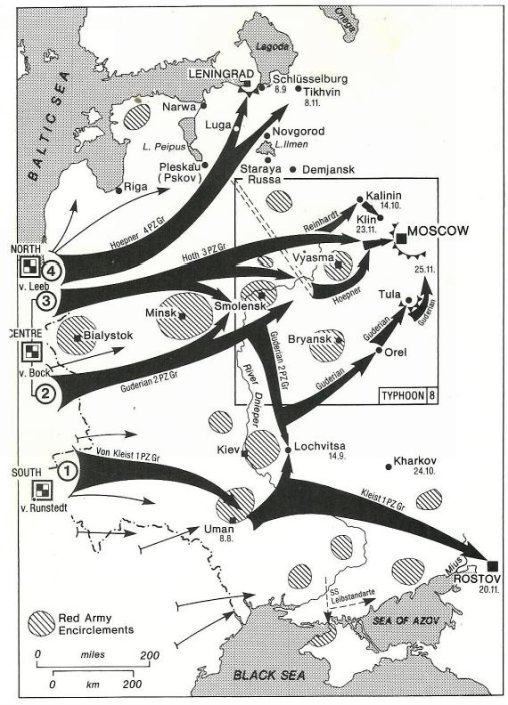
In Operation 'Barbarossa', Army Groups North, Centre and South with powerful Luftwaffe support strike in three directions: Leningrad, Moscow and Kiev-Rostov.
Encirclements of the Red Army are a triumphant feature of the early days, but military operations fanning out over a vast and often trackless interior are soon brought to a standstill. Halted by difficult terrain, bad weather, inadequate supplies and exhausted by an unyielding defence, the panzer divisions after capturing Kiev are driven to unrewarding battles for Leningrad and Moscow.
Hoepner (Fourth Pz-Army) 22 June leads Army Group North (von Leeb) to Leningrad. Guderian and Hoth (Second and Third Pz-Armies) 22 June responsible for the main German effort, lead Army Group Centre (von Bock) in the Moscow direction. Von Kleist (First Pz Army) 22 June leads Army Group South (von Runstedt) to Kiev and Rostov.
The outstanding panzer success of the early weeks is an envelopment of five Russian armies east of Kiev resulting in 600,000 prisoners for which von Kleist and Guderian are responsible. In the course of a subsequent operation, 'Typhoon' 2 October 1941, convergent action by Guderian, Reinhardt and Hoepner encircling Bryansk and Vyasma proves equally rewarding.
Seventeen panzer divisions, thirteen and a half motorized divisions lead 'Barbarossa' - but despite optimistic predictions of a three-week campaign, operations are destined to last four years. Expanded and re-equipped, in later campaigns the panzer force will nevertheless fail to match Russian numbers or strategy. Divisions are switched between theatres, fronts, and controlling corps. Four years later on the Central Front in January 1945, when the Red Army pushes across the Vistula, only four panzer divisions supporting indifferently equipped infantry divisions face 163 Russian divisions. At the conclusion of hostilities the panzer force is totally burned out and only weak battle groups remain at the Army's disposal.
Hoepner (4) PzGr 4: XXXXI PzK Reinhardt, LVI von Manstein: three PzDivs 1st, 6th, 8th: three MotDivs 3rd, 36th and SS Totenkopf (later trapped with SS 'Polizei', 'Danemark' and others at Demjansk).
Hoth (3) PzGrS: XXXIX PzK Schmidt, LVII PzK Kuntzen: four PzDivs 7th, 12th, 19th, 20th: three MotDivs 14th, 18th, 20th: No SS formations
Guderian (2) PzGr 2: XXIV PzK Geyr, XXXXVI PzK Vietinghoff XXXXVII PzK Lemelsen, five PzDivs 3rd, 4th, 10th, 17th, 18th: 3 1/2 Mot Divs 10th, 29th, SS Das Reich (later switched to Hoepner for attack on Moscow) and Regiment 'Gross Deutschland'
Von Kleist (1) PzGr 1: III PzK von Mackensen; XIV PzK von Wietersheim; XXXXVIII PzK Kempf; five PzDivs 9th, 11th, 13th, 14th, 16th; four MotDivs 16th, 25th, SS 'Wiking', SS (Brigade) 'Leibstandarte' AH, Regt Gen Goering. OKH Reserve 2nd, 5th PzDivs: 60th MotDiv
German Army von Brauchitsch 153 divisions (seventeen Pz, + two reserve, 134 mot divs) 3,417 tanks
Luftwaffe Keller, 1st Air Fleet; I Air Corps/A Gr North; Kesselring 2 Air Fleet, II, VIII Air Corps/A Gr Centre; Lohr 4th Air Fleet, IV, V Air Corps/A Gr South; - 3,800 aircraft
Red Army/Air Force 150-180 divs, 20,000 tanks, but only 1,000 T34s and 500 KVs, 10,000 aircraft (2,750 modem types).