
As the Germans regained control of the situation at the front after the winter of 1941/1942, Hitler planned a new offensive in the east. The objective was Stalingrad and the oil fields in the Caucasus region. According to the “Generalstab des Heeres / Organisation Abteilung” (Army General Staff / Organization Department)1 directive, issued on February 18 in preparation for the summer offensive, all two battalion tank regiments were strengthened by addition of a third tank battalion. From that moment, each of the three battalions was to consist of two light and one medium tank company. The specific order concerning the 9th Division came on May 10, the I battalion from the 3rd Panzer Regiment (I./Pz.Rgt. 3) of the 2nd Panzer Division was transferred, and became the third battalion of the 33rd Panzer Regiment (III./Pz.Rgt. 33).2
By the end of June, as part of the reinforcements, the I Armoured Battalion of the 10th Rifle Regiment received about 85 medium SPW3 Schützenpanzerwagen (armoured personnel carrier) vehicles, which were halftrack armoured transporters Sd.Kfz. 251, as well as a number of heavy self-propelled anti-tank guns - sPak. (Sfl.),4 which were most likely the 7.62 cm Pak 36 (r) Fgst. auf Pz.Kpfw. II Sd.Kfz. 132 “Marder” II type.
At the time of the of the summer offensive, on June 1942, the Army Group “South” had nine armoured divisions at its disposal, the 3rd, 9th, 11th, 13th, 14th, 16th, 22nd, 23rd and 24th.
On June 2 the 9th Division’s 102nd Armoured Artillery Regiment was reinforced by an addition of the IV Detachment, which previously was the 287th Land Forces Anti-aircraft Detachment (Heeres-Flakartillerie-Abt. 287 - H.Flakart.Abt. 287). This new sub-unit had four batteries numbered 9 - 12.
On June 22, during the final stages of preparation for the summer offensive, the 9th Panzer Division was equipped with the following tanks: 22 Pz.Kpfw. II, 38 Pz.Kpfw. III armed with a short barrel 50 mm gun (Ausf. E-J), 61 Pz.Kpfw. III armed with a long barrel 50 mm gun (Ausf. J-L), nine Pz.Kpfw. IV armed with a short barrel 75 mm gun (Ausf. B-F1), 12 Pz.Kpfw. IV armed with a long barrel 75 mm gun (Ausf. F2-G). In all it had 142 tanks, supplemented by two command tanks Pz.Bef.Wg.5

Troops of the Hungarian 2nd Army during a march to their initial positions before operation “Blau ”.
For the duration of the Operation “Blau” the Division was part of the XXIV Armoured Corps (XXIV PzK) incorporated into the 4th Panzer Army (PzAOK 4) assigned to the Army Group “South”.
The German offensive begun on June 28, 1942. At 10 o’clock in the morning, the Wehrmacht units moved forward. The main thrust was undertaken by the units of the 4th Panzer Army under General Herman Hoth. The assault was directed towards the river Don, south of the Kursk-Voronezh railway line. The attack, conducted along a 45 kilometre stretch, was aimed at the junction of the Soviet 13th and 40th Army defensive boundaries. The first wave of the German assault consisted of the three Panzer Divisions - 9th, 11th and 24th, three infantry divisions and a motorised division. Armoured grenadiers crossed the river Tim in pontoon boats and secured an area large enough to establish a bridgehead. It took only one hour for the 86th Armoured Pioneer Battalion to put together a provisional bridge allowing for the passage of tanks. During the crossing, a Pz.Kpfw. III Ausf. N tank carrying Fahnenjunker Ludwig Bauer, mentioned before, was hit by an anti-tank shell. The commander’s position was destroyed, causing the death of Leutnant Sirse.6
By the end of the day, the Bryansk Front ramparts were penetrated. German tanks advanced 8 to 12 kilometres behind Soviet defensive lines towards Kastornoye, breaking the communications links and disrupting the command structures of the Red Army. The German advance continued for a few days. An entry made in the “Combat Journal of the Supreme Command of the Armed Forces” (“Kriegstagesbuch des Oberkommando der Wehrmacht”- KTB des OKW) on July 2 states: “Panzer units of the Army Group “von Weichs” (HG “von Weichs”) made rapid advances east and southeast, allowing the 24th Panzer Division to reach the western outskirts of Gorshechnoye; the township was heavily defended by the enemy. The 16th Motorised Infantry Division turned south and is marching towards Staryy Oskol; north of Gorshechnoye units of the “Grossdeutschland” Division crossed the Olym River - the railroad bridge fell into our hands intact - and pushed the enemy out of Kulevka. The 9th Pz. Div. is conducting an attack on Kastornoye. South of Livny an eastward advance reached Kschen River. Strong enemy resistance noted southwest of Livny”.7 On the following day, July 3, the situation became even more complicated for the Soviet side. The Germans deployed their reserve units and were progressing towards Voronezh. The Soviet Army units concentrated on the determined defence of the crucial junction, at the town of Kastornoye. The town was defended by the 284th Rifle Division, which absorbed the retreating units of the 111th and 119th Independent Rifle Brigades. Soviet accounts state that the attempts to take the town from the initial direction of German advance failed. Thus the 11th Panzer Division and the 377th Infantry Division (377. Inf. Div.) bypassed Kastornoye from the north, while the 9th Panzer Division was to take the southern route.8 Meanwhile, an order dated July 3 transformed the 11th Rifle Regiment into the 11th Panzer Grenadiers Regiment (Panzergrenadier-Regiment 11 - Pz.Gren.Rgt. 11).

1 Jentz T. L., Die deutsche.... Band I, op. cit., p. 215.
2 Jentz T. L, Die deutsche....,Band I, op. cit., p. 219.
3 Stoves R, op. cit., p. 70.
4 Ibidem.
5 Jentz T. L, Die deutsche...Band I, op. cit., p. 236.
6 http://www.stengerhistorica.com/History/WarArchive/Ritterkreuztraeger/Bauer.htm
7 Percy E. Schramm Kriegstagesbuch des Oberkommandos der Wehrmacht 1942, Teilband 1, Eine Dokumentation, p. 468.
8 Kołomyjec M., Smirnow A., Fall „Blau” 1942, Warszawa 2004, p. 36.
ORGANIZATIONAL STRUCTURE CHART OF THE 9th PANZER DIVISION ON JUNE 22 1942
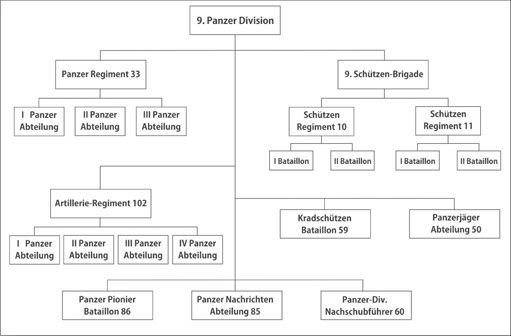
As stated in the “Kriegstagesbuch des OKW“, on July 4 “the 9th Pz. Div. crossed Olym River, turned north and begun an assault on Kastornoye, which is under attack of the 377th Infantry Division from the north.”9 Soviet sources claim that the German manoeuvre was foreseen, so in order to avoid encirclement, the 284th Rifle Division withdrew all its units and supporting artillery during the night of July 4, and took positions in the vicinity of Terbuny.10
Following the pattern established two days prior, on July 5 the 9th Rifle Brigade was converted into the 9th Panzer Grenadiers Brigade (9. Panzergrenadier-Brigade). Subsequent orders of the same day renamed the 10th Rifle Regiment into the 10th Panzer Grenadiers Regiment (Panzergrenadier-Regiment 10 - Pz.Gren.Rgt. 10).
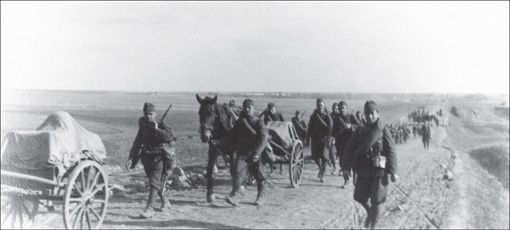
As the railroad lines in the Kursk area were destroyed by partisans, Hungarian units had to disembark in Ukraine, and travel to the front by road, marching some 400 to 500 kilometres.
In the meantime, the Red Army attempted to hold off the German offensive. The Soviet 5th Tank Army launched a counterattack towards Zemlyansk on July 5, to cut the supply lines of the German armoured group, which managed to break through the Don River in the direction of Voronezh. In its next move, the 5th Tank Army was to positioned itself in the rear of the enemy forces, liquidate the Don River crossing and assist the 40th Army in a break out from the pocket around Kastornoye. General M.I. Kazakov, the Bryansk Front’s chief of staff recalls the events as: “Instead of arranging for a concentrated tank attack, carried out simultaneously with even just four or five tank brigades advancing on a 12 to 15 kilometres stretch, the tank corps’ commanders deployed their armour straight from the road columns, launching more or less two spearheading battalions per corps. This kind of tactics, usually applied in a situation where a breach through the enemy lines already existed, resulted in a combat introduction of just a few battalions, while the main forces stood still, taking unnecessary losses from ongoing German aerial assault. But, even this weak attack forced the enemy to redirect two armoured divisions from the XXIV Armoured Corps: the 11th Panzer Division was diverted north in the direction Terbuny, while the 9th Panzer Division was rerouted towards Ozerki via Zemlyansk.”11
The morning of July 6 brought an attack of the armoured brigades from the 7th Tank Corps under Colonel Pavel Rotmistrov. In the vicinity of Krasnaya Polyana, an encounter with 11th Panzer Division took place. As a result, the German troops were halted, and then driven back to 15 kilometres beyond Kobylia Snova River. It is most likely, that on this day the 9th Panzer Division, in one battle, destroyed two Soviet tank brigades12 from the 5th Tank Army. The entry in the “Kriegstagesbuch des OKW” regarding the situation of the 4th Panzer Army between the rivers Don and Olym, made on July 7 seems to support this statement: “..just the 9 Pz. Div. alone, until 2 o’clock in the afternoon yesterday (July 6), destroyed 61 enemy tanks.”13 The 9th Panzer Division captured Zemlyansk on the same day of July 6. On that date, Generaloberst Halder noted a directive given during a briefing at the Führer’s headquarters: “Orders issued to stop the 9th and 11th Panzer Divisions, and make all the motorised units immediately available be led by Tich Sosna following behind the XXXX Army Corps.”14 There is another note regarding a conversation between Halder and Keitel in which a decision was made not to engage the armoured and motorised units in fighting at Voronezh: “All efforts must be made as quickly as possible to dispatch the “Grossdeutschland” and the 24th Panzer Division, right behind the XXXX Army Corps, to be followed by the 9th and 11th Panzer Division.”15

Hungarian infantry were not motorized, thus the units, accompanied by horse drawn wagons, had to walk.

An artillery lieutenant inspecting the front before the “Fall Blau ” operation. On the left, there is a mittlerer Einheits Pkw. Kfz. 17 communication vehicle.
The Soviet 11th Tank Corps under Major General A.F. Popov, supported by the 19th Independent Tank Brigade, arrived on July 7 and immediately engaged the enemy straight from the road march formation. On that day Fahnenjunker Bauer, mentioned before, managed to survive another direct hit from a Russian KV- 1 heavy tank on his Pz.Kpfw. III.16
Generalstabschef Halder commented in his journal on the condition of the 6th Army on July 8: “Enemy tank attacks continue at the northern front. The 9th Pz. Div.was again able to destroy numerous tanks.”17 That same day the 9th Division took Kastornoye. A report dated July 9 states that the 33rd Panzer Regiment had 106 tanks at its disposal.18
July 10 Generaloberst Halder wrote: “Northern sector of “von Weichs” front is under heavy attack. The intended pull out of the 9th and 11th Panzer Division is complicated.”19 During the fierce four-day combat that erupted on July 7, the formations of two Soviet army corps pushed the Germans some 4 to 5 kilometres back, reaching the Sukhaya Vereyka River on July 10. The 2nd Tank Corps under General Major I.G. Lazariev finally entered into combat on that same day. As Generaloberst Halder noted: “Northern combat perimeter of the “von Weichs” units is still under heavy attack of a large tank force. Despite some local break through accomplishments, the attack was stopped.”20 At that point, the Soviet forces were not able to attain any significant success. Lack of coordination during the introduction of the 5th Tank Army units into combat allowed their adversary to deploy reserves and set up reinforced positions along the river, which in itself formed a natural and convenient defence line. As a result, General Liziukov’s forces were halted. The German units, including the 9th Panzer Division, organized powerful resistance supported by anti-tank artillery and minefields in the vicinity of Zemlyansk. These defences could not be penetrated. Furthermore, Russian tank unit thrusts were not aligned with the path of the main offensive, their armour carried out classic wide frontal attacks reminiscent of ordinary infantry formations, with pre-assigned sectors and divisional zones. “Instead of a fist, a hand with outstretched fingers was shoved towards the enemy.”21 Nevertheless, in order to fend off the attack, the Germans had to recall the 9th, the 11th Panzer Division and three infantry divisions from the north, and provide them with sizeable airborne support. In all, the Soviet counter-attack not only delayed the German offensive towards Voronezh, but it also allowed the Bryansk Front units a few days to prepare defences at the new positions.22

An encampment at the operation “Blau” preliminary positions. Behind the tents made of combined Zeltbahn - camouflage tarpaulin, there is a Pz.Kpfw. II light tank.

An artilleryman in Panzerwaffe (Armoured Force) uniform; an Allgemeines-turmabzeichen and a Eisernes Kreuz II klasse (Iron Cross 2nd class) ribbon may be noted

The same artillery officer in tanker’s uniform next to a Pz.Kpfw. II light tank. A fragment of a tactical identifier, “AR0” painted on the turret, most likely indicates the “Artillerie Regiment”. If the above assumption is correct, the tank was used as an “artillery observation tank”, and was assigned to a fire coordination/observer specialist. Between July 23 and 28 1942, the Pz.Kpfw. II tanks obtained more powerful radio transmitters, which allowed them to communicate with artillery units.

A Pz.Kpfw. II Ausf.F light tank from 9th Panzer Division. The “A907” tactical number is displayed. Letter “A” probably indicates either a Headquarters Company or Command Platoon of a Panzer battalion.
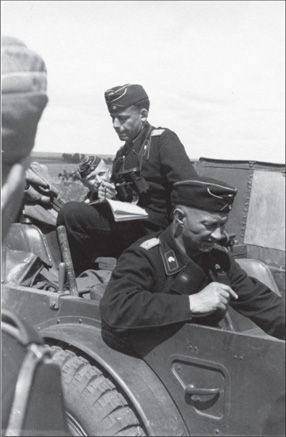
Officers of the 33rd Panzer Regiment’s staff in a crosscountry staff car Horch Kfz. 15. First from the right, Oberst-leutnant Gerhard Willing commander of the III Battalion of the 33rd Panzer Regiment of a Panzer battalion.

The last moments of peace before the attack. Captured in this photograph is an artilleryman wearing a shirt. His Erkennungsmarke (identity disc, also referred to as a dog tag), is worn on the suspenders. Many soldiers of this formation adhered to this particular custom.
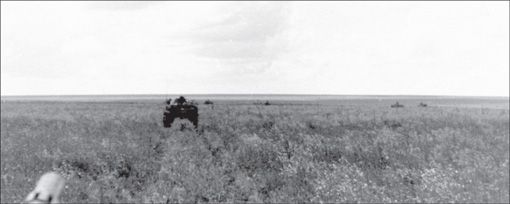
9th Panzer Division tanks are seen here assuming positions in grasslands before an attack. In the background a rear view of Pz.Kpfw. II light tank. The photograph was taken from the turret of another Pz.Kpfw. II - the tip of the 20 mm gun barrel is visible in the foreground.

A meal consumed next to a concealed Pz.Kpfw. II light tank. An improvised sun or rain cover made of the Zeltbahn tarp is noteworthy.
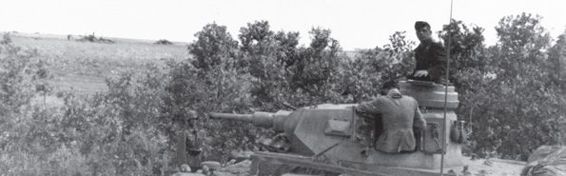
The Panzerbefehlswagen III command tanks had a characteristic frame antenna mounted at the rear . As the enemy became more experienced, this feature allowed for quick identification and successful targeting of the commander’s tanks from long distances. In order to prevent that, the command tanks had to become indistinguishable. Thus, an order was issued to dismantle the antennae. The photograph shows one of the two Pz.Bf.Wg. III Ausf.H tanks in service with the 9th Panzer Division at the time, with the antenna removed. A mock up of the 50 mm (5 cm KwK (L/42)) cannon (dummy gun) may also be noted. This particular tank has the “R01” tactical marking. The letter “R” stands for “Regiment”, and the number indicates the vehicle of Oberst Ewald Kraeber, leader of the Pz.Rgt. 33.
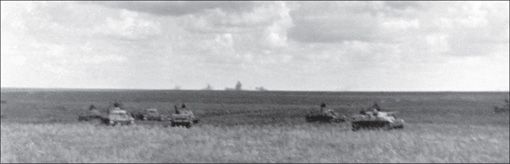
The 9th Panzer Division’s tanks unfold to assume an attack formation.

Divisional vehicles on the Russian steppe. In the foreground a semi tracked armoured Sd.Kfz. 250 transporter.
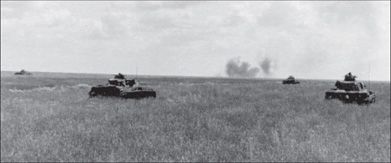
Three Pz.Kpfw., probably Ausf. J or Ausf. L, dispersed in the steppes during Divisional operations.

Combat in the steppe. Well aimed shots set the Soviet tanks on fire.

As the German armoured units were expected to advance, the Soviets tried to position their tanks behind natural obstacles or in manmade trenches, in such a way that only the turrets were exposed towards the approaching enemy. When the German tanks neared, they were subjected to a close range fire. The photograph portrays an entrenched Soviet T-34 tank overwhelmed by the German onslaught.

Another Soviet T-34 tank destroyed in its concealed position.
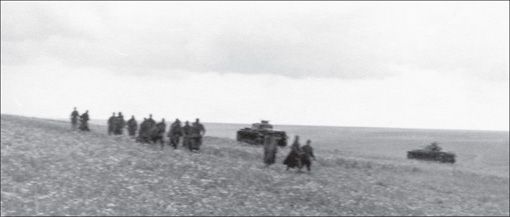
A group of Soviet prisoners of war. In the background, two German Pz.Kpfw. III tanks.

Capsized wreck of Soviet BA-20 armoured car. German tanks are visible in the background.

Staff briefing somewhere in the vast Russian grasslands. In front of the Pz.Bf.Wg.III Ausf.H, there is a motorcycle messenger. Pictured in the rear, a Pz.Kpfw. II light tank used by an artillery coordination officer.

Two 9th Panzer Division troopers. One on the left is distinguished by the Panzerkampfabzeichen (Panzer Assault Badge), one on the right has the same decoration as well as the Eisernes Kreuz I klasse (Iron Cross 1st class).

Three soldiers photographed in a conversation during a combat interval. Two of them were awarded the Eisernes Kreuz I klasse.
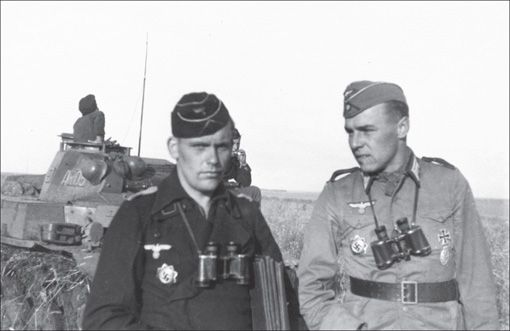
Two recipients of the Deutsches Kreuz in Gold (German Cross in Gold) - a tanker and a lieutenant from the Panzer Grenadier Regiment posed in front of a Pz.Kpfw. II artillery observation tank. The lettering painted on the turret - “AR05” - leads to a belief that this tank was assigned to an “Artillerie Regiment”.

Another trio of the 9th Panzer Division soldiers looking at a burning Russian truck with an 76 mm anti-tank ZIS-3 cannon.
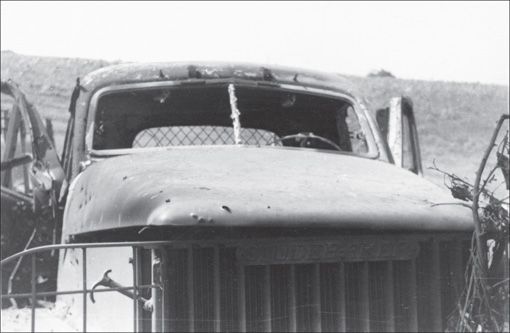
A burned out shell of an American made Studebaker US-6 truck delivered to the Red Army under the Lend-Lease. Manufacturer’s mark is visible.

A destroyed Red Army Valentine MK III tank produced in Great Britain or Canada. The vehicle had tactical number “028”.
As Operation “Fall Blau” was finished, the 9th Division prepared a report regarding the German and Soviet armoured units’ tactics. It stated that in the first phase of the campaign lasting from June 28 to July 13, the cooperation between armoured troops and artillery hardly existed due to the lack of radio communications. The report indicated: “Following installation of a suitable radio in the Pz.Kpfw. II, cooperation with the artillery significantly improved during the period from 23 to 28 July. Supplying the artillery with Pz.Kpfw. II for observation should still be viewed as a makeshift solution.”23
Generalstabschef Halder wrote on July 14 : “Between Voronezh and our previous positions a weak enemy attacks were carried out, they were defeated by a 9th and 11th Pz. Div. strike between Don and Olym Rivers.”24 While the fighting on July 14 may have subsided, the overall intensity of the fighting may be illustrated by the fact that the same afternoon a report was sent alerting that the 33rd Panzer Regiment had only 55 operational tanks left.25
On July 15, Generaloberst Halder wrote: “The front northwest of Voronezh was attacked only by enemy units the size of a regiment or a battalion, but they were repelled.”26
The 9th Division’s tanks declared as a total loss by that date were: two Pz.Kpfw. II, nine Pz.Kpfw. III (short barrel), 19 Pz.Kpfw. III (long barrel), five Pz.Kpfw. IV (short barrel) and four Pz.Kpfw. IV (long barrel)27, a total of 39 combat vehicles. On July 18, it was reported that the number of tanks in the 33rd Panzer Regiment rose to 94,28 which was most likely an accomplishment by service technicians who managed to repair some damaged vehicles.
Generaloberst Halder noted on July 21 : “Northwest of Voronezh stronger enemy action, with breakthroughs reported as wide as 10 kilometres, and as deep a 3 kilometres beyond our lines.”29
The next day Generalstabschef OKH continued: “Northwest of Voronezh at the place of yesterday’s breakthrough, renewed strong attacks continue.”30 Until July 23, the 9th Panzer Division continued defensive efforts on the flank of the Army Group “von Weichs” against Red Army troops attacking from the north, in the region of Bolshaya Vereyka. That day’s entry in Generaloberst Halder’s notebook states: “Northwest of Voronezh heavy fighting against massive enemy attack. Wide enemy breakthrough. The 9th Pz. Div. counterattacks.”31
An entry in the “Kriegstagesbuch des Oberkommando der Wehrmacht“dated July 24 informs of the Army Group “B” situation: “Counter attack eliminated the breakthrough. The units of the 9th Pz. Div. are engaging the enemy”32 Generaloberst Halder’s account of the day states: “Voronezh and the “dry front”33: heavy fighting, with many enemy tanks destroyed and very successful defence.” 34 The number of tanks at the disposal of the 9th Panzer Division on that day was 96.35

Motorcyclists from the Kradschützen-Bataillon 59 riding through the grasslands.
In the journal of Generalstabschef Halder under July 25 it is noted: “Near Cymlansk36 ( should read Zemlyansk ) fierce attacks against a seemingly even more determined enemy”.37 The next day’s entry follows: “Near Cymlansk (should read Zemlyansk) successful counter attack of the 9th Panzer Division restores the previous positions. Heavy losses sustained! Further enemy attacks should be anticipated.”38 During the fighting Generalleutnant J. Baessler, commander of the 9th Panzer Division, was wounded on July 27, his post was temporarily taken over by Oberst Heinrich-Hermann von Hülsen. On July 30, Generalleutnant Walter Scheller reported for duty as the 9th Panzer Division’s commanding officer at the new headquarters of the Army High Command at Vinnytsia.39 A report dated July 31 stated that the 33rd Panzer Regiment had 113 operational tanks.40
This was the day that the previously mentioned report on the German and Soviet armoured units’ tactics, based on the combat experiences of the 33rd Panzer Regiment, was published. It indicated that: “In contrast to the tactics used in the previous campaign, in this campaign the regiment was usually employed as a single unit and thereby could achieve larger successes than when individual companies were employed, each having its own assignment. At least one battalion has to be sent on detached assignments. Detachment of a single company must remain an exception. Concentrated employment of all Panzers should always be strived for.”41
The safety of the command tanks also received some attention: “Removing the frame antenna from the Pz.Bef.Wg. was beneficial. From a distance the Pz.Bef.Wg. is hardly discernible from a gun-armed Panzer.”42 The Soviet defensive tank tactics were also analysed in the report. It was said that the Russians place their tanks in man-made ditches or behind natural obstacles, in such a way that only the turrets are exposed. “When they identified the main body of German Panzers attacking or advancing, they took up hull-down positions and let the German Panzers come on.”43
On August 3, the sixteenth 9th Panzer Division trooper was awarded the Knight’s Iron Cross. It was Feldwebel Alois Eckert from the 9th Company of the 33rd Panzer Regiment.44 The 9th Division was guarding the flank of the Army Group “B” (von Weichs) up until August 4.

A Hungarian unit, probably the 150thBattalion of pioneers advancing towards Don River. Bridge pontoons or assault boats are transported by means of horse traction, the 150th Battalion had two companies equipped in such a way.
9 Percy E. Schramm, op. cit., Teilband 1, p. 474.
10 Kołomyjec M., Smirnow A., op. cit., p. 36.
11 Kołomyjec M., Smirnow A., op. cit., p. 41.
12 Glantz D. M., House J. M., When Titans clashed, Kansas 1995, p. 119.
13 Schramm P. E., op. cit., Teilband 1, p. 482.
14 Halder F., op. cit., v. III, p. 574.
15 Halder F., op. cit., v. III, p. 575.
16 http://www.stengerhistorica.com/History/WarArchive/Ritterkreuztraeger/Bauer.htm clash, http://www.ritter-kreuztraeger-1939-45.de/Infanterie/B/Bauer-Ludwig.htm
17 Percy E. Schramm, op. cit., Teilband 1, p. 484-485.
18 Jentz T L, Die deutsche …Band I, op. cit., p. 241.
19 Halder F., op. cit., v. III, p. 578.
20 Halder F., op. cit., v. III, p. 579.
21 Bieszanow W, Poligon czerwonych generałów, Gdańsk-Warszawa 2009, p. 212-213.
22 Ibidem.
23 Jentz T. L, Die deutsche…Band I, op. cit, p. 243.
24 Halder F., op. cit, v. III, p. 582.
25 Jentz T. L, Die deutsche....Band I, op. cit., p. 241.
26 Halder F., op. cit, v. III, p. 583.
27 Jentz T. L, Die deutsche...Band I, op. cit., p. 241.
28 Ibidem.
29 Halder F., op. cit, v. III, p. 589.
30 Halder F., op. cit, v. III, p. 590.
31 Ibidem.
32 Schramm P. E., op. cit, Teilband 1, p. 523.
33 A stretch of front on the left flank of HG„B”, bowed away from Don River, without any water obstacles. Halder F, op. cit., v. III, p. 586.
34 Halder F., op. cit., v. III, p. 592.
35 Jentz T. L., Die deutsche...Band I, op. cit., p. 241.
36 It is most likely that gen. Halder is mistaken as to the township’s name transliteration. Cymlansk lays few hundred kilometres southeast near Volgodonsk in the Rostov - on -Don region, but it is unlikely that the 9.Pz. Div. was transferred to that area.
37 Halder F, op. cit., v. III, p. 593.
38 Ibidem.
39 Halder F., op. cit., v. III, p. 597.
40 Jentz T. L., Die deutsche....Band I, op. cit., p. 241.
41 Ibidem.
42 Jentz T. L., Die deutsche...Band I, op. cit., p. 243.
43 Ibidem.
44 Hermann C. H., op. cit., p. 172.