
3
The U.S. flag had hardly reached the top of surrendered Vicksburg’s flagpole on July 4 or the smoke from the saluting guns on all the warships dissipated when RAdm. Porter ordered the brown water ball to be reopened. The first event on the dance card was the elimination, once and for all, of the tiny, but pesky Confederate naval presence at Yazoo City, Mississippi, 52 miles above the great Southern fortress. Led by bearded veteran Cmdr. Isaac Newton Brown, CSN, it had plagued the Mississippi Squadron for a year, helping to block Federal northern access to Vicksburg more than once.

Cmdr. Isaac Newton Brown, CSN. This former USN lieutenant won Civil War immortality in 1862 as captain of the Confederate ironclad Arkansas. An expert in underwater warfare, he helped to defend the Yazoo River using “torpedoes” to sink two of the Union’s “City Series” gunboats, the Cairo and the Baron de Kalb (Naval History and Heritage Command).
An expert on the basics of underwater mines, then known as “torpedoes,” the dogged Brown, a native of nearby Granada, Mississippi, gained his greatest claim to fame in July 1862 when he commanded the ironclad Arkansas in her battles with the Union fleet above Vicksburg.1 Taking his surviving crew to build vessels at Yazoo City, the former USN lieutenant was also active in the Rebel defense of the Yazoo River. After overseeing the work of the men who sank the USS Cairo with torpedoes at year’s end and in the spring of 1863 defense of both Fort Pemberton and Steele’s Bayou, his spirits were greatly lifted by newcomers in April. Two Mobile, Alabama–based agents of the Singer Secret Service Corps, Dr. John R. Fretwell and Horace L. Hunley (later, the famed submarine hero), had arrived to provide help with their advanced torpedoes. Still, and despite every best effort, they could not prevent a Northern expedition from destroying the Yazoo City boatyard in May.2
For sure, Cmdr. Brown’s shipbuilding activities were ended at Yazoo City, but his defensive activities there were not. Upon his return from a temporary withdrawal, he found all the town buildings largely intact, save for his military areas, and, more importantly, Fretwell and Hunley were hard at work manufacturing “infernal devices” at a hidden location. All during June and into July, Maj. Gen. Grant and RAdm. Porter concentrated on the siege of Vicksburg, while Confederate Gen. Joseph E. Johnston, CSA, gathered a force to either relieve Vicksburg or make certain the enemy did not move north toward Tennessee.
The Union preoccupation with Vicksburg allowed Brown, at Johnston’s direction, to upgrade defensives. Troops from the 29th North Carolina Infantry were detailed to the town to reinforce the sailors, building redoubts and rifle pits and placing four Napoleon field pieces. Meanwhile, six heavy guns obtained from Fort Pemberton were mounted by the commander’s men on the riverfront east of the charred shipyard. Conscripted African American laborers slaved over all these preparations.
In response to heavy pressure from the Confederate government in Richmond, Virginia, Gen. Johnston, on July 1, ordered his Army of Relief to quit Jackson, Mississippi, and advance toward Vicksburg. Two days later, sensing victory, Maj. Gen. Grant ordered Maj. Gen. William T. Sherman to “make your calculations to attack Johnston; destroy the railroad north of Jackson.” It was now too late for a Southern rescue. The big river fortress surrendered on July 4. The same day Gen. Robert E. Lee’s Army of Northern Virginia retreated toward Virginia following its historic defeat at Gettysburg and soldiers from the Confederate Department of Arkansas were, with help from the USN timberclad Tyler, repulsed after an attack on Helena, Arkansas.
Although probably ignorant of the Pennsylvania victory at the time, Maj. Gen Sherman echoed the sentiments of most Northerners when he exclaimed, “Glory hallelujah!” and proclaimed this “the best Fourth of July since 1776!” Learning of the local disaster, Johnston’s Army of Relief immediately headed back to the Magnolia State capital. Sherman began a pursuit with 50,000 men the next day, proceeding in three prongs over a broad front in the heat and dust, overrunning little towns like Bolton along the route.3
Port Hudson surrendered on July 9 just as Union troops reached Jackson, where Johnston’s returned and tired men were at work strengthening the town’s weak fortifications. To the north, Cmdr. Brown and his colleagues had nearly completed their revitalization of Yazoo City’s shield, and posted pickets in warning along the four incoming roads. When Grant learned on July 11 that Johnston had ordered the fortification of the Yazoo community in addition to Jackson, he wondered to RAdm. Porter in writing: “Will it not be well to send up a fleet of gunboats and some troops to nip in the bud any attempt to concentrate a force there?”
The sea dog was indeed agreeable, suggesting that troops under Maj. Gen. Francis J. Herron that were assigned to visit just-surrendered Port Hudson could instead be rerouted to Yazoo City. Grant cut orders to his subordinate changing his destination, informing him that Johnston was strengthening the town’s defenses and “this we must not permit.” Porter instructed Lt. Cmdr. John G. Walker, who had led the May raid, to provide support with his small task group.

Maj. Gen. Francis Herron. A prewar Iowa banker, Herron led the Federal expedition to Yazoo City, Mississippi, in July 1863 during which the ironclad Baron de Kalb was sunk by a Confederate “torpedo.” In May–June 1865, soldiers and gunboats under his command would reoccupy important Red River communities, securing surrender of the last Southern ironclad, the CSS Missouri (Library of Congress).
While the Federals prepared, Cmdr. Brown at Yazoo City took delivery of the new model torpedoes that Fretwell, Hunley, and their associates had been able to assemble. “The time had come,” notes Mark K. Ragan, “to prove the worth of their deadly invention.” Assisted by his gunners and possibly others, Brown and the torpedomen sewed a field with these advanced “infernal machines” at the bottom of the mud-colored river just south of town. The area, not far from the ruined shipyard, became known in the years after postwar river improvements as Yazoo Lake.
The key, as Brown and Fretwell knew, was location, location, location. According to the Chicago Daily Tribune of July 21, the men not only sewed the new type of mines, but some of the old wire-equipped demi-john models as well. It was later suggested that other local inventors placed at least one “contact mine” in these waters as well.4

A Fretwell torpedo. Singer Secret Service Corps agents Dr. John R. Fretwell and Horace L. Hunley (later, the famed submarine hero) arrived at Yazoo City, Mississippi, in April 1863 to assist Cmdr. Isaac Newton Brown, CSN, defend the town employing their advanced torpedoes. Over the next three months, this group with their assistants would lay a minefield which would cost the advancing Federals an ironclad gunboat (Naval History and Heritage Command).
While Sherman’s force besieged Johnston in Jackson, Maj. Gen. Herron departed up the Yazoo from Vicksburg on July 12 with 5,000 bluecoats in seven transports. The force under Lt. Cmdr. Walker was covered by the ironclad Baron de Kalb, sister of the sunken Cairo, and two tinclads, the Kenwood and Signal. By evening, the group reached a point 12 miles below Yazoo City, where it was spotted by pickets. Alerted, the town’s defenders made ready and, just after dawn on July 13, Cmdr. Brown, by his own testimony, personally placed the last two Fretwells in the Yazoo about half a mile below his battery.
With the weather cloudy and threatening rain, the Northern transports eased into the eastern bank below Brown’s cannon at 11 a.m. to disembark their regiments. Around 12:30 p.m., the Kenwood moved up to anchor ahead of the Signal, herself moored below the flagboat Baron de Kalb. While the infantry formed into line of battle, the gunboats prepared to test the Rebels’ unmasked battery.
Just before 2 p.m., the three Union gunboats cast off and, about 20 minutes later, the Baron de Kalb came up within range of Cmdr. Brown’s gunners, who opened fire. Walker promptly returned the compliment. Watching from his command transport, Maj. Gen. Herron observed that “owing to the river being so narrow and crooked, he [Walker] was able to bring but one or two of his guns to bear on their works.” The ironclad was supported by the Kenwood, which also opened upon Brown’s 40 available Arkansas veterans. The smoky loud duel continued until about 3:40 p.m. and could be heard for miles.
We do not know how many rounds were expended by the two sides. Capt. Charles Barney of the 20th Iowa remembers the Baron de Kalb getting off 30 rounds, and there is a logbook entry showing that the Kenwood fired off eleven shells. There is also no information on whether the boats suffered any casualties; there were, according to the battery commander, none among the Southerners. “Having ascertained the force of the enemy,” Walker later reported, “I dropped out of fire.” Cmdr. Brown later indicated that the Northern boats “were driven back out of sight without loss on our side.”
With Brown’s battery the only significant remaining point of opposition, the bluecoats bore down upon the Southern works by 5 p.m., forcing the leader of the 29th North Carolina to evacuate his soldiers from the town. The naval commander now faced encirclement. “I had,” he later confessed, “either to withdraw or suffer the capture or destruction of my men.” Curious about the potential effectiveness of the seventeen Fretwell torpedoes he had planted, the CSN commander expected the Federal warships to return shortly and so, perhaps with Fretwell and Hunley as company, briefly delayed withdrawing to watch for their next approach. Even though the river had risen in the past day or so, maybe the ironclad or one of the heavier transports could trigger the invisible underwater mines. If not, perhaps one of the older demi-john units would claim a victim.
By 7 p.m., most of the Southerners who were going to get away had escaped and Union troops occupied the battery, military works, and riverfront. With the commanding general embarked, the Baron de Kalb started in toward Yazoo City leading the Kenwood, Signal, and the transports. As on the initial approach earlier, lookouts were posted to watch for wires and buoys, the telltale signs of torpedoes. Deserters or African American refugees warned of mine fields, but, even though the Signal, according to a Chicago reporter, now spotted and picked up a demi-john model, no groupings were reported. It was not suspected, as RAdm. Porter later put it, that they would encounter one of their enemy’s “new inventions.”
Steaming in 15–20 feet of water, the Baron de Kalb approached the ruined Confederate Navy yard about 7:30 p.m., coming within a half mile of Brown’s battery. At that point, her unknowing helmsman ran the warship against an anchored and unseen Fretwell. In the explosion that followed, nearly two feet of the port bow was torn off and the vessel began to sink. As she was going down, a second Fretwell blew up under her stern.
It proved impossible to beach the rapidly filling ironclad and the Kenwood went alongside to take off the crew, several of whom were injured. At 9 p.m., as she backed away, a Fretwell exploded close to her port bow, but caused no damage. Around 11:30 p.m., the Signal moved alongside the wreck and began, by torchlight, to remove her great guns, small arms, and stores.
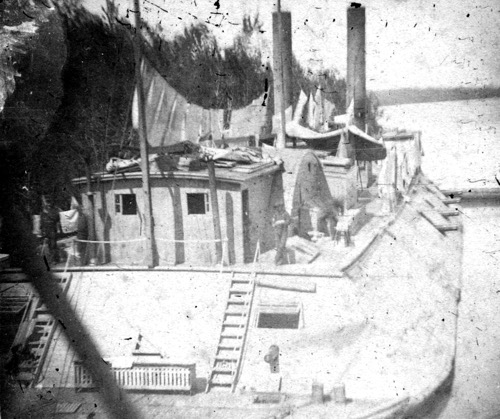
USS Baron de Kalb. One of the original “City Series” ironclads, this vessel was first christened St. Louis, being rebranded Baron de Kalb in October 1862. Active in numerous Mississippi campaigns from Forts Henry/Donelson to Vicksburg, she became a victim of a Confederate torpedo at Yazoo City, Mississippi, on July 13, 1863, sinking in 15 minutes without death or major injury to any crew member (Wilson’s Creek National Battlefield).
Unable to remain longer, Cmdr. Brown did not actually witness the river explosions or the sinking of Walker’s flagboat. Despite his son’s later assertion, a reading of the officer’s official reports and Battles and Leaders comments makes this clear. “We were the last to leave Yazoo City,” he noted a week later, “and the enemy entered it soon after we marched out.” After his contingent withdrew (to Mobile, Alabama), the tiny CSN presence remaining on the Western waters was centered at Shreveport, Louisiana, where the ironclad CSS Missouri neared completion.
With the coming of daylight on July 14, an extremely successful week-long salvage effort began on the Baron de Kalb. Everyone and nearly anything of value was recovered. Plans were later announced to raise the hull, but the wreckage remained in place. It could be seen at low water up into the 1950s. Gen. Johnston evacuated Jackson on July 16 and moved to middle Alabama while the Walker-Herron group returned to Vicksburg on July 22. As the solons of Yazoo City had not warned the fleet of the torpedo field, a sufficient amount of cotton and horses were seized to cover the estimated $500,000 price of the gunboat “that was lost,” according to Porter, “through their treachery.”5
While Cmdr. Brown and the remaining Confederates sailors at Yazoo City made their last stand, another raid was unfolding many miles to the north. Confederate Brig. Gen. John Hunt Morgan, without official approval, had begun a diversion designed to stall an anticipated move to Chattanooga by Maj. Gen. William S. Rosecrans and another, aimed at Knoxville and East Tennessee, by Maj. Gen. Ambrose Burnside. Leading 1,800 cavalry, he crossed the Ohio River at Brandenburg, Kentucky (38 miles below Louisville), on July 8, and with Union forces in dogged pursuit, was riding across the southern counties of Indiana and Ohio, toward a planned return to Dixie through Virginia.

Brig. Gen. John Hunt Morgan, CSA. Perhaps the South’s most famous Western cavalryman when he began his 1,000-mile raid into Indiana and Ohio in July 1863, Morgan was hotly pursued by Union troops and was captured when Mississippi Squadron light draught gunboats prevented his return to Dixie. Having escaped captivity, he was killed at Greeneville, Tennessee, on September 4, 1864, while in command of the Department of Southwest Virginia (Library of Congress).
News of the daring Rebel strike quickly reached the Cincinnati headquarters of both Burnside and Lt. Cmdr. Le Roy Fitch. The commander of the Mississippi Squadron’s Eighth District sprang into action, quickly putting together a blockade strategy that eventually led to the successful containment of the Rebel raiders. Morgan, meanwhile, had skirted Cincinnati, and was headed toward Portland on the river in southeastern Ohio. Years later in his The Naval History of the Civil War, Adm. Porter offered his thoughts on the Morgan chase. “It was a novel sight,” he wrote, “a flotilla of gunboats (very ‘gallinippers’) in pursuit of a land force. It was in every respect a new feature of the war.”6
As they approached the Ohio River on July 15 and the planned reentry into Dixie somewhere closer to Pomeroy, the Confederate raiders were overconfident. Although they knew that Union troops were in hot pursuit, no new locational intelligence was obtained. Morgan continued to believe what he had been told when his gambit began: the Ohio would be too shallow for gunboats. Besides, if any showed up, they would be at a terrible disadvantage when matched against his Parrotts.
Lt. Cmdr. Fitch had no firsthand information on the positions of either Morgan or his Federal pursuers. With five tinclads and an auxiliary ersatz gunboat, the Allegheny Belle, available, he pressed the chase. “This might have been considered an extravagant use of boats,” he later wrote, “but the river was so low and fords so numerous that a less number might not have met with such a favorable result.” Union defenders, mounted and afloat, correctly divined that Morgan’s goal was Buffington Island and began to draw closed a growing net being cast around the invading Southerners. Increasing their own pace, pursuing Yankee riders followed the Confederate horsemen relentlessly.
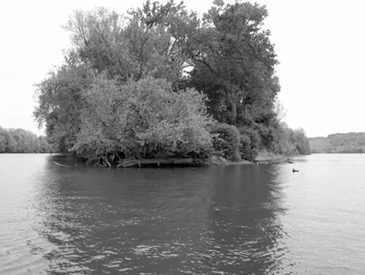
Buffington Island in 2010. About 1/4 mile at its widest point by 1.2 miles long, oval-shaped Buffington Island has survived both nature and the Civil War and today is still located close to the Ohio shore between the communities of Sherman, West Virginia, and Portland, Ohio. Located 43 miles below Parkersburg and 35 below Marietta, the island is owned by the Mountaineer State (U.S. Dept. of the Interior, Fish & Wildlife Service).
About one-quarter mile at its widest point by 1.2 miles long, oval-shaped Buffington Island has survived both nature and the Civil War and today is still located close to the Ohio shore opposite the mouth of Little Sandy Creek, between the communities of Sherman, West Virginia, and Portland, Ohio. Located 43 miles below Parkersburg and 35 below Marietta, the island served as a station on the Underground Railroad prior to the conflict.7
Building largely upon his own information and planning, Lt. Cmdr. Fitch made his final strategic deployment, establishing a blockade some 40 miles in length around Pomeroy. Steaming north against the increasing current of a fortuitous rise, his six warships were “distributed” at those transit locations which might prove most inviting to the raiders. In all, four major and a number of minor fords were patrolled, with Fitch’s flagboat, the Moose, in company with the Allegheny Belle and the dispatch steamer Imperial, furthest upstream.

Lt. Cmdr. Le Roy Fitch, USN. Chosen to command an Upper River “Mosquito Flotilla” in August 1862, the Hoosier spent the war thereafter shepherding convoys and engaging Confederates, including generals Morgan, Joseph Wheeler, and Nathan Bedford Forrest, on the Ohio, Cumberland, and Tennessee Rivers. He would father birth of the Upper Tennessee Eleventh naval district and command the Union gunboat contingent at the Battle of Nashville in December 1864 (Naval History and Heritage Command).
On the evening of July 18, a few hours before the hotly pursued Confederates reached the crest of the nearby shore, the Moose, towed up by the Imperial, anchored off Little Sandy Creek Bar, below Buffington Island on the West Virginia shore. Here they were sighted by Rebel outriders sometime later. Unwilling to ford his command, including his wounded in horse-drawn ambulances and wagons, in the dark, Brig. Gen. Morgan found himself entirely surrounded about six in the morning of the nineteenth and outnumbered nearly four to one. He had only two choices: fight or surrender. In addition to the Moose and Allegheny Belle, advance elements of the Federal land forces were closing in from Ohio’s interior. The Battle of Buffington Island ensued when Morgan, refusing to quit, fired on them.
When battle noise was heard ahead off the port bow about 7 a.m., the Moose, having kept up steam all night, rapidly got underway into the chute between the island and the state of Ohio. Taking aboard a stranded Union officer, Lt. Cmdr. Fitch received his first indication of what was going on ashore, as well as the relative positions of the opposing forces. About the same time, his gunners opened fire on butternut soldiers headed across, turning them around. Back from the river, fighting intensified when bluecoat soldiers, mainly cavalry, joined the attack, rushing onto the plateau between the river and the high ridges which rise a mile inland. By 9 a.m., Northern units, with a big numerical advantage, were pummeling the Confederate defensive line.

Map of Morgan’s Raid. This famous Southern incursion into the North was an utter failure. It collapsed when Federal troops and Union gunboats cornered the retreating Confederates at Buffington Island, preventing their escape across the Ohio River to West Virginia (Battles and Leaders of the Civil War, v. 3).
The Southerners were not the only ones discomforted that morning. Without gunfire spotters and unable to see what was occurring so as to direct his green gunners, Lt. Cmdr. Fitch was never quite sure where his own 24-pounder shells were landing. Both Yankee and Rebel soldiers were affected, causing one newspaperman to record that “an extensive scattering took place.” Confederate Col. Basil W. Duke cursed what he believed was more than one tinclad and “heartily wished that their fierce ardor, the result of a feeling of perfect security, could have been subjected to the test of two or three shots through their hulls.”8
Overwhelmed by Union cavalry charges and subjected to bombardment by the Moose, the contest now went against Morgan’s troopers, many of whom attempted to flee across the river at a point about a mile and a half above the head of Buffington Island. Watching the exodus, Col. Duke despaired. “A shell struck the road throwing up a cloud of dust,” he remembered. His men panicked as the “gunboats raked the road with grapeshot.” Union Lt. Henry Weaver observed: “The thundering tones of those monsters, together with the terrifying shriek of the shells as they came over the heads of the enemy, completed the rout already begun.” A large number of Confederate soldiers tried to make it across the “swift waters rippling over the sand shallows of Buffington Bar and plunged into the angry and power currents of the flooded Ohio River.” All but about 30 escaped the wrath of the Moose in the confusion, the rest thrown into backwards rout.
Many butternuts headed for the woods; “the hiss of the dreaded missiles,” Duke recalled, “increased the panic.” After what seemed like hours of fighting but really was not, he, together with Morgan’s brothers Richard and Charlton, and about 700 from the weary rearguard gang of “horse-thieves, cut-throats, and nondescripts,” were POWs by noon. A number of men were captured on the West Virginia side of the river. Another 57 Rebels were killed in the fighting, with 63 wounded; three Union officers and 18 enlisted men paid the ultimate price, with an unknown number hurt. During her part of the action, the Moose expended 29 HE shells, 10 shrapnel, one cannister, and 100 rounds of small arms cartridges.
The Battle of Buffington Island, which some still wrongly regard as a “naval battle,” was, however, nothing less than a disaster for the outnumbered Confederate raiders. Still, a naval “mop-up” was required as Morgan and his remaining effectives retreated eastward, seeking to cross the Ohio River. Only about 300 graycoats made it, while the remainder rode or walked inland, dogged by Union cavalry. Morgan and his few followers surrendered near East Liverpool, Ohio, on July 26.
The importance of this Confederate foray north was portrayed differently in various locales and in succeeding years. Following upon the disasters at Gettysburg and Vicksburg, the “bold raid” was portrayed in the July 16 issue of the Richmond Enquirer as “the only actively aggressive operation in which our forces are engaged.” According to Morgan’s adjutant, S. P. Cunningham, the Southern riders wounded 600 Federal soldiers, paroled another 6,000, destroyed 34 vital bridges and 60 different stretches of railroad tracks, burned army depots and military and civilian warehouses, and tied down over 120,000 militia in Indiana and Ohio. The estimated value of the burned bridges, destroyed railroad equipment, telegraph wires, and military stores was placed at $10 million. On July 28, the Chicago Daily Tribune told its readers that the raid had cost the Confederacy over 4,000 men and horses, but had released for other duties over five times that many Federal troops, not counting Hoosier and Buckeye minutemen. Ohio historian Andrew R. L. Cayton dismisses the Morgan episode as doing “little serious damage beyond frightening people.” Famed naval historian Bern Anderson was more blunt: “Except for the alarm and consternation it caused, his raid was pointless.”9
1. The combat career of the Arkansas was just 28 days. Brown was able to locate the survivors of his crew and lead them back to the small naval station at Jackson, MS, before most of them traveled to Yazoo City, where their ironclad had been completed at a local shipyard. Promoted to the rank of commander for his leadership, Brown was subsequently honored by the Confederate Congress. The commander’s only full-length biography remains Charles M. Getchell, Jr.’s, “Defender of Inland Waters: The Military Career of Isaac Newton Brown, Commander, Confederate States Navy, 1861–1865” (master’s thesis, University of Mississippi, 1978).
2. The literature documenting this section is large. Most of the operational details were, of course, taken from the nautical reporting in the first nine chapters of my The Fight for the Yazoo, August 1862–July 1864 (Jefferson, NC: McFarland and Co., Inc., 2012). Other works of importance or use include the several parts of Vol. 24 of U.S. War Department, The War of the Rebellion: A Compilation of the Official Records of the Union and Confederate Armies (128 vols.; Washington, D.C.: GPO, 1880–1901; cited hereafter as OR, followed by the series number, volume number, part number, if any, and page[s]); Vol. 24 of U.S. Navy Department, Official Records of the Union and Confederate Navies in the War of the Rebellion (31 vols.; Washington, D.C.: GPO, 1894–1922 (cited hereafter as ORN, followed by the series number, volume number, part title, if any, and page[s]); Michael B. Ballard, Vicksburg: The Campaign that Opened the Mississippi (Chapel Hill: University of North Carolina Press, 2004), 207–208; William N. Still, “Confederate Shipbuilding in Mississippi.” The Journal of Mississippi History, XXX (Fall 1968), 302–303; Edwin C. Bearss, Hardluck Ironclad: The Sinking and Salvage of the Cairo (Baton Rouge: Louisiana State University Press, 1966); Isaac Newton Brown, “Confederate Torpedoes in the Yazoo,” in Battles and Leaders of the Civil War, ed. Robert V. Johnson and Clarence C. Buel (4 vols.; New York: The Century Company, 1884–1887; reprint, New York: Thomas Yoseloff, 1956), III, 580; John C. Wideman, The Sinking of the USS Cairo (Jackson: University Press of Mississippi, 1993); Harry Owens, Steamboats and the Cotton Economy: River Trade in the Yazoo-Mississippi Delta (Jackson: University Press of Mississippi, 1990); and Yazoo Herald, “The Civil War Comes to Yazoo: Civil War History in Yazoo County, Mississippi, 1862–1864,” Visit Yazoo, http:// http://visityazoo.org/wp-content/uploads/2017/02/Civil-War-in-Yazoo-2015-Update-with-Extras-2.pdf (accessed February 15, 2019); Mark K. Ragan, Submarine Warfare in the Civil War (Cambridge, MA: Da Capo Press, 2002), 111; Ragan, Confederate Saboteurs: Building the Hunley and Other Secret Weapons of the Civil War (College Station: Texas A&M University Press, 2015), 31, 40–42; Ragan, “Singer’s Secret Service Corps,” Civil War Times Illustrated, XLVI (November–December 2007), 30–33; Gabriel J. Rains and Peter S. Michie, Confederate Torpedoes: Two Illustrated 19th Century Works with New Appendices and Photographs, edited by Herbert M. Schiller (Jefferson, NC: McFarland & Co., Inc., 2011), 140, 146; Rodney Carlisle, Civil War and Reconstruction (New York: Infobase Publishing/Facts on File, 2008), 179. Cmdr. Brown did not, as asserted by his son, personally build or witness the success of the torpedoes that sank Cairo and Baron de Kalb. H. D. Brown, “The First Torpedo and What It Did,” Confederate Veteran, XVIII (January 1910), 169. It should also be noted that Prof. Wideman’s volume stands as the most extensive work on Confederate torpedoes employed in the Yazoo and offers far more detail on the mechanisms and the men who deployed them than we can offer here.
3. OR, I, 24, 1: 94, 194, 224–228, 244; OR, I, 24, 2: 155, 214, 436–442, 668; OR, I, 24, 3: 368–369, 373–375, 379, 384, 386–387, 390–392, 396, 405–406, 946–948, 951, 953, 955–956, 978; OR, I, 52, 2: 492,494; ORN, I, 25: 57–58, 117; Philadelphia Press, June 17, 1863; The New York Times, July 9, 1863; Gene Edward Smith, Grant (New York: Simon and Schuster, 2001), 231–232; William T. Sherman, Sherman’s Civil War: Selected Correspondence of William T. Sherman, 1860–1865, edited by Brooks D. Simpson and Jean V. Berlin (Chapel Hill: University of North Carolina Press, 1999), 479; Owens, Steamboats and the Cotton Economy, 64–65; Louis H. Manarin and Weymouth T. Jordan, “29th North Carolina Infantry Regiment,” in Vol. 8 of North Carolina Troops, 1861–1865: A Roster (Raleigh: Office of Archives and History, 1981), 232–235; Ballard, Vicksburg, 388, 390–392; Stephen Chicoine, The Confederates of Chappell Hill, Texas: Prosperity, Civil War, and Decline (Jefferson, NC: McFarland & Co., Inc., 2005), 90; Brown, “Confederate Torpedoes in the Yazoo,” 580.
4. It was local historians who provided the credits for those who invented or placed a “homemade torpedo.” Included among the acknowledgments of Judge Robert Bowman plus Harriett Decell and Jo Anne Prichard were Col. J. J. B. White, owner of the “Tokeba” plantation a short distance above town, another plantation owner, Dr. A. W. Washburn, better known as inventor and distributor of a mechanical seed planter, both cited by Bowman in 1903 along with Peter Goosey, a soldier in Company E (“Yazoo Greys”) of the 30th Mississippi, and his son, Capron Goosey, then too young to enlist, who were mentioned in the 1970s. The Goosey family operated a mill named for them back of Goosey’s Landing, about four miles below town. It was later asserted that White and the Gooseys secreted themselves along the shoreline to employ their “home-made torpedo, the first of its kind used in any warfare and believed to be the first “contact mine” to be used anywhere.” They later claimed it to be “a thoroughly destructive machine, and simple in construction.” Much of the discussion regarding these additional inventors appears in Robert Bowman, “Yazoo County in the Civil War,” in Franklin L. Riley, ed., Publications of the Mississippi Historical Society, Vol. 7 (Oxford: Printed for the Society, 1903), 65–66; Harriet DeCell and JoAnne Prichard, Yazoo: Its Legends and Legacies (Yazoo City, MS: Yazoo Delta Press, 1868; reprint, Yazoo City, MS: Yazoo Delta Press, 1976), 308–309 and “Yazoo County in the Civil War,” http://boards.ancestry.netscape.com/thread.aspx?mv=flat&m=574&p=localities.northam.usa.states.mississippi.counties.yazoo (accessed May 18, 2011); “Peter Goosey (1800–1875,” http://www.findagrave.com/cgi-bin/fg.cgi?page=gr&GRid=69960568 (accessed May 14, 2011). Dr. Washburn’s planter is described and praised by its inventor in A. W. Washburn, “Dr. Washburn’s Patent Agricultural Implements,” Southern Cultivator, XV (1857), 292–293.
5. OR, I, 24, 1: 227; OR, I, 24, 2: 522, 524, 525, 528–529, 537, 604, 667; OR, I, 24, 2: 667–673; OR, I, 24, 3: 405–406, 435, 460–461, 499, 500–503, 509, 957, 965–967, 974, 979–980, 994–995, 1000–1003, 1009, 1013–1014; OR, I, 52, 2: 506; ORN, I, 25: 198–199, 280–282, 285–286, 290–292; Yazoo Daily Yankee, July 20, 1863; Chicago Daily Tribune, July 21, 1863; The New York Times, July 22 and August 9, 1863; Richmond Daily Dispatch, July 22, 27, and August 6, 1863; Yazoo City Herald, April 22, 1887; Louis S. Schaefer, Confederate Underwater Warfare: An Illustrated History (Jefferson, NC: McFarland & Co., Inc., 1996), 60–62; Owens, Steamboats and the Cotton Economy, 64–65, 67; Ragan, “Singer’s Secret Service Corps,” 31–33; Brown, “Confederate Torpedoes in the Yazoo,” 580; Brown, “The First Torpedo and What It Did,” 169; John Sanford Barnes, Submarine Warfare, Offensive and Defensive, Including a Discussion on the Offensive Torpedo System (New York: Van Nostrand, 1869), 70–71; Chicoine, The Confederates of Chappell Hill, Texas, 90–93; Charles Barney, Recollections of Field Service with the 20th Iowa Infantry Volunteers; or, What I Saw in the Army (Davenport, IA: Gazette Jobs Room, 1866), 210–219; Getchell, “Defender of Inland Waters,” 116–123; U.S. War Department, Chief of Engineers, Annual Report of the Chief of Engineers, 1874, 366; Kim Allen Scott, Yellowstone Denied: The Life of Gustavus Cheyney Doane (Norman: University of Oklahoma Press, 2007), 43; Chris E. Evans, “Return to Jackson: Finishing Stroke to the Vicksburg Campaign, July 5–25, 1863,” Blue & Gray Magazine, XII (August 1995), 8–22, 50–63. I recently updated the Yazoo City raid story in greater detail in my “Sinking an Ironclad,” North & South, Series II, I (September–October 2019), 55–64.
6. ORN, I, 25: 240–246; Baltimore Sun, July 14, 1863; Lester V. Horwitz, The Longest Raid of the War: Little Known and Untold Stories of Morgan’s Raid into Kentucky, Indiana, and Ohio (Cincinnati, OH: Farmcourt Publishing, 1999), 2; Basil W. Duke, A History of Morgan’s Cavalry (Civil War Centennial Series; Bloomington: Indiana University Press, 1960), 410–411, 432–434; Duke, "The Raid," The Century Magazine, XLI (January 1891), 404; Cecil Fletcher Holland, Morgan and His Raiders: A Biography of the Confederate General (New York: The Macmillan Company, 1942), 217, 232–233; Arville L. Funk, The Morgan Raid in Indiana and Ohio (1863) (Corydon, IN: ALFCO Publications, 1971), 5; David L. Taylor, With Bowie Knives and Pistols: Morgan’s Raid in Indiana (Lexington, IN: TaylorMade Write, 1993), 36–43. A brief summary of "Morgan's Ohio Raid," appears in Battles and Leaders of the Civil War, edited by Robert V. Johnson and Clarence C. Buel (4 vols.; New York: The Century Company, 1884–1887; reprint, New York: Thomas Yoseloff, 1956), III, 634–635.
7. ORN, I, 25: 246–253, 277; David Dixon Porter, Naval History of the Civil War (New York: Sherman Publishing Company, 1886; reprint, Secaucus, NJ: Castle Books, 1984), 338; Horwitz, The Longest Raid of the War, 40, 55–57, 114–166, 193, 204–205, 208, 210; James A. Ramage, Rebel Raider: The Life of General John Hunt Morgan (Lexington: The University Press of Kentucky, 1986), 173–176; Cincinnati Daily Commercial, July 13–20, 1863; OR, I, 23, 1: 747, 760, 766; New York Herald, July 23, 1863; Smith, Le Roy Fitch, 184–196. Because of state boundaries, Buffington Island is officially part of West Virginia; thus both jurisdictions are able to claim "ownership" of the Battle of Buffington Island, as I learned when I penned my article for West Virginia History years ago. The best photographic review of the area and the island remains B. Kevin Bennet and Dave Roth, "The General's Tour: The Battle of Buffington Island," Blue & Gray Magazine, XV (April 1998), 60–65.
8. ORN, I, 25: 256, 656; OR, I, 23, 1: 641; 677; OR, I, 51, 1: 207; Boyd B. Stutler, West Virginia in the Civil War (Charleston, WV: Education Foundation, Inc., 1963), 232–233; Cincinnati Daily Gazette, July 20, 1863; New York Herald, July 23, 1863; Duke, A History of Morgan’s Cavalry, 445–446; Horwitz, The Longest Raid of the War, 40, 55–57, 114–166, 193, 204–205, 208, 210; Smith, Le Roy Fitch, 196–200. A Union general's aide, Lt. Weaver later reported that the Union field commanders were as ignorant of the naval officer's location as Fitch was of theirs. They "supposed he was jealously patrolling the river." Henry C. Weaver, "Morgan's Raid in Kentucky, Indiana, and Ohio, July 1863," in William H. Chamberlain, ed., Sketches of War History, 1861–1865: Papers Prepared for the Ohio Commandry of the Military Order of the Loyal Legion of the United States (6 vols.; Cincinnati, OH: R. Clarke & Co., 1890–1908), V, 304.
9. ORN, I, 25: 256–257, 315, 318; OR, I, 23, 1: 14, 640–645, 656–657, 660–662, 667–668, 774, 776–777, 781, 788; OR, I, 30, 2: 547–552; OR, I, 51, 1: 207; Duke, A History of Morgan’s Cavalry, 450–454; 464; Weaver, "Morgan's Raid in Kentucky, Indiana, and Ohio, July 1863, V, 304; Horwitz, The Longest Raid of the War, 195–248, 420; Cincinnati Daily Gazette, July 20, 1863; Chicago Daily Tribune, July 20, 23, 1863; New York Herald, July 23, 1863; Indianapolis Journal, July 15, 1863; Louisville Daily Journal, July 21, 27, 1863; Nashville Daily Union, July 30, 1863; Ramage, Rebel Raider, 178–179; Smith, Le Roy Fitch, 200–205; Andrew R. L. Cayton, Ohio: The History of a People (Columbus: The Ohio State University Press, 2002), 130; Bern Anderson, By Sea and by River: The Naval History of the Civil War (New York: Knopf, 1962), 155. Captain Oakes of the Imperial later wrote of the battle to a colleague; his July 21 letter was reprinted in Vol. 4 of Frank Moore, ed. The Rebellion Record: A Diary of American Events. (11 vols.; New York: G. Putnam and D. Van Nostrand, 1861–1868), pp 391–392. A concise review of the entire episode is Mark F. Jenkins' "Operations of the Mississippi Squadron During Morgan's Raid," Ironclads and Blockade Runners of the American Civil War homepage, www.wideopenwest.com/~jenkins/ironclads/buffingt.htm (accessed November 11, 2005), which has appeared at several URLs since it was first published in 1999.