
2
BY THE LATE 1950s, the Soviet Union was employing the AK as a key component of its strategy to spread Communism throughout the world. In these early years of the cold war, both the Soviet Union and the United States tried to curry favor with undeveloped and uncommitted countries through sales and gifts of arms. Compared to the United States’ offerings of the M1 and later the M-14, the AK proved vastly superior.
Because of the AK’s ruggedness, it was well suited to severe environmental conditions and the lack of local gun repair facilities in poorer countries. In addition, because the AK was designed with a lot of play and looser tolerances—in the piston head, for example—it could fire ammunition with wide variations, including cheap knockoff cartridges produced locally or ammunition that had deteriorated in humid, jungle-like conditions, without misfiring or jamming.
The AK quickly became the weapon of choice among ragtag Communist-inspired rebel groups, especially in Africa and East Asia, where a backdoor route often was used. These groups were supplied by Soviet bloc countries instead of the Soviet Union to avoid direct confrontation between the world’s superpowers. The weapons also were affordable enough for money-strapped third world nations who could save face by paying for the arms themselves.
To further distribute the rifle, the Soviets offered technical expertise to build the AK as a so-called Gift to Fraternal Countries. These “fraternal countries” included Soviet bloc nations such as Bulgaria and East Germany, which began producing their own AKs in 1959, and Hungary, which had begun a year earlier. China and Poland got an early start with production in 1956, North Korea started in 1958, and Yugoslavia in 1964. The Soviets allowed wholesale production of AK without payments or licensing fees. The guns were easy and cheap to produce in large numbers, further extending its distribution.
For the most part, the Soviet Union and Soviet bloc countries were now producing an improved version of the AK called the AKM, which stood for AK Modernized. This rifle and subsequent improvements continued to be known by many people by the original AK-47 moniker. Most firearms experts today call the rifle and its many iterations the AK no matter what model they’re talking about.
The Soviet Union had finally geared itself for up-to-date sheet metal production technology, and the AKM was able to shed almost three pounds from the earlier milled version. This weight loss gave the gun an even greater cachet. Kalashnikov and his team also added a new trigger assembly component that increased the “cyclic rate” during automatic fire, meaning that less time elapsed between rounds, offering greater accuracy to inexperienced shooters.
Unlike the Germans and the Soviets, U.S. ordnance experts did not embrace the superiority of the intermediate round for modern combat. The bureaucracy was still wedded to the larger round, in this case the standard .30-06 cartridge (usually pronounced “thirty-aught-six”) that was used in the M1 Garand, the army’s standard issue. This view was not universally accepted, and there were intermediate-round boosters within the military establishment, but these voices were crushed by those with a vested interest in maintaining the status quo, partially because of inertia and partly because of a cozy relationship between the government and the Springfield Armory, which had held a near-monopoly position on production of the M1 since the 1930s.
Historians looking back on this often are struck by the irony that the Soviet system, so bogged down in bureaucracy, was able to move ahead in the weapons area while the United States, with its history of technological innovation, lagged behind because of entrenched financial arrangements.
The M1, or Garand, as it was known for its designer John Garand, performed flawlessly during World War II, prompting General George Patton to call it “the greatest battle implement ever devised.” The M1 was simple and reliable and the first self-loading rifle to be adopted by any army as standard issue. Warfare was changing, however, and the M1 was falling behind. The rifle was heavy, clunky, and held only eight rounds in its magazine. Most important, it was not an automatic weapon.
Despite the growing evidence against the .30-caliber round, the Springfield Armory’s position and that of the army remained steadfast. This was seen most dramatically during the waning years of World War II when the army had begun working, albeit halfheartedly, on an automatic weapon. But the project was doomed before it got off the ground, because instead of seeking new designs and new ammunition as the Germans had done with the Sturmgewehr or the Soviets with their AK, the Ordnance Department insisted that it employ .30-caliber ammunition, which was too heavy for automatic firing by a lightweight gun. They insisted on a design criteria that disregarded the laws of mechanics. Other resistance to an automatic weapon came from military corners that saw automatic weapons as a waste of ammunition, insisting that U.S. soldiers firing large-caliber single shots carefully from long distances was in the best tradition of the U.S. military. Still others refused a radical new design because they wanted a weapon that could be built using M1 machinery. In reality, they wanted an improved and automatic version of the M1, an impossible task.
One of the champions of the .30 caliber was Colonel Rene Studler, who had worked his way up the military ladder to chief of the Small Arms Research and Development Division of the U.S. Ordnance Department. Studler had enjoyed an exemplary career, with a string of successes including the M1 steel helmet, the M3 submachine gun, and the Williams M1 Carbine. If anyone could get the bureaucracy moving on an automatic weapon, Studler was the man.
While work was under way, international politics entered. With the formation of the North Atlantic Treaty Organization (NATO) after World War II, there was a desire for a uniform weapon and ammunition that could be used by all signatories, including the United States. The European NATO nations believed that the day of intermediate rounds had come, and their struggle with the United States for a smaller standardized round left the world of reason and entered the realm of nationalism. With the United States being the most powerful nation in the world, and the force that had defeated the Axis powers, the Europeans faced an uphill fight. The large round became the cause célebrè for the Americans and a point upon which they seemed unwilling to yield.
British thinking on the subject of cartridge design, however, was very advanced. British designers had been experimenting with a still smaller round, the .276 caliber, as far back as 1924. Because of their light weight, small bullets like the .276 and even the .22 caliber—the kind used by weekend critter hunters—could be propelled at such high speeds that they extensively destroyed body tissue through a process known as hydrostatic shock. The argument seemed counterintuitive to many who just assumed that a larger bullet would do more damage, but in fact a smaller, higher-velocity bullet contains so much kinetic energy—because less energy is spent propelling its small weight through the air—that once stopped inside an enemy’s body, all its pent-up energy is immediately discharged to destroy surrounding tissue and vital organs. These were not just ballistic theories. So-called Pig Boards, tests in which pigs, whose anatomy resembles that of humans, were shot with small-caliber bullets propelled by high-powered cartridges, proved the devastating power of small-caliber weapons.
If the U.S. military was unwilling to budge from the .30-caliber cartridge, the chances of accepting an even smaller round, let alone an intermediate round, were nil. The fight that followed almost split NATO apart only a year after the pact was signed. After witnessing comparative test firings of a Belgian FAL rifle, their own EM-2—both using a .280 cartridge—and the T-25, a modified M1 firing half-inch-shorter .30-caliber bullets, the British contingent returned home from the United States and announced they were going with a .280 round and their EM-2. To hell with the Americans and their .30-caliber weapon. To hell with NATO. The United States held fast to the obsolete .30-caliber round and, in effect, offered no concessions to its European counterparts as far as ammunition was concerned. Purists noted that although the caliber was called .30, it was not a .30-06 but a 7.62 × 51mm, also known as the .308 Winchester round. The .30-06 was in actuality 7.62 × 63mm.
You might think that the public would not have cared about these seemingly small differences, but the argument captured the attention and ire of the British public, who, somewhat remarkably, understood enough of the fine points of the ammunition fiasco to be peeved. Passionate arguments in Parliament split the country. One side wanted Britain to go it alone without the United States or NATO and produce their rifle with the small round. The other side believed that a unified NATO was the country’s best defense against a growing Soviet threat and that giving in to U.S. demands was the best course.
The fight lingered for years with neither the Americans nor the British giving way. Finally, further tests in 1952 showed that the T-44, the latest incarnation of the M1, and the FAL were both viable NATO weapons, a conclusion that satisfied both parties’ egos. With the Canadians as intermediaries, an agreement in 1953 between Prime Minster Winston Churchill and President Truman meant that the British would accept the U.S. 30-caliber cartridge (7.62 × 51mm) if the United States would accept the Belgian FAL as the NATO standard. U.S. bullets and Belgian guns. Even the popular press noted this important moment, as Newsweek declared in its July 20, 1953, edition that that FN-FAL (the full name was Fabrique Nationale-Fusil Automatique Léger, or Light Automatic Rifle) would be the new NATO assault rifle and therefore the one to be used by U.S. troops.
But the Americans did not keep their promise. Colonel Studler, who was willing to admit defeat of the American-made weapon, retired from the army. He was replaced by his subordinate, Fred Carten, a former major in the Ordnance Corps, who was unwilling to allow the non-U.S. entry to become the rifle of the American army. Under his watch, a last-ditch effort to discredit the FAL took place. With little notice, both weapons were sent to Alaska for testing under frigid conditions. Carten and others hoped that the FAL would fail, and they did everything to move results in that direction.
The Springfield Armory staffers went into overdrive, winterizing T44 components to survive the cold conditions. They even developed a winter trigger that could be pulled by soldiers wearing army-issued mittens. In early tests, the T-44 beat the FN-FAL in subzero temperatures, but neither performed as well as the AK. During sand and mud trials, where the AK shone, the FAL failed miserably because of its tight tolerances. The T-44 performed marginally better. By this time, however, pressure from Britain, West Germany, and, of course, Belgium, was mounting for the United States to keep its agreement and make the FAL the chosen NATO weapon. Arms makers in these countries had already modified the rifle to accept the outmoded .30-caliber round as agreed, and they wanted closure.
Officially, further tests showed that both weapons performed equally well, although the Europeans claimed that the tests were skewed in favor of the American rifle. They could not prove it, and accusations were lodged by both sides. A final decision was delayed several more times as it was passed around like a hot potato by various U.S. military departments. Finally, Chief of Staff General Matthew B. Ridgway reneged on the agreement with NATO allies and gave the order that the T-44, soon to be renamed the M-14, would be the official rifle of the U.S. Army. Considering Ridgway’s past actions, this should not have come as a surprise to anyone, especially the Europeans.
Ridgway was a World War II hero who had helped to plan the airborne operation of D-Day, even jumping with his troops of the 82nd Airborne. In 1952, he had replaced General Dwight D. Eisenhower as the Supreme Allied Commander of Europe, but instead of building relationships with other NATO nations, he had decided to surround himself with American staff instead of a mix of European and U.S. personnel. This upset European military leaders, and Ridgway was called back to the States to replace General Joe L. Collins as chief of staff of the U.S. Army.
The final decision was based on money, nationalism, and the belief that the government’s relationship with the Springfield Armory, which dated back to 1795 when it first produced flintlock muskets, should be maintained despite its detrimental effect on America’s credibility with its European allies.
The FAL and its successors went on to be adopted by Britain, Belgium, Canada, and other NATO nations—all except the United States—which added an unnecessary layer of difficulty to joint maneuvers. The rifle had been adopted by the armies of more than ninety non-Communist nations, more countries than even the AK, although only about three million FALs have been produced compared to almost one hundred million Kalashnikovs. Because of its widespread use among democracies, the FAL is often dubbed the “free world’s rifle” or “free world’s right arm.”
After more than twenty years and $100 million, the army in 1957 ended up with a rifle vastly inferior to the AK and one that was just only incrementally better than the M1. Although the goal was to produce an automatic rifle, the M-14 and its large cartridge were uncontrollable in automatic mode. It could only be used in the semiautomatic position. In fact, some opponents complained that the army used ringers to fire the M-14 during testing. These specially trained marksmen could keep the gun on target although ordinary soldiers could not.
During this protracted battle, another was taking place on the other side of the world, setting the stage for the first confrontation between the AK and the M-14, a showdown that would pit against each other the best infantry weapons of the world’s superpowers.
IN MAY 1954, THE FRENCH army surrendered at the battle of Dien Bien Phu, ending almost eight years of fighting between France, which was trying to retain control of French Indochina, and the Viet Minh, led by Communist leader Ho Chi Minh. After fifty-six days of brutal fighting, the French defenders, low on ammunition, food, and medical supplies, gave up to the guerrillas, who had received direct military help from China and other Communist groups from Laos and Cambodia (now Kampuchea). Under an international agreement, the Viet Minh established the Democratic Republic of Vietnam (North Vietnam) north of the 17th parallel, and the Republic of Vietnam (South Vietnam) was established in the south.
The United States had financially and politically supported the French presence (although it refused direct intervention at Dien Bien Phu) and was gearing up to support the South Vietnamese directly with money and arms to keep it from falling into Communist hands. It was believed by many in the West that if the nations of Southeast Asia turned Communist, the Soviet doctrine would spread country by country throughout the region, even to Australia and New Zealand, until the United States would be fighting Communism on its doorstep. This became known as the domino theory, posited in a 1954 press conference by President Eisenhower in which he stated, “You have a row of dominoes set up; you knock over the first one, and what will happen to the last one is that it will go over very quickly.”
Pentagon planners knew they soon would be called on to participate in a proxy war with the Soviets. A direct confrontation between the superpowers could lead to nuclear annihilation, so the only alternative was for the two sides to fight through third-party nations. That nation would be Vietnam. The fighting would use only conventional weapons in an effort to win the hearts and minds of the population into choosing democracy over Communism. Some military historians view the cold war period as one in which warfare changed from the act of beating the enemy, grabbing territory, or taking over a government to one in which arms were employed as an instrument of ideological change. If the West could win militarily in smaller countries, like Vietnam, the populace would choose democracy over Communism once they were allowed to vote in free elections shielded from outside influences such as Communist guerrillas. Other countries would follow, and the domino theory would be reversed.
The main problem with this plan was that the United States did not have an infantry weapon that could stand up to the AK, especially in close-proximity jungle combat. During the French Indochina War (the First Indochina War in some circles), the Viet Minh fought with Soviet SKS rifles and the PPSh41 submachine gun. If they were to fight anew against the West, which now was becoming a certainty, they surely would be armed with newer AKs supplied by China and other Soviet bloc nations.
The U.S. military was stuck. The M-14 was inferior to the AK, but for all practical purposes nothing else was in the hopper—nothing except for a proposed but discredited rifle so radical and sleek in its design that it resembled a child’s shiny plastic toy gun. Military testers even called it the “Mattel toy.” Unlike the seemingly clumsily made but deadly AK or the solid, you-can-use-it-as-a-club M1 rifle, this new entry sported a 1940s art deco–like sleek profile, a science fictionesque black body, and it weighed two pounds less than the AK or M1.
Aside from its radical appearance, this new rifle was built by a firm outside the closed circle of government-connected small-arms developers—a company with no small-arms experience to boot.
The genius behind this bizarre infantry weapon was Eugene M. Stoner. He was born on November 22, 1922, in Gasport, Indiana, and, like Kalashnikov, had no formal engineering education. He never graduated college. During World War II, Stoner served as an aerial ordnance specialist with the Marine Corps, mainly in the South Pacific and northern China.
Also like Kalashnikov, Stoner had an innate sense about firearm design and mechanics and considered guns and shooting a hobby. He too was a curious tinkerer. His vocation was aircraft, however, and he had worked at several aircraft companies, including Vega Aircraft, which was later absorbed by Lockheed. In 1954, Stoner found a job at aircraft maker Fairchild, headquartered in Hagerstown, Maryland, about sixty miles north of Washington, D.C. A year earlier, the company’s president, Richard S. Boutelle, had decided that Fairchild should diversify from its core aircraft business. The 1950s were a time when many tough and lightweight materials had become newly available to the market, and he wanted to exploit them. Nonferrous materials such as aluminum were being used in aircraft because of their high strength and low weight, in addition to a new crop of plastic products and fiberglass that were also very strong for their weight. The company had gained expertise in working with these new materials and believed there was money to be made outside of aircraft fabrication.
The company decided to target small arms. Studying the terrain, they realized that the small-arms business in the United States was woefully behind the times. After all, the army had not introduced a new weapon since the M1 in the 1930s. Company engineer George Sullivan was convinced that space-age materials, especially plastics and fiberglass, could be incorporated into rifles instead of the traditional wood and steel, offering battlefield toughness with light weight. As he discussed this with Boutelle, they became more excited about the possibility of producing a thoroughly modern weapon using the latest materials technology. The two men were convinced they had a winning idea, and this is where Stoner came in. As chief engineer, his job was to design such a rifle under the company’s newly established division known as ArmaLite, an appropriate name considering the company’s mission.
Working in the company’s Costa Mesa, California, laboratory, Stoner produced the AR-10, a lightweight rifle that surprised yet intrigued military personnel because it was like nothing they had ever seen. It fired the 7.62 × 51mm round that the army had insisted upon, but, being outsiders, ArmaLite overall received a frosty reception by Ordnance. Their timing also was poor, as the Ordnance bureaucracy was knee-deep protecting the M-14 against the foreign-made FAL and had little time for another rifle entry, especially one with such an outlandish design. Boutelle and his team persevered, however, and resistance among a few military leaders melted as they continued to test and modify the weapon. One person in particular, General Willard G. Wyman, commander of Continental Army Command, was particularly impressed. Wyman, who had been the commanding general of IX Corps in Korea, understood the lessons of that war and knew that U.S. infantrymen needed an automatic weapon that would not kick like a mule. Clearly, he was not a fan of the Ordnance Department, the M-14, or the 7.62 × 51mm bullet. If he and Stoner worked together, they could help each other.
Wyman asked Stoner to redesign the AR-10 to accept a smaller bullet that could be shot at high velocity. Both men knew they were up against the AK, which had set the standard for assault rifles. They were also up against the Ordnance bureaucracy, which had already fought successfully against an intermediate round and would surely contest an even smaller round.
Undeterred, Wyman gave Stoner his requirements. He wanted a rifle that could fire in automatic or semiautomatic mode, a magazine that could contain twenty rounds, and a weapon that would be lightweight, about six pounds. The bullet had to maintain a flat trajectory like the .30-caliber round. The small projectile had to pierce body armor as well as both sides of a standard army helmet and a .135-inch steel plate at five hundred meters. This was a wise move by Wyman both militarily and politically. The distance requirements he set were beyond those suggested by reports out of Korea about the more compact theater of combat. In this way, he probably hoped to make the new gun more palatable to those who opposed the smaller round on the basis of range.
Stoner had his work cut out for him. Like Kalashnikov, he designed his weapon to fire a specific bullet, but unlike his Soviet counterpart, he had to build his special bullet first. A .22-caliber military round simply did not exist, so Stoner modified a commercial .222-caliber cartridge from the Remington Arms Company, which they made to order in large numbers for his experiments. The AR-15, as the improved weapon was named, had the same space-age look of the AR-10, and with twenty-five rounds it weighed a little over six pounds. Military testers at Fort Benning, the home of the infantry, liked the AR-15’s light weight and high power. It was a truly innovative weapon, and in test firings the rate of malfunctions clocked in at 6.1 per thousand rounds, compared to 16 per thousand for the M-14. The Ordnance people, however, whose stock was getting lower by the minute among military brass, were embarrassed by the AR-15’s stellar performance. They had spent decades coming up with a new infantry rifle, and this outside group, working only a few years, offered a better weapon than the M-14 on all counts.
Stoner’s weapon had a gas tube above the barrel similar to the AK, but with a major difference. Instead of the gases pushing back a piston attached to a long rod, they traveled the length of the tube into the bolt carrier mechanism, forcing the bolt carrier to the rear, which rotated the bolt via a cam, unlocking the breech mechanism and forcing the bolt and bolt carrier back. This eliminated the gas piston, and getting rid of a part is always a plus for a weapon. However, this gas system had a major flaw. Because it blew gas back into the receiver, it was prone to fouling, a trait that would not become apparent until the Vietnam War. Fouling occurs when the sticky residue of hot gases, burned powder, and microscopic particles of cartridge cases get stuck in rifle parts, literally “gumming up the works” and jamming the weapon.
Also like Kalashnikov, Stoner took ideas from previously built guns, like the FN-FAL and even the MP44 Sturmgewehr, from which he borrowed the hinged dust cover over the cartridge ejection port.
The AR-15 still needed work, especially in dealing with barrel ruptures due to water intrusion. Stoner claimed the problem was not as bad as the Ordnance people had suggested, even going so far as to imply that the tests had been rigged to eliminate the weapon. Because ArmaLite had a very small engineering staff, the weapon was at the mercy of Ordnance personnel and their technical recommendations, and they had every reason to discredit the weapon and offer Stoner bad advice.
As tensions continued to rise between Stoner and Carten, Ordnance sent three of the fifteen AR-15s they had been testing to Alaska for firing under extremely cold conditions. Without notifying Stoner, they sent rifles to Fort Greeley. This move was particularly provocative, because Stoner said he had an agreement with Ordnance that he be called on site whenever testing took place so he could answer questions and make sure that the gun was being used correctly. This was standard procedure for most new weapons, especially for a radically designed weapon like the AR-15, a gun with which shooters were not familiar.
Stoner would not have known about the Arctic tests except that he had received an unexpected request for spare parts. He flew to Alaska and was shocked by the conditions of his guns. The front sights on some had been removed and others were loosened, which prevented accurate firing. Some weapons had jerry-rigged parts welded or otherwise loosely attached to them. Stoner fixed the rifles but was furious. He believed that Ordnance was trying to discredit the AR-15 to make the M-14 look better. Many years later, he said publicly, “My opinion is that they had to get the M-14 into production to feed the Springfield Armory. They touted the M-14 as the answer to the M-1, the M-1 carbine, the grease gun [M3 submachine gun], the Browning Automatic Rifle [machine gun], but everyone in the business knew that it would only take the place of the M1.” He continued, “Hardly anyone could handle it…. The commanding officer [in Alaska] said to me ‘I can’t wait to get your ass off this base. Please leave.’”
Stoner filed a grievance demanding that his repaired rifles be retested, but no retest took place.
By this time, even some of the army brass were catching on to Ordnance’s egregious behavior, but they also were in need of an officially tested weapon, and the M-14, on the record at least, was still in the lead. Also, Ordnance still enjoyed political and bureaucratic clout and maintained a coterie of high-level military backers. Carten dug in his heels even deeper. After all, if he were to admit that the small-caliber AR-15 was superior to the M-14, not only would he be losing the rifle argument but also the large-caliber argument upon which he had based his career. In a last-ditch effort to sink the AR-15 Carten suggested that the AR-15 barrel be changed to accommodate a .258 round, reasoning that a round slightly larger than a .22 caliber might solve the rainwater problem in the barrel by giving it a greater diameter.
One problem: a .258-caliber bullet did not exist. So Stoner, naively, waited for Ordnance to ship him some prototypes so he could redesign the AR-15 for it. After several months of waiting, he traveled to Washington only to learn that Ordnance had dropped the .258-caliber program but had not told him or anyone at ArmaLite. By that time, Carten had issued contracts for M-14 production.
In 1959, full-scale production of the M-14 began, backed by the power of General Maxwell Taylor, army chief of staff, a die-hard large-caliber supporter who did not like the idea of the infantry using smaller-caliber bullets. Moreover, he, like other U.S. generals, would lose face with NATO allies if they were to switch to a smaller caliber after rejecting NATO’s smaller bullet and shoving the larger one down their throats. Stoner and ArmaLite looked beaten. Even though they had the superior weapon, they were no match for cutthroat moves by the Ordnance Corps. The company was out $1.45 million and their only hope was to find private sales for the AR-15. First, they had to stave off bankruptcy. Eventually they found an angel in Colt’s Patent Firearms Manufacturing, which agreed to buy the rights to the AR-15, with ArmaLite retaining some royalties.
COLT HAD A LARGE PROFILE in the world of small arms, with a strong global reputation. Stoner and salesperson Bobby Macdonald joined forces and took the AR-15 on the road, focusing on Southeast Asia, a territory that Macdonald knew well. They learned that the smaller-stature Asian military preferred the lighter weapon with little recoil, but sales still eluded them. It appeared to Macdonald and Stoner that the fix was in again, as foreign military leaders said they had signed agreements with the United States to buy only officially issued weapons and the AR-15 was not an acceptable purchase.
Their luck turned, however, during an Independence Day picnic at Boutelle’s farm outside Hagerstown. He invited an old friend, General Curtis LeMay, air force chief of staff, who was widely known and revered as the father of the Strategic Air Command. He had also taken charge of the Berlin Airlift after the Soviet Union had isolated the city, a move that signaled the beginning of the cold war. Known for his extreme right-wing political views, “Bombs Away” LeMay, as he was dubbed, made no secret of his desire to drop atomic bombs anywhere to achieve a political goal. Years later, during a 1968 press conference, while running for vice president along with self-proclaimed segregationist former Alabama governor George Wallace, he stated to the shock and horror of many around the world, “We seem to have a phobia about nuclear weapons…. If I found it necessary, I would use anything we could dream up—anything that we could dream up—including nuclear weapons, if it was necessary.” So excessive was his warmongering persona that filmmaker Stanley Kubrick satirized him in the 1964 hit film Dr. Strangelove as General Buck Turgidson (played by George C. Scott), the trigger-happy, nuclear bomb-loving top gun who nonchalantly advocated blowing the Soviet Union to smithereens despite the human cost.
It was this outrageous figure who would grab the AR-15 from the scrap heap to become the army’s legendary M-16, the AK’s main rival in the Vietnam War.
Boutelle’s farm was a shooter’s paradise, with skeet and trap fields, pistol ranges, and archery lanes. He had set up three watermelons at 50, 100, and 150 yards and gave LeMay an AR-15. LeMay hit the melons at 50 and 150 yards, and they exploded as if someone had inserted cherry bombs. (He and the others ate the third watermelon.) The AR-15’s performance so impressed LeMay that he invited Colt officials to the Air Force Academy to discuss buying the rifles, and he ordered them to replace the M1 carbine for use by base security personnel. LeMay had cleverly circumvented the system by replacing not the M-14 but a different rifle, and Ordnance could not do a thing about it. At the same time, Colt executives were raising awareness on Capitol Hill about how poorly Ordnance had treated their weapon during testing and what a mess they had made with the M-14. Newspapers were beginning to publish stories about the debacle.
Now, for the first time, Ordnance’s activities were out in the open, and further test firing of the AR-15 took place, with high-ranking brass, including the cigar-chomping LeMay, observing. The AR-15 put in a superb performance against the M-14, including shots fired during rain and extreme cold, which had sunk it two years earlier. Because the results were so much better, allegations of previous test-firing shenanigans had legs.
Colt was still in trouble, however. LeMay’s order was personally turned down by newly elected president John F. Kennedy, who had fired the gun during a military demonstration. It wasn’t that Kennedy disliked the weapon; the president and his military advisors were troubled by the notion of different branches of the military using different rifles. With the United States becoming increasingly involved in the Vietnam conflict, the compatibility issue came to the forefront.
While older military leaders focused on the compatibility issue, they still missed the big picture. Warfare had changed, and U.S. forces still did not have the right weapon. Despite the lessons of Korea, entrenched military brass were still thinking in terms of World War II infantry weapons.
The person most disturbed by the potential inefficiency of having several different rifles was Robert S. McNamara, the new secretary of defense and former president of Ford Motor Company, the first person outside of the Henry Ford family to achieve that post. McNamara had assembled a team, commonly known as the Whiz Kids, who wanted to run government by the numbers as was done at Ford. Now that computers were becoming a part of American industry, this group scrutinized every military expenditure and asked probing questions about how materials were purchased. The M-14/AR-15 conflict fell within their sights when they saw LeMay’s purchase of 8,500 AR-15 rifles, making it the standard arm for air force personnel. Although LeMay was often thought of as a loose cannon, McNamara and his team respected his military expertise and hard-line approach against Communism. In fact, although McNamara had been a captain in the army, he had served under LeMay and taught air force officers analytical approaches used in business. In particular, he had offered methods to analyze the efficiency of using bombers to kill the enemy. One of McNamara’s present goals was to fix the bureaucracy, which had dithered for more than a decade producing a rifle, the M-14, that nobody seemed to want except those in Ordnance.
His interest was more than academic. If the United States was to engage the North Vietnamese, it would need a single rifle that could be quickly mass-produced at low cost.
With Colt still in financial trouble—Boutelle had already been blamed and fired—Macdonald was desperate. He knew that the AR’s future would be in Vietnam, so he traveled there with demonstration models. His bold move was designed to circumvent the standard military procurement process by going directly to battlefield commanders and having them put pressure on higher-ups to purchase the weapons.
Ordinarily, this kind of end-run tactic would not work, but these were unique times. The United States did not officially have troops in South Vietnam, only “advisors,” nomenclature designed to make the growing commitment more palatable to the American public. As such, the job of a special unit known as the Combat Development Test Center, located in Saigon, was to evaluate the military needs of the South Vietnamese army. It was already clear that the smaller-stature Vietnamese—the average recruit was five feet tall and weighed ninety pounds—could not handle the M-14’s recoil and weight. In addition, the average soldier could carry about three times more AR-15 ammunition than M-14 ammunition because of the lower weight of both the cartridges and rifle. This would be a decided advantage to jungle fighters out on long patrols.
The AR-15 was well received, and reports reached Washington about the lethality of the new weapon and smaller ammunition. American commanders and their South Vietnamese counterparts were especially impressed by the gunshot signatures seen in dead enemy soldiers, with reports of limbs being blown apart and chest cavities exploding after being hit by the high-velocity bullets.
Macdonald felt hopeful when Colt received an order for twenty thousand AR-15s, and he was further buoyed by the assistant secretary of defense’s report stating that the AR-15 was up to five times effective as the M-14 rifle as well as being cheaper to manufacture. Most startling, the report stated that the M-14 was inferior to the old M1.
McNamara and his Whiz Kids were surprised and confused by the discrepancy between this report and the Ordnance Department’s position supporting the M-14, so he ordered Secretary of the Army Cyrus Vance to reevaluate the M-14, the AR-15, and the AK. Even President Kennedy got involved, demanding that the situation be cleared up once and for all. Time was of the essence. By October 1962, the United States had committed more than ten thousand advisors to Vietnam without the best available weapon and it was clear that many more troops would be on their way to fight the Communist threat from the north.
Ensuing tests did not prove the anecdotal stories received from the battlefield about the AR-15’s superiority, and charges flew around the highest levels of government about rigged tests designed to make the new weapon look inferior. Ironically, one test showed that the AK had significantly fewer malfunctions than all other weapons (there were some disagreements here, too), but several findings were irrefutable: the AR-15 was lighter, infantrymen could carry more of its ammunition, it was cheaper than the M-14, and it could be produced quickly.
McNamara decided to kill production of the M-14 by 1963 and begin production of the AR-15. He ordered eighty-five thousand AR-15s for the army and nineteen thousand for the air force. Opponents argued that his decision was based on bottom-line numbers—cheaper per unit costs and fast production—but his word was final nonetheless.
Whatever his reason, McNamara was clearly angry at the way Ordnance had handled the entire matter; several years earlier he had called the M-14 project a “disgrace” during public hearings. In congressional testimony he said, “It is a relatively simple job to build a rifle, compared to building a satellite.” In McNamara’s shakeup of the Ordnance bureaucracy, the name was changed to the U.S. Army Materiel Command, and Carten found himself transferred from the Springfield Armory to the army’s Rock Island Arsenal in Illinois.
The Springfield Armory also took heat for its complicity in the M-14 affair. For the first time, an outside vendor, Colt, was going to be the lead supplier of the army’s main weapon, now officially designated as the M-16. It used a .223-caliber cartridge with the military-metric designation of 5.56 × 45mm.
McNamara got even tougher and demanded that all branches of the military work together on modifying the M-16 for full-scale production and battle-readiness. Again, however, he found himself frustrated by the military bureaucracy’s inability to move quickly and decisively. McNamara was used to giving orders at Ford and having them followed immediately and exactly, and he soon found himself at odds with career military personnel as well as civil servants who resisted the new businesslike regime. Government, especially the military establishment, did not work that way. The process was slow, arduous, and contentious. Turf battles continued as various departments micromanaged the project to protect their interests and support their beliefs.
SEVERAL EVENTS IN 1963 PUSHED McNamara for an even faster resolution. In January, the South Vietnamese army, equipped with M-14s, was defeated at Ap Bac by Vietcong carrying AKs. The reports of this automatic weapon’s devastating effects worried U.S. commanders. It was becoming clear that an automatic weapon was crucial for winning in Vietnam because of a new pattern of warfare starting to emerge. Confrontations often consisted of what were termed “meeting engagements,” in which jungle patrols from both sides found themselves unexpectedly face-to-face, and the side that could pump out the most rounds in the shortest amount of time won the skirmish. The M-14 was no match for the AK in these close-quarter encounters.
Again, U.S. military planners were caught unprepared for a different kind of warfare that took place in dense jungles against an enemy that you could not track in advance. Superior airpower was often ineffective, so battles would come down to the infantryman carrying the best weapon for the environment. The United States lagged.
On November 2, 1963, South Vietnamese generals assassinated President Ngo Dinh Diem and his brother and advisor, Ngo Dinh Nhu. Diem was a heavy-handed dictator whose regime so enraged the majority Buddhist population that monks set themselves on fire in the street to protest their oppression. The Kennedy administration expressed shock at the public immolations and dismay at the assassinations, but did nothing to discourage the generals’ actions. At the time of Diem’s death, the United States had about sixteen thousand advisors in South Vietnam. Now, with Diem gone, and American casualties beginning to mount, the nation was getting sucked into a larger combat role as the South Vietnamese government foundered and a string of corrupt generals ruled the country.
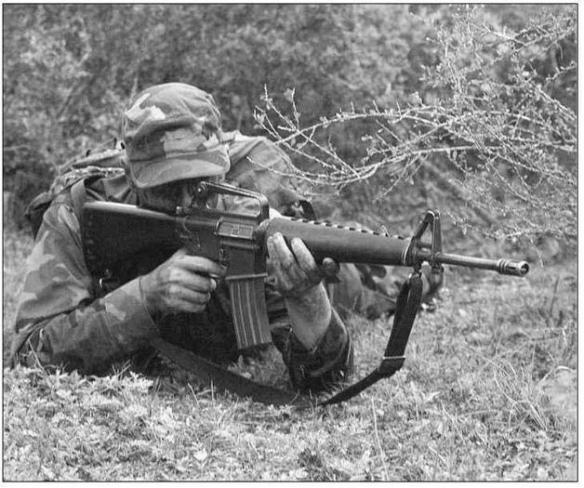
The standard U.S. battle rifle, which first saw action during the Vietnam War, was prone to jams and malfunctions when it was introduced. Although these problems were corrected, many GIs believed that the AK-47s used by the North Vietnamese and Vietcong were superior to M-16s during close-proximity jungle fighting. In the aftermath of the U.S. Invasion of Iraq in 2003, many U.S. soldiers preferred the AK-47 to their M16A2 rifles. U.S. Department of Defense
Only three weeks after Diem’s death, President John F. Kennedy was assassinated in Dallas, and Vice President Lyndon B. Johnson soon escalated his predecessor’s policies. In August 1964, Pentagon officials said that U.S. warships had been attacked in the Gulf of Tonkin by North Vietnamese patrol boats. These attacks prompted Congress to give President Johnson a free hand in Vietnam, through the Gulf of Tonkin Resolution. This incident was later revealed to be a fabrication of the administration. No matter. The war was now in full swing and Special Forces, CIA operatives, and other elite units received the AR-15 to help counterbalance the AK.
Still, most U.S. forces were issued the M-14, and General William Westmoreland, who took command in Vietnam in June 1964, replacing General Paul Harkins, held a meeting of his commanders in Saigon in November 1965 to discuss how poorly the weapons fared against the AK. Congressional hearings held years later noted that GIs were buying black-market AR-15s for $600, compared to a list price of $100.
Back home, more testing of the M-16 continued, but McNamara was in a rush and so was Westmoreland. More than a hundred thousand M-16s were ordered by summer 1966. By October, however, some unexpected reports came in.
M-16s were jamming in combat.
American soldiers were found dead with their rifles in mid-breakdown. They were trying to undo the cause of the misfire while under attack.
Morale plunged as many soldiers felt they could not trust their weapon. Some anecdotal reports indicated that as many as half of M-16s were prone to jamming, but this number was probably too high. The real number was irrelevant, because soldiers never knew if their own weapon would perform as expected, and so every rifle was suspect. As the Vietcong learned of these problems, they were less in awe of the weapon. The sight of the “black rifle,” as the Vietcong had dubbed it in the early days, was now less threatening, and it empowered them. Reports indicated that Vietcong stripped dead GIs of their AR-15s and other equipment but were purposely leaving behind the M-16s.
Although the army tried to minimize the public relations fall-out, reports reached Congress through the parents of men serving in Vietnam as well as from soldiers themselves who felt they had been betrayed. Small-town newspapers ran letters from local soldiers about the failing new rifle. National media also covered the story. Soldiers and their parents inundated congressional representatives with letters and phone calls, and they wanted answers. With more and more Americans uneasy about the nation’s growing role in Vietnam, Congress began an investigation in May 1967. Under Democrat Richard Ichord from Missouri, a subcommittee of the House Armed Services Committee shed public light for the first time on the inner workings of the Ordnance Department and its archaic method of developing small arms.
The subcommittee called hundreds of witnesses, including Macdonald, Stoner, and other representatives of Colt, who testified about their shabby treatment by the army. Military personnel described how the Ordnance Department tested rifles, although many stated they did not recall the fine technical details of the M-16 program. One of the most dramatic moments in the hearings came when a letter from a soldier was entered into the record. This poignant letter read in part, “Before we left Okinawa, we were all issued this new rifle, the M-16. Practically every one of our dead was found with his rifle torn down next to him where he had been trying to fix it.”
The subcommittee visited Vietnam to interview soldiers firsthand. They heard stories about how men routinely took AKs off of enemy dead and used them instead of their M-16s. This practice had became so commonplace that soldiers in the field officially were banned from using AKs, because those rifles’ distinctive sound attracted friendly fire. In the heat of a close-quarters jungle firefight, American soldiers had little to go on to identify enemy positions other than the sound of their weapons. The other reason the AK was banned was that carrying it further stigmatized the M-16. In defiance, many soldiers still carried AKs. Indeed, special covert units of the military and CIA were sanctioned to carry AKs on their secret missions because of the weapon’s reliability.
In his best-selling book Steel My Soldiers’ Hearts, Colonel David H. Hackworth told the story of bulldozers during a base construction project uncovering a buried Vietcong soldier and his AK. Hackworth yanked the weapon out of the mud and pulled back the bolt. “Watch this,” he said. “I’ll show you how a real infantry weapon works.” With that he fired off thirty rounds as if the rifle had been cleaned that morning instead of being buried for a year. “This was the kind of weapon our soldiers needed and deserved, not the M-16 that had to be hospital cleaned or it would jam,” he wrote.
The Ichord hearings continued through the summer. In October 1967 the Special Subcommittee on the M-16 Rifle Program issued a six-hundred-page report highly critical of the Ordnance Department in general and its handling of the development of the M-16 program in particular.
The culprit, it turns out, wasn’t the gun but the ammunition, and it was the result of a bad decision by Ordnance. The report concluded that the M-16s jammed because the Ordnance Department insisted on changing the cartridge propellant from extruded or stick-type powder to ball-type powder, which tended to leave a residue in the rifle after repeated firing. Although both powders are made of the same components, stick powders are shaped like tiny cylinders, extruded, and cut to length. Ball powders are extremely small spheres of propellant. One major difference is that stick powders rely primarily on the grain size and surface area to control the burn rate. Ball powders rely more on a slow-burning covering and need a hotter primer to ignite.
Stoner specified that stick powder be used in his weapon, and it is not fully understood why Ordnance insisted on changing his recommendation. The subcommittee noted that the army had a cozy relationship with Olin Mathieson, the ball-powder manufacturer, which may have influenced the decision to change powders. The subcommittee also noted that because of the powder change, mechanical modifications had to be made to the M-16, and these last-minute changes may also have hurt its performance.
These revelations finally killed the Springfield Armory. After almost two hundred years of operation, it was closed by McNamara at year’s end.
The M-16 controversy was not over, however. Although Congress cited the change in powder as the reason for jamming, not everyone was satisfied. Some ballistics experts contended that the jamming was due to barrel corrosion from humid jungle conditions. This may well have been true, and would have indicted the Ordnance Department even more, because it understood the detrimental affects of barrel corrosion on M1 rifles from fighting in the Pacific during World War II. Ordnance knew that the cure was to chrome-plate the barrel, standard procedure for the AK.
Another contributing factor to jamming was that the army did not issue gun cleaning kits to troops, which gave the impression that the weapon never needed cleaning. Why the kits were not issued also was never made clear. Only speculation exists. One explanation was that McNamara’s Whiz Kids wanted to save money; another is that the Ordnance Department wanted the M-16 to fail; other speculation hinged on an overconfidence in the weapon itself.
Perhaps all three reasons played a role, but the reputation of the M-16 was irrevocably sullied. Even after these issues were addressed and the M-16 proved itself a formidable weapon, it was too late. Its main rival the AK was perceived by many as the world’s best infantry weapon, and the one that could beat the West’s best offering. It was low-tech Soviet style versus high-tech U.S. style, and the Communists won the war of perception, especially among third world nations whose leaders were carefully watching the conflict.
By 1973, the U.S. presence in Vietnam was winding down, with soldiers officially withdrawing in March after reaching a peak of 535,000 in 1966. Without a decisive Western victory, U.S. combatants left Southeast Asia, including Cambodia and Laos. Vietnam fell to North Vietnamese troops in 1975 as the last Americans and many Vietnamese evacuated the country. Stunning television shots of desperate people clinging to helicopters taking off from Saigon building roofs only served to raise the stock of Communist fighters and their AKs.
To this day, one of the most contentious arguments in military circles is, “Which is the better weapon, the M-16 or the AK?” The argument will never be resolved, and it is moot. The AK’s reputation as the underdog’s weapon was born in the rice paddies of Vietnam, given a boost by an unwitting U.S. military.
The lesson of Vietnam is that determined soldiers with simple, reliable arms can beat a well-trained military force despite its sophisticated weapons, like the M-16. In the years that followed the Vietnam War, the larger-than-life AK spread around the globe, giving power and prestige to ad hoc armies, thugs, and terrorists who would change the face of the world forever.