
CHAPTER SEVEN
FIGHTING IN THE FOREST
THOUSANDS OF Americans were now fighting inside the borders of Germany. Sir Alan Brooke wrote in his diary, on beholding the wreckage of Aachen: “It was a relief to see at last German houses demolished instead of French, Italian, Belgian and British!” The occupiers were somewhat bemused by their first encounters with Hitler’s people in their own homes. German civilians of both sexes seemed without humility about their responsibility for the predicament in which they now found themselves. Civil Affairs, a large military bureaucracy whose personnel possessed varying degress of competence, enthusiasm and integrity, followed in the wake of the armies to assume supervision of the vanquished German people. Near Hürtgen, the U.S. 30th Division Civil Affairs officer was summoned to the mansion of a Luftwaffe colonel’s wife, one Frau von Reventlow, who complained bitterly about intrusions upon her privacy by refugees. The American suggested that, since Germany had started the war, it seemed not unreasonable that she, like other Germans, should accept some responsibility towards the refugees caused by it.
Only the Russians possessed clear policies for the lands they occupied. Among the Americans and British, from the humblest footsoldier to the greatest statesmen, deep uncertainties persisted, about whether to treat Germany as a nation of criminals, a threat to world peace that must be permanently emasculated, as U.S. treasury secretary Henry Morgenthau urged; or whether to adopt Churchill’s view, that one could not indict a whole people. The British prime minister preferred to leave great decisions about how to deal with the Germans until after they had been defeated, when the passions of war had abated: “It is a mistake to try to write out on little pieces of paper what the vast emotions of an outraged and quivering world will be either immediately after the struggle is over or when the inevitable cold fit follows the hot,” he wrote to Eden, his foreign secretary.
Among the Allied forces entering Hitler’s dominions, there was an instinctive indifference to German property, reflected in everything from bombing policy to looting. “One advantage of being in Germany is that one can liberate any article which he needs,” Staff-Sergeant Harold Fennema of the 66th Signals Battalion wrote to his wife in Wisconsin. “Since you spoke of wanting a sewing machine, there are lots of them to be liberated here. Washing machines are a little harder to liberate, but we have hopes of getting one soon.” American and British soldiers faced strict injunctions about “non-fraternization” with the enemy. GIs were subject to a fine of $65 for breaking the rules. Soldiers puzzled over how this whimsical figure was determined. In any event, the regulations were heeded more in the breach than in the observance. Many soldiers displayed pity, and even kindness, to individual German civilians. Had it been otherwise, the values for which the war was being fought would have been lost.
A significant number of U.S. soldiers appointed to Civil Affairs were themselves former refugees, picked for their language skills. Corporal Werner Kleeman had been born in Bavaria twenty-five years earlier. A Jew, he spent some months in Dachau concentration camp before achieving the extraordinary good fortune of a passport to England, and thence to America. He found life very tough as an infantry trainee: “Most NCOs were hill-billies who thought Jews wore horns. They had never seen a Jew. They liked to say: ‘Latrine duty for the refugee!’ ” But then Kleeman was posted to Civil Affairs on the strength of his knowledge of German. He cherished the sensation that he was taking a small personal part in the destruction of Hitler’s empire. The former refugee once found himself interrogating a shot-down Luftwaffe pilot who hailed from a Bavarian village three miles from his own. Yet sometimes Kleeman’s American superiors expected more than he could deliver. Colonel Charles Lanham, the flamboyant officer commanding the 22nd Infantry, told the interpreter one day: “Now we’re in Germany, the velvet gloves come off. These cows on the roads are getting in the way of my vehicles.” Kleeman wondered if the colonel expected him to harangue the cows in German.
One of his colleagues was Sergeant J. D. Salinger. “In those days, he was very normal,” Kleeman said of the novelist, “except that he would never let anybody read his letters home, and always forged the signature of a censoring officer.” Sometimes Salinger would say: “Let’s go look up Papa.” They would head for the press camp where Ernest Hemingway was ensconced, asserting that he was hiding from his wife, Martha Gellhorn. Both Hemingways were serving as war correspondents. Jim Gavin of the 82nd Airborne somehow found leisure to conduct a brief affair with Ms. Gellhorn, which involved playing a lot of gin rummy in bed. Salinger and Kleeman admired Ernest Hemingway’s unflinching enthusiasm for getting up front. The novelist had formed a close friendship with Colonel Lanham of the 22nd Infantry, a moody, self-consciously heroic figure who was by no means displeased to find himself the object of Hemingway’s admiration in print. Lanham, who “led from the front, even to the point of foolhardiness,” was now to find himself and his regiment, along with a substantial part of the U.S. First Army, plunged into fighting more painful than any which they had known since Normandy.
“THE STAGNATION OF the war weighs heavily,” the Dresden Jewish academic Victor Klemperer wrote in his diary on 2 November. “Another winter, that is a dreadful thought.” So it seemed also to the Allied generals. At Eisenhower’s strategic planning conference in Brussels on 18 October 1944, it was acknowledged that the British would be unable to launch a major thrust into Germany before winter. Montgomery’s hopes of spearheading a breakthrough had died at Arnhem and on the Scheldt. If there was now to be a dramatic advance, it would have to be achieved by Bradley’s men. It was agreed that Hodges’s First Army should push towards Cologne, while Ninth Army attacked on the left, between Hodges and the British. Patton’s Third Army was placed lowest in the queue for support and supply. Alan Brooke wrote gloomily in his diary on 8 November: “I do not like the layout of the coming offensive, and doubt whether we [will] even reach the Rhine, it is highly improbable that we should cross over before the end of the year.” Brooke had become so desperate to see a land force commander appointed in place of Eisenhower, “[who] is detached and by himself with his lady chauffeur on the golf links at Rheims,” that the sharp, brusque Ulsterman now favoured giving the job to Bradley, with Montgomery commanding all Allied troops north of the Ardennes, and Patton doing the same job in the south. “[Eisenhower] quite incapable of understanding real strategy . . . Among other things discovered that Ike now does not hope to cross the Rhine before May!!!” Such was the gloom of some Allied commanders after their euphoric visions two months earlier.
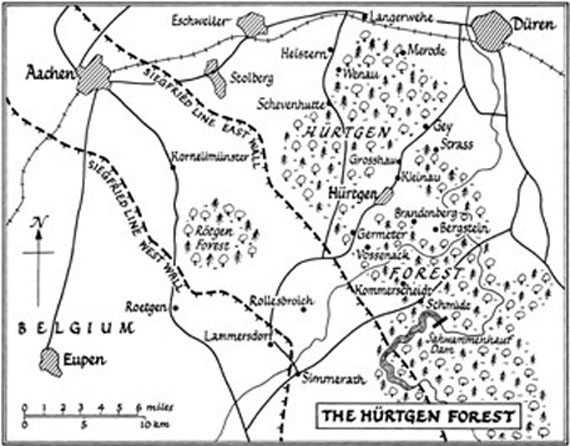
A few miles inside Germany, south-east of Aachen, lay a cluster of large expanses of wooded hills collectively known to the Americans as the Hürtgen Forest. The ridge lines, occupied by the German 275th Division, had been cleared of timber, which increased their dominance of the forests below. The 275th were poor-grade troops, who—like the garrison of Aachen—posed no plausible threat to the flanks of an American advance to the Roer. Yet the strange decision was taken that the Hürtgen should be cleared of Germans before another major attack eastwards was made. The American historian Russell Weigley has wisely observed: “The most likely way to make the Hürtgen a menace to the American army was to send American troops attacking into its depths. An army that depends for superiority on its mobility, firepower, and technology should never voluntarily give battle where these assets are at a discount; the Huertgen Forest was surely such a place.”
The U.S. 9th Division had suffered much unpleasantness during its early attempts to push through the Hürtgen in October, while Aachen was still in German hands. By 16 October, the formation had suffered 4,500 casualties in advancing two miles. At the beginning of November, the 28th Division of V Corps took over the task. Some early successes alarmed the Germans, and caused them to reinforce the area heavily. When the fresh U.S. 18th Infantry was pushed into an assault on 8 November, its battalions suffered 500 casualties in five days. The executive officer of one regiment of 28th Division wrote: “We’re still a first-class outfit, but not nearly as good as when we came across the beach. We have a great deal more prodding to do now.” In the thickly wooded country where the tracks had become quagmires, it could take six or eight hours to move rations and ammunition forward a mile or two. The 121st Infantry charged eleven men with refusal to return to the line—the first such case V Corps had recorded. An American officer said bleakly: “We are taking three trees a day, yet they cost us about 100 men apiece.”
Yet, instead of recognizing the folly of attacking on terrain that suited the Germans so well, Courtney Hodges reinforced failure. The Americans poured men into the long succession of battles which became known to all those who participated as “the hell of the Hürtgen Forest.” This network of woodlands some eight miles deep by twenty wide, almost impassable by tanks, eventually cost its attackers some 25,000 casualties. The terrain made it impossible to deploy American firepower effectively. The defenders’ weapons could cover every narrow access with devastating consequences for advancing infantry. “The trees were so dense that even when the sun shone, the day seemed gray,” wrote Lieutenant William Devitt of the 330th Infantry. “My first impression of the Hürtgen was the unremitting noise of the artillery. It sounded like a thunderstorm that went on and on without stopping.”
Devitt was a thoughtful twenty-year-old Minnesotan, posted to the 83rd Division in December as a replacement. “Until that time, the war hadn’t seemed very real or very deadly to me . . . I was anxious to learn what combat was like. I wanted to have the experience, probably to be able to talk about it after I got home.” As he took his platoon into the line, he was horrified by the sight of the 4th Division men his unit was relieving, their faces and field jackets caked in yellow mud: “They looked like a collection of ghosts . . . a grim lot, hollow-eyed from the constant pounding of shellfire, and fear of impending death.”
Many of the trees around their positions had been hacked short by shellfire. There were craters and fallen branches everywhere, together with German corpses, which fear of booby traps made the Americans unwilling to remove. Because it was hard to bring hot food forward, they lived chiefly off K-rations: processed meat, cheese, cooked eggs, crackers, dried fruit. Devitt’s company commander once asked him to breakfast, thinking he was doing the young officer a favour by offering him hot food, but the lieutenant hated the captain for making him risk the journey to his CP. Their SCR536 radios worked only intermittently among the trees. Incessant and dangerous effort was needed to splice broken field telephone lines. Devitt developed a personal obsession with toilet paper, because lack of it inflicted such humiliations when he, like most men, suffered an outbreak of “the GIs”—chronic diarrhoea. He carried one stash of paper in his helmet, another in his shirt pocket.
As an officer, he felt grateful that he had less time to be frightened than his men, because there was so much to do. The U.S. Army did not allow junior officers batmen—personal servants—as the British did, because it was thought demeaning to ask enlisted men to do such work. Omar Bradley was among those who deplored American scruples. He thought the British system militarily sensible, because overtaxed officers could do their jobs better if they did not also have to dig foxholes and prepare their own rations.
Devitt, like most young officers, learned a great deal from his veterans. His runner, a twenty-year-old from Indiana named Ernie Elliott, wounded in Normandy, put him wise to the shirkers: “Lieutenant, I wouldn’t be too soft on so-and-so—he’s always been a gold-bricker and will do whatever it takes to duck real work.” Yet Devitt found it hard to learn how to rally men subjected to the strain of incoming barrages. He recorded a shouted conversation in the Hürtgen as German shells smashed into the trees around his platoon’s foxholes:
“Lieutenant, will you come over here.”
“Yeah, what d’ya want?”
“It’s Smith. Can you talk to him?”
“Okay, just a second.”
He found the man huddled in a foxhole, weeping uncontrollably.
“Smith, just take it easy. You’ll be all right.”
“Lieutenant, I just can’t take it any more. I’ve just got to get out of here.”
“Well, Smith, we all want to get out of here, but we can’t. It’ll let up soon.”
After half an hour or so, the man recovered himself, and gave no more trouble. When a shell wounded two of his platoon, Devitt found himself struggling to put a field dressing on a large hole in one man’s chest as it smoked in the icy air, giving off a stink of burning flesh. The other wounded man said: “Lieutenant, he won’t make it. Come and help me.” Sure enough, a few moments later as the stretcher-bearers lifted the chest case, he shuddered and was dead.
A new officer arrived to take over a neighbouring platoon, where his sergeant, Haney, urged him to dig his foxhole deeper. The lieutenant ignored this suggestion. Soon afterwards a near-miss gave him a slight shrapnel wound in the hand. The officer leaped up, yelling to his NCO: “Look, Haney, that’s my ticket home! Talk about a million-dollar wound, this is it. Call the medic to put on a bandage, then it’s the rear for me. I’ve had enough of this place.” Devitt’s company suffered thirty-six casualties in a single week in the Hürtgen, without achieving anything of significance.
A MAJOR AMERICAN offensive began early in the afternoon of 16 November with an attempt to push eastwards from a start line north of the Hürtgen, along the so-called Hamich Corridor towards Cologne. Nothing did more to boost the precarious morale of the American attackers than the spectacle of their own fighter-bombers pounding the Germans. “It was a beautiful sight to us,” wrote a U.S. infantryman watching a P-47 strike. “We could see the tracers bouncing off their targets, then they would dig down and let their bombs go. For a second or two, it would look as if they were duds; then a grey geyser of dirt and smoke would erupt.” Inevitably, however, there were mistakes, and mistakes in wars cost lives. Again and again, especially amid the confusion of the woodlands, friendly aircraft strafed Allied positions, causing much bitterness and—more serious—corroding trust among units which had been hit, making them reluctant again to summon air support. Neither side had much idea exactly where the enemy was, except during an attack. The U.S. 28th Field Artillery fired 7,421 rounds of 105mm ammunition during the month of November in the Hürtgen. The regiment acknowledged, however, that most of these—6,520 shells—were blind and unobserved.
Even as the Hamich Corridor push was in progress, the unfortunate 26th Infantry were attacking inside the Hürtgen. Among the trees, the Americans suffered familiar, bloody difficulties in advancing a few hundred yards. In the corridor, where progress was made the lead elements found themselves under fire from German-held high ground on both sides. The first two days’ fighting reduced the lead battalion of the 16th Infantry to an average of sixty riflemen per company, less than half its established strength.
The U.S. 109th Regiment fighting among the trees was deemed close to collapse. Its survivors were withdrawn. The 121st Infantry was so battered that one company broke and ran under artillery fire. On 24 November, both this company’s commander and his battalion superior were relieved. In the next four days, two other company commanders and another battalion CO were sacked. Two days later, the regimental commander was also relieved, along with the 8th Division’s commander, Major-General Donald Stroh. No one could accuse the U.S. Army of tolerating failure in its officers. The anger of the higher command was understandable, since the 121st had suffered only sixty known dead in an attack which petered out without gaining a yard. Private Robert McCall, a Connecticut farmworker, was sent as a replacement to the 121st. As he and some bewildered comrades waited to be allocated to companies, they saw Weasel tracked vehicles carrying out wounded. McCall reflected on the likelihood that he would soon be taking the same route. The first casualty he saw was a sergeant who leapt into a foxhole as shelling started, causing a grenade to fall out of his belt, which exploded and killed him.
McCall took part in his first attack on 28 November. Catching a glimpse of a German helmet, he fired, and was rewarded by the sight of an enemy soldier as frightened as himself emerging from a hole, his upheld hands shaking. The Americans broke out of the woods and began to advance across open ground towards their objective. They were stopped by heavy fire. “To stay where we were would have been suicide, so the whole outfit ran back across the field.” McCall crawled into a foxhole recently vacated by the Germans, and was disconcerted to hear a cry of “Kamerad!” from the next trench. He saw a German helmet, and fired. Examining the corpse of the first man he had ever killed, McCall removed his watch and wallet. The following day, as his unit advanced into Hürtgen, he heard the shriek of an incoming shell. “Next instant, it felt like someone had hit me in the small of my back with a club.” Two men dragged him to the roadside and left him for the medics. A few days later, he was on his way home to Connecticut. After a year of training, McCall’s active service career had ended after just ten days in the line. Many men thought him lucky, and so indeed did he himself.
The 121st’s total casualties were around 600 out of a strength of 3,000, but most of these were combat-fatigue cases. Its commanders concluded that the regiment had succumbed too readily to the misery of the Hürtgen. It was striking to contrast what the best American troops could achieve with the performance of their less effectual brethren. “Attacking forces were interfered with by mud, rain and sleet,” wrote Sergeant Forrest Pogue with V Corps. “Enemy personnel were not of a high quality. The forces consisted principally of regiments of numerous units that had been disorganised in France. Numerous Kampfgruppen were formed of exceptionally young or old soldiers. Poor observation interfered with the use of artillery by the Americans.” When repeated efforts failed to seize a peak named Castle Hill, on 7 December a battalion of the Rangers, who had achieved miracles on D-Day, was sent to do the job. They stormed the hill. Powerful artillery support enabled them to hold it against ferocious German counter-attacks. By the day’s end, only twenty-five men remained in action among the two Ranger assault companies.
Lieutenant Tony Moody joined the 112th Infantry in the Hürtgen late in November. “It was very cold and very wet, and I had lost my bedding roll.” He met his company commander for the first time in the middle of an incoming barrage, which frightened him considerably. He was then taken to meet his platoon: “Their morale was pretty bad. I’m sure we inflicted as many casualties on the Germans as they did on us, but somehow they didn’t seem to get as upset about them as we did. We lost quite a few combat fatigue cases.” Moody was a twenty-one-year-old graduate in architecture from Missouri, with ambitions to be an artist. His first hard test of leadership, he felt, came when a man returning from the latrines failed to hear a challenge and was shot dead by an American sentry. Writing to the man’s wife, Moody struggled to find words to make her husband’s death sound less ugly and futile.
Unglamorous jobs incurred inflated dangers. Prominent among these was that of signal wireman. It was critical to maintain communications between the forward positions and unit headquarters. Telephone lines were constantly severed by fire. Wiremen had to find the breaks and repair them, often while bombardment persisted. “Telephone wiremen were the first to die in every battle,” observed Captain Karl Godau of 10th SS Panzer. Private Ralph Gordon of the U.S. 18th Infantry was called out at 0300 one night: “It was so dark that it was impossible to see your hand in front of your face, and the only reason I knew where I was, was that I followed my wire line till I reached the breaks. I must have fallen down a dozen times, and one time my pistol fell from my belt when I walked into a trench. I spent 15 minutes feeling around in the dark trying to find the pistol, and during those minutes I cursed everyone that had anything to do with starting the war.”
Gordon and his unit emerged from the Hürtgen utterly traumatized by the experience: “We were thankful we were still alive, but for how long no one knew . . . The day after, a few fellows just couldn’t take the strain any more, just went psycho, shouting and running all around like madmen. They got these fellows out as soon as possible, as it was bad on the morale of the other men.” Wilmer Pruett, an eighteen-year-old from the woods of North Carolina serving with the 281st Combat Engineers observed again and again in the Hürtgen: “If there’s another war, the only way they get me is to burn the forest and sift the ashes.”
STRESSES OF BATTLE
BOTH THE AMERICAN and British armies pondered deeply the problem of combat fatigue, the cause of serious losses of fighting soldiers, above all infantrymen. In some units committed to the Hürtgen battle, combat fatigue reached epidemic proportions. A British medical report concluded that “the act of going sick, of giving in, is an all-or-nothing phenomenon, and is damaging to the personality.” Most men, it concluded, were less effective soldiers after returning to duty, as did more than 50 per cent. The same report observed the paradox that a soldier who ran away from the battlefield was treated as a criminal and harshly punished, while the man who reported sick with combat fatigue was sympathetically received, although “the physical escape of the deserters and the psychological escape of the hysteric were expressions of the same mechanism.” The report noted that the problem seemed much smaller in the German Army, “though precipitating trauma was obviously greater.” This was a polite way of suggesting that the German soldier, in defeat, was experiencing a tougher war than his Allied counterpart, on the road to victory. The report failed to remark the small but obvious point, however, that suspected Wehrmacht malingerers were shot. Although combat fatigue was recognized only with the utmost reluctance in the German Army, and not at all in Stalin’s formations, there are no grounds for supposing that German or Russian soldiers were less afflicted by the shock of battle than men of other armies. They were simply denied the sympathy accorded to American and British sufferers.
A British analysis concluded: “Battle exhaustion cases occurred chiefly among men of poor type who, during training have constantly been guilty of petty crimes.” The U.S. Army rejected this thesis, and took the view that many good men succumbed to combat fatigue and could be rehabilitated for return to duty. In the course of the north-west Europe campaign, British Second Army recorded twelve men per thousand as psychoneurotic admissions to hospitals. Comparable American ETO figures were fifty-two men per thousand, a total of 102,989 cases. Some 8.9 per cent of all men who passed through the U.S. Army in the Second World War were recorded as suffering at some time from combat fatigue. Martin Van Creveld, writing of the “enormous number of psychiatric casualties” the U.S. Army suffered in that war, suggests that the condition was regarded by the ordinary soldier and his superior as “a legitimate, almost normal complaint.” The problem was especially prevalent among newly arrived replacements. Although combat fatigue was far less readily acknowledged in the German Army, the consulting psychiatrist at Second Panzer Army recorded in 1943 that it was especially common “among men who had not had time to form strong comradely ties with buddies.” Together with trench foot, which was invariably highest in units where morale was low, combat fatigue represented a huge drain on Allied fighting manpower. Twenty-six per cent of all those who served in combat formations in the ETO between June and November 1944 at some time reported sick in these terms. “Combat fatigue was one of the most important causes of non-effectiveness among combat troops,” concluded a U.S. Army post-war report. “News spread among the troops that they could avoid distasteful duty at least temporarily by getting into medical evacuation channels. It was very difficult under combat conditions to distinguish between malingering and mild combat exhaustion.”
Officers who succumbed were often treated more generously than enlisted men. Lieutenant Colonel Ferdinand Chesarek, commanding the 28th Field Artillery, relieved a major of his duties and sent him to the rear, with a report simply recommending that he should not again be employed forward of a corps command post: “The strain of battle in a field artillery CP is greater than he can undergo and still function efficiently . . . when the situation becomes involved, he works himself into such a state as to make impossible the continuation of his duties.”
In the winter of 1944, Allied fighting strength was further eroded by the loss of thousands of men who simply quit. “There were increasing signs of plummeting morale,” writes Carlo d’Este, “manifested by a rapidly rising desertion rate so serious that Eisenhower . . . became the first [U.S. commander] since Lincoln in the Civil War to order an American soldier executed for desertion.” No reliable figures are available for overall losses caused by desertion and absences without leave, but Martin Van Creveld suggests “several hundred thousand,” of whom a mere 2,854 were ever brought to trial. Available statistics show that the desertion rate in U.S. armies in Europe reached 45.2 per thousand in 1944 and 63 per thousand in 1945. On 1 January 1945, the U.S. provost-marshal acknowledged that more than 18,000 American deserters were roaming the ETO, while the British admitted to more than 10,000. A further 10,000 British soldiers were charged with the lesser offence of Absence Without Leave.
Unsurprisingly desertion, like combat fatigue, was overwhelmingly an issue in combat units. A sample of British offenders in north-west Europe revealed that more than 80 per cent of deserters had absconded from infantry rifle companies. This represented a serious haemorrhage of fighting manpower. The figures suggest that Eisenhower’s armies were deprived of the equivalent of several divisions, men who disappeared from their units to become scavengers, supporting themselves by lives of active or passive criminality. They became familiar flotsam in every urban area of western Europe. This teeming horde sustained a huge traffic in stolen military rations, fuel, equipment and even vehicles, feeding the black markets of impoverished France, Belgium—and Britain. In Brussels in December 1944, an average of seventy jeeps a day were being reported lost. A significant proportion of supplies destined for the armies was diverted into civilian hands. More than a few men in General Lee’s ComZ and its British counterpart did not desert but instead made their contribution to the war effort by selling stores which they were entrusted with moving to the front. Fortunes were made in those days, in those ways. In the British Army, concern about organized looting, black-marketeering and theft of military equipment became so widespread that a restriction was imposed on the value of postal money orders soldiers were permitted to send home. Disciplinary problems of all kinds were a serious issue. Eisenhower was driven to suggest the public execution of men convicted of rape.
The U.S. Army suffered severely in north-west Europe for the grave policy error it had made earlier in the war, of according a low priority to manning infantry formations and providing replacements for their casualties. “We are about to invade the continent,” General Marshall wrote to Stimson, the U.S. secretary of war, in May 1944, “and have staked our success on our air superiority, on Soviet numerical preponderance, and on the high quality of our ground combat units.” Marshall might have added: “and on the willingness of the Soviets to accept the overwhelming burden of ground casualties.” It was also debatable whether the Chief of Staff had, indeed, given the emphasis he claimed to ensuring the quality of fighting manpower. The U.S. Army’s belief that quality personnel were wasted in ground combat units is readily demonstrated by the manner in which it allocated recruits after educational testing. Only 27.4 per cent of American infantry soldiers attained grades I or II in initial army testing, while 29 per cent were grade IIIs, and 43 per cent grades IV or V, which reflected “low intelligence and suitability for training.” The educational standard of men shipped to combat arms ranked far below that of those posted to administrative branches. For instance, 89.4 per cent of soldiers sent to the army’s Finance Department had achieved grades I or II, as had 35.3 per cent even of those sent to the military police. Many riflemen in the U.S. Army felt themselves abandoned by God and by their own country. Charles Felix’s unit was outraged to read in Stars & Stripes that men sentenced to imprisonment for rear-area disciplinary offences were being offered a transfer to infantry as an alternative: “So that’s what they really think of us!”—shades here of Hollywood’s The Dirty Dozen. To put the matter plainly, infantry—the core of every army’s fighting power—reposed at the bottom of the U.S. War Department barrel. For those who had to fight America’s battles in Europe, the cost of this monumental misjudgement was painful indeed.
“Replacements . . . are not satisfactory. They never have been,” wrote Lieutenant Colonel C. Ware, G-1 of the U.S. 1st Division. “It seems the infantry has been the last thing to be taken care of.” Orders to other commands to release men for infantry service were treated with shameless cynicism. One batch of 514 men released by the USAAF to the army was found to muster 231 court-martial convictions between them. In the words of the U.S. official historian, commanders “saw in the emergency retraining program an opportunity to rid their units of misfits and undesirables.” Senior officers remarked on the absurdity of maintaining 198 anti-aircraft units in the U.S. armies in north-west Europe, when the Luftwaffe was almost moribund. It was a measure of the scale of manpower waste that even a modest reduction to 146 AA battalions freed 38,000 men for transfer to infantry. Far more decisive action could have been taken to reduce the grotesquely long support tail and to strengthen infantry units. The British Army gained some benefit from the fact that, unlike its ally, its best foot regiments possessed a prestige which allowed them to recruit quality manpower. However, overall British policy towards infantry was no more imaginative than that of the Pentagon. In a withering memorandum to the War Office, a British divisional commander deplored the fact that many high-ranking officers regarded the infantry “as a legitimate dumping ground for the lowest forms of military life.”
Yet the root cause of Eisenhower’s chronic manpower difficulties was an earlier Washington policy decision. The U.S. had created a ground army far smaller than its population would have allowed because the War Department woefully underestimated the size of the force that would be needed to defeat Hitler. Millions of potential recruits were rejected by medical boards, which were encouraged to set high standards. It was true that America needed a much bigger navy than Germany. The U.S. Navy’s outstanding performance made it probably the most impressive of America’s three wartime services. The U.S. decision to create a huge air force represented a rational exploitation of the nation’s technological brilliance. But it remains astonishing that only eighty-nine U.S. Army divisions were deployed for active service. It may be argued that, given the difficulties of supplying America’s armies in Europe, the commitment of more ground soldiers would merely have compounded these. Yet, even among the five million men drafted to the U.S. Army, only two million served in combat roles, in the loosest interpretation of that phrase. Barely 300,000 men were available in north-west Europe even in 1945 to confront direct German fire, as members of rifle companies or armoured units. It remains insufficiently understood that, while overall casualty rates on the Western Front in the Second World War were vastly lower than those of the First World War, a rifleman’s prospects of surviving the entire campaign unwounded were not much better than those of his father in Flanders. The campaign could have been won more quickly, and Allied forces might have advanced much further east, if Eisenhower had been given more soldiers, and especially more infantrymen.
BOGGED DOWN
THE GERMAN SOLDIER found the experience of the Hürtgen Forest battle every inch as unpleasant as his American counterpart. “It’s Sunday, my God, it’s Sunday,” wrote a German infantry medic of the 1058th Regiment. “With dawn, the whole of our front receives a barrage. The earth trembles. The concussions take our breath away . . . We go forward to counter-attack. The captain is leading it himself. We cannot go far. Our people are dropping like tired flies. Suddenly, the artillery begins its monstrous song again . . . If only we had the munitions and heavy weapons the American has, we would have sent him to hell a long time ago.”
The same man noted on 26 February, near Grosshau: “Two wounded are brought to my hole, one with a torn-up arm, the other with both hands shot off. I am considering whether or not to cut off the rest of the arm. I’ll leave it on. How brave those two are. I hope to God all this is not in vain. When the Ami really attacks again, then he has got to break through. I can’t believe that this ground can be held any longer. Many of our boys just ran away, can’t find them, and have to hold out with this small group.” The U.S. 22nd Infantry noted that between 16 November and 3 December it captured 764 Germans, against some thirty-seven of its own men taken prisoner. The figures highlighted the reluctance of many of the defenders to fight to the last.
Willi Pusch, an eighteen-year-old soldier of the German 3rd Parachute Division, had seen his company reduced from eighty men to fifteen in Normandy, from which he emerged convinced that the war was lost. After two months refitting the unit in Holland, on 22 November they were committed to the last stages of the battle for the Hürtgen Forest. Pusch, a heavy, cheerful man with the huge hands of the East Prussian peasant, once again saw his company shattered. “The forest was a very brutal place,” he said. They were withdrawn and attached to an improvised battle group, which was then given the support of a single tank for a counter-attack. As they advanced to the start line under heavy American artillery fire, the tank swerved off the road and promptly ditched in the mud and snow. The footsoldiers expressed profound relief. “That’s it for us,” they agreed, and trickled away to the rear.
They were in a village a few days later, on 11 December, when word came of Americans nearby. Pusch and his depleted unit were ordered to push the enemy back. The men, most of whom scarcely knew each other, trudged miserably forward. They occupied the first few houses, just as the Americans approached and opened fire. The Germans could see a score or more Shermans. A young lieutenant told Pusch: “Get a faust.” When the paratrooper seemed reluctant to comply, the officer ran for one himself, fired, and set the leading tank on fire before he staggered back into the porch of their house, hit in the legs. The other men dragged him in, then ceased firing and retired to the cellar.
They heard Americans closing in. Two Germans cautiously climbed the steps to meet them, hands held high. A torch probed down from the ground floor upon Pusch and his remaining comrades. An American voice told them to come out. They dumped their weapons and ascended into captivity. Their wounded officer still clutched his Schmeisser, doggedly determined to fight on. The other Germans removed the gun, laid him on a door and carried him out. Pusch felt moved by the care with which an American medic treated his friend from Hamburg, Werner Mittelstrauss, who was badly wounded in the legs. German shells were now falling around them. The paratrooper was slightly wounded by splinters in his lip and eye. Yet he was overwhelmed with gratitude that his war was over: “It was like a reprieve from cancer.” The following two years that he spent as a prisoner, initially working in a fertilizer factory at Norfolk, Virginia, were among the happiest of his life: “I was in heaven. I met no hostility in America.” His story is important, because it highlights the experience of a German soldier no more eager for glory than most of his Allied counterparts. Pusch embraced escape from the war.
THE AMERICANS at last inched out of the Hürtgen Forest in the first days of December. They had won their battle, at fearsome cost. The 4th Division suffered terribly—some 4,053 battle casualties, together with a further 2,000 cases of trench foot and combat fatigue. Some of the division’s companies were reduced to fifty men. Robert Sterling Rush writes of the 4th’s 22nd Infantry: “The soldiers of the regiment did not quit, but at the end there was no attack left in them. The soul of the regiment had been ripped out when it lost its experienced junior leaders, NCOs, platoon officers . . . Although the unit remained above 75 per cent strength through a constant influx of replacements, once all its veterans were lost, its effectiveness declined dramatically.” Meanwhile 1st Division, the “Big Red One,” had lost 3,993 casualties, 1,479 of these in the 26th Infantry Regiment, to advance four miles. On 29 November, in an attempt to take the town of Merode, just north-east of the Hürtgen, the regiment lost two companies cut off and almost wiped out.
At last, the way seemed open to the Roer plain. Yet at the head of its river stood the Roer dams. These offered the Germans scope to flood the low ground at will. Control of the dams was critical, and this had been understood by Allied intelligence staffs since the beginning of October. The obvious solution was to destroy the dams by bombing before the armies reached them. This task was delegated to the RAF, which had made much of its 1943 success in bursting the Möhne and Eder dams by precision attack. Unfortunately, the Roer dams—like the vital Sorpe in 1943—proved resistant to air attack. Three attempts by Bomber Command failed. The RAF then abandoned the operation. The Roer dams remained potent threats in the hands of the Germans. No Allied ground force could advance into the plain until they were taken.
The dams might be reached through the so-called Monschau Corridor, a narrow strip of open ground just south of the Hürtgen, difficult country for an attacker because of its gorges, streams and pillboxes. Its seizure must inevitably be an infantry task. Back in October and November, the Americans had persuaded themselves that they could not advance up the Monschau Corridor while German forces remained on their flank in the forest. Yet the enemy in the trees were not elite mobile formations but infantry dependent upon their own feet and horse-drawn carts to go anywhere.
When the Americans finally addressed the Monschau Corridor in December, Gerow’s V Corps at first made uncommonly good progress. His fresh divisions, especially the 78th, advanced without artillery preparation, exploiting friendly fog on 13 December. The 2nd Division made much slower work of the Monschau Forest. It may have been “battle-hardened,” to use one of the most abused clichés of war, but it was also very tired. Its 9th Infantry Regiment suffered 400 losses from trench foot and exposure, and a rather smaller number of battle casualties. “The German Army almost until its final extremity rotated units out of the line more frequently and regularly than the American Army,” a U.S. historian notes. “The effect was to undermine an effective American division’s asset of experience by sheer weariness.” By the morning of 16 December, the Monschau Corridor attack was stuck. There was also a lurking sense of menace. While the 78th Division confronted the German 272nd Division, there was growing evidence of larger enemy forces beyond, with more ambitious purposes than those of merely checking the U.S. V Corps.
SOUTHWARDS IN LORRAINE, Third Army launched a new attack on 8 November, across a front of almost sixty miles. An assault on such a broad front represented a dispersal of hitting power which puzzled those who admired Patton’s rare grasp of the importance of concentration. The conditions were dreadful. It was at this period that Patton enlisted the aid of Colonel James O’Neill, Third Army’s senior chaplain: “Do you have a good prayer for weather? We must do something about this rain if we are to win the war . . . We must ask God to stop.” If this request strengthened the widespread belief that Patton was not wholly sane, it inspired O’Neill to write a prayer which was afterwards circulated to every man in Third Army alongside its commander’s Christmas greeting: “Almighty and most merciful Father, we humbly beseech Thee, of Thy great goodness, to restrain these immoderate rains with which we have to contend. Grant us fair weather for Battle.” When it began to snow soon afterwards, opinion was divided about interpretations of the divine response.
Sergeant Bill Mauldin became a legend in the U.S. Army long before he achieved the same status in the United States as a cartoonist, by creating his two dogface GIs Willie and Joe for Stars & Stripes. Patton loathed these characters, whose shaggy mien and unheroic behaviour he deemed “subversive.” He summoned their creator for a personal reprimand. Mauldin afterwards provided one of the most vivid portraits of Third Army’s commander:
There he sat, big as life . . . His hair was silver, his face was pink, his collar and shoulders glittered with more stars than I could count, his fingers sparkled with rings, and an incredible mass of ribbons started around desktop level and spread upward in a flood over his chest to the very top of his shoulder, as if preparing to march down his back too. His face was rugged, with an odd, strangely shapeless outline; his eyes were pale, almost colorless, with a choleric bulge. His small, compressed mouth was sharply downturned at the corner, with a lower lip which suggested a pouting child as much as a no-nonsense martinet. It was a welcome, rather human touch. Beside him, lying in a big chair, was Willie, the bull terrier. If ever dog was suited to master this one was. Willie had his beloved boss’s expression and lacked only the ribbons and stars. I stood in that door staring into the four meanest eyes I’d ever seen.
Mauldin observed: “I always admired Patton. Oh, sure, the stupid bastard was crazy. He was insane. He thought he was living in the Dark Ages. Soldiers were peasants to him. I didn’t like that attitude, but I certainly respected his theories and the techniques he used to get his men out of their foxholes.” For all Patton’s bombast, however, in south-eastern France Third Army was still struggling to win ground. The Germans had thickly sown their positions with new plastic and wooden mines, impervious to American detectors. On 25 November, Patton belatedly but triumphantly entered the city of Metz. The local German corps commander sent a message to the remaining encircled forts in the hands of his men, warning them that if they gave up they “would surrender not to fighting troops . . . and in all probability to coloured troops.” The last forts did not yield until 13 December. Enemy officers pricked their captors by expounding on the feebleness of the garrison. There had been no SS fanatics among them, said the Germans proudly, but rather a mix of old men and young replacements, in the usual muddle of units.
On 22 November at Nancy, an SS general galled Patton, who was interrogating him personally, by asserting: “The combat efficiency of the troops on the Eastern Front is far above the sector here.” Patton asked why, if that was so, the SS officer had let the side down by remaining alive. Third Army’s commander implied that the German’s undamaged condition might not prove permanent. The general replied coolly that he was a prisoner of war of the Americans. Patton said: “When I am dealing with vipers, I do not have to be bothered by any foolish ideas . . .” Third Army’s commander likewise questioned a Wehrmacht colonel about why his men were still bothering to fight. This officer replied: “They will continue to fight until such time as they receive orders to lay down their arms . . . It is the fear of Russia that is forcing us to use every man who can carry a weapon.” He added that he hoped he would be taken to a PoW camp in the U.S. rather than Britain. Patton said this was likely.
In the last days of November, Third Army’s offensive ran out of steam. It had reached the West Wall and made some penetrations after initial difficulties. On 1 December, American troops crossed the Sarre river. The Germans abandoned their efforts to hold a line on the west bank, and withdrew on the U.S. XX Corps’s front. The men of every formation in the American advance had suffered heavily from exposure and trench foot. All Patton’s infantry units were seriously short of men. They were weary, and morale was flagging. The mud made it impossible for either side to use tanks off-road, and thus drastically reduced the scope for bold initiatives. Further south in Alsace, Devers’s 6th Army Group overcame weak German opposition to drive through the Vosges Mountains and take Strasbourg on 26 November. Patton urged that at least a part of Devers’s forces should push on eastwards, to cross the upper Rhine and threaten the German First Army with outflanking. Eisenhower vetoed the proposal. He saw no purpose in crossing the Rhine so far south. Devers’s divisions, like Patton’s, were intended to swing northwards. By mid-December, their spearheads had begun to engage the positions of the old French Maginot Line, which the Germans were now defending backwards. Almost everywhere, from the Ardennes southwards, U.S. and French forces had closed up to the borders of Germany. Yet for Patton of all men, the great exponent of speed and dash, the battles of October and November had been deeply disappointing. All hope of a dramatic drive into Germany was gone with the coming of winter weather. After ten weeks of painful slogging, only more slogging seemed to lie ahead.
Some men cracked. Staff-Sergeant Bill Getman of the 254th Infantry spent thirty-one days in the Vosges before his unit began to push forward towards the Alsatian plain. One day during an attack, Getman suddenly turned and ran screaming towards the rear across a blazing field. A medic injected him with morphia and took him to the rear. He found himself unable to speak. After tests, he was taken to the 682nd Neuro-Psychiatric Hospital, where he had more tests. In the months that followed, he received narco-synthesis, narco-analysis and sodium-pentathol treatment. He began to speak again, stammering, and recovered some memory. He felt desperate to escape the army, and after a further examination he got his way. A doctor noted “my misery, my pains, my shaking body and poor speech. It was then that I heard the words: ‘Sergeant, no more duty for you, limited or otherwise.’ ” Early in 1945, Getman went home.
“Many people here are resigned to a static winter,” wrote Bradley’s aide Colonel Chester Hansen on 22 November, “which is hard to understand . . . Germany is now flat on her back and still resisting furiously. With good weather, we might smash on through with the help of our fighter-bombers, but the weather has been miserable and does not seem to want to cooperate.” A visiting group of U.S. industrialists asked Bradley himself on 30 November whether he thought it possible that the armies might still be fighting over the same ground six months on. “I think it’s entirely possible,” answered 12th Army Group’s commander, “unless we get a great deal more of ammunition and matériel.”
“The average infantryman was nearly always certain that everyone else had quit the war except his own platoon,” wrote Sergeant Forrest Pogue with the U.S. V Corps. “They knew whether fire came from left or right, and what casualties, but had little clue about time, or where they had been.” Pogue noted the flat, dreary lull that descended upon the campaign towards the end of November:
Such periods always seemed marked by growing doubts on the part of the soldiers as to the wisdom of the war. In a typical discussion one evening, several of us talked of the listlessness of the American soldier, and the fact that he seldom seemed to know what he was fighting for. Some of them argued that there had never been any reason for our coming over, that all the U.S. needed was a strong navy. I doubted if we could ever make people see what they were fighting for, unless we were invaded. I said that most of them in 1942, soon after Pearl Harbor, seemed to think they knew why they were fighting, but as time went on it was harder to show them.
By the end of the Hürtgen battle, 24,000 Americans had become combat casualties, and another 5,000 had succumbed to trench foot, respiratory diseases and combat fatigue. Overall U.S. casualties in the autumn fighting were 57,000 combat and 70,000 non-combat, to achieve insignificant territorial gains, though the Americans could claim to have inflicted substantial losses upon the enemy. These totals masked harsher realities for individual units which had suffered most severely. A Company of the 4th Division’s 22nd Infantry landed on D-Day with 229 soldiers of all ranks. By 16 November, only fifty-four of these men remained in the line; 275 replacements had been received. Among 500 soldiers all told, 70 had been killed, 41 were missing or captured, 235 were wounded and 91 had become non-battle casualties—trench foot or combat fatigue cases—though most of these returned to duty. Between 16 November and 4 December, 59.4 per cent of the 22nd’s officers were either killed, wounded or missing, or became non-battle casualties, together with 53.9 per cent of their men.
Carlo d’Este has called the Hürtgen “the most ineptly fought series of battles of the war in the west.” It is hard to disagree. A fatal combination of unimaginative command decisions by Bradley and Hodges and undistinguished combat performance by some of the units committed enabled the Germans to inflict greater pain than they suffered in the Hürtgen. While the British floundered in Holland, the U.S. 12th Army Group became almost literally lost in the woods. There is an argument that it was simply not feasible to make substantial advances in terrain such as that of the German border amid winter weather, but Hitler’s panzers were soon to prove otherwise. “We never do anything bold,” Eisenhower’s Chief of Staff Bedell-Smith complained at a staff conference. “There are at least 17 people to be dealt with, so [we] must compromise, and compromise is never bold.”
“If we were fighting a reasonable people,” wrote Bradley’s aide Chester Hansen on 6 December 1944, “they would have surrendered a long time ago. But these people are not reasonable. They have nothing to quit for.” He added five days later: “I believe we have committed a smug and profound psychological error in announcing a program for unconditional surrender, since the German is obviously making capital of this in his effort to fan the fanaticism of the German defence . . . Our demands do nothing to persuade him to realise the folly of his fight. They give him nothing to quit for.”
Hansen’s bewilderment about German persistence reflected in part the absence of any profound American hatred towards the enemy. Germany’s defeat was inevitable. No conceivable throw of the dice by Hitler could prevent the Allies from completing the eventual destruction of his empire. The Nazi leaders’ rejection of surrender was readily comprehensible, for only the gallows could await them. But why did the ordinary German soldier, or even his military commanders, fight stubbornly on, when the only consequence must be to add hundreds of thousands more names to the rollcall of the dead, and to ensure the ruin of such areas of the Heimat as had survived Allied bombing? Greater devastation was wreaked in Germany by air attack and ground fighting in 1945 than had occurred in the entire war before December 1944.
Colonel Hansen was surely right that German determination was strengthened by the Allies’ insistence upon unconditional surrender. Some historians have echoed his conviction that the policy was thus mistaken. Yet it seems extraordinary to suppose that Roosevelt or Churchill could have offered negotiable terms to any faction within Germany, military or civilian. We know that Churchill was taken aback by Roosevelt’s unscheduled assertion of the doctrine of unconditional surrender at the Casablanca conference in 1943. The British prime minister would almost certainly have avoided explicit use of those words. His consistent private advocacy of mercy for the German people, once they had been defeated, reflects his greatness of spirit. After May 1945, the Western allies treated the Germans with vastly greater generosity than they themselves had expected while the war was being fought. Had Germany’s generals been granted a window into their nation’s future, many might have perceived early surrender to Eisenhower as a tempting option.
Yet while the war was still being fought it was unthinkable for the Western allies to offer any olive branch. It would have been profoundly damaging to the motivation of ordinary American and British soldiers suddenly to have informed them that the Germans whom they were being asked to die fighting were merely lost souls who had been unfortunate enough to fall into the hands of evil leaders. Any such equivocation by Washington or London would also have provoked a crisis with Moscow. The time for offering mercy could come only when Germany had been militarily abased. It was a serious blunder by Washington to allow leakage of the Morgenthau Plan, calling for the reduction of Germany to a nation of peasant rustics. Stimson, as secretary of war, opposed this folly from the outset. At a meeting in Washington on 5 September to discuss the Plan, he observed wryly: “I’m the man in charge of the department which does the killing in this war, and yet I am the only one who seems to have any mercy for the other side.” It was regrettable that Washington never formally abandoned the Morgenthau absurdity until the Potsdam conference in July 1945. Yet, given the unspeakable suffering which the German nation had brought upon the world, nothing less than its unconditional surrender could be acceptable. It is surprising that some historians have supposed otherwise.
ON 7 DECEMBER, Eisenhower met Montgomery, Tedder and Bradley for a planning conference at Maastricht. In recent weeks, Montgomery had resumed his familiar written and verbal bombardment about the need to concentrate allied efforts upon a thrust to the Ruhr, “the only worthwhile objective on the western front.” He argued that since Normandy the absence of a single ground commander had caused allied efforts to fail. He now proposed that 21st Army Group, with a U.S. army of at least ten divisions under command, should attack in pursuit of a Rhine crossing between Nijmegen and Wesel. Eisenhower, however, refused to accept the British view that the autumn campaign had been a failure. He suggested that it might be compared to Normandy. German forces had been steadily “written down,” to create the circumstances for a decisive breakthrough. This was fanciful in the extreme. But so was Montgomery’s proposal. The British commander’s credibility as a strategist had been greatly diminished by the events of the autumn. Since June he had rendered himself so obnoxious in American eyes that most senior U.S. officers detested him.
As Supreme Commander, Eisenhower continued to display exemplary patience and discretion in avoiding a breach with the British field-marshal. Because relations between the two were somehow maintained, it is easy to forget that Montgomery provided Eisenhower with plentiful reasons to demand his dismissal. This would have been a disaster. The 21st Army Group’s commander was a British hero. He was also, despite Antwerp and Arnhem, by far the ablest professional the British Army possessed. Later, in the spring of 1945, Montgomery’s excesses caused Brooke seriously to fear that the Americans would insist upon supplanting him with Alexander, the only credible alternative. Alexander was much beloved by Churchill, and by the Americans, as a delightful military gentleman, an authentic hero of the First World War gifted with good looks, charm, courtesy and exquisite sartorial judgement. These merits, however, masked laziness and lack of intellect. Brooke dismissed Alexander as “a very, very, small man [who] cannot see big.”
It was vital to the Allied cause that Montgomery should keep his job. Eisenhower was perhaps the only man with the diplomatic skills to make this possible, despite Montgomery’s relentless provocation of the Americans in general and the Supreme Commander in particular. By December, all possibility of a quick end to the war was gone, under any commander and by any strategy. From Alsace to Holland, the tired soldiers of the Allied armies faced a strongly reinforced German defence. The winter weather made off-road movement almost impossible, and crippled the air forces. At the Maastricht conference, Montgomery secured Eisenhower’s agreement that he should push towards the Rhine early in January, supported by Simpson’s Ninth Army on his right. But this would not be at the expense of other Allied operations further south—the “broad-front strategy.” By this stage, no other policy was credible. An assault on a narrow front merely invited the Germans to move troops from a quiet sector to the threatened one. The relative passivity of the British since September had already enabled the enemy to shift forces southwards from Holland to face the Americans. There was every reason to suppose that they would do the same wherever they were granted a breathing space. In American eyes, since D-Day Montgomery had established a reputation for repeatedly promising more than he and his armies could deliver on the battlefield. Since September, whatever the disappointments and frustrations of U.S. ground operations, it was indisputable that the Americans had borne the brunt of the fighting.
By the standards of the Western allies, if not by those of the Russians or Germans, they had accepted painful casualties. Between 1 September and 16 December 1944, the U.S. First Army lost 7,024 men killed, 35,155 wounded, and 4,860 missing and captured; Ninth Army had suffered 10,056 casualties of all kinds during its brief existence; Third Army’s losses were 53,182. The three armies had sustained an additional 113,742 non-battle casualties, mostly trench foot and combat fatigue. They had also lost almost a thousand tanks. Some of these were recoverable, and all were easily replaced. They had taken 190,000 German prisoners.
Yet, “to put it candidly,” wrote Bradley later, “my plan to smash through to the Rhine and encircle the Ruhr had failed . . . Between our front and the Rhine, a determined enemy held every foot of ground and would not yield. Each day the weather grew colder, our troops more miserable. We were mired in a ghastly war of attrition.” Eisenhower at Maastricht committed himself to more of the same, a continuation of the slow, dogged advance across the front. Hodges’s First Army would maintain its advance across the Roer. Patch’s Seventh Army would continue to support Patton, whose Third Army would launch a new offensive on 19 December, for which its commander cherished high hopes. Not one of the great men who gathered at Maastricht, not to mention the humble footsoldiers slogging through hills and forests in the snow and mud of mid-December, possessed any inkling that Hitler might have plans of his own.