
Chapter Ten
Concentrating on reaching the sea and cutting off the British and French forces in Belgium, the Germans did not mount a major assault on the Aisne until 9 June. General de Lattre’s 14th Infantry Division held for two days throwing back three German divisions and counterattacking. With his flanks exposed, General de Lattre was forced to withdraw on the Marne. The French soon found they could not hold the Marne, Aube or Loire.
Parisians were gripped by a fear of German fifth columnists poised to instigate a sudden putsch as well as the terror of German parachutists, poisoned chocolates and many other false rumours that spread a sense of mounting panic. The Luftwaffe visited Paris on 3 June 1940 when it attacked the airfields at Orly, Villacoublay and Le Bourget. The Citroën plant was also badly damaged as well as part of the city centre. These raids made it abundantly clear just how vulnerable the French capital was to Hitler’s air power. Where were the French Air Force and the RAF everyone asked?
The sense of fear resulting from the attacks was made worse when news came on 6 and 7 June that the French defences on the Somme and Aisne had collapsed. Some 46,000 women, children and pensioners were immediately evacuated on special trains. Parisians could not fail to notice that the government was fleeing too as the trains also took vital government archives and public records.
The official view was that Paris could be successfully defended against the Nazi onslaught. General Pierre Hering, military commander of Paris District, announced on 10 June that Paris would be defended street by street. in 1914 the Germans had been stopped at the Marne, but the truth was In 1940 after nine months almost nothing had been done in terms of constructing elaborate defences for Paris. What there was comprised a few trenches, machine-gun nests and roadblocks, none of which would halt the marauding panzers. Belated efforts to mobilise the Parisian workers proved a failure.
What General Hering did not know was that at the front General Maxime Weygand had already decided Paris could not be defended and should be declared an open city. This meant that the retreating French Amy would bypass Paris and hand it to the Germans without firing a shot. The French Premier Paul Reynaud received word to this effect on 10 June just as Hering was making his rather optimistic announcement.
It was not until the 13th when Hering handed command of Paris to General Henri Dentz that he admitted that the city would not be defended against the Germans. The day before the exodus from Paris had become a flood and the railway lines and roads became jammed with refugees.
Just as France’s citizens were fleeing south the country received a dagger in its back. Mussolini declared war on 10 June and added to the chaos on the roads as Italian Caproni bombers attacked anything moving. The choked roads made it impossible to rally the French Army. General Henri Honoré Giraud reported that such was the situation that military movement between the Seine and Loire was all but impossible. In the meantime General Dentz was left with the unenviable task of arranging the surrender of the French capital.
The initial cars bearing the German conquerors were sent to the north-east suburbs where they were met by machine-gun fire that killed a German officer. Incensed by this treachery, the German commander, General Georg von Küchler, was on the verge of authorising an all-out bombardment of the city. Instead at 5am on 14 June German and French officers met in Sarcelles to arrange the surrender and occupation of Paris. Shortly after a German motorised column entered from the north-east through the Porte de la Villette.
That morning General von Bock was treated to the spectacle of German troops goose-stepping under the Arc de Triomphe and down the Champs-Elysées. When the Germans arrived in Paris they found the city all but deserted, only 700,000 people remained while over 2 million had fled or were in the scattered French Army.
General Alan Brooke, commanding the remaining British troops in France, went to see General Weygand for orders. Brooke recalled Weygand saying, ‘The French Army had ceased to be able to offer organised resistance and was disintegrating into disconnected groups.’ At General George’s headquarters Brooke saw a map showing numerous ‘sausage-shaped indentations’ which proved to be panzer penetrations of up to 100km in the French line. Brooke noted, ‘I had asked him what reserves he had and, holding up his hands in a gesture of desperation he replied, “Absolutely none, not a man, vehicle or gun left.”’ France’s fate was sealed.
Weygand ordered Brooke to create a 150km defensive line to hold Brittany. Brooke’s first responsibility though was to his men and he wanted to get them out of France as quickly as possible. When he phoned London he found himself talking to Winston Churchill. ‘You are there to make the French feel that we are supporting them’, said the Prime Minister. ‘You can’t make a corpse feel’, replied Brooke who after much discussion gained Churchill’s permission to save the rest of the British Army.
The evacuation from Dunkirk was now repeated up and down the French coast. After much hard fighting on the Somme the British 1st Armoured Division headed for Cherbourg. They covered the 175 miles in 20 hours with Rommel’s 7th Panzer Division hot on their heels. Rommel reached the port on 18 June but was held off until the last of the British had steamed out of the harbour and to safety. On the verge of running out of ammunition the French Admiral of the Port surrendered to a handful of panzers the day after Field Marshal Pétain asked for terms. The 51st Highland Division was not so lucky and was forced to surrender by Rommel on 12 June at St Valéry-en-Caux to the west of Dieppe. For six weeks, from the time the Highlanders went into the Saar in front of the Maginot Line, they had not had a minute’s rest.
General Wilhelm Ritter von Leeb’s Army Group C, which had been holding the Franco-German border since the start of the war, attacked the Maginot Line. As all of the French Army’s mobile units had been redeployed the line was pierced in a matter of hours. The Germans used infantry with limited panzer support and found that it was far from invincible with many of the positions poorly sited and plainly not blast-proof.
The Franco-German armistice was signed on 22 June 1940, followed by the Franco-Italian Armistice two days later when the war in France officially came to an end. At 6am on 23 June 1940, just one day after the French capitulation, Hitler took a whirlwind 3-hour tour of Paris. His cavalcade drove beneath the Arc de Triomphe down the Place de la Concorde and then he stood as the conquering hero in front of the iconic Eiffel Tower.
The bulk of the French Army’s 3,000 tanks that had not been destroyed in the fighting fell almost intact into German hands. Hitler captured 2,400 French tanks that were in a re-useable condition, of which 560 were eventually converted into self-propelled guns. Considerable numbers of Somua S-35, the best French tank in 1940 and perhaps in Europe, Renault R-35 and the Hotchkiss H-35/H-39 were taken by the Germans.
Following France’s capitulation, Hitler gained an unexpected ally in the guise of the Vichy government in unoccupied southern France under Marshal Henri-Philippe Pétain. Instead of assembling the considerable resources of the French Navy and Empire to help oust Hitler, Vichy in a state of disarray spent the next year more concerned about retaining its colonial possessions. This effectively meant that French interests in North Africa and the Near East posed a threat to Britain’s vulnerable position in Egypt. Vichy’s policy of ‘wait and see’ played into Hitler’s hands, for unless he could neutralise the powerful French fleet he had no real way of threatening the French Empire.
With Europe conquered Hitler’s remaining problem was to persuade the recalcitrant Churchill to submit to his domination of the Continent. Hitler said of the situation, ‘The British have lost the war, but they don’t know it; one must give them time, and they will come round.’
It was apparent that Hitler’s relations with Joseph Stalin, ruler of the Soviet Union, were in rapid decline. With his designs turning East, Hitler desperately needed peace with Britain, but the pugnacious Churchill would not negotiate. Considering Churchill’s completely hopeless position, this must have infuriated Hitler, who could not understand why the British Prime Minister was being so unreasonable. Faced with Churchill’s continuing obstinacy, Hitler drew the problem of invading Britain to the attention of his three service chiefs.
Hitler’s biggest enemy was now time. He wanted to attack Stalin, so he had insufficient opportunity to organise and conduct a proper invasion of Britain. Also the longer Churchill was left, the stronger his defences and resolve would grow. Britain was weakest during May and June and Hitler’s biggest mistake was to allow the evacuation at Dunkirk and then not follow up with an immediate invasion. After all the BEF returned home almost weaponless, but a German seaborne invasion had not been planned, nor was it practical at that stage. Britain was fortunately to be spared the fate of France. The French in contrast had to endure five years of Nazi occupation.
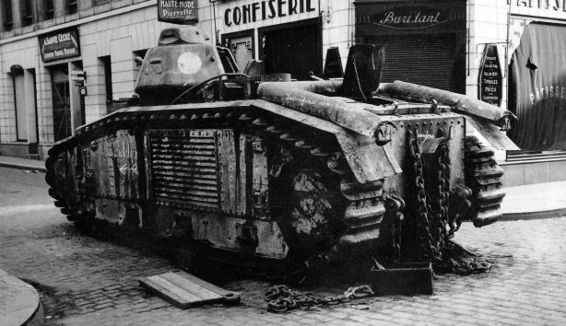
Despite the Allied evacuation at Dunkirk the French and British armies continued to resist the German invasion for another three weeks. By this stage both the French armoured and mechanised forces had been completely dissipated. This Char B lies derelict on a French street; German military police have marked the hull to indicate their knowledge of the tank’s presence. The chains at the rear indicate that it was under tow before being abandoned.
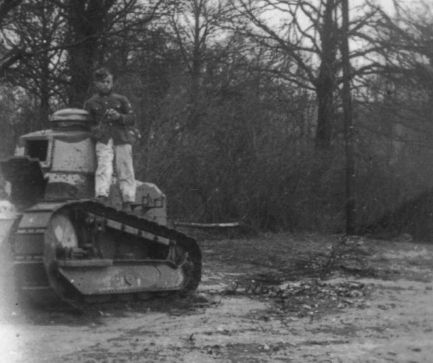
This German soldier could not resist the opportunity to have his photograph taken atop this FT-17 light tank. This particular example had clearly been painted with a camouflage scheme.
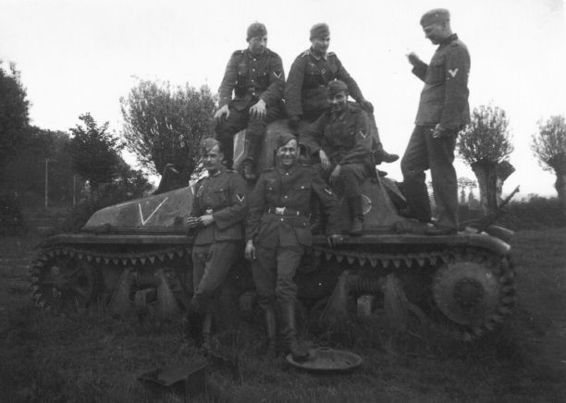
More Germans grinning for the camera – this time they are posing with a H-39.
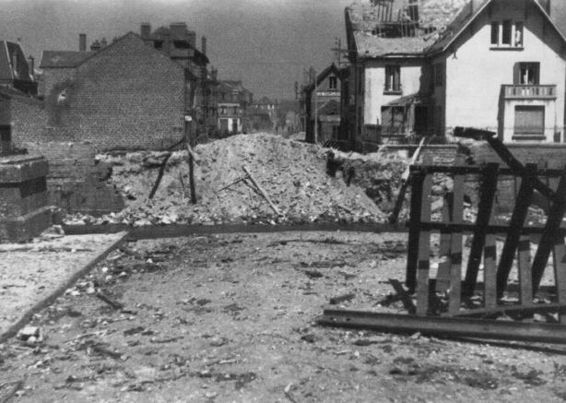
Preparations for the defence of Paris were half-hearted to say the least, comprising roadblocks, machine-gun nests and a few trenches. Such barricades as this one would have proved little impediment to Hitler’s panzers.
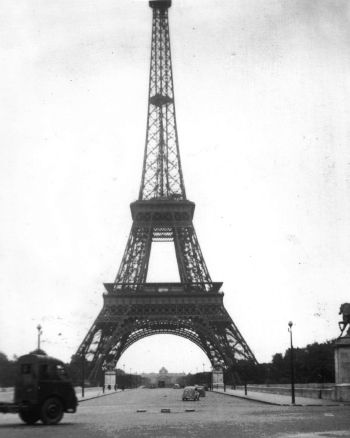
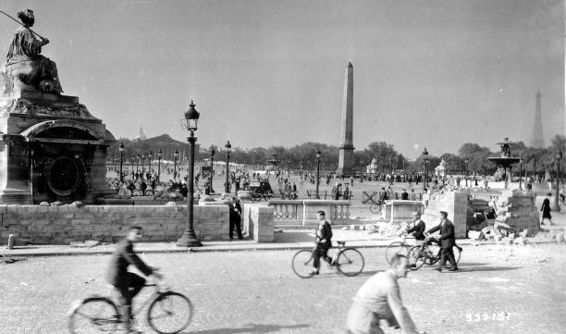
Paris was bombed by the Luftwaffe on 3 June 1940. The French military had drastically conflicting views on whether the capital should be held against the nazis, however on 13 June it was announced that Paris would be made an open city.
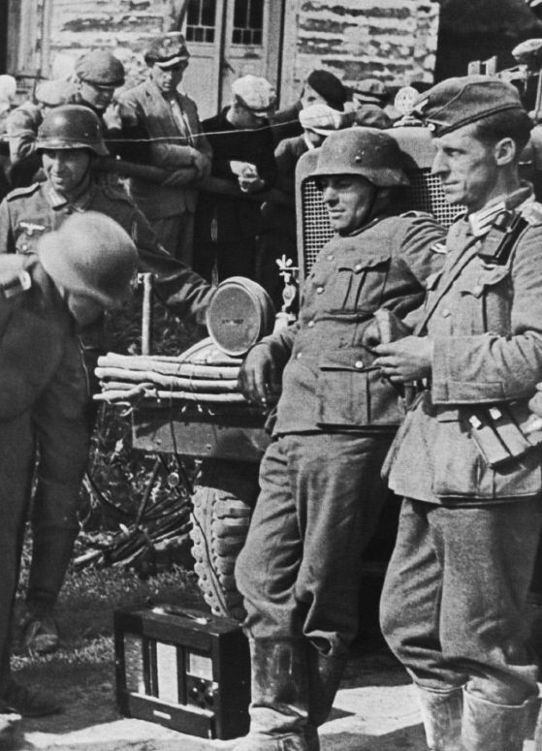
These German troops taking a break from the Blitzkrieg are listening to the radio announcement of France’s surrender. The armistice was signed on 22 June 1940.
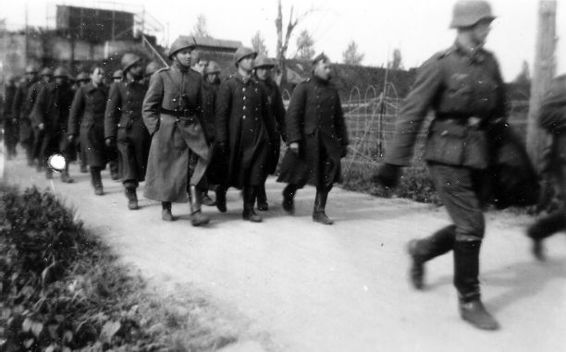
The French Army was forced to lay down its arms. The photograph above shows a French garrison marching from its fixed fortifications – the enormously costly defences of the Maginot Line proved useless in France’s hour of need. The German Army Group C simply bypassed them and hemmed in the defenders. The photograph below shows a column of bedraggled POWs en route to captivity.
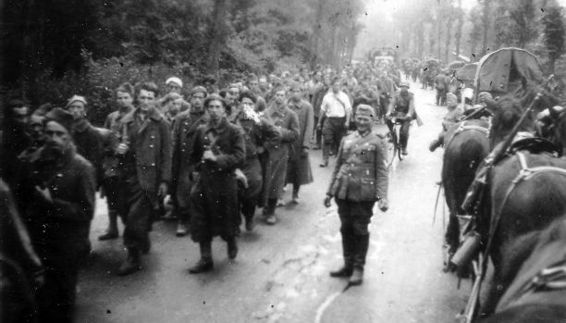
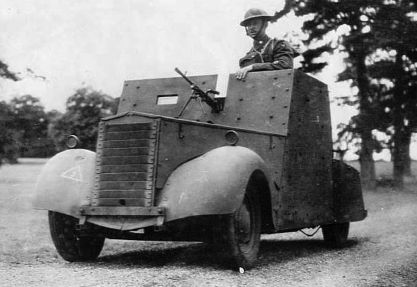
The remains of the BEF returned to Britain bereft of all its equipment. Fearing imminent Nazi invasion, stopgaps had to be produced such as this homemade-looking ‘Ironside’ armoured car.
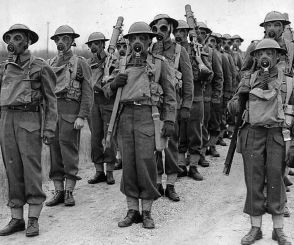
In the wake of Dunkirk the British Army had to look to its defences amidst fears that Hitler might resort to chemical weapons. Fear of invasion soon gripped the whole country.
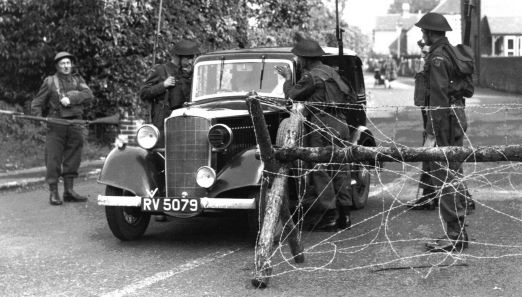
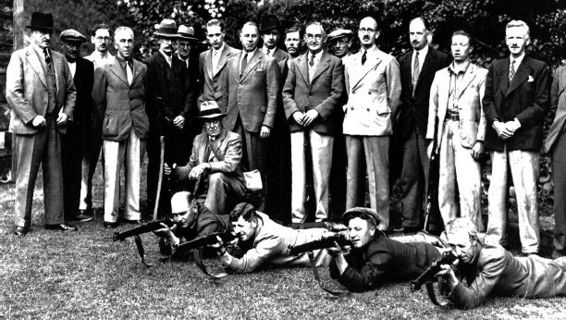
The nation also turned to ‘Dad’s Army’ or the Home Guard to help defend the British Isles.
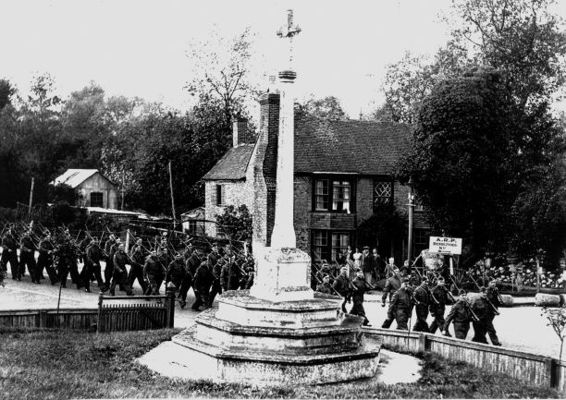
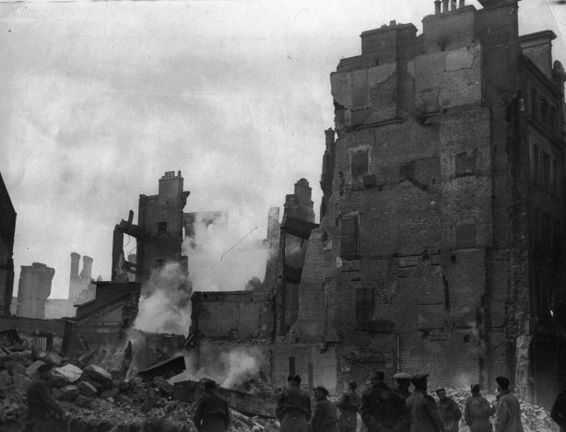
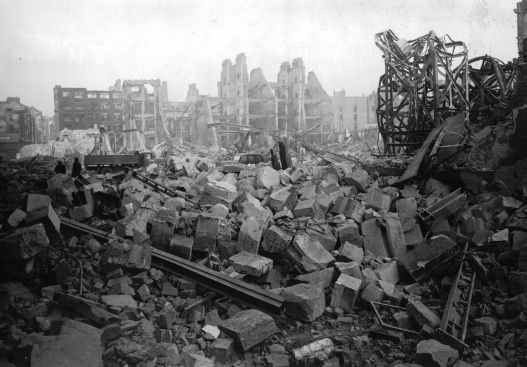
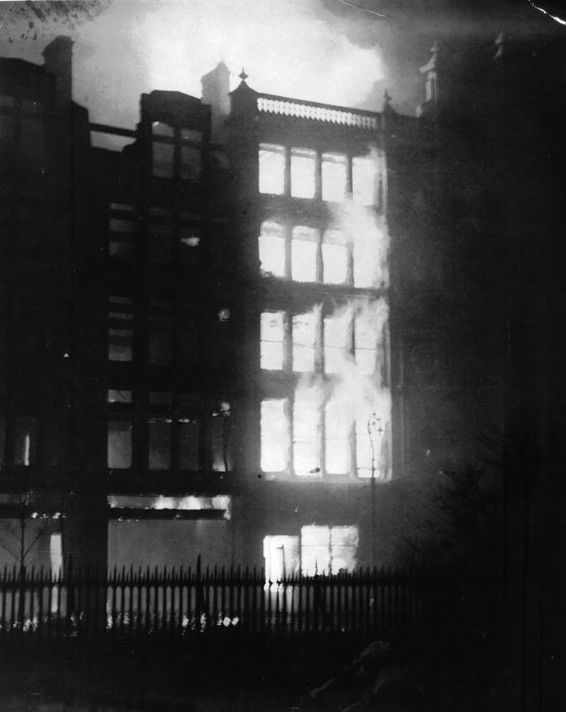
It was not long before the Luftwaffe was pounding Britain’s cities in a prelude to the Battle of Britain. Having taken Paris, Hitler wrongly hoped that Churchill would sue for peace.
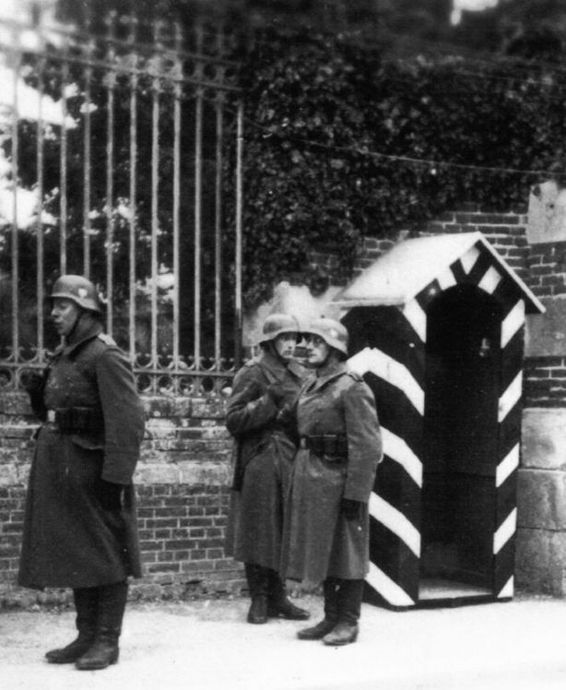
While Britain was spared invasion France had to endure five years of Nazi occupation.