
Chapter Four
Hitler had 3 million men available for the attack on France supported by around 2,500 tanks and 7,380 artillery pieces. Despite everything that has been said and written in the intervening years about the Blitzkrieg, the German Army was only semi-mechanised. In addition many of its best equipped and elite units were easily offset by the numerous second and third-rate divisions. Some 135 divisions were assigned to the offensive, which included 42 reserve units, however only half the German divisions available in 1940 were combat ready. Only 10 per cent of the German Army was motorised with 120,000 vehicles, compared to the French Army which had 300,000 vehicles. Most German support units were reliant on horse-drawn vehicles.
Hitler’s bold plan for his assault on Western Europe relied on deception, power, speed and surprise. Along the front facing the Netherlands and Belgium he massed the thirty divisions of Army Group B which were to strike through the Low Countries in a four-pronged attack. This was really a diversionary attack for Hitler hoped that the British and French would despatch their best troops to assist the Belgians and the Dutch hold their key defences along Belgium’s Dyle River.
Hitler’s real attack would come further south through the forests of the Ardennes using the forty-five divisions of Army Group A which included most of his armour and motorised infantry. Hitler intended they would cut through the gap between the Maginot Line and the Dyle Line, charge across France to the English Channel then swing north to help Army Group B encircle and annihilate almost 1 million Allied troops that he hoped to trap.
Under the terms of the 1919 Treaty of Versailles the German Army was officially forbidden to possess tanks, and had to train with dummy ‘paper panzers’. Secretly it tested equipment in the Soviet Union in order to circumvent the treaty. General Heinz Guderian went to Sweden in 1929 as an observer and gained first-hand experience with Swedish tanks, ironically based on First World War vintage German designs.
Hitler soon found a way round the ban and ordered the production of a dozen Land-Schlepper or ‘agricultural tractors’ for training purposes, which was in reality the Panzer I chassis without the turret. When Hitler saw the experimental Panzer Mk I being put through its paces at the Army Weapons Office’s Kummersdorf training ground, he turned to Guderian and said, ‘That’s what I need! That’s what I want to have!’ The 1st Panzer Regiment came into existence and soon grew into the 1st, 2nd and 3rd Panzer Divisions, with Guderian taking command of 2nd Panzer.
The number of panzer divisions was expanded with the creation of the 4th and 5th as well as four additional panzer brigades. Hitler’s Panzer arm needed tanks that combined the right balance of armament, armour and speed, but deliveries of the newly designed Panzer III and IV were slow, which meant relying on the poorly armed light Panzer I and II.
When the storm clouds began to gather across Europe in the late 1930s Hitler knew only too well that German rearmament was far from complete. Despite his grandiose plans, Germany was not geared up for total war. On the eve of the Second World War his armed forces or Wehrmacht had just over 3,300 tanks, of which only 629 were Panzerkampfwagen (PzKpfw) Mk III and IV. These forces were outclassed by France’s tanks and vastly outnumbered by Russia’s.
General Guderian, commanding the 19th Panzer Corps, records 2,574 tanks were available for the attack on France. The Anglo-French force had in excess of 4,000 tanks. Almost 10 per cent of Hitler’s tank force attacking France was in fact of Czech origin. According to Guderian the 1st Light Division, re-designated the 6th Panzer Division on 18 October 1939, deployed 106 Czech PzKpfw 35(t)s, while 228 Czech PzKpfw 38(t)s were fielded mainly with the 7th and 8th Panzer Divisions.
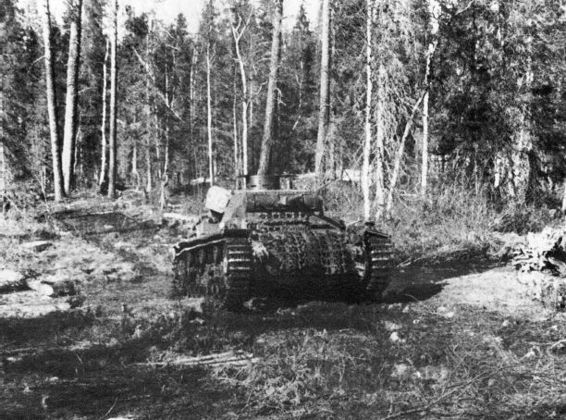
The 7th Panzer Division, commanded by General Erwin Rommel and nicknamed the ‘Ghost Division’ because it was everywhere, was single-handedly to capture 450 enemy tanks. Czech guns also served the Wehrmacht during the invasion of the Low Countries and France. A Czech 4.7cm anti-tank gun was mounted on the Panzer I chassis and between March 1940 and February 1941 over 200 were converted, and first seeing action in Belgium and France the conversion stayed in service until 1943.
Only at Arras on 21 May did the panzers suffer any real setback, when a depleted French light mechanised division with some 60–70 Somua tanks and a British armoured brigade with another 74 tanks successfully attacked 3 German divisions. Unfortunately in the confusion the British found themselves under attack by the French and knocked out four Somuas before the error was realised. The Germans eventually threw back the Anglo-French counterattack using their 88mm anti-aircraft guns in a dual anti-tank role.
Aside from his panzers another of Hitler’s key assets was his air force or Luftwaffe. Under Herman Goering, a former First World War fighter pilot, the Luftwaffe had been building its strength throughout the second half of the 1930s. It had amassed almost 3,000 aircraft by August 1938; this number had increased to 3,750 by the time of Hitler’s invasion of Poland on 1 September 1939. Despite losses over Poland and then over Norway in April 1940, the Luftwaffe could muster almost 5,000 aircraft by May 1940. Some 3,900 were assigned to 2 air groups, Luftflotte 2 and Luftflotte 3, which were poised to lead the Blitzkrieg in the West.
Some 1,815 combat, 487 transport and 50 glider aircraft were in support of Army Group B, while Army Groups A and C could call on another 2,286 aircraft. Again thanks to the success of the German Blitzkrieg and the Stuka dive-bomber another fallacy has arisen that the Luftwaffe was primarily focused on supporting the ground forces. In fact less than 15 per cent of the German Air Force was dedicated to close support of the Army in 1939. Fundamental to the Luftwaffe’s success was flexibility; it was not tied to supporting the Army so could rapidly switch from a tactical support role to medium-range interdiction and strategic bombing. In contrast flexibility was something the Allies inherently lacked.
The Allies failed to heed the warning signs in Poland: 6 panzer divisions and 4 light divisions with a total of 3,195 tanks spearheaded the advance of 44 divisions into the country. The Luftwaffe swiftly achieved complete air superiority and the illequipped Polish Army staggered back before the full onslaught of the Nazi Blitzkrieg. The Poles had few tanks and anti-tank guns and despite the bravery of their cavalry the country was rapidly overrun. The Allies should have made creating their armoured divisions and beefing up their air cover a matter of the utmost urgency during the period of the Phoney War – but it was not to be.
It was during the invasion of Poland that the Germans perfected their concept of Blitzkrieg or Lightning War. In the opening phase the Luftwaffe’s dive-bombers and medium bombers would strike enemy airfields and troop concentrations, roads, railways and bridges causing chaos and confusion. Then their forces would advance to contact, and under the cover of dive-bombers and a smoke screen reconnaissance units would speed towards enemy positions probing for weak points in their defences. In their immediate wake came the panzers and motorised infantry carried in armoured halftracks.
Once in contact, while outlying enemy forces were being engaged, the reconnaissance units would dash for the enemy’s administrative and industrial centres. These they would bypass cutting them off ready for the main assault delivered by their infantry and artillery. Once again the Luftwaffe would strike bombing factories and communication centres. The reeling enemy ground forces would soon find themselves enveloped and cut off from outside help leaving one outcome – defeat. Any counterattacks were usually easily crushed by the concentrated power of the panzers and the Luftwaffe. The Allies singularly failed to learn from this.
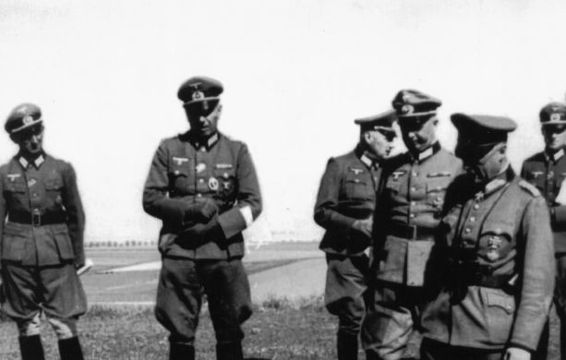
After overwhelming Poland the German high command was confident that it could tackle the French Army.
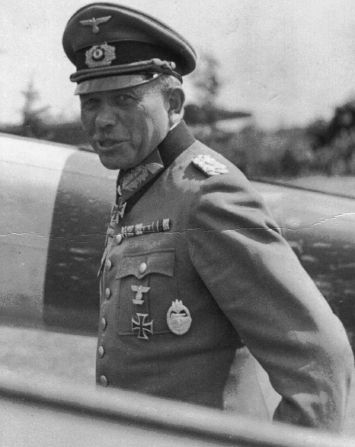
General Heinz Guderian, seen right, commanded the 19th Panzer Corps for the attack on France. His would be the decisive blow.
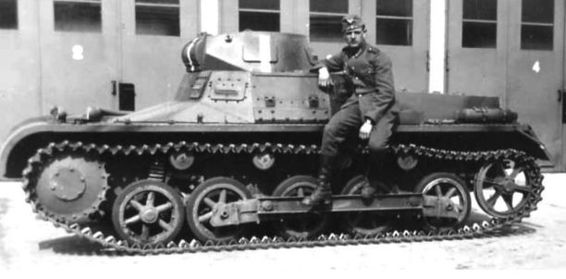
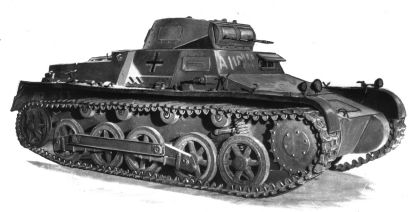
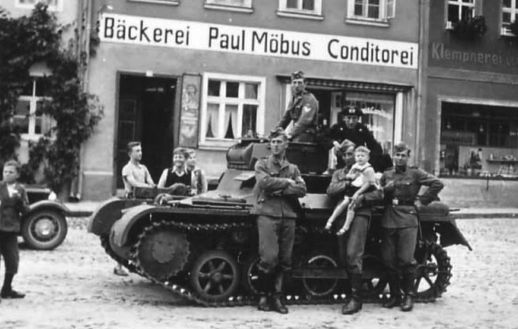
This was the tank that gave rise to modern armoured warfare and led to a tank arms race. Over 500 Panzer Mk Is took part in the campaign in the West. In the 1930s the German firms Daimler-Benz, Henschel, Krupp, MAN and Rheinmetall were asked to prepare prototypes similar in concept to the British Vickers-Carden-Loyd light tanks. The Krupp design became the PzKpfw IA followed by the Ausf A – both types were combat tested during the Spanish Civil War.
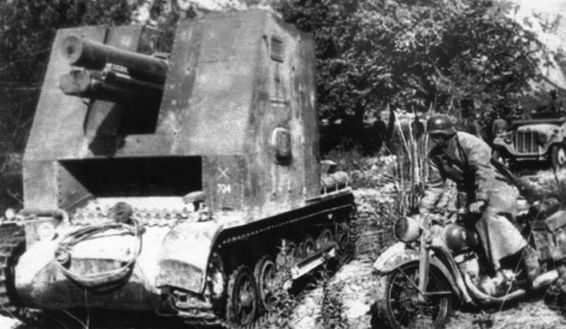
Germany’s very first self-propelled gun. The Panzer Mk I chassis was used as a mount for the German 150mm gun. This top-heavy looking conversion was conducted by Alkett at the Berlin-Spandau works. Some thirty-eight were converted and first saw combat in Poland and subsequently saw action in the Western campaign.
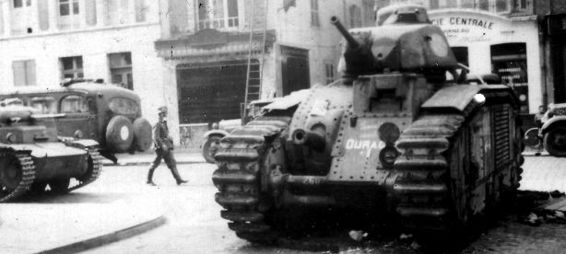
Just to the left of this knocked out French B1-bis is a Panzer Mk II. It was employed in Poland in 1939 and in France the following year. The Germans had 950 Mk IIs in service at the beginning of the Western campaign. It could be said this tank type formed the backbone of the Panzerwaffe as it represented the highest number of any one type out of the 2,500 German tanks deployed. Unlike the Mk I that mounted a machine gun, the Mark II was armed with a 20mm cannon.
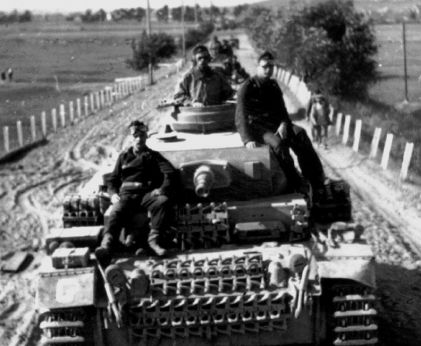
In February 1940 the Panzer Mk III Ausf A, B (seen in the photograph below) and C had been withdrawn from service due to problems with the suspension and thin armour. On 10 May 1940 there were 348 Mk IIIs mainly model E and F but with a few Gs deployed with the seven panzer divisions taking part in the attack on France. These Mk IIIs were armed with a 37mm antitank gun and two machine guns.
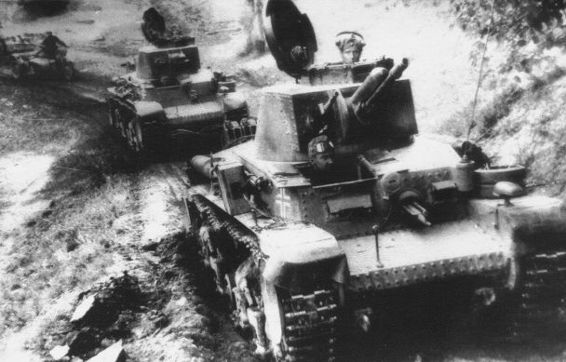
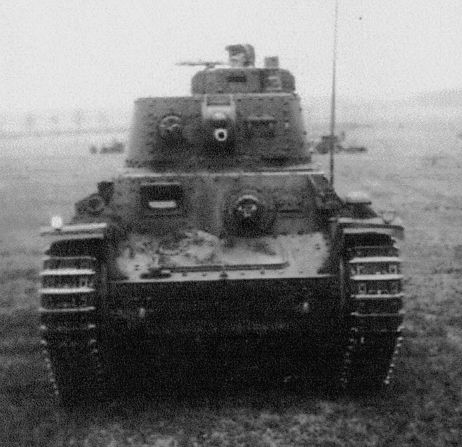
The panzer divisions also included Czechdesigned LT-35 (seen here) and LT-38 tanks that were collectively known as ‘Skodas’ by the Germans. In fact almost 10 per cent of Hitler’s attacking force was of Czech origin.
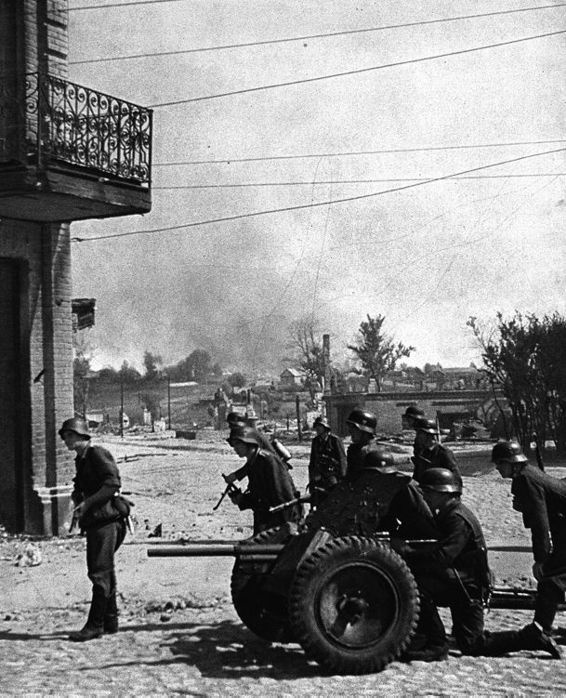
The Germans standard anti-tank gun in 1940 was the 37mm Pak 35/36, which was developed by Rheinmetall and first combat tested in Spain in 1937-8. While its penetrative power was not quite as good as some of its contemporaries, its mobility more than made up for this.
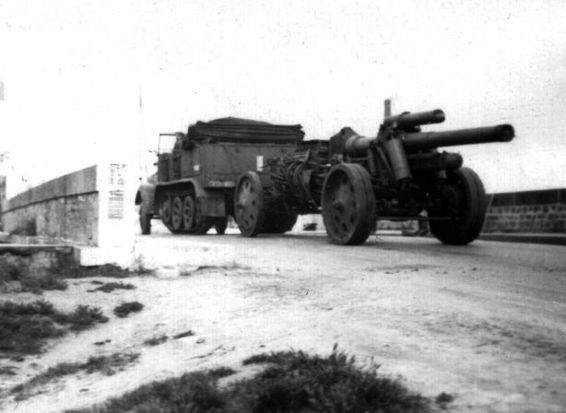
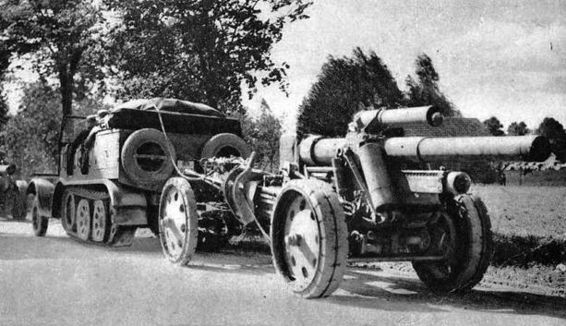
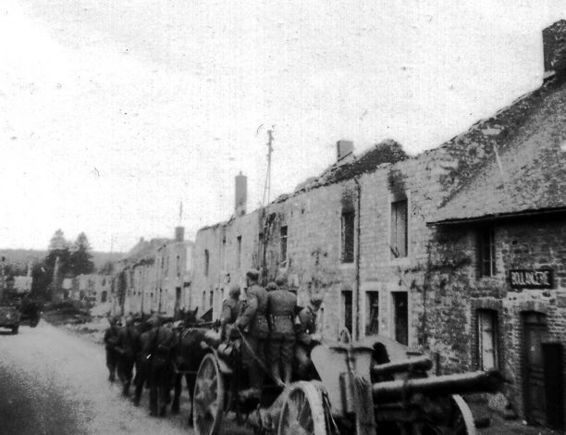
The backbone of the German medium artillery during the Second World War was the sFH18 150mm, seen opposite. Developed during the late 1920s, the howitzer was by Rheinmetall while the carriage was from Krupp. The standard divisional piece was the 105mm leFH 18 field gun, seen above, also designed by Rheinmetall. While a robust gun, it was rather heavy which hampered its mobility.
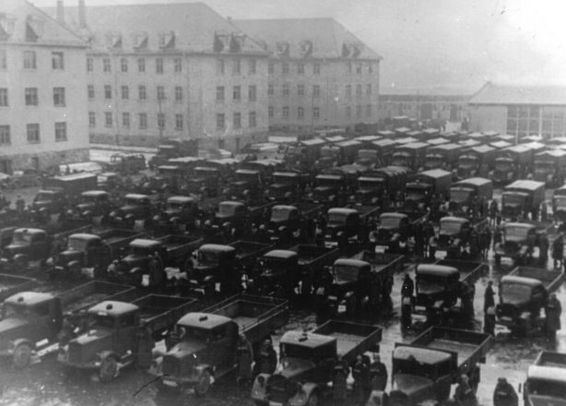
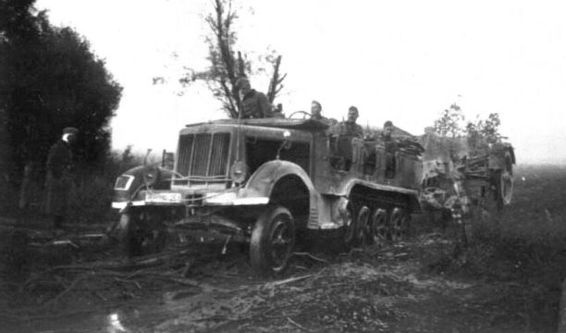
The German Army used both lorries and halftracks.
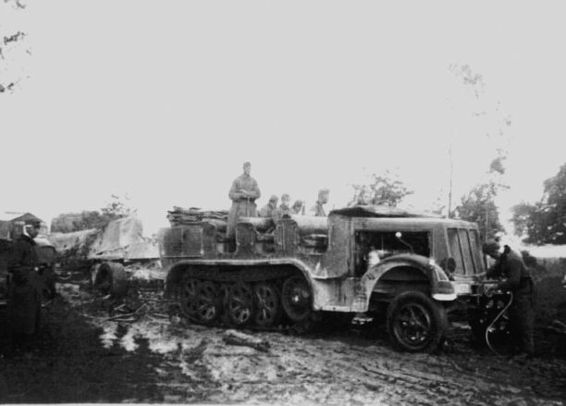
The Sd Kfz 7 and Sd Kfz 8 semi-tractors were produced in large numbers and were variously used to tow artillery or as self-propelled gun carriages.
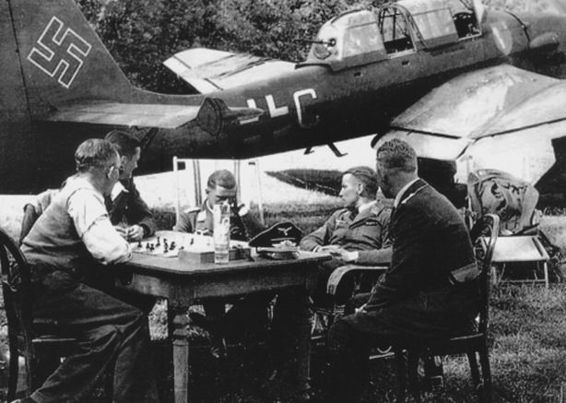
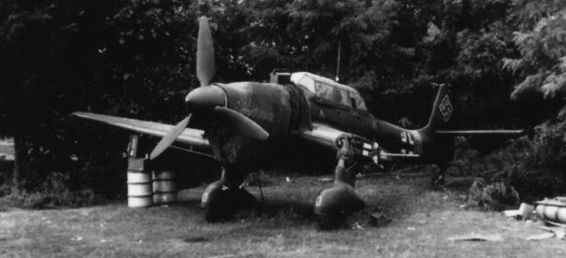
A key part of Hitler’s strike force was the Luftwaffe and in particular its dive-bombers. The Stuka (an abbrevition of Sturzkampfflugzeug or dive-bomber) Junkers Ju 87 established its fearsome reputation during the Polish campaign. It proved a terrifying war machine signalling death from the skies with a screaming siren. Nonetheless it was only effective once air superiority had been achieved and otherwise was vulnerable to enemy fighters, as was proved during the subsequent Battle of Britain.
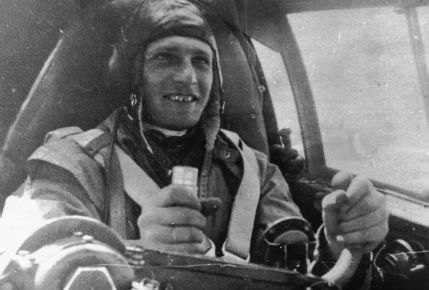
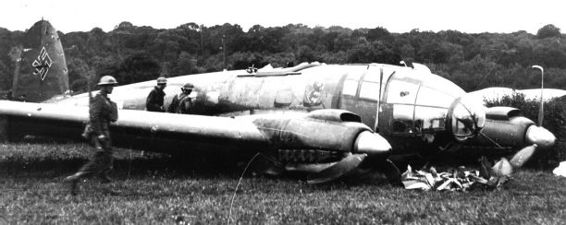
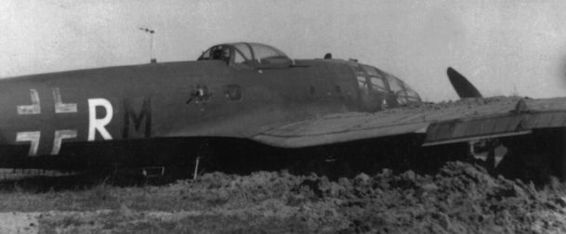
A grinning Luftwaffe bomber pilot. The Heinkel He 111 medium bomber bore the brunt of the Luftwaffe’s bombing efforts in Poland in 1939, Norway and Denmark in April 1940 and France and the Low Countries in May 1940. This bomber first saw action with the German Condor Legion during the Spanish Civil War. The two seen here were shot down in England.
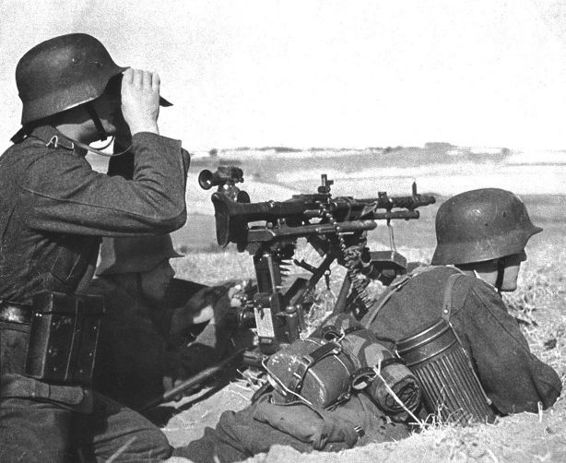
Ready for action – German troops scanning enemy positions. They are manning the Maschinengewehr MG34, which could manage a devastating 900 rounds a minute. It is easily recognisable by the round pierced cooling sleeve on the barrel.