
Chapter Eight
British tanks struggled along choked roads through Carvin and Lens to cover the 30 miles between Orchies and Vimy. The last of the 1st Tank Brigade reached Vimy at 0500hr on 21 May thereby delaying Franklyn’s plans. The lack of trains meant the tanks had covered 120 miles in 5 days and this took its toll in wear and tear; of the 77 Matilda Mk Is 19 had been lost and of the 23 Mk IIs 7 of these were unserviceable. While more numerous, the Matilda I’s armour was almost impervious to the Germans’ standard 37mm anti-tank gun, but its Vickers machine gun lacked real bite. Without an anti-tank gun it simply was not in a position to take on the panzers.
Major General Martel, 50th Division’s commander, was instructed to clear the south of Arras as far as the Cojeul River, a distance of just 10 miles. Following this the 5th Division’s 13th Brigade was to advance south to link up with the 151st Brigade from 50th Division. These combined forces were then to push on to a line on the River Sensee to the south-east. in total Martel’s attack force numbered some 3,500 troops supported by 74 tanks. He organised them into two mobile battle groups each consisting of a tank and infantry battalion supported by field artillery and anti-tank batteries. For the opening of the Arras attack the French 3rd Light Mechanised Division’s S-35 tanks were supposedly to screen the British right flank.
The two British columns were to sweep south-east of Arras. The right-hand column spearheaded by the 7RTR with twenty-three Matilda Is and nine Matilda IIs was to push through Duisans, Walrus and Berneville to the Beaumetz–Arras highway, from where it was to attack toward Wailly, Ficheux and onto the Cojeul River. The left-hand column lead by the 4RTR with thirty-five Matilda Is and seven Matilda IIs was to drive through Dainville, Achicourt, then split clearing Agny to the south to Mercatel and the Cojeul; while just to the north the rest would attack through Beaurains, Neuville and then onto Wancourt on the Cojeul.
The infantry units supporting the tanks were from 6th and 8th Bttalions of the Durham Light infantry (DLI) assigned to the 4RTR and 7RTR respectively. These were Territorial Army units from north-east England and had only half their number of Bren light machine guns, no radios and little artillery. Each column was supported by a battery of just twelve field guns and twelve 2-pounder anti-tank guns. The lack of radios hampered communication with the tanks. The DLIs also lacked adequate transport and were suffering with their feet. They spent the night in the shadow of a much earlier battlefield near the Canadian memorial at Vimy Ridge.
Facing them was Rommel’s 7th Panzer Division consisting of the 25th Panzer Regiment with about 180 tanks and the 7th Rifle Brigade numbering about 4,000 men. They were well supported with thirty-six 105mm field guns and howitzers and thirty-six 37mm anti-tank guns; crucially the 23rd Flak Regiment included a battery of 88mm anti-aircraft guns, which could be used in a dual anti-tank role. Even without the assistance of the nearby 5th Panzer Division Rommel outgunned and outnumbered Martel’s attacking force from the start.
Rommel was aware of the concentrating British and French forces north of Arras and intended to strike west of Arras with the SS Totenkopf Division screening his left flank toward Beaumetz, while the 5th Panzer Division would strike east on his right. To guard his right flank south-east of Arras Rommel established a defensive line extending from Wailly to the west to Neuville in the east.
At 1315hr on 21 May 1941 the British tanks began moving the 8 miles to their Arras–Doullens road start line without the DLI, which had been delayed. They did not catch up with the tanks until 1600hr. Martel found that Maroeuil was already under shellfire at 1430hr and that German troops were in Duisans to the south. The day did not start off well when British tanks accidentally engaged some French ones near the village. Luckily there were no losses before the error was realised.
Rommel takes up the story: ‘At about 15.00 hours I gave the Panzer Regiment orders to attack. Although the armour had by this time been seriously reduced in numbers due to breakdowns and casualties.’ He must have been wrong about the timing, because the French reported seeing panzers on the right flank as the British attack got underway. Discovering the panzers also had no infantry support, Rommel sped off toward Ficheux, finding part of the 6th Rifle Regiment he headed toward Wailly. ‘One of our howitzer batteries was already in position at the northern exit from the village,’ recalled Rommel, ‘firing rapid on enemy tanks attacking southward from Arras.’
After capturing Duisans two companies of the 8th DLI and two troops of the 260th Anti-Tank Battery were left to defend the village. The 8th DLI’s anti-tank guns and support platoon soon went into action against some French tanks! The latter then supported the DLI’s attack on the cemetery near Duisans. The number of German prisoners taken there varies, the implication being that some were shot out of hand. The SS were later to cite the DLI’s behaviour at Arras as the excuse for murdering British POWs at Le Cornet and Wormhoudt.
Certainly heavy casualties among the DLI’s officers meant that POWs received little sympathy from their captors. An officer of 7RTR escorting a German noncommissioned officer was appalled at the treatment the man received. ‘I continued into Dainville and handed over the prisoner to a Captain of the DLI for conveyance to Provost Personnel. The troops displayed great animosity towards the prisoner, and I was compelled to draw my revolver and order them off before I could reach their officer.’
By mid-afternoon with Warlus and Berneville in British possession the 8th DLI finally found themselves on the Arras–Doullens road/railway start line. German defences around Berneville inflicted heavy casualties on the DLI and a Stuka divebomber attack showed the glaring lack of air support available to the British. However, the 7RTR’s tanks pressed on reaching Wailly.
At Wailly Rommel found, ‘The enemy tank fire had created chaos and confusion among our troops in the village and they were jamming up the roads and yards with their vehicles, instead of going into action with every available weapon to fight off the oncoming enemy.’ Moving west of Wailly with Lieutenant Most at his side, Rommel saw that the advancing British tanks, spearheaded by a Matilda II, had already crossed the Arras–Beaumetz railway and set about a Panzer III. British tanks were also pressing in from the north from Bac du Nord, which lay north-west of Wailly. Some of his infantry took flight taking the crew of a howitzer battery with them.
At this point the British were suddenly taken by surprise by Rommel’s well-concealed anti-tank guns and anti-aircraft troop who were hiding in the hollows and small wood. Rommel and Most crept among the guns and personally assigned each its targets. Some of his officers pointed out that the range was too great but Rommel knew they could not wait or they would be overrun. He then ordered a furious and rapid fire in an attempt to halt the oncoming tanks. Despite being under fire themselves Rommel’s gun crews kept their nerve and opened up.
‘It did not look as though the battery would have much difficulty in dealing with the enemy tanks,’ recalls Rommel, ‘for the gunners were calmly hurling round after round into them in complete disregard of the return fire.’ The leading vehicles soon lurched to a halt. Just 150yd west of the small wood a Matilda II was stopped after its driver was killed, and in a daze a British captain emerged from the tank and staggered hands in the air toward the German lines. At a range of up to 1,500yd beyond the abandoned howitzer battery the reception was so hot that the British veered away. ‘One tank [Mk II] showed as many as 14 direct hits,’ a British tank officer recalled, ‘and the only indication the crew had of being hit was a red glow for a few seconds on the inside of the armour plate.’
One of Rommel’s field guns claimed Lieutenant Colonel Fitzmaurice, commanding 4 RTR, when his Mk VI light tank was hit. The 7RTR commander Lieutenant Colonel Heyland was also killed by machine-gun fire after dismounting from his vehicle. Rommel now turned his attention on those tanks approaching from Bac du Nord. Some caught fire, others were halted while the rest turned tail.
In Rommel’s moment of triumph personal tragedy struck. He recalled:
The worst seemed to be over and the attack beaten off, when suddenly Most sank to the ground behind a 20mm anti-aircraft gun close beside me. He was mortally wounded and blood gushed from his mouth. I had no idea that there was any firing in our vicinity at that moment apart from that of the 20mm gun. Now, however, the enemy suddenly started dropping heavy gunfire into our position in the wood. Poor Most was beyond help and died before he could be carried into cover beside the gun position. The death of this brave man, a magnificent soldier, touched me deeply.
The British left-hand column got as far as Neuville and Wancourt but ran into Rommel’s screening defences consisting of 20mm and 88mm anti-aircraft guns and 105mm howitzers. in the area of Tilloy-Beaurains-Agny the British overran the German’s light anti-tank guns and the SS were put to flight. The British triumph was shortlived as Rommel recalls, ‘Finally, the divisional artillery and 88mm anti-aircraft batteries succeeded in bringing the enemy armour to a halt south of the line Beaurains-Agny.’ The carnage among the British armour was considerable, according to Rommel, ‘Twenty-eight enemy tanks were destroyed by the artillery alone, while the anti-aircraft guns accounted for one heavy and seven light [tanks].’
At 1900hr Rommel ordered the 25th Panzer Regiment to strike south-eastwards in order to take the British in the rear. South of Agnez, which lay west of Arras and Duisans respectively, the panzers ran into a superior force of British tanks. In the following tank battle the Germans lost ten panzers but knocked out seven Matilda IIs and six anti-tank guns. The panzers broke through and the defeated British headed back toward Arras.
By 2215hr the British left-hand column was withdrawing on Achicourt, south of Arras, where the 6th DLI conducted a hotly contested rearguard action. On the right, six French tanks and two armoured personnel carriers got through to Warlus past midnight and covered the retreat. Ten Bren gun carriers from the 9th DLI covered the withdrawal of those men still at Duisans. Although Rommel had received a bloody nose, he had kept his nerve and thrown back the brave but futile British counterattack.
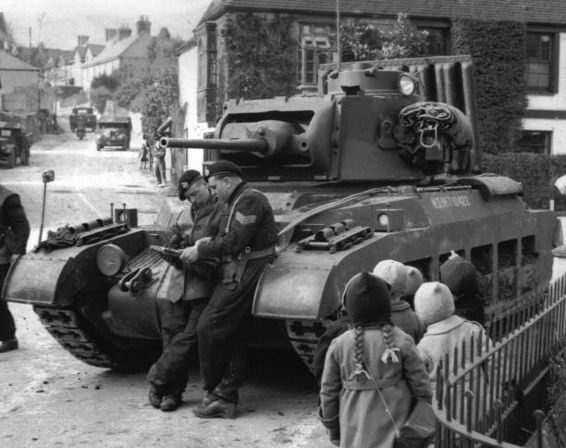
Where are we? The early production Matilda II deployed to France is recognisable by the Vickers machine gun on the left-hand side of the turret, rather than the smaller Besa 7.92mm fitted in the Mk IIA. While the British Prime Minister was insistent that the British and French armies should counterattack, General Blanchard’s French 1st Army was in no position to help the BEF.
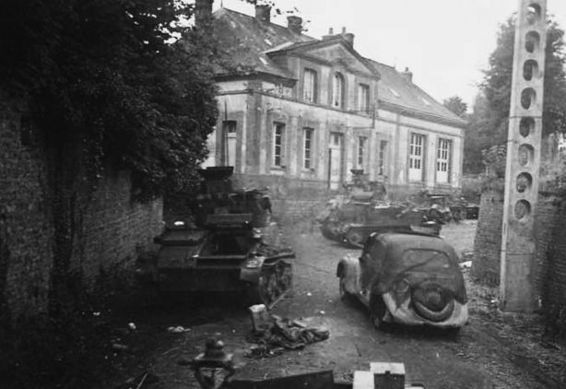
Most of the BEF’s tank strength was made up of the Mk VIB light tank armed with two Vickers machine guns. The 4RTR and 7RTR shipped to France with seven MK VI light tanks each.
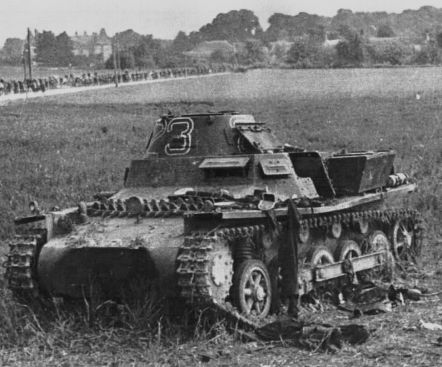
The Panzer Mk I seen here, comparable to the British Mk VIB, was not able to withstand the Matilda II. The British 1st Tank Brigade supported by elements of two infantry divisions confronted Rommel’s 7th Panzer Division, which was equipped with 180 panzers including the Mk I, at Arras.
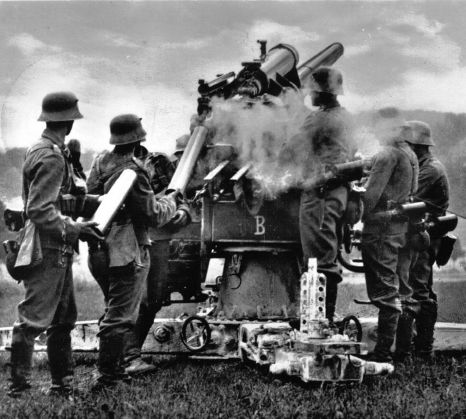
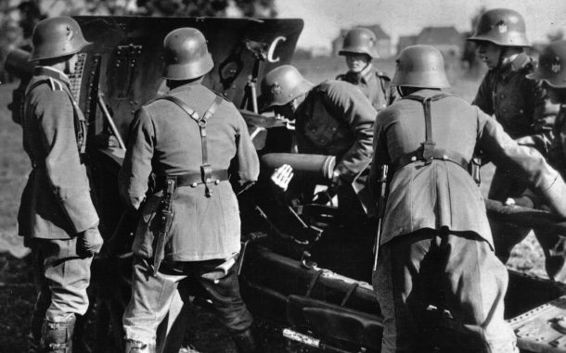
The concentrated firepower of Rommel’s artillery was instrumental in thwarting the British attack accounting for twenty-eight tank kills. According to Rommel, his flak guns, including the 88mm, used in an anti-tank role claimed one heavy and seven light tanks.
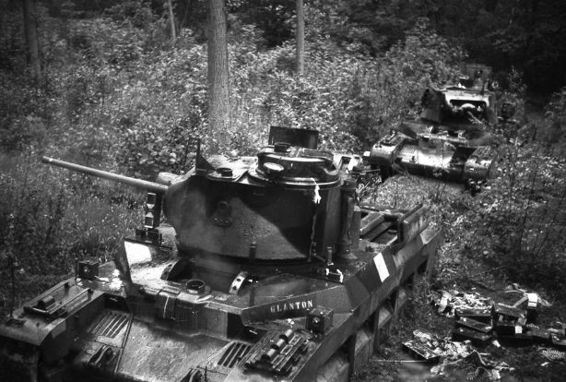
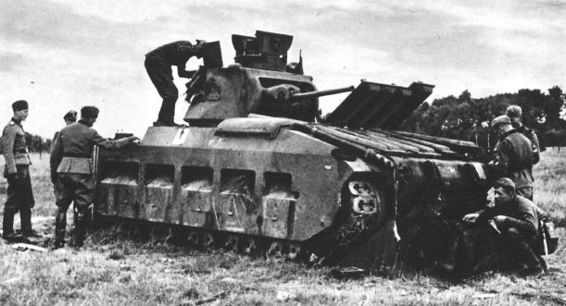
Knocked out British Matilda tanks lost during the fighting in the Arras area. In 1940 the Matilda Mk II Infantry Tank was the heaviest in British service, but was not available in sufficient numbers and those used against Rommel were simply brought to a halt by his superior firepower.
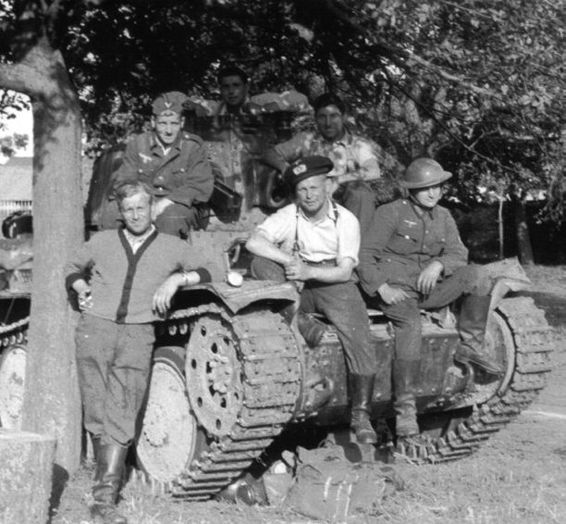
Triumphant panzertruppen seated on their Czech-built PzKpfw 38(t) – note the man on the right at the front sporting a captured British helmet.
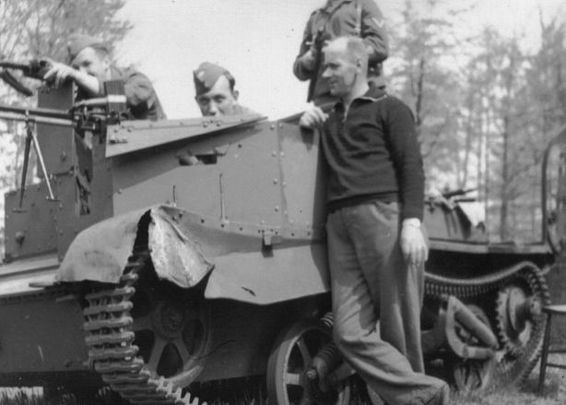
More war trophies – this time a captured British Bren gun carrier.
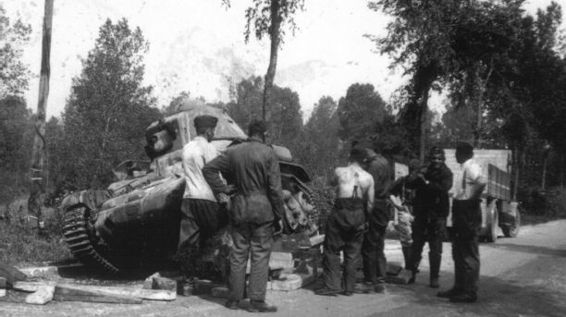
At Arras the British sought the help of the French Cavalry Corps and the French 5th Corps, but between them all they could muster was the 3rd Light Mechanised Division. German troops are seen with knocked out French R-35s.
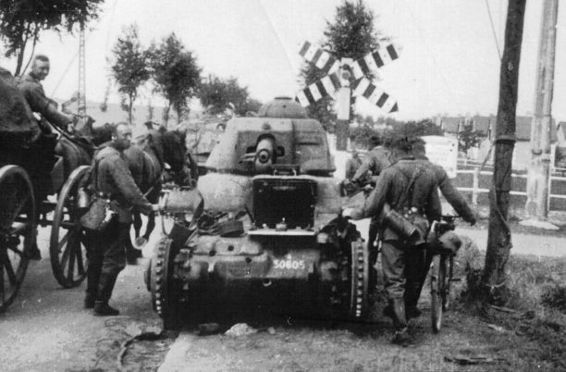
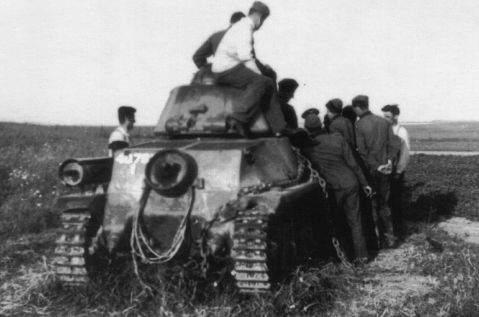
German troops with an H-35 at Arras. By the time of the counterattack here the 3rd Light Mechanised Division had already lost all its H-35s.
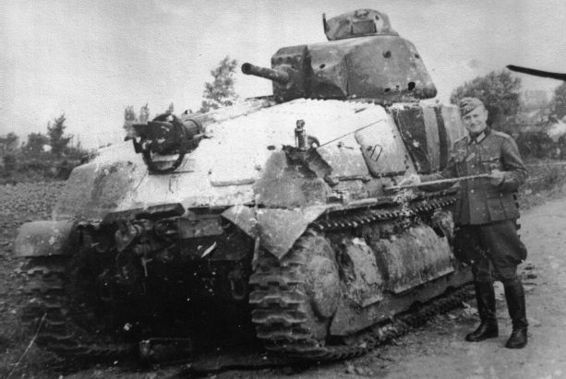
This German officer is highlighting all the anti-tank gun penetration marks on this unfortunate S-35. General Langlois’s 3rd Light Mechanised Division with some sixty such tanks was supposed to have supported the British counterattack at Arras but was two days late. When the French did commence their attack they were pounded to a halt by dive-bombers and artillery and the tank crews fled.
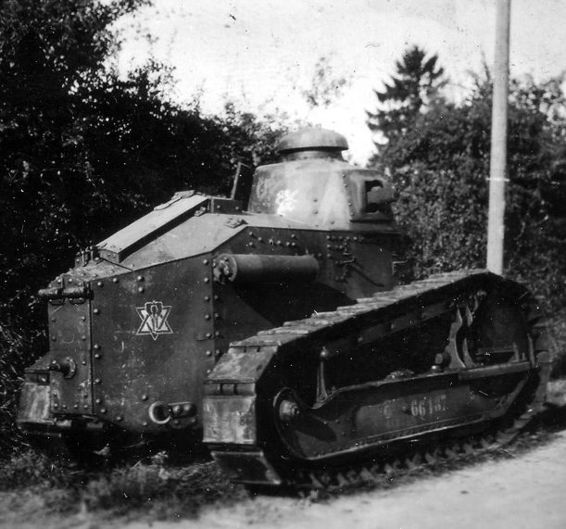
A French FT-17 light tank lays abandoned at the roadside. This type of tank was woefully obsolete and even in an infantry support role was simply too slow.
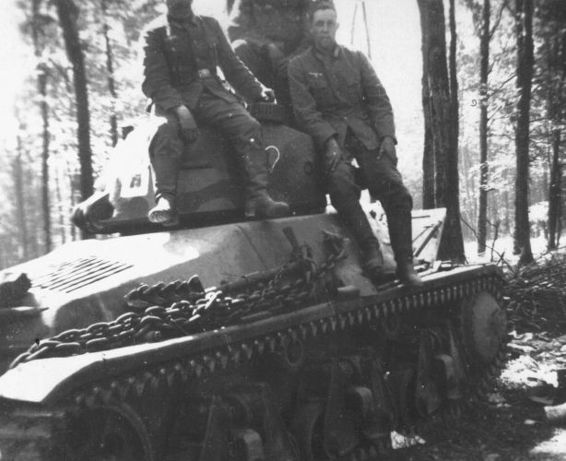
These German soldiers are posing on a Hotchkiss H-39, which is easily identifiable from the earlier H-35 by the slopping rear engine cover. This particular tank seems to have been abandoned in some woods somewhere in northern France.