
CHAPTER 6
After the German withdrawal from Normandy, Hitler held firm in his decision to defend Paris to the last, ignoring the fact that there were no longer sufficient forces in the region to carry out his orders. On the morning of August 25, American forces entered Paris, led by a Free French contingent under General Leclerc. The German garrison offered some light resistance, but by 2:30 P.M., General von Choltitz surrendered the city. The liberation of the former French capital was of greater symbolic than strategic value, yet when von Choltitz disregarded the Führer’s order to leave Paris in ruins Hitler viewed the surrender as an act of betrayal. Outside Paris, and throughout northern France, German forces were conducting a massive withdrawal to the east in an attempt to escape across the Seine. The German Army of the West did not pause in its retreat until it reached more defensible positions on the great northern European waterways, the Scheldt, the Meuse, and the tributaries of the Rhine.
The collapse of their defenses in Normandy led the Germans to abandon most of France. Over the past few weeks, the survival of Army Group B had depended more upon decisions made by local commanders than upon any large-scale movements ordered by OKW. German troops were now retreating in disarray. Along the Seine, their forces were not strong enough to offer serious resistance, while at the same time, the German Nineteenth Army was in flight up the Rhone Valley as the south of France was evacuated in the face of the Allied ANVIL landings. The loss of France was a serious blow to OKW. Under German occupation, the country had supplied a major portion of the food, iron ore, bauxite, coal, and labor that was essential to the Nazi war effort. The Germans were also forced to leave some fifteen hundred tanks behind in France1 and lost the use of the Atlantic ports along the Bay of Biscay, thus further restricting U-boat capabilities.
By the end of August, the Battle of Normandy was over. In eighty-eight days of fighting, the West Army had lost four hundred thousand soldiers as casualties or prisoners of war, while Allied losses amounted to slightly over two hundred thousand. Five panzer divisions had been destroyed and six severely mauled.2 Twenty German infantry divisions were consumed in the fighting, with a further twelve suffering crippling losses. At the close of the campaign, three divisions were trapped in Brittany, and another left isolated in the Channel Islands. German equipment losses were also extremely high after their disordered retreat through the Falaise Gap: 20,000 vehicles, 500 assault guns, 5,500 field guns, and 3,545 aircraft had to be abandoned. During the Battle of Normandy, the West Army had fifty infantry and twelve panzer divisions in the field. Now only about twenty infantry and six panzer divisions retained any semblance of organization.3 In real numbers, the situation was even worse as several panzer divisions had been reduced to about ten tanks each. Several infantry divisions were at one-quarter strength. In terms of combat effectiveness, the Allies had about twice as many infantry and armored divisions at their disposal as the fighting moved west of the Seine. The ratio for their tanks was about twenty to one, while their advantage in air-power was even more dramatic. The Allies had fourteen thousand combat and hundreds of reconnaissance aircraft, while the Luftwaffe’s Third Air Fleet had been reduced to 573 planes of all types.
Allied optimism that the war would soon be at an end seemed justified as August came to a close. About five Allied divisions were pressing on the general area of Elbeuf on the Seine, while to the east, Canadian and British troops later advanced toward Calais and Brussels. Hitler’s faith that his advanced weaponry would turn the tide of the war remained unrealized: the British defenses were finally getting the better of the V-1 flying bomb. Of the ninety-seven sent out on August 28, twenty-three were shot down by British aircraft and sixty-five by anti-aircraft guns.4 Five V-1s reached the outskirts of London while another four fell on the city itself. By the end of the month, the Allied bombing campaign against German synthetic fuel plants and oil fields in southeastern Europe intensified, with sixty bombing raids taking place since August 7. On the eastern front, the Red Army had reached the border of East Prussia and the Rumanian oil fields at Ploesti were in Russian hands. Soviet troops were now within three hundred miles of Berlin.
Allied troops, over Montgomery’s objections, were now divided into two army groups.5 The 21st Army Group, composed of British and Canadians under Montgomery, was assigned to the northeast Pas de Calais region while the American 12th Army Group, under Bradley, cleared Brittany and built up strength for an advance eastward from Paris towards Metz. Both army groups fell under Eisenhower’s personal control when he assumed command of Allied ground forces on September 1. Montgomery believed there should be one single powerful thrust towards Germany and that dividing the armies would weaken them, with neither having sufficient strength to push through to Germany.6 Others, however, envisioned the remainder of the campaign in northwest Europe as a victorious advance on a broad front, and nearly everyone except Churchill thought the war would be over by Christmas. It was soon discovered that the Allies had underestimated the German Army’s capacity for recovery and resistance.7
In northern France, Allied forces consisted of four armies. To the north, on the left flank, was the Canadian First Army. The center group consisted of the British Second Army and U.S. First Army. To the south, on the right flank, was the U.S. Third Army. In view of difficult supply problems hindering the delivery of food, fuel, and ammunition to the forces, Eisenhower on August 24 ordered the U.S. First and Third Armies to halt their advance in order to support Montgomery’s operations in the northeast.8Logistical problems were growing more serious as the armies advanced, exacerbated by the far greater consumption of supplies by Allied divisions compared to the Germans: seven hundred tons a day as opposed to two hundred. Meanwhile, the German hold over the English Channel ports rendered Allied forces dependent upon truck deliveries from Normandy in order to sustain their advance.
The Allies had pushed out a great salient from Abbéville in the north and Orléans in the south, with the apex at Verdun. Supply problems, however, prevented them from mounting an effective pursuit on all four army fronts. Recognizing his enemy’s difficult supply situation, Hitler placed a priority on holding the ports of Le Havre, Boulogne, Dunkirk, and Calais. The Allies were already supplying the U.S. Third Army by airlift and now faced the hard decision of which armies would be brought to a halt in order to accumulate sufficient fuel to sustain the others in their pursuit. Tensions soon rose among the Allied leaders, who were faced with the impossibility of fully exploiting their Normandy victory.
In the Allied center, the advance continued with a string of individual victories bringing gradual progress toward Germany. To the west, the British Second Army made a remarkable advance of 110 miles in two days, liberating Brussels on September 3. For three days and nights, Belgium celebrated without restraint. The northern group of armies received orders to seize the Pas de Calais ports and V-1 launching sites, establish airfields in Belgium, and secure the harbor facilities at Antwerp, the only port with both the capacity and location to ease the Allied supply problem.
On September 4, the British made a sixty-mile dash from Brussels to capture the great inland port at Antwerp. The German garrison abandoned the city and there was no major battle. The Belgian resistance was able to help prevent serious damage to the port. These facilities would not be useable, however, until both banks of the fifty-mile Scheldt estuary leading out to the English Channel were in Allied hands. Von Zangen’s Fifteenth Army was still strong numerically but seriously impeded by lack of fighting experience. They were surrounded, but as long as they held the banks of the Scheldt, there would be no solution to the Allied supply problem.9
On September 5, Field Marshal von Rundstedt arrived at the newly-established headquarters in Koblenz to resume his old position as C-in-C West. He replaced Field Marshal Model, who retained command of Army Group B after having found the administration of both headquarters extremely challenging.10 As C-in-C of Army Group B, Model now had about twenty-five divisions with which to defend a front of four hundred miles. In the previous July, sixty-two German divisions had been hard-pressed to hold a front approximately one-quarter that length in Normandy. To make matters more diffi-cult, Hitler was now calling on Army Group B to go on the offensive in Belgium and Holland.11 With von Rundstedt back as C-in-C West, however, Model was, at least, spared the work of a massive combined headquarters.
Hitler sent Model orders for von Zangen to move the Fifteenth Army across the Scheldt in order to defend the Albert Canal line just north of Antwerp. The Channel fortresses guarding the approaches to the port city, Hitler declared, were to be “held preservingly.”12 Every day the Germans could maintain their grip on Antwerp and other Channel ports, the better their chances of building a strong defense along the Rhine and the line of fortifications known as the West Wall. To this end, von Zangen was to create two new “fortresses”—Scheldt North and Scheldt South—in order to deny the Allies the use of Antwerp and its deep-water port.
While the Germans were preparing their defenses,13 Eisenhower flew to see Montgomery in Brussels in order to settle the dispute over Allied strategy. He came away from the meeting having agreed to Montgomery’s ambitious plan for extensive airborne landings, with Arnhem as the immediate objective. Montgomery was worried about obtaining sufficient supplies to launch the massive undertaking, but Eisenhower agreed to rein in Bradley’s American armies in the southeast in order to provide logistical support for the new offensive, code-named Operation MARKETGARDEN. The plan called for three airborne divisions to be dropped simultaneously astride the road to Arnhem while supporting ground forces moved northward through Eindhoven and Nijmegen. Once bridges over the six major water obstacles had been seized, the way would be open for a turn east into Germany. Allied planners were buoyed by news that U.S. Army patrols had crossed the German border on September 11, while on the next day, I British Corps eliminated the last pocket of resistance at Le Havre. The Allies now held Belgium, Luxembourg, and part of Holland. To the south, the U.S. Army completed its advance up the Rhone Valley and made contact with French forces at Dijon on September 12. Despite the rapid American advance, most of von Blaskowitz’s First and Nineteenth Armies from southern France managed to slip through to the east.
While preparations were underway for British and American troops to land at Arnhem, on September 13, Montgomery assigned the First Canadian Army the task of clearing the Scheldt. With all available resources being siphoned off for Operation MARKETGARDEN, however, Montgomery underestimated the task of opening up the approaches to Antwerp, where the Germans were determined to defend the mouth of the Scheldt.
The German Army at this time was also mounting a concerted effort to restore the West Wall’s system of blockhouses and bunkers. With its foundations laid down in 1936 and expanded in 1938–39 along the prewar Franco-German boundary, the wall had fallen into disuse after the defeat of France. Reactivating the fortifications was an enormous task. Everything moveable had been carted away for construction of the Atlantic Wall and many local farmers in recent years had taken to using the pillboxes as storehouses. Some of the firing slits designed for weapons in 1939 were too small for those used in 1944. There were not enough troops to garrison every strong-point. There was also a shortage of divisions available to man the defenses; the 2nd SS “Das Reich” Panzer Division, for instance, took up positions along the wall covering a front of ten miles rather than the usual three miles. On September 15, the U.S. V Corps attacked the West Wall.14 That same day, Hitler declared this line of fortifications to be of such decisive importance to the battle for Germany that every strongpoint was to be held to the last man’s last round of ammunition.
Montgomery’s Operation MARKET GARDEN began on September 17 with an armada of Allied aircraft passing over the front lines on their way to the drop zones. The seizure of the Eindhoven and Nijmegen bridges, the MARKET phase of the operation, was completed successfully, but GARDEN, the descent of the British 1st Airborne Division, went disastrously astray.15 In their long march toward the Arnhem bridges, the paratroopers were surprised to find the area held by the remnants of the 9th SS and 10th SS Panzer Divisions, which were in the process of reorganizing after escaping the Falaise pocket. Between them, the two panzer divisions could muster only a company of tanks, along with some armored cars and half-tracks, but it was enough firepower to stop the lightly-armed British airborne who waited in vain for their armored support to arrive from the south. The Guards Armoured Division, advancing to join them, found itself bogged down by congestion along a single road between flooded fields. The bold Allied stroke to open the way into Germany had failed.
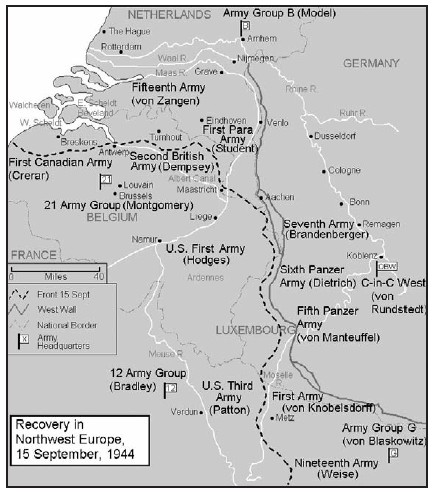
The German high command made no major strategic adjustments as a result of MARKET GARDEN.16 OKW still held the continued defense of the Scheldt estuary to be of greater importance than “cutting off the Arnhem finger.” Heavy fighting broke out in the Dutch polders as Canadian troops made an advance north from the Albert Canal, establishing a bridgehead at Turnhout Canal. Allied tactical airpower harassed von Zangen’s army, but there were few losses as many aircraft were required to support other operations along the Channel coast as well.
Until September 23, the Germans believed that the purpose of MARKET GARDEN was to capture the Rhine bridges in order to outflank their forces west of the Eindhoven-Antwerp axis. They assumed that the Allies would have made Antwerp their priority. Unknown to them, Montgomery had decided that “Antwerp would have to wait.” It was a very costly choice. The Scheldt estuary became the worst kind of battlefield imaginable as the understrength Canadian First Army slogged through flooded fields that lay below sea level. Knowing the importance of the ground they held, the Germans fought here with even greater resolution than usual.
With Operation MARKET GARDEN ending in disaster, the British received orders to withdraw from Arnhem on September 25.17 Of 10,300 British paratroops who jumped at Arnhem, 7,500 became casualties. One thousand were killed in battle, five hundred wounded, and another six thousand taken prisoner. Arnhem was Germany’s first major success since the withdrawal from Normandy. During this same period, the Germans also fought a highly successful defense at Aachen and reinforced their positions along the Scheldt estuary. With a surge of confidence, Hitler further ordered the destruction of the enemy in the Arnhem-Nijmegen area. In Germany, he ordered the conscription of all men from the ages sixteen to sixty to form a “People’s Army,” or home guard, to be equipped mostly with captured small arms.18
In the battle for the Channel ports the Canadians attacked the western defenses at Calais with heavy bomber support on September 25–26, finally taking it by the end of the month. Even with Calais, Le Havre, and Boulogne, however, the Allies needed to shorten their supply lines by seizing a port closer to the front. On October 13, Eisenhower ordered Montgomery to give priority to taking Antwerp before a drive for Germany’s industrial heartland in the Ruhr could be considered.19 The battle for the Scheldt had begun on October 4, but it would be another two months before the first Allied convoy could enter Europe by way of Antwerp.
Pleading for reinforcements to enable him to defend the approaches to Antwerp, von Zangen received only verbal encouragement from von Rundstedt, who replied that reinforcements were simply not available, even though the Fifteenth Army’s stand outside the port was of vital importance. “The attempt of the enemy to occupy the West Scheldt in order to obtain the free use of the harbor of Antwerp must be resisted to the utmost.” Model sent in the 85th Infantry Division “Battle Group Chill,” his fire brigade from the Fifteenth Army tactical reserve, to reinforce the 70th and 346th Infantry in holding a firm line of defense.
At the beginning of September, Allied intelligence reports had assumed that the German Army was all but finished.20 Instead, by the end of the month, the Germans had consolidated their lines, holding the Allies back along four fronts. Both the Allied advance toward the Ruhr and the quest for the Channel ports were bogging down. The U.S. First and Third Armies had each encountered severe resistance by German defenders and were forced to bring their advance to a halt. The British Second Army was unable to breach the West Wall fortifications and suffered a disastrous defeat at Arnhem. The Canadian First Army fought a bitter war of attrition along the Channel coast. With the “miracle in the West,” the German command had succeeded in establishing a continuous line running from Breskens and Walcheren on the extreme right, northeast to Arnhem, and south toward Switzerland. Its forces were determined and well-entrenched. Many months of slow, bitter fighting lay ahead.
At this point, Hitler excitedly called his operations staff together to announce his next offensive on the western front— in the Ardennes. Von Rundstedt and Model’s forces were now to receive priority in the allocation of equipment, food, and ammunition. Hitler guaranteed every man and tank would be at their disposal. With the element of surprise, impeccable planning, and his new V-2 rockets and jet aircraft, the Führer’s forces would cut off the Allied armies, encircle, and destroy them. They would then seize Antwerp and stabilize the western front. This would allow Germany to once again turn its attention to the east and strike out against the Soviets. That, at least, was the state of the Führer’s plans for continuing the war after October 1944.

TO THE CHIEF OF THE COMBINED SERVICES HIGH
COMMAND, GENERAL JODL, TO BE SUBMITTED TO
THE FÜHRER, AUGUST 24, 1944
On the basis of the latest developments in the situation I have arrived at the following estimates of the strengths in the West:
I
The enemy now have about 53 divisions in north-west France, and could raise this number to 55 or 57 by September 1. There are about 8 divisions operating in southern France. All the enemy divisions are extensively motorized and mechanized.
In support of the ground operations they have about 7,000 fighters and 7,200 bombers in north-west France, and in southern France roughly 1,300 fighters and 900 bombers. (At any given time, from a third to a half of these are serviceable.)
The following possibilities are open to the enemy:
(a) After gaining the Seine bank crossings they could push northwards past Paris between Rouen and Mantes to the Somme. Their objectives would be the V-1 bases and the vital Belgian industrial basin. They could use 30–35 divisions for this thrust.
(b) Thrust through Paris towards Rheims to the traditional invasion route to Germany. They could use 35 divisions for this.
(c) West-east push south of Paris across the line Troyes-Auxerre in the direction of Dijon, so as to cut off Army Group G, and then through the Belfort basin for a thrust to Alsace. 25 divisions could be used for this.
For all three operations they could use their airborne army to open up the way (Seine or Somme crossings).
They could conduct operations (a) and (b) simultaneously with 15 and 25 divisions respectively.
II
As was reported on August 18, our own troops are exhausted. We cannot expect appreciable reinforcements before September 1, and the promised replacements still later.
Work on the Somme-Marne positions has only been going on for a short time, and they are not yet ready for any defensive action. It is therefore essential to bridge the gap until at least September 1, because, if things go very badly, the enemy spearheads will in that time have reached the Somme positions, in the area east of Paris, or the Dijon area.
First of all the Seine position downstream from Paris is being manned: 4 H.Q. staffs have been put in there, the LXXXVI, LXXIV, LXXXI, XXXXVII Panzer Corps, with 12 divisions or divisional battle groups (711th, 346th, 3rd Para-troop, 353rd, 271st, 331st, 344th, 17th Luftwaffe Field, 49th, 18th Luftwaffe Field, 6th Paratroop and 275th).
One group from the panzer divisions (what is left of about 6 divisions, which are to be quickly renewed) must be placed under the H.Q.s of I and II SS Panzer Corps between the Somme and the Seine as mobile reserves, and at the same time be renewed. The bridgehead south of the Seine must be held as long as possible to make our crossings easier, and to keep the enemy forces in check. It will only be withdrawn when the advantages in holding it are outweighed by the disadvantages.
The problem of Paris is still urgent. Admittedly the 47th Division will be brought in there from August 25/26 to strengthen the defenses, but in the face of enemy pressure from the outside and with the increased danger inside the city, this reinforcement will not be sufficient for safety. We have therefore ordered a strong line to be set up just to the north and east of Paris.
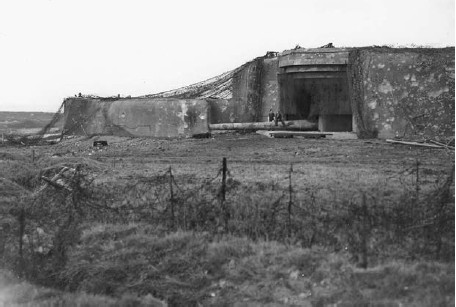
One of the three large coastal guns, of about 16-inch caliber, found intact at Le Trésorerie on September 19, 1944. Pursuing the Germans after their escape across the Seine, the British Second Army advanced toward Brussels, the First Canadian Army toward the Channel ports of the Atlantic coast, and the U.S. First and Third Armies toward southwest Germany.
We can only expect 3 infantry divisions (338th, 716th and 198th) to be sent back from Army Group G, with 1 panzer division, the 11th. The intention is to form from the panzer divisions a group (about 7 or 8 divisions) in the southern flank of the 1st Army, so that they can attack the enemy spearheads and thus cover the western flank of the 19th Army. 15 extra divisions will be necessary in addition to the forces already available, to hold the Seine-Yonne-Dijon line, and they will have to be assembled in the area Troyes–Dijon–Geneva Lake by September 10.
The 3 divisions from the north and the 15th Army area, which will be released by the arrival of the 36th, 553rd and 563rd divisions, will be urgently needed to build up a front on the right flank of the 1st Army. It is taken for granted that there will be sufficient Luftwaffe forces, roughly in the strength of at least 300 fighters ready to take off at any moment.
III
We will need for the Somme-Marne line altogether 4 Army H.Qs, 12 Corps H.Qs and at least 30 to 35 divisions at the front, 1 panzer army with 4 panzer H.Q. staffs, and 12 panzer divisions in reserve to counterbalance the enemy motor mechanized units.
If the enemy begin a strong campaign and bring in new forces, the possibility will have to be reckoned with that the Seine-Yonne-Dijon line cannot be held for long, and we may have to withdraw to the Somme-Marne line. Speedy construction work is therefore needed at the latter line, and a defense force, which can continue this work, is essential. For this we could use the very weak remains of the 12 divisions which need a rest (Remains of the 352nd, 84th, 89th, 326th, 363rd, 276th, 277th, 708th, 272nd, 273rd, 343rd and the 5th Paratroop Division).
Furthermore, the same must be done as on the eastern front. We must look ahead, and build more rearward positions behind the Somme-Marne line, extended to include the Western Wall.
I request the required instructions giving consent for this.
Model, Field Marshal
TO CHIEF OF OKW OPERATIONS STAFF, TO BE
PRESENTED TO THE FÜHRER, AUGUST 29, 1944
I report the following as supplement to the measures taken by Army Group B on August 28 and 29, 1944.
(1) Enemy position: The British Army Group (25–27 divisions) has begun a rapid thrust across the Seine to the north, concentrated on the eastern flank, with the intention of pressing our troops back to the sea, provided the breakthrough is successful, and capturing the V-1 bases. Apart from their heavy artillery and immense air superiority the enemy are able to put in up to 1,500 tanks between Paris and the coast. The American Army Group with the 12 divisions (including up to 1,200 tanks) at present in the area north of Paris–Soissons–Chalons s.M.–Vitry le Francois will continue to attack in a general north-easterly direction. This assumption is based on information from a reliable source, stating that the V Corps have been ordered to attack the towns of Montcornet and Rethel; according to the same source the XII Corps is to take the heights east of Chalons s.M. The XX Corps, between the V and XII Corps, is attacking Rheims. For the remaining 10–12 divisions of the American Army Group (including about 750 tanks) there are the possibilities of following up either towards Rheims or to the east through Troyes.
(2) Position of our troops: The divisions which have arrived from Normandy across the Seine under immense difficulties and after the hardest fighting have only a few heavy arms, and in general they are only armed with carbines. The supply of necessary personnel and material replacements is, as has been reported in detail, completely inadequate. After 5 battle-weary infantry divisions have been sent back to the Reich, there remains, with replacements and reassembling of the remains of the 11 Normandy infantry divisions, enough to form about 4 units, but they will only have equipment if the demands made in the order dated August 27 are fulfilled.
From the 6 SS panzer divisions and 5 army panzer divisions we could only form 1 regimental group, which could be the 11th Regimental Group, and that could only be done if we received replacements of men and equipment.
The panzer divisions now have 5–10 tanks each. With regard to artillery, the infantry divisions only have single guns left, and the panzer divisions have a single battery each.
At the moment the troops are strongly influenced by the enemy’s superiority, especially in aircraft and tanks, and by the fighting in isolated pockets. Measures are being taken. The low degree of manoeuvrability of the infantry divisions, caused by the fact that their mobility is only an emergency expedient (horses), has proved to be a distinct disadvantage in the unequal struggle against a highly mobile enemy, especially as there is absolutely no reserve of assault guns and other heavy anti-tank guns. And so the units available and those which have been brought in from the coast are at the moment tactically inferior. A speedy alteration in these circumstances is the first consideration for successful operations.
With regard to the situation in the air, I wish to refer to my teleprinter message dated August 29, concerning the maintenance of the fighting capacity of the fighter units, which is of vital concern to the Army Group.
(3) The concentration of all available fast-moving units in the area Chalons-Rheims-Soissons, ordered by me on the evening of August 28, and reported at once to General Jodl by Chief of the General Staff of C.-in-C. West, was essential to ward off the swift and dangerous thrust carried out by the American Army Group against the rear of the 15th, 7th and 5th Panzer Armies. Considering the enemy position (see (1)), this meant that the right flank was in danger of an enemy tank attack, and on the left flank there was the possibility of a further enemy advance in the direction of Dijon.
The following temporary expedients are possible:
Withdrawing on the right flank to the Somme if necessary-this was requested by General Dietrich because of the condition of our troops, but I refused this until now.
Diverting to the left flank the reinforcements meant for the right flank of the 1st Army (559th Division and the 106th Panzer Brigade).
Only when the 347th and 553rd Divisions have been brought in, as I ordered, will it be possible to withdraw the fast-moving units in the area Soissons-Rheims-Chalons, which are supposed to come under the command of the 5th Panzer Army as from August 31. Otherwise there would be a dangerous gap left, which would speedily have dangerous consequences. It should here be emphasized that the fighting capacity of the Bittrich and Schwerin groups is very small. We can only expect any improvement when we receive more tanks and artillery.
Model, Field Marshal
TO THE CHIEF OF OKW OPERATIONS STAFF, WITH
THE REQUEST THAT IT BE SUBMITTED IN THE
ORIGINAL TO THE FÜHRER, SEPTEMBER 4, 1944
(1) Enemy position: The British army group is making a concentrated thrust to the north-east, towards the Scheldt estuary (Antwerp), with the double intentions of capturing the V-1 bases and cutting off the 15th Army. The units which are still spread out in depth are now closing up.
An American battle group from the 12th Army Group with about 6–8 divisions has joined in this thrust, and can bring in more forces. At least 2,500 tanks might be used altogether in this operation.
The bulk of the 3rd American Army has been closing up in the Verdun area for the last 3 days, and could start an attack against the Luxembourg-Metz line at any time.
French and Belgian Resistance are joining the battle to an ever increasing extent. The large-scale airborne landing which is expected will most probably be in the region of the West Wall.
Altogether the enemy have brought up till now 55 divisions and strong forces of H.Q. troops into the north France battlegrounds, and in addition they could bring 30 more divisions from Britain and the transfer of further forces from the U.S.A.
(2) Position of our own troops: Our own troops, which in the meanwhile had suffered very heavy losses, were no match against the enemy’s superior equipment and great mobility, especially on the northern flank. They were repeatedly overtaken and cut off, as closely-linked panzer units, assault guns and anti-tank weapons were lacking as much for open warfare as for a local concentrated attack to delay the enemy advance. Otherwise the situation described in my report dated August 29th has become even worse, as the troops are daily becoming more exhausted.
At the moment we only have the following which are really fit for action:
(a) with the 15th Army, which includes the area under C.-in-C. Netherlands, about 4 infantry divisions, not counting the fortress garrisons.
(b) with the 5th Panzer Army, 3 or 4 panzer divisions and 1½ or 2 infantry divisions.
The position is more favorable in the 1st Army area, as there has been no enemy pressure there since August 29.
After receiving the 19th, 553rd and 559th Divisions and the 106th Panzer Brigade they now have a battle force of about 3 panzer and panzer grenadier divisions, as well as 4½ infantry divisions.
(3) We do not yet know how the 15th Army’s attempts to break through are progressing. It seems that only some units will be able to fight their way through. The line Albert Canal– Maas–western positions can still be considered as the line to be held by Army Group B. But it will need to be manned by 25 fresh infantry divisions and an adequate armored reserve of 5–6 panzer divisions.
As a result of the developments on the western flank, 2 panzer brigades (besides the 105th) and several infantry divisions must be sent there immediately.
At least 10 more divisions and 5 more panzer divisions will be needed later (until September 15). Otherwise the approach to north-western Germany will be open. It is already necessary to provide powerful skeleton forces as quickly as possible for the western positions and the West Wall; the 11 fortress battalions and the 6 machine gun battalions which were expected between September 15 and 20 will arrive too late. They must man the western positions earlier. Otherwise it is suggested that anti-aircraft units from Germany could be brought in in sufficient numbers.
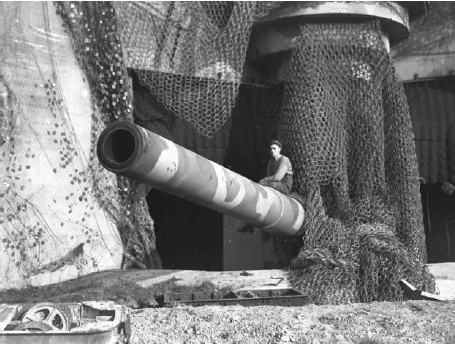
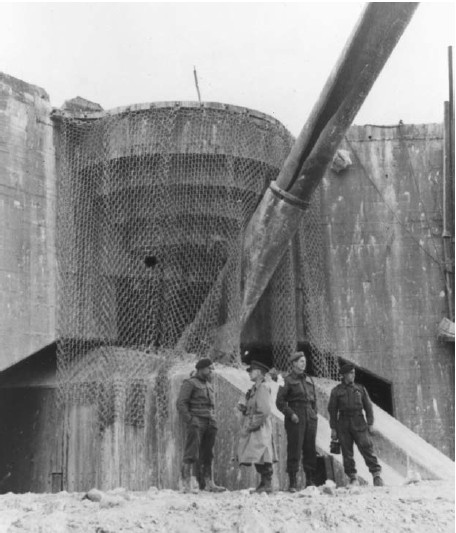
One of the coastal guns of the Atlantic Wall near Boulogne, September 21, 1944. The chain-mail camouflage screen over the gun was used as an anti-shrapnel cover for the gun crew. The Channel ports were taken by the Allies as they advanced northward, with Dieppe falling on September 1, Le Havre on September 12, Dunkirk on the sixteenth, Boulogne on the twenty-second, and Calais and the V-1 sites on October 1.
The mobile battle force which the Führer has commanded to be formed on the southern flank, according to paragraph 2 of the order dated September 3, could then be formed from the following units:
3rd Panzer Grenadier Division
15th Panzer Grenadier Division
17th SS Panzer Grenadier Division
9th Panzer Division
106th Panzer Brigade
Battle groups of the 11th and 21st Panzer Divisions and 3 other panzer brigades.
For this 3 panzer divisions could possibly be transferred from the east.
Model, Field Marshal
TO C.-IN-C. ARMY GROUP B, SEPTEMBER 7, 1944
I request that the following estimate of the situation, which was formed after a conference with Fieldmarshal Model, and based on the latest reports, be submitted to the Führer:
(1) Enemy position: At the moment the Anglo-Americans have in Belgium and northern France about 54 extensively motorized and mechanized divisions and very strong H.Q. forces. French and Belgian Resistance groups are supporting them to an ever increasing degree. There are still at least 30 divisions in England, including 6 airborne divisions which are ready to be brought over to the mainland. The transport of forces direct from the U.S.A. has begun.
The British 21st Army Group has taken from its 25–27 divisions about 8 or 10 divisions with probably 600 tanks between Boulogne and Antwerp for an extensive, partly encircling, attack against the units of the 15th Army which are cut off from the east. A second battle group between Antwerp and Diest is being prepared. Theirs will be the task of forcing a crossing of the Albert Canal, and of pressing on to Rotterdam and Amsterdam.
6 to 8 more British divisions with probably 400 tanks are now closing in, probably from the rearward areas. They could be used to augment the forces intended for the thrust into Holland, or to help the troops against the 15th Army, according to the requirements of the situation.
The fortress of Le Havre is being attacked by 2 or 3 divisions with about 100 tanks. Contrary to what is the case with other fortresses being attacked, it is important for the enemy to take this harbour, which is the most useful in France, as quickly as possible.
The fortresses of Dunkirk, Calais and Boulogne will involve for some time a number of the other divisions of the British forces at present engaged against the 15th Army.
The American 12th Army Group with 15 to 18 divisions and about 1,000 tanks is between Hasselt and Toul attacking to the east on a broad front, with the object of pushing on to the Rhine. To the rear of its northern flank 3 or 4 units are apparently being brought up.
The following points of concentration for attacks seem to be indicated:
(a) The area between Hasselt and the heights running from the east of Namur to the south of the Maas.
(b) Charleville-Sedan area.
(c) The area on both sides of, and especially south of Metz.
The southern flank, which at the moment is rather bent back, will probably be brought into line to coincide with the enemy advance from southern France against the Burgundy Gate.
In Brittany there are about 5 American divisions tied down by the fighting for the fortresses and attempting to enclose them.
(2) Against this must be stated: Our own troops are all engaged in the fighting, are being heavily attacked and are partly exhausted. They have no artillery or armored weapons. No reserves worth considering are available. The enemy’s numerical advantage in tanks is complete. At the moment Army Group B has about 100 tanks. The enemy air forces control the battle area and the communications deep in the rear of our lines. The enemy pressure towards Liege (Meuse Valley), which is obviously directed against Aachen and the Rhine-Westphalia industrial region, has become a serious threat.
It seems to me to be of vital importance to bring up at once the strong forces which have so often been requested—at least 5, and if possible 10 divisions with assault artillery detachments and sufficient anti-tank weapons and also a number of panzer divisions.
All the forces at our disposal (the weak 9th Panzer Division, 1 weak panzer assault detachment, 2 assault gun brigades, with assault guns on the way) have been sent by C.-in-C. West to the Aachen area.
The 12th Grenadier Division has not yet arrived. In agreement with Fieldmarshal Model I perceive here the acute danger which also threatened the rear of the West Wall. No operative enemy airborne landings have taken place as yet. They can take place as the situation demands, either behind the West Wall, or also form a bridgehead on the eastern bank of the Rhine. They will take place wherever the enemy thrust towards the Rhine is successful.
It is our task to play for time with the forces available so that the western positions and the West Wall can be prepared for defense by the H.Q. authorities who have been entrusted with the job, together with units of the armed forces and the Party. The forces which have been reported to me as being intended for the forming of the western positions, 135,000 men all told, seem to me to be totally inadequate. Even if one includes all the rear units of the forces under the C-in-C. West, many more workers will be required along a line of positions more than 500 kilometers long. We do not fail to recognize the difficulties (equipment, billeting, supplies, etc.) in the organization of these auxiliary forces and the indefatigable work of all the Party officials, and civilian departments.
However, the whole organization takes time!
According to the information from the commander of the western fortresses, General Kuntze, the building of the western positions will require 6 weeks. This time must therefore be gained by fighting.
If I am to command with any possibility of success, I again demand that all available tanks be sent up at once apart from the forces intended for the Aachen area to protect the Rhine-Westphalia industrial area, and regardless of the consequences, to complete the panzer units and assault gun brigades, also a special delivery of all anti-tank weapons which can be mustered, which can afford the troops some method of defense against the enemy tanks.
The Führer has ordered me, regardless of the local losses on the front, to carry out an advance deep into the American east flank, in a north-westerly direction, from the area around Epinal. If a stronger panzer group subordinated to the 5th Panzer Army, which itself has been put at the disposal of the C.-in-C. West for this attack (but is instructed to cooperate with Army Group G.), is to be used, I consider it essential that 10,000 cubic metres of fuel should be brought up immediately. Also it will be necessary to have all available forces of the Luftwaffe for this attack, even if it means leaving the other fronts exposed.
(signed) von Rundstedt, Field Marshal
TO C.-IN-C. WEST, FIELD MARSHAL VON RUNDSTEDT,
SEPTEMBER 8, 1944
The situation of the 7th Army has developed in the last two days in a particularly threatening manner. The remains of this army which are still available will be able to offer temporary resistance in the Maas sector between Maastricht and Liege. South of Liege, as far as the newly announced Army Group boundary there is only a very thin and totally inadequate line of defenses. The enemy here enjoys practical freedom of movement as far as the West Wall, 120 km. length of which, behind the 7th Army, is manned by only 7 or 8 battalions.
Of the reinforcements which have already been reported, the 9th Panzer Division, which was detailed by C.-in-C. West on the evening of the 6th September, has not yet arrived, and the furthest forward division, the 12th Grenadier Division, is not expected to arrive until September 12. In any case, neither of these formations will be sufficient to carry out the present task allotted to them—the battle to gain time before the West Wall, followed by the holding of the West Wall itself.
If 3 infantry divisions and 1 panzer division cannot be transferred to the 7th Army with all haste, we can be certain that the exhausted units of the 7th Army will, as happened south-west of Brussels, again be attacked, and this time completely beaten. This would mean that the strategic breach for which the enemy have been striving between the Maas and the Mosel would be opened up automatically, this time on the German frontier. I should like to stress at this point that when the 1st Army received timely reinforcements the situation improved for them considerably. If the same is to be done for the 7th Army it must be now or never.
I request that these conclusions, which have been made on reviewing the deteriorating situation, be brought to the notice of the Fuehrer.
Model, Field Marshal
TO ARMY GROUP B, SEPTEMBER 15, 1944
The Army reports in connection with the disorders which took place at the evacuation of Aachen:
According to reports which came from the G.O.C., the Divisional Commander, the Battle Commandant, and the G2 of the Army, the blame lies incontestably with the Party officials entrusted with the evacuation. When the situation developed adversely, the responsible Party officials and the police, who alone could have kept peace and good order during the evacuation, hurriedly abandoned the city and tried to control the evacuation from the outside. Notice was given that every citizen who did not participate in the evacuation would be a traitor to his country, and this, coupled with the fact that there was no responsible local authority available, led to a panic, which developed into a headlong flight and universal looting.
As a result of the situation reported above in the city of Aachen, the commander of the 116th Panzer Division, Count Schwerin, took upon himself the duty of stopping the evacuation first of all, and then conducting it in a rational way. In doing this he disturbed the Aachen District Administrator by reporting that enemy attacking spearheads would probably be approaching the city by the afternoon. He has also given a letter to a member of the Party who had been named to him, in which he advised the population of Aachen, in English, to trust to the protection of the approaching American armies. Furthermore it has been clearly established that he had always taken all possible measures for the defense of Aachen, and that he has always commanded his division exactly as directed by the High Command.
Nevertheless, General Count Schwerin has been relieved of his post as Divisional Commander because of these mishaps. A court-martial enquiry has been started.
The Army Corps and Division immediately contacted the appropriate Party departments, and now everything has been done to control the evacuation according to plan.
Brandenberger, General of Tank Forces
7th Army H. Q.
TO C.-IN-C. WEST, FIELD MARSHAL VON RUNDSTEDT,
SEPTEMBER 24, 1944
The position of Army Group B has become increasingly worse on the northern flank since the airborne landing on September 17, because the enemy succeeded in bringing in considerable reinforcements during daily flights. Our own reinforcements were insufficient. It was only possible to force a postponement of the enemy’s operational intentions—a breakthrough via Eindhoven, Nijmegen and Arnhem, as a base for the attack on the Ruhr area—during the bitter fighting of the past few weeks, but apart from the holding of Arnhem, it was impossible to stop the enemy. The renewed airborne landing on September 23, the extent of which is not yet possible to judge, will lead to an exceptionally critical situation if we are not able to bring in adequate forces early enough to support the hard-pressed front line of the 1st Parachute Army.
The fact that the new landing took place on September 23, that is, 6 days after the first, suggests that the enemy had originally intended the landing on September 23 for another purpose, but now consider the time to be ripe to strengthen the present operation, obviously with the idea of turning to the south-east between the Rhine and the Maas. The danger is particularly great for this area, as there are no permanent defenses in the way of the presumed line of attack. Our own forces are inadequate against the enemy’s continual push forward. New forces must be produced, or transferred from other fronts.
The quickest means of restoring the position would be an attack. That has been attempted in the direction of both Veghel and Nimegen. The forces available for the attack on Veghel proved to be insufficient for the task. Our pressure on Nijmegen could only be increased to an inadequate extent.
After yesterday’s airborne landings—which the enemy could continue at any time—we cannot expect to be able to push the enemy back across the Waal, and so we must set up defenses in the region of the Lower Rhine on both sides of Arnhem.
The following consequences arise from this situation:
(1) The enemy resistance west of Arnhem must eventually be broken by all the means at our disposal, and the enemy must not be allowed to create a bridgehead to the northern bank of the Lower Rhine.
It will therefore be necessary to reinforce the II SS Panzer Corps with the 506th Tiger Detachment and the whole of the 246th Division.
(2) To release further forces, and to prevent the destruction of our formations, it may be necessary to withdraw the 15th Army with the LXVII Army Corps into a bridgehead Bergen op Zoom–Roosendaal–Moerdijk, with the LXXXVIII Army Corps closing the gap on the left behind the Waal. Time could be found to put through this operation in spite of the fact that it would mean having to establish land communications with Walcheren in the event of penetration to the west, north of the Waal, by strong enemy motorized formations. The renewed danger of the encirclement of the 15th Army which this would entail could only be eliminated by bringing up strong reserves for the eastern flank of the Army. The conduct of battle of the 15th Army would therefore be such that the bridgehead could be held while preparations for a withdrawal were being made.
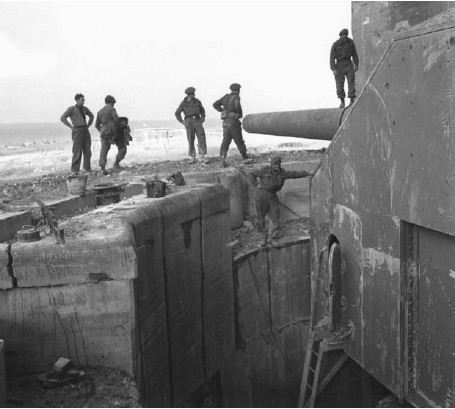
A German cross-Channel gun at Sangatte, near the port of Calais, on September 26, 1944. Although several port areas had been captured by this point, they had either been destroyed by retreating German forces or were too small to handle the volume of provisions needed by the four Allied armies which were now pursuing Army Group B toward Germany. The only suitable port, Antwerp, was captured on September 4 but could not be used until the surrounding Scheldt estuary was cleared. Bitter fighting in this area kept the area under German control until the end of November.
(3) While they are clearing up the position west of Arnhem and defending the present front east and south-east of Nijmegen, the 1st Parachute Army are so to direct their fighting on the left flank that a larger bridgehead can be held on the west bank of the Maas about 20 kilometers west of Venlo, from which it would be possible to launch an attack towards the north-west, after reinforcements had arrived. In view of the necessity for giving support at Arnhem and Nijmegen, forces for this bridgehead could only be obtained by introducing new units, or by withdrawing forces from the 7th Army.
The possibility of launching a larger counter-thrust from the sector of the 1st Parachute Army’s left flank calls for examination of the question whether further forces (2 panzer divisions and 2 panzer brigades) could not be spared from other sectors for this operation.
It would be necessary to work very fast if we wished to make use of the enemy’s present confinement in his corridor through Eindhoven. The 9th and 116th Panzer Divisions could be relieved by a good infantry division. Purely for defensive operations the following are needed:
1 infantry division
1 panzer division
1 panzer brigade.
(4) The 7th Army are still defending their present positions, and are preparing for a counter-attack to clear the enemy from the area east of Aachen. Before the 9th and the 116th Panzer Divisions could be released they would need an infantry division, and a further infantry division would be needed to replace the 2 panzer divisions from I SS Panzer Corps. If the 9th and 116th Panzer Divisions are used north-west of Venlo, another infantry division will be needed as rearguard in the Aachen district.
Altogether, if Army Group B is to continue a successful defensive action it will be required as a minimum:
(a) 2, or better, 3 infantry divisions for the 7th Army.
(b) 1 infantry division, 1 panzer division, a stronger panzer brigade for the 1st Parachute Army.
(c) 1 assault gun brigade each for the 15th Army, the 1st Parachute Army, and the 7th Army.
(d) Increased supplies of ammunition, especially for light and heavy field howitzers.
(e) Replacements for the infantry divisions at the points of heaviest fighting, at least 6 draft conducting battalions.
Model, Field Marshal
TO C.-IN-C. WEST, FIELD MARSHAL VON RUNDSTEDT,
SEPTEMBER 27, 1944
The fighting of Army Group B has suffered because of the following circumstances:
(1) Almost unlimited air superiority of the enemy.
The unsparing use of our fighter formations on various days has brought considerable temporary relief. In the main battle this relief is one of the first essentials for success. These experiences emphasize the necessity for producing the new fighter type as quickly as possible, even if it is at the expense of the bomber units.
(2) Superiority of the enemy artillery.
At the moment the Army Group has over 821 light and heavy cannon, some of them immobile. Against this the enemy artillery have at least 2,680 cannon. This discrepancy would not be so serious if we only had adequate supplies of ammunition. As this is not the case however, as is well known, the enemy’s artillery superiority was more obvious. It is urgent that we have a speedy improvement in the supply either of ammunition or equipment, preferably of both.
(3) Preponderance of the enemy armored weapons.
At the present, our 239 tanks and assault guns are opposing 2,300 enemy tanks, i.e. 10 times the number. Moreover, this represents only half of the ascertained potential of enemy armored units. Even though the enemy have shown an unwillingness to use tank formations in close concentration during the past few days, there can still be no doubt whatsoever that they could throw in sudden concentrations of tanks at any time they wished. Therefore the request for increased supplies of assault gun brigades must be repeated. The formation and use of independent panzer brigades outside the framework of the panzer divisions has not been successful in the previous fighting. More adequate replacements for the tired panzer divisions, and the introduction of assault gun brigades and detachments form the most effective counter-measure against the enemy’s panzer superiority.
It is an incontrovertible fact that the reverses in the west are primarily due to the panzer divisions having to fight when they were exhausted. The supply of equipment for them must be kept up.
(4) Insufficient replacements of personnel.
Even if the number of enemy infantry units is only ⅓ higher than ours, the battle potential of our troops is lowered by their inadequate equipment, and by the fact that there are too many garrison and emergency units amongst our battalions.
During the period between September 1 and 25, our heavy losses were about 75,000 men; during the same period we received only 6,500 men as replacements. This intolerable discrepancy will eventually lead to the complete annihilation of whole valuable divisions, in spite of the plentiful use of newly constituted units. It is essential that we receive adequate numbers of replacements, so that it will be possible for the divisions to re-form their field relief battalions.
The Army Group will continue to try to withdraw in good time the units which have suffered very badly in the fighting, and form new units, as has already been done in the case of 14 divisions. The necessity for maintaining to some extent comparable and useful divisional strengths will mean that we will have to bring in garrison units.
I am reporting the foregoing points, although they are already known, because the result of the present decisive battles is dependent on their being given more consideration. I request that they may be brought directly to the notice of the Führer.
Model, Field Marshal
TO ARMY GROUP B, SEPTEMBER 29, 1944
Estimate of the situation.
According to a verbal message from Reichsminister Speer, there is a factory in Weisweiler (4 kilometers east of Eschweiler) in which is made 40% of the total amount available of an alloy which is vital for the whole steel production.
Even if the present situation does not offer a direct threat to Weisweiler, it must still be emphasized that the defenses of the works, which lies only 6 kilometers behind the lines, are not sufficient to provide for the safety of the works in all circumstances. Apart from that, the works lie within range of effective enemy artillery fire.
In this respect also the situation demands that the enemy penetration east of Aachen be cleared up. The Army wishes to refer to the estimate of the situation dated September 23, 1944. In the first place the Army requests the bringing up of 2 panzer divisions to ensure the success of the proposed attack. If these cannot arrive within a short time, it will be considered necessary to have two complete attacking divisions, 1 Tiger or Panther detachment and sufficient assault guns (4 sections for the infantry divisions) or 2 brigades and H.Q. artillery (5–6 heavy detachments). The need for sufficient ammunition is stressed. In addition, the Army requests complete support in the formation now proceeding of a mortar battalion and an anti-tank battalion, the personnel for which have been assembled and armed by the Klosterkaemper Reception Unit, although their lack of mobility and the shortage of optical instruments hinders any rapid preparations.
Brandenberger
7th Army H.Q.
TO C.-IN-C. WEST, OCTOBER 1, 1944
The following estimate of the situation is forwarded as an appendix to the report already sent by courier:
The reports by our agents of the Americans bringing strong reinforcements in the Aachen area, and of intended operations directed against Cologne have not yet been confirmed by our front line reconnaissance. The only indication which could point to an intended attack has been the partial withdrawal by 1,000–1,500 meters of the most forward American positions in the front of LXXXI Army Corps, as the enemy used a similar method of leaving the ground open for bomber attacks on the invasion front.
The general impressions of the enemy’s movements, the reports of prisoners, the scrutiny of captured documents, artillery reconnaissance and reconnaissance by agents near the front line have not so far supplied any other indications. Even so, the Army is expecting the enemy to use the breach in the West Wall around Aachen as a springing-off ground for a breakthrough operation in the direction of Cologne and the Ruhr industrial area. Therefore the Army is accordingly making its dispositions on the basis of the agents’ reports.
In addition to the reinforcements for the defenses in the Aachen-Monschau area mentioned in the report dated September 30, 1944, the Army has ordered that an infantry battalion and the 341st Assault Gun Brigade (without the 2nd Battery) be transferred from LXXIV Army Corps, the 628th Mortar Detachment and the 1310th Fortress Artillery Detachment from I SS Panzer Corps, and the 2nd Battery of the 341st Assault Gun Brigade which is still with LXXX Army Corps. All of these units are to be transferred to LXXXI Army Corps by October 2. One of the draft conducting battalions formed by the Klosterkaemper Reception Unit and a mortar corps are also to be placed under the command of LXXXI Army Corps.
With regard to the munitions tactics, a definite concentration is being built up with LXXXI Army Corps. In addition the Army requests:
(1) Air reconnaissance in the area Liege-Amiens-Paris-Luxembourg.
(2) Luftwaffe support against the enemy artillery and prepared positions in the area of the breakthrough east and south-east of Aachen.
(3) A Tiger or Panther detachment to be brought in.
(4) The 7th Mortar Brigade which had already been promised to be brought in.
(5) The supply of a heavy artillery detachment with German guns.
(6) Adequate supplies of ammunition, with special reference to types of captured ammunition.
(7) The supply of medium mortars to take the place of the heavy and light mortars in the mortar battalion which is now being formed, as this is the only way of ensuring adequate supplies of ammunition.
(8) The Todt Organization to be persuaded to speed up the construction of an anti-tank front between Erkelenz and Dueren.
(9) Supplies of fuel to be sent to III Anti-aircraft Corps so that it will be possible to regroup the units with LXXXI Army Corps, in accordance with the plan to concentrate forces there. Because we are so very short of fuel ourselves, it will not be possible for the Army to supply them with fuel.
Army Group B
TO CHIEF OF OKW OPERATIONS STAFF, GENERAL
JODL, OCTOBER 9, 1944
I request that the following estimate of the situation be submitted to the Führer:
I
(1) The point of greatest danger to the 15th Army is at the moment on their right flank in the area north of Antwerp, where the enemy is attempting to establish land connections with Walcheren.
With the enemy so strong in the area Nijmegen-Arnhem and near Aachen, it is not possible to withdraw further forces to help the 15th Army. Therefore the 15th Army must shorten its front between Tilburg and Bois-le-Duc, to release forces for the right wing.
The right flank of the 1st Parachute Army (XII SS Corps and II SS Panzer Corps) had to go over to the defensive. The situation around Aachen may make it necessary to remove troops from II SS Panzer Corps and send them there. I therefore request permission to give up the Arnhem bridgehead. (2) The most dangerous point on the whole western front is on the right flank of the 7th Army, where there is a definite threat of encirclement to the whole area around Aachen. The bringing up of reinforcements is being continually slowed down by the regular destruction of railways, so that, for example, the heavy Panzer Detachment 506 (Tiger) has still not arrived at Aachen, the 3rd Panzer Grenadier Division will have to be diverted through Kaiserslauten, and so on. It is estimated that the enemy already have a superiority of 6 infantry divisions and 3 panzer divisions near Aachen, and it is possible that more forces will be sent up (American XXVII Army Corps). In spite of all endeavors, it does not seem as though we will be able to push back the enemy bulges in the front to the north and south-east of Aachen. There is an ever increasing danger that the enemy will be able to draw the circle more tightly round the town. I have issued clear instruction that Aachen is to be defended right to the very last, in agreement with the Fuehrer’s orders. In this case, the possibility of the loss of the 246th Infantry Division must be accepted.
A German gun position of the Atlantic Wall captured by Allied troops. In early September as the Germans retreated from the Seine, Allied intelligence reports assumed that enemy forces were diminished to the point that victory might come by Christmas. Instead, Army Group B had re-grouped by the end of September, with the 9th SS and 10th SS scoring a major victory against Operation M ARKET G ARDEN while the German Fifteenth Army held down Allied forces in the Antwerp area and the Fifth and Sixth Panzer and Seventh Armies stopped the American advance in southwestern Germany. Army Group B had performed its “Miracle in the West”; now Hitler and von Rundstedt turned to their plans for the Ardennes counteroffensive
II
In the Army Group G area the enemy is seeking to invest Metz from the south, and to seize the Vosges passes by an attack on a broad front between Luneville and Lure. As yet there is no indication that there will definitely be an attack on the Burgundy Gate. It will be the task of Army Group G to offer stubborn resistance and thus gain enough time for the further building up of the Vosges positions. In this connection it may be deemed necessary to withdraw the bridgehead at Metz back to the Mosel.
III
The main factor which made it possible for the enemy to gain his recent successes (breakthrough at Eindhoven, gaining the northern bank of the Waal at Nijmegen, pincers movement on Aachen, etc.), is our shortage of reserves for counter-attacking. This shortage made it impossible to form concentrated defenses in time, even at the points where it was obvious that there was going to be a concentrated attack.
There is already a shortage of troops at the parts of the front line which have not yet been attacked, between Monschau and Diedenhof. The 48th Infantry Division was replaced there by the 416th Division, which has had no battle experience, and units of the 19th Infantry Division were removed (for the southern-flank of the 1st Army), so all that remains is a defense garrison under command of the divisional staffs. Considering the low battle potential of the defense battalions it would in my opinion be fatal to remove from the area around Trier the 36th Infantry Division, which is the only complete unit.
Just because I was so concerned about the shortage of reserves I requested that a reinforced regimental group be sent from each of the first 3 available infantry divisions. I now ask in addition for an infantry division to be sent from the assembly areas on each of the three dates, October 12, 15 and 18.
It would be possible to post relief detachments in northern Holland in place of the 256th and 361st Peoples’ Grenadier Divisions. After the experiences of Nijmegen and Arnhem it is not very likely that the enemy will attempt any airborne landings east of the general line connecting Emden and Hamm. However the area west of this line is in great danger. And yet we have no great amount of reserves there.
I therefore request that the reinforcement of the 6th Panzer Army in the area Enschede-Borken-Haltern-Hamm-Muenster-Rheine be done especially early. From that area the Army can if required counter-attack at once in a north-west, west, or south-west direction.
My detailed requirements, once again, are: —
(a) Accelerated arrival of at least 7 draft conducting battalions (4 for Army Group B, 3 for Army Group G)
(b) Greater supplies of anti-tank weapons and materials.
(c) Further increase in ammunition allocations so that with an increased firing power, we will be able to approximate to the enemy strength.
C.-in-C. West Field Marshal von Rundstedt
TO C.-IN-C. WEST, FIELD MARSHAL VON RUNDSTEDT,
OCTOBER 11, 1944
I wish to report that the situation at Aachen has become more critical. In spite of all our efforts the enemy succeeded in narrowing the corridor on both sides of Haaren to 3,000 meters.
This unfortunate development is mainly the direct result of the complete lack of replacements for the divisions which for several weeks have been in the thick of the fighting.
I request that representations be made to the Fuehrer of the urgency of providing as quickly as possible relief in the form of at least 1 draft conducting battalion for the 183rd and 246th Peoples’ Grenadier Divisions, as well as for the 12th Division, since otherwise these divisions will be exhausted and it will be impossible to avoid further reverses.
The bitter and necessarily costly fighting against the enemy’s large supplies of men and materials cannot possibly be continued without regular replacements.
Model, Field Marshal
Footnotes
1 D’Este, 456, 518; Weigley, 31.
2 D’Este, 517–18.
3 D’Este, 431; Stacey, 319.
4 Gilbert, 582.
5 Stacey, 308.
6 Stacey, 309–10, 316–19.
7 Blumenson, 687–88, 702.
8 Bradley, 400; Stacey, 308.
9 Stacey, 320; Bradley, 401–5, 418–26.
10 Ziemke, “Rundstedt,” in Barnett, 201; OKW, 125.
11 Stacey, 302.
12 OKW, 130.
13 OKW, 156–59.
14 Weigley, 304.
15 Stacey, 313.
16 OKW, 184.
17 Stacey, 316; Bradley, 418.
18 Weigley, 256.
19 Stacey, 389.
20 Hinsley, 367–69.