
CHAPTER FIVE
Duration – 1½ Hours by car
Distance – 3.6 Miles or 5.8 Kilometres
Drive from the car park and, with the trip meter at zero, proceed west, towards the Oude (Koude) Herberg crossroads, turn left at the roundabout (a recent post-war construction), trip meter 0.6 miles/1 kilometre, and drive down Van Borsselenweg. As you make the turn you are passing the positions held by, first, 17 Platoon of C Company 1 Border and then 18 Platoon. After some 150 metres you begin to drive through an area that was unoccupied by British troops. Look to your left at the type of terrain, stopping briefly if necessary, to see how difficult it is. After about 500 metres from the crossroads you will encounter a small turning to your right called Wolterbeekweg, opposite a farm at No 34 Van Borsselenweg. This farm was D Company’s HQ, and also housed the Company Aid Post, and they were in position on Tuesday 19 September. It may help you to refer to the map on page 121 when visiting this part of the perimeter. Stop here.
Recall where you saw the RAP on your walking tour, some 700 metres away in the woods from where you are now standing. Lieutenant Alan Green, commanding 20 Platoon of D Company, remembers the enormous difficulty of moving casualties over what appears such a short distance. By 20 September it was no longer possible to evacuate D Company’s casualties.
The preferred method of moving casualties up Van Borsselenweg by jeep ceased to be practical and the open ground was constantly under fire from mortars and snipers preventing stretcher-bearers moving up through the woods. From 20 September wounded were cared for by the platoon medical orderlies.
One of D Company’s platoons was detached to a standing patrol about a kilometre away to the south-west. With his remaining three platoons the company commander placed two in the woods on the right of the road. Responsible for Wolterbeekweg and the field to the right was 22 Platoon, and on its left 20 Platoon covered the area south and west. Just a little way further down the road is an estate-keeper’s cottage and here, on its southern edge, was 21 Platoon facing south towards B Company further down Van Borsselenweg. Having driven this far you will now have an appreciation of the distance between companies, and will have noted the fact that C Company to the north, the nearest friendly unit, was out of sight with no chance of any kind of direct, mutual support and a huge gap through which enemy could infiltrate. The same was true of B company to the south.

D Company HQ was in 34 van Borsselenweg.
The western perimeter was, really, a sieve through which the Germans should have been able to walk almost at will. It was due to the tenacity, courage and fighting capabilities of the Border Regiment that they did not. It is perhaps worth remembering that of all the battalions involved in this battle, both in Oosterbeek and at the Bridge in Arnhem, the Border Regiment lost the most killed – 121 in all.
A view of 22 Platoon’s area of responsibility, looking along Wolterbeekweg.

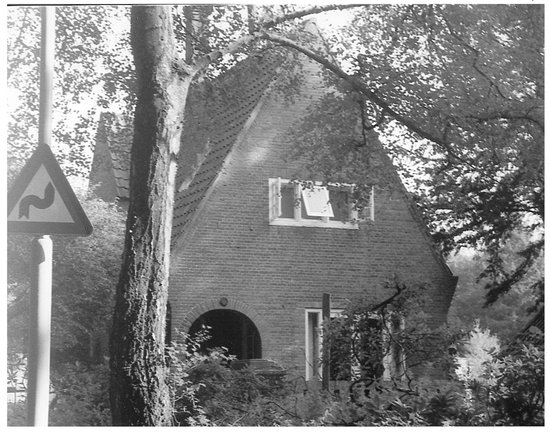
The estate keeper’s cottage.
Having defended the area at great cost for seven days the soldiers of D Company 1 Border awoke on the morning of Tuesday 26 September to find that the Division had withdrawn and nobody had told them. Private Hugh McGuiness was there and was later to write:
‘When we couldn’t fight any more we just sat and waited for the Hun to come, but he still wouldn’t until we told him we had no more ammunition. The SS captain asked me where my commander was. I took him to Captain Hodgson whom he saluted. Captain Hodgson was mortally wounded and could not respond. The German thanked him and us for an honourable fight; they treated us with great respect and said we were the finest soldiers they had come into combat (sic) with. When he found out how many of us were left capable of fighting he said had he known he would have taken the position two days ago.23’

The Driel Ferry which today is only used for foot passengers and cyclists.
Proceed on down the road to the crossroads at the bottom. Go straight over and you come to the Driel Ferry. Now only used for pedestrians and cycles it was, during the war, capable of taking vehicles. Pause briefly to look up at the slope of the Westerbouwing. It was from the bottom here that B Company of the 4th Battalion The Dorsetshire Regiment, with just thirty men, attacked uphill during the night of 24 September during one of the attempts by those south of the river to bring some relief to 1st Airborne Division. It is quite remarkable that fifteen of them got to the top, dislodged the Germans, who had been rolling grenades down and firing machine-guns, and held the position for a short while before being forced to surrender.

Go back to the crossroads, turn left up the hill and as you approach the crest you will see first the exit and then, some 50 metres further on, the entrance to the Westerbouwing café and restaurant. Turn into the car park and stop wherever it is convenient. If the café is open it is worth going up onto the terrace for the view, although politeness probably indicates the need to purchase something – and it is nice place for a break in your tour. The western part of the terrace is now named the ‘Dorset Terrace’ following a small ceremony on 20 September 2001.
Failing that, select a point half way between the terrace and the bottom of the car park and look across the Rhine to the south. Note the ‘island’ in the centre of the river just to the right of the line of the Driel ferry. This is a post-war river barrage, not present in 1944.
Look into the far distance across the line of the ferry and slightly to its right and you will see the chimney stacks of a power station. This is on the River Waal in Nijmegen, and indicates roughly the area from which artillery support was given, firing into the perimeter, by 64 Medium Regiment Royal Artillery from Thursday 21 September. Closer in and just across the river you can see the tower of the church in Driel. It was to the east of Driel, to the left as you look at the village, that the Polish Brigade landed on Thursday 21 September; two days late. The impact of their arrival on the Germans, however, should not be underestimated. It was further proof of the power of the Allies; it had, therefore, a significant effect on morale; and it forced the Germans to divert resources way from attacking the Oosterbeek perimeter and move forces, including armour, across the river in order to counter this new threat, thus bringing some relief to the hard-pressed airborne soldiers.
Turning now to events on the Westerbouwing. It was occupied from Tuesday 19 September to Thursday 21 September by B Company of the Border Regiment. Three platoons occupied the area across the road and around the café, rebuilt since the war following its complete destruction. They were seeking to hold any enemy advance from the west. The fourth platoon was in a depth position down the hill dug in along the small road you just drove along to get to the ferry.
The attack when it did come was ferocious. The Worrowski Battalion, part of the hastily assembled Division von Tettau, attacked at 9.00am on Thursday 21 September from the west and north-west, supported by four Renault Char B tanks from 224 Tank Company. Three of the four tanks were knocked out by PIATs, fired either by Private Ainsworth or Private Savage. On one occasion cover to fire the PIAT was taken behind a dead cow. The fourth tank withdrew. However, the German infantry pressed home their attack and after confused fighting they forced the Border Regiment soldiers off the Westerbouwing and down onto their reserve position at the bottom of the hill. Dominated by the hill, the remnants of B Company moved back deeper into the perimeter to a spot they could hold more easily and without being so exposed.
Drive out of the Westerbouwing and turn right, back towards the ferry crossroads and carry on straight over it. You are on the lower road and hence are driving along part of the route followed by the 2nd Battalion during its approach march on Sunday 17 September. After 400 metres you reach the corner of a wood on the left, and it was to this area that the survivors of B Company withdrew. On the right is a small housing estate on the site of a house called Dennenoord the cellars of which swiftly filled with casualties that could not be evacuated. There was also a gas works on the right between Dennenoord and the crossroads, which has been long since removed.

Breese Force area, former location of the gasworks on Benedendorpsweg looking south. Courtesy Drs Robert P G A Voskuil
Major C F O Breese, the second-in-command of 1 Border, was ordered to take command of a mixed force comprising some men from A Company, a depleted platoon of South Staffords, some mortar-men from the 11th Battalion, and Glider Pilots. It became known as Breese Force. This makeshift force was joined by a few Poles on the night of 22/23 September, and was to remain in this area until it was withdrawn with the rest of 1st Airborne Division on the night of Monday 25/26 September. Their task was to cover the withdrawal, and then be among the last to go. On the river bank, as dawn broke on the next day, Major Charles Breese collected the remaining wounded into the last boat, whilst Sergeant Clarke led the remaining fit soldiers in swimming the river.
Proceed now along the road, named Benedendorpsweg, until you reach Dr Brevéestraat on your left, with your trip meter reading 3 Miles/4.8 kilometres. Turn left and immediately right into the car park. Leave your car and walk back to Benedendorpsweg, turning left and crossing the road to the far pavement as soon as you can. You will see that you are approaching an old church, and as you do so you will be passing a large house on the right hand side, No 138. This was the home of the Ter Horst family during the war, and although it is now divided into two halves members of the Ter Horst family still live in the right hand, or western, half of the house. It is, of course, private property and a home, so due deference should be made and the Ter Horst privacy should not be disturbed by any intrusion.
The house was used from the second day to the end of the battle as the RAP for the 1st Airlanding Light Regiment whose twenty-two guns (two did not make it from the UK) were positioned in the general area of the house. Two batteries were north of Benedendorpsweg in the fields and open areas around the car park in which you have left your car. The other battery we shall see in a moment. Eventually the house became an aid station for the many wounded struck down in the area as the paratroopers withdrew from Arnhem, and back towards the church which marks the bottom, eastern, side of the Oosterbeek perimeter. Veterans of the battle, many of whom owe their lives to the sanctuary offered by her house, even though it was damaged in the fighting, revere Mrs Ter Horst. Along with all the citizens of the area, Mrs Ter Horst was ordered out by the Germans after the battle. Along with her five children she went to stay, with a family in the north. On her return after the war there were fifty-seven dead airborne soldiers buried in temporary graves in her garden. They have all been re-interred in the CWGC cemetery.
A 75mm Gun in action. TAYLOR LIBRARY
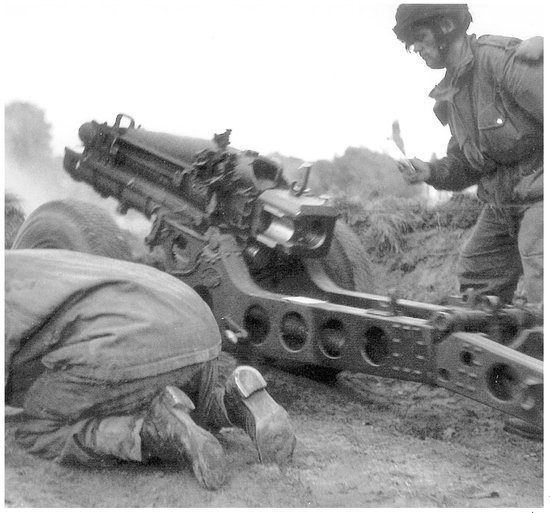
Walk on to the church and go round it to the far side. Here in the field on the other side of a low wall were the three guns of F Troop, half of 3 Battery 1st Airlanding Light Regiment.
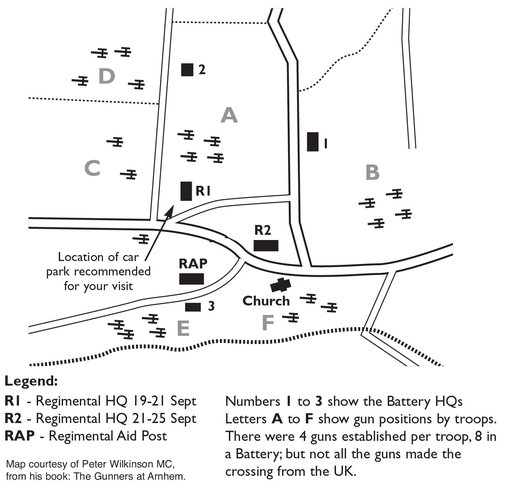
The 1st Airlanding Light Regiment occupied the whole area around here, with 3 Battery here by the church and along the riverbank. Batteries had eight guns, one of F Troop’s had failed to turn up, and the other two batteries were dispersed north of Benedendorpseweg, one along the line of Weverstraat immediately opposite the church and the other in the fields behind the car park in which your car is residing. Their layout is shown on the map on page 131.
On Tuesday 19 September, when attempts to reinforce 2nd
The turnstile is at the end of the track. Peter Wilkinson’s HQ was on the left and E Troop’s guns in the field.

Gun Positions in Oosterbeek
1st Airlanding Light Regiment
Parachute Battalion at the bridge had failed, the remnants of 1st, 3rd and 11th Parachute Battalions and the South Staffords fought their way back towards Oosterbeek long the line of the lower road. Initially the Commanding Officer of the 1st Airlanding Light Regiment, Lieutenant Colonel ‘Sherrif ‘ Thompson was tasked with gathering any fragments under his wing and Thompson Force was created. However, once Lieutenant Colonel Thompson was wounded the fragments were drawn together under the command of the second-in-command of the 11th Battalion, Major Dickie Lonsdale, and now became known as Lonsdale Force. Like Breese Force, a short distance away on the other side of the perimeter, it was to defend this area until the Division’s withdrawal.
Look east along the direction of Benedendorpsweg at the track 100 metres away which turns to the right of the road just on a bend opposite a garage. Soldiers of 1st and 3rd Battalions were dug in here along the line of the track down towards the river, with the remnants of 11th Battalion in the houses around the garage. Almost opposite the church is Weverstraat, and some 200 metres up this road the South Staffords defended the area east of Weverstraat. G Squadron of the Glider Pilot Regiment defended the gun areas and occupied the houses to the north of the laundry, and there were some thirty soldiers in the fields south of the church facing the river.
Lieutenant Michael Dauncey of the Glider Pilot Regiment was with G Squadron of his regiment and was involved in the defence of this area from 20 September to 25 September. German armoured vehicles supported by infantry attacked his position continually, and there were occasions when they prevailed and overran the British defended localities. Lieutenant Dauncey was instrumental in leading the counter-attacks that evicted them; counter-attacks that he organised on his own initiative. He also made a practice of assaulting enemy machine-gun positions with great success, and continued to do so despite having been wounded three times.
It was during a particularly heavy attack on 24 September, supported by tanks and by self-propelled guns, that he was wounded again, losing this time the sight of one eye. Even this did not stop him, and such was the force of the attack he led against the Germans, despite the pain he was in and the loss of vision, that they were beaten back and the lost ground recovered. Artillery fire from 64 Medium Regiment in Nijmegen played a major part in repelling the German assault, which otherwise might easily have cut the Division off from the river.
On 25 September, the last day before withdrawal across the river, his position was once again subjected to intense fire from an enemy self-propelled gun. The houses being occupied by his men were set on fire and he was ordered to withdraw. There were no anti-tank weapons left, and within just a few moments there was every likelihood that the enemy would be able to get inside the gun positions, whereupon they would have been able to wreak real havoc upon the crucially important guns and the Division would have been denied their very important support. Michael Dauncey clearly did not consider this to be sensible, and being alone he single-handedly attacked the mobile gun using a Gammon Bomb.
The Gammon Bomb comprised a small stockingette bag into which was stuffed plastic explosive. A fuze, known as the ‘Always’ fuze, and numbered in the Army inventory Fuze No 69, was attached. It was designed such that the plastic explosive would be smacked onto the tank’s armour, rather like a sort of ‘cow pat’, and then detonated, whereupon the shock-wave of the detonation would pass through the armour and detach a ‘scab’ of steel off the far side about the same size as the ‘pat’. This chunk of metal would then whizz round inside the tank, white hot, at great speed and accompanied by shards of steel from the edges of the ‘scab’, to the acute discomfort of the inhabitants of the armoured vehicle.

The Germans used armoured vehicles such as this StuG self-propelled gun to fire into houses and flush out paratroopers for German patrols to hunt down.
It was Heath Robinson, but effective. The only problem was that the man who launched it had to get very close indeed to his target. It was, to say the least, a hazardous business. Michael Dauncey, half blind, four times wounded, exhausted, under-fed and probably quite cross, was successful in thwarting this attack, but in the process was injured yet again and was captured by the Germans. He eventually managed to escape from hospital in December 1944 and made his own way to British lines. He was recommended for the Victoria Cross and was awarded the Distinguished Service Order for his bravery, and eventually retired from a post-war Army career as a Brigadier.

Major Bill Chidgey RAOC. Collection F R Steer
Walk along the south side of the church and you will see a footpath running along the rear of the Ter Horst House. Follow it through a metal turnstile and in the field on your left were the four guns of E Troop 3rd Battery. The battery’s Command Post Officer, Lieutenant Peter Wilkinson, was positioned in a house just to the east of the one near the turnstile, but which was never rebuilt having been extensively damaged. Walk on for another 100 metres or so beyond the turnstile to a point where the footpath crosses another coming down from the farmhouses to your right towards the stream and the river forelands to your left. This is a good point from which to view the crossing area.
When it was felt that the 1st Airborne Division could hold on no longer and that relief by forces approaching from the south was not a practical option it was decided to evacuate the Division. This took place on the night of 25/26 September 1944. Major General Urquhart’s plan for the withdrawal was to collapse the perimeter into the centre of the position, leaving wounded in place firing weapons to delude the enemy. Radio messages would also continue to be sent for the same purpose. Doctors, medical orderlies and padres were to remain with the wounded. Glider Pilots were to mark two routes and Benedendorpsweg was to be the start line. If, in fact, two routes were marked they were certainly not used by everybody. Many survivors of the battle speak of moving towards the river, but not following a marked path. Down through the area where you are standing part of the Division moved to the river, the sound of their progress being muffled by the sacking they had tied round their boots and by the terrible rain and wind that whipped up that evening, to where they would be ferried across the river by Royal Engineers and Royal Canadian Engineers in canvas boats. From the south side of the river Bofors 40mm anti-aircraft cannon fired tracer along two lines to show the boundaries outside which they should not stray. From Nijmegen, 64 Medium Regiment together with other XXX Corps artillery bombarded German positions and targets near to the perimeter.
Knowing that something was afoot, but not sure if it was a reinforcement, the Germans, who did not enjoy operating at night, stepped up their activity. Over near the church, which you can see from where you are standing, a party of KOSB had a run-in with some Germans, but beat them off. This is a clear example of how close were the enemy and shows yet again how narrow was the area into which the Division was crammed.
Elsewhere random fire into the perimeter created difficulties for those trying to make their way to the crossings. Major Bill Chidgey, the Officer Commanding the Ordnance Field Park, was one of those:
‘The tape-marked route petered out after a few yards. I was on the left flank... Entering a small copse we met opposing fire and decided we should bear left away from it. After some fifty yards or so we ran into immense heavy machine gun fire. I told Sergeant Bennett to withdraw those he could and make his way further left to the river whilst we would help by delaying the enemy. After about half and hour, during which time we were pinned down, the three forward sections eased their way to the left with the intent of following the rear section down to the river. This was not to be as the enemy had closed the gap... on my right I heard a thump and a gasp which told me... had been hit and, by his silence, was killed instantly. There were other sounds of casualties in our group. I felt two hits, one in each shoulder and a searing pain in my back. I passed out. When I came to I found I was unable to move my legs, but there had been plenty of noise and disturbance around for our own artillery had been giving covering fire for the withdrawal and shells had landed on our position. The next morning at daylight... there was no way out. I couldn’t move and the men had suffered casualties. We jettisoned the firing mechanisms of our weapons and accepted the inevitable.’
Private Sydney Harsley RAOC, one of Bill Chidgey’s soldiers, was luckier:
‘I was on my own and saw people moving away from the area and so I followed. I ended up near a gas works where there was an upturned dinghy. There were three or four other blokes there. We turned it the right way up and using our rifles as paddles made our way across the river.’

Sergeant N G ‘Bill’ Griffin RASC. Collection F R Steer
Lieutenant Paddy de Burgh was moving towards the river with two of his soldiers when one was killed by a burst of machine-gun fire and the other wounded, his left hand being almost severed. Paddy took him to an aid station that was by then occupied by Germans where he was ‘invited to stay.’ The following morning, however, he managed to escape the attentions of his captors and made his way down to the river. Clad only in gym shoes and underpants he swam to the other side, being fired on by a machine-gun from somewhere on the north bank. Eventually reaching a groin jutting out into the river on the far bank he sheltered until the German machine-gunner found something else to shoot at. Walking up the dyke he found a Royal Canadian Engineer sentry asleep by his Bren gun. Having tapped the man on the head and asked him what he thought he would do if he, Paddy, had been a German, he left the surprised, but by now very much awake, Canadian soldier and, having been given battledress to wear, walked to Nijmegen. On arrival he asked for the opportunity for just three hours sleep, and slept for twenty-seven.
Some soldiers chose to swim during the night rather than wait for a space on a boat. Some were unsuccessful, and Lance Corporal Hughes of the RASC remembers a friend who did not make it:
‘It was a terrific shock to me... to find out the number of my pals who had not returned. Amongst these was the lad who had been with me ever since we first volunteered for parachuting. We did our first jump together, Legs Wattam. His name, though, still lives in the memory of all those that returned – and we still, especially on exercises, find it hard to realise he is not with us. He was last seen swimming the Rhine – but his chances were little of reaching the other bank.’
Many who drowned are interred in civilian cemeteries to the west, downstream, of Oosterbeek. There was also a case of one soldier who survived the swim, but on exiting the river found he had gone in a circle and was back where he had started.
Having crossed the river men made their way to Nijmegen where reception facilities were being put in place. Instrumental in doing this were the men in the Seaborne Echelon, desperate to help where they could and to discover information about their friends and colleagues who had been fighting north of the river. Some walked, and others managed to get lifts. Major Geoffrey Powell of 156 Parachute Battalion formed the remnants of his unit into a squad and marched them away; just fifteen strong. Bill Griffin was luckier, but his journey was not without its moments:
‘We were told that if a man was wounded he was to be left behind. It was my twenty-first birthday, and I thought, “Today I’m going to die”. I never thought I’d see my twenty-first birthday out. Three of the divisional headquarters clerks got out: Me, Corporal Daniel Lewis and Lance Corporal Norman Davis. I got out in a Canadian boat. We couldn’t start the engine and it was drifting down the river before we eventually got it going. Having got over I headed for a Dorset soup kitchen. Heading back from the river in a DUKW it slipped into a dyke and we all ended up in the ditch, but the driver got it out and drove us to Nijmegen.’
Some even had work to do shortly after they reached the other side, as Sergeant J L Lambert of the Army Catering Corps attached to 156 Parachute Battalion explained:
‘I recollect crossing enemy lines with the Colour Sergeant to get the password for withdrawal into the divisional perimeter, and then the incredible calm of our eventual withdrawal across the river to find tea on the other side. Then finally back to England ahead of the main body to fix up “grub” on arrival with only two of my para cooks left. Quite a business, this Army cooking!’
Ken Clarke made it to the river during the night and fell asleep on the open ground waiting his turn to cross. He was woken at 4.00 am in time to catch one of the last boats. By first light it was over. Just 2,135 of the 10,005 men of 1st Airborne Division had escaped. The remainder were either dead, wounded or missing; and while some were to escape in the ensuing months they were few in number.
Walk back to your car, leave the car park and turn left onto Benedendorpsweg and then up Weverstraat. You are now driving up the eastern perimeter. The early part of the drive takes you through the area occupied first by the South Staffords and G Squadron of the Glider Pilots. On reaching the junction with Van Eeghenweg and Jagerskamp you enter the area into which a Royal Army Service Corps platoon was positioned from 22 September.
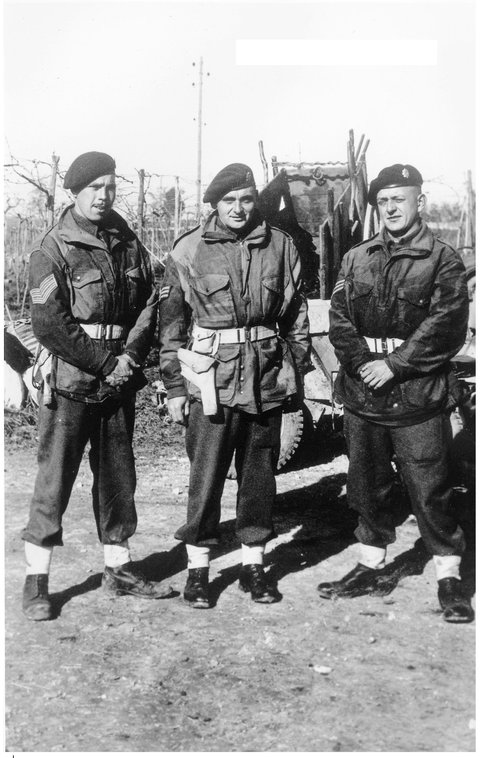
Sergeant Bill Chedgey (right) RASC. Collection F R Steer
Some forty strong, and commanded by Captain Jack Cranmer-Byng, it was a composite organisation made up from the survivors of 250 Airborne Light Company less the few required to continue managing the very limited stocks left in the DAA. The fighting here was hard with constant probes by the Germans seeking to test and penetrate the airborne hold on the perimeter and the paratroopers fighting back tenaciously.
Sergeant Bill Chedgey was part of Jack Cranmer-Byng’s force, and he was in a house near the bottom end of Jagerskamp. From upstairs in one of the buildings he saw a German patrol, and tapping his Bren gunner on the shoulder he directed him onto his target. A few well-aimed bursts killed a number of the enemy, whilst others were wounded and the balance fled. Bill, realising that he was now a target and expecting the Germans to bring up a tank or a self-propelled artillery piece, led his men out of the house and went back towards Cranmer-Byng’s headquarters deeper into the perimeter. The use of a self-propelled gun or tank against buildings had become a standard tactic to drive the defenders out into the open. Once they were clear of the protection offered by the buildings the airborne soldiers would then be hunted down by the Germans using mortar fire. However, on this occasion Bill and his men were able to escape unscathed and made it back to the headquarters, where they were able to rest.
A German patrol moves with caution as they look for British paratroopers.


An example of a German mortar team in action.
However, much against his better judgement, he was back the next day with his men, certain that SP guns would target his building. What followed, though, was a period, almost the whole day, of virtually complete inactivity. This alarmed Bill, and he said so, believing it to be the lull before a storm and that to remain in the position was foolish. Eventually, the expected self-propelled gun arrived – the storm was about to materialise. Sergeant Chedgey dashed upstairs into the front bedroom for a look, and as he did so the gun fired two rounds into the house. Bill was blown over, tumbling over and over as he fell down the stairs, to end up at the bottom with a broken femur. In great pain, he was left with very few options. Clearly the house was no longer a tenable position, for they had nothing with which to defeat the powerful armoured vehicle pitted against them. It could quite simply stand off and blow the building, with them in it, to pieces.
He ordered his men to withdraw, and watched as they raced back across the fields. Some were killed as the German mortars tracked them down, whilst others managed to escape to some relative form of safety in the woods beyond the houses. Discarding his two phosphorous grenades and his two Mills grenades, Bill awaited capture as he lay in pain in the hallway of the house. Soon the barrel of a Schmeisser submachine gun was poked into his stomach, and in German he was asked by one of four youngsters where his comrades were. Speaking a little German, he responded that they had gone. Unsure about what to do with their captive, the sixteen to eighteen year old Germans were faced with an injured sergeant. In their world, his equivalent, a feldwebel, was God, and Bill was treated accordingly. Before long they had constructed a stretcher, had made the sergeant as comfortable as they could and carted him off to hospital.

A Schmeisser sub machine gun (MP 38/40). In use by the Germans. Compare with its British equivalent on page 89.
Moving on up Jagerskamp you come to the houses occupied by, among others, Driver Ron Pearce:
‘We were part of the brigade defences under Captain Cranmer-Byng. I was in 16 Jagerskamp with three others, and next door in 18 there were about twelve of us. It had been very quiet for some time, and the rest said there was no point in staying so they went back to the Hartenstein. We decided to stay in our house, those were our orders. Suddenly, there were a load of Germans coming up the street. I shouted to the Lance Corporal who rushed out to tackle them and was shot in the doorway. They surrounded the house, and fired a Panzerfaust into the house. I was with John Prime, who had learned some German in Italy. Surrounded and with no chance of escape or of doing anything productive we had no choice but to surrender, and so he called out in German. They came to the foot of the stairs and called us down.’
The German Panzerfaust was a shoulder-controlled anti-tank weapon capable of penetrating 200mm of armour plate.

Turning left onto Overzicht you reach the junction with Pietersbergseweg and as you turn right towards the Oosterbeek crossroads a glance to your left will show you the Tafelberg.
As you make your way home, or to your hotel or camp site you may wish to reflect briefly on what you have read and seen and give thanks for the fact that men such as those who landed here in The Netherlands in 1944 were there when we needed them at a time of great danger for our homes, our families, our safety and, not least, our way of life; and pray that we do not need young men like them to make the same sacrifices again. Think also of the Dutch who they came to liberate, and marvel at the affection and esteem they have for the airborne soldiers who landed here despite the loss of life, the devastation and the subsequent German evacuation and looting of the entire area. Ask them why and they will tell you that it is because they tried, and to a people in the grip of a tyrant that meant everything.
Of course, having completed your tour of the landing zones and Oosterbeek there is still the Bridge in Arnhem and the approaches to it for you to discover; but that will have to be for another day.
1
From ‘When Dragons Flew – An Illustrated History of the 1st Battalion The Border Regiment 1939-45’ by Stuart Eastwood, Charles Gray and Alan Green, The Regimental Museum The Border Regiment in association with Silver Link Publishing Ltd, Peterborough 1994.
2
From ‘First In! Parachute Pathfinder Company’ by Ron Kent, B Batsford Ltd, London, and Hippocrene Books, New York, 1979.
3
From ‘Remember Arnhem’ by John Fairley, Peaton Press, Glasgow 1978.
4
ibid
5
From ‘Off At Last – An Illustrated History of the 7th (Galloway) Battalion The King’s Own Scottish Borderers 1939 – 1945’ by Robert Sigmond, 1997.
6
ibid
7
From ‘Arnhem’ by Christopher Hibbert, B T Batsford Ltd, London, 1962.
8
ibid
9
From ‘Off At Last’ by Robert Sigmond, 1997.
10
From ‘It Never Snows in September’ by Robert J Kershaw, The Crowood Press, 1990
11
From ‘Airborne Carpet: Operation Market Garden’ by Anthony Farrar-Hockley, MacDonald and Co, 1970.
12
From ‘A Tour Of The Arnhem Battlefields’ by John Waddy, Pen and Sword Books Limited, 1999.
13
ibid
14
From Off At Last by Robert Sigmond, 1997.
15
From Salute To The Steadfast – From Delhi To Arnhem With 151/156 Parachute Battalion’ by Harry Bankhead, Ramsay Press, 1999.
16
ibid
17
From It Never Snows in September by Robert J Kershaw, The Crowood Press, 1990.
18
From Arnhem by Major General R E Urquhart CB DSO, Cassel, 1958.
19
From Off At Last by Robert Sigmond, 1997.
20
From Salute To The Steadfast by Harry Bankhead, Ramsay Press, 1999.
21
From Red Berets and Red Crosses by Niall Cherry, R N Sigmond, Renkum, The Netherlands, 1999.
22
ibid
23
From When Dragons Flew by Stuart Eastwood, Charles Gray and Alan Green, The Regimental Museum The Border Regiment in association with Silver Link Publishing Ltd, Peterborough 1994.