
Before reaching any conclusions, it is desirable to consider some aspects of performance that affect operational effectiveness, such as stability, seaworthiness and human factors.
Stability
The stability of older destroyers and, to a lesser extent, of other escort vessels became of increasing concern during the war. Radar aerials and their electronic boxes, extra AA guns, depth charges, etc. were added.1 Paint, surprisingly heavy,2 and ‘come in handy’ spares and tools added to the problem. Added weight, high up, will cause the centre of gravity of the whole ship to rise, while fact that the ship floats deeper in the water will usually cause the metacentre to fall.
The Royal Navy did not have formal stability standards before the war but each new design was judged in comparison with previous similar ships on metacentric height (GM), maximum righting lever (GZ) and the angle at which it occurred, and vanishing angle of stability. This comparative approach works well when there are frequent new designs and many ships at sea to provide feedback. Stability after damage is even more difficult and only approximate solutions were possible before the advent of computers. A common rule of thumb for British destroyers was that the ship should just float upright with the engine room and adjacent boiler room flooded. Duncan was a particular worry, as her longest boiler room was adjacent to the engine room. This is a very modest requirement by today’s standards but seems to have been adequate, as only six destroyers capsized out of thirty-seven sunk by a single torpedo hit, perhaps because they broke in half first (see later section on vulnerability).
Errors in safety standards are of two kinds. The first is obvious – that the standard is too low and the ship sinks in a moderate gale or after minor damage. The second kind of error is less obvious – that the standard is so high that operational capability is prejudiced or cost unreasonably increased. It is a fine balance to draw but many subjective accounts suggest that RN standards were not too high.3 No undamaged British destroyer was lost through heavy weather, while other major navies lost nine in such conditions in the decade 1934–44 (see appendix III).4 It will be noticed that many, perhaps most, of these incidents involved water ingress through intakes, weak doors and hatches. It is for this reason that naval architects distinguish between ‘sea-keeping’, the motions of a ship, and ‘seaworthiness’, which takes watertight integrity into account.
By July 1940, action was seen as necessary in the case of some older destroyers, which were required to fill fuel tanks with water ballast when empty. This was very unpopular, as the tanks had to be cleaned before refuelling, and was often ignored.5 A year later, it was estimated that most destroyers had lost about 10 per cent of their initial GM as a result of topweight growth, and the Destroyer Section put a series of proposals to the DNC, Stanley Goodall. They proposed a minimum GM of 1.25 feet in the light condition and that the maximum GZ in this condition should not be less than 0.7 feet. These criteria were chosen to ease the work of calculation in pre-computer days. The section even put these as a pro forma, so that Goodall only had to tick the boxes! His response was interesting: he reluctantly accepted the criteria for intact stability, remarking that he preferred to take a risk on strength than on stability, but said that it was more important to carry additional armament that might prevent the ship being hit than to meet damaged-stability standards.6 In 1943, consideration was given to lowering these standards but this proposal was rejected.

Enchantress heeling, possibly while turning.
Sea-keeping and Seaworthiness
The North Atlantic is big, cold, wet, rough – sometimes very rough – corrosive and hard when it hits you. In bad weather, the fighting capability of a ship falls off rapidly, mainly because of the effect of the ship’s motions on both the physical and mental abilities of the crew. Actual damage to the ship and its equipment may also occur; asdic domes were at risk, as were ships’ boats, but there were more severe cases in which bridge fronts were pushed in and funnels lost. The effect of weather on U-boats, particularly attacking on the surface, and also on the ability of merchant ships to maintain the convoy course and speed is important. The weather also affected air support. The aim should be that surface escorts should retain much of their capability in any weather that permits submarines to attack, either on the surface or submerged. Weather damage accounted for the lower availability in the winter discussed in the next chapter. There are other weather-related problems, such as refuelling.
Table 8.1: Sea state, wave height and wind in the North Atlantic

Table 8.1 shows sea states and corresponding measurements of wind and waves encountered in the North Atlantic. Note that there is no precise link between wave height and wind speed. The figures shown are fairly typical of those that might arise after the stated wind had been blowing steadily for several days over deep water. Subjective accounts seem to suggest that the winters 1940/1 and 1941/2 were unusually severe, but it could be that the authors were not then accustomed to bad weather.
Sea-keeping relates to the motions of a ship; seaworthiness considers the ability of the ship to withstand the effects of these motions. Such matters as the overall strength of the ship and, in particular, the security of doors, hatches, air intakes, etc. loom large in seaworthiness. Sea-keeping was not well understood during the war, as it was not possible to carry out worthwhile calculations before probability theory and computers came into use.

Photos of escorts in bad weather are rare. Eyebright pitching heavily in a moderate sea.
The motions of a ship are usually considered as three bodily movements – along the length (surge), up and down (heave) and sideways (sway) – and three angular movements – see-saw lengthwise (pitch), perturbations about the set course (yaw) and roll (which needs no description). To complicate matters further, each of these motions has a displacement in length or degrees, a velocity and an acceleration, any or all of which may be important. Finally, the size, frequency and direction of the waves relative to the ship’s course are important.
Fortunately, it is possible to ignore most of these factors without much loss of accuracy. The vertical acceleration produced by the combination of pitch and heave is the principal factor in seasickness, while roll acceleration is the main problem in most manual tasks. Damage to the ship and other problems of green seas sweeping the decks are largely governed by the relative motion of stem and wave crest, in turn largely dependent on the combination of pitch and heave magnitude. (Heave is greater in beam seas but is most important when combined with pitch in head seas.)
Seasickness is the most notorious effect of rough seas; it is no coincidence that the word ‘nausea’ derives from the Greek word for ship. The primary cause is vertical acceleration, combining the effects of pitch and heave. The worst case is between frequencies of 0.15 and 0.30Hz (cycles per second) and an acceleration greater than 0.9m/sec2. Most people are sick occasionally, a few so badly that they cannot serve at sea. Other factors – smell, roll, tiredness, the nature of the last meal – may make people more susceptible to sickness, while acclimatisation much reduces the likelihood. Both pitch and heave in head seas are reduced by an increase in ship length. The benefits are not uniform; 20 per cent on the length of a 200-foot ship is far more valuable than 20 per cent on a 300-foot ship. The effects are most severe near the ends of a ship, and living and working spaces should be as near amidships as possible. In most wartime escorts, the mess decks were right forward and the bridge was undesirably far forward.
In the early stages of the design of the postwar Castle class offshore patrol vessel (OPV), the author reviewed subjective accounts of life in World War II escort vessels.7 Life in the Flowers (much the size and shape of the later Island class OPV) was dominated by their behaviour in rough seas. Weather was hardly mentioned with regard to the 300-foot Rivers, while the 240-foot Castles were in-between. It was concluded that the new OPV should be a bit longer than the wartime Castles. After a computer simulation confirmed and refined this historical approach, a length of seventy-five metres (250 feet) was chosen.
A later study based on the Leander class frigates suggested specific losses of capability for a 360-foot ship in bad weather (see table 8.2).8 The views of several experienced COs were used. This was then read across on a simple comparison by length to give a comparison of the equivalent numbers of days’ capability lost per year by various classes described in this book (see table 8.3).
Table 8.2: Effect of motions on fighting capability
|
Sea state |
% loss of capability |
|
0–4 |
0 |
|
5 |
10 |
|
6 |
30 |
|
7+ |
95 |
Table 8.3: Days’ capability lost per year through bad weather
|
Class |
Days lost per year |
|
Flowers |
28 |
|
Castles |
21 |
|
Rivers, old destroyers |
15 |
|
Leanders (for comparison) |
9 |
This is a very crude comparison but has not been improved on. A more recent survey by the Institute of Naval Medicine showed that in a 200-foot ship some 65 per cent of the crew would be sick occasionally and 20 per cent frequently, while on a 300-foot ship these figures would reduce to 50 per cent and 15 per cent. There is some evidence that vertical acceleration, less than that causing sickness, will cause a deterioration in accurate decision-making.9 The accuracy of laying and training a gun is largely determined by the vertical velocity at the mount. All this confirms that the Flowers were too short for ocean-going work but, of course, that is not what they were intended to do. The hull and machinery of a Castle cost little more than those of a Flower and they mainly used the same builders and slips.

The Canadian Modified Flower class Owen Sound in Sea State 5 - 6. The waves are probably 10-15ft high. As it was said, ‘They would roll on wet grass’.
The acceleration due to rolling produces a sideways force, making it difficult to keep one’s feet when doing manual work (there is a small component due to sway but this is normally neglected). Hence the old saying, ‘One hand for yourself and one for the ship.’ This particularly affected the reloading of depth charge throwers, usually made even worse by seas washing over the deck, making it slippery. Rolling is a very complicated phenomenon, dependent on the course of the ship relative to the waves, the resistance of the ship’s hull and bilge keels to rolling and the metacentric height. The metacentric height must be adequate to prevent capsize of the undamaged ship and, as far as possible, after severe flooding. Increase of the metacentric height above this value will lead to a rapid, jerky roll and big sideways forces. (In pre-computer days, the importance of metacentric height on rolling tended to be exaggerated.) Rolling is considered in more detail in the next section.
Slamming is one of the more unpleasant effects of motions. It occurs when the ship pitches so severely that the forefoot comes out of the sea, sometimes as far aft as the bridge, and then re-enters violently. Slamming depends on many factors, of which the most important are sea state, ship speed and the draught and section shape forward. In sea state 6 (four- to six-metre waves) a frigate shape with a draught of two metres would slam at about ten knots; increasing the draught to three metres would raise the speed for onset of slamming to fifteen knots; whilst four metres would give twenty-five knots (these figures are very approximate).
Destroyers were longer, shallower and faster, making them liable to slam frequently from sea state 5 upwards (3.25m). Their highly stressed hulls would shudder and shake, alarming to both captain and crew. Rivets would be loosened, particularly in the single-riveted seams that were used in the forecastle decks of most ships, causing leaks and adding to the misery in mess decks. Leaks might also occur in fuel tanks, giving poor combustion and leaving a trail of oil astern. Worse still would be leaks in reserve feed-water tanks. Damage to asdic domes was frequent, while pitching that was insufficient to cause damage could draw a flow of water containing air bubbles over the dome, much reducing asdic performance. In general, slamming would be rare in sloops, frigates and corvettes, as their speed in heavy weather was insufficient to cause it. This, perhaps, accounts for the surprising description of the Flowers as ‘superb sea boats’.
The impact of a single slam could cause a bottom plate to crack but this was rare. More often, repeated slams would cause a plate to suffer fatigue failure. Slamming could increase the maximum stress in the main hull structure by up to 25 per cent and move the position of maximum stress further forward.
The frequency with which green seas sweep the deck is largely governed by the relative motion of the stem and approaching wave crests and by the freeboard. A rule of thumb used at the end of the war was that freeboard forward should be equal to 1.1 x √(length in feet). This figure was found by recording the freeboard of the classes that complained most about wetness and corresponds to about 100 ‘wettings’ per hour.10 Flare, in moderation, can help but freeboard is the dominant factor.
Green seas can cause actual structural damage to bridge front and funnels (the Towns and the S class destroyers were very vulnerable). Fittings such as boats and lockers were often washed overboard. The greatest danger was to the crew, too many of whom were swept away. In many classes there was no covered access from forward to aft. Later in the war, fleet destroyers were given bridges over the torpedo tubes, making the journey fairly safe even if still wet. Frigates had covered access to the quarterdeck. In almost all ships, the quarterdeck was low and the depth charge crews were often wet and sometimes swept overboard. (It has been suggested that the freeboard aft should be about half that forward.) A particularly bad example was that of the original Flowers, where the galley was aft and food had to be carried along the exposed deck to the short forecastle. The consequences of getting wet were made worse by the lack of proper facilities for drying clothing.
Weather did affect the capability of U-boats, though to a lesser extent. They had no radar and night surface attacks depended on visual sighting alone. In consequence, attacks were normally made down wind and sea, keeping spray off binoculars and giving the worst conditions for the escorts (until radar). In really heavy seas, depth-keeping at periscope depth became difficult.
Weather also affected the merchant ships, as they found station-keeping very difficult in bad weather and the convoy formation tended to break up. This was particularly the case on eastbound voyages, as the ships were lightly laden, often in ballast, the propeller and rudder were half out of the water and the high freeboard and light draft made staying on course very difficult.
Rolling – Flowers
The primary effect of rolling on operational capability is that it makes manual tasks much more difficult. As regards the Battle of the Atlantic, this particularly affected loading of depth charge throwers, always difficult but so much worse on a dark, wet night with the ship rolling violently. The angle through which the ship rolls is not the main problem but rather it is the jerky roll with rapid change of the angular speed (acceleration). Contrary to popular thinking, rolling is not a main cause of seasickness but it is tiring when it goes on day after day without respite, and exhaustion does make people more susceptible to sickness.
A ship is like a pendulum and has a natural period of roll. Rolling will be at its worst when the frequency with which it encounters waves is equal to its own natural period. However, small ships are rather like corks at the mercy of the sea and will be forced to roll at the frequency of encounter as shown in table 8.4. The period of encounter with waves will depend on the ship’s course and speed, and heavy rolling can be avoided if the ship is free to choose; but a corvette escorting a convoy would have little choice of either course or speed.
Soon after the Flowers entered service, there were complaints about their rolling. To a considerable extent these complaints were due to unfa-miliarity with ‘the way of a [small] ship in the sea’ (Proverbs). Like most small ships of all navies, the Flowers had much shallower bilge keels than would now be fitted. Keels up to about eighteen inches deep could be made from a single plate welded or riveted to the shell plating, but deeper than this needed two plates arranged as a ‘V’, with more complicated attachment. There were also fears, largely unjustified, that bigger keels would lead to a significant loss of speed. Table 8.4 gives some examples of the rolling characteristics of particular Flower class vessels. The natural period of a Flower was 10–10¼ seconds, so it is clear that Watson’s figures relate to forced rolling in the period of wave encounter. The Flowers were later fitted with deeper keels.
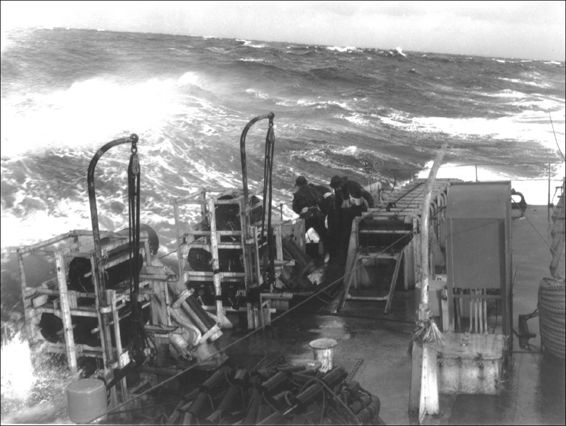
How would you like to manhandle 400lb depth charges in this, even in the dark? HMCS Swansea in Sea State 6 with 17ft waves. Note two throwers with their loading gear and a rail.
Table 8.4: Flower class rolling – some examples11

Rolling – the Captains12
The US-built Captain classes, both diesel- and turbo-electric, were strongly criticised for their rolling as soon as they entered service with the RN. The CO of HMS Duckworth wrote a very comprehensive report:
They are agreeably dry in most weather and after riding out a sharp North Atlantic gale I can report that there is small risk of weather damage. In fact the ships behave like corks. Rolling – since this report is written at sea it is difficult to describe with reticence the nauseating movement of these vessels in the open sea … The violent ‘lurching’ is the principal controlling factor in efficiency. As gun platforms these ships are satisfactory only under the most favourable weather.
Depth charge reloading is possible in a moderately heavy sea pounding the ship … Under average conditions however it must be an even bet whether the throwers lob their charges vertically upwards and on to the quarter deck or immediately alongside the propellers … Limitations on speed and course to windward impose a severe limitation on depth charge attacks while the Hedgehog is inaccurate in a short head swell on account of the unpredictable roll and the resultant tilt.
There were many similar remarks from other officers; there were men thrown out of their bunks, gyrocompass tripping, etc. A constructor confirming the general view blamed an excessive beam-to-draught ratio combined with a light armament, leading to a high metacentric height (GM) and rapid rolling. The GM was about 3.7 feet for the turbine ships and 3.9 feet for the diesels, compared with an average of some 2.5 feet for RN ships of similar size. The roll period of Domett was 7–7½ seconds with a GM of 4 feet, which gave typical roll accelerations of 0.3g. When rolling to 8–10º, she would give the occasional lurch to 20º.
In November 1943, it was proposed to increase the depth of bilge keels from eighteen inches to twenty-four inches and lengthen them by 27.5 feet aft, to cut openings in the longitudinal bulkhead between fuel tanks (this would have reduced the effective metacentric height but was not carried out) and to add many more depth charges. Added weights would need to be more than 14.5 feet from the centre line to increase the polar moment of inertia, which would help to reduce rolling. Both Western Approaches and the dockyards were concerned that this work would take a month, mostly in dock. However, it was thought that the improvement would be worth it. Model tests at AEW, Haslar confirmed the benefits and showed (as I would expect) that there was no discernible penalty on speed or endurance.
Full-scale trials were held with a modified and an unmodified ship of each class running in company in rough weather (see table 8.5). The CO of Goodall reported, ‘The violence of roll has been most noticeably reduced, now ship rolls comparatively slowly and from observation appears to be much steadier than a Castle class corvette.’ His opposite number in Grindall wrote, ‘The excessive rolling formerly experienced has been completely eliminated and provides a much steadier gun platform … I was extremely pleased and consider the conversion of great benefit to both sea going and fighting efficiency.’

Grindall, a diesel-engined Captain in a moderate sea in April 1944. On first entrance into British service the class were criticised for heavy rolling.
A rather strange aspect of this rolling saga is that there were no similar complaints from the USN about their ships. The RN vessels did not carry the torpedo tubes mounted on 01 deck in the US ships but it was calculated that these only added 0.16 seconds to the roll period and very little to the polar moment. It is just possible that the USN crews had less seagoing experience in other ships than their RN counterparts and thought that all ships rolled like that. This and other historical material was used by K Monk in setting and achieving a roll criterion.13
Table 8.5: Comparisons in rough-weather performance of Captain class frigates

The sloops of the Black Swan class had active fin stabilisers following trials in Bittern. The idea was to improve the accuracy of AA gunfire but knowledge of control theory was not great during the war and they were of only limited value. Many people thought the space would be better used to carry more fuel.
Human Factors
Life on small ships in the North Atlantic was inevitably exhausting, particularly in winter. Today, it is recognised that the combat efficiency of the crew is enhanced if they are well fed and can rest properly when off duty, but this was not understood before and during the war and British ships fell well short of what was possible and desirable. There was an impression that sailors were tough and almost revelled in discomfort. In particular, it was thought that discomfort was necessary to keep men awake when on duty. During the 1930s, with high unemployment, it was easy to recruit and there was no great pressure to improve matters.
It was often claimed that hammocks were more comfortable than bunks in rough weather – though most temporary officers had started as ratings but showed no inclination to retain hammocks when promoted. The food supplied was adequate both in quality and quantity but the way it was prepared, cooked and served was primitive and unlikely to provide a balanced diet.
Ventilation in most ships was grossly inadequate, contributing to the high incidence of tuberculosis, and the first fifty-six British-built Flowers completed without lining on their sides. From 1940 the sides were sprayed with asbestos fibres, which would lead to the deaths of many dockyard workers in years to come. Washing and toilet facilities were crude and in inadequate numbers.
The early, short-forecastle Flowers were the worst. They had bunks right forward, where the motion was the most violent. To reach the bridge or engine room, it was necessary to cross the open well deck, getting soaked if the weather was rough. Worse still, the galley was aft and food had to be brought along the open upper deck, getting cold or spilt on the way. As more equipment was added, overcrowding got worse. The following quotation from a Canadian sailor sums it very well:
It was sheer unmitigated hell. She was a short fo’c’sle corvette and even getting hot food from the galley to the fo’c’sle was a tremendous job. The mess decks were usually a shambles and the wear and tear on bodies and tempers was something I shall never forget. But we were young and tough and, in a sense, we gloried in our misery and made light of it all. What possible connection it had with defeating Hitler none of us bothered to ask. It was enough to find ourselves more or less afloat the next day and the hope of duff for pudding and a boiler clean when we reached port.14

Life in the raw! Preparing the joint of meat mixed with depth charges on a corvette. (IWM A6358)


A sequence of interior views of Loch Ruthven. These clean and empty pictures fail to show the horrors of a mess deck full of wet and dirty sailors.
a. PO’s mess.
b. Another view
c. Crew’s washplace
d. Stoker’s mess
e. Open Bridge
The frigates were a little better, as they were longer, reducing vertical motions. They had covered access fore and aft, and their later design remedied some of the detail faults of the Flowers. But with only a little thought and a slight increase in cost, much of this discomfort could have been avoided (see Monsarrat’s comparison of the River and Colony equipment in chapter 6).
Some of these problems arose, as discussed above, from the belief that sailors should be tough. There was little experience of sustained bad weather, as peacetime exercises were usually held in times and areas where bad weather was unlikely and peacetime budgets did not allow for ships to be driven at speeds where damage was liable to occur. It was well known to naval architects and naval officers that motion was worse at the ends of the ship, yet mess decks were right forward – and the captain and admiral had the other end! Much of this problem was due to a failure to quantify the magnitude of the motion. The author as a student was taught that motion was worst at the ends but not given any real idea of how much worse. A full study of motions needed a computer and knowledge of probability theory, but much could have been done by taking measurements along the length of several ships in bad weather.
Another recurring problem was leakage through upper-deck riveted seams, usually single-riveted. To come off watch soaking wet and find that your mess deck, including your locker with change of clothes, was also soaking was good for neither morale nor health. Exercises usually avoided the season of bad weather and were very often in fairly southerly latitudes, convenient for both Home and Mediterranean Fleets. It has long been the author’s contention that one squadron of ships of different classes should proceed at all times at the highest possible speed with the intention of seeing what breaks or is incapacitated.
There were sporadic attempts to set up welfare committees but these were mainly concerned with detail and foundered on lack of funds. It is strange that the two best books dealing with living are both described as ‘fiction’.15
Bridge design was an emotional subject, but RN opinion was unanimous in advocating open bridges. With 30–50 per cent of first contacts being by eyeball up to the end of 1942, it seems that they were right. Nevertheless, there was an unrecognised price to pay, primarily in exhaustion, leading to impaired decisionmaking. The USN tended to favour enclosed bridges and gun houses.
Escape
Losses of escorts during the battle were not unduly severe but, even so, some of their crews found sleeping difficult in the lower mess decks and cabins, with a long and tortuous route to the upper deck, and preferred to rest, if possible, closer to the deck. Most of those ships torpedoed sank in under ten minutes. Adequate escape routes add greatly to peace of mind when sinking may be rapid, and men will stay at their posts longer when they know they can get out quickly.
Very little consideration had been given to lifesaving gear before the war (see chapter 3). Boats could not be lowered in time and neither they nor Carley floats gave any protection from exposure. Just before the war, the inflatable lifebelt was shown to be dangerous in tests but was put into production without change. A very high proportion of those who escaped from sinking ships died of exposure in the water.16 Picking up exhausted survivors from the water was an all-too-frequent task and one to which little thought had been given.
Vulnerability
Escort vessels of the Battle of the Atlantic were relatively small ships and unlikely to survive a torpedo hit. Of 140 destroyers and other escorts hit by a torpedo, worldwide, 102 sank. It is not easy to be specific concerning the number of escorts sunk during the battle, as, in addition to the usual difficulty of defining the area, some were on passage. However, the figures shown in table 8.6 are of the right order.
Table 8.6: Losses of escort vessels in the Atlantic17
|
Type |
RN |
Allied |
|
Destroyer |
15 |
13 |
|
Sloop |
9 |
– |
|
Frigate |
4 |
7 |
|
Corvette |
7 |
4 |
Table 8.7 shows a summary of the time taken for various types of warship to sink. It is not often realised that back-breaking was the principal cause of sinking for the smaller ships of World War II. Broken backs accounted for 44 per cent of destroyer losses, 40 per cent of frigates and 21 per cent of sloops. It may be assumed that the great majority of those that sank quickly broke their backs. The destroyer was highly stressed overall, but the break of forecastle close to amidships exacerbated the problem, making it most likely to fracture. The long forecastle and lower stresses of the sloop and frigate increased survival time.
It is interesting that fire was not a serious problem: of 496 destroyers hit by any weapon, only sixty reported fire, mostly due to bombs, which were not a feature of the Atlantic battle. Caution is needed in assigning a single cause of loss; a ship may be blazing furiously, on the point of capsize when it breaks in half.
Speed
Speed was a valuable asset in an A/S vessel. There were several criteria, the first being that the vessel should have a substantial speed margin over a surfaced submarine, say seventeen-plus knots. The speed of a submerged submarine did not normally exceed three to four knots, although nine knots could be reached for a short period. In hunting submerged targets, the limit was set by asdic performance, constraining speed to about fifteen knots.
The most important aspect of speed lay in rejoining a convoy after falling astern during a prolonged hunt. Convoy speed was seven to nine knots in good conditions and contemporary views were that a speed of about twenty-five knots was needed to catch up after a hunt lasting some hours. Only the destroyers (including long-range conversions) and the steam-powered Captain class were that fast. Given an adequate number of escorts, the senior officer would always detach a fast ship for prosecuting a contact. The success of destroyers and the steam-powered Captain class in terms of kills is largely due to their more frequent opportunities. The comparison between steam and diesel Captains is notable. The use of high speed was expensive in terms of fuel consumption and fast ships needed more fuel (see next section).
Table 8.7: Time to sink after damage in action (worldwide figures)

The Flowers failed by all of these criteria but high speed was not essential for every member of an escort group. The corvettes’ role was that of a mobile asdic set, locating submerged attackers and deterring surface attack. It is interesting to note that the bigger Castle class, with the same engine as the Flowers, were at least half a knot faster as a result of their improved hull form, developed at AEW, Haslar.
Endurance
‘O Lord be kind, thy sea is so big and my ship is so small.’ (FISHERMAN’S PRAYER)
The Atlantic is big: from New York to Liverpool is 3,043 nautical miles; Halifax to Liverpool, 2,485 nautical miles; and Panama to Liverpool, 4,530 nautical miles. The typical convoy route was some 3,000 miles long, requiring fourteen to nineteen days to traverse along a route very close to a great circle. Most maps (including those used in this book) are Mercator’s projection, which greatly exaggerates the scale at higher latitudes, making convoy routes appear far from direct. Escorts would travel considerably further, zigzagging and searching for contacts, and they would also use higher speeds from time to time. Table 8.8 shows the effect of speed on endurance for a V&W class destroyer.

Wanderer in an early trial of replenishment at sea.
Table 8.8: Effect of speed on endurance (V&W destroyer)
|
Speed (kts) |
Endurance (miles) |
|
15 |
3,500 |
|
18 |
1,800 |
|
32 |
900 |
Refuelling at sea only came into use in 1942 and was a slow and unreliable process, possible only in good weather. The older destroyers could not cross the Atlantic without refuelling and some other classes had only a marginal capability. The long-range escorts (mainly V&W conversions) lost a boiler room, and with it a few knots in speed, to gain a bigger fuel stowage. In many classes, the need to conserve fuel limited the use of high speed.
Table 8.9 shows the endurance of various classes of escort. These figures have been drawn from different sources and are not entirely consistent. In any case they are nominal figures and the actual endurance at sea was much less. Note the gradual improvement in pre-war destroyers. Note also the economy of the diesel Captains.
Turning Circle
A small turning circle was needed to position the stern for a successful depth charge attack on a submerged U-boat. It was also desirable to be able to turn inside a U-boat that was fighting it out on the surface. The Flowers were outstanding in this respect – short and with a fair-sized rudder in the slipstream of the propeller. The British twin-screw ships were less good and it is hard with hindsight to see why there was so much reluctance to use twin rudders in the Rivers and Lochs. Table 8.10 gives some typical figures; note how the diameter varies with speed.
Table 8.10: Turning circle
|
Class |
Diameter (yards) |
Speed (kts) |
|
Flower |
136 |
|
|
River, Loch |
330–400 |
12 |
|
Captain DE |
280 |
16 |
|
Captain TE |
350 |
18 |
|
RN Destroyer |
370 |
10 |
|
405 |
15 |
|
|
600 |
30 |
|
|
Town |
770 |
15 |
Table 8.9: Endurance of various classes of escort
