
CHAPTER 9
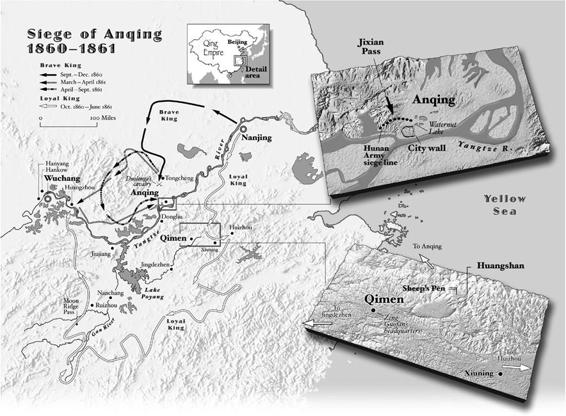
The city of Anqing lay on the northern bank of the Yangtze, at a point where the wide, meandering river flowed briefly in a direct line from west to east before slipping around an island and then diverting northward to continue on toward the ocean, nearly four hundred miles away. A high, crenellated brick wall roughly a mile long on each side surrounded the city, its southern face running along the bank of the river, which here flattened out into a sandy beach. Between the beach and the city wall lay a narrow buffer of land that had held dense settlements and markets in the years before the war, but by 1860 everything on it had been leveled and cleared save for a single seven-story fluted pagoda to the east of the city, surrounded at its base by its own protective stone wall. Otherwise the riverbank was a featureless waste, leaving no protection or shelter for enemies landing from the river. Anqing was hardly the largest of China’s provincial capitals, but it was nevertheless a grand fortress more than a square mile in size, dominating the river and the surrounding countryside. From a military standpoint its siting was perfect. It sat on a high piece of ground that fell away on all sides, giving a clear view and a tactical advantage. And it was exceptionally difficult to approach by land: along with the Yangtze, which enclosed it to the immediate south, there were broad lakes a few miles to the west and close by to the east, which, along with the northerly bend of the river, enveloped the hinterland of the city with water on three sides. Six miles to the north, a steep chain of mountains rose into the mist and impeded most of the approach from that direction as well, save for one lone mountain pass—the Jixian Pass—which had its own stone fortifications.1
Strategically, Anqing operated as a fulcrum. It projected defensive power eastward over the approaches to Nanjing from the north of the Yangtze River, and was also the base for all of the Taiping’s operations to the north and west, through Anhui and into Hubei. And of course, it controlled the river upon which it was founded. The Yangtze was half a mile wide here, but the channel for deeper boats ran up close to the northern bank—so close that the captain of a passing ship could see right into the black maw of a cannon pointing down at him from the city wall.2 The masters of Anqing could thus play havoc with the waterborne supply line of any imperial army that managed to move beyond them into Taiping territory.3 Zeng Guofan had to have it before he could push his army any closer to Nanjing. And the Taiping had to hold it if they wanted to recapture the northern bank of the Yangtze up to Wuchang and eventually link up with the wandering army of Shi Dakai in Sichuan.
With vigilant defense it was nearly impossible for an enemy force to approach Anqing, but when Zeng Guofan began his campaign for it in the summer of 1860, the defenders were not being vigilant. The city (which the Taiping had held for seven years) was the domain of Chen Yucheng, the Brave King, a precocious rebel general only twenty-five years old who had conquered Wuchang at the startlingly young age of eighteen and was known to his enemies as the “Four-Eyed Dog” due to a fearsome pair of black birthmarks under his eyes.4 In the spring of 1860, he decamped with the bulk of his army eastward to help Li Xiucheng break the imperial siege of Nanjing, leaving behind a garrison force numbering roughly 20,000 soldiers to hold the city and protect Anqing’s civilian population—among which were four or five thousand women and perhaps double that number of children, along with the Brave King’s own family.5 The garrison soldiers were unseasoned recruits from Hunan and Hubei provinces, and he left them with strict orders to defend the walls but not to sortie from the gates to engage the enemy. And so, when Zeng Guofan took advantage of the Brave King’s absence to send his brother with 10,000 soldiers down through the northern approach to Anqing, through the Jixian Pass between the mountains, scaring off the defensive pickets into the rain, they managed to set up camp within gunshot of the city walls against little resistance.6
As with the other cities they held, the Taiping treated Anqing primarily as a military camp. The massive outer gates gave way inside to neatly kept neighborhoods with steep cobbled streets preserved for the garrison troops and civilian population, while beyond them were large uninhabited stretches of housing that would soon be torn down to provide wood for fuel, bricks for the construction of new redoubts along the wall, and open space to reclaim for gardening. The city’s residents could grow vegetables in abundance. They were also well provisioned to start with, so there was no particular sense of concern as the garrison troops barricaded the gates to wait for the Brave King’s return, and took turns watching out over the plain from a lookout on top of the wall while the tiny Hunan Army soldiers down below made themselves busy.7

Zeng Guofan’s siege of Anqing was not initially a pressing concern for the Taiping leaders. They knew the city to be well fortified, and the garrison, though inexperienced, had double the numbers of the force under its walls. A plan to relieve Anqing materialized in September 1860 as a secondary objective within the larger Taiping plan to reclaim control of the Yangtze River up through Wuchang. This was the second phase of Hong Rengan’s strategy—in which, after consolidating the lower reaches of the Yangtze to the east of Nanjing, they would turn their attention upstream. But after the repulse at Shanghai in August it was clear that the foreigners would not sell them the steamships Hong Rengan had counted on to transport the Taiping armies up to Wuchang, so they had to go on foot. After the main work of consolidation around Suzhou in the east was done, Chen Yucheng the Brave King and Li Xiucheng the Loyal King embarked on a massive pincer operation westward on opposite banks of the river, planning to converge upstream from the Hunan Army forces at the scantily defended Hubei capital of Wuchang.
According to the plan, the Brave King would take a large army of 100,000 around to the north through Anhui, try to break the siege of Anqing in the early winter en route, and then continue on to seize the smaller city of Hankow on the northern bank across from Wuchang by spring. Li Xiucheng would mirror the Brave King’s path with a smaller force on the southern side of the great river, plowing through Zeng Guofan’s headquarters in Qimen at the same time the northern forces were breaking the siege of Anqing under his brother Guoquan, and then follow around from below to come up and rendezvous with the Brave King in April for a joint attack from both sides on Wuchang—which, because Zeng Guofan had staked almost his entire force on Anqing, had a defensive garrison numbering only about 3,000 troops.8 Any of Zeng Guofan’s forces that remained after the main operation would be trapped, their lines of supply and reinforcement cut off, and the joint Taiping armies under the Brave and Loyal kings could then march back down the twin banks of the Yangtze, with Wuchang as their base, and crush the Hunan Army where it lay.9
The Brave King set out from Nanjing in October 1860, crossing over to the northern bank of the Yangtze and then marching his men westward into Anhui province to test the strength of the imperial lines. This was some of the most bitterly fought territory in the country, where the ravages of the northern Nian bandit armies reached down to overlap with the fighting between the imperialists and the Taiping (fifty years after the war was over, travelers through the region would still lament that its scars hadn’t healed). Relations between the Taiping and Nian leaders were tendentious, but they shared the common enemy of the imperial government and occasionally found common ground. In this case, the Brave King recruited a Nian general to join him with an army on horseback, which made a series of feinted side attacks to confuse the imperials and disguise the main route of his march. In late November, he made his move and turned sharply south to bear straight down on Anqing. But just beyond Taiping-held Tongcheng to the north of the siege, he stumbled onto the enormous force of 20,000 imperial cavalry under the Manchu general Duolonga, whom Zeng Guofan had stationed south of Tongcheng to protect Anqing from just such an approach.
Unable to break Duolonga’s cavalry lines and finding his slower forces consistently outflanked by the swift northern horsemen, the Brave King pulled back to the protective walls of Tongcheng and abandoned the northern approach to Anqing. He held Tongcheng against imperial attacks through the winter and then decamped at the beginning of March, just after the start of the Chinese New Year (and just as Hong Rengan was leaving the capital to bring him more support). This time he led his forces in a grand sweep to the northwest beyond the range of the cavalry, and then turned sharply southwest in a beeline toward the three-city nexus of Wuchang, Hankow, and Hanyang on the Yangtze River. In a final, punishing burst of speed they covered two hundred miles on foot in just eleven days, punching through several pockets of militia resistance along the way. A detachment of the Hunan Army’s cavalry charged due west to try to cut them off, but it arrived too late, and on March 17, 1861, an advance party of the Brave King’s forces arrived outside the river town of Huangzhou on the Yangtze’s northern bank, just fifty miles downstream from Hankow and Wuchang.
Surprising the two thousand imperial soldiers and cavalry who garrisoned Huangzhou, the advance party slaughtered them all and commandeered their horses.10 Then they began tearing down houses to throw up three lines of wood and stone defensive barricades around the town while the rest of the Brave King’s army continued to stagger in, exhausted from the long march. Some were so depleted by the time they got past the blockades that they simply fell to the ground and went to sleep in the street, without even removing their loads.11 With Huangzhou in hand, Chen Yucheng now had a perfect base from which to attack Hankow upstream and complete his side of the pincer maneuver.
In his headquarters in Qimen, below the river and sixty miles southeast of Anqing through a heavy range of mountains, Zeng Guofan greeted the news of rebel movements with worry. Independently of the huge new operation afoot—of which he was as yet unaware—separate Taiping forces had been harassing his defensive outposts around Qimen since the early fall. By the late autumn a rebel army under Li Xiucheng’s cousin the Attending King had captured the town of Xiuning, thirty miles to his immediate east, which commanded the only road in that direction. He dispatched his best field commander, Bao Chao, to try to take it back. Though his forces were well trained, they were outnumbered and had scant intelligence on the rebels’ broader plans.
In the midst of this, the news about his brother across the river at Anqing wasn’t entirely encouraging. Things were still quiet at the siege thanks to Duolonga’s blockade, but Guoquan was an inexperienced leader and Zeng Guofan learned that his officers had been paying the mass of laborers—the ones who were digging their moats and building their defensive walls—with rotten, moldy grain that the starving peasants had no choice but to accept. Zeng Guofan wrote an angry letter to his brother demanding that he make sure they were paid with silver, because word was spreading that the Hunan forces were corrupt and cruel. “You must nurture the people for their own sake, and choose officials who will act on their behalf. What I hate is when officials don’t show love for the people,” he wrote.12 The only good news, such as there was, was that in the late fall he learned that the foreign armies had left the capital after sacking the emperor’s palace, and it seemed that they didn’t intend to take over the empire for themselves, which was a lone source of relief.
On November 23, 1860, Zeng Guofan celebrated his fiftieth birthday by the Chinese calendar. It was not a festive occasion. “My years have passed as wasted time,” he wrote in his diary. “Dejected, I now become an old man.”13 He was on an inspection tour at the time, making the rounds of the mountain peaks surrounding an oval-shaped valley about ten miles northeast of Qimen. The valley was flat and broad, about twelve miles by four, crammed with wealthy merchant villages and dense tea farms and ridged all around with brilliant razor-sharp peaks that reached up more than three thousand feet. It was like an oasis within the mountains that pressed so close all around, you could practically touch them. To the northeast lay the mile-high granite peaks of Huangshan, the Yellow Mountain, with its twisted pines and fingerlings of stone pressing into the sky. Due north, threading through a sea of overlapping ranges, lay the narrow path that was the most likely approach for an army from the north to enter the valley.
After an early breakfast and some paperwork, he left around seven in the morning to climb the arduous graveled path up to the Sheep’s Pen, a strategic peak seven miles north of his camp that watched over the approach through the northern mountains. At 2,700 feet, on a fine day it gave a stunning view down the other side, through waving groves of bamboo to a tiny farming village on the valley floor, and for miles into the distance along the rippling channel of pine-forested valleys leading away to the north. But this wasn’t a fine day, and a heavy blanket of clouds hung over the pass, so dense that he couldn’t make out anything at all from the lookout at the top.14
The weather was getting cold in the higher elevations, and over the next two days his scouts confirmed that the other routes leading in through the mountains were blocked with snow. The valley was safe for the winter. So he finished his inspections and returned to Qimen on November 26.
Five days later, on the first of December, Li Xiucheng’s entire army crossed over the Sheep’s Pen from the north and entered the valley.
Zeng Guofan got the news that afternoon. He immediately dispatched his fastest couriers to ride for help, and stayed up all night in terror. The morning saw him grim with exhaustion and worry, with only 3,000 troops of his own at his headquarters to fend off the rebel army.15 His nearest supporting forces were under Bao Chao, thirty miles away to the east at Xiuning,16 and Li Xiucheng’s army had materialized right between them. He had little hope. But he tried to put on a stoic face as he wrote to Guoquan at Anqing to explain the situation. He had done everything he could, he wrote to his brother, and for the enemy still to come like this, through the fog and the snow, could only be Heaven’s will. Now the rebels were just fifteen miles from his undermanned headquarters. “It’s just a stone’s throw,” he wrote, “and there are no obstacles to stop them.… All we can do now is study our defenses and, when they come, try to hold out until someone comes to help us.”
He had thought many times over the years about how he would face his death when it came, and his voice in the letter was steady and accepting. “I look back on my fifty years,” he wrote in its conclusion, “and though I regret that my scholarship is still incomplete, at least I am guilty of no great crimes.” His final words were moral advice for his family: he asked Guoquan to “guide our younger brothers and sons and teach them to be diligent within, and modest without, to guard against arrogant habits. Beyond this, I have no other will.”17 There it ended and there he sat, composed, waiting for his fate to run its course.
But Li Xiucheng didn’t attack him that day. He had no idea how weak Zeng Guofan’s forces in Qimen were, nor did he know that the Hunan general’s best troops were a day’s march in the other direction. His own men were exhausted from their trek through the mountains and snow and needed rest. And he didn’t want to risk a pitched battle against unknown odds when his real objective, the hundreds of thousands of new Taiping followers who awaited in Jiangxi and Hubei provinces, lay far beyond.18 So, after capturing the county seat in the center of the valley, he paused. That pause was enough.
It was Bao Chao—who would just then have been arriving in Beijing if Zeng Guofan had followed the emperor’s orders—who the next morning swept into the valley from the east with a full force of cavalry and drew up lines of battle. The first day, the two sides fought to a standstill. The second day was a bloodbath. Bao Chao’s men were fewer but far better rested and equipped, and the Loyal King, with an eye on further objectives, finally called a retreat and pulled his weary men back into the mountains, disappearing once again into the fog and leaving four thousand dead and wounded behind him on the valley floor.19
For Zeng Guofan in his position south of the river, the winter was one of constant uncertainty and movement, of lines of supply and communication cut and reopened, strategic towns lost and regained. The Taiping armies outside Qimen—three of them altogether, not including Li Xiucheng’s personal army, which had moved on toward Jiangxi—fanned out and began picking off the towns controlling the roads leading away from his headquarters one by one. On December 15, they took the town to his west and severed his communications with his brother at Anqing. Eight days later, they took another town to his south and cut off his overland supply route from Jiangxi province. He sent Bao Chao south and another commander west to take them back but knew those were desperate moves. He had lost the initiative and was reduced to putting out fires when they erupted. But it was all he could do, and he wrote to Guoquan that “if they don’t succeed, my supply lines will be disrupted. Everything is falling apart … the forty or fifty thousand troops under my command will be defeated if they don’t have supplies.”20
On December 27, Zeng Guofan wrote to one of his naval commanders that everything was going wrong in southern Anhui,21 and by early January, his men were fighting back renewed invasion attempts through the Sheep’s Pen.22 Qimen was being harassed on all sides, and he now began to suspect that the skirmishes on both sides of the river were distractions in the service of a master plan to relieve Anqing.23 Still, it was all he could do to fend off the constant attacks. Fierce battles in February and March saw the fighting encroach to within twenty miles of his Qimen headquarters again. He owed his life to Bao Chao, who charged back and forth across the province to attack the raiding armies as they appeared. And he owed his army’s sustenance to a Hunanese general, Zuo Zongtang, who defended the porcelain-producing city of Jingdezhen to the southwest, the walled city that controlled Zeng Guofan’s sole remaining supply line from Jiangxi province. But when that city fell to Li Xiucheng’s cousin on April 9, Zeng Guofan’s supplies were finally cut off completely, along with all communications with the world outside.24
Fearing the starvation or slaughter of his troops trapped inside the rebel encirclement, he joined with one of his commanders to lead 9,000 of them eastward to break through the Taiping cordons. In that he saw the only hope of survival. “My mouth and tongue are dried up, and my heart is afire,” he wrote in his diary in anticipation. “I almost don’t know what joy there is to be found in life, nor what sorrow there is in death.”25 But at the walled town of Huizhou, at the edge of the cordon, they met with disaster. The rebel garrison managed to sneak out under cover of darkness and set fire to Zeng Guofan’s camp, burning it to the ground and scattering his soldiers into the night.
Zeng Guofan fell back to Qimen with no food or supplies and no route for escape. On April 22, 1861, he wrote a somber letter to his sons back home in Hunan with the resigned certainty that the war, for him, was now over. In his diary, he described it as his will.26 He told his sons that the situation he now faced was as bleak as in January 1855, when he had lost his naval fleet at Lake Poyang and tried to commit suicide. His forces were still intact this time, he wrote, but “we are surrounded on all sides. Our supplies are all cut off. On top of that, to meet with such defeats—the morale of our army is truly shaken.”27
In the will, he told his sons not to become military men. This general, who had only ever wanted to be a scholar, looked back on his own career and saw it as a failure. “At its root, leading an army is not something I was good at,” he told them. “Warfare calls for extremity, but I am too balanced. It calls for deception, and I am too direct. How could I possibly manage against these monstrous rebels?” He told them to avoid following any path like his own, save for the quiet Confucian scholarship that was his only true pride. “All you should do is pursue your studies with a single mind,” he told them, in memory of happier times—before the war had swallowed him whole, before he had given his life to the imperial service. “You must not become soldiers,” he told them. “And you need not become officials, either.”28
After his capture of Huangzhou on March 17, 1861, Chen Yucheng the Brave King was positioned to go on and take Hankow fifty miles upstream, on the northern bank of the Yangtze across from Wuchang. From that base, he could prepare for the impending arrival of Li Xiucheng’s army from the south in April. But Hankow was one of the ports opened to British trade by Elgin’s treaty, and by the most capricious of coincidences, the Brave King’s arrival at the edge of the Yangtze overlapped with Admiral Hope’s expedition—which had just made its initial visit to Nanjing at the end of February and was now upriver in Hankow, where Hope and Parkes were making arrangements to station a British consul before heading back down to Nanjing again for their second visit (the one during which Parkes would demand that the Taiping stay thirty miles from Shanghai).
And so it was that on March 22, 1861, just five days after the Brave King’s army captured Huangzhou, Harry Parkes showed up to pay him a visit. The advance force of rebels in the city—about twenty to thirty thousand men at that point, with several tens of thousands still on their way—were hard at work building defensive barricades as the gunship Bouncer pulled up offshore, dropped anchor, and discharged Parkes (much to the amusement of many of the soldiers, who had never seen a European before). Striding purposefully into town, the diminutive Parkes took note of three proclamations: one inviting the townspeople to trade with the army, one forbidding the soldiers to loot, and the third, “appended to the heads of two rebels,” warning what would happen to soldiers who violated the second proclamation. The rebel troops seemed to him haggard but friendly, with no signs of infighting or discontent, and he ascertained that they came from all over the empire, though primarily from Hubei and Hunan provinces, just like the garrison soldiers in Anqing. These were men from the Brave King’s territory in central China. Parkes was ushered across town to the main government office, where he entered through a gauntlet of halberds and banners to find the Brave King himself seated for audience. He was “a young-looking man, robed in a yellow satin gown and hood embroidered with dragons,” and Parkes found him to be pleasantly modest and highly intelligent.29
Chen Yucheng was remarkably open with Parkes—he, like the Heavenly King, carefully followed Hong Rengan’s injunction that the rebels needed to cultivate the friendship and goodwill of foreigners. He told Parkes the story of his current campaign, leaving out the fighting with Duolonga’s cavalry that had blocked his northern approach to Anqing back in November. But he did reveal quite candidly the strength of the various Taiping armies and their relative positions in the overall campaign, and explained their plan to converge on Hankow and Wuchang in April. He said that his immediate objective was to break the siege of Anqing, and to that end he had come north around the imperial forces and was now firmly planted at their rear. “So far he had been completely successful,” reported the impressed Parkes, who noted that the Brave King’s final breakneck march had turned the flank of the imperial forces and he was now poised either to attack them from the rear once the rest of his army arrived or to capture Hankow upstream and hold it as a base for the coming of the other Taiping armies in a few weeks. (As Parkes well knew, Wuchang was so poorly defended that the entire population of the three cities was at that moment fleeing into the countryside in abject panic at the news of a rebel approach.) Hankow could be the Brave King’s easily, as soon as he wanted—but, he told Parkes, he was now uncertain about whether he should attack it, because the British were there.
Parkes’s response would be more consequential than he could possibly know. “I commended his caution in this respect,” reported Parkes, “and advised him not to think of moving on Hankow.” He explained to the Brave King that the British now had important interests in that city and there was no way for the Taiping to occupy it “without seriously interfering with our commerce.” Parkes didn’t say as much in his report, but behind those words lay a threat that, while unstated, would nevertheless have been crystal clear to the Brave King. Chen Yucheng was not privy to Parkes’s negotiations with the Heavenly King, nor was he aware of the British debates over their neutrality policy or even of the limited power that Parkes, a mere interpreter, was supposed to exercise. Given those limitations in his knowledge, he would clearly understand Parkes to mean that if he dared to approach Hankow with his army, the British guns would meet them in the same way they had met Li Xiucheng at Shanghai the previous summer. “It was necessary that their movements should be so ordered as not to clash with ours,”30 Parkes reported to Bruce as justification for warning the Brave King away from Hankow.
The Brave King tried to negotiate. He said he understood Parkes’s concerns but suggested that perhaps the British could go about their business in Wuchang and Hankow while he, and the army under Li Xiucheng that was soon to arrive, could take the third city in the nexus, Hanyang. Parkes said absolutely not, for they were all commercially linked (and though Elgin’s treaty specified only that the British could trade in Hankow, Parkes liked to think of “Hankow” as encompassing all three of the cities). “The rebels could not take any one of these cities,” he insisted, “without destroying the trade of the whole emporium.” The Brave King reluctantly agreed, and told Parkes he would wait for the rest of his army to arrive “and then be guided by circumstances as to his next operations.” But after Parkes departed he was left unsure whether to take on the Anqing siege forces from the rear with no support, or to stay with the original plan and strike at Hankow in defiance of Parkes’s warning. As the latter option had now become a matter of foreign relations, he had to send a courier back to the capital in Nanjing to get instructions.31 And so the initiative won by his sprint to Huangzhou began to leach away. The imperial cavalry that had chased him across Anhui had reached Wuchang and sounded the alarm. As his army dug itself in at Huangzhou, waiting for instructions that would take months to arrive, the imperial defenders of Wuchang and Hankow were calling up reinforcements and sharpening their swords to prepare for a rebel attack they now knew full well was coming.
Meanwhile, downriver in Anqing the garrison was holding on into its eighth month of siege. The pitched battles around Tongcheng to the north and Qimen to the south were so far away as to be invisible to them. Where they stood, everything was quiet. Zeng Guoquan’s lines of vallation had grown to surround the entire city on its landward sides with a sequence of walls and moats about two miles from the city walls, forming what was effectively a new fortress on the outside, engulfing the fortress of Anqing within. The naval forces that patrolled the river just out of sight completed the encirclement.
The population within the city was on rations, but generous ones: a catty of rice (about a pound and a third, providing more than 2,000 calories) per day, and the residents had vegetables from the gardens they were growing, along with any small animals they could catch. Parkes stopped through on his way down to Nanjing just after visiting the Brave King and noted that although they looked a little “pinched,” they were healthy and visibly content. They expressed no particular urgency about being rescued and asked him if the Brave King was planning to attack Hankow. (“I replied that I believed he would avoid that port,” reported Parkes.) They also asked him, when he got to Nanjing, to please tell Hong Rengan to send them rice, cooking oil, and salt. And it was on that request that the anxiety behind their smiles began to show. For after Parkes reembarked on his steamship, they sent messengers after him to press him with a handful of gold bangles in hopes of ensuring his goodwill. Insulted that they should think he could be bought, Parkes refused the gifts with an angry burst of indignation, and nobody visited his ship again.32 When the rebel kings down in Nanjing later asked him if a British ship might carry supplies up to Anqing for them, he told them it couldn’t possibly be done and offered them a stern lecture on “the rights and duties of neutrality.”33
But even without Parkes’s help, the Anqing garrison had other avenues of supply. A steady traffic of foreign steamships was now beginning to navigate the river on their way up to Hankow, and some of those ships were perfectly happy to drop anchor outside Anqing’s southern gate (facing the river, out of sight and range of the siege forces) to unload food and weapons at inflated prices for the soldiers who came out to trade with them. There was nothing Zeng Guofan’s naval blockades could do to stop the vessels without violating the new treaty, and so, after firing a desultory shot or two across the bow, his patrols had to let the foreign-flagged ships go where they might, and the smugglers made good business of it at Anqing.
In addition to the foreign ships, which supplied them on a larger scale, on a more intimate level there was actually a market outside the walls. The siege had been at a deadlock for so long that this market had sprung up between the defenders and the besiegers, where the prisoners inside could buy some of their necessities from the very people who were imprisoning them.34 This was partly due to financial problems on Zeng Guofan’s side; the Hunan Army was nine months behind in meeting its payroll, which meant that its soldiers wanted money just as much as the people inside the city wanted food.35 But it also reflected the reality that both sides of the siege were from the same homes and similar backgrounds; here at this city in Anhui province, there were as many men from Hunan inside fighting for the rebels as there were outside on the imperial side besieging it. It was simply a matter of where they had cast their loyalties in the early days of the war, on which side they had staked their futures. Otherwise they were as close to brethren as strangers in China could get. They spoke the same dialects, came from the same regions. In the absence of strict orders from their officers to attack—which would come in time, but not yet—the soldiers on each side held their ground and watched out for the others with wary eyes.
Li Xiucheng’s army didn’t show up in April as expected. After retreating from the valley abutting Qimen in December, he steered wide of Zeng Guofan’s forces and relied on the other Taiping armies in southern Anhui to keep the Hunan Army’s leader bottled up, in hopes that with enough harassment Zeng would call off the siege and pull the Anqing forces south for his own protection. With Zeng Guofan trapped, the Loyal King set his sights westward toward Jiangxi and Hubei, where the hundreds of thousands of promised recruits lay. His route meandered in a rough semicircle down through southern Anhui below Zeng Guofan, then west into Jiangxi below Lake Poyang, and finally up into the province of Hubei toward Wuchang, where the Brave King was waiting for him.
He was out of his natural domain. This part of the empire was the Brave King’s territory; the Loyal King’s place was in the east. And down below the river, where he was, most of the towns were under imperial control, even if weakly guarded. So his army had to fight its way through, siege after siege, darting from one town to the next, threading a needle back and forth along the network of fortified settlements to gather provisions and horses. Zeng Guofan had no forces to spare to chase after him, so the towns fell before Li Xiucheng’s army one after the other, mostly with ease. But it was still a slow progress, and by April, when the Brave King expected him at Wuchang, his army was still down deep in Jiangxi province, more than two hundred miles to the south of where it was supposed to be.
It was a strange journey, and his own recollections of it were almost mystical. In early April, his army arrived at the Gan River, which cuts through Jiangxi province from south to north. The river was cold and swollen with snowmelt, and his army had no boats with which to cross, so they could move no farther to the west. There were enemy militias on the other bank, and scouts spotted imperial gunboats patrolling the river. So he marched his men south along the riverbank but still could find no crossing. Then one day, as if by an act of God, the waters suddenly dried up. His army crossed the river on foot.36
As he later explained the tardiness of his movements, he felt a certain duty to the people they encountered along the way. In early May his forces mustered in the city of Ruizhou, still more than a hundred and fifty miles from Wuchang. Though he wanted to move on, the people at Ruizhou asked him to stay. He found that his reputation as a leader was known even in this region deep in the center of the empire (the phenomenon was confirmed by several independent accounts of the era). In a time of lawlessness, his presence projected order and security. It was an attractive force, and the promised recruits came to him. As he waited at Ruizhou, some 300,000 new followers came to him as the weeks passed, and by the time he moved again northward toward Wuchang, his army had grown many times over.37 But the new followers were untrained and had only the weapons they had brought with them from their farms. Also, as Zeng Guofan knew, the larger the army, the greater the challenge of feeding and training it.
The strangeness pervaded his dealings with the enemy as well. Some of his men captured an imperial commander on the way to Ruizhou, defending the Moon Ridge Pass, and they brought him along as a prisoner. At Ruizhou, they brought him before Li Xiucheng to be punished. But Li, after talking to the man, decided that he was too talented to waste by execution, and he invited him to join the Taiping. The officer refused, saying that as a prisoner “he was no longer master of his own wishes.” Moved by the man’s loyalty, Li let him go free and gave him 60 taels of traveling money to return to his own side. He refused to take the money. Departing from the Taiping camp, he made his way back across Jiangxi to rejoin the imperial forces under Zeng Guofan’s general, Zuo Zongtang. But in a war with little forgiveness, this officer had already used up his allotment. When he returned to his own side, he was beheaded as a traitor.38
At the head of his multitudes, Li Xiucheng finally arrived outside Wuchang in June, two months late for his rendezvous. Communication across the river had proven nearly impossible, and Li Xiucheng still expected to find the Brave King ensconced in Hankow on the northern bank, ready to mount a joint attack on Wuchang and then head downriver toward Anqing. What he learned instead was that his counterpart had left without waiting for support, and—worse by far—he hadn’t secured Hankow. By that time, the imperial-held cities around Wuchang had enjoyed three full months of warning to call up reserves, and they were heavily defended.
With vast numbers of untrained men, Li Xiucheng didn’t dare to approach any closer than the outskirts of the county. The Brave King had left behind a garrison in Huangzhou to coordinate with Li Xiucheng when he arrived at Wuchang, but the river was so well controlled by Zeng Guofan’s navy that it turned out to be impossible to get letters across. In desperation, Li Xiucheng had to ask the new British consul at Hankow to deliver a letter for him to the garrison at Huangzhou. In that letter, Li Xiucheng told them he had only the haziest of details of the Brave King’s operations north of the river, and he asked for immediate information so he could plan his own army’s movements accordingly. The British consul kept the letter as a souvenir and never delivered it.39
With no reply from the forces on the northern bank and no information about the movements of the Brave King in Anhui, Li Xiucheng was left with no role to play in the larger campaign. He couldn’t remain where he was, because he didn’t feel confident his untested army could take Wuchang, and word came from the east that Bao Chao’s army was coming for him. He envisioned a disastrous slaughter if Bao Chao’s crack veterans should catch up to his inexperienced, ill-equipped recruits. So at the end of June, he abandoned the western campaign and took his enormous army of new followers down out of Hubei and back toward the safety of his own territory in the east. Bao Chao’s army followed in pursuit, but Li Xiucheng’s God was still with him. The imperials nearly caught his army at a small tributary near the Gan, but a great wind came up just after the Loyal King’s men swam across, blowing so strongly and fiercely that no boats could cross the river for four days, and by the time Bao Chao’s men could resume their chase, the Loyal King’s army was already far ahead of them and the pursuit was hopeless. Leaving behind garrisons to hold the string of cities he had conquered along the way, Li Xiucheng retraced his jagged route back through Jiangxi and across southern Anhui and finally divided his army into two columns to enter the eastern province of Zhejiang, taking advantage of the vulnerability of its capital city, Hangzhou, while Zeng Guofan’s forces were tightening ever more closely around Anqing behind him.
When Li Xiucheng had failed to materialize in April, the Brave King had acted alone. There was no response yet from Nanjing to approve an attack on Hankow with its British presence, so he decided to leave a garrison at Huangzhou and take his best troops downriver to attack the Anqing siege forces himself, without the support of the Loyal King’s army on which he had planned. On April 27, he arrived at the Jixian Pass at the head of 30,000 troops, to reclaim his city. Scaring the outnumbered Hunan Army troops into the cover of their dense ring of defensive works, his men began the process of building yet another set of fortifications outside Zeng Guoquan’s encirclement, effectively containing the besiegers from the outside. A British naval officer from his ship’s deck noted this “strange sight” unfolding as the rebel and imperial forces arrayed themselves in concentric rings—the Brave King’s army in a wide perimeter, surrounding Zeng Guoquan’s siege forces, which in turn surrounded the walled city of Anqing, with the rebel garrison and civilian population inside at its core. The Brave King’s men built a series of heavy wooden stockade forts at the Jixian Pass and set up eighteen more stockades on either side of Waternut Lake, which bounded the city on its eastern side and marked the endpoint of Zeng Guoquan’s encirclement. Taking nominal command of the lake, the rebels built a series of pontoons and makeshift rafts and began ferrying emergency supplies across to the city.40
After three days of hard attacks, however, the Brave King’s men failed to break through Zeng Guoquan’s main defensive works, with their high walls and deep moats. They could not advance inward to open the siege. But they couldn’t move north either, for there was one more layer in the radiating system of encirclements—one far out of the view of anyone watching from the river. Even as he threatened dominance over Zeng Guoquan’s siege forces inside the Jixian Pass, the Brave King was himself cut off from outside support by the continued presence of Duolonga’s vicious imperial cavalry thirty miles to his north, the same force that had prevented his attempt to drive straight down on Anqing back in November. Duolonga’s cavalry blocked the passage between his army at Anqing and the Taiping-held city of Tongcheng, which was the first step on the line of communication and reinforcement leading back toward the rebel capital at Nanjing. Unable to break the siege alone, and with no support from Li Xiucheng’s army on the Yangtze’s southern bank, the Brave King turned out to be less the savior of Anqing than the latest entrant in the grand game of envelopment and strangulation.
On May 1, hope arrived for the Brave King when an army of 20,000 Taiping reinforcements under Hong Rengan’s command reached Tongcheng. This was the end of the journey that had begun back in February when William Muirhead had watched him leave the capital. The orders that had sent him into the field had come on the heels of the Brave King’s first failure to break the cavalry lines at Tongcheng, and Hong Rengan’s military role was clear—to support the Brave King in defeating those forces. But he had come with some reluctance, for he suspected that politics were at work behind him. In the orders sending him out of the capital, he sensed the jealousy of the other members of Hong Xiuquan’s family (especially Hong Xiuquan’s son), who resented his enormous influence over the Heavenly King. In them he also sensed the resentment of the other kings, who had endured the hardships of the winter campaign while he enjoyed a sedentary life in the capital with his family, writing treatises on government and receiving foreign visitors.41
He had first gone south from Nanjing into Taiping-held regions of Anhui and Zhejiang to find soldiers and officers. It wasn’t difficult for him to raise an army, because the tide ran with such strength in the rebels’ favor. Even Zeng Guofan expressed amazement at the sheer numbers of Taiping troops at this time, who seemed to keep appearing without cease. After the fall of the siege camps and the capture of the major cities in Jiangsu the previous year, Zeng estimated that the Taiping armies had grown more than tenfold, and he complained that whenever the militias and imperial armies crumbled, the majority of their broken ranks chose to join the rebels.42 For the Shield King (like the Loyal King in Jiangxi) it was less a matter of recruitment than of gathering. By the time he returned north of the river and marched westward to reinforce the Brave King’s position at Tongcheng, he had under his command an army nearly half the size of Zeng Guofan’s total Hunan force.
Hong Rengan was a different model of the scholar turned general. He did not have Zeng Guofan’s strategic sense, nor his instinct for discipline and order. But he had faith in the power of ideas and composed a series of poems while on campaign to inspire his followers. “A brush stands erect like a weapon,” he wrote upon receiving the Heavenly King’s mandate. “It sweeps away the thousand armies, and what is left of their formations?”43 Hong Rengan’s campaign writings marked a sharp contrast with the image he projected to his foreign missionary friends. Gone was the genial, self-deprecating preacher. Replacing him was the voice of a man who would lead a nation. In one poem he wrote of the “vile stench of the Tartars” that darkened the sky and asked “Who will renew Heaven and Earth and set right the universe?” The poem’s conclusion projected sheer power:
My will upheaves the rivers and mountains. My heart desires action.
In my bosom I embrace the whole of the cosmos, swallowing even my anger.
I condemn the guilty. I console the people.
And on the day I return,
The grass and the woods will sing together,
To proclaim the grace of the dew and rain.44
On May 1, Hong Rengan’s army took up positions outside Tongcheng and sent scouts through the hills to make contact with the Brave King’s encampment at the Jixian Pass.45 On May 6, they divided into two columns and advanced south. Both columns were beaten back savagely by Duolonga’s cavalry. It was at that point that the Brave King, hearing that his support forces were blocked at Tongcheng, made perhaps his worst mistake of the entire campaign. He left 12,000 men behind to hold the stockades at Jixian Pass and Waternut Lake and withdrew with the rest of his men northward to attack Duolonga’s cavalry from below, in coordination with a new attack by Hong Rengan from above. He didn’t expect to be gone long. At the dawn of May 24, their combined forces attacked Duolonga in three columns, two from the north and one from the south, but a spy had revealed the plan, and they fell into an ambush. Duolonga sent a detachment of cavalry around to the Brave King’s rear to fall on his troops from behind, scrambling the attack and sending him north to Tongcheng in a chaotic retreat with heavy casualties. The rout severed the Brave King from his 12,000 men at Anqing and left them without reinforcement or the direct leadership of their general.
The defeat also marked the end of Hong Rengan’s first foray into military command. He had been absent during Harry Parkes’s visits to the capital, the second of which had been so high-handed and unnerving that the Heavenly King had decided he could no longer abide the Shield King’s absence. And so Hong Rengan’s military failure at Tongcheng happened to coincide with the arrival of orders from Nanjing recalling him to the capital to take charge again of the deteriorating state of Taiping diplomacy.46
After the Brave King’s botched division of his forces, the 12,000 soldiers holding the stockades—4,000 men at Jixian Pass and 8,000 at Waternut Lake—were left with only the supplies they had carried in with them. They still outnumbered Zeng Guoquan’s siege forces, but only slightly, and imperial reinforcements were on their way. When Zeng Guofan first learned that the “Four-Eyed Dog” had arrived at Anqing, he ordered Bao Chao to ferry his army across the Yangtze River from the south to help his brother hold out against the larger rebel force. After mustering on the Yangtze’s northern bank at the end of May, Bao Chao’s army had marched through the mountains from the west toward Anqing. The day after the Brave King withdrew to Tongcheng, they swept in and fell hard on the four orphaned rebel stockades at Jixian Pass. It took only a little over a week to break them. On June 7 (about the time Li Xiucheng finally showed up outside of Wuchang), the first three stockades at Jixian Pass surrendered, and Bao Chao’s men killed all 3,000 men inside them.47 The fourth stockade held out a few days longer before meeting the same fate. In all, Bao Chao had his troops keep only one prisoner alive from the stockades: the senior Taiping commander, a veteran officer who was beloved of his men and invaluable to the Brave King. Bao Chao spared him so he would still be alive when they dismembered him under the Anqing wall for the benefit of the garrison inside.48
While Bao Chao’s forces were breaking the stockades at Jixian Pass, Zeng Guoquan’s forces concentrated on the larger body of troops in the eighteen stockades guarding the water passage across Waternut Lake. Those stockades held out longer than the ones at the pass, but they finally ran out of food at the beginning of July and signaled their willingness to surrender.49 Zeng Guoquan was never quite as hardened as his older brother, however, and he worried that their offer to surrender might be a ruse of some kind. To ease his concerns, one of his battalion commanders suggested getting the rebels to send out their weapons first. Guoquan agreed, anxiously telling the officer to arrange it quickly. The next day, July 7, the 8,000 rebel soldiers in the Waternut Lake stockades surrendered all of their weapons: six thousand foreign rifles, eight thousand long spears, a thousand gingals, eight hundred Ming dynasty matchlocks, and two thousand horses.
Zeng Guoquan had no idea what to do with the prisoners, who were almost as numerous as his entire siege force and (to him) frighteningly tough. The same battalion commander who had arranged the surrender said it would be best to kill them. “But even then we need some kind of plan,” Guoquan told him. So the commander came up with one: to open the gates of the camp and bring the prisoners in ten at a time, so they could be beheaded in batches. “In half a day, we could be done,” he thought. Zeng Guoquan couldn’t stomach the plan, so he left it to the commander, who went back to his camp, made preparations, and then, by his own account, supervised the butchering of eight thousand prisoners in the course of a single day, starting at seven in the morning and finishing by the light of lanterns just after the sun went down that night.50
Zeng Guofan was delighted by his brother’s success, which gave him hope that Anqing might fall at last. He wrote several letters to Guoquan over the following days—first more sanguine, suggesting his brother find a way to bury the thousands of corpses or else pile them onto old boats and send them down the river so the stink wouldn’t bring disease into his camp.51 But as he realized that the slaughter was weighing heavily on Guoquan’s conscience, his letters became more reassuring. On July 12, he tried to put his brother’s mind at ease by telling him that if Confucius were alive, he too would say that it was right to exterminate the rebels.52 By July 19, he sounded almost exasperated with his brother’s misgivings. “Since you lead an army, you should take the killing of rebels as your purpose,” he wrote. “So why regret killing a lot of them?”53
But the siege still ground on. Even as Bao Chao and Zeng Guoquan fought off the Taiping relief armies (and shut down the markets outside), foreign ships were still bringing supplies to the rebel garrison at Anqing from the riverside. A British emissary (likely Parkes) was supposed to visit Zeng Guofan’s camp in May, and Zeng planned to “treat him like a person, not treat him as a devil” in hopes of getting him to stop the deliveries. By early June, the emissary still hadn’t come, and Zeng wrote in a letter home that there was now a daily traffic of foreign ships up and down the river. One had landed just the previous week to deliver salt and oil to the garrison. “Here we suffer through this siege,” he wrote, “but the rebels are still being supplied without a break.”54 Two days later he wrote to Guoquan that if the foreign ships didn’t stop bringing supplies to Anqing, there would be no way to master the city. Meanwhile, his own troops’ food supplies on the south of the river were vulnerable, and he saw no good way to force his lines open again. “If the foreign ships can be stopped, we will see our day of conquest at Anqing,” he wrote. “But if they can’t be stopped, there is nothing we can do.”55
By mid-June, his patience finally ran out after he heard a report from one of his brother’s spies that the most recent ship had unloaded nearly two hundred tons of rice at Anqing, enough to feed its population for more than a week.56 Despairing of the foreign emissary’s arrival, Zeng wrote to the governor-general in Wuchang to complain, and the governor-general forwarded his complaint to Beijing. At the same time, Zeng Guofan ordered his gunboats to begin escorting all foreign ships that passed Anqing on the river. The problem was that his captains had no idea what to do if a ship under foreign flag should refuse their orders and drop anchor outside the rebel city.57 Sinking a foreign merchant vessel could mean starting a new war with the British.
In this case, the nascent Office of Foreign Affairs in Beijing worked like a charm. Zeng Guofan’s complaint made its way to Prince Gong in Beijing, who on July 18 wrote to Frederick Bruce to protest the landing of foreign ships at Anqing. Prince Gong claimed the right of imperial forces to board any foreign ships that tried to land in rebel territory and, if warranted, to seize their cargoes and arrest their crews. He asked Bruce to provide a certificate in Chinese and English from the British authorities in Shanghai authorizing the Qing government to search ships under foreign flag. Bruce didn’t actually believe that foreign ships were supplying the rebels, but on the chance that they were, and given his existing feelings about the rebels, he didn’t think that it was a proper business for the British to be involved in. He also worried that such smuggling might lead the imperial government to institute a full blockade of the river at the expense of regular trade. So he took action. Grumbling that “nothing is so difficult as restraining foreigners in a country where the Government is unable or unwilling to assert its own rights,” on July 23, Bruce wrote to the British consul at Shanghai and told him to warn the foreign merchants that the imperials were planning to attack any ship that tried to run their blockade of Anqing, and if that should happen, the British navy would neither protect them nor demand any compensation for the damages.58 The shipments stopped.
By late summer, Zeng Guofan knew from captured letters that the population inside Anqing was finally running out of food.59 In the meantime, he himself was barely holding on. He had survived being cut off at Qimen back in April only because Zuo Zongtang had managed to reconquer Jingdezhen and reopen his supply lines. But for the sake of his own safety—and to maintain closer communications with his brother—he abandoned Qimen in early May. At the same time he sent Bao Chao across the river, he also moved his headquarters to a large boat on the southern bank of the Yangtze at Dongliu, just twenty-five miles up from Anqing. At Dongliu he was protected by his navy, he could keep up direct communications with his brother at Anqing, and he was free from dependence on the vulnerable overland routes that supplied Qimen.
Writing home in the early summer, he revealed just how personal the campaign had become. “The destiny of our family, and the security of the empire, both depend on whether or not we recapture Anqing,” he wrote in a letter home.60 More than ever, he had come to identify his entire life and career, as well as the future of his family, with the single goal of recovering the city of Anqing for the empire. If the empire survived, his family would prosper. If it fell, his family would be lost as well. There was no longer any distinction in his mind between the prestige of his brothers and sons and the survival of the Qing; their fates were one and the same, and without a victory at Anqing, all would be lost. As the southern Taiping forces began to peel off, unexpectedly disappearing overnight from towns they had been holding, it became clear that Li Xiucheng was planning something in Zhejiang province to the east, but Zeng held to his siege with a monomaniacal intensity. In midsummer, the emperor ordered him to send Zuo Zongtang fromJingdezhen to help defend Zhejiang’s capital, but he refused. The emperor also ordered him to send one of his admirals to the southern province of Guangdong, and he refused that as well.61 He could see the noose tightening around Anqing and didn’t want to let go.
Meanwhile, in the heat of an extraordinarily brutal summer, the Brave King tried one last time to lift the siege. Unable to break the ranks of cavalry below Tongcheng, he took the remains of his army, along with the forces left to him by the now-departed Hong Rengan, on one last far-ranging march in a grand circle to the northwest, then down through the mountains along the border with Hubei and back inward along the northern bank of the river below Duolonga’s line of defense, a circuit of well over two hundred miles that on August 24 let him back in again through the Jixian Pass, where his men reoccupied their stockades and prepared for an all-out attack on Zeng Guoquan’s siege works from behind.
As the broiling summer came to a close, the fighting at Jixian Pass built to a frenzied crescendo. Calculation and patience gave way to desperation: the Brave King’s to rescue his family from the city, the garrison’s to get out before it starved to death. To prevent an escape by water, Zeng Guofan’s naval forces portaged some of their gunboats from the river to Waternut Lake and now patrolled there, blasting away at anyone who tried to flee the eastern gate and get away by raft.62 August ended with a cacophony of gunfire and thundering cannon, and rising above it all were the hair-raising cries of the rebels as they threw themselves against Zeng Guoquan’s entrenchments, row upon row of them—the garrison pouring out from the city from one side, the relief forces raining down from the other—the living clambering over the dead even as terrified gunners blasted new openings through their ranks, through seven days and nights of bloodshed and confusion, of blind panic and guttering swords, until on the night of September 3 it all suddenly ended, and the deafening explosions and screams of the rebels gave way to a quiet glow of licking flames north of the city, which grew and rose and finally mounted into the night sky with a roar as the Brave King, giving up once and for all, set fire to his stockades at Jixian Pass and withdrew, leaving Anqing to its fate.63
Most of the surviving garrison soldiers appear to have escaped the city that final night, through a tunnel they had been digging under the wall. The burning stockades to the north may have proved a helpful distraction, though at least one source claims that their escape was by prior arrangement with someone on the imperial side, in exchange for handing over the city without a fight. In any case, they left behind all of the civilians, along with a few cadaverous gunners on the wall, chained to their cannons. When the Hunan Army entered the city on September 5, it was no longer defended.64
The depths of misery inside were beyond anything even the hardened veterans had imagined. After the foreign ships had stopped coming in the early summer, and after the stockades at Waternut Lake had been broken in early July, there had been no more shipments of food into the city at all. By the end of the summer, the daily rice rations were long gone. The vegetables and weeds from the gardens had been eaten. All of the animals, even the rats, were gone, and there was nothing left to sustain the starving thousands inside. Or, almost nothing. The victors who entered the city on September 5 discovered, to their horror, that the markets of Anqing had never closed. The price for human meat had reached half a tael per catty by the end, or about thirty-eight cents a pound.65
Already back in the summer, Zeng Guofan had written to his brother about what they should do when Anqing finally surrendered. “When we conquer the city, the proper thing to do will be to kill a lot of people,” he wrote to Guoquan. “We shouldn’t let compassion lead us to err in the grand scheme of things. What do you think?”66 Loving the people did not mean loving the ones who sided with the rebels. All told, about sixteen thousand people are thought to have survived the siege of Anqing, most if not all of them civilians. The reports of what happened to them afterward differ primarily as to whether or not Zeng Guofan’s officers first separated out the women before they killed everyone who was left.67