
On a stormy night in 1286, Alexander III of Scotland set out to ride to his manor of Kinghorn to be with his new wife, the beautiful Yolande de Dreux. In the darkness his horse stumbled on a cliff-top path and at dawn he was found with a broken neck at the foot of the cliffs. Scotland was without a king and the golden age of peace and prosperity that Scotland had enjoyed under Alexander was drawing to a close. Alexander’s first wife Margaret, daughter of Henry III of England, died in 1275 having borne three children, two sons and a daughter, who were all dead by 1284, leaving the succession in jeopardy. It had been hoped that Alexander’s marriage to the young French woman would produce a male heir to rectify the situation, instead, his sudden death left his sickly three-year-old granddaughter Margaret as heir. The child’s mother, the queen of Eric II of Norway, died in 1283 giving birth to Margaret, ‘The Maid of Norway’, last of the royal house of Canmore. A council of regency consisting of six guardians of the realm was appointed to administer Scotland in the name of little Queen Margaret in far away Norway.
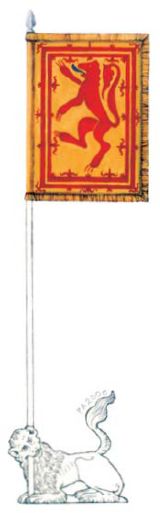
The lion rampant of Scotland (see flag above) was first adopted by William I, known as ‘The Lion’ (1143–1214). A lion rampant within a bordure of fleurs-de-lis appears during the reign of his son, Alexander II (1214–1249). The lion rampant within a double tressure flory counter-flory was first used in the Great Seal of Alexander III in 1251. (author’s drawing)
In England, King Edward I, as strong and able a king as ever ruled Scotland’s powerful southern neighbour, pondered the implications of the death of his brother-in-law. He realised that the possibility of controlling Scotland, as he did Wales and Ireland, was within his grasp and that would make him ruler of the British Isles. He proposed a marriage between his two-year-old son, Edward of Caernarvon, and the Maid of Norway. The Scots assented warily, but insisted, through the terms of the treaty of Birgham, that though there was to be a union of the two crowns, the realm of Scotland was to continue as an entirely separate and independent kingdom. The Maid of Norway set sail for Scotland but became ill on the voyage and died soon after landing in Orkney, leaving the question of the Scottish succession open again.
There was no shortage of claimants to the Crown of Scotland. Two of them – John Balliol and Robert Bruce, 5th Lord of Annandale, known as the ‘Competitor’ – were descended from the Scottish King David I’s grandson, David, Earl of Huntingdon. The Scots asked Edward I to arbitrate between the 14 ‘competitors’ for the vacant throne. At Berwick in November 1292 he decided in favour of John Balliol, who was connected to the powerful Comyn family, bitter rivals of the Bruces. King John rendered homage to Edward I for his kingdom and was subsequently repeatedly humiliated by him as he sought to underline his dominance over the Scots. By 1295 the exasperated Scots lords had had enough, and they persuaded Balliol to renounce his allegiance to the English King and sign a treaty with the French that initiated the auld alliance. Predictably, Edward invaded Scotland the following year and crushed the ineptly led Scots at the battle of Dunbar. John Balliol surrendered his kingdom and as a final indignity Edward tore the Royal Arms from his surcoat before despatching him to the Tower of London; thus the unfortunate Balliol earned the nickname ‘Toom Tabard’ (empty coat).
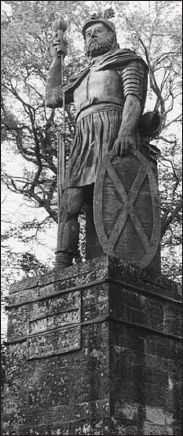
Statue of William Wallace, made for the Earl of Buchan by John Smith in 1814. It stands in the Scottish Borders not far from the Kirk o’ the Forest in Selkirk where Wallace was elected Guardian of Scotland.
Wallace’s Rebellion
At the end of 1296 Edward returned south, taking the Stone of Destiny from Scone with him to Westminster and leaving his well-garrisoned northern conquest in the hands of the Earl of Surrey. Disturbances broke out almost immediately, and in May 1297 William Wallace murdered the English Sheriff of Lanark, an act that propelled Wallace into the spotlight of Scottish history and sparked open rebellion in the land. In September, at Stirling Bridge, Wallace defeated an English force under Surrey and further fanned the flames of revolt in Scotland. His victory resulted in his elevation to the guardianship of the realm and he became effectively, with the support of the people and consent of the church, ruler of Scotland. In 1298 Edward, in vengeful mood, invaded Scotland with a powerful army to hammer the Scots into submission and decisively defeated Wallace at the battle of Falkirk. He resigned the guardianship and disappeared from the pages of history until 1305, when he was betrayed and captured. After a show trial in London he was convicted of treason and dragged to Smithfield, where he was publicly hanged, drawn and quartered.
‘King Hobbe’
Robert Bruce could trace his ancestry back beyond Adam Bruce, who came to England with William the Conqueror, to Lodver, the 10th-century Norse Earl of Orkney. Adam’s eldest son was the first to be named Robert Bruce and he became one of the great magnates of northern England, with widespread lands in Yorkshire. In 1124 David I, who was his feudal overlord in England, succeeded to the Scottish throne. He wanted to transform Scotland from a backward Celtic society into a modern European state and encouraged Anglo-Norman settlement north of the Border. One of his first acts in pursuance of this policy was to grant his vassal, Robert Bruce, the vast estates of the lordship of Annandale. Thus the Bruces became one of the most powerful families in Scotland.
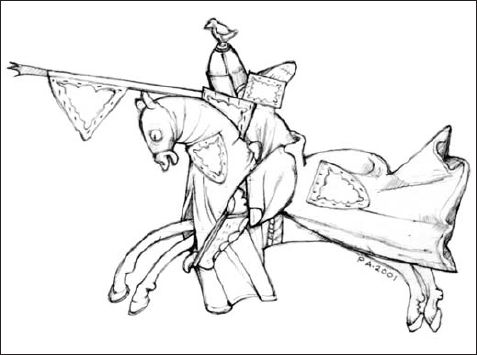
An early 14th-century knight armed in his finery for the joust. Such extravagant clothing would have been replaced with more practical garb for a campaign in Scotland. (author’s drawing)
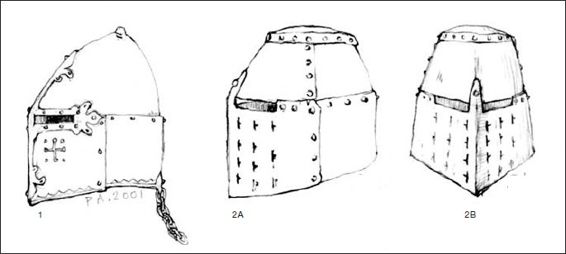
Early 14th-century Helmets. 1. Reconstruction of the helm from the brass of Sir R. de Trumpington c.1289. 2a, 2b. Helm c.1300, probably German, in the Castel San Angelo, Rome. Early 14th-century armour was similar throughout Europe, and Scotland relied heavily on imported arms. (author’s drawing)
The loyalties and allegiances of Robert Bruce in the years up to 1306 were shifting and uncertain. In company with many other Scots, he supported Edward I on the outbreak of war in 1296. Bruce’s stance was determined partly because the patriotic resistance to Edward was led by the Comyns, bitter rivals of the Bruces for power in Scotland, and because Bruce saw in Edward his best hope of securing the kingship, which he believed to be his by right. Yet in 1298 Bruce, perhaps not entirely for patriotic motives, became joint Guardian of Scotland together with John the ‘Red Comyn’ when Wallace resigned the guardianship after the disaster of Falkirk. After a violent quarrel with Comyn, Bruce reverted to his English allegiance and was returned to the king’s ‘peace’, or pardoned, by Edward I early in 1302.
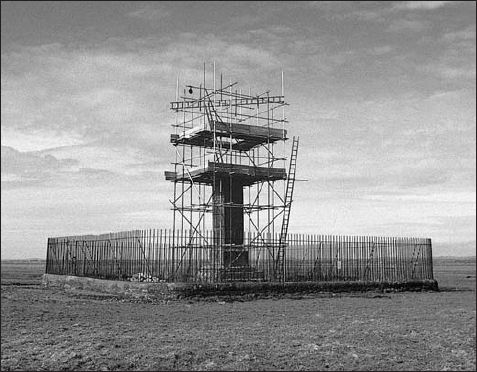
Memorial erected in 1685 at Burgh-by-Sands to King Edward I, ‘The Hammer of the Scots’, who died in camp on Burgh Marsh on 7 July 1307. He had been on his way north to once more hammer the intransigent Scots into submission.
On 10 February 1306 Robert Bruce held a meeting with Comyn in the Greyfriars’ Church in Dumfries. In the course of the discussion tempers flared into violence and Bruce stabbed his rival, leaving him bleeding beside the altar to be finished off by his henchmen. The sacrilegious murder left Bruce no choice; outlawed by Edward I and excommunicated by the Pope, he claimed the throne of Scotland as the great-great-grandson of David I. With support from a section of the Scottish Church and nobility he was crowned, despite the absence of the Stone of Destiny, at Scone on 25 March. Many Scots lords opposed Bruce. The Comyns and their allies bayed for revenge and many others would have nothing to do with him. Edward I swore that he would bring Scotland to heel. In June 1306 his lieutenant, Aymer de Valence, surprised and dispersed Bruce’s army at Methven near Perth. Worse followed. His sisters, his daughter and Elizabeth his queen were captured and delivered into the hands of Edward I. Bruce’s brother Neil was captured at the fall of Kildrummy Castle and brutally executed at Berwick. By the end of June Bruce’s position had collapsed, his supporters were scattered and ‘King Hobbe’ as the English mockingly called him was a hunted fugitive. He escaped his pursuers, however, and took a ship to the tiny Isle of Rathlin off the Ulster coast, where he gained a breathing space and set about reorganising his resources.
In early 1307 Bruce and a handful of followers ventured a return to the mainland. They landed near Turnberry Castle in Ayrshire and disappeared into the wild fells and moors of Carrick. Bruce’s two younger brothers, Thomas and Alexander, meanwhile sailed for Galloway with an expedition intended to provide support by harrying English communications between Carlisle and Ayr, but things went disastrously wrong. As the Scots landed in Loch Ryan they were ambushed by the MacDowells of Galloway, bitter opponents of the Bruces, and dispersed in bloody confusion. Thomas and Alexander Bruce, half dead with wounds, were carted off to Carlisle where Edward I had them hanged and put their heads on display above the town gates. Edward poured troops into southern Scotland, but Bruce’s following was growing and in engagements at Glen Trool and Loudon Hill, King Robert had some success against the English. On 7 July 1307 Edward I, the ‘Hammer of the Scots’, died at Burgh-by-Sands on the Solway and the iron grip in which the Scots had been held in thrall slackened.
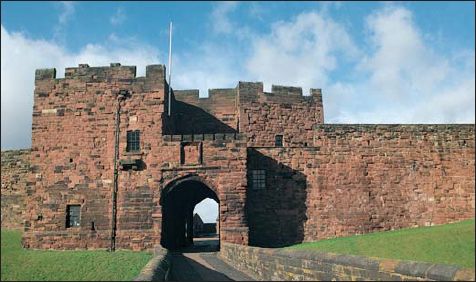
The gateway of Carlisle Castle overlooks the walled Border city. In the early 12th century Cumberland was in the hands of the Scot but in 1157 after the death of David I, Henry II reclaimed Cumberland and the castle became once more part of the English Border defences.
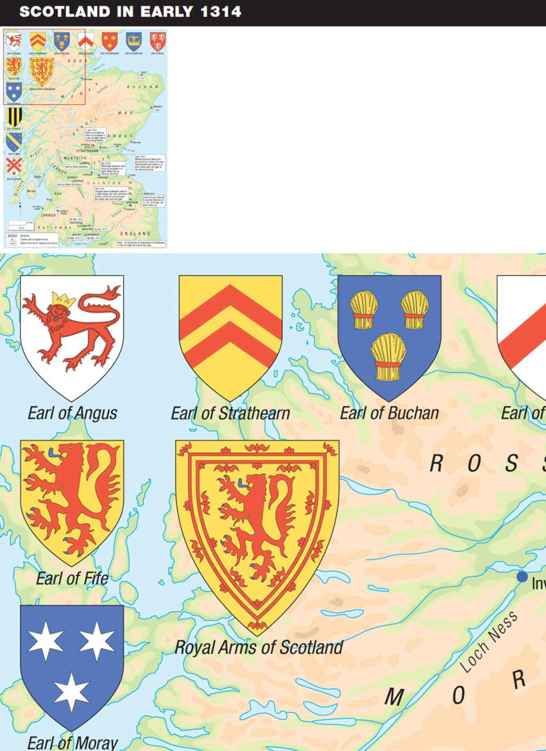
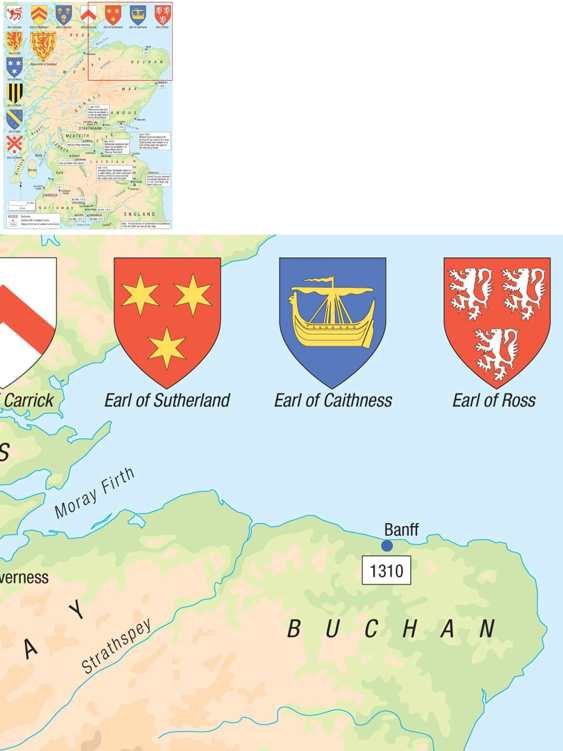
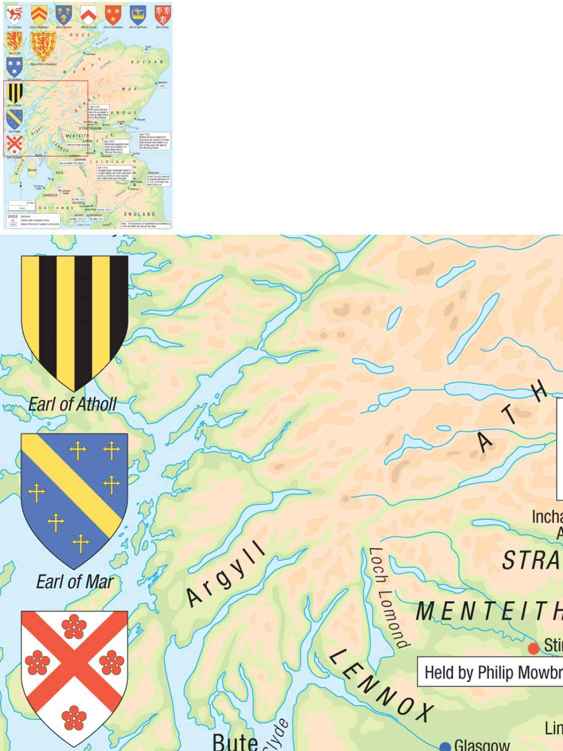
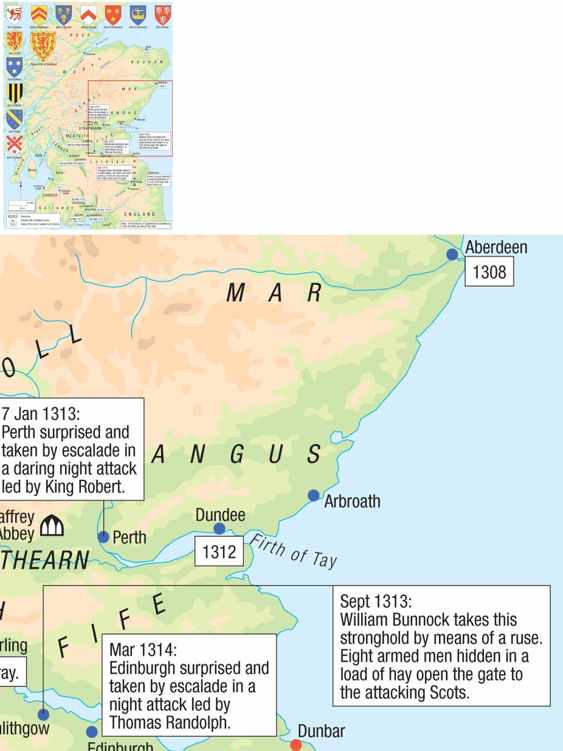
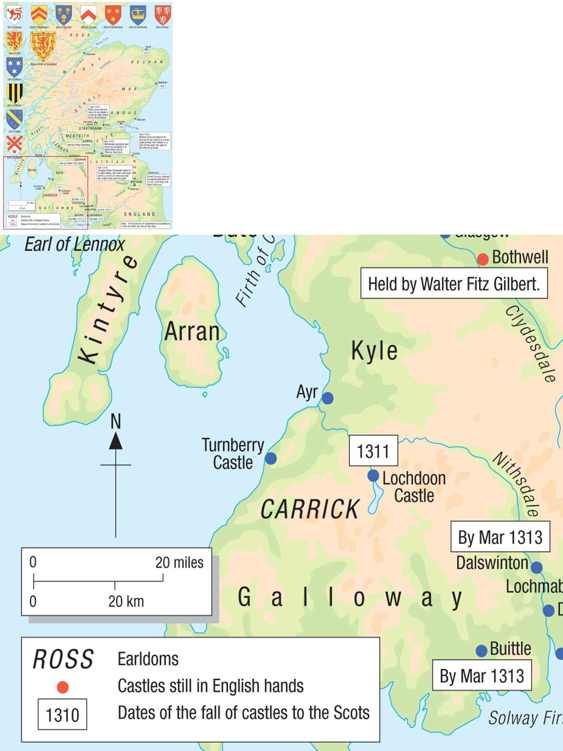
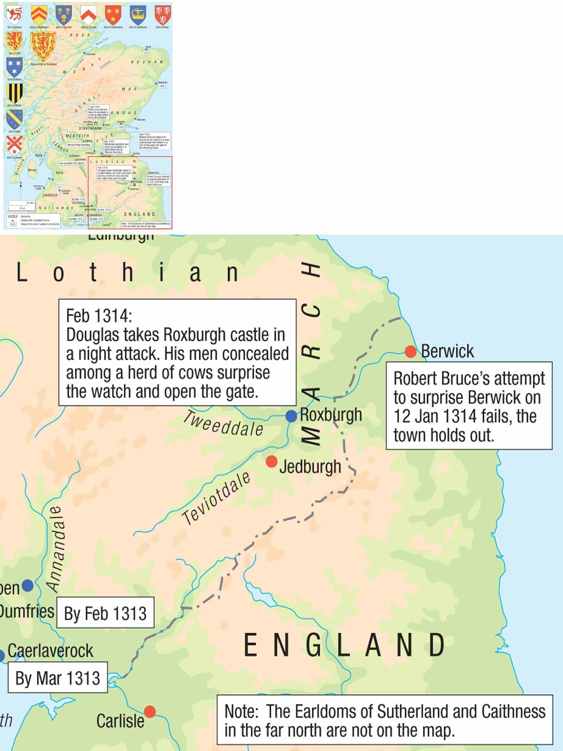
King Robert’s grip on Scotland tightens inexorably as one by one the English strongholds are captured by the Scots and dismantled. By the beginning of the year, outside Lothian, only Bothwell and Stirling castles are still in the invaders’ hands.
Edward I’s frivolous son and successor, Edward II, was distracted from the situation in Scotland by his affair with Piers Gaveston and the opposition of his recalcitrant barons (see Opposing Commanders). This allowed Bruce valuable time to deal with his Scottish opponents. He first turned to the south-west and wreaked vengeance on his enemies the MacDowells. Then, leaving James Douglas to complete the subjugation of Galloway, he marched north in September through the Great Glen to confront his arch-rival John Comyn, whose rich earldom of Buchan stretched from Aberdeen to the Moray Firth. Comyn’s defeat at Inverurie in May 1308 and his flight south to England, left the earldom at the mercy of King Robert, whose ruthless devastation of the lands of Comyn’s supporters became known as the ‘herschip of Buchan’. By the summer Bruce had taken Aberdeen and his hold on the north-east was unassailable. By 1309 most of the remaining Scottish opposition to Bruce had been defeated and he turned his attention to driving the English from his kingdom.
Meanwhile, Edward II had patched up a temporary accommodation with his barons and determined to deal with the Scots. He invaded Scotland in 1309 and again in 1310, but the Scots simply melted away before him, avoiding battle and destroying anything of use in their wake, forcing the hungry and dispirited English to withdraw. Edward’s costly campaigns achieved little, and inevitably he ran short of cash to pay his troops and had to return south to face the demands of his intransigent barons. At the parliament held in August 1311 Edward was forced to accept all the articles constraining his conduct laid before him by the Lords Ordainers and had to send his favourite into exile in Flanders. But within three months Gaveston returned in secret and fearing the wrath of the barons, hurried north with Edward to take refuge in Scarborough Castle. While the King tried to raise troops elsewhere, Gaveston was besieged by the Earl of Pembroke and in return for a safe conduct he surrendered. As he was being taken south to Pembroke’s castle at Wallingford, he was seized by the Earl of Warwick and beheaded on the orders of the Earl of Lancaster.
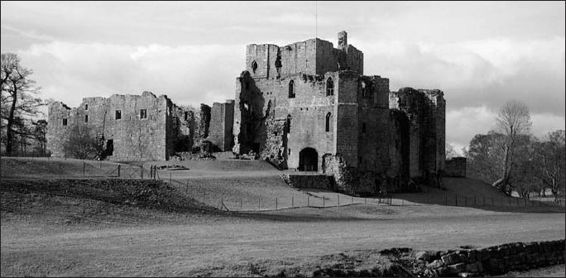
Robert Clifford’s mighty stronghold of Brougham Castle stands beside the River Eamont near Penrith. It was built in the early 13th and late 14th centuries and was one of a chain of castles defending the Eden Valley against Scottish incursions.
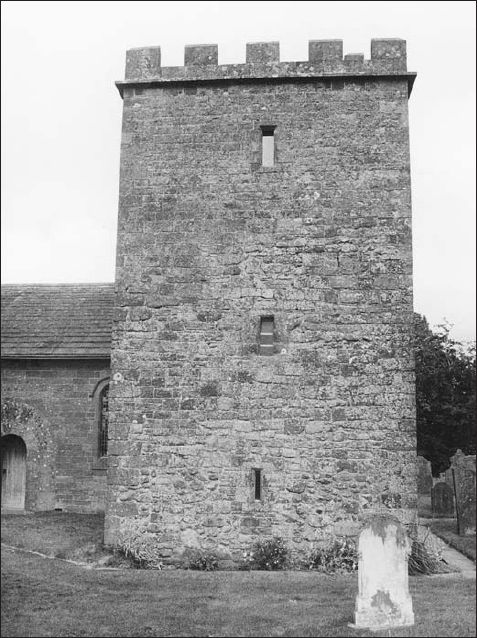
The fortified church of Newton Arlosh stands close by the medieval fords across the Solway Firth. The tower was built as a defence against Scots raiders in the early 14th century. There are similar fortified church towers at nearby Burgh-by-Sands, Great Salkeld and Penrith.
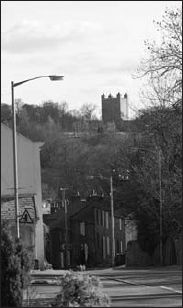
Sir Robert Clifford’s castle at Appleby in the Eden Valley still dominates the old county town of Westmorland.
Robert Bruce took advantage of Edward’s distractions and raided the Border counties of England in 1311, leaving a trail of destruction in his wake. During the following summer, with increasing confidence and in greater strength, he struck deep into the Palatinate of Durham. The defenceless northern counties, seeing no hope of succour from Edward II, were forced to purchase a year’s truce, giving them immunity from the depredations of the Scots, though they returned to exact further payments of ‘blackmail’ or protection money the following year and the finances of Bruce’s poverty-stricken realm improved accordingly.
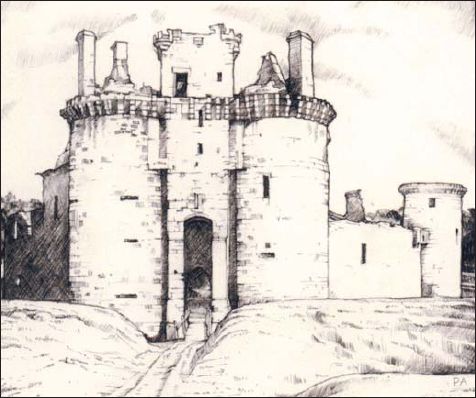
Caerlaverock Castle in Dumfriesshire was besieged and taken by Edward I in 1300; it remained in English hands until it fell to the Scots in 1312. It was ‘demolished’ by Robert Bruce but soon rebuilt, substantial remains of the original 14th-century masonry can be seen in the present structure. (author’s drawing)
In 1309 the English still held a dozen major strongholds in Scotland. These, together with numerous smaller strengths, provided the English with bases from which to dominate the surrounding area. Bruce’s strategy was to take and destroy these castles to render them useless to the enemy, as to garrison them himself would have immobilised too much of his limited manpower. Gradually Bruce prised loose the English grasp on Scotland. He had no siege engines so he had to rely on ruses and surprise assaults or, if all else failed, on tedious blockades. At Berwick, Bruce’s attempt to take the town by a nocturnal escalade was foiled by a barking dog that alerted the garrison. However, he had more success in January 1313, when the strategically vital town of Perth was surprised and taken in an assault by moonlight.
In south-east Scotland or Lothian, many of the Anglo-Scots of the area held lands on both sides of the Border. Lothian was nominally under English rule, so the inhabitants were obliged to pay ‘blackmail’ or protection money to Robert Bruce in the same manner as the people of northern England. Many of the smaller castles of Lothian were already in the hands of the Scots when, in February 1314, James Douglas surprised and captured the important castle of Roxburgh. The climax to the campaign against English strongholds in Lothian came the following month when, not to be outdone by Douglas’s bold exploit, Thomas Randolph took Edinburgh Castle by escalade in a daring night attack.