
Chapter Four

Von Rundstedt’s plan had placed armoured columns across the River Meuse within four days but heroic last stands and the stubborn defence of St Vith and Bastogne had seriously delayed the German advance. Six American divisions had checked twenty German divisions and another six were on the way. However, II Panzerkorps was still waiting to be committed and there remained a slim chance that Hitler’s armour might still be able to achieve some of their objectives.
Eisenhower met his commanders on 19 December and welcomed Patton’s news that a corps was preparing to drive towards the southern flank of the Bulge. On the northern flank Field Marshal Montgomery was also assembling a corps sized reserve along the Meuse behind First Army’s front. Following the meeting SHAEF’s commander made the controversial, but necessary, decision to split the Bulge, handing the northern sector over to Montgomery while General Bradley controlled the southern half of the battlefield. American generals disagreed with many of the British commander’s methods and wanted to go over to the offensive at the first opportunity. Only time would tell if Monty’s decision to draw the Germans forward before unleashing his troops would be the right one.
Whatever the differences, a new defensive line had to be formed and as reinforcements raced to First Army’s assistance the German panzer leaders realised that time was against them. Although the River Meuse was almost in sight, the bridges were being secured and arranged for defence, one by one.

Firefly tank commander Robert Boscawen and crew, Guards Armoured Division, at Meuse River ready to deny the Germans a crossing point.
Previous page: Sergeant Lyle Greene shares a joke with Private Fred Mozzoni as they rest for a moment on the way to the front line near Malmedy. 111-SC-198409

While reserves from all along the American front were moved towards the Ardennes, divisions that had just arrived in England from the States were rushed across to the Continent to help stem the German drive towards the Meuse. This infantry heavy weapons company make their way to the front line along a narrow forest track. 111-SC-197619
The poor road network made it difficult to deploy troops effectively and time was needed to assemble a large reserve.These men stand to one side as a column of trucks rolls past. 111-SC-197620

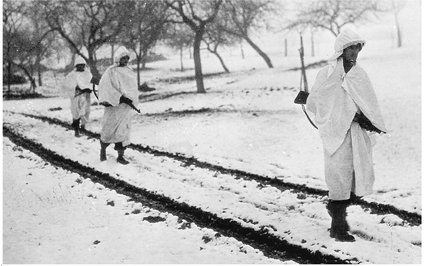
Sergeant James Newman leads a patrol across frozen fields, following a fresh fall of snow. The GIs have wrapped themselves in bed sheets in an attempt to appear inconspicuous. 111-SC-197832
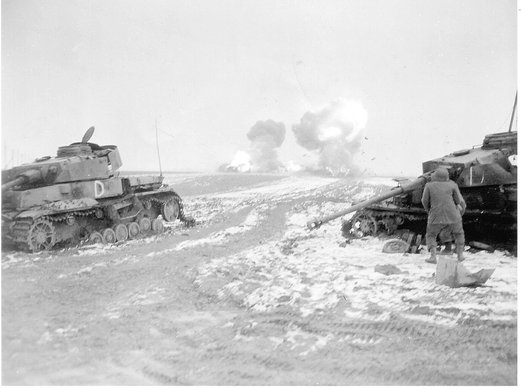
Tank crews from the 3rd ‘Spearhead’ Armoured Division inspect two German tanks knocked out in Hotten. A Panzer IV is partially hidden behind the Panzer V Panther tank. Major General Maurice Rose’s division successfully cut the vital highway leading to St Vith when it counterattacked west of Houfflaize. 111-SC-197822

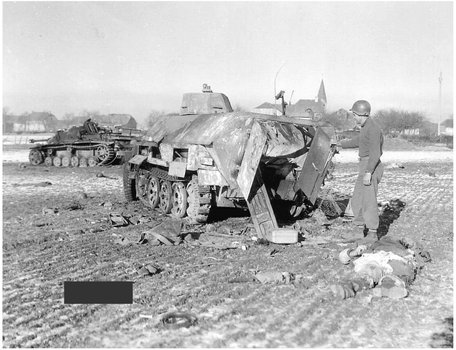
Corporal George F. Gearhart inspects one of four German halftracks knocked out on the outskirts of Heiderscheid. Gearhart’s tank battalion, the 702nd, also destroyed two tanks during the battle for the village. 111-SC-197825
As reinforcements rushed towards the front line Combat Engineers attempted to slow the German advance. Private John Brady wires a line of trees ready for detonation, aiming to drop them across the road when the charges are fired. 111-SC-197834

New Year’s Day and Corporal William Tamantini wipes snow and ice from his .30 calibre machine gun as 85th Reconnaissance Squadron sets up a roadblock near Sourboudt in 5th Armoured Division’s area. The roadblock was one of many set up in Twelfth Army Group’s rear, to guard against further German airborne attacks. 111-SC-197934


New Year’s Eve on Seventh Army’s front and a cold GI takes comfort from his pipe as he scans the woods for signs of enemy activity along 103rd Division’s front. General Patch had just been warned that the First German Army was about to attack Seventh Army’s front. 111-SC-197983
Private Lloyd Spence and Private James Bryson pause for a few moments during 26th Division’s counter-attack. Having taken Arsdorf on Christmas Day the ‘Yankee’ Division regrouped and advanced towards Wiltz. 111-SC-198161


New Year’s Eve 1944 and after a long cold night on lookout duty in St Roche, Privates Tomlinson and Buona of the 7th Armoured Division search through a box of rations for their favourite meal. The ‘Lucky Seventh’ had been directed to Manhay and cleared the town by the end of December. 111-SC-197933
Combat Engineers destroy two disabled tanks to prevent the Germans using them as pillboxes. 111-198123

A two-man patrol creeps through the woods looking for German outposts; the GIs new snow capes virtually blend into the background. 111-SC-198162

A tired and weak 26 Regiment had been committed to help stem the German advance at Dom Butgenbach and Bullingen on 18 December. Over the next twenty-four hours 1st SS Panzer Division failed to dislodge Colonel John Seitz’s men from their exposed position, forcing a detour through Schoppen. The heroic stand had seriously delayed 1 SS Panzerkorps’ advance towards Malmedy. 111-SC-198278
After a cold night and a light covering of snow, a tank crew emerge from their ‘Pup’ tent, to gather around a fire. The mail has arrived several days late and the young men eagerly open their Christmas parcels. 111-SC-198400

The cold weather and snow has frozen the ground on Elsenborn Ridge but these GIs of 2nd Infantry Division still need foxholes for protection. Explosive charges are used to break up the soil and give the soldiers a head start in their digging. 111-SC-198592

A recovery vehicle rescues tanks of the 9th Armoured Division. The Shermans were disabled near Bastogne while 101st Airborne Division formed a defensive perimeter around the town. 111-SC-198649


Camouflage netting hides 912th Field Artillery Battalion’s 155mm Howitzers as they support 87th Division’s counter attack to recapture Germont. Drifting snow is slowly covering tents and piles of ammunition. 111-SC-198887

Clear skies ahead. While tank crews of 3rd Armoured Division mingle around their partially hidden tanks, they are able to watch as bombers fly overhead. For the first time in days the men on the ground can look forward to receiving close support from the Air Force. 111-SC-199099
Infantry of the 83rd ‘Thunderbolt’ Division set up a defensive position in the forests around Rochefort Salient. The firebreak in the trees creates an ideal killing zone. 111-SC-199157


Private John Ellsworth is a welcome sight in 104 Regiment’s perimeter as he distributes blankets along Company E’s front. The Regiment was engaged in 26th Infantry Division’s counter-attack towards Wiltz. 111-SC-199210

Soldiers of the 84th ‘Railsplitters’ Division frantically dig foxholes as German artillery zeros in on their position. One man has already been killed and the barrage could be heralding the beginning of an enemy attack. The Division fought through snow, sleet and rain for nearly a month, as it spearheaded First Army’s counter-attacks. 111-SC-199202
Task Force Herren of 70th Infantry Division was rushed straight from Marseille to reinforce Seventh Army’s line and within days the ‘Trailblazers’ were heavily engaged for Phillipsbourg and Wingen. After fighting throughout the night the stretcher-bearers have finally gathered together the wounded in a shell hole to await evacuation. 111-SC-199233


Medics carry their wounded through the snow to the aid stations.These men were wounded during 35th Division’s attempt to relieve Bastogne. The ‘Sante Fe’ Division held off four German divisions and captured Villers-la Bonne-Eau, after two weeks’ hard fighting. 111-SC-199234
Quick evacuation of the wounded was a top priority during the harsh winter weather. The cold nights could easily kill an injured man and these medics of the 30th ‘Old Hickory’ Division are well prepared.The ski sledge strapped to the front of the jeep was essential for rescuing men from the wooded hills around Malmedy and Stavelot. 111-SC-199239


Surrounded by weapons, boxes of ammunition and cans of rations, crews of the 54th Field Artillery Battalion keep a careful watch from their foxholes as they prepare to support 3rd Armoured Division’s attack west of Houffalize. 111-SC-199254

Private Edward Nobles watches for signs of enemy movement over the top of his frost covered .03 calibre machine gun. 111-SC-199262
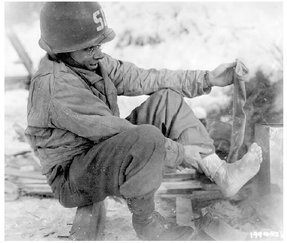
Trench foot, a numbing of the feet that could result in severe pain or amputation, was caused by a combination of cold and wet conditions. The condition was a constant source of worry to GIs during the winter months and here Private Guy Silvis removes damp socks to warm his feet over a fire. 111-SC-199442
A halftrack mounted anti-aircraft gun of 778th Automatic-Anti-Aircraft Weapons Battalion watches over 3rd Armoured Division as it advances towards Bastogne. 111-SC-199325


Moving artillery forward to help stabilise the holding line. Taylor Library