
Part Eight
The cost of the German offensive
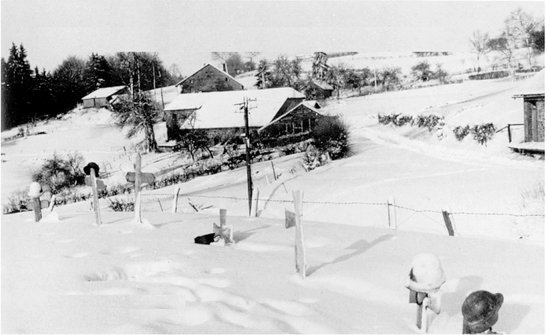
German graves at Moderscheid.
The offensives in both the Ardennes in December, and Alsace the following month, marked the end of Hitler’s initiatives on the Western front; from now on it was only a matter of time before the Allies broke through the Siegfried Line and pushed across the Rhine into Germany. The beginning of the end was in sight. Although there were times when it seemed as though the Allies were in dire peril, neither operation had achieved its objectives and had ultimately seriously dented Germany’s depleted reserves.
By the middle of January 1945 the Bulge had virtually been erased at a terrible cost to both sides.Thirty-two American divisions, well over half a million men, had fought Army Group West to a standstill and then pushed it back beyond its starting line – but at what cost? Over 40,000 Americans were either killed or wounded bringing the German advance to a halt; a similar number of casualties were reported during the fighting to erase the Bulge. Another 17,000 men were listed as killed, missing or injured in Alsace.
The German losses are rather more difficult to ascertain. Estimates put the figure around 90,000 for both operations – but what is certain is that the two battles ended Germany’s capacity to stage offensive operations.The Allies had weathered the worst storm Hitler could throw at them and survived. It was only a matter of time before Nazi Germany was defeated.
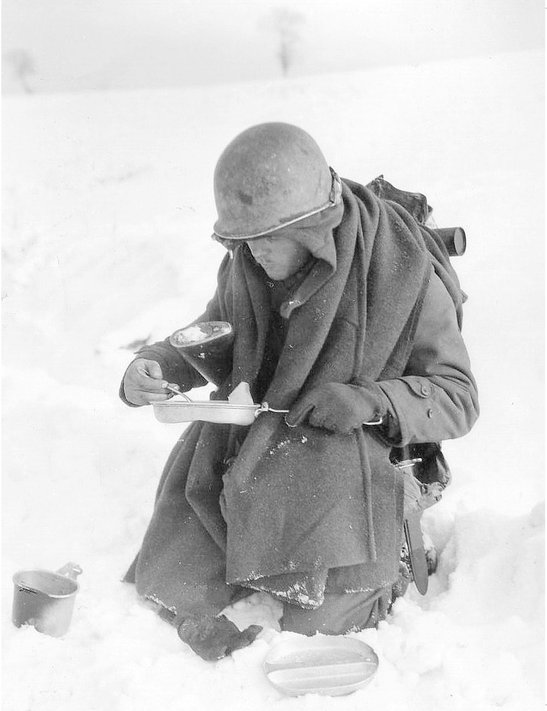
Previous page. The winter of 1944-45 was one of the coldest in living memory and American, British and German troops suffered in the wintry conditions. Private Thomas O’Brien of the 26th Division tucks into his C Ration in a snow-covered field. 111-SC-198483
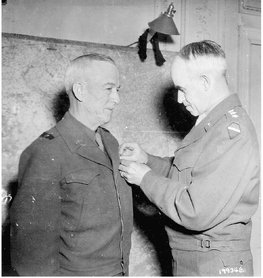
General Courtney Hodges’ First Army bore the brunt of the weight of the German armour during the early days of the offensive. Here General Omar Bradley adds a cluster to his Army commander’s Distinguished Service Medal for leadership during the campaign. 111-SC-199348
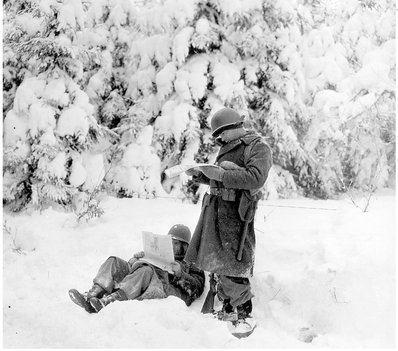
Two paratroopers of the 82nd Airborne Division avidly study the forces’ newspaper, Stars and Stripes. News of the German withdrawal from the Bulge and the American counter offensive would have been reported with vigour. 111-SC-199641
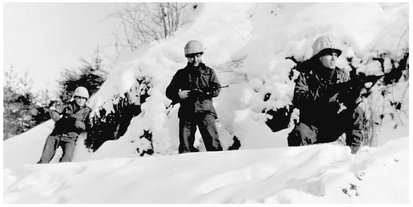
Once the fighting in the Ardennes had subsided, the Allies could resume planning the final offensive on Germany. Three infantrymen of the 5th Infantry Division, appropriately nick named ‘Victory’ Division hug the side of a hill as they patrol near the Luxembourg border in preparation for an advance on the Siegfried Line. 111-SC-197326
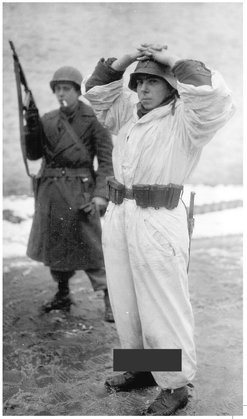
Thousands of prisoners were seized during the German withdrawal and paratroopers of the 82nd Airborne Division captured this well equipped soldier, complete with snowsuit, near Fosse. 111-SC-198552

The Ardennes Offensive exhausted Germany’s armoured reserves and dozens of tanks, assault guns and halftracks had to be abandoned, either knocked out, disabled or simply out of fuel, as they fell back. American armoured reserves were also severely depleted but the Allied war machine was far more capable of replacing those lost. Corporal Ramon McCraw, Private Floyd Wells and Private Bobby Robinson stop to inspect a burnt out M5 Grant tank perched precariously on the edge of a mountain road. 111-SC-455220
Clervaux was the scene of one of the many stands made by 28th Division at the beginning of the offensive, as Fifth Panzer Division advanced towards Bastogne. Six weeks later and the front lines are virtually back to where they had started. Here are two victims from the German withdrawal, a Sherman from 707th Tank Battalion and a Stug self-propelled assault gun. 111-SC-200670

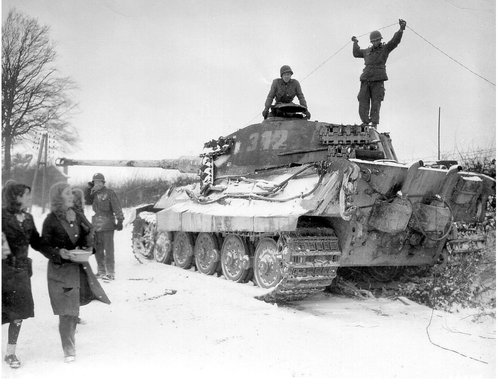
As the number of German tanks dwindled, the weight of American armour began to tell and the larger, slower tanks became prey to lighter and faster tank destroyers. Tank destroyers of the 628th Tank Destroyer Battalion scored an important success when they knocked out this ‘King Tiger’ as it approached 82nd Airborne Division’s position near Gorenne. 111-SC-198889
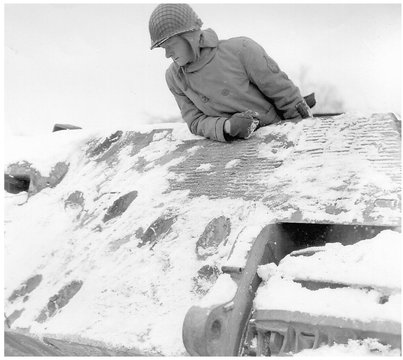
Heavily armoured tanks with superior weapons had smashed through the American lines in the Ardennes but the poor weather, difficult conditions, a lack of supplies and the sheer weight of Allied reinforcements took their toll. Sergeant George Meyer of the 6th Armoured Division takes a moment to study the front of a Panzer VI ‘King Tiger’ tank. Eight direct hits with 75mm shells, the Sherman tanks’ main armament, had literally bounced off the tank’s armour. 111-SC-199475
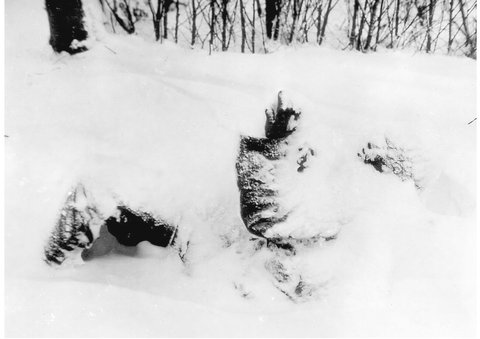
There was no glory for the thousands of men killed, either by enemy action or by the extreme weather conditions. Many more were maimed by the fighting. 1 1 1 -SC- 199350
Hitler had scoured the nation for men and formed them into Volksgrenadier regiments, to fuel his last gamble. He had lost and many of them would now spend the remaining months in the ‘cage’.

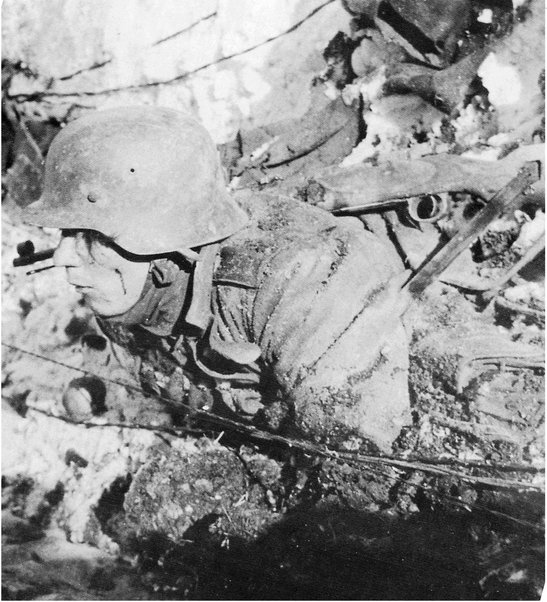
By January 1945 the only Germans remaining on Luxembourg and Belgian soil were either prisoners or dead.

A rifle squad fires a volley in memory of lost comrades; a scene repeated all along the front after the Bulge had been reduced.These men belong to 9th Armoured Engineers’ Battalion who are remembering buddies lost in the siege for Bastogne. 1 1 1-SC-199412

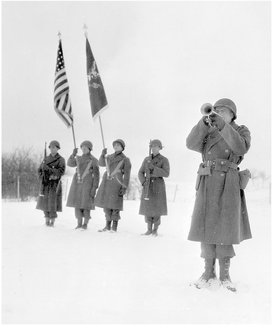
A bugler of the 9th Armoured Division sounds ‘Taps’ as the colour flags stand to attention.The division was committed piecemeal to help stem the German breakthrough and it was instrumental in preventing Fifth Panzer Army from seizing Bastogne. 111-SC-199411