
1
Although Hitler’s premise was that humans were simply animals, his own very human intuition allowed him to transform his zoological theory into a kind of political worldview. The racial struggle for survival was also a German campaign for dignity, he maintained, and the restraints were not only biological but British. Hitler understood that Germans were not, in their daily life, beasts who scratched food from the ground. As he developed his thought in his Second Book, composed in 1928, he made clear that securing a regular food supply was not simply a matter of physical sustenance, but also a requirement for a sense of control. The problem with the British naval blockade during the First World War had not simply been the diseases and death it brought during the conflict and in the months between armistice and final settlement. The blockade had forced middle-class Germans to break the law in order to acquire the food that they needed or felt that they needed, leaving them personally insecure and distrustful of authority.
The world political economy of the 1920s and 1930s was, as Hitler understood, structured by British naval power. British advocacy of free trade, he believed, was political cover for British domination of the world. It made sense for the British to parlay the fiction that free exchange meant access to food for everyone, because such a belief would discourage others from trying to compete with the British navy. In fact, only the British could defend their own supply lines in the event of a crisis, and could by the same token prevent food from reaching others. Thus the British blockaded their enemies during war—an obvious violation of their own ideology of free trade. This capacity to assure and deny food, Hitler emphasized, was a form of power. Hitler called the absence of food security for everyone except the British the “peaceful economic war.”
Hitler understood that Germany did not feed itself from its own territory in the 1920s and 1930s, but also knew that Germans would not actually have starved if they had tried. Germany could have generated the calories to feed its population from German soil, but only by sacrificing some of its industry, exports, and foreign currency. A prosperous Germany required exchange with the British world, but this trade pattern could be supplemented, thought Hitler, by the conquest of a land empire that would even the scales between London and Berlin. Once it had gained the appropriate colonies, Germany could preserve its industrial excellence while shifting its dependence for food from the British-controlled sea lanes to its own imperial hinterland. If Germany controlled enough territory, Germans could have the kinds and the amounts of food that they desired, with no cost to German industry. A sufficiently large German empire could become self-sufficient, an “autarkic economy.” Hitler romanticized the German peasant, not as a peaceful tiller of the soil, but as the heroic tamer of distant lands.
The British were to be respected as racial kindred and builders of a great empire. The idea was to slip through their network of power without forcing them to respond. Taking land from others would not, or so Hitler imagined, threaten the great maritime empire. Over the long term, he expected peace with Great Britain “on the basis of the division of the world.” He expected that Germany could become a world power while avoiding an “Armageddon with England.” This was, for him, a reassuring thought.
It was also reassuring that such an alteration of the world order, such a reglobalization, had been achieved before, in recent memory. For generations of German imperialists, and for Hitler himself, the exemplary land empire was the United States of America.
—
America taught Hitler that need blurred into desire, and that desire arose from comparison. Germans were not only animals seeking nourishment to survive, and not only a society yearning for security in an unpredictable British global economy. Families observed other families: around the corner, but also, thanks to modern media, around the world. Ideas of how life should be lived escaped measures such as survival, security, and even comfort as standards of living became comparative, and as comparisons became international. “Through modern technology and the communication it enables,” wrote Hitler, “international relations between peoples have become so effortless and intimate that Europeans—often without realizing it—take the circumstances of American life as the benchmark for their own lives.”
Globalization led Hitler to the American dream. Behind every imaginary German racial warrior stood an imaginary German woman who wanted ever more. In American idiom, this notion that the standard of living was relative, based upon the perceived success of others, was called “keeping up with the Joneses.” In his more strident moments, Hitler urged Germans to be more like ants and finches, thinking only of survival and reproduction. Yet his own scarcely hidden fear was a very human one, perhaps even a very male one: the German housewife. It was she who raised the bar of the natural struggle ever higher. Before the First World War, when Hitler was a young man, German colonial rhetoric had played on the double meaning of the word Wirtschaft: both a household and an economy. German women had been instructed to equate comfort and empire. And since comfort was always relative, the political justification for colonies was inexhaustible. If the German housewife’s point of reference was Mrs. Jones rather than Frau Jonas, then Germans needed an empire comparable to the American one. German men would have to struggle and die at some distant frontier, redeeming their race and the planet, while women supported their men, embodying the merciless logic of endless desire for ever more prosperous homes.
The inevitable presence of America in German minds was the final reason why, for Hitler, science could not solve the problem of sustenance. Even if inventions did improve agricultural productivity, Germany could not keep pace with America on the strength of this alone. Technology could be taken for granted on both sides; the quantity of arable land was the variable. Germany therefore needed as much land as the Americans and as much technology. Hitler proclaimed that permanent struggle for land was nature’s wish, but he also understood that a human desire for increasing relative comfort could also generate perpetual motion.
If German prosperity would always be relative, then final success could never be achieved. “The prospects for the German people are bleak,” wrote an aggrieved Hitler. That complaint was followed by this clarification: “Neither the current living space nor that achieved through a restoration of the borders of 1914 permits us to lead a life comparable to that of the American people.” At the least, the struggle would continue as long as the United States existed, and that would be a long time. Hitler saw America as the coming world power, and the core American population (“the racially pure and uncorrupted German”) as a “world class people” that was “younger and healthier than the Germans” who had remained in Europe.
—
While Hitler was writing My Struggle, he learned of the word Lebensraum (living space) and turned it to his own purposes. In his writings and speeches it expressed the whole range of meaning that he attached to the natural struggle, from an unceasing racial fight for physical survival all the way to an endless war for the subjective sense of having the highest standard of living in the world. The term Lebensraum came into the German language as the equivalent of the French word biotope, or “habitat.” In a social rather than biological context it can mean something else: household comfort, something close to “living room.” The containment of these two meanings in a single word furthered Hitler’s circular idea: Nature was nothing more than society, society nothing more than nature. Thus there was no difference between an animal struggle for physical existence and the preference of families for nicer lives. Each was about Lebensraum.
The twentieth century was to bring endless war for relative comfort. Robert Ley, one of Hitler’s early Nazi comrades, defined Lebensraum as “more culture, more beauty—these the race must have, or it will perish.” Hitler’s propagandist Joseph Goebbels defined the purpose of a war of extermination as “a big breakfast, a big lunch, and a big dinner.” Tens of millions of people would have to starve, but not so that Germans could survive in the physical sense of the word. Tens of millions of people would have to starve so that Germans could strive for a standard of living second to none.
—
“One thing the Americans have and which we lack,” complained Hitler, “is the sense of vast open spaces.” He was repeating what German colonialists had said for decades. By the time Germany had unified in 1871, the world had already been colonized by other European powers. Germany’s defeat in the First World War cost it the few overseas possessions it had gained. So where, in the twentieth century, were the lands open for German conquest? Where was Germany’s frontier, its Manifest Destiny?
All that remained was the home continent. “For Germany,” wrote Hitler, “the only possibility of a sound agrarian policy was the acquisition of land within Europe itself.” To be sure, there was no place near Germany that was uninhabited or even underpopulated. The crucial thing was to imagine that European “spaces” were, in fact, “open.” Racism was the idea that turned populated lands into potential colonies, and the source mythologies for racists arose from the recent colonization of North America and Africa. The conquest and exploitation of these continents by Europeans formed the literary imagination of Europeans of Hitler’s generation. Like millions of other children born in the 1880s and 1890s, Hitler played at African wars and read Karl May’s novels of the American West. Hitler said that May had opened his “eyes to the world.”
In the late nineteenth century, Germans tended to see the fate of Native Americans as a natural precedent for the fate of native Africans under their control. One colony was German East Africa—today Rwanda, Burundi, Tanzania, and a bit of Mozambique—where Berlin assumed responsibility in 1891. During an uprising in 1905, the Maji Maji rebellion, the Germans applied starvation tactics, killing at least seventy-five thousand people. A second colony was German Southwest Africa, today Namibia, where about three thousand German colonists controlled about seventy percent of the land. An uprising there in 1904 led the Germans to deny the native Herero and Nama populations access to water until they fell “victim to the nature of their own country,” as the official military history put it. The Germans imprisoned survivors in a camp on an island. The Herero population was reduced from some eighty thousand to about fifteen thousand; that of the Nama from about twenty thousand to about ten thousand. For the German general who pursued these policies, the historical justice was self-evident. “The natives must give way,” he said. “Look at America.” The German governor of the region compared Southwest Africa to Nevada, Wyoming, and Colorado. The civilian head of the German colonial office saw matters much the same way: “The history of the colonization of the United States, clearly the biggest colonial endeavor the world has ever known, had as its first act the complete annihilation of its native peoples.” He understood the need for an “annihilation operation.” The German state geologist called for a “Final Solution to the native question.”
A famous German novel of the war in German Southwest Africa united, as would Hitler, the idea of a racial struggle with that of divine justice. The killing of “blacks” was “the justice of the Lord” because the world belonged to “the most vigorous.” Like most Europeans, Hitler was a racist about Africans. He proclaimed that the French were “niggerizing” their blood through intermarriage. He shared in the general European excitement about the French use of African troops in the occupation of Germany’s Rhineland district after the First World War. Yet Hitler’s racism was not that of a European looking down at Africans. He saw the entire world as an “Africa,” and everyone, including Europeans, in racial terms. Here, as so often, he was more consistent than others. Racism, after all, was a claim to judge who was fully human. As such, ideas of racial superiority and inferiority could be applied according to desire and convenience. Even neighboring societies, which might seem not so different from the German, might be defined as racially different.
When Hitler wrote in My Struggle that Germany’s only opportunity for colonization was Europe, he discarded as impractical the possibility of a return to Africa. The search for racial inferiors to dominate required no long voyages by sea, since they were present in eastern Europe as well. In the nineteenth century, after all, the major arena of German colonialism had been not mysterious Africa but neighboring Poland. Prussia had gained territory inhabited by Poles in the partitions of the Polish-Lithuanian Commonwealth in the late eighteenth century. Formerly Polish lands were thus part of the unified Germany that Prussia created in 1871. Poles made up about seven percent of the German population, and in eastern regions were a majority. They were subjected first to Bismarck’s Kulturkampf, a campaign against Roman Catholicism whose major object was the elimination of Polish national identity, and then to state-subsidized internal colonization campaigns. A German colonial literature about Poland, including best sellers, portrayed the Poles as “black.” The Polish peasants had dark faces and referred to Germans as “white.” Polish aristocrats, fey and useless, were endowed with black hair and eyes. So were the beautiful Polish women, seductresses who, in these stories, almost invariably led naive German men to racial self-degradation and doom.
During the First World War, Germany lost Southwest Africa. In eastern Europe the situation was different. Here German arms seemed to be assembling, between 1916 and 1918, a vast new realm for domination and economic exploitation. First Germany joined its prewar Polish territories to those taken from the Russian Empire to form a subordinate Polish kingdom, which was to be ruled by a friendly monarch. The postwar plan was to expropriate and deport all of the Polish landholders near the German-Polish border. In early 1918, after the Bolshevik Revolution had taken Russia from the war, Germany established a chain of vassal states to the east of Poland, from the Baltic to the Black Sea, the largest of which was Ukraine. Germany lost the war in France in 1918, but was never finally defeated on the battlefield in eastern Europe. This new east European realm was abandoned without, it could seem to Germans, ever having been truly lost.
The complete loss of the African colonies during and after the war created the possibility for a vague and malleable nostalgia about racial mastery. Popular novels about Africa with titles such as Master, Come Back! could make sense only after such a complete break. Germans could continue to see themselves as good colonizers, even as the realm of colonization itself became fluid and vague, projected into the future. Hans Grimm’s novel A People Without Space, which sold half a million copies in Germany before the Second World War, concerned the plight of a German who had left Africa only to be frustrated by confinement within a small Germany and an unjust European system.
The problem suggested its own solution. Since racism was an asserted hierarchy of rights to the planet, it could be applied to Europeans who lived east of Germany. Africa as a place was lost, but “Africa” as a form of thinking could be universalized. The experience in eastern Europe had established that neighbors could also be “black.” Europeans could be imagined to want “masters” and yield “space.” After the war, it was more practical to consider a return to eastern Europe than to Africa. Here, as in so many other cases, Hitler drew vague sentiments to remorselessly tight conclusions. He presented as racial inferiors the largest cultural group in Europe, Germany’s eastern neighbors, the Slavs.
—
“The Slavs are born as a slavish mass,” wrote Hitler, “crying out for their master.” He meant primarily the Ukrainians, who inhabited a stretch of very fertile land, as well as their neighbors—Russians, Belarusians, and Poles. “I need the Ukraine,” he stated, “in order that no one is able to starve us again, like in the last war.” The conquest of Ukraine would guarantee “a way of life for our people through the allocation of Lebensraum for the next hundred years.” This was a matter of natural justice: “It is inconceivable that a higher people should painfully exist on a soil too narrow for it, whilst amorphous masses, which contribute nothing to civilization, occupy infinite tracts of a soil that is one of the richest in the world.” As their land was taken, Ukrainians could be given, said Hitler, “scarves, glass beads, and everything that colonial peoples like.” A single loudspeaker in each village would “give them plenty of opportunities to dance, and the villagers will be grateful to us.” Nazi propaganda would simply remove Ukrainians from view. A Nazi song for female colonists described Ukraine thus: “There are neither farms nor hearths, there the earth cries out for the plough.” Erich Koch, chosen by Hitler to rule Ukraine, made the point about the inferiority of Ukrainians with a certain simplicity: “If I find a Ukrainian who is worthy to sit with me at table, I must have him shot.” Even in the racial murder threats, the dining room was the backdrop.
When German occupation came in 1941, Ukrainians themselves made the connection to Africa and America. A Ukrainian woman, literate and reflective in a way that Nazi racism could not have contemplated, recorded in her diary: “We are like slaves. Often the book Uncle Tom’s Cabin comes to mind. Once we shed tears over those Negroes, now obviously we ourselves are experiencing the same thing.” Yet in one respect, colonialism in eastern Europe had to differ from the American slave trade or the conquest of Africa. It required two feats of imagination: the wishing away not just of peoples but also of political entities that were similar to the German state. Hitler’s preoccupation with the racial struggle for nature occluded both nations and their governments. It was always legitimate to destroy states; if they were destroyed, that meant that they should have been destroyed.
Some states, claimed Hitler, were inviting attack. Lower races were incapable of state building, so what appeared to be their governments was illusory—a façade for Jewish power. Hitler maintained that the Slavs had never governed themselves. The lands east of Germany had always been ruled by “foreign elements.” The Russian Empire had been the creation of an “essentially German upper class and intelligentsia.” Without this tradition of German leadership, “the Russians would still be living like rabbits.” Ukrainians were by nature a colonial people and, as German colonial administrators would say, “blacks.” After Germany was forced in 1918 to withdraw its troops and cede its new empire, most of Ukraine, like most of the lands of the Russian Empire, was consolidated within a new communist state known as the Union of Soviet Socialist Republics (Soviet Union, USSR). Hitler claimed that the USSR was an expression of a Jewish “worldview.” The idea of communism was simply a deception that led Slavs to accept their “new leadership in Jewry.”
Communism was the proximate example of Hitler’s claim that all universal ideas were Jewish and all Jews were the servants of universal ideas. The proclaimed identity of Jews with communism—the Judeobolshevik myth—was for Hitler the apposite demonstration of both the supernatural strength and the earthly weakness of Jews. It demonstrated that Jews could win destructive power over the masses with their unnatural ideas. “Bolshevism of international Jewry attempts from its control point in Soviet Russia to rot away the very core of the nations of the world,” he wrote. Yet this apparent misfortune was in fact an opportunity. In killing the strongest members of the Slavic races inside the Soviet Union, Jews were doing the work that Germans would have to do in any event. Jewish communism was in this sense, Hitler wrote, “fortunate for the future.” The Bolshevik Revolution of 1917, thought Hitler, was therefore “merely a preparation” for the later return of “German domination.”
Hitler’s interpretation of the Bolshevik Revolution as a Jewish project was far from unusual: Winston Churchill and Woodrow Wilson saw it the same way, at least at first. A Times of London correspondent saw Jews as the leading force of the world Bolshevik conspiracy. What was unusual was Hitler’s relentlessly systematic conclusion that Germany could gain global power by eliminating east European Jews and overturning their supposed Soviet citadel. This was nothing more than self-defense, he maintained, since Bolshevism’s victory by whatever insidious means would bring the “destruction, indeed the final extermination, of the German people.” In a direct confrontation, though, the Jewish threat could be eliminated. The destruction of Soviet Jews would cause the Soviet Union to “immediately break up.” It would prove to be a “house of cards” or a “giant with feet of clay.” The Slavs would fight “like Indians,” with the same result. Then, in the East, “a similar process will repeat itself for the second time, as in the conquest of America.” A second America could be created in Europe, after Germans learned to see other Europeans as they saw indigenous Americans or Africans, and learned to regard Europe’s largest state as a fragile Jewish colony.
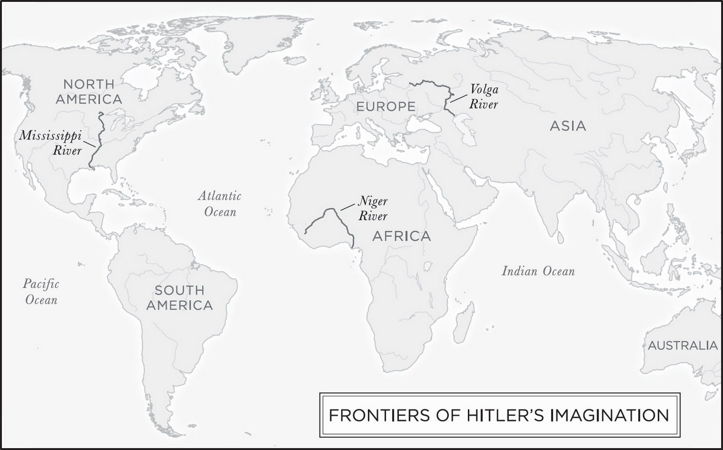
In this racist collage Europeans were interspersed with Africans and Native Americans. Hitler compressed all of imperial history and a total racism into a very short formulation: “Our Mississippi must be the Volga, and not the Niger.” The Niger River, in Africa, was no longer accessible to German imperialism after 1918, but Africa remained a fount of the images and the colonial longing. The Volga, the eastern border of Europe, was where Hitler imagined the outer limit of German power. The Mississippi was not only the river that runs from north to south through the middle of the United States. It was also the line beyond which Thomas Jefferson wanted all Indians expelled. “Who,” asked Hitler, “remembers the Red Indians?” For Hitler, Africa was the source of the imperial references but not the actual site of empire; eastern Europe was that actual site, and it was to be remade just as North America had been remade.
The destruction of the Soviet Union, thought Hitler, would allow the right master race to starve the right subhumans for the right reasons. Once the Germans replaced the Jews as the colonial masters, food from Ukraine could be directed away from the useless Soviet populations towards grateful German cities and a submissive Europe. Hitler’s axiom that life was a starvation war and his proposal for a hunger campaign against the Slavs were reflected in policy documents formulated after his rise to power in Germany in 1933. A Hunger Plan created under the authority of Hermann Göring foresaw that “many tens of millions of people in this territory will become superfluous and will die or must emigrate to Siberia.” Then, according to a second round of plans, designed under the authority of Heinrich Himmler, colonization by Germans could begin.
The Judeobolshevik conception allowed Hitler’s portrait of a planetary ecosystem polluted by Jewish ideas to crystallize as planning. The Judeobolshevik myth seemed to define the point where the application of German force could win an empire and restore the planet. It also permitted a politics of war and extermination that would be decisive for Jews and, in a different way, for Germans. The idea that Jewish power was global and ideological seemed to make the Jewish hold on territory weaker rather than stronger. If Jews could be eliminated, then they could no longer purvey their false ideas of human solidarity, and would have to yield their planetary dominion. Thus the Judeobolshevik myth courted the warriors by promising an easy triumph.
If the war did not proceed as planned, if the Soviet Union could not be so easily destroyed, then the idea of Jewish hegemony over the entire planet could return to the forefront of rhetoric and policy. If the Jews were not weakened by a first strike on Soviet territory, then the war against them would have to be escalated. If Germany had to fight a global enemy, there would seem to be no alternative to a total campaign against Jews, since in a long war the Jews could strike from any point at any time. The Jews behind the lines, in places under German control, would have to be exterminated. This latent potential within Hitler’s ideas was realized in practice: Jews were not killed in large numbers first in Berlin, but on the frontiers of German power in the Soviet East. As the tide of war turned, the mass killing moved west from the occupied Soviet Union to occupied Poland and then to the rest of Europe.
The Judeobolshevik myth seemed to justify a preemptive strike on a certain valuable territory against an inherently planetary enemy. It linked the elimination of the Jews to the subjugation of the Slavs. If this connection could be established in theory and Germans thrust eastward into war, Hitler could hardly fail in practice. Failure to conquer Slavs would make the case for exterminating Jews.
—
The Judeobolshevik idea, a major source of the Second World War, had its origins in the First. It reached Hitler’s mind after a peculiar German experience during the collapse of the Russian Empire, on the eastern front of the First World War.
From the perspective of Berlin, the First World War was fought on a western front against France (and Britain, and later the United States) and on an eastern front against the Russian Empire. Germany was surrounded by enemies on both sides and had to try to eliminate one quickly in order to defeat the other. The attack on France in 1914 failed, condemning Germans to a long two-front war. Under these circumstances, German diplomats sought nonmilitary means of removing the Russian Empire from the conflict, such as fomenting revolution. In April 1917, after a first revolution in Russia had already taken place, Germany arranged the transport of Vladimir Lenin, the leader of the Bolsheviks, from Zurich to Petrograd in a sealed train. He succeeded, along with his comrades, in organizing a second revolution in November. He then withdrew the Russian Empire from the war. This appeared at first to be a tremendous German victory.
Before the revolutions of 1917, the Russian Empire had been the homeland of more Jews than any other country in the world—and an actively antisemitic state. Jews were subject to official forms of discrimination and targeted in pogroms of increasing intensity and frequency. These were not organized by the state, but the Russian imperial subjects who perpetrated them believed that they were following the will of the tsar. Jews were almost two hundred times more likely than ethnic Russians to emigrate from the Russian Empire, in part because they were more likely to want to leave, and in part because imperial authorities were glad to see them go. During the First World War, Jews were largely excluded from the body politic.
Jews inhabited the western regions of the Russian Empire, through which Russian imperial soldiers advanced and retreated as they engaged their German and Austrian enemies. As Russian troops marched into the lands of the Habsburg monarchy in autumn 1914, they found Jews who owned farms (which was illegal in the Russian Empire) and promptly expropriated them. In January 1915, official imperial circulars blamed Jews for sabotage. That month the Russian imperial army expelled some hundred thousand Jews from forty towns near Warsaw. Local Poles took the Jews’ property and kept it. When the Germans drove the Russians back east in 1915, Russian imperial soldiers blamed Jews and carried out about a hundred pogroms. The head of the right faction of the Russian parliament (later the minister of internal affairs) explained setbacks by referring to the plans of an international Jewish oligarchy. Meanwhile, the Russian Empire deported about half a million Jews from their homes, on the logic that they might collaborate with the invaders. The army was the agent of deportations, so soldiers and officers could loot Jews, their fellow Russian imperial subjects. This mass expulsion from the Jewish heartland, accompanied by systematic theft and frequent violence, was one of the greatest disruptions of traditional Jewish life in history.
In the minds of Europeans, the Russian deportation altered the Jewish question. Tens of thousands of Jews fled the Russian Empire, creating an impression in European cities that Jews from the East were suddenly everywhere. The deportations shaped the lives of many of the major Jewish revolutionaries of the twentieth century, both of the Right and the Left. As very young boys both Menachem Begin and Avraham Stern, later right-wing radicals, were displaced. Within the Russian Empire, Jews deported from the front made for the major cities, such as Moscow, Petrograd, and Kyiv, where they were often shunned as spies and denied employment and shelter. After the February 1917 Revolution, as the empire lurched towards becoming a republic, the Jews were formally emancipated and became citizens. Of the sixty thousand or so Jews in Moscow at this time, about half were refugees. Many of them joined Lenin in his second Russian revolution that November. Lenin thanked Jews for their decisive support in the city that he would make his capital.
As of November 1917, Jews were suddenly equal members of a new revolutionary state rather than a repressed religious minority in an empire. The vast majority of Jews tried in 1918 to return to their homes, only to find them, very frequently, inhabited by other people. The Jews’ neighbors did not want to return what they had taken, and often attacked the Jews instead. As one regime gave way to another, Jews were targeted by everyone involved. The first pogroms after the revolution were carried out by the Red Army; but the ideology of their commanders was internationalist, and officers usually tried to stop anti-Jewish violence.
The other side generally did not show such restraint. The men who took up arms against Lenin’s revolution represented no coherent movement; the closest thing to an ideology of counterrevolution was antisemitism. Opponents of the new regime, seeking to draw support from the population, wed traditional religious antisemitism to a present sense of threat, portraying the Bolsheviks as a modern Satan. As the civil war ground on, killing millions of people, journalists and propagandists who opposed revolution developed the Judeobolshevik myth. They drew some of their ideas from the Protocols of the Elders of Zion. The notion of global Jewish power seemed to explain the double catastrophe of revolution and military defeat. It transformed the victory of a universal over a national idea into a plot of an identifiable group of people who could be punished.
—
Germany backed the revolutionaries in 1917, only to find itself on the side of the counterrevolutionaries not long thereafter. During the chaos that followed Lenin’s revolution, Germany was able to build a chain of client states between the Baltic and the Black Sea. The most important of these was Ukraine. The German plan for 1918 was to recall troops from the east to fight a final battle on the western front while feeding Germans from Ukrainian grain. The Germans called the treaty they signed with the Ukrainian state in February 1918 the “Bread Peace,” and it was very popular in Germany. German troops quickly drove the Red Army from Ukraine. But the scheme to exploit the country to win the war failed, not least because of the resistance of Ukrainian peasants, militias, and political parties. Nevertheless, much of Ukraine was, for a memorable six months in 1918, something like a German colony. The image of a Ukrainian cornucopia penetrated German minds at a time of blockade and hunger.
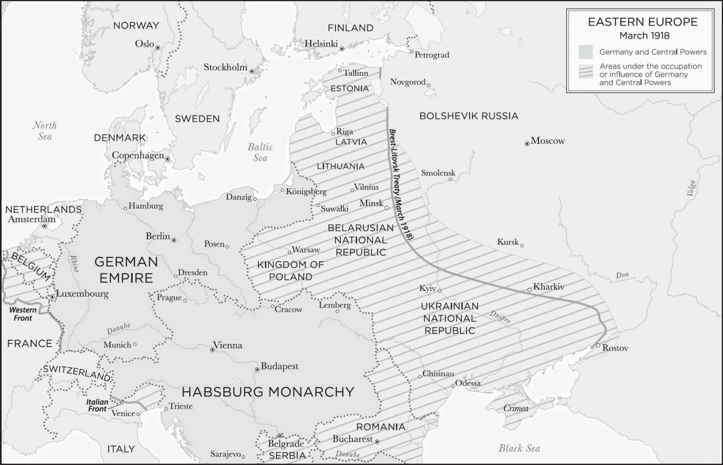
Once Germany was defeated on the western front and forced to sign an armistice in November 1918, Lenin’s commissar for war, Leon Trotsky, turned his attention to Germany’s abandoned client states in what had been the western reaches of the Russian Empire. In Latvia, Lithuania, Belarus, and Ukraine, German officers and soldiers remained to fight against Trotsky’s Red Army. Ukraine in 1919 collapsed into a complicated civil war in which some hundred thousand Jews were murdered by soldiers on all sides: Bolsheviks, the anti-Bolshevik armies known as the Whites, and above all soldiers of the independent Ukrainian state. Most of these perpetrators, regardless of their identities or loyalties, had learned violence against Jews in the Russian imperial army. Very often their Jewish victims were people who had been deported during the war by the Russian imperial policy and therefore lacked security and connections where they were.
The vanquished adherents of the Judeobolshevik thesis were among the hundreds of thousands of defeated Russian imperial subjects who flooded defeated Germany. One of them brought a copy of the Protocols of the Elders of Zion, which appeared in German translation in January 1920. Among those fleeing Lenin’s triumph were Germans from the Baltic region who could convey the Judeobolshevik idea in German without a text. These included Max Erwin von Scheubner-Richter and Alfred Rosenberg, two early Nazi influences on Hitler. In 1919 and 1920, having spoken with people who knew the Protocols and having read the Protocols himself, Hitler assimilated the Judeobolshevik myth and the notion that Jews kill by starvation. These ideas were at the time a matter of intense debate. In July 1920, the representative of Soviet power in Berlin claimed that most Jews were bourgeois, had opposed the revolution, and had no future on Soviet territory. They would not rule but be “destroyed.” This perspective could not persuade Germans who were seeking a single key to the revolutionary moment, one that could be turned either way, toward revolution or counterrevolution. At this very moment, Scheubner-Richter was in Munich gathering money and men to mount an armed expedition against the Bolsheviks, with special emphasis on liberating Ukraine.
The Judeobolshevik idea has a specific historical origin: an extension of the antisemitism of official Russia, an adaptation of Christian apocalyptic visions during a time of crisis, an explanation of the collapse of the ancient imperial order, a battle cry during a civil war, and a form of consolation after defeat. When the Nazi movement began, armed counterrevolution was under way in Russia and Ukraine, and its victory was still a real prospect in the minds of people who mattered to Hitler. For a brief moment in 1920, the Red Army seemed to be on its way to Germany. As the soldiers of Bolshevism advanced on Warsaw that August, it seemed that a final confrontation of the forces of revolution and counterrevolution would soon take place. But after a surprising and decisive Polish victory in that battle and the war, and with the consolidation of the European system that followed in 1921, the character of the problem changed.
Scheubner-Richter’s attempt to assemble an anti-Bolshevik army collapsed in 1922. When he marched arm in arm with Hitler in Munich in 1923, the Nazi putsch was, for him, a final lurch towards the East. When Scheubner-Richter was killed and Hitler was imprisoned, some Nazis saw the failure as a triumph not so much of the young Weimar Republic in Germany as of the Judeobolshevik power they believed they were opposing. As Hitler composed My Struggle in prison in 1924, the Bolsheviks became less a concrete group of political rivals and more a way to connect his ideas about Jews to a piece of territory. For Hitler, who knew little about the Russian Empire, and who thought in grand abstractions, the Judeobolshevik idea was not the end of a Russian struggle but the beginning of a German crusade, not a myth arising from painful events but the glimmering light of eternal truth.
The Judeobolshevik myth seemed to provide the missing piece of Hitler’s entire scheme, uniting the local with the planetary, the promise of victorious colonial war against Slavs with a glorious anti-colonial struggle against Jews. A single attack on a single state, the Soviet Union, could solve all the problems of the Germans at the same time. The destruction of Soviet Jews would mean the removal of Jewish power, which would allow the creation of an eastern empire, which would mean the replay of American frontier history in eastern Europe. The racial German empire would revise the global order and begin the restoration of nature on a planet polluted by Jews. If the war was won, Jews could be eliminated as convenient. If Germans were somehow held back by inferior Slavs, then Jews would bear the consequences. Either way, the pursuit of racial empire would bring the politics of Jewish eradication.
—
In Hitler’s ecology, the planet was despoiled by the presence of Jews, who defied the laws of nature by introducing corrupting ideas. The solution was to expose Jews to a purified nature, a place where bloody struggle rather than abstract thought mattered, where Jews could not manipulate others with their ideas because there would be no others. The exotic deportation sites that Hitler imagined for the Jews, Madagascar and Siberia, would never fall under German power. Much of Europe, however, would. Not so very long after Hitler published his ideas about daily bread and the commandment of self-preservation, Europeans were forcing Jews to recite the Lord’s Prayer and killing them when they could not. Europe itself became the anti-garden, a landscape of trenches.
During a death march, Miklós Radnóti wrote a poem, meant to be discovered in his clothing when his remains were excavated from a death pit: “I the root was once the flower under these dim tons my bower comes the shearing of the thread / deathsaw wailing overhead.”