
Whenever World War II became a topic of discussion at family gatherings, someone would always mention my mom’s uncle, Robert L. Woolfolk. “Bobby was a bombardier in B-17s. His plane was shot down over Germany.” That’s all anyone said—mainly because no one knew anything more. That’s all my great-grandmother knew. That’s all my mom knew. That’s all my aunt knew. Nothing more. There were no photos of Bobby after he joined the service. No “hero shot” of him as a cadet. No photo of him standing alongside a World War II bomber. No idea of his rank or the unit he served with. We looked, but nothing ever turned up.
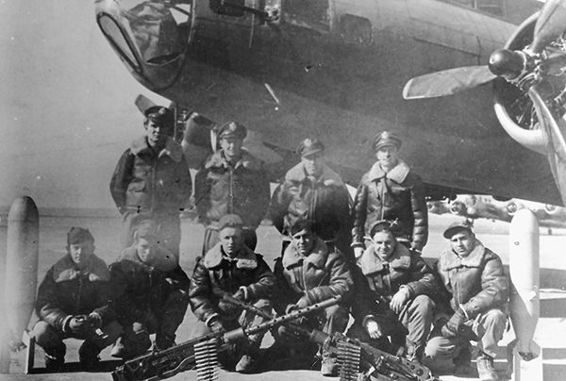
The 390th Bomb Group B-17G 42-31651 Decatur Deb was lost on May 28, 1944. Kneeling (left to right): radio operator Staff Sgt. Nick Mamula, ball turret gunner Sgt. Arthur E. Reed, right waist gunner Sgt. Robert B. Smart, engineer/top turret gunner Technical Sgt. Edward C. Stoy, tail turret gunner Edward D. Molenock, and left waist gunner Sgt. Harold B Bolton. Standing (left to right): navigator George Vincent (he was not on the May 28 raid; Flight Officer Richard C. Brown took his place and perished in the crash), bombardier 2nd Lt. Robert L. Woolfolk, copilot 2nd Lt. Samuel R. Elliot, and pilot 2nd Lt. Herbert V. Strate. Bolton, Molenock, and Stoy survived the shoot-down and were taken prisoner. MRS. ANN ZURAVIC COLLECTION, COURTESY OF IVO DE JONG

Photo 1 of 2: B-17G 42-31651’s nose art painted on a leather A-2 flight jacket held by the Parham Airfield Museum, Framlingham, Suffolk, England. This jacket belonged to bombardier Robert C. Fregosi on Robert H. Hubbell’s Crew 72, which flew twelve of their twenty-eight missions in Decatur Deb. PARHAM AIRFIELD MUSEUM

Photo 2 of 2: B-17G 42-31651’s nose art painted on a leather A-2 flight jacket held by the Parham Airfield Museum, Framlingham, Suffolk, England. This jacket belonged to bombardier Robert C. Fregosi on Robert H. Hubbell’s Crew 72, which flew twelve of their twenty-eight missions in Decatur Deb. PARHAM AIRFIELD MUSEUM
All that changed last year when I bought a copy of Ivo de Jong’s Mission 376: Battle Over the Reich, 28 May 1944. I had seen the oversized hardbound book when it came out in 2003, but never bought it. Over the years, the book kept calling to me. I’d see it, pick it up, thumb through it, and then put it down, not grasping its significance. Finally I purchased a copy, determined to find out what was drawing me to its pages.
I was deeply engrossed in the text and the details of the Eighth Air Force’s Mission 376 to Magdeburg, Germany. I turned from page 103 to page 104. There, in the lower right-hand corner of the two-page spread, was a photo of a bomber crew and a face that looked familiar. The man in the back row, second from the left, was wearing an officer’s hat with a visor and a sheepskin flying jacket. That was odd because the photo had the look of any Army Air Field training base in the southwestern United States. All the men were serious. None were smiling. I imagine they were probably roasting in their cold-weather flight gear, donned just long enough to take the photo and then shed in record time as they cursed the photographer for making them stand out in the blazing sun.
The photo isn’t the best quality, but I was intrigued to see the ten men posed in front of the B-17, flanked by practice bombs and a pair of 0.50-cal. machine guns with belts of ammunition. Reading the caption, I came across the words “Robert L. Woolfolk [bombardier, KIA].”
Continuing to read, I noticed that there were photos of a German pilot on the same page. As it turned out, he was the flight leader who led forty fighters in an attack on the 390th Bomb Group on May 28, 1944. The pilot was Feldwebel (equivalent to an American staff sergeant) Alfred Bindseil. Feldwebel Bindseil was credited with downing B-17G 42-31651 Decatur Deb, the very plane Bobby Woolfolk was flying in as bombardier.
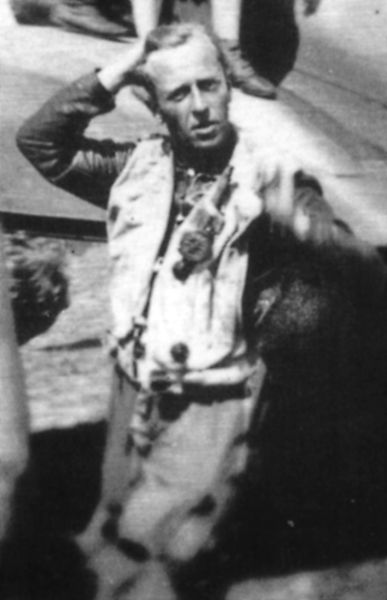
Photo 1 of 2: Feldwebel Alfred Bindseil and his Fw 190A-8 Werke, number 110393, are seen upon landing after the May 28, 1944, defense of the oil refineries at Magdeburg. Bindseil led the fighters that attacked the 390th Bomb Group head-on as they approached the target. The 390th Bomb Group lost six Flying Fortresses that day. ERIC MOMBEEK COLLECTION, COURTESY OF IVO DE JONG
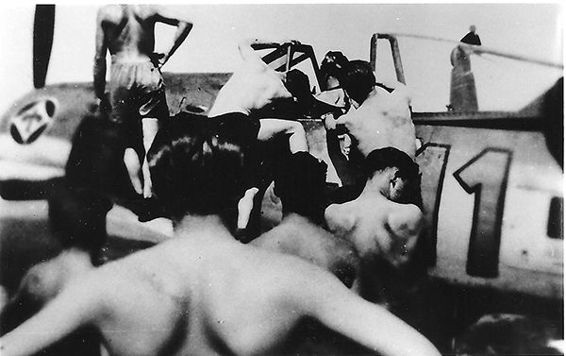
Photo 2 of 2: Feldwebel Alfred Bindseil and his Fw 190A-8 Werke, number 110393, are seen upon landing after the May 28, 1944, defense of the oil refineries at Magdeburg. Bindseil led the fighters that attacked the 390th Bomb Group head-on as they approached the target. The 390th Bomb Group lost six Flying Fortresses that day. ERIC MOMBEEK COLLECTION, COURTESY OF IVO DE JONG
The following day I contacted de Jong, who generously shared the accompanying photos and German documents concerning the crash of Decatur Deb. Later that afternoon, I took the book that held a key to my family’s history to show my mother. As she read the passage describing how Decatur Deb was shot down and saw the photo of her uncle, it brought tears to her eyes—tears of sadness for a life cut short, yet also tears of joy that someone had recorded his and his crew’s sacrifice and decided that the faded, old, crew photo was worthy of publication.
SERVICE WITH THE 390TH BOMB GROUP
For our family, Bobby’s death was a big loss. Born in 1915, he was a swimmer, and a good one at that. While attending the University of California at Los Angeles, Bobby was selected as a member of the Olympic Water Polo team slated to compete at the 1936 games in Berlin. Olympic Committee officials disqualified Bobby because he worked as a lifeguard for the city of Santa Monica, which they considered a professional career; athletes were not eligible to compete if they were paid to perform the same duties.
Instead, Bobby became a clerk at a bank and, through his mother, met a young model named Margaret, who worked at the I. Magnum department store in town. The two fell in love and married on Oct. 14, 1940. Two years later, Bobby was a member of the U.S. Army Air Forces and was sent to Roswell AAF, New Mexico, to train as bombardier with Class 43-15.
Having completed his course work and now proficient at dropping bombs, he joined nine other men to form a bomber crew under 2nd Lt. Herbert V. Strate. They were shipped overseas, and when they arrived at the 571st Bomb Squadron, 390th Bomb Group, at Framlingham, England, the ten assembled men became known as Crew 64. The crew was comprised of pilot Lieutenant Strate, copilot 2nd Lt. Samuel R. Elliot, bombardier 2nd Lt. Robert L. “Bobby” Woolfolk, navigator Flight Officer Richard C. Brown, left waist gunner Sgt. Harold B. Bolton, radio operator Staff Sgt. Nick Mamula, tail turret gunner Edward D. Molenock, ball turret gunner Sgt. Arthur E. Reed, right waist gunner Sgt. Robert B. Smart, and engineer/top turret gunner Technical Sgt. Edward C. Stoy.
As with any crew new to combat, each man was to fly a familiarization mission with another, more experienced crew. For his first mission, the 390th Bomb Group’s Mission 108, Bobby was assigned to Crew 76 (pilot Melvin P. Van Houten) flying B-17G 42-31651 Decatur Deb on May 23, 1944. Decatur Deb was a relatively new Seattle–built B-17G that had arrived in England on Jan. 8, 1944, just months before Crew 64 showed up. The bomber was overall bare metal with a black square “J” on the tail representing the 390th Bomb Group, and wore the fuselage codes FC-G (“FC” for the 571st Bomb Squadron and “G” for its aircraft in squadron designation letter). That day the 390th Bomb Group attacked Melun Airfield, southeast of Paris.
For their second mission, which took place on May 25, Crew 64 was assigned to bomb gun emplacements at Saint-Valery, France. This was Lieutenant Strate’s first combat mission as pilot in command, and Bobby’s first combat mission with his entire crew. It was also the 390th Bomb Group’s 110th mission. Strate and the rest of Crew 64 were assigned to fly B-17G 42-39887 Pickle Dropper IV for this mission. Pickle Dropper IV was only a few months older than Decatur Deb, having arrived with the 390th Bomb Group on Nov. 1, 1943.
After two days rest, on May 27 Crew 64 was assigned to fly B-17G 42-97821 Chaff Wagon for Mission 112 to Strasbourg, France. Chaff Wagon was among the 102 Third Air Division B-17s that attacked marshaling yards and aviation industry targets in the Strasbourg area. Crew 64 completed these three combat missions without incident.
Crew 64’s first three missions were to attack targets in support of the forthcoming D-Day landings and were considered “milk runs”—easy missions to targets relatively close to the English Channel. Sadly, Crew 64’s fourth mission was to be quite different.
Crew 64 woke in the early morning hours of May 28 to prepare for the 390th Bomb Group’s Mission 113. Bobby and his crew reported to the mess hall for chow, then headed to the briefing to learn that their target for the day was the synthetic oil plant at Madgeburg, Germany, about 100 miles west of “The Big B”—Berlin. This was the Eighth Air Force’s fourth mission to bomb the Magdeburg-Rothensee synthetic oil factories, which were extracting 270,000 gallons of synthetic oil products from lignite coal each year. Lubricants and fuels from Magdeburg’s plant kept German planes, submarines, and tanks on the move, oppressing and killing thousands of people each day.
Now airborne and flying Decatur Deb, Crew 64 was part of a larger bomber formation comprised of the four bomb squadrons (568th, 569th, 570th, and 571st) of the 390th Bomb Group. As the bomber formation approached Magdeburg at 2:07 p.m. local time, seventy-five single- and twin-engine German fighters attacked. Simultaneous to the approach of the fighters, Bobby, as the plane’s bombardier, informed the crew over the intercom that Decatur Deb was now on the bomb run. His voice was followed by another crewmember calling out: “Bandits at 12 o’clock!”
Seconds later, forty fighters made a massed, head-on attack, firing their machine guns and cannon as they flew through the Flying Fortresses of the 390th fast approaching the oil refinery. Before dropping his bombs, Bobby looked up from the bombsight to see a gaggle of Focke Wulf Fw 190s literally filling the nose window and heading straight for him. Bobby grabbed the remote control, swung the nose turret’s twin 0.50-cal. machine guns forward, and began firing at the oncoming Nazi fighters.
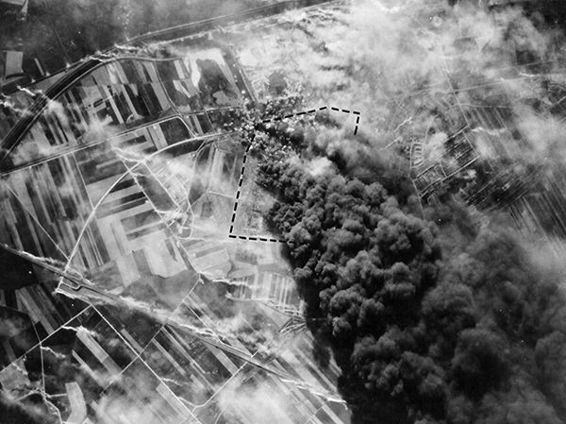
The Magdeburg Rothensee Synthetic Oil Plant was the objective on Eighth Air Force’s Mission 376 on May 28, 1944. That day the Eighth Air Force dispatched 1,341 aircraft to attack oil industry targets in Germany. The 390th Bomb Group lost six aircraft in the attack. USAAF
The bomber’s crew heard and felt an explosion; other pilots in the squadron reported seeing Decatur Deb slide away from the formation with its cockpit on fire and large pieces of both the horizontal and vertical stabilizer shot away. According to the after-mission intelligence report, other air crews said Decatur Deb was seen trying to move back into her tail-end position within the low squadron. As she slid to the right in an effort to regain position, the bomber fell off and began to spiral down toward German soil.
The top turret gunner, Technical Sgt. Edward Stoy, was able to bail out and escape the burning bomber. His recollection of the event is recorded in Missing Air Crew Report 5259:
I heard Lt. Woolfolk’s guns stop about the time we were hit. . . .The pilot and copilot were the only crewmembers I saw after we were hit. They were both in the forward escape hatch and were scrambling around as if they were panicky. They didn’t seem to be hurt when I went into the bomb bay to bail out.
Author de Jong had the good fortune to interview Stoy for Mission 376. Stoy detailed how he turned away from the pilots who were blocking the crew escape hatch and dove out of the bomb bay. Stoy related that as he dove out, he got caught on a bomb and could not get free; all the while the burning bomber was spiraling down from 20,000 feet. Miraculously, Stoy was forced out of the bomb bay when the bombs were salvoed—the entire bomb load dropped at once—a task that can only be accomplished from the bombardier’s control panel in the nose of the bomber. Stoy told de Jong: “All of a sudden something or someone salvoed all of the bombs, with me stuck to the bottom bomb.”
I’d like to think it was a heavily wounded Bobby Woolfolk who moved the salvo handle in one last attempt to get his bombs on target, coincidentally saving Stoy’s life. But we’ll never know.
During his descent attached to the bomb, Stoy’s uniform tore, freeing the explosive to fall one way while he drifted another, parachuting to a safe landing. Stoy, left waist gunner Sergeant Bolton, and tail gunner Sergeant Molenock were taken prisoner as soon as their parachutes set them on German soil. After the war, they were returned to the United States and lived full lives.
Decatur Deb’s remaining seven crewmen perished in the crash. The Flying Fortress came down 2.5 miles north-northwest of Magdeburg near the highway at Ebendorf. It was her twenty-third mission. She had flown her first combat mission on Jan. 29, 1944, to Frankfurt, and also went to heavily defended targets such as Augsburg, Wilhelmshaven, Hannover, Regensburg, and Rostock. She attacked Berlin twice.
MORE 390TH LOSSES THAT DAY
In addition to Decatur Deb, the 390th Bomb Group lost five other B-17s during the May 28, 1944, raid on Magdeburg. Also from the 571st Bomb Squadron was B-17G 42-37806 Stark’s Ark, which crashed near Walternienburg, Germany, with only one man surviving. Lost from the 568th Bomb Squadron that day were B-17G 42-102440 Silver Slipper, which crashed near Burg with her entire crew taken prisoner, and B-17G 42-37906 Angel in Disguise, which ditched in the North Sea; all of her crew were fished out of the water by the Germans and taken prisoner.
The 570th Bomb Squadron lost two G-model Flying Fortresses as well—42-32089 Mountaineer crashed near Holzhausen, Germany, and its entire crew was taken prisoner; 42-31985 Devil’s Aces crashed at Ebendorf with seven killed and three taken prisoner.
On the night of May 28, six 390th Bomb Group B-17s and sixty crewmen did not return to base. Of those men, twenty-three never came home. Second Lt. Robert L. “Bobby” Woolfolk left behind a wife and family, and a legacy of fond memories and bravery. It was an author half a world away who brought him back to life, if only in our hearts.
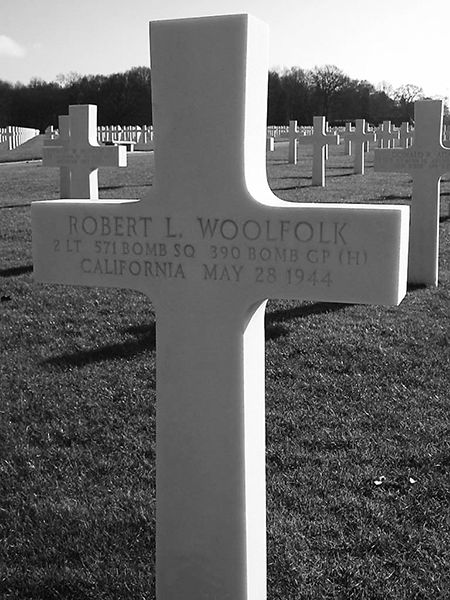
After their bodies were recovered, the Germans buried the crew in Cemetery Westerhüsen at Madgeburg. Following the war, 2nd Lt. Robert L. Woolfolk was reburied at the Ardennes American Cemetery, Neupré, Belgium, in Plot C, Row 30, Grave 3. An “adopt a grave” program is operated at the Ardennes American Cemetery by Cercle Royal Le Briscard. RIK VERHELLE
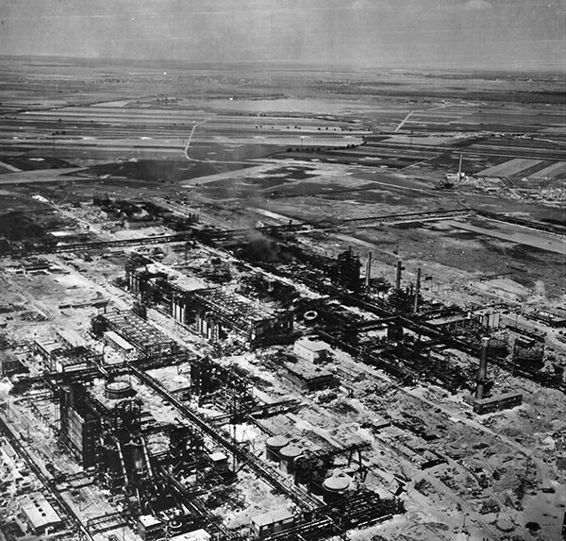
A low-level, post-strike photo showing the complete destruction of the synthetic oil works at Magdeburg. USAAF