
Chapter Four
In 1934, General Sir Hugh Elles, Master-General of the Ordnance, asked Vickers-Armstrongs to design what was described as an ‘infantry tank’. His brief asked that the vehicle be heavily protected, and armed with no more than a machine gun–and yet it was to be cheap and available in significant numbers. The weight of armour necessarily meant that the tank would be much slower than the so-called cruisers, but this was considered unimportant since the role of the infantry tank was to support slow-moving foot soldiers during an attack. Once the attack had broken through the enemy’s front line, faster cruisers, or light tanks, would move in to consolidate the gains.
The design for the first of these infantry tanks, dubbed Matilda for its supposed resemblance to a cartoon duck, was the work of Sir John Carden. Despite being produced in two versions, it was not a great success, but Vickers was sufficiently encouraged by the Matilda to develop a design of their own as a private venture, reusing as many components as possible. The result was the Valentine, subsequently officially adopted as the infantry tank Mk III. It was said to be difficult to drive but, nevertheless, proved itself to be a reliable and robust design which was gradually improved and up-gunned over a four- or five-year period. Alongside the ubiquitous Valentine, the best known British infantry tank is almost certainly the Mk IV–better known as the Churchill. Designed by Harland and Wolff in 1940, and then redesigned for production by Vauxhall Motors, the Churchill remained in production until October 1945, with the last unit not being withdrawn from service until twenty years later.
Infantry Tank Mk I (A11)–Matilda I
The A11 was the first tank intended expressly for infantry support and was designed to a brief laid down by General Sir Hugh Elles for a small, well-armoured vehicle that would be relatively inconspicuous, and which could resist attack by the anti-tank guns of the period. The pilot model, designated A11E1, was submitted for trials in September 1936. It was an ungainly machine, consisting of a narrow, well-armoured riveted hull running on open tracks, with a length of 191 in and a maximum thickness of 60mm, which made it invulnerable to any of the contemporary anti-tank guns. The driver was located centrally at the front and on top of the hull was mounted a tall, but cramped, one-man rotating turret of cast steel, armed with nothing more lethal than a Vickers .303in water-cooled machine gun–although this was later upgraded to a .50in gun, making the tiny turret even more cramped for the hapless gunner. The overall width was 90in, and the tank measured 74in to the top of the turret.
Power came from a 70bhp Ford V8 side-valve engine, driving the rear sprockets through a Ford four-speed gearbox; the brakes, clutches and steering system were adapted from those used on the Vickers light tanks. The suspension consisted of a pair of eight-wheeled leaf-sprung bogies on either side, with the return rollers positioned on the tops of the bogies. The top speed of the 11-ton machine across country was 5–6mph, which was, of course, faster than advancing infantry.
In 1937, Vickers was awarded a production contract for sixty machines, later increased to 139 (plus the prototype), and production continued until August 1940, by which time it was still one of the world’s best-armoured tanks! Despite some Matildas going to France in 1940, the type saw little action, being used largely for training. By the end of 1936, work had started on designing its replacement, the A12 infantry tank Mk II.
Matilda I was also used to mount two types of early mine-clearance device–the Coulter mine plough and the Fowler rollers; neither device saw action.
Infantry Tank Mk II (A12)–Matilda II et seq.
It was obvious almost as soon as the Matilda I appeared that it was too small and was insufficiently armed. It was equally clear that the design could not be upgraded to mount a larger gun, nor to accommodate the minimum crew of three, without making the hull larger–and that this, in turn, would increase the weight and require a new more powerful engine. So, despite retaining the Matilda name–and being known either as Matilda Senior or Matilda II until the original Matilda was withdrawn–the infantry tank Mk II was a new design developed by the War Department Mechanization Board, a forerunner to the Department of Tank Design, and the Vulcan Foundry. The latter was responsible for producing the first wooden mock-up in November 1936, and the pilot machine, designated A12E1, in April 1938.
The hull was larger, with a maximum thickness of 78mm, and there were heavy side skirts to protect the tracks and the suspension. The turret was hydraulically operated and the gun was stabilised. Motive power was provided by a pair of AEC six-cylinder diesel engines, each producing 87bhp, linked together and driving through a six-speed Wilson epicyclic gearbox; steering was effected by a Rackham clutch and brake system. In the later Matilda III, the AEC engines were replaced by Leyland six-cylinder diesels, with a combined power output of 190bhp. The suspension was of the bell-crank ‘Japanese’ type using compound helical springs, the design of which was borrowed from the A6 six-tonner. The 221in-long hull provided accommodation for a four-man crew, and the maximum speed of the 26.5-ton machine on roads was 15mph, reducing to 11mph across country.
The main gun was the 2-pounder (40mm), but there was also a close-support variant mounting a 3in howitzer. A Vickers .303in water-cooled machine gun, and later a 7.92mm Besa machine gun, was carried in a coaxial mount. There were smoke dischargers on either side of the turret and most tanks also carried a .303in Bren gun for anti-aircraft defence.
Production contracts were placed straight off the drawing board in June 1938, with Vulcan Foundry producing most of the castings for the hull and turret, and undertaking final assembly. Fowlers, Ruston and Hornsby, Harland and Wolff, North British Locomotive and the London Midland Scottish Railway workshops were also involved and the total number produced was 2,987, in five main variants. Matilda I* (infantry tank Mk II) was the first production variant, with AEC engines and a 2-pounder (40mm) gun. For the Matilda II (infantry tank Mk IIA), the Vickers machine gun was replaced by a 7.92mm Besa weapon. With the Leyland engines in place of the AEC units the designation became Matilda III (infantry tank Mk IIA*) and when the original Leyland E148/148 engines were replaced by the E164/165 units, the designation was changed to Matilda IV (infantry tank Mk IIA**). Finally, Matilda V (infantry tank Mk II) incorporated improvements to the gearbox and the gear-change mechanism.
There was also a close-support version of the Matilda III and IV, with a 3in howitzer in place of the 2-pounder (40mm). Matildas were also adapted for a variety of specialised roles including mine clearance (Baron, Fowler roller and Scorpion), bridgelayer (Inglis), trench-crossing device and canal defence light (Matilda II and Matilda V CDL). The Australian Army also fitted Matildas with the Frog and Murray flame-thrower devices, as well as a box ‘dozer blade.
The Matilda’s general lack of speed and rather clumsy steering system, together with an inability to fire high-explosive ammunition, meant that the type was rendered obsolete by the appearance of the Valentine (infantry tank Mk III), and by the US-built M3 Grant and M4 Sherman. However, this was not the end of the Matilda’s service career and a number served with the Australian Army in the Far East where the armour was suitably effective against Japanese guns.
Infantry Tank Mk III, III*–Valentine
Valentine was a private venture by Vickers-Armstrongs, designed largely by Leslie Little as an alternative to the A10, but, having been shown drawings of the machine, the War Office was said to have been unhappy about the size of the turret and it was more than a year before a contract was issued. However, when the first order for 275 vehicles was placed in July 1940, the demand for tanks to replace those abandoned following the evacuation of the British Expeditionary Force from France and Belgium was so pressing that the need for a pilot model was waived. Construction started in July 1939, with the first of what ended up as a total of 8,275 vehicles being delivered in May 1940 ready for trials. Despite being designed as an infantry tank, with a maximum thickness of armour of just 65mm, a shortage of cruisers meant that the Valentine soon found itself equipping the newly raised armoured divisions as well as supporting tank brigade infantry.
Valentine I was equipped with an AEC A179 six-cylinder petrol engine producing around 135bhp from 9,610cc, although this was subsequently replaced by the uprated A189 version. In Valentines II and III (infantry tank Mk III*), the petrol engine was replaced by an AEC A190 Comet Mk III six-cylinder diesel engine with a power output of 145bhp from the same 9,610cc capacity–although often dismissed as a ‘bus engine’, the A190 was actually developed specifically for the Valentine. All subsequent versions used an American GMC 6004 two-stroke diesel engine with a power output of 210bhp. In all cases, the engine was coupled to a five-speed transmission driving the rear sprockets. There were six road wheels on either side, carried in two bogies, with the leading and trailing wheels of larger diameter than the others; suspension was of the ‘slow motion’ pattern. The hull was riveted and was designed to accommodate a three-man crew (later four), measuring 212in in length and 103in wide, with the length extended to 232in from Valentine VIII. The combat weight was 17.4 tons, rising to 18.3 tons from Valentine VIII, and the intended infantry support role meant that the top speed was pegged at just 15mph on road surfaces, and 8mph across country.
Valentines I to VII were armed with the 2-pounder (40mm), generally with a coaxial 7.92mm Besa machine gun; for Valentines VIII to X, the main gun was replaced by the 6-pounder (57mm), and from Valentine VI, the Besa machine gun was replaced by a Browning .30in gun. The final derivative, the Mk XI, carried a 75mm gun.
A number served as command vehicles with anti-tank brigades, but by the time the larger and more heavily armoured Churchill infantry tank started to be available in quantity, the Valentine was beginning to show its age. However, production of Valentines continued until 1944 and, with plenty of serviceable vehicles available, the Valentine hull was often chosen as the basis for various specialised roles. These included canal defence light (CDL), duplex-drive (DD) amphibious assault tank, Scorpion mine-clearance flail, anti-mine roller attachment, Snake mine exploder, observation/command post, flame-thrower, flame mortar, bridgelayer or armoured ramp carrier (Ark). The Valentine hull was also used as the basis of the Archer 17-pounder (76.2mm) and Bishop 25-pounder (87.6mm) self-propelled guns.
Although it was cramped and hard to drive, the Valentine was reliable and robust and was well liked by its crews. The tank saw its first service during Operation Crusader in North Africa, and was widely used in the Western Desert in 1941, in Tunisia and Madagascar, as well as with the New Zealand Army in the Pacific.
By the time Valentine production ended, 6,855 vehicles had been manufactured in Britain, by Vickers-Armstrongs, Metropolitan-Cammell Railway Carriage and Wagon Company, and the Birmingham Railway Carriage and Wagon Company; a further 1,420 were constructed in Canada by the workshops of the Canadian Pacific Railway (Valentines VI, VII and VIIA). Most of the latter went to the Soviet Union, where they were used during the Battle of Moscow.
Infantry Tank Mk IV (A22)–Churchill
With a total of 5,640 units–some sources suggest even more–constructed over a five-year period, the Churchill was the second most numerous British tank of the Second World War. Once the initial teething problems had been solved it also became one of the most reliable. Unfortunately, although it was well armoured, as with most Allied tanks its firepower was sadly inadequate when confronted with the German 75mm and 88mm guns.
The work that eventually led to the development of the A22 Churchill started in September 1939 when the Belfast shipyard of Harland and Wolff was commissioned to construct four prototypes for a new infantry tank designated A20. The prototypes were completed by June 1940 and were powered by a twelve-cylinder Meadows engine, which quickly proved itself to be insufficiently powerful. The vehicle was also plagued by transmission troubles.
By this time, events in France had shown that this would be a war of movement and that notions of trench warfare should be forgotten. Clearly, the A20 was obsolete but, using the best features of the design as a starting point, H. E. Merritt, the Director of Tank Design, drew up a specification for yet another infantry tank, this time designated A22. Now there was a new twist to the equation–the shortages of equipment resulting from the abandonment of so much materiel on the beaches of northern France and Belgium dictated a tight timescale and the War Office insisted that the A22 be ready for production within twelve months. Vauxhall Motors had been working on a horizontally opposed twelve-cylinder engine to replace the Meadows unit of the A20, and it was decided to move the A22 development work from Harland and Wolff to Vauxhall. To save time, Vauxhall retained the basic Harland and Wolff hull and the sprung-bogie suspension. The Bedford flat-twelve engine was also retained, producing 325–350bhp from a capacity of 21,240cc and driving the rear sprockets via a Merritt-Brown five-speed gearbox and epicyclic steering unit–although after just 100 vehicles had been constructed, the five-speed transmission was replaced by a four-speed unit. The first pilot model was ready by November 1940.
The hull was of composite construction, consisting of an outer covering of armour plate bolted to a mild-steel inner skin, giving a maximum thickness of armour of 102mm; on the later Mks VII and VIII versions, the thickness of armour was increased to 152mm. The first version was fitted with a cast turret, but this was later superseded by a larger turret of either cast, welded or composite construction.
It was a large and relatively heavy machine–the hull measured 293in in length and was 100in wide, with the width increased to 108in from the Mk III onwards, but at least there was plenty of room for the five-man crew. The combat weight was 39 tons, rising to 40 tons for the Mks VII and VIII and this held the top speed down to around 17mph, reducing to 12.5mph for the heavier Mks VII and VIII.
The first two variants were armed with the 2-pounder (40mm) gun in a cast turret, with a coaxial 7.92mm Besa machine gun and a 3in howitzer mounted in the nose, although in the Churchill II the howitzer was replaced by a second Besa machine gun. There was also a Churchill II close-support version with the 3in howitzer in the turret and the 2-pounder in the nose. When the Churchill III appeared in March 1942, it was sporting the harder-hitting 6-pounder (57mm) in a new welded turret; on the Churchill IV the turret was cast. A Churchill IV(NA) version was constructed in North Africa, with the 6-pounder (57mm) replaced by an M3 75mm gun salvaged from battle-damaged Shermans. Churchill VI was a converted IV, fitted with a 75mm gun developed by Vickers-Armstrongs; tanks manufactured with this gun were designated Churchill VII, or A22F. Churchill V and VIII were close-support versions, with the 6-pounder (57mm) gun replaced by a 95mm howitzer.
Other variants included the Churchill IX, which was a reworked III or IV with a new turret and 6-pounder (57mm) gun, and the Churchill IX-LT, armed with the same gun but retaining the original turret. Churchills X and X-LT were reworked in the same way as the IX, but were armed with the 75mm gun, and Churchills XI and XI-LT were Churchill Vs with additional appliqué armour and the 75mm gun.
The Churchill Oke was developed for use as a flame-thrower in 1942, based on the Churchill II. Further trials with Valentine flame-throwers led to the Churchill Crocodile, initially based on the Churchill IV but, when it came to production, using the Churchill VII instead. Fuel for the flame-thrower was carried in a pressurised trailer and was passed to the hull through an articulated coupling; the projector for the petroleum-based fuel replaced the hull machine gun and the trailer could be remotely detached once the fuel was consumed, allowing reversion to the original role of a gun tank. Other Churchill adaptations included: armoured recovery vehicle (ARV) and deep-wading beach armoured recovery vehicle (BARV); three types of Ark (armoured ramp carrier); hydraulic bridgelayer; bobbin mat layers; various types of mechanical and explosive mine-clearance devices; and the Ardeer Aggie and Woodpecker Pétard mortar projectors.
Production was carried out by a consortium of manufacturers led by Vauxhall Motors. Alongside Vauxhall, other participants included Broom and Wade, Birmingham Railway Carriage and Wagon Company, Metropolitan-Cammell, Leyland Motors, Dennis Brothers, Harland and Wolff, Gloucester Railway Carriage and Wagon Company, Newton, Chambers and Company, and Beyer Peacock and Company. The last Churchill was built in October 1945.
The Churchill’s first action was with the Canadian Army in the Dieppe raid of August 1942, although there was little opportunity to see how it performed. It was also used in Italy, North Africa and northwest Europe, and after the war was used in Korea where it saw its last service as a gun tank. Some specialised versions remained in service until 1965. Churchills were also supplied to the armies of Australia and the Soviet Union during the Second World War, and surplus Churchills were sold or gifted to Ireland, India and Jordan.
Infantry Assault Tank (A38)–Valiant
Intended for use in the Far East as an infantry assault tank, the A38 Valiant used as many Valentine components as possible but carried a new, larger turret, mounting either a 6-pounder (57mm) or 75mm gun, together with a single coaxial 7.92mm Besa machine gun. Although similar in general layout, at 211in long and 111in wide, the four-man hull was larger than the Valentine, and was constructed from heavier cast sections, with a maximum thickness of 110mm, and with a new cast nose that offered considerably greater protection. The turret was also larger and wider, and was bolted together from large cast plates.
The first prototype appeared in 1944, but proved to be extremely difficult to drive during trials. By this time the design was considered obsolete anyway and there was no series production. A second prototype–Valiant II–was planned, and possibly produced, using a Rolls-Royce V8 Meteorite petrol engine (effectively a shortened version of the V12 Meteor) in place of the GMC diesel, but again nothing came of the project.
Like later marks of Valentine, power was provided by a GMC 6004 six-cylinder two-stroke diesel engine, producing 210bhp and driving through an AEC gearbox. Unlike those on the Valentine, the road wheels were all of the same diameter and were individually suspended. With a combat weight of 27 tons, some 10 tons greater than the Valentine, the speed was restricted to just 12mph.
Infantry Tank (A43)–Black Prince
In 1943, Vauxhall Motors was asked to develop an improved version of the Churchill infantry tank capable of mounting a 17-pounder (76.2mm) gun. The hull of the Churchill VII/VIII was the starting point, with the length increased to 347in and the width to 136in, which, despite the larger gun, must have provided a little more space for the crew of five. The running gear consisted of the Bedford flat-twelve petrol engine of the Churchill, combined with a Merritt-Brown H52 five-speed transmission and a differential steering system. Although the maximum thickness of armour was unchanged at 152mm, the changes to the length of the vehicle, combined with the use of a larger gun, put the weight up to 50 tons and reduced the maximum speed on roads to 11mph, with 7mph across country. There was an all-new cast turret, mounting the 17-pounder (76.2mm) main gun, together with a pair of 7.92mm Besa machine guns, one mounted coaxially in the turret. Just six prototypes were constructed–and none saw any action.

The budget allocated to Vickers for production of the A11 infantry tank Mk I called for a maximum price of £6,000, which restricted the designers to producing a two-man tank. It was designed by Sir John Carden at Vickers-Armstrongs in 1934/35. (Warehouse Collection)

Early trials showed that the Matilda had a tendency to throw tracks and this was resolved on production machines by relocating the track-return rollers on the sides of the hull. Changes were also made to the layout of the nose. A small number of Matildas went to France in 1940, but were mostly confined to training. (Warehouse Collection)
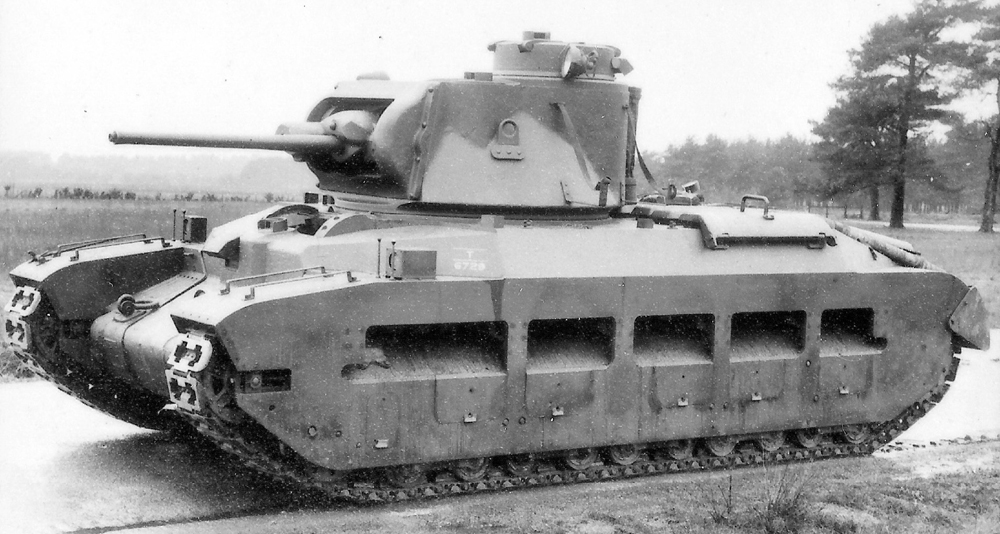
Looking nothing like its predecessor, the Matilda II was based largely on the A7 medium tank that had been designed at the Royal Ordnance Factory (Woolwich) in 1929, but which had never gone into production. (Warehouse Collection)
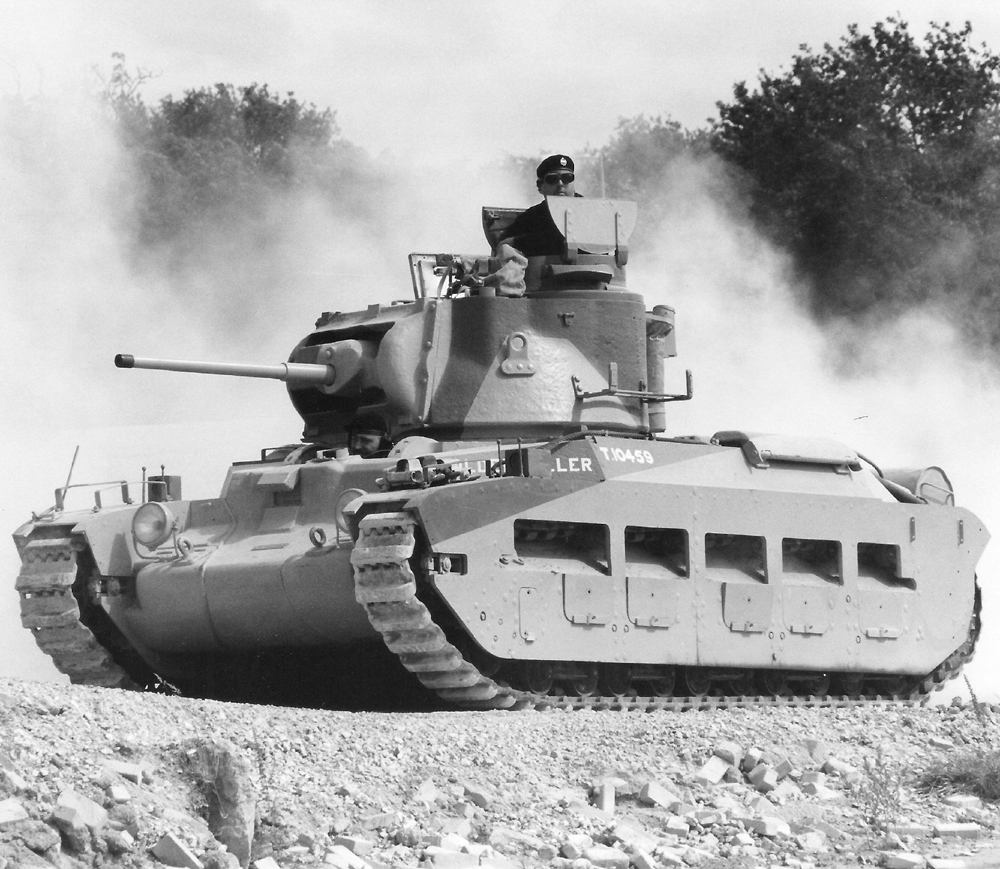
Matildas II–V saw action with the 7th Royal Tank Regiment as part of the British Expeditionary Force (BEF) in France in 1940, where the thickness of the hull led the Germans to reconsider the calibre of their anti-tank guns, and in the Western Desert, where it proved equally resistant to Italian antitank weapons. The photograph shows a Matilda IIA belonging to the Tank Museum. (Simon Thomson)

Although it used mechanical components borrowed from the Vickers-built cruiser tanks Mks I and II, it is something of a sad indictment of official War Office tank design that the most numerous British tank of the Second World War–the Valentine–was actually a private venture by Vickers-Armstrongs. It is said to have acquired its name by virtue of having been presented to the War Office on 12 February 1938–two days short of St Valentine’s Day–though the name may also have been derived from Vickers-Armstrongs Limited, Elswick, Newcastle-upon-Tyne. (Warehouse Collection)
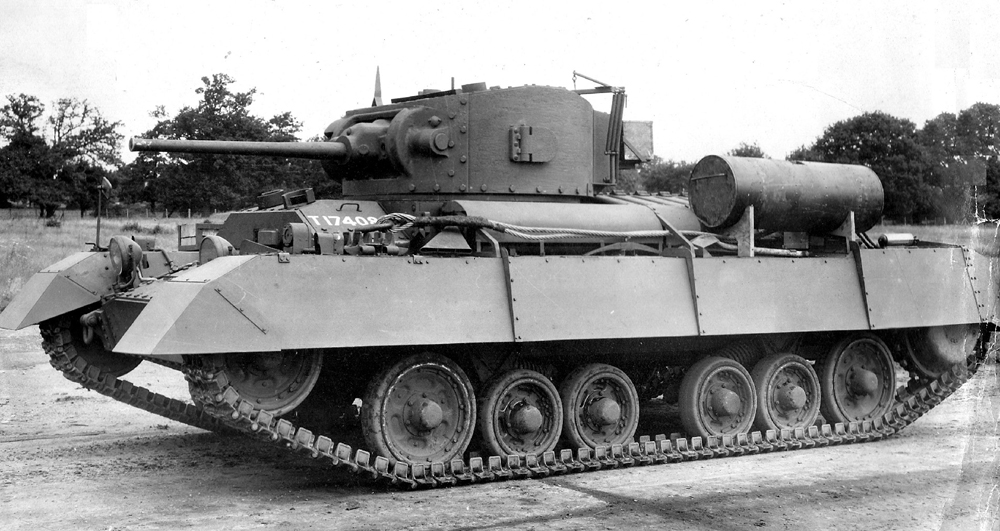
This photograph shows a Valentine II fitted with sand shields and auxiliary fuel tanks for long-range desert use in the Middle East. Valentine III had a larger turret with space for a third crew member and Valentines VI, VII and VIIA were constructed in Canada, using a cast rather than riveted nose. (Warehouse Collection)

External stowage diagram for the Valentine IX. (Warehouse Collection)

The Valentine was selected as the development platform for the duplex-drive (DD) amphibious assault tank. The wading screen is collapsed down onto the hull in this photograph. (Simon Thomson)
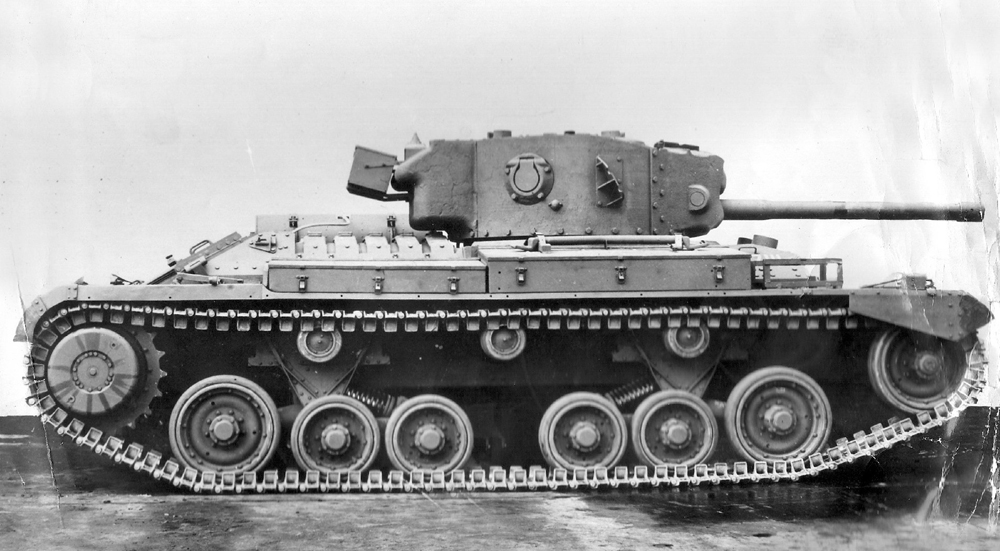
The Valentine IX was effectively a Valentine V up-gunned with the 6-pounder (57mm); at the same time, the turret crew was reduced to two. (Warehouse Collection)

Although it was cramped and hard to drive, the Valentine was reliable and robust and was well liked by its crews. The tank saw its first service during Operation Crusader in North Africa, and was widely used in the Western Desert in 1941, and in Tunisia and Madagascar, as well as with the New Zealand Army in the Pacific. The photograph shows a Valentine IX. (Simon Thomson)
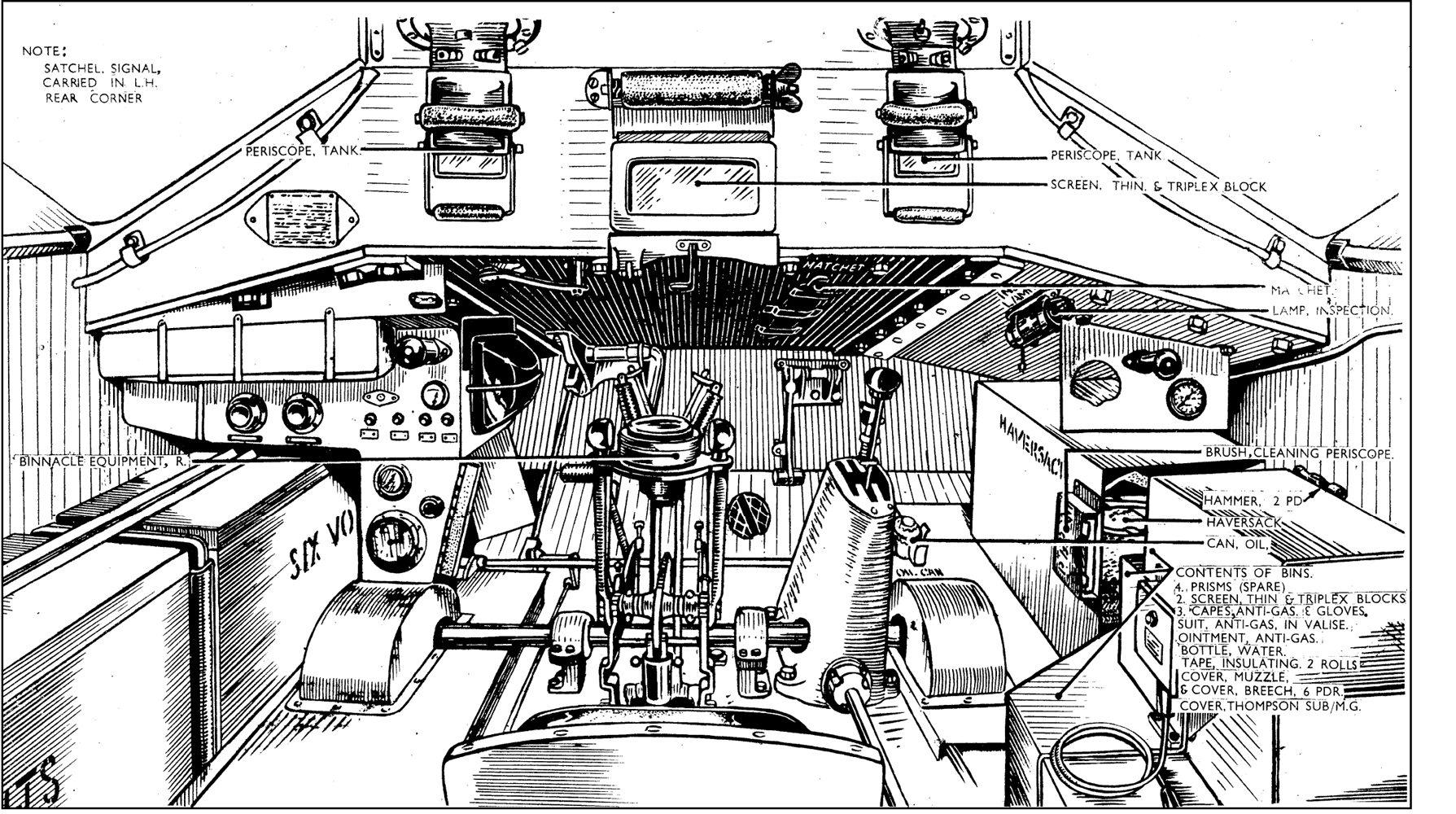
Stowage diagram for the Valentine driving compartment. (Warehouse Collection)

In all, 650 Valentine III and VIII tanks were converted for duplex-drive (DD) operation and were used for crew training. (Simon Thomson)

The A22 Churchill infantry tank was derived from this Harland and Wolff prototype for what was described as the A20. With its rhomboidal hull harking back to the designs of the First World War, the A20 was intended to have good trench-crossing abilities, and was to be armed with a pair of 2-pounder (40mm) guns, one mounted in the turret, the other in the nose; machine guns were planned for recesses in the hull sides. It was obsolete before it was completed. (Warehouse Collection)

Vauxhall’s A22 Churchill superseded the A20 and the War Office approved the design immediately, believing that any problems–and there were many–could be ironed out whilst production was under way. A contract was issued for 500 tanks and the first fourteen production vehicles, designated Churchill I, were delivered by June 1941. (Tank Museum)

The Churchill’s exposed tracks were wrapped around the perimeter of the hull and were supported on eleven small steel road wheels, each with its own trailing arm and coil-spring suspension; track covers were fitted from May 1942, with early vehicles reworked. (Warehouse Collection)
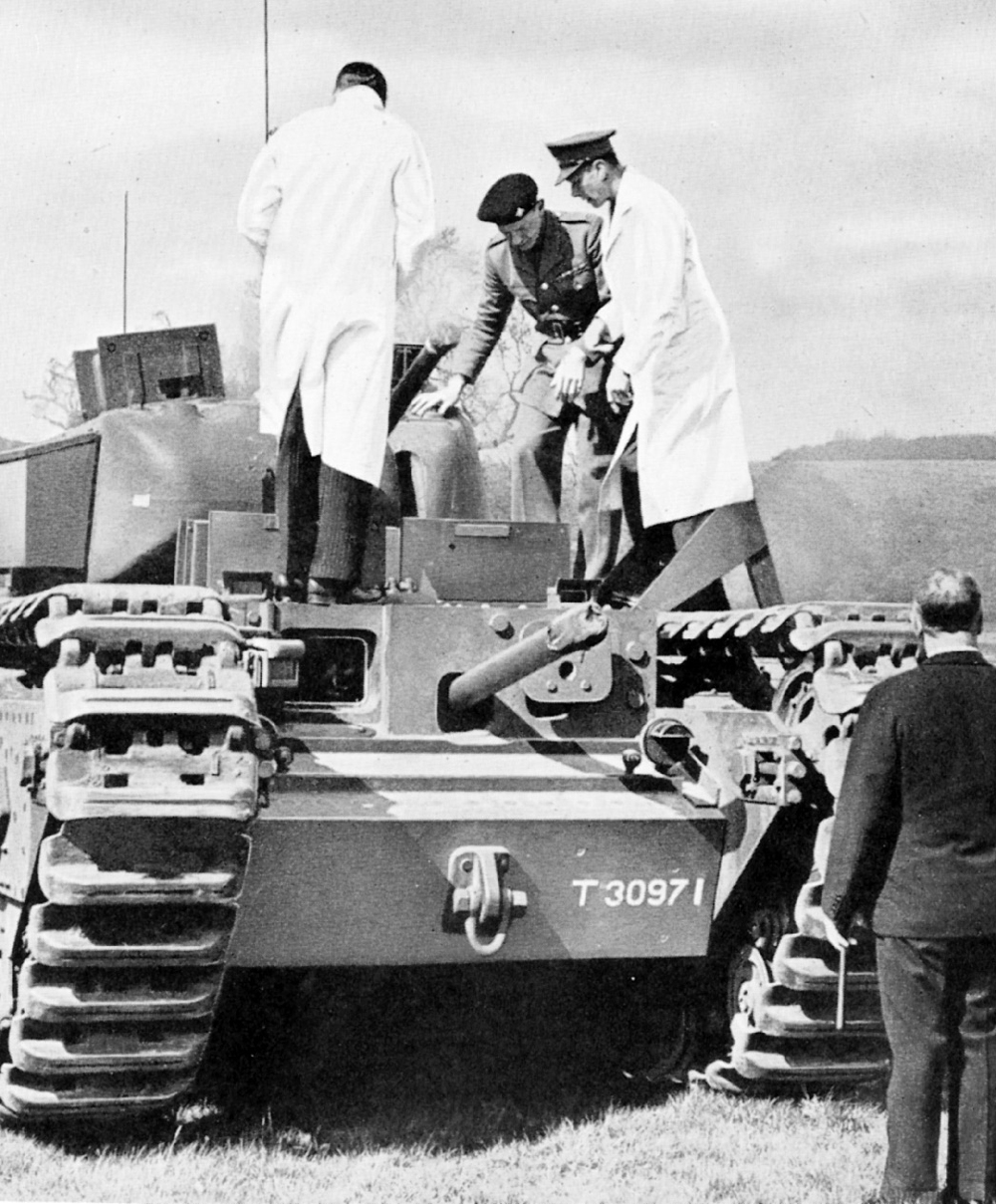
The Churchill underwent considerable development during its production life, with eight major variants and its heavy armour, roomy hull and regular shape also made it useful as an engineer’s vehicle, with innumerable adaptations and modifications for specialised roles. The nose-mounted 3in howitzer was featured only on the Churchill I. (Warehouse Collection)

Stowage diagram for the Churchill III turret. (Warehouse Collection)
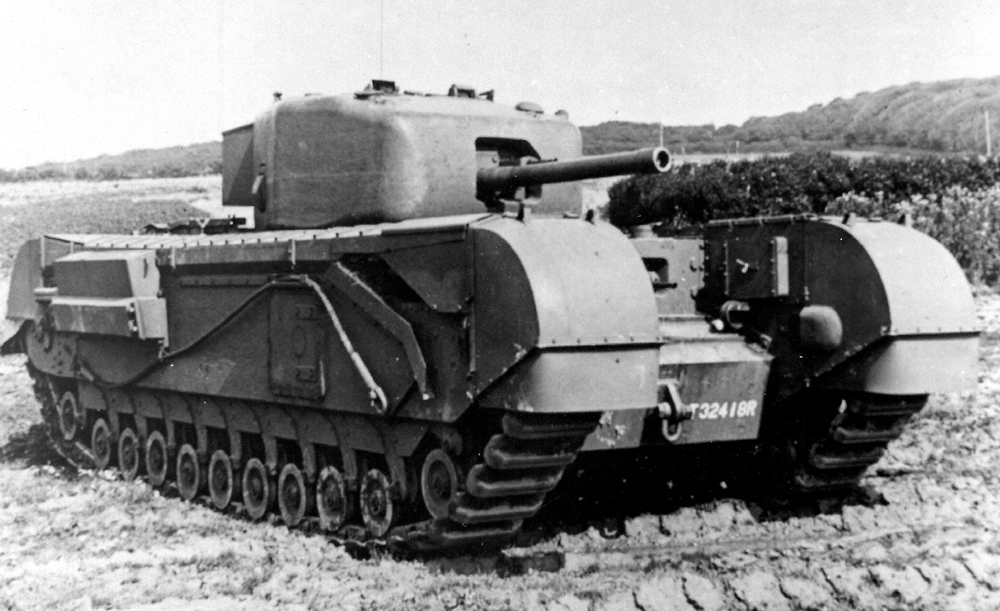
The Churchill IV was armed with a 6-pounder (57mm) gun in a new design of cast turret. (Warehouse Collection)
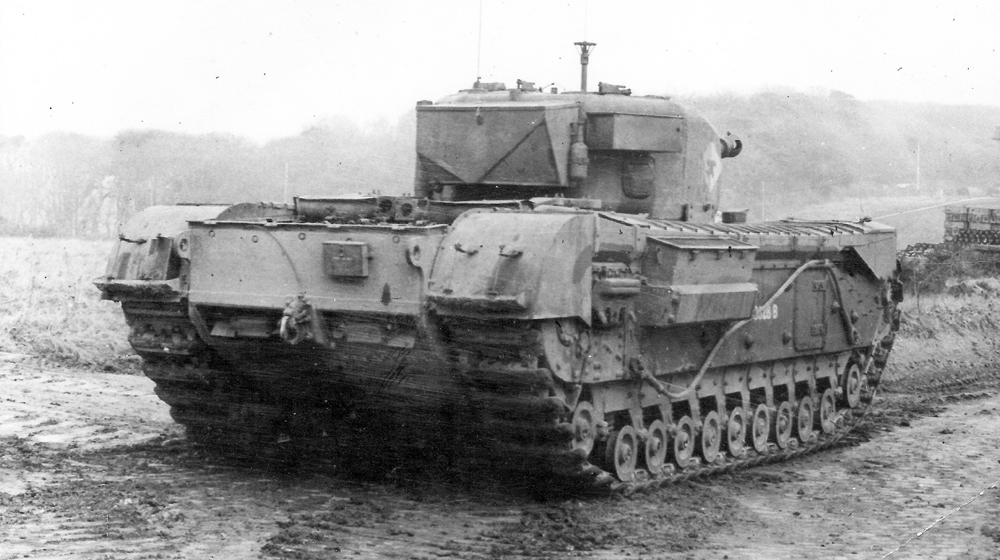
Intended for the close-support role, the Churchill V was equipped with a 95mm howitzer in place of the 6-pounder (57mm) gun. (Warehouse Collection)

Churchills which were fitted with the Vickers 75mm gun during construction were designated Churchill VII, or A22F, and also featured increased thickness of armour and a new cast and welded turret. Tanks which were retro-fitted with this gun in place of the 6-pounder (57mm) were designated Churchill VI. (Warehouse Collection)
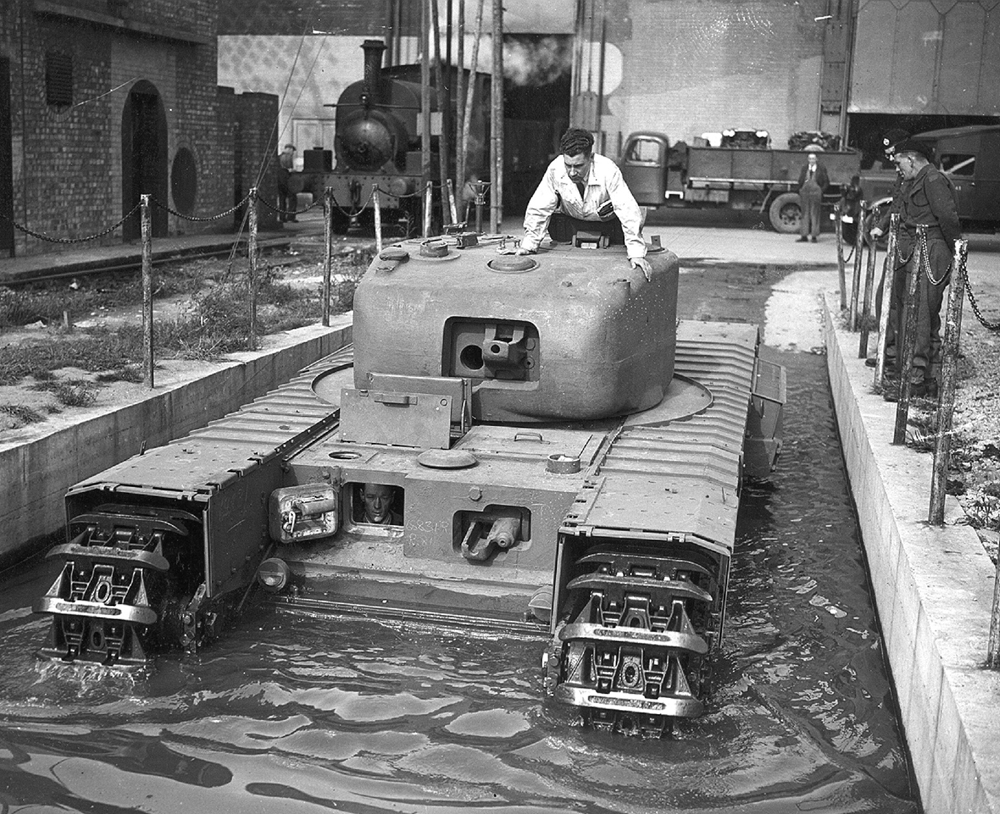
Lacking its 6-pounder gun, this Churchill IV is being put through a submersion test–making the driver look extremely nervous. (Warehouse Collection)
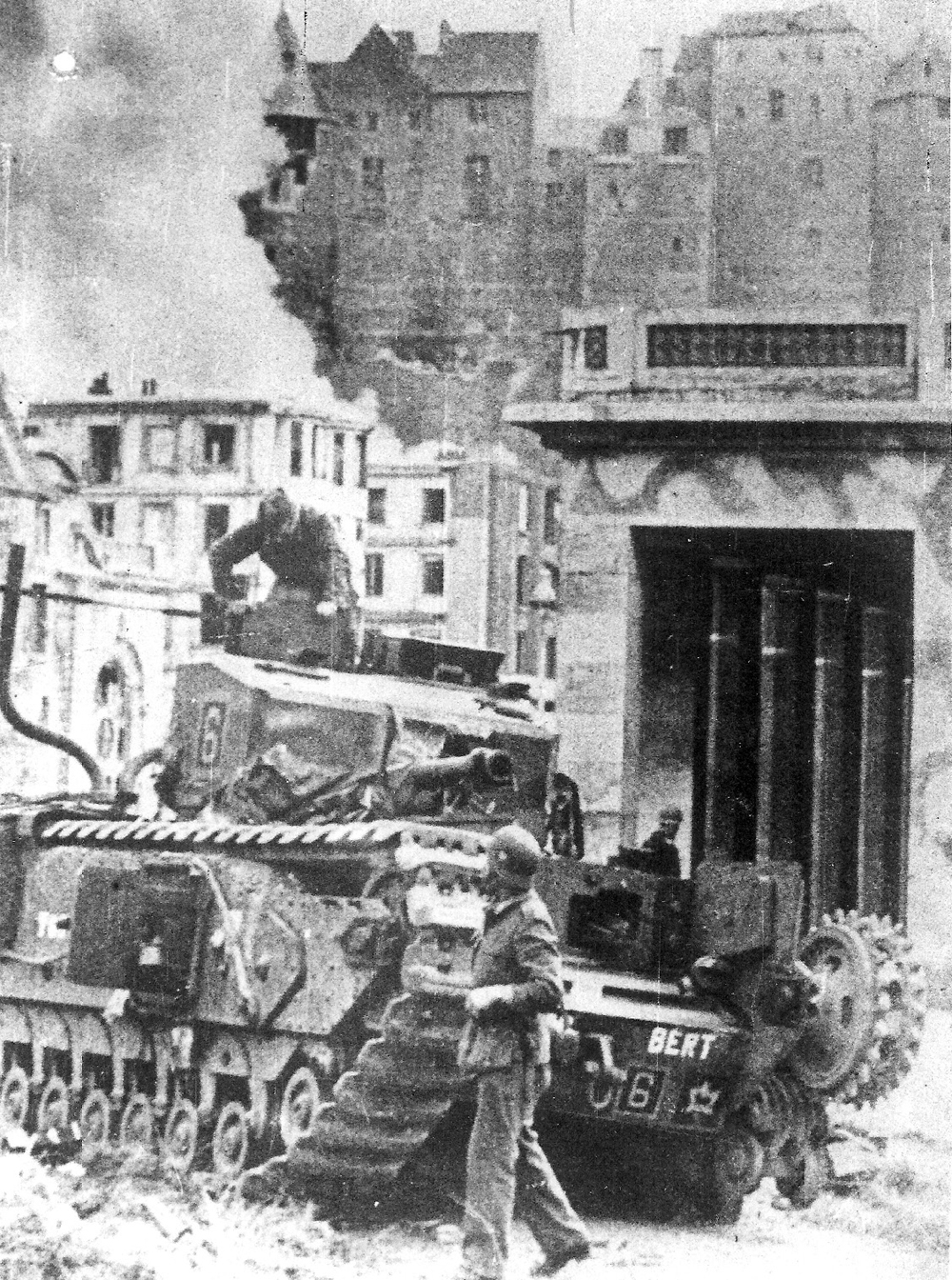
Early Churchill III, battle-damaged and being inspected by Wehrmacht troops. Note how the left-hand track is completely missing. (Warehouse Collection)
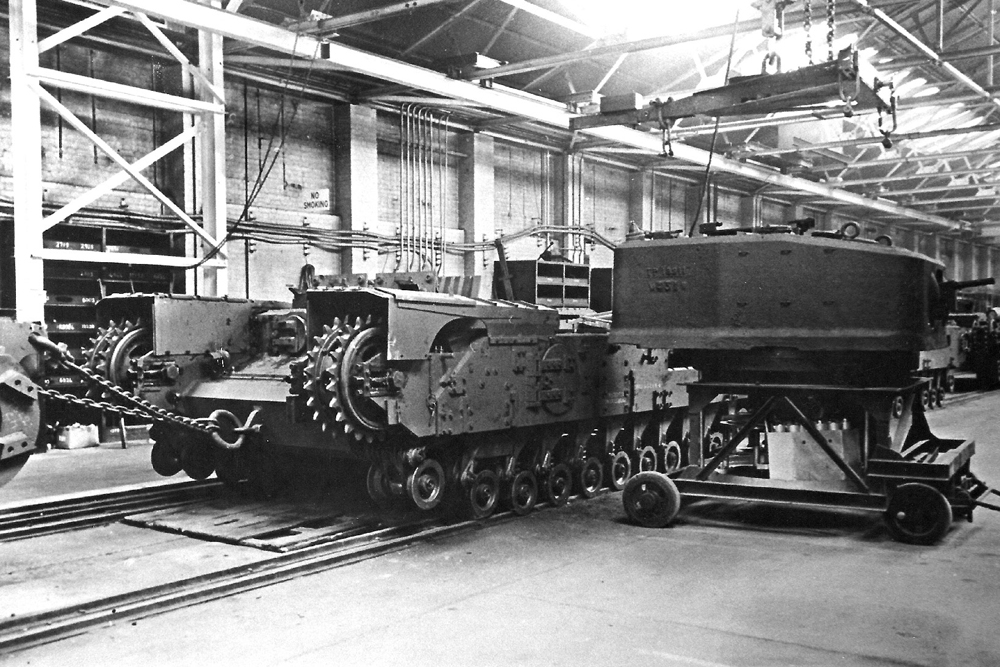
Churchill VII (A22F) photographed during production at Luton; the turret is about to be united with the hull. (Warehouse Collection)

The proposed A28 infantry tank would have been constructed from parts of the A27M Cromwell. The project was initiated by Rolls-Royce, but was abandoned in December 1941. (Warehouse Collection)

Initiated in 1943 by Vickers-Armstrongs as a way of producing a more capable version of the Valentine, the design work for the A38 Valiant was carried out by the Birmingham Railway Carriage and Wagon Company, and the prototypes were constructed by Ruston and Hornsby. (Warehouse Collection)

The Black Prince was effectively an upgraded Churchill armed with the 17-pounder (76.2mm) gun. It was only ever considered to be an interim project whilst development of the A41 Centurion was completed and the contract was cancelled in May 1945 when the war in Europe ended. (Warehouse Collection)

Seen here with the turret traversed to the rear, the A43 Black Prince shows the modified Churchill coil-spring suspension which was improved to support the increased weight. (Warehouse Collection)

With the hull widened and lengthened, putting the weight up to some 50 tons, the Black Prince–sometimes dubbed the ‘Super Churchill’–rode on wider 24in tracks. (Warehouse Collection)