

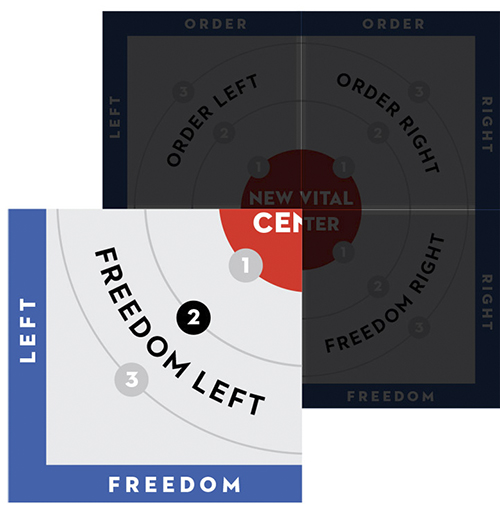
HAVING MADE THE CASE that we have lost a vital center, a shared understanding of the public philosophy, we now move to the largest section of the book and explain how the loss of the vital center engendered polarization, as all four quadrants distance themselves from the center and at the same time are pulled away by the ruling elite. Only when we understand this polarization and the ideas, forces, and people behind it, will we be ready to discover a new vital center. As we look at the polarized positions—the 2 and 3 positions of each quadrant—three things must be kept in mind.
First, in order to understand each polarized position, we need to understand its narrative. In his groundbreaking book Moral Believing Animals, Christian Smith persuasively argues that all worldviews have a narrative; they tell a story.1 And all narratives have in common the components of a good story, that is, a beginning (“Once upon a time”), a middle (“how we fell from the golden age”), and an end (“a plan for recovery”).
Along with this basic narrative structure, Smith argues that narratives stress the existence of enemies, that is, the person or group that causes the loss of the golden era and the person or group that impedes recovery, which more often than not is the same person or group. The narrative of loss and recovery not only helps identify enemies, but it also helps identify natural allies, people who share the declension narrative and the desire for a new golden era, who have enemies in common and can work together. Behind every position, every political point of view, is a narrative, a story, that has shaped each group.
Furthermore, I realize that if we are going to understand how we lost our public philosophy, how our public life has become mired in polarization, tribalism, and rage, we have to first understand the narratives behind each of the four quadrants. Could it be that part of our incivility, part of our difficulty in having conversations that don’t descend into acrimony, is that we don’t understand the deep stories animating those we disagree with? Simply trying to win arguments, using facts and policy positions, doesn’t get to the root of the matter. Until we understand the narratives that shape each tribe, how these narratives shape our views on politics and the emotional connection we have to them, we won’t be able to have civil conversations that don’t engender name-calling, distrust, and hurt feelings.
Second, as we look at each polarized position, I will attempt to be as fair as I can. Since it is so hard to talk about politics without our brains immediately reacting in tribal defensiveness, if I want each side to take self-examination seriously, then the best chance I have is if voices on each side provide the necessary critique. So only the Right will self-critique the Right; and only the Left will self-critique the Left. As the reader will notice later, the voices that are providing the critique, by and large, are coming from the new vital center (the 1 positions on the graph). Some of these thinkers we will return to in part three.
I realize by laying out four extreme quadrants I may be accused of creating a “moral equivalency.” Those on the right will contend that the Far Left is the biggest challenge to democracy and that extremism on the right is small in comparison. Those on the left will contend that the Far Right poses the greatest challenge, and that comparing extremism on the left to the Far Right is a “false moral equivalency.” Since at present we don’t have an accurate number of people in either the Far Left or Far Right we can’t answer the “moral equivalency” argument.
The bottom line is that there exist people and thinkers on both extremes, and thus it is worth discussing them and seeing that the extremes are always a threat to our constitutional republic. And extremism can wax and wane; sometimes it exists more on the right and sometimes on the left. What matters is having the framework to spot it, reject it, and champion a new vital center, one built on constitutional republicanism.
Having said all this, these critiques may hit too close to home for some of my readers. And I realize by starting with the left side of the quadrant graph, I may lose progressives, particularly progressive evangelicals. Thus, my suggestion is that if you identify as a progressive evangelical, you might begin with the chapters on freedom right and order right (chapters seven through ten), and then return to chapters three through six.
Finally, as the forces of polarization attack the vital center, we will see that there is a symbiotic relationship between the polarized positions on the left and the right. Writing in National Affairs in 2018, Jason Willick argues that both sides in our politically polarized environment tend to gravitate toward illiberal solutions and are willing to side-step long held democratic and constitutional practices to achieve their goals.2 This is true of the Right and the Left; both sides flirt with and in some cases embrace illiberal solutions. Relying on a thinker named Peter Viereck, Willick points out that by themselves none of the polarized positions are strong enough to threaten our democratic republic, to threaten our democracy. But, and here he is quoting Viereck, “Freedom is destroyed when both [the Left and the Right] attack at the same time.” According to Viereck, the system is threatened when both sides produce a “mutually reinforcing radicalism that amplify one another. . . . The backing of one such extreme only nourishes the growth of the other extreme,” he wrote.
What happens, as both sides attack the other side, is that it “gradually corrodes the legitimacy of the existing regime and opens the door to a genuine authoritarianism somewhere down the line.” Here is how it happens: “Between a far right that denigrates Western values of pluralism and equality before the law,” argues Viereck, “and a far left that denounces Western civilization as a white-supremacist construction, between multicultural identitarians and white identitarians, between thought controllers of various stripes, the space for rooted liberalism is shrinking.” And it is shrinking because voices on the right and the left, some that contain helpful critiques of our system, when combined, “tag team” to bring down our system and close off what Viereck called “rooted liberalism” or what we have been calling a new vital center. To understand how this tag team works and how it is exploited, we need to understand the polarized positions on the quadrant system.
One last comment. As I lay out each quadrant and the different positions in each, it is important to note that I am not a neutral observer. My task in this book is to explain how we lost the vital center, how the cold civil war has been stoked, and, persuasively I hope, to show how we can move beyond it to a new vital center. So there is a negative project that needs to happen before we get to the positive project of renewal. But clearing away much of the polarized ground will make it easier to plant the seeds of the new vital center, which will produce a harvest of constitutional republicanism. But before we lay out the new vital center, which our country so desperately needs, we must first clear away the polarization. And it is to that clearing that we now turn.
3
NOTHING DEMONSTRATES BETTER the breakdown of the vital center and centrifugal polarization than the fight over our constitution, particularly its justification and interpretation. What grounds it and who decides its meaning are both contested questions. And nothing gets to the heart of this contest better than the confirmation hearings for Amy Coney Barrett.
During the Seventh Circuit confirmation hearing in September 2017, Senator Dianne Feinstein made headlines when she challenged Barrett’s strong Catholic faith, saying “the dogma lives loudly within you, and that’s a concern.” Feinstein feared that Barrett would mingle law and faith, allowing her piety to compromise her legal decisions. Critics jumped on Feinstein, accusing her of imposing a “religious test.”1 Others said it was fair game. Three years later, when Barrett was nominated to the Supreme Court, Feinstein and the other senators steered clear of questions of faith.
However the media wasn’t so reticent, painting her faith as scary, raising questions about her family’s involvement in People of Praise, a community within the Catholic Church, and erroneously claiming it was the inspiration for Margaret Atwood’s dystopian novel The Handmaid’s Tale.2 If Barrett is confirmed, one critic implied, we should be worried about her imposing this dystopian vision on America, a vision where abortion is illegal, women are subservient to men, and a new theocracy is imposed.3 On the other side of the political aisle, Republican senators defended her qualifications, pointed to her stellar professional résumé, and celebrated her accomplishments as a mother of six, but strenuously avoided questions of her faith, not wanting to stir the pot.
But the questions remained. What was it about her faith that worried the Left so much? It wasn’t just her Catholicism. After all, many Democrats in Congress are Catholic, and for them it doesn’t pose any conflict with progressive policies. And it couldn’t really be the People of Praise, which after a decade of involvement, hadn’t turned Barrett into a mindless slave. By all accounts she had a lovely marriage and a healthy family. And it couldn’t have been her commitment to originalism because, even as Justice Elena Kagan said, “We are all originalists now,” endlessly discussing “dubious claims about events centuries in the past,” thus giving the impression that it is a wax nose, a technique of neutrality, which could be pushed in either direction.4 No, what worried Feinstein and the media critics was something else. Something, in their minds, far more sinister. But what was it?
In a lengthy essay in the center-left New Republic, Peter Hammond Schwartz sheds light on what bothers Democrats so much about Barrett.5 It’s not her originalism, which he says is nothing more than a tool, “a vehicle for other legal principles,” for embedding a “deeper structure.” But it is this deeper structure which is the real concern. And at the heart of this deeper structure is something called natural law, a system of moral and ethical thinking tied to religion.
In his “Originalism Is Dead. Long Live Catholic Natural Law,” Schwartz argues that “Barrett represents more than a simple link” to other originalists, like her mentor Justice Scalia, but in fact “represents the alarming future of the conservative legal project,” one that sees the Constitution and the entire American system grounded upon natural law.6 It is this grounding so closely tied to a religious view of the world that they fear. While natural law has been with us for centuries, in the past, says Schwartz, it was mostly agnostic, often acting as a nonreligious guide on issues like civil rights, social justice, and universal human rights.7 But not anymore.
As Schwartz argues, “Catholic theorizing about natural law swung hard right in the 1960s, assuming a new and more sinister synthesis in the new natural law, or NNL, that emerged from the religious and political turmoil of the 1960s.”8 It was then that conservative Catholics transformed natural law “into a rigid, reactionary, punitive, and self-righteous propaganda platform for the most conservative elements of the Catholic Church and its intellectual apologists.”9 Built on this new natural-law foundation, conservatives (including many evangelicals who followed their lead and leaned on their scholarship), have “constructed an intellectual scaffolding that has inspired powerful critiques of liberalism and modernity.”10
It is this “intellectual scaffolding,” this grounding, this destruction of a “neutral space” in the civic realm, that seems to terrify those on the left, including Schwartz. And it terrifies him because it can only lead to one thing: theocracy. For Schwartz, this NNL “would obliterate church-state barriers and superimpose a terrestrial layer of morality and control, under the auspices of natural law, to root out deviance and knit together the republic.”11 What we are witnessing, he argues, is “a new post-liberal vision of what American society would look like stripped of its current impediments and illuminated by . . . natural law.”12 In sum, then, in his fear that the naked public square will be clothed and that all civil and religious liberty will be wiped out, Schwartz drives home the point that to cling to NNL—a view that sees all law, but particularly our constitution, grounded in a transcendent source—can only lead to one place: a second inquisition; it couldn’t but lead to this.
According to Schwartz, NNL is authoritarian, illiberal. And in order to make this point more dramatic, either on purpose or to cause confusion, he downplays, buries in long lists, or simply ignores the natural law thinkers who defend the Constitution and Bill of Rights. Instead, he lumps them all together in the most extreme, most illiberal of positions, downplaying the nuance of thinking that exists in natural-law circles.13 Doing so helps build his case that NNL threatens or may even have destroyed the golden age of liberalism, and in the process it is wiping out decades of progress in civil liberties and the welfare state.
Put simply, in uncovering the real reason for the opposition to Amy Coney Barrett, Schwartz not only provides a helpful summary of why liberals fear her view on natural law but also constructs a window into the freedom left 2 position in general, providing a number of the telltale signs that we will explore in this chapter. In rejecting all proponents of the NNL (even those who champion constitutionalism), he rejects, whether knowingly or not, the original grounding of the founders and thus contributes to the loss of the vital center. This opens the door to the more radical elements of postmodernism. But before we get there we need to step back and understand why the Left reacts so strongly to the new natural law, and to do this we need to go deeper into the genealogy of the progressive Left.
ONCE UPON A TIME: THE GOLDEN AGE OF FREEDOM LEFT 2
The story begins, according to Harvard’s Michael Sandel, around 1900, when the Left felt that America, for all its economic achievements, had fallen short in reaching its promises.14 Throughout the Industrial Revolution, while America was experiencing tremendous economic prosperity, a significant portion of the population was being left behind. Certain historians, professors, and politicians were startled by so much economic and racial injustice all around. And they wondered why after 150 years America still hadn’t fulfilled her promise that “all men are created equal.” As these progressive elites looked for something to blame for the injustice, they came to the conclusion that what had gone wrong was not the promise of the Declaration but the mechanism of the Constitution, setting their sights on the separation of powers and checks and balances, which put too many roadblocks in the way of achieving progressive ends.
Initially, they tried to get rid of the Constitution and start anew, but when they realized that wasn’t possible (Americans love and revere their Constitution), they decided the best they could do was to change what it means, to redefine it, so that it lined up better with progressive ends, that is, the economic equality of all people.
So they set to out to redefine it, knowing that once they redefined the Constitution, they could then transform economics and politics. In the early twentieth century, progressives like John Dewey began teaching that if our society was going to become radically equal, human nature had to be changed. But this posed a problem, for human nature was grounded on an outside authority, whether that authority went by the name nature, reason, or God. So, the first step for Dewey was to reject this grounding and make the case that rights are purely secular, formed through “social conditions.” “They [the founders] put forward their ideas,” wrote Dewey, “as immutable truths good at all times and places; they had no idea of historic relativity.”15
Ultimately Dewey, inspired by Hegel and German philosophy, saw the repudiation of natural right and natural law (and God) as necessary to achieve his vision of the progressive utopia. Once he got rid of the founders’ grounding, the Constitution became flexible, and it could easily be manipulated. And over the first half of the twentieth century that is what progressives did. Judges and legislatures began reinterpreting the Constitution in a completely different way, one guided by a radical vision of justice. Equality was no longer about equal treatment before the law. This had produced too much inequality. And it meant that people started at completely different places in life, so some had more opportunity than others. So now equality would mean equal outcomes and would be achieved through the government leveling the playing field.
As President Lyndon Johnson said in 1965, “We seek . . . not just equality as a right and a theory but equality as a fact and equality as a result.”16 And this meant massive redistribution from the “haves” to the “have-nots.” In order to achieve equality of results, rights had to be redefined as economic rights, the rights to the basic necessities of life: a livable wage, housing, education, medical care, food, and so on.
Following Dewey, Franklin Roosevelt took the next big step, arguing in his economic bill of rights that “certain conditions were prerequisites for the freedom of each person to choose his ends for himself.”17 And for these economic rights to become a reality, a huge state apparatus would need to be built because unless people have these rights met, they are not truly free and certainly not equal. Of course, in order to achieve this massive redistribution, what became known as the welfare state, the government’s administrative function would balloon over time into a massive administrative state, staffed by experts, our version of Soviet apparatchiks.
But, according to Sandel, bypassing the plain words of the Constitution and thus transforming legal rights into economic rights would not have been possible without another significant change: a cultural transformation that went from trusting religion to define the good to allowing the state to protect rights based on neutral conception of the good. Progressives realized that if they wanted to change the historic definition of rights from equality of opportunity to equality of outcomes, the very definition of good had to be changed. And since it was religion, in large measure, that gave shape to the idea of the good, it had to be kept out of the public realm.
Starting in the 1940s, according to Sandel, progressives stopped talking about the good, because it had been tied historically to Christianity, and instead started stressing the ideas of rights and choice. Americans, they believed, must be free to choose their own ends. “Government [through the support of religion] could not impose on its citizens any particular conception of the good life.”18 In a dispute over the meaning of patriotism in a 1940 case, the court concluded, “no official, high or petty, can prescribe what shall be orthodox in politics, nationalism, religion, or other matters of opinion.”19
For Sandel this was a sea change. It meant there was no longer a grounding, a standard, to judge politics or the good; only individual choice mattered. The individual self was supreme. “Patriotism would now be a matter of choice,” concludes Sandel, “not of inculcation, a voluntary act by free and independent selves.”20 But for this to happen, religion had to be downgraded.
Seven years later, in 1947, came an even more important watershed moment; the court ruled for the first time that the government had to remain neutral toward religion, never endorsing one brand over another. The individual’s choice was now the sole authority. “Religious beliefs worthy of respect are the product of free and voluntary choice by the faithful.”21 For Sandel, if individual choice is paramount, the state can have no tutelary role in cultivating virtue. The priority of individual rights took precedence over the good of society. And this meant that the law had to remain neutral, not taking sides. During this time Thomas Jefferson’s “wall” came to mean an extremely high wall, and the complete “bracketing out” (Sandel’s phrase) of religion from public life, keeping religion away from politics altogether.
By the end of the twentieth century, then, the progressive transformation of economics, politics, and culture was complete. They had achieved their golden era. To pull it off, the new progressive Left (freedom left 2) had reinterpreted the founding away from a grounding in natural rights (and natural law) to that of secular individual rights, a grounding based solely on a voluntary conception of the self. No longer was there a conception of the good based on natural law or a religious conception of life or an outside lawgiver to provide guidance on how to live our lives. Now, everything was reduced to individual choice. And for the government not to infringe on individual choice, the government was seen to be secular or neutral. This alone would help the nation reach its true goal, to live up to its original promise. During the progressive era, America was finally living up to its promise, the promise of a democracy for everyone.22 Even if the nation had not completely reached its golden era, for there was still much to accomplish, the “arc of justice” was bending in the right direction.
GODLESS CONSTITUTION
When trying to spot someone in the freedom left 2 position, one of the telltale signs is how they view the Constitution and its grounding. If it is a purely secular grounding, devoid of natural law and natural rights, untethered from religious notions of the good, they are most likely in the freedom left 2 position. They believe in a “godless constitution,” a phrase coined by professors Isaac Kramnick and R. Laurence Moore in their book The Godless Constitution: A Moral Defense of the Secular State.23
In the main, the authors describe a similar progressive genealogy as Sandel but with one twist. Instead of saying that the progressives changed the plain meaning of the Constitution, Kramnick and Moore contend that the early progressives believed strongly that they were simply defending the original meaning of the Constitution, one that had been clouded over, lost in the first 150 years of the nation. For Kramnick and Moore, progressives contended that the founders based the Constitution not on a natural-rights grounding, as erroneously thought, but on “the autonomous independent individual as the center of the social universe, for whom social and political institutions are self-willed constructs whose purpose and function are to secure the rights and interest of self-seeking individuals.” Kramnick and Moore contend that the founders viewed the government’s role as solely negative—“It keeps the peace and order in a voluntaristic, individualistic society” and never seeks “to promote the good of the moral life.”
In this view the founders rejected that government should “nurture and educate its subjects in the way of virtue, or preside over the betterment or improvement of men and society,” or “defend and propagate moral and religious truths.” The founders, argue Kramnick and Moore, pushed “morality and religion outside the public realm to a private realm of individual preference.”24
Religious freedom, then, could only mean one thing: keeping religious influence from the state and its laws. For Kramnick and Moore, Thomas Jefferson wanted a high and impenetrable wall, a godless constitution wherein the individual decides what is good and has the freedom to choose it. Only then will individuals achieve happiness, and only then will our nation maintain the American Dream, a golden era of liberalism rooted in individual reason and a rational state. It has always been thus, and it needs to remain thus.
THE GODLESS CONSTITUTION UNDER SIEGE
But just when the godless-constitution view had reached its zenith, around 1980, the religious Right began to spoil it. Thinkers like Richard John Neuhaus challenged this view of neutrality, pointing out its harmful effects on American culture. In his bestselling book, The Naked Public Square, Neuhaus sounded the alarm, warning the nation that a naked square, a public square devoid of religion, was dangerous because once the benefits of religion were pushed to the side, the square wouldn’t remain naked but would be flooded with secularism; it would end up at the cultural bottom.25 And that is what was happening, said Neuhaus. Ethically and morally, America was rotting from within.
But if this weren’t bad enough, the naked public square was only transitional, for no public square can remain neutral. Eventually it would be highjacked by forces more totalitarian than even the most extreme religious expression. Throughout his book Neuhaus counters the pernicious doctrines of the progressive Left, contending that a secular America (and godless constitution) was revisionist history, a myth concocted by the Far Left to push Christianity into the private realm. In fact, to Neuhaus and those of the Christian Right, both Catholic and Protestant, America was founded on Christian principles.
But it was this contention, that America was a Christian nation, that particularly enraged those of freedom left 2. For them the idea that America is a Christian nation is a lie and destroys what progressives have achieved. Because the Christian Right “refuses to recognize secularism as a fundamental principle of American government,” they have become the sworn enemy of those in the godless-constitution camp.26
PROGRESSIVE EVANGELICALS JOIN THE CAUSE
After thirty years of the religious Right turning back the clock, progressive secularists weren’t the only ones who were angry. Surprisingly, they had unlikely allies—progressive evangelicals. Many of these progressive evangelicals, having grown up in fundamentalist and conservative evangelical churches, brought firsthand grievances to the debate.
A good example is Dartmouth professor Randall Balmer and his book, Thy Kingdom Come: How the Religious Right Distorts the Faith and Threatens America.27 “I write as a jilted lover,” shares Balmer, and “the evangelical faith that nurtured me as a child and sustains me as an adult has been highjacked by right-wing zealots . . . who have failed to appreciate the genius of the First Amendment.”28 Moreover, “the effect of this right-wing takeover has been the poisoning of public discourse and a distortion of the faith.”29 Not only is his book a personal lament that the Christian Right now defines what it means to be an evangelical, but he is also angry that fellow Baptists, heirs of Roger Williams, who were once the strongest proponents of the First Amendment and the separation of church and state, have traded this once proud heritage for the lure of political power.
In his chapter “Where Have All the Baptists Gone?” he traces the history of Roger Williams and other well-known Baptist preachers who he says influenced Thomas Jefferson and James Madison in the formation of the First Amendment and the separation of church and state.30 Treading on ground similar to Kramnick and Moore, Balmer interprets the First Amendment as a secular document that keeps the state and the church separate for the good of both, protecting religious liberty and prohibiting the establishment of any religion.
Holding this position for almost two hundred years, in the late 1970s Baptists did an about-face. “Lured by the prospect of political power during Reagan years, the leaders of the Southern Baptist Convention steadily whittled away at their Baptist heritage and moved the denomination into the orbit of the Religious Right.”31 No longer was the goal to stay away from politics; these new Baptist leaders now sought “to impose their religious views on all Americans, thereby violating not only the First Amendment but the very principles that define their own religious heritage.”32 This pernicious vision threatens America.
But if Balmer seems angry at fellow Baptists, he is furious at another group of right-wing zealots—theonomists. Describing theonomy as “a social ethic . . . that advocates restructuring civil society according to the laws contained in the Hebrew Bible,”33 he says this group of religious-right leaders (infatuated by the founder of theonomy, Rousas John Rushdoony) don’t just “want to reconfigure the line of separation between church and state. They want to obliterate it altogether.”34 They want a theocracy. But to accomplish this the religious Right must “dismantle the First Amendment” and impose “its own theocratic vision” on America.35 Not only does this scare Balmer, but it angers him. He calls for “true Baptists” to stand up and protect the First Amendment, staying out of politics for its own good and the good of democratic pluralism.36
Thus, in the end it isn’t progressives who are altering America, it is the religious Right, the Christian nationalists. Progressives vehemently disagree with the Christian Right that the United States needs to return to its Christian origins.
If the United States was set up as a Christian nation, then critics of Christianity can be painted as radicals who want to change the basic nature of our society. But if it was set up under the umbrella of religious freedom, then it is the critics of Christianity who are fighting to preserve the basic nature of American Society.37
If this view is true, then “it would be cultural conservative activists who would be the radicals attempting to alter the basic nature of American Society.”38 And as social scientists, Yancey and Williamson discovered progressives claiming that “the Christian right is altering the basic nature of our society with their assertions about the primacy of Christianity.”39
So, if the Left is going to return to the golden era, it will need to root out religious conservatives, meaning any conservative who believes that our founding was grounded on natural law or Christian principles or that Christianity has a role in shaping our public life. Those who hold these views are extremists, Christian nationalists, and dangerous to democracy.
So there the freedom left 2 narrative is clearly laid out.40 All the telltale signs are present, making it an easy mark. A progressive golden age, a downfall caused by the religious Right, a recovery through the reinstatement of the high wall of separation between church and state—all part of the freedom left 2 narrative. But are they right?
WARNINGS GO UNHEEDED
Reading Balmer and other progressives leaves no question as to who their enemy is and what they fear. And to defeat this enemy they can’t brook even the slightest intrusion of religion in the public square because just giving it the slightest foothold might open the door to theocracy.
This fear is at the heart of their opposition to Justice Barrett—that isn’t hard to see. But what is hard to fathom is the marriage between secular rationalists and progressive evangelicals. In their desire to keep religion out of the public square, progressive evangelicals have formed an alliance with the most secular of thinkers, progressives who have redefined the very nature of our constitution, the self, and the good and possess a strong antipathy to Christianity. (These progressive secular rationalists in the freedom left 2 position would include atheists like Sam Harris and Christopher Hitchens.) And yet they seem unaware of the downside, the dangers posed to formal religion and the nation.
Moreover, what I find even more interesting in the freedom left 2 position, especially among progressive evangelicals, is their unwillingness to admit any weakness in their position, even after it has been clearly spelled out by critics, many on their own side. They are so sure of their enemies, religious conservatives of any kind, and so confident in their position, a godless view of the Constitution, that they seem blind to the problems that this position entails. Let me explain.
I first came across liberal self-criticism at Georgetown in the early 1990s when I read an essay, “The Search for a Defensible Good: The Emerging Dilemma of Liberalism,” penned by Professor Bruce Douglas, a Democrat.41 Douglass acknowledges that the liberal commitment to prioritizing individual moral autonomy over the good, promoting a view of neutrality that allows individuals to decide what is ultimately good, is problematic—it is the Achilles’ heel of the progressive narrative. Douglas argues that there is no such thing as a neutral state, for even a “secular” state has a conception of what the good is. By giving priority to liberal individual choice, progressives are ruling other views of the good as out of bounds. “The liberal good turns out, above all, to be a certain kind of freedom” that itself rests on a certain teleology or the best end of a human life. And once this view of freedom is adopted, it turns out, ironically, that liberalism “is in actuality not nearly so tolerant or neutral as it first appears . . . certain goods—and ways of life—are promoted at the expense of others.”42
At the time I was Douglas’s student I didn’t realize that he, standing in the liberal tradition, had great reservations about the “one-sided priority attached to the good of freedom.” This priority rules out different and deeper conceptions of the good, other claims from teleology (what the best human being and society should look like), and claims that the liberal project can’t sustain itself without a deeper public philosophy in which to ground itself. Without this public philosophy, liberalism is “incompletely grounded,” and lacks “any sort of deeper support.”43
And this incomplete grounding has led to dire results, which progressive evangelicals seem to ignore. In fact, says Sandel in Democracy’s Discontent, our present unhappiness is not because the religious Right has infringed on freedom of speech. Rather it is due to a huge shift in classical liberalism carried out by the progressive movement, a shift from an old version of liberalism based on a civic republican view of self-democratic rule, to a new vision of America, one that fundamentally reshaped how we looked at the individual, the good, and the purpose or end of government.44 Sandel believes that historic liberalism’s “core thesis” has now become the view that “a just society seeks not to promote any particular ends, but enables its citizens to pursue their own ends, consistent with a similar liberty for all.”45 Government must then remain neutral, holding no conception of the good. No longer is government guided by a conception of the general welfare, the greatest happiness or cultivating virtue, but rather its standard is the “concept of right, a moral category prior to the good, and independent of it.”46 While the godless-constitution view sees this as a good thing, Sandel sees it as the degradation of a noble tradition.
For Sandel, this prioritizing the right over the good for the individual has meant one thing: the “unencumbered self.” Rejecting an older conception of the self that finds its identity in God’s law, the family, and the church, city, and town, the unencumbered self is a self “prior to and independent of purposes and ends.”47 “For the unencumbered self, what matters above all, what is most essential to our personhood, are not the ends we choose but our capacity to choose them.”48
THE LONELY SELF
The self then is prior to the good. The self must determine its own identity apart from any restraint placed on it from the outside, whether God, the family, or the community. No longer is the individual tied down to obligations to others; it can now experience total liberation. We are now free to choose our ends, our purposes, totally unencumbered by any outside authority. And for Sandel, to guarantee the right over the good, the self over the telos, a certain kind of government must be set up, and certain changes in our Constitution and laws need to be enacted to support the unencumbered self—and this new government is the “Procedural Republic” (another memorable phrase),49 a state that remains neutral, brackets out religion, doesn’t propose or legislate any particular conception of the good or purpose of life, allowing the liberated individual to choose for themselves, free from the constraints that traditionally shaped the individual. How has this worked out? Not well.
As Sandel tells the story, the unencumbered self, now flush with its new freedom and rights, initially likes the new liberation but soon realizes it is all alone, having broken away from the family, the town, and the church.50 Isolated, it turns to the government for support, both to protect its rights and also to find financial support when difficult times arrive. Attaching itself to the state, the isolated individual is willing to give up some of its freedom for security. And the administrative state is all too happy to come to the rescue, the heroic protector of individual rights, engendering a massive bureaucracy to protect and support the unencumbered individual.
But where does this leave the individual? The unencumbered self, says Sandel, is left “lurching . . . between detachment on the one hand, entanglement on the other.”51 So-called liberation has turned into slavery. The individual is now less free than ever before—on the one hand it is a slave to loneliness, detachment, and isolation, and on the other it is encumbered by an expansive government that now controls its life. “In our public life, we are more entangled, but less attached, than ever before.”52
THE LOSS OF FREEDOM AND THE GROWTH OF GOVERNMENT
This is the modern dilemma. The “freer” the individual becomes, the bigger the government becomes. The more elite experts become empowered, the less free becomes the individual. And here we see how we have moved from the unencumbered self to the “rights talk” at the heart of our society.53 The more individuals fight for their rights, the more government has to get involved. In fact, the more the government grows, the more it must keep growing, creating more and more dependence. It creates an ever-increasing dependence by destroying the mediating structures that once cared for the individual. Once these structures are gone, the individual has no choice but to turn to the state. Sandel observes that as individual rights have morphed from free-speech rights and the right to choose one’s best life to economic rights—the right to some of the spoils of capitalism, the right to a certain level of economic security—the larger the government grows to protect these new rights.
Ironically, the more economic and political rights the unencumbered self gains, the more detached, isolated, and lonely that self becomes. So, says Sandel, for solidarity and protection the isolated self joins with other isolated individuals to form a group, and together they appeal for more rights for their group. Thus the concept of group rights is born.54 Now, instead of having individuals fighting each other, we have groups fighting each other for the spoils of capitalism. And these group rights, often called identity politics, whether on the left or the right, have fueled our present polarization.
PROGRESSIVE EVANGELICALS IGNORE THE WARNING SIGNS
But Douglas and Sandel’s critique has gone unheeded. In fact, progressive evangelicals like Balmer, unwilling to admit that it has led to the unencumbered self, the procedural republic, the growth of the administrative state ruled by elites, and the rise of the cancel culture, has confidently doubled down on this view of the godless constitution. In his 2021 book, Solemn Reverence: The Separation of Church and State in American life, Balmer makes the case that Christian nationalism, fueled by the erroneous view of a Christian founding, continues to be the greatest threat to democracy in America.55 Christian nationalists have wrecked religious freedom, attacking the First Amendment, that wonderful marriage between rationalists and evangelicals, which has “bequeathed to the United States a vibrant and salubrious culture unmatched anywhere in the world.”56 And we got this culture because of the godless constitution.
But in placing all the blame on religious conservatives, Balmer is not only oblivious to the warnings of people like Sandel, and what this marriage really has given us, but he is also unaware that the naked square, far from remaining free, has been filled with a new established “religion,” that of woke progressivism. Far from admitting this has taken place, an obvious fact for anyone with eyes to see, Balmer instead continues to focus on the problem of the theocratic Right.57 In doubling down on his solution, the godless constitution, he spends most of his book showing how key founders like Jefferson, Madison, and Roger Williams set up a “high wall” of separation, conveniently showing how they line up with his view. The problem is, however, he is perpetuating a dangerous myth—our nation’s secular founding.58
Canadian philosopher Charles Taylor, a thinker well respected by evangelicals on the left and the right, a man who converted to Christianity late in life, contends that at its most fundamental level the godless-constitution thinkers misinterpret the First Amendment, reading back into it—in an anachronistic way—a view that the founding fathers would not have recognized, even Thomas Jefferson and James Madison.59 Jefferson, Madison, and Baptist preacher Isaac Backus wanted to prevent the federal government from aligning with one denomination or one confession, and thus they posited a view of the First Amendment that opposed confessionalism. “The Separation of church and state did not have to mean bracketing out God or religion,” claims Taylor.60 Originally the goal was just as much about protecting Christianity from the state.
In fact, from its inception America has always seen a close connection between the “spirit of liberty and the spirit of religion,” to quote Tocqueville. But today this view has changed—“many people see it as a bracketing today.”61 But this is an incorrect reading of the First Amendment, says Taylor, that has lodged in the minds of many people today and had overtaken the Supreme Court in the 1950s. The court had taken deconfessionalization and turned it into privatization, “a rejection of religion as such from the public sphere.” What was adopted for the purpose of disestablishment has been “subsumed as a stage in privatization” and this is “seriously to distort it.”62
Agreeing with Sandel that this secular view of the First Amendment comports well with the unencumbered self and the neutral procedural-republic state, Taylor concludes that “civic freedom cannot accommodate this bleeding of the public domain of all significance” because the public realm “requires strongly held common values,” a strong notion of what the good is.63 So not only is the loss of these common values problematic, Taylor argues that this absence of values leaves a vacuum for “a minority of determined atheists who try to construct an entire alternative outlook.”64 And it is the construction of this “entire alternative outlook” that Balmer and other progressive evangelicals either don’t see or are unwilling to recognize, fearing it would play into the hands of Christian nationalism. So they take a see-no-evil view of the Far Left.
But the consequences of this secular myth have been catastrophic. The procedural republic has led to the hollowing out of individuals, growing the power of the state, and enshrining a new ruling class. For some reason, progressive evangelicals have gone along with this and joined in the attack with progressive secularists on religious conservatives. In fact, during Barrett’s confirmation hearing, Randall Balmer not only didn’t defend a fellow believer, he reminded Justice Barrett in slightly condescending terms that “one of the crowing achievements of the founders, as embedded in the Constitution, was the rejection of majoritarianism, the notion that the majority dictates the rights and the behavior of everyone else.”65 Clearly, he was worried that her judicial commitment to natural law might “compromise the rights of others.”
But he didn’t have to remind her of the dangers of majoritarianism or compromising the rights of others, especially since it was the Far Left that had been slandering her and her family for weeks on end. If she weren’t so gracious, a trait recognized even by those who disagree with her, she might have said to critics like Balmer, “You might want to look in a mirror yourself” or even “physician, heal thyself.” But I’m not sure it would have helped.
In the end, while progressive evangelicals continue to bang the drum against a mythic theocracy, setting up a straw man, lumping all conservatives into the most radical positions, they are unwilling to admit that their own majoritarianism has already devolved into a far more dangerous handmaid’s tale, one of woke political correctness.66 How this happened is the story of the next chapter.
IN SUM
· For those in the freedom left 2 position, America was founded on a secular, godless constitution, one that is under siege by conservative religious forces, who want to turn it into a theocracy.
· Freedom left 2 believes that the only way America can reach its true promise is to continue to bracket off religion, maintaining a government that is neutral on the question of the “good,” which allows the individual the final choice in determining the good life, questions of right and wrong, and ultimate purpose.
· While progressive evangelicals share many of the same transcendent norms as conservative believers, they too believe in the godless-constitution view, contending it is the best way to protect religious freedom. So these progressive evangelicals side with the freedom left 2 godless-constitution thinkers to fight against religious conservatives, seeing them as the greatest danger to our constitution.
· Yet we have seen many voices on the left who contend that the godless-constitution view is not the original view of our founders, that it has been smuggled in by progressives and in the process it has led to an “unencumbered” self, the growth in government, and the enslavement of individuals, who are less free, more entangled, and more lonely than ever.
· Moreover, what we have learned is that the radical push for an “open society” has not led to freedom, but to a “closed society,” and it was the godless-constitution view that was the Trojan horse, promising freedom built on a neutral procedural government, but in fact it has brought us something entirely different, the rise of the oligarchic elites and the loss of freedom.