
8

History, n. An account mostly false, of events mostly unimportant, which are brought about by rulers, mostly knaves, and soldiers, mostly fools.
—AMBROSE BIERCE, The Devil’s Dictionary
I’m late for Western Civ. A blue exam notebook lies on my desk. Everyone else is already taking the test. I open the blue book. A question about Greece swims before my eyes. “What’s wrong?” the student next to me asks. “Didn’t you study?”
The motel alarm jolted me awake. I lay staring at the digital red 4:00 winking from beside the bed, wondering where I was. Corinth. Corinth, Mississippi. Corinthian columns. Western Civ.
An all-night omelet shop cast a sallow glow across the motel parking lot. It looked like a place Edward Hopper might have gone to sketch a solitary diner. Except that the restaurant was packed. I wedged onto a stool beside a man with “Jerry” stitched on his work shirt. He drank black coffee and blew perfect smoke rings. I asked him why the place was so busy at 4 A.M.
“Busy? Shit. You should’a been here an hour ago, when the bar crowd was here.”
Bar crowd? Arriving in Corinth late the night before, I’d had trouble finding a hamburger, much less a beer. “Hard to believe, but this used to be a rowdy-ass town,” Jerry said. That was before the Baptist majority voted to go dry and close the town’s beer joints. Later, they repented and voted to permit hard liquor (which for some reason citizens judged easier to control). After several decades of losing beer revenue to nearby Tennessee, Corinthians had changed their mind again. “At the last election,” Jerry said, “we voted liquor out and beer in.” So the bars were hopping again.
Jerry, though, didn’t look like the late-night drinking type. “What brings you here?” I asked him.
“Force of habit. Ate here for ten years before punching in at the garment factory at six.” These days, Jerry raised laboratory mice instead. “Rat cage don’t open till eight,” he said. But he couldn’t break the predawn ritual. The other customers were mostly loggers, farmers and truckers. Jerry dropped his cigarette in a pile of grits. “How’s about you, stranger?”
“Just passing through.” I paused. “It’s the anniversary of the battle of Shiloh. I’m headed up there to check things out.”
“At four in the fucking a.m.?” Jerry said it so loud that everyone at the counter turned their heads.
I looked into my coffee. “The battle started at five. I’d sort of planned to be out there by then.”
Jerry shook his head. The others shrugged and returned to their eggs. “Guess you got to go the whole nine yards,” he said.
The road north from Corinth climbed through gentle hills and crossed into Tennessee. My headlights picked up the occasional logging truck and the usual snapshots of rural Southern life: a railroad crossing called Cotton Plant, a G-Whiz convenience store, a trailer labeled Worms for Sale, a small wooden church with a huge sign that blared, PRAYER IS A TRUCK HEADED FOR GOD’S WAREHOUSE.
In half an hour I sped across terrain that the rebel army spent three days slogging through in the muddy spring of 1862. Ulysses S. Grant and 40,000 Federals lay camped by the Tennessee River, near a log church called Shiloh. Grant awaited reinforcements so he could move south and attack the crucial rail junction at Corinth. But the Confederate commander, Albert Sidney Johnston, decided to strike first and dispatched his men north from Mississippi to surprise the encamped Federals. “Tonight we will water our horses in the Tennessee River!” he told his officers at dawn on the day of battle.
Instead, at midafternoon, Johnston lay dead near Shiloh’s Peach Orchard after leading a charge on his horse Fire-eater. The rebels fought on, almost pushing Grant’s men into the river. But during the night, steamboats ferried Federal reinforcements across the river; the Union army counterattacked at dawn, recapturing the ground it had lost the previous day. The Confederates straggled back through the mud to Corinth, which they abandoned seven weeks later. At Shiloh, the South lost its last best chance to halt Grant’s conquest of the western Confederacy.
In April 1862, the Shiloh church had ministered to a backwoods settlement of 150 souls who eked out a living from fruit orchards, beeswax and small plots of cotton and corn. Today, Shiloh wasn’t much more: an unincorporated crossroads with a gas station, a convenience store, and a run-down building labeled “Shiloh Souvenirs” with a window display of minié balls, rusted pocketknives, and slivers labeled “Petrified Wood. Very old.”
Spotting a sign for the battlefield, I became suddenly giddy. Like Shelby Foote, I’d always felt drawn to Shiloh, though for me the tug came from childhood fantasy rather than family ties or firsthand visits. When I’d first read about and painted the battle as a boy, Shiloh—“place of peace” in the Bible—sounded haunting and beautiful, nothing like the bluntly named Bull Run or the Germanic towns of Gettysburg and Fredericksburg. Only Antietam rolled off the tongue in as lovely a way. But Antietam lay within the same fifty-mile orbit of my boyhood home as the Virginia and Pennsylvania battlefields.
Shiloh lay a world away, in a wilderness of lazy rivers, log cabins and tersely named creeks: Dill, Owl, Snake, Lick. Deepening Shiloh’s mystique was the dearth of documentary images from the battle. Wartime photographers rarely ventured west of the Appalachians. The photographic history of the War I’d studied with my father included only one unstaged picture from Shiloh: a tantalizing shot of Union paddle wheelers docking at Pittsburg Landing, beside the battlefield. The wide, slow Tennessee snaked behind. I could almost see a log raft floating past with a boy in a straw hat and britches tossing a catfish line over the side.
Now, the real battlefield lay before me in the predawn gloom. I turned in at the park gate, switching off my headlights lest a ranger apprehend me for entering outside of official hours. Inching along in the dark, I parked near the spot on my tourist map labeled Fraley Field. It was here in J. C. Fraley’s cottonfield, at dawn on April 6th, that Northern sentries first encountered the oncoming rebel army.
Crumpled Bud Lite cans lay on the ground beside a parked car. A match flared inside. Another Civil War addict waiting for dawn? I rapped lightly on the window. The glass came down just enough for me to glimpse two startled teenagers smoking in the front seat. “Do you know how I get out to Fraley Field from here?” I asked. The driver shook his head, started the engine and sped off. Shiloh, like many other battlefields, doubled as a lovers lane after dark.
I stood in the gloom, shivering and feeling suddenly silly. My breakfast companion was right; what was I doing here at four-whatever in the fucking a.m.? If tramping through the woods before dawn was so damned transcendent, why hadn’t Shelby Foote accepted my invitation to come along?
Twigs crunched and a voice called out from the dark. “Fraley Field’s over here, I think.” A figure approached and flicked on a cigarette lighter. He was heavyset, about my own age, and clad in a windbreaker and ski cap. “My great-great-grandfather was doing picket duty out here right about now, a hundred thirty-three years ago. Weird to think, isn’t it?”
The lighter flicked off. It was 4:55—the precise moment when the battle began—and stars still winked in the pitch-black sky. “In the books they talk about ‘gray streaks of dawn’ when the fighting started,” the man said. “But I don’t see any gray or any dawn.” I was confused, too. Then it occurred to me. “They didn’t have daylight savings back then.” So 4:55 in April 1862 would be equivalent to 5:55 today. In Shelby Foote’s terms, we were an hour too early.
We found a log and sat talking by intermittent Bic-light. Bryson Powers was a thirty-eight-year-old bus driver from Minneapolis. Laid off a year before, he’d moved in with his mother. To escape the house during the day, he visited the genealogy section at the local library and learned that his great-great-grandfather had served in the Civil War. Powers followed the paper trail from birth records to enlistment papers to muster rolls and finally to the files of the Cincinnati Sanitary Commission.
“He joins the Sixteenth Wisconsin in the late fall of ’61, travels by train from Wisconsin to St. Louis, then by boat to Pittsburg Landing just in time to march out here,” Powers said. “Then he gets shot in the knee and sent to a hospital in Cincinnati. He dies there a few weeks later. That’s his war.”
Powers’s war remained incomplete. “I want to know the whole story,” he said. Rehired to his bus-driving job, he’d saved enough money to take a week off and come down here. He flew to Memphis and rented a car because he didn’t want to tour the South with Minnesota plates. “In case I broke down on some back road,” he said. Even so, he’d been stricken with panic when the car rental agent told him the quickest route to Shiloh cut through the northern rim of Mississippi. Powers had taken the long way instead, through Tennessee. “This is the first time I’ve been South, just like my great-great-grandfather.” He laughed nervously. “Hope my trip ends better than his.”
The sky had edged from black to dark gray, allowing us to make out a path through the woods. As we emerged at the fringe of Fraley Field, Powers grasped my arm and pointed at something in a clump of trees about fifty yards off. “A deer?” he whispered. The form shifted and split into two. There was a murmur of voices and I thought I could see the silhouette of a rifle. It was just as Foote had described; you could almost see soldiers coming through the trees.
As we crept forward I heard a man say, “Breckinridge and Polk must have come up right through there.” It was the familiar banter of Civil War bores. I relaxed. But Powers still held back. I guessed he’d never met reenactors on his bus route in Minneapolis.
“Looky there,” one of the men called out in an exaggerated drawl. “Some goddamn Yankee sentries.” He lowered the gun from his shoulder. “Twenty-fourth Tennessee,” he called out. “Who goes?
“Sixteenth Wisconsin,” Powers called back.
“We gave you blue-bellies a helluva time here, didn’t we?”
“Shot me in the knee,” Powers replied. He checked his watch. “Right about now, my guys are breaking up campfires and saying ‘Oh shit’ as you guys start charging through the woods.”
The four of us stood silently in the ankle-high dew, listening to the hum of truck traffic out beyond the shield of trees. Then, as the sky shifted from gray to pink, the scene around us began to unfold: a gently swelling field, a stream bed, dogwoods blooming white along the edge of the dark woods.
We could also see each other’s faces and awkwardly introduced our modern selves. The man with the musket—and a Diet Dr. Pepper in his other hand—was Steve Oxford, a big, bushy-bearded man in a leather jacket and jogging pants. His friend, a lean, clean-cut man in jeans, was Mike Brantley. They both worked for phone companies in Nashville and timed their vacations to coincide with the anniversaries of Civil War battles.
“This was my great-grandfather’s gun, so I thought I’d bring it back,” Oxford said. “Actually, he was shot here, dropped his gun and picked this one up from a Yankee.” He showed us where the gun’s original Northern owner had carved his name in the butt. “You didn’t have an ancestor named Melton, did you?” he asked hopefully.
Powers shook his head. “My great-great-grandfather was in Peabody’s regiment, on picket.” He pointed back the way we’d come. “He would have been somewhere back there, I guess, standing behind a tree. The way I understood it, he stuck his leg out for a moment and got shot.”
Oxford’s rebel forebear had charged out from the other side of the field. “His unit got waxed somewhere over there,” he said, pointing at the stream bed. “He took one in the hip.” Brantley’s great-grandfather traveled the same route. He survived the battle, but not the War.
The three men turned to me. I explained that I had no ancestors here and told them about my visit with Shelby Foote. Then I asked why they were out here at dawn.
“Time travel, like Foote talked about,” Brantley said. “I always think of Patton in the movie. You know the scene when he looks out at that ancient battlefield and hears a trumpet, like he’s been there before, way back when?”
Oxford nodded. “I’m half hoping this gun will start glowing and shaking and getting real heavy. You know, telling me exactly where my great-grandfather picked it up.” He laughed. “He’s probably looking down from heaven at me now and thinking, ‘You damned fool, let it go. If I’d had any brains, I’d have hung back from the charge shouting “I’ll be right there!” like I had the Tennessee two-step.’” That was Civil War slang for the runs.
Powers felt the same ancestral tug. “I guess I want to know more about him,” he said. “I mean, I’ve got the paperwork. He was born in 1834, had three kids, enlisted in Oconomowoc, Wisconsin. So did his father. It was fall, they probably wanted a paycheck. They were probably thinking, ‘It’s going to be winter in Wisconsin, not going to get anything done, so let’s go South.’ They put Xs next to their names. Couldn’t write a thing.”
He paused. “I drive a city bus in Minneapolis. I’ve had lots of blacks on the bus call me names. There’s some kind of irony to that. My great-great-grandfather wore blue and got killed so blacks could come up North and call his great-great-grandson a motherfucker.”
The others laughed. “What do you think of the South?” Brantley asked.
“Well, your friend here has a gun so I don’t know what I should say. I’ve heard Southerners are more likely to knock your block off.”
“We’ll let it slide this time, Yank,” Oxford drawled. “Have you tried some of our fine Southern food?”
“Not yet. I’ve been hitting McDonald’s and Taco Bell so far. Food groups I’m used to.”
“You got to try some scratch biscuits and red-eye gravy,” Brantley said.
“What’s red-eye gravy?”
“Basically water and grease.”
A woodpecker banged madly in the woods nearby. “Machine gun!” Oxford joked, ducking to the ground.
It was full dawn now. My feet were soaked with dew and I suddenly felt cold. The magic had slipped away, and so had the easy intimacy of standing in the dark telling personal history to strangers. “Well, this is going to be a regular thing for us,” Oxford said, extending a hand. “Maybe we’ll see you Yanks out here next year.”
We strolled back through the woods. I noticed now that my sedan lay a few yards from a Nissan Sentra and a Chevy Bronco. Unlike the armies of North and South, we could take a break from battle, sit inside our vehicles and turn on the heat for a few minutes before marching on.
When the Tennesseans drove off, Powers got out of his car and came over to mine. “I didn’t want to say it in front of the others,” he said, “but when that guy asked how I felt about the South, I wanted to say, ‘I’ve been to Canada and everyone talks and seems pretty much like me. But down here, it’s like a foreign country.’”
“What do you mean?”
“Maybe it’s the Civil War thing, my being shot here—Henry Powers I mean. But I still feel like they look at me and say to themselves, ‘Damn Yank.’ I know it sounds silly but I almost feel like it’s dangerous down here. That guy with the gun—I saw him at first and thought, ‘He’s pointing it at me.’”
Powers laughed at himself, not so nervous now. “But you know, those guys were okay, and I found myself thinking, if they were up in Minnesota or I was down in Tennessee, maybe we’d be friends. Then I started thinking, maybe it was the same for my great-great-grandfather. That reb who shot him in the leg was probably a farmer like him, and about the same age. If they’d ever had a chance to talk instead of shoot at each other, maybe that whole bloody mess would have turned out different.”
Powers had one more mission before leaving Fraley Field. Shiloh, like other battlefield parks, was dotted with historic markers recording the movements and deeds of individual units. Powers pulled out a map of Shiloh he’d bought at the park headquarters the day before. It looked like an oil prospector’s chart, with tiny, numbered dots and an index that you needed a magnifying glass to decipher.
“I think I’m just over there,” Powers said, pointing to the edge of Fraley Field. We hiked over and found a post with a plaque that said: “21st Missouri and Pickets of Peabody’s (1st) Brig., Prentiss’s (6th) Div., Army of the Tennessee. The 21st Mo., 3 companies of 25th Mo., 2 companies of 12th Mich. and 4 companies of 16th Wisconsin were engaged here April 6, 1862.”
Somewhere in this forest of numerals was an illiterate twenty-seven-year-old from Wisconsin named Henry Powers. I left his great-great-grandson there, silently studying the plaque and the field surrounding it.
THE DAY DAWNED just as it had on April 6th in 1862—“clear, beautiful and still,” in the words of Sam Watkins, a Confederate private who wrote a famous memoir about the War called Co. Aytch. It was at Shiloh that Watkins experienced his first true taste of battle—“seeing the elephant,” as Civil War soldiers called it. Fully 85 percent of rebels at Shiloh and 60 percent of Federals had never seen the elephant before. Advancing toward what Watkins called the “bang, boom, whirr-siz-siz-siz” of battle, he saw many of his comrades stricken with loose bowels, and glimpsed one man shooting off a finger to avoid the fight. Watkins’s own bravado faltered at a field littered with dead and wounded. “I must confess that I never realized the ‘pomp and circumstance’ of the thing called glorious war until I saw this,” he wrote.
A staggering number of soldiers at Shiloh would never see the elephant again. One in four became casualties of the two-day battle, and the toll on both sides—24,000 in all—surpassed the combined American casualties in the Revolutionary War, the War of 1812, and the Mexican War. This “grim arithmetic,” as Shelby Foote called it, sobered those both North and South who thought the War would end quickly and with little bloodshed.
I left my car parked by Fraley Field and pushed north on foot, as the Confederates had done after crushing the thin blue line of Yankee scouts. My plan was to take Foote’s advice and follow the battle as it progressed through the first day. This would take me across a broad plateau that ended abruptly at a hundred-foot-high bluff by the Tennessee River. Apart from the cliff and several streams and ravines, there were few landmarks. Nor had the battle much altered the terrain. In 1862 generals still hewed to Napoleonic tactics; they thought trench-digging would demoralize troops and discourage them from going on the offensive.
So early on the first day of battle, Confederates easily overran the surprised and unfortified Union camps. Some rebels paused to loot greenbacks, rations and clothes from their better-supplied foes. But the Federals quickly regrouped, and by midmorning Shiloh became a hot, pitched battle. Near Fraley Field, I found a marker quoting a rebel’s first sight of stiff Union resistance. T at last saw a row of little globes of smoke streaked with crimson, breaking out with spurtive quickness from a long line of bluey figures in front; and, simultaneously, there broke upon our ears an appalling crash of sound.” The author of this stilted prose was a young journalist-to-be from Arkansas who would later become famous for uttering another improbable phrase: “Dr. Livingstone, I presume?”
Henry Stanley was but one among a cast of future celebrities at Shiloh. The Union generals included Grant (then still an up-and-comer shadowed by rumors of alcoholism), his deputy William Tecumseh Sherman (who had recently returned to the army after a nervous breakdown) and Lew Wallace, later to become author of Ben Hur. Also on hand were John Wesley Powell (who lost an arm here, but still navigated the Colorado River and Grand Canyon after the War), William Le Baron Jenney (a future Chicago architect and “father of the skyscraper”), and a young soldier named Ambrose Bierce, whose morbid short story, “An Occurrence at Owl Creek Bridge,” would become a staple of junior high reading lists.
Bierce also wrote a nonfiction essay called “What I Saw at Shiloh.” What he saw, through his Midwest farmboy’s eyes, was a forest so primeval that “I should not have been surprised to see sleek leopards.” Leaving the paved road and plunging into the woods, I sensed a bit of what Bierce described. Treetops blotted out the sun. Each path dwindled to a rutted trace before dead-ending in a tangled thicket or brambly streambed. Advancing through these woods, rebel units became so lost and confused that they began slaughtering each other. Friendly fire, or “fratricide incidents” as they were known then, were so endemic at Shiloh that a Louisiana colonel later recalled, “We feared friend more than foe.”
Bushwhacking over moss-slick stones and fallen trees, I finally found my way back to a road. It was still an hour before the park’s opening time. But I spotted a man in what looked like a rebel uniform, marching alone with a walking stick and a flag I didn’t recognize. Catching up with him, I called out hello. He turned, nodded solemnly, and said, “It’s a good day to die.”
The man’s long black hair, droopy mustache and unkempt beard looked appropriately nineteenth century. But his uniform was a mishmash: gray Confederate kepi, blue jeans, work boots, and camouflage jacket. It was the sort of motley getup of which Rob Hodge would disapprove. But Scott Sams wasn’t a reenactor, at least not in the usual sense. “This is a religious thing for me,” he said. “Christians have Easter Sunday and midnight mass. I’ve got Shiloh on the anniversary of battle.”
Sams was thirty-five and worked at what he called “a pretty dull job,” putting phones in boxes at a factory in Chattanooga. Eight years ago, while driving home from Graceland, he’d stopped at Shiloh on what happened to be the battle’s anniversary. “The whole Elvis thing seemed so phony to me, but sunrise here was different. I felt this incredible rush I couldn’t explain.” So he’d returned every April 6th since, driving all night after work and sleeping in his car for the few hours until dawn.
Each year, Sams explored a different aspect of the battle: the role of artillery, for instance, or a theme, such as fear. His costume was a way of getting deeper into the experience, a sort of pilgrim’s scallop. The army jacket was the one he’d worn during his own army service in Germany. The flag was a replica of the banner carried by a Tennessee unit at Shiloh.
Sams also carried the same map of the park Bryson Powers had shown me, covered with topographical lines and tiny circles and squares labeling monuments and markers. “I’m a concrete person, not an abstract one,” Sams said. “I try to look out over the field and see what they saw. It doesn’t fall into place until I look hard at the ground, but then it’s click, click, click.”
Running his finger across the chart, he explained that the hundreds of red circles denoted “the good guys,” while blue represented Union positions. Pointing at a rash of blue and red dots in an otherwise blank section of map labeled Lost Field, he plunged straight into the woods. “My theme for this year is chaos,” he called over his shoulder.
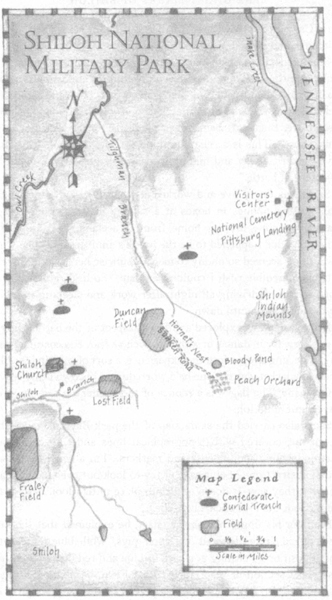
I scrambled after him. Ten minutes later, scratched and sweaty, we emerged in a small clearing. This was the aptly named Lost Field. Several markers to Mississippi units skirted one edge. A marker labeled Burial Place: 49th Illinois Infantry perched at the field’s center. Judging from the close-packed graves, this lonely glade had witnessed one of the short, sharp clashes that together comprised what Foote called the “disorganized, murderous fistfight” that was Shiloh.
Sams turned to me with a contented grin. “You always read about the confusion,” he said, “with all these panicked units wandering through the woods and bumping into each other.” He gazed across the cramped, grave-strewn field. “Click, click, click,” he said.
As we straggled back to the road, Sams showed me another grave: a stone in the shape of an oak stump, etched with the name “J. D. Putnam.” A short text on the stump said: “His comrades buried him where he fell and cut his name in an oak tree which stood here. In 1901, Thomas Steele recognized the burial place, the name he helped to cut in 1862 still being legible on the stump.” The Wisconsin veterans replaced the stump with this granite replica as a permanent marker of their position at the battle.
“I like to think of these old guys coming back and remembering what they went through as young men,” Sams said. “No other war in America could both sides come back and say, ‘This is where it happened, this is what I did.’”
Glancing at Sams’s map, I realized we stood near the scene of the battle’s climax, at the so-called Hornet’s Nest. I asked Sams if he wanted to have a look. He shook his head. The park opened soon and he wanted to finish his mission before Shiloh filled with visitors. “I’ve got some chaos to check out over by Bloody Pond,” he said, vanishing into the trees.
The Hornet’s Nest was a tangled copse of small trees and brush. A split-rail fence ran along its front, just beside a wagon trail known as the Sunken Road. On the other side of the road lay a bucolic pasture called Duncan Field. On the first day at Shiloh, 6,000 Federals crouched in the Hornet’s Nest and Sunken Road, fighting back eleven rebel charges across Duncan Field. The twelfth charge—aided by what was then the largest artillery barrage in U.S. history—finally forced the Union defenders to surrender. But the Yankees’ staunch defense of the Nest turned the whole battle, stalling the rebels long enough for Grant to regroup and take on reinforcements. Or so I’d always read.
I walked into the middle of Duncan Field and turned slowly in a circle. Here was a 360-degree panorama that corresponded to the Platonic ideal of a Civil War battleground I’d carried in my head since childhood. A broad meadow bounded by wilderness, with a mud-chinked log cabin lying in amongst the trees. The crooked, hand-hewn simplicity of a split-rail fence. The Sunken Road, worn down by pioneer wagons toting apples and timber and corn. Bronze-snouted cannons poking out from between tall oak trees.
Succumbing to a boyish impulse, I rushed the Union line, trying to conjure the buzz of bullets that gave the Hornet’s Nest its name. Then, reaching the Nest, I turned and became a Yankee, crouched in the Sunken Road with an imaginary musket resting on the split-rail fence. When I was a boy, the field would have instantly filled with smoke and flame and shrieking rebels. But now, as a fantasy-impaired adult, I found myself glancing around self-consciously to make sure no one was watching.
I sat on a log and gazed at the pastoral scene through grown-up eyes. The Nest was lovely, covered in pine needles and moss and speckled by sunlight glinting through the trees. From this vantage, the whole notion of a “battlefield park” seemed a contradiction in terms. Preserved here for eternity was peace, beauty and quiet—the precise opposite of the events memorialized.
When Ambrose Bierce arrived at Shiloh on the battle’s second day, he found a “smoking jungle” quivering with cannon fire and “the sickening spat of lead against flesh.” The woods had been reduced to blasted stumps. “All the wretched debris of the battle still littered the spongy earth as far as one could see,” Bierce wrote. “Knapsacks, canteens, haversacks distended with soaken and swollen biscuits, blankets beaten into the soil by the rain, rifles with bent barrels or splintered stocks.” Mutilated horses lay everywhere, as did men, “all dead apparently, except one.”
Bierce studied the wounded man. “He lay face upward, taking in his breath in convulsive, rattling snorts,” Bierce wrote. “A bullet had clipped a groove in his skull, above the temple; from this the brain protruded in bosses, dropping off in flakes and strings. I had not previously known one could get on, even in this unsatisfactory fashion, with so little brain.” Bierce debated whether to bayonet the dying man, but decided otherwise and marched on.
Now, where 100,000 men had clashed that April day in 1862, I sat alone on a moss-covered log, listening to a solitary bird warble somewhere in the trees above.
IF THE RAW FEEL of battle eluded me, another piece of Shiloh’s history was easier to grasp. As Scott Sams pointed out, Shiloh had two pasts: the actual battle, and its remembrance by those who fought there. “In our youth our hearts were touched with fire,” wrote Oliver Wendell Holmes, twice wounded in battle. “We have felt, we still feel, the passion of life at its top.” In later life, these same men helped lay out Shiloh and other battlefield parks, recalling in Wordsworthian tranquillity the brave deeds of their youth and memorializing themselves for posterity.
When Shiloh became a park in the 1890s, each state was allowed to build one monument cut from enduring materials, such as granite, marble or bronze. Iowa’s memorial stood seventy-five feet high, weighed over half a million pounds, and had to be hauled to Shiloh by barge and ox. It showed a woman symbolizing “Fame,” inscribing the names of dead Iowans into the monument’s stone. A nurturing breast slipped from her loose robe. Park rangers later confided to me that Fame nurtured Boy Scouts these days, who snapped pictures of each other sucking on the monument’s marble nipple.
The post-War South couldn’t afford monuments on this scale. Nor were all Southerners enamored of battlefield parks, which diehards regarded as a perfidious scheme to glorify Yankee victory. In the end, most Southern states did erect monuments at Shiloh, but not the hundreds of additional memorials to individual units constructed by the North. So, as in war, blue massively outnumbered gray at Shiloh and most other battlefields.
Also, while Northern monuments tended toward the grandiose and triumphalist, Southern memorials possessed an elegiac quality that was somehow more powerful, at least for me. The most striking by far was a monument honoring soldiers from all Southern states, “Whether sleeping in distant places, or graveless here in traceless dust.” Erected by the Daughters of the Confederacy near the high-water mark of the rebel advance at Shiloh, the memorial showed a downcast angel surrendering a laurel wreath to a Grim Reaper-like figure. The sculptor titled his work Victory Defeated by Death and Night. The death was that of General Johnston; night referred to the darkness that denied the rebels a chance to complete their near-triumph on the battle’s first day.
This was a microcosm in marble of the Lost Cause romance that took hold in the South after Appomattox. The Civil War became an epic might-have-been, a “defeated victory” in which the valorous South succumbed to flukish misfortune—Johnston’s untimely death, for instance, or Stonewall Jackson’s mortal wounding by his own men at Chancellorsville—and to the North’s superior manpower and materiel. I later found a program from the monument’s unveiling in 1917, which revealed another side to the unreconciled South. It noted the various objects placed in the monument’s cornerstone for eternity: flags, coins, a lock of General Johnston’s hair, and a photograph of two local dignitaries “in Ku-Klux regalia.”
Just beyond Victory Defeated, I reached a simple hunk of stone chiseled with the names of Alabamans who fought at Shiloh. A minivan drove up with a bumper sticker that read “World’s Greatest Grandpa.” Leaping from the van, an elderly woman in a floppy hat ran her finger along the monument. “He’s still here!” she shouted toward the van. Then to me: “That’s my great-grandfather, Captain Thomas Jenkins.”
His great-granddaughter was a retired Alabama teacher named Edwina. She’d first visited Shiloh with her children in the 1960s and had now returned with her teenaged grandson. “We’re here so he can learn about his Southernness,” she said. Her grandson sat in the van’s backseat, listening to a Walkman. The world’s greatest grandpa perched impatiently behind the van’s wheel with the engine running.
I asked Edwina what she meant by “Southernness.”
“My husband’s a Northerner—from Boston, the worst kind—and he’ll always be one,” she said. “We’re like night and day and we’ve been married forty-three years. He’s English and I’m Scottish, in ancestry and temperament. I’m very careful about how I come across to others. Not him. The other day we’re at the movies and people in front of us are talking. I was bothered but I didn’t say anything. He shouted at them, ‘You know there are others here!’ I could have melted through the floor.”
I wasn’t sure what to make of this civil war. But Edwina reminded me. “He wants to tell people how to do things, the same way the North tells the South how to live, and did back then.”
Her husband honked the horn. From what Edwina had said, it seemed remarkable that she and the world’s greatest grandpa had stayed together forty-three years. “My South is my South,” Edwina shouted as the minivan sped off, leaving me alone with Captain Thomas Jenkins and his brave Alabamians. I reckoned they’d be pleased to know their efforts hadn’t been entirely in vain.
I pressed on, to Bloody Pond. It was here, at the height of the first day’s fighting, that men from both armies crawled to drink water and soak their wounds. Like other stops on the battlefield, the pond’s bank had a stand with a small audio speaker. I pushed a button and heard the testimony of a local man who visited soon after the battle. “There were dead men and horses, broken artillery carriages and dismounted guns in the pond. Soldiers taking dead men out of the water and laying them in rows on the bank. The water looked like blood.” Now, a father and daughter stood on the bank, skipping stones across the clear, cool water.
Parked nearby was a convertible Mercedes with a vanity license plate: MAYS. A paunchy man in an Izod shirt stood riffling through a briefcase balanced on the roof. Bill Mays was a lawyer from Missouri. He’d arranged his caseload so he could slip away from his office and drive six hours to be here on Shiloh’s anniversary. Like the bus driver I’d met at Fraley Field, Mays had come to track the path of his forebear, a rebel private named Elijah.
Mays dug through his briefcase for one of the elaborate park maps I’d seen several times already. “I’m a lawyer, so I always look for what the preponderance of the evidence suggests,” he said. He knew that Elijah fought with the 52nd Tennessee, in a place called Cloud Field. A red dot on the map, near where we now stood, denoted a marker to the Tennessee men. But Mays was having trouble finding the corresponding spot on the ground.
I followed him as he plunged, briefcase in hand, in what he guessed was the direction of the monument. Within minutes, we were lost in thigh-high undergrowth. “I’ve been to battlefields in Virginia—they’re like golf courses compared to this,” he said, Izod shirt stained with sweat. As we rested on a log, swatting gnats, I asked Mays why it was so important to track his great-grandfather’s precise movements 133 years ago.
“I’m here because the issues are still here,” he said. “People still want to be independent of central authority. The evidence suggests that rebels like Elijah believed strongly in their individual right to determine what their government should be.” He started to open his briefcase, then paused, as though realizing he wasn’t in court. “I’m a Republican,” he went on. “Tracking down Elijah gives me some perspective on what it is I believe in, and what commitment to your beliefs is all about.”
It went deeper than that. The South’s failure to stop the North at Shiloh ultimately led Elijah’s unit to another great battle at Chickamauga. Captured there, Elijah was sent to a prison camp in Indiana where he died a few weeks before the War’s end. Soon after, Elijah’s widow died of cholera, so their kids were raised by a brother who moved to Missouri, near where Bill now lived. “Ultimately, I guess, I’m trying to figure out what my place in the big picture is,” Mays said. “I am who I am, geographically and politically, because of what happened here.”
Mays picked up his briefcase and headed deeper into the woods. I stayed on the log and rested awhile. Until now, I’d regarded others’ retracing of their ancestral footsteps as a bit odd and obsessive. Like birdwatchers who tramped around the globe, fanatically compiling “life lists,” these combat genealogists seemed to be missing the forest for the trees.
But Mays’s story forced me to recall a lonely trip of my own, ten years before, to a remote region of what was then still the Soviet Union. Armed with old maps and a family memoir, I’d trudged through ankle-high mud until I found the wagon road my father’s father traveled on the day his family fled Czarist Russia. The road ultimately led to a Baltic seaport, to Ellis Island, to me. As Mays had put it, I was who I was because of what happened on that muddy trace in 1906. Thinking back on the trip, I felt envious of Mays and the others I’d met at Shiloh. They had a blood tie to a patch of American soil that I never would.
AT MIDDAY I REACHED the visitors’ center, a modern building near the Tennessee River. A park ranger named Paul Hawke collected my two-dollar entrance fee. I confessed that I’d already gotten my money’s worth wandering Shiloh since dawn.
Hawke smiled. “One of the pilgrims. We get them every year. Every day, really.” Hawke’s last posting was Pea Ridge, an Arkansas battlefield just off the interstate. “You could tell that half the people stopping there had just seen a sign for a national park on the highway and thought, ‘Clean bathrooms—let’s stop!’” He’d also worked at Gettysburg, which drew thousands of tourists who knew little about the battle, except that it was one of those sites to which all parents should drag their kids. But accidental tourists rarely turned up at Shiloh. “It’s not on the way to anyplace,” Hawke said, “so you tend to get a very devoted breed.”
Shiloh’s isolation, though, hadn’t spared it a growing problem at battlefields across America. The boom market in Civil War relics had unleashed scores of treasure hunters who scavenged after dark with metal detectors. Rangers now patrolled the park with night-vision goggles and had once nabbed two men toting over 130 artifacts. Relics also turned up accidentally; just a month before my visit, a gardener found a live cannonball while planting grass near the visitors’ center. “The dud ratio for Civil War ordnance was fifty percent or more,” Hawke said, “so there’s still a lot of unexploded stuff lying under the ground.”
Hawke, it turned out, specialized in such half-hidden remnants of the Civil War. As part of his park duties, he tramped through the woods around Corinth, searching for earthen defenses thrown up by the Confederates. Hawke had even founded the “Civil War Fortification Study Group,” which met annually to discuss new research on earthworks. The prosaic nature of the subject appealed to Hawke’s modest nature. “We tend always to focus on the biggest and bloodiest events in war,” he said. “But if you think about it, earthworks are the one tangible survival from the Civil War put there by soldiers themselves for the express purpose of fighting.”
Hawke conceded, though, that earthworks weren’t always that tangible. Most had so eroded that they remained invisible to the naked eye at ground level. But their imprints could be spotted in infrared photographs taken from the air.
“Wars leave what’s called ‘ghost marks’ on the landscape,” Hawke said. This struck me as an apt metaphor for the traces of Civil War memory I myself had been searching for in the course of my journey.
As I chatted with Hawke we were joined by an imposing figure with a handle-bar mustache, tight jeans, cowboy boots, a Stetson and tortoiseshell glasses. He looked like a bookish gunslinger. He turned out to be the park’s historian, Stacy Allen, who agreed to take a few minutes to answer some questions I had about Shiloh.
As it happened, we spoke for three hours and toured the whole battlefield. By the time we were done, this somber, bespectacled Kansan had made me wonder if everything I thought I knew about Shiloh—and about many other battles—was closer to fiction than to fact.
Allen’s revisionism sprang from his academic training as a physical anthropologist. “Traditional historians tend to ignore the best primary source out there—the ground,” he began. “If you read it right, you realize a lot of the written history is simply wrong.”
Most history books, for instance, described the 1862 terrain at Shiloh as covered in impenetrable spring woods. But after watching spring unfold for six years at Shiloh, Allen began to wonder if this was really so. Studying old weather charts and nineteenth-century farm records, he discovered that spring came to Shiloh very late in 1862. Most trees remained bare. Allen also learned that Shiloh’s farmers cleared their land for crops and fenced livestock out of the fields. So cattle and hogs roamed the woods, chewing the undergrowth and trampling it down. “Overall, the landscape was still pretty wintry at the time of the battle,” he said. The confusion at the battle, he added, was probably due more to smoke, dust and poor maps than to dense foliage.
Allen also studied what lay under the ground. After the two-day fight in 1862, Grant ordered the dead of both armies buried in mass graves “along the line of battle”—in other words, where they fell. It was therefore logical to conclude that the burial trenches indicated where the heaviest fighting occurred. Yet no burial trenches had ever been found near the Hornet’s Nest, where Union defenders supposedly turned the battle by beating back repeated rebel assaults across Duncan Field.
“Strange, isn’t it,” he said, driving me back to the Sunken Road and gazing out at Duncan Field. “There were supposedly eleven or twelve charges here, yet we can’t find many bodies to speak of.” Allen had also studied the rosters of the units that fought in and around the Hornet’s Nest. He found that their casualty rates were much lighter than for others at Shiloh.
Again, the landscape offered a clue, at least in Allen’s view. The historic tablets scattered across Shiloh had been carefully placed by a battlefield commission in the 1890s, with the help of returning veterans. Each tablet was intended to mark the exact spot where individual units fought. Yet there were no such markers in Duncan Field. Instead, markers for Southern units that fought here clustered in the woods on either side of the pasture.
“Grandpa was brave but he wasn’t stupid,” Allen said. “He avoided that field. Wouldn’t you?” In the end, he’d documented only one attempted charge across Duncan Field and concluded that the other assaults—seven in all, not eleven—worked their way along the thicket bordering the pasture.
Allen also believed that heedless assaults across open ground were much rarer throughout the War than was commonly supposed. The most notable exceptions, such as Franklin and Pickett’s Charge, proved the rule: frontal attacks had become suicidal because of newly improved rifles that could kill at seven hundred yards. Rifled guns, which replaced the much faultier smoothbore muskets used in earlier wars, also cut down another romantic staple of Civil War lore: bayonet combat. Allen had found almost no hard evidence of hand-to-hand fighting at Shiloh, and suspected the same was true at other battles. In fact, bayonets and sabers accounted for only one half of 1 percent of wounds in the Civil War. I later learned that there wasn’t one confirmed bayonet wound in all of Pickett’s Charge.
Allen’s sleuthing revealed another twist to the story of the Hornet’s Nest. He’d done time-and-motion studies of units that later claimed to have fought in and around the Nest. It turned out many of them couldn’t possibly have done so. Allen smiled. He’d come to the kicker of his story. “When you look at the whole battle,” he said, “what actually happened here was almost incidental to the outcome.”
In Allen’s version, the crucial combat at Shiloh occurred on either side of the Nest, where the South concentrated its first-day attack. Some rebel units from these flank assaults made piecemeal contact with the Nest during the day. But it was only after the rebels had pushed the Union back on both flanks that they converged on the Nest, which had by then become a lonely Union salient. So the main reason the Federals in the Nest hung on so long was because the Confederates were busy hammering other positions for most of the day.
The obvious question, then, was why the Hornet’s Nest assumed such prominence in history books. Here, Allen turned from physical anthropology to psychology. “Let’s put ourselves in the heads of those Yankees in the Hornet’s Nest,” he said, pacing up and down the Sunken Road. “We’re in this thicket where we can’t see the rest of the battlefield. There’s rebels coming at us, in bits and pieces, all day long. Then suddenly we’re still here and everyone else has retreated. It seems like we fought the whole battle on our own.”
As prisoners, Allen went on, the 2,200 men captured at the Nest had months to talk over the battle and also to bond with each other. After the War, they formed a vocal veterans’ group called the Hornet’s Nest Brigade, led by their commanding officer, Benjamin Prentiss, an influential politician who outlived most of his contemporaries. “He was eager to foster the impression that the Hornet’s Nest and his role there were crucial to the battle,” Allen said. “He played it up big, particularly later in his life.”
So gradually the myth grew, until the Hornet’s Nest became the battle’s turning point. The Sunken Road, in fact, wasn’t even called that in initial reports of the battle. But as time passed, the shallow wagon trace became deeper and deeper in veterans’ memories, eventually leading to its nickname. “Grant once said that Shiloh was the most misunderstood battle of the Civil War,” Allen concluded. “It’s taken me awhile to grasp how true that was.”
From the Hornet’s Nest, Allen led me to the woods and narrow fields near the Shiloh church, where he believed the battle had in fact turned. It was here that the oncoming rebels almost crushed the Federal right flank. But Sherman’s men held, fell back, counterattacked and stalled the Southern advance. Again, the landscape told the story. All around us rose monuments to Midwestern units that sustained losses of 30 percent or more. Scattered among these slabs were Confederate burial trenches, well-manicured rectangles of grass bordered by cannonballs. They looked rather like putting greens. One burial pit held over 700 rebels, stacked seven deep. Four of the five known burial trenches at Shiloh lay near here.
Allen said that rangers on morning patrol sometimes found Ouija boards, divining rods, notes to the dead—even a funeral card with a picture of a man whose cremated ashes had been spread here in the night. “One woman came into the visitors’ center saying she’d been meditating by one of the pits and had communicated with a soldier named Billy Joe, who told her ‘he wanted out of there,’” Allen said. “I’m sure he did.”
Allen believed the final body count at Shiloh was double the official killed-in-action figure of 3,500 dead. At this early stage of the War, neither army had any real system for handling casualties. On the first night at Shiloh, hundreds of soldiers lay ungathered on the battlefield. Allen had found accounts of hogs enjoying a “carnival feast” of the dead. Some parts of the battlefield also caught fire, roasting both dead and wounded men. Ambrose Bierce, of course, made a clinical examination of one such assembly: “Their clothing was half burnt away—their hair and beard entirely; the rain had come too late to save their nails.” In the end, many bodies may simply have vanished without ever being counted.
Wounded men who survived long enough to receive medical care also fared poorly. Allen guessed that fully 2,500 of those listed as wounded at Shiloh later perished from their wounds, often superficial injuries that became infected. Prisoners also died at a staggering rate, usually from dysentery.
A few weeks before visiting Shiloh, I’d gone to the National Archives in Washington and perused reports from wartime field hospitals. Doctors listed the treatment given each soldier, typically amputation, splinting, or a “water dressing,” a wet bandage that did little but spread infection (doctors didn’t learn about sepsis until after the War). Doctors also wrote brief follow-ups on their patients. Among the most common notations: “probably mortal,” “died of tetanus,” and the oddly redundant “mortally, died.”
But what had struck me most were the doctors’ notes on what they called the “seat of injury” for each soldier. An astonishing number of wounds were seated in the “testicle” or “thigh and privates” or “leg and scrotum.” Allen explained the grisly logic of this. Officers constantly implored their men to “aim low” to avoid firing over the heads of the oncoming enemy. “Also, human beings have a tendency to shoot towards the center mass,” he added. “So you see a lot of hits to the abdomen and groin.”
To Allen, the full details of these and other horrors of Civil War battle were only beginning to emerge from the mythic haze enveloping the conflict. “Each generation sees the War differently, and that’s why interest in it will never die,” he said. The first generation—the veterans themselves—tended to couch tales of battle in high-blown Victorian prose about courage and sacrifice. “It wasn’t their style to dwell on the graphic details of injury and death,” Allen said. (An obvious exception was Ambrose Bierce, shot in the head at Kennesaw Mountain and deeply embittered by his wartime experience.)
Later historians, relying heavily on veterans’ accounts, also glossed over the War’s grisly side, highlighting instead the battle tactics and personalities of generals. But Allen, born in the mid-1950s, belonged to a generation that had grown up watching the Vietnam War on the nightly news.
“I think the next phase of Civil War scholarship—my generation’s phase—will be to hit the American public with the reality of how horrible the War really was,” he said. “You read surgeons’ reports and learn that a big problem wasn’t just missiles, but also bits of clothing and leather and grime and flesh that got blown into wounds. The teeth and bone from others ahead of you could be deadly projectiles, too.” He paused, pointing at a line of cannon on the battlefield. “We look at these nice beautiful weapons and tend to forget what they did to the human body.”
Driving back toward the visitors’ center, Allen pulled in at the most popular stop on the Shiloh auto tour: the site of Albert Sidney Johnston’s death. I’d recorded the scene in the crude cyclorama painted on the walls of my childhood attic, with a bullet arcing cometlike across the woods and striking Johnston in the chest. In reality, Johnston bled to death from a wound in the back of his knee and might have been saved by a simple tourniquet.
Allen walked me to a tree stump marking the site. The stump listed so precariously that it had to be supported, like a ship’s mast, by halyards running between the tree and an iron fence surrounding it. A plaque said the stump was all that remained of the tall oak tree under which one of Johnston’s aides, Isham Harris, found his wounded commander reeling in the saddle. Harris dragged Johnston into a ravine, where the general soon expired. In 1896, Harris returned to identify the spot for posterity.
Allen let me study the stump for a moment, then said, “We haven’t done dendrochronology to determine the stump’s age, but we have studied old photos of the tree it belonged to.” He paused. “It probably wasn’t here in 1862, and if it was it couldn’t have been more than a sapling.”
Before permanent monuments went up across the park, key sites were marked with signs nailed to trees. So after Isham Harris located the spot, a sign went up on the nearest tree, saying “Johnston death site”—though the ravine where he actually died lay some distance away. Early visitors apparently became confused and assumed the tree marked the exact spot and the exact tree under which Johnston died. Allen also thought it likely that the septugenarian Harris, searching Shiloh’s woods thirty-four years after the battle, got the site wrong altogether.
“Either way,” Allen said, “we’re worshiping a rotten piece of wood that probably wasn’t here at the time of battle.” But the stormdamaged tree had been revered for so long that efforts by Allen and other rangers to uproot the stump had provoked protests—even anonymous letters threatening, “If you remove that tree you’ll be sorry.” So the stump survived, a relic of misremembered history. “Legends die hard,” Allen said. “But Mother Nature is doing a good job on that tree for us. It’ll be gone before long.”
Allen left me there, beside the oak impostor, feeling exhilarated but also unsettled by his decoding of the battlefield. Before setting off on my journey, I’d known that heated debate still raged around the War’s causes and legacy. But I’d naively assumed that scholars had closed the book on battlefield matters. After all, Shelby Foote and others relied on the authoritative-sounding Official Records of the Union and Confederate Armies, known as the O.R. to Civil War buffs. The O.R., 128 volumes in all, were compiled by the government soon after the War, mostly from firsthand reports. Historians could also turn to the vast, Talmudic body of interpretive literature published on the War since.
But if Allen was right, this received wisdom was riddled with inaccuracies, false memory and self-serving distortions. Nor was he a lonely revisionist. I later learned that Civil War scholars were rethinking numerous battles and questioning the reliability of long-revered sources. After Gettysburg, for instance, Robert E. Lee—presaging the doctored body counts in Vietnam—fudged his report on the debacle and the appalling casualties he sustained. Lee also ordered George Pickett to destroy his scathing report on the disastrous charge that bore his name.
Even pictures could lie. New research revealed that the captions on many well-known photographs were wrong. And some of the War’s most famous pictures were staged, with corpses dragged across battlefields and posed for dramatic effect. Historians had also found previously untapped sources—wartime diaries, unpublished letters, obscure court records—that led to wholly new assessments of familiar subjects.
Trying to make sense of all this, I later called back Shelby Foote. He calmly acknowledged that Stacy Allen’s view of Shiloh might well be valid, and that all of his own generation’s work was open to challenge. “I could redo my entire three volumes on the Civil War without using one bit of source material I used the first time,” he said, “and probably come to very different conclusions.”
But this didn’t bother Foote. Like Stacy Allen, he felt each generation had to reinterpret the Civil War by its own lights. “I don’t think that I could have written what I wrote in less than a hundred years after the War,” he said. “It took that long for North and South to see each other honestly through the dust and flame.”
Now, it seemed, a new generation had to cut through some of the dust and flame kicked up by Shelby Foote and his peers.
LEAVING JOHNSTON’S DEATH SITE, I trudged back to the Sunken Road. It was now ten hours since my arrival on the battlefield. I was famished, footsore and burnt by the Tennessee sun. Resting for a moment, I caught sight of a lanky figure in sky-blue trousers, a trim blue jacket and a Federal kepi. The only Northerner I’d met at Shiloh was the bus driver from Minneapolis. So I decided to ambush one more Yankee before calling it a day and retreating, like the rebels, to Corinth.
Up close, the man’s “impression” appeared carefully crafted: handmade brogans, period spectacles, a bayonet scabbard and a canteen slung just so across his chest. He stood before a tall monument with a book open in his hands.
“Excuse me,” I said, “could I ask you something?”
The man looked up from his reading. “Yes?”
“I’m researching a book about memory of the Civil War—”
“That’s odd,” he interrupted. “So am I.” He spoke formally, with a slight accent I couldn’t place. Then he said, “Are you by any chance Tony Horwitz?”
I studied him again. “Do I know you from somewhere?”
He smiled and thrust out a hand. “I am Wolfgang Hochbruck of the University of Stuttgart in Germany. I sent you an e-mail months ago. You never responded.”
Before setting out on my journey, I’d posted an Internet query with a Civil War chat group, searching for ideas and contacts. The first flood of responses proved so soporific—mostly lists of unpublished monographs on obscure regiments—that I’d quickly stopped tuning in. Then I’d hit the road and forgotten all about my cyberspace foray. Wolfgang must have tried to contact me some time after that.
“Sorry,” I said. “What did you message me?”
“That we should compare notes,” Wolfgang said. “What were you about to ask me a moment ago?”
“Why you’re standing out here in the sun in a blue uniform, looking at that monument.”
He handed me the book he’d been studying: Shelby Foote’s Shiloh. Wolfgang said he’d first read the novel at age nine in German translation and identified with one of the characters, an immigrant artilleryman named Otto Flickner. Foote based Otto’s story on the history of an actual unit from Minnesota, Munch’s Battery, which saw action near the Hornet’s Nest.
Thirty years later, Wolfgang was now making the same sort of pilgrimage as the lawyer from Missouri and the bus driver from Minnesota. Lacking a real forebear at Shiloh, he’d found a surrogate in the fictional Otto Flickner and was retracing his steps across the battleground. The monument he now stood before showed a Minnesota artilleryman holding what looked like a giant cotton swab. “I am wearing the uniform,” Wolfgang said, “because I thought it would add to the experience of being Otto.”
Otto Flickner was an odd choice of characters to inhabit. In the novel, Otto abandoned his position and fled all the way to the Union rear. This, too, was based on fact; during the first day’s fighting, many Union soldiers broke and ran.
Wolfgang knew all about Otto’s flight; it’s what drew him to the character. “He watched the Confederates come charging, again and again, shooting and screaming. Then he ran.” Wolfgang paused. “Wouldn’t you?”
He opened Shiloh again and consulted a map to locate the next stop on Otto’s retreat route. This German professor and I obviously had a lot to talk about. So I bummed a few swigs from his canteen and hobbled along as he hiked briskly through the woods.
En route, I learned about Wolfgang’s boyhood in the 1960s, which eerily mirrored my own. His father often traveled to the United States on business and returned with Civil War gifts for his son. Wolfgang played with the same plastic soldiers I had. He’d built cabins out of Lincoln Logs. He’d even pored over the same, wonderfully illustrated Time-Life book on Civil War battles that I’d studied.
As he recounted these memories, Wolfgang pointed out an obvious circumstance I’d somehow missed. The early 1960s coincided with the Civil War centennial. Battle reenactments began in earnest; hundreds of Civil War books were published; war-related games, toy cannons and other mass merchandise abounded as never before. This helped explain why Wolfgang’s father returned home with Civil War trinkets. It also shed light on my own childhood fixation, which I’d tended to view, in a self-congratulatory way, as the eccentric passion of a boy born in the wrong century. Perhaps I’d been the opposite, a creature of twentieth-century commercial culture who had simply latched onto a product line current at the time. Other boys thrilled to John Glenn and spaceship models; I preferred Honest Abe and Lincoln Logs.
We reached a riverside bluff topped by flat-topped mounds. A marker explained that the mounds were believed to have been platforms for ancient Indian temples. Scrambling on top of one of the mounds, as Confederate scouts had done during the battle, we gazed down on the Tennessee. It was just as I’d imagined: a wide, lazy river coiling through the countryside, with sandy bluffs and deep woods lining the opposite shore.
Wolfgang was also matching the vista against his childhood imagining. Just below us lay the steep cliffs beneath which Otto Flickner and several thousand real-life skulkers had sought refuge from the battle. Some even waded out in their frenzy to flee the fighting. “So this is it,” Wolfgang murmured. “I have always wondered what became of Otto on the second day of battle.”
When I asked why he identified so strongly with Otto, Wolfgang told me about his own military service. Drafted into the German navy at eighteen, he’d served as a torpedo man on a destroyer and found himself, like Otto, cramming projectiles into guns, in this case antisubmarine weapons. Wolfgang proved a capable seaman and the navy wanted to promote him. But he’d seen one of his fellow crewmen commit suicide and several others “turn into monsters around all these weapons.” So he chose to become a conscientious objector and argued his case before a military panel. Citing Gandhi and Martin Luther King, he won release from the navy and later convinced three other torpedomen to follow his lead.
“I said to myself after that, ‘I’ll never wear a uniform again.’” He fingered his Yankee costume. “Now, here I am.”
Like me, Wolfgang had retrieved his childhood passion only recently. Accompanying his wife to America while she researched a Ph.D. thesis, Wolfgang discovered all the contemporary publications devoted to the Civil War. Then, on a weekend outing, he stumbled on a reenactment. “I realized there was this whole culture, or cult really, surrounding memory of the Civil War,” he said. Returning to Germany, Wolfgang began teaching American Studies classes that took as their syllabus The Red Badge of Courage, Gettysburg, Gone With the Wind, and other Civil War novels and films.
Wolfgang had also formed a reenacting troop in Stuttgart, modeled on a German-American unit, the 3rd Missouri. The original 3rd Missouri included many left-wing political exiles who carried a red flag emblazoned with a hammer smashing chains. The new 3rd Missouri was almost as odd, including several women, four conscientious objectors and a U.S. Army chaplain. All portrayed privates. “Our democratic traditions must be remembered,” Wolfgang explained. The proceeds his troop solicited at reenactments were donated to a refugee camp in Bosnia.
We sat there quietly for a while, watching barges float past on the river. I felt as though I’d stumbled on a body-double, a doppelgänger, here in the woods of Shiloh. Like Wolfgang, I’d drifted from a childhood fascination with the Civil War to adolescent embarrassment about it, and then to a deep distrust of all things military. Yet both of us had found outlets for our childhood obsession. Wolfgang studied war, I wrote about it. During my time overseas, I’d kept gravitating toward combat zones: in Iraq, Lebanon, the Sudan, Bosnia, Northern Ireland. For someone who professed a hatred of guns, I’d spent an awful lot of time watching people shoot at each other. “Nothing in life is so exhilarating as to be shot at without result,” Winston Churchill memorably observed of his own time as a war correspondent.
For Wolfgang, as for many Germans of his generation, fascination with war was freighted with a much more complex self-doubt. “It is not easy to grow up with the knowledge of belonging to one of the most destructive people in world history,” he said. “I think some of the Confederate reenactors in Germany are acting out Nazi fantasies of racial superiority. They are obsessed with your war because they cannot celebrate their own vanquished racists. Most of these people are Bavarians, of course.”
Wolfgang, on the other hand, always played Union soldiers. He also hoped that both his academic work and his reenacting would ultimately buttress a pacifist message. “My thesis so far is that Civil War remembrance reflects a movement towards more civility and peace,” he said. “In reenactments, North and South get along, they work together. And look at all the people who dress as civilians. Maybe if we played at war more instead of really using weapons, our world would be a better place.” He laughed. “Of course, it is possible my thesis is nonsense.”
We walked toward the last stop on Wolfgang’s tour, the National Cemetery, where Union dead were moved after the War from their original burial trenches. It was now late afternoon and the monuments cast long, cool shadows across the freshly mowed grass. Most of the graves were marked only with stone stumps labeled “Unknown.” Some recorded a few initials or other fragments of soldiers’ identities: J. Pe Ia, Mosely, H.O.K. I’d learned from the park historian Stacy Allen that neither army at Shiloh had dog tags to identify corpses. Comrades of the dead sometimes pinned bits of paper to their friends’ uniforms, or put names in bottles or Bibles, which were then placed in dead men’s pockets. Even so, the names of all the Confederates buried at Shiloh and most of the Federals remained unknown.
As we left the graveyard, a man in a Confederate kepi spotted Wolfgang and shook a fist, shouting in mock fury, “We’ll git you next time, Yank!”
“Oh yes?” Wolfgang replied, playing along. “At Gettysburg?”
The man smiled. “What unit you in?”
“The Third Missouri. Stuttgart, Germany.”
“No shit!” The man fumbled in his haversack and took out a camera. “Mind if I snap a picture? This’ll blow my buddies’ minds.”
Wolfgang posed politely. Then the man thanked him and shook his hand. “Yankees in Germany. Man, that’s something.”
As the man wandered off, Wolfgang smiled wearily. He often got odd responses when he told people he was German. Occasionally, reenactors would confide that they liked to do World War II reenactments—dressed in SS uniforms—when they weren’t doing the Civil War. Mostly, though, people just thought Wolfgang was strange. Tired of explaining himself, he’d concocted a phony German-American ancestor in the 3rd Missouri. “That way, when people ask why I’m here, I can just mention him. Otherwise, they think I’ve gone off the rails.”
Wolfgang’s wife, Sabine, stood waiting at the visitors’ center with the indulgent smile of a mother watching her muddy son trudge home from a football game.
“How did you spend your day?” Wolfgang asked her.
“Like an adult. Reading a book at the motel.”
When Wolfgang introduced us, Sabine asked me if I liked to collect Civil War relics. I shook my head. “Your wife is lucky, then,” she said. “We only have two rooms in Stuttgart. Last time in America Wolfgang started gathering—what do you call it, grape nuts?”
“Grape shot,” I said.
“Actually,” Wolfgang said, “they were minié balls.”
“He also wanted to buy a rusty thing,” Sabine said.
“A bayonet,” Wolfgang said.
“It was big, like a sword. It would have taken up the whole shelf.”
Even so, Sabine now participated in her husband’s obsession. At first, she said, reenactments made her uncomfortable. “We still have real civil wars going on in Europe. It does not seem like play to me.” But Wolfgang had persuaded her to join in, dressed as a nineteenth-century nurse or as a teacher of freed slaves. “It is like Carnival in Brazil,” she said. “You get in costume and be who you want to be for a few days. It is a second chance.” It was also a refreshing break from her own academic field: American political rhetoric in the 1960s. “In the 1860s, I think, people spoke more plainly than in the 1960s,” she said.
I went with Wolfgang and Sabine to dinner at a nearby catfish restaurant, then back to their motel, where we drank sourmash bourbon and sifted through the clutter they’d accumulated in their travels: battle flags, reenactors’ mess kits, a windup toy in the shape of a cotton boll that played a tinny rendition of “Dixie.” “Research material,” Wolfgang said. Sabine rolled her eyes. At midnight we stood in the motel parking lot, exchanging addresses and phone numbers and promises to stay in touch.
“I’ll answer your e-mail next time,” I said.
“I am glad you didn’t before,” Wolfgang said. “It was much better that we met on the field of battle.”