

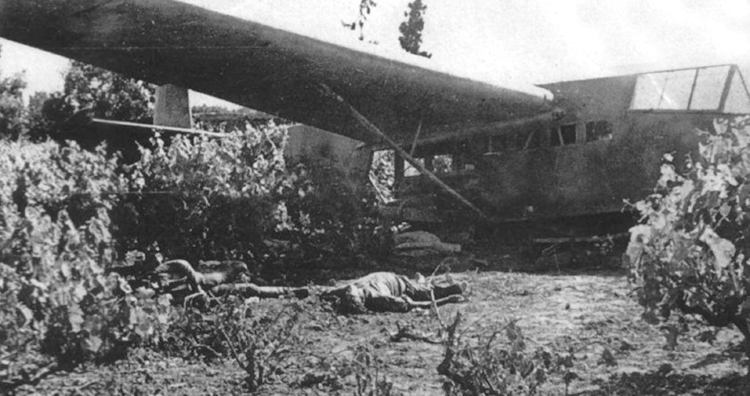
We left Crete rather hurriedly, as the Bosche decided to share the island with us. Since we were rather snobbish, we decided to let them have it – in more senses than one!
Personal letter - officer 2nd Black Watch
The Cretan Campaign took place a full year after the fall of France and demonstrated that Britain and her Empire partners still lacked the resources to match Axis military power. It was also obvious that they had yet to come to terms with, let alone master, the new style of warfare that the Germans had ushered in over the previous two years. As Churchill said, this learning phase or ‘beginning’ was not to end until El Alamein, almost eighteen months later.
For the Germans, the campaign was the first and last time that airborne forces were to play more than a subsidiary role in a strategic operation. The result of the Cretan adventure was so costly that Hitler never authorised another major airborne operation. None the less, General Student’s distinctive elite were to subsequently fight as highly effective infantry in virtually every theatre where German troops were deployed.
In contrast the British studied the airborne invasion of Crete in detail and comprehensive reports were circulated amongst those responsible for the defence of other Mediterranean objectives and the United Kingdom itself. The lessons of Crete also informed those who were developing Britain’s own airborne capability. The recommendations made in these reports were sound but in later years were occasionally forgotten or ignored; where this was so, disaster invariably resulted.
This book covers a short but intense campaign that was full of drama and considerable activity, much of it at a low level of command. In addition, the battle was spread over an area seventy by forty miles and it would be impossible to include every action that was fought in a book of this size. Consequently, within the broad setting of the Cretan Campaign as a whole, I have highlighted the more important actions that for the reader at home or the visitor to the battlefields, give a flavour of what it was like for men of the opposing armies during those twelve days in May 1941.
I have referred to what many would describe as the ‘Allies’ as the ‘Commonwealth’ forces in this volume. Technically the Australians provided the Australian Imperial Force but this name does not reflect the changing status of that nation’s troops or those of New Zealand or Britain’s relationship with their governments. The description ‘Commonwealth’ most accurately reflects the spirit of the time.
The timings given in this book have all been converted to the time used by the Commonwealth troops by adding an hour to the times quoted by German authorities. Thus, the P Hour for the operation is listed as 0815 hours rather than the German 0715 hours.
As this book is as much a guide to the battlefield, as it is an account of the battle, I have elected to use the modern spelling of place names as they are shown on local signposts in roman script. Over the years, I have found it confusing and the cause of some disorientation when having to cope with a change of spelling (the result of differently accented phonetic translations from Greek into English). Some changes, such as Heraklion or Iraklion, now spelt Iraklio, are obvious but others, typically villages west of the island’s capital (Canea or Xania, now Hania), are less obvious. To clarify matters I have standardised the names, but even that is not standard! See table.
Almost finally, many of the photographs were taken by Fallschirmjäger and Gebergsjäger during the campaign, using their personal Leica cameras. Inexpertly composed, using a film that defies adjustment of contrast and often poorly focussed, the results do, however, give a better flavour of the men and conditions than many official photographs. The majority of the campaign pictures are from German sources, as true to the maxim about withdrawing armies having better things to be doing, few Commonwealth photographs exist. I have saved my last and most important point to last. Visitors must note that although Crete is a part of a modern European Greece, that country as a whole, is in a very sensitive part of the world and that security of military establishments is always high. Two of the locations covered in this book are of particular sensitivity. Iraklio is not only an international airport but an active military airfield, with associated barracks and radar sites. At Maleme the site of the RAF Camp is now a Greek barracks and the airfield is still in commission. Definitely avoid photographing these places. Please heed the advice given in the tour section.
Acknowledgements
I would like to start by acknowledging Anglia Battlefield Tours’s part in this book. With a major military customers requiring tours of Crete, I was given the opportunity to both study the campaign in detail and to revisit Crete after several years. During the process of reacquainting myself with the campaign to the depth of detail required, I was able to amass so much material that it was a relatively easy task to assemble it into a Battleground book. On the ground, Cretans too numerous to list, helped me to pinpoint the location of events. This was particularly important as, then as now, maps were poor and most of the war diaries that exist were reconstructed after the campaign and, consequently, tend to be rather general than normal in terms of both times and locations. This made placing action more difficult than in other Battleground titles. I am therefore extremely grateful for the assistance freely and enthusiastically given by my hosts.
Appreciation must also be recorded for the attitude of both the New Zealand and Australian Government, their military museums and the units concerned, who all encouraged and, more to the point, actively supported my endeavours. My dearest wish is that this book enables more visitors from the Commonwealth not only to enjoy Crete but to visit the scene of some of our nations’ most testing times.
Whether at home or on the ground, enjoy the tour.
Tim Saunders
Warminster 2008
Further Reading
Bearing in mind that Crete is a holiday destination the following books could find a welcome space in a suitcase or even be a good read at home:
Officers and Gentlemen (Volume II of the Sword of Honour trilogy).
Evelyn Waugh – A fictional account based on the author’s experience in the Layforce Commandos on Crete.
Ill Met by Moonlight. W Stanley Moss – The contemporaneous diary of the SOE abduction of General Kreipe and the escape through the mountains. Also available in DVD as a drama.
The Cretan Runner. Georre Psychoundakis – Account of the wartime years by an SOE agent/guerrilla covering the Kreipe abduction and numerous other resistance activities.
All are easily found through local bookshops or on-line book sellers.
|
MODERN NAMES AND THEIR 1941 EQUIVALENT: |
||
|
Modern |
1941 |
Other Variants |
|
Iraklio |
Heraklion |
|
|
Hania |
Chania |
K or Xhania |
|
Maleme |
No Change |
|
|
Kastelli |
Kissamous |
Interchangeable today |
|
Rethymno |
Retimo |
|
|
Galatas |
Galatos |
|
|
Daratos |
Karatos |
|
|
Souda |
Suda |
|
|
Tavronitis |
||
|
Agh Pandes |
Babali Hani |
|
|
Stylos |
Stilos |
|
|
Pygi |
Pyrgos |
Pirgos |