
Chapter Four
The battle for Maleme is widely seen as the crux of the Cretan campaign; a battle that at several points could have been decided in favour of the Commonwealth. The Maleme airfield, just fifteen miles from the point that the Germans assessed as being the centre of Commonwealth defensive operations (Hania/Souda), was the natural choice of main effort for an airborne force that had to complete its task in the shortest possible time.
The Defenders and their Plans
The New Zealand Division was deployed to the west of Hania covering the beaches, the coastal strip and a likely approach route to the island’s capital from Prison Valley. At the western end of the divisional area was the compacted earth airfield at Maleme; the only airfield within striking distance of Hania. This vital area was held by Brigadier Hargest’s 5 New Zealand Brigade.
See map map on page 26
Aged fifty, James Hargest was typical of the division’s senior commanders. At the outbreak of the Great War, he was a member of the New Zealand Territorials, serving with the rank of second lieutenant. He fought in Gallipoli, at Suvla Bay, where he was wounded. In 1916 he served with 1st Otago Regiment at Armentières, being promoted captain before the Somme, where he was awarded the MC. As the battalion’s Second in Command, Major Hargest took part in the Battle of Messines in 1917 and in March 1918 he was given the command of the 2nd Otago Battalion, which he led until he was badly wounded in November.

Men of the New Zealand Division during the division’s withdrawal through Greece.

New Zealanders with a Bofors anti-tank rifle in the shelter of an olive tree and surrounded by bamboo.
Brigadier James Hargest.
After the war, he returned to sheep farming and to the New Zealand Territorial Army. Recognised as a distinguished soldier, he was given command of the Southland Regiment and subsequently of 3 New Zealand Brigade. In 1931 he was elected to the New Zealand Parliament.
In 1939 Hargest again volunteered for service but was not considered fit enough for active service. With political influence, the issue was overcome and he was appointed to command 5 Infantry Brigade and went first to the UK and where the New Zealanders helped hold the ‘front line’ in southern England during the Battle of Britain. During the winter of 1940/41 the New Zealand Division was transferred to the Middle East.
Having been evacuated from Greece, Hargest and 5 NZ Brigade arrived in Crete on ANZAC Day. According to 21 NZ Battalion’s historian, they:
…marched inland some three miles to an area in the Perivolia olive plantation, called ‘Rest Camp B’ to distinguish it from any other area in the same plantation. Instead of tents there were olive trees. Rations came from somewhere; cigarettes and matches had been distributed at a point en route … The locality was regarded more as a place to live in than a defensive area, for Crete was then considered to be only a transit camp during the evacuation of Greece.
By 1 May, 5 Brigade had been briefed that they were to stay and be a part of the island’s garrison. They marched west to take up positions covering five miles of the coastal strip between the Tavronitis River and Platanias, including, towards the western extremity, the Maleme airfield. The Brigade’s three usual battalions were augmented by 28 Maori Battalion and a composite unit; the Engineer Detachment, made up of New Zealand Sappers and Ordnance troops, divided into two companies. This enabled the Brigade to hold not only the airfield and five miles of beach (all of it suitable for amphibious landing) but to extend two miles inland.
On 11 May, Brigadier Hargest gave his verbal orders at the Court House in Maleme village and subsequently issued 5 Brigade Operation Instruction No. 4 to his command.
The area they deployed onto was described as being low ground:
‘… from one and a half to three miles in depth, with the Brigade’s inland boundary along a ridge roughly parallel with the coast, and scoured with steep-sided valleys. Many of the hills were wooded and the lower land was covered with olive and citrus groves and occasional fields of corn. Between the lower land and the almost perpendicular country was an area of terraced vineyards.’
Good fields of fire from the tree-cloaked hill were difficult to find but conversely concealment was good and, as discussed, almost impenetrable to the air observers’ eye or camera. The low ground was similarly clothed but with the addition of windbreak ‘hedges’ of tall bamboo around the few diminutive fields. Villages were small and other habitation sparse.

Present day photograph showing one of the good views from Hill 107.

5 New Zealand Brigade positions – 20 May 1941.
The operation instruction issued on 18 May, confirmed the verbal orders and clarified the roles of the various battalions.
5 Brigade was to ‘defend its position at all costs’ and, in the event of the enemy making an airborne or seaborne attack on any part of the brigade area between Platanias and the Tavronitis River, its units were ‘to counter-attack and destroy him immediately’. The Maori Battalion was to remain in the Platanias area, to patrol the neighbouring beaches and to be ‘available for counter attack’. The Engineer Detachments were made responsible for their area and the beaches on their front. Similarly, 21st Battalion was to remain in its position but, since Brigadier Hargest and others recognised the very real danger of an enemy landing in the unoccupied and quite undefended area and beaches to the west of the Tavronitis River, it was to be prepared ‘to move and hold line of the river facing West from 22nd Battalion’s left flank’, and two platoons with a mortar were to take up a holding position along this west flank immediately. 22nd Battalion retained, as its primary task, the static defence of the aerodrome by fire. Its support and reserve companies were to be utilised for ‘immediate counter-attack under cover of mortars and M.G. fire’. The instruction added: ‘If necessary, support will be called for from 23 Bn and should telephonic means of comn fail here the call will be by “verey” signal (WHITE-GREEN-WHITE).’
Subsequent events make it important that the 23rd’s orders be quoted as given:
23 Bn will maintain its present position and be prepared to counterattack if enemy affects a landing (a) on the beach or at Maleme Aerodrome, (b) on area occupied by Det NZ Engineers, West of Platanias.
This Battalion’s role of counter-attack was stressed in both CREFORCE and divisional orders. Brigadier Puttick wrote that ‘A good solid battalion’ was required for the counter-attack role’ in the Maleme area. Consequently, the 23rd, though also dug-in and holding ground, was ‘under orders to counter-attack the enemy should he land on the airfield or on the beach to the east of it’.
Preparations
Examples quoted in the following paragraph are generalisable to other battalions across the brigade and indeed the whole division. At first for the 237 men of 21 Battalion, under their Second-in-Command, preparations for the westerly facing defences on Vineyard Ridge were leisurely, for:
As far as the troops were concerned, digging weapon pits … was an exercise only, for unless the Germans arrived by air or the Navy took a long holiday, they considered there was small chance of using them.
Time passed pleasantly enough. There was a routine stand-to at dusk and dawn, and there were periods when all ranks had to be in their areas. At night one-third of the strength was placed on three hours’ sentry duty, and in the daytime there was three hours’ training; the balance of the time was spent in preparing battle positions, in swimming parades, and resting. Rations could have been more varied, but the cooks – cooking over open fires in kerosene tins – did their best to vary the invariable bully beef.
With the escape from Greece and return of their commanding officer and thirty-seven men, followed by a further fifty-one, and the presence overhead of an increasing numbers of German aircraft, the pace of life increased noticeably. However, not before relations with the military police deteriorated, as further escapees from Greece were welcomed back:
Naturally enough such events called for suitable celebrations, which in turn necessitated unauthorised trips to Hania for supplies. These out-ofbounds excursions and late returns from lawful leave …eventually… necessitated the establishment of a Field Punishment Centre. Major Harding was asked to detail an officer to command the centre. Lieutenant Roach’s appointment was almost automatic, for four of his depleted platoons were already under sentence owing to a misunderstanding about leave passes.
For shelter and defence the 23rd prepared company defensive positions with limited supplies of tools, mines and wire, the new defences did not compare at all favourably with those the battalion had constructed in Greece. Their historian commented:
Some barbed wire arrived and, since there were no pickets, it was strung from tree to tree or along the vines on the lower slopes. Signals equipment was particularly short. The 23rd possessed only three telephones and just a few hundred yards of signal wire.
The battalion’s defences included some captured Italian 75 mm guns but these did not impress, due to the difficulties in communicating with their gun position and the Battery’s general air of improvisation. In common with other units in 5 Brigade, the Battalion had four Vickers machine guns and a pair of mortars but both weapon types lacked full scales of ammunition and were missing important components.

Such had been the losses amongst the rifle companies in Greece that headquarter companies, with little in the way of administration to do now that most of the battalions’ heavy/specialist equipment had been lost, formed a significant part of all four infantry battalions’ fighting strength.
Battalion’s plans
The Maoris provide us with an example of Brigadier Hargest’s assessment of the likely enemy attack and their intent on the arrival in the Brigade area:
The procedure would probably be preliminary bombing and machine gunning to clear areas for paratroopers to land, after which the planes would continue circling and firing to protect the enemy while they organised.
The battalion answer would be action by fire power only until it was certain that any attack was not a feint, whereupon the troops would leave their dug-in positions, deal with the situation, and return again to shelter; reserve platoons were to be concentrated and mobile while all other positions were to be sited for all-round defence; firing was to be controlled as long as possible and only low-flying planes were to be engaged by the troops; trench sentries were to be responsible for operating a system of alarms, as follows:
A series of short whistle blasts—Slit trenches.
Long and short blasts—Battle stations.
White Very lights—Reinforce D and Headquarters Companies’ area.
It can be seen from the above that counter-attacks were at the heart of the Brigade plan.
At the centre of the Brigade’s position, ‘occupying what was to be the unenviable position of honour’ was 22 NZ Battalion, commanded by Lieutenant Colonel Andrews, who, like his General Freyberg, had also earned the Victoria Cross during the Great War.
22 New Zealand Battalion’s Airfield Defences
Subsequent events required Colonel Andrews to write a full report, which opened with a description of the airfield and the resources available to him for its defence.
The troops concerned with the defence of the ‘drome’ were as follows but most of these acted under their own commanders:
Two 4-in naval guns with Marine Detachment [Z Coast Battery, RM]
Two 3-in A.A. guns [C HAA Battery, RM]
Ten Bofors guns
Two I Tanks [7 Royal Tank Regiment]
One infantry battalion – weak in strength and weapons – less carriers and with one [Assault Pioneer] platoon away for the defence of the DF [radar] station
Two Platoons of MMGs (4 x Vickers guns)
Four carriers – three manned by drivers from the Welsh Regiment
Fleet Air Arm and RAF detachments (All Planes had been destroyed)
Some 3.7-inch howitzers
The above force was disposed to cover the drome and prevent landings thereon or on the beach, also landings inland which would move on to the drome. The 4-inch guns were on a spur just south of the aerodrome and could cover the area from the bridge round to Theodora Island. The two 3-in A.A. guns were on the highest point of the ridge south of the drome. The Bofors were distributed round the edge of the aerodrome down on the flat. The two I Tanks were dug in and hidden back against the hills opposite the centre of the drome. One platoon of MMGs was on the ridge overlooking the river bed at the west end of the position with area of fire up and down the river bed, along the beach both ways and on to the aerodrome itself. The other platoon was on the right with one section down on the flat just east of the edge of the drome and able to put fire up and down the beach and on to the landing area. The other section was back on the spur covering the ground to the west of Maleme village.
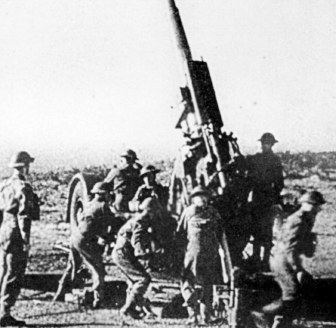
A Royal Marine anti-aircraft gun crew prepare for action.

22NZ Battalion’s Deployment.
The vital machine guns, despite their good positions had improvised tripods, no spare parts, improvised belts and it is not surprising that Colonel Andrews reported that stoppages were frequent. The 3.7-inch howitzers were well to the east of the battalion area but had an OP on the Hill 107 overlooking the Tavronitis river and ground to the west.
Andrews deployed his rifle companies to cover the aerodrome, river and coastline within his area (see map). The RAF and Fleet Air Arm ground crew and admin staff that remained were centred on the RAF Camp, which in terms of 22 NZ Battalion’s defence, was inconveniently placed:
There was another weakness: at the south-west corner of C Company’s position, where this company ended and D Company began near the steel and wood bridge crossing the Tavronitis River, the RAF had its tented camp. The camp and the large number of airmen about it made it impossible for 15 Platoon to tie up thoroughly with the northern platoon of D Company: one good defence line would have run straight through the officers’ mess – unthinkable!
The Germans eventually came straight through this weak spot, where the airmen ‘…occupied trenches covering the company holding the river bank and some were to come under my command as a reserve’. The report estimated about forty-three officers and airmen, out of three times that number, played an active part in the defence, the remainder being either unarmed, captured or killed early on.
Another almost criminal weakness in the defences was that ‘Mines were laid, but on strict orders from Creforce Headquarters were never primed because they might have blown up friendly Greeks’.
Due to the extent of the airfield area and the reduced strength of his battalion (520 men), Andrews’ reserve consisted of a single platoon from the centre company, made up to strength with batmen, HQ clerks and signallers ‘who were unable to maintain communication when the show started’.
German Plans – Gruppe West
The Luftlande Sturmregiment (LLSR), code named COMET, less two companies, was to seize the Maleme area. They were to land following an hour long strike by von Richthofen’s bombers and fighter bombers, designed to neutralise both the Commonwealth air and ground defences. Landing by glider or dropping by parachute, the LLSR would be delivered to company LZ/DZs, as was normal German practice, so as to be close to their objectives.
First to land at H-Hour (0814 hours) would be two I Battalion companies plus a platoon in gliders, who would destroy the two obvious anti-aircraft positions on the airfield to the east and west, while the 36-man assault platoon (Gruppe Brücke) would glide in and seize the Tavronitis Bridge. This latter commitment of a force to capture a bridge over a river that was by late May, reduced to a trickle, is symptomatic of the German lack of intelligence about Crete and its defences. The First Battalion would be followed by HQ LLSR (in gliders), II and III battalions in Ju 52s, who would jump into company DZs at H+15 and H+45 respectively and seize objectives respectively to the south and east of the airfield. IV/LLSR, the heavy weapons battalion would jump with GeneralmajorMeindl’s HQ to the west of the Tavronitis.

Generalmajor Meindl.
The Bombing
During the two weeks running up to the invasion, the Luftwaffe had established air superiority over Crete, driven the last RAF aircraft from their bases on the island and begun a programme of bombing targets that they had located along the entire north coast. Shipping in Souda Bay was a particular target. Colonel Andrews described the preliminary bombing:
For days before the 20th the enemy had regularly bombed and machinegunned the edges of the drome, the RAF Camp and our positions in the hills. He had stirred up the 3-inch AA guns. He had destroyed all planes on the ground but although we had casualties all weapons were working on the morning of the attack.
On X-Day, in their role as the Fallschirmjäger’s flying artillery, the Luftwaffe’s bombers had not only to neutralise the anti-aircraft guns but also soften up the New Zealand defenders before the LLSR’s aircraft appeared over the Maleme area.
For the defenders, who had mostly only received the vaguest of information, as far as permitted by the security rules for using ULTRA intelligence, the enemy were to be finally expected on 20 May. The day dawned, as usual bright and clear and as the first wave of aircraft came into the attack, General Freyberg in his HQ on the Akrotiri Peninsula grunted into his breakfast that ‘They are right on time’.
5 NZ Brigade recorded in their War Diary at 0610 hours, an event, which many thought to be the normal ‘daily hate’:
Heavy bombing attack on AA defences around airdrome. Three flights of five medium Dornier bombers dropped about 1000 bombs around the perimeter and 22 Bn ridge.
The planes turned back to the north and the men prepared to resume their disrupted breakfast but ‘again the air-raid siren sounded from the mysterious Air Ministry Experimental Station [the still secret radar] tucked away up in the hills’. For the infantrymen, however, the approach of the enemy air fleet was felt rather than seen. The New Zealanders could feel the growing throb of hundreds of aircraft through the ground. Just after 0800 hours, ‘Cursing men, still hungry, had just taken cover in trench and under trees when twenty-four heavy bombers appeared, the first of an endless fleet, wave upon wave, bombing, strafing, diving’.
One of the two Bofors anti-aircraft positions, manned by Royal Marines of the MNBDO, positioned in the open despite Colonel Andrews’ protestations to General Weston’s HQ, bore the brunt of the attack. Worse still, following a friendly fire incident when an RAF aircraft had been shot down by their own side, the Royal Marine gunners were ordered not to open fire without the authority of an officer and once the bombing began, no officer could reach the guns to order the crews to engage the enemy. Lieutenant Colonel Andrews recorded that:
From the commencement of the bombing no shot was fired by the 4 inch Naval guns or by the Bofors but the 3 inch [AA] guns remained at their post and were in action against aircraft until put out of action by dive bombers.

New Zealanders shelter from the bombing.
The anti-aircraft gunners of the four Bofors, who dared to open fire, were driven into cover by the overwhelming and relentless bombing and strafing attack. Squadron Leader Howell described the attack:
The ground shuddered like jelly under us. Our eyes and mouths were full of grit. We were shaken till our teeth felt loose and we could hardly see. Debris continued to crash around us and the sides of the trench crumbled. We lost track of time.
For the infantrymen of 22 NZ Battalion in the area surrounding Maleme, the bombing began to build in intensity from 0745, reaching a climax at 0806 hours.
Intense machine-gunning of area surrounding aerodrome. Any movement on ground drew intense fire from planes. Aerodrome perimeter was again heavily bombed raising dense clouds of dust, which completely obscured the aerodrome from view.

One of the Bofors’ positions at the eastern end of the airfield.
Lieutenant Colonel Andrews, in his HQ on the northern extremity of Hill 107, reported that ‘This bombing was most intense and the density and size of bombs made the artillery fire of the Somme 1916, Messines 1917 and Passchendaele a mere picnic. I do not wish to experience another one like it’. 22 NZ Battalion recorded that ‘men, dazed and numb with the fury of the assault, bled from ears and mouths’. It is estimated that the Luftwaffe dropped some 3,000 bombs around the airfield alone.
Colonel Andrews went on to report that the already poor communications were lost, with ‘… the lines being cut by bombs. One No 18 set to Brigade was functioning in a weak and erratic manner. The artillery FOO lost touch …’. Under this concentrated attack, the New Zealanders were isolated and driven into cover; consequently, few saw the aircraft bearing the Fallschirmjäger approaching Maleme.
The Glider Landings
The thirty DFS-230 gliders bearing 3 and 4 Kompanies I/LLSR, under the command of Oberleutnant von Plessen and Oberleutnant Sarrazin respectively, were at the head of the stream of Luftwaffe transports. They and Gruppe Brücke arrived early over the landing zones while the bombing was still under way, some time before 0815 hours. Consequently, the gliders swooping down from their release points at 5,000 feet, a mile to the west of the airfield, approaching from the south-west, found it difficult to identify their landing zones amidst the billowing clouds of dust and smoke, which was particularly bad to the east of the airfield. Gliding-in between the Stukas, the pilots sought out places to land.
Major Koch and his headquarters of I/LLSR were to land with 4 Kompanie in the area most badly affected by smoke and dust on the eastern perimeter but ended up scattered across the RAF Camp and the eastern slopes of Hill 107. Many of the gliders, as they hit the ground, were smashed against trees and rocks; their passengers badly injured. Even those Fallschirmjäger who had ‘good landings’, were stunned by the rapid deceleration of their DFS-230s. Three of the gliders that landed in the RAF Camp did so in front of Aircraftsman Comeau’s trench. Splintering to a halt the glider’s door opened and a Fallschirmjäger staggered out of the wreckage. Comeau recalled that he:
… fired and shot him almost at point blank range. He fell backwards onto a second glider trooper now standing behind him … The second man was holding his head in his hands. I fired again and he spun round and collapsed, his body blocking the doorway.

Major Koch, veteran of the Albert Canal operation in 1940.
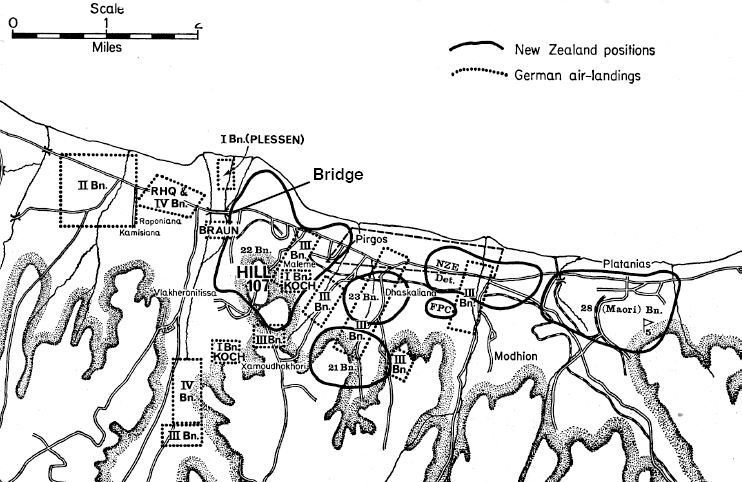
Comeau’s rifle jammed at this point and he headed uphill to what he thought was safety, through the rows of olive trees. Major Koch was also wounded in the neck in a similar engagement early in the battle. For the Germans, who had expected the airfield to be lightly held, the strength of the opposition from the dug-in New Zealanders was an unpleasant surprise. So heavy was the enemy’s fire and so badly scattered were the gliders that Oberleutnant Sarrazin and his surviving men were unable to concentrate into effective groups. However, Fallschirmjäger in a glider landing near the two medium machine-gun section on the northern slope of Hill 107 attacked the Vickers gun crews, who lacking small arms with which to defend themselves, were killed and their guns destroyed. This was a stroke of luck for the Germans and was to have a profound effect on subsequent events.
To the west of the airfield, von Plessen’s 3 Kompanie had a better and more concentrated landing, principally in the dry bed of the Tavronitis River. Here they had some cover despite landing virtually under the noses of C Company, 22 NZ Battalion. However, elements of D Company were able to bring fire down on the gliders from the slopes of Hill 107, as they rattled to a halt. The kompanie commander, von Plessen was killed along with other junior commanders, as they led their men, storming forward to attack the anti-aircraft guns on the western edge of the airfield near the mouth of the river. Command devolved on their medical officer and ardent Nazi, Dr Weinzl, who, with C Company still suffering from the numbing effect of the bombing, took the anti-aircraft position, in an attack that the gunners had no hope of being able to repel. They had no ammunition for their rifles!

Another view of the glider belonging to Gruppe Brücke.
See map map page 60
Gruppe Brücke’s six gliders with, as in the Eben Emael attack, the pick of the pilots, landed accurately in the river bed at the base of the iron bridge across the stony river bed. Taking possession of the bridge, they drove 18 Platoon of D Company who were charged with covering the eastern end of the bridge, back onto the lower slopes of Hill 107. Oberleutnant Braun was, however, killed by a shot to his head and the remainder of Gruppe Brücke were pinned down and eventually forced back to the cover of the river bank, as D Company recovered and brought down effective fire. Similarly, 3 Kompanie were unable to make any headway against the recovering New Zealanders of C Company, whose ‘15 Platoon, were awaiting a renewed assault on the most westerly tip of the highly prized airfield with rifles and nothing more lethal than … grenades made of jam tins filled with concrete and plugs of gelignite with fuses’.

Gliders on the banks of the Tavronitis River viewed from the bridge.

A glider belonging to Gruppe Brücke ended up on the bridge approach banking.
With most of the glider landed Fallschirmjäger scattered, Majors Braun and Koch and many of their junior commanders dead or wounded and their attacks having been halted, the LLSR’s initial assault had failed. Crucially, however, they had knocked out one of the anti-aircraft positions and a key element of Colonel Andrews’ fire power, two of his Vickers guns covering the airfield and its flanks. The slow moving transport aircraft should be able to approach without impossibly heavy casualties.
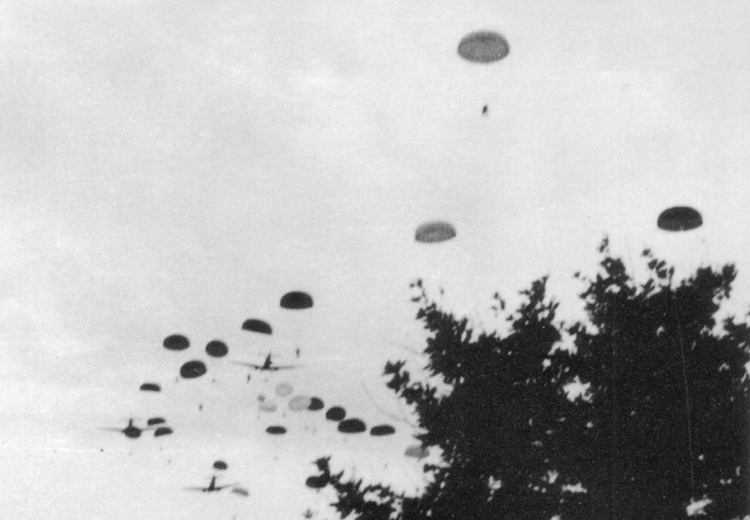
Drop of the LLSR at Maleme.

A pair of LLSR soldiers who dropped into an olive grove near Maleme.
The First Parachute Drop
The throb of aero engines grew to a roar as flights of Ju 52s, each carrying a stick of a dozen Fallschirmjäger and their equipment containers, started to arrive over the Maleme area around 0830 hours. 22 NZ Battalion’s Historian wrote:
The Luftwaffe crossed the coast a mile or more west of the airfield – out of effective Bofors range – and flew inland at about 500 feet. The two 3-inch anti-aircraft guns on Point 107 could not tackle effectively such low-flying aircraft. The planes turned towards Maleme in a broad swing, skimming low over A and B Companies. The slow troop-carriers do not seem to have been fired at by all of the ten Bofors round the airfield, an angry point with the infantry at the time and later.
However, with the departure of the last Stukas the leading Jus were met with increasing ground fire; some from the anti-aircraft guns and some from small-arms fire. Aircraft were hit and as the Fallschirmjäger dived from their aircraft in their spread eagle position, descending on parachute harness linked to a single point on the man’s back, many were hit, helpless as they drifted down. A prisoner, originally from Hamburg, belonging to II/LLSR told his interrogator that:
My parachute had scarcely opened when bullets began cracking past me from all directions. It had felt so splendid just before to jump in sunlight over such wonderful countryside, but my feelings suddenly changed. All I could do was to pull my head in and cover my face with my arms.

Paratroopers cut down shortly after landing; an all too familiar sight on the first day.
For the New Zealand Infantry, after enduring the bombing:
Action came as a relief – almost a grim joy – after cowering under cover for a fortnight of air raids, and the remark, ‘Just like the duck shooting season!’, was widespread at the time.
However, the New Zealanders did not have it all their own way. Amember of 22 Battalion recalled that the enemy, as they descended, fired pistols and Schmeisers ‘indiscriminately certainly, but keeping our heads down’.
First to jump were II/LLSR, starting at 0830 hours. However, the battalion dribbled in due to delays caused by dust on the Greek airfields disrupting take-off. Despite their DZs being to the west of the Tavronitis River, many Fallschirmjäger were mis-dropped to the east and consequently, suffered heavy casualties during their descent. This dispersal and the inevitable jump casualties caused by the rough ground did much to reduce the combat effectiveness of II Battalion. HQ 5 Brigade recorded in its War Diary ‘0914 Parachutists seen landing west of aerodrome and throughout southern part of our whole front’. With the last company down almost an hour after schedule, it would be some time before II/LLSR would be properly in action as a cordinated whole.
Those members of II/LLSR who dropped east of Hill 107 were immediately in battle, including some who were unlucky enough to drop in the area of the Field Punishment Centre, which was under command of 23 NZ Bn. The Battalion Provo Sergeant, Sergeant Hulme and the other members of the Field Punishment Centre were at first busy dealing with the Fallschirmjäger who were dropping in their area. Lieutenant Roach reported later in the morning that the Germans gave some trouble but ‘Sergeant Hulme got cracking – very aggressively. He stood in full view of any German and fired bursts into any suspected places and that closed up the odd burst of fire’. Sometimes alone and sometimes with another – for example, on two occasions he had Private Shatford with him – Hulme went out and dealt with enemy riflemen. Stalking them carefully, he almost invariably got his man. Roach’s report shows how much one determined infantryman could dominate an area when it says: ‘Hulme used to wander about a lot – from the camp to the road was all his country.’ Hulme himself claimed no special credit for the manner in which the Punishment Centre men cleaned up their area but 126 German dead were counted in that general area. Reporting in to 5 Brigade Headquarters on one occasion with some marked maps, Hulme was detailed by Brigadier Hargest to deal with a sniper, whom he stalked and shot.
Sergeant Hulme went on to be one of two New Zealanders to earn the Victoria Cross during the Cretan campaign, as we shall see.
The Second Parachute Drop
Next to jump, now badly delayed, was III/LLSR, principally dropping inland from Maleme and Pyrgi. 5 Brigade recorded their arrival at ‘0950 hours. Second wave commenced dropping’. There follow ‘Sitreps’ from all the battalions of the brigade reporting paratroopers landing in their area. 23 NZ Battalion reported ‘Approx 100 paratroops landing west and 100 in front of position’ and the NZ Engineer Detachment reported at ‘0957, 200 landing in our area’. As before, the drops were dispersed and those Fallschirmjäger who landed unwounded, found it hard to locate each other on the ground and were easily taken on by the defenders.
A note follows in the War Diary, ‘At this stage it was discovered that every seventh parachute was a container for arms and ammunition to which the descending troops must rally as they were only armed with a pistol’. Many of the colour coded containers, fell into Commonwealth hands. Weapons and ammunition in particular were taken into immediate use to make up for deficiencies in this area. The distinctive rapid fire of Spandaus could be heard across the battle area, adding to commanders’ confusion, as they expected to hear the slower rhythmic bursts of Bren-gun fire from their positions.
Oberfeldwebel Helmut Wenzel of 9 Kompanie III/LLSR, who dropped onto Hill 107 recounted:
I jumped first. At the very moment my parachute opened, I heard cracking in the air. Bullets! The English were welcoming us. I was exactly above them and I could see six Tommies standing up firing at me. ‘Dogs!’ I thought. ‘Wait till I land.’ I unfastened my thigh straps, which enabled me to get hold of my pistol. Just before I reached the ground I was hit in the chest. The bullet went in above my right shoulder and came out near the carotid artery. Braces, smock and binocular straps were severed, my Leica case also. I landed softly in a vineyard, not thirty metres from the English positions.
I fired my pistol at two Tommies who fell, the others dropped to the ground. That gave me time to get rid of my parachute completely. The enemy was now firing with a machine gun. I lay low in a little depression. My bag and my water bottle stuck out and were riddled with holes. Firing stopped because the Tommies thought I was dead. I crawled away from there. Where was my section? I had to get it together!

The chapel on the crest of Hill 107. The site of the 3-inch AA guns is just behind he chapel.
Wenzel had dropped onto the eastern side of Hill 107, which was held by A Company, as well as being the position of 22 NZ Battalion’s HQ and the 3-inch anti-aircraft guns on the crest. However, thickly covered with olives and vines and with plenty of other isolated groups of both glider and parachute-landed Fallschirmjäger, many Germans, such as Wenzel, were able to remain active, even if lightly armed. He continued his account:
Despairing, I got up and shouted –‘3rd section, here!’ A machine gun immediately fired at me, hitting me in the head. A better shot than at Eben Emael! It went through my helmet, tore my scalp and touched the bone of the skull. I forced myself not to lose consciousness. But my comrades had heard my shouts and four of them closed in on me … Glóneld did the dressing, and put muck on it to camouflage the white colour. Bullets were whistling all around us and one of them pierced my boot.
Then we attacked with grenades, and forced our opponents to withdraw. That way they would not be able to get near enough to discover how few paratroops they really were facing.
The worst thing for us was being unable to reach our weapon containers! One was nearby; we crawled towards it, but it turned out to contain only the battalion’s short wave radio equipment. It did, however, contain a rifle and a Schmeiser. That was something, for up to now we had been fighting with pistols and grenades.
Wenzel and his men spent most of the day lying–up in a defensive circle, in a bomb crater, within sight of the 3-inch anti-aircraft position on the crest of the hill, watching the guns back in action, successfully engage German aircraft after aircraft over the Maleme area. He recalled that during the day, ‘The heat was terrible and our clothes were too hot – a kingdom for a water bottle! We chewed vine leaves; they were a bit bitter but they did have moisture. But at no moment did we think of surrendering.’ He, like many others, went on to criticise the wisdom of sending troops into battle in equipment designed for use in the inclement weather of northern Europe. Rations too were unsuitable, melting into an unattractive gloop in the heat.
The Luftwaffe’s fighters, Stukas and bombers overhead were unable to provide much help to the Fallschirmjäger fighting the battle around the airfield and Hill 107. Wenzel recorded that ‘…friends and foe were too close together. Moreover, the enemy used our ground identification signs, flags and some of our weapons. In a short time, they already knew how to use it all. There was no coherent front line’. Nazi flags, found in possession of virtually every Fallschirmjäger prisoner, were indeed displayed by the New Zealanders, who found them to be effective protection against attack by enemy aircraft.
See map maps pages 60 and 66
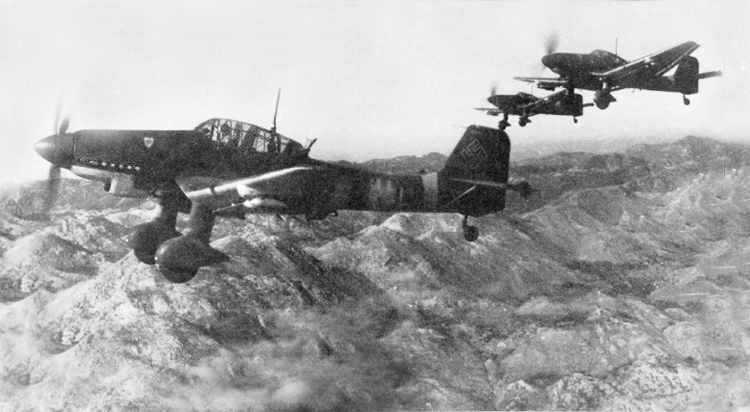
Ju-87 dive bombers worked hard to subdue the defences.

5 NZ Brigade’s area of operations
Meanwhile, a part of 11 Kompanie had been dropped on the coastal strip in Headquarters Company 22 NZ Battalion’s area to the west of Pyrgi, where Lieutenant Beaven and three officers and about sixty men, ‘mostly administrative staff not previously riflemen’ were positioned. Jim Henderson wrote:
It was at once cut off when several gliders silently swam down between it and Battalion Headquarters, followed by perhaps ten, perhaps twenty, plane-loads of parachutists, plus a small field gun. A second wave of parachutists fell about mid-morning. The invaders suffered severe losses, but the well-equipped survivors rallied to form awkward strongpoints in grape-vines and trees. These strongpoints made movement very difficult indeed.

German paratroopers troops pinned down in the Maleme area.
Contributing to the success was a section commanded by a Great War veteran, Sergeant Jack Pender, a New Zealand REME armourer attached to 22 Battalion. ‘Pender… had recently been mounting Browning machine guns out of aircraft… [and] his section had paratroops falling twenty-five yards along the front. Very few of them landed alive.’
Headquarter Company, however, lost an ad hoc platoon commanded by Sergeant Major Matheson, which was ‘out on a limb to the south’, where it was cut-off and overrun. Regimental Quartermaster Sergeant Woods, one of the few survivors recounted:
Over comes the Hun with Stukas, Junkers and gliders, not mentioning the 109s. By the time the Stukas and 109s had left us the air round about seemed to be alive with Junkers, and believe me the birds that flew out of them were pretty thick. They looked impossible as the odds must have been easily 15 to 1. Shooting was good until enemy grenades got the front trenches, Matheson received a mortal wound, and the platoon position fell.
Private Cowling had been on his way to the company cookhouse for fatigues but was about halfway there when the drops began. Occupying a slit trench, facing towards Matheson’s Platoon, he saw:
…quite a few paratroops in the area, they were all easy meat… the Transport Platoon were using machine guns. Boy, and weren’t they using them too! We later found out they were enemy stuff they had captured.
Actions such as this helped prevent the enemy from advancing west towards Pyrgi village. They were driven to cover in ‘small patches among the olives and tried to edge westwards along the coast to the focal point – the all-important airfield’. Headquarters Company continued to hold Pyrgi throughout the day with the help of some unlikely heroes:
Padre Hurst and a group of ‘cooks and bottle-washers’, manning a small defensive position and soon using up the few rounds of ammunition they possessed, were joined by Jack Pender, who … got a German field piece going and he cleaned up a machine-gun nest in a cottage – that was our greatest triumph.
Elsewhere, in 28 Maori Battalion’s area, Fallschirmjäger were seen at a house by the beach about half a mile west of D Company and Captain Tureia was ordered to send two Maori platoons from D Company to eject them. The battalion’s history recorded that:
By the time they had worked to within 500–600 yards of the objective they were closely attended by several planes circling and gunning as they came round, but the Maoris kept on with fire and movement as practised in England. Logan, on the left, swung his platoon in an arc and closed in. The Germans were in twos and threes around the house and, after seven or eight of their number had been killed, two officers and eight other ranks surrendered. The Maoris’ casualties were two slightly wounded, so besides being very gratified at the sight of their captives disliking the attention of their own aircraft, the men felt that a reasonable amount of revenge had been obtained for the men killed in Greece.
See map page 66
The drop on the coastal strip gave rise to accusations of atrocities perpetrated by Commonwealth troops. Not only had some Fallschirmjäger been hideously wounded in their uncontrolled descent by dropping into bamboo thickets but had also been caught up in trees and on power lines in this area. Caught in their parachute harness, many men already wounded bled to death, while others were hit attempting to struggle free. Later, the grotesque, blackened and bloated bodies, some repeatedly hit in exchanges of fire during the following days, were eventually seen ‘strung up’ as their comrades advanced east.
So far, the Fallschirmjäger’s drop into company DZs on or near their objectives had not helped the LLSR’s already poor situation. They had suffered very heavy casualties and were dispersed amongst the olive groves that cloaked the area. However, even though prisoners were being rounded up in quantity and groups of Fallschirmjäger were being destroyed, the effect on the Kiwis, was marked. There was no neat front line, the situation was confused and 22 NZ Battalion was unsupported and seemingly isolated. The shock of vertical envelopment, was having a profound impact on 5 NZ Brigade’s commanders. For the LLSR, however, things were about to improve a little.
Generalmajor Meindl Arrives
IV/LLSR had jumped into DZs to the west of the Tavronitis River and the Commonwealth defences and dropped out of contact with the enemy, along with Regimental HQ and Generalmajor Meindl. Having lost the Vickers section, the 4-inch naval guns could have been useful at this point but D Company’s request for fire ‘was rejected on the ground that the guns on Hill 107 were sited for targets at sea’. Rapidly appreciating that his plan had miscarried, Meindl set out at a brisk pace towards the Tavronitis Bridge to assess the situation, leaving the Fallschirmjäger of IV Battalionto follow on with their heavier support weapons. Meindl promptly ordered that the attack be renewed. The remains of 3 and 4 Kompanies would attack their previous objectives, the airfield and the RAF Camp, with the latter being supported by both fire and manpower from HauptmannGericke’s IV Battalion. Further south, 5 and 6 Kompanies of Major Stentzler’s II/LLSR were to advance into the rear of 22 NZ Battalion’s position via a break in the ridge between Hill 107 and the radar (AMES) site.
While the attack was being organised, there was discussion at the LLSR HQ beneath the abutments of the Tavronitis Bridge regarding the presence of significant elements of 4/LLSR in the area of the RAF Camp. Meindl attempting to get a response by waving a swastika flag was hit in the hand by a rifle bullet. Not badly wounded, Meindl stood up so as to be more easily seen and was promptly hit in the chest probably by a New Zealander of D Company. Badly wounded Meindl was taken to the Regimental Aid Post that had been established in Tavronitis Village. Thus, the LLSR lost a second senior commander within two hours. None the less, a dangerous situation was developing for the New Zealanders in the area of the RAF Camp, which though overlooked by 18 Platoon of D Company, was held by the mixed bag of airmen under Squadron Leader Howell, none of whom had been trained as infantry. AFleet Air Arm officer interviewed by the Inter Service Enquiry reported with unusual realism:
We didn’t know where our own people were; we didn’t know where the enemy were; many people had no rifles. Many people had rifles and no ammunition …if anyone fired at you, he might be (a) an enemy (b) a friend who thought you were an enemy (c) a friend or an enemy who didn’t know who the hell you were (d) someone not firing at you at all.

Generalmajor Meindl set up his HQ beneath the abutments of the Tavronitis Bridge.
Colonel Andrews, despite a situation that was unclear and with the sound of battle, some of it very close to his own HQ, and with a few formal reports of fighting reaching his command post, could not afford to be supine. He reported that he had initially turned down Captain Johnson’s request for reinforcements and the I Tanks to secure his C Company position but:
At approx 1030 hours, the enemy who had landed by the bridge and captured a number of RAF, forced my defences there and pushed up the ridge driving a number of captured airmen in front of them as a screen. This was dealt with, the airmen released and a counter-attack restored the situation down to the road. Again at approx. 1200 hours, the same tactics were used. The airmen were released and a number of enemy killed but the counter-attack was only partially successful. There was further shelling and bombing of the ridge but the positions were not attacked.
During this period the Germans established a vital toehold at the foot of Hill 107 and in the RAF Camp at a heavy cost in casualties. Resistance by small groups of airmen continued among the olive trees, bomb craters, huts and tents, as individuals and groups sniped at the enemy.
The Fallschirmjäger found a copy of the Commonwealth codes in the RAF operations centre, from which they were able to gain intelligence, providing them with their first accurate information about the strength and deployment of the force they had taken on. Squadron Leader Howell, realising the danger of losing these documents, was wounded as he attempted to infiltrate back into the camp area.
Meanwhile, away from the RAF Camp, many members of the parachute element of the LLSR were also fighting in small groups that only later developed into fighting units of more than nuisance value. Willi Maue of 6 Kompanie, II/LLSR was one such man:
After a rather long march, I came through a little group. I was among those who had escaped and we quickly formed up a group and went over to the attack. Quite a while later, towards midday we recovered the rest of our company in dribs and drabs. Then in the course of the afternoon, the rest of the battalion. Our group of seven men became a fairly strong combat unit which could still function in spite of its losses; we later came across the rest of the company. We were still in a defensive situation with several killed and wounded in our ranks, following very concentrated firing from the enemy artillery which was defending itself against our attacks in a remarkable way.
5 and 6 Kompanies had been ordered by Meindl to attack across the saddle at the southern end of Hill 107 but had been unable to advance across the Tavronitis River, having been pinned down by the platoon attached to 22 NZ Battalion to guard against just such a threat. Eventually, however, II/LLSR manoeuvred past the blocking platoon, growing in strength as it met up with groups like that of Willi Maue’s.
Late Morning and Afternoon
As the morning progressed the LLSR became better organised, although with so many commanders killed this was a slow process. The Fallschirmjäger maintained pressure on the New Zealand line opposite the Tavronitis and according to Colonel Andrews:
At approx. 1330 hours, C Company on the aerodrome carried out a local counter-attack in an endeavour to relieve one of their platoons [15, who were isolated] by the river bed but this was not successful.
The fact that German reinforcements had promptly arrived to decisively check the two C Company platoons, is indicative of increased capability at this stage in the battle. All the while enemy aircraft were overhead attacking anything or anybody in the open. Colonel Andrews commented, ‘… daylight movement of troops [including runners] was a most hazardous undertaking. Taken in conjunction with the lack of communications an enormous burden is imposed on … commanders’.
C Company, however, received a small but welcome reinforcement, when at:
About 2 p.m. a spirited lieutenant from an English light anti-aircraft battery led eight men (two ‘bomb happy’), survivors from his troop of Bofors guns by the south-east edge of the airfield, into Company Headquarters. They volunteered to join C Company as riflemen and were armed.
By mid afternoon the situation was deteriorating. At 1550, hours ‘22 Bn reported their left flank had given way but position was believed to be in hand’. This was II/LLSR (Strentzler) beginning to force their way across the saddle at the southern end of Hill 107. It would seem to have been an ideal counter-attack task for elements of 23 NZ Battalion who were nearby and specifically assigned the task. Brigadier Hargest’s inaction, even though this message is recorded in his brigade’s War Diary, is often excused due to ‘poor communications’. He did not implement the ‘immediate counterattack’ required in divisional orders or even his own orders. He did, however, agree to support a counter-attack on the western end of the airfield to be mounted at 1700 hours by Colonel Andrews. Captain Johnson recalled:
At 5 p.m. the long and eagerly awaited order to counter-attack with support of the two tanks arrived from Battalion Headquarters. I had discussed with the tank troop commander the day before just how we would work together. The troop commander, believing the Germans would have no anti-tank weapons capable of hurting a Matilda, feared nothing except enemy soldiers on top of his tanks. He asked that his tanks should be kept sprayed with small-arms fire.
Lieutenant Donald commanded the attackers on foot: 14 Platoon (about 12 below strength) was organised as two sections with a third section of [British and Australian anti-aircraft] gunner volunteers. The tanks left their concealed positions at 5.15 p.m. and moved west past Company Headquarters along the road towards the river in single file about 30 yards apart. The first tank proceeded up to the river, firing as it went, until it stopped in the riverbed.
The appearance of the I Tanks enabled C Company to cross the hitherto fire-swept airfield with hardly a single casualty but with the tanks halted on the bank of the dry river. Lieutenant Sinclair, platoon commander 15 Platoon, in his isolated position west of the airfield, saw the tank ‘go down under the big bridge and out a little further west where it came to a halt. The place was seething with enemy plainly visible in the long grass. They seemed uncertain what to do’.
There are various accounts how the tanks came to grief at this point in the battle. One version has it that the leading tank that went into the dry river bed broke down on the rough river bed. However, Captain Johnson wrote that ‘Apparently the turret jammed and the crew surrendered’. Lieutenant Sinclair has yet another version: that it was hit by an anti-tank shell in the engine and that ‘… the crew at pistol point, were forced to service the damaged part but instead ruined it permanently’. The Germans however, used the tank as a pill box and succeeded in getting the 2-pounder in action against D Company on Hill 107. Captain Johnson recalled:
The second tank turned about before reaching the bridge and came back past Company Headquarters on the Maleme road. It had not fired a shot and broke down. This left 14 Platoon under withering fire from the front and southern flank. Their position was hopeless. Those who were able withdrew, using the lee side of the tank for shelter. Donald, himself wounded, led only eight or nine men back, most of them wounded, from this brave but disastrous counter-attack. The English [antiaircraft gunner] officer was killed in this attack after pleading with me to let him take part and lead a section.
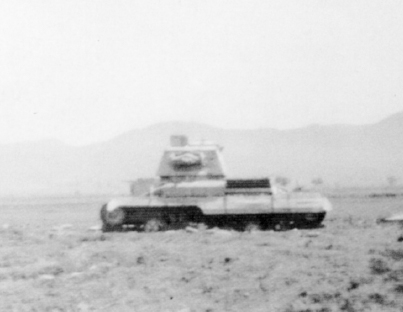
The second tank broken down in the airfield.
Captain Johnson sent a runner to Colonel Andrews’ HQ on Hill 107 with the disturbing news that the counter-attack had failed and that:
15 Platoon and the western section of 13 Platoon seemed to have been overcome; 14 Platoon was practically finished, and the cooks, stretcherbearers, and Company Headquarters staff alone could not hold the inland perimeter of the airfield for long. The company would probably hold out until dark, but reinforcements would be needed then. The CO replied in his last message to get through to Johnson on 20 May: ‘Hold on at all costs.’
With C Company having spent itself in under resourced counter-attack and II/LLSR slowly advancing into the Battalion’s area, things were beginning to look bleak for Colonel Andrews’ New Zealanders.
Student in Athens
If Colonel Andrews thought that the situation was slipping away from his control, the LLSR were reporting to Student that they had failed to capture the airfield. Earlier optimism and self deception born of unrealistic confidence, was replaced by a sense of crisis in Hotel Grande Bretagne, which only worsened as news came in from the other groups further east of a similar lack of success. The option of withdrawal was discussed but faced with a collapse of German airborne forces and loss of his reputation, Student, contrary to the principles of war, decide to reinforce what was arguably a failure at this point. He would concentrate on Maleme, where he perceived a glimmer of success, at the expense of the other groups, who would have to fend for themselves. Orders were given to reinforce Gruppe West with both convoys of light shipping and an ad hoc battalion of Fallschirmjäger who had been left out of battle because of a lack of lift. There was an ideal candidate for commander at hand, Oberst Ramcke, who had a reputation as a fighting soldier but had been excluded from active units as he was ‘too old’ – over forty. He had been brought to Greece only to train and advise 5th Gerbirgsjägerdivision in air portability but as the sole combat officer of the appropriate rank he was brought to Student’s HQ and briefed on the situation. He would jump with every available parachute-trained soldier the following morning.
Attempts to Land
With initial reports being interpreted as success, there early attempts to land Ju-52’s at Maleme had already been ordered. Some of those reported by the New Zealanders were no doubt forced landings by damaged aircraft. For example, 28 Maori Battalion reported at 1030 hours that:
One troop-carrying plane effected a landing on the beach opposite D Coy lines. It was immediately set on fire presumably by Bren gun fire. These enormous black troop-carrying planes are circling round and round the beach and above the aerodrome seeking landing places.
At 1500, 5 Brigade recorded that ’28 Bn OP reports that troop carrying aircraft had been landing on Maleme aerodrome in ones and twos since mid-day’. These were in fact mainly on the nearby beach but later in the day, C Company, at the western edge of the airfield, were well positioned to deal with what is almost certainly a deliberate attempt at landing on the aerodrome:
Late in the afternoon two Ju 52s attempted to land on the airfield, but the mauled company was by no means carrion yet. All weapons opened up and the planes, spitting back small-arms fire, swung out to sea.

There were also reports from the Kiwis’ OPs during the afternoon that the enemy were landing on the beach to the west of the Tavronitis but these remain unconfirmed. The airfield was clearly not captured and could not receive aircraft flying in heavy elements of 7th Fliegerdivision and 5th Gerbirgsjägerdivision. Also delayed by the presence of the Royal Navy in the Aegean was the convoy of Greek caique fishing boats bearing a battalion of Gerbirgsjägerregiment 100 and anti-aircraft guns. They were supposed to cross from the Greek mainland in daylight, under cover of the Luftwaffe, who would keep the Royal Navy away, and land to the west of Tavronitis during the afternoon of X-Day. They would not now arrive until the following afternoon at the earliest.
The Abandonment of Hill 107
As the evening wore on, the aggressive Fallschirmjäger maintained pressure from the west and groups that had hitherto been lying-up, started to move around the area and enemy activity levels climbed again. Although under renewed dive bombing, the Kiwi soldiers felt that they were undefeated. However, the sense of isolation from assistance and even encouragement and the pressure to react in a situation of uncertainty was getting to Colonel Andrews. Captain Twig wrote:
The OC and 2iC showed signs of strain during the day, and I put this down to lack of news and information concerning their own troops and the position in general. I am sure that the bombing or their personal safety did not concern these officers, but the responsibility was great.
See map map page 84

Commander of IV Battalion, Hauptmann Gericke giving orders for the next attack.
The Battalion’s historian offers another factor that was at work on morale in Battalion HQ: ‘The counter-attack by 23 Battalion, freely discussed before the invasion, was widely expected, and when it did not come, the feeling of bewilderment and isolation increased.’
At 1925 hours, in response to his situation report describing the failure of C Company’s latest attack and his plea for assistance, just two companies, one each from 23 and 28 Battalions, were belatedly dispatched to restore the situation around the airfield. They failed to reach C Company, as they had to brave not only dive bombing and strafing but short sharp fights with isolated groups of Fallschirmjäger that they encountered en route. According to 22 NZ Battalion’s historian:
… a company 114 strong from 28 (Maori) Battalion came confidently right to the eastern edge of the airfield and failed by a furlong or so to contact C Company. This would be bitter news to C Company men when they heard some days (or, in some cases, several years) later of the Maoris’ thrust. The company now believes the Maoris came to within but 200 yards of Company Headquarters and 14 Platoon, but halted by the knocked-out Bofors guns, and hearing only the shouts and tramplings of noisy German patrols, concluded that the airfield had fallen and pulled back.
This unlucky failure to join up with C Company on the airfield and for the 23 NZ Battalion company to have any impact on the situation around Hill 107 in the gathering darkness, further reinforced Andrews’ mood and helped make up his mind. It is hard not to conclude that this is one of those small events that could have tipped the balance of the entire campaign in the Commonwealth’s favour.
The situation for Colonel Andrews worsened as the Germans pushed up Hill 107 from the RAF Camp to threaten his HQ. In these circumstances, ‘At approx 2100 hrs, I [Andrews] decided to withdraw the remainder of the battalion to B Coy ridge’. Colonel Andrews elaborated on his decision to withdraw:
In my opinion the strength of the enemy in personnel, machine guns, mortar and SP infantry guns, as well as in the air was greater than one battalion could deal with in such a position. Even if the Brigade counterattack of two companies could have restored this position that night the place would have become untenable first thing in the morning. On my own, in spite of the excellent fighting qualities shown by the men and in spite of the heavy casualties inflicted, I could not have held on one hour after dawn. I would have been completely surrounded by then and the air attacks and shelling would have completed the work.
This withdrawal, typical of the paucity of communication between 22 NZ Battalion and HQ 5 NZ Brigade, was begun with Brigadier Hargest only receiving the barest of details to which he responded: ‘Well, if you must, you must.’
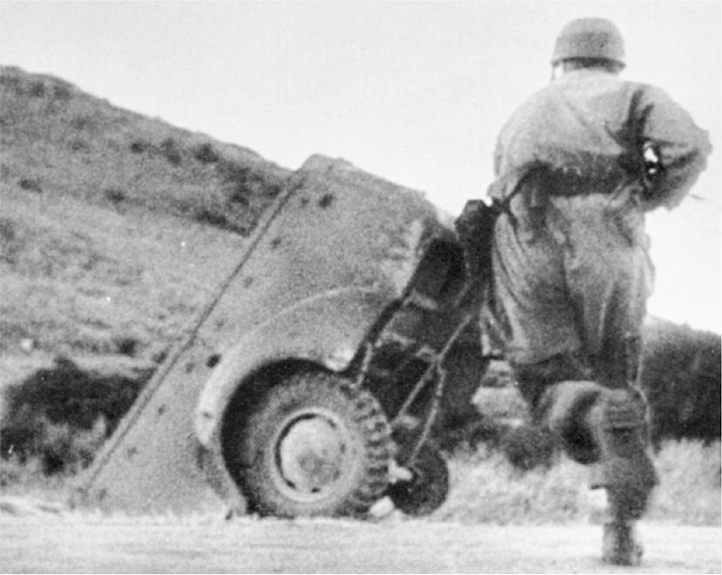
Running to take cover behind a wrecked RAF vehicle. Hill 107 can be seen behind the wreck.
Captain Johnson felt that the withdrawal from the fateful airfield was ‘a bitter reward for their day of steadfast defiance’.
A runner went to tell 13 Platoon and returned saying the place was bare. Every man removed his boots and hung them round his neck. Critically wounded men were made as comfortable as possible and left with food and water. The southern wire round 14 Platoon’s defences was cut and, in single file, the wounded interspersed here and there, they set off. One man was practically carried, stooped over the back of a friend; another crawled all the way to 21 Battalion on his hands and knees. No stretchers were available; the party could not have carried them in any case, for they had to be prepared to fight their way out. They went past the snoring Germans to the right, through the vineyards separating C Company from A Company, up to A Company’s deserted headquarters, on to the road, up the hill past a grounded and ghostly glider…
On reaching B Company Ridge, Colonel Andrews found that the enemy were already advancing around the flanks. He continued:
I may have been able to hold the back ridge that night but I would have been attacked from the left, front and rear in the morning and the holding of that ridge did not strengthen the position in row so I decided to withdraw to 21/23 Bn.

Captain Johnson led his men on ‘… until, after dawn, they reached a wood near 21 Battalion’s positions. As they fell dead-tired under the trees, German planes began the morning hate’. Andrews split and positioned the remains of the Aand C Companies he managed to extricate, with 21 and 23 Battalion. Left behind were elements of the battalion who could not be located in the dark.
On the morning of 21 May, D Company and some men of A Company were left in possession of Hill 107. The following comment sums up the view of many D Company Kiwis: ‘That night, 16 Platoon was sitting very snug and in control of the position, and in the early morning I was surprised when Tom Campbell contacted me and said we were moving out as we could not contact the rest of the Battalion.’

Hill 107 taken from the old Tavronitis Bridge. The new highway bridge is to the right of the picture.
Also left behind by the withdrawal, although they had heard the battalion passing in the night, was the Assault Pioneer Platoon under Captain Wadey on the AMES Ridge, guarding the radar site. They eventually received word that they should hold on at all costs as the Brigade was to counter-attack the airfield and Hill 107, to the immediate north, that night. Easier said than done! During the morning they tangled with passing groups of Germans. However, in the afternoon, Private Parker:
… in an outpost outside the wire, reported enemy flag-waving (ground to air communication), fired, and checked this activity, but soon the bombers turned to pound the mound, a concentrated target with the vehicles, the [radar] masts and the circle of bright new barbed wire.
Captain Wadey recalled:
We received what the battalion had had all the week … the whole hill was heaving in smoke and dust … one of the Stukas seemed to be going to drop right on us … this one carried a bomb, orange in colour, under the belly. I saw it leave the plane and dive for us and knew it was going to be close.

Student poring over reports and maps.

German casualties after a failed attack.
‘This was the end.’ The Assault Pioneer Platoon and the RAF detachment withdrew from the AMES ridge.
The Drop on Kastelli
Kastelli twelve miles to the west of Tavronitis, had been included in the list of places to be secured by the Fallschirmjäger of the LLSR on the morning of 20 May, as it offered a small port to the west of Hania where the amphibious force could land if necessary. Covering the rear of the division, as it advanced eastwards, was also an important consideration. Kastelli had been thought by the Germans not to be strongly held, if at all, but it was in fact garrisoned by 1st Greek Regiment. Leutnant Mürbe was tasked with a reinforced platoon of 6 Kompanie II/LLSR to:
…make a reconnaissance of Kastelli, to take on weak opposition and occupy the town. In the case of the town being heavily defended, we had orders to set ourselves up on a hill to the south of Kastelli and wait for the Regiment’s motorised units.
The arrival of the German aircraft, who circled the area three times before identifying their DZ, was greeted by an immediate mobilisation of not just the Greek soldiers but the local population as well. Old weapons dating back to the Metaxas period and the long Cretan knives were brought out of hiding and into the hands of men and women with a long history of resistance to invaders. Before the Fallschirmjäger had a chance to organise themselves, they were being hunted down in the olive groves. Leutnant Mürbe was amongst those killed. Eventually, these who rallied, according to Kurt Pauli, had been ‘decimated near the enemy lines after a short but fierce fight’, and took cover in a strongly built farmhouse on the main road. With heavy weapons set up, they held the Greeks and Cretans back. The New Zealand advisor to 1st Greek Regiment, Major Bedding, told the commander that the best way to deal with the Fallschirmjäger was to keep them contained until thirst, hunger and tiredness forced them to surrender. However, under pressure from the civilians, the Greeks decided to attack at 1330 hours. Despite heavy machine gun fire, the Greeks and Cretans charged the farmhouse, overwhelming the Germans with their sheer weight of numbers.
The resulting close quarter fight in the farmhouse was brutal and the killing was only just restrained by Major Bedding. The seventeen survivors, of whom four eventually died of their wounds, were taken by school bus to Kastelli bus station, as much for their own protection as for detention. Kurt Pauli complained:
On the way to town, our equipment and our valuables were taken from us. The civilians in particular mistreated us terribly, hit us and spat at us. Apart from one or two exceptions, the Greek and English soldiers behaved correctly.
We were locked in a little cell in the municipal prison. We were given bread, water and lemons.
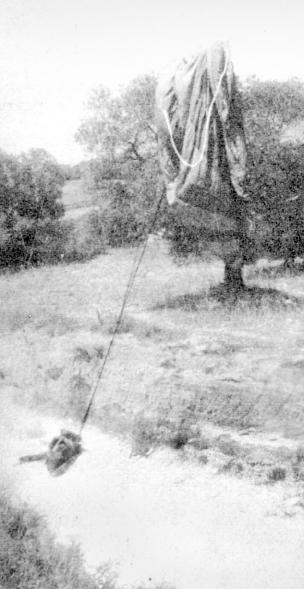
Fallschirmjäger killed during the drop.
This is the first and by no means the only example of Cretan heroism, which prompts the question, why was a formal Home Guard not formed? It would have exploited a source of effective man-power and given protection under the Geneva Convention to the local population who were fighting ferociously in defence of their own land.