

AS THE TWENTIETH CENTURY BEGAN, THE ASANTE PREPARED FOR war—or rebellion as the British always called it. They were surprisingly well organized, considering how unexpectedly the conflict had come. Guided by Opoku Mensa, their political leader, and Kofi Kofia, a vigorous young general, newly mobilized soldiers rapidly assembled outside Kumase where the first battles would have to be fought. Some few of the Asante troops had breech-loading rifles, for the most part older models such as Sniders, but almost all their men were still armed with antiquated flinlock muskets, and they were chronically short of shot and powder. Asante generals were fully aware that the British troops they had chosen to face would not only all be armed with the most modern rifles but also have machine guns, powerful, rapid-firing 75-mm cannon, and seemingly limitless supplies of ammunition.
In searching for a way to neutralize British firepower, Asante military leaders seized on the idea of the stockade, which had apparendy been explained to them by Mende travelers who knew of the use of stockades against the British in Sierra Leone in 1898. Despite inexperience with this kind of defensive structure, the Asante accomplished an astonishing engineering feat. There were only a dozen roads or paths that led out of Kumase through the dense jungle barrier that surrounded the city. If these paths were blocked, British reinforcements could not reach Kumase to relieve the British fort, nor could the forces in it hope to escape. In the space of only three weeks, the Asante managed to block all these roads with twenty-one massive log barricades. Using slave labor driven on by armed troops, the Asante cut thousands of huge logs and dragged them into place. Two six-foot-high walls of logs, lashed together with telegraph wire torn down from its route from Kumase to the coast, were filled in with five to six feet of densely packed dirt, stones, and smaller logs. Loopholes were cut to allow firing. Many of these stockades were built in zigzag patterns to allow cross-firing if the British troops were able to press their attacks close to these formidable barriers. These stockades were so monumental that they were impervious to the heaviest artillery fire the British guns could manage. What is more remarkable, these were not narrow structures that merely blocked a path, like the fallen trees that had been used to impede Wolseley’s advance. Several stockades were over four hundred yards long, and many others were nearly that extensive. The flanks of these stockades were also fortified and entrenched, so that even if British troops succeeded in cutting their way through the jungle to outflank the stockade, they would still encounter heavy fire from well-protected defenders.
Behind each stockade the Asante leaders built extensive war camps capable of housing many thousands of troops. These camps consisted of a thousand or more well-made huts equipped with bamboo beds, outside sitting areas, and some large structures with reinforced log roofs capable of withstanding anything but a direct hit from a 75-mm shell. The camps included large markets and supply areas well-provided with food and gin, the staple beverage of Asante campaigns.Most of the occupants of the camps were armed men, but there were some women and children, too, and traders came and went with supplies. As was the case in earlier Asante wars, sanitation was poor, but the comforts that these camps provided so amazed British officers when they later examined them that the Europeans wondered aloud why they were living in far less comfort.
In addition to the well-built Basel mission station that was now established in Kumase, the British had constructed a prison, a hospital, and large barracks for troops, but the key to their power in the city was the gleaming white fort that commanded the area. Its twelve-foot-high, loopholed stone walls enclosed a fifty-square-yard area that included various multistoried living quarters for residents, large storage rooms, a small hospital, sundry offices, a kitchen, and a well.Large, well-protected circular firing turrets for machine guns and cannon rose above the walls at each of the fort’s four corners. The turrets and the living quarters had roofs of red corrugated iron. The only entrance to the fort was a massive iron gate. The fort mounted four cannon and five machine guns that commanded the city, a nearby vegetable garden, and numerous sheds and houses.
While the Asante forces were building their stockades and war camps, Governor Hodgson was frantically telegraphing for reinforcements. The British government was sympathetic to his plight, but the British army was stretched to its limits by the expanding war against the Boers in South Africa and, most recently, by the need to send an expeditionary force to China to help quell the Boxer Rebellion. Even if the War Office had troops to spare, it was not comfortable about asking white soldiers to campaign during the rainy season in the Gold Coast. London had not forgotten that only sixty-eight of the four hundred men of the Royal West Yorkshire Regiment were fit for duty after Scott’s force returned to the coast five years earlier. However, British public opinion, which was already ill-tempered after the many reverses suffered in South Africa, would not tolerate a defeat in the Gold Coast. A victory was badly needed, and African troops led by British officers and noncommissioned officers would have to do the job. As orders came over the telegraph lines, troops began to muster in Accra to march north to Kumase, while others in the Northern Territories made ready to march south.Other troops from Sierra Leone to the west and Nigeria to the east began their march to the coast where ships were waiting to carry them to the Gold Coast.
For the Nigerian troops led by Captain Harold Biss and Captain Charles Melliss (soon to become a major and a recklessly courageous leader), the march included their first, and wildly exciting, ride in a railroad train. These men, who had never before even seen a train, next had their first sight of the sea as they were ferried aboard a modern steamship on their hurried way to Cape Coast. One of them saw an ice cube for the first time in his life. Fascinated by this strange object, he carefully wrapped it in a cloth and put it in his pack. When he returned with a friend to show off the mysterious object, he found that it had disappeared, and he was convinced that it had been stolen. It took a British officer some time to explain to him what had happened.1 These African soldiers were not only naive about ice and various aspects of European technology, they were young and inexperienced in the ways of modern warfare. They were so likely to fire wildly, wasting precious ammunition, that British officers chose not to issue them repeating magazine rifles, and many of their officers openly doubted that they would stand against the Asante.22 Wolseley had used the same concerns to insist on being sent British troops.
The first troops to reach Kumase were 107 Hausas who had marched down from the north, led by an ill-fated captain named Middlemist. Two other officers, named Marshall and Bishop, along with a doctor named Hay (who would prove to be exceptionally brave) accompanied them. They arrived on April 18 without meeting any opposition. The following day, on Hodgson’s orders, two columns of troops marched out of the fort to destroy abandoned war camps near Kumase without encountering any hostilities. The Asante leaders were still trying to avoid war. But five days later, when Hodgson repeated the order to punish the Asante, one hundred fifty men led by the recendy arrived Captain Marshall marched into a deadly ambush. Four men were killed and fifty-eight wounded, including Marshall, Bishop, and Dr. Hay. The column withdrew to the fort in disorder. All that night the Asante sang and drummed in celebration of their victory. Sleep was impossible in the fort, and Governor Hodgson spent the night sending telegrams requesting more reinforcements. They were the last telegrams to leave Kumase. By morning the line was cut. The construction of the stockades had been completed, and the Asante were ready for war.
The Asante did not intend to starve the British garrison out of the fort. Even though the fort was impregnable to Asante weapons, at ten o’clock on the morning of the next day, the twenty-fifth, the Asante attacked. Despite heavy fire from Hausas deployed outside the fort and from machine guns and artillery in the fort’s turrets, the Asante advanced steadily, taking the barracks and other European buildings as well as the Basel mission where they were delighted to find hundreds of bottles of wine. Thousands of African civilians fled toward the fort ahead of the Asante advance, and as some of the British troops withdrew into it, they made a panic-stricken charge to join them inside its walls. Captain Middlemist was so badly crushed against the fort’s iron door that he was critically injured, and it was only with the utmost effort that he was pulled inside and the door locked shut. The white missionaries, led by Friedrich Ramseyer and his wife, Rose, were admitted to the fort, but their African students and teachers were forced to remain outside where they huddled together, terrified and utterly disillusioned.3 There was not enough room inside for all of them, but all the same, it was not an attractive advertisement for the advantages of converting to Christianity. Machine guns and cannon from the fort stopped the Asante long enough to allow a cordon of Hausas to dig trenches and set up a perimeter defense around the refugees, who were now huddled under the protection of the fort’s guns. Among these forlorn people were several wives of one of the detained Asante kings. They lived in a green canvas tent and were visited only by their sovereign.
The light from the burning city, the wailing of terrified women and their children, and the triumphant shouts of the Asante troops made the night one that the besieged people in the fort would never forget.44 This night, as on most that would follow, the forts’ occupants were kept awake by the seemingly incessant drumming and shouting coming from the Asante war camps behind their stockades. Well fueled by gin, men in the various camps would shout challenges like these back and forth:
CAMP A [to Camp B] : “We are like the mighty bull that prowls about the forest; what are you?”
CAMP B [to Camp A]: “We also are as strong as that great bull.”
CAMP A: “Are you ready?”
CAMP B: “Yes, we are.”
CAMP A: “Then man your stockades.”5
Sounds of cheering men rushing to their positions followed, as one camp after another manned its position. At 5 A.M., when British buglers sounded reveille, the Asante still had enough energy to answer with loud soundings on their elephant-tusk horns.
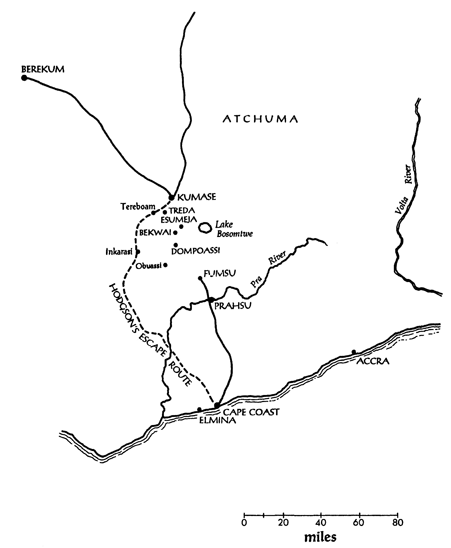
ASANTE BATTLE ZONE in 1900
During the afternoon of April 29, the trapped occupants of the fort listened expectantly to the sound of heavy fighting just beyond Kumase. As the light began to fail, they saw a column of troops straggle toward the fort. Led by Captain J. G.O. Aplin, 250 troops from Nigeria had arrived at Cape Coast on the nineteenth. Accompanied by carriers, they immediately began to march north through heavy rain along the same primitive road that Wolseley and Scott had followed. On the twenty-first they met Captain Davidson-Houston, the British resident at Kumase, who was on his way to the coast to pursue what was referred to as urgent private business. Davidson-Houston told Aplin that there was some unrest at Kumase but assured him that there was nothing to fear—a dubious assessment, considering that only a few months earlier Davidson-Houston had been so concerned about a possible uprising that he forced all the major chiefs to swear an oath of loyalty to the queen. As Aplin continued his difficult trek north, he met nonAsante traders fleeing to the south. These men told a different story. They assured him that there was a great deal to fear—indeed, that there would be war. Aplin’s first real evidence of Asante hostility came when his men encountered an injured British employee of the telegraph department who had been waylaid by the Asante. They had used pieces of telegraph wire to beat the soles of his feet bloody before leaving him. Davidson-Houston had assured this man, too, that there was nothing to fear.
Ignoring Davidson-Houston’s sanguine appraisal of the situation, Captain Aplin continued to press on as rapidly as he could along the rain-sloshed path, his men fording flooded rivers with great difficulty, making use of the bridges erected by Scott’s expedition. On the morning of what he thought would be his last day’s march of seventeen miles into Kumase, a sudden glare from unexpected sunlight saved Aplin’s life by causing him to tilt his helmet to shade his eyes. As he did, his helmet flew off his head, and he felt pain in his throat. An Asante sniper in a tree had fired a rifle shot that had nicked Aplin before it was deflected through his orderly’s calf and then into the ground. It signaled the start of a tremendous fusillade of Asante fire from both sides of the path. Thanks to heavy machine-gun and cannon fire, the Hausa soldiers were eventually able to move forward. After a spirited bayonet charge the Asante troops withdrew into the forest. It was only 2 P.M., but Kumase was still miles away, so Aplin decided to halt to tend to his twenty wounded men, including all six officers. Three men had been killed. As usual it rained that night, and the Asante did not attack.
It was nine the following morning before enough hammocks could be improvised to carry the wounded and Aplin could resume the march. The column crossed the Ordah Biver without opposition, but three miles from Kumase they once again came under such heavy fire that Aplin later said that if the Asante had not fired high, no one would have survived. Even so, there were many casualties and progress was very slow, until finally the troops saw looming ahead a large, horseshoe-shaped stockade blocking the only path through the jungle. Machine-gun and artillery fire had no effect on it, and a frontal bayonet charge only resulted in heavy casualties. After continual firing their machine gun overheated and jammed, and ammunition for their only cannon was exhausted. Just as a disastrous retreat seemed unavoidable, a small path was found that led through the jungle toward the flank of the stockade. When twenty-five bayonet-wielding Hausas unexpectedly charged around the end of the stockade, the startled Asante defenders fled, leaving the path to Kumase open. Abandoning their dead and their only artillery piece but carrying their wounded as well as they could, Aplin’s men dashed for Kumase before the Asante commander could rally his men. The defenders of the fort welcomed the bloody and grimy men, but they were privately horrified to learn that all six officers and 139 of the 250 men were wounded and that the column had lost its food, ammunition, and cannon. Aplin’s men had fought splendidly, but they could do nothing to relieve the garrison; and if the siege were a long one, the additional mouths to feed would be a burden.
In addition to the thirty Europeans now in the fort, there were hundreds of Hausa soldiers, many wounded men, and half a dozen Asante chiefs and kings, some of whom were being held against their will. To maintain morale as well as to search for food, the British launched a number of raids, including one at night. All were driven back with losses, even one in which the venerable Chief Kwatchie N’ketia sat calmly on his chair, both arms raised, as Asante bullets flew by. In his left hand he held a gold-hiked sword, while the two forefingers of his right hand were upheld as if in benediction. Since the firing lasted for three hours, the chief’s attendants had to hold his arms in place. Food was being rationed ever more tighdy, and many of the troops were feeling weak. To keep up their spirits, the fort’s garrison played “God Save the Queen” at full volume on their gramophone at night to counter the incessant singing and drumming of the Asante. The spirits of the men in the fort were never high, and they were dampened even more on May 6, when the popular Captain Middlemist died of internal injuries suffered when he was crushed against the fort’s gate.
On May 10, some of the ostensibly loyal Asante kings detained in the fort proposed peace talks with the “rebels,” as the British insisted on calling the Asante who had taken up arms. Hodgson agreed, and under a flag of truce, talks among the Asante factions began. The British had no reason for optimism. On April 14, before the stockades had been completed, the Asante leaders had presented five peace terms to Hodgson. In addition to demanding the restoration of slavery and the cessation of government demands for forced labor, they insisted that King Prempe be returned from exile and the British, along with all other foreigners, leave. Not surprisingly, these terms were not agreeable to the British. It is also no surprise that, now that the Asante held the upper hand, they did not lessen their demands. Nevertheless, Hodgson allowed the talks to continue because while the truce was in effect, the Asante commanders allowed women to sell food in the Kumase market, to the great relief of the hungry refugees outside the fort as well as the garrison.
On the afternoon of May 15, as the peace talks dragged on, 170 African soldiers and three British officers commanded by Major Morris marched into Kumase past a stockade that was undefended because of the truce. Despite terrific heat each day, rain each night, and several small battles (in one of which Morris had been painfully wounded in the groin) the column had covered 238 miles from the north in only thirteen days. Unlike Aplin’s, most of these men were unwounded, and they had with them a fair amount of food and ammunition. Their machine gun and cannon were welcome, too. They also had some ponies, which soon made good eating for the Hausas. Morris knew nothing about a truce, and Hodgson may have known nothing about Morris being on the march, although there were rumors that troops were on the way. Still, the timing of Morris’s arrival was suspicious, to say the least, and the Asante were furious. They abruptly canceled the truce and resumed the war.
On May 10, the same day the truce was proposed, forty-oneyear-old Colonel James Willcocks, second-in-command of the recently raised West African Frontier Force of northern Nigeria, received orders from London to take command of all the forces preparing to relieve Kumase. Willcocks was only three days away from the exhilarating prospect of launching an attack against a hostile emir in northern Nigeria, but pleased by the chance for his first independent command, he left immediately, pushing himself and his lame pony to their limits in a nightmarish walk and ride toward Lagos where he hoped to board a ship for the Gold Coast. Willcocks suffered acutely from bouts of temporary blindness and from severe gastric pain as a result of food poisoning, and he had badly blistered feet from walking and a sprained knee from a fall, yet he somehow reached Lagos only fourteen days later, a distance of over three hundred miles. Lucky to find a waiting ship, he limped ashore two days later at Cape Coast in a drenching rain. To his dismay he found no staff officers, no troops, no supplies, and no carriers.
During twenty-two years of army service fighting Britain’s batdes in India and Afghanistan, Willcocks had proven to be a distinguished and aggressive officer who adored action. But he had learned to be prudent, too, and he would not make the mistake of trying to relieve Kumase without adequate force. He was well aware that a premature attack with an inadequate force might inflate Asante morale so much that relief would prove impossible. He resigned himself to wait.Unfortunately, other officers already operating in the Gold Coast outside his command also had orders to relieve Kumase, and they were not at all cautious.
Captain Wynyard Montagu Hall, who had marched to Kumase as an officer with the West Yorks in 1896, had landed at the Cape Coast two days before Willcocks in command of 450 men of the West African Frontier Force from Nigeria. The Fante were so alarmed by the prospect of yet another Asante war that nothing Hall could do would induce them to carry relief supplies to Kumase. Disgusted, he loaded up his soldiers with ammunition and boxes of food and set off through the rain and mud toward Kumase. On the fifteenth of May, he reached the base camp at Prahsu where he found a cable from the colonial secretary in Accra, telling him that the fort’s garrison only had food enough to last to the end of the month and urging him to hurry. Hall wasted no time; pausing only long enough to sign a treaty of friendship with the king of Adansi, he arrived at Fomena on May 20. Fomena was the place where Wolseley had set up his supply base twenty-six years earlier and the principal city of the kingdom of Bekwai, whose King had so far reftised to join other Asante states in the war. The king urged Hall to occupy a town named Esumeja, a strategic hamlet on the main road just one day’s march from Kumase, and Hall did so on the twenty-second.
The next day he led two hundred of his men toward Kumase, but Queen Mother Yaa Asantewaa’s large and formidable army was encamped in his path at Kokofu, the site of one of Wolseley’s great batdes. Hall’s force was stopped in its tracks and was lucky to succeed in retreating before being surrounded. No sooner had Hall returned to Esumeja than the king of Adansi thought better of his pledge of unbounded loyalty and joined in the war against the British, leaving Hall with all he could do to keep the king of Bekwae out of the Asante alliance. Any idea of relieving the fort at Kumase had to be set aside. Hall was barely able to defend his hastily fortified camp at Esumeja.
The next attempt to move toward Kumase was made a few days later, in early June, when Lieutenant Colonel Carter, who had been camped near Hall with 380 men and several machine guns and cannon, tried to join Hall’s beleaguered force and together dash to Kumase. Before he could reach Hall, he was ambushed by a large Asante force. Though his men returned fire, the Asante fire was so heavy that all the officers went down, including Carter with a serious wound over his left eye. There was no lack of courage on the British side. A Lieutenant named Edwards was shot down while ramming shells into a cannon with his walking stick. One officer was shot through both wrists but continued to carry ammunition to his men by holding it between his forearms. Another officer went down while firing a machine gun that jammed. All the while Hausas were falling in alarming numbers.
After about two full hours of intense fighting, enough of the vegetation had been cut away that the British could finally see what they were up against. To their amazement they discovered that the Asante troops were firing at them through loopholes in a six-foothigh, six-foot-thick stockade that extended parallel to the road for about a quarter of a mile. It became immediately obvious that the Asante were completely protected against any fire the British could throw at them. The only unwounded senior officer, a colonel named Wilkinson, could see no hope of victory and tried to organize the battered British force for an orderly retreat. But while he was pondering how to manage this without having it turn into a rout, a Scottish colour sergeant named John Mackenzie, on detached duty from the Seaforth Highlanders, asked permission to lead a bayonet charge against the stockade with his company of Yoruba troops from Nigeria. The colonel reluctandy agreed, and one hundred men with fixed bayonets followed Mackenzie, charging direcriy at the stockade. Improbable as it may seem, before the Nigerians even reached the stockade, the Asantes abandoned it and ran. For this remarkable feat Mackenzie was awarded the Victoria Cross and was given a commission in the Black Watch.6 Although the Asante had gone, Wilkinson had too many wounded to continue the advance. He withdrew toward the relative safety of the camp at Prahsu. The first two battles went to the Asante.
When Willcocks was notified that Carter’s well-armed force of four hundred men had been driven back with nearly one hundred casualties and that Hall’s even larger force was besieged at Esumeja, he telegraphed London, asking for more soldiers, special-service officers, and supplies. While he waited for the troops and supplies to arrive, British forces in the Bekwai district continued to run into difficulties. Captain Wilson and 114 Nigerians were ordered to reinforce the survivors of Colonel Carter’s defeat. Wilson was killed in an Asante ambush, while twenty-five soldiers and sixteen carriers were wounded. Led by a British sergeant, the surviving troops fought their way through to Carter’s position only to find that he had left the village and his whereabouts were unknown. In great danger of encirclement, the small force somehow survived a thirtythree-mile march through the rain to safety. They left their wounded behind but loyally carried the dead body of Captain Wilson all the way. Six days later a Nigerian soldier crawled into camp. Despite nineteen wounds, some of which were serious, he had covered twenty miles by dragging himself through the jungle at night and hiding from Asante scouts during the day.7
While the isolated British columns that had gone up-country before Willcocks assumed effective command did their best to avoid annihilation and to keep the king of Bekwai out of the war, the situation in Kumase was growing desperate.Water was not a problem because the Asante chivalrously allowed parties from the fort, as well as the refugees outside of it, to go to and from a nearby stream without harm (the Asante later said that thirst was not a legitimate weapon of war).But by the end of May, the supply of food had dwindled alarmingly. Major Morris’s five ponies had long since been slaughtered, and the last of the four milk cows and all but one sheep in the fort had now been eaten. All birds, cats, snakes, lizards, and rats in Kumase had been eaten as well. The twenty-nine Europeans still in the fort were on a very limited ration of tinned beef and biscuit; the Hausas were on an even more limited diet, and the native carriers received nothing but biscuit. Morris’s men boiled their leather belts and sandals for hours to produce a horrid-tasting, pallid broth. They also chewed the softened leather.
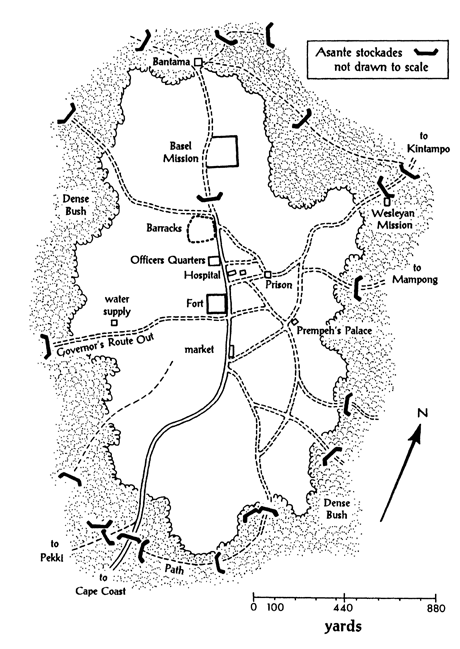
KUMASE, 1900
Most refugees ate nothing but leaves and grass, and many died in agony after eating poisonous roots.8 The British tried to maintain a small soup kitchen that gave children a cup of almost clear water, sometimes containing a trace of European table scraps. “Men walking along or sitting on the road outside the fort would suddenly fall forward dead, while others, wasted almost to skeletons, went mad….”9 Over a thousand refugees, including many carriers, surrendered to the Asante, preferring slavery to starvation. By early June the people outside the fort were dying at a rate of thirty to forty a day, and finding men with the strength to bury them all was not possible. Inside the fort there were endless rumors of relief columns being sighted, of cannon fire being heard, and of European troops in strength at Esumeja. All but the latter proved false. Large rewards were offered to anyone who succeeded in delivering a note (written in French to deceive the Asante) to the commander of the relief force. Several men volunteered, and one actually succeeded. But no word reached the trapped garrison.
By the fifteenth of June, Hodgson, Morris, and the surgeons calculated that their food supplies were so low that they could not delay an escape attempt beyond June 23. Various escape routes were considered but rejected because there were too many stockades to storm and too much hostile territory to pass through. They finally selected a small road through Patasi to Inkwanta. There was only one stockade to pass on this path, and the friendly king of Inkwanta was in the fort with guides. The escape plan called for all but a handful of the fort’s occupants to break out with just enough food and ammunition to get them safely to the coast. Enough food would be left with the skeleton garrison to sustain them for about three weeks. Those left behind were Captain Bishop, Lieutenant Ralph, and Doctor Hay (all of whom had been wounded earlier), 109 Hausas with their seventy-year-old Hausa officer Hari Zenua, and twenty-five carriers. Most of these men were sick, wounded, or both. All the other Europeans, including Lady Hodgson and the wives of three Swiss missionaries, would leave along with six hundred relatively healthy Hausas and some eight hundred carriers and followers of the detained chiefs and kings. As many of the civilian refugees as were able to travel were permitted to follow along after the rear guard. It would be a pitifully vulnerable force. With most of the machine guns and cannon left behind in the fort, it would boast only two Maxims, two cannon, and six hundred rifles to protect close to three thousand people.
The carriers were an obvious source of concern. They were so weak that their usual loads of sixty pounds or more were reduced to thirty pounds or less. Nonetheless, the European women and the wounded would also have to be carried from the start, and it was to be expected that there would be many more wounded during the attempted escape. Given the weakness of the carriers, it is remarkable that serious consideration was actually given to protecting the hammocks of the women with an inverted V-shaped cone of corrugated iron. The experiment was only shelved when it was demonstrated that bullets went through the roofing material like tissue paper. It is even more remarkable that Governor Hodgson felt obliged to take all of his personal possessions, including furniture, other household items, and clothing in addition to books and papers. In all, 106 carriers were required to carry them.10 Aside from Hodgson’s decidedly cavalier attitude toward the emaciated carriers, his decision to leave nothing of value in the fort could hardly have made those who were to remain behind feel terribly secure.
The preparations for a breakout could not be hidden, especially when the carriers were moved into the fort for their protection. But to retain as much surprise as possible, no one was told the date of the breakout or the path to be taken except Major Morris and Governor Hodgson. Morris intentionally let word get out that the column would leave by the Cape Coast route. The Asante fell for his deception, moving forces from the northern stockades to reinforce the men stationed along this road by means of a new road encircling Kumase that they had built to allow them to move troops easily.
At 4:30 A.M. on June 23, the escape column began to assemble outside the fort. It took longer to organize than anyone had expected, and instead of leaving at the predawn hour of five, it was nearly 7 and fully light when the rear guard of the column finally moved away. Before leaving, Governor Hodgson told the officers left behind, “Well, you have a supply of food for twenty-three days and are safe for that period, but we are going to die today.”11 One suspects a bit of disingenuousness on Hodgson’s part. If he truly believed what he said, it is odd that he would take Lady Hodgson and all of his possessions with him.
The advance guard was led by the young captains Armitage and Leggett. Friends since the fight at Bali, they would be the first to face death. In what Armitage called a “dense, clammy, white mist,” the advance guard moved quickly toward the Patasi stockade. Half an hour later they saw the huge barrier, and the Asante behind it saw them, opening fire immediately. With the rest of the column spread out over two miles to the rear, Armitage ordered a bayonet charge, but it was driven back with Leggett shot in the stomach. Armitage then decided to flank the stockade and led twenty men through the jungle, attempting to get around its left side. Seeing movement, his own Hausas promptly fired a volley at Armitage, nearly hitting him. He rushed back, ordered his men to kindly fire elsewhere, and, probably thinking it only wise, took most of them with him into the jungle.
In a deadly game that seems ludicrous only in retrospect, just as Armitage was creeping around the left flank of the stockade, the Asante commander was leading his men around the right, hoping to fire into the British troops from their flank. Armitage and his men got behind the stockade just before the Asante troops left it and poured a volley into their backs, sending them flying in disarray. The short exchange of fire cost four British dead and eleven wounded, including Leggett, who had to be carried back to the main body in great pain. Pushing on toward Patasi as rapidly as they could, the advance guard was ambushed, and Captain Marshall, who had replaced Leggett, received a severe head wound. The captured war camp behind the stockade and the villages along the Patasi path were so well stocked with food that the British officers, who were almost as hungry as the men were, had to pry the famished soldiers and carriers away from the plentiful supply of plantains, bananas, and other food they found. Somehow the column kept moving, although some men stayed behind and were killed by pursuing Asante soldiers.
Asante pursuit of the two-mile-long line of escape was delayed long enough by Captain Bishop’s gunners, who sprayed the forests and the ring road with shells, that when significant numbers of Asante troops caught up with the column, they first encountered the civilian refugees who trailed behind it. Caught between the British rear guard and the Asante, some of these pitiable people were able to shove their way past the Hausa soldiers to relative safety, but hundreds of others were caught and killed. Their headless bodies were found later all along the path and in the jungle on each side. As the panic spread, some of the carriers bolted. Among them were the men who were carrying the gray-bearded Reverend Ramseyer and his lame wife. Dumped roughly to the ground, the elderly couple sat serenely on the path, praying and awaiting their fate. It came in the form of the rear guard’s commander, Captain Aplin, who ordered other carriers to take them to the relative safety of the main column.12
By maintaining continuous fire as it withdrew, Captain Aplin’s rear guard managed to keep the Asante from overrunning the rear of the column, while the head of the column continued to keep up a rapid pace. By early afternoon Armitage reached the fortified village of Tereboam where Major Morris hoped to have the entire column spend the night. The small village was loopholed and heavily defended, but when the Hausas of the advance guard saw huge piles of plantains and bananas stacked around the huts in full view, the famished troops wasted no time in driving the defenders out at bayonet point. Then, while waiting for the rest of the column to come in, they gorged themselves so heavily that Armitage was afraid they would be unable to march the next day.
All along the line of march, soldiers, carriers, and refugees darted off into jungle clearings in search of food. Sometimes they found it in lush unharvested fields; sometimes they found death, instead, when groups of Asante soldiers shot them down. By mid-afternoon such heavy rain began to fall that the flintlocks of the Asante became useless, and the entire column safely crowded into Tereboam, which had no more than twenty huts for three thousand people. Although there was little danger of an Asante attack, thanks to the rain, the night was spent in dreadful discomfort. Armitage described what it was like:
Our loads lay out in utter confusion where they had been dumped down by the carriers, who came staggering in like drunken men. The Governor and Lady Hodgson sat upon boxes waiting for the tent which never came, and finally sought shelter in the wretched hut I had kept for them. The crush was so great that two huts filled with wounded collapsed from the pressure on the walls from without, and the occupants were with difficulty rescued. Fires had been lit everywhere, and from them arose suffocating volumes of smoke, as the damp wood spluttered and cracked. The many trampling feet had churned the ground into a sea of mud over ankle deep. And upon this steaming mass of humanity the torrential rain fell silently, pitilessly, as though determined to extinguish the wretched fires around which squatted shivering groups of natives.13
Despite the incessant rain, Asante drums thundered all night, and for all but a handful of people who managed to crowd into a hut, the night was spent standing or sitting in cold mud. Few had any sleep, and there was little food, but by 7A.M. the wretched column moved out to the south. The rear guard again fought a running battle all day, this time doing more to protect civilian refugees; but many more were killed nonetheless—how many will never be known. That night the column camped in a small village named Moseasu. Major Morris quickly ordered that guards be stationed all around the village to prevent any of the unarmed, starving civilians from crowding into the already packed area. These wretched souls spent the night in the forest, at the mercy of any armed Asante who wanted to take their lives.
Many of the starving carriers had thrown down their loads and staggered into the jungle or had collapsed along the path and died. Even under ordinary circumstances, carriers often collapsed. Always cold and wet during the night, most had dangerous bronchial infections, and their coughing was a constant accompaniment to camp life. They were underfed, cursed at by soldiers, shot at by the Asante, and largely ignored by the officers who recruited them and flogged them when they misbehaved. Now these starving men collapsed by the hundreds. Lady Hodgson wrote about one such man on the march out of Kumase:
Just as we emerged from the swamp, which, fortunately for us, was not at its worst, a poor carrier, with an ammunition box on his head, fell backwards from exhaustion, gave one gasp, and went to his long home. This was the beginning of many terrible things to happen that day. I shall never forget the sight of this unfortunate man lying on his back in a bed of rushes, his hands still clutching his load which lay up-tilted against his head.14
The pursuing Asante troops could not resist the temptation to examine the many supply boxes that now littered the path. Their inexperienced commander, Antoa Mensa, permitted them to loot, believing that his superiors would be pleased by the many valuables he dutifully returned to them. He also appears to have believed that since the British were in a great hurry to leave Kumase, there was little reason to risk heavy losses by exposing his men to their fire. His decision allowed the British to escape against all odds. His superiors rebuked him and fined him heavily.15
The second night was more painful to endure than the first. It was still pouring rain and was quite cold. Because so many loads had been lost, there was virtually no food, and nearly three thousand people were forced to spend the night in an area so small that it was only 120 yards in circumference. Governor Hodgson spent the night sitting in a camp chair; Lady Hodgson’s devoted carrier managed to find her a camp bed, which enabled her to sleep a little. Armitage was so exhausted that he slept on the floor of one of the huts, all of which had been reserved for Europeans. The next day there was little firing by the Asante, and by early afternoon the column reached the fort of the friendly village of Inkwanta, where they were welcomed by a British flag, much cheering, and ample food. To everyone’s surprise and alarm Hodgson promptly passed out, though he soon revived. Not everyone had died, as Hodgson had prophesied, but slim, handsome Captain Leggett and balding Captain Marshall both died of their wounds. No one would ever know how many of the carriers or the hapless civilians that followed the fleeing column had been killed, but their deaths were not important to the overjoyed public in England, where church bells tolled in gratitude. Only two officers and twenty-three soldiers had been killed, with only thirty-seven wounded and thirty-nine missing. That anyone escaped was remarkable; that so many did was amazing. But the British public did not realize that the fighting had just begun.
Not long after Captain Bishop ordered his men to fire the fort’s cannon in support of the fleeing column, he watched in disbelief as several score armed Asante walked casually toward the fort, obviously believing that it had been abandoned.Bishop waited until they were well within range before ordering his machine guns to open fire. The approaching Asante quickly scattered, leaving several dead on the ground. After that, the Asante kept their distance, and the terribly weakened garrison settled down to await the relief that Governor Hodgson had solemnly promised would arrive in five days at the latest.16 Hodgson clearly had no confidence in his prediction, and it is hardly to his credit that he said it. The first day after Hodgson’s escape, three men in the fort died. After five days passed, the feeble garrison admittedly lost heart; after ten days Bishop said that even he had given up all hope, although he continued to do what little he could to encourage the garrison.
Bishop’s Hausas were so sick and emaciated that he ordered them to sleep on the ramparts next to their loopholes, believing with good reason that if they were to sleep below they would be too weak to climb up to their posts should there be an attack. His soldiers were little more than skeletons covered with running sores. Each soldier received only a cup of linseed meal and a two-inch square of tinned meat as a daily ration. It is no surprise that one or two Hausas died each day. Smallpox also broke out among the starving men, and Dr. Hay had no choice but to have the infected men carried outside the fort where they were left to die. They lay next to some 150 refugees who had been too weak to join the escapecolumn and were slowly starving to death. There began to arise a stench of death so appalling that people in the fort were quite literally nauseated by it. Too weak to dig graves, the fort’s Hausas marched out each day to drag the night’s victims into one of the abandoned trenches. This action so little alleviated the smell of death that Dr. Hay, himself ill with malaria, and Captain Bishop decided to burn all the huts and bodies around the fort. As they did their horrible work, they found only one living person, a starving woman whose dead child was still held to her flaccid breast. What became of this tragic person is not recorded.
On June 1, Colonel Willcocks was delighted by the arrival of three hundred men of his own West African Frontier Force from Nigeria under the command of Major Charles Melliss, whose sword-wielding exploits at the head of his forces would soon make him famous. Willcocks was so pleased to see “their honest faces” and hear their welcoming salutations that he warmly shook their hands and sat down to listen to their tales of travel across what they called “the big, black sea.”17 On the fifth he led the men (figuratively, that is: his sprained knee was so painful he had to be carried) north on a seventy-one-mile march to the base camp at Prahsu. Despite terrible weather, they arrived there four days later to find the once grand camp now badly neglected and in need of repair. It was here that Willcocks learned that Captain Hall was still pinned down at Esumeja and that Colonel Carter’s force of eleven Europeans and 380 Hausas had been defeated near a scenically beautiful place called Dompoase with six killed and seven officers and eighty-six men wounded.
Willcocks immediately sent Melliss with a company of Nigerians to reinforce Carter at the fortified village of Fumasa. Melliss’s men had great difficulty crossing flooded rivers, and at one point Melliss had to dive in to save two Nigerian nonswimmers from drowning. He also saved Willcocks’s typewriter, which had fallen in as well. (When it dried out, the machine worked surprisingly well.)18 Once they managed to find a ford over a chest-deep river, Melliss’s men marched into an Asante ambush. Never one to be satisfied by exchanging fire with an unseen enemy, Melliss drew his sword and led his men in a wild bayonet charge into the jungle. The Asante fled, but Melliss’s boy bugler was killed and thirteen men were wounded, including a British sergeant. Melliss reached Carter without further trouble and delivered the badly needed ammunition his men had carried.
Reinforcements and supplies, now arriving at Cape Coast, began the long trek to Prahsu through torrents of rain that made the road a quagmire. On June 25 a colonel named Burroughs and a battalion of the West African Regiment from Sierra Leone passed through Prahsu on the way to reinforce Hall and hopefully keep the king of Bekwai and his large army on the side of the British. The Bekwai fighting men still wanted to join the Asante rebellion, and their king was only barely able to control them. When Burroughs first arrived at Cape Coast, he did not make a favorable impression. One of Willcocks’s staff officers described him as “an extraordinary little colonel called Burroughs who has gout and can’t wear a boot and has never been on [active] service in his life….” The same officer reported of Burroughs’s officers, “They also brought all their mess plate and many cases of champagne, all of which our transport officer left behind at Cape Coast by mistake.”19
To reach Hall, Burroughs had to drive the Asante out of Dompoase, the village where Carter had been so badly defeated. Arriving at nightfall in a pouring rain, Burroughs’s men caught the Asante troops with wet powder and easily drove them away, destroying their stockade and burning the village. Burroughs was able to join Hall without further opposition. Thanks to this victory, Willcocks on July 1 decided to move his newly arrived forces north of the Pra River. The next day he received what appeared to be authentic news of the governor’s escape, and on the fourth a telegraph message confirming the breakout came from the governor himself at Cape Coast. The telegram also reported that the fort could not be held beyond July 15. Willcocks promptly sent a telegram to the colonial secretary promising to relieve the fort by the fifteenth, and he moved north with all the force he had.
Burroughs’s orders were to tie down Queen Mother Yaa Asantewaa’s large army of Kokofu by consolidating Hall’s troops with his own at Esumeja; but the “gouty little colonel” had ideas of his own. Though Hall warned him that Yaa Asantewaa’s army held a strong position behind stockades, Burroughs, puffed up by his easy victory at Dompoase, decided to drive through Kokofu and relieve Kumase himself. The day before Willcock’s men marched north toward Kumase, Burroughs’s West African Regiment led the attack, with Hall’s men relegated to duties as a rear guard. After maneuvering his men through relatively open terrain on a broad front, Burroughs ordered them to advance. Protected by their stockades, the Asante troops poured tremendous fire from Dane guns and a considerable number of Sniders into Burroughs’s men, who began to go down. Burroughs himself was painfully wounded and his second-in-command killed. When Asante troops began to work their way around his flanks, the wounded colonel ordered a retreat. A panicky staff officer ran back to Hall, telling him that the attack was hopeless-and that Hall had been ordered to use his machine guns and 75-mm cannon to cover the retreat. He also apologized for the ignominy of it all but made it plain that there was no alternative.20
Hall’s rapid fire slowed the Asante soldiers who had come out from behind their stockades in pursuit, and after a hard fight the British force was able to withdraw to its fortified position at Esumeja. Happy to escape at all, Burroughs quickly decamped for the safety of Bekwai with his regiment and some eighty wounded men, leaving Hall to defend Esumeja. Hall’s men had barely taken up their former positions around the town when the queen mother’s troops launched an impetuous attack. They were shot down in large numbers but came on again and again against rifles and machine guns being fired by Hall’s men, who were protected by trenches and log barriers. Despite their losses, the Asante refused to break off the battle, and for the first time they continued to fire against Hall’s men well into the night before finally withdrawing to their stockades.
Willcocks was in Kwissa when he learned of Burroughs’s defeat on the morning of July 8. Furious that Burroughs had disobeyed his orders and disturbed by his defeat, he marched to Bekwai, arriving the next day. Even though Burroughs was wounded, Willcocks did not hesitate to berate him for making the attack and, once having made it, for not ordering a bayonet charge, which Willcocks was sure would have succeeded. Burroughs defended his actions, and Willcocks let the matter drop. He had to get his own force ready to continue the march on Kumase, and Yaa Asantewaa’s army at Kokofu stood across his path.
Willcocks would make the march with one thousand troops—seven hundred of his own men from the West African Frontier Force, two hundred men from the West African Regiment, fifty Sierra Leone Frontier Police, and fifty gunners to handle his six cannon and six machine guns. He also had about three thousand supply carriers, one thousand five hundred of whom had come all the way from East Africa by ship. The day after Willcocks arrived in Bekwai, a starving, exhausted Hausa soldier from the fort at Kumase crawled into Hall’s camp at Esumeja on his hands and knees. He took a crumpled, sweat-soaked piece of paper out of his loincloth. It read: “From O.C. [officer in command] Kumassi to O.C.troops Esumeja. His Excellency and main troops left for the coast seventeen days ago; relief most urgently wanted here. Remaining small garrison diminishing: disease, etc. Reduced rations for only a few days more.” 53 It was signed by Captain F. E. Bishop. The messenger was carried to Bekwai in a hammock where Willcocks promoted him to sergeant on the spot and gave him some money. Willcocks later regretted that he had not recommended the unnamed man for a Victoria Cross.21
Always concerned about the threat that Yaa Asantewaa’s army at Kokofu posed to him, the king of Bekwai urged Willcocks to attack her before moving on to Kumase. Willcocks agreed to do so; he even asked the king to send word to the Asante troops at Kokofu that Willcocks would attack them the next day. As soon as this threat was received, two thousand Asante troops left their stockades around Kumase, seventeen miles to the north, to reinforce Kokofu. On July 11, four hundred of Willcocks’s men moved out toward the Asante position, laboriously widening the road as they went as if in preparation for a larger force to follow. After several hours they withdrew. Willcocks explained to the king of Bekwai that this maneuver was simply a reconnaissance for the real attack, which would come soon enough. In fact, Willcocks only wanted to tie down the Asante troops at Kokofu. He had no intention of repeating Burroughs’s attack against them.
The twelfth of July was spent making preparations for a do-or-die dash to Kumase. To make the one thousand man fighting force more mobile, only one thousand seven hundred carriers would be taken, but these men would have to carry large amounts of ammunition in addition to the food and hospital supplies the starving garrison was waiting for. After a long day of checking weapons and packing loads, the carriers tried to sleep on the muddy ground as a steady drizzle fell.At the extraordinary hour of 2 A.M., Willcocks called for the king of Bekwai and explained that he would not attack Kokofu after all but would move directly on Kumase. The king angrily accused Willcocks of deceiving him, something the colonel freely owned up to, saying that in war a commander had to deceive even friends, an admission that the old king accepted with surprising good humor, especially considering the hour. Willcocks also meant to deceive the Asante, who did not know that a European gold miner named Behne, one of fifty who were working at nearby mines, had offered to lead Willcocks to Kumase on a little used path that bypassed Kokofu. By taking this path through the Bekwai village of Pekki, the column would not encounter any stockades until they were just outside Kumase.22
British-paid spies were sent to Kokofu to spread the word that the delayed British attack would begin on the morning of the thirteenth. Early that morning Willcocks sent a force toward Kokofu as a feint while the main body began its march through the jungle toward Pekki. The path was only barely passable at best, and the bare feet of the advance guard soon turned it into a quagmire for the rest of the troops and carriers. Several neck-deep rivers also had to be forded.Exhausted, the advance guard did not cover the fifteen miles to Pekki until after dark, and the rear guard was not settled in until 2 A.M. While his men were trickling in, Willcocks conferred with the chief of Pekki, who told him that a large force of Asante held the religious center of Treda, only two miles away across the Bekwae frontier into Kumase district.
As Willcocks was digesting the information that these men had many modern rifles, two terrified Asante prisoners were brought to him. Expecting to be killed, the men were clearly amazed when Willcocks told them they were free to return to Treda, where they should tell their commander that the British would camp the next day at Pekki, but if the Asante persisted in their rebellion, Willcocks would attack them the following day. Waiting until eight the following morning, to give the appearance of being true to his word and also to give his men a chance for some rest, Willcocks attacked Treda without warning, taking the Asante by surprise and driving them away after little resistance. Pausing only to burn the Asante village, including its temple, Willcocks’s men rapidly pressed on. In one small village they found a Hausa who had been captured when Hodgson’s column escaped from the fort. He was very hungry but had not been mistreated. In another village Willcocks himself found a two-year-old child all alone in a hut, shrieking in terror. He left some bread and a cup of tinned milk for the child, and the column again pressed on. Some days later, when Willcocks’s troops passed through the village again, the child was found dead in exactly the same place, the food untouched.23
That night was spent in the village of Ekwanta, five miles south of Kumase. Three rounds were fired from a 75-mm cannon in the hope that they would be heard in the fort, but they were not. At daybreak on the fifteenth, Willcocks’s last day to relieve the fort, the advance guard under Major Melliss set off for the fort. Soon after, the Asante fired on the long column from its left flank, and the Asante commander, who survived to be questioned after the war, then ordered an attack on the carriers, hoping to create panic and disrupt the march. He very nearly succeeded, but the rear guard’s machine guns finally drove the Asante back after the loss of many loads that the carriers dropped. During this action the rest of the column continued its march. Before Willcocks realized it, a gap a mile long had opened up between the main body and the rear guard fighting to save the carriers. At just this point in the battle, Asante reinforcements from Kokofii were hurrying north parallel to Willcocks’s column. Unaware that the huge gap in the British column existed, they attacked the rear guard and were driven off. Had they moved into the gap, Willcocks later wrote, they would have caused “much trouble, if no worse.”24 In fact, they might well have stopped the advance.
At 4:15 P.M. the advance guard reached the stockade that blocked the Pekki road. It was small, nothing like the huge stockades that had given the British such problems earlier, but the men who were behind it and hidden around it in the forest opened fire with everything they had. Willcocks called the roar “the best moment of my life” because it meant that he was engaged in the last great battle that would, he was sure, lead to the relief of the fort. The British gunners were ordered to fire as rapidly as possible at the stockade in order to keep the Asante busy while the infantry formed up on each side of the road along a front of about six hundred yards. Still uncertain whether his African soldiers would obey his order to charge, Willcocks hesitated, then ordered his massed buglers to sound cease-fire. His troops obeyed, and as their fire ceased, so did that of the Asante. After a moment of eerie silence, Willcocks ordered his buglers to sound the charge, and his troops instantly obeyed. Led by sword-waving British officers, Melliss in front as usual, they rushed forward with bayonets fixed. The charge was so infectious that all of Willcocks’s staff officers joined in, leaving the colonel alone with an African sergeant. Turning to this French-speaking man, Willcocks asked in all seriousness where his staff was. “Voila, c’est moi,” was the answer.25
As Willcocks had expected, only a few Asante stood against the bayonet charge. Asante officers tried to rally their men, but the flight could not be halted, and those Asante officers who fought back quickly fell to swords and bayonets. After Willcocks paused to examine the shattered Asante bodies that lay behind the stockade, he wrote that “it was impossible not to admire the gallantry of these savages, who could stand up against the modern guns and rifles”26 Willcocks also understood that without bayonets of their own and unable to reload their cumbersome Dane guns in time to defend themselves, the Asante soldiers, so brave in withstanding artillery and machine-gun fire, would have to yield to a bayonet charge. Captain Harold Biss was shocked by what he called the “very gruesome sight” of the dead Asante behind the stockade. “A shell from one of the guns had penetrated and done terrible execution, bespattering the timbers with blood and shreds of human flesh. Its defenders themselves presented a loathsome spectacle. A pile of mangled forms, some still breathing, lay in confusion, many having fallen across one another, some disembowelled, another with the whole face blown off—all variously mutilated. Limbs had been carried yards away into the bush beyond, and the ground was slippery with blood.”27
With dark coming on, Willcocks hurried his troops toward Kumase, but his men were so exhausted by their march and the excitement of the charge that he called a brief halt. One of his officers lay down in a pool of mud and water and instantly fell asleep. When Willcocks woke him a few minutes later to continue the advance, the man commented, “I don’t see much difference between this and other beds in Ashanti.”28 On the march again, they passed burned-out houses, litter of all sorts, and headless bodies, but everyone’s mind was on the fort. When it finally came into sight, the British flag was still flying, and at the sound of a bugle from the fort playing “general salute,” everyone began to run through the long grass, often stumbling over unburied bodies but cheering at the top of their lungs.
The garrison of the fort had known that relief was close at hand since 4:15, when they had heard the heavy firing close to Kumase. Captain Bishop opened fire with a machine gun to let the rescuers know the garrison was still alive, but no one with Willcocks heard it over the sounds of battle. The three Europeans in the fort then searched anxiously with their field glasses for the first sign of rescue. It came at 6 P.M., only shortly before dark. Incredibly, the first thing they saw was, not a conquering army, but Major Melliss’s fox terrier, who had somehow survived the entire campaign with the troops and was now dashing toward the fort. In those singular times it was so commonplace for British officers to take their dogs into battle with them that no one thought to record the terrier’s name. Not far behind the fox terrier came dozens of running British officers, their faces filthy under their white helmets, and many African soldiers wearing fezzes. When they heard the forts’s two buglers playing welcome, they ran even faster, cheering even louder.
Bishop and his feeble men tottered out of the fort, “cheering to the best of our ability.”29 Bishop ordered his emaciated Hausas to stand at attention, and these gallant men somehow managed to do so with great dignity, even as the rescuers threw their helmets in the air and gave three cheers for the queen. Willcocks, who had run ahead despite his bad knee, was so overcome with emotion that he could scarcely speak. He thought the Hausas seemed to be near death and the Europeans were gaunt and sallow-faced, but other British officers, while agreeing that the Hausas were terribly thin and covered with open sores, thought that the Europeans looked quite fit, in marked contrast to their own appearance, which one of Willcocks’s staff officers likened to “scarecrows.”30 They were indeed ragged soldiers, their boots falling apart, their uniforms in tatters. But before the men lay down for the first decent sleep they had had for three days, Captain Bishop opened his last bottle of champagne and shared it with his rescuers. Later, British cannon fired starshells, like giant fireworks, high above Kumase.